


Abstract
Construction safety has garnered extensive attention, among which the hoisting construction safety of prefabricated buildings constitutes a distinct concern warranting further focus, as it fundamentally differs from traditional cast-in situ construction. However, relevant studies remain relatively scarce, and there is a lack of research frameworks that enable the multi-dimensional comprehensive assessment of the significance of influencing factors. This study aims to comprehensively account for both the mechanisms of influence and the inherent importance of factors, thereby determining the significance of the influencing factors for hoisting construction safety in prefabricated buildings. Fifteen influencing factors were identified, and the fuzzy-DEMATEL and ANP methods were adopted, respectively to investigate the inter-factor mechanisms of influence and the systemic importance of these factors. This study finds that: at the level of the influence mechanism, factors such as workers’ behavior and construction process control play a core hub role in the system; management factors and external environments are the primary factors affecting workers’ behavior, and workers’ behavior tends to influence physical factors and construction site coordination; at the level of system importance, factor weights show a stepped distribution, among which management personnel competence is the most important factor; factors such as policies and regulations, as well as safety assurance plans, are also relatively significant. A comprehensive analysis of the two calculation results reveals that construction process control is the most critical factor, followed by workers’ behavior, the competence of management personnel, and construction operation coordination. Drawing on the functions of these factors, a series of recommendations was put forward, covering the aspects of safety resource allocation, safety training, and safety supervision. The present study facilitates a more comprehensive evaluation of the importance levels of each influencing factor and delivers practically accessible guidance for safety management in the hoisting operation of prefabricated buildings.
1. Introduction
The construction industry is widely recognized as a high-risk industry, characterized by numerous hazards and frequent safety accidents that impose substantial economic and social burdens [1,2,3]. Construction safety is critical to project success and the performance and prosperity of the construction industry, warranting significant attention [4,5]. However, construction sites typically involve numerous stakeholders, feature complex technical processes, and operate in dynamic environments, all of which contribute to high levels of risk and uncertainty, thereby posing considerable challenges to safety risk management [6,7]. Although construction safety issues have received considerable attention over an extended period, no significant effect on the reduction of safety accidents has been observed [1]. Therefore, it is crucial to identify the key safety risk factors, analyze the relationships among these factors, and clarify the roles that these factors play within the system.
Prefabricated buildings differ from traditional cast-in-place buildings in that building components and accessories are first prefabricated in factories, transported to the construction site, and then assembled via reliable connection methods [8]. Prefabricated construction offers advantages such as cost and time reduction, improved manufacturing quality and precision, and also serves as an effective means of carbon reduction in the construction industry. As a result, it has become an alternative to traditional cast-in-place construction in many countries [9,10]. The Chinese government has also endorsed the widespread adoption of prefabricated buildings [9]. While factory-based production of prefabricated components can reduce safety risks to a certain extent, safety risks during the construction process still cannot be overlooked due to its unique construction methods [11,12]. In China, construction safety accidents related to prefabricated buildings are relatively frequent, and there remains room for further improvement in the relevant management system [13].
Hoisting constitutes the most critical process in the construction of prefabricated buildings, characterized by heavy component weight, complex hoisting operations, the need for multi-trade collaboration, and involvement in high-altitude operations. Meanwhile, the operation process is highly susceptible to external environmental influences [14,15]. During the hoisting phase of prefabricated buildings, there exist numerous risk factors, making such types of safety accidents as falls and collisions involving machinery or components highly likely to occur. Furthermore, accidents occurring during hoisting account for a substantial proportion of all construction accidents related to prefabricated buildings [13,16]. Given the particularity of its construction technology and the complexity of associated risks, the weights and influence relationships of the risk factors pertaining to the hoisting of prefabricated buildings may differ from those of traditional cast-in-place construction projects, necessitating further scientific analysis [13].
Several existing studies have addressed the safety issues of hoisting construction for prefabricated buildings from different perspectives. On the one hand, advanced information technologies such as digital twins and the Internet of Things (IoT) are leveraged to support decision making in the safety management of prefabricated building hoisting [14,16]. On the other hand, tools including Bayesian networks and the Two Additive Choquet Integral are adopted to conduct analyses from the perspectives of risk probability or risk evolution [13,15,17]. In addition, studies analyze relationships among influencing factors using structural equation modeling (SEM) [18]. These perspectives undoubtedly make valuable contributions, yet there are inevitably some aspects that require further refinement. First, the primary focus of technology application-oriented studies is not to conduct an in-depth analysis of the importance of influencing factors, whereas practical construction requires easy-to-understand results regarding the importance of factors to guide on-site practices. Second, concepts such as risk probability and influence paths are not entirely equivalent to the actual importance of factors, and such perspectives may lead to the overestimation or underestimation of factor importance. Therefore, it is necessary to conduct a more systematic and comprehensive analysis of the factors.
Identifying key influencing factors, exploring the significance level of these factors, and investigating the relationships among them constitute a crucial foundation for the implementation of construction safety management. Although artificial intelligence (AI) algorithms have rapidly advanced and been applied to auxiliary decision making in construction management in recent years, their input parameters generally still rely on an accurate definition by researchers rather than being automatically generated by the models themselves [19,20,21]. Therefore, the identification of key factors and the exploration of inter-factor relationships remain indispensable. The purpose of this paper is to analyze the key factors influencing hoisting safety in prefabricated buildings and the inter-factor relationships among these factors. The factor interaction mechanism of construction safety is highly complex, and numerous methods—such as Interpretive Structural Modeling (ISM), structural equation modeling (SEM), Analytic Network Process (ANP), and complex networks—are well-suited for the analysis of such complex systems [16,22]. Among these methods, the Decision-Making Trial and Evaluation Laboratory (DEMATEL) is a decision-making approach based on pairwise comparisons and expert opinions, which is suitable for analyzing the interdependencies among risks and revealing how different risks interact with one another [23,24,25]. Given that the fuzziness of the real world is difficult to evaluate using precise numerical values, the integration of fuzzy logic into DEMATEL facilitates more robust decision making [26]. ANP is a multi-criteria decision-making model that derives factor weights while accounting for interdependencies and feedback among elements, and has been successfully applied in the existing literature [27,28]. This study integrates the fuzzy-DEMATEL and ANP methods to investigate the influence relationships and weights of factors affecting hoisting safety in prefabricated construction.
Based on this, this study comprehensively considers the inter-influencing relationships among factors, as well as the importance of the roles of relevant factors within the system, and focuses primarily on the following issues: (1) What is the strength of the connection between each factor and other factors, and which factors have extensive connections with others and can play a core hub role? (2) Which factors tend to influence other factors, and which factors are more likely to be influenced? (3) Which factors exert a significant dominant impact on the safety of prefabricated hoisting construction? (4) Considering the interconnections among factors as well as their dominance within the system in a comprehensive manner, what is the level of importance of each factor?
The remainder of this paper is organized as follows: Section 2 includes a literature review to further clarify the research logic and innovations of the study; Section 3 elaborates on the logical application of the methodology; Section 4 performs data analysis to reveal the influence relationships among factors and the weights of each factor; Section 5 carries out a comparative analysis of the data results and presents relevant discussions; and the final section summarizes the research findings of this paper and provides corresponding strategies.
2. Literature Review
2.1. Prefabricated Construction Management
Prefabricated buildings have long been recognized for their numerous advantages. However, new problems have emerged accordingly due to differences in their construction methods, attracting considerable attention; these include supply chain management, construction scheduling, and cost control, among others. The supply chain is crucial to the successful delivery of prefabricated construction projects: Luo et al. (2020) [29] examined prefabricated building projects in Hong Kong, China, collecting supply chain information on prefabricated components to identify critical issues and their root causes, thereby contributing to enhanced supply chain performance in prefabricated construction projects. Wang et al. (2022) [30] analyzed the impact of uncertain factors on the supply chain risks of prefabricated buildings, aiming to investigate the formation paths of such risks. Lin et al. (2024) [31] identified the factors influencing the supply chain resilience of prefabricated buildings, explored the interrelationships among these factors, and conducted a sensitivity analysis. Owing to their unique construction methods, the construction schedule also constitutes a critical issue for prefabricated buildings: Luo et al. (2025) [32] identified the key schedule risk factors of prefabricated buildings and explored in detail the complex interrelationships among these factors; Wang et al. (2023) [33] considered uncertainties in the construction process of prefabricated buildings, developed an optimized algorithm for project scheduling, and verified the performance of the algorithm in practical projects. High costs are detrimental to the development of prefabricated buildings: Lou & Guo (2020) [34] identified the factors influencing costs, constructed a causal relationship model, and identified key cost drivers through simulation; Luo et al. (2022) [35] explored the relationships between relevant influencing factors, their dynamic interactions, and the costs of prefabricated buildings.
It is therefore evident that numerous factors in prefabricated construction differ substantially from those in conventional cast-in situ projects. Given that construction engineering constitutes a complex systems engineering endeavor with tightly interconnected factors and intricate interrelationships, safety concerns typically undergo corresponding transformations relative to traditional cast-in-place construction. Numerous scholars have focused on the safety issues in the construction of prefabricated buildings. Liu et al. (2018) [36] identified the key factors influencing the safety of prefabricated buildings; constructed an evaluation index system; assessed the safety performance of prefabricated construction by means of the AHP, entropy weight method, and cloud model; and verified the applicability of the assessment method through a case study. Xiong et al. (2024) [37] established an index system for the safety performance of prefabricated buildings and used the DEMATEL and NK models to evaluate safety performance and explore improvement paths. Liu et al. (2025) [38] incorporated the dimension of occupational health into the safety management of prefabricated buildings, constructed an index system by combining literature analysis and expert opinions, and subsequently elaborated on the methods for calculating indicator weights and evaluating the level of occupational health and safety management in such buildings. Zhang et al. (2023) [39] considered the bounded rationality of government regulatory authorities and contractors, as well as the information asymmetry between them, and established an evolutionary game model of dynamic supervision to explore their strategic behaviors. With the continuous advancement of technology, the safety management of prefabricated construction has also exhibited a certain degree of intelligentization: Wang et al. (2025) [40] proposed a real-time monitoring method for the cognitive fatigue level of tower crane operators in prefabricated buildings based on a new type of portable semi-dry electrodes; Liao et al. (2025) [11], aiming to avoid as much as possible the safety risks caused by construction workers’ lack of familiarity with prefabricated construction, developed an innovative question-and-answer system with the aid of large language models to provide real-time safety knowledge consultation.
2.2. Factors Influencing Construction Safety
The identification and analysis of factors influencing construction safety provide a scientific basis for construction safety management. In academic research, safety-influencing factors typically serve as prerequisites for safety assessment, and even the application of intelligent algorithms requires the preliminary clarification of these factors or indicators. The identification of construction safety-influencing factors, their degree of importance, and the influence relationships among them are issues requiring long-term research and continuous refinement.
Numerous scholars have contributed to the investigation of factors related to construction safety. Bavafa et al. (2018) [41], taking construction projects in Kuala Lumpur, Malaysia, as a case study, identified eleven factors affecting safety planning, evaluated the causal relationships among these factors, and discovered five critical factors. Kim et al. (2021) [42] considered fire safety as an important component of construction safety, identified key factors influencing fire safety on construction sites, and quantified the mechanisms of influence among factors. However, as construction projects are highly diverse with unique safety risk characteristics, safety factors for specific project types have received considerable attention: Lin et al. (2021) [22] investigated safety-influencing factors in high-speed railway station construction and quantified the mechanisms of influence among them; Xu et al. (2024) [43] identified factors affecting bridge erection machine construction safety through literature synthesis and field investigation, analyzing both their impacts on construction safety and the interrelationships among these factors. Liu et al. (2024) [44] focused on the complex internal and external environments of large-scale projects, constructing an indicator system for construction safety-influencing factors from a resilience governance perspective; Guo et al. (2025) [45], considering the particularities of undersea tunnel construction, proposed a characteristic indicator of “overburden thickness/overlying seawater depth (RSR)” and established a risk assessment method for undersea tunnel collapse. Moreover, specific influencing factors have increasingly been investigated in greater depth. For instance, at the behavioral decision-making level of construction workers or stakeholders, He et al. (2024) [46] highlighted the significant role of workers’ safety behavior in enhancing construction safety and explored its relationship with multi-level, interrelated organizational, personal, and psychological factors; Ning et al. (2022) [47] examined the interactive decision-making patterns between government and construction enterprises from a game theory perspective.
2.3. Prefabricated Building Hoisting Safety
Hoisting constitutes a critical link in the safety management of prefabricated buildings. The hoisting process of prefabricated buildings is complex and prone to safety accidents, and this issue has been investigated from multiple perspectives. Wan et al. (2022) [13] summarized and classified the safety risk factors of hoisting, analyzed the evolutionary mechanism of correlations among multiple systems and risks based on multiple correlation analysis, and thereby explored the risk probability of hoisting construction for prefabricated buildings. Wang et al. (2022) [15] conducted a safety evaluation of hoisting for prefabricated buildings based on an improved Human Factors Analysis and Classification System (HFACS) framework and Bayesian networks and adopted an improved similarity aggregation method to better process data and enhance reliability. Song et al. (2022) [18] used accident data, questionnaire data, and the improved HFACS to summarize risk factors in the hoisting process of prefabricated buildings and adopted the Structural Equation Model (SEM) to explore the action paths of safety risk factors. Pan et al. (2021) [17] applied the systems-theoretic process to identify unsafe control actions and their causal factors, utilized Bayesian networks to analyze the state probabilities and influencing factors of safety risks, and made contributions to the assessment of safety risk states and the identification of risk factors. Liu et al. (2022) [14] considered the real-time information interaction mechanism of safety risks, and by means of Bayesian networks and digital twin technology, achieved the visualization of the decision-making and analysis process for safety risk control. Liu et al. (2021) [16] proposed a safety risk management framework for the hoisting of prefabricated construction based on multiple technologies such as digital twins, Building Information Modeling (BIM), and the Internet of Things (IoT), to realize real-time perception of multi-source information and virtual-reality interaction.
Although hoisting constitutes a critical and high-risk phase in the construction of prefabricated buildings, research on the hoisting safety of prefabricated construction remains limited to date. As shown in Table 1, existing research can be broadly categorized into the following types: first, safety risk assessment from a probabilistic perspective, where Bayesian networks are a commonly adopted method, providing a highly valuable perspective for research on hoisting construction safety. However, given the complex interrelationships among factors in the construction process, processes such as model parameter determination and uncertainty handling pose significant challenges. Additionally, there are certain limitations in translating model results into actionable strategies. Second, there is research on influencing factors and their action paths, where the Structural Equation Model (SEM) has been adopted to investigate this issue. It is indeed a valuable tool for exploring the influence relationships among factors, but it usually requires a large volume of data to support model calculations. Both securing a sufficient number of professionals in the field of prefabricated building hoisting construction safety and verifying the quality of data pose significant challenges. Third, there is research on implementing visual management of hoisting safety by means of intelligent technologies. Advancements in technology are highly beneficial for improving the efficiency and performance of safety management. However, current technologies cannot yet fully replace human decision-making. Thus, it remains highly necessary to identify the key influencing factors of prefabricated building hoisting safety and the influence relationships among these factors—a requirement for both managers and frontline operators.

Table 1.
Research status of hoisting safety for prefabricated buildings.
In summary, due to the particularity of hoisting construction for prefabricated buildings, in-depth research into safety management is imperative. It is crucial to identify the key influencing factors and to explore the relationships among them; there remains room for further refinement in existing research. This study first systematically identifies the factors influencing hoisting operation safety in prefabricated construction based on previous research. Second, fuzzy-DEMATEL is employed to investigate the causal relationships among these factors. Such an approach does not require extensive data and facilitates data quality verification, which is critical to research validity. Moreover, fuzzy numbers can effectively handle uncertainty and reduce subjectivity. Subsequently, the comprehensive influence matrix is employed as the unweighted supermatrix for ANP to calculate factor weights. The main contributions of this study are threefold: (1) Based on the characteristics of prefabricated construction hoisting operations, influencing factors are systematically identified in a targeted manner, and both factor weights and causal relationships among factors are explored. (2) Through rational methodological integration, both causal logic among factors and factor weights are comprehensively considered, rendering the analysis more aligned with the complex context of safety factor interactions in prefabricated construction hoisting. (3) The computational process exhibits strong interpretability, and the results facilitate translation into implementable strategies.
3. Materials and Methods
3.1. Identification of Risk Factors in Prefabricated Building Hoisting
This study adopted the Web of Science Core Collection, with the search criteria of “Topic: Prefabricated Building*Hoisting” AND “Topic: safety”, yielding a total of 9 relevant studies. After screening, literature that did not take the hoisting process as the primary research objective or did not explicitly target construction safety during the hoisting process, as well as those that only focused on workers’ behaviors rather than the safety-influencing factors in the hoisting process, were excluded from the reference for factor induction in this section. A final set of six studies was thus obtained.
Various studies have adopted different approaches to classifying and defining hoisting safety factors. For example, Liu et al. [14] categorized relevant factors into personnel factors, equipment factors, component factors, management factors, and environmental factors; Pan et al. [17], through systematic analysis, summarized the safety risk factors for prefabricated construction hoisting into five categories: hoisting operation errors, hoisting machinery failures, hoisting connection failures, management deficiencies, and environmental interference; Song et al. [18] summarized hoisting safety factors into categories such as external environment, organizational influence, unsafe leadership behavior, accident preconditions, and hoisting accidents. Specific indicators within the same factor category also vary across the literature. For example, Liu et al. [14] considered safety policies and regulations under management factors, while Pan et al. [17] considered emergency plans under this category. Given the excessive number of involved factors and the diversity of their classification methods, the relevant factors require further collation and induction. The factors were reclassified based on the literature, and a clear definition was formulated for each category, yielding the following results:
- (1)
- Personnel factors: These mainly include workers’ safety competency, workers’ physical and mental state [14,15,18], workers’ behavior [15], and management personnel competence [13]. Among them, workers’ safety competency refers to the comprehensive capability demonstrated when facing known or potential risks during hoisting operations in prefabricated construction, encompassing specific indicators such as workers’ technical proficiency, safety awareness, coordination among trades, and operators’ emergency response capabilities [13,14,15,17,18].
- (2)
- Physical factors: These mainly include the status and performance of equipment and facilities, component quality, component stacking [14,15,18], and component connection [13,17,18]. Among them, equipment status and performance includes specific indicators such as equipment safety defects, equipment suitability, load-bearing capacity, actual operating hours of cranes, crane wear rate, sling angle, sling connection point strength, and temporary support systems [14,16,17,18]; component quality in this study refers to component design quality, manufacturing quality, and inherent component strength [14,16,17].
- (3)
- Management factors: These mainly include safety assurance plans, construction process control, policies and regulations [14,15], and operational coordination. Among them, safety assurance plans in this study refer to systematic safety management documents or plan systems formulated by stakeholders to minimize safety accidents during prefabricated construction hoisting, primarily encompassing specific indicators such as special construction plans, on-site supervisor allocation, safety measure investment, emergency plans, layout, and equipment selection [13,14,17,18]; construction process control mainly includes specific indicators such as the adequacy and compliance of safety supervision, sufficiency of safety investment, safety technical disclosure and training, and equipment maintenance and upkeep [14,16,17]; operational coordination in this study refers to the temporal and spatial arrangement of prefabricated construction hoisting operations, including factors such as cross operations and schedule arrangement [15,16].
- (4)
- Environmental factors: These mainly include the climatic environment [14,17], hoisting operation environment [13,15,17], and organizational climate [18].
3.2. Fuzzy-DEMATEL
Fuzzy-DEMATEL is a derivative and extended form of the DEMATEL method. It is a systematic factor analysis method formed by integrating fuzzy logic (e.g., triangular fuzzy numbers) with traditional DEMATEL and is suitable for handling the fuzzy interactive relationships among factors in complex systems. It can convert fuzzy natural language evaluations into quantitative data while retaining DEMATEL’s capability to analyze the causal relationships among factors, which helps mitigate the subjectivity and ambiguity inherent in expert numerical evaluations of traditional DEMATEL [48,49]. Fuzzy-DEMATEL has been recognized in existing research for its advantages [48,49]. The hoisting construction process of prefabricated buildings is complex, with widespread interactive relationships among factors, and it is difficult to provide accurate evaluations of the importance of relevant factors affecting safety—making Fuzzy-DEMATEL an effective tool for addressing such issues.
Applying Fuzzy-DEMATEL to address the factor analysis of prefabricated building hoisting construction safety requires the following processes [49,50]: First, select experts in the field to assess the intensity of the influence relationships among factors. These experts must be proficient in at least two fields—prefabricated building, hoisting construction, and safety science—to ensure the quality of the scoring data. On this basis, it is the optimal choice if they are also proficient in management science. Second, invite experts to conduct pairwise scoring on the influence intensity between the factors related to prefabricated building hoisting construction safety. A clearly described semantic evaluation scale should be provided as the basis for scoring. This study adopts triangular fuzzy numbers. Third, perform calculations based on the obtained data to derive the influence degree, influenced degree, centrality, cause degree, and weight of each factor.
Among these, the Fuzzy-DEMATEL calculation process consists of two main components: defuzzification via the CFCS method and DEMATEL computation [48,49,50]. Defuzzification using the CFCS method includes the following steps: (1) standardization (see Equations (1)–(3) for details); (2) calculation of the standardized left and right values (see Equations (4) and (5) for details); (3) calculation of the total standardized value (see Equation (6) for details); (4) calculation of the defuzzified value for the k-th expert’s evaluation (see Equation (7) for details); and (5) synthesis of the evaluations of p experts to obtain the defuzzified direct influence matrix (see Equation (8) for details). The DEMATEL calculation process includes the following steps: (1) normalization based on the defuzzified direct influence matrix (see Equation (9) for details); (2) calculation of the comprehensive influence matrix to reflect the comprehensive effects of the influences among prefabricated building hoisting safety factors (see Equation (10) for details), where E denotes the identity matrix; (3) calculation of the influence degree, influenced degree, centrality, and cause degree of each prefabricated building hoisting safety factor (see Equations (11)–(14) for details).
where
3.3. D-ANP
The total influence matrix derived from DEMATEL is employed as the unweighted supermatrix of ANP. Through normalization and exponential operation, the limit supermatrix is generated, ultimately yielding the weights that reflect the relative systemic influence of each factor on the hoisting safety of prefabricated buildings. In contrast to the traditional ANP, which constructs the weighted supermatrix via the “equal clustering weighted average method”, D-ANP demonstrates greater potential to incorporate the causal relationships and influence intensities among the factors affecting prefabricated building hoisting safety, resulting in weights that are more aligned with practical hoisting safety management. The advantages of D-ANP have been validated in existing research [50].
In existing research, the logic governing the integrated application of DEMATEL and ANP has not been fully standardized. For instance, a separate scoring approach using DEMATEL and ANP, respectively is adopted in some studies [51,52], while in others, based on the calculations of DEMATEL, the comprehensive influence matrix is utilized as the foundational data for ANP analysis [50,53]. Each of the aforementioned approaches contributes uniquely to the calculation of factor influence relationships and factor weights. However, the latter approach presents distinct advantages: specifically, DEMATEL can capture causal relationships and influence intensities among factors, which are difficult to account for in traditional ANP, which relies on pairwise comparison scoring. Utilizing the comprehensive influence matrix from DEMATEL as the unweighted supermatrix of ANP facilitates the synergistic application of the strengths of both methods. Given the complexity of the influence relationships among construction safety factors in building projects, this study adopts the approach of using the comprehensive influence matrix as the foundational data for ANP analysis.
4. Data Analysis and Results
4.1. Data Collection
A cohort of experts was selected to evaluate the direct influence relationships between factors. Within relevant disciplinary domains—including civil engineering, construction management, safety engineering, and management science—professionals qualified to assess prefabricated building hoisting safety were identified, comprising supervision engineers, project managers, safety officers, and research scholars. In the first round, 18 potential candidates were preliminarily screened. The aforementioned experts were consulted to ascertain their level of expertise and willingness to participate. One expert was proficient in civil engineering but lacked project management experience; four experts possessed some understanding of construction management but were primarily responsible for cost estimation or quality management tasks, expressing insufficient confidence in their expertise in the safety domain; three experts were indeed engaged in construction safety management or research, but had relatively limited knowledge of prefabricated building construction; additionally, three experts declined to participate in this study. The remaining experts demonstrated adequate understanding of prefabricated component hoisting construction safety, thus meeting the research requirements. Detailed expert information is presented in Table 2. According to prior research, the current number of experts is generally sufficient to support this study, provided that data quality is appropriately controlled [54].
Table 2.
Expert background information.
The objectives of this research were communicated to the aforementioned experts. Through interviews, the definitions of factors related to prefabricated building hoisting safety and the rationale for factor selection were clarified. The scoring methodology was also explained, which involved assessing direct influence relationships via pairwise comparison of factors. Subsequently, a semantic evaluation scale was provided to the experts as a reference (Table 3). The evaluation process was conducted independently by each expert without mutual interference. Ultimately, all aforementioned experts submitted complete questionnaires. To guard against random responding, the assessment data were subjected to a two-stage validation procedure. The first stage comprised a meticulous examination of the data to identify any entries violating common sense. The second stage involved interviews, during which certain factors were randomly selected and experts were asked to describe their influence relationships through face-to-face inquiry. If these descriptions demonstrated clear contradictions with the questionnaire responses, the authenticity of the data would be flagged as suspect. After verification, no data quality issues were identified. Therefore, further analysis was conducted based on this dataset.
Table 3.
Semantic evaluation scale.
4.2. Fuzzy-DEMATEL Calculation Results
Calculations were performed in accordance with the procedure outlined in Section 3, yielding the direct influence matrix as presented in Table 4, the normalized influence matrix as presented in Table 5, and the total influence matrix as presented in Table 6. For convenience of presentation, the factor names are denoted by symbols as follows: A1—workers’ safety competency, A2—workers’ physical and mental state, A3—workers’ behavior, A4—management personnel competence; B1—equipment and facilities status and performance, B2—component quality, B3—component stacking, B4—component connection; C1—safety assurance plan, C2—construction process control, C3—policies and regulations, C4—operational coordination; D1—climatic environment, D2—hoisting operation environment, D3—organizational climate.
Table 4.
The direct influence matrix.
Table 5.
The normalized influence matrix.
Table 6.
The total influence matrix.
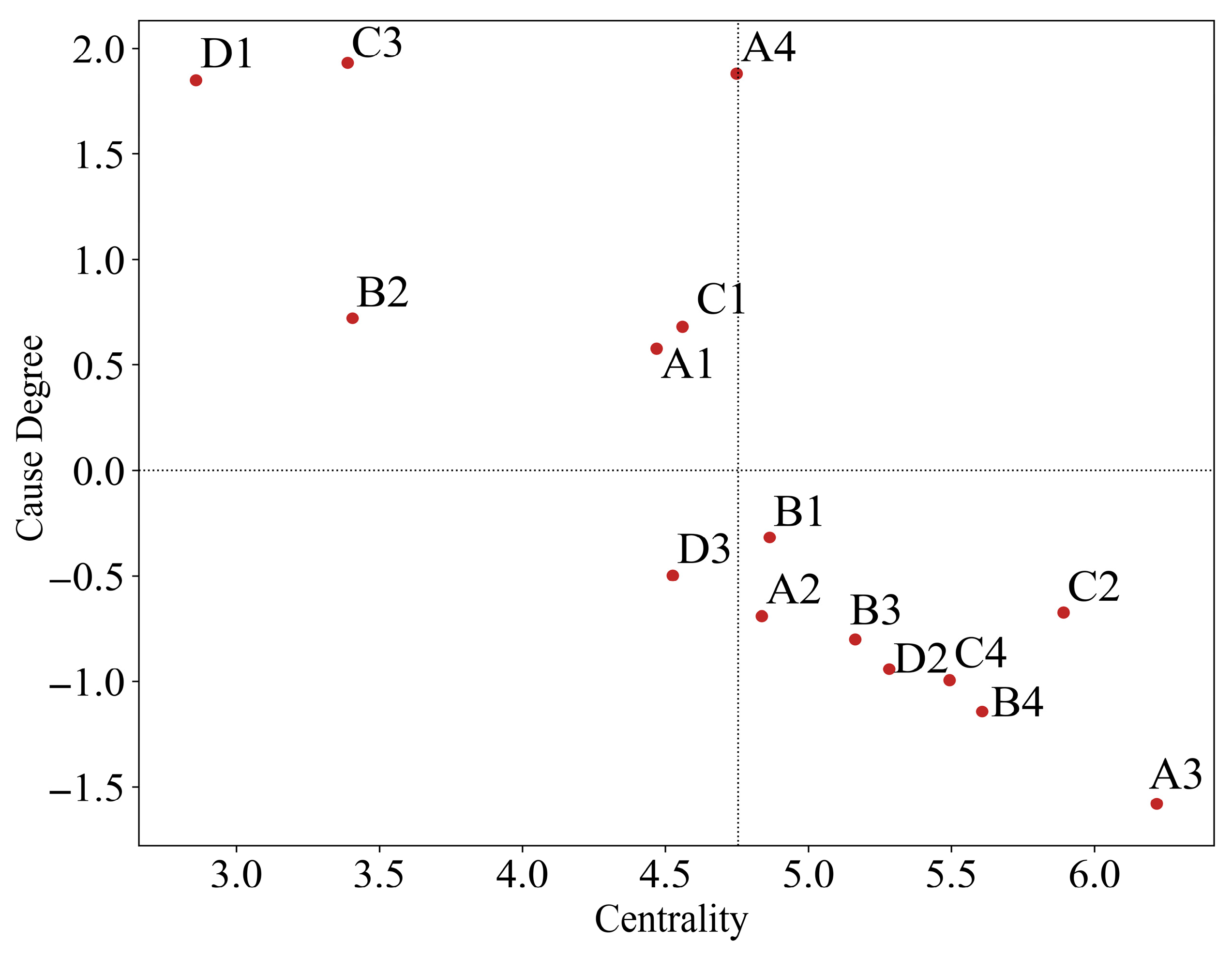
The influence degree, being influenced degree, centrality degree, cause degree, and indicator weights are presented in Table 7. Figure 1 visually presents the calculation results. The degree of centrality is defined as the sum of the influence degree and the being influenced degree of the corresponding factor, representing the status of prefabricated building hoisting safety factors in the system. A larger value of centrality degree indicates more causal connections between the factor and other factors, thus assigning it a higher weight. The cause degree is calculated as the difference between the influence degree and the being influenced degree of the corresponding factor, measuring the overall causal relationship between the factor and other factors in the system. A positive cause degree suggests that the factor tends to influence other factors, whereas a negative value indicates that it tends to be influenced by other factors.
Table 7.
Calculation Results.
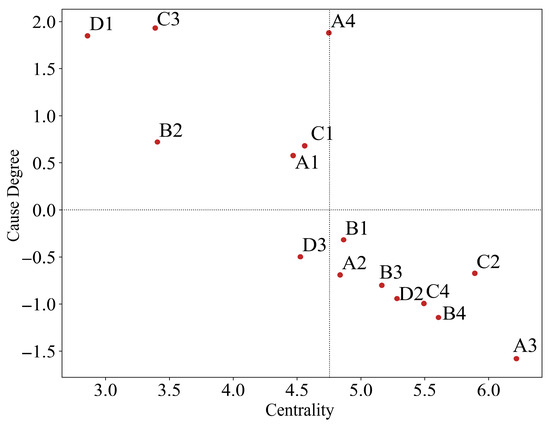
Figure 1.
DEMATEL cause–effect visualization.
From the perspectives of centrality and weight, the weight distribution demonstrates relative concentration without extreme values, which, to some extent, reflects the high coupling of the construction safety system. Among these factors, workers’ behavior (A3) had the highest weight, significantly exceeding other factors, indicating that it functions as the most critical hub within the system. These are followed by construction process control (C2), component connection (B4), operational coordination (C4), hoisting operation environment (D2), and component stacking (B3), which demonstrate close linkages with other factors and constitute critical intervention points for safety control. Equipment and facilities status and performance (B1), workers’ physical and mental state (A2), management personnel competence (A4), safety assurance plan (C1), organizational climate (D3), and workers’ safety competency (A1) demonstrate connections with other factors, and their roles in the system warrant due attention. Relatively speaking, component Quality, policies and regulations, and climatic environment exhibit significantly lower centrality compared to other factors. Among them, climatic environment (D1) and policies and regulations (C3) demonstrate considerable influence degrees yet significantly low influenced degrees, indicating that they exert certain effects on other factors while being scarcely affected in return. Component quality (B2) shows relatively balanced influence and influenced degrees, but both values remain low, resulting in low centrality, which suggests that while it still functions within the system, its importance is relatively weaker compared to factors such as workers’ behavior (A3) and construction process control (C2).
From a causality perspective, the principal causal factors include management personnel competence (A4), policies and regulations (C3), and climatic environment (D1), indicating that these factors more readily influence other factors, may reside at the upstream of the safety causal chain, and constitute driving factors for safety risks. The principal result factors mainly include workers’ behavior (A3), component connection (B4), operational coordination (C4), and hoisting operation environment (D2), indicating that these factors are more readily influenced by other factors, may reside at the downstream of the safety causal chain, and constitute driving factors for safety risks. However, for workers’ behavior (A3), although its influenced degree is significantly higher than its influence degree, its influence degree remains relatively high, and its effects on other factors and construction safety cannot be neglected, which once again confirms the critical hub role of workers’ behavior in prefabricated hoisting safety. Similarly, the influence of operational coordination (C4) and component connection (B4) on the system should not be overlooked.
Based on centrality and causality, certain factors are identified as key factors, including workers’ behavior, construction process control, component connection, operational coordination, management personnel competence, climatic environment, and others. Analyzing the influence relationships among these factors and identifying critical influence paths can help accurately prevent risks. Based on the data calculation process, management personnel competence exerts relatively extensive influence, primarily involving hoisting operation environment, operational coordination, construction process control, component connection, and workers’ behavior; construction process control mainly influences workers’ behavior, component connection, operational coordination, and hoisting operation environment; policies and regulations mainly influences workers’ behavior and construction process control; climatic environment mainly influences workers’ behavior and hoisting operation environment; hoisting operation environment mainly influences workers’ behavior; workers’ behavior exerts substantial influence on component connection and operational coordination. Therefore, management factors and external environment constitute the primary factors influencing workers’ behavior, which serves as an intermediary factor that subsequently influences material factors and construction site coordination.
4.3. D-ANP Calculation Results
Using the total influence matrix as the unweighted supermatrix in the Analytic Network Process (ANP) facilitates consideration of inter-factor influence relationships on the basis of the traditional ANP method, rendering the results more consistent with practical scenarios. First, the unweighted supermatrix is normalized, as presented in Table 8. Subsequently, the weighted supermatrix is iteratively multiplied by itself until convergence is achieved, forming the limit supermatrix of ANP, as shown in Table 9. Each column represents the weight vector of prefabricated building hoisting safety factors, and the final weights are presented in Table 10. Due to space constraints, Table 9 is rounded to three decimal places, while Table 10 displays one additional decimal place to enhance distinguishability.
Table 8.
Weighted supermatrix.
Table 9.
The limit supermatrix.
Table 10.
ANP weight calculation results.
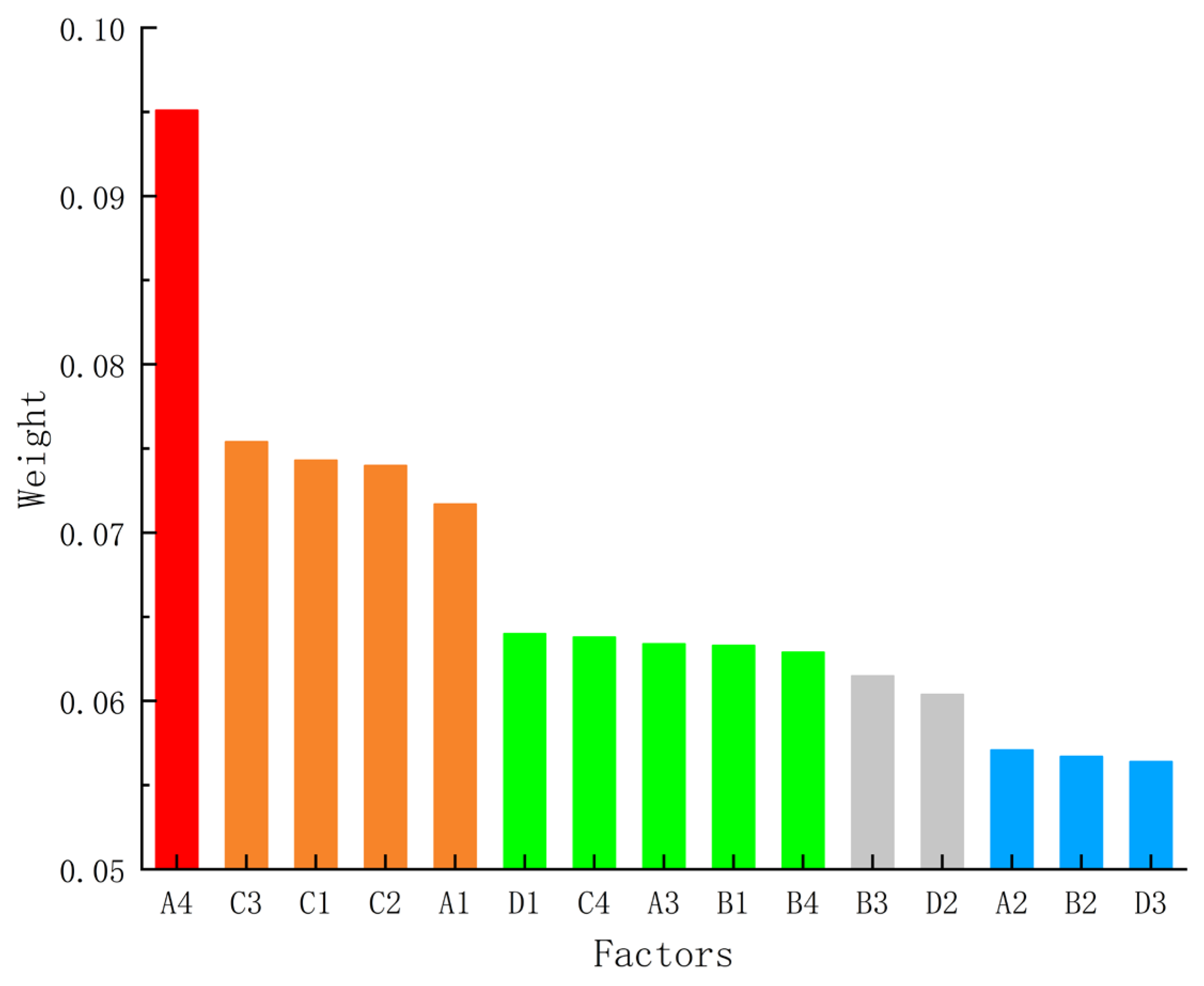
Unlike DEMATEL, which focuses on causal relationships and factor influence, ANP emphasizes the analysis of systematic impacts and can calculate the weights of various factors in hoisting safety [50]. Based on the calculation results of the ANP, the weights and distributions of all factors are relatively balanced, with the highest weight being 9.51% and the lowest 5.64%. No extremely important factors or factors with weights close to zero are observed, indicating that all factors related to prefabricated building hoisting safety are relatively important and cannot be ignored, which is consistent with the complexity of construction safety management. However, the weight results exhibit the characteristic of a stepwise distribution. For instance, the weights of factors ranked 2nd to 5th differ by only 0.37%, while those of the factors ranked 5th and 6th differ by 0.77%, and the factor ranked 6th and that ranked 10th differ by a mere 0.11%. This kind of stepwise distribution also facilitates the graded grasp of the importance of factors and improves the efficiency of safety management.
As shown in Figure 2, prefabricated hoisting construction safety factors can be roughly divided into the following levels based on their importance. The first level is management personnel competence (A4), with a weight as high as 9.51%, which constitutes the core of prefabricated hoisting construction safety factors; the second level includes policies and regulations (C3), safety assurance plan (C1), construction process control (C2), and workers’ safety competency (A1), with weights ranging from 7.17% to 7.54%, representing key dominant factors affecting prefabricated hoisting construction safety; the third level primarily includes climatic environment (D1), operational coordination (C4), workers’ behavior (A3), equipment and facilities status and performance (B1), and component connection (B4), with weights ranging from 6.29% to 6.40%. These factors are considered relatively important and warrant appropriate attention; the fourth level includes workers’ physical and mental state (A2), component quality (B2), and organizational climate (D3), with weights ranging from 5.64% to 5.71%, and their influence on hoisting construction safety is relatively limited; component stacking (B3) and hoisting operation environment (D2) lie in the transitional zone between the third and fourth levels, among which component stacking (B3) is relatively important.
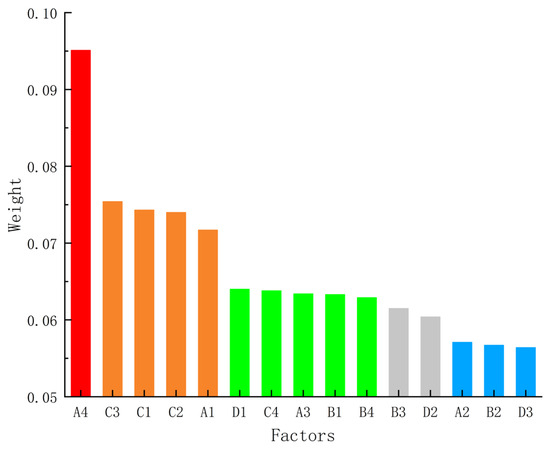
Figure 2.
Hierarchical distribution of ANP calculation results.
5. Discussion
This study integrates fuzzy-DEMATEL and ANP methods to investigate the importance of factors affecting prefabricated hoisting construction safety and the influence relationships between factors, identifies factors such as workers’ behavior and construction process control that are closely linked with other factors within the system, determines factors such as management personnel competence and climatic environment that tend to influence other factors, as well as factors such as workers’ behavior and operational coordination that tend to be influenced by other factors, and finally calculates the contribution of each factor to prefabricated hoisting construction safety. However, several issues remain to be further discussed, including a comparison of results derived from the DEMATEL and ANP algorithms, the comprehensive processing of the two sets of weight results, and a comparison with previous studies. These discussions are conducive to proposing targeted strategies.
5.1. Comparison of the Results Derived from the Two Algorithms
In terms of weight values, the calculation results of the two methods show relatively small differences overall. In comparison, the differences between DEMATEL weights and ANP weights for factors such as management personnel competence, policies and regulations, climatic environment, and workers’ behavior are relatively large, generally exceeding 2%. Specifically, the DEMATEL weight for workers’ behavior is higher than its ANP weight, while the ANP weights for the remaining three factors are higher than their DEMATEL weights, as shown in Table 10. For factors such as management personnel competence, policies and regulations, and climatic environment, their influence relationships with other factors are not particularly high; policies and regulations and climatic environment, as well as their linkages with other system factors, are at the weakest level, resulting in relatively low DEMATEL weights for these factors. However, management personnel competence significantly influences important factors, such as workers’ behavior, construction process control, and operational coordination; policies and regulations also exert a relatively significant influence on workers’ behavior and construction process control; and the climatic environment also demonstrates a strong influence on factors such as workers’ behavior and hoisting operation environment. This indicates that although the breadth of influence of these factors is not substantial, their decisive effect on other key factors is significant, rendering them causal factors in the system, which increases their ANP weights. In contrast, the breadth of connections between workers’ behavior and other factors is notably prominent; however, its decisive role in the system is relatively weaker, and it tends to function as an outcome factor within the system.
In terms of weight ranking, the discrepancy between the two methods is quite significant. In addition to the four factors with considerable differences in weight values, the differences in weight ranking for workers’ safety competency, component connection, safety assurance plan, and hoisting operation environment are also highly significant, while the differences in weight ranking for workers’ physical and mental state and component stacking are relatively notable. Among these factors, component connection, hoisting operation environment, workers’ physical and mental state, and component stacking have higher weights in the DEMATEL method, while workers’ safety competency and safety assurance plan have higher weights in the ANP method. This indicates that the influencing and influenced relationships between component connection, hoisting operation environment, workers’ physical and mental state, component stacking, and other factors are relatively more significant, while workers’ safety competency and safety assurance plan have a slight edge in terms of their key decisive roles within the system. On the whole, although there are considerable discrepancies in weight ranking, the differences in numerical values are not significant. This also aligns with the characteristic of the stepwise distribution in weight calculation.
Drawing on previous studies, providing a comprehensive weight ranking by integrating the weight results from the two methods facilitates construction managers and workers in identifying primary contradictions and improving the efficiency of safety management resource utilization. Specifically, the weight rankings of each factor obtained from the two methods are summed up, and those with smaller summed values are regarded as key factors [50,53]. The weights of each factor calculated by the two methods and their summed results are presented in Table 11. In terms of the scope and breadth of influence with other factors, workers’ behavior, construction process control, component connection, and operational coordination are key factors; in terms of contribution to construction safety, management personnel competence, policies and regulations, safety assurance plan, construction process control, and workers’ safety competency exert a more dominant role. Integrating both sets of weights, construction process control ranks as the most important factor, followed by workers’ behavior and management personnel competence, and subsequently followed by operational coordination, safety assurance plan, and component connection. Evidently, management and behavioral factors are the most critical. By contrast, organizational climate and component quality register the lowest comprehensive weights due to their relatively limited breadth of connections with other factors and their weaker decisive role in the system relative to important factors such as construction process control and workers’ behavior.
Table 11.
Comparison of weight calculation results between DEMATEL and ANP.
5.2. Comparison with the Current Body of Knowledge
In previous studies on prefabricated construction safety, Liu et al. (2025) [38] assigned relatively high weights to material-, component-, and machinery-related factors; Liu et al. (2018) [36] accorded the highest weight to safety awareness and relatively high weights to the safety management system (which encompasses the professional competence, operating behavior, and rule compliance of relevant personnel); Xiong et al. (2024) [37] highlighted the important role of the establishment and implementation of safety management systems, personnel’s safety awareness and attitudes, the quality and safety status of prefabricated components, and the working environment of construction sites. These results differ from the key factor in the construction process control derived from the present study. Firstly, the present study focuses primarily on safety during the hoisting phase, leading to differences in research scope, which may be one of the contributing factors. Secondly, there are distinctions in the methodological frameworks: while the aforementioned studies mainly focused on factor weights or inter-factor influence relationships, advancing research on prefabricated construction safety, the present study comprehensively considers the influence relationships, causal relationships among factors, and the dependency strength of factors within the network, thereby enhancing the alignment of the results with practical scenarios. In other studies, construction workers’ behavior is identified as the main cause of safety accidents [55], and management behavior is regarded as the root cause of construction safety accidents [56], which provides certain support for the conclusions of this study.
In previous prefabricated hoisting construction safety studies, Pan et al. (2021) [17] identified inadequate on-site safety management as a critical cause, which shows similarity with the result of construction process control having the highest weight in this study; Wang et al. (2022) [15] identified unsafe behavior and inadequate safety supervision as major risk factors, partially validating this study’s emphasis on workers’ behavior and construction process control. Building upon existing research, this study further analyzed the mechanisms of factor roles from two perspectives—the scope of influence relationships and comprehensive contribution to safety. The findings reveal that construction process control exerts a more decisive role, while workers’ behavior possesses broader connections with other factors. Building upon this, this study further identifies important factors, such as component connection, operational coordination, management personnel competence, and safety assurance plan, along with the mechanisms through which they become important, constituting a theoretical extension of the existing knowledge system.
5.3. Research Contributions and Implications
This study takes into account the particularities of construction safety management during the hoisting phase of prefabricated buildings and identifies that there is a paucity of existing studies focusing on identifying the key influencing factors and mechanisms of influence of hoisting safety, which constitutes a further refined study in the field of construction safety management. At the level of research logic, this study not only considers the causal relationships and connection strength among influencing factors but also takes into account the relative importance of each factor in enhancing the hoisting safety of prefabricated buildings. Such a logical design with multi-perspective considerations enables a more comprehensive measurement of the importance of each factor for the hoisting construction safety of prefabricated buildings. The results of this paper can provide references and guidance for the practice of prefabricated hoisting safety management, helping enterprises and managers identify the primary contradictions among complex factors and improve the efficiency of safety investment and construction management.
In addition, this study can offer certain implications for the safety management of construction systems. First, for different construction projects and construction phases, it is necessary to conduct a targeted identification of key influencing factors and an analysis of their mechanisms of influence. Second, the measurement of the importance of factors should not be confined to a single perspective; instead, a comprehensive evaluation should be conducted by integrating multi-source evidence from diverse perspectives, including the causal relationships among factors, the extent of connections between each factor and others, and the significance of each factor for system objectives. The research approach used in this paper can be applied to other studies involving the analysis of influencing factors in construction safety, providing more specific and accurate references for safety management practices.
Nevertheless, this study inevitably has its limitations. First, although this paper has adopted multiple approaches to reduce the subjectivity of evaluation, it is almost impossible to completely eliminate it. Second, the perspectives for measuring the importance of factors are not necessarily limited to the aspects mentioned in this paper; for instance, they may also include the dynamic variation range of factors and factor sensitivity. In future research, we will consider the dynamism and sensitivity of the influencing factors affecting the hoisting construction safety of prefabricated buildings and attempt to introduce other algorithms to obtain quantitative weight values.
6. Conclusions
To identify the key factors influencing the safety of prefabricated hoisting construction, this study first compiled 15 influencing factors based on existing research, which were validated through expert interviews. Secondly, fuzzy triangular numbers were introduced to conduct pairwise scoring and evaluation of direct influence relationships among these factors, and fuzzy-DEMATEL was employed to analyze the influence relationships among various factors as well as their causal attributes within the system; subsequently, the ANP algorithm was introduced to further calculate the contribution degree of each factor to prefabricated hoisting construction safety. Finally, the results from the two models were compared and analyzed, and a comprehensive ranking was provided for reference. The following conclusions were drawn: (1) workers’ behavior, construction process control, component connection, and operational coordination demonstrate extensive linkages with other factors; (2) management personnel competence, policies and regulations, and climatic environment more readily influence other factors, whereas workers’ behavior, component connection, operational coordination, and hoisting operation environment tend to be influenced by other factors; (3) management personnel competence exerts the most critical decisive role in hoisting safety, while policies and regulations, safety assurance plan, construction process control, and workers’ safety competency play relatively critical decisive roles; (4) integrating the rankings from both DEMATEL and ANP results, construction process control is identified as the most important factor, followed by workers’ behavior and management personnel competence.
Based on the calculation results of this study, the following suggestions are proposed. First, priority should be given to ensuring managerial competence, including strict qualification verification, background and experience screening, the implementation of pre-job training and regular ongoing education, and other such measures. Second, the implementation of supervision and control during the construction process must be guaranteed: enterprises should take the initiative to formulate sound construction plans and ensure sufficient safety investment; regulatory authorities should conduct regular inspections of on-site safety management, strictly enforce rules and regulations, and implement incentive measures involving rewards and penalties. Third, the core of process control is to manage the behaviors of on-site operators. Enterprises should appropriately increase resource allocation in specific workflows such as safety training, technical disclosure, formulation of standardized operation procedures, on-site inspections, and intelligent monitoring. In addition, inspecting the coordination of on-site operations and the hoisting process can help assess operators’ behaviors and the effectiveness of construction process control. Finally, attention should be paid to the driving effect of climatic and environmental factors, relevant contingency plans should be formulated in advance, and plans should be adjusted in a timely manner according to environmental conditions.
Author Contributions
Conceptualization, C.C. and B.C.; methodology, Z.Z.; software, C.C.; validation, C.C. and Z.Z.; formal analysis, C.C. and B.C.; investigation, Z.Z.; resources, C.C.; data curation, C.C. and B.C.; writing—original draft preparation, B.C. and Z.Z.; writing—review and editing, C.C. and Z.Z.; visualization, Z.Z.; supervision, C.C.; project administration, C.C.; funding acquisition, C.C. All authors have read and agreed to the published version of the manuscript.
Funding
This research was funded by Key Projects for University Basic Research under the Educational Department of Liaoning Province, grant number LJ212510153029.
Data Availability Statement
The original contributions presented in this study are included in the article. Further inquiries can be directed to the corresponding author.
Conflicts of Interest
The authors declare no conflicts of interest.
Abbreviations
The following abbreviations are used in this manuscript:
| DEMATEL | Decision Making Trial and Evaluation Laboratory. |
| ANP | Analytic Network Process. |
| D-ANP | DEMATEL-ANP. |
References
- Hu, Z.; Li, S.; He, C.; Shen, Y.; Zhong, H.; Li, S. Literature Review on Construction Safety Resilience: A Bibliometric Analysis to Map the State of the Art. Saf. Health Work 2025, 16, 259–267. [Google Scholar] [CrossRef] [PubMed]
- Johansen, K.; Schultz, C.; Teizer, J. Knowledge Graph Exploitation to Enhance the Usability of Risk Assessment in Construction Safety Planning. Adv. Eng. Inform. 2025, 65, 103305. [Google Scholar] [CrossRef]
- Shi, D.; Li, Z.; Zurada, J.; Manikas, A.; Guan, J.; Weichbroth, P. Ontology-Based Text Convolution Neural Network (TextCNN) for Prediction of Construction Accidents. Knowl. Inf. Syst. 2024, 66, 2651–2681. [Google Scholar] [CrossRef]
- Alhammadi, Y.; Farouk, A.M.; Rahman, R.A. Enhancing Construction Safety Education: Insights from Student Perspectives. Buildings 2024, 14, 660. [Google Scholar] [CrossRef]
- Han, Y.; Chen, M.; Li, N.; Ji, M.; Wang, X. Digital Twin in Construction Safety Management: Recent Advances, Challenges, and Future Directions from 4M1E Perspective. Saf. Sci. 2025, 192, 107006. [Google Scholar] [CrossRef]
- Kang, L. Measuring Construction Safety Performance in Chinese Provinces through Cross-Efficiency Theory. Ain Shams Eng. J. 2024, 15, 103107. [Google Scholar] [CrossRef]
- Ge, M.; Yuan, Y. Evaluation Model Design of Project Construction Safety Level Based on Bidirectional Recurrent Neural Network (BiRNN) and Bidirectional Long Short-Term Memory (BiLSTM). PEERJ Comput. Sci. 2024, 10, e2351. [Google Scholar] [CrossRef]
- Shang, Z.; Wang, F.; Yang, X. The Efficiency of the Chinese Prefabricated Building Industry and Its Influencing Factors: An Empirical Study. Sustainability 2022, 14, 10695. [Google Scholar] [CrossRef]
- Li, S.; Du, Q.; Wang, X.; Shi, J.; Zhang, Y. The Effect of Dynamic Subsidy and Consumer Preference on Prefabricated Building Diffusion Under Emission Trading Scheme. J. Hous. Built Environ. 2025, 1–28. [Google Scholar] [CrossRef]
- Navaratnam, S.; Ngo, T.; Gunawardena, T.; Henderson, D. Performance Review of Prefabricated Building Systems and Future Research in Australia. Buildings 2019, 9, 38. [Google Scholar] [CrossRef]
- Liao, L.; Mo, W.; Wen, Y.; Liu, S.; Zou, Y.; Mo, L.; Wu, C.; Fan, C. Safety Consultation for Prefabricated Construction: A Localized Retrieval-Augmented Generative Question-Answering System. J. Comput. Civ. Eng. 2025, 39, 04025076. [Google Scholar] [CrossRef]
- Zhang, Z.; Duan, L.; Du, X. Risk Assessment of Prefabricated Building Projects Based on the G1-CRITIC Method and Cloud Model: A Case Study from China. Buildings 2025, 15, 2787. [Google Scholar] [CrossRef]
- Wan, P.; Wang, J.; Liu, Y.; Lu, Q.; Yuan, C. On Risk Probability of Prefabricated Building Hoisting Construction Based on Multiple Correlations. Sustainability 2022, 14, 4430. [Google Scholar] [CrossRef]
- Liu, Z.; Li, A.; Sun, Z.; Shi, G.; Meng, X. Digital Twin-Based Risk Control during Prefabricated Building Hoisting Operations. Sensors 2022, 22, 2522. [Google Scholar] [CrossRef]
- Wang, J.; Guo, F.; Song, Y.; Liu, Y.; Hu, X.; Yuan, C. Safety Risk Assessment of Prefabricated Buildings Hoisting Construction: Based on IHFACS-ISAM-BN. Buildings 2022, 12, 811. [Google Scholar] [CrossRef]
- Liu, Z.; Meng, X.; Xing, Z.; Jiang, A. Digital Twin-Based Safety Risk Coupling of Prefabricated Building Hoisting. Sensors 2021, 21, 3583. [Google Scholar] [CrossRef]
- Pan, Z.; Wang, J.; Wang, J.; Tian, M.; Liu, S. Safety Risk Analysis for Prefabricated Building Hoisting Construction Based on STPA-BN. In Proceedings of the ICCREM 2021, Beijing, China, 16–17 October 2021; pp. 171–180. [Google Scholar]
- Song, Y.; Wang, J.; Liu, D.; Guo, F. Study of Occupational Safety Risks in Prefabricated Building Hoisting Construction Based on HFACS-PH and SEM. Int. J. Environ. Res. Public Health 2022, 19, 1550. [Google Scholar] [CrossRef]
- Zhang, Z.; Xu, R.; Wu, X.; Wang, J. ANN-Based Dynamic Prediction of Daily Ground Settlement of Foundation Pit Considering Time-Dependent Influence Factors. Appl. Sci. 2022, 12, 6324. [Google Scholar] [CrossRef]
- Yin, S.; Wu, Y.; Shen, Y.; Rowlinson, S. Development of a Classification Framework for Construction Personnel’s Safety Behavior Based on Machine Learning. Buildings 2023, 13, 43. [Google Scholar] [CrossRef]
- Xia, X.; Xiang, P.; Khanmohammadi, S.; Gao, T.; Arashpour, M. Predicting Safety Accident Costs in Construction Projects Using Ensemble Data-Driven Models. J. Constr. Eng. Manag. 2024, 150, 04024054. [Google Scholar] [CrossRef]
- Lin, F.; Wu, P.; Xu, Y. Investigation of Factors Influencing the Construction Safety of High-Speed Railway Stations Based on DEMATEL and ISM. Adv. Civ. Eng. 2021, 2021, 9954018. [Google Scholar] [CrossRef]
- Fontela, E.; Gabus, A. The DEMATEL Observer, DEMATEL 1976 Report; Battelle Geneva Research Center: Geneva, Switzerland, 1976. [Google Scholar]
- Xue, Y.; Luo, X.; Li, H.; Liu, J. Shield Construction Safety Risks and Their Interrelations Analysis of Subway Tunnel Undercrossing a River Based on Grey-DEMATEL-ISM. Front. Public Health 2025, 13, 1536706. [Google Scholar] [CrossRef]
- Zarei-Kordshouli, F.; Paydar, M.M.; Nayeri, S. Designing a Dairy Supply Chain Network Considering Sustainability and Resilience: A Multistage Decision-Making Framework. Clean Technol. Environ. Policy 2023, 25, 2903–2927. [Google Scholar] [CrossRef] [PubMed]
- Wu, W.-W.; Lee, Y.-T. Developing Global Managers’ Competencies Using the Fuzzy DEMATEL Method. Expert Syst. Appl. 2007, 32, 499–507. [Google Scholar] [CrossRef]
- Orji, I.J.; Kusi-Sarpong, S.; Huang, S.; Vazquez-Brust, D. Evaluating the Factors That Influence Blockchain Adoption in the Freight Logistics Industry. Transp. Res. Part E Logist. Transp. Rev. 2020, 141, 102025. [Google Scholar] [CrossRef]
- Saaty, T.L. Decision Making with Dependence and Feedback: The Analytic Network Process: The Organization and Prioritization of Complexity; RWS Publications: Pittsburgh, PA, USA, 1996. [Google Scholar]
- Luo, L.; Jin, X.; Shen, G.Q.; Wang, Y.; Liang, X.; Li, X.; Li, C.Z. Supply Chain Management for Prefabricated Building Projects in Hong Kong. J. Manag. Eng. 2020, 36, 05020001. [Google Scholar] [CrossRef]
- Wang, D.; Luo, J.; Wang, Y. Multifactor Uncertainty Analysis of Prefabricated Building Supply Chain: Qualitative Comparative Analysis. Eng. Constr. Archit. Manag. 2022, 31, 1994–2010. [Google Scholar] [CrossRef]
- Lin, M.; Ren, Y.; Feng, C.; Li, X. Analyzing Resilience Influencing Factors in the Prefabricated Building Supply Chain Based on SEM-SD Methodology. Sci. Rep. 2024, 14, 17393. [Google Scholar] [CrossRef]
- Luo, Q.; Sun, C.; Li, G.; Li, Y.; Xue, J.; Zhang, G. Hierarchical Schedule Risk Structures and Mitigation Strategies in Prefabricated Building Projects: An Integrated SNA-ISM Approach. Eng. Constr. Archit. Manag. 2025. [Google Scholar] [CrossRef]
- Wang, J.; Liu, H.; Wang, Z. Stochastic Project Scheduling Optimization for Multi-Stage Prefabricated Building Construction with Reliability Application. KSCE J. Civ. Eng. 2023, 27, 2356–2371. [Google Scholar] [CrossRef]
- Lou, N.; Guo, J. Study on Key Cost Drivers of Prefabricated Buildings Based on System Dynamics. Adv. Civ. Eng. 2020, 2020, 8896435. [Google Scholar] [CrossRef]
- Luo, L.; Wu, X.; Hong, J.; Wu, G. Fuzzy Cognitive Map-Enabled Approach for Investigating the Relationship Between Influencing Factors and Prefabricated Building Cost Considering Dynamic Interactions. J. Constr. Eng. Manag. 2022, 148, 04022081. [Google Scholar] [CrossRef]
- Liu, J.; Gong, E.; Wang, D.; Teng, Y. Cloud Model-Based Safety Performance Evaluation of Prefabricated Building Project in China. Wirel. Pers. Commun. 2018, 102, 3021–3039. [Google Scholar] [CrossRef]
- Xiong, Z.; Lin, Y.; Wang, Q.; Yang, W.; Shen, C.; Zhang, J.; Zhu, K. Research on Safety Performance Evaluation and Improvement Path of Prefabricated Building Construction Based on DEMATEL and NK. Appl. Sci. 2024, 14, 8010. [Google Scholar] [CrossRef]
- Liu, W.; Feng, Z.; Hu, Y.; Luo, X. Study on the Measurement of the Level of Construction Occupational Health and Safety Management in Prefabricated Building: A Case Study of a Practical Training Building. Eng. Constr. Archit. Manag. 2025. [Google Scholar] [CrossRef]
- Zhang, Y.; Yi, X.; Li, S.; Qiu, H. Evolutionary Game of Government Safety Supervision for Prefabricated Building Construction Using System Dynamics. Eng. Constr. Archit. Manag. 2023, 30, 2947–2968. [Google Scholar] [CrossRef]
- Wang, F.; Wang, H.; Fu, R.; Zhang, X. Study on Unsafe Behavior Detection of Tower Crane Drivers in Prefabricated Building Construction. IEEE Trans. Intell. Transp. Syst. 2025, 26, 4406–4417. [Google Scholar] [CrossRef]
- Bavafa, A.; Mahdiyar, A.; Marsono, A.K. Identifying and Assessing the Critical Factors for Effective Implementation of Safety Programs in Construction Projects. Saf. Sci. 2018, 106, 47–56. [Google Scholar] [CrossRef]
- Kim, J.; Shan, Y.; Kim, S.; Song, D.; Park, H.; Bang, C. Factors Influencing Fire Safety on Building Construction Sites: A Fire Officer’s Perspective. J. Constr. Eng. Manag. 2021, 147, 04021118. [Google Scholar] [CrossRef]
- Xu, J.; Li, Z.; Wang, H.; Zhang, Y.; Zhang, X. Construction Safety Influencing Factor Analysis of Bridge-Erecting Machines Based on Structural Equation Modeling. Heliyon 2024, 10, e24957. [Google Scholar] [CrossRef]
- Liu, K.; Liu, Y.; Kou, Y. Study on Construction Safety Management in Megaprojects from the Perspective of Resilient Governance. Saf. Sci. 2024, 173, 106442. [Google Scholar] [CrossRef]
- Guo, S.; Yan, J.; Li, R.; Li, X.; Zheng, D.; Zhang, Q.; Liu, Y. A Risk Assessment Method for Subsea Tunnel Collapse Based on Cloud Bayesian Network. Mar. Georesources Geotechnol. 2025, 43, 1918–1933. [Google Scholar] [CrossRef]
- He, C.; Wu, C.; McCabe, B.; Hu, Z.; Shen, Y.; Jia, G.; Sun, J. A Bayesian Network Model Integrating Organizational, Individual and Psychological Factors for Strengthening Construction Worker Safety Behavior. Int. J. Occup. Saf. Ergon. 2024, 30, 1058–1068. [Google Scholar] [CrossRef] [PubMed]
- Ning, X.; Qiu, Y.; Wu, C.; Jia, K. Developing a Decision-Making Model for Construction Safety Behavior Supervision: An Evolutionary Game Theory-Based Analysis. Front. Psychol. 2022, 13, 861828. [Google Scholar] [CrossRef]
- Peng, J.L.; Liu, X. Analysis of Factors Influencing Resource Scheduling for Emergency Construction Projects Considering Multiple Spatial Characteristics. Dev. Built Environ. 2024, 17, 100329. [Google Scholar] [CrossRef]
- Zhong, Q.; Tang, H.; Zhou, W. Analyzing the Influence Factors of the Post-Earthquake Reconstruction Project Using Fuzzy DEMATEL. J. Asian Archit. Build. Eng. 2024, 23, 1050–1062. [Google Scholar] [CrossRef]
- Nishad, N.H.; Mitra, P.; Nath, S.D. Investigating the Key Challenges and Success Factors for Blockchain Adoption in an Emerging Economy’s Textile Industry: An Integrated DEMATEL and ANP Approach. Ann. Oper. Res. 2025, 1–37. [Google Scholar] [CrossRef]
- Wang, J.; Qin, Y.; He, P.; Yan, W. Research on Smart Construction Site Evaluation Model Based on DEMATEL-ANP Method. Buildings 2025, 15, 3077. [Google Scholar] [CrossRef]
- Khalilzadeh, M.; Banihashemi, S.A.; Heidari, A.; Božanić, D.; Milić, A. Risk Analysis and Assessment of Water Supply Projects Using the Fuzzy DEMATEL-ANP and Artificial Neural Network Methods. Water 2025, 17, 1995. [Google Scholar] [CrossRef]
- Kumar, S.; Yadav, D.; Paramasivam, P.; Gowroju, S.; Gupta, R.; Kanti, P.K.; Dabelo, L.H. Assessing Barriers to Adoption of Battery Electric Vehicles Using Decision-Making Trial and Evaluation Laboratory Combined with Analytic Network Process. Energy Sci. Eng. 2025, 14, 236–256. [Google Scholar] [CrossRef]
- Zhong, C.; Zhang, S. Schedule Risk Analysis of Prefabricated Building Projects Based on DEMATEL-ISM and Bayesian Networks. Buildings 2025, 15, 508. [Google Scholar] [CrossRef]
- Ma, L.; Guo, H.; Fang, Y. Analysis of Construction Workers’ Safety Behavior Based on Myers-Briggs Type Indicator Personality Test in a Bridge Construction Project. J. Constr. Eng. Manag. 2021, 147, 04020149. [Google Scholar] [CrossRef]
- Fang, D.; Wu, C.; Wu, H. Impact of the Supervisor on Worker Safety Behavior in Construction Projects. J. Manag. Eng. 2015, 31, 04015001. [Google Scholar] [CrossRef]
Disclaimer/Publisher’s Note: The statements, opinions and data contained in all publications are solely those of the individual author(s) and contributor(s) and not of MDPI and/or the editor(s). MDPI and/or the editor(s) disclaim responsibility for any injury to people or property resulting from any ideas, methods, instructions or products referred to in the content. |
© 2026 by the authors. Licensee MDPI, Basel, Switzerland. This article is an open access article distributed under the terms and conditions of the Creative Commons Attribution (CC BY) license.