BIM-Integrated Multi-Objective Optimisation of Prefabricated Construction Configurations: A WBS-Based Generative Decomposition Framework

Abstract
1. Introduction
2. Literature Review
2.1. BIM and DfMA for Prefabricated Construction
2.2. WBS Integration with BIM
2.3. Multi-Objective Optimisation in BIM Environments
2.4. Identified Research Gap
3. Methodology
3.1. Research Design
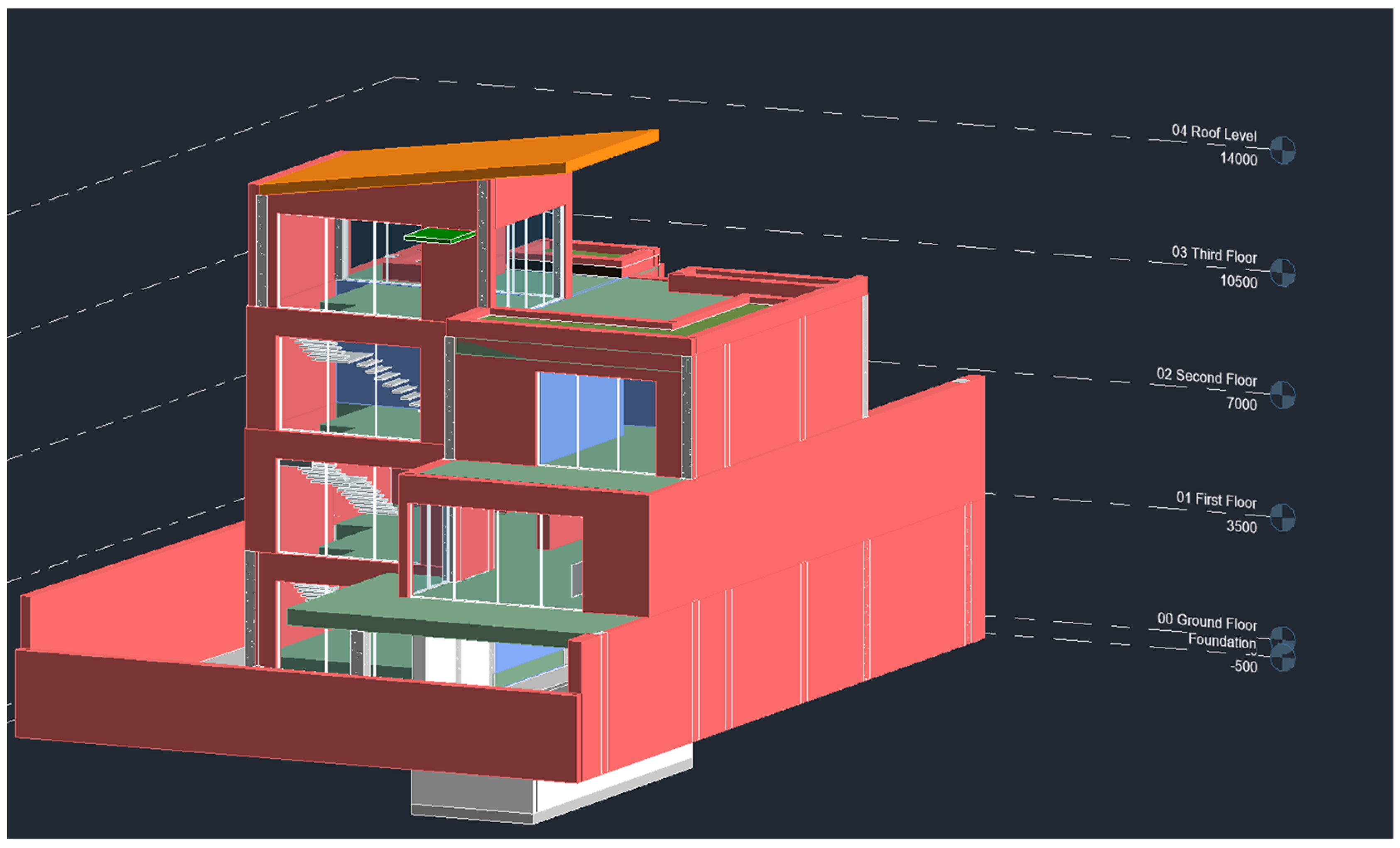
3.2. Case Study
4. Development and System Framework
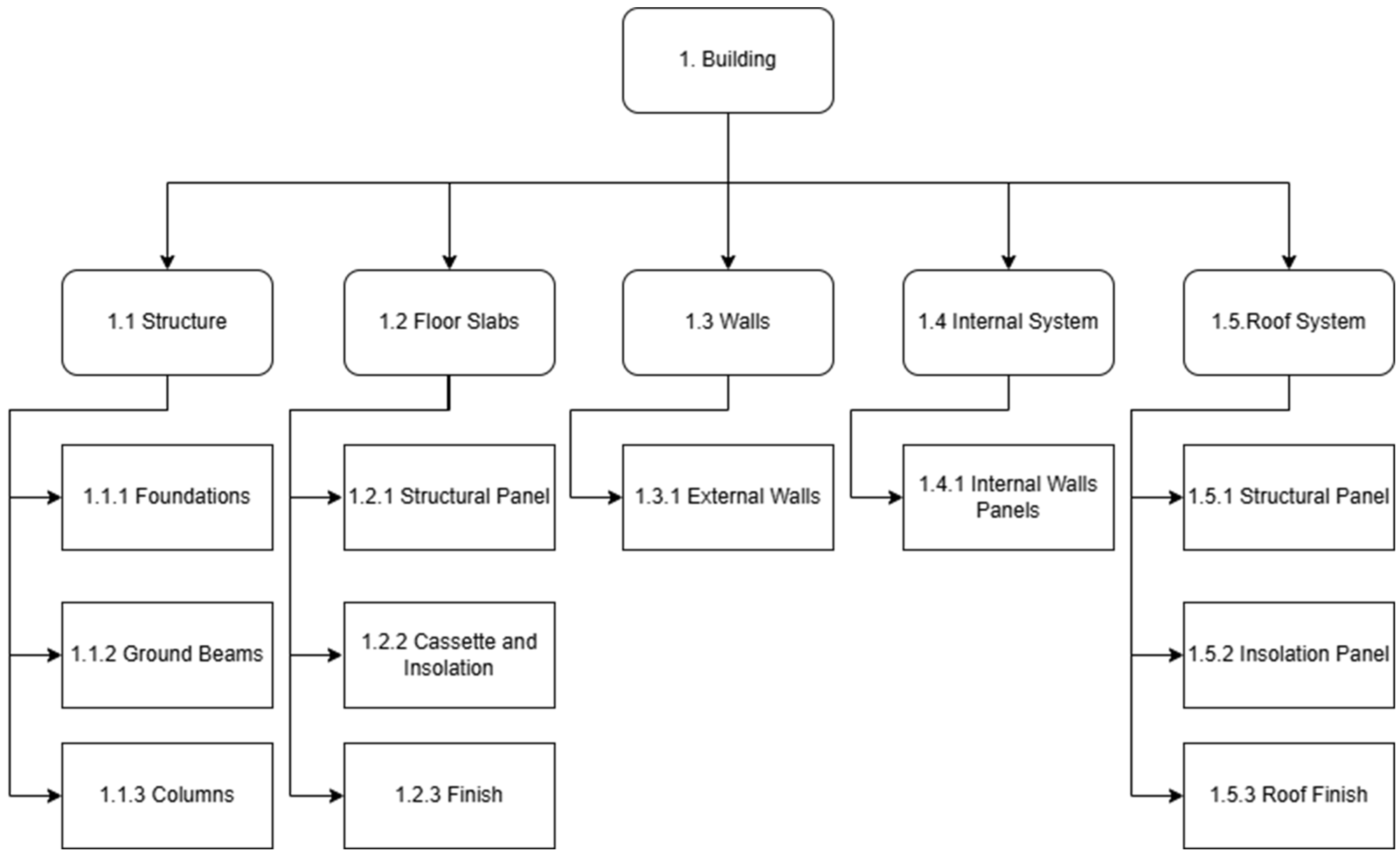
4.1. Component Database
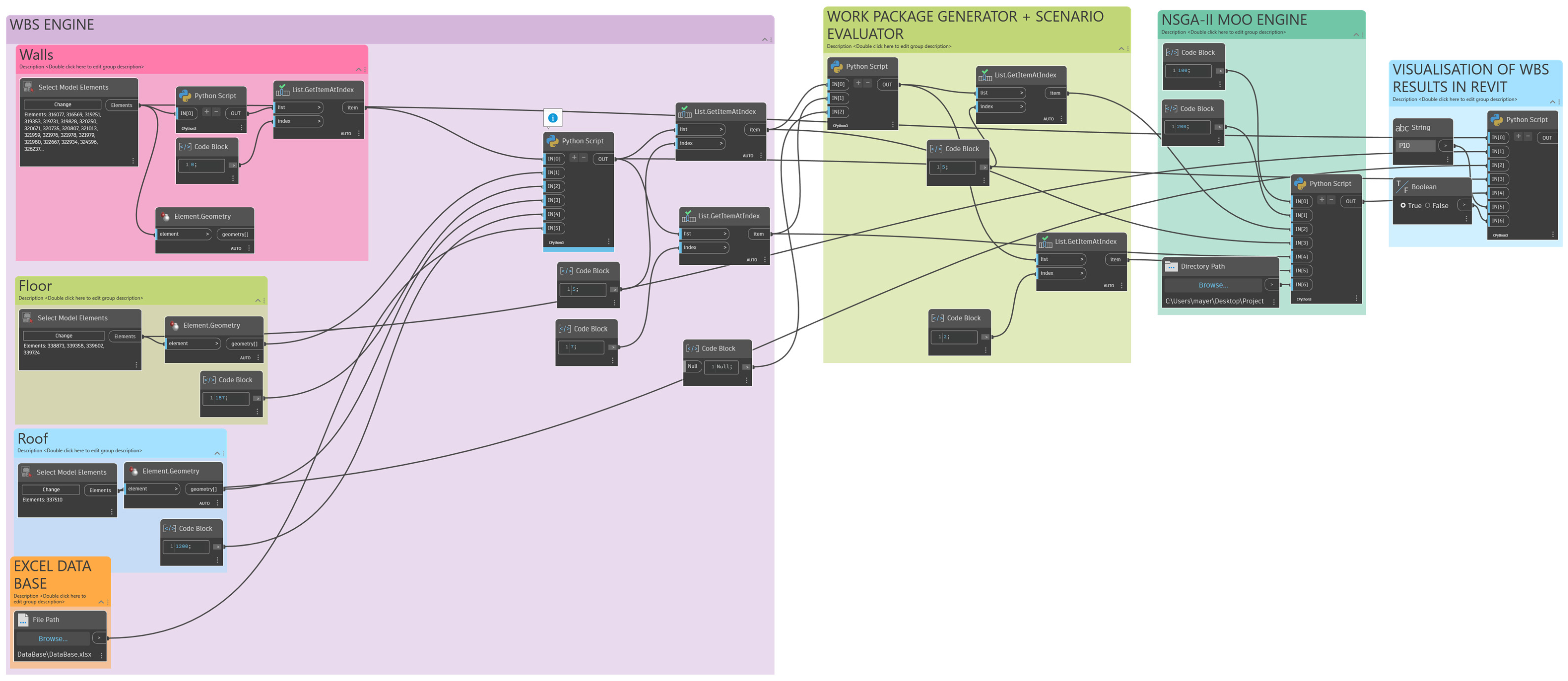
4.2. System Architecture
| Algorithm 1: WBS Engine Modular Division |
| Input: element length L, element height H, ordered module list M = [3600, 1200, 600], standard panel height H_std, database db Output: list of assigned prefabricated components 1: remaining = L 2: components = empty list 3: for each module m in M (largest to smallest): 4: count = floor(remaining/m) 5: if count > 0: 6: append count standard panels of size m from db 7: remaining = remaining minus (count times m) 8: if remaining > 0 and remaining within [INFILL_min, INFILL_max]: 9: append one variable INFILL component of length = remaining 10: if H > H_std: 11: for each assigned panel: 12: append one CLOSURE component sized to (H minus H_std) 13: return components |
4.3. Multi-Objective Optimisation
5. Results
5.1. Pareto Front
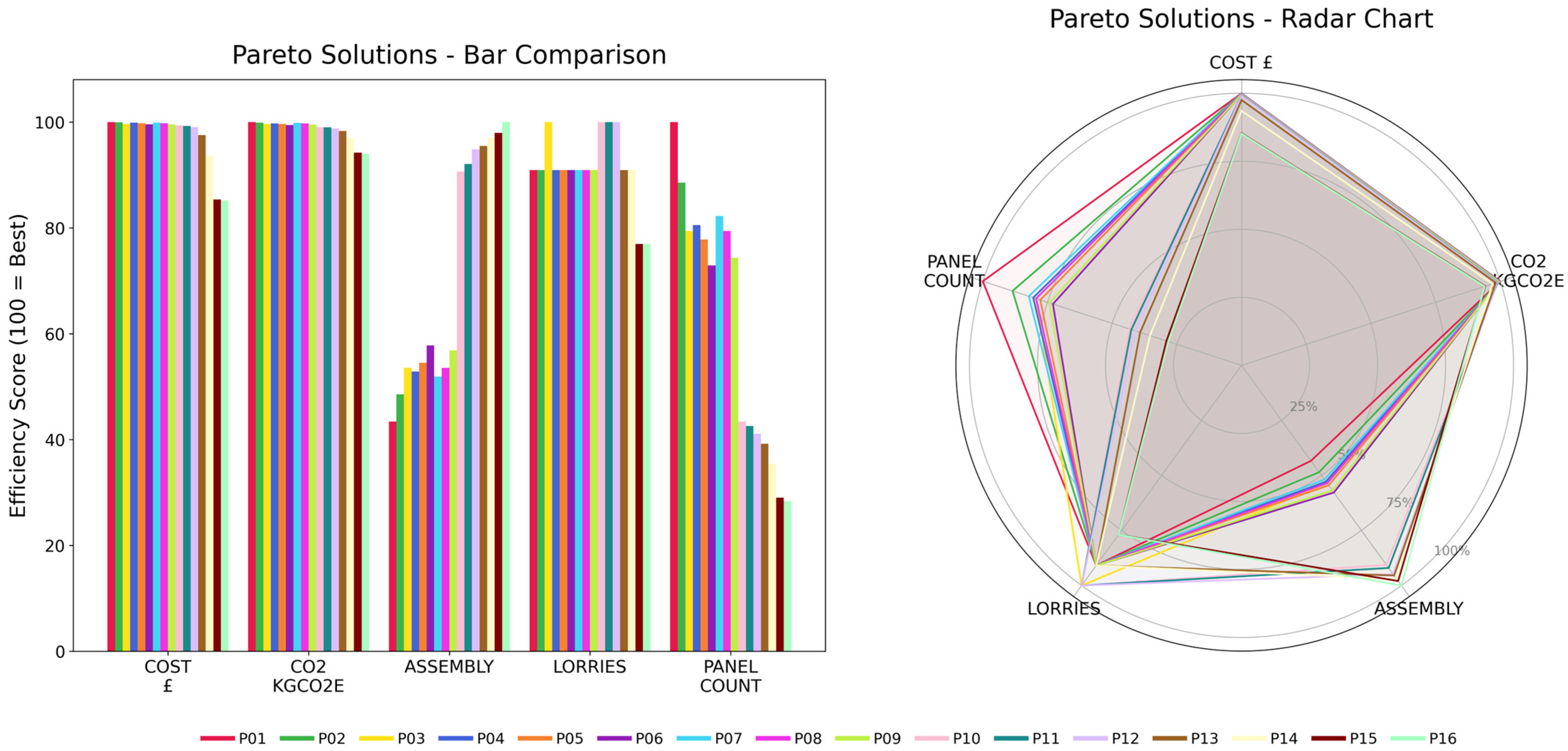
5.2. Structure of the Pareto Front
5.3. Best Compromise Solution: P10
5.4. Bill of Materials for P10
6. Discussion
6.1. Impact of Wall Modularity on Cost and Embodied Carbon
6.2. The Pareto Front as a Decision Instrument
6.3. The WBS as a Generative Mechanism
6.4. Limitations
6.5. Positioning Relative to Prior Work
7. Conclusions
Supplementary Materials
Author Contributions
Funding
Data Availability Statement
Conflicts of Interest
References
- Doan, D.T.; Atencio, E.; Muñoz La Rivera, F.; Alnajjar, O. A systematic literature review of BIM and offsite construction integration: Emerging technologies and future trends. Appl. Sci. 2025, 15, 9981. [Google Scholar] [CrossRef]
- Eastman, C.M.; Teicholz, P.; Sacks, R.; Liston, K. BIM Handbook: A Guide to Building Information Modeling for Owners, Managers, Designers, Engineers and Contractors, 2nd ed.; Wiley: Hoboken, NJ, USA, 2011. [Google Scholar]
- Volk, R.; Stengel, J.; Schultmann, F. Building information modelling (BIM) for existing buildings: Literature review and future needs. Autom. Constr. 2014, 38, 109–127. [Google Scholar] [CrossRef]
- Moradabadi, B.; Noorzai, E.; Abbasi, S. BIM-based optimization approach to reduce life cycle costs by focusing on the integration of construction and operation phases in office-commercial buildings. J. Build. Eng. 2024, 98, 111126. [Google Scholar] [CrossRef]
- Padala, S.P.; Kumar, H. A BIM-integrated multi-objective optimisation model for sustainable building construction management. Constr. Innov. 2025, 25, 1727–1751. [Google Scholar] [CrossRef]
- Peng, J.; Feng, Y.; Zhang, Q.; Liu, X.; Peng, H.; Wu, X. Multi-objective integrated optimisation study of prefabricated building projects introducing sustainable levels. Sci. Rep. 2023, 13, 2821. [Google Scholar] [CrossRef]
- Zhang, Y.; Wang, R. Multi-objective optimisation of construction based on genetic algorithm NSGA-II. Int. J. Archit. Comput. 2025. [Google Scholar] [CrossRef]
- Liu, H.; Abudayyeh, O.; Al-Kasasbeh, M. An integrated decision support system for building asset management based on BIM and WBS. J. Build. Eng. 2020, 32, 101959. [Google Scholar] [CrossRef]
- Stas, S.; Abrishami, S. Decentralised automated BIM collaboration: A blockchain and WBS integrated platform. Smart Sustain. Built Environ. 2025, 14, 1564–1590. [Google Scholar] [CrossRef]
- Hevner, A.R.; Parsons, J.; Brendel, A.B.; Lukyanenko, R.; Tiefenbeck, V.; Tremblay, M.C.; vom Brocke, J. Transparency in design science research. Decis. Support Syst. 2024, 187, 114236. [Google Scholar] [CrossRef]
- Subramanya, K.; Kermanshachi, S.; Rouhanizadeh, B. Modular construction vs. traditional construction: Advantages and limitations. In Proceedings of the Creative Construction e-Conference 2020, Budapest, Hungary, 28 June–1 July 2020; pp. 11–19. [Google Scholar] [CrossRef]
- Montazeri, S.; Lei, Z.; Odo, N. Design for manufacturing and assembly (DfMA) in construction: A holistic review of current trends and future directions. Buildings 2024, 14, 285. [Google Scholar] [CrossRef]
- RIBA. Design for Manufacture and Assembly Overlay to the RIBA Plan of Work; RIBA Publishing: London, UK, 2021. [Google Scholar]
- Abrishami, S.; Martín-Durán, R. BIM and DfMA: A paradigm of new opportunities. Sustainability 2021, 13, 9591. [Google Scholar] [CrossRef]
- Getuli, V.; Bruttini, A.; Rahimian, F. Parametric design methodology for developing BIM object libraries in construction site modelling. Autom. Constr. 2025, 170, 105897. [Google Scholar] [CrossRef]
- Qi, B.; Costin, A. BIM and ontology-based DfMA framework for prefabricated component. Buildings 2023, 13, 394. [Google Scholar] [CrossRef]
- Laovisutthichai, V.; Lu, W. Design for manufacture and assembly (DfMA) for modular buildings: An analytical framework. J. Asian Archit. Build. Eng. 2025, 25, 247–261. [Google Scholar] [CrossRef]
- Jalilzadehazhari, E.; Vadiee, A.; Johansson, P. Achieving a trade-off construction solution using BIM, an optimisation algorithm, and a multi-criteria decision-making method. Buildings 2019, 9, 81. [Google Scholar] [CrossRef]
- Deb, K.; Pratap, A.; Agarwal, S.; Meyarivan, T. A fast and elitist multiobjective genetic algorithm: NSGA-II. IEEE Trans. Evol. Comput. 2002, 6, 182–197. [Google Scholar] [CrossRef]
- Zhang, C.; Jiang, J.; Xia, C.; Fu, Y.; Liu, J.; Duan, P. Dual-objective optimisation of prefabricated component logistics based on JIT strategy. Sci. Rep. 2024, 14, 31267. [Google Scholar] [CrossRef]
- Li, C.Z.; Tam, V.W.; Lai, X.; Zhou, Y.; Guo, S. Carbon footprint accounting of prefabricated buildings: A circular economy perspective. Build. Environ. 2024, 258, 111602. [Google Scholar] [CrossRef]
- Hevner, A.; March, S.; Park, J.; Ram, S. Design science in information systems research. MIS Q. 2004, 28, 75–105. [Google Scholar] [CrossRef]
- Masood, R.; Lim, K.; González, P. A systematic review on supply chain management in prefabricated house-building research. Buildings 2022, 12, 40. [Google Scholar] [CrossRef]
- Xu, Z.; Zayed, T.; Niu, Y. Comparative analysis of modular construction practices in mainland China, Hong Kong and Singapore. J. Clean. Prod. 2020, 245, 118861. [Google Scholar] [CrossRef]
- Sharafi, P.; Rashidi, M.; Samali, B.; Ronagh, H.; Mortazavi, M. Identification of factors and decision analysis of the level of modularization in building construction. J. Archit. Eng. 2018, 24, 04018010. [Google Scholar] [CrossRef]
- Haie, H.; Liu, M.; Zhou, J. Research on cost and carbon reduction using the optimisation of composite slabs modules based on BIM technology. Sci. Rep. 2024, 14, 31982. [Google Scholar] [CrossRef]
- Xiang, Y.; Mahamadu, A.-M.; Florez-Perez, L.; Wu, Y. Design optimisation towards lower embodied carbon of prefabricated buildings: Balancing standardisation and customisation. Dev. Built Environ. 2024, 18, 100413. [Google Scholar] [CrossRef]
- Liu, L.; Tai, H.-W.; Wang, T.; Qiao, L.; Cheng, K.-T. Analyzing cost impacts across the entire process of prefabricated building components from design to application. Sci. Rep. 2025, 15, 9542. [Google Scholar] [CrossRef]
- BCIS. BCIS Materials Cost Index and Price Data; Royal Institution of Chartered Surveyors (RICS): London, UK, 2024; Available online: https://bcis.co.uk (accessed on 5 May 2026).
- Hammond, G.; Jones, C. Inventory of Carbon and Energy (ICE) Database, Version 3.0; Sustainable Energy Research Team, University of Bath: Bath, UK, 2019. [Google Scholar]
- EN 1991-1-1:2002; Eurocode 1: Actions on Structures; Part 1-1: General Actions. Densities, Self-Weight, Imposed Loads for Buildings. CEN: Brussels, Belgium, 2002.
- Blank, J.; Deb, K. pymoo: Multi-objective optimisation in Python. IEEE Access 2020, 8, 89497–89509. [Google Scholar] [CrossRef]
- Shi, G.; Zhao, H.; Gao, Y. Development of triple grades hybrid high-performance steel structure (TGHSS): Concept and experiments. Eng. Struct. 2022, 266, 114654. [Google Scholar] [CrossRef]
- Shi, G.; Zhao, H.; Gao, Y. Experimental study on triple grades hybrid high-performance steel structure (TGHSS): Members and joints. Eng. Struct. 2022, 273, 115109. [Google Scholar] [CrossRef]
- Huang, J.; Zhao, H.; Gao, Y.; Shi, G. Numerical study on cyclic behaviour of triple grades hybrid high-performance steel structure. Eng. Struct. 2025, 327, 119605. [Google Scholar] [CrossRef]
- Huang, J.; Zhao, H.; Gao, Y.; Shi, G. Finite element analysis and design of triple grades hybrid high-performance steel structure (TGHSS). Eng. Struct. 2025, 330, 119909. [Google Scholar] [CrossRef]
- Smith, R.; Liggett, W.; Niewola, J.; Hegarty, K. From dimes to deadlines: What project management techniques are right for you? In Proceedings of the 2024 IEEE Aerospace Conference, Big Sky, MT, USA, 2–9 March 2024; pp. 1–17. [Google Scholar] [CrossRef]
- ISO 19650-1:2018; Organization and Digitization of Information about Buildings and Civil Engineering Works, Including Building Information Modelling (BIM). Information Management Using Building Information Modelling. Concepts and Principles. International Organization for Standardization: Geneva, Switzerland, 2018.



| Walls (mm) | Floors (mm) | Roof (mm) | Strategy | |
|---|---|---|---|---|
| S1 | 3600; 1200; 600 | 3600; 1200 | 4800 | Minimum component count, lowest cost and carbon |
| S2 | 1200; 600 | 6000; 3600; 1200 | 3600; 1200 | Balance between cost, carbon and assembly factor |
| S3 | 600 | 1200 | 1200 | Maximum assembly flexibility, highest component count |
| Objective | Unit | Definition |
|---|---|---|
| f1—Total cost | £ | ∑ Cost × number_panels across all WBS levels and building elements. |
| f2—Embodied carbon | kgCO2e | ∑ Embodied_Carbon_kgCO2e × number_panels across all WBS levels. |
| f3—Assembly factor | - | AF = 0.35·W_norm + 0.25·A_norm + 0.25·Interface_Score + 0.15·Standardisation_Score; W_norm and A_norm are weight and area normalised to [0, 1] within each constructive family. |
| f4—Lorries | trips | Physical load model: vehicle 13.6 m × 2.55 m × 4.0 m, 24 t payload; wall panels vertical, floor/roof panels stacked. Lorries = max (⌈V_total/V_vehicle⌉, ⌈W_total/24,000⌉). |
| Walls (mm) | Floors (mm) | Roof (mm) | Cost (£) | CO2e (kg) | AF | Lorries | Panels | |
|---|---|---|---|---|---|---|---|---|
| P01 | 3600, 1200, 600 | 6000, 3600, 1200 | 4800 | £149,498.75 | 126,541.88 | 0.3968 | 11 | 694 |
| P02 | 3600, 1200, 600 | 6000, 1200 | 4800 | £149,592.65 | 126,660.00 | 0.3548 | 11 | 784 |
| P03 | 3600, 1200, 600 | 6000, 1200 | 1200 | £150,056.64 | 127,052.98 | 0.3216 | 10 | 874 |
| P04 | 3600, 1200, 600 | 4800, 1200 | 4800 | £149,674.03 | 126,918.25 | 0.3259 | 11 | 862 |
| P05 | 3600, 1200, 600 | 4800, 1200 | 3600, 1200 | £149,828.69 | 127,049.24 | 0.3160 | 11 | 892 |
| P06 | 3600, 1200, 600 | 4800, 1200 | 1200 | £150,138.02 | 127,311.22 | 0.2981 | 11 | 952 |
| P07 | 3600, 1200, 600 | 3600, 1200 | 4800 | £149,655.25 | 126,738.75 | 0.3319 | 11 | 844 |
| P08 | 3600, 1200, 600 | 3600, 1200 | 3600, 1200 | £149,809.91 | 126,869.75 | 0.3216 | 11 | 874 |
| P09 | 3600, 1200, 600 | 3600, 1200 | 1200 | £150,119.24 | 127,131.73 | 0.3030 | 11 | 934 |
| P10 | 3600, 1200, 600 | 1200 | 4800 | £150,444.01 | 127,731.00 | 0.1900 | 10 | 1600 |
| P11 | 3600, 1200, 600 | 1200 | 3600, 1200 | £150,598.67 | 127,862.00 | 0.1871 | 10 | 1630 |
| P12 | 3600, 1200, 600 | 1200 | 1200 | £150,908.00 | 128,123.98 | 0.1816 | 10 | 1690 |
| P13 | 3600, 600 | 1200 | 1200 | £153,272.93 | 128,752.41 | 0.1804 | 11 | 1771 |
| P14 | 1200, 600 | 1200 | 1200 | £159,806.20 | 130,458.58 | 0.1774 | 11 | 1962 |
| P15 | 600 | 1200 | 3600, 1200 | £175,209.08 | 134,326.92 | 0.1758 | 13 | 2391 |
| P16 | 600 | 1200 | 1200 | £175,518.41 | 134,588.91 | 0.1722 | 13 | 2451 |
| Indicator | P01 (Min. Cost) | P10 (Best Compromise) | P16 (Min. AF) | Change P01 → P16 |
|---|---|---|---|---|
| Total cost (£) | 149,498.75 | 150,444.01 | 175,518.41 | +17.4% |
| Embodied carbon (kgCO2e) | 126,541.88 | 127,731.00 | 134,588.91 | +6.4% |
| Assembly factor (AF) | 0.397 | 0.190 | 0.172 | −56.6% |
| Lorries (trips) | 11 | 10 | 13 | +18.2% |
| No. of panels | 694 | 1600 | 2451 | +253.2% |
| WBS Code | Units | Component Types | Modules Used (mm) |
|---|---|---|---|
| 1.2.1 Structural floor | 422 | PF-FLR-xxxx-1200-187 | 1200 exclusively |
| 1.2.2 Floor insulation | 422 | PF-FLR-xxxx-1200-218 | 1200 exclusively |
| 1.2.3 Floor finishes | 422 | PF-FLR-xxxx-1200-65 | 1200 exclusively |
| 1.3.1 External walls | 249 | PF-EXT; PF-CLOSURE-500; PF-EXT-INFILL | 600; 1200; 3600 + bespoke infill pieces |
| 1.4.1 Internal walls | 55 | PF-INT; PF-CLOSURE; PF-INT-INFILL | 600; 1200; 3600 bespoke infill pieces |
| 1.5.1 Structural roof | 10 | PF-RF-4800-1200-245 | 4800 exclusively |
| 1.5.2 Roof insulation | 10 | PF-RF-4800-1200-22 | 4800 exclusively |
| 1.5.3 Roof finishes | 10 | PF-RF-4800-1200-50 | 4800 exclusively |
| Total | 1600 | - | - |
Disclaimer/Publisher’s Note: The statements, opinions and data contained in all publications are solely those of the individual author(s) and contributor(s) and not of MDPI and/or the editor(s). MDPI and/or the editor(s) disclaim responsibility for any injury to people or property resulting from any ideas, methods, instructions or products referred to in the content. |
© 2026 by the authors. Licensee MDPI, Basel, Switzerland. This article is an open access article distributed under the terms and conditions of the Creative Commons Attribution (CC BY) license.
Share and Cite
Abrishami, S.; Ramos Boada, M. BIM-Integrated Multi-Objective Optimisation of Prefabricated Construction Configurations: A WBS-Based Generative Decomposition Framework. Buildings 2026, 16, 2373. https://doi.org/10.3390/buildings16122373
Abrishami S, Ramos Boada M. BIM-Integrated Multi-Objective Optimisation of Prefabricated Construction Configurations: A WBS-Based Generative Decomposition Framework. Buildings. 2026; 16(12):2373. https://doi.org/10.3390/buildings16122373
Chicago/Turabian StyleAbrishami, Sepehr, and Mayerlin Ramos Boada. 2026. "BIM-Integrated Multi-Objective Optimisation of Prefabricated Construction Configurations: A WBS-Based Generative Decomposition Framework" Buildings 16, no. 12: 2373. https://doi.org/10.3390/buildings16122373
APA StyleAbrishami, S., & Ramos Boada, M. (2026). BIM-Integrated Multi-Objective Optimisation of Prefabricated Construction Configurations: A WBS-Based Generative Decomposition Framework. Buildings, 16(12), 2373. https://doi.org/10.3390/buildings16122373