Article

Mesoscale Mechanism Study of Geocell-Reinforced Foundation Under Strip Footing Using PFC3D

1
School of Mechanics and Engineering Science, Shanghai University, Shanghai 200444, China
2
School of Civil Engineering and Water Resources, Qinghai University, Xining 810016, China
*
Author to whom correspondence should be addressed.
Buildings 2026, 16(12), 2371; https://doi.org/10.3390/buildings16122371 (registering DOI)
Submission received: 22 April 2026 / Revised: 26 May 2026 / Accepted: 5 June 2026 / Published: 13 June 2026
(This article belongs to the Section Building Structures)

Abstract

Optimizing the structural stability of foundations is challenging in modern geotechnical engineering. This study investigated the mechanism of geocell-reinforced foundations through discrete element modeling based on transparent soil model tests. A three-dimensional particle flow code (PFC3D) model was developed to investigate the micromechanical soil–geocell interactions in both unreinforced and geocell-reinforced foundations under strip loading. Particle displacement, contact force distribution, and structural deformation within the foundation system were analyzed to quantify the performance of geocell reinforcement. The results show that geocell inclusion enhances structural performance by 2.1 times compared to an unreinforced foundation, increasing the bearing capacity from 60.6 to 126.8 kPa at a defined bearing capacity criterion. The geocell walls act as rigid physical boundaries that microscopically intercept the lateral migration and horizontal extrusion of soil particles. The kinematic trajectories of soil particles beneath the loading plate are forced into a downward realignment, decreasing the displacement vector rotation angle from 42° in the unreinforced soil to 27° in the reinforced soil and effectively mitigating the heave of adjacent surfaces. Furthermore, the quasi-rigid three-dimensional network completely interrupts the continuous steep contact force chains inherent in unreinforced foundations. Concentrated vertical stresses are converted into horizontal components through interfacial friction and mechanical interlocking, resulting in the lateral redistribution of the applied load by a distance of approximately 0.06 m. The geocell–soil composite considered as a flexible raft foundation extends load dispersion and reduces average subsoil pressure. A coupled tension and compression stress state in the horizontal plane is developed within the geocell structure. Forces are channeled along rigid paths by elevated bending moments and stress concentrations at the cell junctions. These findings provide micromechanical insights into the performance of geocell-reinforced-foundation systems.

1. Introduction

Geocell reinforcement has been used in engineering practice as a cost-effective strategy for ground improvement [1,2,3,4,5,6]. The successful reinforcement of these foundations hinges on the complex soil–geocell interactions in order to enhance load-bearing efficiency and deformation compatibility [7,8,9,10,11]. Three-dimensional geocells further increase load-bearing capacity and constrain surface deformation, which is favorable for structural reinforcement [12,13,14,15,16,17]. Experimental studies indicate that the ultimate bearing capacity of geocell-reinforced foundations depends on multiple factors, including soil density, loading plate geometry, and the stiffness and tensile strength of the geocell [18,19,20,21]. In these investigations, visualization of soil displacements of strain fields is critical but not possible for natural soil. Therefore, transparent soil technology has emerged as an effective tool to evaluate the effectiveness of geocell reinforcement [22,23,24]. The primary advantage of transparent soil lies in combining optical techniques, such as digital image correlation (DIC), with the simulation of the macroscopic mechanical behavior of natural soils, thereby enabling non-invasive and continuous 3D visualization of soil kinematics. However, it also should be noted that the application of transparent soil is constrained by the need for specialized surrogate materials and strict refractive index matching conditions, which may limit its ability to fully replicate certain complex real-soil behaviors [25,26].
Numerical modeling has emerged as a highly effective and versatile tool for investigating soil–geosynthetic interactions. While the Finite Element Method (FEM) is traditionally employed to evaluate the macroscopic behavior of reinforced foundations [27,28,29,30,31], it fundamentally treats soil as a continuum. In contrast, the Discrete Element Method (DEM) offers a distinct advantage by explicitly capturing the inherent discontinuous nature and micromechanical responses of granular assemblies at the particle scale [32,33,34,35]. Therefore, the DEM has been successfully applied in reinforced soil research. Hou et al. [36] used PFC3D to examine the micromechanical response of horizontally reinforced geosynthetics under construction loading, showing that an overlying sand layer contributed to homogenized distributions of contact forces and thus minimized local damage. Gao and Meguid [37] developed a three-dimensional DEM model to investigate soil–geogrid interactions and suggested that accurate representation of reinforcement geometry is critical to capturing mechanical responses under both confined and unconfined conditions. Despite these advances, micromechanical investigations of geocell-reinforced foundations remain limited, and research focused on the interactions at the geocell–soil interface is needed [38,39,40].
This study built upon a transparent soil model test of a geocell-reinforced foundation and developed a corresponding three-dimensional DEM model using PFC3D. The objectives were to characterize particle displacement and contact force distributions under strip loading and to quantify the contribution of geocell reinforcement to bearing capacity. An unreinforced foundation was also evaluated for comparison. Reinforcement mechanisms and failure modes were also discussed by examining soil–geocell interactions as well as the displacement and stress state of the geocell. The findings of this study will provide a comprehensive understanding of the performance and underlying mechanisms of geocell-reinforced foundations by integrating macroscale physical modeling with particle-scale numerical simulation.

2. Transparent Soil Model Test Overview

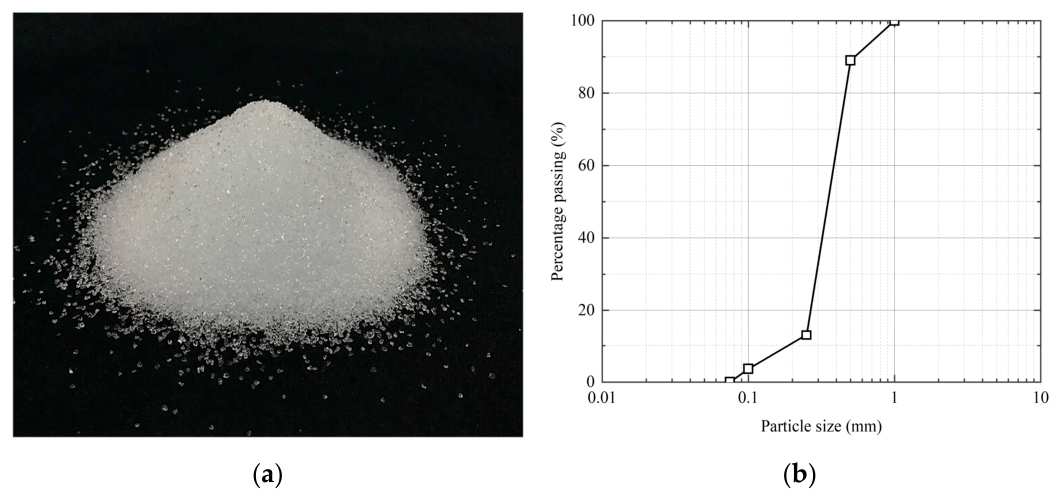
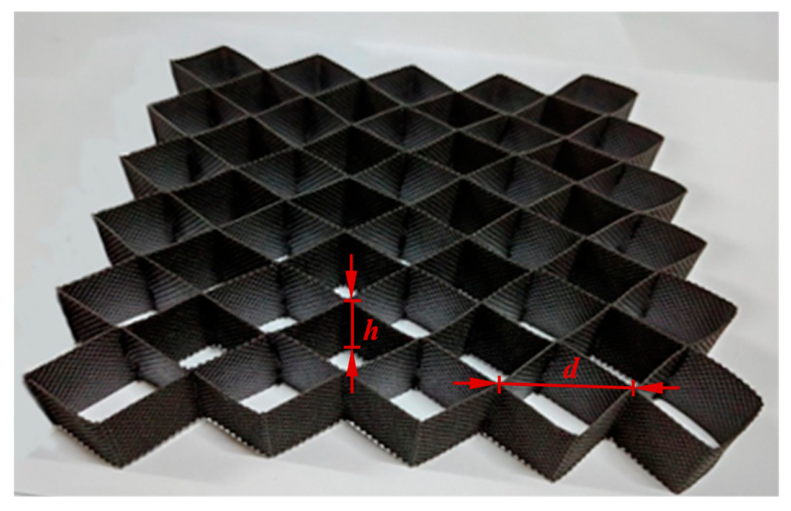
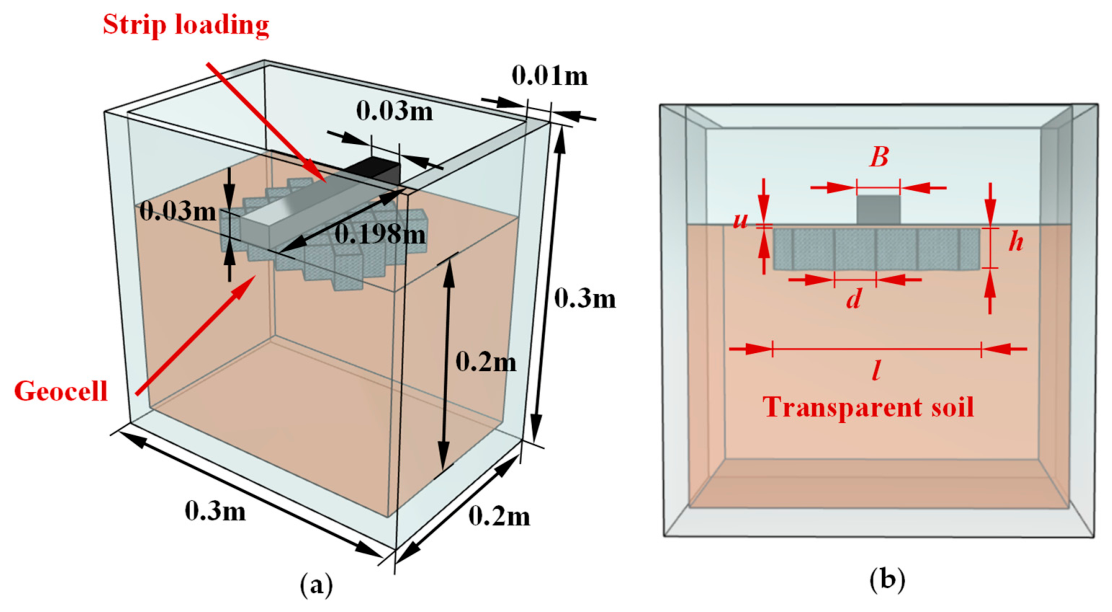
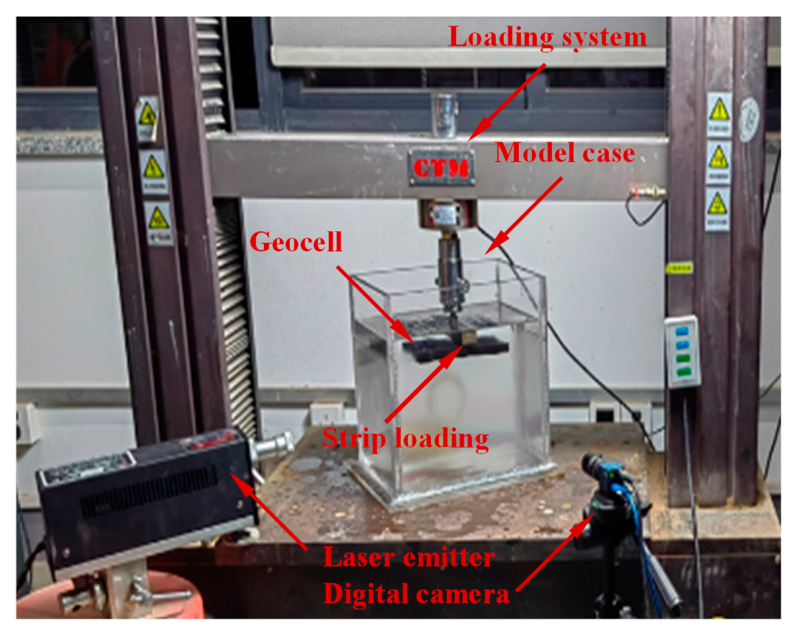
Transparent soil model tests were performed to examine the bearing behavior of geocell-reinforced foundations. High-purity fused quartz sand (SiO2 99.99%) (Figure 1a) with a refractive index of 1.4586 (20 °C), particle size range of 0.075–1 mm (Figure 1b), and minimum dry density of 1.08 g/cm3 was used as the soil analog. The sand exhibited Cu = 2.06 and Cc = 1.20. The transparent pore fluid consisted of 90 NF white oil and n-dodecane mixed at a mass ratio of 1:4, producing a refractive index of 1.4581 (20 °C), closely matching that of the quartz sand to ensure optical clarity [41]. Geocells (Figure 2) were manually fabricated using a woven geotextile with a tensile strength of 2.11 kN/m2 and tensile stiffness of 4.77 kN/m [21]. The cell height of the geocell is denoted by “h”, and the cell spacing is denoted by “d”. All physical parameters of the transparent soil and mechanical properties of geocells are summarized in Table 1 [42,43,44,45]. The model container (0.3 m × 0.2 m × 0.3 m) was constructed from 0.01 m thick acrylic plates (Figure 3) [46]. A stainless-steel strip footing (0.198 m × 0.03 m × 0.03 m) was used for loading, with soil prepared to a height of 0.2 m. The footing width (B = 0.03 m) was used to define the reinforcement parameters, including a cell spacing of 1B, a cell height of 1B, a geocell length of 5B, and an embedment depth of 0.1B [47]. The experimental setup is shown in Figure 4. Loading was applied at a rate of 2 mm/min using a universal testing machine [48,49]. A 60 W laser (500 nm) and a high-resolution CCD camera (5496 × 3672 pixels) were used for deformation visualization.
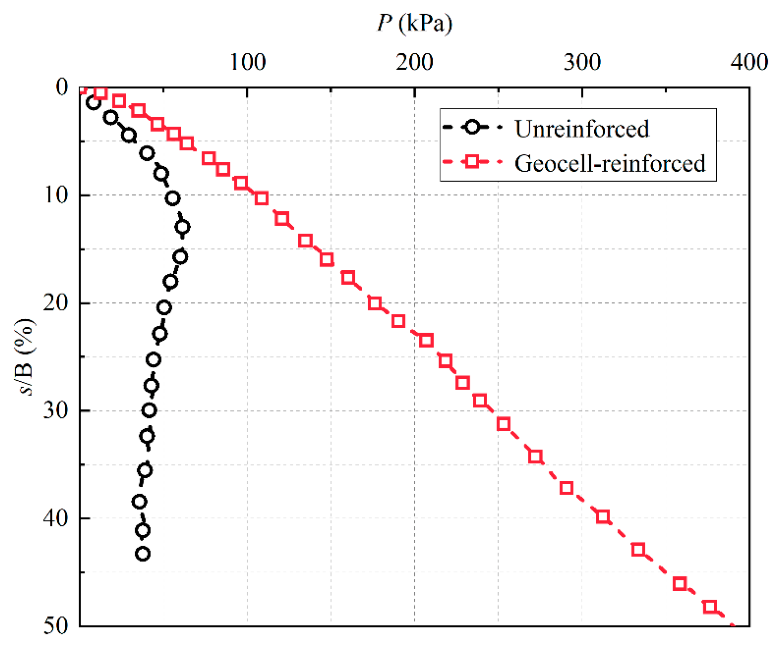
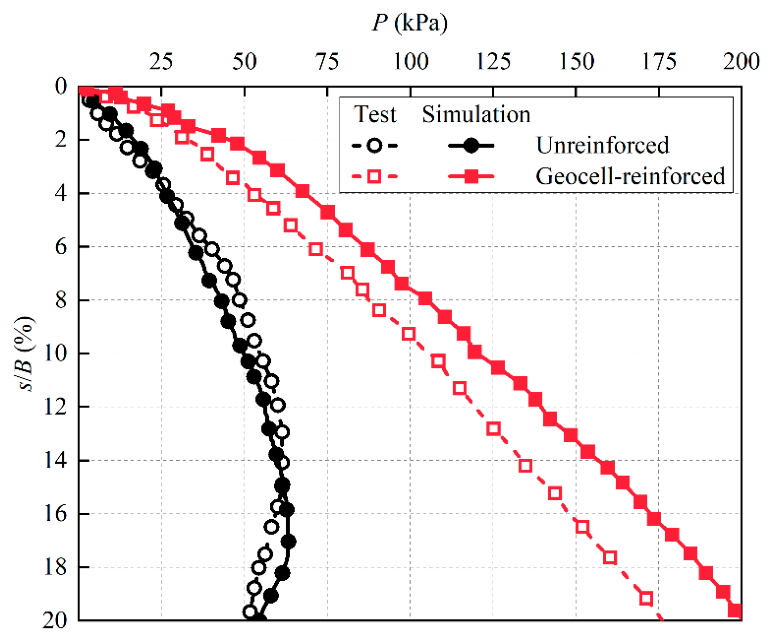
Figure 5 shows the pressure–settlement (P-s) curves obtained from the transparent soil model tests. The geocell-reinforced foundation exhibits continuous strain-hardening behavior without a clear peak failure load, indicating that an absolute ultimate bearing capacity was not reached. Therefore, the pressure corresponding to a settlement ratio of s/B = 13% was adopted as a comparative bearing capacity criterion based on the settlement range observed in the common practice for reinforced foundation interpretation in this study [19,27,54]. The curves clearly indicate that geocell reinforcement substantially increases the bearing pressure and restricts settlement compared with the unreinforced foundation.

3. PFC3D Numerical Simulations

3.1. Methodologies

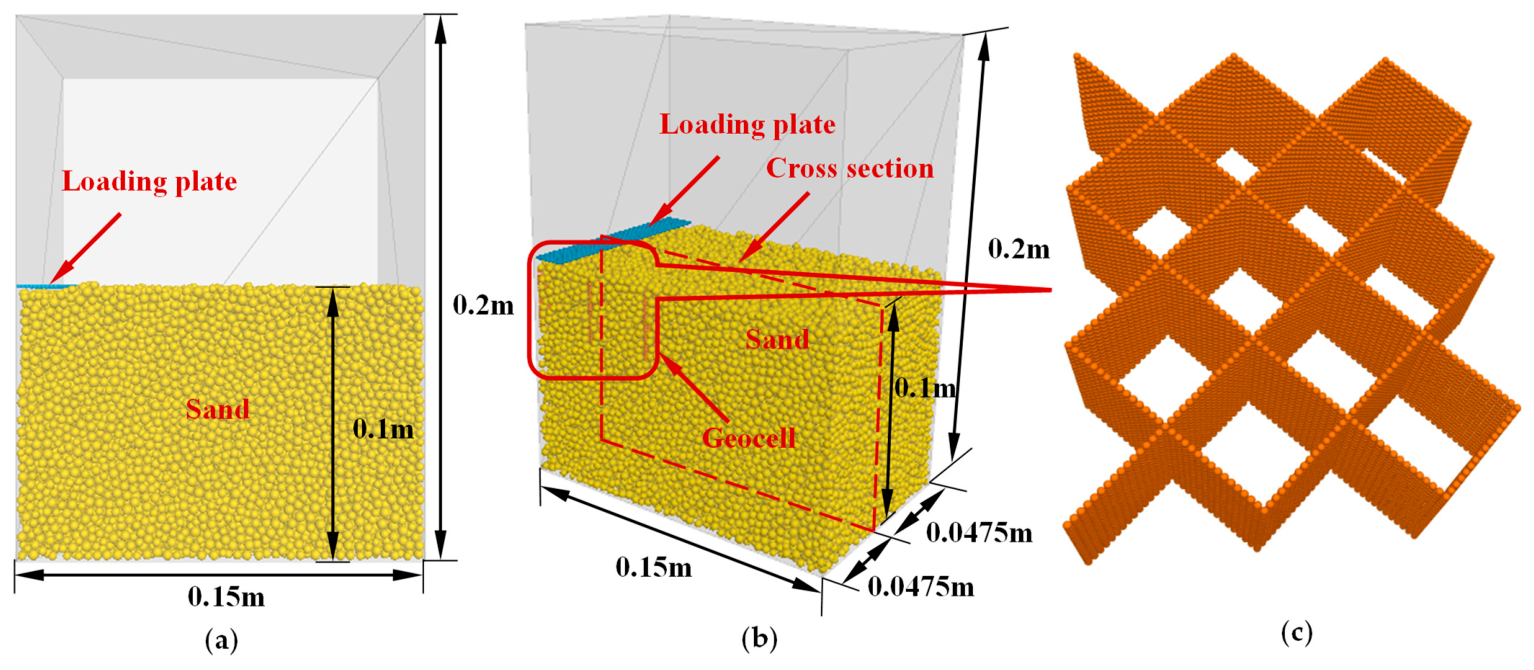
Numerical simulations in this study were conducted using the PFC3D. The model container walls were represented by rigid wall elements. The loading plate was modeled as a rigid, non-deformable clump element. Soil and geocell materials were simulated using spherical ball elements. A linear contact bond was assigned between soil particles to permit force transmission only, whereas a linear parallel bond was used for geocell particles to enable the transfer of both forces and moments, thereby reproducing the structural stiffness of the reinforcement. To ensure computational efficiency while maintaining mechanical fidelity, the physical model was simplified following established modeling practices [19,55]. Due to geometric symmetry, only half of the container was modeled along the longitudinal direction. Along the width direction, the numerical domain was limited to approximately three cell spacings (0.09 m). Based on experimental observations indicating negligible particle displacement below a depth of 0.1 m, the vertical height of the soil layer was reduced to half of the actual test height. The final dimensions of the numerical model were 0.15 m × 0.095 m × 0.2 m (length × width × height), with a soil layer thickness of 0.1 m. The horizontal distance from the footing edge (width B = 0.03 m) to the lateral rigid boundary is 0.135 m (4.5B), while the depth of the effective soil domain beneath the footing is 0.1 m (>3B). A boundary distance exceeding 3B–4B is generally considered sufficient to minimize boundary effects [56,57,58]; therefore, the selected domain dimensions are expected to effectively reduce boundary interference. Meanwhile, employing the actual particle size for the foundation model would incur prohibitive computational costs, exceeding the capacity of standard computing resources. Consequently, the particle upscaling technique is widely adopted in the DEM to enhance computational efficiency [59,60,61]. Although enlarged particles may overestimate interface interlocking [62,63], they could be considered to be reliable as the particles properties are calibrated with the experimental data in this study [see Appendix A].
The developed PFC3D models for both the unreinforced and geocell-reinforced foundations are presented in Figure 6. Figure 6a shows the front view of the unreinforced foundation model. It clearly demonstrates that the loading plate was placed directly on the foundation surface with no embedment. Figure 6b illustrates the 3D layout of the geocell-reinforced foundation, where the red dashed line denotes the cross-section used for subsequent internal analysis. The corresponding numerical representation of the geocell structure is presented in Figure 6c.

3.2. Materials and Parameter Calibration

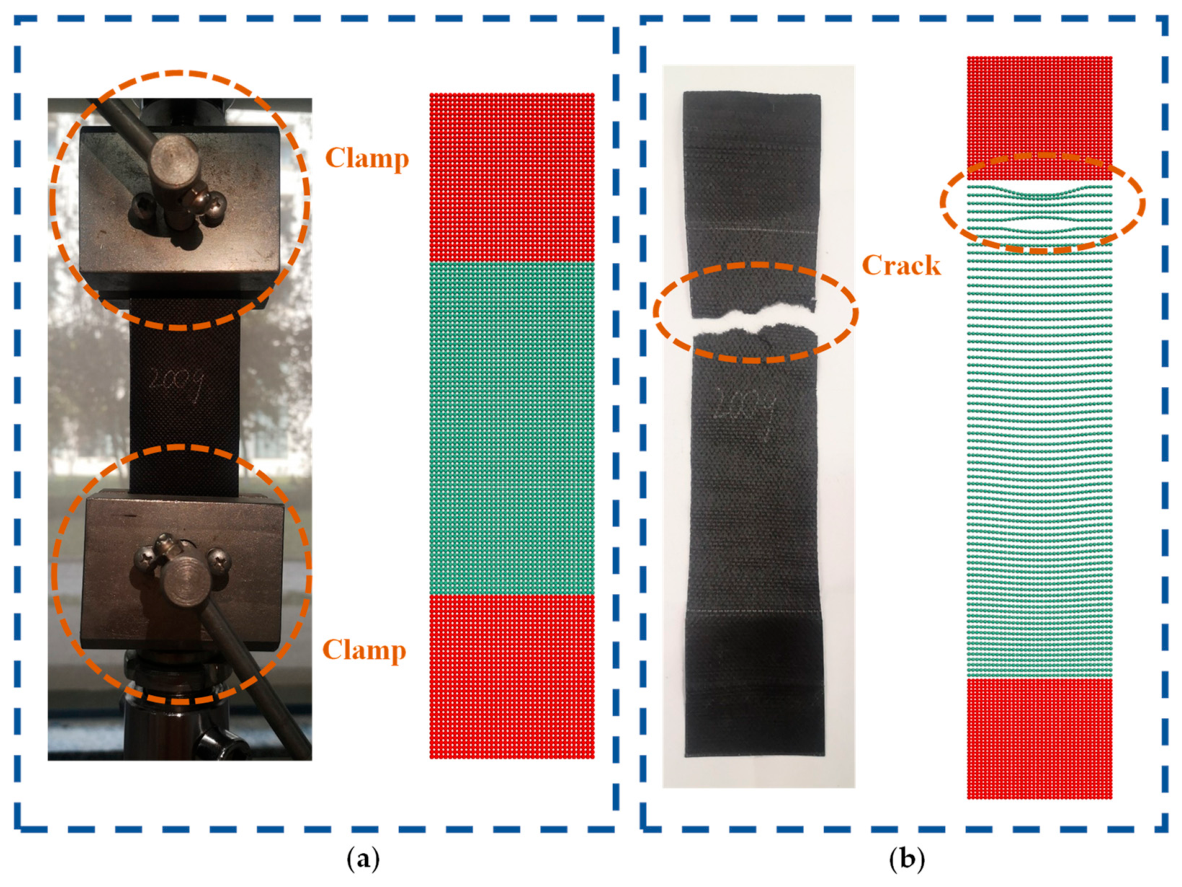
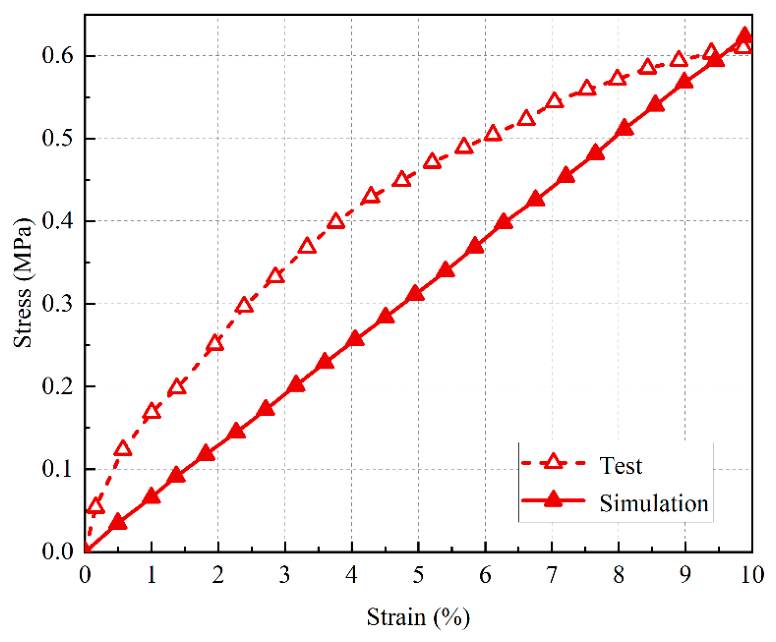
The microparameters of the geocell are calibrated by establishing a strip tensile model of the geocell in PFC, as shown in Figure 7. Red particles represent the clamped ends of the geocell strip, and green particles denote the tensioned region (Figure 7a). The size and tensile rate of the geocell strip in numerical simulation tensile tests are consistent with those in laboratory tests. The micromechanical parameters are iteratively adjusted until the numerical simulation results exhibit a failure mode (Figure 7b) and stress–strain curve (Figure 8) that closely match those obtained from the physical test. To quantitatively validate the numerical model, a statistical comparison between the experimental and simulated results was performed. Data alignment via linear interpolation yielded a Root Mean Square Error (RMSE) of approximately 0.11 MPa across the entire strain domain. Furthermore, at the ultimate limit state (strain > 8%), the Mean Absolute Percentage Error (MAPE) was found to be as low as 4.1%. While the linear contact model inherent to the DEM simulation slightly underestimates the nonlinear initial stiffness during the early loading phase, these statistical metrics confirm that the calibrated model is highly reliable in predicting the ultimate bearing capacity and macroscopic failure behavior of the geocell-reinforced foundation. A summary of the calibrated geocell parameters is presented in Table 2. The soil particles are connected by a linear contact model with a diameter of 1–2 mm. Micromechanical parameters, including contact stiffness and bond stiffness, were initially assigned based on the literature values [23,24,64] and iteratively calibrated using a trial-and-error procedure against the experimental P-s curve of the unreinforced foundation. The normal and shear contact stiffness, friction coefficient, and particle density are calibrated incrementally. Force and displacement data at locations matching the physical test positions are recorded during simulation. Parameters were refined until the simulated P-s curve closely matched experimental results, establishing the final micromechanical properties for the soil particles. The vertical bearing capacity under the strip footing is primarily governed by the internal shear strength of the soil and the lateral confinement provided by the geocell [18]. Therefore, the friction at the footing–soil interface has a negligible impact on the overall macroscopic bearing mechanism [65]. To simplify the contact model and enhance computational efficiency, the friction coefficient of the footing was set to 0 in this study. The calibrated parameters of the geocell and soil particles are summarized in Table 2.

4. Results and Discussion

4.1. P-s Curves

Figure 9 presents a comparison of the pressure–settlement (P-s) curves obtained from both experimental tests and numerical simulations for unreinforced and geocell-reinforced foundations under strip loading. The simulated P-s curves show good agreement with the experimental data, indicating that the selected micromechanical parameters in the PFC3D model effectively capture the observed mechanical behavior. The findings unequivocally demonstrate that geocell reinforcement significantly enhances the bearing capacity, increases the stiffness of the soil, reduces compressibility, and thereby improves the overall stability of the foundation. In the initial loading stage, the P-s curves of the unreinforced and geocell-reinforced foundation increase linearly (see solid lines), corresponding to an elastic deformation phase. The slope of the P-s curve for the unreinforced foundation is steeper than that of the geocell-reinforced foundation. As settlement progresses, the unreinforced foundation gradually deviates from linearity, with its slope increasing continuously, marking the onset of plastic deformation and a progressive loss of bearing capacity. In contrast, the geocell-reinforced foundation remains in the nearly elastic stage, with its bearing capacity continuing to increase linearly, consistent with the findings of Zhang et al. [66] and Demirdogen et al. [67]. The quantitative comparison further confirms the effectiveness of geocell reinforcement. When s/B reaches 13%, the unreinforced foundation attains its bearing capacity of 60.6 kPa. At the same settlement level, the bearing capacity of the geocell-reinforced foundation is 126.8 kPa, which is 2.1 times that of the unreinforced foundation.

4.2. Displacement Distribution of Soil Particles

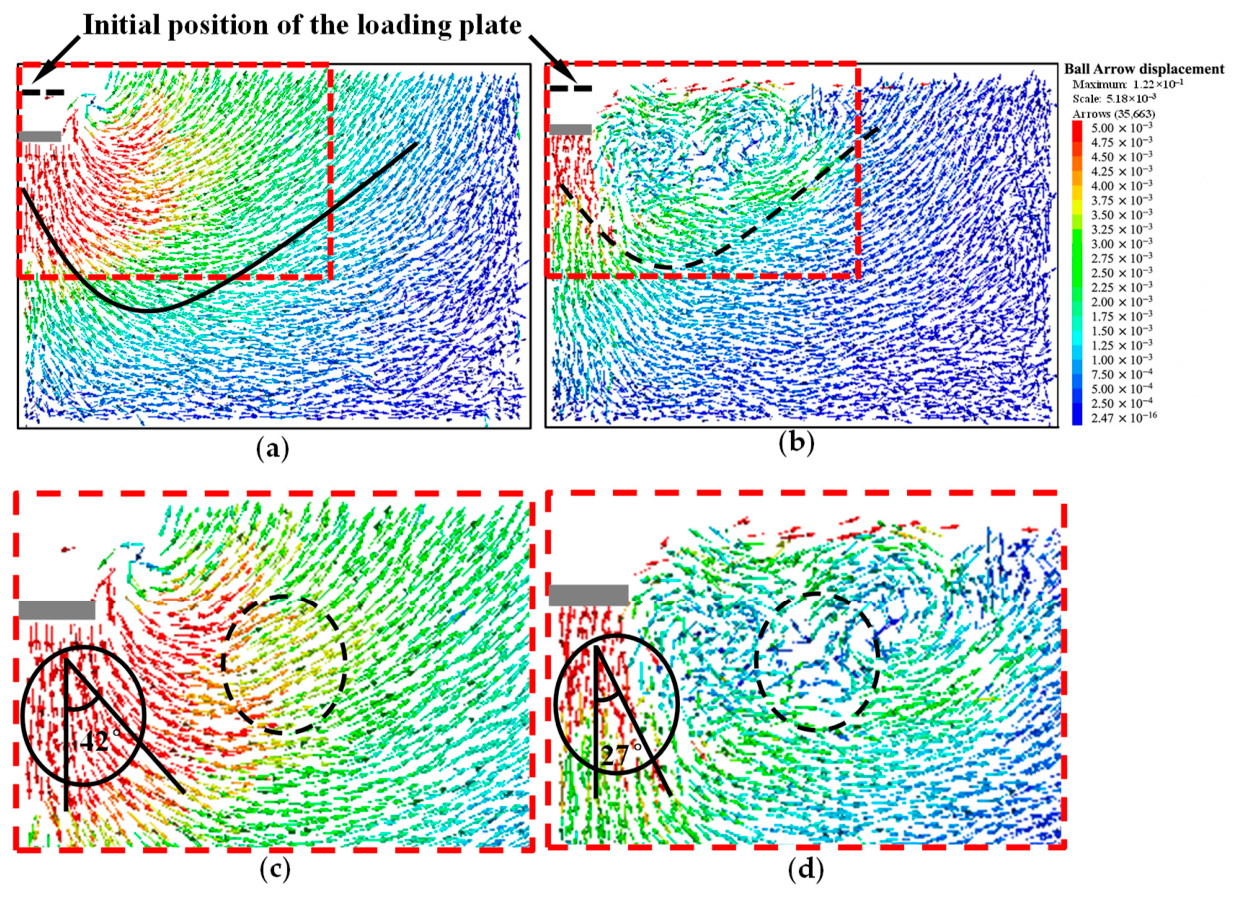
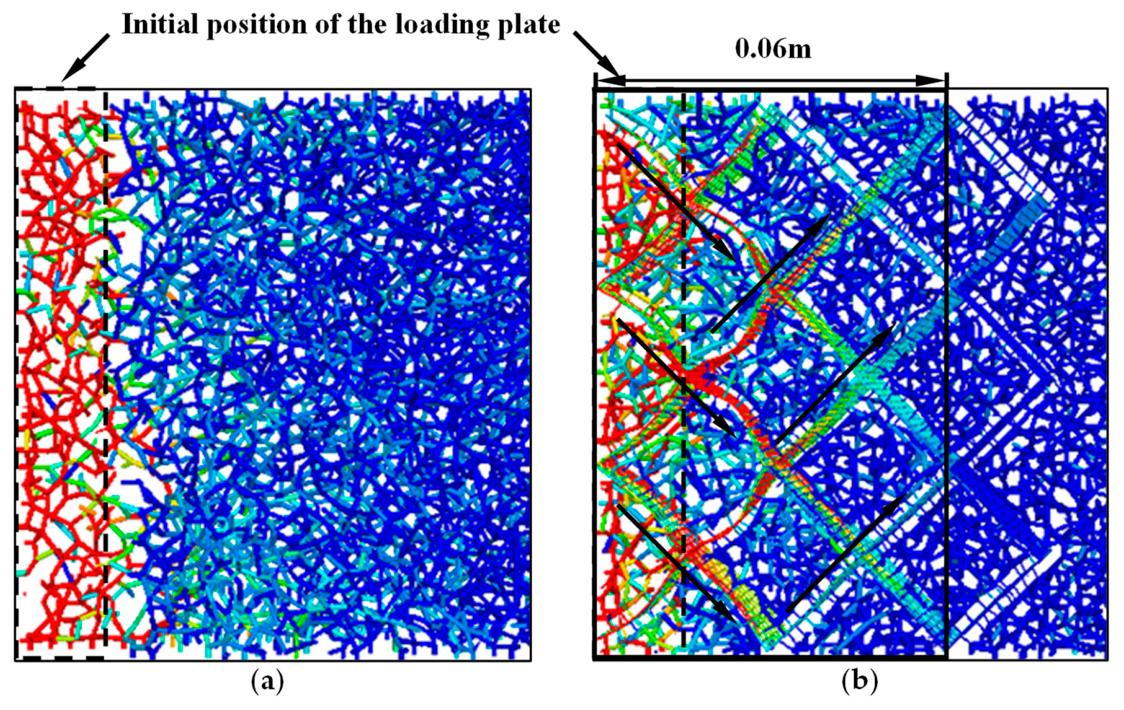
Figure 10 illustrates the displacement vector fields of soil particles in both unreinforced and geocell-reinforced foundations subjected to strip loading. The length and direction of each arrow represent the relative magnitude and orientation of particle movement, respectively. In the unreinforced foundation (Figure 10a), particle displacement is most pronounced immediately below the loading plate and propagates laterally, forming a continuous steep slip surface (see solid line) that corresponds to the broad failure region of general shear failure. In the geocell-reinforced foundation (Figure 10b), the geocell walls act as physical boundaries that interrupt lateral particle migration, effectively confining the displacement field and restricting the resulting slip surface (see dashed line) entirely within the reinforced zone. The underlying soil remains essentially stable and non-participatory in the failure mechanism, transforming the failure mode from general shear to localized failure, as suggested by Wu et al. [35]. A detailed comparison of the magnified regions within the dashed boxes in Figure 10a,b (Figure 10c,d) further reveals the restraining effect of the geocell. Soil particle displacements within the reinforced zone are substantially smaller than those at corresponding locations in the unreinforced foundation, as indicated by the comparison between the dashed circles in Figure 10c,d. Moreover, the rotation angle of the displacement vectors directly beneath the loading plate decreases from 42° in the unreinforced soil (see solid circles in Figure 10c) to 27° in the reinforced soil (see solid circles in Figure 10d). This 15° vector realignment provides quantitative proof of the lateral resistance exerted by the geocell walls. By structurally arresting horizontal particle extrusion, the geocell forces the kinematic trajectories downward, effectively mitigating the heave of adjacent surfaces on both sides of the loading plate and limiting overall foundation settlement.

4.3. Contact Force Distribution of Soil Particles

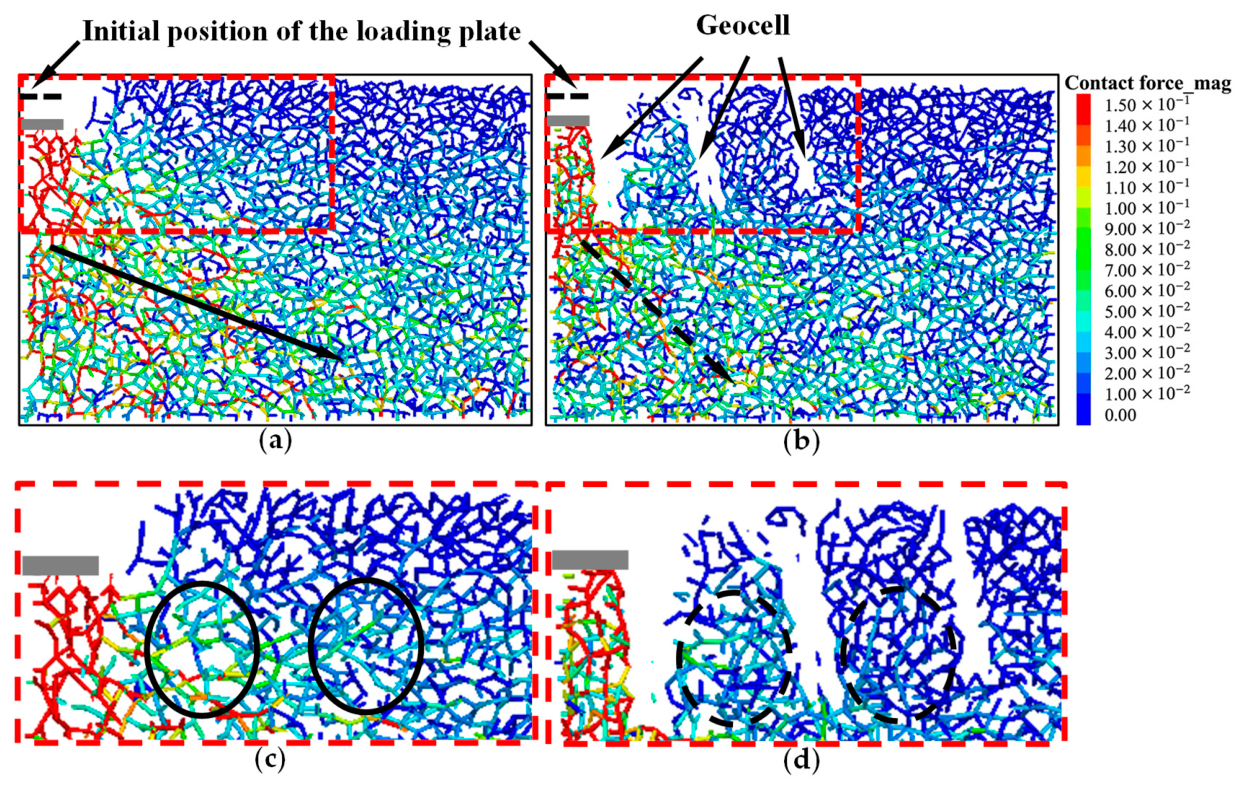
Figure 11 illustrates the distribution of contact force chains among soil particles under strip footing loading for both unreinforced and geocell-reinforced foundations. In the unreinforced foundation (Figure 11a), force chains are densest beneath the loading plate and propagate rapidly from the footing edges, forming a connected inclined concentration zone (see solid line arrow) that corresponds to the slip surface of general shear failure. Analysis of the chain orientation shows a steep inclination toward the lateral edges, indicating concentrated load paths and the early development of continuous shear planes. In the geocell-reinforced foundation (Figure 11b), the white gaps visible in the figure correspond to the geocell strips. These strips act as quasi-rigid planes that interrupt the continuity of force chains, effectively segmenting the soil mass and delaying the formation of inclined slip surfaces (see dashed line arrow). The PFC3D simulation shows that contact forces within the reinforced layer are redistributed laterally along the geocell, reducing local stress concentrations in the upper soil, as suggested by Hou et al. [36]. Magnified regions within the dashed line boxes in Figure 11a,b (Figure 11c,d) further show that the force chains in the soil directly above and adjacent to the geocell are weaker than those in the unreinforced foundation, as indicated by the comparison between the dashed and solid circles. This demonstrates that the geocell absorbs part of the applied load through its stiffness, deflects force transmission paths, and promotes deeper, more uniform load penetration.

4.4. Displacement Analysis of Reinforcement–Soil Interaction

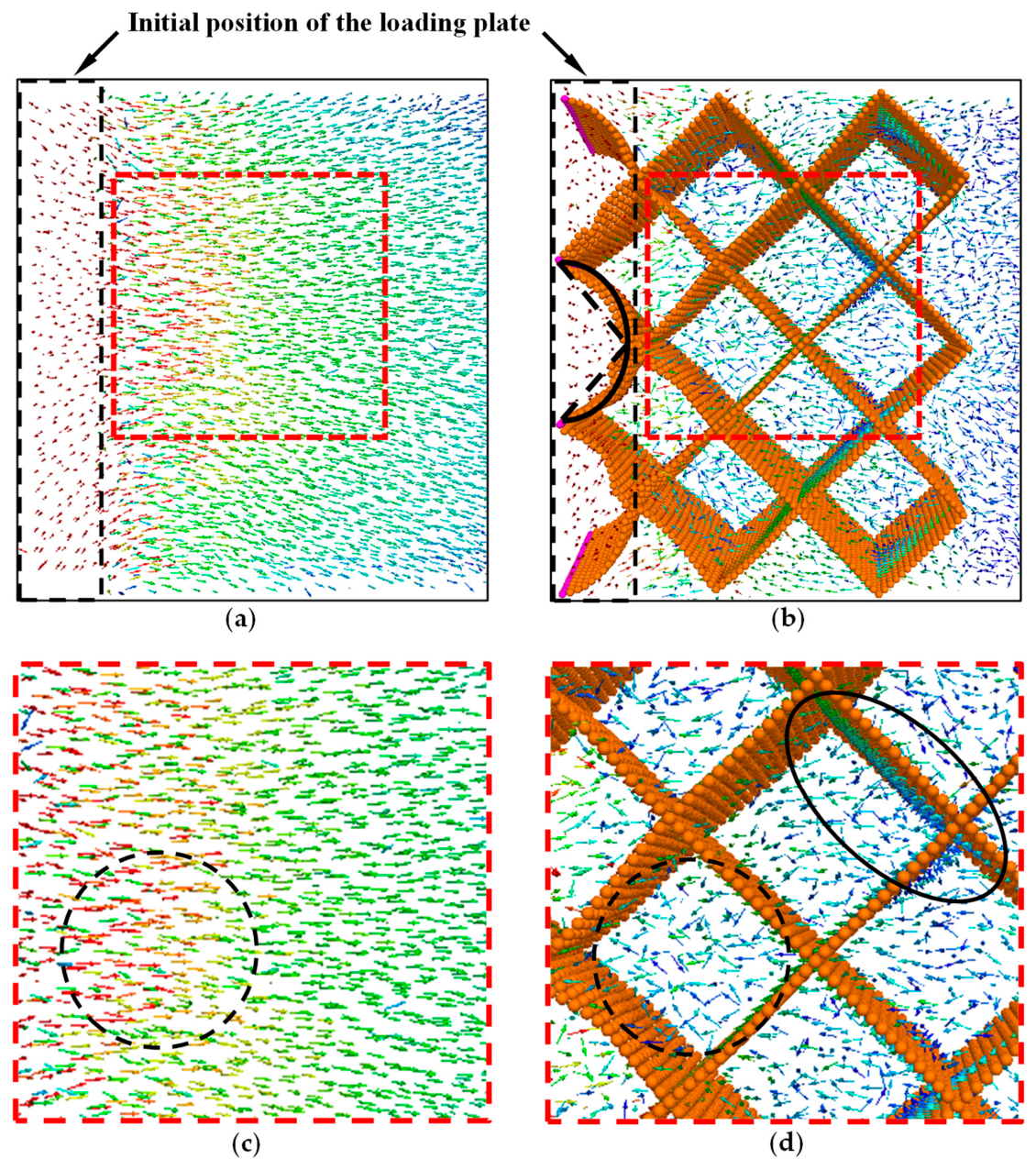
Figure 12 presents the top-view distribution of particle displacements in both unreinforced and geocell-reinforced foundations under strip loading. In the unreinforced foundation (Figure 12a), displacements are intensely concentrated directly beneath the footing (see black dashed box), forming an elongated deformation zone with sharp stress gradients. Conversely, the geocell-reinforced foundation (Figure 12b) exhibits a remarkably uniform displacement field. This homogenization effect results from the interconnected geocell network, which effectively intercepts and laterally redistributes the concentrated vertical stress. Moreover, the geocell beneath the loading plate underwent significant expansion, transitioning from its initial quadrilateral geometric shape (see dashed line) to an arched configuration (see solid arc). Notably, the geocell structure effectively constrains soil movement within its cells, as evidenced by the different particle displacement patterns in the magnified regions (Figure 12c,d). Specifically, soil particles in the unreinforced foundation exhibit predominantly unidirectional rightward movement, as highlighted by the dashed circle in Figure 12c. In contrast, particles within the geocell-reinforced foundation display irregular but more uniform displacement patterns with evident lateral restraint, as indicated by the dashed circle in Figure 12d. This fundamental difference occurs because the geocell walls physically intercept lateral soil movement, forcing particles to redistribute their energy within the confined cell structure rather than escaping outward. The resulting mechanical interaction between the soil and geocell creates a reinforced influence zone around the geocell perimeter (see the solid circle in Figure 12d), where particle trajectories are significantly altered. This constraint mechanism enhances particle interlocking and compaction within the cells, leading to improved load distribution and reduced localized deformation, as investigated by Dash et al. [54] and Gao et al. [68]. This mechanism also explains the marked differences in particle displacements observed between the dashed circles in Figure 10c,d.

4.5. Contact Force Analysis of Reinforcement–Soil Interaction

Figure 13 presents a comparative top-view visualization of contact force distributions in unreinforced and geocell-reinforced foundations, revealing fundamental differences in load transfer mechanisms. In the unreinforced foundation (Figure 13a), force chains are intensely concentrated directly beneath the loading plate, forming a narrow, vertical load path characterized by high-magnitude red force chains (see black dashed box). This concentration indicates localized stress transfer with minimal lateral dispersion, resulting in significant stress gradients and potential for localized failure. Conversely, the geocell-reinforced foundation (Figure 13b) demonstrates a markedly different force distribution pattern. Through friction and interlocking [50,69] between the cell walls and the surrounding soil, the geocell integrates the initially loose soil particles into a coherent composite system, thereby generating a flexible raft effect [9]. This composite effectively redistributes and disperses the applied load laterally by a distance approximately equal to two cell spacings (0.06 m) (see black solid box). The force chains are visibly guided along the geocell walls (see black solid arrows), which function as a structural framework to convert vertical forces into horizontal components, thereby allowing more soil to participate in load bearing. The flexible raft effect as well as force chain redirection mechanism significantly reduce stress concentration beneath the loading plate while enhancing overall foundation stability. The transition from a single dominant load path in the unreinforced case to a multi-directional, distributed force network in the reinforced configuration clearly illustrates how geocell reinforcement fundamentally alters the soil’s mechanical behavior under loading.

4.6. Displacement Distribution of Geocell

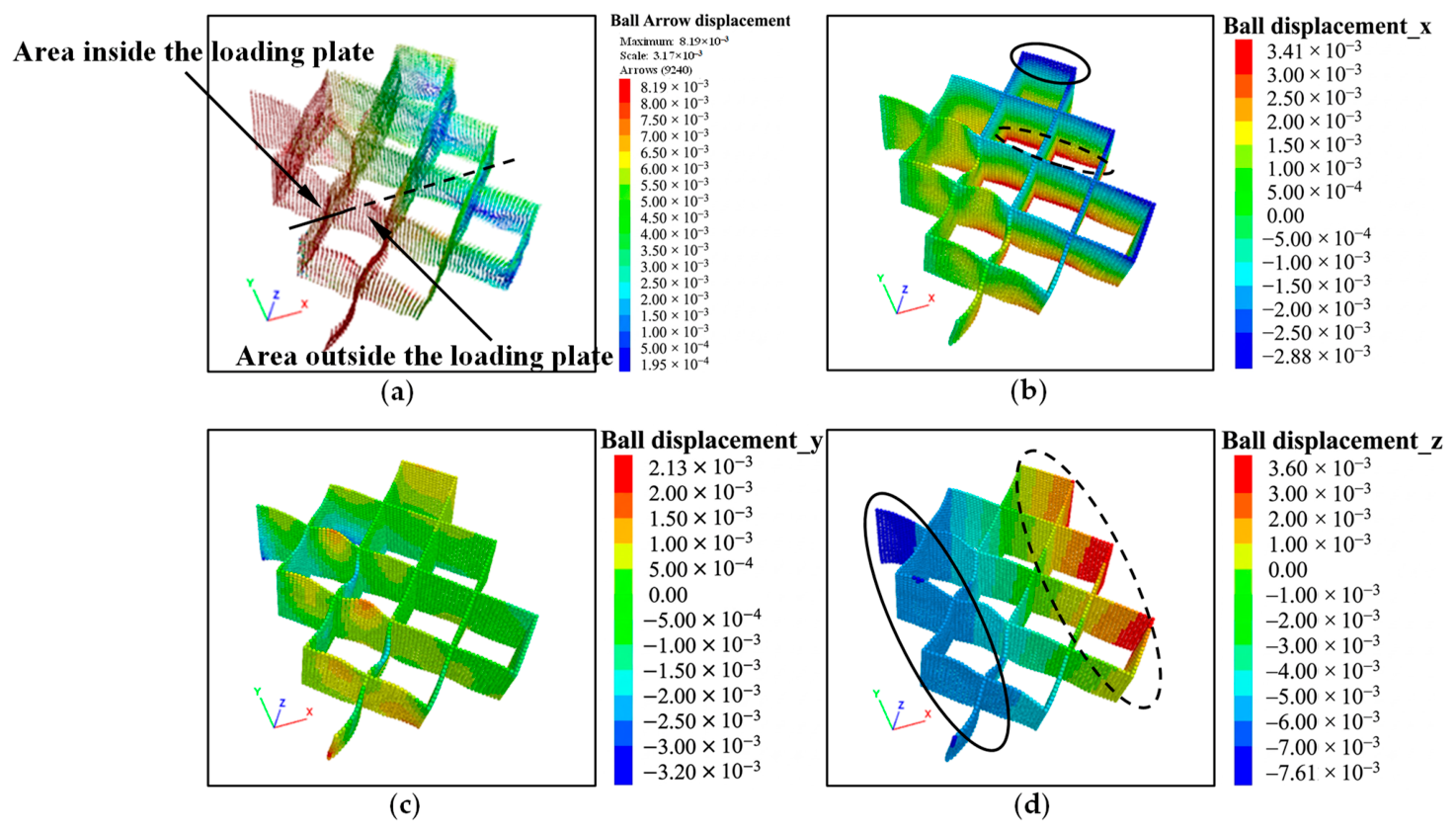
Figure 14 illustrates the displacement distribution of the geocell under strip loading, with the coordinate axes indicating the positive directions. The color transition from red to blue represents a shift from positive to negative displacement, while the numerical value denotes the absolute magnitude of displacement. Figure 14a displays the overall displacement vector field with arrow directions denoting the movement tendencies of geocell particles. The geocell wall experiences maximum strains immediately below the footing, which diminish as the distance from the loading area increases, consistent with the observations of Demirdogen and Gurbuz [51]. The transverse displacement distribution in Figure 14b shows that the extreme positive and negative displacement values are highly concentrated on the lateral walls at the transverse edges of the geocell (see solid and dashed circles). This indicates that the strong lateral expansion tendency of the soil beneath the loading plate is effectively intercepted by the geocell sidewalls. The small transverse displacement gradient within the geocell further proves that the geocell successfully locks the soil within respective cells, maintaining high structural stability. The longitudinal displacement distribution in Figure 14c presents a similar but milder lateral movement pattern, which perfectly aligns with the plane strain assumption for the infinitely long strip footing. As shown in Figure 14d, substantial vertical settlement beneath the loading plate (see dashed circle) and upward heaving at the periphery (see solid circle) are observed. The resulting concave deformation of the geocell is known as the pocket effect [9]. Acting as a tensioned membrane, the deformed geocell develops additional tensile forces under footing, the vertical component of which counteracts part of the load, reduces vertical deformation, and ultimately improves foundation bearing capacity. This deformation-induced tensioned membrane effect further amplifies the reinforcement performance [15,52,66].

4.7. Stress Distribution of Geocell

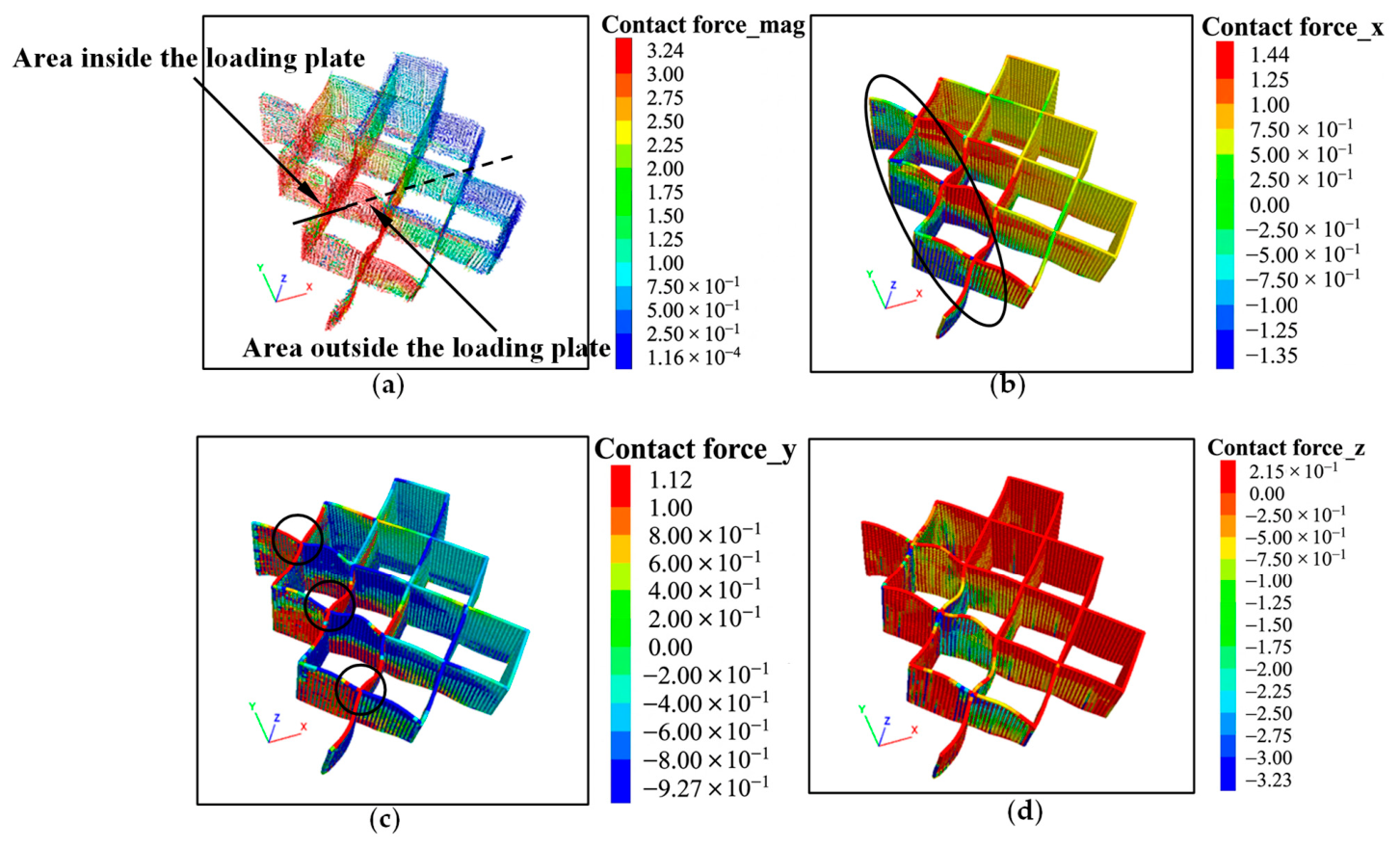
Figure 15 presents the distribution of the contact force chains of the geocell under strip loading. The color transition from red to blue represents a transition from compression to tension, while the numerical value denotes the absolute force magnitude. The overall contact force distribution (Figure 15a) shows a pronounced stress concentration (red zone) near the loading plate, which arises from direct load transfer to the underlying geocell units that form the primary load path, while force magnitudes gradually decrease toward the periphery. The alternating positive and negative values in the transverse (Figure 15b) and longitudinal (Figure 15c) contact force distributions indicate a tension–compression coupled stress state in the horizontal plane. The bidirectional load transfer further confirms the frictional and interlocking interaction between the soil and geocell. Notably, distinct stress concentrations are observed near the loading plate (see solid circle in Figure 15b) and at the cell junctions (see solid circle in Figure 15c). The concentration adjacent to the loading plate (see solid circle in Figure 15b) arises from lateral confinement exerted by the geocell walls against the soil under the applied load (see solid arc in Figure 15b). These tensile forces in the walls are transmitted outward along rigid paths through the stiffer DEM-modeled cell connections [53], which also experience elevated bending moments during geocell flexure, thereby amplifying tensile and compressive stresses. The vertical stress distribution (Figure 15d) dominated by compressive stresses further supports this mechanism. Localized stress concentrations are mitigated as stresses diffuse through the geocell-reinforced zone, generating a raft-like effect that spreads the load, lowers average subsoil pressure and improves overall bearing capacity.

5. Conclusions

This study employed PFC3D to investigate the bearing capacity and reinforcement mechanism of geocell-reinforced foundations. The primary conclusions are as follows:
  • The combination of transparent soil model tests and three-dimensional discrete element modeling provides an effective approach to visualize and quantify the micromechanical behavior of geocell-reinforced foundations under strip loading. The validated PFC model captures key features of soil–geocell interactions, including particle displacement fields, force chain evolution, and reinforcement response.
  • Geocell inclusion significantly enhances structural performance, increasing the bearing capacity from 60.6 to 126.8 kPa at a defined bearing capacity criterion, representing an improvement of 2.1 times over an unreinforced foundation. The geocell walls act as rigid physical boundaries that microscopically intercept the lateral migration and horizontal extrusion of soil particles. This mechanism restricts the slip surface entirely within the reinforced zone, transforming the failure mode from general shear to localized failure. It also forces the downward realignment of displacement vectors directly beneath the loading plate, reducing the rotation angle from 42° to 27° and thereby effectively mitigating the heave of adjacent surfaces on both sides of the loading plate.
  • The quasi-rigid three-dimensional geocell network interrupts the continuous steep contact force chains inherent in unreinforced foundations. Concentrated vertical stresses are converted into horizontal components through interfacial friction and mechanical interlocking. Force chains are visibly guided laterally along the geocell walls, transforming a single dominant load path into a multi-directional distributed force network. This mitigates shallow localized stress concentrations and promotes deeper, more uniform load penetration.
  • The geocell structure expands and undergoes concave flexural deformation subjected to foundation settlement, transitioning from an initial quadrilateral shape to an arched configuration. This geometric alteration fully mobilizes the pocket effect and tensioned membrane effect, developing additional tensile forces within the deformed walls. The vertical component of these forces directly counteracts the applied load, ultimately limiting vertical deformation and amplifying the reinforcement performance.
  • The geocell functioning as the primary load-bearing skeleton exhibits a coupled tension–compression stress state in the horizontal plane due to bidirectional load transfer. Stiffer cell junctions experience elevated bending moments and distinct stress concentrations, channeling forces along rigid paths. This response enables the reinforced layer to act as a flexible raft, which significantly broadens the load dispersion area and lowers the average subsoil pressure.
These findings provide a comprehensive understanding of the reinforcement mechanisms of geocells and their influence on the overall performance of reinforced-foundation systems using PFC3D. For future studies, the application of coupled DEM-FEM approaches for more precise simulations as well as comprehensive parametric investigations on loading geometry, geocell joint design, and soil relative density need to be systematically evaluated to better guide practical design.

Author Contributions

J.H., writing—review and editing, writing—original draft, visualization, validation, supervision, resources, project administration, methodology, investigation, funding acquisition, data curation, and conceptualization. J.O. and X.X., writing—original draft, visualization, software, investigation, and data curation. All authors have read and agreed to the published version of the manuscript.

Funding

Financial support for Hou’s contributions to this study was provided by the National Natural Science Foundation of China (NSFC) (Nos. 52478349, 51978390); the Qinghai Provincial Department of Science and Technology International Cooperation Project, grant number [2025-HE-8061]; and the China Scholarship Council (CSC 202506890127). The APC was funded by [2025-HE-8061].

Institutional Review Board Statement

Not applicable.

Informed Consent Statement

Not applicable.

Data Availability Statement

The data presented in this study are available on request from the corresponding author.

Conflicts of Interest

The authors declare no conflicts of interest.

Appendix A

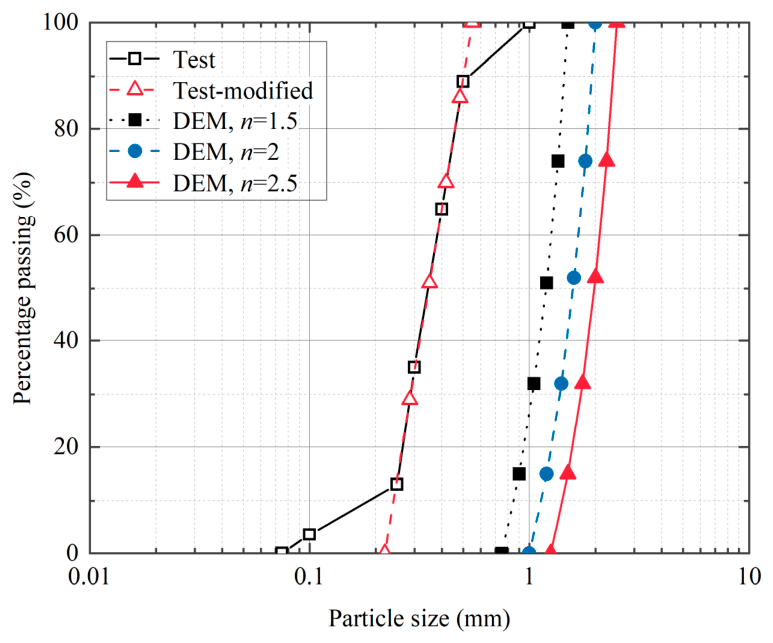
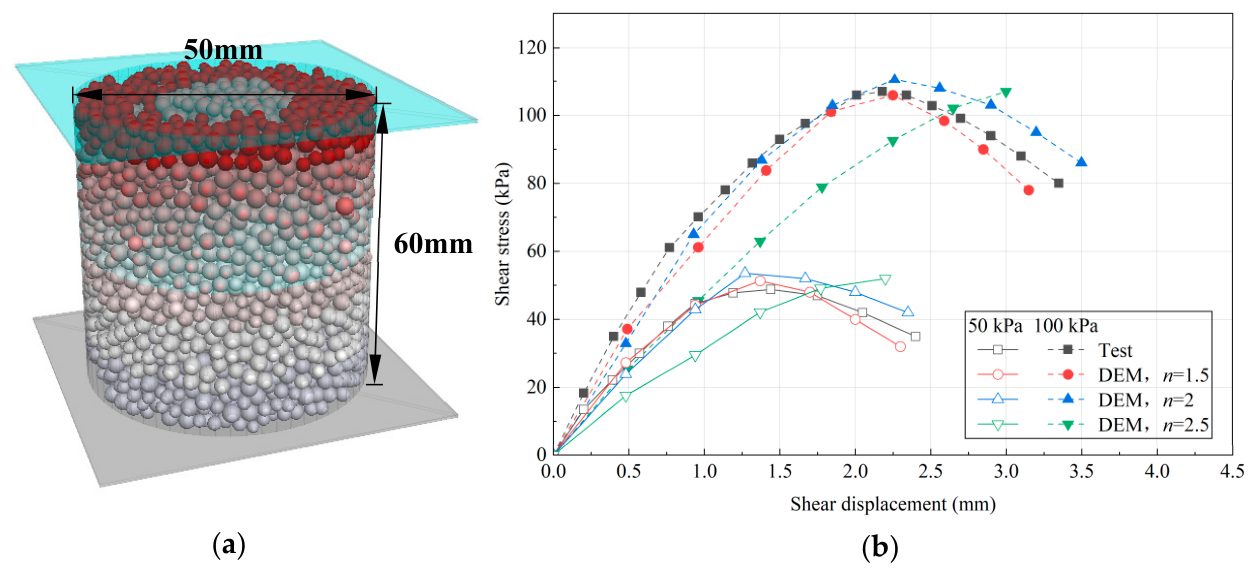
Because the particle scaling factor (n) directly dictates the reliability and computational efficiency of discrete element models, a sensitivity analysis was conducted using three scaling magnitudes (n = 1.5, 2, and 2.5) (Figure A1). The initial gradation curve was simplified by truncating the negligible fractions of the finest (d ≤ 0.1 mm) and coarsest (d > 0.5 mm) particles, while maintaining the mean particle size (d50 = 0.35 mm). This modified grading curve was then uniformly upscaled by a factor of n to generate the numerical specimens. As depicted in Figure A2a, a cylindrical numerical shear model (50 mm in diameter and 60 mm in height) was established. The specimens were subjected to four constant normal stresses, 50, 100, 150, and 200 kPa, prior to shearing. The macroscopic shear stress–displacement responses were continuously recorded. All simulated specimens exhibited typical strain-hardening behavior (Figure A2b). The numerical models with smaller scaling factors (n = 1.5 and 2) demonstrated excellent agreement with the physical test data, whereas the n = 2.5 model significantly underestimated the shear stiffness and strength. Since the discrepancy between the n = 1.5 and n = 2 curves was negligible and adopting n = 1.5 would generate an excessively large number of particles, leading to prohibitive computational costs, a scaling factor of n = 2 was selected for balancing computational efficiency and numerical accuracy.
Figure A1. Particle size distribution used for tests and DEM simulations.
Buildings 16 02371 g0a1
Figure A2. Shear test using different scaling factors. (a) shear test model; (b) comparison of shear stress–shear displacement curves from model test and numerical simulation.
Buildings 16 02371 g0a2

References

  1. Latha, G.M.; Murthy, V.S. Effects of Reinforcement Form on the Behavior of Geosynthetic Reinforced Sand. Geotext. Geomembr. 2007, 25, 23–32. [Google Scholar] [CrossRef]
  2. Sireesh, S.; Sitharam, T.G.; Dash, S.K. Bearing Capacity of Circular Footing on Geocell–Sand Mattress Overlying Clay Bed with Void. Geotext. Geomembr. 2009, 27, 89–98. [Google Scholar] [CrossRef]
  3. Wesseloo, J.; Visser, A.T.; Rust, E. The Stress–Strain Behaviour of Multiple Cell Geocell Packs. Geotext. Geomembr. 2009, 27, 31–38. [Google Scholar] [CrossRef]
  4. Leshchinsky, B.; Ling, H.I. Numerical Modeling of Behavior of Railway Ballasted Structure with Geocell Confinement. Geotext. Geomembr. 2013, 36, 33–43. [Google Scholar] [CrossRef]
  5. Mehdipour, I.; Ghazavi, M.; Moayed, R.Z. Numerical Study on Stability Analysis of Geocell Reinforced Slopes by Considering the Bending Effect. Geotext. Geomembr. 2013, 37, 23–34. [Google Scholar] [CrossRef]
  6. Sheikh, I.R.; Shah, M.Y. State-of-the-Art Review on the Role of Geocells in Soil Reinforcement. Geotech. Geol. Eng. 2021, 39, 1727–1741. [Google Scholar] [CrossRef]
  7. Bathurst, R.J.; Knight, M.A. Analysis of Geocell Reinforced-Soil Covers over Large Span Conduits. Comput. Geotech. 1998, 22, 205–219. [Google Scholar] [CrossRef]
  8. Zhan, C.; Yin, J.H. Elastic Analysis of Soil-Geosynthetic Interaction. Geosynth. Int. 2001, 8, 27–48. [Google Scholar] [CrossRef]
  9. Zhou, H.; Wen, X. Model Studies on Geogrid- or Geocell-Reinforced Sand Cushion on Soft Soil. Geotext. Geomembr. 2008, 26, 231–238. [Google Scholar] [CrossRef]
  10. David Frost, J.; Kim, D.; Lee, S.-W. Microscale Geomembrane-Granular Material Interactions. KSCE J. Civ. Eng. 2012, 16, 79–92. [Google Scholar] [CrossRef]
  11. Ding, X.; Luo, Z.; Ou, Q. Mechanical Property and Deformation Behavior of Geogrid Reinforced Calcareous Sand. Geotext. Geomembr. 2022, 50, 618–631. [Google Scholar] [CrossRef]
  12. Sitharam, T.G.; Sireesh, S.; Dash, S.K. Model Studies of a Circular Footing Supported on Geocell-Reinforced Clay. Can. Geotech. J. 2005, 42, 693–703. [Google Scholar] [CrossRef]
  13. Madhavi Latha, G.; Rajagopal, K.; Krishnaswamy, N.R. Experimental and Theoretical Investigations on Geocell-Supported Embankments. Int. J. Geomech. 2006, 6, 30–35. [Google Scholar] [CrossRef]
  14. Li, W.; Han, S.; Han, X.; Yao, Y. Experimental and Numerical Analysis of Mechanical Properties of Geocell Reinforced Reclaimed Construction Waste Composite Base Layer. Constr. Build. Mater. 2021, 304, 124587. [Google Scholar] [CrossRef]
  15. Yang, X.; Han, J.; Leshchinsky, D.; Parsons, R.L. A Three-Dimensional Mechanistic-Empirical Model for Geocell-Reinforced Unpaved Roads. Acta Geotech. 2013, 8, 201–213. [Google Scholar] [CrossRef]
  16. Leshchinsky, B.; Ling, H. Effects of Geocell Confinement on Strength and Deformation Behavior of Gravel. J. Geotech. Geoenviron. Eng. 2013, 139, 340–352. [Google Scholar] [CrossRef]
  17. Amiri, A.; Moghaddas Tafreshi, S.N.; Dawson, A.R. Vibration Response of Machine Foundations Protected by Use of Adjacent Multi-Layer Geocells. Geotext. Geomembr. 2023, 51, 15–35. [Google Scholar] [CrossRef]
  18. Dash, S. Bearing Capacity of Strip Footings Supported on Geocell-Reinforced Sand. Geotext. Geomembr. 2001, 19, 235–256. [Google Scholar] [CrossRef]
  19. Tafreshi, S.N.M.; Dawson, A.R. Comparison of Bearing Capacity of a Strip Footing on Sand with Geocell and with Planar Forms of Geotextile Reinforcement. Geotext. Geomembr. 2010, 28, 72–84. [Google Scholar] [CrossRef]
  20. Lal, D.; Sankar, N.; Chandrakaran, S. Behaviour of Square Footing on Sand Reinforced with Coir Geocell. Arab. J. Geosci. 2017, 10, 345. [Google Scholar] [CrossRef]
  21. Kargar, M.; Mir Mohammad Hosseini, S.M. Influence of Reinforcement Stiffness and Strength on Load-Settlement Response of Geocell-Reinforced Sand Bases. Eur. J. Environ. Civ. Eng. 2018, 22, 596–613. [Google Scholar] [CrossRef]
  22. Ahmed, M.; Iskander, M. Transparent Soil Model Tests and FE Analyses on Tunneling Induced Ground Settlement. In Proceedings of the Geo-Frontiers 2011, Dallas, TX, USA, 11 March 2011; American Society of Civil Engineers: Reston, VA, USA, 2011; pp. 3381–3390. [Google Scholar]
  23. Ezzein, F.M.; Bathurst, R.J. A New Approach to Evaluate Soil-Geosynthetic Interaction Using a Novel Pullout Test Apparatus and Transparent Granular Soil. Geotext. Geomembr. 2014, 42, 246–255. [Google Scholar] [CrossRef]
  24. Yuan, B.; Sun, M.; Wang, Y.; Zhai, L.; Luo, Q.; Zhang, X. Full 3D Displacement Measuring System for 3D Displacement Field of Soil around a Laterally Loaded Pile in Transparent Soil. Int. J. Geomech. 2019, 19, 04019028. [Google Scholar] [CrossRef]
  25. Yuan, B.; Xiong, L.; Zhai, L.; Zhou, Y.; Chen, G.; Gong, X.; Zhang, W. Transparent Synthetic Soil and Its Application in Modeling of Soil-Structure Interaction Using Optical System. Front. Earth Sci. 2019, 7, 276. [Google Scholar] [CrossRef]
  26. Guo, P.; Li, N.; Zhang, M.; Wang, G.; Liu, Y.; Wang, Y. Transparent Soil: A Review of Material Innovation, Optical Imaging Technique, and Multidisciplinary Application. J. Mater. Eng. Perform. 2025, 34, 1–46. [Google Scholar] [CrossRef]
  27. Latha, G.M.; Somwanshi, A. Bearing Capacity of Square Footings on Geosynthetic Reinforced Sand. Geotext. Geomembr. 2009, 27, 281–294. [Google Scholar] [CrossRef]
  28. Naderi, E.; Hataf, N. Model Testing and Numerical Investigation of Interference Effect of Closely Spaced Ring and Circular Footings on Reinforced Sand. Geotext. Geomembr. 2014, 42, 191–200. [Google Scholar] [CrossRef]
  29. Chakraborty, D.; Kumar, J. Bearing Capacity of Circular Footings on Reinforced Soils. Int. J. Geomech. 2015, 15, 04014034. [Google Scholar] [CrossRef]
  30. Hussein, M.G.; Meguid, M.A. A Three-Dimensional Finite Element Approach for Modeling Biaxial Geogrid with Application to Geogrid-Reinforced Soils. Geotext. Geomembr. 2016, 44, 295–307. [Google Scholar] [CrossRef]
  31. Shahin, H.M.; Nakai, T.; Morikawa, Y.; Masuda, S.; Mio, S. Effective Use of Geosynthetics to Increase Bearing Capacity of Shallow Foundations. Can. Geotech. J. 2017, 54, 1647–1658. [Google Scholar] [CrossRef]
  32. Cundall, P.A.; Strack, O.D.L. A Discrete Numerical Model for Granular Assemblies. Géotechnique 1979, 29, 47–65. [Google Scholar] [CrossRef]
  33. Chen, C.; McDowell, G.R.; Thom, N.H. Discrete Element Modelling of Cyclic Loads of Geogrid-Reinforced Ballast under Confined and Unconfined Conditions. Geotext. Geomembr. 2012, 35, 76–86. [Google Scholar] [CrossRef]
  34. Anh Tran, Q.; Villard, P.; Dias, D. Discrete and Continuum Numerical Modeling of Soil Arching between Piles. Int. J. Geomech. 2019, 19, 04018195. [Google Scholar] [CrossRef]
  35. Wu, J.; Zhang, F.; Gao, L.; Hou, J. Bearing Capacity and Reinforced Mechanisms of Horizontal–Vertical Geogrid in Foundations: PFC3D Study. Buildings 2024, 14, 1533. [Google Scholar] [CrossRef]
  36. Hou, J.; Li, H.; Liu, L.; Wang, S.; Teng, Y.; Bao, S. A DEM Analysis of Geomembrane-Lined Landfill Subject to Vertical Loading. Geotext. Geomembr. 2021, 49, 369–375. [Google Scholar] [CrossRef]
  37. Gao, G.; Meguid, M.A. Effect of Particle Shape on the Response of Geogrid-Reinforced Systems: Insights from 3D Discrete Element Analysis. Geotext. Geomembr. 2018, 46, 685–698. [Google Scholar] [CrossRef]
  38. Liu, Y.; Deng, A.; Jaksa, M. Three-Dimensional Modeling of Geocell-Reinforced Straight and Curved Ballast Embankments. Comput. Geotech. 2018, 102, 53–65. [Google Scholar] [CrossRef]
  39. Liu, Y.; Deng, A.; Jaksa, M. Three-Dimensional Discrete-Element Modeling of Geocell-Reinforced Ballast Considering Breakage. Int. J. Geomech. 2020, 20, 04020032. [Google Scholar] [CrossRef]
  40. Lei, H.; Ma, T.; Feng, S.; Wang, L. Confinement Effect of Geocell on the Mechanical Characteristics of Reinforced Sand Subgrade. Transp. Geotech. 2024, 48, 101336. [Google Scholar] [CrossRef]
  41. Guzman, I.L.; Iskander, M.; Suescun-Florez, E.; Omidvar, M. A Transparent Aqueous-Saturated Sand Surrogate for Use in Physical Modeling. Acta Geotech. 2014, 9, 187–206. [Google Scholar] [CrossRef]
  42. Michalowski, R.L.; Asce, F.; Shi, L. Deformation Patterns of Reinforced Foundation Sand at Failure. J. Geotech. Geoenviron. Eng. 2003, 129, 439–449. [Google Scholar] [CrossRef]
  43. Kargar, M. E Ect of Reinforcement Geometry on the Performance of a Reduced-Scale Strip Footing Model Supported on Geocell-Reinforced Sand. Sci. Iran. A 2017, 24, 96–109. [Google Scholar]
  44. Saha Roy, S.; Deb, K. Bearing Capacity of Rectangular Footings on Multilayer Geosynthetic-Reinforced Granular Fill over Soft Soil. Int. J. Geomech. 2017, 17, 04017069. [Google Scholar] [CrossRef]
  45. Saha Roy, S.; Deb, K. Effects of Aspect Ratio of Footings on Bearing Capacity for Geogrid-Reinforced Sand over Soft Soil. Geosynth. Int. 2017, 24, 362–382. [Google Scholar] [CrossRef]
  46. Dash, S. Model Studies on Circular Footing Supported on Geocell Reinforced Sand Underlain by Soft Clay. Geotext. Geomembr. 2003, 21, 197–219. [Google Scholar] [CrossRef]
  47. Tafreshi, S.N.M.; Dawson, A.R. Behaviour of Footings on Reinforced Sand Subjected to Repeated Loading—Comparing Use of 3D and Planar Geotextile. Geotext. Geomembr. 2010, 28, 434–447. [Google Scholar] [CrossRef]
  48. Cerato, A.B.; Lutenegger, A.J. Bearing Capacity of Square and Circular Footings on a Finite Layer of Granular Soil Underlain by a Rigid Base. J. Geotech. Geoenviron. Eng. 2006, 132, 1496–1501. [Google Scholar] [CrossRef]
  49. Arabpanahan, M.; Mirghaderi, S.R.; Hosseini, A.; Parsa Sharif, A.; Ghalandarzadeh, A. Experimental–Numerical Investigation of Embedment Effect on Foundation Behavior Under Vertical Loading. Int. J. Civ. Eng. 2019, 17, 1951–1969. [Google Scholar] [CrossRef]
  50. ASTM D1218; Standard Test Method for Refractive Index and Refractive Dispersion of Hydrocarbon Liquids. ASTM International: West Conshohocken, PA, USA, 2021.
  51. ASTM D6913/D6913M; Standard Test Methods for Particle-Size Distribution (Gradation) of Soils Using Sieve Analysis. ASTM International: West Conshohocken, PA, USA, 2017.
  52. ASTM D7263; Standard Test Methods for Laboratory Determination of Density (Unit Weight) of Soil Specimens. ASTM International: West Conshohocken, PA, USA, 2021.
  53. ASTM D6637/D6637M; Standard Test Method for Determining Tensile Properties of Geogrids by the Single or Multi-Rib Tensile Method. ASTM International: West Conshohocken, PA, USA, 2015.
  54. Mazouz, B.; Mansouri, T.; Baazouzi, M.; Abbeche, K. Assessing the Effect of Underground Void on Strip Footing Sitting on a Reinforced Sand Slope with Numerical Modeling. Eng. Technol. Appl. Sci. Res. 2022, 12, 9005–9011. [Google Scholar] [CrossRef]
  55. Wang, Y.-H.; Leung, S.-C. A Particulate-Scale Investigation of Cemented Sand Behavior. Can. Geotech. J. 2008, 45, 29–44. [Google Scholar] [CrossRef]
  56. Wang, Z.; Jacobs, F.; Ziegler, M. Visualization of Load Transfer Behaviour between Geogrid and Sand Using PFC2D. Geotext. Geomembr. 2014, 42, 83–90. [Google Scholar] [CrossRef]
  57. Badakhshan, E.; Noorzad, A.; Bouazza, A.; Zameni, S.; King, L. A 3D-DEM Investigation of the Mechanism of Arching within Geosynthetic-Reinforced Piled Embankment. Int. J. Solids Struct. 2020, 187, 58–74. [Google Scholar] [CrossRef]
  58. Peters, J.F.; Horner, D.A. Errors of Scale in Discrete Element Computations. In Proceedings of the Discrete Element Methods, Santa Fe, NM, USA, 27 August 2002; American Society of Civil Engineers: Reston, VA, USA, 2002; pp. 56–61. [Google Scholar]
  59. McDowell, G.R.; Harireche, O.; Konietzky, H.; Brown, S.F.; Thom, N.H. Discrete Element Modelling of Geogrid-Reinforced Aggregates. Proc. Inst. Civ. Eng. Geotech. Eng. 2006, 159, 35–48. [Google Scholar] [CrossRef]
  60. Chen, J.-F.; Guo, X.-P.; Xue, J.-F.; Guo, P.-H. Load Behaviour of Model Strip Footings on Reinforced Transparent Soils. Geosynth. Int. 2019, 26, 251–260. [Google Scholar] [CrossRef]
  61. Gabrieli, F.; Cola, S.; Calvetti, F. Use of an Up-Scaled DEM Model for Analysing the Behaviour of a Shallow Foundation on a Model Slope. Geomech. Geoengin. 2009, 4, 109–122. [Google Scholar] [CrossRef]
  62. Zhang, L.; Zhao, M.; Shi, C.; Zhao, H. Bearing Capacity of Geocell Reinforcement in Embankment Engineering. Geotext. Geomembr. 2010, 28, 475–482. [Google Scholar] [CrossRef]
  63. Demirdöğen, S.; Gürbüz, A.; Yünkül, K. Performance of Eccentrically Loaded Strip Footings on Geocell-Reinforced Soil. Geotext. Geomembr. 2024, 52, 421–434. [Google Scholar] [CrossRef]
  64. Gao, B.; Liu, X.; Liu, J.; Song, L.; Shi, Y.; Yang, Y. Field Characterization of Dynamic Response of Geocell-Reinforced Aeolian Sand Subgrade under Live Traffic. Appl. Sci. 2023, 13, 864. [Google Scholar] [CrossRef]
  65. Hufenus, R.; Rueegger, R.; Banjac, R.; Mayor, P.; Springman, S.; Bronnimann, R. Full-Scale Field Tests on Geosynthetic Reinforced Unpaved Roads on Soft Subgrade. Geotext. Geomembr. 2006, 24, 21–37. [Google Scholar] [CrossRef]
  66. Tavakoli Mehrjardi, G.; Motarjemi, F. Interfacial Properties of Geocell-Reinforced Granular Soils. Geotext. Geomembr. 2018, 46, 384–395. [Google Scholar] [CrossRef]
  67. Demirdogen, S.; Gurbuz, A. Load-Induced Strain Analysis in Geocell Reinforced Footing Systems. Geotext. Geomembr. 2025, 53, 1156–1167. [Google Scholar] [CrossRef]
  68. Perkins, S.W.; Ismeik, M. A Synthesis and Evaluation of Geosynthetic-Reinforced Base Layers in Flexible Pavements—Part I. Geosynth. Int. 1997, 4, 549–604. [Google Scholar] [CrossRef]
  69. Hou, J.; He, X.; Lu, S.; Ma, Y. Integrated Plug High-Strength Geocell Reinforcement in Foundation Design for Square Footing. Appl. Sci. 2024, 14, 5547. [Google Scholar] [CrossRef]
Figure 1. Fused quartz sand used in the test: (a) photograph; (b) particle size distribution.
Buildings 16 02371 g001
Figure 2. Photograph of geocell (h = cell height; d = cell spacing).
Buildings 16 02371 g002
Figure 3. Schematic diagram of geocell-reinforced foundation model: (a) model case; (b) geocell layout (d = cell spacing, h = cell height, l = geocell length and u = embedment depth).
Buildings 16 02371 g003
Figure 4. Photograph of test device.
Buildings 16 02371 g004
Figure 5. Comparison of P-s curves for unreinforced foundation and geocell-reinforced foundation.
Buildings 16 02371 g005
Figure 6. PFC3D models of unreinforced and geocell-reinforced foundation: (a) unreinforced foundation (front view); (b) reinforced layout (3D view); (c) geocell.
Buildings 16 02371 g006
Figure 7. Comparison of tensile test and PFC3D simulation for geocell strip: (a) before stretching; (b) after stretching.
Buildings 16 02371 g007
Figure 8. Strain–stress curves of geocell under tension.
Buildings 16 02371 g008
Figure 9. Comparison of P-s curves from model test and numerical simulation for unreinforced and geocell-reinforced foundations.
Buildings 16 02371 g009
Figure 10. Displacement distribution of soil particles in unreinforced and geocell-reinforced foundations under load: (a) unreinforced; (b) geocell-reinforced; (c) close up of unreinforced foundation showing rotation angle; (d) close up of geocell-reinforced foundation showing rotation angle.
Buildings 16 02371 g010
Figure 11. Contact force distribution of soil particles in unreinforced and geocell-reinforced foundations under load: (a) unreinforced; (b) geocell-reinforced; (c) close up of unreinforced foundation showing localized force chains; (d) close up of geocell-reinforced foundation showing localized force chains.
Buildings 16 02371 g011
Figure 12. Displacement distribution for unreinforced and geocell-reinforced foundations (top view): (a) unreinforced; (b) geocell-reinforced; (c) close up of unreinforced foundation showing unidirectional soil movement; (d) close up of geocell-reinforced foundation showing irregular soil movement and lateral restraint.
Buildings 16 02371 g012
Figure 13. Contact force distribution for unreinforced and geocell-reinforced foundations (top view): (a) unreinforced; (b) geocell-reinforced.
Buildings 16 02371 g013
Figure 14. Displacement distribution of geocell: (a) overall vector field; (b) transverse direction; (c) longitudinal direction; (d) vertical direction.
Buildings 16 02371 g014
Figure 15. Stress distribution of geocell: (a) overall vector field; (b) transverse direction; (c) longitudinal direction; (d) vertical direction.
Buildings 16 02371 g015
Table 1. Physical and mechanical properties of test materials.
CategoryPerformance IndexSpecific Parameter ValueStandard
Fused quartz sandSiO2 purity (%)99.99/
Refractive index (20 °C)1.4586ASTM D1218 [50]
Particle size range (mm)0.075–1ASTM D6913 [51]
Minimum dry density (g/cm3)1.08ASTM D7263 [52]
Coefficient of uniformity Cu2.06ASTM D6913 [51]
Coefficient of curvature Cc1.2ASTM D6913 [51]
Pore fluidMass mixing ratio90 NF white oil:n-dodecane = 1:4/
Refractive index (20 °C)1.4581ASTM D1218 [50]
GeocellTensile strength (kN/m2)2.11ASTM D6637 [53]
Tensile stiffness (kN/m)4.77ASTM D6637 [53]
Table 2. Summary table of meso-parameters.
ParametersSoilGeocellModel BoxFooting
Normal stiffness, kn (N/m)2 × 1061 × 1061 × 10125 × 107
Shear stiffness, ks (N/m)2 × 1061 × 1061 × 10125 × 107
Friction coefficient, μ0.50.30.50
Parallel bond normal stiffness, kn-pb (Pa/m)-6 × 109--
Parallel bond shear stiffness, ks-pb (Pa/m)-3 × 109--
Tensile strength, σt-pb (Pa)-1 × 10¹⁶--
Cohesion, cpb (Pa)-1 × 10¹⁶--
Disclaimer/Publisher’s Note: The statements, opinions and data contained in all publications are solely those of the individual author(s) and contributor(s) and not of MDPI and/or the editor(s). MDPI and/or the editor(s) disclaim responsibility for any injury to people or property resulting from any ideas, methods, instructions or products referred to in the content.