Intelligent Ventilation and Indoor Air Quality: State of the Art Review (2017–2025)


Abstract
1. Introduction
2. Scope and Review Metho
2.1. Search Method and Inclusion Criteria
2.2. Data Extraction, Classification, and Synthesis Methods
2.2.1. Numerical Data Extraction and Normalization
- Energy metrics: All energy consumption values were converted to primary energy using climate- and energy-source-specific conversion factors: electricity (factor 2.5 for European grid average per EN 15603:2008 [15]), natural gas (factor 1.1), and district heating (factor 0.7). Studies reporting only final energy were converted using these factors. Energy-savings percentages were retained as reported when baseline systems were clearly defined; studies with ambiguous baselines were flagged and analyzed separately to assess sensitivity to baseline assumptions.
- Economic data: Cost values originally reported in non-EUR currencies were converted to EUR using annual average exchange rates for the year of publication (World Bank data), then inflation-adjusted to 2024 EUR using Eurostat Harmonized Index of Consumer Prices (HICP). Payback periods were recalculated assuming a standard discount rate of 3% real (5% nominal) for net present value (NPV) calculations to enable comparison across studies using different financial assumptions. Studies reporting simple payback were converted to discounted payback when sufficient cash flow data were available.
- IAQ metrics: CO2 concentrations were normalized to concentration above outdoor baseline (indoor minus outdoor) to account for geographic and temporal variations in outdoor CO2 levels (ranging 400–450 ppm). VOC concentrations reported as compound-specific values (e.g., formaldehyde, benzene) were retained as reported; total VOC (TVOC) values were flagged due to known measurement method dependencies (MOX vs. PID sensors yield non-comparable TVOC values). Particulate matter was normalized to 24 h average concentrations when shorter averaging periods were reported, applying correction factors from EPA guidelines for time-series data.
- Climate normalization: Heating degree days (HDDs) and cooling degree days (CDDs) were recalculated to base 18 °C (European standard per EN ISO 15927-6:2007 [16]) for studies using different base temperatures (commonly 15.5 °C in the North American literature or 20 °C in some Asian studies). This enabled classification into standardized climate zones as described below.
2.2.2. Classification Frameworks for Building Types and Climatic Zones
- Residential: Single-family homes (typically 80–200 m2, 1–2 stories, 2–5 occupants), multi-family apartments (50–120 m2 per unit, 2–4 occupants per unit, shared ventilation systems), and mixed residential (combining single- and multi-family characteristics). Occupancy density is typically 0.02–0.04 persons/m2.
- Office: Open-plan offices (>200 m2 continuous zones, low partition density, occupancy 0.08–0.15 persons/m2), cellular offices (<25 m2 enclosed rooms, high partition density, occupancy 0.05–0.10 persons/m2), and mixed office layouts. Typical operating schedules are as follows: 08:00–18:00 weekdays.
- Educational: Classrooms (40–80 m2, occupancy 0.3–0.6 persons/m2 during class periods, intermittent schedules with 45–60 min occupied periods), lecture halls (>100 m2, occupancy 0.8–1.5 persons/m2, variable schedules), and laboratories (specialized ventilation requirements, often excluded from main analysis due to unique exhaust needs).
- Commercial: Retail spaces (variable occupancy 0.1–0.4 persons/m2, extended hours 08:00–22:00), hospitality (hotels, restaurants, occupancy 0.2–0.8 persons/m2 in dining areas, 0.02–0.03 persons/m2 in guest rooms), and mixed-use buildings combining commercial with residential or office functions.
- Cold climate: HDD > 3000 (base 18 °C), CDD < 500. Heating-dominated energy balance (>60% of total HVAC energy for heating). Representative locations: Nordic countries (Finland, Sweden, Norway), Canada, northern continental Europe (Estonia, northern Germany). Climate codes Dfb, Dfc (Köppen).
- Temperate climate: HDD 2000–3000, CDD 200–1000. Balanced heating and cooling seasons, significant shoulder periods with free cooling/heating potential. Representative locations: Western Europe (Belgium, Netherlands, UK, northern France, Switzerland), Pacific Northwest USA. Climate codes Cfb, Cfa (Köppen).
- Warm climate: HDD < 2000, CDD > 800. Cooling-dominated energy balance (>50% of total HVAC energy for cooling). Representative locations: Mediterranean Europe (Spain, Italy, Greece, southern France), Middle East, southeastern USA, parts of Asia (southern China, Japan). Climate codes Csa, Csb, Cfa (warm variants), BWh, BSh (Köppen).
2.2.3. Balancing Variability and Deriving Average Indicators
3. Control Strategies for Intelligent Ventilation
3.1. DCV and Threshold Control
3.2. Model Predictive Control (MPC)
3.3. Deep Reinforcement Learning (DRL)
3.4. Heuristic Optimization and ANN/RSM Approaches
3.5. Quantitative Synthesis of Control Strategy Performance
4. Monitoring, IoT Architectures, and Validation Methodologies
4.1. Scalable IoT Network Architectures for Building Ventilation
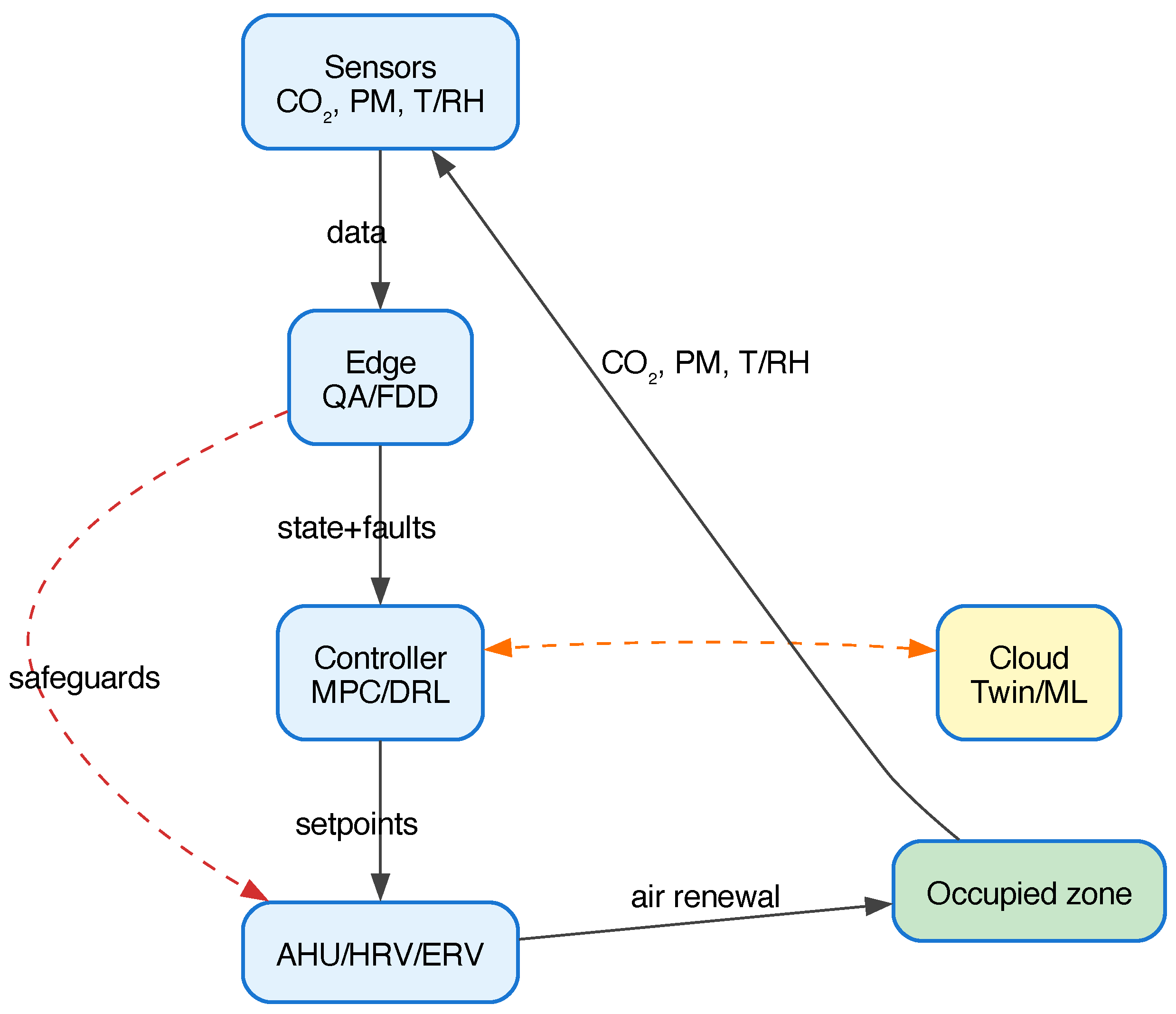
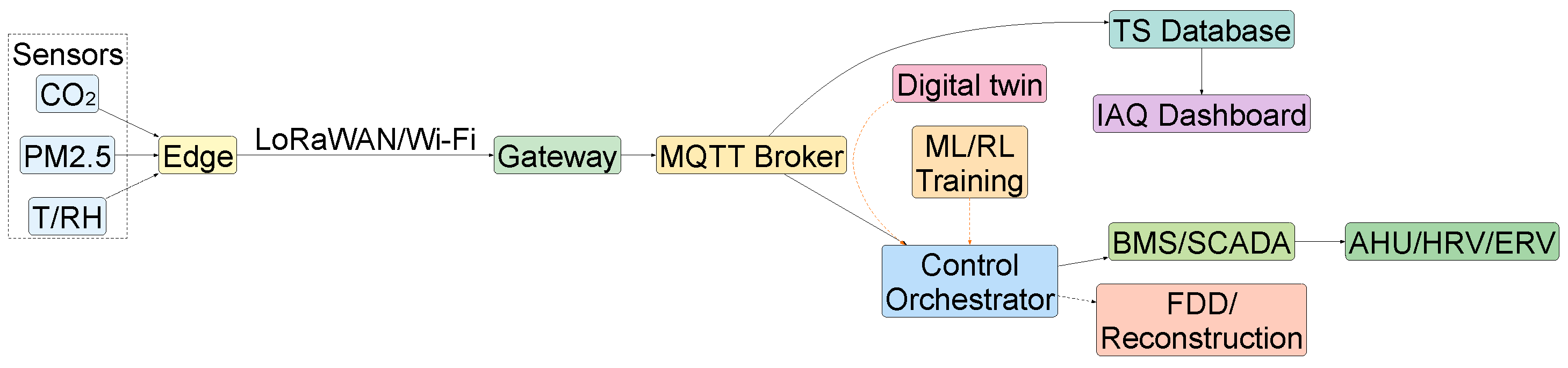
- Sensing layer: 72 wireless multi-parameter nodes (CO2, temperature, relative humidity, VOC, occupancy) distributed across zones, plus 18 motorized window actuators and 6 mechanical ventilation units.
- Edge computing layer: Zone-level controllers (Raspberry Pi) executing local control logic (threshold-based DCV, occupancy-responsive window control) with 5 min update intervals, capable of autonomous operation during network outages.
- Gateway layer: Central LoRaWAN gateway aggregating data from all zones, executing building-level optimization (MPC), and interfacing with cloud analytics platform.
- Cloud layer: Historical data storage, machine learning model training (occupancy prediction, energy baseline modeling), performance dashboards, and remote configuration management.
4.2. Machine Learning for Sensor Placement and Data Imputation
4.3. Fault Detection and Diagnostics (FDD) for Ventilation Systems
- Anomaly detection: An attention-based autoencoder learns normal operating patterns from multi-sensor time series (supply/exhaust temperatures and flow rates, HRV pressure drops, fan speeds, IAQ parameters) during fault-free operation. During real-time operation, the reconstruction error between observed and autoencoder-predicted sensor values indicates anomalies. The attention mechanism identifies which sensors contribute most to detected anomalies, focusing diagnostic efforts.
- Fault classification: A GRU classifier, trained on labeled fault scenarios (simulated and historical field faults), categorizes detected anomalies into specific fault types: sensor drift, filter clogging, HRV fouling, actuator failure, duct leakage, control logic error. The GRU captures temporal fault signatures (e.g., gradual drift vs. abrupt failure) for accurate classification.
4.4. Field Validation Protocols for Ventilation Effectiveness
- Injection location at outdoor air intake or supply duct to simulate fresh air distribution;
- Sampling locations at breathing zone height (1.1–1.5 m) representing occupant exposure;
- Minimum measurement duration of 3–5 air changes to capture complete tracer decay;
- Background tracer concentration measurement for 30 min pre-test to ensure zero baseline.

Cross-Sensitivities and Mitigation Strategies
- Multi-sensor fusion with statistical filtering: Deploy complementary sensor types (e.g., MOX VOC + PID VOC, optical PM + nephelometer) and apply Kalman filtering or Bayesian fusion algorithms to combine redundant measurements, reducing influence of individual sensor artifacts. Liu and Zheng [8] demonstrate that dual-sensor VOC fusion reduces measurement error from ±35% (single MOX sensor) to ±12% (fused estimate) in residential environments with ethanol interference.
- Context-aware control logic: Incorporate activity recognition and scheduling data to suppress false alarms during known interference events. For example, disable formaldehyde-based ventilation boost for 15–30 min following hand sanitizer dispensing events detected via door sensor or scheduling (healthcare facilities), or apply ethanol correction factors during documented cleaning schedules ([6,7]). This approach prevents unnecessary ventilation responses to transient, non-hazardous interference while maintaining protection against persistent pollutant sources.
- Environmental compensation algorithms: Apply real-time corrections for temperature and humidity dependencies using co-located T/RH sensors. Modern sensor firmware increasingly incorporates manufacturer-provided compensation curves (polynomial or lookup-table based) that adjust reported concentrations based on ambient T and RH. Field validation shows that T/RH compensation reduces systematic errors from ±15–25% (uncorrected) to ±5–10% (corrected) for VOC and PM sensors across typical building environmental ranges ([9,36]).
- Temporal pattern analysis and anomaly filtering: Implement edge-computing algorithms that distinguish between genuine pollutant events (sustained elevations with characteristic time constants) and sensor artifacts (abrupt spikes, physically implausible rates of change). For instance, genuine formaldehyde emissions from building materials exhibit gradual concentration increases over 30–120 min, while ethanol interference produces sharp 2–5 min spikes. Temporal filtering using moving averages (15–30 min windows) or wavelet decomposition effectively suppresses short-duration interference while preserving response to true IAQ threats ([8,9]).
- FDD-integrated cross-sensitivity detection: Extend fault detection and diagnostics frameworks (Section 4.3) to identify systematic cross-sensitivity patterns. For example, repeated simultaneous spikes in formaldehyde and ethanol-responsive sensors, or correlated VOC and humidity increases, indicate cross-sensitivity rather than genuine multi-pollutant events. Machine learning FDD systems trained on labeled cross-sensitivity scenarios achieve 85–92% accuracy in distinguishing true IAQ events from sensor artifacts, enabling automated alarm suppression and adaptive control reconfiguration ([9]).
- Sensor placement optimization: Position sensors to minimize exposure to known interference sources. Locate formaldehyde sensors away from hand sanitizer dispensers, kitchen ethanol storage, or cleaning product cabinets. Place PM sensors in locations with stable humidity and away from humidifiers, showers, or steam sources. While placement optimization cannot eliminate all cross-sensitivities, strategic siting reduces interference frequency by 40–60% in typical building layouts ([8]).
5. Energy Recovery Technologies and System Integration
5.1. Uncertainty Quantification in HRV/ERV Performance
- Airflow imbalance: Deviations from balanced supply-exhaust flow rates (±10–20%) reduce effectiveness by 3–7 pp and can reverse pressure differentials, affecting infiltration rates.
- Frost formation: In cold climates (outdoor T < −10 °C), ice accumulation on exhaust-side surfaces reduces effectiveness by 15–35% and increases pressure drop by 40–120%, triggering defrost cycles that temporarily bypass recovery.
- Fouling and filter loading: Particulate accumulation on heat exchanger surfaces over 6–12 months reduces effectiveness by 5–12% and increases fan energy by 25–60% due to elevated pressure drop.
- Control logic: Inappropriate bypass activation thresholds or defrost cycling parameters can reduce annual recovery efficiency by 10–25% compared to optimized strategies.
5.2. Anti-Frost Strategies and Cold-Climate Operation
5.3. Low-Loss Heat Exchangers and Advanced Core Designs
5.4. Phase-Change Material Integration and Thermal Storage
5.5. Fouling Detection and Predictive Maintenance
5.6. Compact Hybrid Systems: EAHE + HRV Integration
6. Active and Passive Envelope Strategies for Ventilation Load Reduction
6.1. Thermochromic and Adaptive Glazing Systems
6.2. Supply-Air Windows and Envelope-Integrated Ventilation
- Winter heating: Supply air temperature increase of 6–10 °C at airflow rates of 15–25 m3/(h·m2 of window), reducing heating energy for ventilation air by 35–45% compared to direct outdoor air supply.
- Summer cooling: Solar heat gain reduction of 40–55% compared to conventional triple glazing without cavity ventilation, corresponding to cooling load reduction of 18–24 W/m2 of window during peak afternoon hours.
- Acoustic performance: The triple-glazed configuration maintained sound transmission class (STC) ratings of 38–42 dB, comparable to conventional triple glazing, despite the ventilation openings at top and bottom of the frame.
6.3. Earth–Air Heat Exchanger (EAHE) Design and Optimization
6.3.1. Multi-Criteria Design Optimization Across Climates
- Pipe length: Optimal lengths range from 40 m (hot-humid coastal climates with mild winters) to 80 m (continental climates with cold winters and hot summers). Marginal thermal performance gains diminish beyond these lengths, while pressure drop and cost increase linearly, yielding poor cost-effectiveness for longer pipes.
- Burial depth: 2.5–3.5 m depths provide an optimal balance between thermal stability (deeper soils exhibit less annual temperature variation) and installation cost. Depths below 4 m offer minimal additional thermal benefit in most climates while significantly increasing excavation costs.
- Pipe diameter: 200–250 mm diameters achieve a favorable compromise between heat transfer surface area (larger diameters reduce surface-to-volume ratio) and pressure drop (smaller diameters increase velocity and friction losses). Cuny et al. [53] demonstrate that increasing the diameter from 200 mm to 300 mm reduces pressure drop by 60% but decreases outlet temperature moderation by 12–15%, requiring 20–30% longer pipes to achieve equivalent thermal performance.
- Material selection: PVC, HDPE, and concrete pipes exhibit similar thermal performance, but differ in cost, durability, and hygiene characteristics. HDPE offers the lowest installation cost and good durability, but smooth interior surfaces can promote condensate accumulation. Concrete pipes provide superior hygrothermal buffering but increase installation cost by 40–60%.
6.3.2. Coupling with HRV/ERV and Bypass Strategies
- 1.
- Series operation: EAHE preconditions outdoor air before HRV supply inlet, maximizing total thermal conditioning.
- 2.
- Parallel operation with selective bypass: Outdoor air flows through either EAHE or directly to HRV depending on which pathway provides better thermal performance (determined by comparing EAHE outlet temperature to outdoor temperature and HRV recovered supply temperature).
- 3.
- Series operation with HRV bypass: EAHE continuously preconditions outdoor air, while HRV is bypassed during periods when EAHE outlet temperature is more favorable than HRV-recovered temperature.
6.3.3. Hybrid EAHE Variants and Evaporative Cooling Integration
- Supply air temperatures of 22–26 °C from outdoor conditions of 38–42 °C, representing cooling capacity of 25–35 W per m3/h of airflow.
- Cooling COP (coefficient of performance) of 8–12 considering only fan and water pump energy, compared to COP of 2.5–3.5 for conventional vapor-compression cooling.
- Zero refrigerant use and 75–85% reduction in cooling-related primary energy consumption compared to conventional air conditioning for equivalent sensible cooling delivery.
6.4. Integration with Intelligent Ventilation Control Architectures
7. Comprehensive Evaluation and Users
7.1. User Behavior, Acceptance, and Human-in-the-Loop Design
7.1.1. Perceived Control and Transparency
- Configuration 1 (no interface) achieved design energy savings of 32% during the initial 3 months, but savings degraded to 18% by month 12 due to occupant complaints leading to system reprogramming toward more conservative (higher) ventilation rates. Occupant satisfaction scores were lowest (2.8/5.0), with common complaints of “stuffiness” and “lack of control.”
- Configuration 2 (dashboard feedback) maintained 30% energy savings throughout 18 months, with an occupant satisfaction of 3.9/5.0. Real-time IAQ visualization helped occupants understand system operation and build trust, significantly reducing complaints. Exit interviews revealed that 78% of occupants checked the dashboard at least weekly, and 34% reported that IAQ awareness influenced behaviors (e.g., reducing use of VOC-emitting products, adjusting cooking practices).
- Configuration 3 (dashboard + override) achieved 28% energy savings (slightly lower than configuration 2 due to occasional boost activations) but the highest occupant satisfaction (4.3/5.0). Override frequency averaged 2.3 activations per week per household, typically triggered by cooking events, guest visits, or perceived odors. Importantly, 89% of boost activations were appropriate from an IAQ perspective (occurring during elevated pollutant levels), indicating that occupants used the override capability responsibly rather than gaming the system.
7.1.2. Override Behaviors and System Gaming
- High-override group (28% of occupants): Overrode automated control on >40% of occupied days, typically opening windows immediately upon arrival regardless of outdoor conditions. Post-occupancy surveys indicated low trust in system responsiveness (“It doesn’t react fast enough”) and preference for personal control. In these zones, actual energy consumption exceeded baseline manual window operation by 8–12% due to windows left open during cold/hot conditions.
- Moderate-override group (51% of occupants): Overrode control occasionally (10–25% of days), typically in response to specific discomfort events (perceived stuffiness, odor, warm afternoon temperatures). Energy performance remained favorable (15–20% savings vs. baseline).
- Low-override group (21% of occupants): Rarely overrode system (<5% of days), expressing high satisfaction with automated operation. These zones achieved design energy savings of 25–32%.
7.1.3. Behavioral Influence on IAQ and Ventilation Requirements
- Cooking practices: High-emission cooking (frying, grilling) generates PM2.5 concentrations of 80–350 µg/m3 and VOC spikes of 400–1200 ppb, requiring ventilation rates 3–5 times higher than baseline for 30–90 min to restore acceptable IAQ. Residents who cook high-emission meals > 4 times per week require 18–25% higher average ventilation rates than low-emission cooking households.
- Cleaning and product use: Use of conventional cleaning products, air fresheners, and personal care products contributes 30–60% of total residential VOC exposure. Households preferring natural/unscented products exhibit 35–50% lower baseline VOC levels, reducing required ventilation rates accordingly.
- Window-opening habits: In hybrid natural–mechanical ventilation systems, occupant window-opening patterns significantly impact mechanical ventilation loads. Andersen et al. [6] found that households that open windows during mild weather (>40% of shoulder-season hours) reduce mechanical ventilation energy by 22–28% compared to households that rarely open windows, despite similar IAQ outcomes.
- Occupancy density and patterns: Households with frequent guests or multi-generational occupancy exhibit 40–70% higher CO2 generation rates than single or couple occupancy, requiring proportionally increased ventilation. Accurate occupancy sensing or prediction is critical for avoiding under-ventilation in high-density scenarios.
7.1.4. Design Implications for Human-in-the-Loop Intelligent Ventilation
- Transparency and feedback: Provide real-time or near-real-time IAQ feedback via dashboards, smartphone apps, or ambient displays (e.g., color-changing LED indicators). Communicate system status and control decisions in plain language to build understanding and trust.
- Preserve occupant agency: Include manual override or boost capabilities that allow occupants to intervene when they perceive discomfort or unusual conditions. Design overrides with automatic time limits (30–90 min) to prevent indefinite manual control that defeats intelligent operation.
- Adaptive personalization: Implement learning algorithms that adapt to household- or zone-specific behaviors, pollutant sources, and preferences. Use occupancy detection, activity recognition, and pollutant event detection to refine control policies over time.
- Explainability: When feasible, provide brief explanations of control actions (“Increasing ventilation due to elevated CO2” or “Reducing ventilation due to favorable outdoor conditions”) to help occupants understand system logic and build mental models of operation.
- Graceful degradation: Design systems to maintain acceptable (if not optimal) performance even when occupants frequently override or when sensors fail, avoiding scenarios where system malfunctions lead to severe IAQ degradation or occupant rejection.
7.2. Regulatory and Standardization Context
7.3. Economic and Maintenance Evaluation
Regional Climate and Socioeconomic Factors Affecting Adaptability
7.4. Building Typology and Structural Characteristics
7.4.1. Residential Buildings: Single-Family and Multi-Family
7.4.2. Office Buildings: Open-Plan and Cellular Layouts
7.4.3. Educational Buildings: Classrooms and Lecture Halls
7.4.4. Commercial Buildings: Retail, Hospitality, and Mixed-Use
7.4.5. Comparative Analysis: Envelope, Zoning, and Occupancy Interactions
8. Conclusions
Supplementary Materials
Author Contributions
Funding
Data Availability Statement
Conflicts of Interest
Abbreviations
| Abbreviation | Full Term/Description |
| ACH | Air Changes per Hour |
| ANN | Artificial Neural Network |
| ASHRAE | American Society of Heating, Refrigerating and Air-Conditioning Engineers |
| BiLSTM | Bi-directional Long Short-Term Memory (neural network) |
| BMS | Building Management System |
| BTES | Borehole Thermal Energy Storage |
| CDD | Cooling Degree Days |
| CFD | Computational Fluid Dynamics |
| COP | Coefficient of Performance |
| DCV | Demand-Controlled Ventilation |
| DQN | Deep Q-Network (reinforcement learning algorithm) |
| DRL | Deep Reinforcement Learning |
| DX | Direct Expansion (cooling system) |
| EAHE | Earth–Air Heat Exchanger |
| EN | European Norm (standard) |
| EPBD | Energy Performance of Buildings Directive (European Union) |
| ERV | Energy Recovery Ventilator |
| FDD | Fault Detection and Diagnostics |
| GA | Genetic Algorithm |
| GHE | Ground Heat Exchanger |
| GRU | Gated Recurrent Unit (neural network) |
| HDD | Heating Degree Days |
| HDPE | High-Density Polyethylene |
| HICP | Harmonised Index of Consumer Prices (Eurostat) |
| HRV | Heat Recovery Ventilator |
| HVAC | Heating, Ventilation, and Air Conditioning |
| IAQ | Indoor Air Quality |
| IEC | Indirect Evaporative Cooling |
| IoT | Internet of Things |
| ISO | International Organization for Standardization |
| LCA | Life-Cycle Assessment |
| LCC | Life-Cycle Costing |
| LEED | Leadership in Energy and Environmental Design (certification) |
| LoRaWAN | Long Range Wide Area Network (IoT communication protocol) |
| LSTM | Long Short-Term Memory (neural network) |
| MAML | Model-Agnostic Meta-Learning |
| MAPE | Mean Absolute Percentage Error |
| MCP | Model Context Protocol |
| ML | Machine Learning |
| MOX | Metal-Oxide Semiconductor (sensor) |
| MPC | Model Predictive Control |
| NPV | Net Present Value |
| PCM | Phase-Change Material |
| PHE | Plate Heat Exchanger |
| PM | Particulate Matter (e.g., PM2.5, PM10) |
| pp | Percentage Points |
| PSO | Particle Swarm Optimization |
| PV | Photovoltaic (solar generation) |
| PVC | Polyvinyl Chloride |
| QA | Quality Assurance |
| RBD-FAST | Random Balance Design - Fourier Amplitude Sensitivity Test |
| RH | Relative Humidity |
| RL | Reinforcement Learning |
| RSM | Response Surface Methodology |
| RUL | Remaining Useful Life |
| SA | Simulated Annealing (optimization algorithm) |
| SHGC | Solar Heat Gain Coefficient |
| SMA | Shape Memory Alloy |
| SRI | Smart Readiness Indicator |
| STC | Sound Transmission Class |
| TC | Thermochromic |
| TVOC | Total Volatile Organic Compounds |
| UQ | Uncertainty Quantification |
| UV-C | Ultraviolet C (germicidal irradiation) |
| VO2 | Vanadium Dioxide |
| VOC | Volatile Organic Compound |
| WELL | WELL Building Standard (certification) |
| WHO | World Health Organization |
References
- Niza, I.L.; Bueno, A.M.; Gameiro Da Silva, M.; Broday, E.E. Air quality and ventilation: Exploring solutions for healthy and sustainable urban environments in times of climate change. Results Eng. 2024, 24, 103157. [Google Scholar] [CrossRef]
- Guyot, G.; Sherman, M.H.; Walker, I.S. Smart ventilation energy and indoor air quality performance in residential buildings: A review. Energy Build. 2018, 165, 416–430. [Google Scholar] [CrossRef]
- Lee, Y.J. Mapping the technological landscape of green smart buildings: A patent analytics of key topics, leading companies, and technology gaps. J. Build. Eng. 2024, 98, 111020. [Google Scholar] [CrossRef]
- Wang, G.; Fang, J.; Yan, C.; Huang, D.; Hu, K.; Zhou, K. Advancements in smart building envelopes: A comprehensive review. Energy Build. 2024, 312, 114190. [Google Scholar] [CrossRef]
- Chiesa, G.; Vigliotti, M. Comparing mechanical ventilation control strategies for indoor air quality: Monitoring and simulation results of a school building in northern Italy. Energy Build. 2024, 322, 114665. [Google Scholar] [CrossRef]
- Andersen, R.; Fabi, V.; Corgnati, S. Predicted and actual indoor environmental quality: Verification of occupants’ behaviour models in residential buildings. Energy Build. 2016, 127, 105–115. [Google Scholar] [CrossRef]
- De Jonge, K.; Ghijsels, J.; Laverge, J. Energy savings and exposure to VOCs of different household sizes for three residential smart ventilation systems with heat recovery. Energy Build. 2023, 290, 113091. [Google Scholar] [CrossRef]
- Liu, L.; Zheng, F. An improved cohesive hierarchical clustering for indoor air quality monitoring in smart gymnasium with healthy sport areas. Alex. Eng. J. 2024, 105, 204–217. [Google Scholar] [CrossRef]
- Tariq, S.; Loy-Benitez, J.; Yoo, C. Multi-sensor fault detection and correction for automated IAQ monitoring in smart buildings through attention-aware autoencoders with spatial prediction module. J. Build. Eng. 2024, 96, 110573. [Google Scholar] [CrossRef]
- EN 16798-1:2019; Energy Performance of Buildings—Ventilation for Buildings—Part 1: Indoor Environmental Input Parameters for Design and Assessment of Energy Performance of Buildings Addressing Indoor Air Quality, Thermal Environment, Lighting and Acoustics. CEN: Brussels, Belgium, 2019.
- ISO 17772-1:2017; Energy Performance of Buildings—Indoor Environmental Quality— Part 1: Indoor Environmental Input Parameters for the Design and Assessment of Energy Performance of Buildings. ISO: Geneva, Switzerland, 2017.
- ASHRAE Standard 62.1-2022; Ventilation for Acceptable Indoor Air Quality. ASHRAE: Atlanta, GA, USA, 2022.
- ASHRAE Standard 62.2-2022; Ventilation and Acceptable Indoor Air Quality in Residential Buildings. ASHRAE: Atlanta, GA, USA, 2022.
- World Health Organization. WHO Air Quality Guidelines: Global Update 2021; World Health Organization: Geneva, Switzerland, 2021.
- EN 15603:2008; Energy Performance of Buildings—Overall Energy Use and Definition of Energy Ratings. CEN: Brussels, Belgium, 2008.
- EN ISO 15927-6:2007; Hygrothermal Performance of Buildings—Calculation and Presentation of Climatic Data—Part 6: Accumulated Temperature Differences (Degree-Days). CEN: Brussels, Belgium, 2007.
- Bordignon, S.; Carnieletto, L.; Zarrella, A. An all-in-one machine coupled with a horizontal ground heat exchanger for the air-conditioning of a residential building. Build. Environ. 2022, 207, 108558. [Google Scholar] [CrossRef]
- Poirier, B.; Guyot, G.; Woloszyn, M. Uncertainty quantification: For an IAQ and energy performance assessment method for smart ventilation strategies. Build. Environ. 2024, 266, 112115. [Google Scholar] [CrossRef]
- Qiu, S.; Che, Y.; Chang, Y.; Wang, Z.; Li, Z. Uncertainty quantification of exchange efficiency in membrane-based air-to-air energy exchanger cores: Repetitive manufacturing and experiments. Case Stud. Therm. Eng. 2024, 59, 104475. [Google Scholar] [CrossRef]
- Heo, S.; Nam, K.; Loy-Benitez, J.; Li, Q.; Lee, S.; Yoo, C. A deep reinforcement learning-based autonomous ventilation control system for smart indoor air quality management in a subway station. Energy Build. 2019, 202, 109440. [Google Scholar] [CrossRef]
- An, Y.; Niu, Z.; Chen, C. Smart control of window and air cleaner for mitigating indoor PM2.5 with reduced energy consumption based on deep reinforcement learning. Build. Environ. 2022, 224, 109583. [Google Scholar] [CrossRef]
- Zhang, W.; Wu, W.; Norford, L.; Li, N.; Malkawi, A. Model predictive control of short-term winter natural ventilation in a smart building using machine learning algorithms. J. Build. Eng. 2023, 73, 106602. [Google Scholar] [CrossRef]
- Chen, E.X.; Han, X.; Malkawi, A.; Zhang, R.; Li, N. Adaptive model predictive control with ensembled multi-time scale deep-learning models for smart control of natural ventilation. Build. Environ. 2023, 242, 110519. [Google Scholar] [CrossRef]
- Tarragona, J.; Gangolells, M.; Casals, M. Model predictive control for managing indoor air quality levels in buildings. Energy Rep. 2024, 12, 787–797. [Google Scholar] [CrossRef]
- Yu, L.; Sun, Y.; Xu, Z.; Shen, C.; Yue, D.; Jiang, T.; Guan, X. Multi-Agent Deep Reinforcement Learning for HVAC Control in Commercial Buildings. IEEE Trans. Smart Grid 2021, 12, 407–419. [Google Scholar] [CrossRef]
- Ren, C.; Cao, S. Implementation and visualization of artificial intelligent ventilation control system using fast prediction models and limited monitoring data. Sustain. Cities Soc. 2020, 52, 101860. [Google Scholar] [CrossRef]
- Sulaiman, M.H.; Mustaffa, Z. Using the evolutionary mating algorithm for optimizing the user comfort and energy consumption in smart building. J. Build. Eng. 2023, 76, 107139. [Google Scholar] [CrossRef]
- Seraj, M.; Parvez, M.; Khan, O.; Yahya, Z. Optimizing smart building energy management systems through industry 4.0: A response surface methodology approach. Green Technol. Sustain. 2024, 2, 100079. [Google Scholar] [CrossRef]
- Alshamrani, A.; Abbas, H.A.; Alkhayer, A.G.; Mausam, K.; Abdullah, S.I.; Alsehli, M.; Rajab, H.; Ahmed, M.; El-Shafay, A.; Kassim, M. Application of an AI-based optimal control framework in smart buildings using borehole thermal energy storage combined with wastewater heat recovery. J. Energy Storage 2024, 101, 113824. [Google Scholar] [CrossRef]
- Majdi, A.; Alrubaie, A.J.; Al-Wardy, A.H.; Baili, J.; Panchal, H. A novel method for Indoor Air Quality Control of Smart Homes using a Machine learning model. Adv. Eng. Softw. 2022, 173, 103253. [Google Scholar] [CrossRef]
- Zivelonghi, A.; Giuseppi, A. Smart Healthy Schools: An IoT-enabled concept for multi-room dynamic air quality control. Internet Things -Cyber-Phys. Syst. 2024, 4, 24–31. [Google Scholar] [CrossRef]
- Contrada, F.; Causone, F.; Allab, Y.; Kindinis, A. A new method for air exchange efficiency assessment including natural and mixed mode ventilation. Energy Build. 2022, 254, 111553. [Google Scholar] [CrossRef]
- ASHRAE Standard 129-1997 (RA 2002); Measuring Air Change Effectiveness. ASHRAE: Atlanta, GA, USA, 2002.
- Wang, T.; Verfaillie, J.; Szutu, D.; Baldocchi, D. Handily measuring sensible and latent heat exchanges at a bargain: A test of the variance-Bowen ratio approach. Agric. For. Meteorol. 2023, 333, 109399. [Google Scholar] [CrossRef]
- ISO 16000-26; Indoor Air—Standard Method for Testing the Performance of Sensors for the Determination of Gaseous Pollutants. Provides Procedures for Calibration and Validation of Indoor Air Quality Sensors. International Organization for Standardization (ISO): Geneva, Switzerland, 2023.
- United States Environmental Protection Agency. Performance Targets for Air Quality Sensors: Evaluation and Calibration Protocols; Technical Report; Establishes Reference Criteria for Sensor Performance and Validation; EPA Office of Research and Development: Washington, DC, USA, 2023.
- U.S. Environmental Protection Agency (EPA). Air Sensor Performance Targets; EPA: Washington, DC, USA, 2023.
- Gendebien, S.; Parthoens, A.; Lemort, V. Investigation of a single room ventilation heat recovery exchanger under frosting conditions: Modeling, experimental validation and operating strategies evaluation. Energy Build. 2019, 186, 1–16. [Google Scholar] [CrossRef]
- He, H.; Zhou, X.; Lyu, N.; Wang, F.; Liang, C.; Zhang, X. Enhancing heat-exchanger performance in frost conditions via superhydrophobic surface modification. Appl. Therm. Eng. 2024, 246, 122914. [Google Scholar] [CrossRef]
- Simonetti, M.; Fracastoro, G.V.; Chiesa, G.; Sola, S. Numerical optimization and experimental testing of a new low pressure heat exchanger (LoPHEx) for passive ventilation of buildings. Appl. Therm. Eng. 2016, 103, 720–729. [Google Scholar] [CrossRef]
- Ma, X.; Ouyang, Z.; Wang, Y.; Liang, S.; Xiong, J.; Wang, Z.; Cheng, H.; Yang, J.; Zheng, H. Design and performance analysis on a breathing-type instant heat recovery module for fresh air ventilation. Energy Build. 2024, 310, 114107. [Google Scholar] [CrossRef]
- Mustafaoğlu, M.; Aksuoğlu, O.K.; Kotcioğlu, İ.; Güneş, Ü.; Yeşilyurt, M.K.; Elaty, A.A. Experimental and numerical investigation of flow and heat transfer in lancet-type-finned cross-flow heat exchangers. Int. Commun. Heat Mass Transf. 2024, 159, 108017. [Google Scholar] [CrossRef]
- Martinaitis, V.; Streckienė, G.; Biekša, D.; Bielskus, J. The exergy efficiency assessment of heat recovery exchanger for air handling units, using a state property—Coenthalpy. Appl. Therm. Eng. 2016, 108, 388–397. [Google Scholar] [CrossRef]
- Mankibi, M.E.; Stathopoulos, N.; Rezaï, N.; Zoubir, A. Optimization of an Air-PCM heat exchanger and elaboration of peak power reduction strategies. Energy Build. 2015, 106, 74–86. [Google Scholar] [CrossRef]
- Ilyunin, O.; Bezsonov, O.; Rudenko, S.; Serdiuk, N.; Udovenko, S.; Kapustenko, P.; Plankovskyy, S.; Arsenyeva, O. The neural network approach for estimation of heat transfer coefficient in heat exchangers considering the fouling formation dynamic. Therm. Sci. Eng. Prog. 2024, 51, 102615. [Google Scholar] [CrossRef]
- Hollmuller, P.; Lachal, B. Air–soil heat exchangers for heating and cooling of buildings: Design guidelines, potentials and constraints, system integration and global energy balance. Appl. Energy 2014, 119, 476–487. [Google Scholar] [CrossRef]
- Tittelein, P.; Achard, G.; Wurtz, E. Modelling earth-to-air heat exchanger behaviour with the convolutive response factors method. Appl. Energy 2009, 86, 1683–1691. [Google Scholar] [CrossRef]
- Yu, W.; Zhou, Y.; Li, Z.; Zhu, D.; Wang, L.; Lei, Q.; Wu, C.; Xie, H.; Li, Y. When thermochromic material meets shape memory alloy: A new smart window integrating thermal storage, temperature regulation, and ventilation. Appl. Energy 2024, 372, 123821. [Google Scholar] [CrossRef]
- Li, W.; Tao, T.; Xu, J.; Chen, Z. Thermal performance of thermochromic smart windows in different indoor environments. Energy Build. 2024, 324, 114941. [Google Scholar] [CrossRef]
- Gloriant, F.; Tittelein, P.; Joulin, A.; Lassue, S. Study of the Performances of A Supply-Air Window for Air Renewal Pre-Heating. Energy Procedia 2015, 78, 525–530. [Google Scholar] [CrossRef]
- Vaz, J.; Sattler, M.A.; Dos Santos, E.D.; Isoldi, L.A. Experimental and numerical analysis of an earth–air heat exchanger. Energy Build. 2011, 43, 2476–2482. [Google Scholar] [CrossRef]
- Vaz, J.; Sattler, M.A.; Brum, R.D.S.; Dos Santos, E.D.; Isoldi, L.A. An experimental study on the use of Earth-Air Heat Exchangers (EAHE). Energy Build. 2014, 72, 122–131. [Google Scholar] [CrossRef]
- Cuny, M.; Lapertot, A.; Lin, J.; Kadoch, B.; Le Metayer, O. Multi-criteria optimization of an earth-air heat exchanger for different French climates. Renew. Energy 2020, 157, 342–352. [Google Scholar] [CrossRef]
- Diedrich, C.H.; Santos, G.H.D.; Carraro, G.C.; Dimbarre, V.V.; Alves, T.A. Numerical and Experimental Analysis of an Earth–Air Heat Exchanger. Atmosphere 2023, 14, 1113. [Google Scholar] [CrossRef]
- Nemati, N.; Omidvar, A.; Rosti, B. Performance evaluation of a novel hybrid cooling system combining indirect evaporative cooler and earth-air heat exchanger. Energy 2021, 215, 119216. [Google Scholar] [CrossRef]
- Singhal, S.; Kumar Yadav, A.; Prakash, R. Thermal performance and economic analysis of saw-tooth and photo-voltaic roof type greenhouse integrated with Earth air heat exchanger. Sol. Energy 2024, 283, 113035. [Google Scholar] [CrossRef]
- Lapertot, A.; Cuny, M.; Kadoch, B.; Le Métayer, O. Optimization of an earth-air heat exchanger combined with a heat recovery ventilation for residential building needs. Energy Build. 2021, 235, 110702. [Google Scholar] [CrossRef]
- Lekhal, M.C.; Benzaama, M.H.; Kindinis, A.; Mokhtari, A.M.; Belarbi, R. Effect of geo-climatic conditions and pipe material on heating performance of earth-air heat exchangers. Renew. Energy 2021, 163, 22–40. [Google Scholar] [CrossRef]
- Maury-Micolier, A.; Huang, L.; Taillandier, F.; Sonnemann, G.; Jolliet, O. A life cycle approach to indoor air quality in designing sustainable buildings: Human health impacts of three inner and outer insulations. Build. Environ. 2023, 230, 109994. [Google Scholar] [CrossRef]
- Gobinath, P.; Crawford, R.H.; Traverso, M.; Rismanchi, B. Comparing the life cycle costs of a traditional and a smart HVAC control system for Australian office buildings. J. Build. Eng. 2024, 91, 109686. [Google Scholar] [CrossRef]
- Hadjidemetriou, L.; Stylianidis, N.; Englezos, D.; Papadopoulos, P.; Eliades, D.; Timotheou, S.; Polycarpou, M.M.; Panayiotou, C. A digital twin architecture for real-time and offline high granularity analysis in smart buildings. Sustain. Cities Soc. 2023, 98, 104795. [Google Scholar] [CrossRef]
- Campodonico Avendano, I.A.; Heimar Andersen, K.; Erba, S.; Moazami, A.; Aghaei, M.; Najafi, B. A novel framework for assessing the smartness and the smart readiness level in highly electrified non-residential buildings: A Norwegian case study. Energy Build. 2024, 314, 114234. [Google Scholar] [CrossRef]
- Moeller, S. Is it a match? Smart home energy management technologies and user comfort practices in German multi-apartment buildings. Energy Res. Soc. Sci. 2024, 118, 103794. [Google Scholar] [CrossRef]
- Saini, J.; Dutta, M.; Marques, G. Smart indoor air quality monitoring for enhanced living environments and ambient assisted living. In Advances in Computers; Elsevier: Amsterdam, The Netherlands, 2024; Volume 133, pp. 99–125. [Google Scholar] [CrossRef]
- Run, K.; Cévaër, F.; Dubé, J.F. Does energy-efficient renovation positively impact thermal comfort and air quality in university buildings? J. Build. Eng. 2023, 78, 107507. [Google Scholar] [CrossRef]
- European Parliament and Council. Directive (EU) 2024/1275 of the European Parliament and of the Council on the Energy Performance of Buildings (Recast); European Union: Brussels, Belgium, 2024. [Google Scholar]
- Fazlikhani, F.; Goudarzi, H.; Solgi, E. Numerical analysis of the efficiency of earth to air heat exchange systems in cold and hot-arid climates. Energy Convers. Manag. 2017, 148, 78–89. [Google Scholar] [CrossRef]
- International Energy Agency. Electricity Market Report 2023; Technical Report; International Energy Agency: Paris, France, 2023. [Google Scholar]
- International Energy Agency. Energy Subsidies: Tracking the Impact of Fossil-Fuel Subsidies; Technical Report; International Energy Agency: Paris, France, 2022. [Google Scholar]
- World Bank. Electricity Prices: Global Database 2010–2023. World Development Indicators. 2023. Available online: https://databank.worldbank.org/source/world-development-indicators (accessed on 8 March 2025).
- Economidou, M.; Todeschi, V.; Bertoldi, P. Accelerating Energy Renovation Investments in Buildings: Financial and Fiscal Instruments Across the EU; Technical Report JRC117816; Publications Office of the European Union: Luxembourg, 2019. [Google Scholar]
- Rosenow, J.; Fawcett, T.; Eyre, N.; Oikonomou, V. Energy Efficiency and the Policy Mix. Build. Res. Inf. 2016, 44, 562–574. [Google Scholar] [CrossRef]
- Seraj, F.; van den Wymelenberg, K.; Liu, X.; El Ammari, K. Economic performance of heuristic optimization approaches for HVAC control in large buildings. Appl. Energy 2021, 284, 116287. [Google Scholar] [CrossRef]
- Rivas, I.; Querol, X.; Wright, J.; Sunyer, J.; Alvarez-Pedrerol, M. Ventilation rates in schools and their impact on indoor air quality and students’ performance. Build. Environ. 2018, 144, 674–684. [Google Scholar] [CrossRef]
- Hong, T.; D’Oca, S.; Taylor-Lange, S.C.; Turner, W.J.N.; Chen, Y. An ontology to represent energy-related occupant behavior in buildings. Build. Environ. 2016, 102, 269–281. [Google Scholar] [CrossRef]
- Santamouris, M.; Kolokotsa, D.; Fiorito, F.; Secinaro, A.; Patterson, M.; Mitoula, R. Passive and active cooling systems for buildings. Energy Build. 2017, 154, 74–94. [Google Scholar] [CrossRef]




| Control Strategy | Baseline Type | Energy Savings (%) | CO2 Reduction (%) | PM2.5 Reduction (%) |
|---|---|---|---|---|
| DCV (Threshold) | Schedule-based ventilation | 35 ± 14 [15–60] | 12 ± 6 [5–22] | 15 ± 8 [8–28] |
| MPC | Schedule-based ventilation | 40 ± 11 [25–55] | 14 ± 5 [8–24] | 18 ± 10 [10–35] |
| DRL | Mixed baselines (schedule/rule) | 32 ± 13 [14–45] | 11 ± 7 [3–20] | 23 ± 18 [2–44] |
| Heuristic/ANN | Constant-flow ventilation | 28 ± 9 [16–42] | 10 ± 4 [5–16] | 12 ± 6 [6–22] |
| Aggregate (All) | Mixed baselines (normalized) | 38 ± 12 [14–60] | 13 ± 6 [3–24] | 19 ± 12 [2–44] |
| System Configuration | Investment (EUR/m2) | Annual Maintenance (EUR/m2/yr) | Payback Period (years) |
|---|---|---|---|
| Conventional (Baseline) | 70–100 | 3.5–5.0 | – |
| DCV (CO2 + occupancy) | 110–145 | 4.5–6.5 | 4–6 |
| MPC with IoT sensors | 135–180 | 5.5–7.5 | 5–8 |
| DRL + Multi-parameter | 155–210 | 6.0–8.5 | 6–10 |
| HRV/ERV + DCV | 180–250 | 7.0–10.0 | 5–9 |
| Comprehensive (MPC + HRV + FDD) | 220–320 | 8.5–12.0 | 6–11 |
| Building Type | Typical Characteristics | Occupancy Patterns | Envelope Influence | Recommended Control Strategy |
|---|---|---|---|---|
| Residential (Single/Multi-family) | 80–150 m2/unit 3–6 zones/unit U-value 0.2–0.4 W/(m2K) | Low density (2–5 persons) Predictable daily cycles Evening/weekend peaks | Moderate Natural ventilation viable in mild climates HRV cost-effective in new construction | Primary: CO2DCV Secondary: HRV + DCV in cold climates Distributed zone control in multi-family |
| Office (Open-plan) | 200–800 m2/zone 4–12 zones/floor U-value 0.15–0.3 W/(m2K) | Medium density (0.10–0.15 persons/m2) Weekday 8:00–18:00 Predictable patterns | High Large glazing areas (40–60% WWR) Thermochromic/EC glazing beneficial | Primary: MPC with occupancy/pricing Secondary: DRL for complex buildings Integrate with adaptive glazing |
| Educational (Classrooms) | 50–80 m2/classroom 15–30 zones/building U-value 0.2–0.5 W/(m2K) | High density (0.3–0.5 persons/m2) Intermittent (45–60 min periods) Rapid transitions | Variable Older: high ceilings, operable windows Modern: tight envelope, fixed glazing | Primary: Predictive DCV with schedule Secondary: Hybrid mechanical + natural (older buildings) HRV+DCV (new construction) |
| Commercial (Retail/Hospitality) | 200–2000 m2/zone Highly variable layout U-value 0.2–0.4 W/(m2K) | Variable density (0.1–0.4 persons/m2) Unpredictable peaks Extended hours (6:00–23:00) | Low to Moderate Frequent interior reconfigurations Limited natural ventilation potential | Primary: Real-time occupancy DCV with VOC Secondary: Distributed zone control Robust sensor placement (avoid layout conflicts) |
| Mixed-Use | Combines above 1000–10,000 m2 total 30–100+ zones | Conflicting simultaneous demands Residential + Office + Commercial schedules | High Diverse envelope systems Complex inter-zone airflow | Primary: Distributed IoT architecture Secondary: Zone-level autonomy with system coordination Multi-objective MPC |
Disclaimer/Publisher’s Note: The statements, opinions and data contained in all publications are solely those of the individual author(s) and contributor(s) and not of MDPI and/or the editor(s). MDPI and/or the editor(s) disclaim responsibility for any injury to people or property resulting from any ideas, methods, instructions or products referred to in the content. |
© 2025 by the authors. Licensee MDPI, Basel, Switzerland. This article is an open access article distributed under the terms and conditions of the Creative Commons Attribution (CC BY) license.
Share and Cite
Rizo-Maestre, C.; Flores-Moreno, J.M.; Nebot Sanz, A.; Echarri-Iribarren, V. Intelligent Ventilation and Indoor Air Quality: State of the Art Review (2017–2025). Buildings 2026, 16, 65. https://doi.org/10.3390/buildings16010065
Rizo-Maestre C, Flores-Moreno JM, Nebot Sanz A, Echarri-Iribarren V. Intelligent Ventilation and Indoor Air Quality: State of the Art Review (2017–2025). Buildings. 2026; 16(1):65. https://doi.org/10.3390/buildings16010065
Chicago/Turabian StyleRizo-Maestre, Carlos, José María Flores-Moreno, Amor Nebot Sanz, and Víctor Echarri-Iribarren. 2026. "Intelligent Ventilation and Indoor Air Quality: State of the Art Review (2017–2025)" Buildings 16, no. 1: 65. https://doi.org/10.3390/buildings16010065
APA StyleRizo-Maestre, C., Flores-Moreno, J. M., Nebot Sanz, A., & Echarri-Iribarren, V. (2026). Intelligent Ventilation and Indoor Air Quality: State of the Art Review (2017–2025). Buildings, 16(1), 65. https://doi.org/10.3390/buildings16010065