Orientation-Dependent Window Area: Linking Solar Gains and Transmission Losses to Annual Heating and Cooling Loads


Abstract
1. Introduction
2. Method
- The opaque envelope and glazing properties were defined in accordance with TS 825:2024. Opaque assemblies complied with city-specific U-value limits, and glazing was selected to satisfy region-specific solar heat gain (g-value) requirements [23].
- The building was modeled with a flat roof slab exposed to outdoor conditions; therefore, the ceiling of the top floor was treated as the roof assembly. For each city, roof construction complied with the local TS 825:2024 U-value requirement and was kept constant across scenarios.
- Lighting was excluded as an electrical end-use. Its thermal impact was represented as internal gains using a lighting-equivalent power density with specified radiant and convective fractions, so that the reported heating and cooling loads include the effect of lighting-induced heat gains.
- Domestic hot water (DHW) demand was not modeled and is outside the scope of the present analysis.
- A generic hospital ward profile (patient rooms and associated areas) was adopted as the representative space type to ensure consistent, scenario-driven comparisons across climates.
- Healthcare-specific internal gains, occupancy assumptions, and operational practices followed ASHRAE Handbook—HVAC Applications (Healthcare) [25].
- Ventilation inputs referenced ASHRAE/ASHE Standard 170-2021 [26].
- Infiltration was set to a constant 0.20 ACH (h−1) with wind and stack effects disabled to avoid double-counting with mechanical ventilation and to isolate facade/WWR impacts.
- External climate data were obtained from the IWEC2 (2021) dataset, which provides hourly climatic information, including dry-bulb temperature, solar radiation, and relative humidity [28]. Wind speed was used only to compute exterior convective heat-transfer coefficients, not for wind-driven infiltration or structural loading.
2.1. Operational Assumptions and Internal Loads
2.2. Dimensions and Properties of Selected Material
3. Results
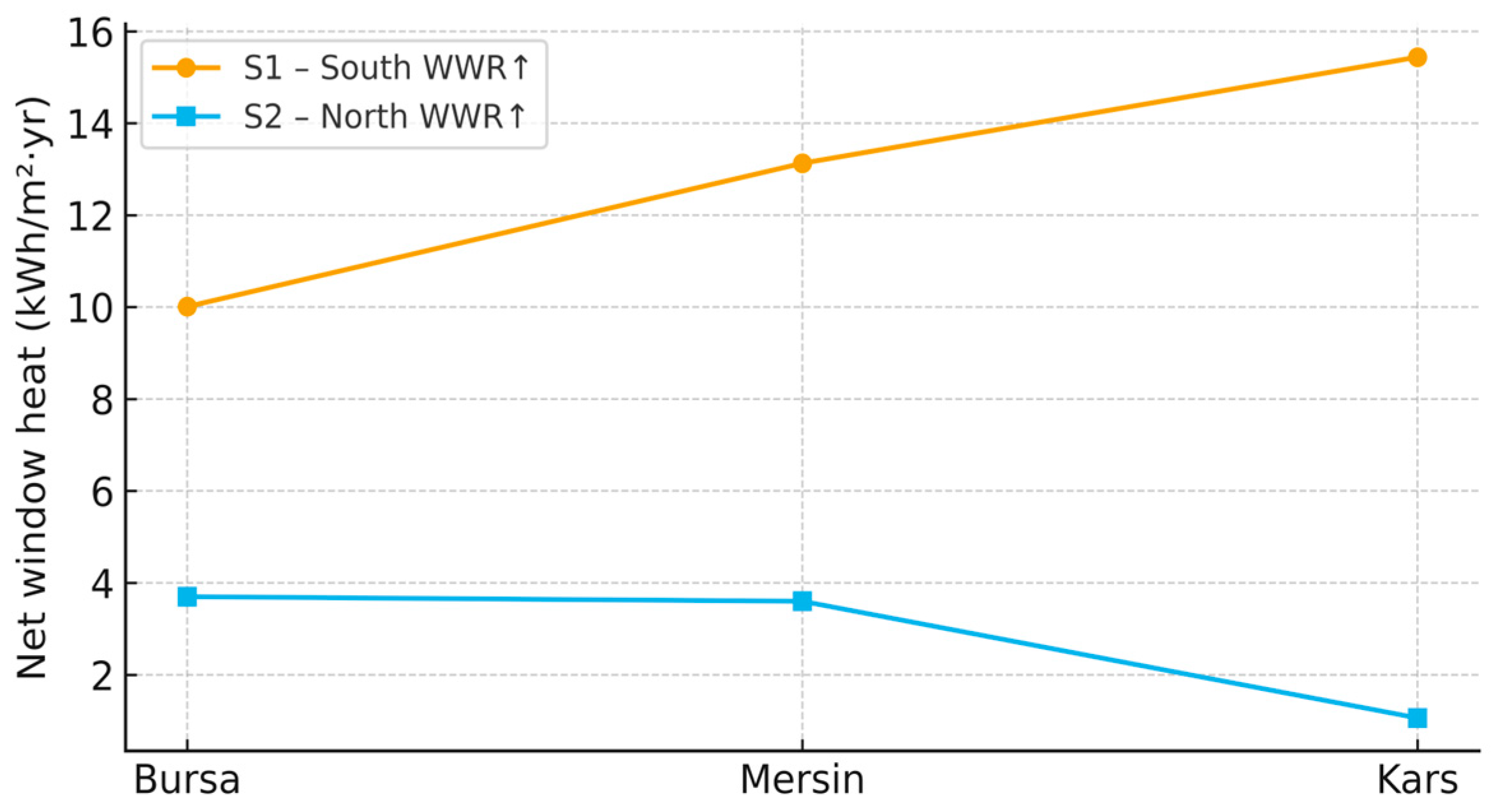
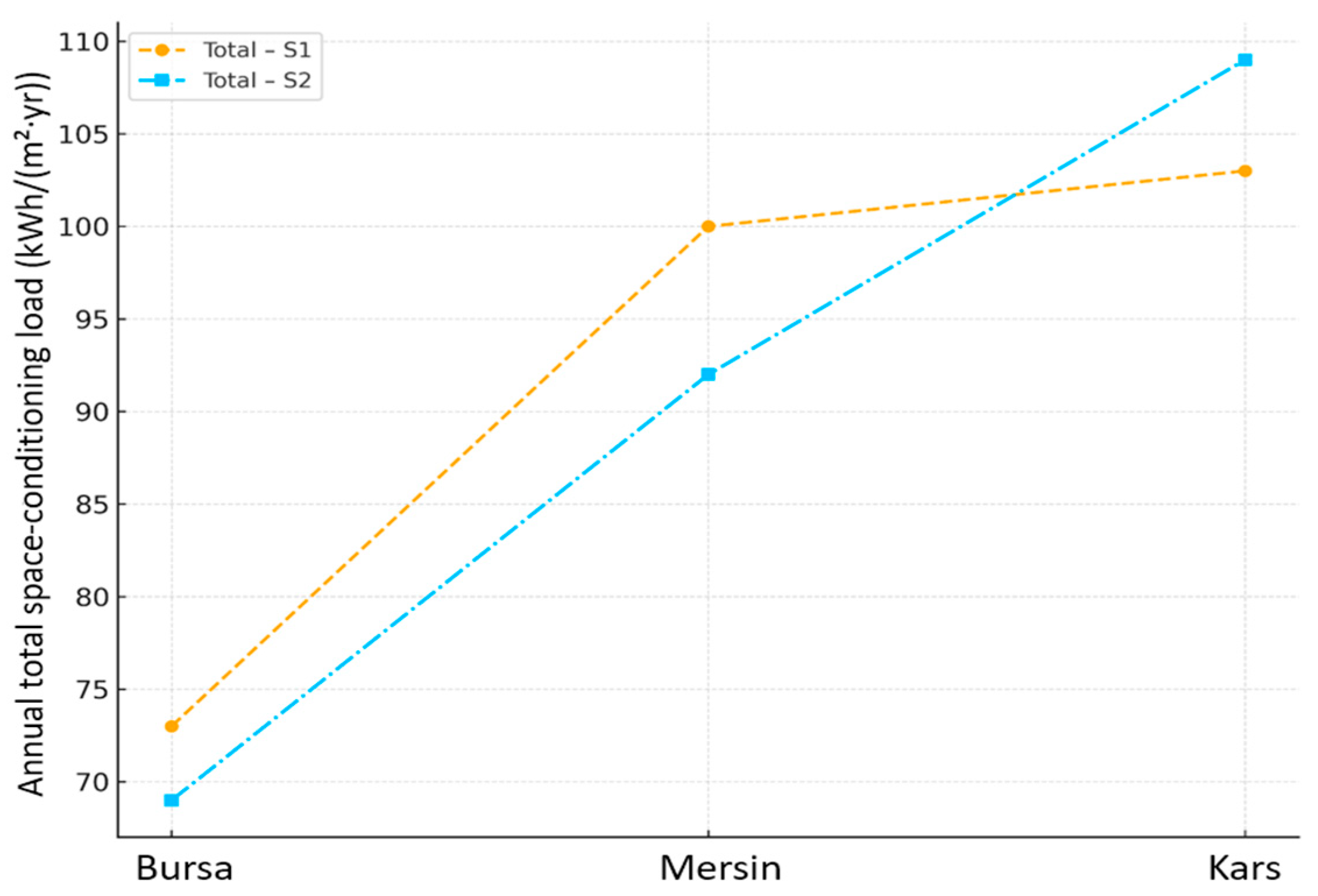
- Bursa (Zone 3, Marmara—temperate/transition): On the varying facade, net window heat is higher in S1 (10.01 vs. 3.70 kWh/(m2·yr)), consistent with the heating–cooling trade-off. Solar gains decrease significantly (12.67 in S1 to 6.32 in S2), with minimal change in transmission losses (2.66 in S1 to 2.62 in S2), all in kWh/(m2·yr) (Table 8; Figure 2). Totals are close in S1 and S2 (73 vs. 69 kWh/(m2·yr); 6% difference; Table 9; Figure 3). S2 reduces cooling by 15% (from 54 to 46) but increases heating by 21% (from 19 to 23), both in kWh/(m2·yr). These countervailing changes yield a moderate reduction in the annual total (Table 9).
- Mersin (Zone 1, Mediterranean—hot–humid): Moving from S1 to S2 reduces the annual total by 8% (from 100 to 92 kWh/(m2·yr); Table 9; Figure 3). Cooling decreases by 11% (from 95 to 85), while heating increases (from 5 to 7), both in kWh/(m2·yr), remaining a small fraction of the total. On the facade where WWR increases by floor, the net window heat declines from 13.13 to 3.60 in S2. This 73% drop is mainly due to reduced solar gains (15.38 in S1 to 5.79 in S2), with minimal change in transmission losses (2.25 in S1 to 2.19 in S2), all in kWh/(m2·yr) (Table 8; Figure 2).
- Kars (Zone 6; humid continental—cold): Choosing S1 instead of S2 reduces the annual total by 6% (from 109 to 103 kWh/(m2·yr); Table 9; Figure 3). Heating decreases by 11% (from 91 to 81), whereas cooling rises (from 18 to 22), all in kWh/(m2·yr), yet cooling remains secondary in magnitude. On the varying facade, net window heat is higher in S1 (15.44 vs. 1.06 kWh/(m2·yr)), reflecting window solar gains (20.69 in S1 to 5.94 in S2) that outweigh transmission losses, (5.25 in S1 to 4.88 in S2), all in kWh/(m2·yr) (Table 8; Figure 2).
- The direction of the effect is consistent with the climate. For Mersin (Zone 1, Mediterranean, hot–humid), S2 (north facade with WWR increasing by floor) is more favorable; for Kars (Zone 6, humid continental, cold), S1 (south facade with WWR increasing by floor) is advantageous; for Bursa (Zone 3, temperate/transition, Marmara), annual totals are close (Table 9).
- The mechanism is explained by solar gains, while transmission (U-value) losses play a limited role. On the varying-WWR facade, transmission losses change only slightly between S1 and S2: from 2.66 to 2.62 kWh/(m2·yr) in Bursa, 2.25 to 2.19 in Mersin, and 5.25 to 4.88 in Kars. By contrast, solar gains decrease much more: from 12.67 to 6.32 in Bursa, 15.38 to 5.79 in Mersin, and 20.69 to 5.94 in Kars, all in kWh/(m2·yr). Thus, net window heat is governed mainly by solar-gain changes across all scenarios (Table 8).
- A uniform window assembly strengthens interpretation. Keeping the same window system in all scenarios isolates WWR and orientation effects from envelope variability and improves comparability across scenarios (Table 8).
- The hospital typology keeps effects moderate at the building scale. With 24/7 operation, internal gains and continuous ventilation, facade-driven differences are clear in the window metrics but still translate to modest changes in annual totals; the changes remain in the single-digit percentage range (Bursa 6%; Mersin 8%; Kars 6%) (Table 9).
- Decisions were recommended to be co-optimized with daylight and comfort targets; in inpatient rooms, ventilation strategies (heat recovery, pressure regime, air distribution) were identified as safety-critical as well as energy-relevant, calling for integrated facade–HVAC design [11].
4. Discussion
Supplementary Materials
Author Contributions
Funding
Data Availability Statement
Conflicts of Interest
Abbreviations
| ASHRAE | American Society of Heating, Refrigerating, and Air-Conditioning Engineers |
| ASHE | American Society for Health Care Engineering |
| EPS | Expanded polystyrene (graphite EPS where specified) |
| g (SHGC) | Solar heat gain coefficient (dimensionless) |
| HCB | Hollow clay block |
| HVAC | Heating, ventilation, and air conditioning |
| IEQ | Indoor environmental quality |
| IWEC | International Weather for Energy Calculations (ASHRAE, v1) |
| IWEC2 | International Weather Files for Energy Calculations (ASHRAE, v2) |
| TS 825 | Turkish Standard for thermal insulation in buildings |
| U | Overall heat transfer coefficient [W/(m2·K)] |
| WRB | Water-resistive barrier |
| WWR | Window-to-wall ratio |
| λ | Thermal conductivity [W/(m·K)] |
| kWh/(m2·yr) | Kilowatt-hours per square meter per year (unit used for annual loads) |
References
- Troup, L.; Phillips, R.; Bilec, M.M. Effect of window-to-wall ratio on measured energy consumption in US office buildings. Energy Build. 2019, 203, 109434. [Google Scholar] [CrossRef]
- Yeom, S.; Kim, H.; Hong, T.; Lee, M. Determining the optimal window size of office buildings considering the workers’ task performance and the building’s energy consumption. Build. Environ. 2020, 177, 106872. [Google Scholar] [CrossRef]
- Cherier, M.K.; Hamdani, M.; Kamel, E.; Bekkouche, S.M.E.A.; Guermoui, M.; Al-Saadi, S.; Djeffal, R.; Bashir, M.O.; Elshekh, A.E.A.; Drozdova, L.; et al. Impact of glazing type, window-to-wall ratio, and orientation on building energy savings quality: A parametric analysis in Algerian climatic conditions. Case Stud. Therm. Eng. 2024, 61, 104902. [Google Scholar] [CrossRef]
- Ahmed, A.E.; Suwaed, M.S.; Shakir, A.M.; Ghareeb, A. The impact of window orientation, glazing, and window-to-wall ratio on the heating and cooling energy of an office building: The case of a hot and semi-arid climate. J. Eng. Res. 2023, 13, 409–422. [Google Scholar] [CrossRef]
- Goia, F. Search for the optimal window-to-wall ratio in office buildings in different European climates and the implications on total energy saving potential. Sol. Energy 2016, 132, 467–492. [Google Scholar] [CrossRef]
- Lahmar, I.; Cannavale, A.; Martellotta, F.; Zemmouri, N. The impact of building orientation and window-to-wall ratio on the performance of electrochromic glazing in hot arid climates: A parametric assessment. Buildings 2022, 12, 724. [Google Scholar] [CrossRef]
- Campano, M.Á.; García-Martín, G.; Acosta, I.; Bustamante, P. Designing Intensive care unit windows in a Mediterranean climate: Efficiency, daylighting, and circadian response. Appl. Sci. 2024, 14, 9798. [Google Scholar] [CrossRef]
- Eisazadeh, N.; De Troyer, F.; Allacker, K. The impact of glazing characteristics, orientation and wall reflectance on energy, daylighting, visual comfort and environmental performance in patient rooms. In Proceedings of the Building Simulation 2021: 17th Conference of IBPSA, Bruges, Belgium, 1–3 September 2021; pp. 2695–2702. [Google Scholar] [CrossRef]
- Coakley, D.; Raftery, P.; Keane, M. A review of methods to match building energy simulation models to measured data. Renew. Sustain. Energy Rev. 2014, 37, 123–141. [Google Scholar] [CrossRef]
- Chong, A.; Gu, Y.; Jia, H. Calibrating building energy simulation models: A review of the basics to guide future work. Energy Build. 2021, 253, 111533. [Google Scholar] [CrossRef]
- Nourozi, B.; Wierzbicka, A.; Yao, R.; Sadrizadeh, S. A systematic review of ventilation solutions for hospital wards: Addressing cross-infection and patient safety. Build. Environ. 2024, 247, 110954. [Google Scholar] [CrossRef]
- Harshalatha, H.; Patil, S.; Kini, P.G. Calibration of simulation model to analyze hospital building energy performance. Energy Build. 2024, 313, 114242. [Google Scholar] [CrossRef]
- Jain, N.; Burman, E.; Mumovic, D.; Davies, M. Calibrating energy performance model of a hospital building: Dealing with practical issues of data availability and granularity in a case study building in the UK. In Proceedings of the Building Simulation 2019 (IBPSA), Rome, Italy, 2–4 September 2019; pp. 4625–4633. [Google Scholar] [CrossRef]
- Almhafdy, A.; Alsehail, A.M. The effect of window design factors on the cooling load in hospitals wards. Smart Sustain. Built Environ. 2025, 14, 1389–1406. [Google Scholar] [CrossRef]
- Sayadi, S.; Hayati, A.; Salmanzadeh, M. Optimization of window-to-wall ratio for buildings located in different climates: An IDA-ICE simulation study. Energies 2021, 14, 1974. [Google Scholar] [CrossRef]
- Alwetaishi, M. Impact of glazing-to-wall ratio in various climatic regions: A case study. J. King Saud Univ. Eng. Sci. 2019, 31, 6–18. [Google Scholar] [CrossRef]
- Ozel, M.; Sengur, S. Thermal analysis and energy requirement of wall and window components for buildings with different orientations. J. Ther. Eng. 2025, 11, 519–549. [Google Scholar] [CrossRef]
- Aydinol, F.A.Z.; Zorer Gedik, G. Impact of Different Transparency Ratios of the Building Envelope on Building Energy Performance in Various Climatic Zones. Master’s Thesis, Yildiz Technical University, Istanbul, Turkey, 2016. Available online: https://tez.yok.gov.tr/UlusalTezMerkezi/tezDetay.jsp?id=IceW4B9n5YOm0_6zqJ16NA&no=E-AQYrVhKuyw0S_xXnl29w (accessed on 25 September 2025).
- Özel, M.; Özel, C. Effect of window-to-wall-area ratio on thermal performance of building wall materials in Elazığ, Turkey. PLoS ONE 2020, 15, e0237797. [Google Scholar] [CrossRef]
- Ciftci, N.D.; Sahin, A.D. Temperature and precipitation extremes’ variability in Turkey. Meteorol. Atmos. Phys. 2023, 135, 40. [Google Scholar] [CrossRef]
- Shi, Y.; Yan, Z.; Li, C.; Li, C. Energy consumption and building layouts of public hospital buildings: A survey of 30 buildings in the cold region of China. Sustain. Cities Soc. 2021, 74, 103247. [Google Scholar] [CrossRef]
- DesignBuilder. Building Design, Energy Simulation and Visualization Software; DesignBuilder: Stroud, UK, 2021; Available online: https://designbuilder.co.uk/ (accessed on 16 September 2025).
- TS 825:2024; Binalarda Isı Yalıtım Kuralları. Turkish Standards Institute (TSE): Ankara, Turkey, 2024. Available online: https://www.tse.org.tr/standart-satis/ (accessed on 2 September 2025).
- ANSI/ASHRAE/IES Standard 90.1-2021; Energy Standard for Buildings Except Low-Rise Residential Buildings. American Society of Heating, Refrigerating and Air-Conditioning Engineers (ASHRAE): Atlanta, GA, USA, 2021. Available online: https://www.ashrae.org/technical-resources/bookstore/standard-90-1 (accessed on 1 September 2025).
- ASHRAE. ASHRAE Handbook—HVAC Applications; Healthcare Chapter; American Society of Heating, Refrigerating and Air-Conditioning Engineers (ASHRAE): Atlanta, GA, USA, 2023; Available online: https://www.ashrae.org/technical-resources/ashrae-handbook/2023-ashrae-handbook-hvac-applications (accessed on 1 September 2025).
- ANSI/ASHRAE/ASHE Standard 170-2021; Ventilation of Health Care Facilities. American Society of Heating, Refrigerating and Air-Conditioning Engineers/American Society for Health Care Engineering (ASHRAE/ASHE): Atlanta, GA, USA, 2021. Available online: https://www.ashe.org/standard170 (accessed on 1 September 2025).
- Department for Levelling Up, Housing and Communities (DLUHC). National Calculation Methodology (NCM) Modelling Guide (for Buildings Other Than Dwellings in England): 2021 Edition (England); UK Government: London, UK, 2021. Available online: https://www.uk-ncm.org.uk/filelibrary/NCM_Modelling_Guide_2021_Edition_England_15Dec2021.pdf (accessed on 10 September 2025).
- ASHRAE. International Weather for Energy Calculations (IWEC2) Dataset; American Society of Heating, Refrigerating and Air-Conditioning Engineers (ASHRAE): Atlanta, GA, USA, 2021; Available online: https://www.ashrae.org/technical-resources/bookstore/ashrae-international-weather-files-for-energy-calculations-2-0-iwec2 (accessed on 10 September 2025).



| Scenarios | WWR *1 |
|---|---|
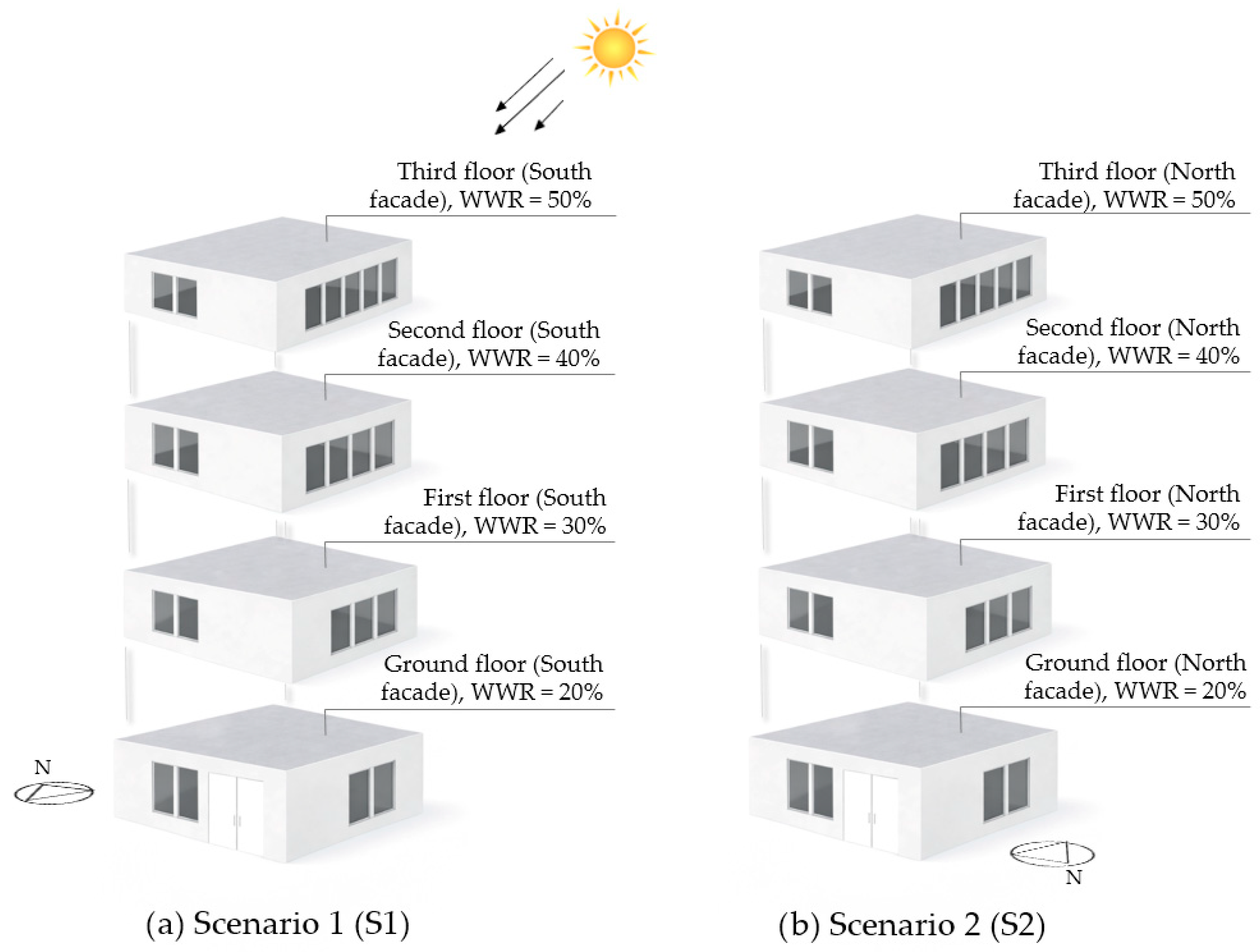
| S1 | North = 20%, East = 30%, West = 20% South = 20%/30%/40%/50% (by floor *2) |
| S2 | South = 20%, East = 30%, West = 20% North = 20%/30%/40%/50% (by floor *2) |
| Item | Description |
|---|---|
| Space/Activity type | Hospital–Inpatient ward/Patient room (generic) |
| Occupancy density | 0.08 persons/m2 (≈12.5 m2 per person; patient + attendant average) |
| Metabolic rate (met) | 1.1 met (sitting/standing, light activity) |
| Clothing (clo) | Winter: 1.0 clo; Summer: 0.5 clo |
| Lighting target (lux) | 300 lux (typical for patient rooms/general areas) |
| Lighting internal gains | 8 W/m2 (patient rooms; schedule: 06:00–22:00 = 1.0; 22:00–06:00 = 0.3) |
| Equipment internal gains | 12 W/m2 (medical/office equipment mix, conservative) |
| People sensible/latent | Sensible ~70 W/person, Latent ~45 W/person (typical for 1.1 met) |
| Item | Description |
|---|---|
| HVAC template | Central AHU + terminal units (generic ward); code-compliant, no optimization; availability schedule: 24/7 in wards |
| Mechanical ventilation | On (24/7 availability) |
| Thermostat setpoints | Heating 21 °C (setback 19 °C); Cooling 24 °C (setup 26 °C) |
| Heating/Cooling supply air temperature | 32 °C/12 °C |
| Heating source/ Seasonal efficiency | Natural gas (hot-water boiler), η_seasonal ≈ 0.90 |
| Cooling system/Seasonal COP | ≈3.2 (air-cooled chiller, conservative) |
| Operation (heating/cooling) | 24/7 ward schedule (diurnal variation) |
| Humidity control | Not actively controlled (temperature control only) |
| Natural ventilation | On—by zone (non-critical areas only) |
| Outdoor air (ventilation) | Outdoor air ≥2 ACH, Total supply 6 ACH (24/7; typical per ASHRAE 170; neutral pressure, generic ward) |
| Infiltration | Fixed 0.20 h−1 (ACH); wind-driven infiltration and structural wind loads are outside the scope |
| City | Climate Zone | U_Wall *1 | U_Roof *1 | U_Ground *1 | Code Limit U_Window *2 | Modeled U_Window *2 | SHGC *3 | Selected g (Glazing Model) *4 |
|---|---|---|---|---|---|---|---|---|
| Bursa | 3 | 0.40 | 0.30 | 0.35 | 1.8 | 1.5 | ≤0.45 | 0.40 |
| Mersin | 1 | 0.45 | 0.35 | 0.40 | 1.8 | 1.5 | ≤0.45 | 0.40 |
| Kars | 6 | 0.25 | 0.20 | 0.25 | 1.8 | 1.5 | ≥0.55 | 0.60 |
| Bursa, Turkey (Zone 3, Marmara—Temperate/Transition) | ||
|---|---|---|
| External Wall Layers | Ground-Floor Layers | Rooftop Layers |
| (exterior → interior) U_wall = 0.39 W/(m2·K) | (soil side → room) U_ground = 0.32 W/(m2·K) | (outdoor side → room) U_roof *2 = 0.29 W/(m2·K) |
| Mineral render (exterior finish) 0.015 m *1 Air barrier/WRB (water-resistive barrier) 0.0015 m Graphite EPS insulation (λ ≈ 0.031) 0.055 m Hollow clay block (HCB) infill 0.190 m Gypsum plasterboard 0.012 m | Reinforced concrete slab 0.120 m PE/EPDM moisture barrier 0.001 m XPS 0.100 m Cement–sand screed 0.050 m Floor finish (vinyl/linoleum) 0.003 m | Waterproofing membrane 0.004 m XPS 0.110 m Vapor retarder 0.0003 m Reinforced concrete slab 0.140 m Gypsum plasterboard 0.012 m |
| Mersin, Turkey (Zone 1, Mediterranean—Hot–Humid) | ||
|---|---|---|
| External Wall Layers | Ground-Floor Layers | Rooftop Layers |
| (exterior → interior) U_wall = 0.36 W/(m2·K) | (soil side → room) U_ground = 0.39 W/(m2·K) | (outdoor side → room) U_roof *2 = 0.33 W/(m2·K) |
| Mineral render (exterior finish) 0.012 m *1 Air barrier/WRB (water-resistive barrier) 0.0015 m Graphite EPS insulation (λ ≈ 0.031) 0.030 m Autoclaved aerated concrete 0.200 m Gypsum plasterboard 0.012 m | Reinforced concrete slab 0.120 m PE/EPDM moisture barrier 0.001 m XPS 0.080 m Cement–sand screed 0.050 m Floor finish (vinyl/linoleum) 0.003 m | Reflective roofing membrane 0.003 m EPS insulation 0.100 m Vapor retarder 0.0003 m Reinforced concrete slab 0.120 m Gypsum plasterboard 0.011 m |
| Kars, Turkey (Zone 6, Humid Continental—Cold) | ||
|---|---|---|
| External Wall Layers | Ground-Floor Layers | Rooftop Layers |
| (exterior → interior) U_wall = 0.24 W/(m2·K) | (soil side → room) U_ground = 0.25 W/(m2·K) | (outdoor side → room) U_roof *2 = 0.19 W/(m2·K) |
| Mineral render (exterior finish) 0.015 m *1 Mineral wool insulation (external) 0.080 m Hollow clay block (HCB) infill 0.190 m Service cavity (mineral wool infill) 0.040 m Vapor retarder 0.0003 m Gypsum plasterboard (double) 0.025 m | Reinforced concrete slab 0.150 m PE/EPDM moisture barrier 0.001 m XPS 0.090 m Cement–sand screed 0.050 m Floor finish (vinyl/linoleum) 0.003 m | Roofing membrane 0.003 m Mineral wool insulation 0.180 m Vapor retarder 0.0003 m Reinforced concrete slab 0.140 m Gypsum plasterboard 0.012 m |
| City (District) | Scenario | WWR Pattern (N/E/S/W) | Window Solar Gains | Transmission Losses (U-Value) | Net Window Heat Gain |
|---|---|---|---|---|---|
| Bursa | S1 | N20/E30/S20, 30, 40, 50/W20 | 12.67 | 2.66 | 10.01 |
| Bursa | S2 | N20, 30, 40, 50/E30/S20/W20 | 6.32 | 2.62 | 3.70 |
| Mersin | S1 | N20/E30/S20, 30, 40, 50/W20 | 15.38 | 2.25 | 13.13 |
| Mersin | S2 | N20, 30, 40, 50/E30/S20/W20 | 5.79 | 2.19 | 3.60 |
| Kars | S1 | N20/E30/S20, 30, 40, 50/W20 | 20.69 | 5.25 | 15.44 |
| Kars | S2 | N20, 30, 40, 50/E30/S20/W20 | 5.94 | 4.88 | 1.06 |
| City | Scenario | Heating | Cooling | Total |
|---|---|---|---|---|
| Bursa | S1 | 19 | 54 | 73 |
| Bursa | S2 | 23 | 46 | 69 |
| Mersin | S1 | 5 | 95 | 100 |
| Mersin | S2 | 7 | 85 | 92 |
| Kars | S1 | 81 | 22 | 103 |
| Kars | S2 | 91 | 18 | 109 |
Disclaimer/Publisher’s Note: The statements, opinions and data contained in all publications are solely those of the individual author(s) and contributor(s) and not of MDPI and/or the editor(s). MDPI and/or the editor(s) disclaim responsibility for any injury to people or property resulting from any ideas, methods, instructions or products referred to in the content. |
© 2025 by the authors. Licensee MDPI, Basel, Switzerland. This article is an open access article distributed under the terms and conditions of the Creative Commons Attribution (CC BY) license.
Share and Cite
Aydınol, F.A.Z.; Ayyıldız, S. Orientation-Dependent Window Area: Linking Solar Gains and Transmission Losses to Annual Heating and Cooling Loads. Buildings 2026, 16, 177. https://doi.org/10.3390/buildings16010177
Aydınol FAZ, Ayyıldız S. Orientation-Dependent Window Area: Linking Solar Gains and Transmission Losses to Annual Heating and Cooling Loads. Buildings. 2026; 16(1):177. https://doi.org/10.3390/buildings16010177
Chicago/Turabian StyleAydınol, Fatma Azize Zülal, and Sonay Ayyıldız. 2026. "Orientation-Dependent Window Area: Linking Solar Gains and Transmission Losses to Annual Heating and Cooling Loads" Buildings 16, no. 1: 177. https://doi.org/10.3390/buildings16010177
APA StyleAydınol, F. A. Z., & Ayyıldız, S. (2026). Orientation-Dependent Window Area: Linking Solar Gains and Transmission Losses to Annual Heating and Cooling Loads. Buildings, 16(1), 177. https://doi.org/10.3390/buildings16010177