Temporal Trajectories in EEG-Based Mental Workload: Effects of Workspace Type
 ,
,  ,
,  and
and 
Abstract
1. Introduction
2. Literature Review
2.1. Workspaces, Health and Cognitive Well-Being
2.2. Mental Workload and EEG Metrics in Office Work Tasks
3. Materials and Methods
3.1. Participants
3.2. Procedure
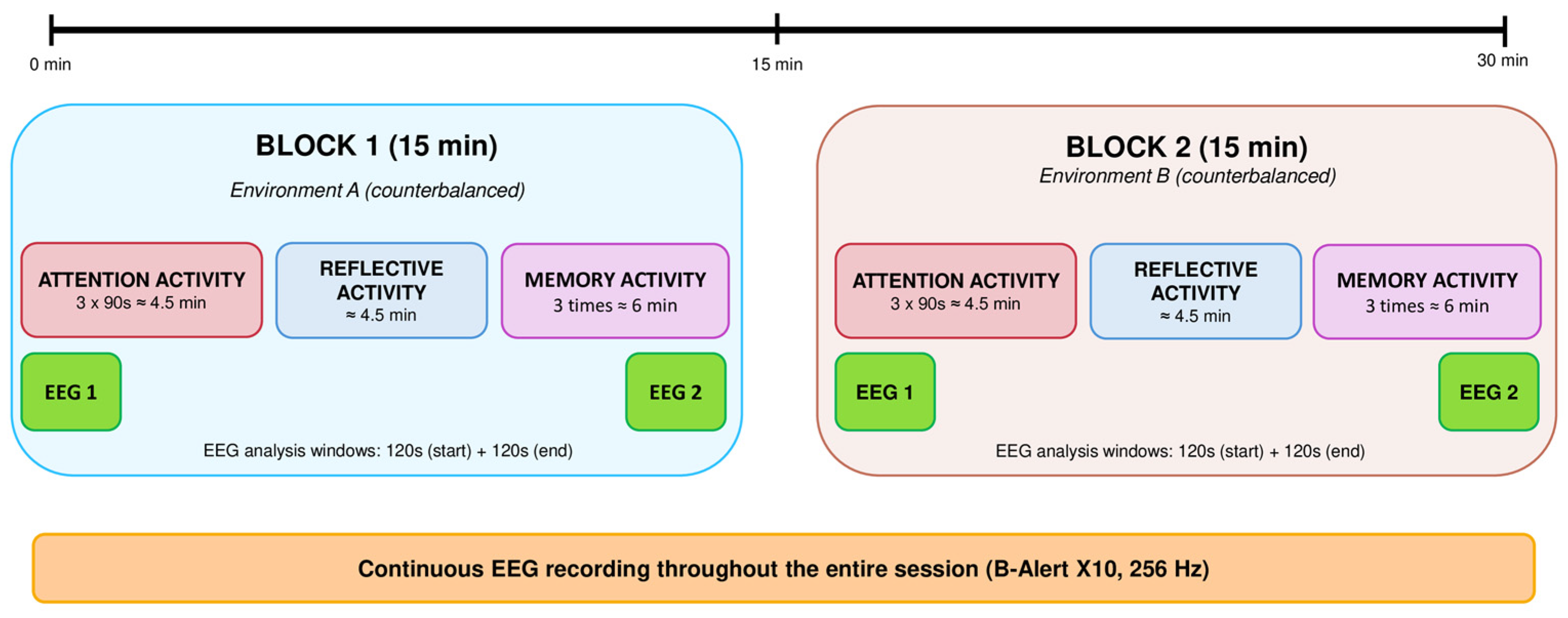
3.2.1. Experimental Design
- Attention activity (auditory task),
- Reflective activity (reading and writing task),
- Memory activity (reading and writing task).
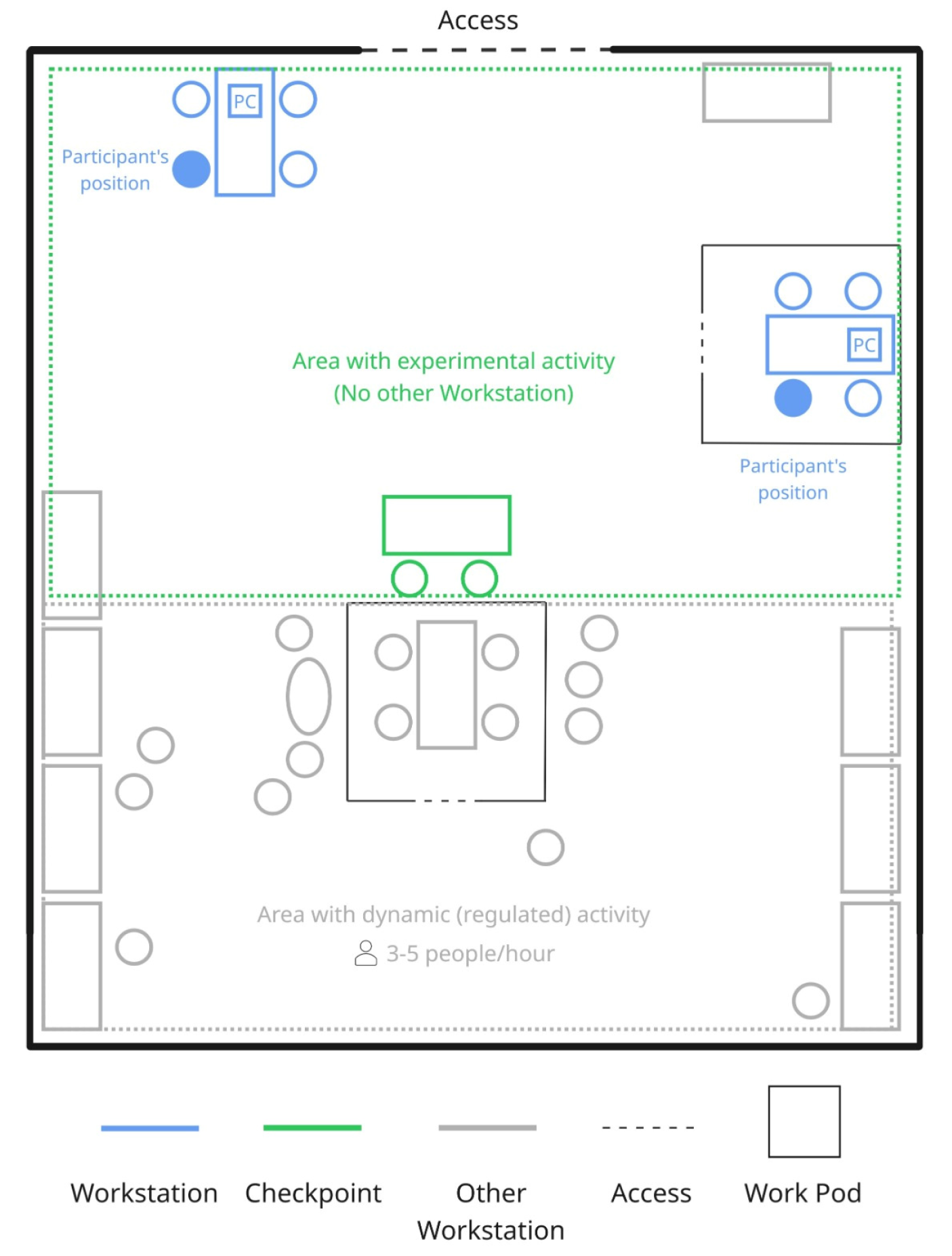
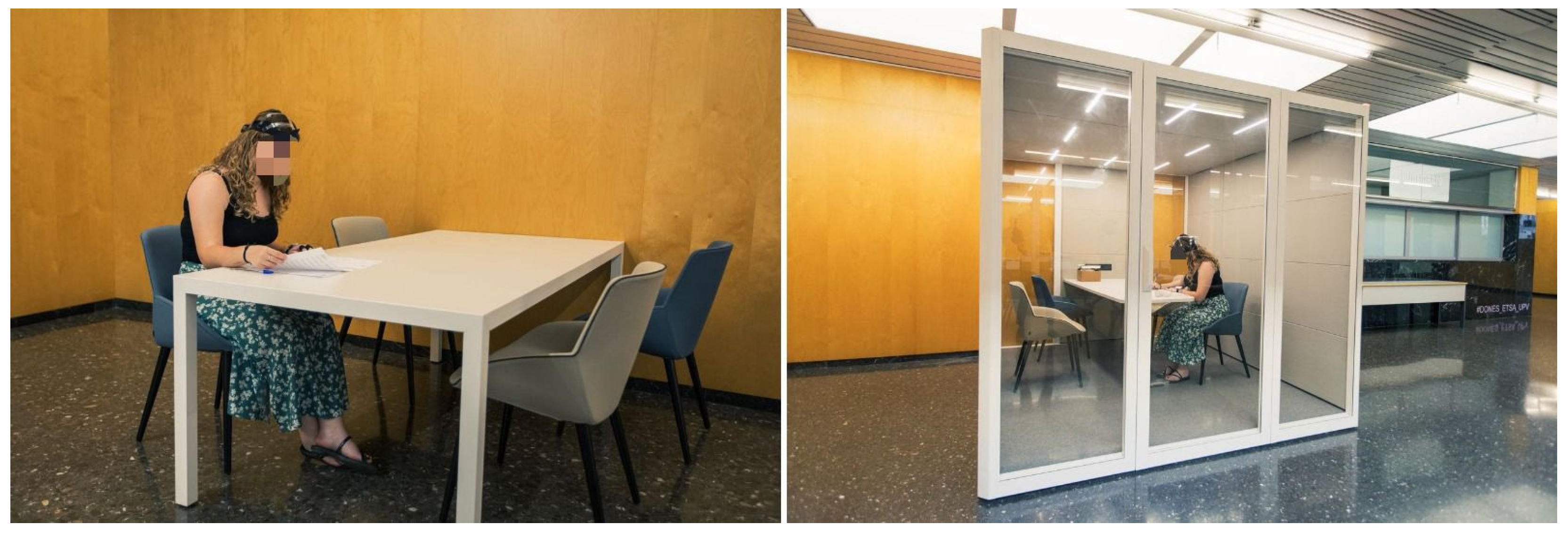
3.2.2. Experimental Environment
3.3. Experimental Stimuli: Cognitive Tasks for Mental Workload
Cognitive Tasks
- [Attention activity] this task consisted of a continuous auditory vigilance test, inspired by the auditory vigilance paradigm proposed by Seidman et al. [65]. In this test, participants listened to a sequence of brief auditory stimuli and had to respond with a mouse click whenever a specific target stimulus appeared, ignoring the distractor stimuli. The task was presented in three consecutive blocks of approximately 90 s each (total duration ≈ 4.5 min). Performing this task requires sustained attention, inhibitory control, and the ability to maintain a constant level of vigilance, processes that are fundamental in work activities requiring prolonged concentration under conditions of monotony or environmental distraction.
- [Reflective activity] between the attention activity and the memory activity, participants completed a brief reading and writing activity, which included filling out forms and open-ended questions about their experience during the experiment and their evaluation of the workstation. This phase aimed to simulate typical office tasks involving reading comprehension, reflection, and written production.
- [Memory activity] this task was based on a free recall paradigm derived from the study by Alonso et al. [66] on false memory production and recognition in Spanish word lists. In each trial, participants studied a list of visually presented words for 60 s, and after a brief interval, were given another 60 s to write down all the words they could remember. The sequence was repeated three consecutive times (total duration ≈ 6 min). This task requires encoding, retention, and retrieval of information, critical aspects of cognitive performance in work activities involving processing and remembering recent information.
3.4. Experimental EEG Recording
Signal Processing and Analysis
- [Beta (β)] associated with active cognitive processing, sustained attention, and alertness [77]. Increases in frontal beta commonly appear in tasks requiring concentration and executive control [78]. In work environments, elevated beta may reflect cognitive activity as well as stress induced by high task demands [79].
- [Theta (θ)] frontal theta reflects working memory load, executive control, and sustained mental effort, but also the build-up of mental fatigue [49,81,82]. This functional duality implies that sustained increases may indicate either the cognitive effort required to maintain performance or the progressive onset of fatigue. In workplace contexts, elevated theta levels can signal cognitive overload or sustained mental effort.
- [Engagement ()] reflects active involvement in the task. Originally proposed by Pope et al. [15] this index has been used to assess cognitive involvement, flow states, and its inverse relationship with mental workload in learning and work environments [58,83,84]. It was computed as the mean absolute power (µV2/Hz) across frontal and prefrontal electrodes; higher values indicate greater engagement and flow-like states.
- [Arousal ()] represents cortical activation and alertness [85]. This ratio increases with attentional demand and decreases with relaxation or fatigue [86]. In built-environment research, it helps to evaluate how spatial configurations modulate users’ activation levels [33,73]. It was computed as the mean absolute power (µV2/Hz) across frontal and prefrontal electrodes, where higher values reflect greater arousal.
- [Ratio Gamma/Beta ()] An exploratory index derived from the ratio between gamma activity, associated with information integration and higher-order processing; [75] and beta activity, linked to active cognitive processing [77]. Recent studies have used increases in this ratio as a complementary marker of heightened cognitive engagement and elevated working-memory demands in demanding tasks [17,54].
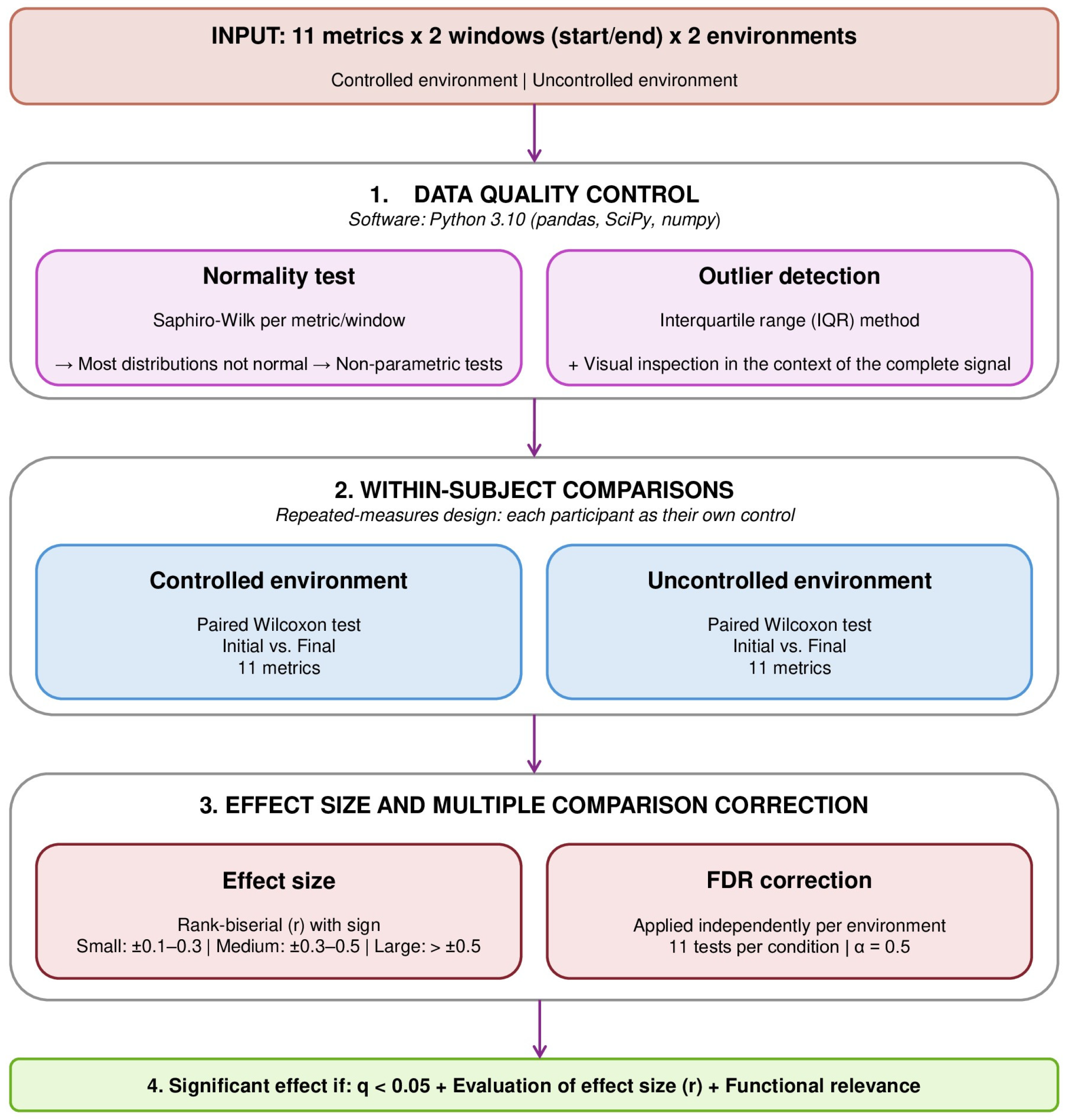
3.5. Statistical Analysis
4. Results
4.1. Work Pod Environment
4.2. Open-Plan Office Enviroment
4.3. Descriptive Comparison Between Environments
5. Discussion
Limitations and Future Research Directions
6. Conclusions
Author Contributions
Funding
Institutional Review Board Statement
Informed Consent Statement
Data Availability Statement
Acknowledgments
Conflicts of Interest
References
- Kalgotra, P.; Sharda, R.; McHaney, R. Understanding the Impact of Interruptions on Knowledge Work: An Exploratory Neuroimaging Study. SSRN 2014. [Google Scholar] [CrossRef]
- Russell, E.; Jackson, T.W.; Fullman, M.; Chamakiotis, P. Getting on Top of Work-Email: A Systematic Review of 25 Years of Research to Understand Effective Work-Email Activity. J. Occup. Organ. Psychol. 2024, 97, 74–103. [Google Scholar] [CrossRef]
- Kern, M.; Ohly, S.; Ďuranová, L.; Friedrichs, J. Drowning in Emails: Investigating Email Classes and Work Stressors as Antecedents of High Email Load and Implications for Well-Being. Front. Psychol. 2024, 15, 1439070. [Google Scholar] [CrossRef]
- De Croon, E.M.; Sluiter, J.K.; Kuijer, P.P.F.M.; Frings-Dresen, M.H.W. The Effect of Office Concepts on Worker Health and Performance: A Systematic Review of the Literature. Ergonomics 2005, 48, 119–134. [Google Scholar] [CrossRef]
- Haapakangas, A.; Hallman, D.M.; Mathiassen, S.E.; Jahncke, H. Self-Rated Productivity and Employee Well-Being in Activity-Based Offices: The Role of Environmental Perceptions and Workspace Use. Build. Environ. 2018, 145, 115–124. [Google Scholar] [CrossRef]
- Haapakangas, A.; Hallman, D.M.; Bergsten, E.L. Office Design and Occupational Health—Has Research Been Left Behind? Scand. J. Work. Environ. Health 2023, 49, 1–4. [Google Scholar] [CrossRef] [PubMed]
- Kraus, S.; Bouncken, R.B.; Görmar, L.; González-Serrano, M.H.; Calabuig, F. Coworking Spaces and Makerspaces: Mapping the State of Research. J. Innov. Knowl. 2022, 7, 100161. [Google Scholar] [CrossRef]
- Richardson, A.; Potter, J.; Paterson, M.; Harding, T.; Tyler-Merrick, G.; Kirk, R.; Reid, K.; McChesney, J. Office Design and Health: A Systematic Review. N. Z. Med. J. 2017, 130, 39–49. [Google Scholar]
- Haapakangas, A.; Hongisto, V.; Varjo, J.; Lahtinen, M. Benefits of Quiet Workspaces in Open-Plan Offices—Evidence from Two Office Relocations. J. Environ. Psychol. 2018, 56, 63–75. [Google Scholar] [CrossRef]
- Kim, J.; de Dear, R. Workspace Satisfaction: The Privacy-Communication Trade-off in Open-Plan Offices. J. Environ. Psychol. 2013, 36, 18–26. [Google Scholar] [CrossRef]
- Candido, C.; Chakraborty, P.; Tjondronegoro, D. The Rise of Office Design in High-Performance, Open-Plan Environments. Buildings 2019, 9, 100. [Google Scholar] [CrossRef]
- Wang, X.; Li, D.; Menassa, C.C.; Kamat, V.R. Investigating the Effect of Indoor Thermal Environment on Occupants’ Mental Workload and Task Performance Using Electroencephalogram. Build. Environ. 2019, 158, 120–132. [Google Scholar] [CrossRef]
- Sander, E.J.; Marques, C.; Birt, J.; Stead, M.; Baumann, O. Open-Plan Office Noise Is Stressful: Multimodal Stress Detection in a Simulated Work Environment. J. Manag. Organ. 2021, 27, 1021–1037. [Google Scholar] [CrossRef]
- Pieper, K.; Spang, R.P.; Prietz, P.; Möller, S.; Paajanen, E.; Vaalgamaa, M.; Voigt-Antons, J.N. Working with Environmental Noise and Noise-Cancelation: A Workload Assessment With EEG and Subjective Measures. Front. Neurosci. 2021, 15, 771533. [Google Scholar] [CrossRef]
- Pope, A.T.; Bogart, E.H.; Bartolome, D.S. Biocybernetic System Evaluates Indices of Operator Engagement in Automated Task. Biol. Psychol. 1995, 40, 187–195. [Google Scholar] [CrossRef] [PubMed]
- McMahan, T.; Parberry, I.; Parsons, T.D. Evaluating Player Task Engagement and Arousal Using Electroencephalography. Procedia Manuf. 2015, 3, 2303–2310. [Google Scholar] [CrossRef]
- Chauhan, S.; Choudhary, G.; Bhavsar, A.; Dutt, V. An EEG-Based Study Investigating Cognitive and Behavioral Reactions to Indian Knowledge System Narratives in Virtual Reality. Res. Publ. Connect. 2025, 2, 1012–1019. [Google Scholar] [CrossRef]
- Bernstein, E.S.; Turban, S. The Impact of the ‘Open’ Workspace on Human Collaboration. Philos. Trans. R. Soc. B Biol. Sci. 2018, 373, 20170239. [Google Scholar] [CrossRef]
- Bouncken, R.B.; Reuschl, A.J. Coworking-Spaces: How a Phenomenon of the Sharing Economy Builds a Novel Trend for the Workplace and for Entrepreneurship. Rev. Manag. Sci. 2016, 12, 317–334. [Google Scholar] [CrossRef]
- Spinuzzi, C. Working Alone Together: Coworking as Emergent Collaborative Activity. J. Bus. Tech. Commun. 2012, 26, 399–441. [Google Scholar] [CrossRef]
- Danielsson, B.C.; Bodin, L. Office Type in Relation to Health, Well-Being, and Job Satisfaction among Employees. Environ. Behav. 2008, 40, 636–668. [Google Scholar] [CrossRef]
- De Been, I.; Beijer, M. The Influence of Office Type on Satisfaction and Perceived Productivity Support. J. Facil. Manag. 2014, 12, 142–157. [Google Scholar] [CrossRef]
- Seddigh, A.; Berntson, E.; Bodin Danielson, C.; Westerlund, H. Concentration Requirements Modify the Effect of Office Type on Indicators of Health and Performance. J. Environ. Psychol. 2014, 38, 167–174. [Google Scholar] [CrossRef]
- Appel-Meulenbroek, R.; Janssen, I.; Groenen, P. An End-user’s Perspective on Activity-based Office Concepts. J. Corp. Real. Estate 2011, 13, 122–135. [Google Scholar] [CrossRef]
- Gifford, R.; Steg, L.; Reser, J.P. Environmental Psychology. In IAAP Handbook of Applied Psychology; Wiley: Hoboken, NJ, USA, 2011; pp. 440–470. [Google Scholar] [CrossRef]
- Evans, G.W.; McCoy, J.M. When Buildings Don’t Work: The Role of Architecture in Human Health. J. Environ. Psychol. 1998, 18, 85–94. [Google Scholar] [CrossRef]
- Jahncke, H.; Hygge, S.; Halin, N.; Green, A.M.; Dimberg, K. Open-Plan Office Noise: Cognitive Performance and Restoration. J. Environ. Psychol. 2011, 31, 373–382. [Google Scholar] [CrossRef]
- Evans, G.W.; Johnson, D. Stress and Open-Office Noise. J. Appl. Psychol. 2000, 85, 779–783. [Google Scholar] [CrossRef]
- Frontczak, M.; Wargocki, P. Literature Survey on How Different Factors Influence Human Comfort in Indoor Environments. Build. Environ. 2011, 46, 922–937. [Google Scholar] [CrossRef]
- Hamilton, D.K.; Watkins, D.H. Evidence-Based Design for Multiple Building Types; John Wiley & Sons, Inc.: Hoboken, NJ, USA, 2009; ISBN 978-0-470-12934-0. [Google Scholar]
- Ulrich, R.S.; Zimring, C.; Zhu, X.; DuBose, J.; Seo, H.B.; Choi, Y.S.; Quan, X.; Joseph, A. A Review of the Research Literature on Evidence-Based Healthcare Design. HERD Health Environ. Res. Des. J. 2008, 1, 61–125. [Google Scholar] [CrossRef]
- Semprini, G.; Secchi, S.; Jahanbin, A.; Suryo, S.; Ichinose, M.; Kuroda, Y.; Alkhalaf, H. An Investigation of Indoor Environment Quality on Occupants’ Thermal Responses, Health, and Productivity: A Study Based on Physiological Data in Occupied Office Space. Buildings 2024, 14, 3562. [Google Scholar] [CrossRef]
- Coburn, A.; Vartanian, O.; Chatterjee, A. Buildings, Beauty, and the Brain: A Neuroscience of Architectural Experience. J. Cogn. Neurosci. 2017, 29, 1521–1531. [Google Scholar] [CrossRef]
- Higuera-Trujillo, J.L.; Llinares, C.; Macagno, E. The Cognitive-Emotional Design and Study of Architectural Space: A Scoping Review of Neuroarchitecture and Its Precursor Approaches. Sensors 2021, 21, 2193. [Google Scholar] [CrossRef] [PubMed]
- Rolfö, L.V. Relocation to an Activity-Based Flexible Office—Design Processes and Outcomes. Appl. Ergon. 2018, 73, 141–150. [Google Scholar] [CrossRef]
- Paas, F.G.W.C.; Van Merriënboer, J.J.G. Instructional Control of Cognitive Load in the Training of Complex Cognitive Tasks. Educ. Psychol. Rev. 1994, 6, 351–371. [Google Scholar] [CrossRef]
- Wickens, C.D. Multiple Resources and Mental Workload. Hum. Factors 2008, 50, 449–455. [Google Scholar] [CrossRef]
- Salvucci, D.D.; Taatgen, N.A. The Multitasking Mind; Oxford University Press: Oxford, UK, 2011. [Google Scholar]
- Baddeley, A. Working Memory: Theories, Models, and Controversies. Annu. Rev. Psychol. 2012, 63, 1–29. [Google Scholar] [CrossRef]
- Joo, M.; Im, J.B.; Lee, K.T.; Kim, J.H. Comparative Analysis of Work Performance and Physiological Response Based on Office Types and Indoor Space Design. In Architectural Engineering and Design Management; Tayior & Francis: Abingdon, UK, 2025. [Google Scholar] [CrossRef]
- Houthoofd, S.A.M.K.; Morrens, M.; Sabbe, B.G.C. Cognitive and Psychomotor Effects of Risperidone in Schizophrenia and Schizoaffective Disorder. Clin. Ther. 2008, 30, 1565–1589. [Google Scholar] [CrossRef] [PubMed]
- Gevins, A.; Smith, M.E. Neurophysiological Measures of Working Memory and Individual Differences in Cognitive Ability and Cognitive Style. Cereb. Cortex 2000, 10, 829–839. [Google Scholar] [CrossRef]
- Klimesch, W.; Sauseng, P.; Hanslmayr, S. EEG alpha oscillations: The inhibition–timing hypothesis. Brain Res. Rev. 2007, 53, 63–88. [Google Scholar] [CrossRef]
- Gola, M.; Magnuski, M.; Szumska, I.; Wróbel, A. EEG Beta Band Activity Is Related to Attention and Attentional Deficits in the Visual Performance of Elderly Subjects. Int. J. Psychophysiol. 2013, 89, 334–341. [Google Scholar] [CrossRef]
- Ray, W.J.; Cole, H.W. EEG Alpha Activity Reflects Attentional Demands, and Beta Activity Reflects Emotional and Cognitive Processes. Science 1985, 228, 750–752. [Google Scholar] [CrossRef] [PubMed]
- Jensen, O.; Tesche, C.D. Frontal theta activity in humans increases with memory load in a working memory task. Eur. J. Neurosci. 2002, 15, 1395–1399. [Google Scholar] [CrossRef] [PubMed]
- Nyhus, E.; Curran, T. Functional Role of Gamma and Theta Oscillations in Episodic Memory. Neurosci. Biobehav. Rev. 2010, 34, 1023–1035. [Google Scholar] [CrossRef]
- Mitchell, D.J.; McNaughton, N.; Flanagan, D.; Kirk, I.J. Frontal-Midline Theta from the Perspective of Hippocampal “Theta”. Prog. Neurobiol. 2008, 86, 156–185. [Google Scholar] [CrossRef]
- Wascher, E.; Rasch, B.; Sänger, J.; Hoffmann, S.; Schneider, D.; Rinkenauer, G.; Heuer, H.; Gutberlet, I. Frontal Theta Activity Reflects Distinct Aspects of Mental Fatigue. Biol. Psychol. 2014, 96, 57–65. [Google Scholar] [CrossRef]
- Tallon-Baudry, C.; Bertrand, O. Oscillatory Gamma Activity in Humans and Its Role in Object Representation. Trends Cogn. Sci. 1999, 3, 151–162. [Google Scholar] [CrossRef]
- Herrmann, C.S.; Fründ, I.; Lenz, D. Human Gamma-Band Activity: A Review on Cognitive and Behavioral Correlates and Network Models. Neurosci. Biobehav. Rev. 2010, 34, 981–992. [Google Scholar] [CrossRef]
- Kim, S.; Park, H.; Choo, S. Effects of Changes to Architectural Elements on Human Relaxation-Arousal Responses: Based on VR and EEG. Int. J. Environ. Res. Public Health 2021, 18, 4305. [Google Scholar] [CrossRef]
- Holm, A.; Lukander, K.; Korpela, J.; Sallinen, M.; Müller, K.M.I. Estimating Brain Load from the EEG. Sci. World J. 2009, 9, 639–651. [Google Scholar] [CrossRef]
- Chauhan, S.; Aggarwal, P.; Dutt, V. Brains and Bots: EEG Insights into Moral Learning with Social Robots and Text-Based Methods. Proc. Hum. Factors Ergon. Soc. Annu. Meet. 2025, 69, 327–332. [Google Scholar] [CrossRef]
- Brookings, J.B.; Wilson, G.F.; Swain, C.R. Psychophysiological Responses to Changes in Workload during Simulated Air Traffic Control. Biol. Psychol. 1996, 42, 361–377. [Google Scholar] [CrossRef] [PubMed]
- Borghini, G.; Astolfi, L.; Vecchiato, G.; Mattia, D.; Babiloni, F. Measuring Neurophysiological Signals in Aircraft Pilots and Car Drivers for the Assessment of Mental Workload, Fatigue and Drowsiness. Neurosci. Biobehav. Rev. 2014, 44, 58–75. [Google Scholar] [CrossRef] [PubMed]
- Kamzanova, A.T.; Kustubayeva, A.M.; Matthews, G. Use of EEG Workload Indices for Diagnostic Monitoring of Vigilance Decrement. Hum. Factors 2014, 56, 1136–1149. [Google Scholar] [CrossRef]
- Berka, C.; Levendowski, D.; Lumicao, M.N.; Yau, A.; Davis, G.; Zivkovic, V.T.; Olmstead, R.; Tremoulet, P.D.; Craven, P.L. EEG Correlates of Task Engagement and Mental Workload in Vigilance, Learning, and Memory Tasks. Aviat. Space Environ. Med. 2007, 78, B231–B244. [Google Scholar]
- Aspinall, P.; Mavros, P.; Coyne, R.; Roe, J. The Urban Brain: Analysing Outdoor Physical Activity with Mobile EEG. Br. J. Sports Med. 2015, 49, 272–276. [Google Scholar] [CrossRef]
- Ladouce, S.; Donaldson, D.I.; Dudchenko, P.A.; Ietswaart, M. Mobile EEG Identifies the Re-Allocation of Attention during Real-World Activity. Sci. Rep. 2019, 9, 15851. [Google Scholar] [CrossRef]
- Llinares, C.; Higuera-Trujillo, J.L.; Serra, J. Cold and Warm Coloured Classrooms. Effects on Students’ Attention and Memory Measured through Psychological and Neurophysiological Responses. Build. Environ. 2021, 196, 107726. [Google Scholar] [CrossRef]
- Llinares Millán, C.; Higuera-Trujillo, J.L.; Montañana i Aviñó, A.; Torres, J.; Sentieri, C. The Influence of Classroom Width on Attention and Memory: Virtual-Reality-Based Task Performance and Neurophysiological Effects. Build. Res. Inf. 2021, 49, 813–826. [Google Scholar] [CrossRef]
- Castilla, N.; Higuera-Trujillo, J.L.; Llinares, C. The Effects of Illuminance on Students’ Memory. A Neuroarchitecture Study. Build. Environ. 2023, 228, 109833. [Google Scholar] [CrossRef]
- Welch, P.D. The Use of Fast Fourier Transform for the Estimation of Power Spectra: A Method Based on Time Averaging Over Short, Modified Periodograms. IEEE Trans. Audio Electroacoust. 1967, 15, 70–73. [Google Scholar] [CrossRef]
- Seidman, L.J.; Goldstein, J.M.; O’Craven, K.; Savoy, R.; Breiter, H.C.; Goodman, J.M.; Woodruff, P.W.R.; Tsuang, M.T.; Rosen, B.R. A Functional Magnetic Resonance Imaging Study of Auditory Vigilance with Low and High Information Processing Demands. Neuropsychology 1998, 12, 505–518. [Google Scholar] [CrossRef]
- Alonso, M.Á.; Fernández, Á.; Díez, E.; Beato, M.S. Índices de Producción de Falso Recuerdo y Falso Reconocimiento Para 55 Listas de Palabras En Castellano. Psicothema 2004, 16, 357–362. [Google Scholar]
- Gevins, A.; Smith, M.E. Neurophysiological Measures of Cognitive Workload during Human-Computer Interaction. Theor. Issues Ergon. Sci. 2003, 4, 113–131. [Google Scholar] [CrossRef]
- Delorme, A.; Makeig, S. EEGLAB: An Open Source Toolbox for Analysis of Single-Trial EEG Dynamics Including Independent Component Analysis. J. Neurosci. Methods 2004, 134, 9–21. [Google Scholar] [CrossRef] [PubMed]
- Gudmundsson, S.; Runarsson, T.P.; Sigurdsson, S.; Eiriksdottir, G.; Johnsen, K. Reliability of Quantitative EEG Features. Clin. Neurophysiol. 2007, 118, 2162–2171. [Google Scholar] [CrossRef] [PubMed]
- Delorme, A.; Makeig, S.; Sejnowski, T. Automatic Artifact Rejection for EEG Data Using High-Order Statistics and Independent Component Analysis. In Proceedings of the Third International ICA Conference, San Diego, CA, USA, 9–13 December 2001; pp. 9–12. [Google Scholar]
- Li, J.; Jin, Y.; Lu, S.; Wu, W.; Wang, P. Building Environment Information and Human Perceptual Feedback Collected through a Combined Virtual Reality (VR) and Electroencephalogram (EEG) Method. Energy Build. 2020, 224, 110259. [Google Scholar] [CrossRef]
- Zhang, N.; Liu, C.; Li, J.; Hou, K.; Shi, J.; Gao, W. A Comprehensive Review of Research on Indoor Cognitive Performance Using Electroencephalogram Technology. Build. Environ. 2024, 257, 111555. [Google Scholar] [CrossRef]
- Choi, Y.; Kim, M.; Chun, C. Measurement of Occupants’ Stress Based on Electroencephalograms (EEG) in Twelve Combined Environments. Build. Environ. 2015, 88, 65–72. [Google Scholar] [CrossRef]
- Banaei, M.; Hatami, J.; Yazdanfar, A.; Gramann, K. Walking through Architectural Spaces: The Impact of Interior Forms on Human Brain Dynamics. Front. Hum. Neurosci. 2017, 11, 289961. [Google Scholar] [CrossRef]
- Herrmann, C.S.; Munk, M.H.J.; Engel, A.K. Cognitive Functions of Gamma-Band Activity: Memory Match and Utilization. Trends Cogn. Sci. 2004, 8, 347–355. [Google Scholar] [CrossRef]
- Mathewson, K.E.; Lleras, A.; Beck, D.M.; Fabiani, M.; Ro, T.; Gratton, G. Pulsed out of Awareness: EEG Alpha Oscillations Represent a Pulsed-Inhibition of Ongoing Cortical Processing. Front. Psychol. 2011, 2, 10619. [Google Scholar] [CrossRef]
- Engel, A.K.; Fries, P. Beta-Band Oscillations—Signalling the Status Quo? Curr. Opin. Neurobiol. 2010, 20, 156–165. [Google Scholar] [CrossRef]
- Luijmes, R.E.; Pouwels, S.; Boonman, J. The Effectiveness of Neurofeedback on Cognitive Functioning in Patients with Alzheimer’s Disease: Preliminary Results. Neurophysiol. Clin. Clin. Neurophysiol. 2016, 46, 179–187. [Google Scholar] [CrossRef]
- Vanhollebeke, G.; De Smet, S.; De Raedt, R.; Baeken, C.; van Mierlo, P.; Vanderhasselt, M.A. The Neural Correlates of Psychosocial Stress: A Systematic Review and Meta-Analysis of Spectral Analysis EEG Studies. Neurobiol. Stress 2022, 18, 100452. [Google Scholar] [CrossRef] [PubMed]
- Klimesch, W. EEG Alpha and Theta Oscillations Reflect Cognitive and Memory Performance: A Review and Analysis. Brain Res. Rev. 1999, 29, 169–195. [Google Scholar] [CrossRef]
- Cavanagh, J.F.; Frank, M.J. Frontal theta as a mechanism for cognitive control. Trends Cogn. Sci. 2014, 18, 414–421. [Google Scholar] [CrossRef] [PubMed]
- Käthner, I.; Wriessnegger, S.C.; Müller-Putz, G.R.; Kübler, A.; Halder, S. Effects of Mental Workload and Fatigue on the P300, Alpha and Theta Band Power during Operation of an ERP (P300) Brain–Computer Interface. Biol. Psychol. 2014, 102, 118–129. [Google Scholar] [CrossRef]
- Pereira, A.R.; Sampaio, A.; McGlone, F.; González-Villar, A.J. Neurophysiological Responses to Vicarious Affective Touch: An Electroencephalography (EEG) Study. Eur. J. Neurosci. 2025, 61, e70099. [Google Scholar] [CrossRef] [PubMed]
- Jap, B.T.; Lal, S.; Fischer, P.; Bekiaris, E. Using EEG Spectral Components to Assess Algorithms for Detecting Fatigue. Expert. Syst. Appl. 2009, 36, 2352–2359. [Google Scholar] [CrossRef]
- Barry, R.J.; Clarke, A.R.; Johnstone, S.J.; Magee, C.A.; Rushby, J.A. EEG Differences between Eyes-Closed and Eyes-Open Resting Conditions. Clin. Neurophysiol. 2007, 118, 2765–2773. [Google Scholar] [CrossRef]
- Oken, B.S.; Salinsky, M.C.; Elsas, S.M. Vigilance, Alertness, or Sustained Attention: Physiological Basis and Measurement. Clin. Neurophysiol. 2006, 117, 1885–1901. [Google Scholar] [CrossRef]
- Maris, E.; Oostenveld, R. Nonparametric Statistical Testing of EEG- and MEG-Data. J. Neurosci. Methods 2007, 164, 177–190. [Google Scholar] [CrossRef]
- Tukey, J.W..; Anscombe, F.R..; Hoaglin, D.C. Exploratory Data Analysis; Addison-Wesley Publishing Company: Boston, MA, USA, 1977; ISBN 0201076160. [Google Scholar]
- Wilcoxon, F. Individual Comparisons by Ranking Methods. Biom. Bull. 1945, 1, 80. [Google Scholar] [CrossRef]
- Kerby, D.S. The Simple Difference Formula: An Approach to Teaching Nonparametric Correlation. Compr. Psychol. 2014, 3, 11.IT. [Google Scholar] [CrossRef]
- Benjamini, Y.; Hochberg, Y. Controlling the False Discovery Rate: A Practical and Powerful Approach to Multiple Testing. J. R. Stat. Soc. Ser. B 1995, 57, 289–300. [Google Scholar] [CrossRef]
- Neubauer, A.C.; Fink, A. Intelligence and Neural Efficiency. Neurosci. Biobehav. Rev. 2009, 33, 1004–1023. [Google Scholar] [CrossRef]
- Gevins, A.; Smith, M.E.; McEvoy, L.; Yu, D. High-Resolution EEG Mapping of Cortical Activation Related to Working Memory: Effects of Task Difficulty, Type of Processing, and Practice. Cereb. Cortex 1997, 7, 374–385. [Google Scholar] [CrossRef] [PubMed]
- Wang, F.; Ke, H.; Cai, C. Deep Wavelet Self-Attention Non-Negative Tensor Factorization for Non-Linear Analysis and Classification of FMRI Data. Appl. Soft Comput. 2025, 182, 113522. [Google Scholar] [CrossRef]



| Cortical Region | Spectral Change | Task Type/Context | Associated Functional Interpretation |
|---|---|---|---|
| FM | ↑ β | Multitasking (↑ number of tasks) | ↑ Executive control; ↑ Stimulus processing |
| PM | ↓ α | Multitasking (↑ number of tasks) | ↑ Cortical inhibition |
| PM | ↑ α | Multitasking (↑ number of tasks) | ↑ Fatigue–sleepiness |
| FM/PM | ↑ α/β | Multitasking (↑ number of tasks) | ↑ Acute cognitive load |
| FM + C + PM + TM | ↓↓ β | Monotonous task | ↑ Fatigue |
| FM + C + PM + TM | ↑ α | Monotonous task | ↑ Fatigue |
| FM + C + PM + TM | ↑ (θ + α)/β | Monotonous task | ↑ Fatigue |
| F + C + P | ↑ β | Demanding cognitive task | ↑ Alertness; ↑ Processing |
| FM + PP | ↑ α | Demanding cognitive task | ↑ Internally directed attention; (↓ Need for learning = ↑ Habituation) |
| FM + PP | ↓ α | Demanding cognitive task | ↑ Externally directed attention; (↑ Need for learning) |
| F + C + P | ↓ α | Demanding cognitive task | ↑ Cortical inhibition |
| Irrelevant areas | ↑ α | Demanding cognitive task | ↑ Cortical inhibition |
| F + C + P | ↑ α | Demanding cognitive task | ↑ Fatigue |
| F + C + P | ↑ θ (Ton) | Demanding cognitive task | ↑ Fatigue |
| FM | ↑ θ (Pha) | Demanding cognitive task | ↑ Sustained attention; ↑ Working memory; ↑ Executive control; (↑ Probability of conflict/high demand) |
| F + C + P | ↓ β/(α + θ) | Demanding cognitive task | ↑ Fatigue; (↓ Need for effort) |
| F + C + P | ↑ β/(α + θ) | Demanding cognitive task | ↑ Flow state ↑ Task engagement |
| Global | ↑ β/(α + θ) | Immediately before “Game over” | ↑ Flow state ↑ Task engagement |
| F | ↑ β/α | Immediately before “Game over” | ↑ Arousal |
| F + O + T + H | ↑ γ | Visual memory task | ↑ Memory encoding |
| S + T | ↑ γ/β | VR Narrative task | ↑ Arousal—Engagement; ↑ Audiovisual processing |
| S + T | ↓ γ/β | Reading narrative task | ↓ Sensory processing |
| F | ↑ α/θ | Narrative reading task—VR | ↑ Externally directed attention; ↑ Narrative processing |
| Metrics Involved | Cortical Region | Start Mean | Start SD | Final Mean | Final SD | Means Dif. | p-Value | Effect | q-Value (FDR) |
|---|---|---|---|---|---|---|---|---|---|
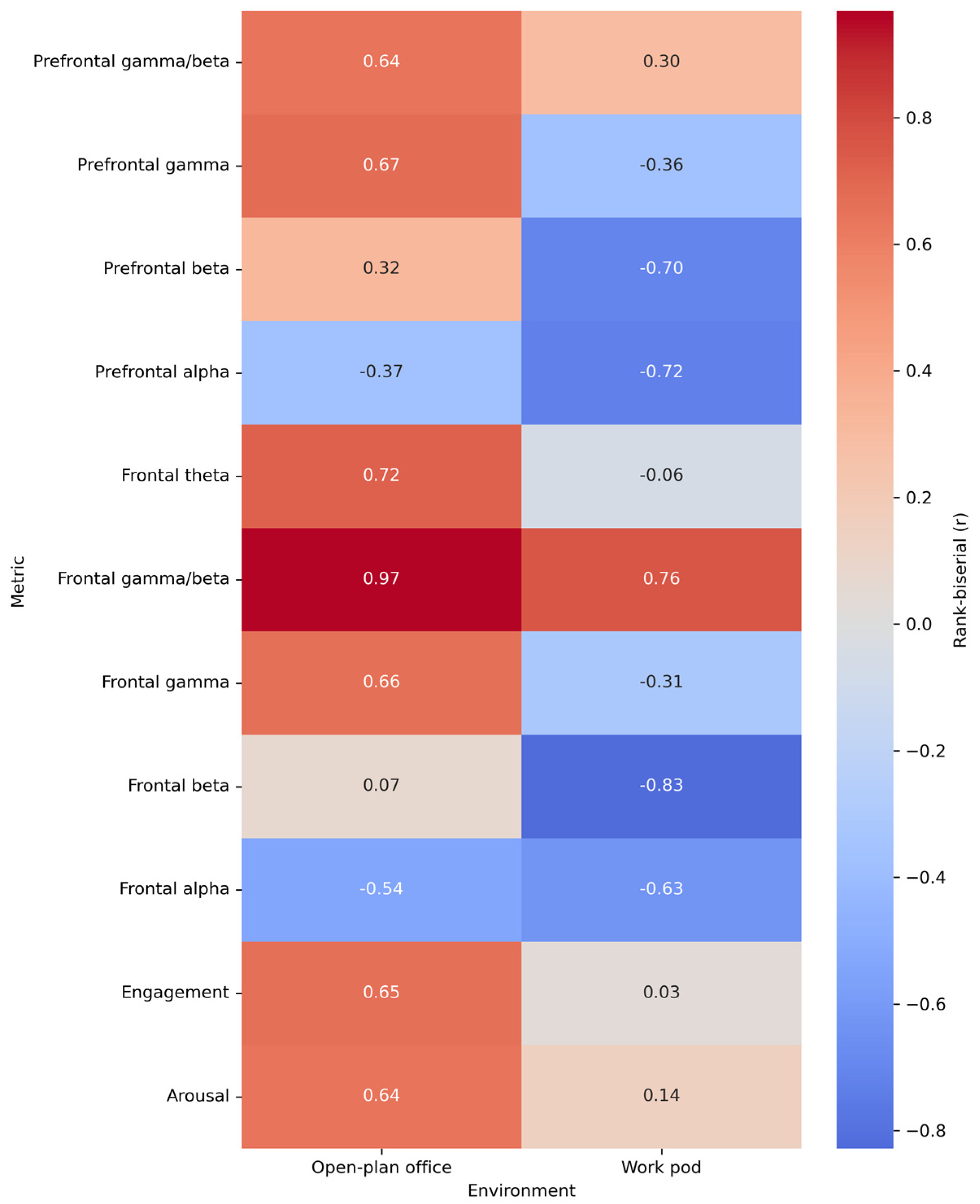
| γ | PF | 0.077 | 0.104 | 0.026 | 0.034 | −0.051 | 0.165 | −0.362 | 0.330 |
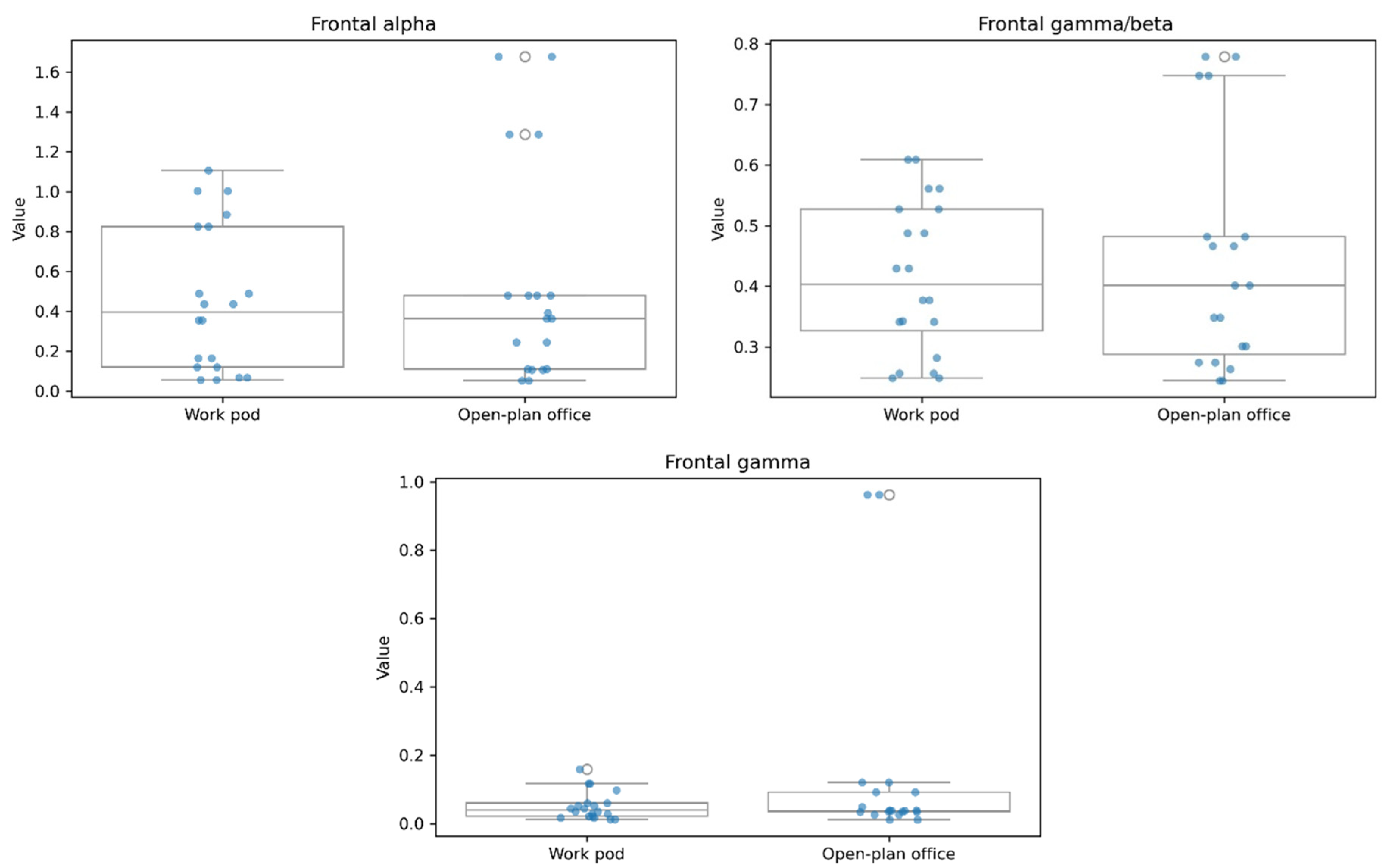
| γ | F | 0.208 | 0.411 | 0.052 | 0.041 | −0.157 | 0.231 | −0.314 | 0.366 |
| β | PF | 0.171 | 0.195 | 0.064 | 0.068 | −0.107 | 0.004 | −0.705 | 0.012 * |
| β | F | 0.504 | 0.850 | 0.137 | 0.124 | −0.367 | <0.001 | −0.829 | <0.001 * |
| α | PF | 0.614 | 0.742 | 0.157 | 0.134 | −0.456 | 0.003 | −0.724 | 0.012 * |
| α | F | 1.324 | 0.724 | 0.452 | 0.364 | −0.872 | 0.012 | −0.556 | 0.028 * |
| θ | F | 1.911 | 1.927 | 1.950 | 2.192 | 0.038 | 0.841 | −0.057 | 0.906 |
| γ/β | PF | 0.379 | 0.209 | 0.398 | 0.116 | 0.019 | 0.261 | 0.295 | 0.366 |
| γ/β | F | 0.356 | 0.164 | 0.415 | 0.125 | 0.059 | 0.047 | 0.761 | 0.127 |
| Arousal (β/α) | (PF + F)/2 | 0.474 | 0.421 | 0.434 | 0.138 | −0.039 | 0.596 | 0.142 | 0.758 |
| Engagement (β/(α + θ)) | (PF + F)/2 | 0.191 | 0.275 | 0.124 | 0.062 | −0.068 | 0.927 | 0.029 | 0.927 |
| Metrics Involved | Cortical Region | Start Mean | Start SD | Final Mean | Final SD | Means Dif. | p-Value | Effect | q-Value (FDR) |
|---|---|---|---|---|---|---|---|---|---|
| γ | PF | 0.029 | 0.029 | 1.034 | 2.034 | 1.006 | 0.008 | 0.673 | 0.022 * |
| γ | F | 0.038 | 0.022 | 0.906 | 2.569 | 0.868 | 0.009 | 0.663 | 0.022 * |
| β | PF | 0.093 | 0.135 | 0.680 | 1.898 | 0.587 | 0.241 | 0.316 | 0.281 |
| β | F | 0.126 | 0.065 | 0.350 | 0.722 | 0.224 | 0.798 | 0.074 | 0.798 |
| α | PF | 0.352 | 0.604 | 0.900 | 0.406 | 0.548 | 0.169 | −0.368 | 0.215 |
| α | F | 0.604 | 0.684 | 0.892 | 1.559 | 0.287 | 0.040 | −0.537 | 0.062 |
| θ | F | 0.554 | 0.292 | 0.856 | 0.298 | 0.303 | 0.004 | 0.716 | 0.021 * |
| γ/β | PF | 0.394 | 0.211 | 0.469 | 0.217 | 0.075 | 0.012 | 0.642 | 0.022 * |
| γ/β | F | 0.316 | 0.161 | 0.465 | 0.259 | 0.149 | <0.001 | 0.968 | <0.001 * |
| Arousal (β/α) | (PF + F)/2 | 0.354 | 0.102 | 0.481 | 0.168 | 0.127 | 0.012 | 0.642 | 0.021 * |
| Engagement (β/(α + θ)) | (PF + F)/2 | 0.128 | 0.081 | 0.164 | 0.068 | 0.037 | 0.011 | 0.652 | 0.021 * |
| Environment | Direction of Change | Metrics Involved | Neurophysiological Profile |
|---|---|---|---|
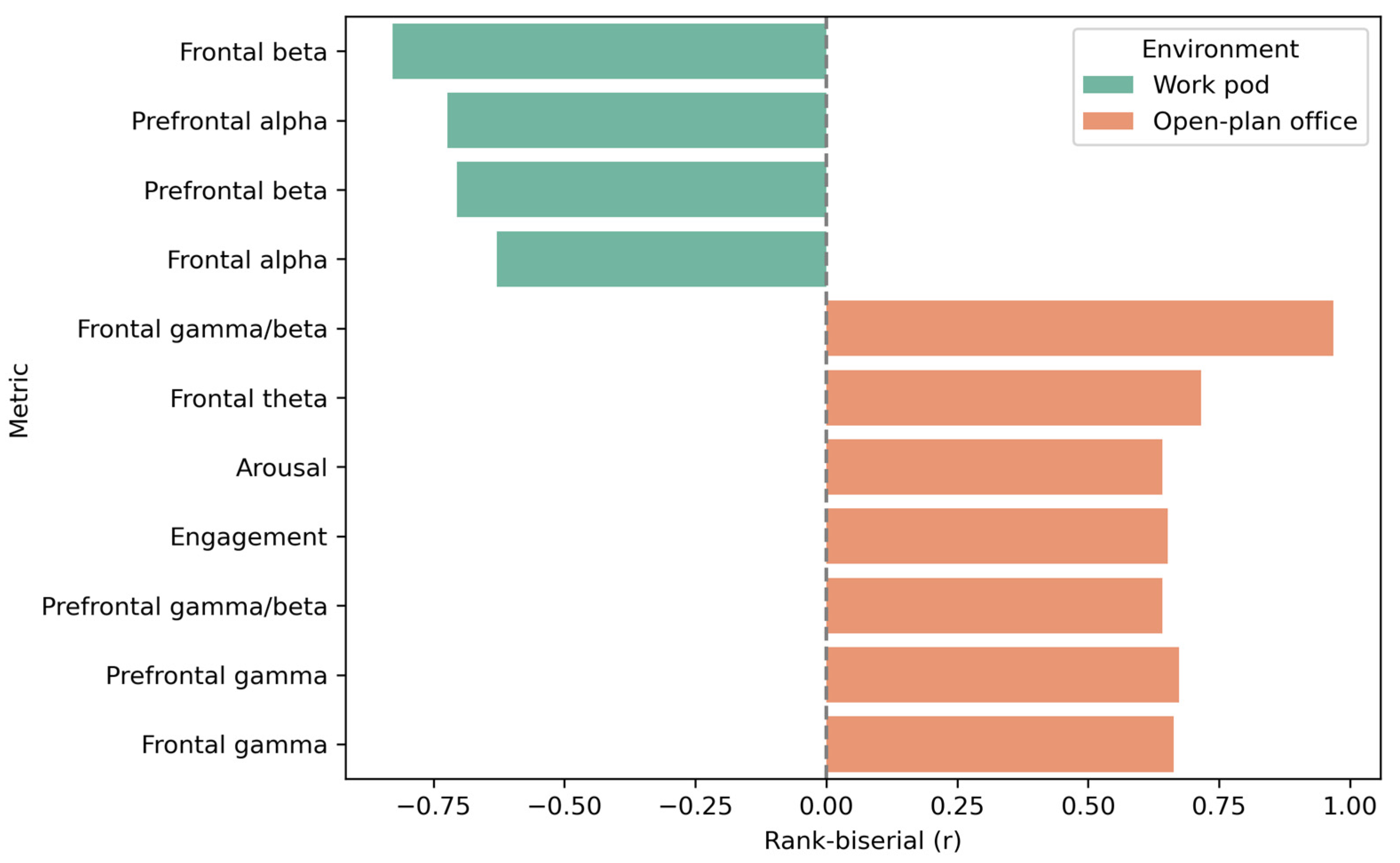
| Work pod | Decline | β (F, PF) α (F, PF) | Progressive reduction in mental workload and greater cortical stabilization |
| Open-plan office | Increase | γ (F, PF) θ (F) γ/β, β/α, β/(α + θ) | Increased activation, fatigue alertness, and cognitive demand during the task |
Disclaimer/Publisher’s Note: The statements, opinions and data contained in all publications are solely those of the individual author(s) and contributor(s) and not of MDPI and/or the editor(s). MDPI and/or the editor(s) disclaim responsibility for any injury to people or property resulting from any ideas, methods, instructions or products referred to in the content. |
© 2025 by the authors. Licensee MDPI, Basel, Switzerland. This article is an open access article distributed under the terms and conditions of the Creative Commons Attribution (CC BY) license.
Share and Cite
Pérez-Martínez, M.; Barranco-Merino, R.; Higuera-Trujillo, J.L.; Llinares, C. Temporal Trajectories in EEG-Based Mental Workload: Effects of Workspace Type. Buildings 2026, 16, 176. https://doi.org/10.3390/buildings16010176
Pérez-Martínez M, Barranco-Merino R, Higuera-Trujillo JL, Llinares C. Temporal Trajectories in EEG-Based Mental Workload: Effects of Workspace Type. Buildings. 2026; 16(1):176. https://doi.org/10.3390/buildings16010176
Chicago/Turabian StylePérez-Martínez, María, Robi Barranco-Merino, Juan Luis Higuera-Trujillo, and Carmen Llinares. 2026. "Temporal Trajectories in EEG-Based Mental Workload: Effects of Workspace Type" Buildings 16, no. 1: 176. https://doi.org/10.3390/buildings16010176
APA StylePérez-Martínez, M., Barranco-Merino, R., Higuera-Trujillo, J. L., & Llinares, C. (2026). Temporal Trajectories in EEG-Based Mental Workload: Effects of Workspace Type. Buildings, 16(1), 176. https://doi.org/10.3390/buildings16010176