You are currently viewing a new version of our website. To view the old version click .
Buildings
  • Editorial
  • Open Access

8 December 2025

Interior Design Towards the Sustainable Environment: People, Environment, Design, Technology—Editor’s Comment


Faculty of Architecture, Poznan University of Technology, 60-965 Poznań, Poland
Buildings2025, 15(24), 4432;https://doi.org/10.3390/buildings15244432 
(registering DOI)
This article belongs to the Topic Interior Design Towards the Sustainable Environment: People, Environment, Design, Technology

1. Introduction

The present Topic concerns interior design with a focus towards the sustainable environment. It is precisely this branch of design that is distinctive, linking well-being with the technical solutions shaping our everyday living conditions, while simultaneously contributing to the development of a sustainable society.
The borderland between engineering and art, which interior architecture represents, constitutes a rewarding field for research and modelling, yet it is also entrusted with expectations of supporting the implementation and achievement of the Sustainable Development Goals (SDGs). Their implementation requires the consolidation of academic and economic entities. Research and innovative projects are indispensable: this Topic poses a genuine challenge to specialists. Research in this field is being conducted intensively. The present Topic addresses the interpenetration of such studies and their prestige within interior architecture, and within the technical and social infrastructure. It offers an opportunity to acquaint oneself with new achievements and to appreciate the significance of knowledge, the symbiosis of scientific disciplines, and the need for cooperation among specialists, as well as the identification and examination of phenomena together with their implications.
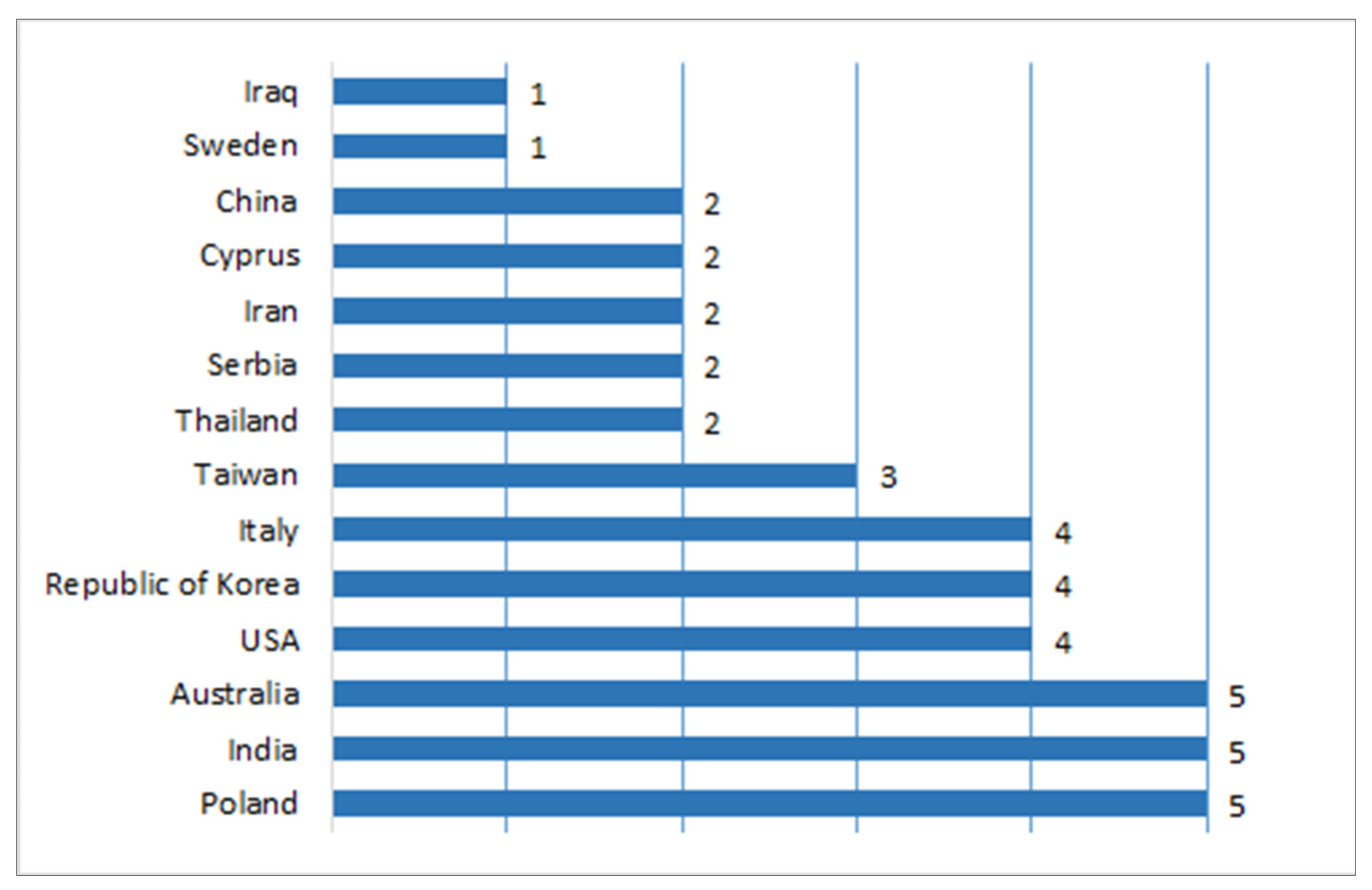
From the manuscripts submitted, following rigorous substantive selection by editors and reviewers, 17 articles were accepted and published. The Topic attracted considerable attention within the academic community; ultimately, 42 authors from 14 countries took part, with the largest groups representing Australia, India and Poland. A broader perspective on the distribution of authors by country is presented in Figure 1.
Figure 1. Distribution of authors by country.

2. Overview of the Contributions

The subject matter of the accepted articles is multifaceted, and has resulted in the application of diverse research techniques. Despite their originality, the contents of these articles intersect to some extent, and may be classified into four thematic groups. The criterion for assigning an article to one of these groups is its dominant substantive feature (the principal issue or disciplinary focus). Naturally, such classification remains subjective. The groups selected are as follows: (A) pro-life technical aspects; (B) human beings and spatial satisfaction; (C) pro-health actions; (D) a sustainable society.
A list of the contributions to the present Topic, arranged according to these groups, is presented in Table 1. To facilitate readers in locating issues of particular interest, Table 1 includes three additional columns answering three guiding questions: What is the subject of the research? What constitutes the research problem? What research techniques (or instrumentality) have been applied? The following paragraphs provide a synthetic collation.
Table 1. The content of the Topic “Interior Design Towards the Sustainable Environment: People, Environment, Design, Technology”, and synthetic collation.
Group (A): Pro-life technical aspects. This thematic group embraces studies on workspaces, indoor lighting, signage systems in rooms and internal routes, pedestrian movement transit, the Design Thinking methodology, and spatial ability. Wang et al. [1] discuss the assessment of Wayfinding Behaviours on the basis of a case study conducted at the National Taiwan University Hospital (NTUH). The navigation system in healthcare buildings constitutes the subject of their analysis. The investigation of wayfinding was preceded by a preliminary test, after which a virtual-environment model of part of the hospital campus was developed for experimental purposes. The findings indicated appropriate indoor signage arrangements that improved the legibility and consistency of information. At the same time, the results elucidated behavioural patterns during wayfinding in complex spatial environments.
Research concerning spatial ability was undertaken by Cho and Suh [2]. Their article examines a significant topic within the fields of interior design and architecture, namely the assessment and comprehension of spatial abilities in professional education and practice. The study compares traditional static modes (a paper–desktop mode) with interactive virtual reality (VR) modes for assessing spatial abilities, employing instruments such as VR AISAT and VR OSIQ. The participants were students of the Architecture and Interior Design Domain, and the classrooms at one of the universities in Seoul served as the experimental setting.
Two subsequent articles address a closely related subject. They concern studies on the lighting (in various aspects) of workplaces, more specifically office environments. The quality of interior lighting represents an important element of interior architecture, owing to its impact on well-being. Both articles highlight the need to incorporate lighting design into the overall architectural design process. The first, written by Park et al. [3], presents actual measurements and simulations concerning daylight-induced glare. In the study of glare perception, a fisheye field of view (FOV) was applied. The measurements took into account the location and direction of glare and were conducted in office rooms at Hongik University in Seoul. The second article (Kubiak [4]) introduces the Design Thinking (DT) methodology in the lighting design of office rooms. Lighting devices should be designed and installed to efficiently and comfortably illuminate the work task and work environment. The article presents a holistic approach to lighting design, and the priority of requirements is oriented to users. The primary users of the office are administrative staff working at computer stations. The background of the analysis lies in the discrepancies (and their minimisation) between sustainable design and the use of the modernised interior. The author recommends applying the DT methodology during lighting modernisation works.
The article by Ma and Yang [5] concludes this technical group. It addresses the integration of various functional spaces and passenger flow routes within railway stations, underground areas, and commercial zones. The essence of the research is to determine spatial locations for the Guidance Signage System. The experiments presented highlight the areas that connect different spaces and track passengers’ visual attention, providing scientific insights for the design and implementation of the national Transit-Oriented Development (TOD) model in China. The Tobii Glasses 2 eye-tracking device was employed in these studies.
Group (B) (Human and spatial satisfaction) is characterised by the following keywords: residents’ physical abilities (in-home mobility), sleep hygiene, patient stress, first impression effect, quality of work life, ergonomics, and inclusive design. The subject matter of the articles in Group (B) is introduced by the paper authored by Selanon and Chuangchai [6]. The article presents evidence-based findings on ergonomic design that promote mobility, safety, and healthy living by embedding these considerations within interior design. The creation of residential spaces in the face of knowledge, integrative design, and even the ergonomics of ageing is complemented by inclusive design. The adjustment of interior decoration for people with disabilities, as well as the physical and mental well-being of the residents, the increase in self-esteem, and the reduction in dependence on caregivers, enrich the content of the article.
Dincer et al. [7] introduce the world of the sleep environment, focusing on the use of the bedroom, on sleep research, on user preferences and their needs. The majority of the surveyed Australians declared the desire for physical and architectural changes and the need for functional changes as well as changes in aesthetics and comfort. It was comfort that was indicated as the primary necessity. Of course, owners and tenants defined different preferences. The designer must pay attention to the relationship between the quality of sleep and the need for privacy.
Waiting rooms in a clinic/dental surgery, a visit, stress, a certain nervousness, time standing still—who doesn’t know that pain? Help may come from the interior architect: it is possible to shape clinical/consulting environments in such a way as to alleviate patients’ stress. Experiments and proposals for interior arrangements were carried out in three Iranian clinics. The respondents made use of computer-generated images of waiting rooms. Eight attributes of the interior design of the waiting rooms were taken into account; ‘ambient lighting’ proved to be the most important attribute in increasing patient comfort. The article by Emami et al. [8] harmonises with the themes of health, arrangement styles, and well-being.
Wlazły and Bonenberg [9] introduce the reader to visual perception in interior architecture. The research investigates a fundamental question of how decorative elements influence spatial perception. Indirectly, it also explores how different individuals—architects, users, and developers—visually engage with their interior surroundings. The living room served as the study environment, and the research instrument was a mobile eye-tracking device. A clear impact of decorative styling on the design process was identified. This is where we encounter the effect of first impressions.
When designing workplaces, attention should be paid to both employee and spatial satisfaction. We enter the sensory and sociological dimensions of design: Krizmanić and Milovanović [10] shared the results of a study identifying predictors of workplace satisfaction, namely aesthetics, flexibility, and a sense of belonging. The empirical setting comprised the offices of three corporations in Belgrade. An assessment of Quality of Work Life (QWL) was accompanied by the Workspace Satisfaction Scale (WSS). The title of the article is telling: From Space to Satisfaction.
Group (C) is Pro-Health Activities, including biophilic design, health quality of the environment, legal regulations, standards, including the WELL Building Standard, salutogenic design, synaesthesia, and Design for All. From the notion of well-being, we move to biophilic design; that is, to a direction in interior design. This represents a path towards better well-being through interiors inspired by nature (a healthy space for people). Mohammed et al. [11] present a study of biophilic content in preschool buildings in a town in Iraq. The existence of biophilic features and attributes was examined, and the Biophilic Interior Design Matrix was used for their identification. Interest in the relationship between architecture, human beings, and nature is becoming increasingly common. This is an interesting aspect of sustainability.
Another article [12] offers a contextual literature review of salutogenic design, sustainable development, and health-focused architecture. It discusses the tension between the pathogenic model that has permeated Polish regulations and the salutogenic model. The author identified key salutogenic factors and compared Polish regulations with international standards, primarily with the WELL Building Standard. The discussion as a whole is conducted in the spirit of sustainable, human-centred design.
Research on the role of colour perception extending beyond the visual modality is presented in [13]. The article emphasises how multisensory colour coding can support accessibility and well-being in interior spaces. In this case, colours can be coded and perceived through senses other than sight. Particular attention was paid to the needs of older adults and individuals with visual impairments. Three concepts—the phenomenon of synaesthesia, inclusivity in interior design, and Design for All—are central to the present discussion.
Group (D) (A Sustainable Society) is formed by strong values, that is, recovery homes in the Oxford House network, addiction recovery homes, student dormitories, community homes (Case della Comunità), healthcare work environments, social and environmental policy (case study of treatment through work), and factors shaping the work environment. A significant social problem, situated within the network of recovery homes, is presented by Jason et al. [14]. The subject of their research is women with addiction and the sustainable society, while the objects are workplaces, the employment of women in communities, and housing problems. The exploration of the relationship between women’s employment at the community level and internal variables in care homes within the Oxford House network (USA) is the essence of this article. The background in care homes, including the importance of community integration for sustainable development, is also articulated.
The main issue addressed by the following article [15] is a comprehensive understanding of the factors of the physical environment affecting personnel in healthcare institutions, which has been analysed through a systematic review of the existing literature. The physical environment is considered in three dimensions, which are architectural design, interior design, and environmental elements. The key element of the study is the search for determinants of staff satisfaction and the building of community in healthcare facilities.
The use of space, its layout, and the efficiency of users is the domain of the research presented in [16]. The subject of consideration is student rooms, and the background is room occupancy. Privacy, personalisation, and satisfaction are discussed. In turn, the article [17] focuses on the design of waiting rooms in the Italian “Casa della Comunità,” aiming to promote health, active ageing, and social interaction. The theoretical framework rests on three pillars: territorial care, waiting space, and sensory design. Eight spatial typologies are discussed within the context of Italy’s new Casa della Comunità healthcare model. The article draws attention to the spatial requirements of waiting areas, and in particular to how sensory design and environmental configurations enhance psychological comfort, social interaction, physical activity, and the adoption of healthy behaviours.

3. Discussion and Comments

A review of the contributions and achievements of the present Topic makes it possible to formulate several findings.
A technical theme can be traced across each of the four thematic groups discussed in the contributions. It will always exist in interior architecture, to a greater or lesser extent, regardless of time. However, in the present issue, this aspect has not been sufficiently emphasised: there are no articles devoted entirely to the technical equipment of the building, HVAC, or domotics (home automation system). These and related issues are and will remain indispensable in design, and technological progress continues to make a permanently astonishing advancement. The research instruments and methods applied are adequate for the problems analysed. Their diversity is evident. In further studies, attention should be given, among other areas, to the Internet of Things (IoT) and to AI + BIM, which is the combination of Artificial Intelligence (AI) with Building Information Modelling (BIM) technology. We already know that AI is revolutionising the construction industry (for example [18,19]). It is not yet known to what extent it will strengthen design within the field of interior architecture.
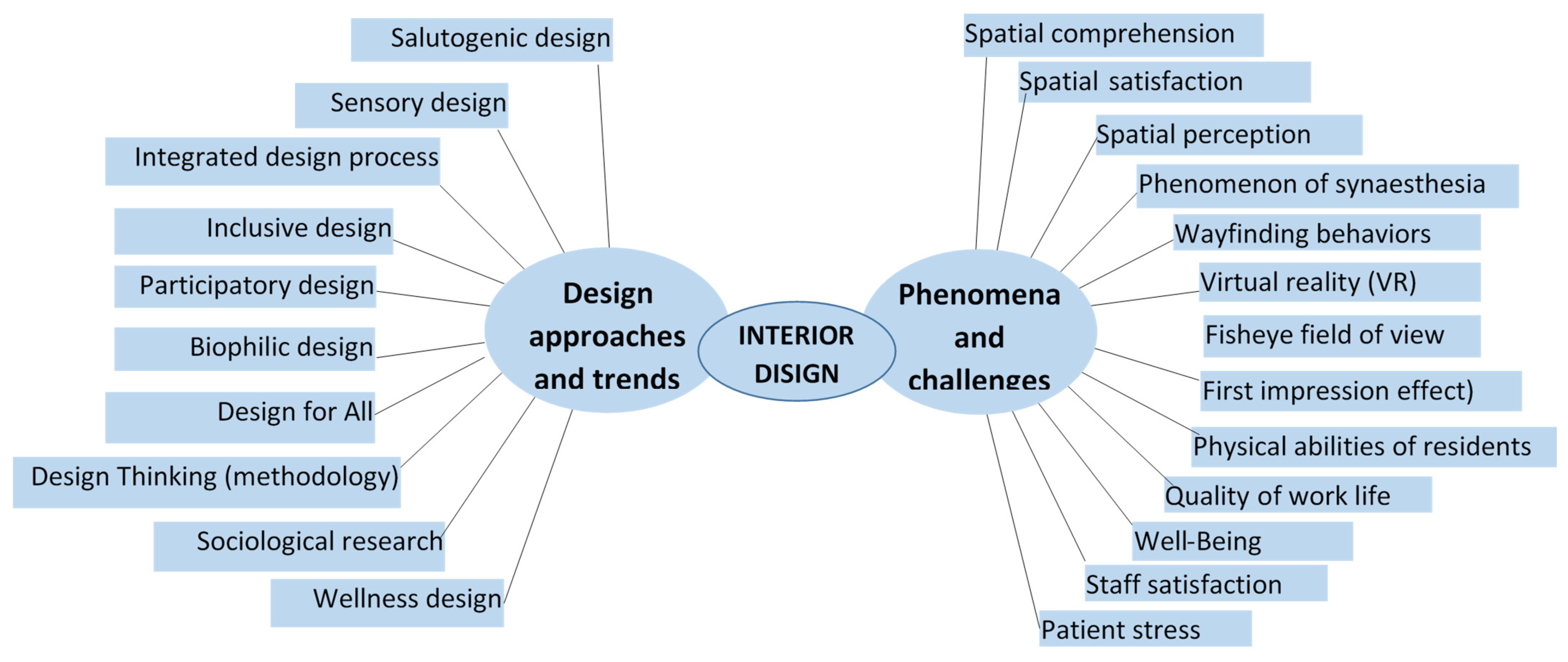
The synthesis of the articles assembled in the present Topic indicates high cognitive value. The very identification and subsequent tackling of a refined phenomenon, and the kinds of approaches to design, ennoble the scientific worth of the collection. A juxtaposition of these notions is presented in Figure 2. All those listed can be included among the new trends in environmental and social design, and more precisely Human-Centred Design and Sustainable Design. The overview of instrumentality is presented in Table 1. All this confirms that the research issues in the domain of interior architecture are multi-layered and multi-parametric. Even the WELL Building Standard [20] included in this collection contains 10 health-related parameters (10 concept areas and 120 features). In a sphere with an abundance of subjectivity and artistry, it is still difficult today to measure qualitative factors by quantitative methods. What is important is that all the papers submitted have a research character or deal with research.
Figure 2. The cognitive value of a collection of articles. Trends used in research and in environmental design.
The participation of authors from fourteen countries and the range of topics raise the question of whether, in the era of globalisation, research results can be transferred to other regions. Chinese problems concerning the solution of communication (pedestrian signage [5]), or the Italian experiences of creating new community care homes [17], the outcomes of Design for All [13], and similar examples, may be utilised by other designers, though perhaps with a degree of caution. It is easier to transfer experiences from the implementation of biophilic solutions [11]; it is somewhat harder to replicate the results of the previously mentioned organic design, which will certainly differ. In all four groups of articles, themes concerning styles (within interior architecture and arrangement) feature subtly. Architects are familiar with the emergence, interpenetration, and disappearance of styles; they recognise changes along the axis of time and their evolution, for example in the context of population migration. Migrants most often carried with them elements of their own culture, including architectural and interior styles. For instance, nineteenth-century emigrants from Pomerania (from Germany and Poland) brought to Brazil half-timbered structures, the layout of rural settlements, traditions of shared space, and the rustic style [21], whereas the wave of settlers from Bamberg (Bavaria, Germany) to Poland in the eighteenth century introduced farmsteads with an enclosed courtyard, characteristic wooden furniture—dowry chests, benches, and cupboards—and embroidery and textiles in the Bavarian style [22]. The remaining aspects are connected with the process of cultural assimilation. However, the persistent standardisation of styles (of interiors) is premature, as confirmed by Lefaivre and Tzonis [23].
There is an important feature characterising all articles submitted to this Topic. Regardless of whether the subject is housing or workplaces, or whether the facilities are social, industrial, or involve pedestrian areas, their foremost qualities are safety, satisfaction, and contentment. The subject is the human being. This accords with the global trend in interior architectural design [24,25], and the attributes emphasised in papers on wellness design have become a permanent component of sustainability.
Health and well-being, discussed in the articles of Group (C) and partly in Group (B), relate not only to the role of the healthcare environment, care homes, or student residences, but also to the enhancement of psychological comfort, social interaction, and the health quality of the interior environment. This is manifested especially in Biophilic Design and Organic Design (see [11]). The interior architect distinguishes between these two concepts: biophilic design is the creation of spaces integrating people with nature, whereas organic design focuses on forms inspired by nature. If, following Coulthard (paraphrasing the title of his book [26]), biophilia in interior architecture can be defined as YOU + NATURE + HOME, then it represents an exceptionally expressive component of sustainability.

4. Conclusions

The subject matter of interior architecture develops at the intersection of architecture and arrangement; it is an attractive field and offers a rewarding area for scientific research. However, it is also multidimensional, even multidisciplinary (for instance, combining neuroscience, psychology, and design). It requires refined research methods and becomes a collective endeavour. Although it is impossible to encompass the entire complexity of the field, every step (whether by the designer, developer, or researcher) is both intriguing and responsible. The processes, studies, and projects presented in this Topic are not randomised but purposeful.
The triad of values mentioned, namely safety, satisfaction, and contentment, is supported by the four thematic groups of articles: pro-life technical aspects, human beings and spatial satisfaction, pro-health actions, and a sustainable society. What is clearly visible is the manifestation of the primacy of the human being in various aspects of public life—in design, in science, and in research on interior architecture.
It is worth reviewing the research findings.

Funding

This research received no external funding.

Conflicts of Interest

The author declares no conflicts of interest.

References

  1. Wang, C.-Y.; Chen, C.-I.; Zheng, M.-C. Exploring Sign System Design for a Medical Facility: A Virtual Environment Study on Wayfinding Behaviors. Buildings 2023, 13, 1366. [Google Scholar] [CrossRef]
  2. Cho, J.Y.; Suh, J. Spatial Ability Performance in Interior Design and Architecture: Comparison of Static and Virtual Reality Modes. Buildings 2023, 13, 3128. [Google Scholar] [CrossRef]
  3. Park, J.; Lee, K.; Kim, K. Comparative Validation of Light Environment Simulation with Actual Measurements. Buildings 2023, 13, 2742. [Google Scholar] [CrossRef]
  4. Kubiak, K. Design Thinking in Lighting Design to Meet User Needs. Sustainability 2024, 16, 3561. [Google Scholar] [CrossRef]
  5. Ma, X.; Yang, Q. Research on the Spatial Location Design of Guidance Signage Systems to Connect the Space of Transit-Orientated Development Sites Based on Multi-Software Analysis. Buildings 2025, 15, 683. [Google Scholar] [CrossRef]
  6. Selanon, P.; Chuangchai, W. Residential Interior Design for People with Special Needs in Thailand Based on Physical Abilities: Age, Gender, and Living Environment Considerations. Buildings 2023, 13, 2170. [Google Scholar] [CrossRef]
  7. Dincer, D.; Tietz, C.; Dalci, K. Beyond Sleep: Investigating User Needs in Today’s Bedrooms. Buildings 2024, 14, 1061. [Google Scholar] [CrossRef]
  8. Emami, M.; Pazhouhanfar, M.; Stoltz, J. Evaluating Patients’ Preferences for Dental Clinic Waiting Area Design and the Impact on Perceived Stress. Buildings 2024, 14, 3160. [Google Scholar] [CrossRef]
  9. Wlazły, W.; Bonenberg, A. Modulating Perception in Interior Architecture Through Décor: An Eye-Tracking Study of a Living Room Scene. Buildings 2025, 15, 48. [Google Scholar] [CrossRef]
  10. Krizmanić, V.; Milovanović, A. From Space to Satisfaction: Investigating Architectural Interior Determinants of Quality Work Environments. Buildings 2025, 15, 2256. [Google Scholar] [CrossRef]
  11. Mohammed, I.; Onur, Z.; Çağnan, Ç. An Exploration of Biophilic Design Features within Preschool Interiors. Sustainability 2023, 15, 11913. [Google Scholar] [CrossRef]
  12. Rek-Lipczyńska, A. Salutogenic Factors and Sustainable Development Criteria in Architectural and Interior Design: Analysis of Polish and EU Standards and Recommendations. Sustainability 2025, 17, 9661. [Google Scholar] [CrossRef]
  13. Rek-Lipczyńska, A.; Kowalska, A. Multisensory Coding of Red and Blue in Interior Design for Older Adults and Visually Impaired Users: An Inclusive Design Perspective. Sustainability 2025, 17, 9381. [Google Scholar] [CrossRef]
  14. Jason, L.A.; Bell, J.S.; Bobak, T.J. Positive Associations between Women’s Employment at the Community-Level and Opportunities and Interpersonal Sharing within Recovery Homes. Sustainability 2024, 16, 6551. [Google Scholar] [CrossRef]
  15. Shetty, R.S.; Kamath, G.B.; Rodrigues, L.L.R.; Nandineni, R.D.; Shetty, S.R. The Impact of the Physical Environment on Staff in Healthcare Facilities: A Systematic Literature Review. Buildings 2024, 14, 2773. [Google Scholar] [CrossRef]
  16. Song, X.; Dincer, D. Spatial Constraints and User Adaptation: A Mixed-Methods Study of High-Density Students Dormitories. Buildings 2025, 15, 4330. [Google Scholar] [CrossRef]
  17. Bellini, E.; Setola, N.; Rossi, L.; Stara, V. Active and Healthy Case Della Comunità: Model Research for Spatial Requirements of Waiting Spaces. Sustainability 2025, 17, 9467. [Google Scholar] [CrossRef]
  18. Li, J.; Liu, Z.; Han, G.; Demian, P.; Osmani, M. The Relationship Between Artificial Intelligence (AI) and Building Information Modeling (BIM) Technologies for Sustainable Building in the Context of Smart Cities. Sustainability 2024, 16, 10848. [Google Scholar] [CrossRef]
  19. Alnaser, A.A.; Elmousalami, H. Exploring Critical Success Factors of AI-Integrated Digital Twins on Saudi Construction Project Deliverables: A PLS-SEM Approach. Buildings 2025, 15, 3543. [Google Scholar] [CrossRef]
  20. WELL v2: Dynamic, Resilient, Validated: The Next Version of the WELL Building Standard™; International WELL Building Institute: New York, NY, USA, 2020; Available online: https://kb-well-support.s3.amazonaws.com/space-5/mediaLibrary/2526/well-building-standard-v2-q4-2020-wellapv2-02-03-23.pdf (accessed on 20 September 2025).
  21. Angoneze-Grela, E. Tożsamość migrantów a tożsamość miejsca: Architektura wiejska Pomorza Zachodniego w świetle masowych migracji ludności w XIX i XX wieku. Zesz. Nauk. Politech. Poznańskiej Archit. Urban. Archit. Wnętrz 2021, 7, 39–53. [Google Scholar] [CrossRef]
  22. Kapliński, O. The Creeping Gentrification of a Street: The Case of the Historic Oval-Shaped Kościelna Street in Poznań. Architecture 2025, 5, 13. [Google Scholar] [CrossRef]
  23. Lefaivre, L.; Tzonis, A. Architecture of Regionalism in the Age of Globalization: Peaks and Valleys in the Flat World; Routledge: London, UK, 2021. [Google Scholar]
  24. McGee, S. The Art of Home; Harper Horizon: Nashville, TN, USA, 2023. [Google Scholar]
  25. Fiell, C.; Fiell, P. Design of the 20th Century; Taschen: Cologne, Germany, 2022. [Google Scholar]
  26. Coulthard, S. Biophilia: You + Nature + Home. A Handbook for Bringing the Natural World into Your Life; Octopus Publishing Group: London, UK, 2020. [Google Scholar]
Disclaimer/Publisher’s Note: The statements, opinions and data contained in all publications are solely those of the individual author(s) and contributor(s) and not of MDPI and/or the editor(s). MDPI and/or the editor(s) disclaim responsibility for any injury to people or property resulting from any ideas, methods, instructions or products referred to in the content.

Article Metrics

Citations

Article Access Statistics

Article metric data becomes available approximately 24 hours after publication online.