


Abstract
The Public–Private Partnership (PPP) model has significantly contributed to global infrastructure and public service provision. The evolution of the PPP model closely aligns with policy directives. China’s PPP policy evolution has included five stages: budding (1986–2000), fluctuating (2001–2008), steady (2009–2012), expanding (2013–2018), and stagnating (2019–present). This study employs bibliometric analysis and co-word analysis to examine 407 policies enacted by the Chinese government from 1986 to 2018. By extracting policy text keywords at various stages and constructing a co-word network matrix, this study delineates the distinctive characteristics of Chinese PPP policies across different epochs. It can be found that critical areas such as “government credit”, “contract spirit”, and “power supervision” are still underappreciated. The challenges confronting China’s PPP model are multifaceted, stemming from policy gaps that have led to substantial project difficulties. Although the government proposed a new mechanism for franchising in 2023, the new mechanism is only for new PPP projects, and the difficulties of existing PPP projects have not been solved. This study advocates for enhancements in project bankability, regulatory clarity, institutional environment improvement, contract spirit defense, and the development of the PPP-REITs model to address these issues.
1. Introduction
The Public–Private Partnership (PPP) model has played a pivotal role in the development of global infrastructure, utilities, and other sectors in recent decades. Through enduring collaborations between public institutions and the private sector [1] PPP has emerged as a crucial mechanism for delivering high-quality services and public goods while alleviating fiscal pressures [2]. Since the 1980s, the Chinese government has progressively liberalized its policies, enabling social capital to engage in various domains in partnership with the government. This period witnessed the emergence of significant projects, such as the Laibin B Power Project in Guangxi [3], the Chengdu Water Plant, and the Shenzhen Shajiao B Power Plan13t [4]. The evolution of Chinese PPP policy has traversed phases of intermittent relaxation, low density, and high density, reflecting a transition from a “passive response” to “active promotion” and, ultimately, to “comprehensive leadership”. Notably, the policy document ‘Decision of the Central Committee of the Communist Party of China on Several Important Issues Concerning Comprehensively Deepening’ [5] advocated for the participation of social capital in urban infrastructure investment and operations through franchising, among other methods. Furthermore, the ‘Notice of the Ministry of Finance on Promoting the Use of the Cooperative Model of Government and Social Capital (No. 76 [6])’ explicitly encouraged the adoption of the government and social capital cooperation model in infrastructure and public services, marking a continuous deepening of the PPP system and policy reform by the Chinese government. The PPP industry ushered in a peak period from 2015 to 2017. Then, in 2019, the Ministry of Finance required that regions where PPP investment accounts for more than 5% of fiscal expenditure in the current year do not have new PPP projects. In 2022, the National Audit Office conducted a special audit of 18 provinces. In 2023, the PPP sector encountered a cessation phase, leading to the suspension of the PPP Center project library, for instance, by the Ministry of Finance.
Within less than ten years, China’s PPP projects witnessed a trajectory from rapid growth to decline. This shift has prompted widespread inquiry and introspection regarding the stagnation of PPP projects in China.
However, most studies into China’s PPP policy employ qualitative or theoretical model analysis [7]. Existing studies often summarize development laws from a qualitative standpoint or conduct phased policy analyses from a quantitative perspective, which does not fully address the policy texts’ development direction and political intentions [8]. This paper seeks to bridge this gap by integrating qualitative and quantitative methods, identifying policy development focuses or keywords and employing co-word analysis to examine the co-occurrence of keywords at different stages.
To this end, this study has compiled a Chinese PPP policy database from 1986 to 2019, employing systematic retrieval and meticulous screening based on the quantitative research paradigm of the policy literature [9]. Utilizing statistical analysis, cluster analysis, and co-word network analysis, this paper explores the mining of China’s PPP policies from the perspective of policy changes over time. It delineates the changing patterns of policy content, governance methods, and policy emphasis across different policy periods and highlights the policy’s characteristics and trends.
2. Prior Research into PPP Project Policy
The core of Public–Private Partnerships (PPP) is a distinct procurement activity undertaken by the government [10]. The execution of PPP projects encompasses a more extensive contractual relationship between the public and private sectors and is different from traditional procurement (design and construction) and other procurement methods [11,12]. Typically, the PPP lifecycle encompasses three principal phases: the development stage, the implementation stage, and the operation stage [13].
Currently, research into Public–Private Partnerships (PPP) primarily concentrates on risk management, critical success factors, financing, investment climate, procurement processes, economic viability, concession durations, etc. [1], alongside the contribution of PPPs to sustainable development [14,15]. Nonetheless, the evolution of PPPs is intricately linked to national policies and frameworks. While each region possesses unique conditions, cross-regional policy comparisons are instrumental for fostering the standardized progression of PPPs. Qi et al. [16] analyzed the discrepancies within the PPP decision-making processes between China and Singapore, aiming to enhance the legal framework, policy and regulatory system, and institutional arrangements. Verhoest et al. [17] assessed the policy’s support across 20 European countries from a systemic perspective, creating the PPP government support index. Willems and Van Dooren [18] evaluated the PPP policies of the UK and Flanders, not by conducting a detailed policy comparison but by identifying notable trends in PPP policies through the examination of key documents and media coverage. Gurgun and Touran [19] conducted a comparative analysis of PPP development status in Europe, the United Kingdom, the United States, China, and Turkey through policy descriptions.
Previous studies have predominantly concentrated on facets of PPP policies, such as risk allocation and diffusion [20,21], post-implementation assessment [22], financing challenges [23,24], and preliminary evaluation and value verification [25,26], among others. Notably, countries that have extensively investigated and identified the success factors of policy implementation have significantly benefited from this procurement approach. In contrast, those with limited insights have not fully capitalized on implementing the PPP policy [27]. For instance, through its Ministry of Private Sector Development and the Presidential Special Initiative, the Government of Ghana formally embraced the PPP concept as a national policy and introduced policy guidelines until 2004 [28]. Wang et al. [29] emphasized the importance of a robust system for PPP success, advocating that China foster an institutional environment conducive to PPP. Zhang et al. [30] argued that the essence of PPP governance resides at the institutional and organizational levels, ensuring proper “order and rules”. Zhang [30] elucidated key success factors for PPP projects and offered policy recommendations, including legal frameworks, financial subsidies, and government compensation policies. In their study of PPP model policy support, Verhoest et al. [15] conducted an empirical analysis and developed the PPP government support index, highlighting government support as a critical component of a country’s PPP endeavors. Ke et al. [31] demonstrated through case studies that social capital regards “tax incentives” as an efficacious means of financing PPP projects. Shi and He et al. [32] explored the influence of performance guarantee policies and government subsidies in preventing the inefficient dissolution of PPP infrastructure projects when external benefits are significant and assured. Despite these insights offering valuable recommendations for PPP policies, a comprehensive understanding of PPP policies remains elusive [33]. To effectively leverage legal policies for guiding PPP development, it is imperative to review and comprehend the trajectory and directives of previously issued policies within a temporal context and to forecast and advise on future PPP development. Zhang et al. [13] devised a theoretical framework for PPP evolution, suggesting that the PPP system has undergone excessive developmental phases, evolving and maturing with systemic changes. Chen et al. [33] performed a bibliometric analysis of 299 policy documents issued by the Chinese central government from 1980 to 2017, categorizing the evolution of PPP policies into three historical stages and demonstrating the ongoing enhancement of the sustainability of PPP’s role in China’s development.
While much of the existing literature has focused on identifying the deficiencies of the current PPP legal framework, with some scholars highlighting key shortcomings from a sustainability viewpoint [34], none have satisfactorily explained the current predicaments faced by China’s PPP projects, indicating a gap in systematic institutional analysis, particularly from a dynamic evolutionary perspective [13].
Building on previous studies, this paper refines the developmental stages of PPP and enhances the methodology for policy text screening. Subsequently, a database of PPP policy texts was created, with policy themes extracted at each stage. This paper concludes by analyzing the trajectory and prospective direction of PPP development.
3. Research Methods
The bibliometric method is a research approach that involves collecting, identifying, and organizing the relevant literature on a specific research topic. It then systematically, objectively, and quantitatively analyzes the content of this literature to extract information, culminating in a scientific comprehension of the facts [35,36,37]. The co-word analysis method is particularly adept at examining research subjects characterized by voluminous texts and complex, elusive patterns, such as policies, government reports, and other documents necessitating thorough interpretation [38,39].
Leveraging the established PPP policy database, this study employed a dual approach combining bibliometric methods with policy content analysis techniques. This integrated method facilitated both quantitative and qualitative examinations of the evolution of PPP policy analysis in China (Figure 1).
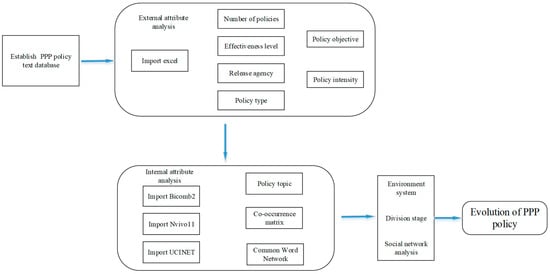
Figure 1.
Research framework.
3.1. Data Acquisition
A comprehensive search was performed for policy texts issued by government departments regarding social capital access in infrastructure and public sector investment construction, with 1986 to May 2019 used as the focal point of the search. The search was conducted by utilizing the government’s official website, and “PKULAW” was the primary policy retrieval database (http://www.pkulaw.cn/ accessed on 7 April 2024), as it is a renowned repository of laws and regulations frequently used by researchers to gather Chinese policy information [40]. Keywords such as “cooperation between government and social capital”, “PPP”, “build-operate-transfer (BOT)”, “private capital”, “social capital”, “foreign capital”, “private investment”, and “franchise” were employed to search and export data. Consequently, 4454 central judicial interpretations were identified, encompassing 83 laws, 691 administrative regulations, and 3196 departmental regulations. To ensure the accuracy and representativeness of the data, a pre-analysis screening was conducted based on specific criteria:
- Documents with binding authority, including administrative regulations, regulatory documents, departmental regulations, working documents, and others issued by the central government, the State Council, the Ministry of Finance, the Ministry of Housing and Urban–Rural Development, and other relevant ministries and commissions, were present;
- Policy documents pertinent to the establishment of the PPP model, featuring terms such as “franchise”, “marketization”, “foreign capital”, “private capital”, “BOT”, “TOT”, and similar were present;
- The policies significantly influence the development of the PPP model.
After removing duplicates and irrelevant entries according to these criteria, this study ultimately identified 407 national-level policies related to the PPP theme. The publication date, title, number, issuing organization, level of effectiveness, and content link of each policy text were meticulously recorded to construct the PPP policy evolution database (as detailed in Table 1).

Table 1.
List of PPP-related policies.
3.2. Calculating Policy Intensity
To observe the evolution path of China’s PPP policy more intuitively, the relevant policy documents issued by China from 1980 to 2019 were used according to time (as shown in Table 2).
Table 2.
Quantitative Scoring Indicators Table.
The frequency of policy promulgation can reflect the government’s policy orientation and attention to a certain field to a certain extent, but due to the different attributes of various policy documents, the number of documents alone cannot fully reflect the government’s support in this field. Policy intensity can be determined by corresponding quantitative standards and quantitative statistics based on required indicators to obtain a more objective and accurate expression of policy support.
The calculation method of the policy intensity was divided into three steps. Firstly, quantitative indicators were established from three dimensions: policy level, policy measures, and policy objectives. Then, the policy documents were scored according to the established quantitative scoring criteria. Finally, the policy intensity quantitative value of the newly issued policy for that year was summarized via policy intensity calculation (1) [41].
where “” is the year of publication of the scoring policy, “” “”, “” is the policy issued in year “”, is the score of each policy objective “” (goal) and policy measure “” of the policy, “” is the power score of the policy, and is the overall status of the level, objectives, and measures of the PPP-related policy content issued in the year “”.
Considering the continuity of the policy, the newly issued policy reflects the change in the government’s support towards a certain area, which is the main part of policy attention. Therefore, the policy intensity of the current year can be characterized by the cumulative value of the quantified policy intensity from the initial year to the current year, and the value of the policy intensity of the current year can be obtained by using the cumulative Formula (2).
where “” is the year and “” is the initial year of the policy under study. Based on the PPP’s burgeoning policy in China in 1986, in this study, “” = 1986, represents the quantified value of policy intensity in the year. Due to the timeliness of the policy, the intensity of the policy in the year “” needs to be deducted from the cumulative amount of the initial year of the policy to quantify the strength of the policy documents that have expired to ensure the accuracy of the data and the rigor of the research.
3.3. Coding Analysis Based on Nvivo
Nvivo11 represents the forefront of computer-assisted qualitative data analysis software, being the first of its kind in the world [42]. This software is a crucial tool for qualitative researchers to efficiently manage substantial volumes of qualitative data. Advances in computer technology have now enabled the integration of qualitative and quantitative data into a unified dataset [43]. Through ongoing development and updates, Nvivo11 has achieved capabilities for coding, indexing, and theorizing non-quantitative and unstructured materials.
Coding is a fundamental step in analyzing qualitative research data, helping us to organize and impart meaning to text. It facilitates material organization by segmenting observed or collected data into memos by sentence and line. Consequently, a coding system is devised to structure the data, unveil patterns and themes, and identify the topics or types of words or phrases encompassed by the data. Coding serves as a unit of meaning that labels or tags the descriptive or inferential data collected during the research process. It serves as a mechanism for data reduction and expansion, generating new inquiries, and interpreting concepts [44]. In essence, coding is the transformation of data into concepts, where researchers dissect collected data, assign new concepts, reorganize data into various units of analysis, categorize them into distinct types, and investigate operations particularly pertinent to the research topic.
In this study, the coding and cluster analysis functionalities of Nvivo11 were employed to conduct a cluster analysis of policy topics, thereby extracting the focal points of policy attention. By utilizing BICOMB version 2.0 bibliographic analysis software, keywords from policy texts were statistically extracted. The resulting similarity matrix of common words for each stage was processed using UCINET version 6.766 and its accompanying visualization software NETDRAW version 2.158, which led to the generation of co-word networks for PPP policy text keywords at different stages.
3.4. Co-Word Analysis
Social network analysis employs network structure diagrams to depict the social relationship structures and attribute relationships between individuals, groups, or social units. It serves as a specialized instrument of Social Network Theory for examining relationships, information, or knowledge primarily shared between entities such as people, groups, and organizations, and evaluating their significance [45]. In this study, UCINET social network analysis software, along with its integrated visualization module NETDRAW, was utilized to analyze and create a knowledge map of research related to policy texts. In the generated graph, the nodes represent keywords, with larger nodes indicating a greater focus on the research content denoted by those keywords. The degree of centrality measured the number of direct connections to a node. A higher value signified a node’s greater importance within the network graph. Consequently, the co-word matrix of PPP policy text keywords corresponding to the four stages was derived. These keywords were considered significant, with values greater than or equal to 1.
4. Result Analysis
4.1. Policy Intensity Distribution Analysis
Using the index system and policy intensity quantification method established above, the quantitative distribution of Chinese PPP policy from 1986 to 2018 was summarized to obtain the annual distribution figure of policy intensity (Figure 2 and Figure 3).
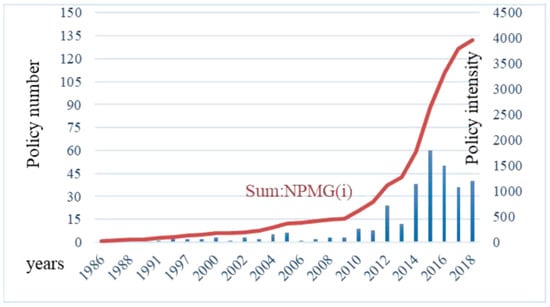
Figure 2.
Distribution of the number and intensity of Chinese PPP policies from 1986 to 2018.
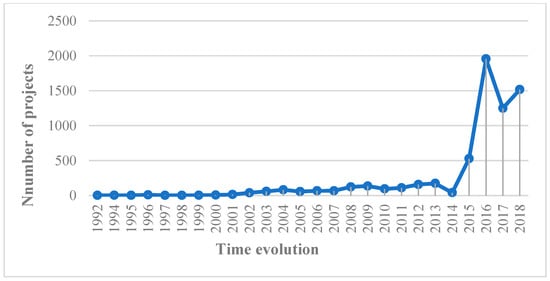
Figure 3.
Quantitative distribution of Chinese PPP projects from 1986 to 2019.
Source: The PPP policy quantity data were compiled by the authors from PKULAW; the project quantity data came from the World Bank PPIAF database, and for 2014, 2015, 2016, 2017, and 2018, the annual project quantity was obtained according to the China PPP quarterly report.
From the time axis, the enactment of China’s PPP-related policies has transitioned through various phases, from periods of low-frequency discontinuity, through phases of fluctuating growth, to stages of continuous high-density issuance.
The general trend in policy distribution is upward, signifying that the Chinese government’s policy guidance on PPPs has progressively intensified. However, policy distribution does not exhibit stable linear growth; it is marked by certain fluctuations and is characterized by distinct phases. From 1986 to 2000, policy issuance was sporadic and infrequent, with these periods scoring low in terms of policy objectives and measures, reflecting weak policy intensity and slow growth. Continuous policy releases occurred from 2001 to 2008, with a notable peak in 2006. Despite this, the quantitative assessment of policy intensity reveals that policy measures remain relatively low. From 2009 to 2012, policies were published continuously, with an increasing frequency of issuance. The quantitative analysis of policy intensity indicates that the scores for policy measures and objectives improved somewhat, leading to a steady increase in policy intensity. Between 2013 and 2018, policy publications maintained a high density, reaching a peak in 2016. The quantitative results for policy intensity show that the overall scores for policy objectives and measures have achieved a high level, indicating a significant leap in policy intensity.
The above analysis shows that the periodic features characterizing the Chinese government’s policy support for the PPP model are characterized by periodic features. For further analysis of policy shifts, this article categorizes the evolution of policy into four stages: the budding period (1986–2000), the fluctuation period (2001–2008), the steady development period (2009–2012), and the expansion period (2013–2018).
4.2. Policy Topic Analysis
This article employed Nvivo11 coding to identify several policy subject terms for each stage, subsequently performing statistical analysis and clustering. Analogous to the academic literature, the subject terms of policy documents serve as the core vocabulary that encapsulates the content and dictates the literature types. The objective is to streamline the classification, storage, and retrieval of the policy literature. Typically, the number of subject terms in a document ranges from 4 to 6, which should encapsulate not only words that convey policy direction, such as “support” and “tax”, but also terms that articulate the core content of the policy text, like “facilities” and “investment”.
4.2.1. Budding Period (1986–2000)
During this period, 15 key policies were extracted and analyzed using Nvivo11 to code and statistically identify policy subject terms. Eighteen keywords were extracted (as detailed in Table 3), representing the policy focus on investment subjects, industry access, and investment methods.
Table 3.
PPP policy keywords during 1986–2000.
Using BICOMB 2.0, the high-frequency words in the literature were compiled into a common word matrix (18 × 18) (partial matrix, as shown in Table 4).
Table 4.
High-frequency keyword co-occurrence matrix (partial).
The keyword co-occurrence matrix can be used to mine the implicit association information between high-frequency keywords, as shown in Table 4. In the co-occurrence matrix, the closer the value is to 1, the more similar the two keywords are; on the contrary, the similarity is lower. As can be seen from Table 4, bidding (0.769), traffic (0.615), energy (0.0.538), and other topics are the focus of attention, while franchise (0.154) receives relatively little attention.
It is evident from the analysis that the keywords used during this period were predominantly concentrated in infrastructure sectors such as foreign investment and transportation (Figure 4). Following China’s reform and opening-up policy initiation in 1978, a significant influx of advanced technology and foreign capital investment from developed countries occurred. To encourage and attract foreign investment during this process, the BOT (Build–Operate–Transfer) model became increasingly prominent. Frequently adopted by developing countries for infrastructure development, the BOT model has achieved notable success. It balances maintaining market mechanism operations and providing an effective avenue for government intervention. Thus, the embryonic form of government–social capital cooperation emerged, undergoing continuous exploration in policies and practices. The policy texts issued during this stage primarily aimed to encourage and permit social capital’s participation in some public projects, with a significant focus on attracting foreign capital for domestic projects. At that time, the potency of private capital was limited, and due to the pressing need for marketization, foreign capital, with its mature market and risk assessments and ability to introduce advanced technology, was particularly encouraged.
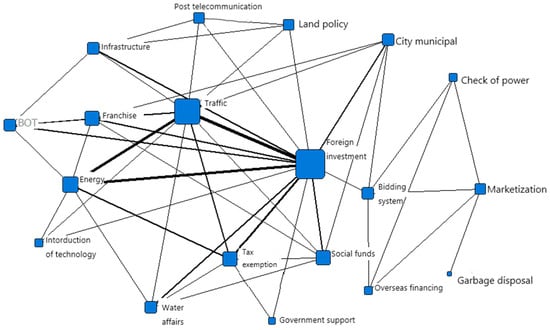
Figure 4.
Social network diagram of subject terms from 1986 to 2000.
However, this period lacked effective policy guidance for attracting social capital investment and implementing public projects. In BOT projects, issues such as the government’s unprincipled guarantees or commitments gradually arose. Generally, the project applications at this stage were mainly in transportation, infrastructure, and water services, with the primary policy orientation being towards encouraging foreign investment.
4.2.2. Fluctuation Period (2001–2008)
A high-frequency keyword was obtained from the policy texts at this stage using Nvivo 11 software; then, the high-frequency words in the literature were compiled into a common word matrix by using BICOMB 2.0 (partial matrix as illustrated in Table 5).
Table 5.
High-frequency keyword co-occurrence matrix (partial).
From this analysis, it is evident that keywords such as “private capital”, “investment and financing”, “legal policy”, “supervision mechanism”, and “franchise” hold significant importance. In the 21st century, the rapid development of urbanization in China has led to a conflict between the limited funding available through government finances and the pressing need for urban infrastructure construction. To address this, the central government has enacted a series of laws and policies to actively promote the development of the PPP model, as manifested in two primary aspects: the vigorous promotion of marketization within urban infrastructure utilities and the encouragement of private investment. Investment and financing channels have been progressively expanded, the approval procedures for private capital investment have been simplified, and more industries and sectors have been opened to private capital. Concurrently, China has begun to enhance policy support to foster the growth of the non-public-ownership economy, despite traditionally restricting entry to non-public ownership. Policies regarding franchises in the infrastructure and utilities sectors have seen rapid development. In response to demand, the Chinese government has recognized the benefits of the PPP model and further integrated social capital to address developmental challenges.
Contrary to the earlier period’s encouraging and supportive investment policies, the policy goals of this phase have shifted towards the application in specific urban facilities, such as sewage treatment, waste management, rail transit, and water supply (as shown in Figure 5). Moreover, due to the absence of policy constraints and guidance at the end of the last century, local PPP development revealed numerous issues. During this phase, the central government emphasized market access and project operation via the supervision mechanism. Overall, the proportion of foreign companies declined during this period, with domestic private and state-owned enterprises becoming more predominant. The extensive selection of investors through public bidding has effectively reduced costs and established a relatively mature PPP project implementation process.
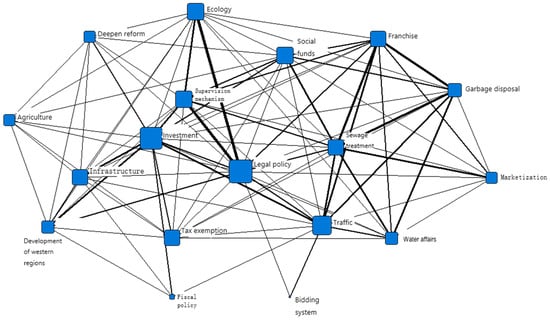
Figure 5.
Policy topic gatherings from 2001 to 2008.
4.2.3. Steady Period (2009–2012)
The high-frequency keyword co-occurrence matrix can be obtained by extracting keywords from the policy text extracted at this stage using Nvivo11 software (as shown in Table 6).
Table 6.
High frequency keyword co-occurrence matrix (partial).
As illustrated in Figure 6, keywords such as “private capital”, “energy saving and emission reduction”, “people’s livelihood”, “energy”, “technological innovation”, “finance”, and “fiscal policy” hold significant prominence. Following the 2008 Asian financial crisis, the development of PPPs experienced a downturn. In response, the central government enacted a series of proactive fiscal policies to stimulate economic recovery, which led to the exacerbation of local government debt issues. This positive policy environment prompted many local governments to pursue project construction through establishing local investment and financing platforms to fulfill their performance objectives. Addressing local government debt and standardizing the management of financing platforms, thus, emerged as pressing concerns. The central and local governments initiated specific policy research efforts, such as encouraging private capital to invest in basic public welfare projects and regulating local government financing platforms. Despite volatile development phases, these conditions provided opportunities for the advancement of PPPs. PPPs began to be applied across various sectors, with preliminary efforts in specific areas.
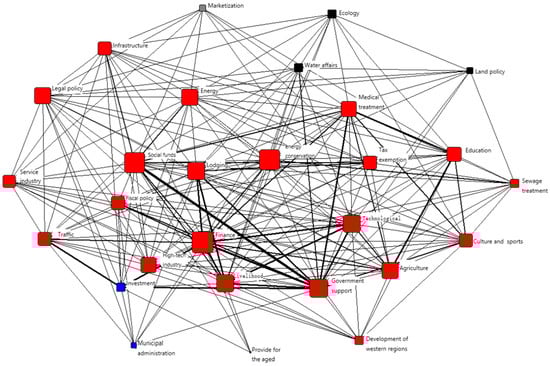
Figure 6.
Policy topic gatherings from 2009 to 2012.
At this stage, public projects involving social capital started to exhibit diverse characteristics, and issues such as healthcare, pensions, affordable housing, and people’s livelihoods were placed on the policy agenda, creating new pathways for the integration of social capital. The collaboration between government and state-owned enterprises emerged as a defining feature of PPPs with distinct Chinese characteristics during this period. With the surge in capital requirements and the maturation of the financial market, a variety of new financing channels for PPP projects, including public offerings, corporate bonds, and trusts, gradually began to emerge.
4.2.4. Expansion Period (2013–2018)
The high-frequency keyword co-occurrence matrix can be obtained by extracting keywords from the policy text extracted at this stage using Nvivo11 software (as shown in Table 7).
Table 7.
High-frequency keyword co-occurrence matrix (partial).
The analysis reveals that “PPP” has emerged as the most significant keyword node within the network diagram (Figure 7). Beyond infrastructure, the co-occurrence of keywords such as “ecology”, “urbanization”, “government support”, “deepening reforms”, “private capital”, and “scientific and technological innovations” is notably pronounced. Additional keywords, including “energy saving and emission reduction”, “energy”, “healthcare”, and “tax reduction and exemption”, as well as their co-occurrence relationships with “agriculture”, “rural areas”, and “ecology”, are also strengthening. Sectors like “tourism”, “development of the West”, “high-tech industries”, and “environmental governance” continue to expand investment channels for social capital. Through franchising, the central government has facilitated social capital’s participation in urban infrastructure investment and operations and encouraged investments in rural areas, public cultural service systems, and ecological environmental protection. Consequently, the application of the PPP model has flourished extensively.
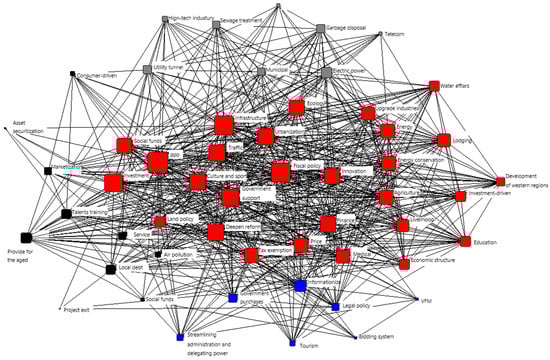
Figure 7.
Policy topic gatherings from 2013 to 2018.
The years 2014 and 2015 marked the most intensive period in the history of PPP policy development. The evolution of the central government’s approach towards PPP policies and strategies transitioned from initially encouraging broad policies to departments adopting specific policy tools for distinct industries, culminating in a clear stance that PPPs would serve as a platform to address local government debt issues and a critical means for managing local government financing.
During this time, the central government delineated the direction for local government investment and financing, advocating for reforming investment and financing mechanisms through the PPP model to establish a competitive foundation for social capital. The government assured investors long-term and stable returns through pre-agreed revenue rules, franchise rights, reasonable pricing, and financial subsidies. However, 2017 marked the beginning of a rationalization and deepening phase for PPP projects. The General Office of the Ministry of Finance systematically reviewed inbound PPP projects nationwide. It introduced a negative list for government service purchases, strictly prohibiting the misuse or fabrication of government service contracts for illegal financing. Subsequently, the State-Owned Assets Supervision and Administration Commission issued directives to curb the overheated investment of state-owned enterprises in PPPs and encourage private capital participation in infrastructure construction within cultural, tourism, sports, health, pension, and education sectors. As of 2013, the PPP policy landscape has transitioned into a stable and rational development phase.
4.2.5. Stagnant Period (2019–Present)
In 2019, the Ministry of Finance released “The Implementation Opinions on Promoting the Standardized Development of Government and Social Capital Cooperation” (Finance (2014) No. 76), stipulating that regions where PPP projects account for more than 5% of fiscal expenditure should not initiate new PPP projects. This directive aimed to address the issue of PPP projects exacerbating the debt burdens of local governments, leading to a massive cleanup of irregular PPP projects. By 2023, the PPP initiative reached a standstill, with the PPP Center’s official website under the Ministry of Finance ceasing the provision of updates.
In November 2023, the General Office of the State Council of China disseminated a document titled “Guiding Opinions on Standardizing the Implementation of a New Mechanism for Cooperation between Government and Social Capital”, which delineates a refined approach towards the Public–Private Partnership (PPP) model, transitioning it towards a user-pays franchise scheme. This adjustment restricts the PPP framework, emphasizing the recoupment of investments predominantly through user charges. The revised PPP paradigm advocates for governmental subsidies to exclusively support operational expenditures, excluding construction costs. This evolution signifies a strategic shift from a conventional Public–Private Partnership towards a franchising model that predominantly involves social capital. Although the government proposed a new mechanism for franchising in 2023, the new mechanism is only for new PPP projects, and the difficulties of existing PPP projects have not been resolved.
5. Discussion
The Public–Private Partnership (PPP) model represents a significant advancement in the mechanism of public service provision, whereby the government engages social capital—entities with capabilities in investment, operation, and management. Within this framework, the roles, responsibilities, and rights of both parties are explicitly delineated, allowing social capital to deliver public services while the government compensates these entities based on the outcomes of performance evaluations, ensuring a reasonable return on investment for social capital. This model is posited to effectively harness market mechanisms, thereby enhancing the quality and efficiency of public service delivery and optimizing public interest. Following its endorsement by the Ministry of Finance and the National Development and Reform Commission in 2014, the PPP model garnered substantial interest from local governments and state-owned and private enterprises, resulting in an exponential increase in both the quantity of PPP projects and the level of investment. This period of rapid expansion, however, was not without its challenges; the PPP model has been critiqued for deviating towards local financing tools and giving rise to new forms of concealed debt risk. Additionally, there is a discernible imbalance favoring construction over operational management, alongside deficiencies in the framework for performance evaluation.
The current development of China’s Public–Private Partnership (PPP) model faces numerous challenges. The analysis of policy trends reveals a decline in PPP projects since 2019, attributable to the absence of key policy elements such as “government credit”, “contract spirit”, and “power supervision”. This deficiency has precipitated significant issues across various aspects of China’s PPP projects, rendering their continuation problematic.
- Lack of project bankability. Globally, PPP projects grapple with securing affordable financing, a challenge also prevalent in China. High capital costs and stringent lending criteria complicate private investors’ ability to fund infrastructure projects under the PPP model. The lack of financial viability and bankability, attributed to inadequate risk allocation, unclear revenue streams, and insufficient government support, deters private investment.
- Regulatory issues. Successful PPP development necessitates a clear, unified policy environment with standardized supervision. China’s evolving regulatory framework for PPP projects suffers from a lack of clear guidelines and standardized procedures, introducing uncertainty for private investors and impeding the development of successful PPP projects. The approval process involving multiple government stakeholders often results in delays or cancellations due to political considerations or shifts in government priorities.
- Institutional environment. Countries with effective PPP models have established management and service systems tailored to their development needs. While China has introduced various systems to encourage and manage PPPs, no specific laws governing government and social capital cooperation have been enacted. Divergences in PPP development perspectives and legislation between the Ministry of Finance and the Development and Reform Commission complicate decision-making related to local governments and social capital for promoting PPP projects.
- Contract Spirit. Emphasizing the full integration of PPP-related laws and policies, the market concept and contract spirit of PPP should be upheld. The Chinese government must balance all participants’ interests, adhering to interest measurement principles.
- PPP-REITs model. Real Estate Investment Trusts (REITs) offer a mechanism to revitalize asset stocks for reinvestment. The structural design and logic of REITs differ fundamentally from those of PPPs, which are debt-financed, whereas REITs are equity-financed. PPP affects the construction period of a project, while REITs have an impact from the operational phase onwards. Utilizing REITs to rejuvenate PPP infrastructure assets could provide a way out of the current dilemmas, contingent on resolving legal issues and ensuring that PPP projects generate stable cash flows.
6. Conclusions
A chronological analysis of China’s PPP policy documents from 1986 to 2018 reveals a maturation in policy focus and intensity, especially post-2009. However, critical areas such as “government credit”, “contract spirit”, and “power supervision” remain under-addressed. The policy’s evolution has gone through five stages: budding (1986–2000), fluctuating (2001–2008), steady (2009–2012), expanding (2013–2018), and stagnating (2019-present). Initially focused on public utilities, the participation dynamics have shifted, with foreign enterprises receding and private and state-owned entities predominating.
The challenges confronting China’s PPP model are multifaceted, stemming from policy gaps that have led to substantial project difficulties. This study advocates for enhancements in project bankability, regulatory clarity, institutional environment improvement, contract spirit defense, and the development of the PPP-REITs model to address these issues.
This analysis of the evolution of China’s PPP policy provides suggestions for the healthy operation of China’s PPP projects and provides references for PPP projects in other countries and regions.
Author Contributions
Conceptualization, X.J.; Data curation, S.H.; Investigation, E.X.; Methodology, X.J.; Software, Y.L.; Writing—original draft, Z.Z.; Writing—review and editing, M.S. All authors have read and agreed to the published version of the manuscript.
Funding
Soft Science Research Plan of Hefei University of Technology (No. W2021JSFW0885) and the Innovation Research Plan of Anhui Construction Engineering Group in China (No. W2021JSZX0653).
Data Availability Statement
The raw data supporting the conclusions of this article will be made available by the authors on request.
Conflicts of Interest
The authors declare that they have no known competing financial interests or personal relationships that could have appeared to influence the work reported in this paper.
References
- Ke, Y.; Wang, S.; Chan, A.P.C. Risk Allocation in Public-Private Partnership Infrastructure Projects: Comparative Study. J. Infrastruct. Syst. 2010, 16, 343–351. [Google Scholar] [CrossRef]
- Tingting, L.; Yan, W.; Wilkinson, S. Identifying critical factors affecting the effectiveness and efficiency of tendering processes in public-private partnerships (PPPs): A comparative analysis of Australia and China. Int. J. Proj. Manag. 2016, 34, 701–716. [Google Scholar] [CrossRef]
- Wang, S.Q.; Tiong, L.K. Case study of government initiatives for PRC’s BOT power plant project. Int. J. Proj. Manag. 2000, 18, 69–78. [Google Scholar] [CrossRef]
- Qiao, L.; Wang, S.Q.; Tiong, R.L.K.; Chan, T.S. Critical Success Factors for Tendering BOT Infrastructure Projects in China. J. Struct. Financ. 2002, 8, 40–52. [Google Scholar] [CrossRef]
- Decision of the Central Committee of the Communist Party of China on Several Important Issues Concerning Comprehensively Deepening. 2013. Available online: http://www.china.org.cn/china/third_plenary_session/2014-01/16/content_31212602.htm (accessed on 1 April 2024).
- Ministry of Finance. Promoting the Use of Cooperation Pattern between Government and Social Capital (Cai Jin Document No. 76); Ministry of Finance: Beijing, China, 2014. Available online: https://www.gov.cn/zhengce/2016-05/25/content_5076557.htm (accessed on 1 April 2024).
- Zhang, Y. From State to Market: Private Participation in China’s Urban Infrastructure Sectors, 1992–2008. World Dev. 2014, 64, 473–486. [Google Scholar] [CrossRef]
- Bellier, M.; Zhou, Y.M. Private Participation in Infrastructure in China: Issues and Recommendations for the Road, Water, and Power Sectors; World Bank Working Paper, No. 2; World Bank: Washington, DC, USA, 2003. [Google Scholar]
- Huang, C.; Su, J.; Xie, X.; Li, J. Basic research is overshadowed by applied research in China: A policy perspective. Scientometrics 2014, 99, 689–694. [Google Scholar] [CrossRef]
- Jiang, X.; Lu, K.; Xia, B.; Liu, Y.; Cui, C. Identifying Significant Risks and Analyzing Risk Relationship for Construction PPP Projects in China Using Integrated FISM-MICMAC Approach. Sustainability 2019, 11, 5206. [Google Scholar] [CrossRef]
- Chan, A.P.C.; Lam, P.T.I.; Chan, D.W.M.; Cheung, E.; Ke, Y. Critical Success Factors for PPPs in Infrastructure Developments: Chinese Perspective. J. Constr. Eng. Manag. 2010, 136, 484–494. [Google Scholar] [CrossRef]
- Tang, L.; Shen, Q.; Skitmore, M.; Cheng, E.W.L. Ranked Critical Factors in PPP Briefings. J. Manag. Eng. 2013, 29, 164–171. [Google Scholar] [CrossRef]
- Zhang, S.; Gao, Y.; Feng, Z.; Sun, W. PPP application in infrastructure development in China: Institutional analysis and implications. Int. J. Proj. Manag. 2015, 33, 497–509. [Google Scholar] [CrossRef]
- Koppenjan, J.; Enserink, B. Public–Private Partnerships in Urban Infrastructures: Reconciling Private Sector Participation and Sustainability. Public Adm. Rev. 2009, 69, 284–296. [Google Scholar] [CrossRef]
- Powell, J. PPPs and the SDGs: Don’t Believe the Hype; University of Greenwich: London, UK, 2016. [Google Scholar]
- Qi, X.; Yi, C.; Li, J. The Problems in PPP Project Decision Process in China Comparing with Singapore. Appl. Mech. Mater. 2013, 357–360, 2519–2523. [Google Scholar] [CrossRef]
- Verhoest, K.; Petersen, O.; Scherrer, W.; Soecipto, R. How Do Governments Support the Development of Public Private Partnerships? Measuring and Comparing PPP Governmental Support in 20 European Countries. Transp. Rev. 2015, 35, 118–139. [Google Scholar] [CrossRef]
- Willems, T.; Van Dooren, W. (De)Politicization Dynamics in Public–Private Partnerships (PPPs): Lessons from a comparison between UK and Flemish PPP policy. Public Manag. Rev. 2016, 18, 199–220. [Google Scholar] [CrossRef]
- Gurgun, A.P.; Touran, A. Public-Private Partnership Experience in the International Arena: Case of Turkey. J. Manag. Eng. 2014, 30, 04014029. [Google Scholar] [CrossRef]
- Broadbent, J.; Gill, J.; Laughlin, R. Identifying and controlling risk: The problem of uncertainty in the private finance initiative in the UK’s National Health Service. Crit. Perspect. Account. 2008, 19, 40–78. [Google Scholar] [CrossRef]
- Demirag, I.; Khadaroo, I.; Stapleton, P.; Stevenson, C. The diffusion of risks in public private partnership contracts. Account. Audit. Account. J. 2012, 25, 1317–1339. [Google Scholar] [CrossRef]
- Broadbent, J.; Gill, J.; Laughlin, R. Evaluating the Private Finance Initiative in the National Health Service in the UK. Account. Audit. Account. J. 2003, 16, 422–445. [Google Scholar] [CrossRef]
- Asenova, D.; Beck, M. Crucial silences: When accountability met PFI and finance capital. Crit. Perspect. Account. 2010, 21, 1–13. [Google Scholar] [CrossRef]
- Demirag, I.; Khadaroo, I.; Stapleton, P.; Stevenson, C. Risks and the financing of PPP: Perspectives from the financiers. Br. Account. Rev. 2011, 43, 294–310. [Google Scholar] [CrossRef]
- Heald, D. Value for money tests and accounting treatment in PFI schemes. Account. Audit. Account. J. 2003, 16, 342–371. [Google Scholar] [CrossRef]
- Shaoul, J. A critical financial analysis of the Private Finance Initiative: Selecting a financing method or allocating economic wealth? Crit. Perspect. Account. 2005, 16, 441–471. [Google Scholar] [CrossRef]
- Osei-Kyei, R.; Chan, A.P.C. Review of studies on the Critical Success Factors for Public–Private Partnership (PPP) projects from 1990 to 2013. Int. J. Proj. Manag. 2015, 33, 1335–1346. [Google Scholar] [CrossRef]
- Fuest, V.; Haffner, S.A. PPP-policies, practices and problems in Ghana’s urban water supply. Water Policy 2007, 9, 169–192. [Google Scholar] [CrossRef]
- Wang, S.; Ke, Y.; Xie, J. Public Private Partnership Implementation in China; Certified Accountants Educational Trust: Glasgow, UK, 2012. [Google Scholar]
- Zhang, X. Critical Success Factors for Public–Private Partnerships in Infrastructure Development. J. Constr. Eng. Manag. 2005, 131, 3–14. [Google Scholar] [CrossRef]
- Ke, Y.; Wang, S.; Chen, B. Government incentives for private sector involvement in infrastructure PPP projects. J. Tsinghua Univ. (Sci. Technol.) 2009, 49, 1480–1483. (In Chinese) [Google Scholar] [CrossRef]
- Shi, L.; He, Y.; Onishi, M.; Kobayashi, K. Efficiency Analysis of Government Subsidy and Performance Guarantee Policies in Relation to PPP Infrastructure Projects. Math. Probl. Eng. 2018, 2018, 6196218. [Google Scholar] [CrossRef]
- Chen, C.; Li, D.; Man, C. Toward Sustainable Development? A Bibliometric Analysis of PPP-Related Policies in China between 1980 and 2017. Sustainability 2018, 11, 142. [Google Scholar] [CrossRef]
- Agarchand, N.; Laishram, B. Sustainable infrastructure development challenges through PPP procurement process. Indian perspective. Int. J. Manag. Proj. Bus. 2017, 10, 642–662. [Google Scholar] [CrossRef]
- Zhang, Y.; Huang, K.; Yu, Y.; Yang, B. Mapping of water footprint research: A bibliometric analysis during 2006–2015. J. Clean. Prod. 2017, 149, 70–79. [Google Scholar] [CrossRef]
- Zupic, I.; Čater, T. Bibliometric Methods in Management and Organization. Organ. Res. Methods 2014, 18, 429–472. [Google Scholar] [CrossRef]
- Bornmann, L.; Mutz, R. Growth rates of modern science: A bibliometric analysis based on the number of publications and cited references. J. Assoc. Inf. Sci. Technol. 2015, 66, 2215–2222. [Google Scholar] [CrossRef]
- Liu, G.-Y.; Hu, J.-M.; Wang, H.-L. A co-word analysis of digital library field in China. Scientometrics 2012, 91, 203–217. [Google Scholar] [CrossRef]
- Ronda-Pupo, G.A.; Angel Guerras-Martin, L. Dynamics of the evolution of the strategy concept 1962-2008: A co-word analysis. Strateg. Manag. J. 2012, 33, 162–188. [Google Scholar] [CrossRef]
- Wang, X.; Liu, Y.; Ju, Y. Sustainable Public Procurement Policies on Promoting Scientific and Technological Innovation in China: Comparisons with the US, the UK, Japan, Germany, France, and South Korea. Sustainability 2018, 10, 2134. [Google Scholar] [CrossRef]
- Ji, C.; Wu, Q. Research on Evaluation of Urban Land Intensive Use Policy Efficiency Based on Policy Quantification: A Case Study of Nanjing. Resour. Sci. 2015, 37, 2193–2201. Available online: https://kns.cnki.net/kcms2/article/abstract?v=Y2wviAwYlnJNXdRmcmYU3Tvoa1mmYKdOWdztkFrjP1aZVyF2rhNnXcM183z46eBLV77LMx2Gz1R7vGYzTCHB26mhBhe0qi9Rj2ZFNmHO36btWN95QFbZlcW3FyDyiputvu_it5t2D2BR8cEPijvU1g==&uniplatform=NZKPT&language=CHS (accessed on 1 April 2024). (In Chinese).
- Zapata-Sepúlveda, P.; López-Sánchez, F.; Sánchez-Gómez, M.C. Content analysis research method with Nvivo-6 software in a PhD thesis: An approach to the long-term psychological effects on Chilean ex-prisoners survivors of experiences of torture and imprisonment. Qual. Quant. 2012, 46, 379–390. [Google Scholar] [CrossRef]
- Bazeley, P. The evolution of a project involving an integrated analysis of structured qualitative and quantitative data: From N3 to NVivo. Int. J. Soc. Social. Res. Methodol. 2002, 5, 229–243. [Google Scholar] [CrossRef]
- Miles, M.; Huberman, A.M. Qualitative Data Analysis: An Expanded Sourcebook; Sage Publications: Thousand Oaks, CA, USA, 1994. [Google Scholar]
- Mead, S.P. Using Social Network Analysis to Visualize Project Teams. Proj. Manag. J. 2001, 32, 32–38. [Google Scholar] [CrossRef]
Disclaimer/Publisher’s Note: The statements, opinions and data contained in all publications are solely those of the individual author(s) and contributor(s) and not of MDPI and/or the editor(s). MDPI and/or the editor(s) disclaim responsibility for any injury to people or property resulting from any ideas, methods, instructions or products referred to in the content. |
© 2024 by the authors. Licensee MDPI, Basel, Switzerland. This article is an open access article distributed under the terms and conditions of the Creative Commons Attribution (CC BY) license (https://creativecommons.org/licenses/by/4.0/).