Deriving the Importance of Defects in Multi-Unit Residential Buildings Using the Analytic Hierarchy Process Method


Abstract
1. Introduction
1.1. Background and Purpose of the Study
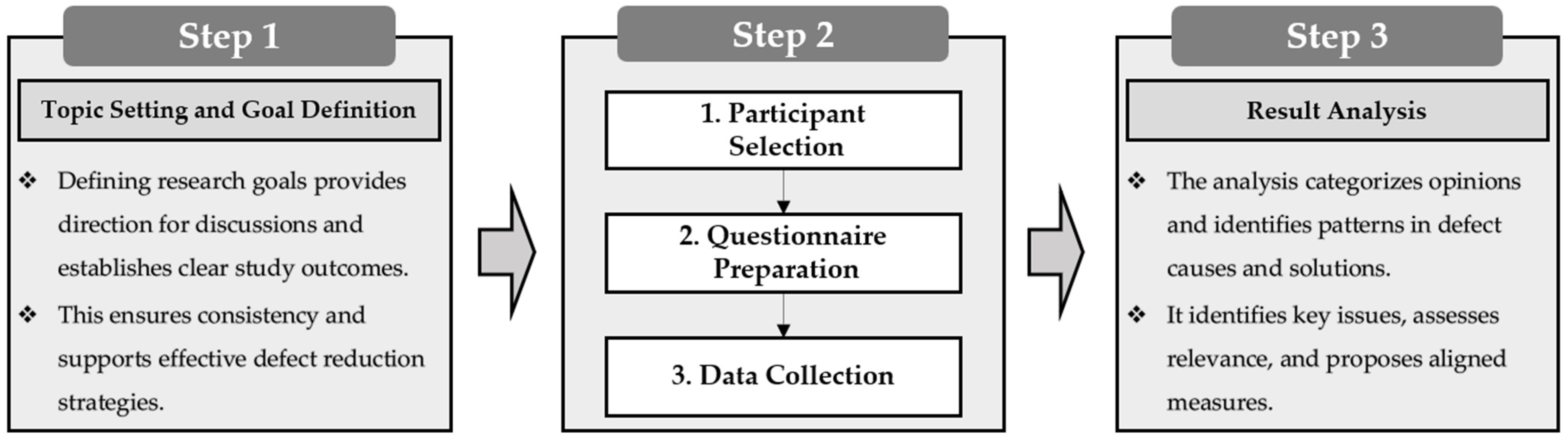
1.2. Research Methods and Procedures
2. Literature Review
2.1. Building Defects and Effects
2.2. Causes of Defects
2.3. Classification of Defects
2.4. Evaluating Building Defect Importance
2.5. Review of Limitations in Previous Studies
3. Research Methodology
3.1. FGI Survey
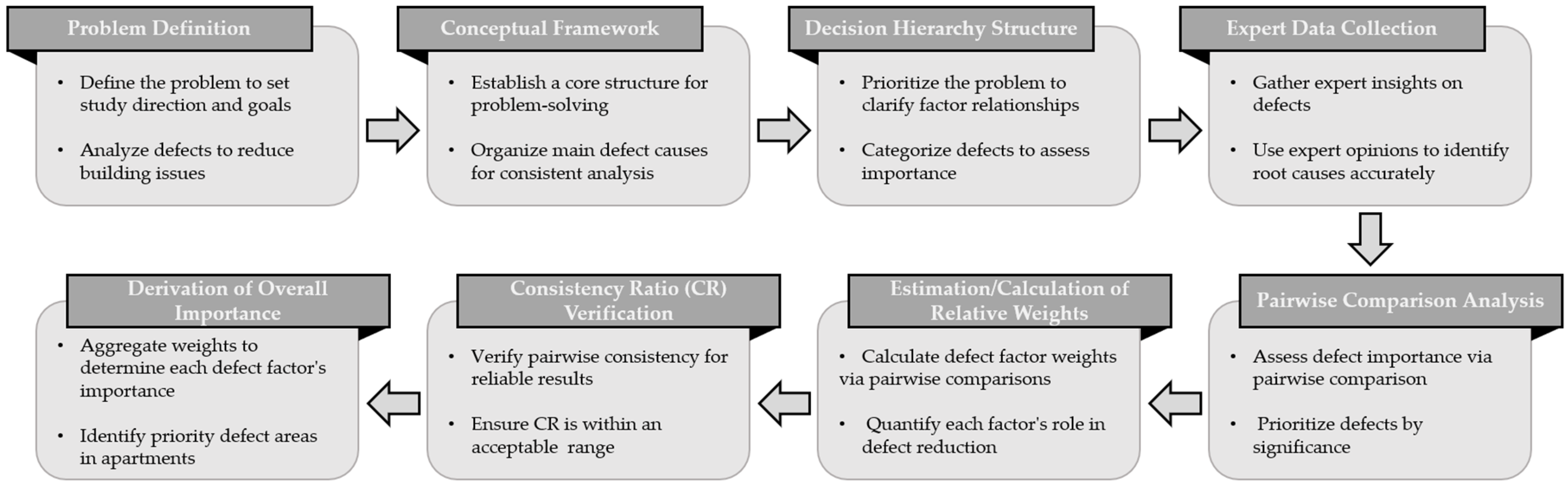
3.2. AHP Analysis
3.3. TOPSIS Analysis and Clustering
4. Model Framework Development
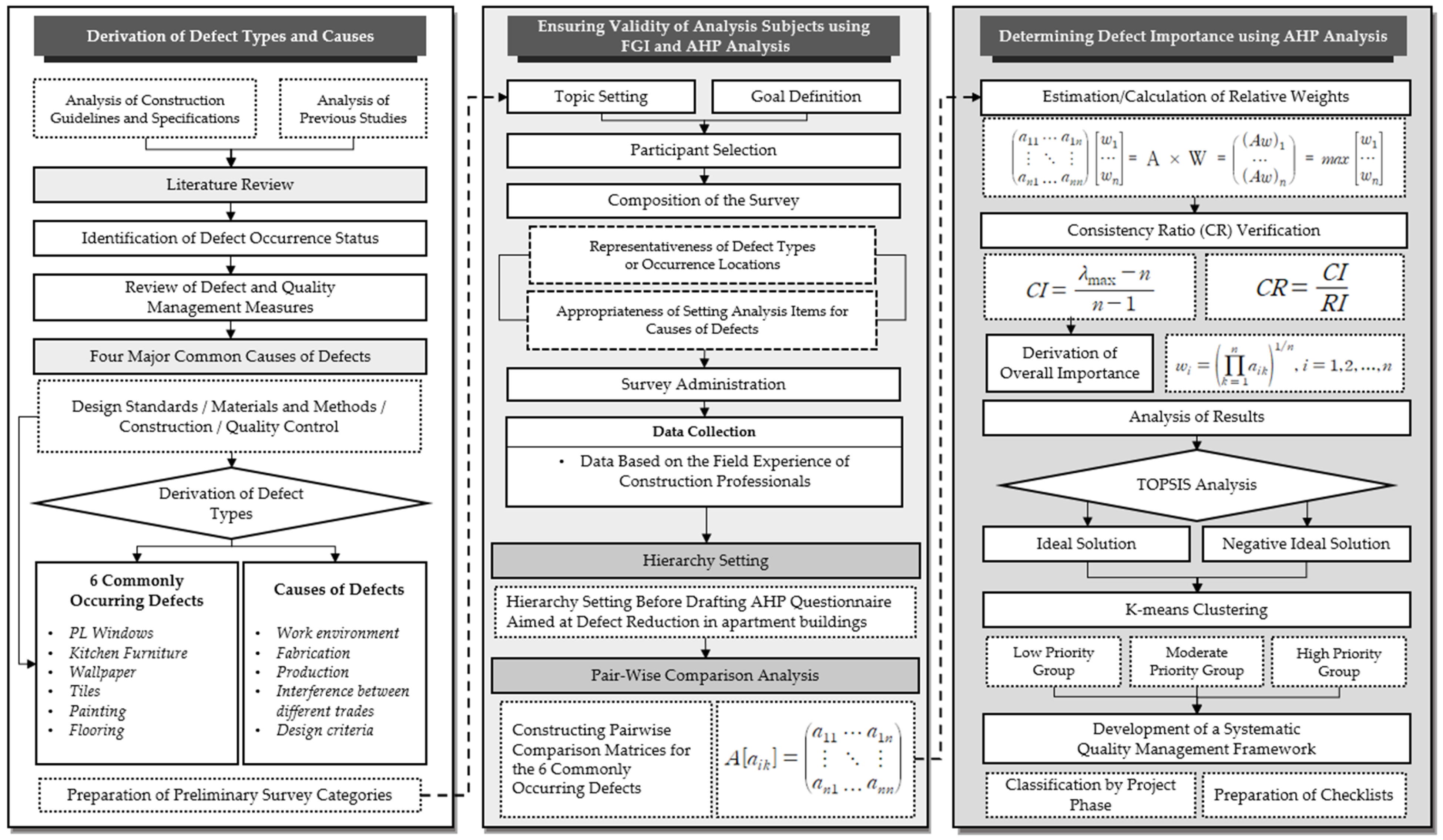
4.1. Framework Model
4.2. Derivation of Defect Types and Causes
4.3. Ensuring Validity of Analysis Subjects Using FGI
4.4. Determining Defect Importance Using AHP Analysis
5. Results and Discussion
5.1. Importance Analysis of Defects in the Six Major Defect-Prone Categories
5.2. Cause Importance Analysis of Defects in the Six Major Defect-Prone Categories
5.2.1. Importance Analysis of Defects in PL Windows
5.2.2. Importance Analysis of Defects in Kitchen Furniture
5.2.3. Importance Analysis of Wallpaper Defects
5.2.4. Importance Analysis of Tile Defects
5.2.5. Importance Analysis of Paint Defects
5.2.6. Importance Analysis of Flooring Defects
5.3. Importance Analysis of Causes for Defects in the Six Major Defect-Prone Categories
5.3.1. Results of Relative Importance of Cause Items for PL Window Defects
5.3.2. Relative Importance Results of Cause Items for Kitchen Furniture Defects
5.3.3. Relative Importance Results of Cause Items for Wallpaper Defects
5.3.4. Results of Relative Importance of Cause Items for Tile Defects
5.3.5. Relative Importance Results of Cause Items for Paint Defects
5.3.6. Relative Importance Results of Cause Items for Flooring Defects
5.3.7. Clustering Grouping Based on TOPSIS Analysis
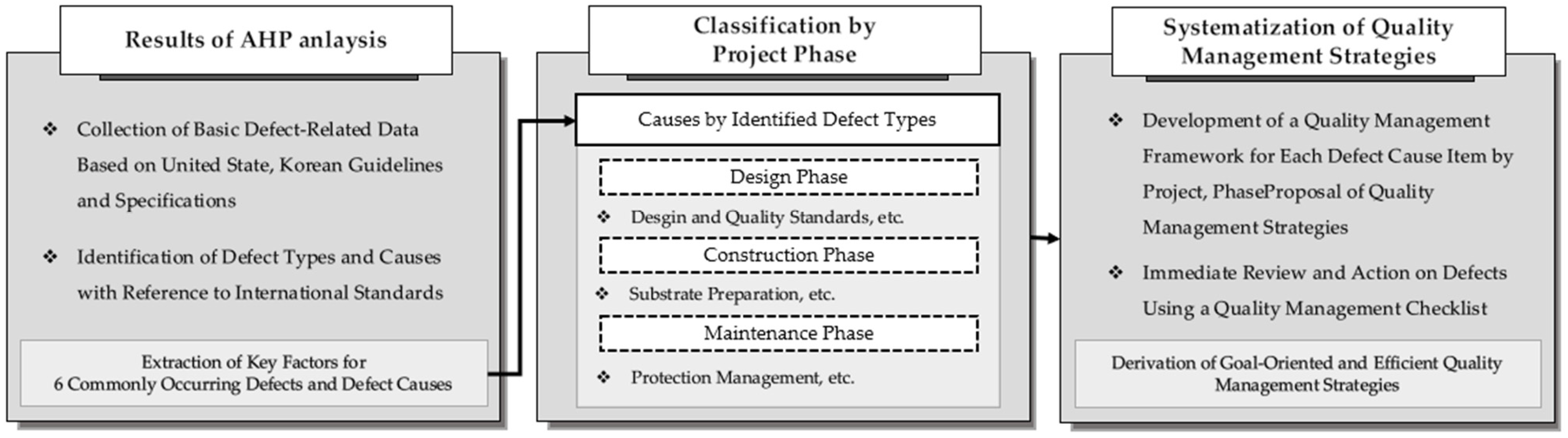
5.3.8. Strategies for Systematization of Quality Management by Project Phase
6. Conclusions
Author Contributions
Funding
Data Availability Statement
Acknowledgments
Conflicts of Interest
Appendix A

| Expert | Summary of Consultation Content |
|---|---|
| A | · Issues such as facade window operation failure and loose fixation of extended double windows require review from the design stage · Adjustment of defect cause analysis items (appropriate materials and factory inspection—preceding and subsequent trade management—sealing and fastening) |
| B | · An I-beam support is required to prevent sagging when the window height exceeds 1.8 M · To prevent sagging of the bedroom sliding door frame, ensure support wood installation at the base during flooring work |
| C | · For precise work around drilled areas, thoroughly clean the backs of drilled sections after waterproofing · Apply mortar adhesion enhancer to structural surfaces before tiling to prevent peeling and delamination defects |
| D | · Ensure strict management to avoid contamination and damage caused by subsequent trades after painting is completed · Painting should be conducted only after the surface is thoroughly dried and cleaned |
| E | · Poor door finish quality often arises from color discrepancies between manufacturers; standardize products from the same manufacturer and thoroughly inspect color before installation · Adjust defect cause analysis items (design completion—factory inspection—appropriate construction period—interference from other trades) |
| F | · Tearing of wallpaper is common around electrical outlets, during removal of protective sheets, or with rapid ventilation inside units |
| G | · When cracks occur in floor mortar, it can lead to flooring delamination; ensure mortar surface crack repair and thorough cleaning before flooring installation |
| H | · To prevent cracking, it is essential to maintain rebar spacing and cover thickness, ensure quality control of ready-mix concrete, and conduct thorough vibration compaction. To reduce finish work defects, securing sufficient time for finish construction is crucial |
| I | · To prevent and manage water leakages, it is advisable to ensure proper roof slope installation and install drainage boards on the interiors of the external walls of underground parking areas |
| J | · Selecting key quality control items for each construction phase and managing them through checklists is required, along with identifying high-frequency defect items and verifying their implementation |
| K | · Strengthen measures at the design stage by supplementing defect cause analysis and preventive measures during design · Efforts to proactively prevent defects should include discovering and utilizing smart inspection equipment |
| L | · Crack occurrence is often due to improper rebar placement, drying shrinkage, lack of props, poor curing, or exceeding design loads (e.g., placing heavy equipment), requiring diligent management |
| M | · To prevent recurring defects, thorough management of frequently occurring defect records, procurement of supply materials, fostering specialized construction companies, and establishing cooperative systems are important |
| N | · For water leakage prevention, ensure proper slope installation, apply hydrophilic sealing materials at jointed areas, and install drainage boards on the exterior walls of underground parking areas to facilitate guided drainage |
| O | · Classify defect causes into criteria, materials, construction, and quality management aspects and present these as quantitative data to set and manage defect and quality management priorities |
| P | · Consider establishing major defect prioritization based on the level of inconvenience or frequency of complaints from consumers · A comprehensive analysis of defect causes, corrective actions, duration of corrective actions, and post-correction satisfaction is necessary |
| Q | · Classify inter-floor noise into light- and heavy-impact sounds and establish causes and countermeasures accordingly · Separate cracking causes into those related to joint areas and those due to work loads and establish countermeasures for each |
| Item A | Very Important | Equal | Very Important | Item B | ||||||
|---|---|---|---|---|---|---|---|---|---|---|
| Design, quality standards | 9 | 7 | 5 | 3 | 1 | 3 | 5 | 7 | 9 | Suitable materials and production |
| Design, quality standards | 9 | 7 | 5 | 3 | 1 | 3 | 5 | 7 | 9 | Working conditions (temperature and humidity) |
| Design, quality standards | 9 | 7 | 5 | 3 | 1 | 3 | 5 | 7 | 9 | Substrate preparation |
| Design, quality standards | 9 | 7 | 5 | 3 | 1 | 3 | 5 | 7 | 9 | Construction quality control |
| Design, quality standards | 9 | 7 | 5 | 3 | 1 | 3 | 5 | 7 | 9 | Worker skill level |
| Design, quality standards | 9 | 7 | 5 | 3 | 1 | 3 | 5 | 7 | 9 | Interference between trades |
| Suitable materials and production | 9 | 7 | 5 | 3 | 1 | 3 | 5 | 7 | 9 | Working conditions (temperature and humidity) |
| Suitable materials and production | 9 | 7 | 5 | 3 | 1 | 3 | 5 | 7 | 9 | Substrate preparation |
| Suitable materials and production | 9 | 7 | 5 | 3 | 1 | 3 | 5 | 7 | 9 | Construction quality control |
| Suitable materials and production | 9 | 7 | 5 | 3 | 1 | 3 | 5 | 7 | 9 | Worker skill level |
| Suitable materials and production | 9 | 7 | 5 | 3 | 1 | 3 | 5 | 7 | 9 | Interference between trades |
| Working conditions (temperature and humidity) | 9 | 7 | 5 | 3 | 1 | 3 | 5 | 7 | 9 | Substrate preparation |
| Working conditions (temperature and humidity) | 9 | 7 | 5 | 3 | 1 | 3 | 5 | 7 | 9 | Construction quality control |
| Working conditions (temperature and humidity) | 9 | 7 | 5 | 3 | 1 | 3 | 5 | 7 | 9 | Worker skill level |
| Working conditions (temperature and humidity) | 9 | 7 | 5 | 3 | 1 | 3 | 5 | 7 | 9 | Interference between trades |
| Substrate preparation | 9 | 7 | 5 | 3 | 1 | 3 | 5 | 7 | 9 | Construction quality control |
| Substrate preparation | 9 | 7 | 5 | 3 | 1 | 3 | 5 | 7 | 9 | Worker skill level |
| Substrate preparation | 9 | 7 | 5 | 3 | 1 | 3 | 5 | 7 | 9 | Interference between trades |
| Construction quality control | 9 | 7 | 5 | 3 | 1 | 3 | 5 | 7 | 9 | Worker skill level |
| Construction quality control | 9 | 7 | 5 | 3 | 1 | 3 | 5 | 7 | 9 | Interference between trades |
| Worker skill level | 9 | 7 | 5 | 3 | 1 | 3 | 5 | 7 | 9 | Interference between trades |
| Category | Defect Reduction and Quality Management Checklist | Inspection Phase | Remarks | |
|---|---|---|---|---|
| Design | Construction | |||
| Design Quality Standards Management | Verify the appropriate use and storage of painting materials onsite according to LH standards. | |||
| Is the quality of the urethane sealing and the substrate, which are concealed by painting, appropriate? | ||||
| Confirm the procedure for front door frames, including galvanizing → epoxy primer application. | ||||
| Verify the proper quality application of elastic putty for external floor joint areas. | ||||
| Check whether painting has been completed on concealed areas beneath kitchen furniture during painting works. | ||||
| Substrate Preparation | Verify whether progressive structural cracks in the painting substrate have been appropriately addressed. | |||
| Assess the condition of the painting substrate (e.g., removal of foreign materials, surface irregularities, and damaged areas). | ||||
| Evaluate the quality or omissions of preceding work on substrates for balconies and interior painting. | ||||
| Verify the quality of the substrate and check for lifting or detachment of CRC board PVC joints in balconies and utility rooms. | ||||
| Compliance with Work Environment(Temperature and Humidity) | Confirm weather conditions (humidity ≤ 85%, temperature ≥ 5 °C). | |||
| Identify potential quality degradation factors due to contamination, damage, excessive humidity, or low temperatures on painted surfaces. | ||||
| Check for quality degradation issues, such as peeling, caused by low temperatures during winter exterior painting. | ||||
| Ensure construction management to prevent condensation and moisture damage during the rainy season. | ||||
| Construction Quality Control | Verify the proper quality application of elastic putty for external floor joint areas. | |||
| Assess for potential quality degradation factors in external water-based primer paint. | ||||
| Check for quality degradation issues such as cracks or discoloration following the application of the external water-based topcoat. | ||||
| Evaluate the suitability of materials and quality of anti-graffiti primer and topcoat. | ||||
| Protection Management | Inspect the protective measures taken before painting. | |||
| Confirm the implementation of appropriate management plans to prevent damage after the completion of painting works. | ||||
| Check the protection status after painting, particularly for landscaping trees and facilities. | ||||
| Ensure there is no contamination or damage caused by soil or traffic after painting works. | ||||
References
- Household Characteristics|National Multifamily Housing Council. Available online: https://www.nmhc.org/research-insight/quick-facts-figures/quick-facts-resident-demographics/household-characteristics/ (accessed on 13 July 2019).
- America’s Rental Housing 2022|Joint Center for Housing Studies of Harvard University. Available online: www.jchs.harvard.edu/americas-rental-housing (accessed on 21 January 2022).
- Characteristics of Apartment Stock|National Multifamily Housing Council. Available online: https://www.nmhc.org/research-insight/quick-facts-figures/quick-facts-apartment-stock/characteristics-of-apartment-stock/ (accessed on 24 July 2019).
- People Living in Apartments|Landgeist. Available online: https://landgeist.com/2021/08/20/people-living-in-apartments/ (accessed on 20 August 2021).
- Most Common Type of Home in Europe|Landgeist. Available online: https://landgeist.com/2023/07/01/most-common-type-of-home-in-europe/ (accessed on 1 July 2023).
- Jonhston, N.; Reid, S. An Examination of Building Defects in Residential Multi-Owned Properties; DEAKIN University: Waurn Ponds, VIC, Australia; Griffith University: Brisbane, QLD, Australia, 2019; Available online: https://www.bellsbic.com.au/building-defects-the-extent/ (accessed on 30 June 2019).
- NSW Government Survey Finds More than Half of Newly Registered Apartments Have Had at Least One Serious Defect|NSW. Available online: https://www.abc.net.au/news/2024-01-24/more-than-half-newly-registered-apartments-defects-nsw/103379978 (accessed on 24 January 2024).
- New Home Review. Annual Report on Defects in New-Build Homes: Findings from 2017–2018 Survey. 2018. Available online: https://phpdonline.co.uk/news/9-10-new-build-homes-defects-according-new-home-reviews-annual-report/ (accessed on 2 April 2019).
- National Assembly Land, Infrastructure and Transport Committee. 2016 National Audit Report; National Assembly Land, Infrastructure and Transport Committee: Seoul, Republic of Korea, 2016.
- Kim, J.H.; Go, S.S. Evaluation of defective risk for the finishing work of apartment house. Korean J. Constr. Eng. Manag. 2012, 13, 63–70. [Google Scholar]
- Choi, S.J.; Shin, M.J. Improvement Measures for the Defect Determination and the Application of Repair Method for Interlayer Cracks in Apartment Houses. Korean J. Constr. Eng. Manag. 2022, 23, 23–33. [Google Scholar]
- Lee, S.H.; Lee, H.S.; Kim, M.H. A Method for Selecting Principal Items of Quality Management through the Defect Analysis in the Construction Process. J. Korean Inst. Archit. 1996, 12, 301–308. [Google Scholar]
- Mésároš, P.; Chellappa, V.; Spišáková, M.; Kaleja, P.; Špak, M. Factors infuencing defects in residential buildings. J. Build. Pathol. Rehabil. 2024, 9, 31. [Google Scholar] [CrossRef]
- Son, S.H.; Lee, J.H.; Son, K.Y. An Examination of a Risk Assessment Method and Analysis of Defect Types of Apartment Finishing Works. J. Korea Inst. Build. Constr. 2024, 24, 249–260. [Google Scholar]
- Heo, Y.C.; Bang, H.S.; Kim, O.K. Analysis of the Major Works Causing Secondary Defects in Apartment Building Construction. J. Archit. Inst. Korea 2021, 23, 1–8. [Google Scholar]
- Lee, D.S. Defect Reduction Method of Apartment Housing Accord to Change of Defect Management Process by Each Work Process. Ph.D. Thesis, University of Gyeonggi, Suwon, Republic of Korea, 2020. [Google Scholar]
- Watt, D.S. Building Pathology: Principles and Practice, 2nd ed.; John Wiley & Sons, Inc.: New York, NY, USA, 2009. [Google Scholar]
- Kim, D.H.; Lee, D.Y.; Lee, H.J.; Min, Y.G.; Park, I.S.; Cho, H.H. Analysis of Importance by Defect Type in Apartment Construction. J. Korea Inst. Build. Constr. 2020, 20, 357–365. [Google Scholar]
- Kwon, N.H.; Song, K.S.; Ahn, Y.H.; Park, M.S.; Jang, Y.J. Maintenance cost prediction for aging residential buildings based on case-based reasoning and genetic algorithm. J. Build. Eng. 2020, 28, 101006. [Google Scholar] [CrossRef]
- Ahn, J.; Ji, S.H.; Ahn, S.J.; Park, M.S.; Lee, H.S.; Kwon, N.H.; Kim, Y. Performance evaluation of normalization-based CBR models for improving construction cost estimation. Autom. Constr. 2020, 119, 103329. [Google Scholar] [CrossRef]
- Kwon, N.H.; Ahn, Y.H.; Son, B.S.; Moon, H.S. Developing a machine learning-based building repair time estimation model considering weight assigning methods. J. Build. Eng. 2020, 43, 102627. [Google Scholar] [CrossRef]
- Kwon, N.H.; Song, K.S.; Park, M.S.; Jang, Y.J.; Yoon, I.S.; Ahn, Y.H. Preliminary service life estimation model for MEP components using case-based reasoning and genetic algorithm. Sustainability 2019, 11, 3074. [Google Scholar] [CrossRef]
- Song, K.S.; Ahn, J.; Ahn, Y.H.; Park, M.S.; Kwon, N.H. Reduction and transformation of energy use data for end-user group categorization in dormitory buildings. J. Build. Eng. 2020, 32, 101524. [Google Scholar] [CrossRef]
- Shinde, R.; Meshram, K. Investigation of Building Failure Using Structural Forensic Engineering. Int. J. Sci. Technol. Res. 2020, 9, 1876–1878. [Google Scholar]
- Kim, B.; Ahn, Y.H.; Lee, S.H. LDA-Based Model for Defect Management in Residential Buildings. Sustainability 2019, 11, 7201. [Google Scholar] [CrossRef]
- Milion, R.N.; Alves, T.C.L.; Paliari, J.C. Impacts of defects on customer satisfaction in residential buildings. In Proceedings of the 24th Annual Conference of the International Group for Lean Construction, Boston, MA, USA, 20–22 July 2016; Volume 24. [Google Scholar]
- Ifran Che-Ani, A.; Samsul Mohd Tazilan, A.; Afizi Kosman, K. The development of a condition survey protocol matrix. Struct. Surv. 2011, 29, 35–45. [Google Scholar] [CrossRef]
- Gatlin, F. Identifying and managing design and construction defects. Constr. Insight Hindsight 2013, 5, 1–7. [Google Scholar]
- Pereira, C.; de Brito, J.; Silvestre, J.D. Harmonised classification of the causes of defects in a global inspection system: Proposed methodology and analysis of fieldwork data. Sustainability 2020, 12, 5564. [Google Scholar] [CrossRef]
- Muhwezi, L.; Twinamatsiko, D.; Acai, J. Mitigation of Building Failures in Uganda’s Construction Industry: A Case Study of Greater Bushenyi District. Int. J. Constr. Eng. Manag. 2020, 9, 11–19. [Google Scholar]
- Ali, A.S.; Wen, K.H. Building defects: Possible solution for poor construction workmanship. J. Build. Perform. 2011, 2. [Google Scholar]
- Shittu, A.; Adamu, A.; Mohammed, A.; Suleiman, B.; Isa, R.; Ibrahim, K.; Shehu, M. Appraisal of Building Defects Due To Poor Workmanship in Public Building Projects in Minna, Nigeria. IOSR J. Eng. 2013, 3, 30–38. [Google Scholar]
- Othman, N.A.; Mydin, M.A. Poor Workmanship in Construction of Low Cost Housing. Analele Univ. ‘Eftimie Murgu’ 2014, 21, 300. [Google Scholar]
- Van Den Bossche, N.; Blommaert, A.; Daniotti, B. The impact of demographical, geographical and climatological factors on building defects in Belgium. Int. J. Build. Pathol. Adapt. 2023, 41, 549–573. [Google Scholar] [CrossRef]
- Ahmed, A.E. Assessment of Causes of Construction Building Defects in Debre Birhan University, North Showa, Amhara, Ethiopia. Am. J. Civ. Eng. Archit. 2019, 7, 152–156. [Google Scholar]
- Alomari, O.M. Identification and categorization of building defects. Civ. Eng. Archit. 2022, 10, 438–446. [Google Scholar] [CrossRef]
- Macarulla, M.; Forcada, N.; Casals, M.; Gangolells, M.; Fuertes, A.; Roca, X. Standardizing housing defects: Classification, validation, and benefits. J. Constr. Eng. Manag. 2013, 139, 968–976. [Google Scholar] [CrossRef]
- Shooshtarian, S.; Gurmu, A.T.; Mahmood, M.N. Application of the DEMATEL approach to analyse the root causes of building defects. Qual. Quant. 2024, 58, 4641–4660. [Google Scholar] [CrossRef]
- Faqih, F.; Zayed, T. Defect-based building condition assessment. Build. Environ. 2021, 191, 107575. [Google Scholar] [CrossRef]
- Zuraidi, S.N.F.; Rahman, M.A.A.; Akasah, Z.A. A study of using AHP method to evaluate the criteria and attribute of defects in heritage building. E3S Web Conf. 2018, 65, 01002. [Google Scholar] [CrossRef]
- Juan, Y.K.; Sheu, U.Y.; Chen, K.S. Application of statistical data and methods to establish RPN ratings of FMEA method for construction projects. J. Civ. Eng. Manag. 2023, 29, 662–668. [Google Scholar] [CrossRef]
- Rabiee, F. Focus-group interview and data analysis. Proc. Nutr. Soc. 2004, 63, 655–660. [Google Scholar] [CrossRef]
- Vaughn, S.; Schumm, J.S.; Sinagub, J.; Sinagub, J.M. Focus Group Interviews in Education and Psychology; Sage Publications, Inc.: New York, NY, USA, 1996. [Google Scholar] [CrossRef]
- Ekblad, S.; Bäärnhielm, S. Focus group interview research in transcultural psychiatry: Reflections on research experiences. Transcult. Psychiatry 2002, 39, 484–500. [Google Scholar] [CrossRef]
- Kitzinger, J. Qualitative research: Introducing focus groups. BMJ 1995, 311, 299–302. [Google Scholar] [CrossRef]
- Roller, M.R.; Lavrakas, P.J. Applied Qualitative Research Design: A Total Quality Framework Approach; The Guilford Press: New York, NY, USA, 2015; p. 398. [Google Scholar]
- Srebrenkoska, S.; Apostolova, A.; Dzidrov, M.; Krstev, D. Application of Analytical Hierarchy Process (AHP) in the selection of a flexible production system. Eng. World 2023, 5, 138–143. [Google Scholar] [CrossRef]
- Saaty, T.L. Highlights and critical points in the theory and application of the analytic hierarchy process. Eur. J. Oper. Res. 1994, 74, 426–447. [Google Scholar] [CrossRef]
- Park, S.J.; Kwon, N.H.; Ahn, Y.H. Forecasting repair schedule for building components based on case-based reasoning and fuzzy-AHP. Sustainability 2019, 11, 7181. [Google Scholar] [CrossRef]
- Saaty, T.L. Decision making with the analytic hierarchy process. Int. J. Serv. Sci. 2008, 1, 83–98. [Google Scholar] [CrossRef]
- Karthikeyan, R.; Venkatesan, K.G.S.; Chandrasekar, A. A comparison of strengths and weaknesses for analytical hierarchy process. J. Chem. Pharm. Sci. 2016, 9, 12–15. [Google Scholar]
- Moon, H.S.; Mirmotalebi, S.; Jang, Y.J.; Ahn, Y.H.; Kwon, N.H. Risk Evaluation of Radioactive Concrete Structure Decommissioning in Nuclear Power Plants Using Fuzzy-AHP. Buildings 2024, 14, 1536. [Google Scholar] [CrossRef]
- Çelikbilek, Y.; Tüysüz, F. An in-depth review of theory of the TOPSIS method: An experimental analysis. J. Manag. Anal. 2020, 7, 281–300. [Google Scholar] [CrossRef]
- ISO 9001:2015; Quality Management Systems-Requirements. ISO: Geneva, Switzerland, 2015.
- Abdullah, A.G.; Shafii, M.A.; Pramuditya, S.; Setiadipura, T.; Anzhar, K. Multicriteria decision making for nuclear power plant selection using fuzzy AHP: Evidence from Indonesia. Energy AI 2023, 14, 100263. [Google Scholar] [CrossRef]

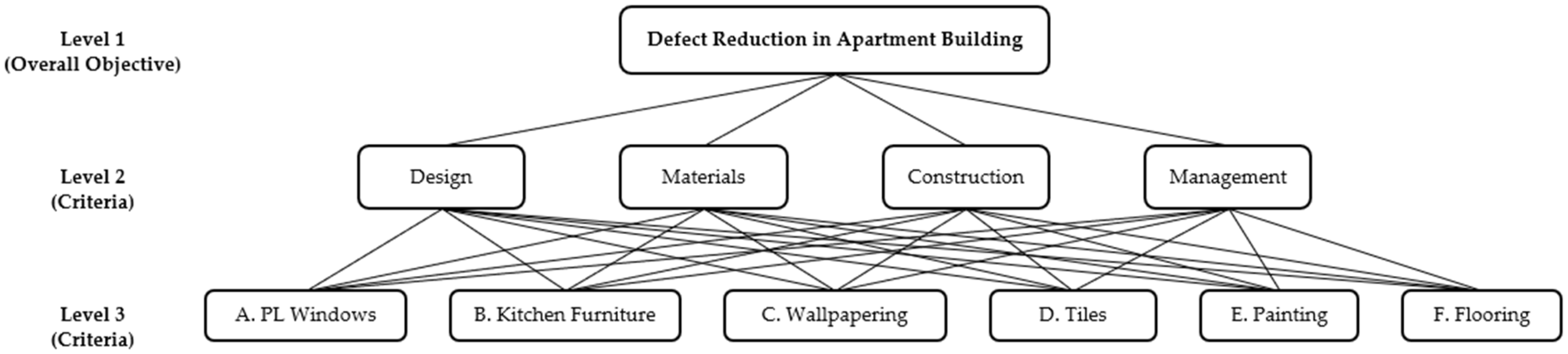
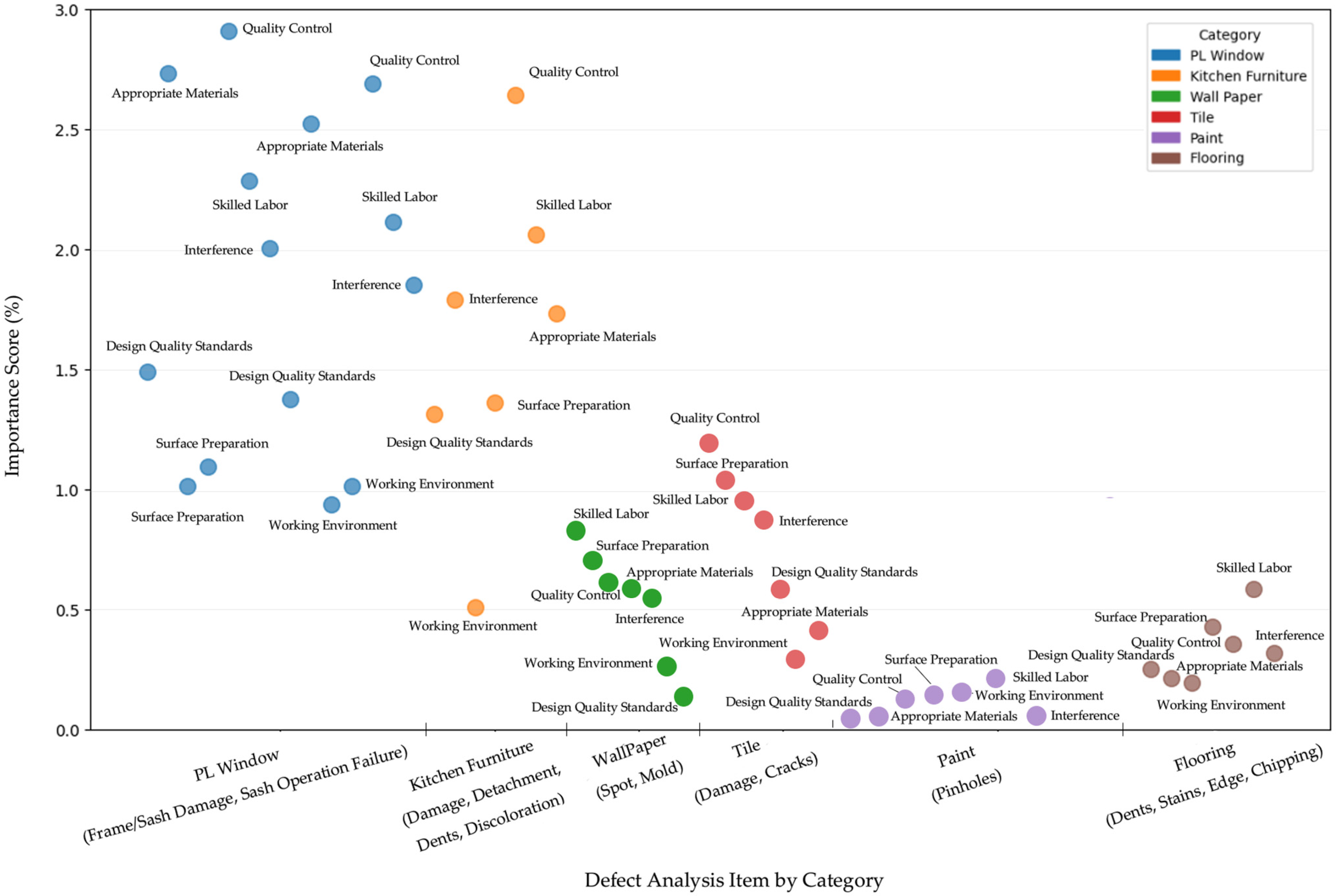
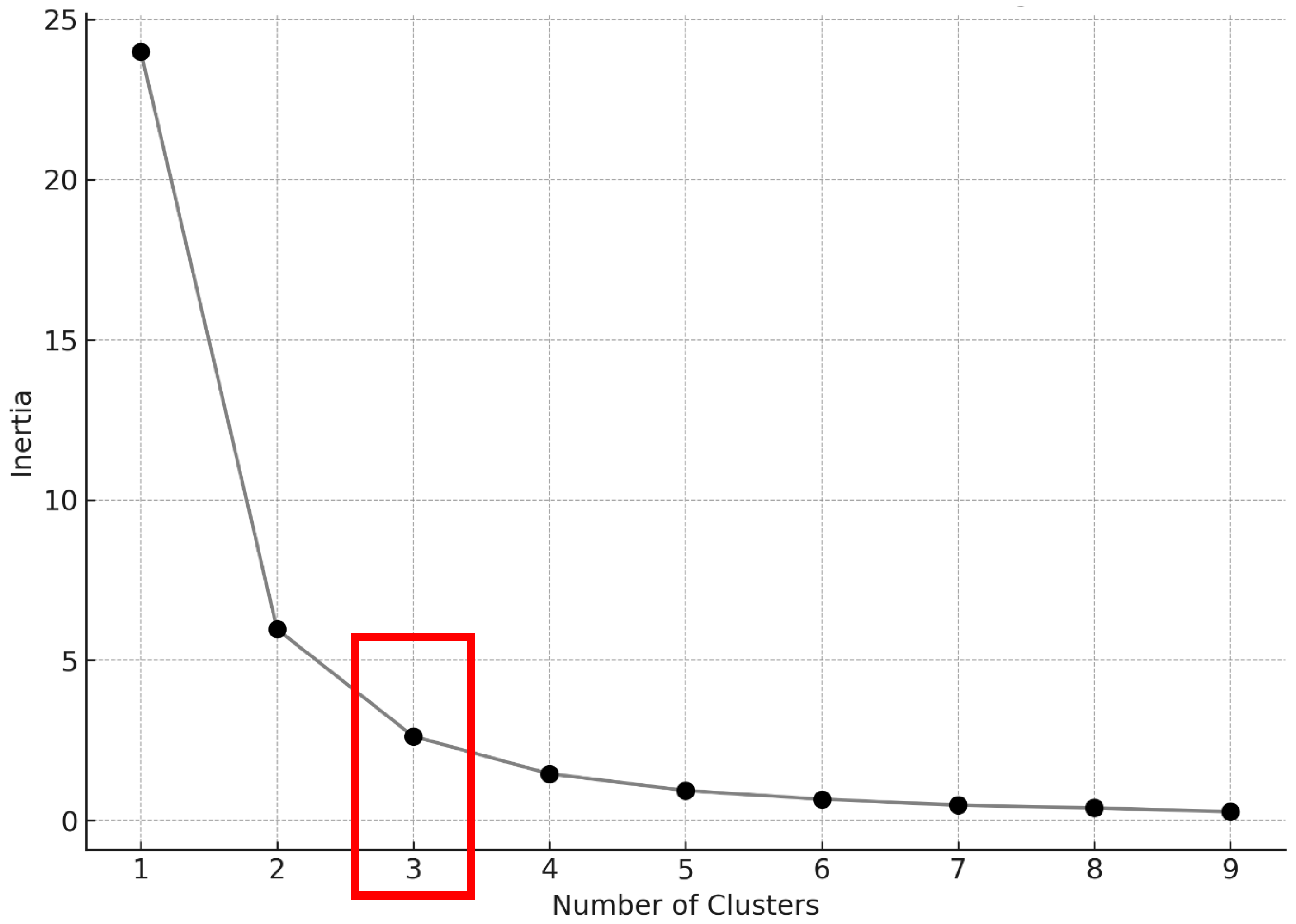

| Country | Ratio (%) | Country | Ratio (%) | Country | Ratio (%) |
|---|---|---|---|---|---|
| South Korea | 78 | Germany | 56 | Estonia | 61 |
| United State | 31 | Italy | 53 | Austria | 46 |
| Spain | 65 | Czechia | 51 | Finland | 34 |
| Switzerland | 62 | Portugal | 46 | Denmark | 33 |
| Greece | 59 | Sweden | 47 | Bulgaria | 47 |
| Rank | Type | Completion Phase | Pre-Occupancy Inspection | Total | Ratio (%) |
|---|---|---|---|---|---|
| 1 | Wallpaper | 2830 | 5311 | 8141 | 18.29 |
| 2 | Kitchen Furniture | 2400 | 2913 | 5313 | 11.93 |
| 3 | Tile | 1524 | 2191 | 3715 | 8.35 |
| 4 | Flooring | 1815 | 972 | 2787 | 6.26 |
| 5 | Painting | 755 | 386 | 1141 | 2.56 |
| 6 | PL Window | 171 | 313 | 484 | 1.09 |
| Others | 9584 | 13,352 | 22,936 | 51.52 | |
| Total | 19,079 | 25,438 | 44,517 | 100 | |
| Authors | Objective | Research Target | Factors | Research Method | Results | Limitations of the Study |
|---|---|---|---|---|---|---|
| Faqih et al. (2021) [39] | To develop a systematic approach to assessing building conditions based on the identification and classification of defects | Study of defects in various types of buildings, focusing on severity and structural impacts | Defect severity, structural integrity, workmanship issues | Visual inspection using drones and imaging systems and defect mapping and classification | A structured defect classification system enhances maintenance planning and decision-making | Subjectivity in defect severity assessment and lack of standardized defect classification system |
| Shinde et al. (2020) [24] | To identify and categorize factors contributing to building defects and failures, aiming to minimize time and costs in construction projects | Defects in construction projects focusing on design, materials, and workmanship | Severity of defects, different warranty periods | Forensic engineering to analyze structural failures, using both destructive and non-destructive tests | Emphasizes that addressing the root causes of failures can improve structural integrity and prevent future issues | The study focuses on only existing cases, so it may require broader application |
| Kim et al. (2019) [25] | To analyze defect patterns in residential buildings during warranty period and provide strategies to minimize losses | 16,108 defects from 133 buildings, focusing on severity over different warranty periods | Maintenance, workmanship, design flaws | Loss distribution approach (LDA) and analysis of defect patterns in residential buildings | Defect losses high in RC, waterproof, and finish work | Defects observed in residential buildings in South Korea between 2008 and 2018 |
| Milion et al. (2016) [26] | To analyze the relationship between defects, perception, and satisfaction in buildings and investigate how defects impact customer satisfaction | Defects in residential units in Brazil, focusing on occurrence and customer perceptions | Transition from descriptive reports to numerical rating system | Combining customer satisfaction surveys with data from the technical assistance department (TAD) | Defects can influence customer satisfaction; many customers remain satisfied with their projects | The reliance on customer memory for defect reporting, which may lead to inaccuracies, and the study’s focus on a specific region in Brazil |
| Ifran Che-Ani et al. (2011) [27] | To create the Condition Survey Protocol (CSP) 1 matrix, a new method for the assessment of building conditions | Building inspections emphasizing the transition from descriptive reports to numerical rating | Frequency of defect causes, relationships with defects | A matrix that combines two assessment criteria: condition assessment and defect seriousness rating | The CSP 1 matrix is a reliable and efficient tool for building inspections | A new matrix system may necessitate further validation and broader acceptance within the industry |
| Pereira et al. (2020) [29] | To harmonize the causes of defects in a global inspection system and analyze the frequency and relationship between causes and defects | Analysis of 12 building elements or materials, focusing on defect frequency and relationships | Supervising engineers, site engineers, foremen, clerks, clients | Harmonization of causes from 12 individual expert inspection systems and analysis of frequency | Direct causes of defects in various building elements were identified | The scope of the 12 types of elements/materials considered, which might not encompass all potential defect causes |
| Muhwezi et al. (2020) [30] | To establish causes of building failure and evaluate impacts of causes on building failure | Survey of 210 respondents including supervising engineers, site foremen, and clients | Management, labor competency, communication | Questionnaire and interviews used for data collection and data analyzed quantitatively using SPSS and Microsoft Excel | Inadequate supervision of work significantly influences building failures | The focus on a specific geographic area and the reliance on self-reported data from respondents |
| Shooshtarian et al. (2024) [38] | To identify major causes of building defects and provide recommendations to minimize building defects | Construction industry analysis, focusing on material quality and workmanship | Materials, workmanship, and design flaws as defect causes | DEMATEL approach, which involves gathering expert opinions through questionnaires and semi-structured interviews | Materials, workmanship, and design are major causes of building defects | Lack of prioritization or knowledge of building defect causes |
| Zuraidi et al. (2018) [40] | To evaluate criteria and attributes for defects in heritage buildings | Heritage buildings in Malaysia, identifying and ranking criteria related to defects | Criteria and attributes linked to defects in heritage buildings | Analytic hierarchy process (AHP) and survey questionnaire administered to experts | Developed a model using AHP method for building performance evaluation | Potential subjectivity in expert opinions, a limited sample size of 20 experts |
| Alomari (2022) [36] | To identify and classify common factors contributing to building defects | Survey of construction participants, analyzing 57 critical factors influencing defect rates | Design, material, workmanship, maintenance, and environmental influences | Comprehensive review of previous studies focused on the causes of building defects to collect and analyze relevant data | Factors related to design and construction contribute the most to building defects | Reliance on qualitative data from existing literature |
| Mésároš et al. (2023) [13] | To analyze factors influencing defects in residential buildings and propose strategies to mitigate them | Residential buildings with frequent defects over different phases of construction and occupancy | Maintenance practices, workmanship, material selection, design deficiencies | Literature review, expert interviews, quantitative analysis of defect severity and frequency | Improper maintenance and low-quality workmanship were the most critical causes of defects | Study focused on a specific region, limiting generalizability |
| Gatlin (2013) [28] | To identify and manage design and construction defects to prevent future failures | Construction projects with significant design and construction defects | Design inadequacies, poor workmanship, material misuse | Case studies, forensic analysis, and visual inspections of defective projects | Defects were mostly caused by poor design and inadequate maintenance | Focused more on maintenance issues rather than construction quality control |
| Juan et al. (2023) [41] | To develop a statistical data-based model to establish RPN ratings in FMEA to improve construction project management | Analysis of defect occurrence, severity, and detection methods in the context of RPN calculations | Occurrence rates, severity of defects, and effectiveness of detection methods | Using FMEA method and classify and calculate the RPN for construction projects using a 10-level model | The proposed model provides a more scientific approach to prioritizing risks in construction | Reliability depends on the completeness and accuracy of the collected data over time |
| Classification | Gender | Age Group | Career | Classification | Gender | Age Group | Career | ||||
|---|---|---|---|---|---|---|---|---|---|---|---|
| Expert Firm Technical Manager | A | Representative of PL Windows | M | 60 | 30 | Construction Company | H | Site Manager 1 | M | 60 | 34 |
| B | Technical Executive of PL Windows | M | 50 | 23 | I | Site Manager 2 | M | 50 | 30 | ||
| C | Representative of Tile Company | M | 60 | 33 | LH Supervisor | J | Supervisor 1 | M | 60 | 30 | |
| D | Representative of Painting Company | M | 50 | 25 | K | Supervisor 2 | M | 50 | 30 | ||
| E | Technical Executive of Kitchen Furniture | M | 40 | 26 | L | Supervisor 3 | M | 50 | 28 | ||
| F | Technical Executive of Wallpaper Company | M | 40 | 21 | M | Supervisor 4 | M | 50 | 25 | ||
| G | Technical Executive of Flooring Company | M | 40 | 21 | N | Supervisor 5 | M | 40 | 23 | ||
| Professor | O | Professor of Structural Engineering | M | 60 | 34 | Researcher Ph.D. | Q | Researcher Ph.D. 1 | M | 50 | 30 |
| P | Professor of Construction Engineering | M | 50 | 30 | R | Researcher Ph.D. 2 | M | 40 | 22 | ||
| Category | Type | Defect Occurrence Location or Defect Type |
|---|---|---|
| 6 Major Defect-Prone Categories | PL Window | Window Frame/Sash Damage, Sash Operation Failure, Automatic Handle Malfunction, Excessive Gaps in Frame/Sash |
| Kitchen Furniture | Damage, Detachment, Dents/Misaligned Door Panel/Poor Door Finish/Missing Side Panel at Interference Points/Drawer Operation Failure | |
| Wallpaper | Stains, Damage, Dents/Uneven Surface, Peeling/Cracking/Spots, Mold | |
| Tiles | Insufficient Grout Filling/Stains/Damage, Cracks/Peeling, Detachment/Poor Wall Flatness, and Floor Slope/Excessive Drilling Affecting Esthetics | |
| Paint | Discoloration, Stains/Peeling, Delamination, Cracks/Efflorescence/Pinhole Defects | |
| Flooring | Dents, Stains/Peeling, Delamination/Discoloration, Fading/Poor Seams/Level Differences |
| Category | Defect Type | Defect Cause Analysis Items | ||||||
|---|---|---|---|---|---|---|---|---|
| Design, Quality Standards | Suitable Material Manufacturing /Production | Working Environment Interference with Other Categories | Surface Preparation | Construction Quality Control | Worker Skill Level | Protection Management | ||
| PL Window | Frame/sash damage | Manufacturing defect | Insufficient product strength | Damage caused by other construction work | Poor opening treatment | Carelessness in construction | Poor construction quality | Insufficient protection management |
| Sash operation failure | Undersized window frame | Defective roller | Opening/closing issues at low temperatures | Poor opening treatment | Sagging or loose window frame | Poor construction quality | Insufficient protection management | |
| Automatic handle malfunction | Insufficient performance | Product defect | Malfunction at low outdoor temperatures | - | Poor construction precision | Poor construction quality | Insufficient protection management | |
| Excessive gaps in frame/sash | Manufacturing defect | Defective mohair | - | Misalignment of opening | Damaged mohair | Lack of proficiency | Insufficient protection management | |
| Kitchen Furniture | Detachment, dents, discoloration | Manufacturing defect | Color inconsistency between products | Damage caused by other construction work | Poor substrate treatment | Poor reinforcement wood installation | Poor construction quality | Insufficient protection management |
| Door misalignment | Excessive door width | Manufacturing error | - | - | Incorrect hinge installation | Poor construction quality | Insufficient protection management | |
| Poor door finish | Poor factory manufacturing quality | Color inconsistency between products | Damage caused by other construction work | Poor substrate treatment | Construction negligence | Lack of proficiency | Insufficient protection management | |
| Missing side panel at interference area | Interference with adjacent furniture | Inadequate factory inspection | - | - | Construction imprecision | Lack of proficiency | - | |
| Drawer operation failure | Incorrect drawer size | Defective drawer rail | Damage caused by other construction work | - | Rail installation defect | Poor construction quality | - | |
| Wallpaper | Stains, damage, dents, discoloration | Product defect | Manufacturing error | Damage caused by other construction work | Inadequate substrate preparation | Excessive roller usage | Poor construction quality | Inadequate protection after construction |
| Uneven surface, peeling | - | Defective adhesive | Failure to meet temperature conditions | Poor substrate cleaning | Defective adhesive application | Lack of proficiency | Inadequate protection after construction | |
| Wallpaper tearing | Insufficient product strength | Defective adhesive | Winter season work | Insufficient flatness | Overlapping wallpaper installation | Lack of proficiency | Insufficient protection management | |
| Spots, mold | Product defect | Manufacturing error | Winter season work | Poor substrate cleaning | Defective installation with foreign materials | Carelessness in construction | Insufficient protection management | |
| Tile | Insufficient grout filling, stains | - | Product defect | Damage caused by other construction work | Reduced adhesion | Poor grout filling | Poor construction quality | Insufficient protection management |
| Damage, cracks | Tile product defect | Insufficient tile strength | Construction during the rainy season | Cracks in substrate | Improper mortar mix ratio | Carelessness in construction | Insufficient curing | |
| Peeling, detachment | Tile product defect | Defective adhesive | Construction during the rainy season | Insufficient substrate drying | Insufficient mortar thickness | Poor construction quality | Insufficient protection management | |
| Poor wall flatness | Inadequate tile layout plan | - | - | Insufficient flatness | Incorrect slope construction | Lack of proficiency | Insufficient protection management | |
| Esthetic damage from over-drilling | Unverified hole position | - | Damage caused by other construction work | Poor substrate treatment | Tile drilling error | Lack of proficiency | ||
| Paint | Discoloration, stains | Production color inconsistency | Insufficient solvent power of thinner | Work at temperatures above 5 °C | Poor substrate cleaning | Construction negligence | Poor construction quality | Inadequate protective management |
| Peeling, delamination, cracking | Painting defect | Mismatched upper and lower materials | Work at temperatures above 5 °C | Poor substrate cleaning | Non-compliance with open time | Lack of proficiency | Post-completion mismanagement | |
| Efflorescence | Painting defect | Insufficient solvent power of thinner | Work at high ambient temperatures | Poor substrate treatment | Insufficient paint thickness | Poor construction quality | Insufficient protection management | |
| Pinholes | Painting defect | Use of fast-evaporating solvent | Work when the coated material temperature is high | Poor substrate treatment | Excessive paint thickness | Poor construction quality | Insufficient protection management | |
| Flooring | Dents, stains, edge chipping | Product defect | Use of defective materials | Damage caused by other construction work | Poor substrate cleaning | Construction imprecision | Poor construction quality | Insufficient protection management |
| Peeling, delamination | Product defect | Defective adhesive | Work at temperatures above 5 °C | Poor substrate cleaning | Construction negligence | Lack of proficiency | Insufficient protection management | |
| Discoloration, fading | Product defect | Use of defective materials | Work at temperatures above 5 °C | Substrate leakage | Construction imprecision | Lack of proficiency | Insufficient protection management | |
| Defective joint | Excessive gap at joints | Use of defective materials | - | Insufficient flatness | Carelessness in construction | Poor construction quality | Insufficient protection management | |
| Level differences | Product defect | Use of defective materials | - | Insufficient flatness | Inadequate treatment of joints | Lack of proficiency | Insufficient protection management | |
| Classification | Public Institution | Project Supervisor | Construction Company | Expert Group (Professor, Ph.D.) | Total |
|---|---|---|---|---|---|
| Survey Respondents (Number of People) | 66 | 43 | 45 | 9 | 163 |
| Survey Adoption (Number of People) | 30 | 18 | 17 | 5 | 71 |
| Main Category | Importance of Pairwise Comparison Items | Classification | ||||||
|---|---|---|---|---|---|---|---|---|
| A. PL Windows | B. Kitchen Furniture | C. Wallpaper | D. Tiles | E. Paint | F. Flooring | Weight | Priority | |
| A. PL Windows | 1 | 2.142 | 5.792 | 3.234 | 4.926 | 2.425 | 0.381 | 1 |
| B. Kitchen Furniture | 0.467 | 1 | 3.590 | 2.139 | 4.218 | 2.249 | 0.239 | 2 |
| C. Wallpaper | 0.173 | 0.279 | 1 | 1.419 | 1.610 | 1.497 | 0.105 | 4 |
| D. Tiles | 0.309 | 0.467 | 0.705 | 1 | 4.564 | 1.292 | 0.124 | 3 |
| E. Paint | 0.203 | 0.237 | 0.621 | 0.219 | 1 | 0.421 | 0.049 | 6 |
| F. Flooring | 0.412 | 0.445 | 0.668 | 0.774 | 2.377 | 1 | 0.102 | 5 |
| Consistency Index = 0.0611 | ||||||||
| Main Category | Importance of Pairwise Comparison Items | Classification | ||||
|---|---|---|---|---|---|---|
| Frame/Sash Damage | Sash Operation Failure | Automatic Handle Malfunction | Excessive Gaps in Frame/Sash | Weight | Priority | |
| Frame/Sash Damage | 1 | 1.246 | 2.465 | 1.979 | 0.355 | 1 |
| Sash Operation Failure | 0.803 | 1 | 2.678 | 1.804 | 0.328 | 2 |
| Automatic Handle Malfunction | 0.406 | 0.373 | 1 | 2.863 | 0.192 | 3 |
| Excessive Gaps in Frame/Sash | 0.505 | 0.554 | 0.349 | 1 | 0.126 | 4 |
| Consistency Index = 0.0819 | ||||||
| Main Category | Importance of Pairwise Comparison Items | Classification | ||||
|---|---|---|---|---|---|---|
| Door/Sink Countertop Damage, Detachment, Dents, Discoloration | Door Misalignment | Poor Door Finish | Drawer Operation Failure | Weight | Priority | |
| Door/Sink Countertop Damage, Detachment, Dents, Discoloration | 1 | 3.261 | 2.576 | 2.496 | 0.474 | 1 |
| Door Misalignment | 0.307 | 1 | 0.830 | 2.843 | 0.211 | 2 |
| Poor Door Finish | 0.388 | 1.205 | 1 | 1.059 | 0.183 | 3 |
| Drawer Operation Failure | 0.401 | 0.352 | 0.944 | 1 | 0.132 | 4 |
| Consistency Index = 0.0663 | ||||||
| Main Category | Importance of Pairwise Comparison Items | Classification | ||||
|---|---|---|---|---|---|---|
| Stains, Damage, Dents, Discoloration | Uneven Surface, Peeling | Wallpaper Tearing | Spots, Mold | Weight | Priority | |
| Stains, Damage, Dents, Discoloration | 1 | 0.962 | 1.081 | 0.527 | 0.199 | 3 |
| Uneven Surface, Peeling | 1.039 | 1 | 1.193 | 0.378 | 0.197 | 4 |
| Wallpaper Tearing | 0.925 | 0.838 | 1 | 1.474 | 0.264 | 2 |
| Spots, Mold | 1.896 | 2.644 | 0.678 | 1 | 0.340 | 1 |
| Consistency Index = 0.0815 | ||||||
| Main Category | Importance of Pairwise Comparison Items | Classification | ||||
|---|---|---|---|---|---|---|
| Insufficient Grout Filling, Stains | Damage, Cracks | Peeling, Detachment | Esthetic Deterioration Due to Excessive Drilling | Weight | Priority | |
| Insufficient Grout Filling, Stains | 1 | 0.251 | 1.257 | 0.963 | 0.171 | 3 |
| Damage, Cracks | 3.984 | 1 | 1.234 | 3.776 | 0.443 | 1 |
| Peeling, Detachment | 0.795 | 0.810 | 1 | 3.169 | 0.270 | 2 |
| Esthetic Deterioration Due to Excessive Drilling | 1.038 | 0.265 | 0.316 | 1 | 0.116 | 4 |
| Consistency Index = 0.0866 | ||||||
| Main Category | Importance of Pairwise Comparison Items | Classification | ||||
|---|---|---|---|---|---|---|
| Discoloration, Stains | Peeling, Delamination, Cracks | Efflorescence | Pinholes | Weight | Priority | |
| Discoloration, Stains | 1 | 2.331 | 1.599 | 1.910 | 0.393 | 1 |
| Peeling, Delamination, Cracks | 0.429 | 1 | 1.810 | 3.009 | 0.287 | 2 |
| Efflorescence | 0.625 | 0.552 | 1 | 1.856 | 0.196 | 3 |
| Pinholes | 0.524 | 0.332 | 0.539 | 1 | 0.124 | 4 |
| Consistency Index = 0.0619 | ||||||
| Main Category | Importance of Pairwise Comparison Items | Classification | ||||
|---|---|---|---|---|---|---|
| Dents, Stains, Edge Chipping | Peeling, Delamination | Discoloration, Fading | Level Differences | Weight | Priority | |
| Dents, Stains, Edge Chipping | 1 | 0.614 | 1.920 | 0.727 | 0.230 | 2 |
| Peeling, Delamination | 1.629 | 1 | 2.965 | 1.193 | 0.366 | 1 |
| Discoloration, Fading | 0.521 | 0.337 | 1 | 1.492 | 0.177 | 4 |
| Level Differences | 1.375 | 0.838 | 0.670 | 1 | 0.229 | 3 |
| Consistency Index = 0.0772 | ||||||
| Main Category | Importance of Pairwise Comparison Items | Classification | |||||||
|---|---|---|---|---|---|---|---|---|---|
| Design Quality Standards | Appropriate Materials, Manufacturing/ Production | Compliance with Working Environment | Surface Preparation | Quality Control | Skilled Labor | Protection Management, Interference from Other Trades | Weight | Priority | |
| Design Quality Standards | 1 | 0.734 | 2.020 | 1.397 | 0.451 | 0.536 | 0.731 | 0.110 | 5 |
| Appropriate Materials, Manufacturing /Production | 1.346 | 1 | 2.784 | 1.924 | 1.605 | 1.716 | 0.996 | 0.202 | 2 |
| Compliance with Working Environment | 0.495 | 0.359 | 1 | 0.539 | 0.253 | 1.254 | 0.341 | 0.075 | 7 |
| Surface Preparation | 0.716 | 0.520 | 1.854 | 1 | 0.342 | 0.314 | 0.517 | 0.081 | 6 |
| Construction Quality Control | 2.216 | 0.623 | 3.946 | 2.920 | 1 | 1.171 | 1.813 | 0.215 | 1 |
| Skilled Labor | 1.866 | 0.583 | 0.797 | 3.184 | 0.854 | 1 | 1.610 | 0.169 | 3 |
| Protection Management, Interference from Other Trades | 1.369 | 1.004 | 2.934 | 1.933 | 0.551 | 0.621 | 1 | 0.148 | 4 |
| Consistency Index = 0.0705 | |||||||||
| Main Category | Importance of Pairwise Comparison Items | Classification | |||||||
|---|---|---|---|---|---|---|---|---|---|
| Design Quality Standards | Appropriate Materials, Manufacturing/ Production | Compliance with Working Environment | Surface Preparation | Quality Control | Skilled Labor | Protection Management, Interference from Other Trades | Weight | Priority | |
| Design Quality Standards | 1 | 0.765 | 2.753 | 1.574 | 0.508 | 0.522 | 0.713 | 0.116 | 6 |
| Appropriate Materials, Manufacturing /Production | 1.307 | 1 | 3.318 | 2.109 | 0.644 | 0.668 | 1.040 | 0.151 | 4 |
| Compliance with Working Environment | 0.363 | 0.301 | 1 | 0.536 | 0.222 | 0.224 | 0.294 | 0.045 | 7 |
| Surface Preparation | 0.635 | 0.474 | 1.868 | 1 | 0.313 | 2.275 | 0.424 | 0.120 | 5 |
| Construction Quality Control | 1.970 | 1.553 | 4.497 | 3.199 | 1 | 1.149 | 1.676 | 0.233 | 1 |
| Skilled Labor | 1.914 | 1.498 | 0.439 | 0.439 | 0.870 | 1 | 1.599 | 0.182 | 2 |
| Protection Management, Interference from Other Trades | 1.402 | 0.962 | 3.400 | 2.360 | 0.597 | 0.625 | 1 | 0.153 | 3 |
| Consistency Index = 0.0780 | |||||||||
| Main Category | Importance of Pairwise Comparison Items | Classification | |||||||
|---|---|---|---|---|---|---|---|---|---|
| Design Quality Standards | Appropriate Materials, Manufacturing/ Production | Compliance with Working Environment | Surface Preparation | Quality Control | Skilled Labor | Protection Management, Interference from Other Trades | Weight | Priority | |
| Design Quality Standards | 1 | 0.845 | 0.475 | 0.279 | 0.274 | 0.215 | 0.312 | 0.053 | 7 |
| Appropriate Materials, Manufacturing /Production | 1.183 | 1 | 1.564 | 1.283 | 1.289 | 1.243 | 0.395 | 0.151 | 4 |
| Compliance with Working Environment | 2.106 | 0.639 | 1 | 0.428 | 0.428 | 0.322 | 1.574 | 0.101 | 6 |
| Surface Preparation | 3.585 | 0.779 | 2.337 | 1 | 1.108 | 0.839 | 1.408 | 0.173 | 2 |
| Construction Quality Control | 3.655 | 0.776 | 2.339 | 0.903 | 1 | 0.761 | 1.342 | 0.165 | 3 |
| Skilled Labor | 4.648 | 0.805 | 3.105 | 1.919 | 1.314 | 1 | 1.721 | 0.212 | 1 |
| Protection Management, Interference from Other Trades | 3.205 | 2.533 | 0.635 | 0.710 | 0.745 | 0.581 | 1 | 0.145 | 5 |
| Consistency Index = 0.0878 | |||||||||
| Main Category | Importance of Pairwise Comparison Items | Classification | |||||||
|---|---|---|---|---|---|---|---|---|---|
| Design Quality Standards | Appropriate Materials, Manufacturing/ Production | Compliance with Working Environment | Surface Preparation | Quality Control | Skilled Labor | Protection Management, Interference from Other Trades | Weight | Priority | |
| Design Quality Standards | 1 | 0.784 | 0.910 | 0.521 | 0.345 | 1.266 | 0.459 | 0.097 | 5 |
| Appropriate Materials, Manufacturing /Production | 1.275 | 1 | 0.852 | 0.609 | 0.370 | 0.289 | 0.560 | 0.081 | 7 |
| Compliance with Working Environment | 1.099 | 1.173 | 1 | 0.777 | 0.371 | 0.306 | 0.569 | 0.087 | 6 |
| Surface Preparation | 1.920 | 1.643 | 1.287 | 1 | 1.618 | 1.472 | 0.976 | 0.187 | 2 |
| Construction Quality Control | 2.899 | 2.704 | 2.694 | 0.618 | 1 | 1.833 | 1.479 | 0.220 | 1 |
| Skilled Labor | 0.790 | 3.463 | 3.270 | 0.679 | 0.545 | 1 | 1.748 | 0.182 | 3 |
| Protection Management, Interference from Other Trades | 2.180 | 1.786 | 1.758 | 1.025 | 0.676 | 0.572 | 1 | 0.147 | 4 |
| Consistency Index = 0.0698 | |||||||||
| Main Category | Importance of Pairwise Comparison Items | Classification | |||||||
|---|---|---|---|---|---|---|---|---|---|
| Design Quality Standards | Appropriate Materials, Manufacturing/ Production | Compliance with Working Environment | Surface Preparation | Quality Control | Skilled Labor | Protection Management, Interference from Other Trades | Weight | Priority | |
| Design Quality Standards | 1 | 0.979 | 0.429 | 0.310 | 0.301 | 0.302 | 1.538 | 0.073 | 7 |
| Appropriate Materials, Manufacturing /Production | 1.022 | 1 | 0.541 | 0.353 | 0.366 | 0.332 | 1.561 | 0.080 | 6 |
| Compliance with Working Environment | 2.328 | 1.850 | 1 | 1.660 | 1.749 | 0.669 | 1.247 | 0.190 | 2 |
| Surface Preparation | 3.221 | 2.831 | 0.602 | 1 | 1.167 | 1.012 | 1.784 | 0.186 | 3 |
| Construction Quality Control | 3.320 | 2.729 | 0.572 | 0.857 | 1 | 0.834 | 1.637 | 0.170 | 4 |
| Skilled Labor | 3.306 | 3.011 | 1.494 | 0.988 | 1.199 | 1 | 1.973 | 0.212 | 1 |
| Protection Management, Interference from Other Trades | 0.650 | 0.641 | 0.802 | 0.560 | 0.611 | 0.507 | 1 | 0.089 | 5 |
| Consistency Index = 0.0489 | |||||||||
| Main Category | Importance of Pairwise Comparison Items | Classification | |||||||
|---|---|---|---|---|---|---|---|---|---|
| Design Quality Standards | Appropriate Materials, Manufacturing/ Production | Compliance with Working Environment | Surface Preparation | Quality Control | Skilled Labor | Management, Interference from Other Trades | Weight | Priority | |
| Design Quality Standards | 1 | 0.797 | 0.612 | 1.367 | 1.333 | 0.281 | 0.430 | 0.107 | 5 |
| Appropriate Materials, Manufacturing /Production | 1.254 | 1 | 1.947 | 0.425 | 0.394 | 0.339 | 0.559 | 0.091 | 6 |
| Compliance with Working Environment | 1.633 | 0.514 | 1 | 0.416 | 0.422 | 0.331 | 0.720 | 0.082 | 7 |
| Surface Preparation | 0.732 | 2.351 | 2.404 | 1 | 1.874 | 0.710 | 1.532 | 0.182 | 2 |
| Construction Quality Control | 0.750 | 2.538 | 2.370 | 0.534 | 1 | 0.694 | 1.364 | 0.152 | 3 |
| Skilled Labor | 3.563 | 2.949 | 3.021 | 1.408 | 1.441 | 1 | 1.881 | 0.250 | 1 |
| Protection Management, Interference from Other Trades | 2.326 | 1.787 | 1.388 | 0.653 | 0.733 | 0.532 | 1 | 0.136 | 4 |
| Consistency Index = 0.0817 | |||||||||
| Category | Defect Type | Defect Cause Analysis Item | ||||||
|---|---|---|---|---|---|---|---|---|
| Design Quality Standards | Appropriate Materials, Manufacturing/ Production | Compliance with Working Environment | Surface Preparation | Quality Control | Skilled Labor | Management, Interference from Other Trades | ||
| PL Window (1) | Frame/Sash Damage | 1.488 | 2.732 | 1.014 | 1.096 | 2.908 | 2.286 | 2.002 |
| Sash Operation Failure | 1.375 | 2.524 | 0.937 | 1.012 | 2.687 | 2.112 | 1.850 | |
| Automatic Handle Malfunction | 0.805 | 1.478 | 0.549 | 0.593 | 1.573 | 1.236 | 1.083 | |
| Excessive Gaps in Frame/Sash | 0.528 | 0.970 | 0.360 | 0.389 | 1.032 | 0.811 | 0.710 | |
| Kitchen Furniture (2) | Damage, Detachment, Dents, Discoloration | 1.314 | 1.711 | 0.510 | 1.359 | 2.640 | 2.062 | 1.733 |
| Door Misalignment | 0.585 | 0.761 | 0.227 | 0.605 | 1.175 | 0.918 | 0.772 | |
| Poor Door Finish | 0.507 | 0.660 | 0.197 | 0.525 | 1.019 | 0.796 | 0.669 | |
| Drawer Operation Failure | 0.366 | 0.476 | 0.142 | 0.379 | 0.735 | 0.574 | 0.483 | |
| Wall Paper (4) | Stains, Damage, Dents, Discoloration | 0.111 | 0.316 | 0.211 | 0.361 | 0.345 | 0.443 | 0.303 |
| Uneven Surface, Peeling | 0.110 | 0.312 | 0.209 | 0.358 | 0.341 | 0.439 | 0.300 | |
| Wallpaper Tearing | 0.147 | 0.419 | 0.280 | 0.480 | 0.457 | 0.588 | 0.402 | |
| Spots, Mold | 0.189 | 0.539 | 0.361 | 0.618 | 0.589 | 0.757 | 0.518 | |
| Tiles (3) | Insufficient Grout Filling, Stains | 0.206 | 0.172 | 0.184 | 0.397 | 0.466 | 0.386 | 0.312 |
| Damage, Cracks | 0.533 | 0.445 | 0.478 | 1.027 | 1.209 | 0.999 | 0.808 | |
| Peeling, Detachment | 0.325 | 0.271 | 0.291 | 0.626 | 0.737 | 0.609 | 0.492 | |
| Esthetic Deterioration | 0.140 | 0.117 | 0.125 | 0.269 | 0.316 | 0.262 | 0.211 | |
| Paint (6) | Discoloration, Stains | 0.141 | 0.154 | 0.366 | 0.362 | 0.327 | 0.408 | 0.171 |
| Peeling, Delamination, Cracks | 0.103 | 0.113 | 0.267 | 0.264 | 0.239 | 0.298 | 0.125 | |
| Efflorescence | 0.070 | 0.077 | 0.182 | 0.181 | 0.163 | 0.204 | 0.085 | |
| Pinholes | 0.044 | 0.049 | 0.115 | 0.114 | 0.103 | 0.129 | 0.054 | |
| Flooring (5) | Dents, Stains, Edge Chipping | 0.250 | 0.213 | 0.192 | 0.425 | 0.355 | 0.584 | 0.318 |
| Peeling, Delamination | 0.399 | 0.340 | 0.306 | 0.679 | 0.567 | 0.933 | 0.508 | |
| Discoloration, Fading | 0.193 | 0.164 | 0.148 | 0.329 | 0.274 | 0.451 | 0.246 | |
| Level Differences | 0.250 | 0.213 | 0.192 | 0.425 | 0.355 | 0.584 | 0.318 | |
 : highest-ranked items (top 10).
  : lowest-ranked items (top 10).
| Defect Type | TOPSIS Score | Cluster |
|---|---|---|
| Frame/Sash Damage | 1.000 | 2 |
| Sash Operation Failure | 0.970 | 2 |
| Automatic Handle Malfunction | 0.940 | 2 |
| Excessive Gaps in Frame/Sash | 0.910 | 2 |
| Damage, Detachment, Dents, Discoloration | 0.880 | 2 |
| Door Misalignment | 0.850 | 2 |
| Poor Door Finish | 0.820 | 2 |
| Drawer Operation Failure | 0.790 | 2 |
| Stains, Damage, Dents, Discoloration | 0.760 | 0 |
| Uneven Surface, Peeling | 0.730 | 0 |
| Wallpaper Tearing | 0.700 | 0 |
| Spots, Mold | 0.670 | 0 |
| Insufficient Grout Filling, Stains | 0.640 | 0 |
| Damage, Cracks | 0.610 | 0 |
| Peeling, Detachment | 0.580 | 0 |
| Esthetic Deterioration | 0.550 | 0 |
| Discoloration, Stains | 0.520 | 1 |
| Peeling, Delamination, Cracks | 0.490 | 1 |
| Efflorescence | 0.460 | 1 |
| Pinholes | 0.430 | 1 |
| Dents, Stains, Edge Chipping | 0.400 | 1 |
| Peeling, Delamination | 0.370 | 1 |
| Discoloration, Fading | 0.340 | 1 |
| Level Differences | 0.310 | 1 |
| Category (Importance Ranking) | “Defect Cause Analysis Items” Classified by Project Phase (Priority ①~⑦) | ||
|---|---|---|---|
| Design Phase | Construction Phase | Maintenance Phase | |
| PL Window (1) | ② Appropriate Materials and Manufacturing ⑤ Design and Quality Standards | ① Construction Quality Control ③ Skilled Labor Proficiency ⑥ Substrate Preparation ⑦ Compliance with Work Environment | ④ Protection Management, Impact of Interference Between Trades |
| Kitchen Furniture (2) | ④ Appropriate Materials and Manufacturing ⑥ Design and Quality Standards | ① Construction Quality Control ② Skilled Labor Proficiency ⑤ Substrate Preparation ⑦ Compliance with Work Environment | ③ Protection Management, Impact of Interference Between Trades |
| Tiles (3) | ⑤ Design and Quality Standards ⑦ Appropriate Materials and Manufacturing | ① Construction Quality Control ② Substrate Preparation ③ Skilled Labor Proficiency ⑥ Compliance with Work Environment | ④ Protection Management, Impact of Interference Between Trades |
| Wallpaper (4) | ④ Appropriate Materials and Manufacturing ⑦ Design and Quality Standards | ① Skilled Labor Proficiency ② Substrate Preparation ③ Construction Quality Control ⑥ Compliance with Work Environment | ⑤ Protection Management, Impact of Interference Between Trades |
| Flooring (5) | ⑤ Design and Quality Standards ⑥ Appropriate Materials and Manufacturing | ① Skilled Labor Proficiency ② Substrate Preparation ③ Construction Quality Control ⑦ Compliance with Work Environment | ④ Protection Management, Impact of Interference Between Trades |
| Paint (6) | ⑥ Appropriate Materials and Manufacturing ⑦ Design and Quality Standards | ① Skilled Labor Proficiency ② Compliance with Work Environment ③ Substrate Preparation ④ Construction Quality Control | ⑤ Protection Management, Impact of Interference Between Trades |
| Category | Defective Work Type | PL Window | Kitchen Furniture | Tiles | WallPaper | Flooring | Paint | |
|---|---|---|---|---|---|---|---|---|
| Design Phase | Design Quality Standards (Design and Specification Verification) | · Compliance with Specification Standards · Design of Appropriate Window Frame Dimensions | · Design of Appropriate Pull-Out Mesh Size · Verification of Interior Drawings | · Pre-Verification of Drilling Locations · Planning of Tile Sizes and Grout Layout | · Verification of Drilling and Switch Locations | · Verification of Furniture and Door Frame Installation Locations · Flooring Trim Planning (e.g., Height Differences) | · Verification of Painting Color Plan | |
| Materials and Methods (Appropriate Materials, Manufacturing, and Production) | · Product Manufacturing Condition Check · Roller Product Condition Check | · Product Manufacturing Condition Check · Product Performance Test Report | · Adhesive Quality Check · Fill Mortar Quality Check | · Product Condition Check · Ensure Wallpaper Strength | · Ensure Adhesive Performance · Product Manufacturing Condition Check | · Ensure Consistent Material for Primer and Topcoat · Check Thinner Quality (Solubility) | ||
| Construction Phase | Pre-Construction | Construction Plan (Verification of Detailed Construction Drawings) | · PL Window Manufacturing Drawings · Window Installation Detailed Drawings | · Kitchen Furniture Layout Plan by Unit Type · Material Delivery and Storage Plan | · Detailed Installation Plan for Corner Tiles | · Protection Locations and Wallpaper Seaming Method | · Construction Schedule Plan by Building · Flooring Division Planning | · Painting Method by Application Area · Verification of Coating Thickness |
| Sample Construction | · One Sample Check for Each Window Size and Type | · One Sample Unit Per Unit Type | · One Sample Unit Per Unit Type | · One Sample Unit Per Unit Type | · One Sample Unit Per Unit Type | · Test 10 m2 or More Per Color, Substrate Material | ||
| Main Construction | Compliance with Work Environment | · Avoid Installation During Low Outdoor Temperatures | · Completion of Preceding Works Such as Painting and Wallpapering | · Maintain Temperature Above 5 °C | · Maintain Temperature Above 5 °C (−72 h to +48 h) | · Maintain Temperature Above 5 °C | · Maintain Temperature Above 5 °C · Prohibit Work During Strong Winds or Heavy Rain | |
| Substrate Preparation | · Ensure Opening Alignment · Substrate Preparation for Openings | · Substrate Preparation and Cleaning · Ensure Wall Surface Flatness | · Ensure That Substrate Is Dry and Repair Cracks · Substrate Flatness (±3 mm) | · Clean and Dry Substrate · Sanding and Putty Application | · Removal of Leaks and Moisture from Substrate (Maintain Moisture Content ≤ 4.5%) | · Dry Substrate and Repair Cracks (Maintain Moisture Content ≤ 10%) | ||
| Construction Quality Control (Ensuring Skilled Labor Proficiency) | · Precision Installation by Unit · Prevent Mohair Damage | · Precision Installation of Reinforcement Wood · Accurate Hinge Installation | · Ensure Appropriate Mortar Thickness · Adhere to Cement Mixing Ratio | · Precision Cutting of Wallpaper · Avoid Excessive Roller Application | · Uniform Application of Adhesive · Ensure Quality and Skill | · Ensure Construction Quality and Worker Proficiency · Adhere to Open Time | ||
| Post-Construction Phase | Protection Management, Minimization of Interference with Other Trades | · Check Operational Condition of Window Hardware · Protection Management (0.03 mm PE Film) | · Protection Management (0.03 mm PE Film) · Prevention of Damage by Other Trades | · Prevent Vibration and Impact for 3 Days · Thorough Protection Management | · Prevent Sudden Temperature Changes After Wallpaper Installation · Thorough Protection Management | · Thorough Protection Management · Restrict Walking During Curing Time | · Thorough Protection Management · Prevent Damage from Other Trades | |
Disclaimer/Publisher’s Note: The statements, opinions and data contained in all publications are solely those of the individual author(s) and contributor(s) and not of MDPI and/or the editor(s). MDPI and/or the editor(s) disclaim responsibility for any injury to people or property resulting from any ideas, methods, instructions or products referred to in the content. |
© 2024 by the authors. Licensee MDPI, Basel, Switzerland. This article is an open access article distributed under the terms and conditions of the Creative Commons Attribution (CC BY) license (https://creativecommons.org/licenses/by/4.0/).
Share and Cite
Kang, D.; Lee, E.; Ahn, Y.; Kwon, N. Deriving the Importance of Defects in Multi-Unit Residential Buildings Using the Analytic Hierarchy Process Method. Buildings 2024, 14, 4028. https://doi.org/10.3390/buildings14124028
Kang D, Lee E, Ahn Y, Kwon N. Deriving the Importance of Defects in Multi-Unit Residential Buildings Using the Analytic Hierarchy Process Method. Buildings. 2024; 14(12):4028. https://doi.org/10.3390/buildings14124028
Chicago/Turabian StyleKang, Dongryeol, Eojin Lee, Yonghan Ahn, and Nahyun Kwon. 2024. "Deriving the Importance of Defects in Multi-Unit Residential Buildings Using the Analytic Hierarchy Process Method" Buildings 14, no. 12: 4028. https://doi.org/10.3390/buildings14124028
APA StyleKang, D., Lee, E., Ahn, Y., & Kwon, N. (2024). Deriving the Importance of Defects in Multi-Unit Residential Buildings Using the Analytic Hierarchy Process Method. Buildings, 14(12), 4028. https://doi.org/10.3390/buildings14124028