


Abstract
Urban regeneration by participatory methods is being discussed in many parts of the world, but conflicts between stakeholders emerge as a major challenge. In order to address this problem, a new approach to urban regeneration has been attempted in Korea. By targeting towns with university campuses, this project encourages active participation from university students as well as local residents. As a result of COVID-19 restrictions, the project adopted an online-based communication strategy. First, the online data was collected; second, the data for each participant was classified through data refinement; and third, the data analysis and data visualization were carried out at each stage using program R. The results revealed that the stakeholders exhibited different perceptions about the process, indicating a potential benefit of distinct role division for the success of the multiparty project. The significance of this study lies in the fact that it analyzes participants’ perceptions of urban regeneration using a text-mining process. The results of the study can serve as the basis for minimizing conflict and planning effective urban regeneration.
1. Introduction
1.1. The Background of the Research
The Republic of Korea has now entered the phase of transition from rapid growth to slow growth, requiring sustainable measures in urban planning. The focus of sustainable cities lies in improving the quality of life for people, not on expanding and growing [1]. Urban regeneration with residents’ participation is known to improve the quality of life of the residents [2,3,4]. However, it is never easy for residents and the public to discuss common regional problems and seek solutions [5]. In the typical urban regeneration process promoted so far, residents are invited to participate in the process led by public and private organizations. This method decreases the confidence level of residents in the urban regeneration project since it increases the fatigue of residents, creating conflicts among residents, and prolonging the project [6]. Thus, the Republic of Korea introduced a variety of urban regeneration methods with resident participation that are adapted to regional conditions. Recently, the contribution of universities to the social community has been discussed as an enabler for successful regional development and regeneration [7,8,9]. Various efforts have been made to implement urban regeneration in towns with university campuses by encouraging communication between students and residents. These projects, however, merely relied on a survey of the present condition, a survey of residents’ opinions, and idea derivation at the conceptual level, without providing practical tools and methods [10,11,12,13,14,15,16]. As urban regeneration process is intertwined with various stakeholders, it is crucial to identify the role of each party and develop effective tools and methods to collect, analyze, and process their opinions and suggestions. This study takes the case of the Student Village Design Project led by Sejong University, in Seoul, which adopted practical methods to actively integrate the participants’ responses for the success of the student-led urban regeneration model.
The Student Village Design Project was undertaken from June 2020 to July 2022, and thus had to respond to COVID-19. Social distancing was strengthened in Korea, and it was difficult to have a meeting or work with people face-to-face. This provided a new opportunity for online communication and led to a new method being tested. Using online platforms, the facilitator promoted the project and explained the procedure. The facilitators, students, and residents could monitor the progress of the project and share content online at all times during the course of the project. The traditional method of verifying the effectiveness of the project was also conducted in the form of a survey. Due to the availability of online data, such as with this project, it becomes easier to understand urban activity [17,18]. Equipped with the text-mining method, which analyzes a large amount of unstructured textual data, this online-based multi-party project could effectively derive the relationships [19].
Based on what the stakeholders mentioned online, this study aims to reveal the participants’ perception of urban regeneration projects through text mining and keyword network analysis. This study considers previous studies related to participants’ perceptions of urban regeneration and text mining. This confirms the necessity and differentiation of the research, and it lays the foundation for discussing future research results. On that basis, the research methods were designed, and the collected data and current status were organized. The keyword networks were analyzed step-by-step and the results interpreted. Psychological characteristics, attitudes, and emotional expressions can be analyzed by using the text-mining method [20]. Finally, the analysis results were discussed, compared with the previous studies, and research conclusions drawn.
1.2. Precedent Research
1.2.1. Participants’ Perception of Urban Regeneration
The decision-making process for urban regeneration is extremely complicated since it involves a wide variety of stakeholders, including the central government, local governments, the private sector, and residents [21,22]. It is typical that conflicts arise among stakeholders due to communication problems [23]. A number of studies have been conducted on the perception of each participant of an urban regeneration project [24,25,26,27,28,29,30]. Wang et al. reviewed the research on urban regeneration published from 2010 to 2019, focusing on policies, strategies, and management of stakeholders, but failed to address the mechanisms of the stakeholder relationship [30]. Kim et al. emphasized the importance of monitoring residents’ awareness of and satisfaction in urban regeneration projects, in particular, their understanding of designated zoning and changes in the landscape of neighborhood commercial districts [25]. According to Kang et al., residents consider it significant to improve the physical environment, while facilitators consider it relatively insignificant [24]. Lee argues that residents are sensitive to the negative side of unilateral public communication, but, in most cases, the resident participation process tends to remain as a consultation rather than a communication [23]. Jin and Hwang investigated the perception of institutions operating urban regeneration projects during the spread of COVID-19 [26]. In spite of the difficulty of assembly due to COVID-19, they emphasized the importance of creating a space for community interaction and the necessity of revitalizing the local economy through local festivals. Woolrych and Sixsmith pointed out that residents’ long-term participation causes various types of issues [27]. They argued that many opportunities for informal participation could mitigate these issues for the sustainability of urban regeneration. While these studies provided useful insights on the viability of urban regeneration projects, they mainly addressed the importance of residents’ participation without proposing a possible involvement of other user groups, such as student tenants living in the same area. Even in those rare cases where students were involved, their role was limited to the idea proposal at the initial stage. In this vein, this research made a contribution to the existing literature by adding a perspective of the multi-dimensional participatory method through the involvement of students in the target area.
1.2.2. Text Mining in the Urban Regeneration Field
Text mining is defined as a technique which is used to extract interesting information or knowledge from text documents, which are usually in an unstructured form [31]. The text-mining analysis is not just about keyword extraction. It means discovering hidden patterns in the data and deriving information by analyzing the context among texts [32]. In this context, Matz and Netzer argue that the emotional factors and behaviors that help explain the general tendency can be figured out through a text-mining analysis [20]. As the natural language processing technology has improved quickly recently, research using text mining has been conducted in the field of social contents, which is a central part of social media data [33]. In addition, in the marketing field, consumer perceptions of products and advertising [34,35], people’s response to policy decision-making [36], and tourist behavior [37,38] have been analyzed using text mining.
Text mining is also used for research on cities to analyze geographical characteristics. These studies have discussed potential solutions to resolve urban problems or analyze patterns of urban activity [17,18]. It has been claimed that text mining is more efficient than traditional data collection, such as surveys and censuses [33]. Among the empirical research on urban regeneration, Jang and Jung analyzed the related research trends [39]. Ko set the management direction by analyzing the changes in issues for urban parks with the proceedings of the council [40]. Park et al. analyzed the changes in placeness of urban regeneration areas by each period [41]. Zhou et al. used the text-mining method to select the target area for an urban regeneration [42]. Kim et al. proposed a system that recommends various types of urban regeneration by analyzing the contents of news media related to urban regeneration [43]. Most of the text-mining research related to urban regeneration has analyzed the research trends, satisfaction in specific places, and participants’ perception. The only study that dealt with stakeholders in urban regeneration projects is the Kang and Chi [44], but it has limitations in grasping the residents’ opinions since it simply analyzed the data in the task manuals for the project promotion. In general, in their efforts to focus on changes, characteristics of places, and project typologies, the existing studies have not properly addressed the role of the stakeholders who actually operate the project.
2. Materials and Methods
2.1. Research Methods
The temporal scope of this study is from 2020 to 2022, when the Student Village Design Project was carried out. The spatial range is limited to the Student Village Design Project area, which is a residential area behind Sejong University, in Seoul. Therefore, it does not include other urban regeneration projects that are conducted under similar names.
In terms of methodologies, the research is conducted in four major stages. First, the data suitable for the purpose of the research is collected. The data is collected by searching online contents based on the keywords ‘student village design’ or ‘student village designer’. Second, data processing and refinement are performed. The stakeholders are classified as facilitators, students, and residents, and the data is categorized by each stakeholder. The facilitators include the local government (public organizations), the support centers, and the Student Village Design facilitators. The students denote those enrolled in Sejong University who have participated in the Student Village Design Project. The residents include those residing in the project site and merchants who operate retail businesses there. During this second stage, unnecessary contents are deleted through data preprocessing. Third, data analysis and data visualization are performed, where the frequency analysis and the 3-g analysis are performed, and then the network relationships are visualized. The 3-g analyzes the frequency of three words appearing simultaneously and the centrality of each word. Fourth, the differences in perceptions of projects by the participants are analyzed through a comprehensive analysis. In order to refine, analyze, and visualize the data, program R, which is useful for big data network analysis, is used. Program R is a language and platform that is often used to conduct statistical analyses and produce publishable graphs [45]. Network analysis research based on program R is actively being conducted by researchers and statisticians to create and share network analysis packages [46,47].
2.2. Data Collection
The collected data reflects the characteristics of each participant and is obtained from the social network service (hereinafter referred to as ‘SNS’) used by the participants. A social network service can be defined as an individual web page that collects useful information and shares it with a number of people to form human relationships online [48]. The data from the facilitators and the students could be accessed via Facebook, Instagram, and blogs. The residents’ opinions could not be found from these SNS and blog searches. Instead, they could only be found in the YouTube video comments that were requested during the project activities. The contents that had been uploaded from 1 June 2020, when the Student Village Design Project started, up to 28 October 2022 were searched and collected, as shown in Table 1.

Table 1.
Data collection status.
The total number of data points is 261, in which the YouTube comments occupied the dominant 157, followed by Instagram (50), blogs (45), and Facebook (9). The number of comments from 27 YouTube videos was aggregated. Sorting the data by participant group, the residents’ comments were the most dominant, with 157, followed by the facilitators (61), and the students (43). Each user group showed a tendency to use different platforms. The facilitators mainly used Instagram, while the students used blogs a lot.
2.3. Text Mining
Data preprocessing is the process of deleting unnecessary content. To remove special characters, program R is used, and the morpheme is extracted based on the ‘morphological dictionary (NIADic)’ of the KoNLP Package [49]. The tidytext package is also used for tokenization.
Frequency analysis extracts only nouns, using the tokenization package, and analyzes the simple appearance frequency to analyze frequently used words by each participant. The YouTube comments, which are the residents’ opinions, can be analyzed emotionally. Sentimental analysis is a polar analysis that distinguishes negatives and positives in the text, which is one of the opinion-mining techniques. Sentimental analysis matches and then judges the sensitivity of each individual word using the emotional word dictionary package.
The 3-g analysis analyzes phrases of three words appearing simultaneously. It includes nouns, verbs, adjectives, adverbs, and exclamations. An N-gram analysis is useful for grasping the meaning of the context by removing unnecessary words. The research by Ogada et al. claims that the 3-g is the most effective analysis for grasping context in an N-gram-based text analysis [50]. Therefore, the 3-g analysis is used in this research.
Centrality and visualization analyses are performed based on the 3-g analysis results. The centrality analysis by each word is a method of analysis of the role of keywords, while measuring the connection degree of the keywords in the network. By using a visualization analysis, a group of words connected to words with high centrality can be identified. Since this research is big data research, there is a limit to visualizing all the data. Therefore, the visualization analysis is conducted by focusing on the data which have an average appearance frequency of two or more. It is assumed that this is the result of analysis of frequently repeated contexts.
2.4. The Student Village Design Project
The Student Village Design Project is a student-led urban regeneration project conducted by Sejong University as a part of the Seoul Campus Town Project. Three projects were conducted over three years: the first one from June to December 2020; the second one from January to June 2021; and the third one from May to July 2022. The site for the urban regeneration is the residential area on the north side of Sejong University, and the coverage of the area is approximately 106,450 m2. According to the database of the Ministry of Land, as of 2022, detached houses account for 65%, neighborhood commercial facilities for 20%, apartment houses for 11%, and others for 4% of the building stock. Since 90% of the buildings here are older than 20 years, and only 7% are under 10 years old, the area can be considered as a deteriorated low-rise residential area. Moreover, what causes more complexity in this area is the coexistence of activity areas for college students and residential areas. The facilitators conducted a survey of residents on local problems in the process of planning the Student Village Design Project. As a result, problems such as dangers in dark places, the inconvenience of illegal parking, the illegal dumping of garbage, and the noise problem were revealed. Therefore, the content of this project was to find realistic ways for students to reduce the level of residents’ inconvenience while implementing a regeneration project based on public participation. The total number of participating college students was 66, including 36 in the first round, 24 in the second, and 6 in the third. The first and second rounds were carried out to derive the problems and action plans at various places, and it was conducted by several teams made up of students. The third round was carried out at specific locations (the rest area and the retaining wall area), and thus required only two student teams.
3. Results
3.1. Important Keyword
Table 2 shows the results of the frequency analysis of the participants. The number of whole words is 10,344 and the number of words appearing is 1697. Looking at the number of words by participant, the number of words mentioned by the students is the highest, at 5674, followed by the facilitators (553), and the residents (50). Among the top 20 words, ‘student’ is the most mentioned word, followed by ‘village’, ‘designer’, ‘Sejong’, ‘design’, ‘participation’, ‘resident’, ‘university’, ‘proceeding’, and ‘activities’. These are the words related to people, institutions, and activities participating in the urban regeneration. By participant, the most commonly mentioned words are ‘designer’, ‘Sejong’, ‘resident’, and ‘student’.
Table 2.
Frequency of words (nouns) mentioned by each participant.
On the other hand, the difference is the blue cells shown in Table 2. The facilitators mainly use words such as ‘participation’, ‘recruitment’, ‘program’, ‘interest’, ‘survey’, and ‘event’, while the students and residents do not use them as much. The facilitators seem to consider the participation and the process of the project operation important. Students usually use words such as ‘we’, ‘workshop’, ‘time’, ‘idea’, and ‘garbage’, while the facilitators and residents do not use them as much. These words focus on solving problems (waste) together through workshops. The residents use the words ‘rest area’, ‘improvement’, ‘appearance’, ‘support’, ‘video’, ‘effort’, ‘opinion’, ‘auxiliary entrance’, ‘space’, ‘people’, and ‘expectation’ more than the other participants. These words show the support or expectation for improvement and address the places where the problems occur (the rest area, the auxiliary entrance, and spaces).
Due to the nature of SNS, the facilitators focus on project promotion and information delivery, and the students focus on recording the activity process. On the other hand, residents express their emotions frankly, because they focus on commenting. Therefore, with the residents’ comments, the opinion analysis was conducted, and the residents’ thoughts on the Student Village Design Project were analyzed. As shown in Table 3, the total number of words related to emotions are 313, with 125 positive and 98 negative words. Comparing the number of positive and negative words, the residents generally express positive feelings about the project. Looking at the positive words, ‘good’ appears the most, followed by ‘expecting’, ‘improving’, ‘supportive’, and ‘great’. The characteristics of positive words, in addition to their own satisfaction, have many expressions, such as expected meanings (‘expecting’, ‘improving’, ‘great’, ‘mendable’, and ‘progressive’), and cheering meanings (‘supportive’, ‘nice’, ‘passionate’, ‘proud’, and ‘commendable’).
Table 3.
Positive and negative emotional analysis of residents.
Among the negative words, ‘problematic’ appears the most, followed by ‘tough’, ‘uncomfortable’, ‘bad’, and ‘sorry’. The words relating to dissatisfaction include ‘uncomfortable’, ‘hard’, ‘neglecting’, ‘severe’, and ‘unpleasant’. Also, unexpected emotions, such as ‘bad’, ‘excessive’, ‘difficult’, and ‘insignificant’, appear.
The results of the frequency analysis show the keywords of the commonalities and differences which participants perceive in urban regeneration projects. Everyone is interested in the institution that runs the project in common, so it can be seen that the role of the participants is more important. Looking at the role of analyzing the difference in perception by each participant, the role of the facilitators is to create relationships between people in the process of promoting the project. The students have a role in driving step-by-step activities, and the residents have a role in determining the environmental problems or improvements. The results of the residents’ estimation analysis show that residents have distrust of or conflict with urban regeneration projects; however, with the students, there is the potential to increase the positive emotions of the residents. Meanwhile, the negative emotions of the residents are due to dissatisfaction with the residential environment problem; therefore, they can be converted to positive emotions after improvement.
3.2. Characteristics of Projects Recognized by Participants
To understand which phrases participants used the most, the frequency of phrases of 3-g appearing simultaneously was analyzed. The following Table 4, Table 5, Table 6 and Table 7 arrange the top 10 phrases in the order of frequency, and they show all the phrases of the same frequency corresponding to the top 10. Table 4 shows the result of analyzing the frequency of phrases of three words appearing simultaneously among all the data. The words of the highest frequency are ‘student’, ‘village’, and ‘designer’, who leads the project and the students mention a lot. Next, ‘the campus town of Sejong University’ means the project site, and ‘the recruitment of village designers’ seems to have a lot of content related to the recruitment of the students who lead the project. From the 3rd to the 6th, the phrases pertaining to ‘small design’, ‘student design’, and ‘village design’ appear frequently, which can replace ‘student village designer’ or ‘student village design’. From the 8th, the phrases such as ‘a lot of interest in participation’, ‘discovering local agendas’, and ‘nth designer workshop (program)’ appear. It is important for people to induce public participation and interest, show the process of discovering local agendas, and inform about the contents of the workshop (program).
Table 4.
Phrases of 3-g appearing simultaneously (total).
Table 5.
Phrases of 3-g frequently used by facilitators.
Table 6.
Phrases of 3-g frequently used by students.
Table 7.
Phrases of 3-g frequently used by residents.
Table 5, Table 6 and Table 7 show the frequency of phrases of 3-g appearing simultaneously by participant. The following differences are shown for each participant, except for the similar meaning to ‘the Student Village Designer’ and ‘the Student Village Design’. As shown in Table 5, the fifth place for the facilitators was the request for ‘interest’ and ‘participation’, and the ninth place was ‘the resident participation type’. In Table 6, the third place for the students was related to ‘the nth workshop’ and qualification of ‘the nth Student Village Designer’. Since the Student Village Design Project has been conducted three times, students recognized the roles of designers and carried out their roles. As ‘the discovering local agendas’ ranked in ninth place, the students seemed to value it. As shown in Table 7, the residents take on a different complexion from the other participants. The first place is ‘expecting remarkable activities’, which has the meaning of supporting the thriving project, and the ‘campus town support center of Sejong University’ means the organization that supports this project.
By analyzing the frequency of phrases of 3-g appearing simultaneously, the centrality value was compared to figure out what the participants focused on (Table 8). As a result, the words having the highest centrality are ‘to be’, followed by ‘many’, ‘design’, ‘designer’, ‘we’, ‘student’, region’, and ‘similar’. The words ‘to be’ are the central words (centrality 162) in what students mention, and the word ‘many’ is the same as that (centrality 52) for residents.
Table 8.
The 3-g of centrality by the participant.
Looking at the differences among the participants, the facilitators mentioned the words related to people, such as ‘participation’, ‘town’, ‘region’, ‘investigation’, ‘project’, ‘event’, ‘campus’, ‘recruitment’, and ‘program’, etc. The students mainly mentioned the words ‘we’, ‘workshop’, ‘time’, ‘treat’, and ‘make.’ The residents mainly mentioned the words ‘great’, ‘rest area’, ‘problem’, ‘improvement’, ‘appearance’, ‘thinking’, and ‘video’. They use the verbs with opinions such as ‘nice’, ‘know’, ‘don’t know’, ‘for’, and ‘through’.
From the above, the facilitators focus on the contents to encourage recruitment and participation, investigate, and inform events. The students focus on the contents of the workshop process, and the work they create. The residents mention different contents from the facilitators and students. They mention the places where the residential environment needs to be improved, and the places to improve in the future.
The results of the 3-g analysis explain words describing urban regeneration projects by each participant, which shows that urban regeneration projects are viewed from different perspectives. The facilitators focus on the residents’ participation; the students focus on the student-led discovering agenda; and the residents focus on the environmental changes. In other words, from the participant’s point of view, it can be seen that the facilitators pay attention to the participants; the students pay attention to the process; and the residents pay attention to the problems and results.
3.3. Semantic Network Analysis
To analyze the relationships between the words and the grouping of the main contents, a network analysis was conducted. However, there is a limit to identifying networks and groups, due to the large number of words. Thus, the data which have an average appearance frequency of two or more were extracted, and the analysis was conducted focusing on the repeated contents. As shown in Table 9, the total number of words (node) shown in the network analysis is 393, and the facilitators have the largest number with 256, followed by the students with 146, and the residents with 25.
Table 9.
Overview of network graph analysis of words appearing more than twice (3-g).
Unlike the data, which were analyzed (Table 9) considering all the appearances, the number of words used by the students is lower than that of the facilitators. This shows that the facilitators use more repeated phrases. The total number in an undirected multi-graph is 23, with 21 in the students, 10 in the residents, and 3 in the facilitators. From this, it seems that the students talk about various stories, while the facilitators talk about a common story. In addition, looking at the size of the main graph by participant, the facilitators have 252 connected nodes, and the students have 96 connected nodes. As for the residents, two or three words are connected only by lines, so the main graph does not appear.
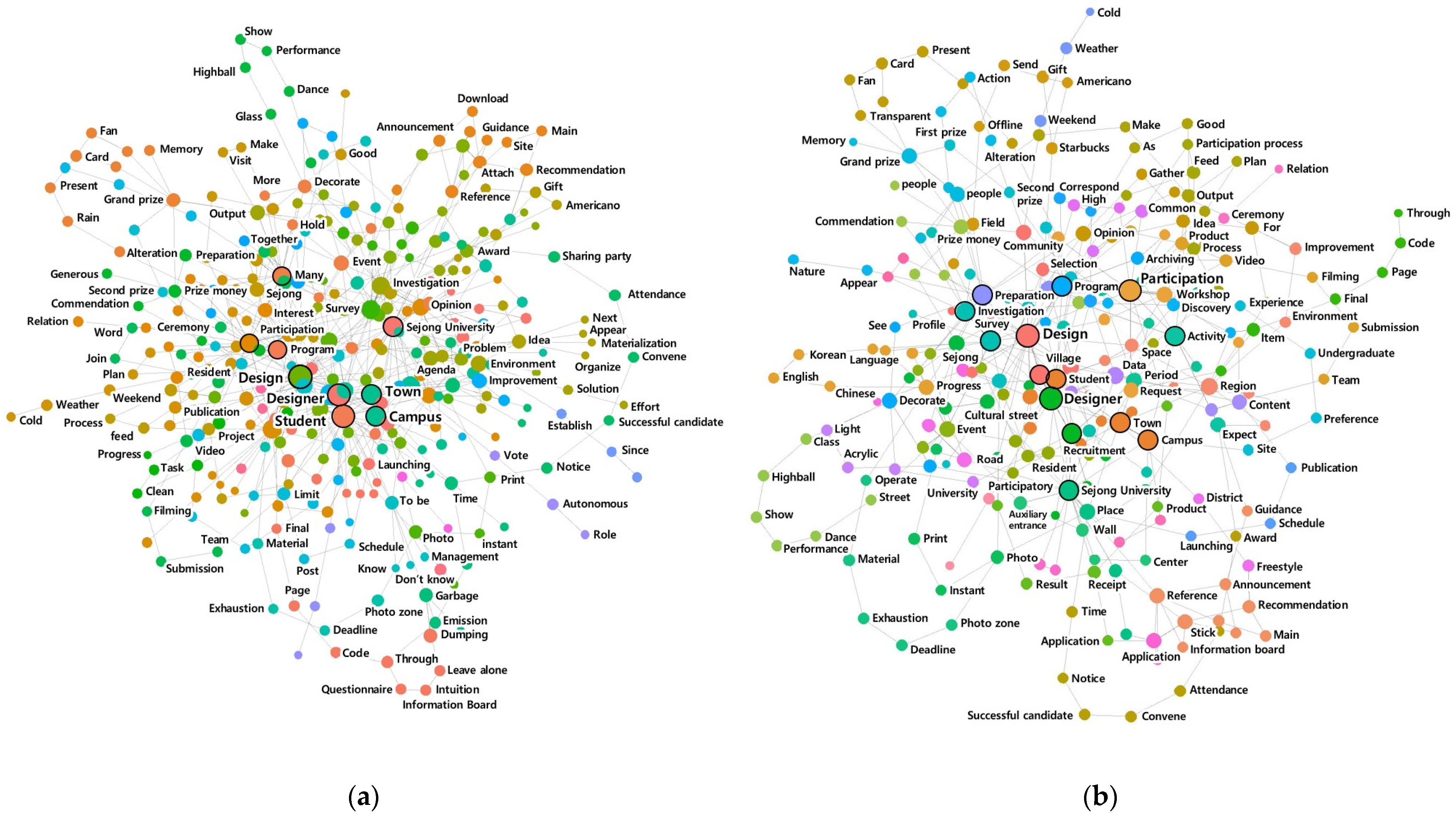
Figure 1a is the visualization effect of the network analysis for the whole content. The centrality of the words ‘design’, ‘designer’, ‘campus’, ‘town’, ‘student’, and ‘university’ is significant. Looking at the connected words by groups, the contents include holding awards and events, discovering local agendas, problem-solving processes, surveys, and the participation of residents. The facilitators inform the operation process of the project, and the students’ activities appear in a specific group; however, the activities of the residents do not appear.
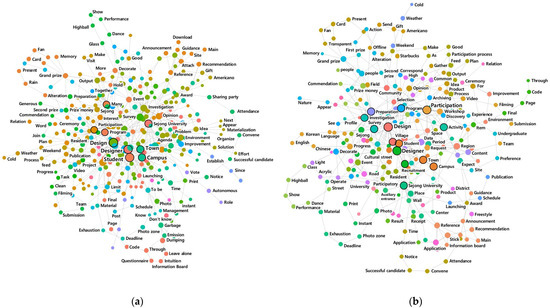
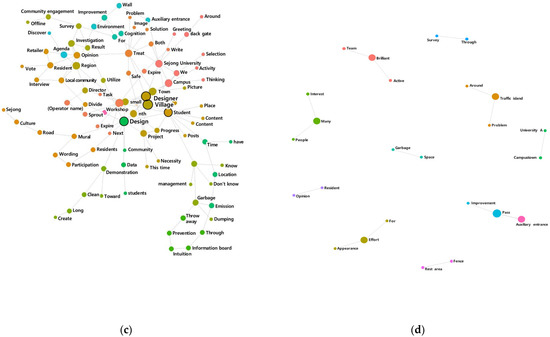
Figure 1.
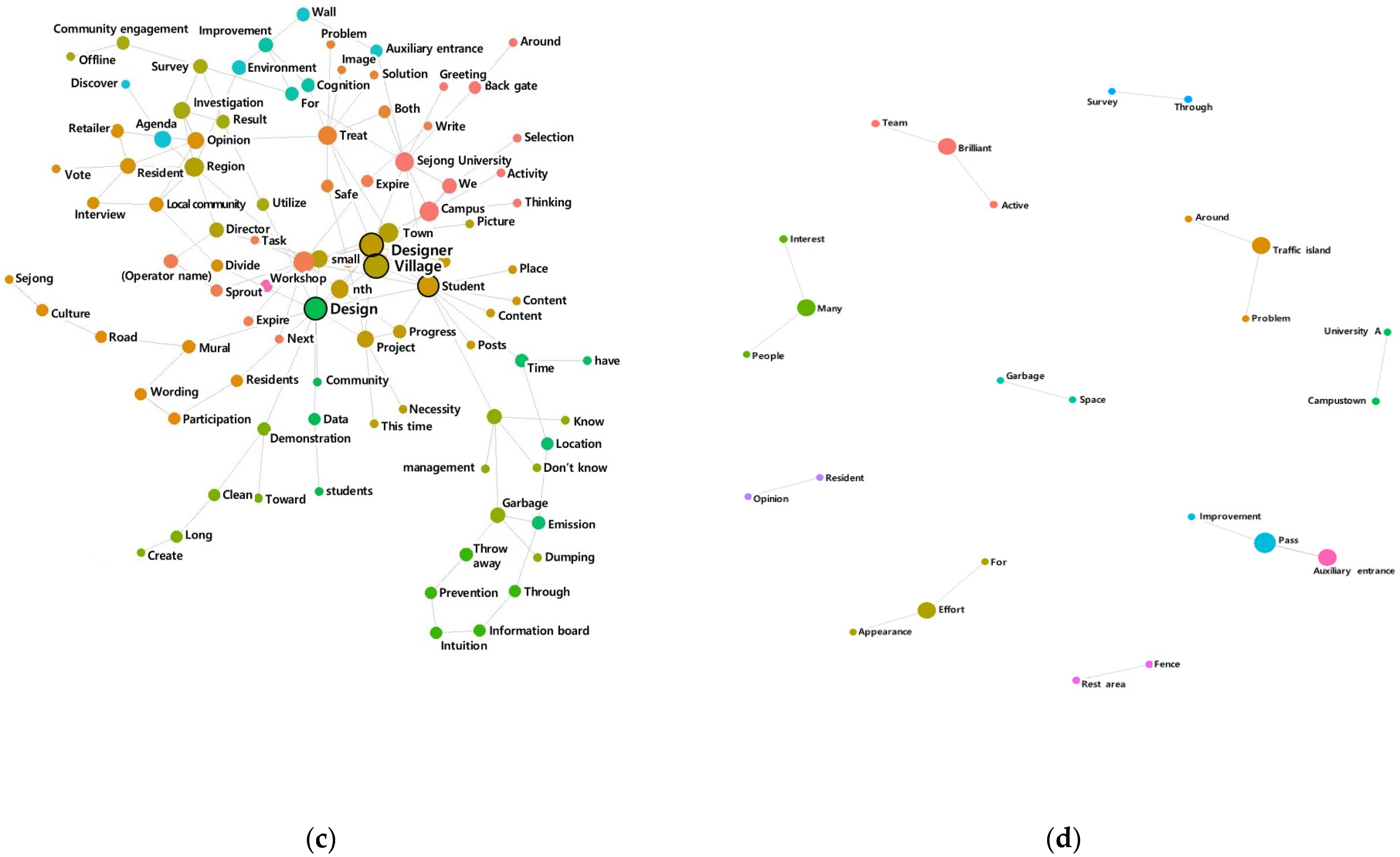
Network graph analysis: (a) total; (b) facilitators; (c) students; (d) residents.
Figure 1b shows the connections of the words mentioned by the facilitators. In the facilitator’s network graph analysis, the additional words with high centrality are ‘participation’, ‘preparation’, ‘recruitment’, and ‘activity’. Looking at the connected words by groups, the contents are related to the recruitment of Student Village Designers, the workshop process, preparation for awards and events, surveys, submission of the results, announcements, and the places where residential environmental problems arise.
Figure 1c shows the connections of the words mentioned by the students. In addition to ‘design’ and ‘designer’, ‘village’ and ‘student’ are the words of high centrality in the analysis of the students’ graph. The next highest words, ‘region’, ‘treat’, and ‘Sejong University’, serve as hubs. Looking at each group, the contents are related to the discovering of agendas through interviews of residents, problem-solving methods, and the place where the school boundary problems arise. In addition to these, the contents include local issues, communication, and cultural streets.
Figure 1d shows the connections of the words mentioned by the residents. The main graph does not exist; it is a linear graph with 10 segments. Utilizing teams, surveys, residents’ opinions, efforts and improvements, and the places where residential environmental problems arise are mentioned.
Through the results of the semantic network analysis, it can be identified that the keywords and topics about urban regeneration projects that each participant emphasizes are different. The facilitators cover topics such as project planning and performance, events, and surveys. The students cover the workshop process as a topic. The residents don’t seem to have a leitmotif, since regional issues and opinions appear in various words. When the participants describe urban regeneration projects, the facilitators focus on the project process, and the students focus on participation in the problem-solving process.
4. Discussion
This study identified the participants’ perceptions of the urban regeneration project through a text-mining analysis of online communication content. The participants were classified into facilitators, students, and residents for analysis. As a result, the participants were commonly aware of the operating organization, purpose, and name related to Student Village Design. On the one hand, the participants differed in interests, such as the project process, program contents, participation methods, and physical environment. The facilitators focused on planning the event and promoting participation in the project. The students gave meaning to the activities in which they participated in the workshop program. The residents paid more interest in places to improve the residential environment, and positive emotions appeared in the activities of the students. They understood the urban regeneration project quite differently from the facilitators and students. Based on these findings, the participants’ perceptions and roles can be compared with previous studies and discussed in the following four aspects.
First, since the stakeholders have different perspectives on decision-making, it is necessary to set up a role considering the characteristics of each participant. By analyzing the contents mentioned by each participant, this study confirmed that the role of the project they perceive is different. It shows similar results to the study of Lee [23], which argued that the level of communication between stakeholders was different. Liu et al. asserted that it is difficult to measure participation performance, because urban regeneration projects involve many stakeholders [22]. In this respect, this study can present role criteria for judging stakeholder engagement performance.
Second, in the participant role, the facilitators should focus on supporting and managing, rather than determining an agenda or solution for the project. As this study shows, the words the facilitators used were mainly related to encouraging participation and holding events. In the frequency analysis results, the words associated with the residents’ involvement appeared. In the results of the 3-g analysis, phrases related to human relationship formation were used, and the results of the semantic network analysis dealt with topics such as planning, events, and surveys. As in the study by Kang et al. [24], this study also confirms that facilitators need to consider the improvement of the physical environment as necessary compared to the residents. In the study of Jin and Hwang [26], facilitators pay attention to community revitalization or festivals, and are not the actual decision-maker of urban regeneration projects. Therefore, the facilitator is responsible for the projects, the regions, and the support activities for the residents. Therefore, the facilitator is responsible for the projects, the regions, and the support activities for the residents.
Third, the critical role of students is to become a hub of communication with the residents and lead them from discovering agendas to creating and implementing ideas. From the frequency analysis result of this study, it was important for the students to be the nth Student Village Designer. They mainly mentioned that they led the program together. In particular, as a result of the 3-g analysis, it was found that the convergence of local agendas is essential. The related previous studies found a similar result as this study, wherein students conducted the survey to collect residents’ opinions when they had to participate in urban regeneration projects [10,15,16,51]. The process of communication with residents in urban regeneration projects always reveals conflicts [23]. However, in this study, positive emotions rather than conflict appeared in the process of being with the students.
Fourth, as residents are interested in places to improve the residential environment, it is appropriate to participate in deciding when to discover local agendas and how to solve them. The words and phrases frequently mentioned by the residents in this study were places that needed environmental improvement. This was similar to the study by Kang et al. [24] in that the residents valued the progress in the physical environment. Although several studies have claimed that long-term and deep participation caused side effects, no studies have suggested the appropriate degree of participation of residents [5,6,27]. In this regard, the results of this study showed that students were sensitive to conducting opinion surveys. Significantly, they used positive words about the project, as shown in the sentiment analysis. Therefore, there are two processes where the participation of residents is effective. One is when the problematic site is selected, to discover the local agendas, and the other is determining the implementation project for problem-solving.
5. Conclusions
This study is significant in the following respects. First, in terms of contents, this is the first study to present the role of each participant by analyzing the perception of stakeholders in urban regeneration projects involving students and residents. In terms of methodology, it shows the effectiveness and possibility of applying the text-mining analysis methodology, using the contents of online project activities, in urban regeneration research.
However, this study has two research limitations, which present future research directions. First, the demographic characteristics of the authors who composed the text converted to the data, the radical limit of text mining, cannot be considered. In the case of SNS, since researchers can additionally grasp the data-sharing location and the personal disposition, specific research results can be derived with individual characteristics in future research. Second, the data quantity and the number of appearing words were not in proportion, as the data were collected from different online platforms such as SNS and blogs. For example, though both blogs and comments on YouTube consist of one piece of data, the blogs comprise a relatively large number of words, whereas comments on YouTube include very few words. Since this study used a short-term project as a case study, using various platforms for statistically significant data analysis was inevitable. In the future, supposing that similar projects are carried out, further research that can control these data characteristics is needed to generalize the research results.
Author Contributions
Conceptualization, J.Y.K.; methodology, J.Y.K. and K.W.S.; software, J.Y.K.; validation, J.Y.K.; formal analysis, J.Y.K. and J.H.K.; investigation, J.Y.K. and K.W.S.; data curation, J.Y.K. and J.H.K.; writing—original draft preparation, J.Y.K.; writing—review and editing, J.Y.K., J.H.K. and K.W.S.; visualization, J.Y.K. and J.H.K. All authors have read and agreed to the published version of the manuscript.
Funding
This work was supported by the Ministry of Education of the Republic of Korea and the National Research Foundation of Korea (NRF-2022S1A5A2A03054727).
Institutional Review Board Statement
Not applicable.
Informed Consent Statement
Not applicable.
Data Availability Statement
The data can be made available upon contacting the authors.
Conflicts of Interest
The authors declare no conflict of interest.
References
- Kim, S.H. Urban Policy Direction in Response to the Low-Growth Erea. Urban Inf. Serv. 2017, 418, 2. [Google Scholar]
- Duncan, P.; Thomas, S. Neighbourhood Regeneration: Resourcing Community Involvement; Policy Press: Bristol, UK, 2000. [Google Scholar]
- Park, J.S. A Study on Urban Regeneration by Community Regeneration-Focussing on Community Regeneration Projects in the Uk. J. Archit. Inst. Korea Plan. Des. 2017, 33, 41–51. [Google Scholar] [CrossRef]
- Seo, S.J.; Seong, E.Y. Sustainability and the Roles of the Community-Led Social Economic: Organization for Urban Regeneration. Space Environ. 2018, 28, 12–47. [Google Scholar] [CrossRef]
- Kim, S.H. Resident Participation for Residential Regeneration. Plan. Policy 2018, 442, 21–26. [Google Scholar]
- Kim, C.J. Residents’ Participation and Exit in Collaborative Governance Process of Urban Regeneration Project. Master’s Thesis, Seoul National University, Seoul, Republic of Korea, 2021. [Google Scholar]
- Lieberman, J.; Miller, J.; Kohl, V. Creating Linkages among Community-Based Organizations, the University, and Public Housing Entities. Cityscape 2000, 5, 159–171. [Google Scholar]
- Kim, J.E. A Case Study of Neighborhood Renewal through University-Community Partnership: Uic Neighborhood Initiative. Seoul Stud. 2010, 11, 69–86. [Google Scholar]
- Lee, T.H.; Park, S.E.; Kim, T.H. Urban Regeneration through University-Community Partnerships in Japan—A Case Study of Yokohama City and Yokohama City University Partnership. J. Korean Geogr. Soc. 2016, 51, 57–75. [Google Scholar]
- Kong, J.S.; Lee, J.H. Performance and Experience of Korea University Anam Campustown. Archit. Inst. Korea 2018, 62, 21–25. [Google Scholar]
- Bae, W.K. Chung-Ang University Campustown: Young People, Blue Dragon Soaring from the Ground. Archit. Inst. Korea 2018, 62, 37–42. [Google Scholar]
- Hong, M.Y. Campustown Strategic Plan. Archit. Inst. Korea 2018, 62, 14–20. [Google Scholar]
- Park, T.W. Campustown Planning of Kwangwoon University: Implementation Strategy for Start-up Friendly City. Archit. Inst. Korea 2018, 62, 43–48. [Google Scholar]
- Oh, J.S.; Kim, D.H.; Yeo, H.J.; Kim, S.Y. Campus Town Planning and Designing from Neighborhood Regeneration Perspectives—Focused on Designating a Strategic Area and Devising Its Creation Plan. J. Urban Des. Inst. Korea Urban Des. 2014, 15, 41–59. [Google Scholar]
- Tal, R.; Fenster, T.; Kulka, T. Academic Engagement in Urban Regeneration Projects: Challenges in Building Students’ Critical Professional Identity. In Understanding Campus-Community Partnerships in Conflict Zones; Markovich, D., Golan, D., Shalhoub-Kevorkian, N., Eds.; Palgrave Macmillan: Cham, Switzerland, 2019; pp. 157–184. [Google Scholar]
- Borucka, J.; Czyż, P.; Mazurkiewicz, W.; Pancewicz, Ł.; Perzyna, I. Improving Social Competencies of Architecture Students through Participatory Design of Marketplace Regeneration. World Trans. Eng. Technol. Educ. 2021, 19, 71–78. [Google Scholar]
- Long, H.; Liu, Y. Rural Restructuring in China; Elsevier: Amsterdam, The Netherlands, 2016; pp. 387–391. [Google Scholar]
- Thakuriah, P.V.; Tilahun, N.Y.; Zellner, M. Big Data and Urban Informatics: Innovations and Challenges to Urban Planning and Knowledge Discovery. In Seeing Cities through Big Data; Palgrave Macmillan: London, UK, 2017; pp. 11–45. [Google Scholar]
- Feinerer, I.; Hornik, K.; Meyer, D. Text Mining Infrastructure in R. J. Stat. Softw. 2008, 25, 1–54. [Google Scholar] [CrossRef]
- Matz, S.C.; Netzer, O. Using Big Data as a Window into Consumers’ Psychology. Curr. Opin. Behav. Sci. 2017, 18, 7–12. [Google Scholar] [CrossRef]
- Zhou, T.; Zhou, Y. Fuzzy Comprehensive Evaluation of Urban Regeneration Decision-Making Based on Entropy Weight Method: Case Study of Yuzhong Peninsula, China. J. Intell. Fuzzy Syst. 2015, 29, 2661–2668. [Google Scholar] [CrossRef]
- Liu, B.; Lu, X.; Hu, X.; Li, L.; Li, Y. What’s Wrong with the Public Participation of Urban Regeneration Project in China: A Study from Multiple Stakeholders’ Perspectives. Eng. Constr. Arch. Manag. 2021, 29, 91–109. [Google Scholar] [CrossRef]
- Lee, J.E. A Grounded Theory Approach on Experiences of Citizen Participation in Urban Regeneration. J. Korea Plan. Assoc. 2019, 54, 24–41. [Google Scholar] [CrossRef]
- Kang, M.H.; Song, H.S.; Lee, M.H. A Study on the Difference of Perceptions on Major Elements of Urban Regeneration between Residents and Experts—Focused on Urban Regeneration Areas in Seoul. J. Urban Des. Inst. Korea Urban Des. 2017, 18, 45–59. [Google Scholar] [CrossRef]
- Kim, K.H.; Kang, Y.e.; Son, S.W. A Study on Selection and Application of Indicators for Urban Regeneration Project Monitoring: Focused on the Residents’ Perception and Satisfaction of Urban Regeneration Project in Ulsan Jungang-Dong. J. Assoc. Korean Geogr. 2021, 10, 259–275. [Google Scholar]
- Jin, Y.H.; Hwang, J.H. Recognition and Response to Delays in Urban Regeneration Revitalization Projects: Focusing on Interim Support Organizations in the Midst of the Spread of Covid-19. GRI Rev. 2022, 24, 57–95. [Google Scholar]
- Woolrych, R.; Sixsmith, J. Mobilising Community Participation and Engagement: The Perspective of Regeneration Professionals. J. Urban Regen. Renew. 2013, 6, 309–321. [Google Scholar]
- Park, D.K.; Jeong, D.W.; Kim, H.S. Assessment of the Downtown Regeneration Project Based on the Analysis of Planning Factors. J. Korean Urban Manag. Assoc. 2009, 22, 295–316. [Google Scholar]
- Lee, H.J.; Kim, Y.J.; Kim, J.G. Assessment of the Urban Design Elements in Urban Regeneration Space of Community Business Type. J. Urban Des. Inst. Korea Urban Des. 2014, 15, 17–31. [Google Scholar]
- Wang, S.; Jin, H.; Deng, Y.; Xiao, Y. Comprehensive Utilization Status of Red Mud in China: A Critical Review. J. Clean. Prod. 2021, 289, 125136. [Google Scholar] [CrossRef]
- Sukanya, M.; Biruntha, S. Techniques on Text Mining. In Proceedings of the 2012 IEEE International Conference on Advanced Communication Control and Computing Technologies (ICACCCT), Ramanathapuram, India, 23–25 August 2012. [Google Scholar]
- Chon, C.N.; Seo, I.W. Analyzing the Bigdata for Practical Using into Technology Marketing: Focusing on the Potential Buyer Extraction. J. Mark. Stud. 2013, 21, 181–203. [Google Scholar]
- Niu, H.; Silva, E.A. Crowdsourced Data Mining for Urban Activity: Review of Data Sources, Applications, and Methods. J. Urban Plan. Dev. 2020, 146, 04020007. [Google Scholar] [CrossRef]
- Eum, S.W. A Study on Analysis of Consumer Perception of Youtube Advertising Using Text Mining. Manag. Inf. Res. 2020, 39, 181–193. [Google Scholar]
- Cho, Y.H.; Han, J.H. A Study on Foodservice Consumers Awareness of Hotel Restaurant Using Social Big Data Analysis. J. Foodserv. Manag. 2018, 21, 121–139. [Google Scholar]
- Porreca, A.; Scozzari, F.; Di Nicola, M. Using Text Mining and Sentiment Analysis to Analyse Youtube Italian Videos Concerning Vaccination. BMC Public Health 2020, 20, 259. [Google Scholar] [CrossRef]
- Kim, S.M.; Lee, H. Analysis of Hallyu and Korean Wave Media Using Text Mining: Focusing on Potential Hallyu Tourists. J. Tour. Stud. 2020, 32, 153–179. [Google Scholar] [CrossRef]
- We, J.Y.; Hong, C.S. A Study on the Tourism Destination Regeneration and the Change of Destination Image: Focusing on Text Mining. Tour. Manag. Res. 2019, 23, 631–648. [Google Scholar]
- Jang, S.-Y.; Jung, S. An Analysis of the Research Trends for Urban Study Using Topic Modeling. J. Korea Academia-Ind. Coop. Soc. 2021, 22, 661–670. [Google Scholar]
- Ko, H.J. Changes in the Issues of Urban Parks Using Text Mining—Ased on the Minutes of the Seoul Metropolitan Council. Seoul Stud. 2020, 21, 21–40. [Google Scholar]
- Park, J.H.; Kang, J.S.; In, K.S.; Jin, L.S.; Bom, L.S. An Analysis on the Variation of Placeness by Private Sector-Led Urban Regeneration Using Text Mining. J. Humanit. Soc. Sci. 2021, 12, 217–232. [Google Scholar]
- Zhou, Y.; Lan, F.; Zhou, T. An Experience-Based Mining Approach to Supporting Urban Renewal Mode Decisions under a Multi-Stakeholder Environment in China. Land Use Policy 2021, 106, 105428. [Google Scholar] [CrossRef]
- Kim, I.J.; Lee, J.H.; Kim, H.M.; Kang, J.Y. Suggestion of Urban Regeneration Type Recommendation System Based on Local Characteristics Using Text Mining. J. Intell. Inf. Syst. 2020, 26, 149–169. [Google Scholar]
- Kang, K.H.; Chi, Y.K. A Study on the Method of Analyzing Keywords for Urban Regeneration Public Design Projects in Seoul: Focusing on Text Mining and Keyword Network Analysis. J. Korea Inst. Spat. Des. 2021, 16, 115–128. [Google Scholar]
- Wells, C.S. A Brief R Tutorial; Cambridge University Press: Cambridge, UK, 2021. [Google Scholar]
- The R Project for Statistical Computing. Available online: https://www.r-project.org/ (accessed on 29 June 2022).
- Kolaczyk, E.D.; Csárdi, G. Statistical Analysis of Network Data with R; Springer: New York, NY, USA, 2014. [Google Scholar]
- Kwon, O.B.; Wen, Y. An Empirical Study of the Factors Affecting Social Network Service Use. Comput. Hum. Behav. 2010, 26, 254–263. [Google Scholar] [CrossRef]
- Nia (National Information Society Agency) Dictionary. Available online: https://github.com/haven-jeon/NIADic#nianational-information-society-agency-dictionary (accessed on 5 September 2022).
- Ogada, K.; Mwangi, W.; Cheruiyot, W. N-Gram Based Text Categorization Method for Improved Data Mining. J. Inf. Eng. Appl. 2015, 5, 35–43. [Google Scholar]
- Kim, J.M. A Study on the Establishment of Urban Regeneration by Participation of Students—Focused on the Establishment of Dongyang Mirae University’s Campus Town Plan. Youth Facil. Environ. 2017, 15, 15–22. [Google Scholar]
Disclaimer/Publisher’s Note: The statements, opinions and data contained in all publications are solely those of the individual author(s) and contributor(s) and not of MDPI and/or the editor(s). MDPI and/or the editor(s) disclaim responsibility for any injury to people or property resulting from any ideas, methods, instructions or products referred to in the content. |
© 2023 by the authors. Licensee MDPI, Basel, Switzerland. This article is an open access article distributed under the terms and conditions of the Creative Commons Attribution (CC BY) license (https://creativecommons.org/licenses/by/4.0/).