Construction Workforce’s Mental Health: Research and Policy Alignment in the Australian Construction Industry


Abstract
1. Introduction
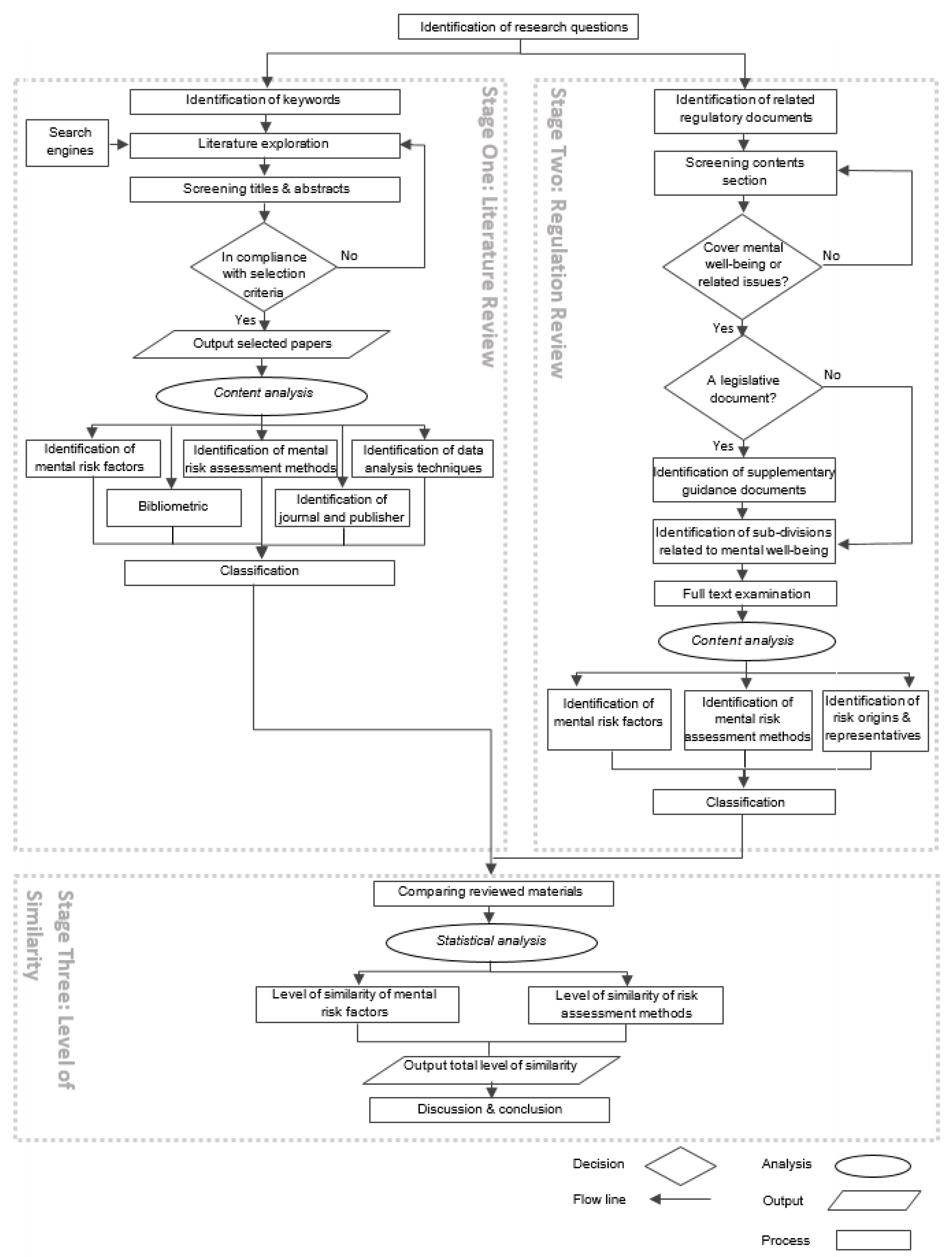
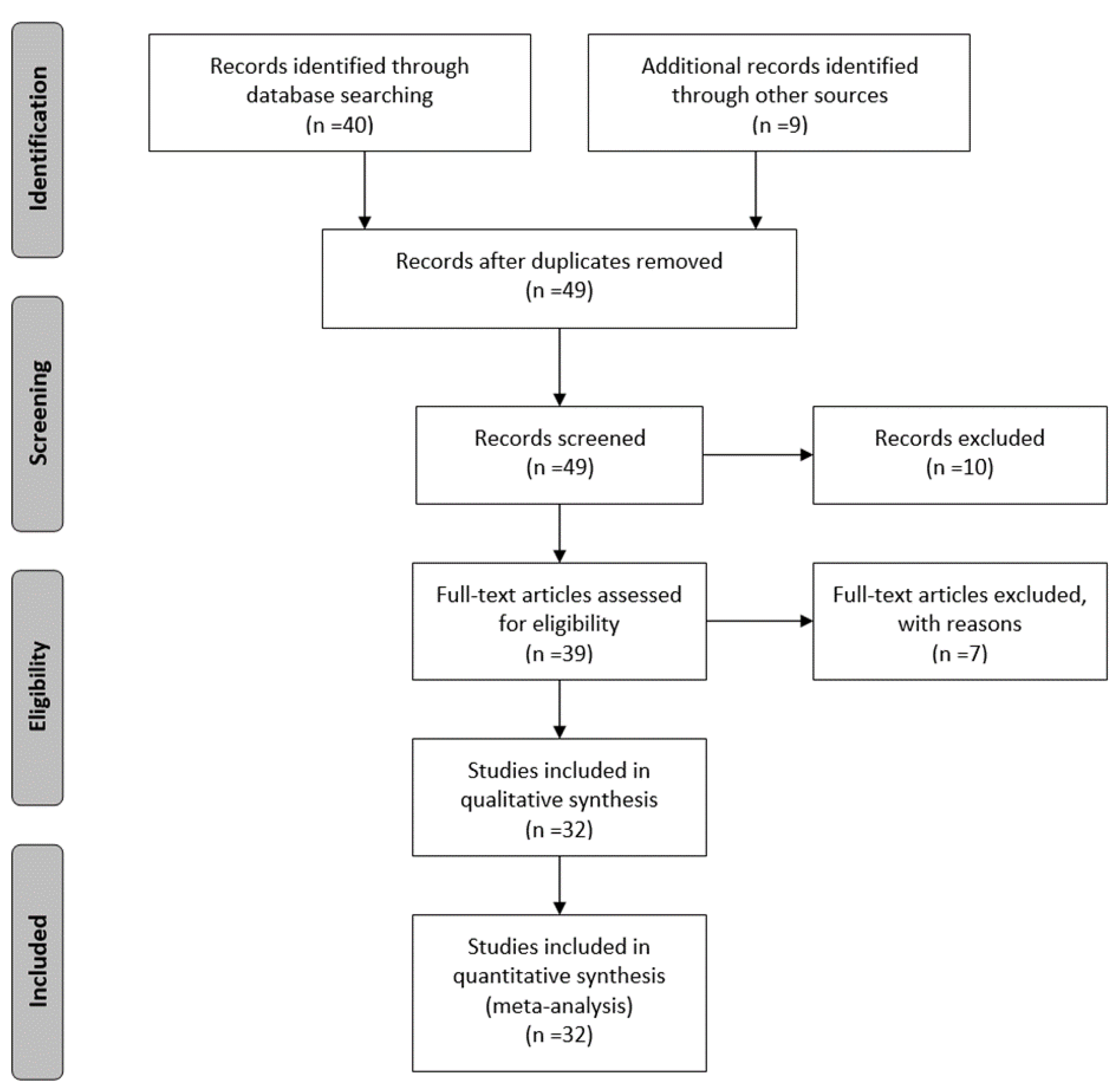
2. Methodology

| Journal | Publisher | Publications |
|---|---|---|
| Australian Health Review | CSIRO | [39] |
| Australasian Journal of Construction Economics and Building | Informit | [40] |
| Australian & New Zealand Journal of Psychiatry | SAGE | [41] |
| BMJ Open | BMJ | [42] |
| Construction Management and Economics | Taylor & Francis | [43,44] |
| Drug and Alcohol Review | APSAD | [45] |
| Engineering, Construction and Architectural Management | Emerald | [46,47] |
| Health Promotion International | Oxford University Press | [48] |
| International Journal of Environmental Research and Public Health | MDPI | [9] |
| International Journal of Project Management | Elsevier | [49] |
| Journal of Child & Adolescent Mental Health | Taylor & Francis | [50] |
| Journal of Construction Engineering and Management | ASCE | [4,7,51] |
| Journal of Engineering, Design and Technology | Emerald | [52] |
| Journal of Occupational and Environmental Medicine | Wolters Kluwer | [53] |
| Medical Journal of Australia | Wiley Online Library | [54] |
| SAGE Open | SAGE | [55] |
| PLoS ONE | PLOS ONE | [56] |
| Public Health | BMC | [57] |
| Psychosomatic Medicine | Lippincott Williams & Wilkins | [58] |
| Safety and Health at Work | Elsevier | [59,60] |
| Safety Science | Elsevier | [61] |
| SSM—Population Health | Elsevier | [62] |
| Substance Use & Misuse | Taylor & Francis | [63] |
| The International Journal of Human Resource Management | Taylor & Francis | [64] |
| The Journal of the Economics of Ageing | Elsevier | [65] |
| Work, Employment and Society | SAGE | [66,67] |
3. Results and Discussion
3.1. Stage 1 Results
3.1.1. Home–Work Conflict
3.1.2. Job, Workplace, and Industry Characteristics
3.1.3. Job Control
3.1.4. Excessive Job Demand
3.2. Mental Health Status Assessment Methods
3.3. Stage 2 Results
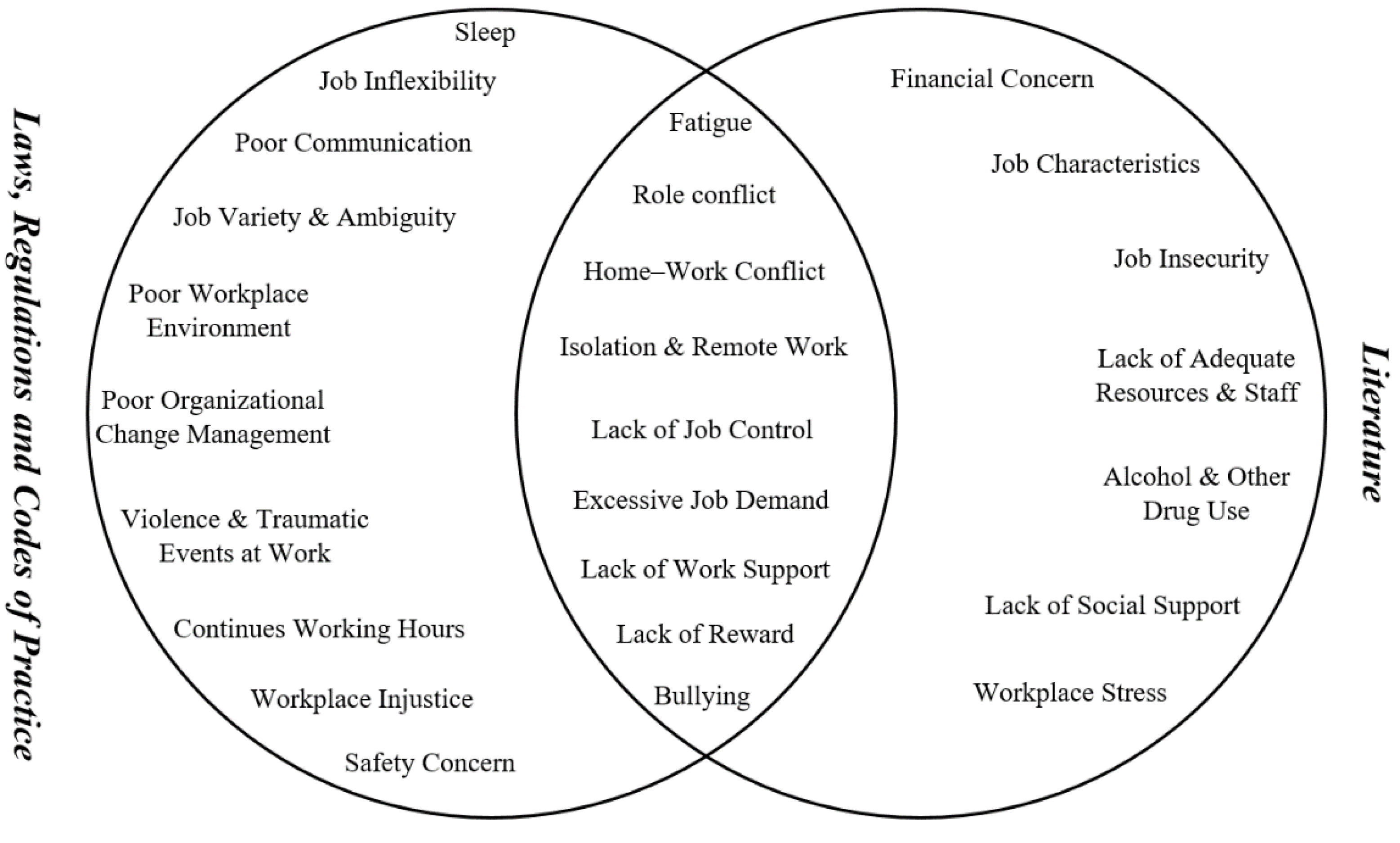
3.3.1. Mental Health Risk Factors
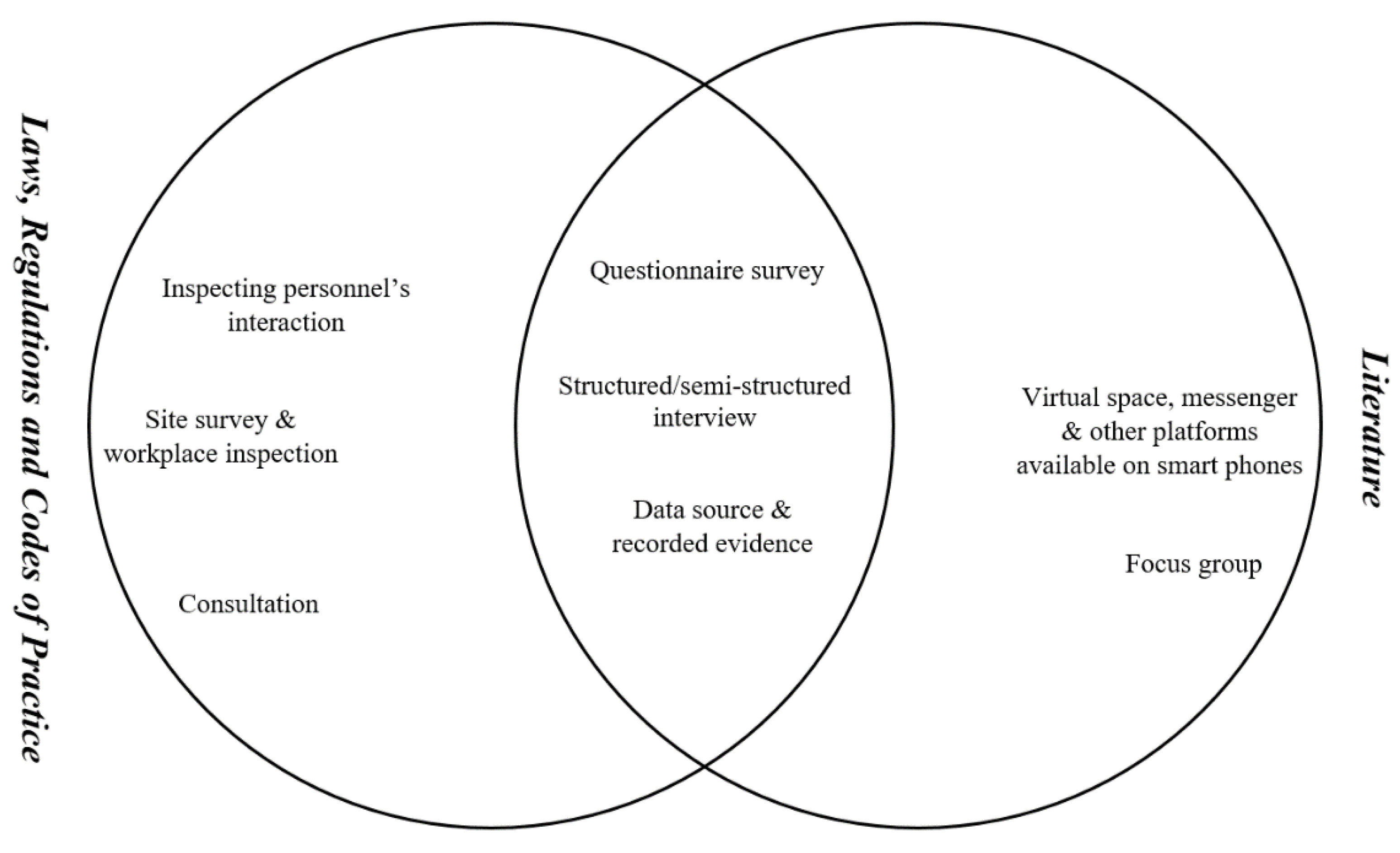
3.3.2. Mental Status Assessment Methods
3.4. Stage 3 Results
4. Conclusions
Author Contributions
Funding
Institutional Review Board Statement
Informed Consent Statement
Data Availability Statement
Conflicts of Interest
References
- Herrman, H.; Saxena, S.; Moodie, R. Promoting Mental Health: Concepts, Emerging Evidence, Practice: Summary Report; World Health Organization: Geneva, Switzerland, 2004; ISBN 92-4-159159-5. [Google Scholar]
- Chan, A.P.; Nwaogu, J.M.; Naslund, J.A. Mental ill-health risk factors in the construction industry: Systematic review. J. Constr. Eng. Manag. 2020, 146, 04020004. [Google Scholar] [CrossRef] [PubMed]
- Maheen, H.; LaMontagne, A.D.; King, T. Suicide in the Cosntruction Industry: 2001–2018; Mates in Construction: Brisbane, QLD, Australia, 2020; Volume 4, pp. 1–35. [Google Scholar]
- Love, P.E.; Edwards, D.J.; Irani, Z. Work stress, support, and mental health in construction. J. Constr. Eng. Manag. 2010, 136, 650–658. [Google Scholar] [CrossRef]
- Powell, A.; Galea, N.; Salignac, F.; Loosemore, M.; Chappell, L. Masculinity and workplace wellbeing in the Australian construction industry. Proceeding of the 34th Annual ARCOM Conference, Belfast, UK, 3–5 September 2018; pp. 321–330. [Google Scholar]
- Loosemore, M.; Waters, T. Gender differences in occupational stress among professionals in the construction industry. J. Manag. Eng. 2004, 20, 126–132. [Google Scholar] [CrossRef]
- Langdon, R.R.; Sawang, S. Construction workers’ well-being: What leads to depression, anxiety, and stress? J. Constr. Eng. Manage. 2018, 144, 04017100. [Google Scholar] [CrossRef]
- Eyllon, M.; Vallas, S.; Dennerlein, J.; Garverich, S.; Weinstein, D.; Owens, K.; Lincoln, A. Mental health stigma and wellbeing among commercial construction workers: A mixed methods study. J. Occup. Environ. Med. 2020, 62, 423–430. [Google Scholar] [CrossRef]
- Ross, V.; Caton, N.; Gullrdtrup, J.; Kolves, K. Understanding the barriers and pathways to male help-seeking and help-offering: A mixed methods study of the impact of the mates in construction program. Int. J. Environ. Res. Public Health 2019, 16, 2979. [Google Scholar] [CrossRef]
- Anwer, S.; Li, H.; Antwi-Afari, M.F.; Wong, A.Y.L. Associations between physical or psychosocial risk factors and work-related musculoskeletal disorders in construction workers based on literature in the last 20 years: A systematic review. Int. J. Ind. Ergon. 2021, 83, 103113. [Google Scholar] [CrossRef]
- Loosemore, M.; Lim, B.; Ilievski, M. Depression in Australian Undergraduate Construction Management, Civil Engineering, and Architecture Students: Prevalence, Symptoms, and Support. J. Civ. Eng. Educ. 2020, 146, 04020003. [Google Scholar] [CrossRef]
- Dunn, K.; Loosemore, M.; Phua, F.; Ozguc, U. Racism, Tolerance and Anti-racism on Australian Construction Sites. Int. J. Divers. Organ. Communities Nations 2011, 10, 129–148. [Google Scholar] [CrossRef]
- Loosemore, M.; Phua, F.; Dunn, K.; Ozguc, U. Operatives’ experiences of cultural diversity on Australian construction sites. Constr. Manag. Econ. 2010, 28, 177–188. [Google Scholar] [CrossRef]
- Turner, M.; Lingard, H. Examining the interaction between bodily pain and mental health of construction workers. Constr. Manag. Econ. 2020, 38, 1009–1023. [Google Scholar] [CrossRef]
- Colquhoun, S.; Biggs, H.C.; Dovan, N.; Wang, X.; Mohamed, S. An occupational study of the mental health of fifo/dido construction workers. In Proceedings of the International Conferenceon Innovative Production and Construction, Perth, Australia, 29–30 September 2016. [Google Scholar]
- Fini, A.A.F.; Akbarnezhad, A.; Rashidi, T.H.; Waller, S.T. Enhancing the safety of construction crew by accounting for brain resource requirements of activities in job assignment. Autom. Constr. 2018, 88, 31–43. [Google Scholar] [CrossRef]
- Safe Work Australia. Work-Related Psychological Health and Safety: A Systematic Approach to Meeting Your Duties, National Guidance Material; Safe Work Australia: Canberra, Australia, 2019; ISBN 978-1-76051-500-3. [Google Scholar]
- WHS-Act Australia. Work Health and Safety Act 2011; ComLaw Authoritative Act C2011A00137; Australian Government: Canberra, Australia, 2011.
- Safe Work Australia. Guide for Managing the Risk of Fatigue at Work; Safe Work Australia: Canberra, Australia, 2013; ISBN 978-1-74361-260-6. [Google Scholar]
- FairWork. Fair Work Act; Office of Parliamentary Counsel: Canberra, Australia, 2009.
- ConstructionWorkAct. Work Health and Safety (Construction Work) Code of Practic; Australian Government: Canberra, Australia, 2015; ISBN 978-0-642-33361-2.
- Commission for Occupational Health and Safety. Mentally Healthy Workplaces for Fly-in Fly-Out (FIFO) Workers in the Resources and Construction Sectors; Government of Western Australia, Department of Mines, Industry Regulation and Safety: East Perth, Western Australia, 2019; ISBN 9781-922149-62-6.
- Trainor, G. A Culture Standard for the Construction Industry; Australian Contractors Association: Culture In Construction, 2021. Available online: https://cultureinconstruction.com.au/wp-content/uploads/2021/10/A-Culture-Standard-for-the-Construction-Industry_Consultation-Paper_October-2021.pdf (accessed on 25 July 2022).
- Edwards, N.; Chauvin, J.; Blanchet, R. Advocating for improvements to building codes for the population’s health. Can. J. Public Health 2019, 110, 516–519. [Google Scholar] [CrossRef]
- Vaughan, E.; Turner, J. The Value and Impact of Building Codes. Environmental and Energy Study Institute, White Paper. 2013, pp. 1–27. Available online: https://www.eesi.org/files/Value-and-Impact-of-Building-Codes.pdf (accessed on 11 March 2022).
- Sánchez, F.A.S.; Peláez, G.I.C.; Alís, J.C. Occupational safety and health in construction: A review of applications and trends. Ind. Health 2017, 55, 210–218. [Google Scholar] [CrossRef]
- Lavis, J.N.; Oxman, A.; Lewin, S.; Fretheim, A. SUPPORT Tools for evidence-informed health Policymaking (STP) 3: Setting priorities for supporting evidence-informed policymaking. Health Res. Policy Syst. 2009, 7, 1–9. [Google Scholar] [CrossRef]
- Mirzoev, T.; Green, A.; Nancy, G.; Stephen, P.; Philippa, B.; Ha, B.T.T.; Ramani, K.; Qian, X.; Yang, X.; Mukhopadhyay, M.; et al. Role of evidence in maternal health policy processes in Vietnam, India and China: Findings from the HEPVIC project. Evid. Policy: A J. Res. Debate Pract. 2013, 9, 493–511. [Google Scholar] [CrossRef]
- Hanney, S.R.; González-Block, M.A. Evidence-Informed Health Policy: Are We Beginning to Get There at Last? Health Res. Policy Syst. 2009. Available online: https://health-policy-systems.biomedcentral.com/articles/10.1186/1478-4505-7-30 (accessed on 8 May 2022).
- Crook, D.; Tessler, A. The Cost of Doing Nothing; BIS Oxford Economics: Sydney, Australia, 2021. [Google Scholar]
- Safe Work NSW. Mental Health in Construction; Fact Sheet, SafeWork NSW: Sydney, Australia. Available online: https://www.safework.nsw.gov.au/__data/assets/pdf_file/0020/1037342/mental-health-in-construction-fact-sheet.pdf (accessed on 5 November 2021).
- Cohen, A.A.; Magnezi, R.; Weinstein, O. Review and Analysis of mental health reforms in several countries: Implementation, comparison and future challenges. Ann. Psychiatry Treat. 2020, 4, 13–24. [Google Scholar] [CrossRef]
- World Health Organization. Mental Health Atlas 2020; World Health Organization: Geneva, Switzerland, 2021; ISBN 978-92-4-003670-3. [Google Scholar]
- Committee for Economic Development of Australia (CEDA). How Can Employers Improve Productivity through Wellbeing? Mental Health and the Workplace. 2022. Available online: https://cedakenticomedia.blob.core.windows.net/cedamediacontainer/kentico/media/attachments/mental-health-report-13.pdf (accessed on 8 September 2022).
- Moher, D.; Liberati, A.; Tetzlaff, J.; Altman, D.G. Preferred reporting items for systematic reviews and meta-analyses: The PRISMA statement. PLoS Med. 2009, 6, e1000097. [Google Scholar] [CrossRef]
- Campbell, D.; Picard-Aitken, M.; Cote, G.; Caruso, J.; Valentim, R.; Edmonds, S.; Williams, G.T.; Macaluso, B.; Robitaille, J.-P.; Bastien, N.; et al. Bibliometrics as a Performance Measurement Tool for Research Evaluation: The Case of Research Funded by the National Cancer Institute of Canada. Am. J. Eval. 2010, 31, 66–83. [Google Scholar] [CrossRef]
- Hayfield, N.; Huxley, C. Insider and Outsider Perspectives: Reflections on Researcher Identities in Research with Lesbian and Bisexual Women. Qual. Res. Psychol. 2015, 12, 91–106. [Google Scholar] [CrossRef]
- Podsakoff, P.; MacKenzie, S.B.; Bachrach, D.G.; Podsakoff, N.P. The Influence of Management Journals in the 1980s and 1990s. Strateg. Manag. J. 2005, 26, 473–488. [Google Scholar] [CrossRef]
- Miller, P.; Brook, L.; Stomski, N.J.; Ditchburn, G.; Morrison, P. Depression, suicide risk, and workplace bullying: A comparative study of fly-in, fly-out and residential resource workers in Australia. Aust. Health Rev. 2019, 44, 248–253. [Google Scholar] [CrossRef] [PubMed]
- Hosseini, M.R.; Chileshe, N.; Zillante, G. Investigating the factors associated with job satisfaction of construction workers in South Australia. Australas. J. Constr. Econ. Build. 2014, 14, 1–17. [Google Scholar] [CrossRef]
- Andersen, K.; Hawgood, J.; Klieve, H.; Kõlves, K.; De Leo, D. Suicide in Selected Occupations in Queensland: Evidence from the State Suicide Register. Aust. New Zealand J. Psychiatry 2010, 44, 243–249. [Google Scholar] [CrossRef] [PubMed]
- Gardner, B.; Alfrey, K.-L.; Vandelanotte, C.; Rebar, A.L. Mental health and well-being concerns of fly-in fly-out workers and their partners in Australia: A qualitative study. BMJ Open 2018, 8, e019516. [Google Scholar] [CrossRef]
- Lingard, H.C.; Francis, V.; Turner, M. Work–family enrichment in the Australian construction industry: Implications for job design. Constr. Manag. Econ. 2010, 28, 467–480. [Google Scholar] [CrossRef]
- Lingard, H.; Turner, M. Promoting construction workers’ health: A multi-level system perspective. Constr. Manag. Econ. 2017, 35, 239–253. [Google Scholar] [CrossRef]
- Roche, A.M.; Chapman, J.; Duraisingam, V.; Phillips, B.; Finnane, J.; Pidd, K. Construction workers’ alcohol use, knowledge, perceptions of risk and workplace norms. Drug Alcohol Rev. 2020, 39, 941–949. [Google Scholar] [CrossRef]
- Loosemore, M.; Phua, T.T.F.; Dunn, K.; Ozguc, U. The politics of sameness in the Australian construction industry: Comparing operative and manager attitudes towards cultural diversity. Eng. Constr. Archit. Manag. 2011, 18, 363–380. [Google Scholar] [CrossRef]
- Lingard, H.; Francis, V.; Turner, M. Work time demands, work time control and supervisor support in the Australian construction industry: An analysis of work-family interaction. Eng. Constr. Archit. Manag. 2012, 19, 647–665. [Google Scholar] [CrossRef]
- Milner, A.; Aitken, Z.; Law, P.C.F.; LaMontagne, A.D.; Mann, C.; Cooper, T.; Witt, K. The relationship between an electronic mental health stigma campaign and suicidal thoughts and behaviours: A two-arm randomized controlled trial in the Australian construction industry. Health Promot. Int. 2020, 35, 478–485. [Google Scholar] [CrossRef]
- Lingard, H.; Francis, V.; Turner, M. Work–life strategies in the Australian construction industry: Implementation issues in a dynamic project-based work environment. Int. J. Proj. Manag. 2012, 30, 282–295. [Google Scholar] [CrossRef]
- Broadbent, R.; Papadopoulos, T. Improving mental health and wellbeing for young men in the building and construction industry. J. Child Adolesc. Ment. Health 2014, 26, 217–227. [Google Scholar] [CrossRef]
- Sunindijo, R.Y.; Kamardeen, I. Work stress is a threat to gender diversity in the construction industry. J. Constr. Eng. Manag. 2017, 143, e04017073. [Google Scholar] [CrossRef]
- De Silva, N.; Samanmali, R.; De Silva, H.L. Managing occupational stress of professionals in large construction projects. J. Eng. Des. Technol. 2017, 15, 488–504. [Google Scholar] [CrossRef]
- Ling, R.; Kelly, B.; Considine, R.; Tynan, R.; Searles, A.; Doran, C.M. The economic impact of psychological distress in the Australian coal mining industry. J. Occup. Environ. Med. 2016, 58, 171–176. [Google Scholar] [CrossRef]
- Bowers, J.; Lo, J.; Miller, P.; Mawren, D.; Jones, B. Psychological distress in remote mining and construction workers in Australia. Med. J. Aust. 2018, 208, 391–397. [Google Scholar] [CrossRef]
- McPhedran, S.; De Leo, D. Suicide among miners in Queensland, Australia: A comparative analysis of demographics, psychiatric history, and stressful life events. SAGE Open 2013, 3, 2158244013511262. [Google Scholar] [CrossRef]
- James, C.; Tynan, R.; Roach, D.; Leigh, L.; Oldmeadow, C.; Rahman, M.; Kelly, B. Correlates of psychological distress among workers in the mining industry in remote Australia: Evidence from a multi-site cross-sectional survey. PLoS ONE 2018, 13, e0209377. [Google Scholar] [CrossRef]
- Milner, A.; Maheen, H.; Currier, D.; LaMontagne, A.D. Male suicide among construction workers in Australia: A qualitative analysis of the major stressors precipitating death. BMC Public Health 2017, 17, 1–9. [Google Scholar] [CrossRef]
- Milner, A.; Spittal, M.; Pirkis, J.; Chastang, J.-F.; Niedhammer, I.; LaMontagne, A.D. Low control and high demands at work as risk factors for suicide: An Australian national population-level case-control study. Psychosom. Med. 2017, 79, 358–364. [Google Scholar] [CrossRef] [PubMed]
- Kalliath, P.; Hughes, M.; Newcombe, P. When work and family are in conflict: Impact on psychological strain experienced by social workers in Australia. Aust. Soc. Work 2012, 65, 355–371. [Google Scholar] [CrossRef]
- Carlisle, K.N.; Parker, A.W. Psychological distress and pain reporting in Australian coal miners. Saf. Health Work 2014, 5, 203–209. [Google Scholar] [CrossRef] [PubMed]
- Idris, M.A.; Dollard, M.F.; Coward, J.; Dormann, C. Psychosocial safety climate: Conceptual distinctiveness and effect on job demands and worker psychological health. Saf. Sci. 2012, 50, 19–28. [Google Scholar] [CrossRef]
- Milner, A.; Law, P.; Mann, C.; Cooper, T.; Witt, K.; LaMontagne, A.D. A smart-phone intervention to address mental health stigma in the construction industry: A two-arm randomised controlled trial. SSM-Popul. Health 2018, 4, 164–168. [Google Scholar] [CrossRef] [PubMed]
- Roche, A.M.; Chapman, J.; Duraisingam, V.; Phillips, B.; Finnane, J.; Pidd, K. Flying below the radar: Psychoactive drug use among young male construction workers in Sydney, Australia. Subst. Use Misuse 2021, 56, 758–767. [Google Scholar] [CrossRef]
- Brough, P.; Timms, C.; O’Driscoll, M.P.; Kalliath, T.; Siu, O.L.; Sit, C.; Lo, D. Work–life balance: A longitudinal evaluation of a new measure across Australia and New Zealand workers. Int. J. Hum. Resour. Manag. 2014, 25, 2724–2744. [Google Scholar] [CrossRef]
- Miranti, R.; Li, J. Working hours mismatch, job strain and mental health among mature age workers in Australia. J. Econ. Ageing 2020, 15, 100227. [Google Scholar] [CrossRef]
- McGann, M.; White, K.; Moss, J. Labour casualization and the psychosocial health of workers in Australia. Work. Employ. Soc. 2016, 30, 766–782. [Google Scholar] [CrossRef]
- Galea, N.; Powell, A.; Salignac, F.; Chappell, L.; Loosemore, M. When following the rules is bad for wellbeing: The effects of gendered rules in the Australian construction industry. Work. Employ. Soc. 2022, 36, 119–138. [Google Scholar] [CrossRef]
- Hennink, M.M. Understanding Focus Group Discussions; Oxford University Press: Oxford, UK, 2013; ISBN 9780199856169. [Google Scholar]
- Burton, E.; Edwards, D.J.; Roberts, C.; Chileshe, N.; Lai, J.H.K. Delineating the Implications of Dispersing Teams and Teleworking in an Agile UK Construction Sector. Sustainability 2021, 13, 9981. [Google Scholar] [CrossRef]
- Tijani, B.; Jin, X.; Osei-Kyei, R. A systematic review of mental stressors in the construction industry. Int. J. Build. Pathol. Adapt. 2020, 39, 433–460. [Google Scholar] [CrossRef]
- Casson, A.J.; Yates, D.C.; Smith, S.J.; Duncan, J.S.; Rodriguez-Villegas, E. Wearable electroencephalography. IEEE Eng. Med. Biol. Mag. 2010, 29, 44–56. [Google Scholar] [CrossRef]
- Carbonaro, N.; Cipresso, P.; Tognetti, A.; Anania, G.; De Rossi, D.; Gaggioli, A.; Riva, G. A mobile biosensor to detect cardiorespiratory activity for stress tracking. In Proceedings of the 7th IEEE International Conference on Pervasive Computing Technologies for Healthcare and Workshops, Venice, Italy, 5–8 May 2013. [Google Scholar] [CrossRef]
- Holmqvist, K.; Nyström, M.; Andersson, R.; Dewhurst, R.; Jarodzka, H.; Van de Weijer, J. Eye Tracking: A Comprehensive Guide to Methods and Measures; Oxford University Press: Oxford, UK, 2015; ISBN -10-. [Google Scholar]
- Safe Work Australia. Taking Action: A Best Practice Framework for the Management of Psychological Claims in the Australian Workers’ Compensation Sector; Safe Work Australia: Canberra, Australia, 2017; ISBN 978-1-76051-302-3. [Google Scholar]
- Safe Work Australia. How to Manage Work Health and Safety Risks, Code of Practice; Safe Work Australia: Canberra, Australia, 2018; ISBN 978-0-642-33301-8. [Google Scholar]
- Public Service Australia. Public Service Act; Federal Register of Legislation, Australia Government: Canberra, Australia, 1999.
- Western Australian Legislation. Occupational Safety and Health Regulations; Department of Justice, Parliamentary Counsel’s Office, Government of Western Australia, 1996. Available online: https://www.legislation.wa.gov.au/legislation/statutes.nsf/main_mrtitle_1853_homepage.html (accessed on 19 February 2022).
- Safe Work Australia. Guide for Preventing and Responding to Workplace Bullying; Safe Work Australia: Canberra, Australia, 2018; ISBN 978-1-74361-243-9. [Google Scholar]
- Loosemore, M. Innovation, Strategy and Risk in Construction: Turning Serendipity into Capability; Routledge: London, UK, 2013. [Google Scholar] [CrossRef]
- Graham, S.T. Analysis of Construction-Related Research Compared to Needs of Industry Professionals. Master’s Thesis, Brigham Young University, Provo, UT, USA, 2010. [Google Scholar]
- Galea, N.; Powell, A.; Loosemore, M.; Chappell, L. Designing robust and revisable policies for gender equality: Lessons from the Australian construction industry. Constr. Manag. Econ. 2015, 33, 375–389. [Google Scholar] [CrossRef]
- Nelson, J. CSR and Public Policy: New Forms of Engagement between Business and Government. In Corporate Social Responsibility Initiative; John, F., Ed.; Working Paper No. 45.; Kennedy School of Government, Harvard University: Cambridge, MA, USA, 2008. [Google Scholar]
- Singh, S.K. Sustainable people, process and organization management in emerging markets. Benchmarking: Int. J. 2018, 25, 774–776. [Google Scholar] [CrossRef]
- Guo, H.; Yu, Y.; Xiang, T.; Li, H.; Zhang, D. The availability of wearable-device-based physical data for the measurement of construction workers’ psychological status on site: From the perspective of safety management. Autom. Constr. 2017, 82, 207–217. [Google Scholar] [CrossRef]

| Mental Health Risk Factor | Publications | Total | Rank |
|---|---|---|---|
| Home–Work Conflict | [40,41,42,43,44,47,49,53,54,57,64,65] | 13 | 1 |
| Job Characteristics | [7,9,41,44,52,54,58,65,67] | 9 | 2 |
| Job Control | [42,43,47,51,52,58,64,66] | 8 | 3 |
| Excessive Job Demand and Fatigue | [40,47,51,52,58,61,64,67] | 8 | 3 |
| Job Insecurity | [7,41,44,53,56,65,66] | 7 | 4 |
| Continuous Working Hours | [40,43,44,52,56,65] | 6 | 5 |
| Lack of Social Support | [4,39,42,47] | 5 | 6 |
| Alcohol and Other Drug Use | [45,55,61,63] | 4 | 7 |
| Isolation and Remote Work | [41,42,50,54] | 4 | 7 |
| Financial Concern | [7,54,56,57] | 4 | 7 |
| Lack of Work Support | [43,47,51,56] | 4 | 7 |
| Poor Communication and Workgroup Relationships | [46,48,52,62] | 4 | 7 |
| Job Inflexibility | [40,43,44] | 3 | 8 |
| Safety Concern | [45,57,66] | 3 | 8 |
| Workplace Injustice | [46,54,67] | 3 | 8 |
| Job Variety and Ambiguity | [44,66] | 2 | 9 |
| Role Conflict | [51,52] | 2 | 9 |
| Workplace Stress | [4,51] | 2 | 9 |
| Work Environment | [53,54] | 2 | 9 |
| Bullying | [39] | 1 | 10 |
| Lack of Adequate Resources and Staff | [52] | 1 | 10 |
| Lack of Promotion/Reward Opportunity | [40] | 1 | 10 |
| Mental Status Assessment Method | Publications | Total | Rank |
|---|---|---|---|
| Questionnaire Survey | [4,9,39,40,43,45,48,52,53,54,60,61,63,65] | 14 | 1 |
| Structured/Semi-structured Interview | [9,42,44,47,49,50,56,66,67] | 9 | 2 |
| Focus Group | [9,44,45,50,56,63,67] | 7 | 3 |
| Virtual Space, Messenger and Other Platforms Available on Smart Phones | [39,41,42,48,62], | 5 | 4 |
| Data Source and Recorded Evidence | [55,57,58,63,65] | 5 | 4 |
| Mental Risk Factor | Documents |
|---|---|
| Fatigue | [21,22,74,75] |
| Job Demand | [17,19,22,74] |
| Low Job Control | [17,21,22,74] |
| Poor Environmental Conditions | [17,19,22,74] |
| Poor Job Support | [17,18,22,74] |
| Poor Organizational Change Management | [17,21,22,74] |
| Poor Organizational Injustice | [17,18,20,22] |
| Bullying | [20,74,75] |
| Isolated Work | [17,21,22] |
| Low Role Clarity | [17,22,74] |
| Remote Work | [17,21,22] |
| Violent or Traumatic Events | [17,22,75] |
| Continuous Working Hours | [20,75] |
| Inappropriate Behaviours | [22,74] |
| Low Reward and Recognition | [17,74] |
| Poor Workplace Relationships | [17,22] |
| Safety Concerns | [18,21] |
| Work Schedules | [19,75] |
| Alcohol and Other Drug Use | [22] |
| Communication | [21] |
| Home–Work conflict | [20] |
| Job Inflexibility | [20] |
| Job Insecurity | [74] |
| Sleep | [19] |
| Non-Work-Related Factors | [19] |
| Risk Assessment Method | Documents |
|---|---|
| Consultation | [18,19,21,75] |
| Data Source and Recorded Evidence | [17,19,22,75] |
| Interview | [17,21,22] |
| Site Survey and Workplace Inspection | [17,19,75] |
| De-identified Survey | [22] |
| Focus Group | [22] |
| Examine Work Practices and Systems of Work | [19] |
| Inspecting Personnel’s Interaction | [17] |
| Mental Risk Factor | |||||
|---|---|---|---|---|---|
| Excessive Job Demand | 8 | 4 | 0.25 | 0.50 | 0.75 |
| Job Characteristics | 9 | 0 | 0.28 | 0.00 | 0.72 |
| Workplace Stress | 2 | 0 | 0.06 | 0.00 | 0.94 |
| Lack of Job Control | 8 | 4 | 0.25 | 0.50 | 0.75 |
| Home–Work Conflict | 13 | 2 | 0.41 | 0.25 | 0.84 |
| Job Insecurity | 7 | 1 | 0.22 | 0.13 | 0.91 |
| Poor Workplace Environment | 2 | 4 | 0.06 | 0.50 | 0.56 |
| Continuous Working Hours | 6 | 3 | 0.19 | 0.38 | 0.81 |
| Poor Communication | 4 | 2 | 0.13 | 0.25 | 0.88 |
| Lack of Reward | 1 | 3 | 0.03 | 0.38 | 0.66 |
| Lack of Work Support | 4 | 4 | 0.13 | 0.50 | 0.63 |
| Financial Concern | 4 | 0 | 0.13 | 0.00 | 0.88 |
| Lack of Social Support | 5 | 0 | 0.16 | 0.00 | 0.84 |
| Workplace Injustice | 3 | 4 | 0.09 | 0.50 | 0.59 |
| Job Variety and Ambiguity | 2 | 2 | 0.06 | 0.25 | 0.81 |
| Safety Concern | 3 | 2 | 0.09 | 0.25 | 0.84 |
| Isolation and Remote Work | 4 | 3 | 0.13 | 0.38 | 0.75 |
| Job Inflexibility | 3 | 1 | 0.09 | 0.13 | 0.97 |
| Role conflict | 2 | 3 | 0.06 | 0.38 | 0.69 |
| Lack of Adequate Resources and Staff | 1 | 0 | 0.03 | 0.00 | 0.97 |
| Bullying | 1 | 3 | 0.03 | 0.38 | 0.66 |
| Poor Organizational Change Management | 0 | 4 | 0.00 | 0.50 | 0.50 |
| Violence and Traumatic Events at Work | 0 | 4 | 0.00 | 0.50 | 0.50 |
| Alcohol and Other Drug Use | 4 | 1 | 0.13 | 0.12 | 0.99 |
| Sleep | 0 | 1 | 0.00 | 0.13 | 0.88 |
| Fatigue | 8 | 5 | 0.25 | 0.63 | 0.63 |
| Mental Risk Assessment Method | |||||
|---|---|---|---|---|---|
| Questionnaire Survey | |||||
| Focus Group | |||||
| Structured/Semi-structured Interview | |||||
| Data Source and Recorded Evidence | |||||
| Virtual Space, Messenger and Other Platforms Available on Smart Phones | |||||
| Site Survey and Workplace Inspection | |||||
| Inspecting Personnel’s Interaction | |||||
| Consultation |
Disclaimer/Publisher’s Note: The statements, opinions and data contained in all publications are solely those of the individual author(s) and contributor(s) and not of MDPI and/or the editor(s). MDPI and/or the editor(s) disclaim responsibility for any injury to people or property resulting from any ideas, methods, instructions or products referred to in the content. |
© 2023 by the authors. Licensee MDPI, Basel, Switzerland. This article is an open access article distributed under the terms and conditions of the Creative Commons Attribution (CC BY) license (https://creativecommons.org/licenses/by/4.0/).
Share and Cite
Hosseini, O.; Loosemore, M.; Fini, A.A.F. Construction Workforce’s Mental Health: Research and Policy Alignment in the Australian Construction Industry. Buildings 2023, 13, 335. https://doi.org/10.3390/buildings13020335
Hosseini O, Loosemore M, Fini AAF. Construction Workforce’s Mental Health: Research and Policy Alignment in the Australian Construction Industry. Buildings. 2023; 13(2):335. https://doi.org/10.3390/buildings13020335
Chicago/Turabian StyleHosseini, Omid, Martin Loosemore, and Alireza Ahmadian Fard Fini. 2023. "Construction Workforce’s Mental Health: Research and Policy Alignment in the Australian Construction Industry" Buildings 13, no. 2: 335. https://doi.org/10.3390/buildings13020335
APA StyleHosseini, O., Loosemore, M., & Fini, A. A. F. (2023). Construction Workforce’s Mental Health: Research and Policy Alignment in the Australian Construction Industry. Buildings, 13(2), 335. https://doi.org/10.3390/buildings13020335