Abstract
Climate change represents a vital public health challenge, resulting in serious impacts that require passive strategies in the built environment sector to mitigate such impacts. Such strategies are associated with the Sustainable Development Goals (SDGs), which present a vital need. Consequently, the solar chimney (SC) can be considered as an effective passive strategy to provide energy, thermal comfort, and air ventilation performance. Therefore, this study focused on SC performance and its related significance on air ventilation. This study aimed to bridge the gap in previous studies and indicates the hotspot topics to conduct a conceptual framework with three phases that can integrate various configurations of a SC with various buildings by considering the recent tools of numerical analysis. Thus, a bibliometric analysis based on the Biblioshiny and VOSviewer tools within the scope of the SC and air ventilation promotion was accomplished. Then, various configuration parameters related to SC performance-driven air ventilation are provided. The results indicate that further studies are required to develop themes like the “building design” of SC and its associated effects such as air quality and ventilation, in addition to “numerical analysis” and “optimization” in terms of hotspot topics and the potential for future consequences. Additionally, limited configurations of previous studies provide promising investigations resulting in several applications including many zones and floors that can be achieved by the proposed conceptual framework. Various insights and possibilities can promote numerous configuration parameters related to SC performance-driven air ventilation promotion, which serves as research guidance for designers and specialists toward the mitigation of climate change impacts and attaining the SDGs.
1. Introduction
Climate change and urbanization can be considered as some of the global challenges affecting human society in this century [1,2,3,4,5]. Thus, passive solutions in several sectors including construction are required [1,6,7,8]. As such, the yearly energy consumption of buildings is 42%, primarily used for heating, ventilation, and air conditioning (HVAC) as well as power generation [9,10,11]. Therefore, an increasing recognition of the importance of energy-efficient and environmentally friendly approaches in providing the building design has emphasized the incorporation of natural ventilation solutions in buildings [12,13,14,15,16]. Passive solutions for buildings can provide high durability to promote indoor air quality (IAQ) and indoor thermal comfort and decrease the energy consumption, besides the carbon footprint, by using passive ventilation solutions including, in particular, atria, courtyards, double walls, wind towers, and solar chimneys (SCs) [12,17,18,19,20,21,22]. SCs can be considered as a significant green passive design solution that can enhance both passive ventilation and solar energy proportionately [23,24,25,26,27,28,29]. On the one hand, a SC is based on solar-induced thermal convection and buoyancy [2,17,30]. Due to pressure and temperature gradients across spaces, such thermal convection and buoyancy can promote airflow circulation and provide significant ventilation and thermal comfort. On the other hand, SC power plants (SCPP) including photovoltaic panels can generate electricity [31,32,33,34,35]. Thus, SCs can be considered promising in terms of providing SDGs including thermal comfort, air ventilation performance, climate action, good health and well-being, clean energy, and energy efficiency, besides sustainable communities [2,36].
Several studies have investigated the effectiveness of SCs and natural ventilation [36], the optimal configurations, and the geometrical parameters of SCs theoretically [37,38,39], experimentally [40,41,42,43,44], and numerically [2,45,46,47,48,49] in various climate zones. For instance, Maghrabie HM, Abdelkareem MA, Elsaid K, Sayed ET, Radwan A, Rezk H et al. [36] reviewed the qualitative investigations concerning the geometrical parameters influencing the SC’s fluid flow behaviors and thermal performance. Arce J, Jiménez MJ, Guzmán JD, Heras MR, Alvarez G, and Xamán J [43] experimentally explored a SC’s thermal efficiency for natural ventilation. In addition, to enhance the flow characteristics within the SCPP, Patel SK, Prasad D, and Ahmed MR [46] provided ANSYS-CFX computational fluid dynamics (CFD) software to optimize the geometry of the key components of the SCPP. Gan G [50] used CFD to explore the impacts of the wall-to-glazing distance, wall height, glazing type, and wall insulation of Trombe walls on the summer cooling of buildings. In addition, nine distinct aerodynamic designs for two cases of buildings in Bushehr, Iran’s coastal district, were investigated by Shaeri J and Mahdavinejad M.A [17]. Haghighi AP, and Maerefat M [23] explored the ability of SC to address the users’ thermal and ventilation requirements throughout the winter months. Leng PC, Aw SB, Eeda N, Ali H, Hoh G, Ling T et al. [21] investigated the effectiveness of a SC in improving the ventilation and air-exchange rates in multi-story public housing in tropical areas to potentially reduce the transmission of airborne illnesses. An overview of the SC’s performance and operation as well as any potential design and operational factors that may affect the SC’s performance for natural ventilation were proposed in [36]. Furthermore, the thermal performance of a SC using different configurations was experimentally investigated in [43]. However, the limited studies only highlighted the performance of SCs regarding configurations and geometrical parameter-driven ventilation efficiency and the SC’s performance related to multi-story public buildings [21,51,52,53,54], high-rise residential buildings [55], and multi-zones [56].
Therefore, this study aimed to bridge the gap in previous studies and promote air ventilation efficiency through the configurations and geometrical parameters of a SC. The rest of this paper is organized as follows. Section 2 provides the various classifications of a SC, followed by a focus on the associated relationship between the performance of a SC and IAQ in Section 3. Section 4 presents the method related to bibliometric analysis based on both the Biblioshiny and VOSviewer tools within the scope of the SC and air ventilation promotion. Section 5 highlights the results and discussion of the bibliometric analysis, and various configuration parameters related to SC performance-driven air ventilation promotion are discussed in Section 6. Section 7 emphasizes the discussion and potential of future implications, and finally, the proposed conceptual framework is conducted. Section 8 presents our conclusions.
2. Various Classifications of a SC
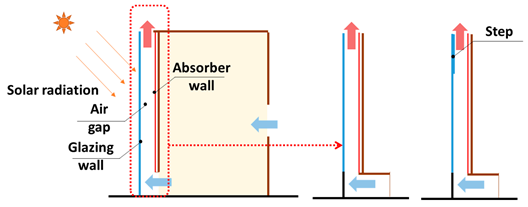
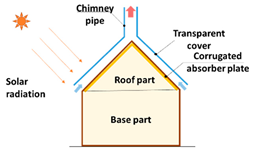
SCs can be classified according to their configuration, application, and performance. Regarding the configurations, roof SCs, a Trombe wall of vertical SCs, and combined SCs present the main configurations of SCs. The vertical SC is built with vertical glass to capture the solar heat. A solar collector serves a similar purpose as glass for the roof in a vertical SC [28]. In addition, several promising examples are couples between them. Moreover, SCs can be classified into two types based on their application: diurnal ventilation chimneys and nocturnal ventilation chimneys. SCs for diurnal ventilation have a low heat capacity absorber surface that is characterized for providing natural ventilation based on absorbed sun irradiation in tropical climates. However, the absorber surfaces used in nocturnal ventilation have a wide heat capacity; they store heat during the day and at night and then dissipate it, resulting in nocturnal ventilation [23]. Concerning the SC performance, the SC can act as a solar-driven passive ventilation system based on the airflow within the space being driven by buoyancy. The stack effect is brought on by changes in air density at the SC’s inlet and output [36]. In addition, a proposed large-scale power system called a SCPP absorbs both the direct and dispersed solar radiation and partially transforms it into electricity that is GHG-free. A SCPP is comprised of a solar collector, a SC at the collection’s center, a power conversion unit (PCU) with one or more turbine generators, and an energy storage layer [57]. The airflow produced inside the collector by buoyancy brought on by the greenhouse effect powers the turbines [58].
3. The Performance of the SC and IAQ
Natural ventilation, according to the American Organization of Heating, Refrigeration, and Air Conditioning Engineers (ASHRAE), is the process of bringing outside air within a building as a result of differences in the natural pressure or density. The difference in air density between indoor and outdoor air due to variations in air temperature is known as the stack effect or air buoyancy [36]. Natural ventilation presents a vital requirement for a healthy lifestyle, the significance of which has been emphasized by the current global COVID-19 outbreak [20,59,60], whereas air changes per hour (ACH) offer a means of preventing infections [21].
Air ventilation is based on providing indoor spaces with fresh air from the outside atmosphere to eliminate and dilute indoor-accumulated hazardous air pollutants [10,43], hence improving the IAQ and thermal comfort [2,61]. Indoor thermal comfort is associated with efficient ventilation systems either mechanically or naturally, and accounts for 35 to 40 percent of the country’s electrical demand consumed by the residential sector [36]. Therefore, both natural ventilation and thermal comfort in buildings are associated with several solutions such as atria, courtyards, wind towers, double façades, Trombe walls, and SCs [22,36,62].
For natural ventilation, air motion through the building is based on wind force, thermal or temperature forces, or the stack effect [63]. For instance, a wind tower can be considered as a passive ventilation configuration, hence a low-carbon component in vernacular architecture based on air motion to provide both passive cooling and thermal comfort as well as reduce energy consumption [12]. On the other hand, a SC, using solar-induced buoyancy-driven convection [42], is based on thermal or temperature forces and invests heat gain to induce natural cooling in various buildings [28].
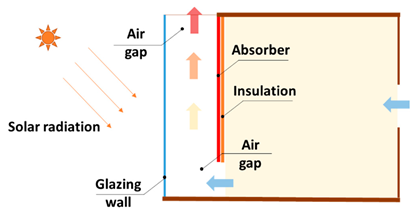
A SC utilizes solar radiation on the southwest- and south-facing buildings for ventilation, heat insulation, and heat preservation [21,63] to generate convective airflows that enhance thermal comfort and the IAQ through the reduction in pollutants [36,43]. To create natural airflow, SCs are based on the temperature pressure difference between indoor and outdoor spaces. As a result, when the absorber plate gathers the radiant energy from the glazed area, the temperature difference between the chimney channel and the indoor spaces creates a pressure difference. As a result of the temperature difference and natural convection, the indoor air escapes through the chimney’s entrance [21,28], enhancing the ACH, and hence the air-flow rates within indoor spaces [21].
4. Methods
The procedures used in this study can be split into two main sections that involve choosing the generation of the database as well as the Biblioshiny and VOSviewer tools. The preferred reporting items for systematic reviews and meta-analysis (PRISMA) method was used to develop the database, as the subtitles below emphasize.
4.1. Generation of Database
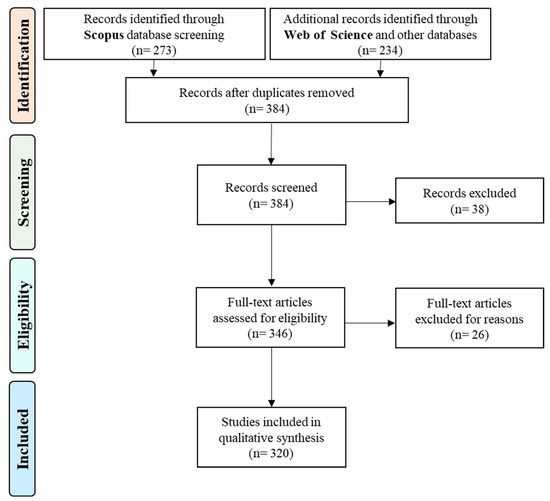
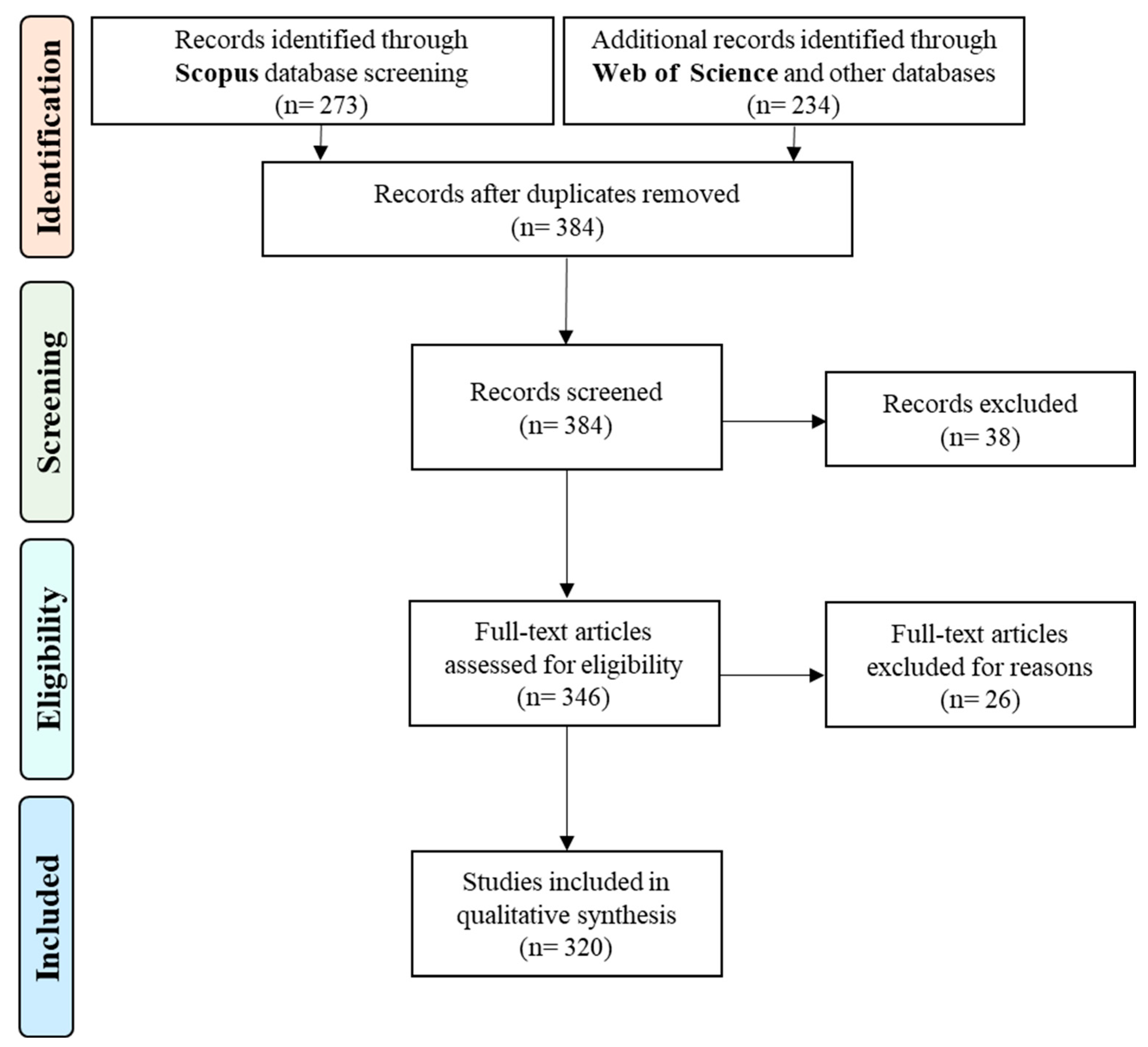
The development of a database presents an important step that directly influences the characteristics of the results [64]. This study emphasized Scopus, and Web of Science (WoS), which can be considered as the most available bibliometric sources [65]. Regarding the publication inclusion criteria, a literature search on Scopus was conducted by combining relevant keywords like “Air ventilation” OR “Airflow” AND “Solar chimney”. The inclusion criteria of this paper emphasized SCs and passive natural ventilation. When considering the publication filtering criteria, the search process was conducted using the titles, abstracts, and keywords of publication materials. A total of 293 publications were identified on 1 January 2023 involving 182 articles, 94 proceeding conferences, nine book chapters, six review articles, one book, and one erratum. Furthermore, this study used three filters—categories, publication type, and language—to reduce the number of pertinent papers that fit the criteria. This study focused on “solar chimneys”, “natural ventilation”, “ventilation performance”, and “air flow rate”. According to the publication type, this paper was based on “articles”, “review articles”, and “book chapters”. Finally, publications that were authored in languages other than English were not included. A total of 273 documents were thus discovered that satisfied the basic filters.
Further searches using comparable keywords through the WoS core collection were conducted to ensure that no material relevant to the investigation was missed. As a result, 111 additional articles were added to the preliminary database, bringing the total up to 384. After manual screening of the publication titles and abstracts to ensure that the research fit the goals and parameters, 346 publications were found. Finally, the whole text of 346 publications was examined to determine whether they could be kept on as papers pertinent to the study’s subject. Thus, as they were linked to the purpose of this bibliometric analysis, 320 were selected, as shown in Figure 1 and Table A1 in Appendix A.
Figure 1.
Workflow of the selection procedure based on the PRISMA method.
4.2. Selection of Bibliometric Tools
Documents, keywords, authors, journals, references, countries, and other entities in research fields can be visualized using the Biblioshiny and VOSviewer applications. As a result, both Biblioshiny (version 4) and VOSviewer (version 1.6.17) were used in this investigation.
5. Results of Bibliometric Analysis
5.1. Network Analysis of Co-Occurrence
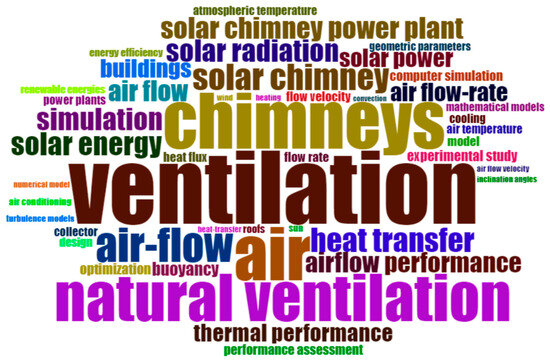
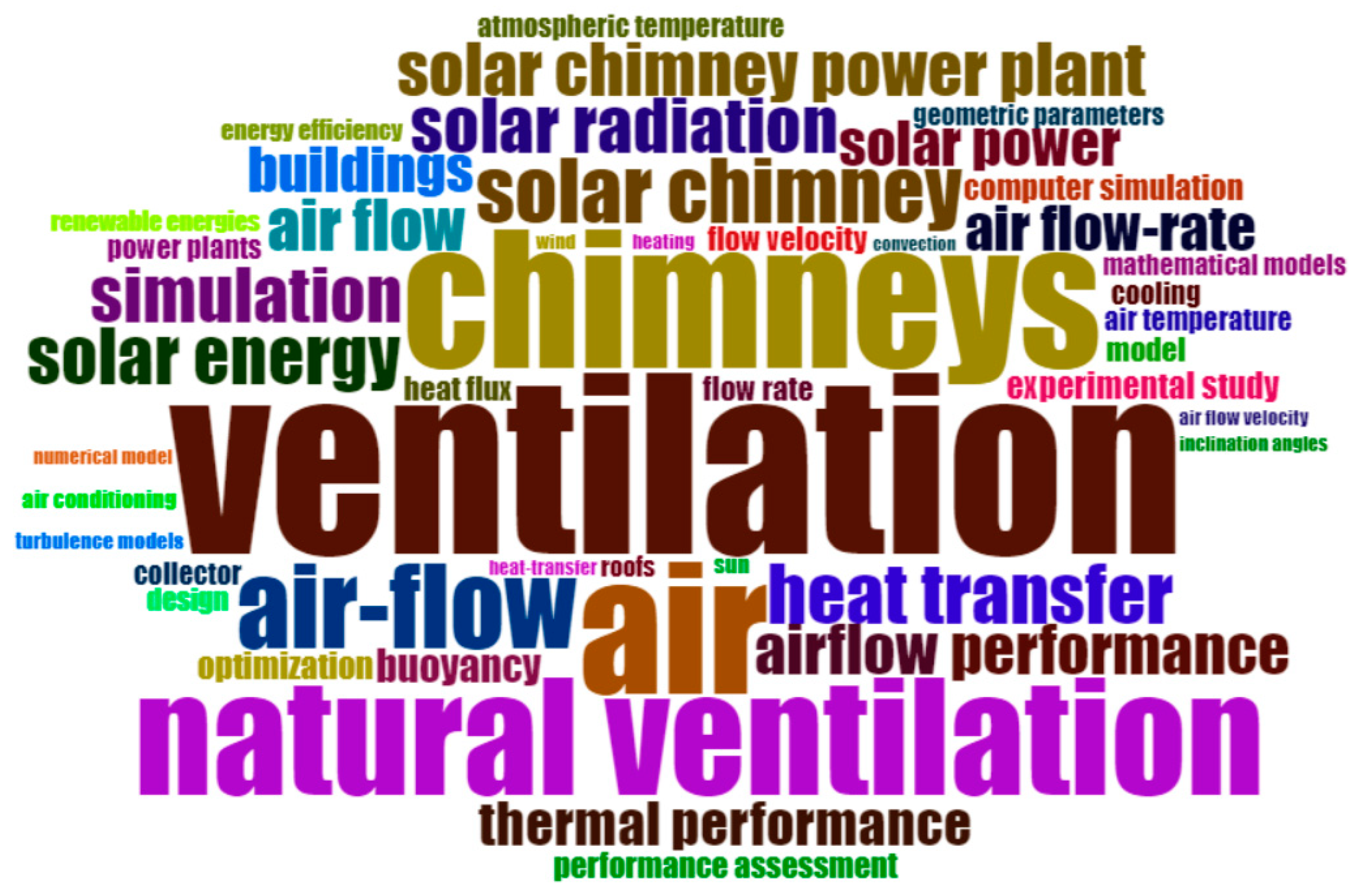
Research frontiers and hotspots can be identified via keyword co-occurrence analysis [9,66]. Consequently, the bibliometric search presented in this study was related to the clustering of the 50 most popular keywords throughout the previous years in the publications. The word cloud word dynamics of the authors’ most frequently used keywords in SC and air ventilation are shown in Figure 2.
Figure 2.
A visualized word cloud of the research focus’s top-performing keywords.
On the other hand, Figure 3 indicates the co-occurrence analysis network, in which colors present various clusters, and the cluster formation is based on the relationships between the objects, resulting in clusters of sections that are strongly related. The most frequently occurring keywords in the chosen publications, in order of highest occurrence, were SC (346 occurrences), natural ventilation (116 occurrences), CFD (55 occurrences), solar energy (52 occurrences), and thermal performance (32 occurrences). Such results propose relevant concerns on the possibilities of the numerical analysis of SCs toward ventilation and thermal performance.
Figure 3.
Clustering of the co-occurrence network based on: (a) different clusters; (b) evolution over time.
The co-occurrence analysis network was divided into six clusters, and the largest cluster (red color), which includes natural ventilation, SC, building ventilation, CFD, and collector, is shown in Figure 3a. In addition, the green cluster includes architectural design, air quality, and energy systems. The third cluster (blue color) and the green one are closely linked, involving airflow, photovoltaic panels, and numerical models. The fourth (yellow color) emphasizes solar energy, solar radiation, and power plants. Likewise, Figure 3b highlights the evolution of the co-occurrence analysis network over time, which demonstrates the applications of SCs considering climate change and numerical simulations.
5.2. Thematic Analysis
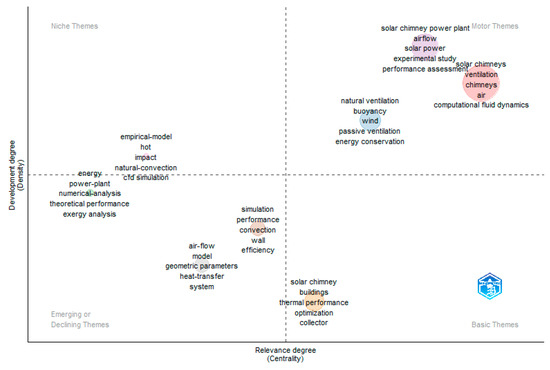
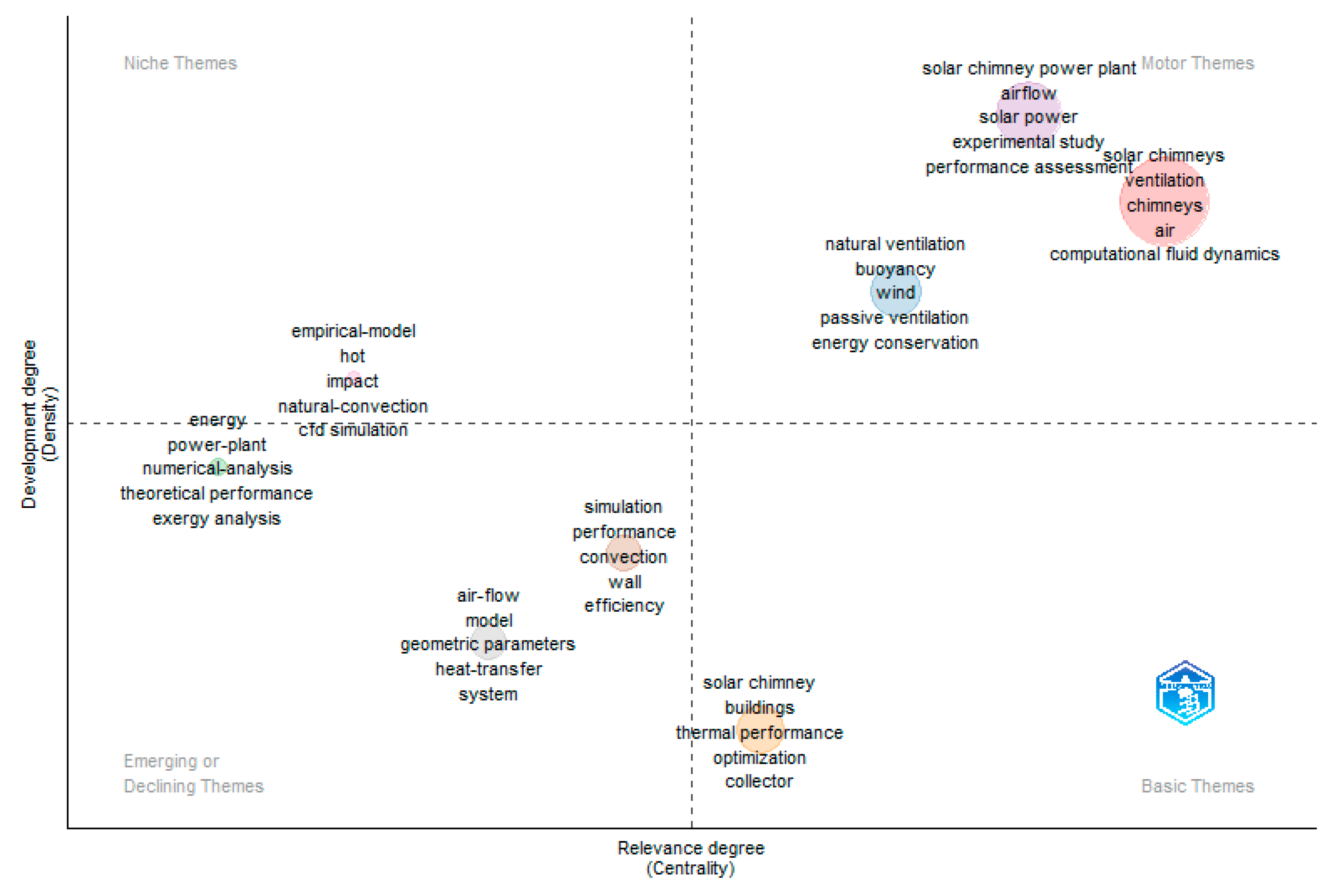
The four quadrants of the thematic map—niche themes, emerging or declining themes, motor themes, and basic themes—can easily plot and group the keywords to identify research themes (Figure 4). As shown in Table A2, eight clusters can include the keywords with their associated occurrences. The keywords “empirical model”, “energy”, and “natural convection” presented as niche themes. Nevertheless, the keywords “geometric parameters”, “simulation performance”, “power planet”, and “numerical analysis” presented as emerging, despite their importance. In contrast, the keywords “solar chimney”, “airflow”, “natural ventilation”, and “CFD” were considered motor themes, which reflect well-developed and important themes. In contrast, “optimization”, “collector”, “thermal performance”, and “buildings” reflected basic themes.
Figure 4.
Thematic map of the 250 most frequent keywords.
According to the thematic analysis, further efforts are required to develop important issues like “numerical analysis” and “optimization”, in addition to “building design” in SCs and their related effects on air quality and ventilation. Additionally, despite its importance, the most popular terms did not sufficiently repeat the “geometric parameters” technique. Thus, additional study is required to investigate and apply such issues.
5.3. Most Cited Publications
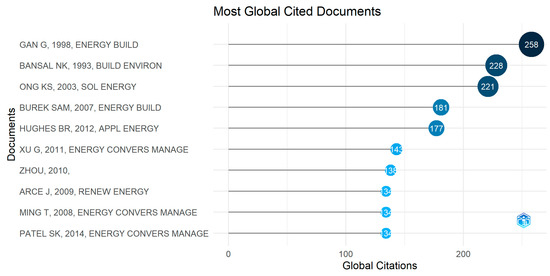
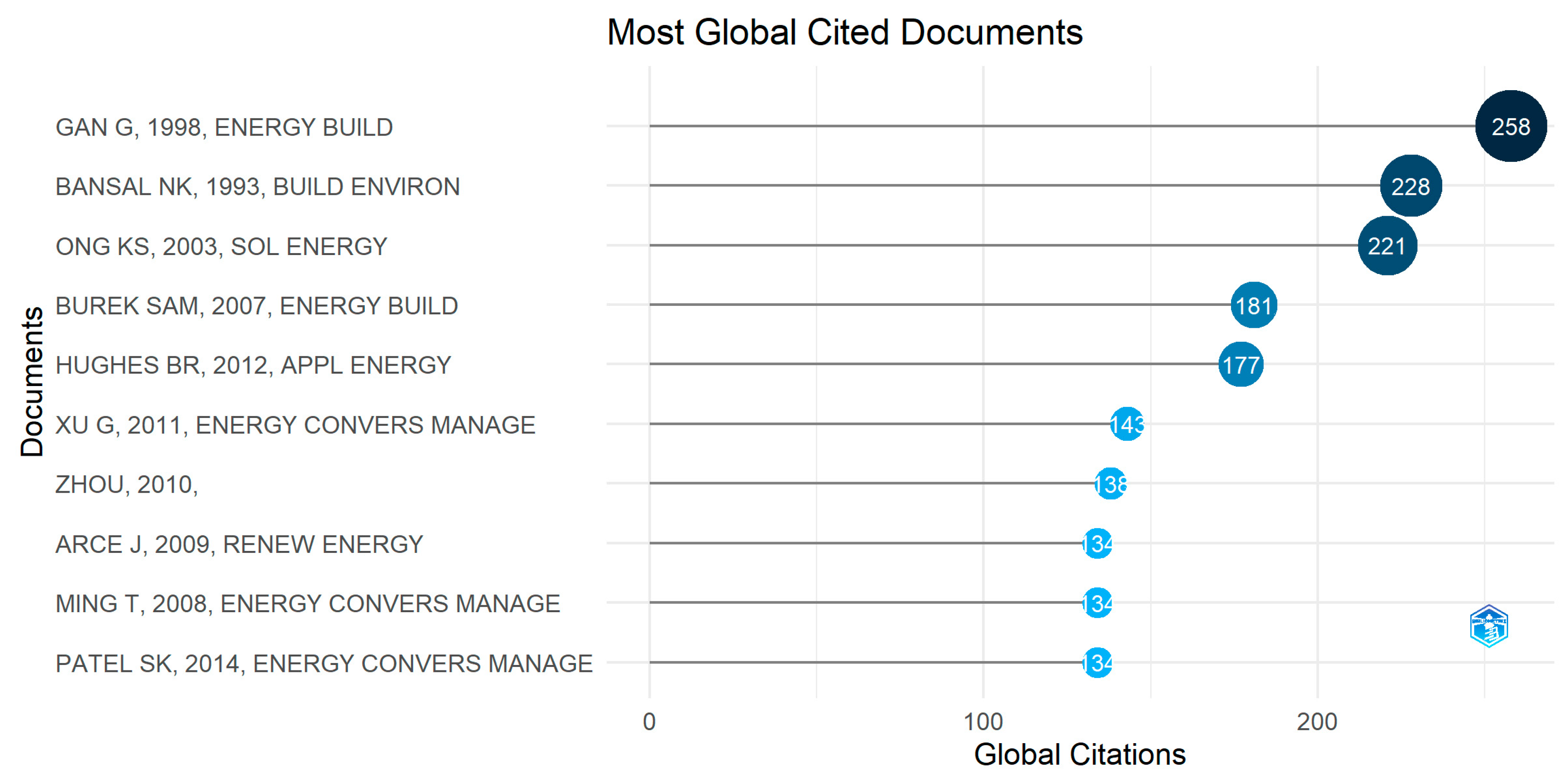
Co-citation analysis was identified for the most globally cited publications, as shown in Figure 5. The top ten articles have also been compiled in Table 1, where 80% of the top ten cited publications cover experimental and numerical analysis. The first, ninth, and tenth positions of the most cited application with 258 citations examined the ventilation rate of Trombe walls in buildings using CFD simulation [50]. The publication ranked in second and third-position publications with 228 and 221 citations, respectively, had developed a steady model of a SC to promote the influence of building thermally-induced ventilation [39,63]. The fourth-position publication with 181 citations was based on the experimental investigation of SC and Trombe walls to predict heat transfer and mass flow for natural ventilation [42]. On the other hand, the fifth and seventh positions with 177 and 138 citations, respectively, provided a thorough analysis of the evolution of wind towers and SCs, emphasizing the many cooling methods and power technologies that can be incorporated with wind tower systems to enhance ventilation and thermal performance [12,58]. A numerical simulation of the airflow, heat transport, and power output characteristics of a SCPP model with an energy storage layer and turbine was also produced in the sixth position with 143 citations [67]. The eighth position included three publications with 134 citations that emphasized the experimental investigation of thermal performance for natural ventilation related to the SC [43], whereas the subsequent publications were based on the numerical analysis of heat transfer and airflow in the SCPP system [46,57].
Figure 5.
Co-citation analysis for the most cited publications.
Table 1.
Top-ten most-cited publications.
Based on an examination of the most widely cited publications, overall, good consistency could be observed between the results of co-citation for references and the co-occurrence of the analysis of the keyword. In addition, SC publications have provided optimization of the geometry, energy systems, and CFD simulations, which integrate a passive strategy to provide air ventilation and renewable systems to provide electricity via integration elements like solar collectors, chimney towers, and wind turbines.
5.4. The Impact and Network of Authors
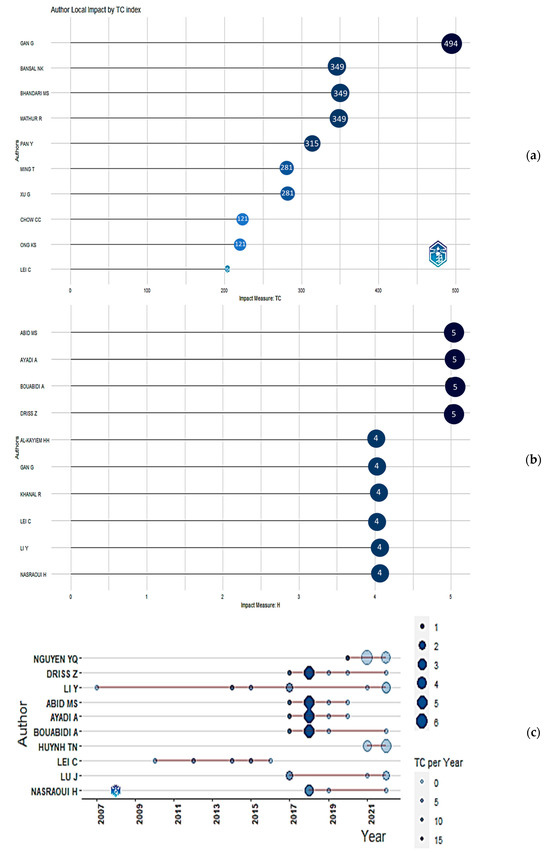
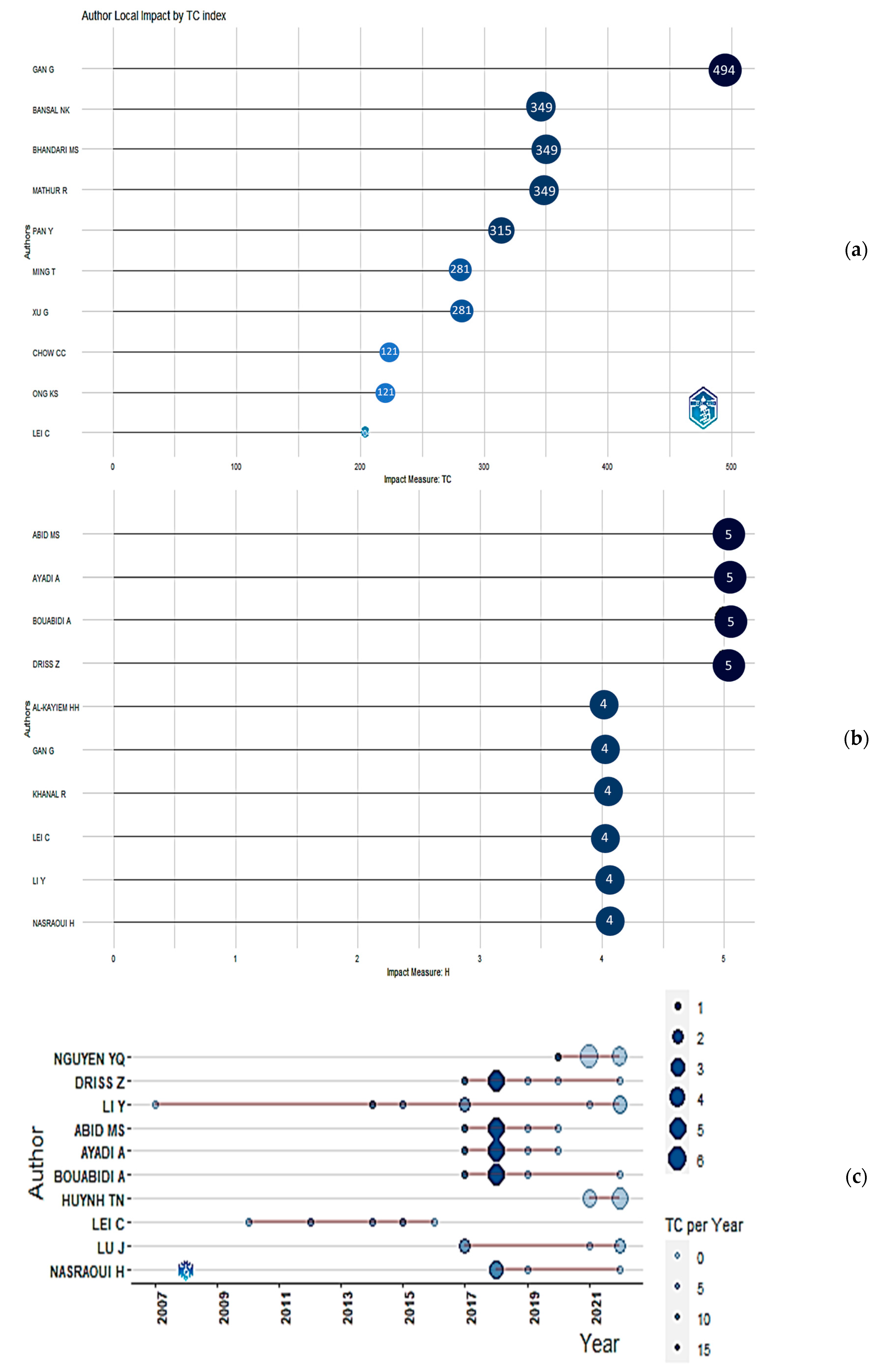
In accordance with the author’s impact concerning the total number of citations, Gan G, a Professor of the Institute of Building Technology, Department of Architecture and Building Technology, University of Nottingham, University Park, Nottingham, UK, is the most cited author, as shown in Figure 6a with 494 total citations in the research scope. He is followed by Bansal NK, Bhandari MS, and Mathur R, each of whom has a total of 349 citations. However, concerning the authors’ H-Index, Abid MS, Ayadi A, Bouabidi A, and Driss Z obtained the greatest value, followed by Al-kayiem HH, Gan G, Khanal R, Lei C, Li Y, and Nasraoui H with an H-Index of 4, as shown in Figure 6b.
Figure 6.
Bibliometric analysis of the top 10 authors: (a) total citations; (b) H-Index; (c) production over years.
Figure 6c shows the output of the top 10 authors over time, with the number of papers (circle size) and the total number of citations (circle color) every year. For Nguyen YQ, Professor at the Dept. of Civil Engineering, Ho Chi Minh City University of Technology, and Driss Z, Full Professor in the Department of Mechanical Engineering at the National School of Engineers of Sfax, their documents in the research scope presented a greater number, so were the most productive authors.
On the other hand, the size of the circles can be defined by the number of citations per 50 authors, which highlights the significance of the authors’ network, as illustrated in Figure 7. The lines between the authors indicate linkages. The author’s network included eighteen clusters. The most cited authors in each cluster were Gan G (494 citations), Bhandari MS (349 citations), Abid MS (192 citations), Li Y (185 citations), Zhang G (71 citations), and Chen I (38 citations).
Figure 7.
Bibliometric analysis of the 50 most prominent authors’ networks.
5.5. The Network of Sources
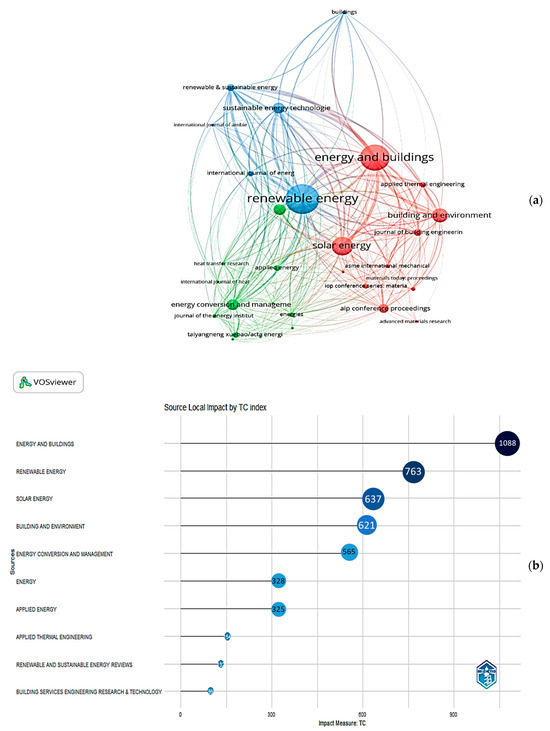
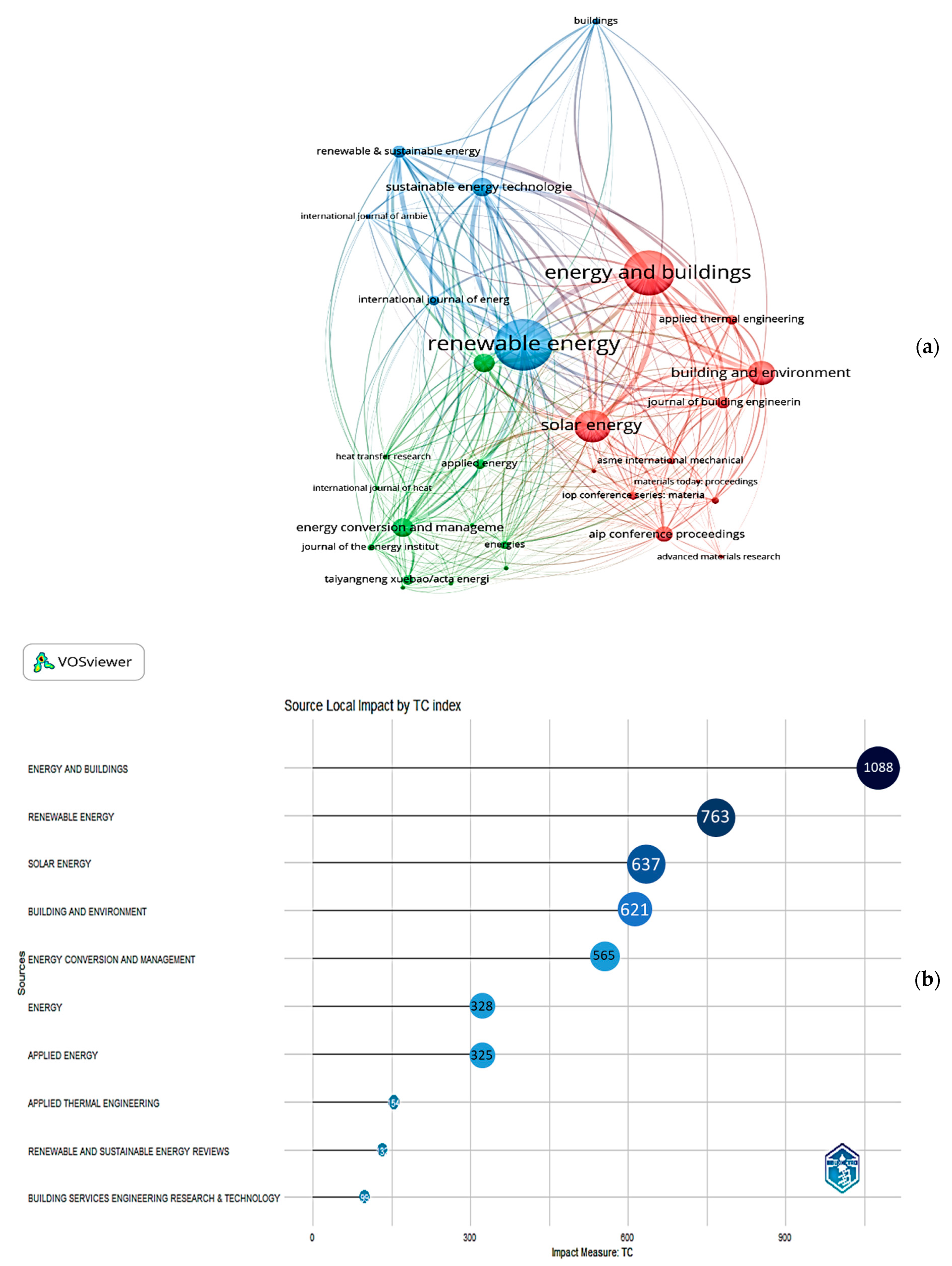
The top 30 sources in the network that frequently published previous research can be used as an accurate indicator of a publication’s credibility [68]. The network analysis of the top 30 sources according to the quantity of documents is shown in Figure 8a. Renewable Energy, Energy and Buildings, and Solar Energy were the top 3 in the ranking. The network consisted of three clusters of sources; the red and green contained the largest number of items (12 sources), the blue, six sources. It is worth mentioning that the most important issues in each cluster can be identified based on the scope and aim of the sources. However, when looking at the total number of citations, the journal Renewable Energy came in second with 763 citations, followed by the Journal of Energy and Buildings with 1066, as shown in Figure 8b.
Figure 8.
Bibliometric analysis of sources: (a) sources’ network by the number of documents; (b) total citations of the top 10 sources.
5.6. The Network of Countries
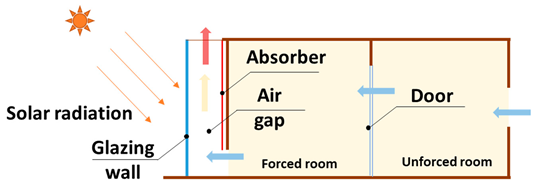
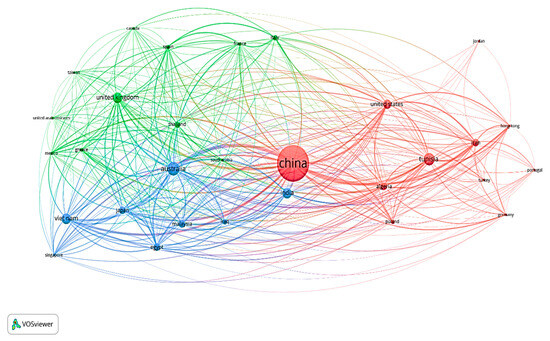
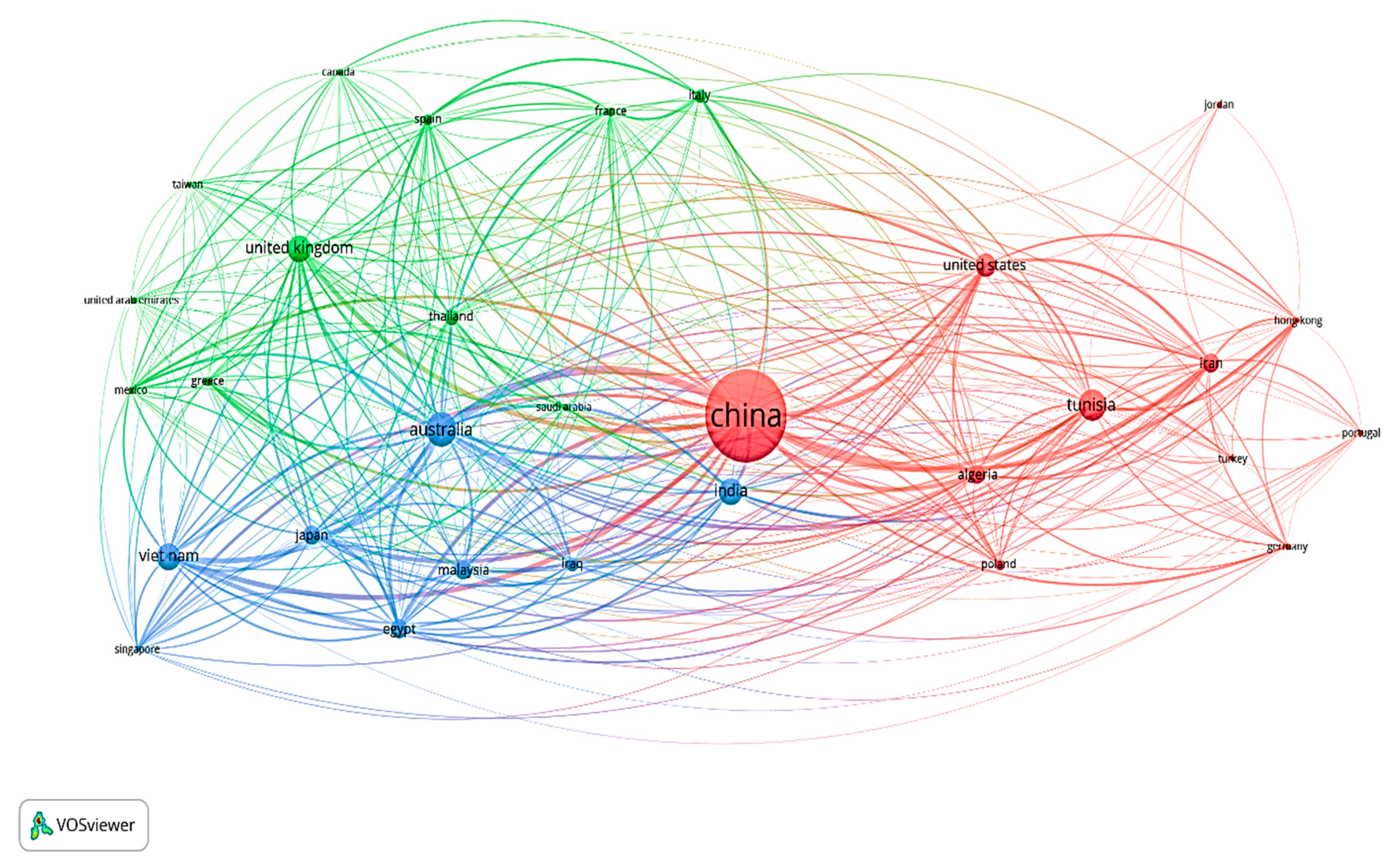
By using bibliographic coupling, it is possible to identify the countries that have made significant contributions to the research field, which sheds more light on the topic and explains why that specific method of study had been developed [66,69]. In this context, based on the number of documents, Figure 9 shows the top countries in the research sector. The size of each node reflects how many documents each country has published. According to the results, China completed 57 documents with 882 citations, Australia completed 17 documents with 488 citations, India completed 14 documents with 2108 citations, Italy completed 73 documents with 1740 citations, and Germany completed 51 documents with 428 citations. Three clusters formed, providing the number of publications: red cluster including (12 items), green cluster (11 items), and blue cluster (seven items).
Figure 9.
Bibliometric analysis of the 30 most prominent countries’ networks by the number of documents.
6. Various Configuration Parameters Related to SC Performance-Driven Air Ventilation Promotion
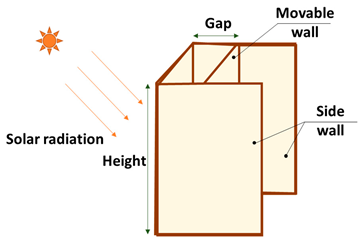
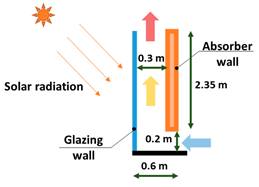
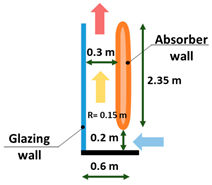
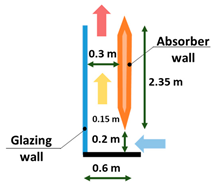
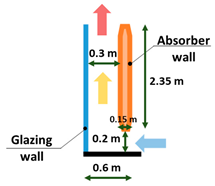
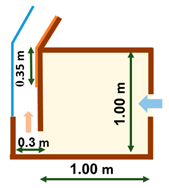
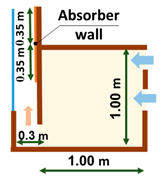
Numerous computational, analytical, and experimental studies for multi-zone and zonal models as well as for small-scale and full-scale experimental prototypes have shown that the chimney’s shape and morphology affect the flow rate and ACH [15,25,46,50,55,57,70,71,72,73,74]. Patel SK, Prasad D, and Ahmed MR [46] explored the influence of various geometric parameters on a SCPP such as the collector inlet opening and the collector outlet. In addition, Zhang, H.; Yang, D.; Tam, V.W.Y.; Tao, Y.; Zhang, G.; Setunge, S.; Shi, L. [13] investigated the flow rate of the roof collector of the Trombe wall. Table 2 outlines various configuration parameters related to SC performance-driven air ventilation promotion such as layout, configurations of openings, chimney ratio including air gap and height, the inclination of the SC including glazing wall and roof as well as the materials and configurations of absorber and glazing walls or mixed configurations. For instance, Hosien MA and Selim SM [57] investigated the relationship between ACH and the chimney’s height, gap, and width. Fine JP, Zhang S, Li Y, and Touchie MF [55] analyzed the airflow created by solar chimneys in high-rise buildings. Key parametric relationships were provided such as a negative relationship between the building’s height and the airflow rates on each story. In addition, positive relationships could be observed by the solar collector’s width and each floor’s airflow rate. Moreover, the solar chimney design can be optimized to provide the indoor air velocity and thermal comfort, as indicated in [25], where they highlighted that the most important factor is the width of the solar chimney, followed by the inclination degree and the air gap, while the impact of the SC height is minimal. Moreover, the ACH can be associated with increasing the air gap of the SC, which causes the hydraulic boundary layer on the absorber and glass wall to develop, hence reducing the flow and the amount of air flowing [13]. Dhahri et al. [74] examined absorber wall configurations such as flat corners, trapeze corners, rounded corners, and triangle corners. In comparison to alternative arrangements, the triangular corner configuration increased the solar chimney’s thermal efficiency for natural ventilation. In the following subsections, various configuration parameters of SCs related to air ventilation are discussed.
6.1. Layout of the SC
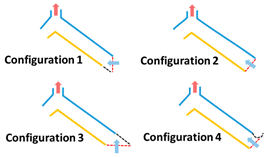
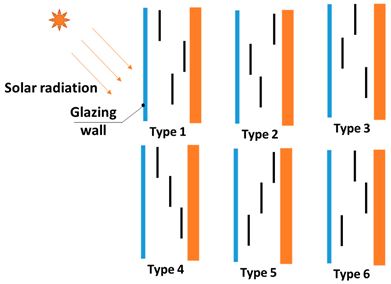
The layout of the SC can affect the airflow rate, and thus the ventilation rate and SC efficacy. Using EnergyPlus software, the efficiency of a solar chimney connected to a typical Isfahan seven-story office building was investigated based on the location of its components in the building’s southern, southwestern, and eastern regions [53]. The findings showed that the solar chimney’s placement in the east–southeast corner of the building, where there is the greatest amount of radiation and two absorbing walls, could result in the highest ventilation rate. In addition, Nguyen YQ, Nguyen V, Tran L, and Wells J [75] indicated that the highest flow rate could be achieved by the parallel and exhaust air at two different outputs, and the suggested configurations significantly (up to 40%) increased the flow rate when compared to a regular SC.
6.2. Configurations of Openings of SC
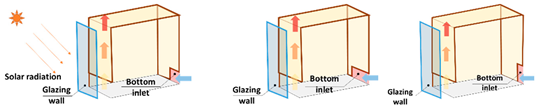
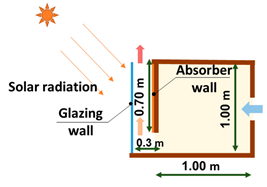
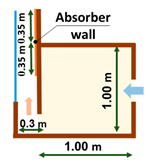
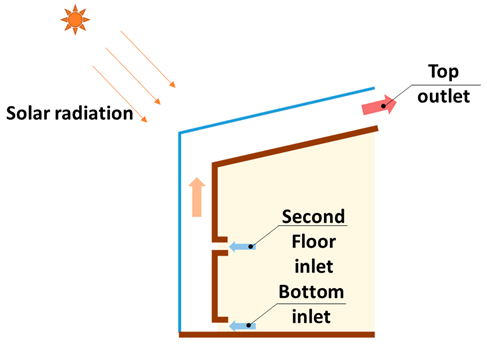
The sizing and orientation of the openings can affect the performance of a SC [46]. Punyasompun S, Hirunlabh J, Khedari J, and Zeghmati B [52] experimentally and numerically investigated small scale models of a three-story building with a SC under Bangkok’s climatic conditions. The findings indicated that an inlet opening on each floor and one outlet opening on the third floor was preferable to installing inlet and outlet apertures on each floor. Regarding the position, Mohamed AQ, Alshara AK, and Mitlaik HM [49] investigated the various locations and shapes of the openings (top, middle, and bottom) as well as windows in horizontal, vertical, and square shapes. The performance of the chimney was impacted by the orientation of the suction opening entrances. In Maysan, a SC at any angle of inclination on the horizontal bottom suction opening offered the best thermal results. Ling LS, Rahman MM, Chu CM, Misaran MSB, and Tamiri FM [76] examined the area related to the inlet and outlet of a SC, which varied depending on the inclination angle and space between the inner and outer walls from 0.0224 m2 to 0.6 m2 and 0.1 m2 to 0.14 m2, respectively. The area ratio between the inlet and outlet provides an essential parameter, according to the CFD results, and the inlet opening area should be at least twice as large as the outlet opening area. Moreover, Zhang H, Tao Y, Nguyen K, Han F, Li J, and Shi L [56] found that an inlet size of 0.2 m resulted in the best design; larger windows and inlets also promoted overall performance, but their effects were negligible when their sizes exceeded the ideal sizes in multi-zone rooms. Four distinct inlet designs were investigated by the ANSYS FLUENT program while taking into account the roof opening [77]. The results demonstrated that the vertical cross-section inlet outperformed the other three inlet configurations, followed by the horizontal cross-section inlet.
6.3. The Ratio of SC Ratio Gap-to-Height
Significant characteristics depending on the ratio of the air gap to height are presented by the SC ratio. In this context, Imran and Ahmed [11] examined the induced air inside a 12 m3 chamber using SC. To achieve the highest rate of ventilation, they concluded that the ideal chimney aspect ratio was 13.3, that the length should be 2 m, and the inclination angle should be 60 degrees [17].
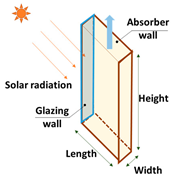
Regarding the height, the SC’s height contributes to the buoyant force that affects air circulation [36] and develops turbulent airflow to obtain a large flow rate [78]. According to Hashim HS, Kassim MS, and Kadhim HH [45], inclined and vertical extended chimneys increased the ventilation rates by 7.5% and 13%, respectively, in comparison to a conventional chimney model. With regard to length, Wei D, Qirong Y, and Jincui Z [79] showed that increasing the overall chimney length enhanced the ventilation. The air mass flow rate showed that an optimal length-to-width ratio of 12:1 existed as it initially developed, and then declined with the chimney width. Jing H, Chen Z, and Li A [41] experimentally investigated a SC model with large gap-to-height ratios between 0.2 and 0.6. The results showed that the optimum ratio that maximized the airflow rate in the chimney was around 0.5. Moreover, Zhang H, Tao Y, Nguyen K, Han F, Li J, and Shi L [56] investigated how effectively a SC performed in multi-zone buildings. The findings demonstrated that relocating the air inlet upward increased the ventilation rate by 57.28% and increased the ventilation capacity by roughly 90% when the chimney height was increased from 3.0 to 5.0 m. Additionally, the maximum airflow rate in this experiment was discovered for a SC with a cavity gap of 0.2 m and an entrance size of 0.2 m. According to Hosien MA and Selim SM [57], raising the chimney’s height, gap, and width will enhance the rate of ACH. They discovered that the chimney gap, as opposed to the other geometrical factors, had a significantly bigger impact on the ACH, but that the mass flow rate could be increased by about 18% for the height, 78% for the chimney gap, and 63% for the width.
6.4. Incline of SC
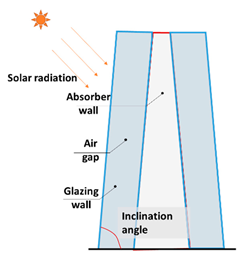
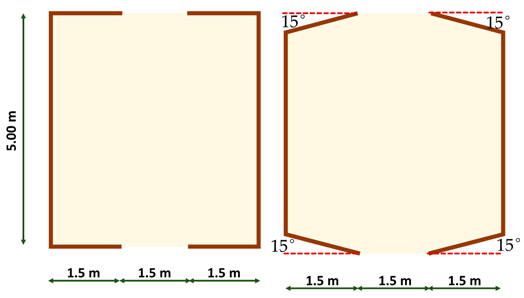
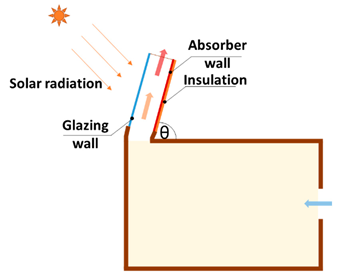
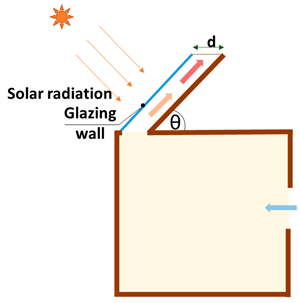
The SC inclination angle is a significant configuration parameter that has a significant impact on the ventilation rate and room flow patterns [80]. When compared to the typical chimney design with a vertical passive wall layout, the glazing wall’s slope can significantly enhance a SC’s ventilation effectiveness. Khanal R and Lei Ce [81] investigated the variation of passive wall inclination angles in the range of 0–6 degrees with a 0.1 m fixed base air gap width. The results showed that the passive wall’s inclination angle had no influence on the temperature distribution along the height of the chimney and over the air gap width. However, the inclination angle had a significant impact on the averaged airflow velocity over the air gap width. The association was also found to be valid for all inclination angles, from 30° to 90°, according to Chen C, Naraghi M, and Akbari P [82].
Table 2.
Various configuration parameters related to SC performance-driven air ventilation promotion. Source: The researcher, based on [41,45,49,54,57,70,74,75,76,77,78,80,83,84,85,86].
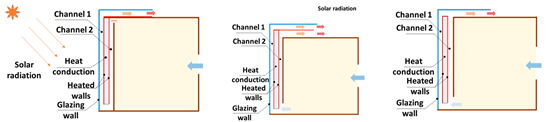
Table 2.
Various configuration parameters related to SC performance-driven air ventilation promotion. Source: The researcher, based on [41,45,49,54,57,70,74,75,76,77,78,80,83,84,85,86].
| Case | Conf. | Description | Schematics | Method | Findings | Ref. | |
|---|---|---|---|---|---|---|---|
| Single spaced | Layout of SC |
| ![]() | Numerically |
| [75] | |
| Section drawings of three configurations of SC layout. | |||||||
| Single spaced | Configurations of openings of SC |
| ![]() | ![]() | Experimentally and numerically |
| [77] |
| Section drawing of a typical model of SC inlet configuration. | Section drawings of four configurations of SC inlet configuration. | ||||||
| Single spaced | Configurations of openings of SC |
| ![]() | Numerically |
| [49] | |
| Perspective drawings of: | |||||||
![]() | |||||||
| Single spaced | Configurations of openings of SC |
| ![]() Section drawing of opening areas | Numerically |
| [76] | |
| Single spaced | Ratio of SC |
| ![]() Perspective drawing of the SC ratio | Numerically |
| [78] | |
| Single spaced | Ratio of SC |
| ![]() Perspective drawing of the SC ratio | Experimentally |
| [41] | |
| Single spaced | Ratio of SC |
| ![]() Section drawing of the SC ratio | Numerically |
| [57] | |
| Multi-zone | Ratio of SC |
| ![]() Section drawing of the SC ratio | Numerically |
| [56] | |
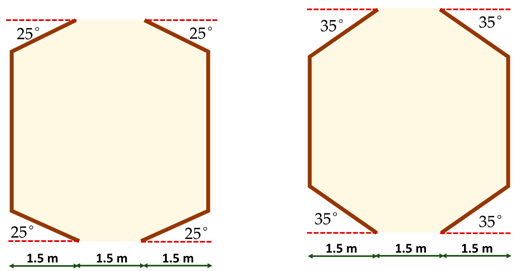
| Typical floors | Incline of SC |
| ![]() | Numerically |
| [54] | |
| Plan drawings of SC with: | |||||||
| Lateral angle = 0° | Lateral angle = 15° | ||||||
![]() | |||||||
| Lateral angle = 25° | Lateral angle = 35° | ||||||
| Single spaced | Incline of SC |
| ![]() Section drawing of the SC incline | Numerically |
| [83] | |
| Single spaced | Incline of SC |
| ![]() Section drawing of the SC incline | Numerically |
| [80] | |
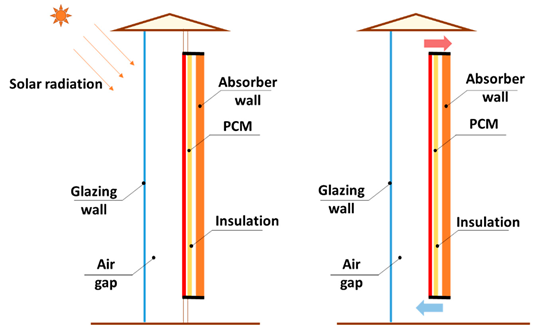
| Single spaced | Materials and configurations of absorber wall and glazing cover of SC |
| ![]() | Experimentally |
| [84] | |
| Section drawings of the SC with: | |||||||
| Closed mode | Open mode | ||||||
| Single spaced | Materials and configurations of absorber wall and glazing cover of SC |
| ![]() | Numerically |
| [70] | |
| Section drawings of the SC with: | |||||||
| Typical SC with a plane wall absorbing solar radiation | Proposed chimney with a stepped absorber surface | ||||||
| Single spaced | Materials and configurations of absorber wall and glazing cover of SC |
| ![]() | ![]() | Numerically |
| [74] |
| Flat corner | Rounded corner | ||||||
![]() | ![]() | ||||||
| Triangle corner | Trapeze corner | ||||||
| Single spaced | Materials and configurations of absorber wall and glazing cover of SC |
| ![]() | Numerically |
| [85] | |
| Single spaced | Mixed configurations |
| ![]() | ![]() | Numerically |
| [45] |
| The conventional model | The chimney is extended vertically (v.ext.) | ||||||
![]() | ![]() | ||||||
| The extended chimney is inclined at the angle of 45° (i.e.) | The extended chimney length combined with another window | ||||||
| Two typical floors | Mixed configurations |
| ![]() | Numerically |
| [86] | |
A material with high thermal mass that can store thermal energy and release it later when solar energy is unavailable is frequently used to create the absorbing surface. Khosravi M, Fazelpour F, and Rosen MA [54] evaluated the improved design for the inclined SC to establish the most effective geometry for generating a high number of air changes per hour in the given scenario. The results revealed that when the length of the titled surface is sufficient enough, the inclination angle is considerable. Furthermore, compared to traditional designs, the inclination angle can increase the natural ventilation rate of the building by 24%. According to Hashim HS, Kassim MS, and Kadhim HH [45], when compared to a regular chimney model, inclined and vertical extended chimneys increased the ventilation rates by 7.5% and 13%, respectively. The room’s second window had increased airflow, which decreased the amount of heated air there. As a result, the ventilation rate increased by 39%, and the temperature difference between the average air room and the ambient air was 3 °C. The ideal inclination angle, which was 4 degrees from the horizontal, increased the mass flow rate, according to Wei D, Qirong Y, and Jincui Z [79]. Finally, the velocity distribution inside the chimney improved and the airflow rate increased as the chimney inclination angle increased.
The ideal inclination angle of a small-scale roof-top solar chimney for maximum ventilation effectiveness in the context of the roof’s incline was determined by Kong J, Niu J, and Lei CA [83]. Under diverse heat fluxes, a SC model was developed with inclination angles ranging from 30° to 90° concerning the horizontal plane. The results showed that the optimal inclination angle varied from 45° to 60° depending on the latitude and operating season. In addition, Bassiouny R and Korah NSA [80] investigated the chimney inclination angle. The ideal air gap width was between 0.1 and 0.35 m, with an inclination range of 45 to 75 degrees.
6.5. Materials and Configurations of Absorber Wall and Glazing Cover of SC
For improved SC performance, materials with higher thermal conductivity (like metal) or higher thermal mass (like concrete) can be taken into consideration. However, designers must also think about ways to reduce the radiant heat transfer into livable environments [21]. For instance, the thermal performance of a phase change material (PCM) integrated with SC has been examined in several studies. For instance, three charging modes—closed-fully charging, open-partially charging, and open-fully charging—have been studied by Liu S and Li Y [84]. According to the findings, when compared to a solar chimney without PCM, adding a PCM decreased the airflow while charging, but increased it during discharging. In the open-partly charging mode compared to the closed-fully charging mode, the mean airflow rate was lower during the phase shift period. To prevent unintentional warming of the room air, the interior surface of the storage wall should be insulated [50]. In terms of absorber wall configurations, computational investigations were accomplished on the thermal performance of four different absorber wall designs, fat corner, rounded corner, triangle corner, and trapeze corner [74], to find the best configuration. A triangular corner had a 50% higher energy efficiency than a trapeze corner, a 67% higher efficiency than a rounded corner, and a 2% higher efficiency than a fat corner. The SC’s triangular corner increased the air pressure and temperature, which maximized the air mass flow and enhanced the ventilation.
The glazing cover provides a higher flow rate via the chimney of approximately 6 ACH, which is higher than the required ventilation requirement rate. The glazing cover is made of concrete, gypsum board, and aluminum [57].
7. Discussion and Potential of Future Implications
Based on the previous analysis of the bibliometric analysis and a comprehensive review of various configuration parameters related to SC performance-driven air ventilation promotion, the following points discuss the potential and further implications of the integration of a SC with various configurations.
Further study is required to develop themes like “building design” of SC and its associated effects such as air quality and ventilation, in addition to “numerical analysis” and “optimization” in terms of hotspot topics and the potential for future consequences. Additionally, despite its importance, the most popular terms did not sufficiently apply the “geometric parameter” technique. Therefore, additional research is required to explore and implement such themes, which also call for ongoing incentives for future interdisciplinary collaboration. Additionally, previous studies have been based on single spaces, although promising investigations may lead to several applications including many zones and floors.
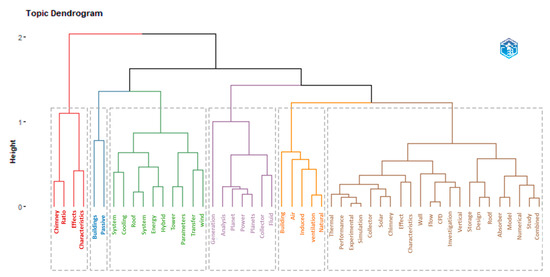
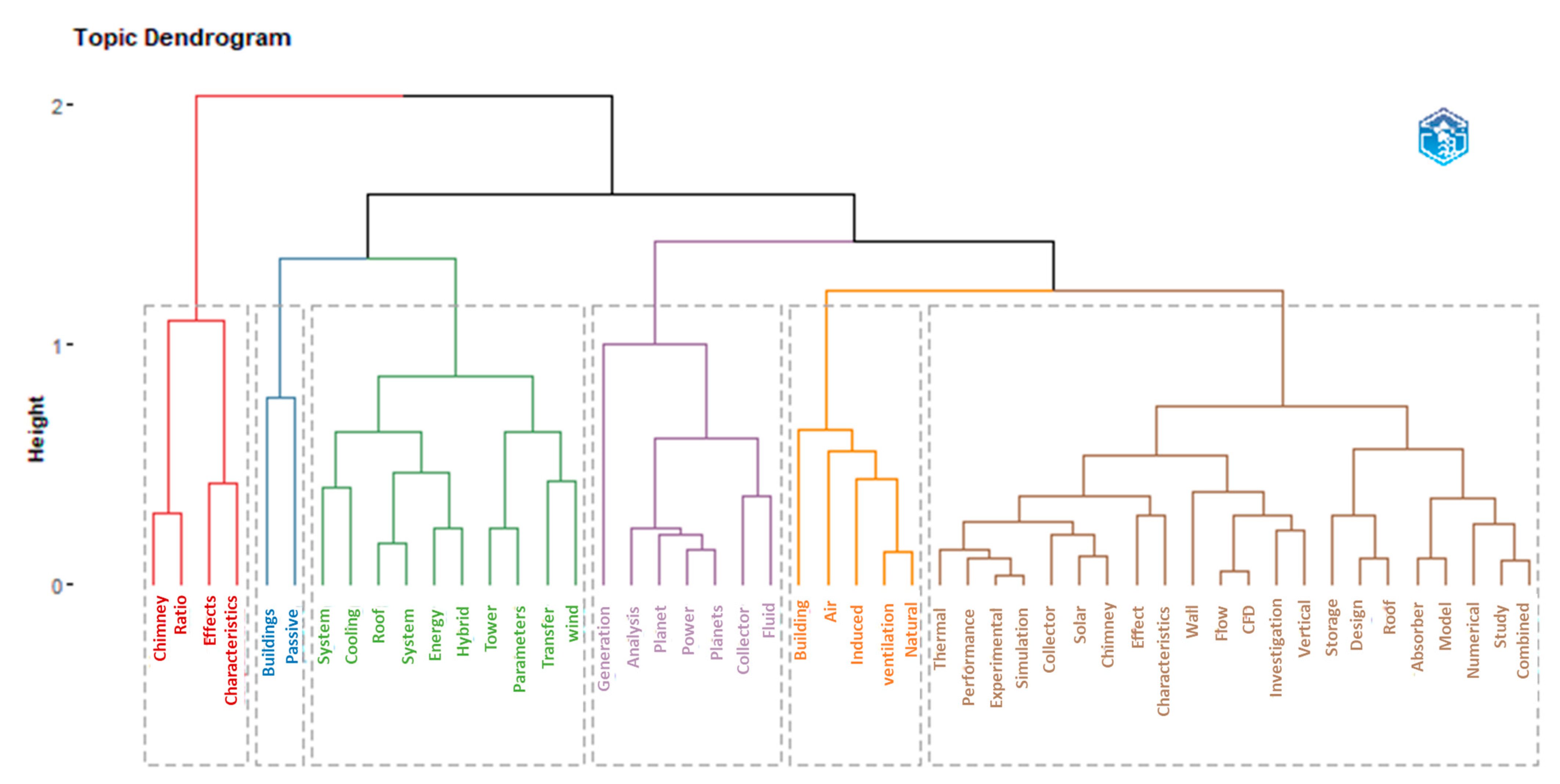
Figure 10 illustrates the topic dendrogram map that reflects the relationship between the various keywords associated with SC performance and air ventilation promotion using hierarchical clustering and hierarchical order. Such a map integrates 50 keywords with six clusters to explore how the topics are associated. The performance of SC as a passive strategy can be directly associated with a cluster of building designs with limited configurations and building forms (Table 2), in addition to clusters of air ventilation, cooling, and thermal performance through CFD tools. However, clusters related to the energy and power planets present are indirectly associated with the integration of SC with the design of buildings.
Figure 10.
The topic dendrogram with the associated 50 keywords and six clusters using hierarchical clustering and hierarchical order.
Therefore, based on previous analysis and the hierarchical clustering of topic dendrogram map, the study discusses the potential and further implications of the integration of a SC with various configurations via the proposed conceptual framework as well as the limitations, hotspots, and potential for future implications.
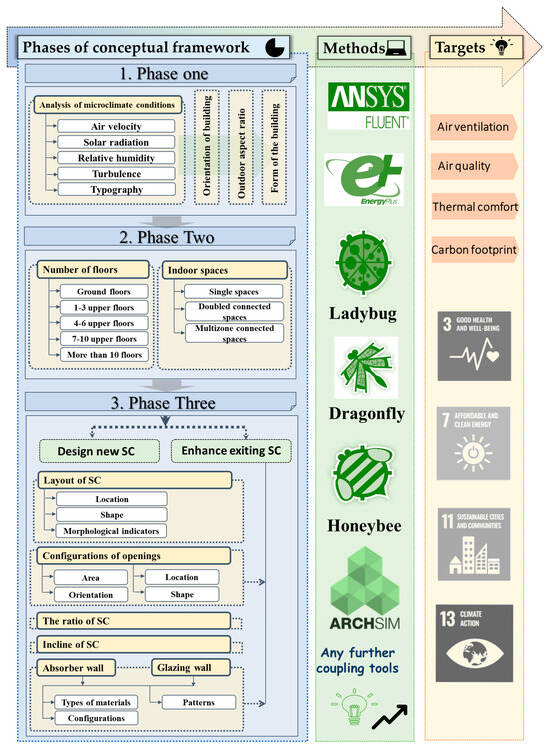
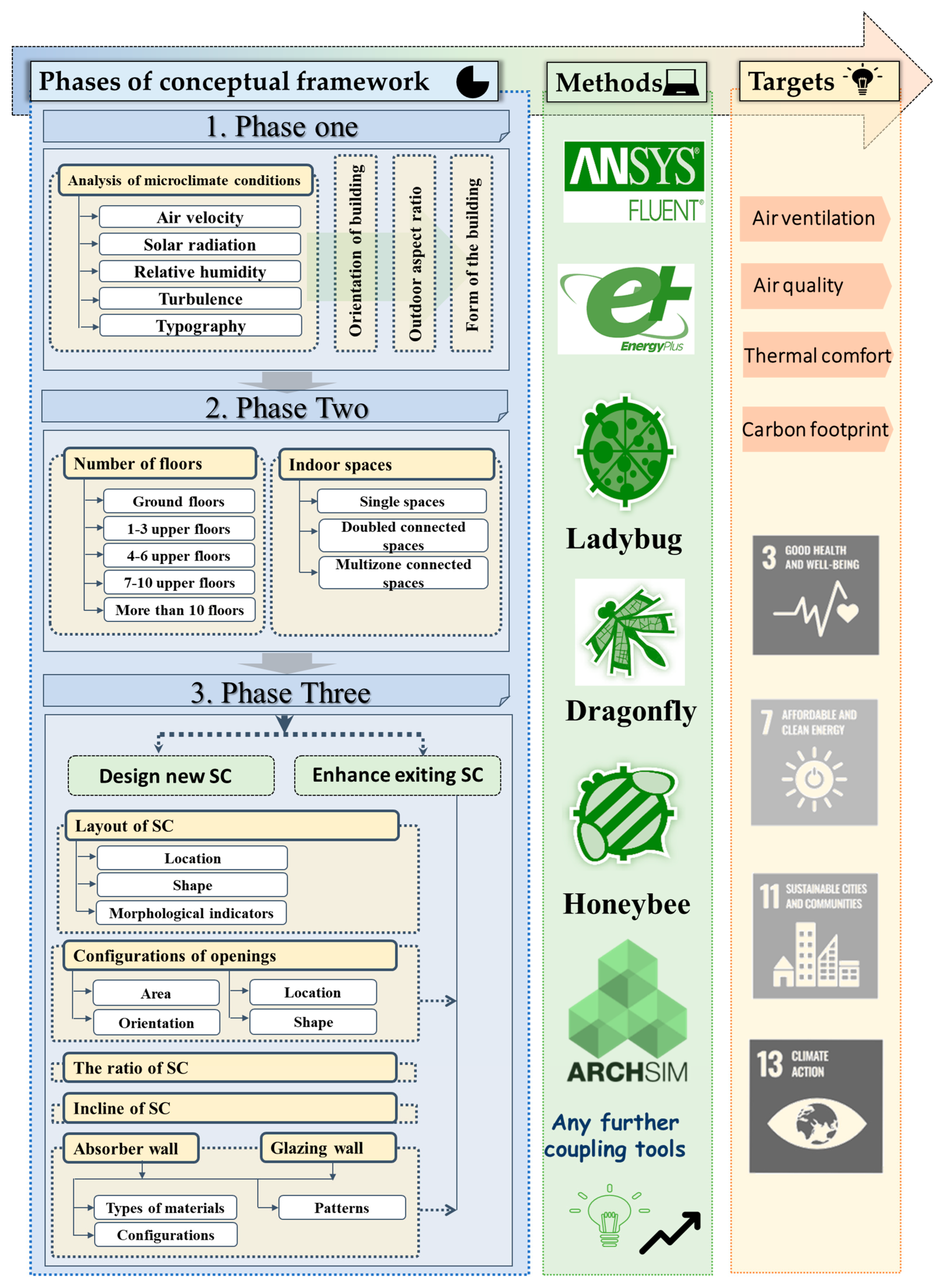
Figure 11 illustrates the proposed framework that promotes the integration of the SC’s possible configuration parameters that provide not only the air ventilation, air quality, or thermal comfort, but also the energy consumption and carbon footprint, which reflect the SDGs. Various recent methods and numerical analysis, generative design, machine learning, and parametric tools, for instance, can provide such a framework, resulting in novel potential modeling, analysis, and investigation via diverse configurations. The proposed framework starts with identifying three phases to achieve the final design of the SC. The first phase is based on an analysis of outdoor microclimate conditions that can be associated with the orientation and form of the building, besides the outdoor aspect ratio, which can influence the performance of the SC. The second phase emphasizes determining the number of floors and the connected multi-zone of the building, which can also influence the configurations of the SC. Furthermore, phase three provides the configuration parameters of a SC that differ between the initial design of the SC or renovation of an exciting SC to enhance its performance based on specific parameters like the openings and patterns of the absorber wall and glazed wall, for instance. Such phases and investigations can be analyzed based on various numerical methods like simulation-based models including CFD-based models, energy balance models, data-driven models like parametric tools, and coupled models. Such a conceptual framework can provide various SDGs including good health and well-being, affordable and clean energy, sustainable cities and communities, and climate action. Various specialists associated with construction, building, and environmental sectors can implement such a framework and develop several implications including morphological indicators related to layout, glazed and absorber walls, and horizontal and vertical forms of the main core of the SC, for instance, a chimney with three venturi designs [87]. In addition, the proposed framework confirmed the results of the bibliometric analysis related to the further required attempts to provide several accurate investigations. Moreover, an enormous evolution in terms of future possibilities can be achieved with such an integration.
Figure 11.
The proposed conceptual framework.
Regarding the limitations, numerous potential restrictions must be taken into account. First, database development, which is a crucial stage, served as the foundation for this investigation. On 1 January 2023, a search was conducted using a limited amount of keywords inside narrowly defined categories, producing specialized results that could not be generalized. Additionally, a significant number of publications were excluded from this analysis via the Scopus or WoS databases, which were based on three filters: categories, publication type, and language; or manual screening in accordance with the objectives and scope of the micro-scale, and eligibility to retain articles in relevance to the research topic.
This work strengthened the function of a SC in the design process as well as in research and academic consequences. The involvement of designers, mechanical engineers, atmospheric specialists, and programmers, among other fields, are required to enrich reducing energy consumption, provide carbon communities and public health, and environmental and social resilience.
8. Conclusions
Within the context of SC performance-driven air ventilation promotion based on configuration parameters, this study conducted a bibliometric analysis based on 320 filtered publications using the Biblioshiny and VOSviewer tools to visualize “co-occurrence”, “co-citation”, “co-authorship”, “bibliographic coupling”, and “citation” analyses. Moreover, the proposed conceptual framework was conducted to provide insights and possibilities into promoting numerous configuration parameters related to SC performance-driven air ventilation promotion, which serves as research guidance for designers and specialists toward the mitigation of climate change impacts and attaining the SDGs. Here are the conclusions that were drawn:
- In terms of trends and hotspots, “solar chimney”, “natural ventilation”, “CFD”, “solar energy”, and “thermal performance” indicate trending topics, hotspots, and frontiers concerning their effects. Additionally, additional research is required to develop essential topics like “numerical analysis” and “optimization”, in addition to “building design” of SC and its associated effects on air quality and ventilation. Additionally, despite its importance, the most popular terms did not sufficiently apply the “geometric parameter” technique. Thus, additional study is required to investigate and apply such issues.
- Based on an examination of the most frequently cited publications, overall, good consistency could be observed between the results of the co-citation for references and the co-occurrence of the analysis of the keyword. In addition, SC publications have provided optimization of the geometry, energy systems, and CFD simulations, which integrate a passive strategy to provide air ventilation and renewable systems to provide electricity via integration elements like solar collectors, chimney towers, and wind turbines.
- According to the authors’ impact regarding the overall total citation, the author Gan G, a Professor at the Institute of Building Technology, Department of Architecture and Building Technology, University of Nottingham, University Park, Nottingham, UK, received the most citations overall. The most productive authors are Driss Z, a Full Professor in the Department of Mechanical Engineering at the National School of Engineers of Sfax, and Nguyen YQ, Professor at the Department of Civil Engineering, Ho Chi Minh City University of Technology
- Renewable Energy, Energy and Buildings, and Solar Energy were the top three journals in the ranking. In addition, the results showed that China carried out 57 studies with 882 citations, Australia produced 17 papers with 488 citations, and India had 14 articles with 2108 citations.
- The proposed framework promotes the integration of the SC’s possible configuration parameters that provide the air ventilation, air quality or thermal comfort, energy consumption, and carbon footprint.
- Various recent methods and numerical analysis, generative design, machine learning, and parametric tools, for instance, can provide such a framework, resulting in novel potential modeling, analysis, and investigating via diverse configurations.
- Such phases and investigations can be analyzed based on various numerical methods like simulation-based models including CFD-based models, energy balance models, data-driven models like parametric tools, and coupled models.
- The conceptual framework can provide various SDGs including good health and well-being, affordable and clean energy, sustainable cities and communities, and climate action, which act toward the mitigation of climate change impacts.
Through promoting SC performance toward air ventilation and energy efficiency with the associated configuration parameters, this research helps mitigate the effects of urbanization and climate change. In order to optimize the SC performance in response to linked global environmental concerns, more work is required to generate additional configurations and consequences that take generative design into account.
Funding
This research received no external funding.
Institutional Review Board Statement
Not applicable.
Informed Consent Statement
Not applicable.
Data Availability Statement
Not applicable.
Conflicts of Interest
The author declares no conflict of interest.
Appendix A
Table A1.
List of the analyzed bibliometric publications.
Table A1.
List of the analyzed bibliometric publications.
| Authors | Title | Year | Source |
|---|---|---|---|
| Abdallah A.S.H. | A new design of passive air condition integrated with solar chimney for hot arid region of Egypt | 2019 | International Journal of Environmental Science and Technology |
| Abdallah A.S.H. | Thermal performance and experimental study of solar chimneys integrated into a room in Assiut University, Egypt | 2016 | 6th International Conference on Energy Research and Development, ICERD 2016 |
| Abdeen A., Serageldin A.A., Ibrahim M.G.E., El-Zafarany A., Ookawara S., Murata R. | Solar chimney optimization for enhancing thermal comfort in Egypt: An experimental and numerical study | 2019 | Solar Energy |
| Aboulnaga M.M. | A roof solar chimney assisted by cooling cavity for natural ventilation in buildings in hot arid climates: An energy conservation approach in Al-ain city | 1998 | Renewable Energy |
| AboulNaga M.M., Abdrabboh S.N. | Improving night ventilation into low-rise buildings in hot-arid climates exploring a combined wall-roof solar chimney | 2000 | Renewable Energy |
| Ahmed K.I.E., Abdel-Rahman A.K., Ahmed M., Khairaldien W.M. | Virtual height aided solar chimney: A new design | 2011 | ASME 2011 International Mechanical Engineering Congress and Exposition, IMECE 2011 |
| Alemu A.T., Saman W., Belusko M. | A model for integrating passive and low energy airflow components into low rise buildings | 2012 | Energy and Buildings |
| Alemu A.T., Saman W., Belusko M. | A coupled building ventilation and thermal model incorporating passive airflow components | 2011 | Proceedings of Building Simulation 2011: 12th Conference of International Building Performance Simulation Association |
| Alimi S., Nciri R., Nasri F., Rothan Y.A., Ali C. | Performance investigation of an original hybrid solar façade system used for HDH desalination and building natural ventilation | 2021 | Journal of Building Engineering |
| Al-Kayiem H.H., Aurybi M.A., Gilani S.I.U., Ismaeel A.A., Mohammad S.T. | Performance evaluation of hybrid solar chimney for uninterrupted power generation | 2019 | Energy |
| Al-Kayiem H.H., Sreejaya K.V., Chikere A.O. | Experimental and numerical analysis of the influence of inlet configuration on the performance of a roof top solar chimney | 2018 | Energy and Buildings |
| Al-Nimr M., Kiwan S., Sharadga H. | A hybrid TEG/wind system using concentrated solar energy and chimney effect | 2018 | International Journal of Energy Research |
| Al-Nimr M.A., Kiwan S., Sharadga H. | Simulation of a novel hybrid solar photovoltaic/wind system to maintain the cell surface temperature and to generate electricity | 2018 | International Journal of Energy Research |
| Arce J., Jiménez M.J., Guzmán J.D., Heras M.R., Alvarez G., Xamán J. | Experimental study for natural ventilation on a solar chimney | 2009 | Renewable Energy |
| Arce J., Xaman J.P., Alvarez G., Jiménez M.J., Heras M.R. | A parametric study of conjugate heat transfer of solar chimney | 2009 | Proceedings of the ASME 3rd International Conference on Energy Sustainability 2009, ES2009 |
| Asadi S., Fakhari M., Fayaz R., Mahdaviparsa A. | The effect of solar chimney layout on ventilation rate in buildings | 2016 | Energy and Buildings |
| Attig-Bahar F., Sahraoui M., Guellouz M.S., Kaddeche S. | Effect of the ground heat storage on solar chimney power plant performance in the South of Tunisia: Case of Tozeur | 2019 | Solar Energy |
| Awbi H.B. | Design considerations for naturally ventilated buildings | 1994 | Renewable Energy |
| Ayadi A., Bouabidi A., Driss Z., Abid M.S. | Experimental and numerical analysis of the collector roof height effect on the solar chimney performance | 2018 | Renewable Energy |
| Ayadi A., Driss Z., Abid M.S. | Study of a solar chimney characterized by a convergent collector output and a divergent chimney bottom | 2020 | Proceedings of the Institution of Mechanical Engineers, Part E: Journal of Process Mechanical Engineering |
| Ayadi A., Driss Z., Bouabidi A., Abid M.S. | Effect of the number of turbine blades on the air flow within a solar chimney power plant | 2018 | Proceedings of the Institution of Mechanical Engineers, Part A: Journal of Power and Energy |
| Ayadi A., Driss Z., Bouabidi A., Abid M.S. | Experimental and numerical study of the impact of the collector roof inclination on the performance of a solar chimney power plant | 2017 | Energy and Buildings |
| Ayadi A., Driss Z., Bouabidi A., Nasraoui H., Bsisa M., Abid M.S. | A computational and an experimental study on the effect of the chimney height on the thermal characteristics of a solar chimney power plant | 2018 | Proceedings of the Institution of Mechanical Engineers, Part E: Journal of Process Mechanical Engineering |
| Ayadi A., Nasraoui H., Bouabidi A., Driss Z., Bsisa M., Abid M.S. | Effect of the turbulence model on the simulation of the air flow in a solar chimney | 2018 | International Journal of Thermal Sciences |
| Ayadi A., Nasraoui H., Driss Z., Bouabidi A., Abid M.S. | Unsteady state of a solar chimney power plant accoupled with a turbine: case study | 2018 | Journal of Engineering, Design and Technology |
| Bansal N.K., Mathur R., Bhandari M.S. | A study of solar chimney assisted wind tower system for natural ventilation in buildings | 1994 | Building and Environment |
| Bansal N.K., Mathur R., Bhandari M.S. | Solar chimney for enhanced stack ventilation | 1993 | Building and Environment |
| Bansod P.J., Thakre S.B., Wankhade N.A. | Experimentational data analysis of chimney operated solar power plant | 2016 | International Journal of Mechanical Engineering and Technology |
| Barozzi G.S., Imbabi M.S.E., Nobile E., Sousa A.C.M. | Physical and numerical modeling of a solar chimney-based ventilation system for buildings | 1992 | Building and Environment |
| Bassiouny R., Korah N.S.A. | Effect of solar chimney inclination angle on space flow pattern and ventilation rate | 2009 | Energy and Buildings |
| Betrouni S.A., Zrikem Z., Bilgen E. | ON THE FREE CONVECTION HEAT TRANSFER WITHIN THE TROMBE-MICHEL WALL COLLECTOR SYSTEM. | 1987 | Solar Engineering |
| Blomsterberg A., Johansson T. | Use of multi-zone air flow simulations to evaluate a hybrid ventilation system | 2005 | IBPSA 2005—International Building Performance Simulation Association 2005 |
| Bouabidi A., Nasraoui H., Ayadi A., Driss Z., Abid M.S. | Numerical and experimental study of the solar chimney with divergent collector | 2019 | Heat Transfer Research |
| Bouchair A. | The effect of the altitude on the performance of a solar chimney | 2022 | Energy |
| Bouchair A. | Solar chimney for promoting cooling ventilation in southern Algeria | 1994 | Building Services Engineering Research & Technology |
| Bouhdjar A., Larbi S., Chergui T., Gahgah M. | Influence of fluid flow regimes on the performances analysis of solar chimney power plants | 2013 | Energy, Environment and Economics Research Compendium |
| Buccolieri R., Carlo O.S., Rivas E., Santiago J.L., Salizzoni P., Siddiqui M.S. | Obstacles influence on existing urban canyon ventilation and air pollutant concentration: A review of potential measures | 2022 | Building and Environment |
| Bugutekin A. | Effect of the collector diameter on solar chimney power plants | 2011 | Energy Education Science and Technology Part A: Energy Science and Research |
| Buonomo B., Manca O., Nardini S., Romano P. | Thermal and fluid dynamic analysis of solar chimney building systems | 2013 | International Journal of Heat and Technology |
| Burek S.A.M., Habeb A. | Air flow and thermal efficiency characteristics in solar chimneys and Trombe Walls | 2007 | Energy and Buildings |
| Cammarata G., Fichera R., Marletta L., Rosso M. | AIR FLOWDYNAMICS IN BIOCLIMATIC BUILDINGS: A COMPUTER ALGORITHM FOR OPEN AND CLOSED CIRCUITS | 1985 | |
| Cao Q., Pui D.Y., Pui D.Y., Lipiński W. | A concept of a novel solar-assisted large-scale cleaning system (SALSCS) for urban air remediation | 2015 | Aerosol and Air Quality Research |
| Chappell R.D., Congdon M.J., French J.J. | Design, construction, and testing of a small scale solar chimney for nomadic herdsmen | 2012 | ASME 2012 6th International Conference on Energy Sustainability, ES 2012, Collocated with the ASME 2012 10th International Conference on Fuel Cell Science, Engineering and Technology |
| Chen C., Naraghi M., Akbari P. | A correlation for airflow rate of inclined and vertical solar chimneys | 2013 | 11th International Energy Conversion Engineering Conference |
| Chen W., Qu M. | Analysis of the heat transfer and airflow in solar chimney drying system with porous absorber | 2014 | Renewable Energy |
| Chergui T., Boualit H., Bouhdjar A., Larbi S. | Entropy generation analysis of the solar chimney power plant | 2012 | World Renewable Energy Forum, WREF 2012 including World Renewable Energy Congress XII and Colorado Renewable Energy Society (CRES) Annual Conference |
| Chungloo S., Limmeechokchai B. | Application of passive cooling systems in the hot and humid climate: The case study of solar chimney and wetted roof in Thailand | 2007 | Building and Environment |
| Ćoćić A.S., Djordjević V.D. | One-dimensional analysis of compressible flow in solar chimney power plants | 2016 | Solar Energy |
| da Silva P.C., Leal V., Correia da Silva J. | Modelling buoyancy induced flows of passive cooling systems | 2009 | IBPSA 2009—International Building Performance Simulation Association 2009 |
| Das S.K., Kumar Y. | Design and performance of a solar dryer with vertical collector chimney suitable for rural application | 1989 | Energy Conversion and Management |
| DeBlois J., Bilec M., Schaefer L. | Simulating home cooling load reductions for a novel opaque roof solar chimney configuration | 2013 | Applied Energy |
| Demissie P., Hayelom M., Kassaye A., Hailesilassie A., Gebrehiwot M., Vanierschot M. | Design, development and CFD modeling of indirect solar food dryer | 2019 | Energy Procedia |
| Dhahri A., Omri A., Orfi J. | Night Operation of a Solar Chimney Integrated with Spiral Heat Exchanger | 2021 | Power Systems |
| Dhahri M., Aouinet H. | CFD investigation of temperature distribution, air flow pattern and thermal comfort in natural ventilation of building using solar chimney | 2020 | World Journal of Engineering |
| Duan S. | A predictive model for airflow in a typical solar chimney based on solar radiation | 2019 | Journal of Building Engineering |
| Duraković B. | Heat transfer mechanisms in PCM-based building envelope systems | 2020 | Green Energy and Technology |
| Elghamry R., Hassan H. | Impact a combination of geothermal and solar energy systems on building ventilation, heating and output power: Experimental study | 2020 | Renewable Energy |
| Fine J.P., Zhang S., Li Y., Touchie M.F. | Analysis of solar chimney ventilation systems in high-rise residential buildings using parallel flow networks | 2022 | Building and Environment |
| Fu S. | An enhanced heat collector design and numerical simulation for solar chimney power plant | 2019 | IOP Conference Series: Materials Science and Engineering |
| Gaczoł T. | Living quarters. A natural balanced ventilation system. Simulations part 1 | 2018 | E3S Web of Conferences |
| Gaczoł T. | Natural balanced ventilation. Simulations part 2 | 2018 | E3S Web of Conferences |
| Gan G. | General expressions for the calculation of air flow and heat transfer rates in tall ventilation cavities | 2011 | Building and Environment |
| Gan G. | Simulation of buoyancy-induced flow in open cavities for natural ventilation | 2006 | Energy and Buildings |
| Gan G. | A parametric study of Trombe walls for passive cooling of buildings | 1998 | Energy and Buildings |
| Gan G., Riffat S.B. | A numerical study of solar chimney for natural ventilation of buildings with heat recovery | 1998 | Applied Thermal Engineering |
| Gao N., Yan Y., Sun R., Lei Y. | Natural Ventilation Enhancement of a Roof Solar Chimney with Wind-Induced Channel | 2022 | Energies |
| Ghorbani B., Ghashami M., Ashjaee M. | Electricity production with low grade heat in thermal power plants by design improvement of a hybrid dry cooling tower and a solar chimney concept | 2015 | Energy Conversion and Management |
| Hadj A.E., Noureddine S., Mabrouk D.M., Belkhir N., Soumia R. | Experimental investigation of a small solar chimney in the south of Algeria | 2018 | AIP Conference Proceedings |
| Hamdy I.F., Fikry M.A. | Passive solar ventilation | 1998 | Renewable Energy |
| Hami K., Draoui B., Hami O. | The thermal performances of a solar wall | 2012 | Energy |
| Hashim H.S., Kassim M.S., Kadhim H.H. | Numerical investigation for natural ventilation enhancement in different models of solar chimney inside a room elicited from the concepts of the conventional chimney model | 2020 | Journal of Mechanical Engineering Research and Developments |
| Hassan A., Ali M., Waqas A. | Numerical investigation on performance of solar chimney power plant by varying collector slope and chimney diverging angle | 2018 | Energy |
| Hong S., Wu Q., Ge W., Lv D., Li Z., He G. | Evaluation of Three Analytical Solar Chimney Models with Field Data | 2020 | Environmental Science and Engineering |
| Hosien M.A., Selim S.M. | Effects of the geometrical and operational parameters and alternative outer cover materials on the performance of solar chimney used for natural ventilation | 2017 | Energy and Buildings |
| Hu S., Leung D.Y.C., Chen M.Z.Q., Chan J.C.Y. | Effect of guide wall on the potential of a solar chimney power plant | 2016 | Renewable Energy |
| Huang M.-H., Chen L., He Y.-L., Cao J.-J., Tao W.-Q. | A two-dimensional simulation method of the solar chimney power plant with a new radiation model for the collector | 2017 | International Communications in Heat and Mass Transfer |
| Huang M.-H., Chen L., Lei L., He P., Cao J.-J., He Y.-L., Feng Z.-P., Tao W.-Q. | Experimental and numerical studies for applying hybrid solar chimney and photovoltaic system to the solar-assisted air cleaning system | 2020 | Applied Energy |
| Hughes B.R., Calautit J.K., Ghani S.A. | The development of commercial wind towers for natural ventilation: A review | 2012 | Applied Energy |
| Huynh B.P. | A LES study of ventilation flow through a 3-D room fitted with solar chimney | 2020 | American Society of Mechanical Engineers, Fluids Engineering Division (Publication) FEDSM |
| Huynh B.P. | Natural-ventilation flow in a 3-D room fitted with solar chimney | 2012 | ASME International Mechanical Engineering Congress and Exposition, Proceedings (IMECE) |
| Huynh M.-T.T., Nguyen Y.Q. | Effects of inlet area on performance of a solar chimney for natural ventilation and heating of buildings | 2021 | AIP Conference Proceedings |
| Huynh T.N., Nguyen Y.Q. | Effects of the Computational Domain Sizes on the Simulated Air Flow in Solar Chimneys | 2022 | Lecture Notes in Mechanical Engineering |
| Huynh T.N., Nguyen Y.Q. | Effects of outlet area on the Nusselt number of the solar chimney | 2021 | AIP Conference Proceedings |
| Huynh T.N., Nguyen Y.Q. | Effects of the top extension of the domain in CFD simulation of solar chimneys | 2021 | AIP Conference Proceedings |
| Imran A.A., Jalil J.M., Ahmed S.T. | Induced flow for ventilation and cooling by a solar chimney | 2015 | Renewable Energy |
| Jamali S., Yari M., Mahmoudi S.M.S. | Enhanced power generation through cooling a semi-transparent PV power plant with a solar chimney | 2018 | Energy Conversion and Management |
| Jameei A., Akbarzadeh P., Zolfagharzadeh H., Eghbali S.R. | Numerical study of the influence of geometric form of chimney on the performance of a solar updraft tower power plant | 2019 | Energy and Environment |
| Jawad A., Rahman M.M., Misaran M.S.B. | Study the effects of physical parameters on performance in the divergent solar chimney | 2019 | Journal of Mechanical Engineering Research and Developments |
| Jianliu X., Weihua L. | Study on solar chimney used for room natural ventilation in Nanjing | 2013 | Energy and Buildings |
| Jing H., Chen Z., Li A. | Experimental study of the prediction of the ventilation flow rate through solar chimney with large gap-to-height ratios | 2015 | Building and Environment |
| Jones H., Elgindy P., Lei C., Chauhan K. | Performance of a solar chimney with a dual-cavity system | 2016 | Proceedings of the 20th Australasian Fluid Mechanics Conference, AFMC 2016 |
| Kalantar V. | Numerical simulation of cooling performance of wind tower (Baud-Geer) in hot and arid region | 2009 | Renewable Energy |
| Kamar H.M., Kamsah N., Liq K.J. | Indoor air of a double-storey residential house in Malaysia | 2017 | Journal of Advanced Research in Fluid Mechanics and Thermal Sciences |
| Kasaeian A.B., Heidari E., Vatan S.N. | Experimental investigation of climatic effects on the efficiency of a solar chimney pilot power plant | 2011 | Renewable and Sustainable Energy Reviews |
| Kato Yoshio | 6 PASSIVE SOLAR HOUSES WITH AIR FLOW DUCT, ROCK HEAT STORAGE, SOLAR CHIMNEY AND THE OTHER METHODS IN JAPAN. | 1985 | |
| Khanal R., Lei C. | A numerical investigation of buoyancy induced turbulent air flow in an inclined passive wall solar chimney for natural ventilation | 2015 | Energy and Buildings |
| Khanal R., Lei C. | An experimental investigation of an inclined passive wall solar chimney for natural ventilation | 2014 | Solar Energy |
| Khanal R., Lei C. | Flow reversal effects on buoyancy induced air flow in a solar chimney | 2012 | Solar Energy |
| Khanal R., Lei C. | Numerical investigation of the ventilation performance of a solar chimney | 2010 | ANZIAM Journal |
| Khedari J., Pongsatirat C., Puangsombut W., Hirunlabh J. | Experimental performance of a partially-glazed Modified Trombe Wall | 2005 | International Journal of Ambient Energy |
| Khedari J., Rachapradit N., Hirunlabh J. | Field study of performance of solar chimney with air-conditioned building | 2003 | Energy |
| Khidhir D.K., Atrooshi S.A. | Investigation of thermal concentration effect in a modified solar chimney | 2020 | Solar Energy |
| Klimes L., Charvát P., Hejčík J. | Comparison of the energy conversion efficiency of a solar chimney and a solar PV-powered fan for ventilation applications | 2018 | Energies |
| Koonsrisuk A., Chitsomboon T. | Effects of flow area changes on the potential of solar chimney power plants | 2013 | Energy |
| Koronaki I.P. | The impact of configuration and orientation of solar thermosyphonic systems on night ventilation and fan energy savings | 2013 | Energy and Buildings |
| Koronakis P.S. | Solar chimney dynamic performance under typical Mediterranean summer conditions | 1992 | International Journal of Solar Energy |
| Krumar Mandal D., Pradhan S., Chakraborty R., Barman A., Biswas N. | Experimental investigation of a solar chimney power plant and its numerical verification of thermo-physical flow parameters for performance enhancement | 2022 | Sustainable Energy Technologies and Assessments |
| Kumar L.M., Sivaramakrishnan V., Premalatha M., Vivekanandan M. | Interpretation on result of directions of suction opening on solar chimney coherent with building | 2016 | Journal of Scientific and Industrial Research |
| Kumar L.M.A., Sivaramakrishnan V., Premalatha M., Vivekanandan M. | Experimental and simulation studies on the effect of suction opening orientation on solar vertical chimney | 2017 | International Journal of Sustainable Energy |
| Kuscu H., Eryener D. | The effect of flow rate on small solar chimney performance | 2020 | Energy Sources, Part A: Recovery, Utilization, and Environmental Effects |
| Laouar R., Wünsch O. | Numerical Investigation of the Temperature and Flow Fields in a Solar Chimney Power Plant | 2023 | Fluid Dynamics and Materials Processing |
| Lechowska A., Szczepanik-Ścisło N., Schnotale J., Stelmach M., Pyszczek T. | CFD modeling of transient thermal performance of solar chimney used for passive ventilation in a building | 2018 | IOP Conference Series: Materials Science and Engineering |
| Leng P.C., Aw S.B., Ali N.E.H., Ling G.H.T., Lee Y.L., Ahmad M.H. | Solar Chimneys as an Effective Ventilation Strategy in Multi-Storey Public Housing in the Post-COVID-19 Era | 2022 | Buildings |
| Li Y., Duanmu X., Sun Y., Li J., Jia H. | Study on the air movement character in solar wall system | 2007 | IBPSA 2007—International Building Performance Simulation Association 2007 |
| Li Y., Liu S. | Experimental study on thermal performance of a solar chimney combined with PCM | 2014 | Applied Energy |
| Li Y., Liu S., Lu J. | Effects of various parameters of a PCM on thermal performance of a solar chimney | 2017 | Applied Thermal Engineering |
| Ling L.S., Rahman M.M., Chu C.M., Misaran M.S.B., Tamiri F.M. | The effects of opening areas on solar chimney performance | 2017 | IOP Conference Series: Materials Science and Engineering |
| Lipnicki Z., Gortych M., Staszczuk A., Kuczyński T., Grabas P. | Analytical and experimental investigation of the solar chimney system | 2019 | Energies |
| Liu B., Ma X., Wang X., Dang C., Wang Q., Bennacer R. | Experimental study of the chimney effect in a solar hybrid double wall | 2015 | Solar Energy |
| Liu Q., Chen F., Kong Z. | Performance of induced Solar Chimney for Natural Ventilation | 2015 | Ventilation 2015—Proceedings of the 11th International Conference on Industrial Ventilation |
| Liu S., Li Y. | An experimental study on the thermal performance of a solar chimney without and with PCM | 2015 | Renewable Energy |
| Long T., Li W., Lv Y., Li Y., Liu S., Lu J., Huang S., Zhang Y. | Benefits of integrating phase-change material with solar chimney and earth-to-air heat exchanger system for passive ventilation and cooling in summer | 2022 | Journal of Energy Storage |
| Long T., Zhao N., Li W., Wei S., Li Y., Lu J., Huang S., Qiao Z. | Numerical simulation of diurnal and annual performance of coupled solar chimney with earth-to-air heat exchanger system | 2022 | Applied Thermal Engineering |
| Maad B., Belghith A. | The intensification of the heat transfer in passive solar systems using grid generated turbulence: Spectral study | 1994 | Renewable Energy |
| Maad R.B., Belghith A. | The use of grid-generated turbulence to improve heat transfer in passive solar systems | 1992 | Renewable Energy |
| Madan Ananda Kumar L., Sivaramakrishnan V., Premalatha M., Vivekanandan M. | Experimental studies on the effect of suction opening orientation on the inclination of solar chimney | 2015 | International Journal of Mechanical and Mechatronics Engineering |
| Maesaka A., Hayakawa S., Yoshihara K., Hiwatashi K., Nagata S. | Study on ventilation characteristics of the solar chimney at a sustainable college building | 2007 | AIJ Journal of Technology and Design |
| Mazen R., Radwan M., Abdel-Samiea M. | Solar updraft chimney systems in high rise buildings | 2013 | 4th International Conference on Clean Electrical Power: Renewable Energy Resources Impact, ICCEP 2013 |
| Mehdipour R., Baniamerian Z., Golzardi S., Murshed S.M.S. | Geometry modification of solar collector to improve performance of solar chimneys | 2020 | Renewable Energy |
| Mehdipour R., Mohammadi E., Babaie Parsa A.M., Nahalekah H. | Thermal and exergy assessment of solar chimney performance in various energy absorptions; using indoor experimental setup | 2021 | Heat and Mass Transfer/Waerme- und Stoffuebertragung |
| Mezzasalma D., Petrone G., Cammarata L., Cammarata G. | Validation of a numerical model for simulating solar chimney performances | 2012 | Proceedings of the International Symposium on Turbulence, Heat and Mass Transfer |
| Ming T., Liu W., Pan Y., Xu G. | Numerical analysis of flow and heat transfer characteristics in solar chimney power plants with energy storage layer | 2008 | Energy Conversion and Management |
| Ming T., Xu G., Pan Y., Meng F., Zhou C. | Fluid flow and heat transfer of solar chimney power plant | 2016 | Solar Chimney Power Plant Generating Technology |
| Ming T.-Z., Liu W., Huang X.-M. | Unsteady numerical conjugate simulation of the solar chimney power generation systems | 2009 | Kung Cheng Je Wu Li Hsueh Pao/Journal of Engineering Thermophysics |
| Ming T.Z., Zheng Y., Liu C., Liu W., Pan Y. | Simple analysis on thermal performance of solar chimney power generation systems | 2010 | Journal of the Energy Institute |
| Miyazaki T., Akisawa A., Nikai I. | The cooling performance of a building integrated evaporative cooling system driven by solar energy | 2011 | Energy and Buildings |
| Mohamed A.Q., Alshara A.K., Mitlaik H.M. | Numerical study for the ventilation with solar chimney under effect of different location and the shape of the section opening window | 2020 | IOP Conference Series: Materials Science and Engineering |
| Murena F., Gaggiano I., Mele B. | Fluid dynamic performances of a solar chimney plant: Analysis of experimental data and CFD modelling | 2022 | Energy |
| Nakielska M., Pawłowski K. | Enhancement of gravity ventilation in buildings | 2017 | 10th International Conference on Environmental Engineering, ICEE 2017 |
| Nasraoui H., Bouabidi A., Driss Z., Kchaou H. | Impact of Venturi Shape on Performance of Solar Chimney Power Plant | 2022 | Lecture Notes in Mechanical Engineering |
| Nazir K., Huynh B.P. | Effect of inlet location on ventilation flow through a room fitted with solar chimney | 2018 | ASME International Mechanical Engineering Congress and Exposition, Proceedings (IMECE) |
| Negrou B., Rahmouni S., Settou N., Chennouf N. | Inverse design method of wind turbine in solar chimney power plants coupled with geothermal energy | 2018 | Green Energy and Technology |
| Nguyen V.T., Nguyen Y.Q., Huynh T.N. | Natural Ventilation and Cooling of a House with a Solar Chimney Coupled with an Earth–To–Air Heat Exchanger | 2022 | Lecture Notes in Mechanical Engineering |
| Nguyen Y.Q. | Computational Fluid Dynamics Simulation of a Wall Solar Chimney—Effects of the Computational Domain | 2022 | AIP Conference Proceedings |
| Nguyen Y.Q., Huynh M.-T.T. | A numerical study on the performance of a solar chimney with expanded inlet | 2021 | AIP Conference Proceedings |
| Nguyen Y.Q., Huynh T.N. | Effects of suction flow on the performance of a solar chimney | 2021 | AIP Conference Proceedings |
| Nguyen Y.Q., Nguyen V.T. | Effects of heated cavities below and above the air channel on the performance of a solar chimney for natural heating | 2021 | AIP Conference Proceedings |
| Nguyen Y.Q., Wells J.C. | A numerical study on induced flowrate and thermal efficiency of a solar chimney with horizontal absorber surface for ventilation of buildings | 2020 | Journal of Building Engineering |
| Ong K.S., Chow C.C. | Performance of a solar chimney | 2003 | Solar Energy |
| Patel S.K., Prasad D., Ahmed M.R. | Computational studies on the effect of geometric parameters on the performance of a solar chimney power plant | 2014 | Energy Conversion and Management |
| Pfeffer M.D., Bachmeier E. | Computer simulations: Advances in research and applications | 2018 | Computer Simulations: Advances in Research and Applications |
| Pretorius J.P., Kröger D.G. | Regulating solar chimney power plant output according to demand | 2009 | 29th ISES Biennial Solar World Congress 2009, ISES 2009 |
| Punyasompun S., Hirunlabh J., Khedari J., Zeghmati B. | Investigation on the application of solar chimney for multi-storey buildings | 2009 | Renewable Energy |
| Qi H., Wang Q., Li D., Bai H. | The numerical simulation of using the solar chimney strengthen natural ventilation | 2012 | Advanced Materials Research |
| Quoc Nguyen Y., Huynh T.N. | Solar Chimneys for Natural Ventilation of Buildings: Induced Air Flow Rate Per Chimney Volume | 2022 | Lecture Notes in Mechanical Engineering |
| Quoc Nguyen Y., Huynh T.N. | Enhancing Ventilation Performance of a Solar Chimney with a Stepped Absorber Surface | 2022 | Lecture Notes in Mechanical Engineering |
| Raghib Shakeel M., Al-Sadah J., Mokheimer E.M.A. | Analytical and Numerical Modeling of Solar Chimney | 2017 | Journal of Energy Resources Technology, Transactions of the ASME |
| Sajjadul Alam Md., Li X. | Numerical study on combined effect of solar chimney and earth cooling for building ventilation | 2018 | Proceedings of the Thermal and Fluids Engineering Summer Conference |
| Sakonidou E.P., Karapantsios T.D., Balouktsis A.I., Chassapis D. | Corrigendum to “Modeling of the optimum tilt of a solar chimney for maximum air flow” [Sol. Energy 82 (2008) 80-94] | 2012 | Solar Energy |
| Sakonidou E.P., Karapantsios T.D., Balouktsis A.I., Chassapis D. | Modeling of the optimum tilt of a solar chimney for maximum air flow | 2008 | Solar Energy |
| Saleem A.A., Bady M., Ookawara S., Abdel-Rahman A.K. | Achieving standard natural ventilation rate of dwellings in a hot-arid climate using solar chimney | 2016 | Energy and Buildings |
| Sánchez M.M., Lucas M., Martínez P., Sánchez A., Viedma A. | Climatic solar roof: An ecological alternative to heat dissipation in buildings | 2002 | Solar Energy |
| Sandali M., Boubekri A., Mennouche D. | Improvement of the Thermal Performance of Solar Drying Systems Using Different Techniques: A Review | 2019 | Journal of Solar Energy Engineering, Transactions of the ASME |
| Schwan L., Madjidi M., Auer T. | Calculation methods for the ventilation with solar chimneys: Comparison of analytical models, simulations and measurements | 2018 | PLEA 2018—Smart and Healthy within the Two-Degree Limit: Proceedings of the 34th International Conference on Passive and Low Energy Architecture |
| Schwan L., Wange F., Madjidi M., Auer T. | Investigation of different absorber systems for thermally activated solar chimneys | 2018 | ECOS 2018—Proceedings of the 31st International Conference on Efficiency, Cost, Optimization, Simulation and Environmental Impact of Energy Systems |
| Seytier C., Naraghi M.H. | Combined convective-radiative thermal analysis of an inclined rooftop solar chimney | 2013 | Journal of Solar Energy Engineering, Transactions of the ASME |
| Shafik M., Devaney J., Chen B. | A comparison of passive solar and mechanically driven earth-to-air heat exchangers for cooling buildings | 2012 | World Renewable Energy Forum, WREF 2012, Including World Renewable Energy Congress XII and Colorado Renewable Energy Society (CRES) Annual Conference |
| Shahreza A.R., Imani H. | Experimental and numerical investigation on an innovative solar chimney | 2015 | Energy Conversion and Management |
| Sharma S.D., Kotani H., Kaneko Y., Yamanaka T., Sagara K. | Design, development of a solar chimney with built-in latent heat storage material for natural ventilation | 2007 | International Journal of Green Energy |
| Sharma V., Dadhich M., Panwar R.S., Jain G., Sharma G.S., Jayaswal K. | Natural Ventilation Improvement of Building using Solar Chimney Made of Honey Comb Structure: A CFD Based Study | 2021 | 2021 IEEE International Conference on Emerging Trends in Industry 4.0, ETI 4.0 2021 |
| Shbailat S.J., Nima M.A. | EFFECT OF ABSORBER PLATE HEIGHT ON THE PERFORMANCE OF SOLAR CHIMNEY UTILIZED WITH POROUS ABSORBER AND INTEGRATED WITH AN INSULATED ROOM | 2022 | Thermal Science |
| Sh-Eldin M., Alghoul F.O., Abouhnik A., Sopian K., Ae. Muftah M. | Predication of air velocity in Solar Chimney using RBFNN | 2012 | Proceedings—2012 7th International Conference on Computing and Convergence Technology (ICCIT, ICEI, and ICACT), ICCCT 2012 |
| Shi L., Zhang G., Cheng X., Guo Y., Wang J., Chew M.Y.L. | Developing an empirical model for roof solar chimney based on experimental data from various test rigs | 2016 | Building and Environment |
| Shinada Y., Kimura K.-I. | Development of continuous, simultaneous multi-point measuring system for supply/exhaust volume at every floor in natural ventilation system of a multi-storeyed building with field measurement results | 2009 | Journal of Environmental Engineering |
| Singh A.P., Akshayveer, Kumar A., Singh O.P. | Strategies for effective cooling of photovoltaic panels integrated with solar chimney | 2019 | Materials Today: Proceedings |
| Sivalakshmi S., Sethupathi V., Pachiyannan M. | A comparative analysis on the thermal performance of solar chimney with smooth and dimpled absorber plate | 2020 | Materials Today: Proceedings |
| Sivaram P.M., Harish S., Premalatha M., Arunagiri A. | Performance analysis of solar chimney using mathematical and experimental approaches | 2018 | International Journal of Energy Research |
| Somsila P., Teeboonma U., Seehanam W. | Investigation of buoyancy air flow inside solar chimney using CFD technique | 2010 | Proceedings of the International Conference on Energy and Sustainable Development: Issues and Strategies, ESD 2010 |
| Soto A., Martínez P.J., Martínez P., Tudela J.A. | Simulation and experimental study of residential building with north side wind tower assisted by solar chimneys | 2021 | Journal of Building Engineering |
| Sreejaya K.V., Al-Kayiem H.H., Gilani S.I.U.-H. | Analytical analysis of roof top solar chimney for power generation | 2011 | Journal of Applied Sciences |
| Su Y.X., Lei F.N., Xue Y.F. | Modeling of natural ventilation in solar chimney and optimization of the channel profile by CFD method | 2013 | Applied Mechanics and Materials |
| Sudprasert S., Chinsorranant C., Rattanadecho P. | Numerical study of vertical solar chimneys with moist air in a hot and humid climate | 2016 | International Journal of Heat and Mass Transfer |
| Suhendri | Effect of Solar Chimney and PCM cooling ceiling to the air flow inside a naturally-ventilated building | 2019 | IOP Conference Series: Earth and Environmental Science |
| Tingzhen M., Wei L., Yuan P. | Numerical analysis of the solar chimney power plant with energy storage layer | 2007 | ISES Solar World Congress 2007, ISES 2007 |
| Van Nguyen T., Nguyen Y.Q., Huynh T.N. | A Solar Chimney for Natural Ventilation of a Three–Story Building | 2022 | Lecture Notes in Mechanical Engineering |
| Villar-Ramos M.M., Macias-Melo E.V., Aguilar-Castro K.M., Hernández-Pérez I., Arce J., Serrano-Arellano J., Díaz-Hernández H.P., López-Manrique L.M. | Parametric analysis of the thermal behavior of a single-channel solar chimney | 2020 | Solar Energy |
| Visagavel K., Srinivasan P.S.S. | Experimental investigation on solar air heater assisted natural ventilation in single-sided ventilated room | 2010 | Indian Journal of Science and Technology |
| Wang L., Li A. | A numerical study of Trombe wall for enhancing stack ventilation in buildings | 2006 | PLEA 2006—23rd International Conference on Passive and Low Energy Architecture, Conference Proceedings |
| Wang L., Wang J., Jiang L., Han R. | Suitability of Inlet Wind Speed for Tunnel Wind System | 2020 | Environmental Science and Engineering |
| Wang Q., Zhang G., Wu Q., Shi L. | Solar chimney performance in buildings under three heating modes: An empirical analysis | 2022 | Sustainable Energy Technologies and Assessments |
| Wang S.H., Sheng C., Chou H.M., Corado E.J.T. | A study of solar panel chimney for house ventilation | 2013 | Applied Mechanics and Materials |
| Wang S.H., Sheng C., Chou H.M., Yu S.C. | A 3-Dimentional numerical analysis of solar-panel-chimney for house ventilation | 2014 | Applied Mechanics and Materials |
| Wang X., Lei Y.-G., Wang F., Hou J.-Q. | Numerical simulation on the characteristic of a solar chimney | 2013 | Advanced Materials Research |
| Wang Y., Zhu L., Fang Z., Tian W. | Simulation and experimental study on fresh water production from seawater using solar chimney | 2005 | Proceedings of the Solar World Congress 2005: Bringing Water to the World including Proceedings of 34th ASES Annual Conference and Proceedings of 30th National Passive Solar Conference |
| Wataka M., Ohya Y., Karasudani T., Uchida T. | Improvement of power generation of the wind solar tower | 2015 | ICOPE 2015—International Conference on Power Engineering |
| Wei D., Qirong Y., Jincui Z. | A study of the ventilation performance of a series of connected solar chimneys integrated with building | 2011 | Renewable Energy |
| Xie M., Jia T., Dai Y. | Hybrid photovoltaic/solar chimney power plant combined with agriculture: The transformation of a decommissioned coal-fired power plant | 2022 | Renewable Energy |
| Xu F., Xu S., Xiong Q. | Computational investigation of natural ventilation induced by solar chimneys: Significance of building space on thermofluid behavior | 2022 | Physics of Fluids |
| Xu G., Ming T., Pan Y., Meng F., Zhou C. | Numerical analysis on the performance of solar chimney power plant system | 2011 | Energy Conversion and Management |
| Xu H., Talkhoncheh F.K., Liu K., Yang M. | Numerical study of the thermal characteristics of a solar chimney for creating interior multi-climate zones | 2013 | ICMREE 2013—Proceedings: 2013 International Conference on Materials for Renewable Energy and Environment |
| Xu Y., Zhou X. | On-line power management for grid-connected solar chimney power plants with various heat storages | 2019 | Energy Conversion and Management |
| Xue H., Esmaeilpour M. | RENEWABLE ENERGY PRODUCTION BY SOLAR CHIMNEY: THE INFLUENCE OF CURVED GUIDE VANES ON THE PERFORMANCE OF A SOLAR CHIMNEY USING CFD SIMULATION | 2021 | ASME International Mechanical Engineering Congress and Exposition, Proceedings (IMECE) |
| Xue Y.-F., Su Y.-X. | The improvement of natural ventilation in an industrial workshop by solar chimney | 2011 | Proceedings—International Conference on Computer Distributed Control and Intelligent Environmental Monitoring, CDCIEM 2011 |
| Xue Y.-F., Su Y.-X., Liu Z.-B. | Effect of solar chimney on natural ventilation in an industrial workshop | 2010 | 2010 International Conference on E-Product E-Service and E-Entertainment, ICEEE 2010 |
| Yuan X., Liu H., Liu J., Jin C., Yuan X. | Performance Analysis and Comparison of a Combined Solar Chimney | 2020 | Environmental Science and Engineering |
| Zha X., Zhang J., Qin M. | Experimental and Numerical Studies of Solar Chimney for Ventilation in Low Energy Buildings | 2017 | Procedia Engineering |
| Zhang H., Yang D., Tam V.W.Y., Tao Y., Zhang G., Setunge S., Shi L. | A critical review of combined natural ventilation techniques in sustainable buildings | 2021 | Renewable and Sustainable Energy Reviews |
| Zhang H., Zhang J.-M., Huang H.-L., Lu F. | Experimental device setup for solar chimney collector | 2007 | Shanghai Ligong Daxue Xuebao/Journal of University of Shanghai for Science and Technology |
| Zhang K., Yang J. | Power output characteristics of solar chimney power device | 2012 | Taiyangneng Xuebao/Acta Energiae Solaris Sinica |
| Zheng D., Long T., Ye K., Lu J., Li Y. | Experimental research on the reliability of continuous natural ventilation of SC-EAHE coupled system [太阳能烟囱-地埋管耦合系统连续自然通风可靠性实验研究] | 2021 | Xi’an Jianzhu Keji Daxue Xuebao/Journal of Xi’an University of Architecture and Technology |
| Zhou X.P., Yang J.K., Xiao B., Long F. | Numerical study of solar chimney thermal power system using turbulence model | 2008 | Journal of the Energy Institute |
| Zhou Y., Wang L., Gong Y., Lu H., Dong H., Li Q. | Study on the operation mechanism of vertical solar chimney power plant system | 2016 | Taiyangneng Xuebao/Acta Energiae Solaris Sinica |
| Zhou Y., Zheng W.-J., Fan X.-Y., Chao J., Li Q.-L. | Numerical study on enhanced paraffin/air heat transfer with extended surface | 2012 | Key Engineering Materials |
| Zhou Z., Ming T., Pan Y., Liu W., Huang S. | Analysis on the thermodynamic performance of the solar chimney power generation systems | 2009 | Taiyangneng Xuebao/Acta Energiae Solaris Sinica |
| Zhu L., Wang Y., Hu T., Wang J. | Temperature rise performance in solar chimneys with different heat storages | 2008 | Taiyangneng Xuebao/Acta Energiae Solaris Sinica |
| Zou Z., Guan Z., Gurgenci H., Lu Y. | Solar enhanced natural draft dry cooling tower for geothermal power applications | 2012 | Solar Energy |
| Zuo L., Zheng Y., Sha Y., Li Z. | Study on unsteady heat transfer and performance analysis of solar chimney power generation system | 2011 | Taiyangneng Xuebao/Acta Energiae Solaris Sinica |
| Kong, J; Niu, JL; Lei, CW | A CFD based approach for determining the optimum inclination angle of a roof-top solar chimney for building ventilation | 2020 | SOLAR ENERGY |
| Huynh, BP | A LES STUDY OF VENTILATION FLOW THROUGH A 3-D ROOM FITTED WITH SOLAR CHIMNEY | 2020 | PROCEEDINGS OF THE ASME 2020 FLUIDS ENGINEERING DIVISION SUMMER MEETING (FEDSM 2020), VOL 3 |
| Shaeri, J; Mahdavinejad, M; Pourghasemian, MH | A new design to create natural ventilation in buildings: Wind chimney | 2022 | JOURNAL OF BUILDING ENGINEERING |
| Abdelsalam, E; Almomani, F; Ibrahim, S | A novel hybrid solar chimney power plant: Performance analysis and deployment feasibility | 2022 | ENERGY SCIENCE & ENGINEERING |
| Gong, J; Cheng, KX; Liu, H; Chew, LW; Lee, PS | A novel staggered split absorber design for enhanced solar chimney performance | 2022 | BUILDING AND ENVIRONMENT |
| Arce, J; Xaman, JP; Alvarez, G; Jimenez, MJ; Heras, MR | A PARAMETRIC STUDY OF CONJUGATE HEAT TRANSFER OF SOLAR CHIMNEY | 2009 | ES2009: PROCEEDINGS OF THE ASME 3RD INTERNATIONAL CONFERENCE ON ENERGY SUSTAINABILITY, VOL. 1 |
| Maghrabie, HM; Abdelkareem, MA; Elsaid, K; Sayed, ET; Radwan, A; Rezk, H; Wilberforce, T; Abo-Khalil, AG; Olab, AG | A review of solar chimney for natural ventilation of residential and non-residential buildings | 2022 | SUSTAINABLE ENERGY TECHNOLOGIES AND ASSESSMENTS |
| Zhou, XP; Wang, F; Ochieng, RM | A review of solar chimney power technology | 2010 | RENEWABLE & SUSTAINABLE ENERGY REVIEWS |
| Kasaeian, AB; Molana, S; Rahmani, K; Wen, D | A review on solar chimney systems | 2017 | RENEWABLE & SUSTAINABLE ENERGY REVIEWS |
| Das, P; Chandramohan, VP | A review on solar updraft tower plant technology: Thermodynamic analysis, worldwide status, recent advances, major challenges and opportunities | 2022 | SUSTAINABLE ENERGY TECHNOLOGIES AND ASSESSMENTS |
| Hu, ZT; He, W; Ji, J; Zhang, SY | A review on the application of Trombe wall system in buildings | 2017 | RENEWABLE & SUSTAINABLE ENERGY REVIEWS |
| BANSAL, NK; MATHUR, R; BHANDARI, MS | A STUDY OF SOLAR CHIMNEY ASSISTED WIND TOWER SYSTEM FOR NATURAL VENTILATION IN BUILDINGS | 1994 | BUILDING AND ENVIRONMENT |
| Wang, SH; Sheng, C; Chou, HM; Corado, EJT | A Study of Solar Panel Chimney for House Ventilation | 2013 | INFORMATION ENGINEERING FOR MECHANICS AND MATERIALS RESEARCH |
| Du, W; Yang, QR; Zhang, FC | A study of the ventilation performance of a series of connected solar chimneys integrated with building | 2011 | RENEWABLE ENERGY |
| Taengchum, T; Chirarattananon, S; Exell, RHB; Kubaha, K; Chaiwiwatworakul, P | A study on a ventilation stack integrated with a light pipe | 2013 | APPLIED THERMAL ENGINEERING |
| Chan, CY; Hu, SY; Raynal, M; Leung, DYC; Chang, APS; Yao, JB | A telescopic divergent chimney for power generation based on forced air movement: Principle and theoretical formulation | 2014 | APPLIED ENERGY |
| Zhang, HH; Tao, Y; Nguyen, K; Han, FL; Li, J; Shi, L | A wall solar chimney to ventilate multi-zone buildings | 2021 | SUSTAINABLE ENERGY TECHNOLOGIES AND ASSESSMENTS |
| AboulNaga, MM; Alteraifi, AM | Air flow patterns of roof solar chimney for cooled natural ventilation in low rise buildings in hot-arid climates | 1998 | PROCEEDINGS OF THE 23RD NATIONAL PASSIVE SOLAR CONFERENCE |
| Rahimi, M; Bayat, MM | An experimental study of naturally driven heated air flow in a vertical pipe | 2011 | ENERGY AND BUILDINGS |
| Hamdan, MO | Analysis of solar chimney power plant utilizing chimney discrete model | 2013 | RENEWABLE ENERGY |
| Jimenez-Xaman, C; Xaman, J; Gijon-Rivera, M; Zavala-Guillen, I; Noh-Pat, F; Sima, E | Assessing the thermal performance of a rooftop solar chimney attached to a single room | 2020 | JOURNAL OF BUILDING ENGINEERING |
| Fidaros, D; Baxevanou, C; Markousi, M; Tsangrassoulis, A | Assessment of Various Trombe Wall Geometries with CFD Study | 2022 | SUSTAINABILITY |
| Maia, CB; Silva, JDC | CFD Analysis of a Small-Scale Solar Chimney Exposed to Ambient Crosswind | 2022 | SUSTAINABILITY |
| Nguyen, YQ; Nguyen, VT; Tran, LT; Wells, JC | CFD Analysis of Different Ventilation Strategies for a Room with a Heated Wall | 2022 | BUILDINGS |
| Karapantsios, TD; Balouktsis, AI; Chassapis, D; Petala, MD | CFD model to estimate the effect of tilt and height on the natural air flow inside a solar chimney | 2007 | CHALLENGES IN POWER, HIGH VOLTAGES AND MACHINES: PROCEEDINGS OF THE 7TH WSEAS INTERNATIONAL CONFERENCE ON ELECTRIC POWER SYSTEMS, HIGH VOLTAGES, ELECTRIC MACHINES (POWER ‘07) |
| Foroozesh, J; Hosseini, SH; Hosseini, AJA; Parvaz, F; Elsayed, K; Babaoglu, NU; Hooman, K; Ahmadi, G | CFD modeling of the building integrated with a novel design of a one-sided wind-catcher with water spray: Focus on thermal comfort | 2022 | SUSTAINABLE ENERGY TECHNOLOGIES AND ASSESSMENTS |
| Chu, CCM; Rahman, MM; Kumaresan, S | CFD Simulation and Experimental Data for a Fixed Heat Load Natural Draft Air Cooled Heat Exchanger with Cold Inflow Mitigation | 2016 | PROCEEDINGS OF THE ASME POWER CONFERENCE, 2015 |
| Song, ZY; Huang, XY; Kuenzer, C; Zhu, HQ; Jiang, JC; Pan, XH; Zhong, XX | Chimney effect induced by smoldering fire in a U-shaped porous channel: A governing mechanism of the persistent underground coal fires | 2020 | PROCESS SAFETY AND ENVIRONMENTAL PROTECTION |
| Mehranfar, S; Gharehghani, A; Azizi, A; Andwari, AM; Pesyridis, A; Jouhara, H | Comparative assessment of innovative methods to improve solar chimney power plant efficiency | 2022 | SUSTAINABLE ENERGY TECHNOLOGIES AND ASSESSMENTS |
| Sengupta, A; Mishra, DP; Sarangi, SK | Computational performance analysis of a solar chimney using surface modifications of the absorber plate | 2022 | RENEWABLE ENERGY |
| Chappell, RD; Congdon, MJ; French, JJ | DESIGN, CONSTRUCTION, AND TESTING OF A SMALL SCALE SOLAR CHIMNEY FOR NOMADIC HERDSMEN | 2012 | PROCEEDINGS OF THE ASME 6TH INTERNATIONAL CONFERENCE ON ENERGY SUSTAINABILITY—2012, PTS A AND B |
| Zamora, B | Determining correlations for solar chimneys in buildings with wind interference: A numerical approach | 2021 | SUSTAINABLE ENERGY TECHNOLOGIES AND ASSESSMENTS |
| Shi, L; Zhang, GM; Yang, W; Huang, DM; Cheng, XD; Setunge, S | Determining the influencing factors on the performance of solar chimney in buildings | 2018 | RENEWABLE & SUSTAINABLE ENERGY REVIEWS |
| Hosien, MA; Selim, SM | Effects of the geometrical and operational parameters and alternative outer cover materials on the performance of solar chimney used for natural ventilation | 2017 | ENERGY AND BUILDINGS |
| Li, YC; Liu, SL; Lu, J | Effects of various parameters of a PCM on thermal performance of a solar chimney | 2017 | APPLIED THERMAL ENGINEERING |
| Li, WY; Liu, JL; Zhang, GM; Wang, QY; Shi, L | Energy assessment methods for solar chimney in buildings: A review | 2021 | JOURNAL OF RENEWABLE AND SUSTAINABLE ENERGY |
| Prajongsan, P; Sharples, S | Enhancing natural ventilation, thermal comfort and energy savings in high-rise residential buildings in Bangkok through the use of ventilation shafts | 2012 | BUILDING AND ENVIRONMENT |
| Kobayashi, T; Chikamoto, T; Osada, K | Evaluation of ventilation performance of monitor roof in residential area based on simplified estimation and CFD analysis | 2013 | BUILDING AND ENVIRONMENT |
| Bayareh, M | Exergy analysis of solar chimney power plants: A review | 2022 | SUSTAINABLE ENERGY TECHNOLOGIES AND ASSESSMENTS |
| Ayadi, A; Driss, Z; Abid, MS | Experimental and computational analysis of the collector geometry of a solar chimney | 2019 | ENVIRONMENTAL PROGRESS & SUSTAINABLE ENERGY |
| Hou, YC; Li, H; Li, AG | Experimental and theoretical study of solar chimneys in buildings with uniform wall heat flux | 2019 | SOLAR ENERGY |
| Mehdipour, R; Golzardi, S; Baniamerian, Z | Experimental justification of poor thermal and flow performance of solar chimney by an innovative indoor experimental setup | 2020 | RENEWABLE ENERGY |
| Kassaei, F; Ghodsi, A; Jadidi, AM; Valipour, MS | Experimental studies on solar chimneys for natural ventilation in domestic applications: a comprehensive review | 2022 | ENVIRONMENTAL SCIENCE AND POLLUTION RESEARCH |
| Ghalamchi, M; Kasaeian, A; Ghalamchi, M | Experimental study of geometrical and climate effects on the performance of a small solar chimney | 2015 | RENEWABLE & SUSTAINABLE ENERGY REVIEWS |
| Liu, B; Ma, XY; Wang, XL; Dang, C; Wang, QW; Bennacer, R | Experimental study of the chimney effect in a solar hybrid double wall | 2015 | SOLAR ENERGY |
| Guo, YQ; Xue, XD; Li, QS; Li, ZA; Si, Y; Li, K; Mei, SW | Experimental Study of Solar Chimney Power Plant System | 2017 | 2017 CHINESE AUTOMATION CONGRESS (CAC) |
| Ghanbari, M; Rezazadeh, G | Giant chimney for air ventilation of metropolises | 2019 | ATMOSPHERIC POLLUTION RESEARCH |
| Ren, XH; Hu, JT; Liu, D; Liu, CW; Zhao, FY; Wang, HQ | Heterogeneous convective thermal and airborne pollutant removals from a partial building enclosure with a conducting baffle: Parametric investigations and steady transition flow solutions | 2017 | ENERGY AND BUILDINGS |
| Aligholami, M; Khosroshahi, SS; Khosroshahi, AR | Hydrodynamic and thermodynamic enhancement of a solar chimney power plant | 2019 | SOLAR ENERGY |
| Chami, N; Zoughaib, A | Modeling natural convection in a pitched thermosyphon system in building roofs and experimental validation using particle image velocimetry | 2010 | ENERGY AND BUILDINGS |
| Sakonidou, EP; Karapantsios, TD; Balouktsis, AI; Chassapis, D | Modeling of the optimum tilt of a solar chimney for maximum air flow | 2012 | SOLAR ENERGY |
| Jomehzadeh, F; Hussen, HM; Calautit, JK; Nejat, P; Ferwati, MS | Natural ventilation by windcatcher (Badgir): A review on the impacts of geometry, microclimate and macroclimate | 2020 | ENERGY AND BUILDINGS |
| Huynh, BR | NATURAL-VENTILATION FLOW IN A 3-D ROOM FITTED WITH SOLAR CHIMNEY | 2013 | PROCEEDINGS OF THE ASME INTERNATIONAL MECHANICAL ENGINEERING CONGRESS AND EXPOSITION—2012, VOL 7, PTS A–D |
| Nasraoui, H; Driss, Z; Kchaou, H | Novel collector design for enhancing the performance of solar chimney power plant | 2020 | RENEWABLE ENERGY |
| Ming, TZ; Liu, W; Pan, Y; Xu, GL | Numerical analysis of flow and heat transfer characteristics in solar chimney power plants with energy storage layer | 2008 | ENERGY CONVERSION AND MANAGEMENT |
| Rayan, R; Abla, C; Zeroual, A; Ming, TZ | Numerical analysis of solar chimney power plant system: Algeria as a case study | 2016 | PROCEEDINGS OF THE 2016 5TH INTERNATIONAL CONFERENCE ON ENVIRONMENT, MATERIALS, CHEMISTRY, AND POWER ELECTRONICS |
| Shen, WQ; Ming, TZ; Ding, Y; Wu, YJ; de Richter, RK | Numerical analysis on an industrial-scaled solar updraft power plant system with ambient crosswind | 2014 | RENEWABLE ENERGY |
| Elshafei, G; Negm, A; Bady, M; Suzuki, M; Ibrahim, MG | Numerical and experimental investigations of the impacts of window parameters on indoor natural ventilation in a residential building | 2017 | ENERGY AND BUILDINGS |
| Nasraoui, H; Driss, Z; Ayedi, A; Kchaou, H | Numerical and Experimental Study of the Aerothermal Characteristics in Solar Chimney Power Plant with Hyperbolic Chimney Shape | 2019 | ARABIAN JOURNAL FOR SCIENCE AND ENGINEERING |
| Bouabidi, A; Nasraoui, H; Ayadi, A; Driss, Z; Abid, MS | NUMERICAL AND EXPERIMENTAL STUDY OF THE SOLAR CHIMNEY WITH DIVERGENT COLLECTOR | 2019 | HEAT TRANSFER RESEARCH |
| Brangeon, B; Joubert, P; Bastide, A | NUMERICAL INVESTIGATION OF NATURAL CONVECTION IN AN ASYMMETRICALLY HEATED INCLINED CHANNEL-CHIMNEY SYSTEMS IMPORTANCE OF THE CHOICE OF ARTIFICIAL INLET-OUTLET BOUNDARY CONDITIONS | 2013 | BUILDING SIMULATION 2013: 13TH INTERNATIONAL CONFERENCE OF THE INTERNATIONAL BUILDING PERFORMANCE SIMULATION ASSOCIATION |
| Xue, YF; Zhang, XZ; Su, YX; Deng, WY | Numerical modeling of air flow and pollutant distribution in industrial workshop with different solar chimney on the roof | 2017 | GREEN BUILDING, ENVIRONMENT, ENERGY AND CIVIL ENGINEERING |
| Alaidroos, A; Krarti, M | Numerical modeling of ventilated wall cavities with spray evaporative cooling system | 2016 | ENERGY AND BUILDINGS |
| Li, YF; Fu, CY; Lu, YW; Li, JM; Duanmu, XL | Numerical simulation of a solar wall system | 2008 | FIRST INTERNATIONAL CONFERENCE ON BUILDING ENERGY AND ENVIRONMENT, PROCEEDINGS VOLS. 1–3 |
| Xu, XW; Su, YX | Numerical simulation of air flow in BiPV-Trombe wall | 2014 | ENERGY DEVELOPMENT, PTS 1–4 |
| Yang, WB; Liu, GY; Shi, MH | Numerical simulation of the performance of a solar-induced ventilation wall | 2008 | FIRST INTERNATIONAL CONFERENCE ON BUILDING ENERGY AND ENVIRONMENT, PROCEEDINGS VOLS. 1–3 |
| Zhang, K; Zhang, XS; Li, SH; Wang, G | Numerical study on the thermal environment of UFAD system with solar chimney for the data center | 2014 | PROCEEDINGS OF THE 2ND INTERNATIONAL CONFERENCE ON SOLAR HEATING AND COOLING FOR BUILDINGS AND INDUSTRY (SHC 2013) |
| Ibanez-Puy, M; Vidaurre-Arbizu, M; Sacristan-Fernandez, JA; Martin-Gomez, C | Opaque Ventilated Facades: Thermal and energy performance review | 2017 | RENEWABLE & SUSTAINABLE ENERGY REVIEWS |
| Boutin, Y; Gosselin, L | Optimal mixed convection for maximal energy recovery with vertical porous channel (solar wall) | 2009 | RENEWABLE ENERGY |
| Silva, JOC; Maia, CB | OPTIMIZATION OF A SMALL SOLAR CHIMNEY | 2020 | ACTA POLYTECHNICA |
| Ma, QS; Fukuda, H; Wei, XD; Hariyadi, A | Optimizing energy performance of a ventilated composite Trombe wall in an office building | 2019 | RENEWABLE ENERGY |
| Geetha, NB; Velraj, R | Passive cooling methods for energy efficient buildings with and without thermal energy storage—A review | 2012 | ENERGY EDUCATION SCIENCE AND TECHNOLOGY PART A—ENERGY SCIENCE AND RESEARCH |
| Rabani, M | Performance analysis of a passive cooling system equipped with a new designed solar chimney and a water spraying system in an underground channel | 2019 | SUSTAINABLE ENERGY TECHNOLOGIES AND ASSESSMENTS |
| Manganhar, AL; Rajpar, AH; Samo, SR | Performance Analysis of a Savonius Wind Turbine in the Solar Integrated Rotor House | 2017 | MEHRAN UNIVERSITY RESEARCH JOURNAL OF ENGINEERING AND TECHNOLOGY |
| Abdelsalam, E; Kafiah, F; Tawalbeh, M; Almomani, F; Azzam, A; Alzoubi, I; Alkasrawi, M | Performance analysis of hybrid solar chimney-power plant for power production and seawater desalination: A sustainable approach | 2021 | INTERNATIONAL JOURNAL OF ENERGY RESEARCH |
| Maghrebi, MJ; Nejad, RM; Masoudi, S | Performance analysis of sloped solar chimney power plants in the southwestern region of Iran | 2017 | INTERNATIONAL JOURNAL OF AMBIENT ENERGY |
| Sivaram, PM; Harish, S; Premalatha, M; Arunagiri, A | Performance analysis of solar chimney using mathematical and experimental approaches | 2018 | INTERNATIONAL JOURNAL OF ENERGY RESEARCH |
| Al-Kayiem, HH; Aurybi, MA; Gilani, SIU; Ismaeel, AA; Mohammad, ST | Performance evaluation of hybrid solar chimney for uninterrupted power generation | 2019 | ENERGY |
| Wang, HX; Chen, JS; Dai, P; Zhang, FJ; Li, QL | Simulation and Experimental Study of the Influence of the Baffles on Solar Chimney Power Plant System | 2021 | PROCESSES |
| Kasaeian, A; Ghalamchi, M; Ghalamchi, M | Simulation and optimization of geometric parameters of a solar chimney in Tehran | 2014 | ENERGY CONVERSION AND MANAGEMENT |
| Shi, L; Ziem, A; Zhang, GM; Li, J; Setunge, S | Solar chimney for a real building considering both energy-saving and fire safety? a case study | 2020 | ENERGY AND BUILDINGS |
| Khanal, R; Lei, CW | Solar chimney-A passive strategy for natural ventilation | 2011 | ENERGY AND BUILDINGS |
| Jimenez-Xaman, C; Xaman, J; Moraga, NO; Hernandez-Perez, I; Zavala-Guillen, I; Arce, J; Jimenez, MJ | Solar chimneys with a phase change material for buildings: An overview using CFD and global energy balance | 2019 | ENERGY AND BUILDINGS |
| Cao, F; Mao, YF; Liu, QJ; Xiao, H; Zhu, TY | Solar collector angle optimization for maximum air flow rate in the solar chimney | 2016 | PROCEEDINGS OF THE 2015 5TH INTERNATIONAL CONFERENCE ON COMPUTER SCIENCES AND AUTOMATION ENGINEERING |
| Mazen, R; Radwan, M; Abdel-Samiea, M | Solar Updraft Chimney Systems in High Rise Buildings | 2013 | 2013 4TH INTERNATIONAL CONFERENCE ON CLEAN ELECTRICAL POWER (ICCEP): RENEWABLE ENERGY RESOURCES IMPACT |
| Fang, ZC; Wang, WJ; Chen, YH; Song, JK | Structural and Heat Transfer Model Analysis of Wall-Mounted Solar Chimney Inlets and Outlets in Single-Story Buildings | 2022 | BUILDINGS |
| Raj, PL; Hemanth, P; Raju, NP; Rajamurugu, N; Yaknesh, S | Studies on divergent solar chimney subjected to variable collector configurations | 2022 | ENERGY SOURCES PART A-RECOVERY UTILIZATION AND ENVIRONMENTAL EFFECTS |
| Cheng, XD; Shi, L; Dai, P; Zhang, GM; Yang, H; Li, J | Study on optimizing design of solar chimney for natural ventilation and smoke exhaustion | 2018 | ENERGY AND BUILDINGS |
| Lahcene, A; Benazza, AY; Benguediab, M | The Effect of Geometric Parameters on the Performance of Solar Chimney: A Numerical and Experimental Study | 2020 | ENGINEERING TECHNOLOGY & APPLIED SCIENCE RESEARCH |
| Pavlou, K; Vasilakopoulou, K; Santamouris, M | The Impact of Several Construction Elements on the Thermal Performance of Solar Chimneys | 2009 | INTERNATIONAL JOURNAL OF VENTILATION |
| MAAD, B; BELGHITH, A | THE INTENSIFICATION OF THE HEAT-TRANSFER IN PASSIVE SOLAR-SYSTEMS USING GRID-GENERATED TURBULENCE—SPECTRAL STUDY | 1994 | RENEWABLE ENERGY |
| Shi, L | Theoretical models for wall solar chimney under cooling and heating modes considering room configuration | 2018 | ENERGY |
| Xu, SH; Dong, HG; Ma, TL | Theoretical Research of Solar Chimney Enhancing Natural Ventilation for Classrooms | 2009 | 6TH INTERNATIONAL SYMPOSIUM OF ASIA INSTITUTE OF URBAN ENVIRONMENT: ENERGY CONSERVATION AND CARBON OFF IN ASIA CITY |
| Buonomo, B; Manca, O; Nardini, S; Romano, P | THERMAL AND FLUID DYNAMIC ANALYSIS OF SOLAR CHIMNEY BUILDING SYSTEMS | 2013 | INTERNATIONAL JOURNAL OF HEAT AND TECHNOLOGY |
| Shakya, P; Ng, G; Zhou, XL; Wong, YW; Dubey, S; Qian, SZ | Thermal Comfort and Energy Analysis of a Hybrid Cooling System by Coupling Natural Ventilation with Radiant and Indirect Evaporative Cooling | 2021 | ENERGIES |
| Ren, XH; Liu, RZ; Wang, YH; Wang, L; Zhao, FY | Thermal driven natural convective flows inside the solar chimney flush-mounted with discrete heating sources: Reversal and cooperative flow dynamics | 2019 | RENEWABLE ENERGY |
| Maia, CB; Silva, JDC | Thermodynamic assessment of a small-scale solar chimney | 2022 | RENEWABLE ENERGY |
| Zheng, Y; Ming, TZ; Zhou, Z; Yu, XF; Wang, HY; Pan, Y; Liu, W | Unsteady numerical simulation of solar chimney power plant system with energy storage layer | 2010 | JOURNAL OF THE ENERGY INSTITUTE |
| Wang, QY; Zhang, GM; Wu, QH; Shi, L | Ventilating aged-care center based on solar chimney: Design and theoretical analysis | 2022 | ENERGY AND BUILDINGS |
| Tao, Y; Zhang, HH; Huang, DM; Fan, CG; Tu, JY; Shi, L | Ventilation performance of a naturally ventilated double skin facade with low-e glazing | 2021 | ENERGY |
| Tao, Y; Zhang, HH; Zhang, LL; Zhang, GM; Tu, JY; Shi, L | Ventilation performance of a naturally ventilated double-skin facade in buildings | 2021 | RENEWABLE ENERGY |
| Ahmed, KIE; Abdel-Rahman, AK; Ahmed, M; Khairaldien, WM | VIRTUAL HEIGHT AIDED SOLAR CHIMNEY: A NEW DESIGN | 2012 | PROCEEDINGS OF THE ASME INTERNATIONAL MECHANICAL ENGINEERING CONGRESS AND EXPOSITION, 2011, VOL 4, PTS A AND B |
| Rakotomahefa, TMJ; Wang, F; Zhang, TF; Wang, SG | Zonal network solution of temperature profiles in a ventilated wall module | 2018 | JOURNAL OF BUILDING PERFORMANCE SIMULATION |
Table A2.
List of analyzed keywords and their associated occurrences and clusters of thematic analysis.
Table A2.
List of analyzed keywords and their associated occurrences and clusters of thematic analysis.
| Occurrences | Keywords | Cluster | Cluster Label |
|---|---|---|---|
| 364 | solar chimneys | 1 | solar chimneys |
| 116 | natural ventilation | 1 | solar chimneys |
| 55 | computational fluid dynamics | 1 | solar chimneys |
| 52 | solar energy | 1 | solar chimneys |
| 32 | thermal performance | 1 | solar chimneys |
| 36 | airflow | 1 | solar chimneys |
| 32 | airflow rate | 1 | solar chimneys |
| 18 | computer simulation | 1 | solar chimneys |
| 16 | flow rate | 1 | solar chimneys |
| 14 | heat flux | 1 | solar chimneys |
| 15 | air temperature | 1 | solar chimneys |
| 16 | atmospheric temperature | 1 | solar chimneys |
| 14 | cooling | 1 | solar chimneys |
| 16 | power plants | 1 | solar chimneys |
| 14 | mathematical models | 1 | solar chimneys |
| 14 | energy efficiency | 1 | solar chimneys |
| 14 | roofs | 1 | solar chimneys |
| 11 | air conditioning | 1 | solar chimneys |
| 13 | sun | 1 | solar chimneys |
| 12 | turbulence models | 1 | solar chimneys |
| 11 | inclination angles | 1 | solar chimneys |
| 10 | heat storage | 1 | solar chimneys |
| 10 | numerical methods | 1 | solar chimneys |
| 10 | walls (structural partitions) | 1 | solar chimneys |
| 9 | architectural design | 1 | solar chimneys |
| 9 | energy utilization | 1 | solar chimneys |
| 8 | solar absorbers | 1 | solar chimneys |
| 9 | velocity | 1 | solar chimneys |
| 9 | ventilation performance | 1 | solar chimneys |
| 8 | flow of fluids | 1 | solar chimneys |
| 8 | temperature differences | 1 | solar chimneys |
| 8 | thermal efficiency | 1 | solar chimneys |
| 8 | turbines | 1 | solar chimneys |
| 8 | ventilation rate | 1 | solar chimneys |
| 7 | heat exchangers | 1 | solar chimneys |
| 7 | natural convection | 1 | solar chimneys |
| 6 | numerical analysis | 1 | solar chimneys |
| 7 | solar chimney power plant system | 1 | solar chimneys |
| 7 | surface temperatures | 1 | solar chimneys |
| 4 | aerodynamics | 1 | solar chimneys |
| 6 | air velocities | 1 | solar chimneys |
| 6 | computer software | 1 | solar chimneys |
| 6 | earth-to-air heat exchanger | 1 | solar chimneys |
| 5 | environmental conditions | 1 | solar chimneys |
| 6 | mass flow rate | 1 | solar chimneys |
| 6 | numerical investigations | 1 | solar chimneys |
| 6 | renewable energy resources | 1 | solar chimneys |
| 6 | solar buildings | 1 | solar chimneys |
| 6 | solar collectors | 1 | solar chimneys |
| 5 | flow and heat transfer | 1 | solar chimneys |
| 5 | numerical results | 1 | solar chimneys |
| 5 | passive cooling | 1 | solar chimneys |
| 5 | passive solar | 1 | solar chimneys |
| 5 | phase change materials | 1 | solar chimneys |
| 3 | Rayleigh number | 1 | solar chimneys |
| 5 | reverse flow | 1 | solar chimneys |
| 5 | solar heating | 1 | solar chimneys |
| 4 | specific heat | 1 | solar chimneys |
| 5 | thermal characteristics | 1 | solar chimneys |
| 4 | turbulent models | 1 | solar chimneys |
| 4 | aspect ratio | 1 | solar chimneys |
| 4 | building envelopes | 1 | solar chimneys |
| 4 | CFD simulations | 1 | solar chimneys |
| 4 | computational fluid dynamics methods | 1 | solar chimneys |
| 4 | computational results | 1 | solar chimneys |
| 4 | energy storage layer | 1 | solar chimneys |
| 4 | flow patterns | 1 | solar chimneys |
| 4 | Navier–Stokes equations | 1 | solar chimneys |
| 4 | numerical simulation | 1 | solar chimneys |
| 4 | Nusselt number | 1 | solar chimneys |
| 3 | passive solar buildings | 1 | solar chimneys |
| 4 | research results | 1 | solar chimneys |
| 3 | Reynolds number | 1 | solar chimneys |
| 4 | solar irradiances | 1 | solar chimneys |
| 4 | ventilation flow | 1 | solar chimneys |
| 3 | absorber plates | 1 | solar chimneys |
| 3 | ambient air | 1 | solar chimneys |
| 3 | ambient air temperature | 1 | solar chimneys |
| 3 | CFD (computational fluid dynamics) | 1 | solar chimneys |
| 2 | climate control | 1 | solar chimneys |
| 3 | collector diameters | 1 | solar chimneys |
| 3 | cooling capacity | 1 | solar chimneys |
| 3 | discharge coefficients | 1 | solar chimneys |
| 3 | discrete ordinates | 1 | solar chimneys |
| 3 | energy dissipation | 1 | solar chimneys |
| 3 | energy productions | 1 | solar chimneys |
| 3 | energy storage | 1 | solar chimneys |
| 3 | environmental engineering | 1 | solar chimneys |
| 3 | experiments | 1 | solar chimneys |
| 3 | finite volume method | 1 | solar chimneys |
| 3 | flywheels | 1 | solar chimneys |
| 3 | intelligent buildings | 1 | solar chimneys |
| 3 | inverse problems | 1 | solar chimneys |
| 2 | mean temperature | 1 | solar chimneys |
| 3 | models | 1 | solar chimneys |
| 3 | natural cooling | 1 | solar chimneys |
| 82 | natural ventilation | 2 | natural ventilation |
| 21 | buoyancy | 2 | natural ventilation |
| 11 | wind | 2 | natural ventilation |
| 9 | energy conservation | 2 | natural ventilation |
| 10 | passive ventilation | 2 | natural ventilation |
| 9 | thermal comfort | 2 | natural ventilation |
| 8 | Trombe wall | 2 | natural ventilation |
| 7 | sustainable development | 2 | natural ventilation |
| 5 | air quality | 2 | natural ventilation |
| 5 | chimney | 2 | natural ventilation |
| 5 | floors | 2 | natural ventilation |
| 5 | housing | 2 | natural ventilation |
| 5 | indoor temperature | 2 | natural ventilation |
| 5 | space heating | 2 | natural ventilation |
| 5 | ventilation systems | 2 | natural ventilation |
| 4 | evaporation | 2 | natural ventilation |
| 4 | evaporative cooling systems | 2 | natural ventilation |
| 4 | indoor air pollution | 2 | natural ventilation |
| 4 | outdoor temperature | 2 | natural ventilation |
| 4 | planning | 2 | natural ventilation |
| 4 | residential building | 2 | natural ventilation |
| 4 | solar equipment | 2 | natural ventilation |
| 4 | wind towers | 2 | natural ventilation |
| 3 | building design | 2 | natural ventilation |
| 3 | evaporative cooling | 2 | natural ventilation |
| 3 | experimental studies | 2 | natural ventilation |
| 3 | indoor air quality | 2 | natural ventilation |
| 3 | indoor thermal environments | 2 | natural ventilation |
| 10 | energy | 3 | energy |
| 7 | power plant | 3 | energy |
| 6 | numerical analysis | 3 | energy |
| 6 | theoretical performance | 3 | energy |
| 5 | exergy analysis | 3 | energy |
| 5 | generation | 3 | energy |
| 5 | systems | 3 | energy |
| 4 | power plants | 3 | energy |
| 4 | updraft tower | 3 | energy |
| 3 | feasibility | 3 | energy |
| 38 | solar chimney power plant | 4 | solar chimney power plant |
| 33 | airflow | 4 | solar chimney power plant |
| 32 | solar power | 4 | solar chimney power plant |
| 18 | experimental study | 4 | solar chimney power plant |
| 18 | performance assessment | 4 | solar chimney power plant |
| 14 | flow velocity | 4 | solar chimney power plant |
| 14 | renewable energies | 4 | solar chimney power plant |
| 10 | air flow velocity | 4 | solar chimney power plant |
| 9 | heating | 4 | solar chimney power plant |
| 11 | numerical model | 4 | solar chimney power plant |
| 10 | power plant | 4 | solar chimney power plant |
| 10 | solar power generation | 4 | solar chimney power plant |
| 9 | building | 4 | solar chimney power plant |
| 9 | numerical models | 4 | solar chimney power plant |
| 9 | photovoltaic cells | 4 | solar chimney power plant |
| 7 | geometry | 4 | solar chimney power plant |
| 8 | temperature effect | 4 | solar chimney power plant |
| 7 | governing equations | 4 | solar chimney power plant |
| 7 | mass transfer | 4 | solar chimney power plant |
| 7 | towers | 4 | solar chimney power plant |
| 6 | equipment | 4 | solar chimney power plant |
| 6 | power out put | 4 | solar chimney power plant |
| 6 | thermal power | 4 | solar chimney power plant |
| 6 | turbulence | 4 | solar chimney power plant |
| 6 | wind turbines | 4 | solar chimney power plant |
| 5 | alternative energy | 4 | solar chimney power plant |
| 5 | building ventilations | 4 | solar chimney power plant |
| 4 | drying | 4 | solar chimney power plant |
| 5 | experimental investigations | 4 | solar chimney power plant |
| 3 | geothermal energy | 4 | solar chimney power plant |
| 5 | incident solar radiation | 4 | solar chimney power plant |
| 5 | numerical method | 4 | solar chimney power plant |
| 5 | photovoltaic panels | 4 | solar chimney power plant |
| 5 | photovoltaic system | 4 | solar chimney power plant |
| 5 | solar concentrators | 4 | solar chimney power plant |
| 4 | solar dryers | 4 | solar chimney power plant |
| 4 | absorption | 4 | solar chimney power plant |
| 4 | CFD modeling | 4 | solar chimney power plant |
| 4 | electrical power | 4 | solar chimney power plant |
| 3 | electricity generation | 4 | solar chimney power plant |
| 4 | energy conversion | 4 | solar chimney power plant |
| 4 | experimental and numerical studies | 4 | solar chimney power plant |
| 4 | fossil fuel power plants | 4 | solar chimney power plant |
| 4 | greenhouse effect | 4 | solar chimney power plant |
| 4 | heat convection | 4 | solar chimney power plant |
| 4 | hybrid systems | 4 | solar chimney power plant |
| 4 | kinetic energy | 4 | solar chimney power plant |
| 4 | kinetics | 4 | solar chimney power plant |
| 4 | photovoltaic effects | 4 | solar chimney power plant |
| 4 | power generation | 4 | solar chimney power plant |
| 4 | solar power plants | 4 | solar chimney power plant |
| 4 | solar radiation intensity | 4 | solar chimney power plant |
| 4 | thermoelectric power | 4 | solar chimney power plant |
| 3 | Tunisia | 4 | solar chimney power plant |
| 3 | atmospheric movements | 4 | solar chimney power plant |
| 3 | atmospheric pollution | 4 | solar chimney power plant |
| 3 | carbon | 4 | solar chimney power plant |
| 3 | chimney effect | 4 | solar chimney power plant |
| 3 | collector efficiency | 4 | solar chimney power plant |
| 3 | computational fluid dynamics codes | 4 | solar chimney power plant |
| 3 | cooling towers | 4 | solar chimney power plant |
| 2 | correlation | 4 | solar chimney power plant |
| 3 | digital storage | 4 | solar chimney power plant |
| 3 | Egypt | 4 | solar chimney power plant |
| 3 | electric power transmission networks | 4 | solar chimney power plant |
| 3 | glass | 4 | solar chimney power plant |
| 3 | global warming | 4 | solar chimney power plant |
| 2 | heat transfer and flows | 4 | solar chimney power plant |
| 3 | incident radiation | 4 | solar chimney power plant |
| 46 | solar chimney | 5 | solar chimney |
| 32 | buildings | 5 | solar chimney |
| 31 | thermal performance | 5 | solar chimney |
| 18 | optimization | 5 | solar chimney |
| 16 | collector | 5 | solar chimney |
| 16 | design | 5 | solar chimney |
| 10 | temperature | 5 | solar chimney |
| 9 | performance analysis | 5 | solar chimney |
| 7 | cooling systems | 5 | solar chimney |
| 5 | prediction | 5 | solar chimney |
| 5 | Trombe walls | 5 | solar chimney |
| 4 | cooling performance | 5 | solar chimney |
| 3 | cooling system | 5 | solar chimney |
| 3 | houses | 5 | solar chimney |
| 39 | simulation | 6 | simulation |
| 35 | performance | 6 | simulation |
| 10 | convection | 6 | simulation |
| 10 | wall | 6 | simulation |
| 8 | efficiency | 6 | simulation |
| 8 | room | 6 | simulation |
| 6 | height | 6 | simulation |
| 6 | roof | 6 | simulation |
| 4 | CFD | 6 | simulation |
| 8 | empirical model | 7 | empirical model |
| 7 | hot | 7 | empirical model |
| 4 | impact | 7 | empirical model |
| 4 | natural convection | 7 | empirical model |
| 3 | CFD simulation | 7 | empirical model |
| 3 | channel | 7 | empirical model |
| 3 | climate | 7 | empirical model |
| 3 | cross-ventilation | 7 | empirical model |
| 3 | double-skin facade | 7 | empirical model |
| 3 | driven | 7 | empirical model |
| 3 | energy performance | 7 | empirical model |
| 3 | enhancement | 7 | empirical model |
| 3 | hot-arid climates | 7 | empirical model |
| 59 | air-flow | 8 | airflow |
| 17 | model | 8 | airflow |
| 15 | geometric parameters | 8 | airflow |
| 11 | heat transfer | 8 | airflow |
| 10 | system | 8 | airflow |
| 5 | flow | 8 | airflow |
| 5 | Numerical simulation | 8 | airflow |
| 3 | behavior | 8 | airflow |
References
- Shaeri, J.; Mahdavinejad, M.; Pourghasemian, M.H. A New Design to Create Natural Ventilation in Buildings: Wind Chimney. J. Build. Eng. 2022, 59, 105041. [Google Scholar] [CrossRef]
- Madhlopa, A.; Town, C.; Africa, S. Effect of Controlling Airflow in a Solar Chimney on Thermal Load in a Built Environment. J. Eng. Des. Technol. 2016, 14, 286–309. [Google Scholar] [CrossRef]
- Hassan, A.M.; Megahed, N.A. Urban Planning and Development Improving Urban Energy Resilience with an Integrative. Archit. Eng. 2022, 7, 17–35. [Google Scholar] [CrossRef]
- Nashaat, B.; Elmokadem, A.; Waseef, A. Evaluating Adaptive Facade Performance in Early Building Design Stage: An Integrated Daylighting Simulation and Machine Learning. In Proceedings of the 8th International Conference on Advanced Machine Learning and Technologies and Applications (AMLTA2022), Cairo, Egypt, 5–7 May 2022; pp. 211–223, ISBN 978-3-031-03917-1. [Google Scholar]
- Hassan, A.M. UMC-Based Models: An Integrating UMC Performance Analysis and Numerical Methods. Renew. Sustain. Energy Rev. 2023, 181, 113307. [Google Scholar] [CrossRef]
- Hassan, A.M.; ELMokadem, A.A.; Megahed, N.A.; Abo Eleinen, O.M. Urban Morphology as a Passive Strategy in Promoting Outdoor Air Quality. J. Build. Eng. 2020, 29, 101204. [Google Scholar] [CrossRef]
- Elzeni, M.M.; ELMokadem, A.A.; Badawy, N.M. Impact of Urban Morphology on Pedestrians: A Review of Urban Approaches. Cities 2022, 129, 103840. [Google Scholar] [CrossRef]
- Hassan, A.M.; El Mokadem, A.; Megahed, N.A.; Abo Eleinen, O.M. Improving Outdoor Air Quality Based on Building Morphology: Numerical Investigation. Front. Archit. Res. 2020, 9, 319–334. [Google Scholar] [CrossRef]
- Cheng, X.; Shi, L.; Dai, P.; Zhang, G.; Yang, H.; Li, J. Study on Optimizing Design of Solar Chimney for Natural Ventilation and Smoke Exhaustion. Energy Build. 2018, 170, 145–156. [Google Scholar] [CrossRef]
- Aboria, S.G.; Eleinen, O.M.A.; El-Mowafy, B.N.; Hassan, A.M. How urban morphology affects energy consumption and building energy loads? Strategies based on urban ventilation. In Proceedings of the Engineering Solutions Toward Sustainable Development, Port Said, 2–3 May 2023. [Google Scholar]
- Adel, R.; Megahed, N.; Hassan, A.M.; Shahda, M. Evolution of the Courtyard to the Skycourt: A Bibliometric Analysis of Research Trends. Int. J. Build. Pathol. Adapt. 2023. ahead of print. [Google Scholar] [CrossRef]
- Ali, R.A.; Megahed, N.A.; Shahda, M.M.; Hassan, A.M. Natural Ventilation as a Passive Cooling Strategy for Multi-Story Buildings: Analytic Vertical Skycourt Formations. City Territ. Archit. 2023, 10, 28. [Google Scholar] [CrossRef]
- Hassan, S.R.; Megahed, N.A.; Eleinen, O.M.A.; Hassan, A.M. An Overview of LCA Integration Methods at the Early Design Stage Towards National Application. In Proceedings of the Engineering Solutions Toward Sustainable Development, Port Said, 2–3 May 2023. [Google Scholar]
- Hughes, B.R.; Calautit, J.K.; Ghani, S.A. The Development of Commercial Wind Towers for Natural Ventilation: A Review. Appl. Energy 2012, 92, 606–627. [Google Scholar] [CrossRef]
- Zhang, H.; Yang, D.; Tam, V.W.Y.; Tao, Y.; Zhang, G.; Setunge, S.; Shi, L. A Critical Review of Combined Natural Ventilation Techniques in Sustainable Buildings. Renew. Sustain. Energy Rev. 2021, 141, 110795. [Google Scholar] [CrossRef]
- Prajongsan, P.; Sharples, S. Enhancing Natural Ventilation, Thermal Comfort and Energy Savings in High-Rise Residential Buildings in Bangkok through the Use of Ventilation Shafts. Build. Environ. 2012, 50, 104–113. [Google Scholar] [CrossRef]
- Tolba, L.; Mokadem, A.; Badawy, N.; Shahda, M. A Retrofitting Framework for Improving Curtain Wall Performance by the Integration of Adaptive Technologies. J. Build. Eng. 2023, 107979. [Google Scholar] [CrossRef]
- Megahed, N.A.; Hassan, A.M. Evolution of BIM to DTs: A Paradigm Shift for the Post-Pandemic AECO Industry. Urban Sci. 2022, 6. [Google Scholar] [CrossRef]
- Noaman, D.; Moneer, S.A.; Megahed, N.; El-Ghafour, S. Integration of Active Solar Cooling Technology into Passively Designed Facade in Hot Climates. J. Build. Eng. 2022, 56, 104658. [Google Scholar] [CrossRef]
- Hassan, S.R.; Megahed, N.A.; Abo Eleinen, O.M.; Hassan, A.M. Toward a National Life Cycle Assessment Tool: Generative Design for Early Decision Support. Energy Build. 2022, 267, 112144. [Google Scholar] [CrossRef]
- Shehata, A.O.; Megahed, N.A.; Shahda, M.M.; Hassan, A.M. (3Ts) Green Conservation Framework: A Hierarchical-Based Sustainability Approach. Build. Environ. 2022, 224, 109523. [Google Scholar] [CrossRef]
- Leng, P.C.; Aw, S.B.; Eeda, N.; Ali, H.; Hoh, G.; Ling, T.; Lee, Y.L.; Ahmad, M.H. Solar Chimneys as an Effective Ventilation Strategy in Multi-Storey Public Housing in the Post-COVID-19 Era. Buildings 2022, 12, 820. [Google Scholar] [CrossRef]
- Tao, Y.; Zhang, H.; Zhang, L.; Zhang, G.; Tu, J.; Shi, L. Ventilation Performance of a Naturally Ventilated Double-Skin Façade in Buildings. Renew. Energy 2021, 167, 184–198. [Google Scholar] [CrossRef]
- Haghighi, A.P.; Maerefat, M. Solar Ventilation and Heating of Buildings in Sunny Winter Days Using Solar Chimney. Sustain. Cities Soc. 2014, 10, 72–79. [Google Scholar] [CrossRef]
- Ismail, R.M.; Megahed, N.A.; Eltarabily, S. A Conceptual Framework for Phase Change Material Integration in Building Components. Indoor Built Environ. 2023, 32, 1115–1139. [Google Scholar] [CrossRef]
- Abdeen, A.; Serageldin, A.A.; Ibrahim, M.G.E.; El-Zafarany, A.; Ookawara, S.; Murata, R. Solar Chimney Optimization for Enhancing Thermal Comfort in Egypt: An Experimental and Numerical Study. Sol. Energy 2019, 180, 524–536. [Google Scholar] [CrossRef]
- Aboulnaga, M.M. A Roof Solar Chimney Assisted by Cooling Cavity for Natural Ventilation in Buildings in Hot Arid Climates:An Energy Conservation Approach in Al-Ain City. Renew. Energy 1998, 14, 357–363. [Google Scholar] [CrossRef]
- Lahcene, A.; Benazza, A.Y.; Benguediab, M. The Effect of Geometric Parameters on the Performance of Solar Chimney: A Numerical and Experimental Study. Eng. Technol. Appl. Sci. Res. 2020, 10, 6456–6461. [Google Scholar] [CrossRef]
- Jiménez-Xamán, C.; Xamán, J.; Moraga, N.O.; Hernández-Pérez, I.; Zavala-Guillén, I.; Arce, J.; Jiménez, M.J. Solar Chimneys with a Phase Change Material for Buildings: An Overview Using CFD and Global Energy Balance. Energy Build. 2019, 186, 384–404. [Google Scholar] [CrossRef]
- Li, Y.; Liu, S.; Lu, J. Effects of Various Parameters of a PCM on Thermal Performance of a Solar Chimney. Appl. Therm. Eng. 2017, 127, 1119–1131. [Google Scholar] [CrossRef]
- Lal, S.; Kaushik, S.C.; Bhargava, P.K. A Case Study on Solar Chimney-Assisted Ventilation for Residential Building in India. Int. J. Energy Sect. Manag. 2013, 7, 478–490. [Google Scholar] [CrossRef]
- Toghraie, D.; Karami, A.; Afrand, M.; Karimipour, A. Effects of Geometric Parameters on the Performance of Solar Chimney Power Plants. Energy 2018, 162, 1052–1061. [Google Scholar] [CrossRef]
- Torabi, M.R.; Hosseini, M.; Akbari, O.A.; Afrouzi, H.H.; Toghraie, D.; Kashani, A.; Alizadeh, A. Investigation the Performance of Solar Chimney Power Plant for Improving the Efficiency and Increasing the Outlet Power of Turbines Using Computational Fluid Dynamics. Energy Rep. 2021, 7, 4555–4565. [Google Scholar] [CrossRef]
- Farid, A.A. Gaps Facing Sustainable Architectural Design Training and Education in Egypt BT—Architecture and Urbanism: A Smart Outlook; Kamel, S., Sabry, H., Hassan, G.F., Refat, M., Elshater, A., Elrahman, A.S.A., Hassan, D.K., Rashed, R., Eds.; Springer International Publishing: Cham, Switzerland, 2020; pp. 49–63. [Google Scholar]
- Ismail, A.; El-Marhoumy, A.-A.; Hamed, A.; Eldein Hussin, A.T.A. Numerical Modeling for a Solar Chimney. J. Al Azhar Univ. Eng. Sect. 2019, 14, 87–98. [Google Scholar] [CrossRef][Green Version]
- Muhammed, H.A.; Atrooshi, S.A. Modeling Solar Chimney for Geometry Optimization. Renew. Energy 2019, 138, 212–223. [Google Scholar] [CrossRef]
- Maghrabie, H.M.; Abdelkareem, M.A.; Elsaid, K.; Sayed, E.T.; Radwan, A.; Rezk, H.; Wilberforce, T.; Abo-Khalil, A.G.; Olabi, A.G. A Review of Solar Chimney for Natural Ventilation of Residential and Non-Residential Buildings. Sustain. Energy Technol. Assess. 2022, 52, 102082. [Google Scholar] [CrossRef]
- Taengchum, T.; Chirarattananon, S.; Exell, R.H.B.; Kubaha, K.; Chaiwiwatworakul, P. A Study on a Ventilation Stack Integrated with a Light Pipe. Appl. Therm. Eng. 2013, 50, 546–554. [Google Scholar] [CrossRef]
- Shi, L. Theoretical Models for Wall Solar Chimney under Cooling and Heating Modes Considering Room Configuration. Energy 2018, 165, 925–938. [Google Scholar] [CrossRef]
- Ong, K.S.; Chow, C.C. Performance of a Solar Chimney. Sol. Energy 2003, 74, 1–17. [Google Scholar] [CrossRef]
- Abdallah, A. A New Design of Passive Air Condition Integrated with Solar Chimney for Hot Arid Region of Egypt. Int. J. Environ. Sci. Technol. 2018, 16, 2611–2618. [Google Scholar] [CrossRef]
- Jing, H.; Chen, Z.; Li, A. Experimental Study of the Prediction of the Ventilation Flow Rate through Solar Chimney with Large Gap-to-Height Ratios. Build. Environ. 2015, 89, 150–159. [Google Scholar] [CrossRef]
- Burek, S.A.M.; Habeb, A. Air Flow and Thermal Efficiency Characteristics in Solar Chimneys and Trombe Walls. Energy Build. 2007, 39, 128–135. [Google Scholar] [CrossRef]
- Arce, J.; Jiménez, M.J.; Guzmán, J.D.; Heras, M.R.; Alvarez, G.; Xamán, J. Experimental Study for Natural Ventilation on a Solar Chimney. Renew. Energy 2009, 34, 2928–2934. [Google Scholar] [CrossRef]
- Zha, X.; Zhang, J.; Qin, M. Experimental and Numerical Studies of Solar Chimney for Ventilation in Low Energy Buildings. Procedia Eng. 2017, 205, 1612–1619. [Google Scholar] [CrossRef]
- Hashim, H.S.; Kassim, M.S.; Kadhim, H.H. Numerical Investigation for Natural Ventilation Enhancement in Different Models of Solar Chimney inside a Room Elicited from the Concepts of the Conventional Chimney Model. J. Mech. Eng. Res. Dev. 2020, 43, 436–450. [Google Scholar]
- Patel, S.K.; Prasad, D.; Ahmed, M.R. Computational Studies on the Effect of Geometric Parameters on the Performance of a Solar Chimney Power Plant. Energy Convers. Manag. 2014, 77, 424–431. [Google Scholar] [CrossRef]
- Kasaeian, A.; Ghalamchi, M.; Ghalamchi, M. Simulation and Optimization of Geometric Parameters of a Solar Chimney in Tehran. Energy Convers. Manag. 2014, 83, 28–34. [Google Scholar] [CrossRef]
- Jiménez-Xamán, C.; Xamán, J.; Gijón-Rivera, M.; Zavala-Guillén, I.; Noh-Pat, F.; Simá, E. Assessing the Thermal Performance of a Rooftop Solar Chimney Attached to a Single Room. J. Build. Eng. 2020, 31, 101380. [Google Scholar] [CrossRef]
- Mohamed, A.Q.; Alshara, A.K.; Mitlaik, H.M. Numerical Study for the Ventilation with Solar Chimney under Effect of Different Location and the Shape of the Section Opening Window. IOP Conf. Ser. Mater. Sci. Eng. 2020, 881, 012164. [Google Scholar] [CrossRef]
- Gan, G. A Parametric Study of Trombe Walls for Passive Cooling of Buildings. Energy Build. 1998, 27, 37–43. [Google Scholar] [CrossRef]
- Van Nguyen, T.; Nguyen, Y.Q.; Huynh, T.N. A Solar Chimney for Natural Ventilation of a Three—Story Building BT—Modern Mechanics and Applications; Tien Khiem, N., Van Lien, T., Xuan Hung, N., Eds.; Springer: Singapore, 2022; pp. 617–630. [Google Scholar]
- Punyasompun, S.; Hirunlabh, J.; Khedari, J.; Zeghmati, B. Investigation on the Application of Solar Chimney for Multi-Storey Buildings. Renew. Energy 2009, 34, 2545–2561. [Google Scholar] [CrossRef]
- Asadi, S.; Fakhari, M.; Fayaz, R.; Mahdaviparsa, A. The Effect of Solar Chimney Layout on Ventilation Rate in Buildings. Energy Build. 2016, 123, 71–78. [Google Scholar] [CrossRef]
- Khosravi, M.; Fazelpour, F.; Rosen, M.A. Improved Application of a Solar Chimney Concept in a Two-Story Building: An Enhanced Geometry through a Numerical Approach. Renew. Energy 2019, 143, 569–585. [Google Scholar] [CrossRef]
- Fine, J.P.; Zhang, S.; Li, Y.; Touchie, M.F. Analysis of Solar Chimney Ventilation Systems in High-Rise Residential Buildings Using Parallel Flow Networks. Build. Environ. 2022, 218, 109096. [Google Scholar] [CrossRef]
- Zhang, H.; Tao, Y.; Nguyen, K.; Han, F.; Li, J.; Shi, L. A Wall Solar Chimney to Ventilate Multi-Zone Buildings. Sustain. Energy Technol. Assess. 2021, 47, 101381. [Google Scholar] [CrossRef]
- Ming, T.; Liu, W.; Pan, Y.; Xu, G. Numerical Analysis of Flow and Heat Transfer Characteristics in Solar Chimney Power Plants with Energy Storage Layer. Energy Convers. Manag. 2008, 49, 2872–2879. [Google Scholar] [CrossRef]
- Zhou, X.; Wang, F.; Ochieng, R.M. A Review of Solar Chimney Power Technology. Renew. Sustain. Energy Rev. 2010, 14, 2315–2338. [Google Scholar] [CrossRef]
- Hassan, A.M.; Megahed, N.A. COVID-19 and Urban Spaces: A New Integrated CFD Approach for Public Health Opportunities. Build. Environ. 2021, 204, 108131. [Google Scholar] [CrossRef] [PubMed]
- Megahed, N.; Ghoneim, E. Antivirus-Built Environment: Lessons Learned from COVID-19 Pandemic. Sustain. Cities Soc. 2020, 61, 102350. [Google Scholar] [CrossRef]
- Ali, R.A.; Megahed, N.A.; Hassan, A.M.; Shahda, M.M. Questions Concerning the Role of the Skycourt as a Passive Strategy to Enhance Energy Efficiency. In Proceedings of the Engineering Solutions Toward Sustainable Development, Port Said, 2–3 May 2023. [Google Scholar]
- Ma, Q.; Fukuda, H.; Wei, X.; Hariyadi, A. Optimizing Energy Performance of a Ventilated Composite Trombe Wall in an Office Building. Renew. Energy 2019, 134, 1285–1294. [Google Scholar] [CrossRef]
- Bansal, N.K.; Mathur, R.; Bhandari, M.S. Solar Chimney for Enhanced Stack Ventilation. Build. Environ. 1993, 28, 373–377. [Google Scholar] [CrossRef]
- Omrany, H.; Chang, R.; Soebarto, V.; Zhang, Y.; Ghaffarianhoseini, A.; Zuo, J. A Bibliometric Review of Net Zero Energy Building Research 1995–2022. Energy Build. 2022, 262, 111996. [Google Scholar] [CrossRef]
- Olawumi, T.O.; Chan, D.W.M. A Scientometric Review of Global Research on Sustainability and Sustainable Development. J. Clean. Prod. 2018, 183, 231–250. [Google Scholar] [CrossRef]
- Ampese, L.C.; Sganzerla, W.G.; Di Domenico Ziero, H.; Mudhoo, A.; Martins, G.; Forster-Carneiro, T. Research Progress, Trends, and Updates on Anaerobic Digestion Technology: A Bibliometric Analysis. J. Clean. Prod. 2022, 331, 130004. [Google Scholar] [CrossRef]
- Xu, G.; Ming, T.; Pan, Y.; Meng, F.; Zhou, C. Numerical Analysis on the Performance of Solar Chimney Power Plant System. Energy Convers. Manag. 2011, 52, 876–883. [Google Scholar] [CrossRef]
- Wang, K.; Guo, F. Towards Sustainable Development through the Perspective of Construction 4.0: Systematic Literature Review and Bibliometric Analysis. Buildings 2022, 12, 1708. [Google Scholar] [CrossRef]
- Hosien, M.A.; Selim, S.M. Effects of the Geometrical and Operational Parameters and Alternative Outer Cover Materials on the Performance of Solar Chimney Used for Natural Ventilation. Energy Build. 2017, 138, 355–367. [Google Scholar] [CrossRef]
- Li, W.; Yigitcanlar, T.; Liu, A.; Erol, I. Mapping Two Decades of Smart Home Research: A Systematic Scientometric Analysis. Technol. Forecast. Soc. Change 2022, 179, 121676. [Google Scholar] [CrossRef]
- Quoc Nguyen, Y.; Huynh, T.N. Enhancing Ventilation Performance of a Solar Chimney with a Stepped Absorber Surface BT—Modern Mechanics and Applications; Tien Khiem, N., Van Lien, T., Xuan Hung, N., Eds.; Springer: Singapore, 2022; pp. 641–652. [Google Scholar]
- Awbi, H.B. Design Considerations for Naturally Ventilated Buildings. Renew. Energy 1994, 5, 1081–1090. [Google Scholar] [CrossRef]
- Koronaki, I.P. The Impact of Configuration and Orientation of Solar Thermosyphonic Systems on Night Ventilation and Fan Energy Savings. Energy Build. 2013, 57, 119–131. [Google Scholar] [CrossRef]
- Dhahri, M.; Nekoonam, S.; Hana, A.; El Haj Assad, M.; Arıcı, M.; Sharifpur, M.; Sammouda, H. Thermal Performance Modeling of Modified Absorber Wall of Solar Chimney-Shaped Channels System for Building Ventilation. J. Therm. Anal. Calorim. 2021, 145, 1137–1149. [Google Scholar] [CrossRef]
- Nguyen, Y.Q.; Nguyen, V.; Tran, L.; Wells, J. CFD Analysis of Different Ventilation Strategies for a Room with a Heated Wall. Buildings 2022, 12, 1300. [Google Scholar] [CrossRef]
- Ling, L.S.; Rahman, M.M.; Chu, C.M.; Misaran, M.S.B.; Tamiri, F.M. The Effects of Opening Areas on Solar Chimney Performance. IOP Conf. Ser. Mater. Sci. Eng. 2017, 217, 012001. [Google Scholar] [CrossRef]
- Al-Kayiem, H.H.; Sreejaya, K.V.; Chikere, A.O. Experimental and Numerical Analysis of the Influence of Inlet Configuration on the Performance of a Roof Top Solar Chimney. Energy Build. 2018, 159, 89–98. [Google Scholar] [CrossRef]
- Gong, J.; Cheng, K.X.; Liu, H.; Chew, L.W.; Lee, P.S. A Novel Staggered Split Absorber Design for Enhanced Solar Chimney Performance. Build. Environ. 2022, 224, 109569. [Google Scholar] [CrossRef]
- Su, Y.X.; Lei, F.N.; Xue, Y.F. Modeling of Natural Ventilation in Solar Chimney and Optimization of the Channel Profile by CFD Method. Appl. Mech. Mater. 2013, 368–370, 549–553. [Google Scholar] [CrossRef]
- Bassiouny, R.; Korah, N.S.A. Effect of Solar Chimney Inclination Angle on Space Flow Pattern and Ventilation Rate. Energy Build. 2009, 41, 190–196. [Google Scholar] [CrossRef]
- Khanal, R.; Lei, C. An Experimental Investigation of an Inclined Passive Wall Solar Chimney for Natural Ventilation. Sol. Energy 2014, 107, 461–474. [Google Scholar] [CrossRef]
- Chen, C.; Naraghi, M.; Akbari, P. A Correlation for Airflow Rate of Inclined and Vertical Solar Chimneys. In Proceedings of the 11th International Energy Conversion Engineering Conference, San Jose, CA, USA, 14–17 July 2013. [Google Scholar] [CrossRef]
- Kong, J.; Niu, J.; Lei, C. A CFD Based Approach for Determining the Optimum Inclination Angle of a Roof-Top Solar Chimney for Building Ventilation. Sol. Energy 2020, 198, 555–569. [Google Scholar] [CrossRef]
- Liu, S.; Li, Y. An Experimental Study on the Thermal Performance of a Solar Chimney without and with PCM. Renew. Energy 2015, 81, 338–346. [Google Scholar] [CrossRef]
- Nasraoui, H.; Bouabidi, A.; Driss, Z.; Kchaou, H. Impact of Venturi Shape on Performance of Solar Chimney Power Plant; Springer International Publishing: Cham, Switzerland, 2022; Volume 2, ISBN 9783030849573. [Google Scholar]
- Wei, D.; Qirong, Y.; Jincui, Z. A Study of the Ventilation Performance of a Series of Connected Solar Chimneys Integrated with Building. Renew. Energy 2011, 36, 265–271. [Google Scholar] [CrossRef]
Disclaimer/Publisher’s Note: The statements, opinions and data contained in all publications are solely those of the individual author(s) and contributor(s) and not of MDPI and/or the editor(s). MDPI and/or the editor(s) disclaim responsibility for any injury to people or property resulting from any ideas, methods, instructions or products referred to in the content. |
© 2023 by the author. Licensee MDPI, Basel, Switzerland. This article is an open access article distributed under the terms and conditions of the Creative Commons Attribution (CC BY) license (https://creativecommons.org/licenses/by/4.0/).