


Abstract
The building sector accounts for over 40% of global energy consumption. The utilization of renewable energy systems such as the solar-assisted heat pump (SAHP) in buildings has been shown to improve building energy efficiency and achieve carbon neutrality. This paper presents a review of the research and development of solar-assisted heat pumps for buildings in China. It firstly introduces the different stages of solar-assisted heat pump research. Secondly, the research on different types of heat pumps, the core components of heat pumps, the computer software used, and the economic feasibility evaluation of solar-assisted heat pumps are presented. Thirdly, the application of SAHPs in practical projects is examined and relevant regulations, standards, and policies for solar-assisted heat pump development in China are highlighted. Finally, recommendations for the future development of solar-assisted heat pumps in China are suggested.
1. Introduction
Since the energy shortage and oil crisis in the 1970s, it has been evident that any development at the expense of environmental deterioration is not sustainable [1]. The increase in building energy consumption is one of the most important factors that contribute to energy shortages, as buildings consume up to 45% of the primary energy globally [2]. With rapid urbanization, the total energy consumption in China continued to grow since 2005 and surpassed the United States in 2009 [3]. According to the statistics from the China Building Energy Conservation Association, the total building energy consumption reached 2.233 billion tons of standard coal in China in 2019, accounting for 46% of the total national primary energy consumption [4]. In addition, carbon emissions in the building sector were 50% of the national carbon emissions [4]. To reduce carbon emissions from fossil fuels, China has increased its investment in renewable energy, such as solar energy. It has been at the forefront of the utilization of renewable energy for sustainable development. Since 2013, China surpassed Europe as the investment leader in the renewable energy industry. In 2017, China’s total installed solar power generation capacity reached 53 GW, accounting for half of the global total solar power generation [5]. In addition, China’s total investment in renewable energy reached $8.34 × 10¹⁰, far exceeding the $5.55 × 10¹⁰ investment in the USA, ranking China first in the world [5]. According to the World Energy Statistics yearbook, the world’s solar power generation capacity has increased by 127 GW in the past 20 years [6]. China is the largest contributor to the growth of renewable energy (1.0 EJ/year), followed by Europe (0.7 EJ/year) and the United States (0.4 EJ/year). Figure 1 presents the comparison of solar power generation in China, the United States, Europe, and Japan. It can be seen that, since 2017, China has become the largest solar power-generating country in the world, with an installation capacity reaching 253.8 GW in 2020.
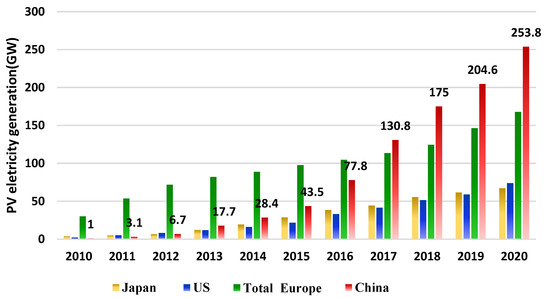
Figure 1.
Solar photovoltaic power generation from 2010 to 2020 in various countries [6].
Since the issue of the “Green Building Evaluation Standard” in 2006, building energy efficiency has received wide attention in China [7]. In particular, renewable energy application in buildings is regarded as one of the focuses in the future [8]. Professor Jiang proposed the transition to a low-carbon energy system based on renewable energy in 2017 [9]. China has set a target to reach the peak of carbon dioxide emissions by 2030 and carbon neutrality by 2060 [10]. Therefore, it is critical to adopt clean energy sources in the building sector to reduce carbon emissions. Of many sources of carbon emission, the heating, ventilation, and air-conditioning (HVAC) system accounts for 50%–70% of building energy consumption [11]. Therefore, it is an important area to be considered in building energy reduction. Since many emerging energy resources come from solar energy, the rational development and utilization of solar energy resources are essential to solving future energy shortage problems [12]. The application of the solar-assisted heat pump in buildings can reduce building energy consumption by utilizing solar energy to power the HVAC system/improve the HVAC system’s efficiency.
The solar heat pump technology was developed with the breakthrough in monocrystalline silicon cells and selective solar absorptive coatings in the 1950s using solar energy as the heat source [13]. Since then, the concept of the direct expansion solar-assisted heat pump (DX-SAHP) and other types of solar-assisted heat pump systems (SAHP) with single or multiple heat sources including solar energy have been proposed [14,15]. Typically, a SAHP system is an integration of a traditional heat pump and solar thermal panels, which function as a low-temperature heat source. The heat produced is used to feed the evaporator. Due to a higher evaporator temperature, their coefficients of performance (COPs) are much higher than those of traditional heat pumps. In addition, with multiple heat sources, SAHPs can work stably under different climatic conditions [16]. A large number of experimental and theoretical studies and system optimizations have subsequently been conducted in developed countries [17,18,19]. By comparison, China’s research on SAHPs started later in the 1980s [20]. At the beginning of the 21st century, Ji and Pei et al. [15] conducted comprehensive research on photovoltaic electric/thermal heat pumps. Since then, many universities and research institutes have carried out studies on SAHPs leading to great progress theoretically and practically [21].
China has a vast territory with rich solar energy resources [22]. There are five climatic regions in China: the severe cold region, cold region, hot summer and cold winter region, mild region, and hot summer and warm winter region [23]. The total annual solar irradiations vary in the range of 3340 MJ/m2~8400 MJ/m2 across the countries, with a median value of 5852 MJ/m2. High solar irradiations are distributed across different climatic regions including Qinghai (severe cold region), Xinjiang (severe cold region and cold region), southern Ningxia (cold region), Gansu (cold region), southern Inner Mongolia (severe cold and cold region), northern Shanxi (cold region), Liaoning (severe cold region), southeastern Hebei (cold region), southeastern Shandong (cold region), southeastern Henan (cold region), western Jilin (severe cold region), central and southwestern Yunnan (mild region), southeastern Guangdong (hot summer and warm winter region), southeastern Fujian Guangdong (hot summer and warm winter region), eastern and western Hainan Island (hot summer and warm winter region), and Qinghai-Tibet Plateau(severe cold region and cold region). Although they have abundant solar energy resources, in most areas their economy is less developed. In the more developed regions of China, the advantages of solar energy resources are not obvious, and SAHP development is driven by the local heating energy demand and financial support for clean energy systems from governments [24].
The research and development of SAHP and its application in buildings in China are quite different from that of other countries due to China’s complex climatic conditions and economic situation. Therefore, it is important to carry out a comprehensive and systematic review of the research and development of SAHP in China. Firstly, this paper introduces the different stages in the research and development of SAHP for buildings in China. Secondly, the research on different types of heat pumps, the core components of heat pumps, the computer software used, and the economic feasibility evaluation of solar-assisted heat pumps is presented. Thirdly, the application of SAHP in practical projects is examined and the relevant regulations, standards, and policies for solar-assisted heat pump development in China are highlighted. Finally, recommendations for the future developments of solar-assisted heat pumps in China are suggested.
2. Stages of SAHP Research in China
Developed countries such as the United States, Japan, and Denmark have conducted a large number of studies on SAHP since it was first proposed in 1955. The research on SAHP started late in China, and the renewable energy applications in China are still in a rapid development stage [25]. The following section summarizes the publication trend for SAHP research in China in recent decades and divides it into four stages according to the research topics and timelines.
2.1. Research Publication Trend from 1981 to 2021
This review searched the literature published in databases including CNKI, Web of Science, Baidu, and Google Scholar and focused on SAHP research in China from 1986 to 2021. A total number of 1224 publications were found (Figure 2), and after careful selection within the areas of the building environment, energy consumption, numerical simulation, experimental and theoretical analysis, policy and system optimization, based on the quality and authority, e.g., from core collections of the Chinese literature database, government official websites, and the Science Citation Index (SCI) database, 153 representative papers and electronic documents were selected. It should be noted that the primary purpose of this review is to focus on the research and development of SAHPs in the building sector, and therefore theoretical analyses of the application of heat pumps in other areas such as drying and dehumidification were excluded.
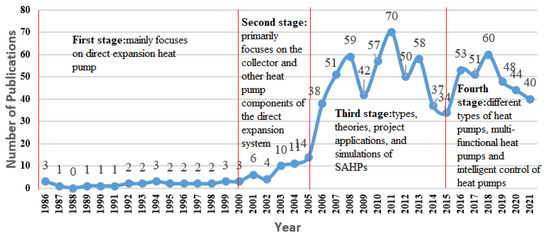
Figure 2.
Publication trends from 2010 to 2021.
From Figure 2, it can be observed that fewer than ten papers were published annually before 2000, meaning renewable energy resources did not receive much attention during that time period. In 2005, the enactment of the Law of Renewable Energy of the People’s Republic of China greatly supported the large-scale application of solar, thermal, and photovoltaic electric power in China [26]. This appears to have stimulated research on SAHP with relatively steady growth in publications. With the implementation of the National Tenth Five-Year Plan, the development of clean energy represented by solar, thermal, and photovoltaic power generation was formulated as an important national energy development strategy. With governmental support, more and more studies were devoted to SAHPs [27]. The rapid rise of the solar industry in China was attributed to the favorable world economic environment and government policies. However, during the period from 2008 to 2014, the emergence of the global financial crisis had a significant impact on the new energy industry. Meanwhile, due to a lack of innovations and core technologies, the overall quality and technological level were low, compared with developed countries, leading to overproduction in solar-related industries in China [28]. In 2013, photovoltaic product demand was less than 60% of its output, and the polysilicon industry supply exceeded 67% of market demand by the end of the year [29]. The bankruptcy of the largest photovoltaic company in China was indicative of the overproduction of PV industries reaching their peak level. This fluctuation appears to be reflected in the number of publications during this same period. With the promulgation of relevant subsidy policies for the solar energy industry by the central government after 2014, research on SAHPs again became more prominent and the number of publications has been on the rise since 2015.
2.2. Research Topics in Different Periods
From the literature survey, it was found that Chinese scholars began to carry out experimental studies on the SAHP manufactured by Hitachi in 1985 and then gradually conducted some theoretical research on SAHP [30]. According to the research topics and timelines, the SAHP research can be divided into four stages.
The first stage of the study lasted from 1985 to 2000. The main research topics and timelines are shown in Figure 3. At this stage, the research mainly focuses on direct expansion heat pumps. Although few research outcomes were presented during this period, they did provide important references for future theoretical and experimental research. The representative research results of the first stage are the performance outcomes of the DX-SAHP system. The technical difficulty of this research stage is that, in conventional SAHPs, the solar collector and heat pump are used to operate as two separate units with high energy losses.

Figure 3.
Timeline of SAHP research between 1985 and 2000.
The second stage was from 2001 to 2005 when the research on the SAHP system expanded considerably. Figure 4 categorizes the areas of research during this period. It can be seen from Figure 4 that the research primarily focuses on the collector and other heat pump components of the direct expansion system [31]. At the same time, preliminary research was carried out on different types of SAHPs, such as multiple heat sources and non-direct expansion heat pumps, which lays good foundations for subsequent studies [32]. The representative research results of the second stage are the optimization of the heat exchanger and solar heat collector. The technical difficulties of this research stage are the lack of more environmentally friendly refrigerants, standard system application specifications, and fixed heat sources, which make it impossible to greatly improve the thermal efficiency of the system.
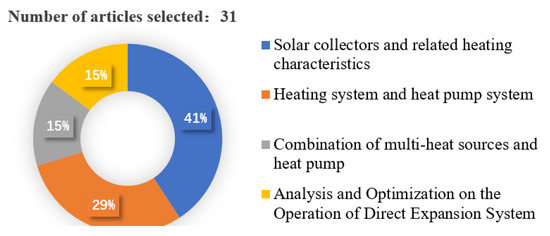
Figure 4.
Categories and contribution proportions of SAHP research between 2001 and 2005.
The third stage is from 2006 to 2015, which is a period of development with some fluctuation. During this period, fruitful theoretical achievements were made in the types, theories, project applications, and simulations of SAHPs. The main research categories and corresponding contributions are presented in Figure 5. It can be observed that a large proportion of the studies still focus on direct expansion systems and a small proportion of them concentrates on experimental research on non-direct expansion systems. In addition, multi-functional SAHPs such as the photovoltaic thermal (PV/T) system, the photovoltaic solar energy system, ground source auxiliary, and other new types of SAHPs have become the focus of research in this period due to their high efficiency and ability to meet different operating conditions [33,34]. The representative research results of the third stage are the design of multiple heat source systems, e.g., solar-assisted ground source heat pumps (SGHP), and the emergence of various high-efficiency heat and electricity cogeneration systems. The technical difficulties of this research stage are the low system thermal efficiency and low system application rate due to cost factors such as material prices, inadequate information to gather collectors’ lifespans and performances under high temperature operating conditions, and the experimental verification of numerical models.
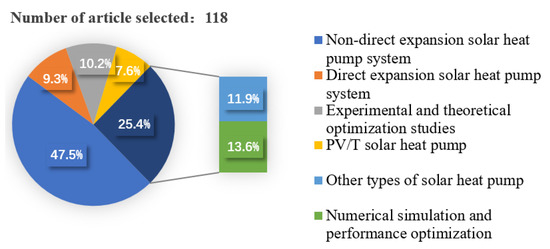
Figure 5.
Categories and contribution proportions of SAHP research between 2006 and 2015.
The fourth stage is from 2016 to now, which is again a period of rapid development. Figure 6 presents the research categories and contribution proportion during this time. It can be observed that the research focuses switched to different types of heat pumps, multi-functional heat pumps, and the intelligent control of heat pumps. Based on the direct-expansion system, new systems with different connections on the main components of the heat pumps and combinations with various heat sources have been explored, such as the PV/T system, the sewage source heat pump system, the air and solar energy heat pump compound machine, etc. [35,36,37]. In addition, during this period, significant achievements have been made in the application of refrigerants, and many practical projects on SAHPs were carried out. Furthermore, the optimal control of SAHPs has gradually become the research focus. The representative research results of the fourth stage are on the enhancement of the efficiency of the photovoltaic/thermal (PV/T) collector, e.g., micro-channel heat pipes and concentrating heat collectors, as well as automated and intelligent control of the SAHP system. The technical difficulties of this research stage are the integration of wind and geothermal heat sources into SAHP systems and optimization of the system configuration, the integration of terminal units and the SAHP system, and a lack of specific guidelines for SAHP application in the residential sector.
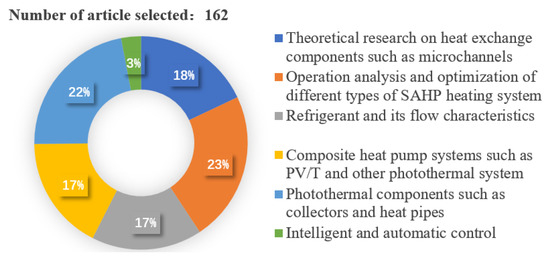
Figure 6.
Categories and contribution proportions of SAHP research between 2016 and 2021.
The research progress on SAHP systems in China can be summarized in Figure 7. It can be concluded that SAHP research in China has undergone significant advancements in heat source selection, theoretical optimization, numerical simulation, etc. New types of systems such as PV/T-SAHP and geothermal auxiliary SAHP systems were developed based on direct expansion and non-direct expansion SAHP systems. Excellent achievements were made after 2015 when the Chinese government proposed a continuous transformation of energy structures and high-quality development with the “Paris Agreement” being signed in December 2015 [38].
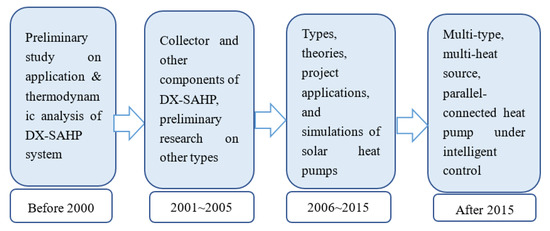
Figure 7.
Research progress on SAHP in China.
More research publications and diverse topics on SAHP can be expected in the next decade as the Chinese government has proposed its goals of achieving carbon peak and carbon neutrality at the United Nations Climate Conference in 2020. Meeting the carbon neutrality targets will bring significant investment in new renewable energy research and projects, which will stimulate Chinese researchers to carry out more in-depth research on SAHP.
3. Research on SAHP
3.1. Research on the Types of Heat Pumps
SAHP technology is an effective combination of solar collectors and traditional heat pumps. The SAHP is based on the transformation of the heat exchanger of the traditional heat pump by utilizing solar energy as the heat source, or combined with other energy sources, to improve the coefficient of performance of the heat pump. From the ways of solar energy utilization, SAHP systems can be divided into photovoltaic-solar-assisted heat pumps (PV-SAHP), photothermal-solar-assisted heat pumps (PT-SAHP), and photovoltaic/thermal-solar-assisted heat pumps (PV/T-SAHP).
The PV-SAHP systems can be divided into direct solar-assisted heat pumps (DX-SAHP), indirect solar-assisted heat pumps (IX-SAHP), and PV/T-SAHP systems, according to the different connection methods and heat collection media. In the DX-SAHP system, the refrigerant flows into the solar collector directly and is heated. The collector is the heat source for evaporation. In the IX-SAHP system, the solar collector and the heat pump evaporator operate independently, and heat is absorbed through a heat exchanger. According to the differences in the connection between the solar heat collection cycle and the heat pump cycle, they can be classified as series, parallel, and dual heat source heat pumps [39,40]. The PV/T-SAHP system simultaneously utilizes solar energy, electric energy, and other forms of ambient energy. PV/T modules are used as a heat collection evaporator combined with an SAHP cycle to realize the comprehensive utilization of solar energy, photoelectricity, and heat, and improve the overall efficiency of the heat pump system [41]. The PV/T system will be one of the focuses of future research.
Table 1 lists the main components for the different types of SAHP systems.

Table 1.
Classification and system components of SAHP systems.
The SAHP system combines solar energy utilization and building energy supply through the heat pump cycle. In the DX-SAHP system, the refrigerant flows directly through the collector/evaporator and then passes through various components such as the compressor to complete a cycle [39]. For IX-SAHP, the solar collector absorbs heat and transfers it to the system evaporator through the heat exchanger. The refrigerant absorbs heat in the evaporator, evaporates, and then passes through the compressor, condenser, and throttle valve to complete a cycle [42]. Compared with IX-SAHP, the application of the collector in the DX-SAHP system makes the system structure more simplified and compact for the following reasons: (1) the refrigerant in the solar collector directly absorbs heat and vaporizes, leading to higher thermal performance; (2) at the same time, the working fluid in the collector is refrigerant instead of water, which can prevent the freezing problem of solar collectors on cold nights [39]; (3) for the collector, the refrigerant absorbs heat and evaporates in the collector, which can maintain a low collector temperature and effectively improve the efficiency of the collector. The disadvantage of DX-SAHP is that the thermal performance of the system is closely related to the change in solar radiation intensity. As the daily solar radiation intensity can vary from 0 W/m2 to 800 W/m2, the thermal performance of the system fluctuates greatly [43]. Figure 8a–d display the system diagrams for DX-SAHP and IX-SAHP in series, parallel, and hybrid connections. In a series system, the solar collector and the heat pump evaporator are connected in series and exchange heat through an intermediate medium. In the parallel system, the solar heat collection system and the heat pump system are connected in parallel, and both can produce hot water [43]. Figure 8e presents the system diagram of a PV/T-SAHP system. Compared with normal photovoltaic-assisted solar heat pumps, the PV/T systems address both the cooling need of photovoltaic modules and the heat absorption need of the evaporator. The solar energy utilization efficiency is significantly improved when the photoelectric and photothermal conversions are carried out at the same time. In addition, the working temperature of the photovoltaic cell is decreased, and the photoelectric efficiency is increased. As the heat source of the heat pump, the PV/T heat collection module increases the evaporation temperature and evaporation pressure of the working fluid of the evaporator so that the coefficient of performance of the heat pump can be improved [44].
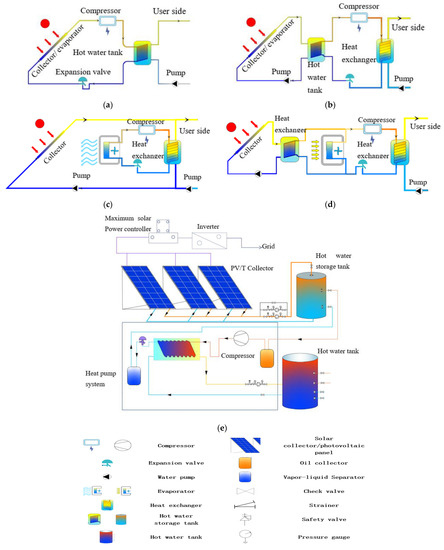
Figure 8.
Different types of SAHPs. (a) Schematic diagram of DX-SAHP; (b) Series connection of IX-SAHP; (c) Parallel connection of IX-SAHP; (d) Hybrid connection of IX-SAHP; (e) PV/T-SAHP [43].
3.2. Research on the Core Components of Heat Pumps
The SAHP system follows the basic reversed Carnot cycle, assuming that the refrigerant gas compression is adiabatic and reversible, so that there is no pressure loss outside the compressor and throttling device, and there is no heat exchange with the ambient environment except with the evaporator and condenser. The theoretical cycle of DX-SAHP can be described as two isobaric heat transfer processes of isentropic compression and adiabatic throttling [42]. In practice, due to the complexity of the system and environmental factors, overheating, subcooling, and pressure drops exist during the refrigerant cycle; therefore, it is much more complicated than the reversed Carnot cycle [40]. The solar collector/evaporator, compressor, and piping system are the core parts of the SAHP. Their performance directly affects the operating efficiency of the entire system. Therefore, they will be separately discussed in the following sections. Meanwhile, the research on heat exchangers and refrigerant flow characteristics will be presented.
3.2.1. Solar-Collector/Evaporator
Current PV/T collector/evaporator research focuses on the heat exchanger where the bare-plate structure is common for most evaporators [45,46,47,48,49,50,51]. As the finned tube structure has the advantages of material saving, lightweight, and high heat exchange efficiency, the tube-fin structure heat collecting evaporator receives wide attention [43]. Figure 9 provides a schematic diagram of a solar collector module. Figure 10 is the cross-sectional view of a heat pipe of a PV collector/evaporator, with Table 2 summarizing the investigations on evaporator-related components by Chinese scholars. Based on the comparison of the systems’ COP, a significant improvement in the system performance can be found after the optimization of the materials and structural configurations of the evaporator.
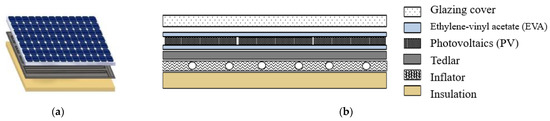
Figure 9.
Structure layered diagram of PV/T collector/evaporator [40]. (a) Structure diagram; (b) Sectional view.
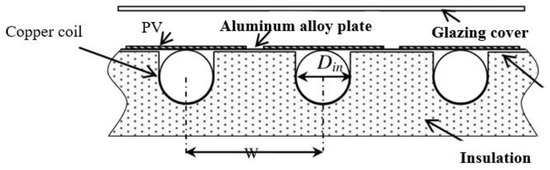
Figure 10.
Cross-sectional view of the heat pipe of the PV collector/evaporator [41].
Table 2.
Investigations on evaporator components of the SAHP system.
The collector/evaporator is responsible for heat collection. At the same time, the working fluid evaporates in the collector/evaporator and absorbs heat from solar thermal conversion and ambient air which increases the evaporator temperature and improves the system COP. Therefore, they are the key components to exploit solar radiation to improve the system’s efficiency. The technical difficulties in the research on collector/evaporators lie in how to improve the absorptivity of the collector/evaporator and their heat transfer performance. The corresponding solutions are to use finned tube structures with high heat exchange efficiency and selective absorption coating for the collector/evaporator.
The above literature survey shows that the improvement of the collector/evaporator and the load matching between the evaporator/condenser and the compressor have always been the focus of the research. Many studies have been carried out on the structural arrangement of vertical copper–aluminum finned tube collector evaporators and fins. Moreover, investigations have been conducted on the arrangement between the heat-absorbing plate and the evaporator, refrigerant selection, and structural optimization of the collector/evaporator. The evaporator structure and material selection have a great influence on the operation of the whole DX-SAHP system.
3.2.2. Operation and Thermal Characteristics of the Compressor
The operating frequency, solar irradiation intensity, and ambient air temperature are the three most important factors that affect the performance of the SAHP. In particular, the performance of the compressor plays a key role in the system’s performance [52]. The matching between different components is very important, especially the matching between the area of the collector/evaporator and the compressor capacity [53]. Table 3 lists the theoretical investigations on the characteristics of the compressor by Chinese scholars. It can be found that the system COP can be improved by adjusting the compressor speed under different working conditions.
Table 3.
Theoretical investigations on the characteristics of the compressor.
The compressor is a fundamental component of the SAHP system, as it is responsible for circulating the refrigerant throughout the system. The choice of the compressor may deeply affect the system’s performance and reliability. The technical difficulties of the research on compressors are how to match the compressor with solar heat gain under different climatic conditions while improving the system performance and also avoiding short-cycling under low load conditions. The solutions are to use variable frequency compressors and using dynamic frequency control.
The above literature survey demonstrates that lots of work has been carried out on the variation of working conditions of the SAHP under ambient environments. It can be summarized that (1) the dynamic matching of the compressor, collector/evaporator, and other components affects the overall performance of the SAHP system, and it is crucial for the improvement of the system COP; (2) the dynamic frequency adjustment strategy on the performance of the compressor is highly sensitive to regional environmental and weather factors. Simply adjusting the operating frequency of the compressor does not lead to a significant improvement in the thermal performance of the system. Further research can be carried out to obtain the optimal variable capacity control strategy by considering multiple influencing factors. In addition, more in-depth experimental tests are needed to optimize the operation modes of multi-functional composite heat pumps such as PV and PV/T heat pumps.
3.2.3. Refrigerant and Its Flow Characteristics
Chlorofluorocarbons (CFCs) are widely used in refrigeration cycles due to their excellent thermodynamic and chemical properties. Considering the ozone depletion potential and the impact of chlorofluorocarbon-containing refrigerants, including CFCs, Hydrochlorofluorocarbons (HCFCs), and Hydrofluorocarbons (HFCs), on the atmospheric environment, the search for suitable environment-friendly and high energy performance refrigerants has been one area of the research focus [62]. Many studies have been conducted on the characteristics of refrigerants in DX-SAHP systems. In China, the production of R11 and R12 has been prohibited, and the production of R22 is based on a quota and will be prohibited in 2030 [63]. Potential alternative refrigerants for R12 include R134A, R152A, R142B, etc., among which R134A is widely used in heat pump air conditioners [64]. Studies have shown that SAHP systems using R-12 and R-22 have the highest COP, and R-134A has the best performance among all the alternative refrigerants. Compared with R-134A, the COPs of all mixed azeotropic refrigerants can be lower by up to 20% [65]. An important research direction in China is to study the use of environmentally friendly refrigerants and their flow characteristics in the heat pump system. Among them, the refrigerant mass flow rate adjustment is of great importance for the efficient operation of the heat pump system [65]. Table 4 shows the recent investigations on the refrigerant of SAHP by Chinese scholars. It can be found that most of the studies focus on R134a, R290a, and R410a. The systems with R134a have the highest COPs under different working conditions. Therefore, it can be considered the best refrigerant and will be widely used in SAHPs.
Table 4.
Recent investigations on the refrigerant of SAHP by Chinese scholars.
The refrigerant is the working fluid in the refrigeration cycle and, as such, is highly important. The technical problem of the research is to find refrigerants with a low environmental impact that leads to high system COP. Environmentally friendly refrigerants are the potential solutions to solve these problems.
Based on the above literature survey, it can be seen that due to the environmental problems caused by HCFCs refrigerants such as R22 and R12, searching for new green and environmentally friendly refrigerants to replace traditional refrigerants has become the focus of the research. Alternative refrigerants including R134a, R152a, R142b, R410a, etc., have been proposed as replacement refrigerants. Among these, it is worthwhile to mention that many studies focused on the application of the R134a refrigerant in the DX-SHAP, especially its influence on energy consumption and system COP. In addition, theoretical and experimental studies on the application of new refrigeration cycles such as transcritical CO2 to SAHP systems, as well as research on the flow characteristics of new environmentally friendly refrigerants in PV/T-SAHP systems, are relatively few in China. As the physical properties, charging capacity, and type of refrigerant are important factors affecting the COP and energy consumption of the system, more investigation on its operating performance and system optimization are needed.
3.2.4. Performance of the Dual-Source Heat Pump
The heat exchange performance of the heat pump system is very important to improve the operation performance of the heat pump and antifog in cold winter. Chinese scholars have carried out experimental and theoretical studies on the heat exchange performance for different types of SAHPs, including solar-assisted air source heat pumps, solar-assisted soil-source heat pumps, solar-assisted water source heat pumps, etc. [78,79]. Table 5 lists the relevant studies on the performance of the dual-source SAHPs by Chinese scholars.
Table 5.
Relevant studies on the heat exchange performance of SAHPs by Chinese scholars.
Based on the above survey of the literature, it can be concluded that the coupling of solar energy and other heat sources needs to take advantage of the abundance of energy sources in the specific region. This is because multi-energy-source heat pumps usually have higher COPs than that of single-source heat pumps. Few papers have focused on the intelligent control of the SAHPs; although, it is very important to match the dynamic user demand and achieve energy saving in practice. More studies are needed to optimize the capacity matching among all the components of the heat pump to achieve high system energy efficiency.
3.3. Research on the Performance of SAHP
Different commercially available software and programming language have been used by scholars to conduct simulations of the performance of the SAHP system, among which TRNSYS was most favored by the researchers due to its ability to dynamically simulate the annual building thermal load, heating/air conditioning system operation, solar energy system, ground source, hybrid connection SAHP performance, etc. Table 6 lists representative numerical studies on SAHP systems and the programs used by the researchers.
Table 6.
Numerical studies on the SAHP system by Chinese scholars.
Figure 11 lists the simulation platforms/programming languages adopted by the researchers. It can be found that a large proportion of the computer models were developed under the TRNSYS/MATLAB environment. TRNSYS is most favored by researchers for whole system performance analysis, while MATLAB is welcome for analyzing the operating characteristics of a certain component in the SAHP system and the dynamic energy performance under different environmental conditions. The CFD software, such as ANSYS and Fluent, is used to perform analysis of indoor thermal and humidity environments.
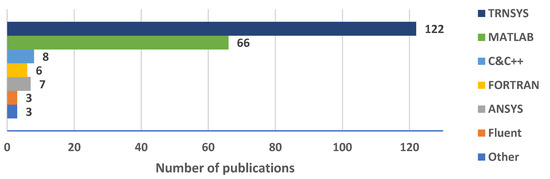
Figure 11.
Simulation platforms/programming languages adopted by the researchers.
From the literature survey, it can be concluded that current studies focus on whole system operation performance or component level simulation, or indoor environmental condition analysis. Few studies have been conducted to investigate the optimal control strategies and their impact on indoor thermal and humidity, which could be the future direction of research.
3.4. Economic and Feasibility Evaluation
The economic and feasibility evaluation of the SAHP system is also an important area of research. Although the SAHP systems utilize renewable energy, the installation of such systems requires extra costs [100,101]. In addition, the SAHP system might not be able to provide enough cooling and heating when solar radiation is low. In this case, an auxiliary heating/cooling system would be needed, which would result in additional investment costs. Therefore, the economic and feasibility evaluation of the SAHP system is critical. Table 7 lists the relevant studies of SAHP from Chinese scholars.
Table 7.
Economic and feasibility evaluation of SAHP.
From Table 7, it can be found that most of the investigations were on the energy saving potential and economical and environmental analysis of the system, especially the air source heat pump-assisted solar water heating system as it is common and easy to be implemented. Analysis of other types of systems is relatively rare and very little research could be found on exergy analyses of the system, which could be the future research direction.
4. Application of SAHP
The application of SAHP in a certain region is related to the solar power generation capacity in that region. Figure 12 presents the solar power generation by region in China in 2019. It can be observed that solar power generation concentrates in the northwest, east coast, and north China regions. The solar power generation in the northern region of China (north of Qinling and Huaihe River) is much higher than that in the southern region, which could be due to the better local solar energy resources and more supportive government policies in northern regions. As a result, more SAHP projects were developed in northern regions. Table 8 lists the representative SAHP projects in China since 2001 that have been implemented and put into operation. The projects were selected from the national and local government official websites. Those local renewable demonstration projects have been completed and put into operation with proven energy-saving data and benefits. These projects demonstrate innovation and economic and environmental protection benefits compared with traditional projects.
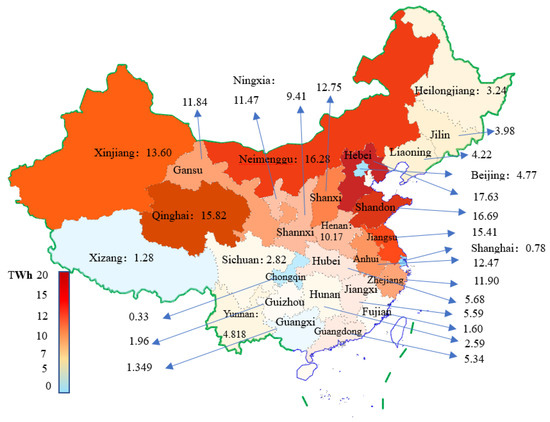
Figure 12.
Solar power generation by region in China in 2019 (TWh) [3].
Table 8.
List of representative SAHP projects in China.
Figure 13 and Figure 14 provide an overview of the Beijing Daxing Village Household Solar Energy + Air Source Heat Pump Heating Retrofit Project and the Solar + Water Source Heat Pump Heating Project of Caina Township Government, respectively.
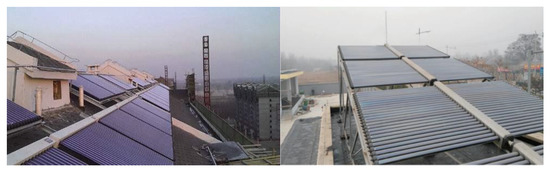
Figure 13.
Overview of the Beijing Daxing Village Household Solar Energy + Air Source Heat Pump Heating Retrofit Project [113].
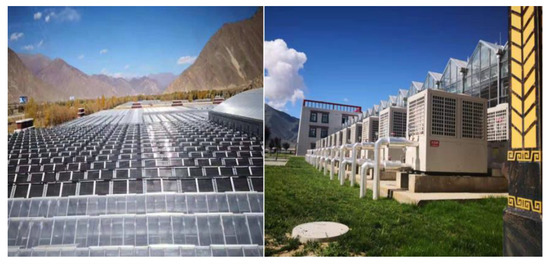
Figure 14.
Overview of the Solar + Water Source Heat Pump Heating Project of Caina Township Government [114].
The above projects point out that in regions with sufficient radiation during the heating season, DX-SAHP is suggested for seasonal heating. In regions with sufficient annual irradiation throughout the year, it is advisable to use solar heating assisted with a dual-source heat pump for heating. In cold regions that required heating most of the time in the year and with insufficient radiation, a combination of a non-direct expansion heat pump system with thermal storage technology as an auxiliary heat source is recommended. Furthermore, most projects are implemented in coastal areas in the east and inland areas with moderate solar energy resources and developed economies. Although solar energy resources are abundant in the northwest regions, southwest regions, and Tibetan regions, very few SAHP projects could be found in these regions. Therefore, to help reach carbon peak and carbon neutrality, it is recommended to promote SAHP projects in these regions.
5. Regulations, Standards, and Policies Related to SAHP
The solar energy industry is part of both the renewable energy industry and the energy-saving industry. Currently, the regulations, standards, and policies for SAHP mainly focus on solar thermal utilization and water heaters. Compared with large-scale solar heat collection projects, the standards and technical regulations of different types of SAHPs and hot water systems still need improvement. It is also important to increase the formulation and implementation of economic policies for SAHPs [116].
5.1. Regulations and Standards for SAHP in China
Table 9 lists the relevant regulations for SAHP in China. It can be seen that early regulations mostly focused on solar energy hot water systems due to their easy installation. “Technical specification for solar photovoltaic and thermal heat pump system (T/CECS 830-2021)” [117] is the first relatively complete technical regulation on the utilization of SAHP in the past ten years. In addition, the mandatory policies of relevant laws and regulations on SAHPs mainly focus on solar thermal utilization.
Table 9.
Relevant regulations and standards in China.
With the proposal of new national strategies for reaching carbon peak and carbon neutrality, a complete technical specification and design standard is needed for solar thermal utilization and SAHP application to support and promote the extensive application of SAHPs in China. In addition, there are very few mandatory policies for solar energy and heat pump engineering technology. Therefore, in the future development of SAHPs, the government still needs to formulate and improve relevant laws and regulations and develop practical guidelines for implementation accordingly.
5.2. Government Financial Subsidy Policy for Solar Industry
The solar photovoltaic industry in China has great development potential with policy-based financial support and market-based financial support. However, due to the high investment risk and uncertain yield in the renewable energy market, market-based financial support is not yet mature enough. Therefore, setting up economic policies that can provide guidance and incentives to the solar energy industry is very important at the early stage [125]. For example, the average photovoltaic power generation cost is about six times that of thermal power. However, among all primary energy sources, the proportion of solar power generation energy has steadily increased. By 2020, the annual solar energy utilization nationwide reached over 1.140 × 10⁸ tons of equivalent standard coal [126]. From 2012 to 2021, the proportion of solar power generation increased from 0.07% to 4% of the total national power generation [127].
The SAHP industry belongs to the new energy industry and renewable energy industry, and the government has been providing special subsidies to solar photovoltaic cells and modules [128]. Article 25 of the “Renewable Energy Law of the People’s Republic of China”, revised in 2009, states that the renewable energy development and utilization projects listed in the National Renewable Energy Industry Development Guidance Catalog are eligible for loan application and can receive financial assistance with discounted loans from financial institutions [26].
Table 10 lists the financial subsidy policies for the photovoltaic solar energy industry from the central government. Financial subsidies for the solar energy industry mainly include subsidies for initial investment, on-grid tariffs, and financial subsidies for technology research and development and personnel training in the photovoltaic industry. The subsidy policies come from many different ministries, such as the National Development and Reform Commission, Energy Administration, and China Development Bank, and the subsidies are not unified [129].
Table 10.
Financial subsidy policies for the photovoltaic solar energy industry from the central government.
In addition to the central government’s subsidies, local governments have also introduced a large number of relevant subsidy policies to encourage the development of the solar industry, which are added to the national subsidies. The subsidies offered by the local governments can be mainly divided into power demand/consumption subsidies and one-time investment subsidies. With the support from the subsidies, the Return On Investment (ROI) of distributed photovoltaic power generation projects can be significantly improved [125]. Table 11 lists the representative subsidies from local governments.
Table 11.
Subsidies from different local governments.
According to the analysis of fiscal policies in Table 10 and Table 11, the number of subsidies from the state and local governments provided to the solar energy industry, especially the photovoltaic industry, is steadily increasing. At the same time, with the national macro policy, the supporting photovoltaic policies in local regions are more active. However, due to poor project supervision and the low entry barrier of this industry, there have been problems such as fraudulent subsidies and fake projects that disrupt the market order, which discourage the enthusiasm of the enterprise [139]. Therefore, financial subsidies for the solar energy industry should move reasonably towards investment subsidies, electricity price subsidies, and consumption subsidies in order to stimulate and develop the clean energy consumption markets [132].
5.3. Fiscal, Tax, and Financial Policies for the Photovoltaic Industry
In terms of income tax, the National Development and Reform Commission has added solar photovoltaic products to the “National Environmental Protection Industry Equipment Product Catalog” which was released in 2010. With this, relevant enterprises can enjoy tax reductions and exemptions in terms of investment credits and accelerated depreciation for equipment [116]. For Value-Added Tax (VAT), when the scale of distributed photovoltaic power plants is small and the monthly online sales revenue is less than CNY 20,000, VAT is exempt. When the annual sales revenue exceeds CNY 500,000, VAT must be paid. According to the notice of the PV power VAT policy issued by the Ministry of Finance and the State Taxation Administration, taxpayers can enjoy a 50% refund of VAT immediately after collection, and enterprises can be exempt from a certain percentage of income tax within a certain period of time [129].
In recent years, the China Development Bank has provided various support for distributed photovoltaic project implementation [125]. The financing methods for solar photovoltaic enterprises mainly include equity financing, debt financing, policy financing, financial leasing, internet crowdfunding, internet wealth management and third-party financing [140], among which bank loans are the primary financing method. In terms of policy financing, the China Development Bank is the leading provider for the new energy industry [141]. As of August 2013, the China Development Bank has provided loans of CNY 4.105 × 10¹¹ to photovoltaic solar energy, and the Bank of China offered CNY 3.01 × 10¹² green finance in 2014, mainly to support wind power and solar photovoltaic industry [142]. As of March 2017, a total of 60 banks across the country have launched “photovoltaic loans” to support the development of the photovoltaic industry, mainly from Zhejiang, Jiangsu, Jiangxi, Shandong, Shanxi Province, etc. [143].
Multiple guidelines and policies have been issued for the use of clean energy in building design and renovation in a number of domestic provinces and cities. For example, the economic policies issued in Hubei, Shandong, and other provinces and cities provide guidance on projects related to solar energy + “multi-energy complementary heat utilization”, cooling, heating, electricity trigeneration, solar/air source energy, ground source, and other clean energy sources.
6. Recommendations for Future Improvement
The vigorous development of the SAHP industry requires the formulation of government policies, the R&D and innovation vitality of enterprises, the fairness and improvement of the market, and the improvement of relevant laws and regulations. Therefore, a good development environment will help the SAHP industry in China step into a more promising future. Some recommendations for future improvement are elaborated as follows.
6.1. Expansion of Research Directions on SAHP
In addition to the traditional research directions on SAHPs, the following areas can be explored in the future: (1) SAHPs + intelligent control and remote monitoring systems, (2) multi-source heat pumps, (3) advanced heat storage and exchange unit (HSEU) technology, (4) advanced machine learning and multi-objective evolutionary optimization models that can be used for performance prediction and optimization of SAHP technology, (5) energy-efficient and low-carbon operation of heat pumps [144]. In addition, in-depth R&D on solar panel arrays, heat pumps with heat recovery, thermal storage and thermal storage technologies, and specific technology case studies can help identify potential ways for promoting the development of SAHPs to meet the requirements of a carbon-neutrality target. For example, the combination of soil source and solar energy heat pump technology, which has dual heat sources, can make the system more flexible and reliable and reduce the power consumption of the compressor [145]. Therefore, the combination of digitalization and intelligence technology for sustainable development may become a future research direction for SAHP.
6.2. Strengthen Industrial Chain Development and Increase the Output of Fundamental R&D
The development of any industry is inseparable from innovation and scientific research outputs. The proportion of transformation of theoretical achievements into practical application projects is relatively low in China, showing a large gap compared with developed countries such as the United States and Europe. Therefore, the experiences from developed countries need to be used. For example, Japan has put great emphasis on the development and protection of core technologies during the development of the solar energy industry with staged support from the state and local governments. During the early development stage, the government subsidizes enterprises to promote technology research and development. After the technology is mature, solar energy products can be introduced into the market, which will effectively reduce the cost of industrial promotion [118]. The Chinese government should increase investment in fundamental research and development of solar energy utilization technology in order to lead breakthroughs in key technologies such as solar cell materials as soon as possible [146].
6.3. Establish Positive Interaction between Local Government and Enterprises and Optimize Industrial Structure
To promote the development of the solar energy industry, it is crucial to building a benign interaction between local governments, the market, and enterprises. The local governments should create a healthy market environment, formulate rules for fair marketing, and replace traditional planning methods with more market economic methods [118]. They also must actively fill the loopholes and fix shortcomings in the market industry chain. It is necessary to supervise the solar energy industrial chain and utilize the advantages of local resources to increase resource utilization efficiency [147]. More policies should be introduced to improve the effectiveness of the role of the local government in SAHP industry development.
To optimize and upgrade the industrial structure, the process of production factors such as capital, labor, land, and technology should flow from the production sectors with low value-added, poor efficiency, and high consumption to those with high value-added, high efficiency, and low consumption. Large solar energy companies with a low production cost and high efficiency can be encouraged to merge with small companies with a high production cost and low efficiency to create a more competitive and vigorous market [148]. More specifically, more support should be provided to the development of the equipment manufacturing industry, parts production enterprises, and technical research and development institutions [149].
6.4. Develop Specific Fiscal and Financial Subsidy Policy for SAHP Industry
So far, no specific fiscal and financial subsidy policies have been developed for the SAHP industry in China. Most of the existing subsidy policies were developed for the solar photovoltaic industry. However, there are some macro policies for the promotion of solar water heaters and solar heating [150,151]. Therefore, the government should develop more flexible and specific subsidy policies for the SAHP industry to promote the application of SAHP in buildings.
The subsidy policies can be made concerning the following aspects: (1) Product subsidy: the government compensates for some of the SAHP products in order to reduce their expenses while increasing their output. As a result, production and consumption grow, but the price remains the same; (2) consumer subsidy: the government subsidizes the consumers to incentivize them to use more SAHP products; (3) employment subsidy: the government gives this incentive to SAHP companies and organizations in order to enable them to provide more job opportunities. The above subsidy policies should be provided based on market needs to avoid overproduction.
7. Conclusions
This paper provides a systematic review of the research, application, regulations, standards, and financial policies related to solar-assisted air heat pumps for buildings in China. Recommendations for the future development of the solar energy industry in China are also provided. The following conclusions can be made based on the literature review:
- (1)
- Current research focuses on the theoretical and experimental investigation of the performance of the main components of the solar air heat pump system, in particular the collector/evaporator, compressor, and heat exchanger, and the characteristics of the refrigerant. More attention should be paid to the intelligent control and optimal operation of the system and integration with buildings to achieve maximum energy savings. In addition, more comprehensive economic and feasibility evaluation studies should be carried out for different types of SAHP systems;
- (2)
- Due to the uneven distribution of solar energy resources and economic growth, the development of SAHP should take advantage of regional resources and complement solar energy with other clean energy resources. The selection of the appropriate type of SAHP in a particular region should consider the climate conditions of that region. It is also important to strengthen the cooperation between enterprises and local governments to increase resource utilization efficiency for the development of SAHP projects.
- (3)
- There is a lack of specific fiscal and financial subsidy policies for SAHP. To promote the application of SAHP in buildings, the government should develop relevant subsidy policies according to the market needs. The subsidy should cover product subsidies, consumer subsidies, and employment subsidies.
Author Contributions
Y.L. and W.Y. contributed to the conception of the study and the development of the methodology. Y.L, Z.B., W.Y., V.F., H.Z. and C.-Q.L. wrote the manuscript. All authors have read and agreed to the published version of the manuscript.
Funding
This work was funded by the Natural Science Foundation of Hubei Province, grant number 2017CFB602.
Institutional Review Board Statement
Not applicable.
Informed Consent Statement
Not applicable.
Data Availability Statement
Not applicable.
Acknowledgments
The authors acknowledge the support from the R&D center of the transportation industry of health and epidemic prevention technology, the Ministry of Transportation of the People’s Republic of China.
Conflicts of Interest
The authors declare no conflict of interest.
Abbreviations
| AS-SAHP | air source solar-assisted heat pump |
| CFC | Chlorofluorocarbon |
| COP | coefficients of performance |
| DSHP | Dual-source heat pump |
| DX-SAHP | direct expansion solar-assisted heat pump |
| EVA | Ethylene-vinyl acetate |
| HCFC | Hydrochlorofluorocarbon |
| HFC | Hydrofluorocarbon |
| HVAC | heating, ventilation, and air-conditioning |
| IX-SAHP | indirect solar-assisted heat pump |
| PT-SAHP | photothermal-solar-assisted heat pump |
| PV | Photovoltaics |
| PV/T | photovoltaic thermal |
| PV/TA + HPWH | PV/T-assisted heat pump water heating system () |
| PV/T-SAHP | photovoltaic/thermal-solar-assisted heat pump |
| PV-SAHP | photovoltaic-solar-assisted heat pump |
| PV-SAHPWH | PV-SAHP water heaters |
| PV-SALHP/HP | photovoltaic solar-assisted loop heat pipe/heat pump system |
| SAHP | solar-assisted heat pump system |
| SAHPMCM | solar-assisted heat pump multifunctional composite machine |
| SASIHPDHW | solar-assisted air source heat pump integrated domestic hot water system |
| SGCHPS | solar-ground coupled heat pump system |
| TEG | Triethylene Glycol |
References
- Castleton, H.F.; Stovin, V.; Beck, S.B.M. Green roofs, building energy savings and the potential for retrofit. Energy Build. 2010, 42, 161–179. [Google Scholar] [CrossRef]
- Wei, X. Literature Review on Building Energy efficiency. Cap. Constr. Manag. Optim. 2019, 31, 13–16. [Google Scholar]
- National Bureau of Statistics. China Energy Statistics; YearbookAppendix 2–10: Total end-use energy consumption. China Statistics Press: Beijing, China, 2021. [Google Scholar]
- China Building Energy Efficiency Association, Building Energy Consumption and Carbon Emission Data Professional Committee. Available online: https://www.cabee.org/site/content/24237.html (accessed on 4 April 2022).
- FS-UNEP Collaborating Centre. Available online: https://www.fs-unep-centre.org/wp-content/uploads/2020/06/GTR_2020.pdf (accessed on 21 April 2022).
- British Petroleum (BP). Available online: https://www.bp.com/content/dam/bp/business-sites/en/global/corporate/pdfs/energy-economics/statistical-review/bp-stats-review-2021-full-report.pdf (accessed on 5 August 2022).
- Yao, R.; Li, B.; Ding, Y.; Liu, M. Overview of green building development. HVAC 2006, 36, 27–31. [Google Scholar]
- Zhang, X. Study on the Application of Renewable Energy in Architectural Design. Des. Case 2020, 3, 1–7. [Google Scholar]
- Jiang, Y. China Urban Energy 2050. New Energy Econ. Trade Watch. 2017, 12, 26–27. [Google Scholar]
- Xi, J. Speech at the general debate of the 75th session of the United Nations General Assembly. Bull. State Counc. People’s Repub. China 2020, 28, 5–7. [Google Scholar]
- Chua, K.J.; Chou, S.K.; Yang, W.M.; Yan, J. Achieving better energy-efficient air conditioning—A review of technologies and strategies. Apply Energy 2013, 104, 87–104. [Google Scholar] [CrossRef]
- Xu, T. Parameter Matching and Scheduling Optimization of Solar Heat Pump Hot Water System. Master’s Thesis, Hangzhou University of Electronic Science and Technology, Hangzhou, China, 2021. [Google Scholar]
- Zhao, Y. Overview of the development of solar energy utilization and future trends. China Electr. Power 2003, 36, 63–70. [Google Scholar]
- Sporn, P.; Ambrose, E.R. The heat pump and solar energy. In Proceedings of the World Symposium on Applied Solar Energy, Phoenix, AZ, USA, 1–5 November 1955. [Google Scholar]
- Pei, G. Comprehensive Performance Study of Photovoltaic a Solar Heat Pump System and Multifunctional Heat Pump System. Ph.D. Thesis, University of Science and Technology of China, Anhui, China, 2006. [Google Scholar]
- Badiei, A.; Golizadeh Akhlaghi, Y.; Zhao, X.; Shittu, S.; Xiao, X.; Li, J.; Fan, Y.; Li, G. A chronological review of advances in solar assisted heat pump technology in 21st century. Renew. Sustain. Energy Rev. 2020, 132, 110–132. [Google Scholar] [CrossRef]
- Kara, O.; Ulgen, K.; Hepbasli, A. Exergetic assessment of direct-expansion solar-assisted heat pump systems: Review and modeling. Renew. Sustain. Energy Rev. 2008, 12, 1383–1401. [Google Scholar] [CrossRef]
- Omojaro, P.; Breitkopf, C. Direct expansion solar assisted heat pumps: A review of applications and recent research. Renew. Sustain. Energy Rev. 2013, 22, 33–45. [Google Scholar] [CrossRef]
- Zu, W.; Li, Q. Solar heat pump development status and application analysis at home and abroad. Proceeding of the 17th Academic Exchange Conference of the Building Thermal Power Branch of the Architectural Society of China, Taiyuan, China, 8 October 2011. [Google Scholar]
- Zhang, Q.; Tetsu, F. Exergy analysis for heat pump and exergy efficiency of solar heat pump. Acta Energ. Sol. Sin. 1985, 6, 333–340. [Google Scholar]
- Liu, P.; Guan, X.; Mu, Z.J.; Ma, H. Research and development of solar heat pump technology in China. Adv. Chem. Eng. 2009, 28, 328–333. [Google Scholar]
- Luo, Y.; He, X.; Wang, C. Solar Energy Utilization Technology, 9th ed.; Chemical Industry Press: Beijing, China, 2013. [Google Scholar]
- Ministry of Housing and Urban-Rural Development of the People’s Republic of China. Uniform Standard for Design of Civil Buildings (GB 50352-2019); China Construction Industry Press: Beijing, China, 2019. [Google Scholar]
- Xu, Z. Adaptability Research and Optimization of Solar Heat Pump Hot Water System in Different Climate Regions. Master’s Thesis, Taiyuan University of Technology, Taiyuan, China, 2021. [Google Scholar]
- Bu, Z.; Sun, D.; Lin, B.; Lin, W.; Yang, J. Practice and innovation: A review of green building development in China. HVAC 2012, 42, 1–8. [Google Scholar]
- National Energy Administration. Available online: http://www.nea.gov.cn/2017-11/02/c_136722869.htm (accessed on 4 April 2022).
- Wang, Y.; Xu, X.; Li, C.; Li, D.; Wang, J. Study on the amount and replacement ratio of conventional energy for renewable energy building applications. Build. Sci. 2020, 36, 100–106. [Google Scholar]
- Zhang, C. Opportunities and challenges of China’s solar industry under the financial crisis. Mark. Res. 2008, 9, 7–13. [Google Scholar]
- Xiao, X. Ways, obstacles and policy suggestions for the transformation and upgrading of the photovoltaic industry—An investigation based on Wuxi Hairun. China Econ. Trade Her. 2014, 16, 49–52. [Google Scholar]
- Liu, M.S. Solar heat pump type air conditioner. Refrigeration 1986, 1, 89. [Google Scholar]
- Hou, X. Study of Solar-Soil Source Heat Pump System in the Middle and Lower Reaches of Yangtze River in Winter. Master’s Thesis, Huazhong University of Science and Technology, Wuhan, China, 2005. [Google Scholar]
- Kuang, Y.; Li, Y.; Wang, R.; Zhang, X. Experimental study on direct expansion solar heat pump air conditioning and hot water system. In Proceedings of the Third Symposium on New Technologies for Refrigeration and Air Conditioning, Hangzhou, China, 20–23 April 2005. [Google Scholar]
- Pei, G.; Ji, J.; He, W.; Sun, W. Performance study of PV/T solar heat pump system. Strateg. Study CAE 2006, 9, 49–56. [Google Scholar]
- Pei, G.; Ji, J.; Liu, K.L.; He, H.F.; Lu, J.P. Characteristics of photovoltaic-solar heat pumps at different condensing water temperatures. J. Univ. Sci. Technol. China 2006, 36, 1044–1050. [Google Scholar]
- Wang, Y. Experimental Study of A Solar-Wastewater Source Composite Heat Pump System. Master’s Thesis, Harbin Institute of Technology, Harbin, China, 2021. [Google Scholar]
- Li, G.; Yu, H.; Zhang, Y.; Yan, H.; Zhang, H.; Jiang, P. PID simulation implementation and experimental analysis of a new solar heat pump compound machine (SAHPM). Acta Energ. Sol. Sin. 2020, 41, 22–26. [Google Scholar]
- Li, H.; Sun, Y.; Fu, X.S. New solar photovoltaic-loop heat pipe/heat pump hot water system. Acta Energ. Sol. Sin. 2020, 41, 22–26. [Google Scholar]
- Peng, X. Clean nuclear energy, green development. South. Energy Constr. 2015, 4, 1. [Google Scholar]
- Huang, W. Theoretical and Experimental Study of Direct Expansion Solar Heat Pump System. Ph.D. Thesis, University of Science and Technology of China, Hefei, China, 2017. [Google Scholar]
- Liu, Y. Research on the Performance of Solar One-Air Composite Heat Source Heat Pump System. Ph.D. Thesis, Xi’an University of Architecture and Technology, Xi’an, China, 2010. [Google Scholar]
- Li, G. Research on the Performance of Solar Heat Pump Water Heater Based on Photovoltaic/Photovoltaic Collector Evaporator. Master’s Thesis, Shanghai Jiaotong University, Shanghai, China, 2018. [Google Scholar]
- Tie, Y. Study on the Thermal Performance and Operational Characteristics of A New Air Source Heat Pump Assisted Heating Solar Water Heating System. Master’s Thesis, Kunming University of Science and Technology, Kunming, China, 2010. [Google Scholar]
- Che, J. Research on Thermal Performance of Direct Expansion Solar Heat Pump Hot Water System. Master’s Thesis, Xi’an University of Architecture and Technology, Xi’an, China, 2019. [Google Scholar]
- Pei, G.; Ji, J.; Liu, K.; He, H.; Lu, J.; Han, C.; He, W. Performance of PV-SAHP under different condensing water temperatures. J. Univ. Sci. Technol. 2006, 36, 1044–1050. [Google Scholar]
- Ji, J.; He, H.; Chow, T.; Pei, G.; He, W.; Liu, K. Distributed dynamic modeling and experimental study of PV evaporator in a PV/T solar-assisted heat pump. Int. J. Heat Mass Transf. 2009, 52, 1365–1373. [Google Scholar] [CrossRef]
- Xu, G.; Zhang, X.; Deng, S. A simulation study on the operating performance of a solar–air source heat pump water heater. Appl. Therm. Eng. 2006, 26, 1257–1265. [Google Scholar] [CrossRef]
- Qin, J.; Ji, J.; Huang, W.; Qin, H.; Modjinou, M.; Li, G. Experimental Study of a Novel Direct-Expansion Variable Frequency Finned Solar/Air-Assisted Heat Pump Water Heater. Int. J. Photoenergy 2018, 2018, 5986463. [Google Scholar] [CrossRef]
- Long, J.; Zhang, R.; Lu, J.; Xu, F. Heat transfer performance of an integrated solar-air source heat pump evaporator. Energy Convers. Manag. 2019, 184, 626–635. [Google Scholar] [CrossRef]
- Cai, J.; Li, Z.; Ji, J.; Zhou, F. Performance analysis of a novel air source hybrid solar assisted heat pump. Renew. Energy 2019, 139, 1133–1145. [Google Scholar] [CrossRef]
- Ji, W.; Cai, J.; Ji, J.; Huang, W. Experimental study of a direct expansion solar-assisted heat pump (DX-SAHP) with finne d-tub e evaporator and comparison with conventional DX-SAHP. Energy Build. 2020, 207, 109632. [Google Scholar] [CrossRef]
- Wang, G.; Quan, Z.; Zhao, Y.; Sun, C.; Deng, Y.; Tong, J. Experimental study on a novel PV/T air dual-heat-source composite heat pump hot water system. Energy Build. 2015, 108, 175–184. [Google Scholar] [CrossRef]
- Kong, X.Q.; Zhang, D.; Li, Y.; Yang, Q.M. Thermal performance analysis of a direct-expansion solar-assisted heat pump water heater. Energy 2011, 36, 6830–6838. [Google Scholar] [CrossRef]
- Qin, J. Experimental Study on the Performance and Frosting of Solar/Air Direct Expansion Inverter Fin Heat Pump Water Heaters. Master’s Thesis, University of Science and Technology of China, Hefei, China, 2017. [Google Scholar]
- Li, Y.W.; Wang, R.Z.; Wu, J.Y.; Xu, Y.X. Experimental performance analysis on a direct-expansion solar-assisted heat pump water heater. Appl. Therm. Eng. 2006, 27, 2858–2868. [Google Scholar] [CrossRef]
- Kong, X.; Wang, B.; Shang, Y.; Li, J.; Li, Y. Influence of different regulation modes of compressor speed on the performance of direct-expansion solar-assisted heat pump water heater. Appl. Therm. Eng. 2020, 169, 115007. [Google Scholar] [CrossRef]
- Pei, G.; Ji, J.; Han, C.; Fan, W. Performance of solar assisted heat pump using PV evaporator under different compressor frequency. In Proceedings of the ISES Solar World Congress 2007: Solar Energy and Human Settlement, Beijing, China, 18–21 September 2007; Volume Ⅱ. [Google Scholar]
- Li, Z.; Huang, X. Simulation analysis of the influence of compressor speed on a solar-assisted heat pump hot water system. Earth Environ. Sci. 2021, 23, 012102. [Google Scholar] [CrossRef]
- Li, Y.; Wang, R.; Wang, T.; Wu, J.; Xu, Y. Thermal performance analysis and optimal design of direct expansion solar heat pump water heaters. J. Sol. Energy 2007, 28, 465–470. [Google Scholar]
- Dong, S. Operation Control and Energy Management of Variable Capacity Direct Expansion Solar Heat Pump Water Heater. Master’s Thesis, Shandong University of Science and Technology, Qingdao, China, 2015. [Google Scholar]
- Dong, Y.; Yang, Y. Simulation study on variable capacity control of direct expansion solar heat pump. Friends Sci. 2013, 12, 7–9. [Google Scholar]
- Li, Y. Optimization Analysis and Variable Capacity Operation of Direct Expansion Solar Heat Pump Hot Water Plant. Ph.D. Thesis, Shanghai Jiao Tong University, Shanghai, China, 2007. [Google Scholar]
- Harby, K. Hydrocarbons and their mixtures as alternatives to environmental unfriendly halogenated refrigerants: An updated overview. Renew. Sustain. Energy Rev. 2017, 73, 1247–1264. [Google Scholar] [CrossRef]
- HVACR. Available online: https://bao.hvacr.cn/202106_2091978.html (accessed on 18 April 2022).
- Liu, N. Research on the Performance of R134a Heat Pump System. Master’s Thesis, Tangshan North China University of Technology, Tangshan, China, 2020. [Google Scholar]
- Xu, X.; Pan, Y.; Deng, S.; Xia, L.; Chan, M. Experimental study of a novel capacity control algorithm for a multi-evaporator air conditioning system. Appl. Therm. Eng. 2013, 50, 975–984. [Google Scholar]
- Zhao, J.; Liu, L.; Li, L.; Zhu, Q.; Tu, F. R134a for direct expansion solar heat pump systems. J. Tianjin Univ. 2000, 33, 303–305. [Google Scholar]
- Kong, X.; Jiang, K.; Dong, S.; Li, Y.; Li, J. Control strategy and experimental analysis of a direct-expansion solar-assisted heat pump water heater with R134a. Energy 2018, 145, 17–24. [Google Scholar] [CrossRef]
- Kong, X.; Zhang, M.; Yang, Y.; Li, Y.; Wang, D. Comparative experimental analysis of direct-expansion solar-assisted heat pump water heaters using R134a and R290. Sol. Energy 2020, 203, 187–196. [Google Scholar] [CrossRef]
- Wang, H.; Zhang, S.; Han, D. Performance comparison of solar-air source composite heat pumps based on R1234yf and R134a refrigerants. Energy Conserv. 2018, 37, 54–60. [Google Scholar] [CrossRef]
- Yang, Y. Experimental Study on the Heat Production Performance of R290 Direct Expansion Solar Heat Pump System. Master’s Thesis, Handong University of Science and Technology, Qingdao, China, 2020. [Google Scholar]
- Ouyang, J. Theoretical Analysis and Optimization Study of Solar-Assisted Transcritical CO2 Heat Pump System. Master’s Thesis, North China Electric Power University, Beijing, China, 2012. [Google Scholar]
- Kong, X.; Dong, S.; Jiang, K.; Li, Y. Experimental system design of propane for direct expansion solar heat pump. Exp. Sci. Technol. 2019, 17, 6–12. [Google Scholar]
- Zhang, D.; Wu, Q.B.; Li, J.P.; Kong, X.Q. Effects of refrigerant charge and structural parameters on the performance of a direct-expansion solar-assisted heat pump system. Appl. Therm. Eng. 2014, 73, 522–528. [Google Scholar] [CrossRef]
- Kong, X.Q.; Li, Y.; Lin, L.; Yang, Y.G. Modeling evaluation of a direct-expansion solar-assisted heat pump water heater using R410A. Int. J. Refrig. 2017, 76, 136–146. [Google Scholar] [CrossRef]
- Jin, X.; Qin, H.; Liu, C. Study on the refrigerant charge of solar/air energy dual source integrated heat pump. Refrig. Air Cond. 2014, 27, 101–106. [Google Scholar]
- Kong, X.; Ma, S.; Ma, T.; Li, Y.; Cong, X. Mass flow rate prediction of direct-expansion solar-assisted heat pump using R290 based on ANN model. Sol. Energy 2021, 215, 375–387. [Google Scholar] [CrossRef]
- Wang, B.; Kong, X.; Yan, X.; Shang, Y.; Li, Y. Influence of subcooling on performance of direct-expansion solar-assisted heat pump. Int. J. Refrig. 2021, 122, 201–209. [Google Scholar] [CrossRef]
- Huang, Z. Research on the Characteristics of Solar and Air Source Composite Heat Pump System; Southeast University: Nanjing, China, 2017. [Google Scholar]
- Wei, Z.; Xu, B. Research on solar--water source heat pump technology. Enterp. Technol. Dev. 2015, 34, 17–20. [Google Scholar]
- Fang, L. Research on the Characteristics of Solar and Air Composite Heat Source Two-Stage Compression CO2 Heat Pump Water Heater System. Master’s Thesis, Zhongyuan Institute of Technology, Zhengzhou, China, 2020. [Google Scholar]
- Hou, J.; Gu, M.; Yang, Q.; Gao, M.; Zheng, M.; Ren, Y. Analysis of economic impact factors of heat pump assisted solar centralized hot water system. J. Lanzhou Univ. 2008, 27, 56–591. [Google Scholar]
- Yang, W.; Shi, M.; Chen, Z. Numerical simulation and experimental validation of energy storage characteristics of solar-U-tube soil. J. Southeast Univ. (Nat. Sci. Ed.) 2008, 38, 651–656. [Google Scholar]
- Wang, H.; Qi, C. Performance study of underground thermal storage in a solar-ground coupled heat pump system for residential buildings. Energy Build. 2008, 40, 1278–1286. [Google Scholar] [CrossRef]
- Han, Z.; Zheng, M.; Kong, F. Simulation study of solar-soil heat storage heat pump heating system in severe cold regions. Acta Energ. Sol. Sin. 2008, 29, 574–580. [Google Scholar]
- Xu, H. Research on the Characteristics of Combined Solar-Ground Source Heat Pump Heating for Residential Buildings. Master’s Thesis, Shanghai University of Applied Engineering and Technology, Shanghai, China, 2015. [Google Scholar]
- Gao, Y.; Sun, Z.; Lin, X.; Wang, C.; Sun, Z.; Chen, Y. Designing and Optimizing Heat Storage of a Solar-Assisted Ground Source Heat Pump System in China. Int. J. Photoenergy 2020, 2020, 4102350. [Google Scholar] [CrossRef]
- Yi, Y. Study on Operational Characteristics of Solar Water Source Heat Pump Composite System. Master’s Thesis, Hunan University, Changsha, China, 2009. [Google Scholar]
- Qu, S.; Wang, D.; Dong, J.; Peng, L. Optimization study of solar water source heat pump system based on TRNSYS. J. Nanjing Univ. Technol. 2015, 39, 494–499. [Google Scholar]
- Li, S. Research on Solar-Water Source Heat Pump Assisted Heating System. Master’s Thesis, Shenyang University of Architecture, Shenyang, China, 2011. [Google Scholar]
- Ma, C. Analysis of the Applicability of Solar-Air-Wastewater Multi-Energy Complementary System in Low-Energy Residential Building Retrofit. Master’s Thesis, Harbin Institute of Technology, Harbin, China, 2020. [Google Scholar]
- Tsai, H.L. Modeling and validation of refrigerant-based PVT-assisted heat pump water heating (PVTA-HPWH) system. Sol. Energy 2015, 122, 36–47. [Google Scholar] [CrossRef]
- Dai, N.; Xu, X.; Li, S.; Zhang, Z. Simulation of hybrid photovoltaic solar assisted loop heat pipe/heat pump system. Appl. Sci. 2017, 72, 197. [Google Scholar] [CrossRef]
- Zhou, J.; Ma, X.; Zhao, X.; Yuan, Y.; Yu, M.; Li, J. Numerical simulation and experimental validation of a micro-channel PV/T modules based direct-expansion solar heat pump system. Renew. Energy 2020, 145, 1992–2004. [Google Scholar] [CrossRef]
- Xu, L.; Luo, X.; Li, M. Study on the matching of heat pump power and heating area of combined solar heat pump heating system in Shangri-La. J. Yunnan Norm. Univ. (Nat. Sci. Ed.) 2020, 40, 20–23. [Google Scholar]
- Wang, X. Research and Application of Control Strategy for Solar-Thermal Pump Hot Water System. Master’s Thesis, Hangzhou University of Electronic Science and Technology, Hangzhou, China, 2020. [Google Scholar]
- Shen, Y. Numerical simulation study of solar/air source heat pump based on TRNSYS. Cent. Air Cond. Mark. 2015, 1, 80–83. [Google Scholar]
- Yin, L. Simulation Study of Solar Coupled Soil Source Heat Pump System Based on TRNSYS. Master’s Thesis, Taiyuan University of Technology, Taiyuan, China, 2013. [Google Scholar]
- Li, Z. Performance Study of Solar Coupled Air Source Heat Pump Integrated Domestic Hot Water System. Master’s Thesis, Taiyuan University of Technology, Taiyuan, China, 2017. [Google Scholar]
- Wei, Y.; Deng, H.; Ma, L. Simulation and analysis of solar heat pump systems. Lab. Res. Explor. 2019, 38, 102–108. [Google Scholar]
- Guan, Q. TRNSYS Simulation and Study of Solar-Storage and Ground Source Heat Pump Hot Water Supply System. Master’s Thesis, Tianjin University, Tianjin, China, 2009. [Google Scholar]
- Guangzhou Energy Research Institute Project Management Office, Comprehensive Planning Bureau, Chinese Academy of Sciences. Progress on the demonstration of solar heat pump central hot water system in the Olympic Village and Olympic venues. Bull. Chin. Acad. Sci. 2004, 19, 360–361+315. [Google Scholar]
- Yu, G.; Zhang, X.; Meng, F. Technical and economic analysis of solar heat pump heating for single-family houses. Build. Energy Effic. 2007, 35, 55–57. [Google Scholar]
- Feng, L. Simulation Study and Economic Analysis of Photovoltaic Solar Heat Pump System. Master’s Thesis, Nanjing University of Technology, Nanjing, China, 2012. [Google Scholar]
- Luo, H.; Tie, Y.; Li, M.; Zhong, H. Study on the thermal performance of air source heat pump assisted heating solar hot water system. Build. Sci. 2009, 2, 52–54. [Google Scholar]
- Jing, Y. Performance Study of Air Source Heat Pump Assisted Solar Water Heating System. Master’s Thesis, Huazhong University of Science and Technology, Wuhan, China, 2015. [Google Scholar]
- Liu, Y. Simulation and Application of Air Source Heat Pump Assisted Solar Water Heating System in Hot Summer and Cold Winter Regions. Master’s Thesis, Chongqing University, Chongqing, China, 2011. [Google Scholar]
- Peng, J. Study on the Energy Saving and Environmental Benefits of Air Source Heat Pump Assisted Solar Water Heating System in Jianghuai Region. Master Thesis, Yangzhou University, Yangzhou, China, 2010. [Google Scholar]
- Li, J.; Li, B. Demonstration application of large scale solar air conditioning/heat pump system. Chin. J. Renew. Energy 2004, 4, 26–27. [Google Scholar]
- Jin, H.; Zhang, S.; Fan, S. Application of solar heat pump system in a hotel hot water system. Build. Energy Effic. Green Build. 2015, 22, 78–81. [Google Scholar]
- Wang, Y.; Wang, Z.; Dong, L.; Zhao, S.; Liu, Z. Introduction to the design elements of solar water source heat pump project in Guangzhou Asian Games City. Water Wastewater Eng. 2011, 37, 76–79. [Google Scholar]
- Li, R.; Chen, Y. Engineering application of ground source heat pump + solar energy + energy storage system. Fly Ash Compr. Util. 2015, 4, 45–47. [Google Scholar]
- Kang, J.; Zhang, M. Ruzhou city soil source heat pump coupled with solar trigeneration demonstration project won the first prize of Henan province construction science and technology progress. Constr. Wall Innov. Build. Energy-Sav. 2015, 8, 71–72. [Google Scholar]
- Yuan, W.; Li, P. Beijing Daxing village household solar + air source heat pump heating renovation project. Constr. Sci. Technol. 2016, 22, 90–91. [Google Scholar]
- Chao, S.; Ding, H. Study on solar+water source heat pump heating project of Lhasa Cai Na Township Government. Heat. Cool. 2019, 4, 52–55. [Google Scholar]
- Liu, Q.; Zhao, L. Operational study of multi-energy complementary cooling and heating system renovation project—Complementary application of ground source heat pump, solar energy and valley power storage system. Constr. Budg. 2020, 11, 76–79. [Google Scholar]
- Xia, Y. Research on the Dilemma and Path of Solar Energy Industry Development in China. Master’s Thesis, Shanghai University of Finance and Economics, Shanghai, China, 2020. [Google Scholar]
- China Academy of Building Research Co., Ltd. Technical Specification for Solar Photovoltaic and Thermal Heat Pump System T/CECS 830-2021; China Planning Press: Beijing, China, 2021. [Google Scholar]
- General Administration of Quality Supervision, Inspection and Quarantine of the People’s Republic of China, National Standardization Administration of China. Specifications of Air Source Heat Pump Assisted Domestic Solar Water Heating System: GB/T 23889-2009; China Standard Press: Beijing, China, 2009. [Google Scholar]
- General Administration of Quality Supervision, Inspection and Quarantine of the People’s Republic of China, National Standardization Administration of China. Technical Specification for Solar Water Heating Systems Assisted by Air Source Heat Pumps (Storage Tank Volume Greater than 0.6 m3): GB/T 26973-2011; China Standard Press: Beijing, China, 2011. [Google Scholar]
- Ministry of Housing and Urban-Rural Development of the People’s Republic of China. Technical Specification for Solar Air Conditioning Engineering in Civil Buildings: GB 50787-2012; China Construction Industry Press: Beijing, China, 2012. [Google Scholar]
- Ministry of Housing and Urban-Rural Development of the People’s Republic of China. Technical Standard for the Application of Solar Water Heating Systems in Residential Buildings (with Notes on Provisions): GB 50364-2018; China Construction Industry Press: Beijing, China, 2018. [Google Scholar]
- National Energy Administration. Test Method for Domestic Direct Expansion Solar Heat Pump Water Heating Systems: NB/T 10155-2019; China Construction Industry Press: Beijing, China, 2019. [Google Scholar]
- Ministry of Housing and Urban-Rural Development of the People’s Republic of China. Solar Heat and Heating Engineering Standard (with Explanatory Notes): GB 50495-2019; China Construction Industry Press: Beijing, China, 2019. [Google Scholar]
- Central People’s Government of the People’s Republic of China. Available online: http://www.gov.cn/zhengce/zhengceku/2020-07/27/content_5530301.htm (accessed on 21 May 2022).
- Geri, L. Research on Investment Benefits and Financial Support for Distributed Photovoltaic Power Generation. Master’s Thesis, North China Electric Power University, Beijing, China, 2016. [Google Scholar]
- Zhang, X. Study on Energy Consumption Transition and its Social, Economic and Environmental Impacts; China Social Science Press: Beijing, China, 2018; p. 80. [Google Scholar]
- National Energy Administration; China Electricity Council; State Grid Corporation of China; China Southern Power Grid Co., Ltd.; China Huaneng Group Co., Ltd.; China Datang Group Co., Ltd.; China Huadian Group Co., Ltd.; National Energy Investment Group Co., Ltd.; State Power Corporation Investment Group Company; China Three Gorges Corporation Limited; et al. China Electricity Yearbook 2021; China Electricity Press: Beijing, China, 2022. [Google Scholar]
- National Development and Reform Commission. Available online: https://www.ndrc.gov.cn/xxgk/zcfb/tz/202004/t20200402_1225031_ext.html (accessed on 27 April 2022).
- Wu, S. Research on the Impact of Financial and Taxation Support Policies on Inefficient Investment in New Energy Industry. Master’s Thesis, Xi’an Petroleum University, Xi’an, China, 2019. [Google Scholar]
- Xie, B. Discussion on the investment efficiency of the Golden Sun demonstration project. Renew. Energy 2011, 29, 160–161. [Google Scholar]
- National Development and Reform Commission. Available online: http://www.gov.cn/xinwen/2016-12/28/content_5153820.htm (accessed on 29 June 2022).
- Ma, J. Research on Fiscal Policies to Promote the Development of Clean Energy in China. Ph.D. Thesis, China University of Geosciences, Beijing, China, 2014. [Google Scholar]
- Beijing Development and Reform Commission. Available online: http://fgw.beijing.gov.cn/so/s?tab=all&siteCode=1100000011 (accessed on 27 April 2022).
- National Energy Administration. Available online: http://www.nea.gov.cn/2014-09/04/c_133620549.htm (accessed on 29 June 2022).
- Shanghai Municipal Development and Reform Commission. Available online: http://service.shanghai.gov.cn/XingZhengWenDangKuJyh/XZGFDetails.aspx?docid=REPORT_NDOC_006422 (accessed on 27 April 2022).
- National Energy Administration. Available online: http://www.nea.gov.cn/2014-09/04/c_133620485.htm (accessed on 27 April 2022).
- Shaanxi Provincial People’s Government. Shaanxi Provincial People’s Government’s implementation opinions on demonstrating and promoting distributed photovoltaic power generation. Shaanxi Prov. People’s Gov. Gaz. 2015, 2, 35–37. [Google Scholar]
- Hangzhou Municipal People’s Government. Available online: http://www.hangzhou.gov.cn/art/2016/7/4/art_1209287_3815.html (accessed on 29 June 2022).
- Wang, L. Simulation of Financial Incentive Policy Innovation and Effects in China’s PV Industry. Master’s Thesis, China University of Petroleum, Beijing, China, 2019. [Google Scholar]
- Ma, Y. Research on the Financing Efficiency and Influencing Factors of Solar Photovoltaic Enterprises in China—Taking Listed Solar Photovoltaic Companies in China as an Example. Master’s Thesis, Northwestern University, Xi’an, China, 2018. [Google Scholar]
- Tang, X. Research on the Efficiency of Financing in China’s New Energy Industry and the Factors Influencing It. Master’s Thesis, Shanxi University of Finance and Economics, Taiyuan, China, 2019. [Google Scholar]
- Yao, Y. Research on the Financing of New Energy Industry Development in China. Master’s Thesis, Sichuan Academy of Social Sciences, Chengdu, China, 2016. [Google Scholar]
- Wang, R. Research on Financial Support for the Development of New Energy Industry in China. Master’s Thesis, Shanxi University of Finance and Economics, Taiyuan, China, 2018. [Google Scholar]
- Fan, Y.; Zhao, X.; Han, Z.; Li, J.; Badiei, A.; Akhlaghi, Y.G.; Liu, Z. Scientific and technological progress and future perspectives of the solar assisted heat pump (SAHP) system. Energy 2021, 229, 120719. [Google Scholar] [CrossRef]
- Wang, J.; Yao, H.; Zhao, S.; Zhang, W. Application and development of soil source and solar heat pump composite system. Dist. Heat. 2021, 2, 85–93. [Google Scholar]
- Li, M.; Gao, L.; Wang, L.; Geng, Q.; Li, Y.; Cui, P.; Ji, J.; Huang, H. The development status and outlook of solar energy utilization technology in China under the goal of emission peak and carbon neutrality. Sol. Energy 2021, 11, 13–18. [Google Scholar]
- Gao, X. A brief analysis of the prospects of solar energy in clean energy in China. Low Carbon World 2021, 11, 6–7. [Google Scholar]
- Yun, G. Analysis of the Current Situation and Market Development Prospects of Commercial Utilization in the New Energy Industry. China J. Commer. 2015, 14, 121–123. [Google Scholar]
- Yang, G. Research on the problems and countermeasures for the development of new energy industry in China. China Strateg. Emerg. Ind. 2018, 44, 1–2. [Google Scholar]
- Shandong Economic and Information Commission Committee and Finance Department. Available online: http://innovation.jinan.gov.cn/art/2018/2/24/art_17708_974536.html (accessed on 4 July 2022).
- Xianning Housing and Urban-Rural Development Bureau. Available online: http://zjj.xianning.gov.cn/xxgk/xxgkml/tzgg/201803/t20180316_1280137.shtml (accessed on 4 July 2022).
Publisher’s Note: MDPI stays neutral with regard to jurisdictional claims in published maps and institutional affiliations. |
© 2022 by the authors. Licensee MDPI, Basel, Switzerland. This article is an open access article distributed under the terms and conditions of the Creative Commons Attribution (CC BY) license (https://creativecommons.org/licenses/by/4.0/).