


20th-Century Award-Winning Buildings in Lisbon (Portugal). Study of Plasters, Rendering, and Concrete Materials Aiming Their Sustainable Preservation
 , ,
, ,  ,
,
Abstract
1. Introduction
- (a)
- Mechanical compatibility. It must be ensured that excessive stress does not develop in covering and jointing cementitious repair materials, failing the support or surrounding pre-existing materials. Excessive stresses should not be transmitted to the pre-existing structural/masonry elements, so the knowledge of the modulus of elasticity, compressive strength, and adhesion characteristics are required.
- (b)
- Physical compatibility. It is related to the capillary rising and drying of water, and the permeability of liquid water and water vapour. In masonry buildings, the water drainage off the support implies that the water vapour permeability must be high, and the capillary absorption of water must be low to moderate with a high drying capacity. Therefore, the porous structure must be evaluated.
- (c)
- Chemical and mineralogical compatibility. It is related to the binder and aggregate types, and their salt content. It is intended that the new mortars and other composite materials used for repair do not give rise to expansive reactions or harmful reaction products, and they do not contain high levels of soluble salts nor favour their crystallisation.
2. The Valmor Prize. Historical Background and Case Studies
2.1. Case Studies Typology and Architectural Features
2.2. Historical Records
3. Methodology
3.1. Visual Inspection, Sampling, and In Situ Testing
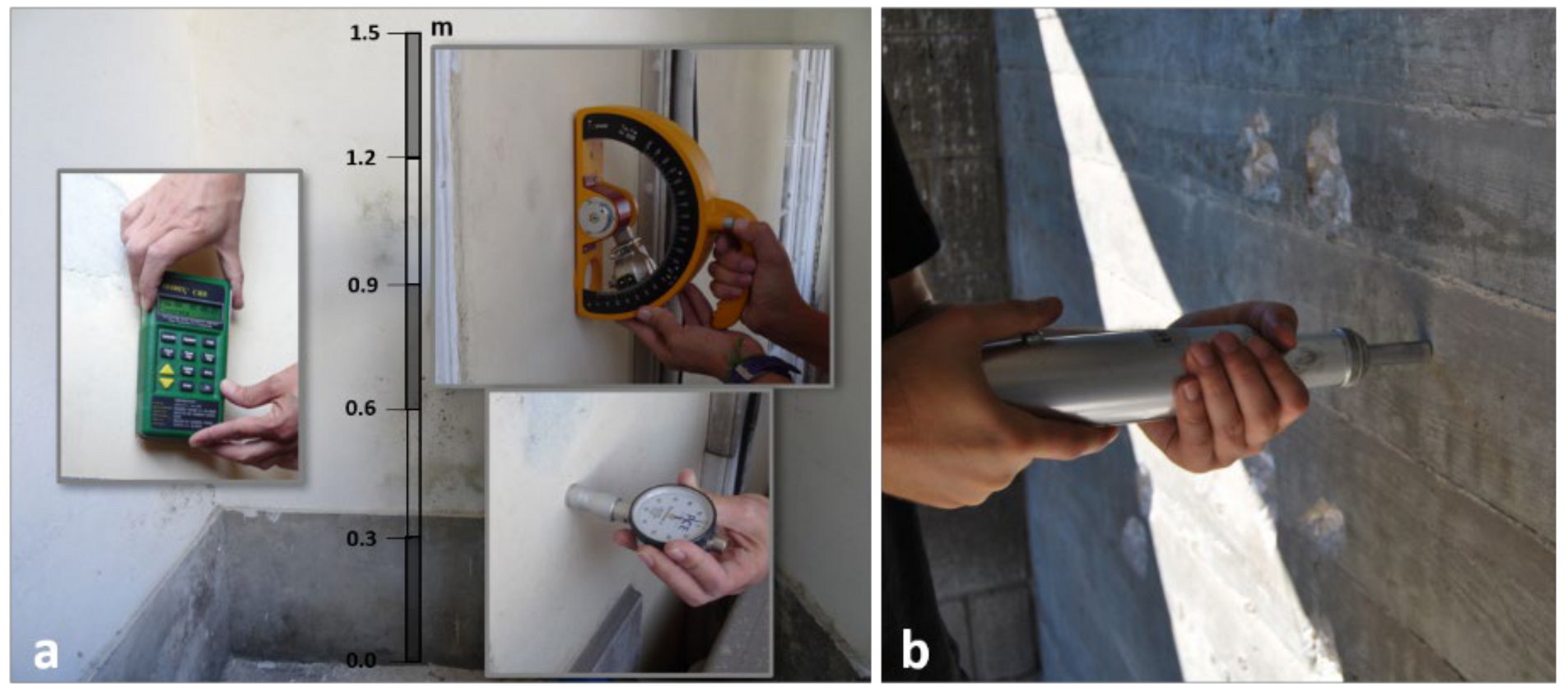
- Identify the main macroscopic characteristics of buildings’ renderings and plasters, namely thickness, and the number of layers, and measure the cover thickness and the carbonation depth in concrete samples.
- Assess the state of conservation of buildings’ renderings, plasters, and visible concrete surfaces.
- Mineralogical analysis by X-ray diffraction (XRD) for phase identification of the binder and the aggregates, complemented with simultaneous thermogravimetry and differential thermal analysis (TG/DTA) to confirm XRD results and to estimate the proportion of some compounds.
- Optical microscopy to identify pozzolanic additives and neoformation products, and the type of the binder since the binder-related particles and raw material remnants can be identified by petrographic observations.
- Microstructural observations with scanning electron microscope equipped with X-ray microanalysis (SEM-EDS) will provide additional information on the morphology and chemical composition of the mortar and concrete constituents.
- Wet chemical analysis to separate the soluble from the insoluble fraction (siliceous sand). The insoluble fraction is also used to obtain the grain size distribution of the sand and to estimate the binder/aggregate ratio. If carbonate aggregate is present, the petrographic point-counting technique will be used to estimate its proportion. Regarding the soluble fraction, atomic absorption spectroscopy (AAS) may be carried out to obtain the content of soluble salts.
- Physical and mechanical tests will be accomplished, and the data extracted for the formulation of a compatible material similar to the pre-existing one must ensure a satisfactory performance. Test methods should at least include capillary water absorption, drying, compressive strength, open porosity, and ultrasonic pulse velocity.
3.2. Anomalies’ Survey
3.3. State of Conservation Classification
3.4. Age, Materials, and Degradation Relationship over Time
4. Results
4.1. Diagnosis and State of Conservation Assessment
4.1.1. Renders and Plasters
4.1.2. Reinforced Concrete

| Case Study | FRAN (1971) | ISCJ (1975) | |||||
| Location | E facade. Rear windows’ precast panels | E facade | Terrace over the gallery (1st floor) | 3rd floor staircase level | 6th floor. Entrance door | Nave’s ceiling | |
| Image |  | 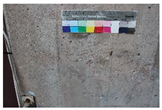 | 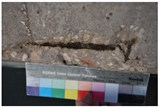 | 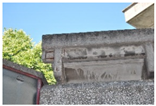 | 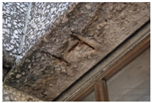 |  | |
| Detected anomalies | Biological growth; spalling | Erosion | Spalling | Stains; biological growth; spalling | Spalling | Moisture and corrosion stains | |
| Case Study | JRP (1987) | ||||||
| Location | Indoor garden | Children’s day care building | Exterior passage between buildings | Indoor garden | W side building | ||
| Image | 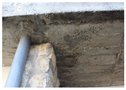 |  | 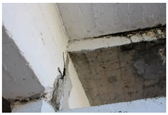 | 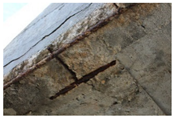 | 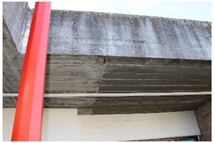 | ||
| Detected anomalies | Honeycombing; stains | Flatness defects; efflorescences | Oriented cracking (>3mm); spalling; corrosion stains, biological growth | Spalling | Stains; oriented cracking (<0.5 mm) | ||
| Case Study | PCV (1998) | C8 (2000) | |||||
| Location | E facade | E facade | W facade | N facade | N high block facade | S facade. 7th level | |
| Image | 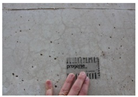 |  |  | 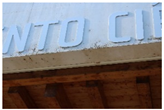 | 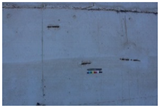 | 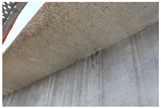 | |
| Detected anomalies | Mapped cracking; bug holes | Oriented cracking (<0.5 mm) | Flatness defects | Crust; corrosion stains | Spalling; flatness defects; dirt stains | Moisture and dirt stains | |
| Case Study | C8 (2000) | AS (2001) | UNL (2002) | ||||
| Location | N facade | W facade | E facade | Restaurant area, level 0 | Car parking, level −3 | Car parking, level −4 | Technical area, level −1 |
| Image |  | 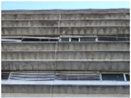 |  | 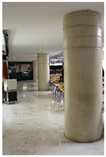 | 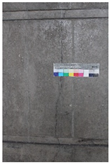 | 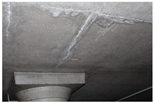 |  |
| Detected anomalies | Moisture and dirt stains | Dribbling; Moisture stains | Wear | Oriented cracking (<0.5 mm) | Dribbling; efflorescences | Fastening marks | |
| Case Study | IRF (1938) | DN (1940) | LIP (1958) | EUA53 (1970) | FCG (1975) | JRP (1987) | PCV (1998) | C8 (2000) |
|---|---|---|---|---|---|---|---|---|
| Age (years) | 83 | 81 | 64 | 52 | 52 | 34 | 23 | 21 |
| Concrete cover thickness (mm) | ||||||||
| min | 30.0 | 20.0 | 10.0 | 21.0 | 35.0 | 25.0 | 20.0 | 24.0 |
| max | 70.0 | 45.0 | 74.3 | 30.0 | 65.0 | 67.0 | 50.0 | 75.0 |
| average | 52.5 | 35.0 | 31.7 | 27.7 | 48.6 | 43.3 | 36.5 | 47.3 |
| Carbonation depth (mm) | ||||||||
| min | 15.0 | 0.0 | 1.0 | 0.0 | 0.0 | 4.0 | 4.0 | 1.0 |
| max | 45.0 | 50.0 | 31.0 | 3.0 | 3.0 | 31.0 | 35.0 | 15.0 |
| average | 26.9 | 10.5 | 15.3 | 1.2 | 1.5 | 12.2 | 15.8 | 6.1 |
| Case Study | FRAN (1971) | ISCJ (1975) | PCV (1998) | C8 (2000) | AS (2001) | UNL (2002) |
|---|---|---|---|---|---|---|
| Age (years) | 52 | 51 | 23 | 21 | 24 | 19 |
| Compressive strength (MPa) | ||||||
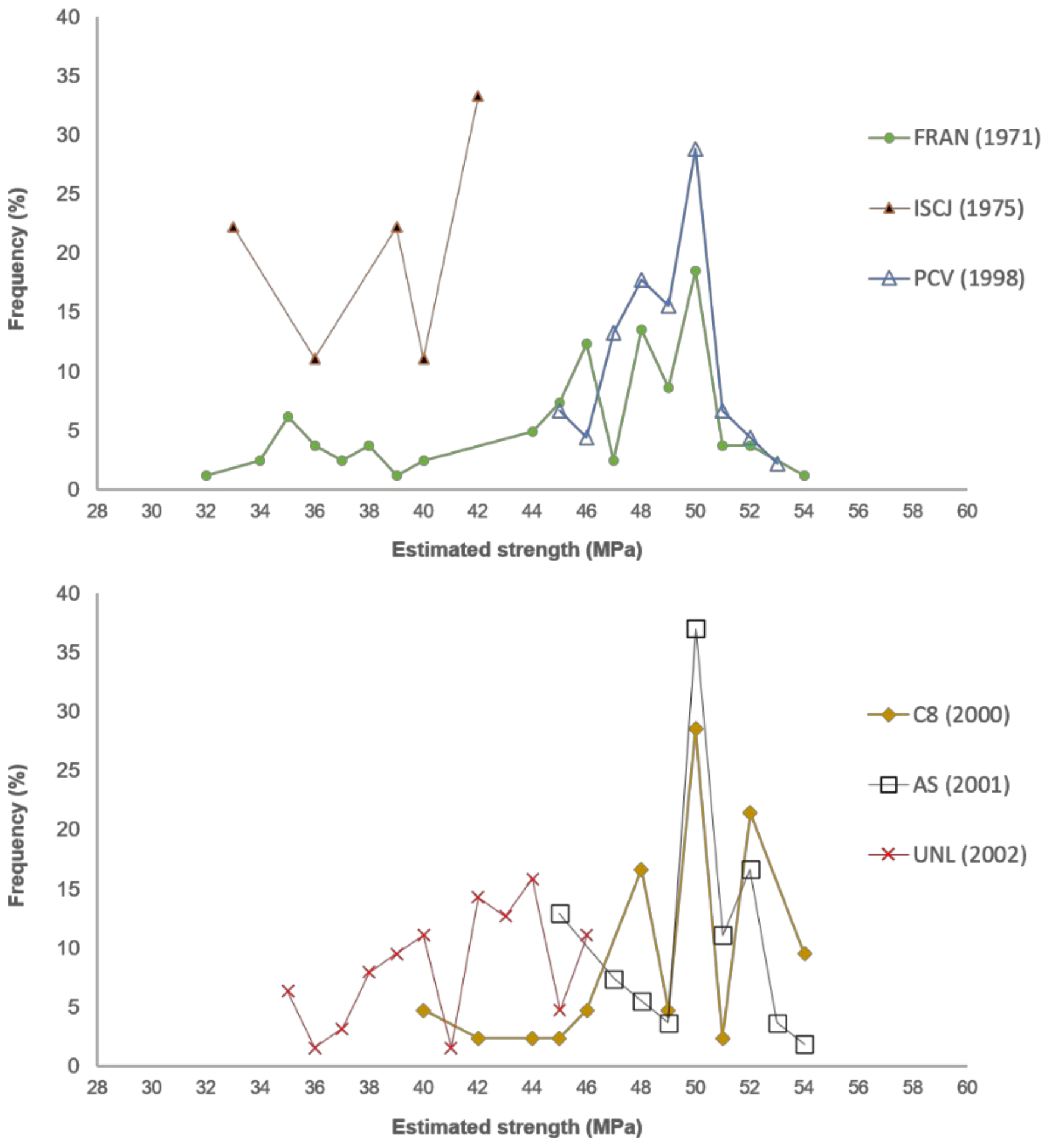
| min | 32.0 | 33.0 | 45.0 | 40.0 | 45.0 | 35.0 |
| max | 54.0 | 42.0 | 53.0 | 54.0 | 54.0 | 46.0 |
| median | 47.0 | 39.0 | 49.0 | 50.0 | 50.0 | 42.0 |
| Concrete cover thickness (mm) | ||||||
| min | 17.0 | (a) | 40.0 | 24.0 | 25.0 | 25.0 |
| max | 50.0 | (a) | 65.0 | 33.0 | 85.0 | 65.0 |
| average | 34.1 | (a) | 54.8 | 27.3 | 49.2 | 42.3 |
| Carbonation depth (mm) | ||||||
| min | 1.0 | 3.0 | 1.0 | 6.0 | 1.0 | 0.0 |
| max | 25.0 | 20.0 | 8.0 | 10.0 | 9.0 | 25.0 |
| average | 11.4 | 10.7 | 2.5 | 8.2 | 2.6 | 16.3 |
5. Discussion
5.1. Renders and Plasters
- The physical degradation mechanisms due to the water action are the main causes of anomalies found in PRCBs. Though in RCBs, those mechanisms contribute to degradation with a lower prevalence, as seen by the extension of degradation, which is usually lower in comparison to PRCBs;
- The loss of adhesion and cohesion, which lead respectively to detaching and disaggregation, are the most serious anomalies found in PRCBs. The migration and crystallisation of soluble salts (efflorescences and cryptoflorescences) are sometimes found in the walls due to capillary rising water from the underground on the lower building floors. The inefficient connections between elements (e.g., roofs/eaves; terraces/walls) aggravate the infiltrations, as well as the deficient channeling of water off the buildings;
- Stains are frequently found in external facades of PRCBs and RCBs due to moisture, dirt, and biological action, as a result of the environmental exposure;
- Cracking is also present, mainly as a result of shrinkage and water action in the early stages of detaching process. Cracking can also be associated with the presence of salts and corrosion of reinforced concrete elements;
- The surface hardness results do not corroborate in general the degradation observed, which is probably due to the multilayer system found in the tested wall coverings;
- No relationship between the age and the state of conservation was found, since the studied buildings have, in general, a reasonable state of conservation. However, in comparison to RCBs, PRCBs’ renders and plasters show a higher degree and extension of degradation, including severity as well, which is mainly related to water action as already mentioned;
- Despite the anomalies surveyed, their degree and extension in both types of buildings are not persistent nor generalised. This condition, despite the age of the buildings, may reflect the good selection of materials and careful construction, as it could be a characteristic of the awarded buildings. In addition, more care with maintenance than in the case of common buildings of the same period would have been beneficial.
5.2. Reinforced Concrete
- Changes of colour and shape are the most common anomalies detected. Colouration, similar to moisture stains, were mainly caused by water runoff, while the corrosion stains are mainly related to spalling, indicating ongoing corrosion of rebars phenomena, and being more worrying than moisture stains in terms of durability;
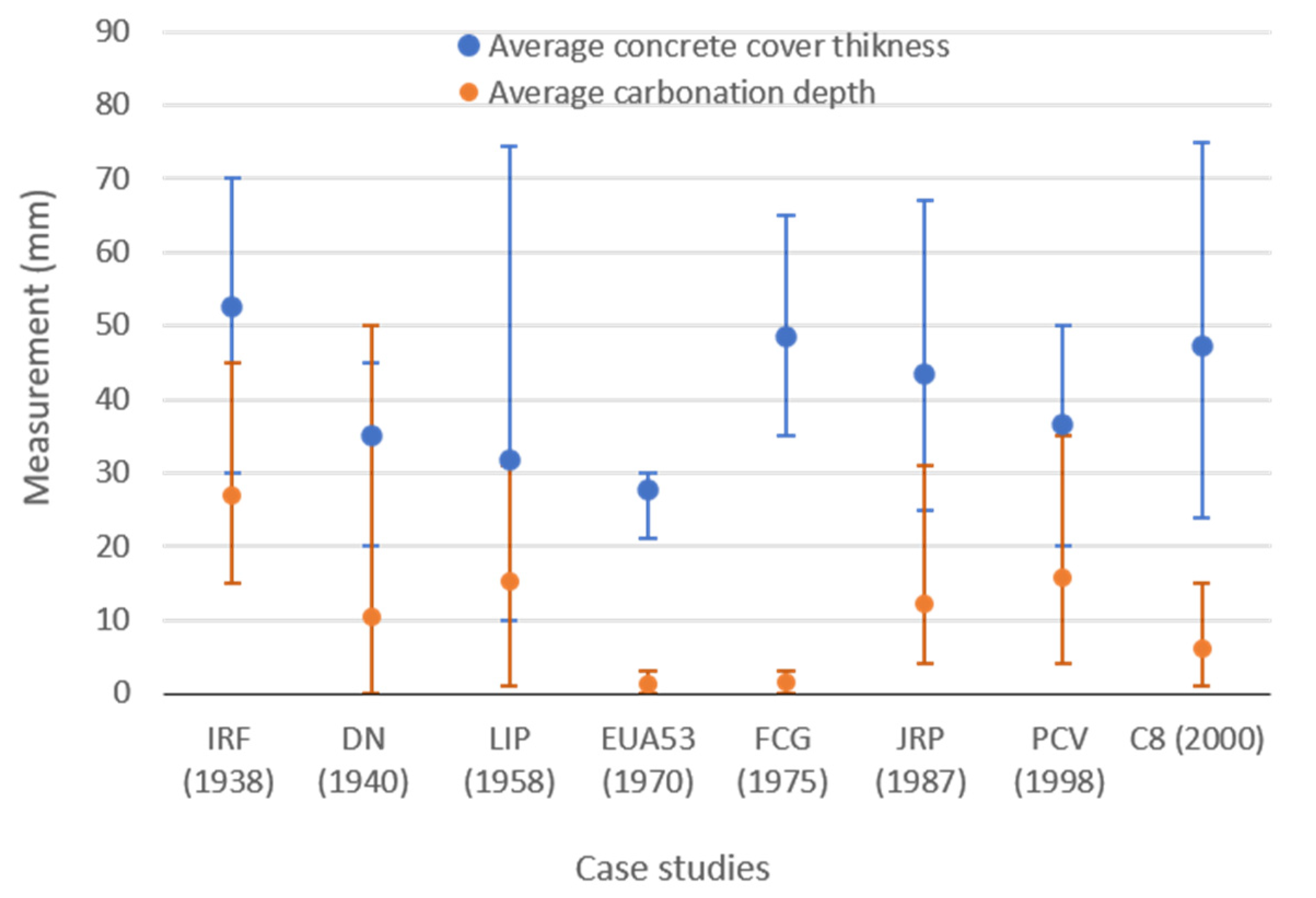
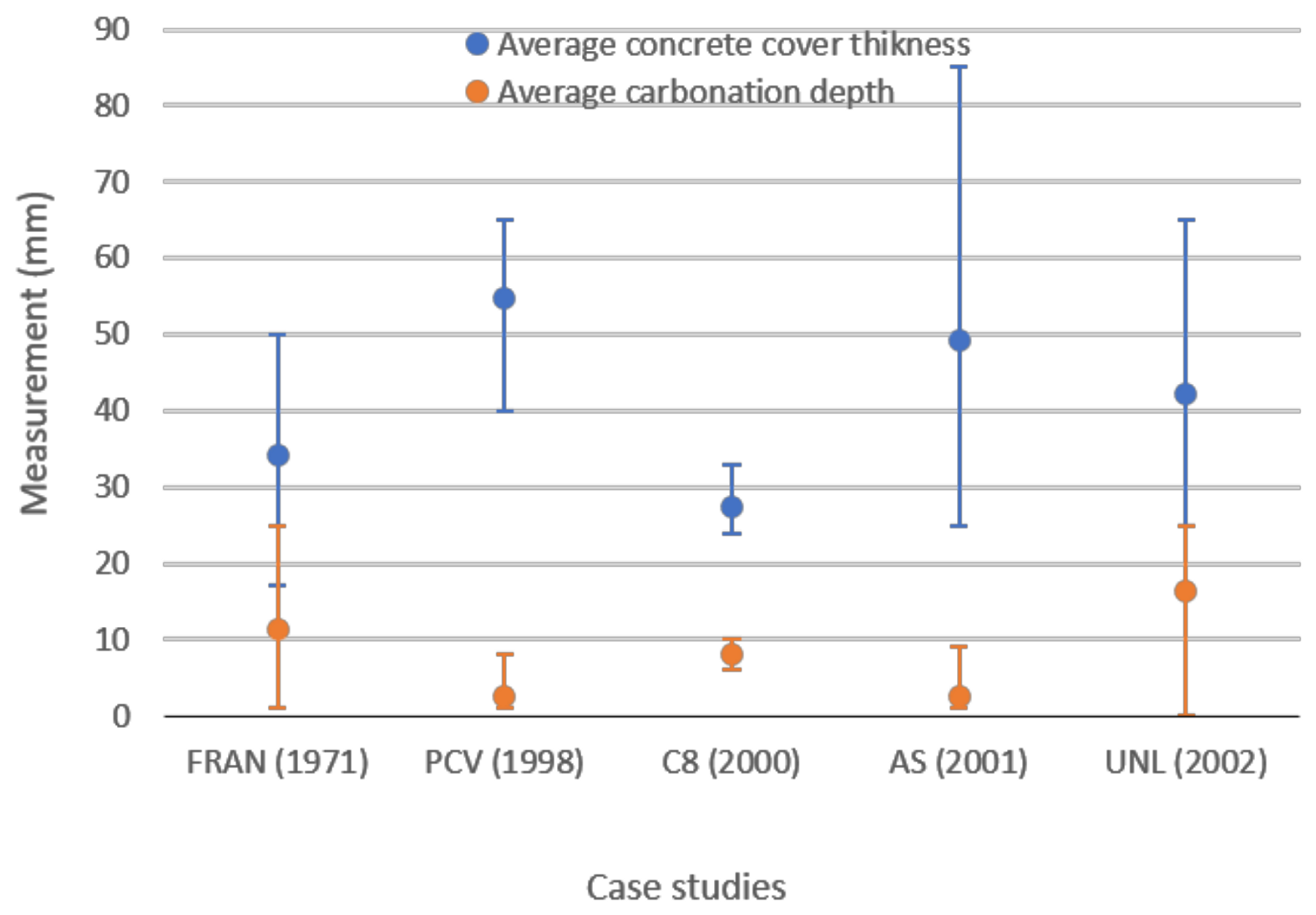
- Shape anomalies, specially spalling, were regularly found in older buildings such as FRAN (1971), ISCJ (1975), and JRP (1987). Spalling, mainly due to the corrosion of the reinforcement, can be attributed to a deficient constructive control associated with a low covering concrete thickness. Nevertheless, covering thicknesses in sampled areas are, on average, higher than the carbonation depth measured in samples (Figure 7);
- Texture anomalies, which include bug holes, mapped cracking, fastening marks, and honeycombing, are also present in most of the buildings studied but are less frequent than other groups of anomalies. All of these are related to the construction technology, which reveals in some cases lesser care in the application of in situ concrete cast elements than in precast concrete.
- The main anomalies related to concrete corrosion are spalling and oriented cracking and were found in buildings corresponding to case studies until 1998. These observations are in line with the higher values of carbonation depth for buildings until 1975. After that, it should be mentioned the case study UNL (2002) where the carbonation depth measured (16.3 mm) was the highest, which was probably due to a different binder type, low binder content, or high water-to-cement ratio;
- The results of the concrete strength show values between 32 and 54 MPa. It should be mentioned that the case study FRAN (1971) exhibits a higher dispersion of results. As shown in Table 1, only one class of reinforced concrete was prescribed for this building. There would not be expected such a dispersion of results for only one reinforced concrete class, unless (1) a variation in the composition of applied concrete had occurred or (2) due to different carbonation areas.
- The analysis of carbonation depth and the concrete cover thickness of all the architectural concrete surfaces from the buildings’ sampling zones (Table 11 and Figure 7) except for the FRAN (1971) demonstrates that the carbonation did not yet reach the rebars. However, spalling was locally identified in some buildings.
- All the concrete materials analysed from the studied buildings are in a reasonable conservation state condition (Table 12), according to the proposed classification. Nevertheless, building JRP (1987), showed the largest number of anomaly types, which can be related to lack of quality control during the construction phase and lack of maintenance.
6. Conclusions
- Ongoing investigation on the past interventions should be carried out for in-depth knowledge of the buildings’ historical background.
- Frequent monitoring of the areas that shows anomalies. Increased degradation can lead to the need for complete replacement of the materials, which forces a reduction of the life cycle as well as interrupts the original aesthetic and cultural concept of the buildings.
- Actions to minimise the damage caused by agents such as water, using water protection capacity systems while preserving the vapour permeability of the walls, namely in the case of “before concrete” buildings (PRCBs).
- Repair actions on exposed concrete degraded surfaces, due to reinforcement corrosion as a result of carbonation, to prevent the increase in anomalies, using compatible and informed repair materials.
- Characterising the composition, the physical and the mechanical properties of mortars and concrete, to produce a range of data capable of leading to the informed choice of compatible materials, respecting their typology (e.g., multi or monolayer mortar), with a reduction of the carbon footprint, by performing minimal interventions and using local materials.
Author Contributions
Funding
Acknowledgments
Conflicts of Interest
References
- ICOMOS. The Athens Charter for the Restoration of Historic Monuments. In Proceedings of the First International Congress of Architects and Technicians of Historic Monuments, Athens, Greece, 21–30 October 1931. [Google Scholar]
- ICOMOS. The Venice charter for the conservation and restoration of monuments and sites. In Proceedings of the Second International Congress of Architects and Specialists of Historic Buildings, Venice, Italy, 25–31 May 1964. [Google Scholar]
- ICOMOS. Krakow charter: Principles for the conservation and restoration of built heritage. In Proceedings of the International Conference on Conservation Kraków 2000, Krakow, Poland, 22–24 November 1998. [Google Scholar]
- Santos, A.R.; Veiga, M.R.; Santos Silva, A.; Brito, J. Microstructure as a critical factor of cement mortars’ behaviour: The effect of aggregates’ properties. Cem. Concr. Compos. 2020, 111, 103628. [Google Scholar] [CrossRef] [Scilit]
- Marques, A.I. Rehabilitation of Old Buildings: Reduction of Seismic Vulnerability by Reinforcing Walls. Ph.D. Thesis, Instituto Superior Técnico, Lisbon, Portugal, 2020. (In Portuguese) [Google Scholar]
- Marques, A.I.; Ferreira, J.G.; Candeias, P.X.; Veiga, M.R. Axial compression and bending tests on old masonry walls. In Proceedings of the 3rd International Conference on Protection of Historical Constructions, Lisbon, Portugal, 12–15 July 2017. [Google Scholar]
- Haspel, J.; Petzet, M.; Zalivako, A.; Ziesemer, J. The Soviet Heritage and European Modernism. Heritage at Risk; Hendrik Bässler Verlag: Berlin, Germany, 2007. [Google Scholar]
- Cannata, M. The Repair and Alterations of the De La Warr Pavilion. J. Arch. Conserv. 2006, 12, 81–94. [Google Scholar] [CrossRef] [Scilit]
- Buck, L.S. A Material Evaluation of the Gropius House: Planning to Preserve a Modern Masterpiece. APT Bull. 1997, 28, 29–35. [Google Scholar] [CrossRef] [Scilit]
- Boothby, T.; Parfitt, M.; Roise, C. Case Studies in Diagnosis and Repair of Historic Thin-Shell Concrete Structures. APT Bull. 2005, 36, 3–11. Available online: https://www.jstor.org/stable/40004699 (accessed on 27 April 2021).
- Allanbrook, T.; Normandin, K. The Restoration of the Fifth Avenue Facades of the Metropolitan Museum of Art. Apt Bull. 2007, 38, 45–53. Available online: https://www.jstor.org/stable/i40000278 (accessed on 27 April 2021).
- Dell’Acqua, A.C.; Franzoni, E.; Sandrolini, F.; Varum, H. Materials and techniques of Art Nouveau architecture in Italy and Portugal: A first insight for a European route to consistent restoration. Rest. Build. Monum. 2009, 15, 129–144. [Google Scholar] [CrossRef] [Scilit]
- Sandrolini, F.; Franzoni, E.; Varum, H.; Nakonieczny, R. Materials and technologies in Art Nouveau architecture: Façade decoration cases in Italy, Portugal and Poland for a consistent restoration. Inf. Construcción 2011, 63, 5–11. [Google Scholar] [CrossRef] [Scilit]
- Marie-Victoire, E.; Cailleux, E.; Texier, A. Carbonation and historical buildings made of concrete. J. Phys. 2006, 136, 305–318. [Google Scholar] [CrossRef] [Scilit]
- Tostões, A.; Vieira Constantino, M.; Casciato, M. The Buildings; Lisbon: Calouste Gulbenkian Foundation Central Services: Lisbon, Portugal, 2012. [Google Scholar]
- Santos, D.; Veiga, M.R. Test Methods for Existing Coatings. In Situ and Laboratory Tests. In Proceedings of the V Jornadas FICAL, Lisbon, Portugal, 23–25 May 2016. (In Portuguese) [Google Scholar]
- Cóias, V. Inspection and Tests in the Rehabilitation of Buildings, 2nd ed.; IST Press: Lisbon, Portugal, 2009. (In Portuguese) [Google Scholar]
- Veiga, M.R. Conservation of Historic Renders and Plasters: From Laboratory to Site. In Historic Mortars; RILEM Bookseries; Válek, J., Hughes, J., Groot, C., Eds.; Springer: Dordrecht, Germany, 2012; Volume 7. [Google Scholar] [CrossRef] [Scilit]
- Morgan, D.R. Compatibility of concrete repair materials and systems. Constr. Build. Mater. 1996, 10, 57–67. [Google Scholar] [CrossRef] [Scilit]
- Veiga, M.R.; Fragata, A.; Velosa, A.L.; Magalhães, A.C.; Margalha, G. Lime-Based Mortars: Viability for Use as Substitution Renders in Historical Buildings. Int. J. Archit. Herit. 2010, 4, 177–195. [Google Scholar] [CrossRef] [Scilit]
- Veiga, M.R.; Aguiar, J.; Santos Silva, A.; Carvalho, F. Methodologies for characterisation and repair of mortars of ancient buildings. In Proceedings of the 3rd International Seminar on Historical Constructions, Guimarães, Portugal, 7–9 November 2001. [Google Scholar]
- CML. Valmor Prize; Silva, A.P., Ed.; Câmara Municipal de Lisboa: Lisbon, Portugal, 2004. (In Portuguese) [Google Scholar]
- Bairrada, E.M. Valmor Prize 1902–1952; Biblioteca de Lisboa: Lisbon, Portugal, 1988. (In Portuguese) [Google Scholar]
- Rodea, J. Apropos of Lisbon’s Modern Architecture (1925–1965) in Modern Lisbon. International committee for documentation and conservation of buildings, sites and neighbourhoods of the modern movement. Docomomo J. 2016, 55, 4–7. [Google Scholar] [CrossRef] [Scilit]
- Ministério do Comércio. Decree nº 4036. Regulation for the Use of Reinforced Concrete; Diário do Govêrno: Lisbon, Portugal, 1918. (In Portuguese)
- Ministério das Obras Públicas e Comunicações. Decree nº25948. Reinforced Concrete Regulation; Diário do Govêrno: Lisbon, Portugal, 1935. (In Portuguese)
- Ministério das Obras Públicas. Decree nº 47723. Regulation of Reinforced Concrete Structures; Imprensa Nacional de Lisboa: Lisbon, Portugal, 1967. (In Portuguese)
- Ministério das Obras Públicas. Decree nº 404/71. Hydraulic Binder Concrete Regulation; Imprensa Nacional de Lisboa: Lisbon, Portugal, 1971. (In Portuguese)
- Ministério das Obras Públicas, Transportes e Comunicações. Decree-Law 445/89. Hydraulic Binder Concrete Regulation; Imprensa Nacional de Lisboa: Lisbon, Portugal, 1989. (In Portuguese)
- Rodrigues, M.F.S.; Teixeira, J.M.C.; Cardoso, J.C.P. Buildings envelope anomalies: A visual survey methodology. Constr. Build. Mater. 2011, 25, 2741–2750. [Google Scholar] [CrossRef] [Scilit]
- Marteinsson, B.; Jónsson, B. Overall survey of buildings-performance and maintenance. In Proceedings of the 8th Durability of Building Materials and Components, Vancouver, BC, Canada, 30 May–3 June 1999; Institute for Research in Construction: Ottawa, ON, Canada, 1999. [Google Scholar]
- Shohet, I.M.; Puterman, M.; Gilboa, E. Deterioration patterns of building cladding components for maintenance management. Constr. Manag. Econ. 2002, 20, 305–314. [Google Scholar] [CrossRef] [Scilit]
- Jaggs, M.; Palmer, J. Energy performance indoor environmental quality retrofit—A European diagnosis and decision making method for building refurbishment. Energy Build. 2000, 31, 97–101. [Google Scholar] [CrossRef] [Scilit]
- CEN. EN 16085:2012. Conservation of Cultural Property. Methodology for Sampling from Materials of Cultural Property. General Rules; European Standard: Brussels, Belgium, 2012. [Google Scholar]
- Moropoulou, A.; Bakolas, A.; Bisbikou, K. Characterization of ancient, byzantine and later historic mortars by thermal and X-ray diffraction techniques. Thermochim. Acta 1995, 269–270, 779–795. [Google Scholar] [CrossRef] [Scilit]
- Groot, C.J.W.P.; Bartos, P.J.M.; Hughes, J.J. Characterisation of old mortars with respect to their repair. In Proceedings of the 12th International Brick/Block Masonry Conference, Madrid, Spain, 25–28 June 2000; Volume 2. [Google Scholar]
- Elsen, J. Microscopy of historic mortars—A review. Cem. Concr. Res. 2006, 36, 1416–1424. [Google Scholar] [CrossRef] [Scilit]
- Magalhães, A.; Veiga, R. Physical and mechanical characterisation of historic mortars. Application to the evaluation of the state of conservation. Mater. Construcción 2009, 59, 61–77. [Google Scholar] [CrossRef] [Scilit]
- Valek, J.; Veiga, M.R. Characterisation of mechanical properties of historic mortars—testing of irregular samples. In Proceedings of the 9th International Conference on Structural Studies, Repairs and Maintenance of Heritage Architecture (STREMAH 2005), Msida, Malta, 22–24 June 2005. [Google Scholar]
- GranDuBé. Quantities Associated with the Durability of Concrete; Arliguie, G., Hornain, H., Eds.; Presses de l’Ecole Nationale des Ponts et Chaussées: Paris, France, 2007; Volume 1. (in French) [Google Scholar]
- Massari, G.; Massari, I. Damp Buildings. Old and New; ICCROM: Rome, Italy, 1993. [Google Scholar]
- Henriques, F. Moisture in Walls, 3rd ed.; LNEC: Lisbon, Portugal, 2001. (In Portuguese) [Google Scholar]
- ASTM. D2240-05. Standard Test Method for Rubber Property-Durometer Hardness; ASTM International: West Conshohocken, PA, USA, 2005. [Google Scholar]
- ASTM. C805. Standard Test Method for Rebound Number of Hardened Concrete; ASTM International: West Conshohocken, PA, USA, 2008. [Google Scholar]
- Tavares, M. A The Conservation and Restoration of Exterior Cladding of Old Buildings–A Study and Repair Methodology. Ph.D. Thesis, Faculty of Architecture of the Technical University of Lisbon, Lisbon, Portugal, 2009. (In Portuguese) [Google Scholar]
- CEN. EN 125-04-2:2012b. Testing Concrete in Structures Non-Destructive Testing. Determination of Rebound Number; European Standard: Brussels, Belgium, 2012. [Google Scholar]
- CEN. EN 14630. Products and Systems for the Protection and Repair of Concrete Structures. Test Methods. Determination of Carbonation Depth in Hardened Concrete by the Phenolphthalein Method; European Standard: Brussels, Belgium, 2006. [Google Scholar]
- Veiga, M.R.; Silva, S. Mortars. In Long-Term Performance and Durability of Masonry Structures. Degradation Mechanisms, Health, Monitoring and Service Life Design, 1st ed.; Ghiassi, B., Lourenço, P.B., Eds.; Elsevier. Ltd.: Amsterdam, The Netherlands, 2019; pp. 169–208. [Google Scholar]
- Veiga, M.R. Rendered Façades: Anomalies and Resolution Strategies. In Proceedings of the Façade Rehabilitation Seminar, Portugal, 2016; Vasconcelos, G., Lourenço, P., Eds.; University of Minho: Guimarães, Portugal, 2016. (In Portuguese) [Google Scholar]
- Sousa, V.; Almeida, N.; Meireles, I.; Brito, J. Anomalies in Wall Renders: Overview of the Main Causes of Degradation. Int. J. Arch. Herit. 2011, 5, 198–218. [Google Scholar] [CrossRef] [Scilit]
- CEN. EN 1504:2005. Products and Systems for the Protection and Repair of Concrete Structures; European Standard: Brussels, Belgium, 2005. [Google Scholar]
- Griffin, I.; Tate, J. Conserving our Wartime Heritage: A Reinforced Concrete Air Raid Shelter in East Lothian, Scotland. J. Arch. Conserv. 2012, 18, 81–100. [Google Scholar] [CrossRef] [Scilit]
- Alonso, C.; Andrade, C. Lifetime of rebars in carbonated concrete. In Proceedings of the Understanding and Prevention of Corrosion, 10th European Corrosion Congress, Barcelona, Spain, 5–8 July 1993; Costa, J.M., Mercer, A.D., Eds.; Institute of Materials: London, UK, 1994. [Google Scholar]
- AFNOR. NF P-18-503. Concrete Surfaces and Facings. Identification Elements; French Standard: Paris, France, 1989. (In French) [Google Scholar]
- CIB. Report No. 24. Tolerances on Blemishes of Concrete; Report Prepared by CIB Working Commission W29 “Concrete Surface Finishings”; CIB: Rotterdam, The Netherlands, 1971. [Google Scholar]
- Veiga, M.R.; Aguiar, J. Defining Intervention Strategies for Old Building Renders. In Proceedings of the 1st National Pathology and Buildings Rehabilitation Seminar, Porto, Portugal, 18–19 March 2003. (In Portuguese) [Google Scholar]
- Serralheiro, M.I.; Brito, J.; Silva, A. Methodology for service life prediction of architectural concrete facades. Constr. Build. Mater. 2017, 133, 261–274. [Google Scholar] [CrossRef] [Scilit]
- Ximenes, S.; Brito, J.; Gaspar, P.; Silva, A. Modeling the degradation and service life of ETICS in external walls. Mater. Struct. 2015, 48, 2235–2249. [Google Scholar] [CrossRef] [Scilit]
- Silva, A.; Gaspar, P.; Brito, J. Methodologies for Service Life Prediction of Buildings: With a Focus on Façade Claddings, 1st ed.; Springer International Publishing: Cham, Switzerland, 2016. [Google Scholar]
- Balaras, C.A.; Droutsa, K.; Dascalaki, E.; Kontoyiannidis, S. Deterioration of European apartment buildings. Energy Build. 2005, 37, 515–527. [Google Scholar] [CrossRef] [Scilit]
- Martinho, C.; Veiga, R.; Faria, P. Marmorite-contribution to a proper preservation of a durable wall coating. Conserv. Património 2018, 28, 31–38. [Google Scholar] [CrossRef] [Scilit]
- Magalhães, A.; Veiga, M.R.; Pina dos Santos, C.; Matias, L.; Vilhena, A. Methodologies for diagnosis of rendering anomalies due to moisture in walls. Conserv. Património 2008, 7, 45–54. [Google Scholar] [CrossRef] [Scilit]
- Veiga, M.; Fragata, A.; Tavares, M.; Magalhães, A.C.; Ferreira, N. Inglesinhos convent: Compatible renders and other measures to mitigate water capillary rising problems. J. Build. Apprais. 2009, 5, 171–185. [Google Scholar] [CrossRef] [Scilit]
- Franzoni, E. Rising damp removal from historical masonries: A still open challenge. Constr. Build. Mater. 2014, 54, 123–136. [Google Scholar] [CrossRef] [Scilit]
- Veiga, M.R. Influence of application conditions on the cracking susceptibility of renderings. Concr. Sci. Eng. 2000, 2–7, 134–140. [Google Scholar]
- Veiga, M.R.; Stefanidou, M.; Balksten, K.; Alvarez, I.; Nunes, C.; Theoridoridid, M.; Faria, P.; Papayianni, I.; Van Hees, R. Durability of lime-based renders: A review of some degradation mechanisms and assessment test methods. In Proceedings of the RILEM SMSS19 Rovinj Proceedings, Rovinj, Croatia, 18–22 March 2019; RILEM Publications SARL: Cachan, France, 2019. [Google Scholar]
- Valença, J.; Almeida, C.; Botas, J.; Júlio, E. Patch Restoration Method: A new concept for concrete heritage. Constr. Build. Mater. 2015, 101, 643–651. [Google Scholar] [CrossRef] [Scilit]
- Emmons, P.H. Concrete Repair and Maintenance Illustrated; RS Means: Kingston, NY, USA, 1993. [Google Scholar]
- Courard, L.; Van der Wielen, A.; Darimont, A. From defects to causes: Pathology of concrete and investigation methods. In Proceedings of the 17th Slovenski Kolokvij o Betonih, Ljubljana, Slovenia, 19 May 2010. [Google Scholar]
- Courard, L.; Gillard, A.; Darimont, A.; Bleus, J.M.; Paquet, P. Pathologies of concrete in Saint-Vincent Neo-Byzantine Church and Pauchot reinforced artificial stone. Constr. Build. Mater. 2012, 34, 201–210. [Google Scholar] [CrossRef] [Scilit]
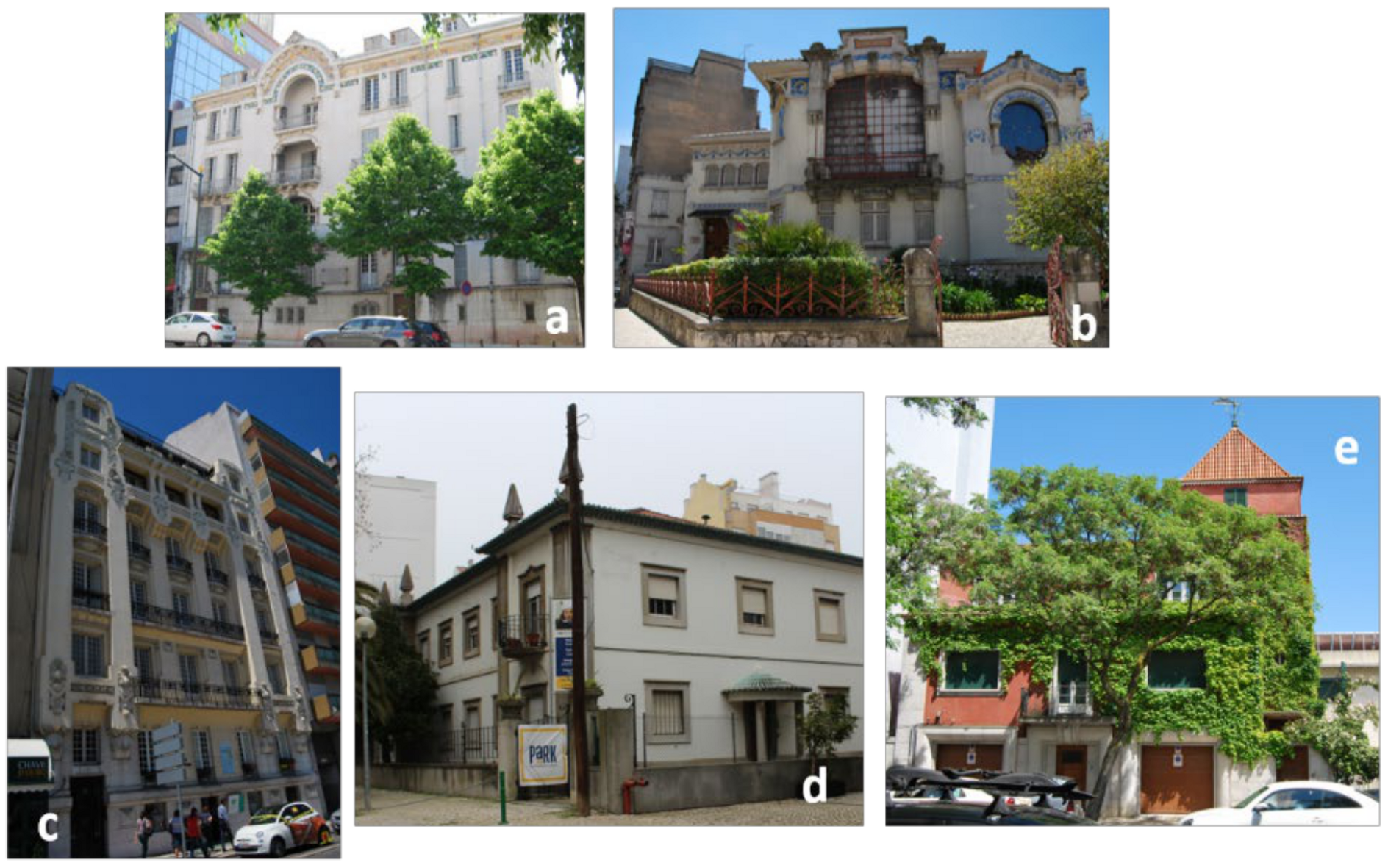
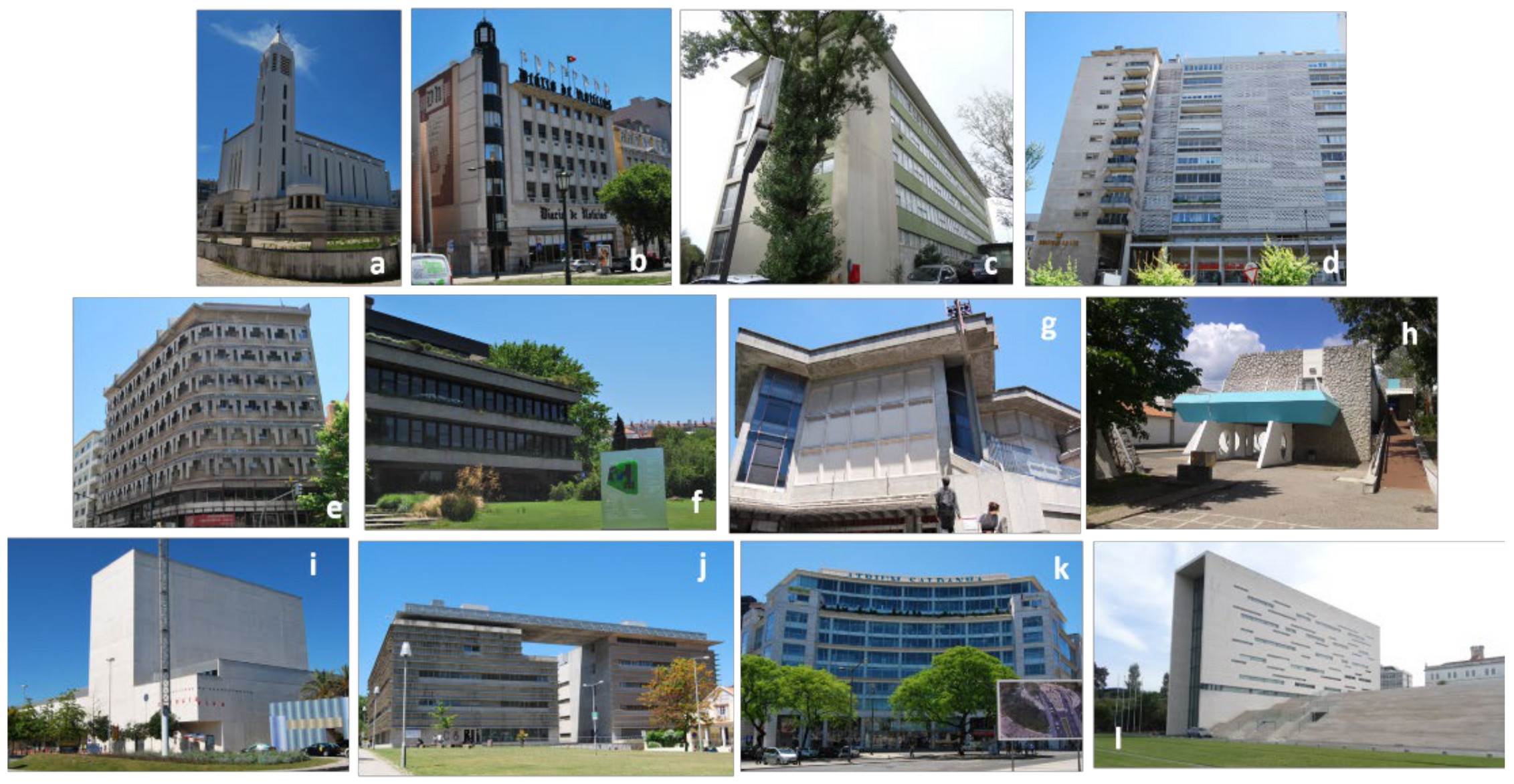
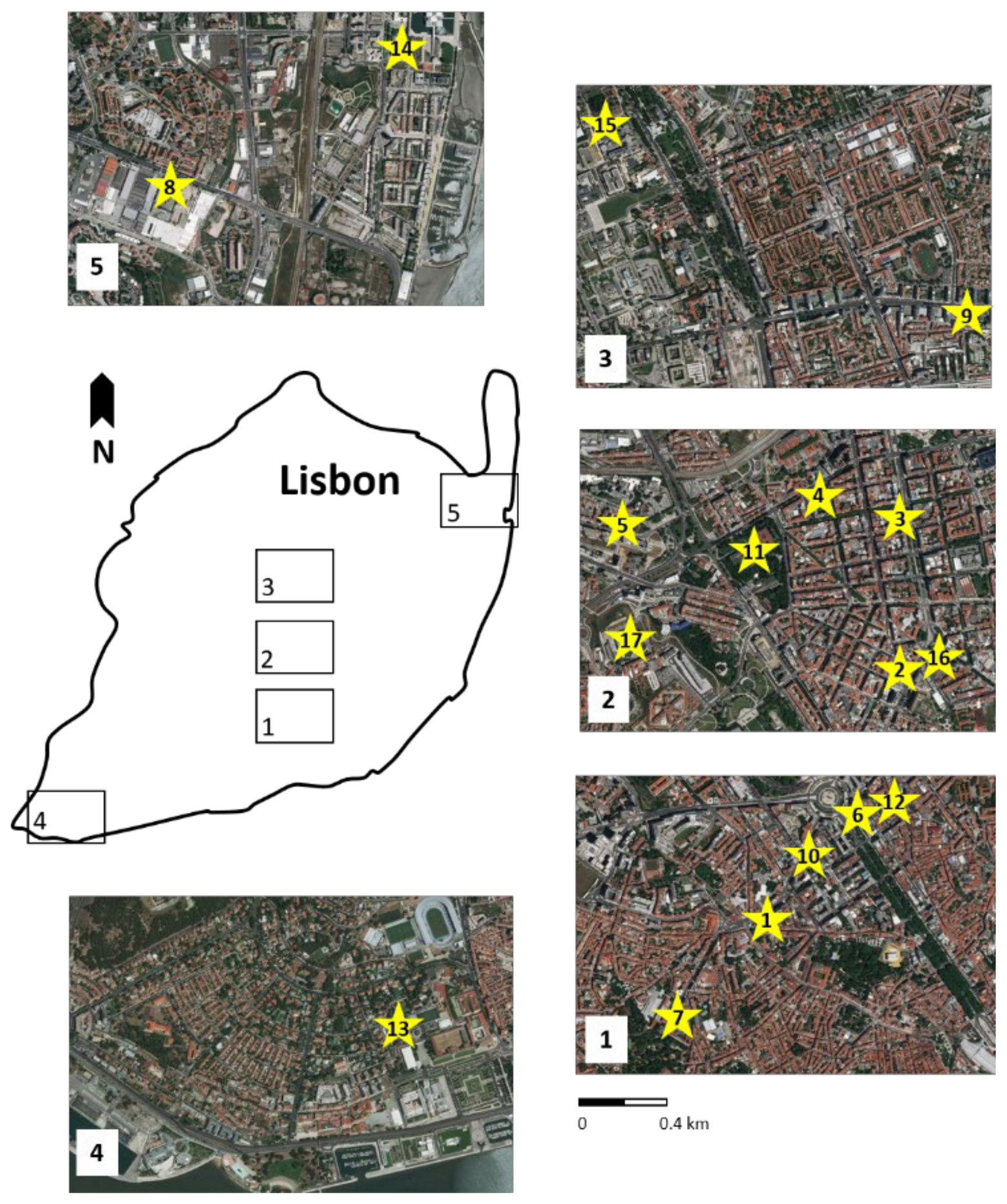
| Case Study | Name | Construction Period | Construction Typology | Award Year | Architect | Structural Characteristics | Main Constructive and Architectonical Features | Main Coatings/ Renderings | Class of Concrete Prescribed in the Design Project |
|---|---|---|---|---|---|---|---|---|---|
| CVT (1903) | Ventura Terra Building | 1902–1903 | PRCB | 1903 | Miguel Ventura Terra | Self-supporting masonry walls. Steel beams used as structural elements | Multifamily building. Four floors, basement, and attic. Art Nouveau facade with decorative elements | Limestone coating all over the main facade; polychromatic elements and frieze tiles; rendering mortars | (a) |
| CMAG (1905) | Malhoa House | 1904–1905 | PRCB | 1905 | Manuel Norte Júnior | Self-supporting masonry walls | Single-family house. Two floors and basement. Art Nouveau elements on facades with neo-Romanic decorative elements | Limestone coatings; frieze tiles; rendering mortars | (a) |
| AR49 (1923) | Luiz Rau Building | 1920–1923 | PRCB | 1923 | Porfírio Pardal Monteiro | Self-supporting masonry walls. Concrete slabs and steel-supporting balconies’ structure in balconies at rear facade | Dwelling building with five floors, basement, and mansard. East facade adorned with corbels and decorated pilasters. Steel stairs in balconies at rear facade. | Exterior limestone coatings at street level; rendering mortars | According to 1918 regulations (b) |
| IRF (1938) | Nossa Senhora do Rosário de Fátima Church | 1934–1938 | RCB | 1938 | Porfírio Pardal Monteiro | Reinforced concrete structure with brick masonry panes | Modernist architecture religious building. Ogival arches are built in a centered plan. | Indoor mural decoration and white marble coatings. Limestone-coatings in exterior walls | According to 1935 regulations (c) |
| CBP (1939) | Bernardo da Maia House | 1938–1939 | PRCB | 1939 | Carlos and Guilherme Rebelo de Andrade | Self-supporting masonry walls. Reinforced concrete structure in the foundations and basement floor | Joanino Baroque-inspired like architectural style Dwelling and office building with two floors, basement, and attic. | Exterior limestone coatings at street level; rendering mortars | According to 1935 regulations (c) |
| DN (1940) | Diário de Notícias Building | 1936–1940 | RCB | 1940 | Porfírio Pardal Monteiro | Reinforced concrete structure with brick masonry panes | Modernist architecture building constructed to house a newsroom and a typography with six upper floors and basement | Most of the main facade area is covered with limestone; ceramic tiles and rendering mortars | According to 1935 regulations (c) |
| AAC (1944) | Cristino da Silva Building | 1942–1944 | PRCB | 1944 | Luís Cristino da Silva | Mixed concrete-masonry structure (concrete slabs and self-supporting masonry walls) | Multifamily building designed with nationalist tendency and composed by three dwelling floors and terrace | Rendering mortars and rock imitating mortars; limestone coatings | According to 1935 regulations (c) |
| LIP (1958) | Laboratories of Pasteur Institute of Lisbon | 1955–1957 | RCB | 1958 | Carlos Manuel Oliveira Ramos | Reinforced concrete structure with brick masonry panes | Modern architecture building for industrial purposes. All the building walls have the functions of dividing the spaces, insulation, and thermal protection | Glazed partitions. Rendering mortars and limestone coatings | According to 1935 regulations (c) |
| EUA53 (1970) | América Building | 1966–1969 | RCB | 1970 | Leonardo Rey Colaço de Castro Freire | Reinforced concrete structure with brick masonry panes | 15th floor dwelling and commerce building inserted in residential area | Rendering mortars, limestone coatings, ceramic tiles, rock imitating mortars | B300 [compressive strength = 300 kg/cm2] (d) |
| FRAN (1971) | Franjinhas Building | 1965–1969 | RCB | 1971 | Nuno Teotónio Pereira; João Braula Reis | Reinforced concrete structure | Building designed for trade and services. Facades in architectural concrete | Concrete precast exterior panels | B300—superstructure [compressive strength = 300 kg/cm2] (d) |
| FCG (1975) | Calouste Gulbenkian Foundation Headquarters and Museum | 1963–1969 | RCB | 1975 | Ruy Athouguia, Alberto Pessoa, Pedro Cid, G. Ribeiro Teles and António Barreto | Reinforced concrete structure | Modernist building’s complex, consisting essentially of architectural concrete | Granite coatings | B225—foundations [compressive strength = 225 kg/cm2]; B300—superstructure [compressive strength = 300 kg/cm2] (d) |
| ISCJ (1975) | Sagrado Coração de Jesus Church | 1966–1970 | RCB | 1975 | Nuno Teotónio Pereira; Nuno Portas: Pedro Almeida; Luís Vassalo | Reinforced concrete structure | Modernist, religious architecture developed on several levels due to the irregularity of the site, featuring architectural concrete | Concrete-based precast exterior panels with visible limestone and marble aggregates | B300 [compressive strength = 300 kg/cm2] (d) |
| JRP (1987) | Jacob Rodrigues Pereira Institute | 1984–1987 | RCB | 1987 | Rui de Sousa Cardim | Reinforced concrete structure | Set of four modernist buildings with several areas in architectural concrete | Rendering mortars and limestone coatings onto concrete buttresses | B225 [compressive strength = 225 kg/cm2] (e) |
| PCV (1998) | The Knowledge Pavilion | 1996–1998 | RCB | 1998 | João Luís Carrilho da Graça | Reinforced concrete structure | Composed of two bodies of distinct volumetry. Both built in white architectural concrete | Limestone coatings and iron elements | B35 [compressive strength = 35 MPa]—white concrete (f) |
| C8 (2000) | C8 Building (Faculty of Sciences of the University of Lisbon) | 1997–2000 | RCB | 2000 | Gonçalo Byrne | Reinforced concrete structure | Architectural concrete facades | Precast concrete panels applied onto external facades and limestone coatings | B25 [compressive strength = 25 MPa] - Foundations and earth supporting walls; B30 [compressive strength = 30 MPa]-superstructure (f) |
| AS (2001) | Atrium Saldanha Building | 1992–1997 | RCB | 2001 | João Paciência and Ricardo Bofill | Reinforced concrete structure | Vertical elements consisting of cylindrical white architectural concrete pillars. Architectural concrete in the underground floors | White and gray architectural concrete, glass and marble coatings | B30 [compressive strength = 30 MPa]; B40 [compressive strength = 40 MPa]—architectural concrete (f) |
| UNL (2002) | New University of Lisbon Rectory | 2000–2002 | RCB | 2002 | Manuel and Francisco Aires Mateus | Reinforced concrete structure | Composed of two bodies of distinct volumetry, featuring architectural concrete in the underground floors | External limestone cladding all over the building; glass | B25 [compressive strength = 25 MPa] Foundations and earth supporting walls; B30 [compressive strength] - superstructure (f) |
| Shore A Durometer | Hardness Classification | Rebound (Vickers Degrees) | Mechanical Strength Classification |
|---|---|---|---|
| <30 | very weak | <20 | very weak |
| 30–50 | weak | 20–30 | weak |
| 51–70 | moderate | 31–40 | moderate |
| 71–87 | normal | 41–55 | normal |
| 88–100 | very hard | 56–75 | hard |
| >75 | very hard |
| Renders/Plasters | Architectural Concrete Surfaces | |||||
|---|---|---|---|---|---|---|
| Causes/Group of Anomalies | Physical | Mechanical | Chemical and Biological | Shape | Texture | Colouration |
| Types of anomalies | Wear/erosion | Disaggregation | Stains | Wear/erosion | Bug holes | Dirt stains |
| Capillary rising water; water retention or infiltration | Detaching | Biological growth | Flatness defects | Mapped cracking | Moisture stains | |
| Water condensation | Cracking | Cracking | Disaggregation | Dribbling | Corrosion stains | |
| Efflorescence | Spalling | Spalling | Fastening marks | Biological growth | ||
| Disaggregation | Oriented cracking | Honeycombing | Efflorescence | |||
| Efflorescence | Crusts | |||||
| Formwork incrustation | ||||||
| Degree and Extension of Degradation | ||||
|---|---|---|---|---|
| + | ++ | +++ | ||
| Severity of degradation | 1 | Good | Reasonable | Reasonable |
| 2 | Reasonable | Reasonable | Poor | |
| 3 | Reasonable | Poor | Very Poor | |
| 4 | Reasonable | Very Poor | Very Poor | |
| Case Study | Construction Period | Plasters | Renders |
|---|---|---|---|
| CVT (1903) | 1902–1903 | 2 to 3 layers (includes finishing white layer) | (a) |
| CMAG (1905) | 1904–1905 | (a) | 1 to 4 layers: non-original renders (b) |
| AR49 (1923) | 1920–1923 | 3 layers (includes finishing white layer) | 2 layers |
| IRF (1938) | 1934–1938 | 1 to 2 layers (includes finishing white layer) | (a) |
| CBP (1939) | 1938–1939 | 2 layers (includes finishing white layer) | (a) |
| DN (1940) | 1936–1940 | 2 (c) to 4 layers (includes finishing white layer) | (a) |
| AAC (1944) | 1942–1944 | 2 layers (includes finishing in stone imitation mortar) | 2 to 3 layers (includes finishing in stone imitation mortar) |
| LIP (1958) | 1955–1957 | (a) | 1 layer |
| EUA53 (1970) | 1966–1969 | 2 layers (includes finishing in stone imitation mortar) | 2 layers (includes finishing in stone imitation mortar) |
| FRAN (1971) | 1965–1969 | (a) | (a) |
| FCG (1975) | 1963–1969 | 1 layer | (a) |
| ISCJ (1975) | 1966–1970 | (a) | (a) |
| JRP (1987) | 1984–1987 | (a) | 1 layer |
| PCV (1998) | 1996–1998 | (a) | (a) |
| C8 (2000) | 1997–2000 | (a) | (a) |
| AS (2001) | 1992–1997 | (a) | (a) |
| UNL (2002) | 2000–2002 | 1 layer | (a) |
| a. Examples of main types of anomalies detected in PRCBs’ renders and plasters by location. | ||||||
| Case Study | CVT (1903) | CMAG (1905) | ||||
| Zone ID | 1 | 2 | 3 | 1 | 2 | 3 |
| Location | Basement | Hall entrance | Main stairs/roof | SE facade | NW facade | NW facade |
| Image | 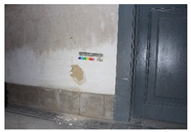 | 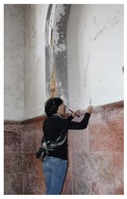 | 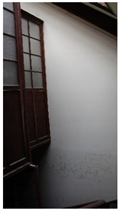 | 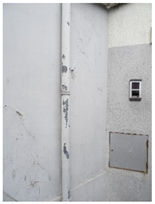 |  | 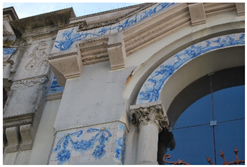 |
| Detected anomalies | Capillary rising water; detaching | Water infiltrations; detaching; efflorescence | Water infiltrations | Cracking | Cracking; biological growth | Detaching; stains; biological growth |
| Case Study | AR49 (1923) | |||||
| Zone ID | 1 | 2 | 3 | 4 | 5 | |
| Location | W rear facade. Ground floor level (exterior) | E façade. 1st floor | Interior stairs. 1st/2nd floor | Interior stairs. 4th/5th floor | Interior stairs. 5th/6th floor | |
| Image | 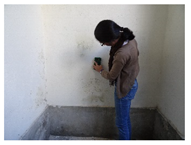 |  | 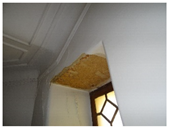 | 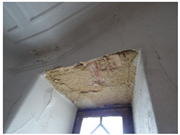 | 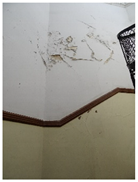 | |
| Detected anomalies | Capillary rising water | Cracking, stains | Water infiltrations; cracking; detaching and efflorescence | |||
| Case Study | CBP (1939) | AAC (1944) | ||||
| Zone ID | 1 | 2 | 3 | 1 | ||
| Location | Basement. NE access | Basement. Intermediate room | Basement. NW access | Access to the rear outer space | ||
| Image | 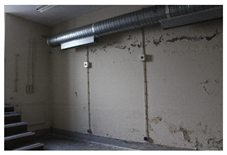 | 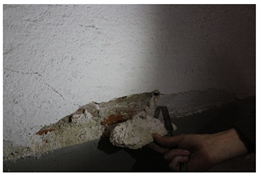 |  | 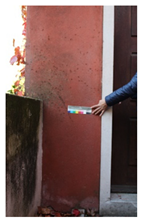 | ||
| Detected anomalies | Capillary rising water | Capillary rising water; cracking;cryptoflorescences; detaching | Capillary rising water; cracking; efflorescence | Stains, biological growth | ||
| Case Study | AAC (1944) | |||||
| Zone ID | 2 | 3 | 4 | 5 | ||
| Location | Belvedere | Boiler room. Ground floor | Access stairs to the terrace | W facade. 2nd floor | ||
| Image |  | 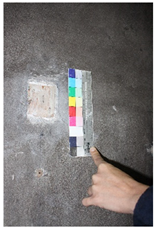 | 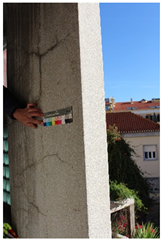 |  | ||
| Detected anomalies | Erosion; capillary rising water; stains and biological growth | Stains | Cracking; stains | Disaggregation | ||
| b. Examples of main types of anomalies detected in RCBs’ renders and plasters by location | ||||||
| Case Study | IRF (1938) | DN (1940) | ||||
| Zone ID | 1 | 2 | 3 | 1 | ||
| Location | N.S. Piedade Chapel. Upper wall | Right upper gallery | Left-side gallery | SE facade | ||
| Image | 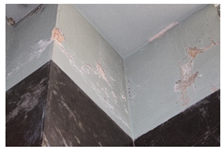 | 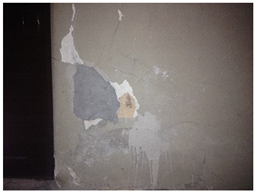 | 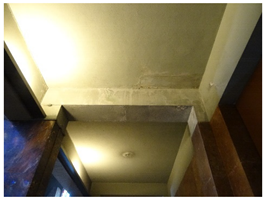 |  | ||
| Detected anomalies | Water infiltration; cracking and detachment | Cracking; detaching | Water infiltration; cracking | Stains, biological growth; detaching | ||
| Case Study | DN (1940) | LIP (1958) | EUA53 (1970) | |||
| Zone ID | 2 | 1 | 2 | 1 | ||
| Location | NE facade | Roof’s chimney | West side 4th floor bathroom. | Service room corridor. Ground floor | ||
| Image | 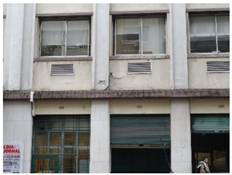 | 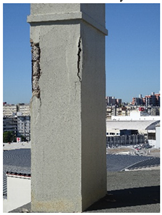 | 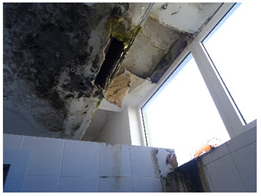 | 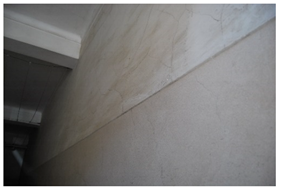 | ||
| Detected anomalies | Water retention; stains; biological growth; detaching | Cracking; detaching | Water infiltration; stains; biological growth; detaching | Cracking | ||
| Case Study | CVT (1903) | CMAG (1905) | AR49 (1923) | CBP (1939) | AAC (1944) | EUA53 (1970) | ||||||
|---|---|---|---|---|---|---|---|---|---|---|---|---|
| Construction typology | PRCB | PRCB | PRCB | PRCB | PRCB | RCB | ||||||
| Zone ID | 1 | 2 | 1 | 1 | 5 | 1 | 2 | 3 | 1 | 2 | 3 | 1 |
| MC | ||||||||||||
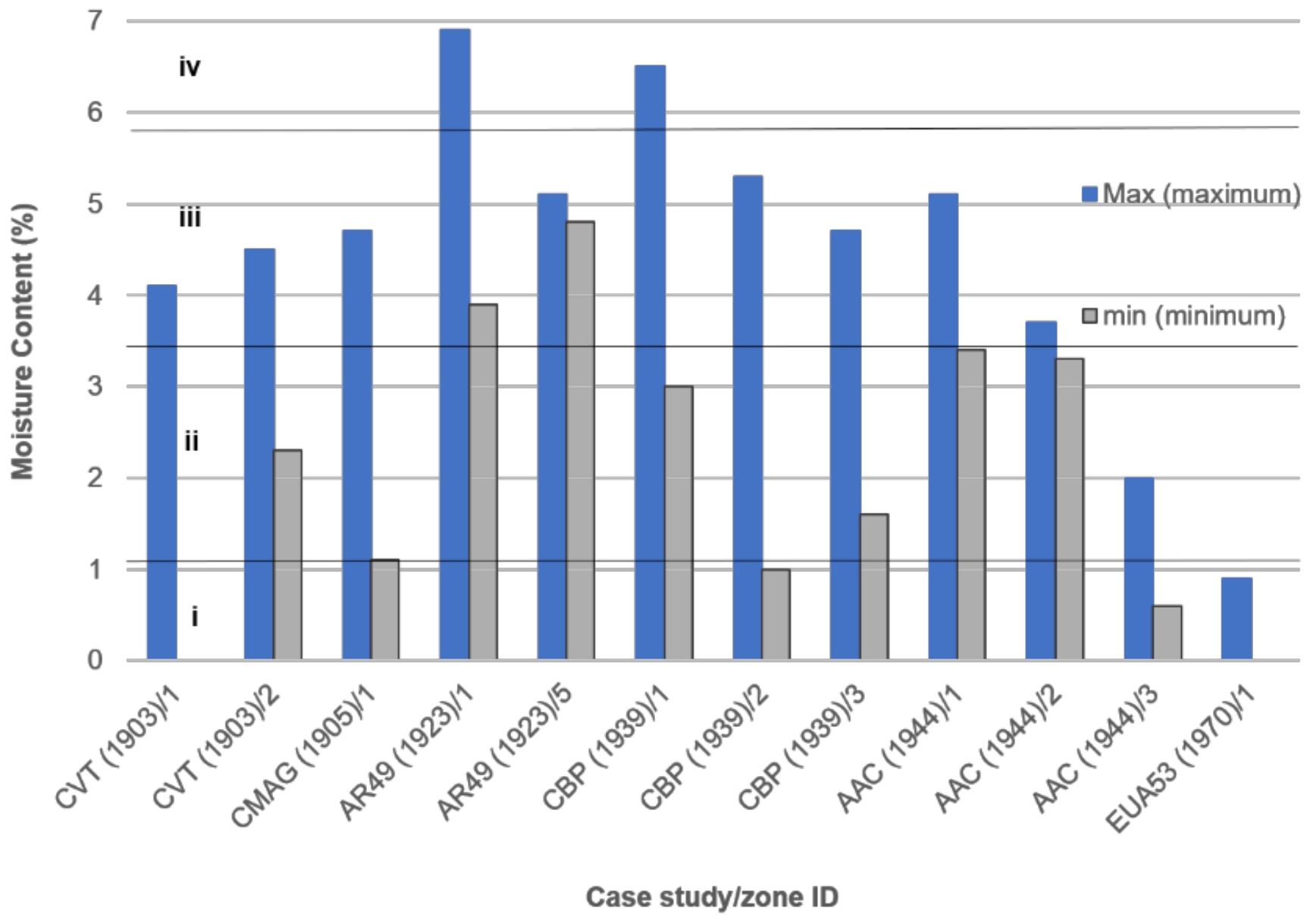
| m | 0.0 (>0.9 m) | 2.3 (at 1.5 m; 2.1 m) | 1.1 (at 2.7 m) | 3.9 (at 1.8 m) | 4.8 (at 0.3 m) | 3.0(at 1.5 m) | 1.0 (at 1.8 m) | 1.6 (at 1.2 m) | 3.4 (at 0.3 m) | 3.3 (at 0.9 m) | 0.6 (at 1.8 m) | 0.0 (>1.5 m) |
| M | 4.1 (at 0.3 m) | 4.5 (at 0.6 m) | 4.7 (at 0.3 m) | 6.9 (at 0.6 m) | 5.1 (at 2.1 m) | 6.5 (at 0.6 m) | 5.3 (at 0.3 m) | 4.7 (at 0.6 m) | 5.1 (at 1.2 m) | 3.7 (at 0.6 m) | 2.0 (at 0.3 m) | 0.9 (at 0.3 m) |
| MS | ||||||||||||
| m | 12 (at 0.3 m) | (a) | 36 (at 1.5 m) | (a) | (a) | (a) | (a) | (a) | 35 (at 1.2 m) | 23 (at 0.6 m) | 71 (at 0.9 m) | 96 (at 1.5 m) |
| M | 26 (at 0.9 m) | (a) | 38 (at 1.2 m) | (a) | (a) | (a) | (a) | (a) | 48 (at 0.3 m) | 50 (at 0.9 m) | 92 (at 0.3 m) | 106 (at 1.2 m) |
| SH | ||||||||||||
| m | 97 (at 0.3 m) | 20 (at 2.1 m) | 94 (at 0.9 m; 2.7 m) | (a) | (a) | (a) | (a) | (a) | (a) | (a) | 98 (at 0.6 m) | (a) |
| M | 99 (>0.9 m) | 100 (at 0.6 m) | 97 (at 1.8 m) | (a) | (a) | (a) | (a) | (a) | (a) | (a) | 100 (at 0.9 m) | (a) |
| Case Study | Construction Typology | Anomaly Type | Mechanism/Cause | Extension and Degree of Degradation | Severity | State of Conservation |
|---|---|---|---|---|---|---|
| CVT (1903) | PRCB | Water infiltrations | Physical | ++ | 1 | Reasonable condition |
| Capillary rising water | + | 1 | ||||
| Detaching | Mechanical | + | 4 | |||
| Efflorescences | Chemical/Physical | + | 1 | |||
| CMAG (1905) | PRCB | Cracking | Mechanical | ++ | 2 | Reasonable condition |
| Detaching | + | 4 | ||||
| Stains | Chemical | + | 1 | |||
| Biological growth | + | 1 | ||||
| AR49 (1923) | PRCB | Capillary rising water | Physical | + | 1 | Reasonable condition |
| Water infiltrations/retention | ++ | 1 | ||||
| Cracking | Mechanical | ++ | 3 | |||
| Detaching | + | 4 | ||||
| Stains | Chemical | + | 1 | |||
| Efflorescences | Chemical/Physical | + | 1 | |||
| CBP (1939) | PRCB | Capillary rising water | Physical | +++ | 1 | Reasonable condition |
| Cracking | Mechanical | ++ | 2 | |||
| Detaching | + | 4 | ||||
| Cryptoflorescences | Chemical/Physical | + | 1 | |||
| AAC (1944) | PRCB | Capillary rising water | Physical | + | 1 | Reasonable condition |
| Erosion | + | 1 | ||||
| Disaggregation | Mechanical | + | 4 | |||
| Stains | Chemical | ++ | 1 | |||
| Biological growth | ++ | 1 | ||||
| IRF (1938) | RCB | Water infiltration | Physical | ++ | 1 | Reasonable condition |
| Cracking | Mechanical | + | 2 | |||
| Detaching | + | 4 | ||||
| DN (1940) | RCB | Water retention | Physical | + | 1 | Reasonable condition |
| Detaching | Mechanical | + | 1 | |||
| Stains | Chemical | ++ | 1 | |||
| Biological growth | + | 4 | ||||
| LIP (1958) | RCB | Water infiltration | Physical | + | 1 | Reasonable condition |
| Cracking | Mechanical | + | 1 | |||
| Detaching | + | 4 | ||||
| Stains | Chemical | + | 1 | |||
| Biological growth | + | 1 | ||||
| EUA53 (1970) | RCB | Cracking | Mechanical | + | 1 | Good condition |
| Case Study | Anomaly Type | Group of Anomalies | Extension and Degree of Degradation | Severity | State of Conservation |
|---|---|---|---|---|---|
| FRAN (1971) | Biological growth | Colouration | + | 1 | Reasonable condition |
| Erosion | Shape | + | 1 | ||
| Spalling | + | 2 | |||
| ISCJ (1975) | Moisture stains | Colouration | ++ | 2 | Reasonable condition |
| Corrosion stains | + | 1 | |||
| Biological growth | + | 1 | |||
| Spalling | Shape | + | 2 | ||
| JRP (1987) | Moisture stains | Colouration | ++ | 2 | Reasonable condition |
| Corrosion stains | + | 1 | |||
| Efflorescences | + | 2 | |||
| Biological growth | + | 1 | |||
| Oriented cracking (<0.5 mm) | Shape | + | 2 | ||
| Oriented cracking (>3mm) | + | 3 | |||
| Spalling | + | 2 | |||
| Flatness defects | + | 2 | |||
| Honeycombing | Texture | + | 2 | ||
| PCV (1998) | Corrosion stains | Colouration | + | 1 | Reasonable condition |
| Dirt stains | + | 1 | |||
| Bug holes | Texture | + | 1 | ||
| Mapped cracking | + | 3 | |||
| Oriented cracking (<0.5 mm) | Shape | + | 2 | ||
| Spalling | + | 2 | |||
| Flatness defects | + | 1 | |||
| Crust | + | 2 | |||
| C8 (2000) | Moisture stains | Colouration | ++ | 2 | Reasonable condition |
| Dirt stains | ++ | 2 | |||
| Dribbling | Texture | + | 1 | ||
| AS (2001) | Efflorescences | Colouration | + | 1 | Reasonable condition |
| Wear | Shape | + | 1 | ||
| Oriented cracking (<0.5 mm) | + | 2 | |||
| Dribbling | Texture | + | 1 | ||
| UNL (2002) | Corrosion stains | Colouration | + | 1 | Reasonable condition |
| Fastening marks | Texture | + | 2 |
Publisher’s Note: MDPI stays neutral with regard to jurisdictional claims in published maps and institutional affiliations. |
© 2021 by the authors. Licensee MDPI, Basel, Switzerland. This article is an open access article distributed under the terms and conditions of the Creative Commons Attribution (CC BY) license (https://creativecommons.org/licenses/by/4.0/).
Share and Cite
Almeida, L.; Silva, A.S.; Veiga, M.d.R.; Mirão, J.; Vieira, M. 20th-Century Award-Winning Buildings in Lisbon (Portugal). Study of Plasters, Rendering, and Concrete Materials Aiming Their Sustainable Preservation. Buildings 2021, 11, 359. https://doi.org/10.3390/buildings11080359
Almeida L, Silva AS, Veiga MdR, Mirão J, Vieira M. 20th-Century Award-Winning Buildings in Lisbon (Portugal). Study of Plasters, Rendering, and Concrete Materials Aiming Their Sustainable Preservation. Buildings. 2021; 11(8):359. https://doi.org/10.3390/buildings11080359
Chicago/Turabian StyleAlmeida, Luís, António Santos Silva, Maria do Rosário Veiga, José Mirão, and Manuel Vieira. 2021. "20th-Century Award-Winning Buildings in Lisbon (Portugal). Study of Plasters, Rendering, and Concrete Materials Aiming Their Sustainable Preservation" Buildings 11, no. 8: 359. https://doi.org/10.3390/buildings11080359
APA StyleAlmeida, L., Silva, A. S., Veiga, M. d. R., Mirão, J., & Vieira, M. (2021). 20th-Century Award-Winning Buildings in Lisbon (Portugal). Study of Plasters, Rendering, and Concrete Materials Aiming Their Sustainable Preservation. Buildings, 11(8), 359. https://doi.org/10.3390/buildings11080359

