

An Integrated Organizational System for Project Source Selection in the Major Iranian Construction Companies



Abstract
1. Introduction
- What are the main selection criteria of the key service/goods providers for the housing construction clients in Iran?
- What is the main evidence for criteria evaluation to select each of the above sources?
- Which assessment model is the most appropriate method for source selection at each level?
2. Outsourcing in the Construction Industry
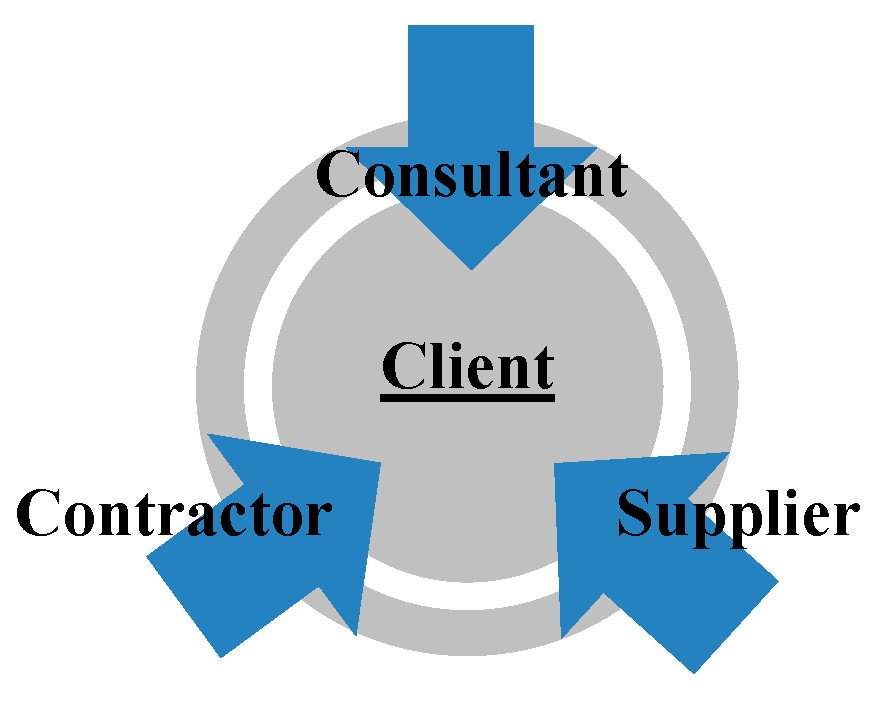
- Construction General Contractor, who may also be called Constructor [32], is the second party in a construction contract with the client and refers to the person who undertakes the executive phase of the project by the preparation of required resources including machinery, materials and human resources [33,34,35].
- Construction Consultant, who may also be called the Designer [34], Engineer [32] or Architect, is the party in a construction contract with the client and means a person who acts on behalf of the client and undertakes the vast responsibilities of designing, estimating and monitoring the execution phase, interpreting contract documents and inspecting the improvements and payments [35,36].
2.1. Procedures of Source Selection
- Long list of interested contractors;
- Short list of contractors to interview;
- The contractors who will tender;
- The final choice of the contractor by competition or negotiation.
2.2. Source Selection Criteria
2.3. Source Qualification Models
3. Research Methodology
4. Discussion
4.1. Levels of Evaluation
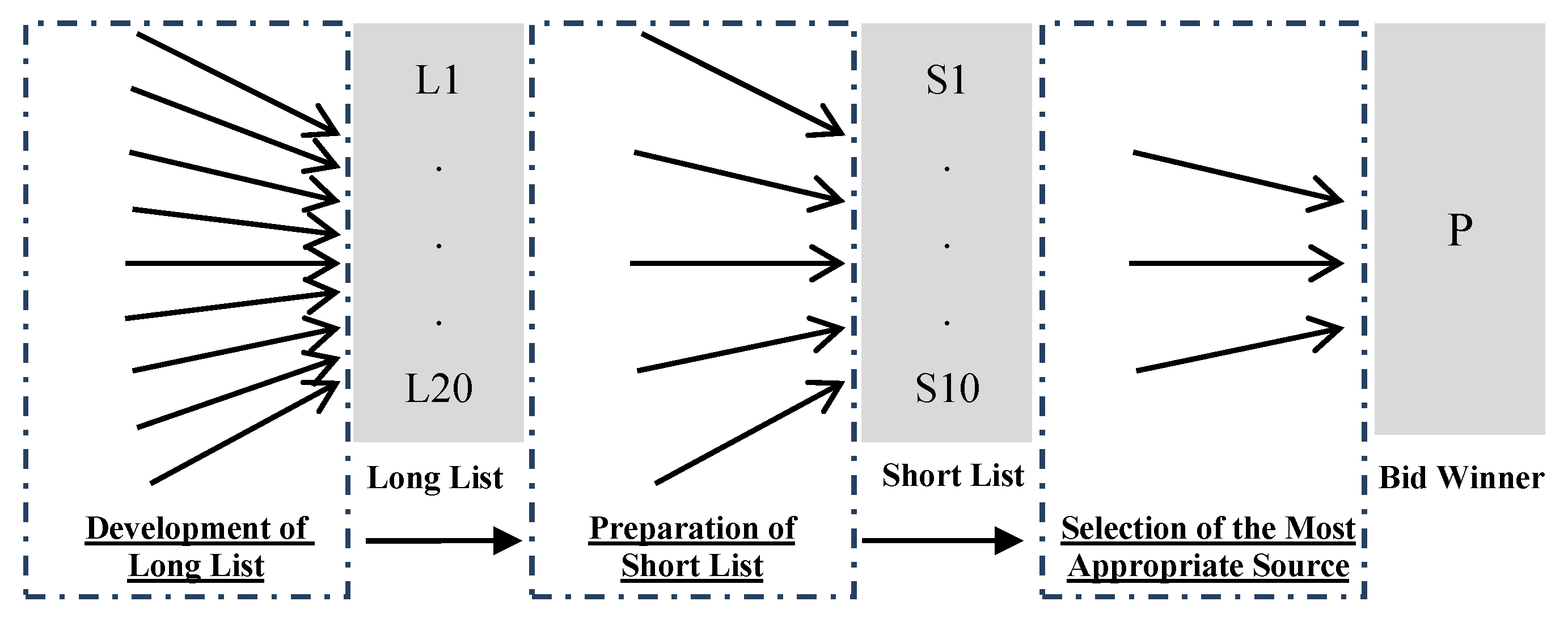
- Development of the long list (prospective sources): in this stage, the client side tries to develop a list of all potential corporations that can sell goods and services without considering a specific project. Obviously, this list is one of the assets of the organization, which should be updated regularly and, based on an arranged survey and precise criteria, be kept in a data bank. This stage is mainly done by the headquarters of corporations. To achieve consistent terminology, this stage is called the prequalification level.
- Preparation of the short list (screened sources): referring to a particular project, by considering the characteristics of a given project on one hand and checking the capabilities of existing sources of the long list on the other hand, a short list of potential bidders is selected. This stage should be done by the project applicant sector or subsidiary company and under the supervision/approval of senior managers of the organization. This process may also be defined under a limited tendering procedure. This stage is called the qualification level.
- Selection of the most appropriate source (selected source): in the tender process, technical and financial proposals of potential bidders are received through an RFP procedure. Selection of the source as the bid winner and the second party of the contract by evaluating different suggestions is the final step of outsourcing, which is normally followed by a scrutinized process. Responsibility for this stage is usually delegated to an expert committee and under the supervision/approval of senior managers of the organization or subsidiary company. This stage is called the evaluation level. It is also very important to separate technical evaluations from commercial ones in this step.
4.2. Procedures of Evaluation
4.2.1. Source Identification Method
- -
- No historical data are available in the organization.
- -
- Search. The primary method for gathering and updating information about sources is to investigate available companies active in various fields and disciplines.
- -
- Advertisement. Sources can also be identified by sending advertisements to professional and specialist newspapers or web pages. Such procedures are compulsory by law in some public organizations.
- -
- Available lists of other organizations (e.g., lists of surety companies, associations or public entities).
- -
- Similar available lists.
- -
- Correspondence/Contact. Direct contact with companies to request information about them is a conventional way to acquire proper information.
- -
- Screening. In the case of available lists of sources and their information in the organization, screening of companies by the elimination of thoroughly unrelated sources is a method to achieve a preliminary list of companies.
- -
- Scoring. Following the above-defined screening process, it is possible to improve the list by using engineering judgment by primarily prioritizing the available options by scoring the available companies.
4.2.2. Criteria Definition
- -
- Criteria Determination. As source selection is a multi-criteria decision-making process, it is essential to determine and define specific criteria to be used to designate satisfaction with each option versus the intended criterion.
- -
- Criteria Weighting. Clearly, all defined criteria are not equal in terms of importance, so their weight in the calculations should be specified.
- -
- Evidence. To obtain a reliable and objective basis to assign the points, related documents must be defined exactly. Evidence should provide a basis on which all evaluators have the same judgment and impression.
4.2.3. Evaluation Arrangement
- -
- Independent Evaluators. In this method, evaluators score companies based on different criteria completely separately and autonomously.
- -
- Expert Judgment (Consensus). In this method, evaluators score criteria based on negotiation until they make a unanimous decision.
- -
- Specialized Team (Voting). In this method, evaluators score companies based on a preliminary discussion on various options and then reach a decision based on maximum votes.
4.2.4. Development of Assessment Model
- -
- Analytical hierarchy process (AHP). In this method, all sources for each criterion are compared pair-wise, and a ranking list of sources is provided. It should be mentioned that choosing this method affects previously made decisions and compels the panel to follow the laws of this method.
- -
- Linear model of simple additive weighting (SAW). In this method, each source satisfaction against each criterion is calculated by applying their weights.
- -
- Engineering judgment (EJ). If the nature of the work and its complexity necessitates that the review and the decision should be made by a panel, the responsibility for overall scoring and ranking will be dedicated to an engineering expert panel that is capable of taking into account all the parameters.
4.3. Proposed Integrated System of the Source Selection
5. Conclusions
Author Contributions
Funding
Conflicts of Interest
References
- Tavakolan, M.; Mohammadi, A. Risk management workshop application: A case study of Ahwaz Urban Railway project. Int. J. Constr. Manag. 2018, 18, 260–274. [Google Scholar] [CrossRef]
- Polat, G.; Bayhan, H.G. Selection of HVAC-AHU system supplier with environmental considerations using Fuzzy EDAS method. Int. J. Constr. Manag. 2020, 1–9. [Google Scholar] [CrossRef]
- Hosseini-Nasab, H.; Ghamsarian, M.M. A fuzzy multiple-criteria decision-making model for contractor prequalification. J. Decis. Syst. 2015, 24, 433–448. [Google Scholar] [CrossRef]
- Dixit, V. Risk assessment of different sourcing contract scenarios in project procurement. Int. J. Constr. Manag. 2020, 1–13. [Google Scholar] [CrossRef]
- Abdelhadi, Y.; Dulaimi, M.F.; Bajracharya, A. Factors influencing the selection of delay analysis methods in construction projects in UAE. Int. J. Constr. Manag. 2018, 19, 329–340. [Google Scholar] [CrossRef]
- Korytárová, J.; Hanák, T.; Kozik, R.; Zielina, E.R. Exploring the Contractors’ Qualification Process in Public Works Contracts. Procedia Eng. 2015, 123, 276–283. [Google Scholar] [CrossRef][Green Version]
- Chiang, F.-Y.; Yu, V.F.; Luarn, P. Construction Contractor Selection in Taiwan Using AHP. Int. J. Eng. Technol. 2017, 9, 211–215. [Google Scholar] [CrossRef][Green Version]
- El-Sayegh, S.M.; Basamji, M.; Ahmad, A.H.; Zarif, N. Key contractor selection criteria for green construction projects in the UAE. Int. J. Constr. Manag. 2019, 1–11. [Google Scholar] [CrossRef]
- Nguyen, L.H.; Watanabe, T. The Impact of Project Organizational Culture on the Performance of Construction Projects. Sustainability 2017, 9, 781. [Google Scholar] [CrossRef]
- Liu, J.; Low, S.P.; Zhang, Q. Enterprise risk management practices of top ENR international contractors. Int. J. Constr. Manag. 2018, 18, 364–374. [Google Scholar] [CrossRef]
- Acheamfour, V.K.; Kissi, E.; Adjei-Kumi, T. Ascertaining the impact of contractors pre-qualification criteria on project success criteria. Eng. Constr. Arch. Manag. 2019, 26, 618–632. [Google Scholar] [CrossRef]
- Simon, L.; Jefferies, M.; Davis, P.; Newaz, M.T. Developing a theoretical success factor framework for the tendering phase of social infrastructure PPPs. Int. J. Constr. Manag. 2020, 20, 613–627. [Google Scholar] [CrossRef]
- Dansoh, A.; Frimpong, S.; Ampratwum, G.; Oppong, G.D.; Osei-Kyei, R. Exploring the role of traditional authorities in managing the public as stakeholders on PPP projects: A case study. Int. J. Constr. Manag. 2020, 20, 628–641. [Google Scholar] [CrossRef]
- Dolla, T.; Laishram, B. Factors affecting public-private partnership preference in Indian municipal waste sector. Int. J. Constr. Manag. 2019, 20, 567–584. [Google Scholar] [CrossRef]
- Osei-Kyei, R.; Chan, A.P.; Dansoh, A. Project selection index for unsolicited public–private partnership proposals. Int. J. Constr. Manag. 2019, 20, 1–12. [Google Scholar] [CrossRef]
- Seth, D.; Nemani, V.K.; Pokharel, S.; Al Sayed, A.Y. Impact of competitive conditions on supplier evaluation: A construction supply chain case study. Prod. Plan. Control. 2018, 29, 217–235. [Google Scholar] [CrossRef]
- Moore, M.J. Selecting a contractor for fast-track projects. 1. principles of contractor evaluation. Plant Eng. 1985, 39, 74–75. [Google Scholar]
- Stephen, A. Contract Management Handbook for Commercial Construction: The Wheres, Whys, Hows, and Whats of Planning, Forming, and Administering Commercial Construction Contracts; Naris Publications: Sarajevo, Bosnia and Herzegovina, 1984. [Google Scholar]
- Richard, H.C.; Glenn, S. Construction Contracting; Wiley & Sons: New York, NY, USA, 1986. [Google Scholar]
- Lines, B.; Kumar, G.G.R. Developing More Competitive Proposals: Relationship between Contractor Qualifications-Based Proposal Content and Owner Evaluation Scores. J. Constr. Eng. Manag. 2018, 144, 04018030. [Google Scholar] [CrossRef]
- Merna, A.; Smith, N. Bid evaluation for UK public sector construction contracts. Proc. Inst. Civ. Eng. 1990, 88, 91–105. [Google Scholar] [CrossRef]
- Alsugair, A.M. Framework for Evaluating Bids of Construction Contractors. J. Manag. Eng. 1999, 15, 72–78. [Google Scholar] [CrossRef]
- Scott, C.; Lundgren, H.; Thompson, P. Guide to Outsourcing in Supply Chain Management. In Guide to Supply Chain Management; Springer: Berlin/Heidelberg, Germany, 2011; pp. 169–182. [Google Scholar]
- Fard, M.M.; Terouhid, S.A.; Jokar, M.R.A. Managerial evaluation of construction contractors in the selection process. Sch. J. Econ. Bus. Manag. 2015, 2, 145–158. [Google Scholar]
- Vilasini, N.; Neitzert, T.; Rotimi, J.O.B. Correlation between Construction Procurement Methods and Lean Principles. Int. J. Constr. Manag. 2011, 11, 65–78. [Google Scholar] [CrossRef]
- Alzahrani, J.I.; Emsley, M.W. The impact of contractors’ attributes on construction project success: A post construction evaluation. Int. J. Proj. Manag. 2013, 31, 313–322. [Google Scholar] [CrossRef]
- Taylan, O.; Bafail, A.O.; Abdulaal, R.M.; Kabli, M.R. Construction projects selection and risk assessment by fuzzy AHP and fuzzy TOPSIS methodologies. Appl. Soft Comput. 2014, 17, 105–116. [Google Scholar] [CrossRef]
- Toor, S.-U.-R.; Ogunlana, S.O. Beyond the ‘iron triangle’: Stakeholder perception of key performance indicators (KPIs) for large-scale public sector development projects. Int. J. Proj. Manag. 2010, 28, 228–236. [Google Scholar] [CrossRef]
- Love, P.E.; Irani, Z.; Edwards, D.J. A seamless supply chain management model for construction. Supply Chain Manag. Int. J. 2004, 9, 43–56. [Google Scholar] [CrossRef]
- Bygballe, L.E.; Jahre, M.; Swärd, A. Partnering relationships in construction: A literature review. J. Purch. Supply Manag. 2010, 16, 239–253. [Google Scholar] [CrossRef]
- Black, C.; Akintoye, A.; Fitzgerald, E.A. An analysis of success factors and benefits of partnering in construction. Int. J. Proj. Manag. 2000, 18, 423–434. [Google Scholar] [CrossRef]
- Howells, R. Occupational Health and Safety Law; M + E: London, UK, 1997. [Google Scholar]
- LawInsider. Definition of Construction Contractor. Available online: https://www.lawinsider.com/dictionary/construction-contractor (accessed on 25 June 2020).
- Phillips, C.S. Construction Contract Administration; Society for Mining, Metallurgy, and Exploration: Englewood, CO, USA, 2015. [Google Scholar]
- Wiley, J. The CSI Construction Contract Administration Practice Guide; Wiley: Hoboken, NJ, USA, 2011. [Google Scholar]
- LawInsider. Definition of Construction Consultant. Available online: https://www.lawinsider.com/dictionary/construction-consultant (accessed on 25 June 2020).
- Bayazit, O.; Karpak, B.; Yagci, A. A purchasing decision: Selecting a supplier for a construction company. J. Syst. Sci. Syst. Eng. 2006, 15, 217–231. [Google Scholar] [CrossRef]
- Tanskanen, K.; Holmström, J.; Elfving, J.; Talvitie, U. Vendor-managed-inventory (VMI) in construction. Int. J. Product. Perform. Manag. 2008, 58, 29–40. [Google Scholar] [CrossRef]
- Cameron, J.G. A Practitioner’s Guide to Construction Law; ALI-ABA: Hangzhou, China, 2000. [Google Scholar]
- Alsugair, A.M.; Abuthnain, M.M. Assessment of Government Contractor Classification System in Saudi Arabia. Adv. Mater. Res. 2011, 250, 345–355. [Google Scholar] [CrossRef]
- Griek, L. Government Procurement in Japan. Obstacles and Opportunities for European SMEs; EU-Japan Centre for industrial Cooperation: Tokyo, Japan, 2014. [Google Scholar]
- Padhi, S.S.; Mohapatra, P.K. Centralized bid evaluation for awarding of construction projects—A case of India government. Int. J. Proj. Manag. 2010, 28, 275–284. [Google Scholar] [CrossRef]
- Plebankiewicz, E. Construction contractor prequalification from Polish clients’ perspective. J. Civ. Eng. Manag. 2010, 16, 57–64. [Google Scholar] [CrossRef]
- Harvey, S. Successful contractor selection. Eng. Manag. J. 1997, 7, 97–100. [Google Scholar] [CrossRef]
- Palaneeswaran, E.; Kumaraswamy, M.M.; Tam, P.W.M. Comparing Approaches to Contractor Selection for Design and Build Projects. In Customer Satisfaction: A Focus for Research and Practice in Construction, Proceedings of W55 & W65 Joint Triennal Symposium, Cape Town, South Africa, 5–10 September; University of Cape Town, Department of Construction Economics and Management: Cape Town, South Africa, 1999. [Google Scholar]
- Balubaid, M.; AlAmoudi, R. Application of the Analytical Hierarchy Process (AHP) to Multi-Criteria Analysis for Contractor Selection. Am. J. Ind. Bus. Manag. 2015, 5, 581–589. [Google Scholar] [CrossRef]
- Hatush, Z.; Skitmore, M. Criteria for contractor selection. Constr. Manag. Econ. 1997, 15, 19–38. [Google Scholar] [CrossRef]
- Janssens, D.E.L. Design-Build Explained; Macmillan International Higher Education: London, UK, 1991. [Google Scholar]
- Rushton, A.; Croucher, P.; Baker, P. The Handbook of Logistics and Distribution Management: Understanding the Supply Chain; Kogan Page Publishers: London, UK, 2014. [Google Scholar]
- El-Khalek, H.A.; Aziz, R.F.; Morgan, E.S. Identification of construction subcontractor prequalification evaluation criteria and their impact on project success. Alex. Eng. J. 2019, 58, 217–223. [Google Scholar] [CrossRef]
- Mbachu, J. Conceptual framework for the assessment of subcontractors’ eligibility and performance in the construction industry. Constr. Manag. Econ. 2008, 26, 471–484. [Google Scholar] [CrossRef]
- Wong, C.H.; Holt, G.D.; Cooper, P.A. Lowest price or value? Investigation of UK construction clients’ tender selection process. Constr. Manag. Econ. 2000, 18, 767–774. [Google Scholar] [CrossRef]
- Horta, I.M.; Camanho, A.S.; Lima, A.F. Design of performance assessment system for selection of contractors in construction industry e-marketplaces. J. Constr. Eng. Manag. 2013, 139, 910–917. [Google Scholar] [CrossRef]
- Semaan, N.; Salem, M. A deterministic contractor selection decision support system for competitive bidding. Eng. Constr. Arch. Manag. 2017, 24, 61–77. [Google Scholar] [CrossRef]
- Hatush, Z.; Skitmore, M. Contractor selection using multicriteria utility theory: An additive model. Build. Environ. 1998, 33, 105–115. [Google Scholar] [CrossRef]
- Holt, G.D.; Olomolaiye, P.O.; Harris, F.C. Factors influencing U.K. construction clients’ choice of contractor. Build. Environ. 1994, 29, 241–248. [Google Scholar] [CrossRef]
- Singh, D.; Tiong, R.L.K. Contractor selection criteria: Investigation of opinions of singapore construction practitioners. J. Constr. Eng. Manag. 2006, 132, 998–1008. [Google Scholar] [CrossRef]
- Hatush, Z.; Skitmore, M. Assessment and evaluation of contractor data against client goals using PERT approach. Constr. Manag. Econ. 1997, 15, 327–340. [Google Scholar] [CrossRef][Green Version]
- Palaneeswaran, E.; Kumaraswamy, M. Recent advances and proposed improvements in contractor prequalification methodologies. Build. Environ. 2001, 36, 73–87. [Google Scholar] [CrossRef]
- Cheung, F.; Kuen, J.L.F.; Skitmore, M.; Skitmore, M. Multi-criteria evaluation model for the selection of architectural consultants. Constr. Manag. Econ. 2002, 20, 569–580. [Google Scholar] [CrossRef]
- Hai, S.; Wang, J.; Wu, D.; Bao, Q. Evaluating the Quality of Project Supervision Engineers—A Case Study in China. Int. J. Constr. Manag. 2002, 2, 13–23. [Google Scholar] [CrossRef]
- Lam, K.; Hu, T.S.; Ng, S.T. Using the principal component analysis method as a tool in contractor pre-qualification. Constr. Manag. Econ. 2005, 23, 673–684. [Google Scholar] [CrossRef]
- Zhang, X. Factor Analysis of Public Clients’ Best-Value Objective in Public–Privately Partnered Infrastructure Projects. J. Constr. Eng. Manag. 2006, 132, 956–965. [Google Scholar] [CrossRef]
- El-Sawalhi, N.; Eaton, D.; Rustom, R. Contractor pre-qualification model: State-of-the-art. Int. J. Proj. Manag. 2007, 25, 465–474. [Google Scholar] [CrossRef]
- Enshassi, A.; Arain, F.; Tayeh, B. Subcontractor Prequalification Practices in Palestine. Int. J. Constr. Manag. 2010, 10, 45–74. [Google Scholar] [CrossRef]
- Lam, K.-C.; Tao, R.; Lam, M.C.-K. A material supplier selection model for property developers using Fuzzy Principal Component Analysis. Autom. Constr. 2010, 19, 608–618. [Google Scholar] [CrossRef]
- Keršulienė, V.; Turskis, Z. Integrated fuzzy multiple criteria decision making model for architect selection. Technol. Econ. Dev. Econ. 2012, 17, 645–666. [Google Scholar] [CrossRef]
- Nieto-Morote, A.; Ruz-Vila, F. A fuzzy multi-criteria decision-making model for construction contractor prequalification. Autom. Constr. 2012, 25, 8–19. [Google Scholar] [CrossRef]
- Eshtehardian, E.; Ghodousi, P.; Bejanpour, A. Using ANP and AHP for the supplier selection in the construction and civil engineering companies; Case study of Iranian company. KSCE J. Civ. Eng. 2013, 17, 262–270. [Google Scholar] [CrossRef]
- Enshassi, A.; Mohamed, S.; Modough, Z. Contractors’ Selection Criteria: Opinions of Palestinian Construction Professionals. Int. J. Constr. Manag. 2013, 13, 19–37. [Google Scholar] [CrossRef]
- Alptekin, O. Multi-criteria decision making approach in contractor selection. Int. J. Nat. Eng. Sci. 2014, 5, 6–9. [Google Scholar]
- Kwofie, T.E.; Adinyira, E.; Botchway, E.A. Identification of the critical project management competencies of architects in the Ghanaian construction industry. Int. J. Constr. Manag. 2015, 15, 288–298. [Google Scholar] [CrossRef]
- Kog, F.; Yaman, H. A multi-agent systems-based contractor pre-qualification model. Eng. Constr. Arch. Manag. 2016, 23, 709–726. [Google Scholar] [CrossRef]
- Ebrahimi, A.; Alimohammadlou, M.; Mohammadi, S. Identification and prioritization of effective factors in assessment and ranking of contractors using fuzzy multi-criteria techniques. Decis. Sci. Lett. 2016, 5, 95–108. [Google Scholar] [CrossRef]
- Liu, B.; Yang, X.; Huo, T.; Shen, G.; Wang, X. A linguistic group decision-making framework for bid evaluation in mega public projects considering carbon dioxide emissions reduction. J. Clean. Prod. 2017, 148, 811–825. [Google Scholar] [CrossRef]
- Cengiz, A.; Aytekin, O.; Ozdemir, I.; Kusan, H.; Cabuk, A. A Multi-criteria Decision Model for Construction Material Supplier Selection. Procedia Eng. 2017, 196, 294–301. [Google Scholar] [CrossRef]
- Wang, T.-K.; Zhang, Q.; Chong, H.-Y.; Wang, X. Integrated Supplier Selection Framework in a Resilient Construction Supply Chain: An Approach via Analytic Hierarchy Process (AHP) and Grey Relational Analysis (GRA). Sustainability 2017, 9, 289. [Google Scholar] [CrossRef]
- Mousakhani, E.; Ranjbar, S.; Ashoori, T. Identification and evaluation of criteria for selecting contractors using a risk management approach. Organ. Technol. Manag. Constr. Int. J. 2018, 10, 1747–1760. [Google Scholar] [CrossRef]
- Rao, M.V.K.; Kumar, V.S.S.; Kumar, P.R. Optimal Contractor Selection in Construction Industry: The Fuzzy Way. J. Inst. Eng. Ser. A 2018, 99, 67–78. [Google Scholar] [CrossRef]
- Bonyani, A.; Alimohammadlou, M. A new approach for evaluating international EPC contractors in Iran’s energy sector. Int. J. Constr. Manag. 2020, 20, 775–782. [Google Scholar] [CrossRef]
- Yazdani, M.; Wen, Z.; Liao, H.; Banaitis, A.; Turskis, Z. A grey combined compromise solution (COCOSO-G) method for supplier selection in construction management. J. Civ. Eng. Manag. 2019, 25, 858–874. [Google Scholar] [CrossRef]
- Birjandi, A.K.; Akhyani, F.; Sheikh, R.; Sana, S.S. Evaluation and selecting the contractor in bidding with incomplete information using MCGDM method. Soft Comput. 2019, 23, 10569–10585. [Google Scholar] [CrossRef]
- El-Kholy, A.M. A new technique for subcontractor selection by adopting choosing by advantages. Int. J. Constr. Manag. 2019, 1–23. [Google Scholar] [CrossRef]
- Mahdi, I.M.; Riley, M.J.; Fereig, S.M.; Alex, A.P. A multi-criteria approach to contractor selection. Eng. Constr. Arch. Manag. 2002, 9, 29–37. [Google Scholar] [CrossRef]
- Holt, G.D. Which contractor selection methodology? Int. J. Proj. Manag. 1998, 16, 153–164. [Google Scholar] [CrossRef]
- Sönmez, M.; Yang, J.B.; Holt, G.D. Addressing the contractor selection problem using an evidential reasoning approach. Eng. Constr. Archit. Manag. 2001, 8, 198–210. [Google Scholar] [CrossRef]
- Russell, J.S.; Hancher, D.E.; Skibniewski, M.J. Contractor prequalification data for construction owners. Constr. Manag. Econ. 1992, 10, 117–135. [Google Scholar] [CrossRef]
- Holt, G.D.; Olomolaiye, P.O.; Harris, F.C. Evaluating prequalification criteria in contractor selection. Build. Environ. 1994, 29, 437–448. [Google Scholar] [CrossRef]
- Rao, M.K.; Kuma, V.K.V.; Kumar, P.R. Prequalification of contractor in the construction industry using multi-attribute utility theory: A multiplicative approach. Malays. J. Civ. Eng. 2016, 28. [Google Scholar] [CrossRef]
- Paul, P.; Salini, P.S.; Mohan, S. Selection of the most optimal contractor in Indian Construction Industry using TOPSIS and Extended TOPSIS model. IOSR J. Mech. Civ. Eng 2016, 99, 67–78. [Google Scholar]
- Rao, K. Multi-Criteria Decision Making for Contractor Selection—A Fuzzy Set Theoretic Approach. Ph.D. Thesis, Osmania University, Hyderabad, India, 2013. [Google Scholar]
- Widianta, M.M.D.; Rizaldi, T.; Setyohadi, D.P.S.; Riskiawan, H.Y. Comparison of Multi-Criteria Decision Support Methods (AHP, TOPSIS, SAW & PROMENTHEE) for Employee Placement. J. Phys. Conf. Ser. 2018, 953, 12116. [Google Scholar] [CrossRef]
- Darvish, M.; Yasaei, M.; Saeedi, A. Application of the graph theory and matrix methods to contractor ranking. Int. J. Proj. Manag. 2009, 27, 610–619. [Google Scholar] [CrossRef]
- Akcan, S.; Güldeş, M. Integrated Multicriteria Decision-Making Methods to Solve Supplier Selection Problem: A Case Study in a Hospital. J. Healthc. Eng. 2019, 2019, 1–10. [Google Scholar] [CrossRef]
- Marzouk, M. A superiority and inferiority ranking model for contractor selection. Constr. Innov. 2008, 8, 250–268. [Google Scholar] [CrossRef]
- Rajaie, H.; Hazrati, A.; Rashidi, A. Evaluation of construction contractors in developing countries using fuzzy SAW method. In Proceedings of the International Conference on Computing Civil and Building Engineering, Nottingham, UK, 30 June–2 July 2010; Volume 283. [Google Scholar]
- Abudayyeh, O.; Zidan, S.J.; Yehia, S.; Randolph, D. Hybrid Prequalification-Based, Innovative Contracting Model Using AHP. J. Manag. Eng. 2007, 23, 88–96. [Google Scholar] [CrossRef]
- Martin, H.G.; Koylass, J.; Welch, F. An exploration of the consistency limits of the analytical hierarchy process and its impact on contractor selection. Int. J. Constr. Manag. 2016, 18, 14–25. [Google Scholar] [CrossRef]
- Luzon, B.; El-Sayegh, S. Evaluating supplier selection criteria for oil and gas projects in the UAE using AHP and Delphi. Int. J. Constr. Manag. 2016, 16, 175–183. [Google Scholar] [CrossRef]
- Cheaitou, A.; Larbi, R.; Al Housani, B. Decision making framework for tender evaluation and contractor selection in public organizations with risk considerations. Socio-Econ. Plan. Sci. 2019, 68, 100620. [Google Scholar] [CrossRef]
- Huang, W.-H.; Tserng, H.P.; Liao, H.-H.; Yin, S.Y.L.; Chen, P.-C.; Lei, M.C. Contractor financial prequalification using simulation method based on cash flow model. Autom. Constr. 2013, 35, 254–262. [Google Scholar] [CrossRef]
- Wong, C.H. Contractor Performance Prediction Model for the United Kingdom Construction Contractor: Study of Logistic Regression Approach. J. Constr. Eng. Manag. 2004, 130, 691–698. [Google Scholar] [CrossRef]
- Kajornboon, A.B. Using interviews as research instruments. E-J. Res. Teach. 2005, 2, 1–9. [Google Scholar]
- Leech, B.L. Asking Questions: Techniques for Semistructured Interviews. PS Polit. Sci. Polit. 2002, 35, 665–668. [Google Scholar] [CrossRef]
- Clifford, N.; Cope, M.; Gillespie, T.; French, S. Key Methods in Geography; Sage: Thousand Oaks, CA, USA, 2016. [Google Scholar]
- Dimitrijević, B.; Simic, V.; Radonjic, V.; Kostic-Ljubisavljevic, A. The Delphi Method as a research tool: An application in transportation and logistics systems evaluations. In Proceedings of the 6th International Quality Conference, Kragujevac, Serbia, 8 June 2012. [Google Scholar]
- Skulmoski, G.J.; Hartman, F.T.; Krahn, J. The Delphi Method for Graduate Research. J. Inf. Technol. Educ. Res. 2007, 6, 1–21. [Google Scholar] [CrossRef]
- Bamberger, C.; Stark, M. Best Practices for Use of Best Value Selection; AGC of America: Arlington, VA, USA, 2008. [Google Scholar]


| Reference | Source | Country/Context | Selection Criteria |
|---|---|---|---|
| [21] | Contractor | Invitation to a Tender | current regional location/financial conditions/technical expertise/managerial capabilities/size of previous contracts |
| [58] | Contractor | - | financial soundness/technical ability/management capability/health and safety/reputation |
| [47] | Contractor | Prequalification and bid process | financial soundness/technical ability/managerial capability/safety and reputation |
| [59] | Contractor | Hong Kong | financial/technical/managerial |
| [60] | Consultant | Architect selection in Hong Kong | background of firm/past performance/capacity to accomplish the work/project approach |
| [61] | Supervision Engineers | China | education/comprehensive practical experience/ability of organizing/working attitudes/professional ethics/ability in using a foreign language/ability in using the computer |
| [62] | Contractor | - | financial capacity/past performance/related experience/manpower/machinery/HSE/quality systems/capacity/claims record |
| [63] | Contractor | Public–private partnerships | price/experience/technical approach/management approach/qualification/schedule/past performance/financial capability/responsiveness to the RFP/legal status |
| [34] | Supplier | - | logistical performance/commercial structure/production |
| [64] | Contractor | - | financial/management and technical ability/experience/historical/resources/quality/health and safety |
| [65] | Sub-Contractor | Palestine | adherence to requirements/time schedule/commitment to the provided prices/reputation/specialty in certain type/quality standards/sufficient equipment/labor monitoring/provide the necessary equipment/qualified craftsmen and laborers |
| [66] | Supplier | - | cost/quality and services/assurance of supply/payment/terms and past performance |
| [67] | Consultant | Architect | working knowledge/education/ability to revise project’s quality and achieving determined goals/creativity/ability to satisfy client’s and project manager’s requirements/ability to work with clients, consultants and community/culture and communication skills/responsibility and ability in detailing of the project |
| [23] | Supplier | Tendering process | technology/quality/function/management/commercial terms/past achievements in contract performance/price/financial plans |
| [68] | Contractor | - | technical/financial/managerial capacity/experience/ reputation and occupational health and safety |
| [69] | Supplier | - | price/receiving discount for specific purchase/possibility of selecting the way to pay the order/same quality of products in the multi-stage orders/variety of the products/low number of defective parts in the deliver orders/exchange of defective parts/possibility of ordering products in desired volume/delivery of products according to order/delivery of products according to schedule/possibility of rapid delivery of order in emergency cases/possibility of producing product according to buyers demand/providing technical consultation/possibility of delivery of order in desired location/having different representatives all around the country/reputation of company in the market/cooperation experience with manufacturer/great history of company in the market/great history of company to produce the desired product/market share/considering environmental issues/domestic certifications/international certifications |
| [70] | Contractor | Palestine | Financial evaluation of the bid/Completeness of bid document/Past performances in similar projects/Staff skills and experience/Contractor’s reputation/Quality of work/Contractor site management/Bid understanding/Plant and equipment resources/Health and safety performance |
| [71] | Contractor | Saudi Arabia | experience/financial capabilities/reputation/capacity/manpower/organization/HSE/past performance/quality systems |
| [72] | Architect | Key project management (PM) competencies | Effective cost control/ability to progress monitoring/knowledge of standard specifications/understanding project phases/effective in managing different persons/project time management skill |
| [34] | Contractor | Poland | legal authorizations/knowledge and experience/technical capability/personnel and financial points |
| [3] | Contractor | - | financial stability/experience/past performance/technical/capacity/resources/quality and safety |
| [46] | Contractor | - | financial capability/past performance/contractor’s past experience/contractor’s resources/current workload/safety performance |
| [73] | Contractor | Prequalification | financial/managerial/technical/reputation |
| [74] | Contractor | - | price/experience/equipment/technical ability/financial stability/scheduling, quality/organizational factors/policies/certifications/security/factors pertaining to customer/factors pertaining to contractor/past function |
| [2] | Supplier | Heavy equipment, Indonesia | price and sales according to market dynamics/trading permits: producers, vendors, agents, recondition services, financing services, and importers/equipment registration |
| [75] | Contractor | CO2 emissions bid evaluation | technology/tender price/HSE |
| [76] | Supplier | For wall, cladding and roofing materials | cost/quality/delivery/payment method/geographical location/supplier profile/buyer-supplier relations/ecological characteristics/supplier capacity/technical acceptable materials |
| [77] | Supplier | - | primary performance/flexibility/enterprise capacity/R&D/green abilities |
| [78] | Contractor | - | past relationship/financial statements/bid price/quality of past performance of the contractor/organization chart/work experience/HSE/claims and legal issues/documented program of risk management/machinery and equipment appropriate to the project/accuracy of the documents in the technical proposal, sufficient knowledge of the site/labor/time |
| [20] | Contractor | Bid evaluation | technical/managerial/financial/personnel/experience/past performance/HSE |
| [79] | Contractor | India | company’s attributes/experience record/past performance of the contractor/financial capability of the contractor/performance potential of the contractor/project-specific criteria |
| [16] | Supplier | - | time/price/quality competence/delivery ability/production facilities and location/management and organization/and performance history |
| [80] | EPC Contractor | Iran | Experience/conducting similar projects/legal and political affairs/technicality and production include skills and technology/project management/available equipment and human resources/record of cooperation/volume of investment/financial affairs |
| [81] | Supplier | - | design/GHG pollution/delivery and flexibility/responsiveness and communication/ financial condition/the offered price/environmental management system |
| [50] | Sub-Contractor | - | on-time delivery of materials/failure to complete contract due to financial problems subcontractor’s difficulty in reimbursement/reputation/tender price/dealing with the critical activities during the construction stage |
| [8] | Contractor | Green Construction Projects | firm characteristics/commitment to sustainability/experience in similar projects/relation with the client/reputation/bid price/proposed time/technical bid/proposed project management plan/environmental |
| [82] | Contractor | Bid Evaluation | financial stability/technical capability/management ability/experience/health and safety/organizational performance |
| [83] | Sub-Contractor | Bid Evaluation | estimated tender price/reputation/acknowledgement certificates from government agencies/the qualification of staff/financial status/delivery/duration/health and safety record/management/production and capacity |
| [2] | Contractor | Public–private partnership projects, Bid level | three groups of criteria namely value for money/financial feasibility/sustainable innovation |
| [2] | Supplier | Air handling unit system, Russia | price of product/warranty period/delivery lead time/conformity with the specifications/quality of communication with the supplier/quality of maintenance and spare parts service/conformity with energy performance of buildings directives for green production, design and supply/efficiency level of motors |
| Theme | Main Categories | Subcategories/Levels | No. (and Percentage) of Appearing in Transcripts |
|---|---|---|---|
| Develop an integrated system for the source selection problem | Levels of evaluation |
| 23 (31%) 27 (36%) 25 (33%) |
| Procedures of evaluation |
| 25 (28%) 33 (37%) 16 (18%) 15 (17%) |
| Level of Source Selection | Seller Type | Minimum Number of Evaluators | Minimum Number of Competitive Outputs | Responsible and Administrative Unit | ||
|---|---|---|---|---|---|---|
| Mean (µ) | Std.dev. (σ) | Mean (µ) | Std.dev. (σ) | |||
| Development of Long List | Contractor | 6 | 1.90 | 25 | 3.00 | PMO |
| Consultant | 6 | 1.50 | 12 | 2.40 | ||
| Supplier | 4 | 1.80 | 10 | 2.30 | ||
| Preparation of Short List | Contractor | 8 | 1.70 | 10 | 2.60 | Project Manager and Board of Directors |
| Consultant | 7 | 1.50 | 4 | 3.40 | ||
| Supplier | 4 | 1.50 | 8 | 2.90 | ||
| Selection of the Most Appropriate Source | Contractor | 8 | 1.40 | N.A | N.A | Expert Committee and CEO |
| Consultant | 8 | 1.50 | N.A | N.A | ||
| Supplier | 3 | 1.20 | N.A | N.A | ||
| Categories | Subcategories/Levels | Characteristics/Alternatives | Number (Percentage) of Appearing in Responses |
|---|---|---|---|
| Levels of evaluation |
|
| 8 (23.53%) |
| 13 (38.24%) | ||
| 13 (38.24%) | ||
|
| 12 (14.29%) | |
| 9 (10.71%) | ||
| 34 (40.48%) | ||
| 21 (25.00%) | ||
| 8 (9.52%) | ||
|
| 13 (14.94%) | |
| 28 (32.18%) | ||
| 9 (10.34%) | ||
| 29 (33.33%) | ||
| 8 (9.20%) | ||
| Procedures of evaluation |
|
| 25 (17.24%) |
| 23 (15.86%) | ||
| 35 (24.14%) | ||
| 11 (7.59%) | ||
| 33 (22.76%) | ||
| 18 (12.41%) | ||
|
| 10 (23.26%) | |
| 9 (20.93%) | ||
| 24 (55.81%) | ||
|
| 25 (51.02%) | |
| 13 (26.53%) | ||
| 11 (22.45%) | ||
|
| 27 (32.14%) | |
| 24 (28.57%) | ||
| 33 (39.29%) |
| NO. | Criteria | Generic Proofing Evidence or Documents Based on the Results (Past Performance) and Enablers (Current Capabilities) | References |
|---|---|---|---|
| 1 | Price | Cost of past completed projects in the past 5 years, Cost overruns, Current Proposed Price | [16,50,55,63,64,74,75,78] |
| 2 | Quality | Quality performance of previous works, Quality confirmation of former clients, Quality control, policy, Assurance systems | [3,16,62,63,71,74,78,108] |
| 3 | Technical | Record of failures, Design capabilities, Executive technics, Innovated method, Drawings and technical documents | [3,6,8,16,20,21,50,55,58,59,63,64,68,73,74,75,78,79,80,82] |
| 4 | Management | Performance, procedures and standards of project management capabilities, Organizational structure | [8,16,20,21,55,57,58,59,63,64,68,71,73,74,78,79,80,82,108] |
| 5 | HSE | Safety performance, Accountability, Injury and illness | [3,20,46,55,58,62,64,68,71,75,78,82] |
| 6 | Reputation | Length of time in business, Client satisfaction, Company image, Relationship | [3,8,50,55,58,64,68,73,74] |
| 7 | Experiences | Number, Size and type of projects in the past 5 years, Experience in the region | [3,6,8,16,20,21,46,56,62,63,64,68,71,74,78,79,80,82,108] |
| 8 | Financial | Credit rating, Turnover, Bank confirmation, Debit ratio, Liquidity, Profitability, Bonding | [3,6,8,20,21,46,50,56,58,59,62,63,64,68,71,73,74,78,79,80,82] |
| 9 | Time | Time of past completed projects in the past 5 years, Time overruns, Current Proposed Time | [16,50,63,74,78] |
| 10 | Manpower | Number, Quality and Experience of staff | [3,6,8,20,46,62,64,71,78,80,108] |
| 11 | Legal | Claims and litigation, Shareholders | [6,62,63,64,78,80] |
| 12 | Capacity | Current work load | [3,46,62,71] |
| 13 | Machinery | Plant and equipment | [3,8,16,46,62,64,74,78] |
| Levels | Criteria Definition | ||||
|---|---|---|---|---|---|
| No. | Main Criteria | Evidence | Weight of Criterion | Kendall’s Coefficient (W) | |
| Development of Long List | 1 | Management | Organizational charts, systems and procedures | 19.85 | 0.809 |
| 2 | HSE | Safety performance | 32.12 | 0.726 | |
| 3 | Reputation | Length of time in business | 33.33 | 0.894 | |
| 4 | Experiences | Contracts of the previous 5 years, Experience in the region | 14.70 | 0.858 | |
| Preparation of Short List | 1 | Financial | Turnover of the past 10 years, Bank confirmation, Bonding | 29.74 | 0.789 |
| 2 | Manpower | Number, Quality and Experience of staff | 16.05 | 0.825 | |
| 3 | Legal | Records of previous claims | 11.11 | 0.822 | |
| 4 | Machinery | Plant and equipment | 43.11 | 0.741 | |
| Most Appropriate Source * | 1 | Price | Comparison with other proposed prices ** | 13.99 | 0.899 |
| 2 | Quality | Quality control, policy, assurance systems | 19.26 | 0.711 | |
| 3 | Technical | Drawings and technical documents | 18.92 | 0.738 | |
| 4 | Time | Comparison with other proposed times ** | 23.80 | 0.913 | |
| 5 | Capacity | Checking current workload | 13.90 | 0.881 | |
| 6 | HSE *** | HSE plan | 10.13 | 0.881 | |
| Categories | Long List | Kendall’s Coefficient (W) | Short List | Kendall’s Coefficient (W) | Tendering | Kendall’s Coefficient (W) |
|---|---|---|---|---|---|---|
| Identification Method | Available lists/Search | 0.762 | Long list | 0.892 | Short list | 0.792 |
| Evaluation Arrangement | Independent Evaluators | 0.799 | Specialized Team | 0.792 | Specialized Team | 0.893 |
| Assessment Model | Engineering Judgment | 0.842 | SAW | 0.898 | AHP | 0.865 |
| Levels | Criteria Definition | ||||
|---|---|---|---|---|---|
| No. | Main Criteria | Evidence | Weight of Criterion | Kendall’s Coefficient (W) | |
| Development of Long List | 1 | Quality | Quality performance of previous work | 43.31 | 0.916 |
| 2 | Management | Design management systems | 30.93 | 0.700 | |
| 3 | Reputation | Client satisfaction, Company image | 25.76 | 0.914 | |
| Preparation of Short List | 1 | Experiences | Number, Size and type of projects in the past 5 years | 32.87 | 0.913 |
| 2 | Time | Time of past completed projects in the past 5 years | 44.80 | 0.711 | |
| 3 | Legal | Claims and litigation, Shareholders | 22.33 | 0.876 | |
| Most Appropriate Source | 1 | Price | Comparison with other proposed prices * | 27.71 | 0.871 |
| 2 | Technical | Design capabilities, Executive techniques, Innovated method, BIM | 26.66 | 0.719 | |
| 3 | Manpower | Number, Quality and Experience of staff | 25.22 | 0.766 | |
| 4 | Capacity | Checking current workload | 20.41 | 0.731 | |
| Categories | Long List | Kendall’s Coefficient (W) | Short List | Kendall’s Coefficient (W) | Tendering | Kendall’s Coefficient (W) |
|---|---|---|---|---|---|---|
| Identification Method | Advertisement | 0.876 | <Long list> | 0.886 | <Short list> | 0.810 |
| Evaluation Arrangement | Independent Evaluators | 0.780 | Independent Evaluators | 0.792 | Expert Judgment | 0.759 |
| Assessment Model | SAW | 0.870 | AHP | 0.753 | EJ | 0.854 |
| Levels | Criteria Definition | ||||
|---|---|---|---|---|---|
| No. | Main Criteria | Evidence | Weight of Criterion | Kendall’s Coefficient (W) | |
| Development of Long List | 1 | Reputation | Length of time in business, Client satisfaction | 18.36 | 0.722 |
| 2 | Experiences | Number, Size and type of projects in the past 5 years, Experience in the region | 33.16 | 0.910 | |
| 3 | Financial | Credit rating, Debit ratio | 31.98 | 0.684 | |
| 4 | Machinery | List of plant and equipment | 16.51 | 0.899 | |
| Preparation of Short List | 1 | Management | Production management systems | 12.14 | 0.718 |
| 2 | Manpower | Number, Quality and Experience of staff | 28.12 | 0.850 | |
| 3 | Legal | Records of litigation, Shareholders | 34.53 | 0.901 | |
| 4 | Capacity | Checking current work load | 25.21 | 0.787 | |
| Most Appropriate Source | 1 | Price | Comparison with other available prices * | 29.10 | 0.817 |
| 2 | Quality | Quality confirmation of former clients, Quality control, policy, assurance systems | 18.36 | 0.904 | |
| 3 | Technical | Design capabilities, Innovated method, Technical documents | 26.22 | 0.805 | |
| 4 | Time | Comparison with other proposed times * | 26.32 | 0.885 | |
| Categories | Long List | Kendall’s Coefficient (W) | Short List | Kendall’s Coefficient (W) | Tendering | Kendall’s Coefficient (W) |
|---|---|---|---|---|---|---|
| Identification Method | Advertisement/Available lists | 0.819 | <Long list> | 0.887 | <Short list> | 0.724 |
| Evaluation Arrangement | Independent Evaluators | 0.839 | Independent Evaluators | 0.741 | Specialized Team | 0.710 |
| Assessment Model | AHP | 0.823 | SAW | 0.919 | EJ | 0.899 |
| Source | Level of Selection | Selection Criteria | Evidence | Identification Method | Evaluation Arrangement (Min Number of Evaluators) | Assessment Model |
|---|---|---|---|---|---|---|
| Construction General Contractor | Long List | Management | Organizational charts, systems and procedures | Available lists/Search | Independent Evaluators (6) | Engineering Judgment |
| HSE | Safety performance | |||||
| Reputation | Length of time in business | |||||
| Experiences | Contracts of previous 5 years, Experience in the region | |||||
| Short List | Financial | Turnover of past 10 years, Bank confirmation, Bonding | <Long list> | Specialized Team (8) | SAW | |
| Manpower | Number, quality and experience of staff | |||||
| Legal | Records of previous claims | |||||
| Machinery | Plant and equipment | |||||
| Tendering | Price | Comparison with other proposed prices | <Short list> | Specialized Team (8) | AHP | |
| Quality | Quality control, policy, assurance systems | |||||
| Technical | Drawings and technical documents | |||||
| Time | Comparison with other proposed times | |||||
| Capacity | Checking current workload | |||||
| HSE | HSE plan | |||||
| Construction Consultant | Long List | Quality | Quality performance of previous works | Advertisement | Independent Evaluators (6) | SAW |
| Management | Design management systems | |||||
| Reputation | Client satisfaction, Company image | |||||
| Short List | Experiences | Number, size and type of projects in the past 5 years | <Long list> | Independent Evaluators (7) | AHP | |
| Time | Time of past completed projects in the past 5 years | |||||
| Legal | Claims and litigation, Shareholders | |||||
| Tendering | Price | Comparison with other proposed prices | <Short list> | Expert Judgment (8) | EJ | |
| Technical | Design capabilities, Executive techniques, Innovated method, BIM | |||||
| Manpower | Number, Quality and Experience of staff | |||||
| Capacity | Checking current work load | |||||
| Construction Supplier | Long List | Reputation | Length of time in business, Client satisfaction | Advertisement/Available lists | Independent Evaluators (4) | AHP |
| Experiences | Number, Size and type of projects in the past 5 years, Experience in the region | |||||
| Financial | Credit rating, Debit ratio | |||||
| Machinery | List of plant and equipment | |||||
| Short List | Management | Production management systems | <Long list> | Independent Evaluators (4) | SAW | |
| Manpower | Number, Quality and Experience of staff | |||||
| Legal | Records of litigation, Shareholders | |||||
| Capacity | Checking current workload | |||||
| Tendering | Price | Comparison with other available prices | <Short list> | Specialized Team (3) | EJ | |
| Quality | Quality confirmation of former clients, Quality control, policy, assurance systems | |||||
| Technical | Design capabilities, Innovated method, Technical documents | |||||
| Time | Comparison with other proposed times |
Publisher’s Note: MDPI stays neutral with regard to jurisdictional claims in published maps and institutional affiliations. |
© 2020 by the authors. Licensee MDPI, Basel, Switzerland. This article is an open access article distributed under the terms and conditions of the Creative Commons Attribution (CC BY) license (http://creativecommons.org/licenses/by/4.0/).
Share and Cite
Faraji, A.; Rashidi, M.; Sorooshnia, E. An Integrated Organizational System for Project Source Selection in the Major Iranian Construction Companies. Buildings 2020, 10, 251. https://doi.org/10.3390/buildings10120251
Faraji A, Rashidi M, Sorooshnia E. An Integrated Organizational System for Project Source Selection in the Major Iranian Construction Companies. Buildings. 2020; 10(12):251. https://doi.org/10.3390/buildings10120251
Chicago/Turabian StyleFaraji, Amir, Maria Rashidi, and Ehsan Sorooshnia. 2020. "An Integrated Organizational System for Project Source Selection in the Major Iranian Construction Companies" Buildings 10, no. 12: 251. https://doi.org/10.3390/buildings10120251
APA StyleFaraji, A., Rashidi, M., & Sorooshnia, E. (2020). An Integrated Organizational System for Project Source Selection in the Major Iranian Construction Companies. Buildings, 10(12), 251. https://doi.org/10.3390/buildings10120251

