

DFT Modelling of Cu Segregation in Al-Cu Alloys Covered by an Ultrathin Oxide Film and Possible Links with Passivity

Abstract
1. Introduction
2. Methods
2.1. Calculations
2.2. Models
2.3. Electronic and Charge Analysis
2.4. Energetics
3. Results
3.1. Energetics of Cu in Al(111) Covered by an Oxide Layer as a Function of Cu Concentration and Location
3.2. Copper Segregation at the Interface with the Passive Film
3.2.1. Energy of Segregation
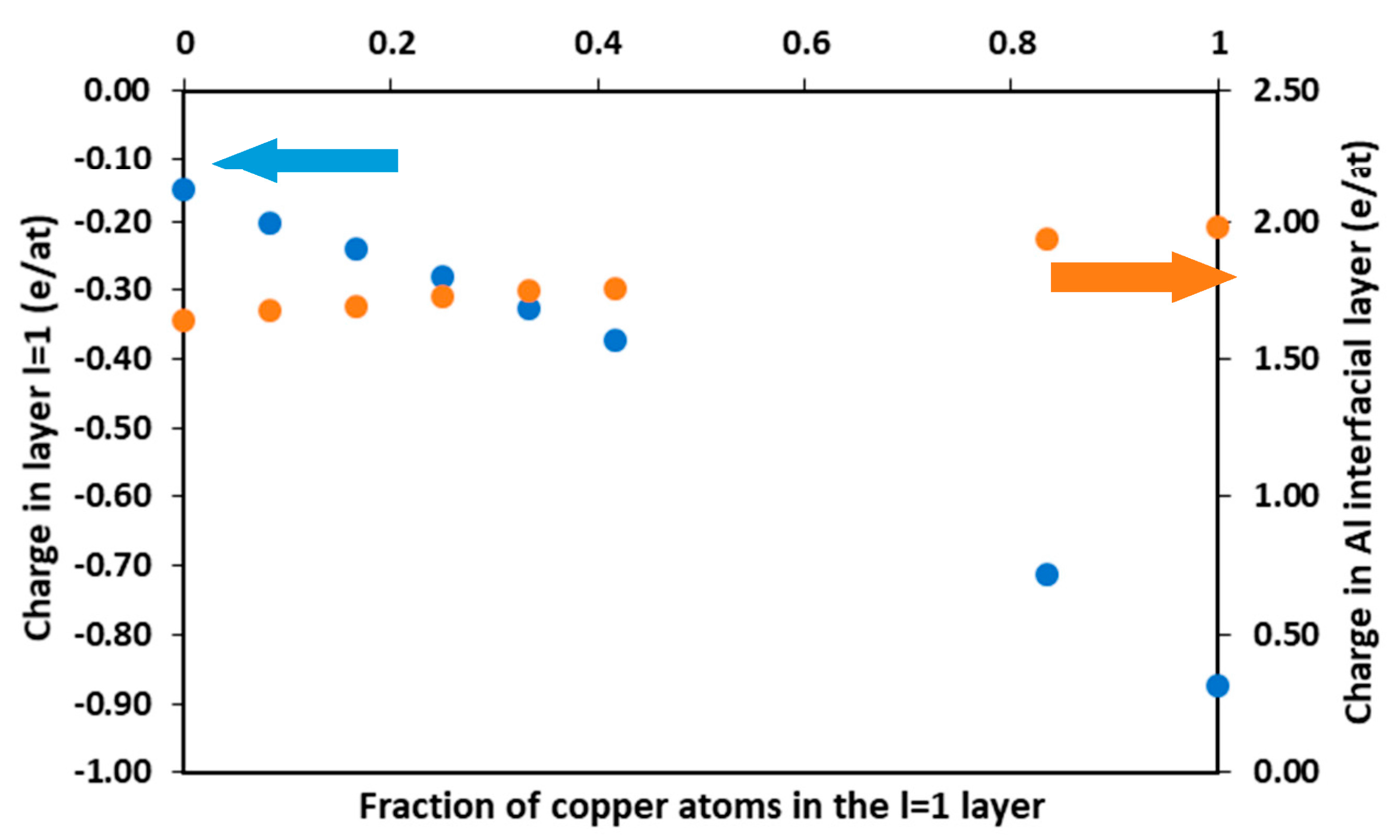
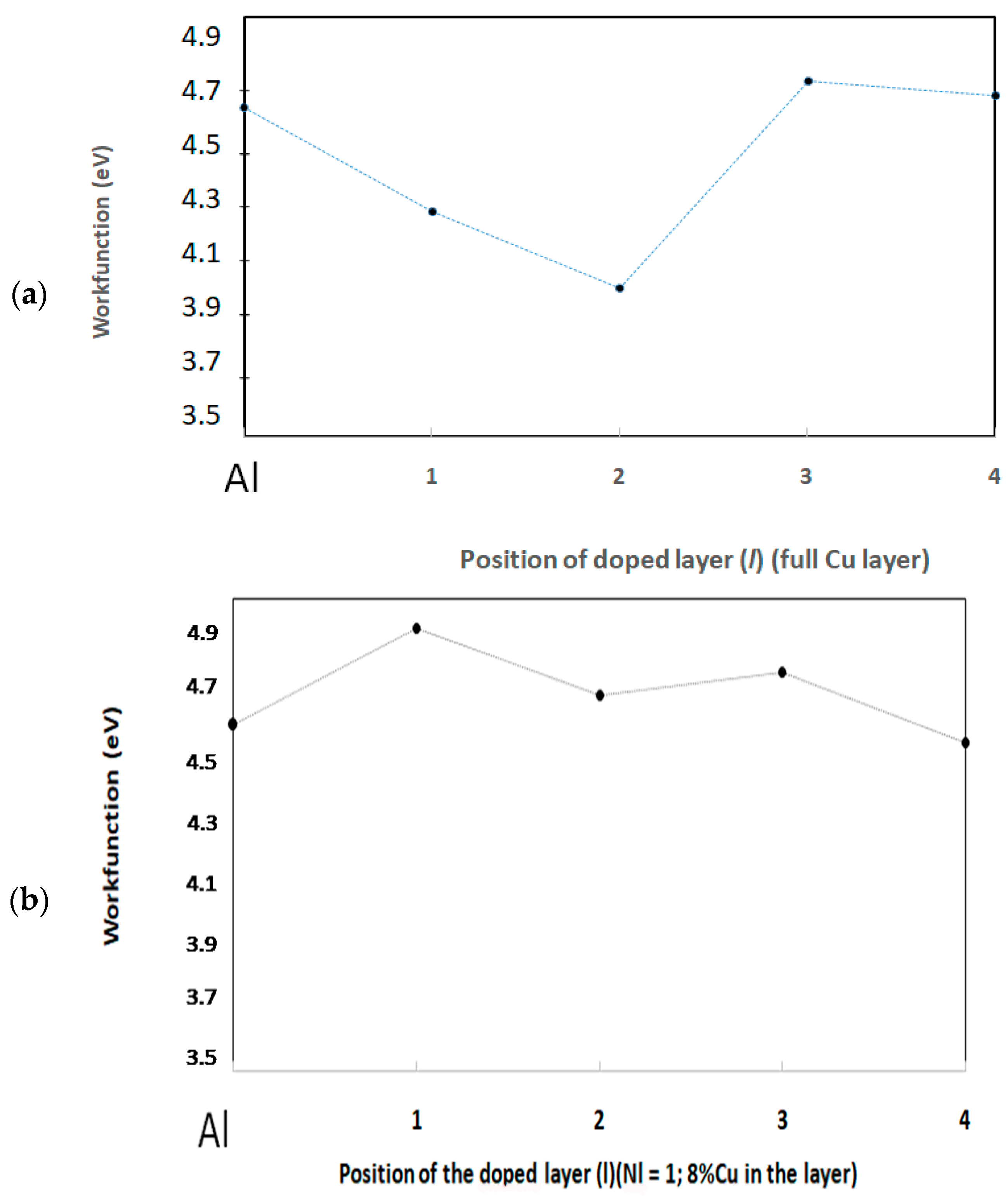
3.2.2. Charge Analysis and Electronic Workfunction
Cu Located in the l = 1 Layer
Full Cu Layer at Depths l = 2, 3, 4
Cu at Low Concentration
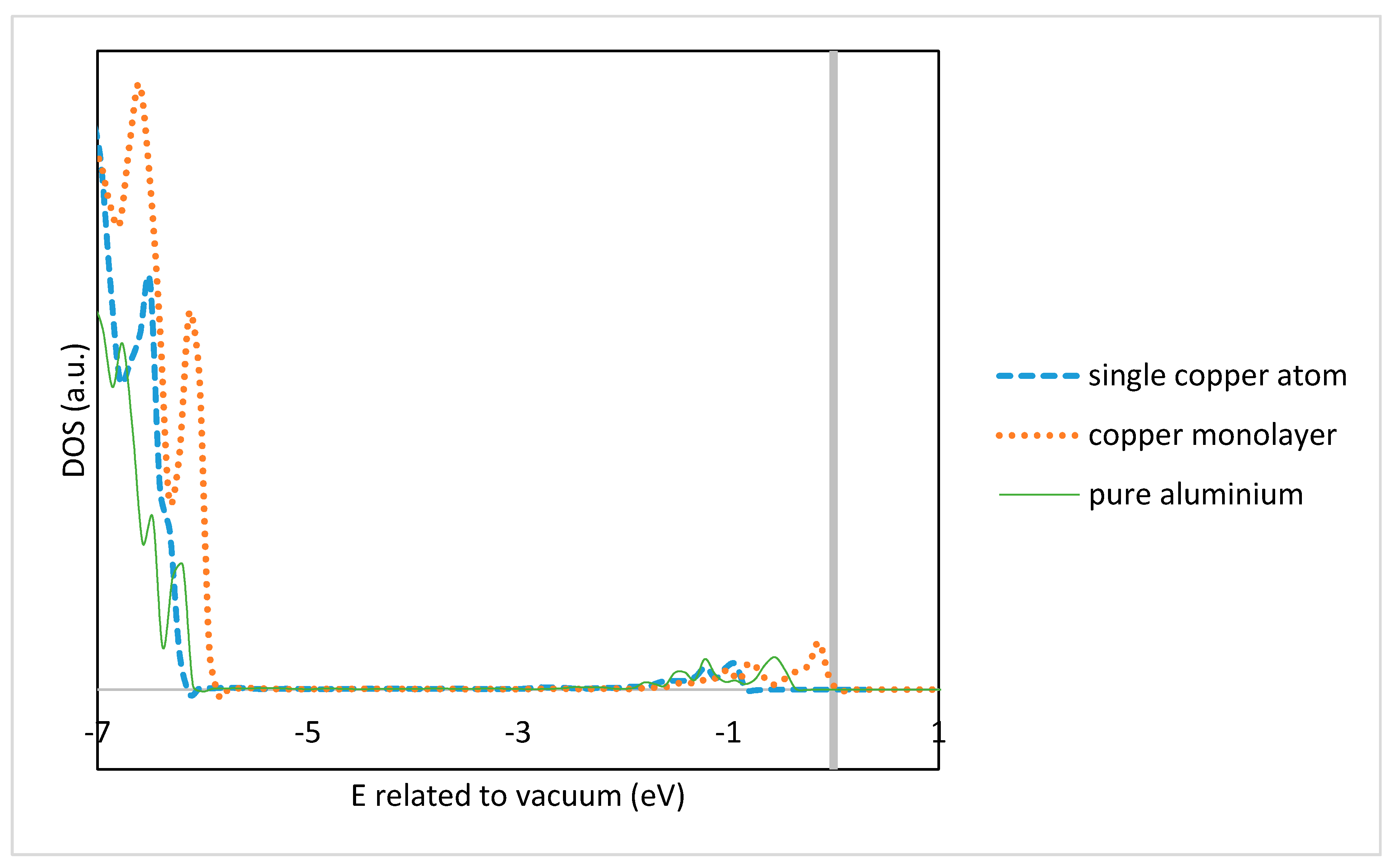
3.3. Electronic Density of States Analysis
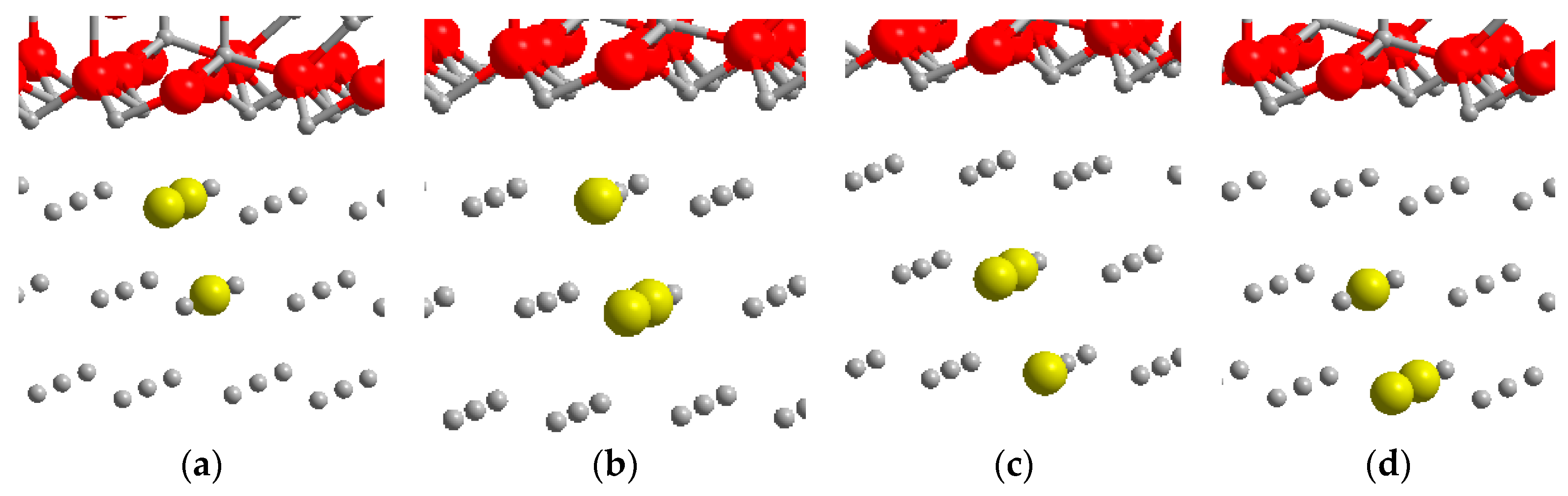
3.4. Copper Segregation in GP Zones
4. Discussion and Conclusions
Acknowledgments
Author Contributions
Conflicts of Interest
References
- Vargel, C. Corrosion of Aluminium, 1st ed.; Elsevier: Amsterdam, The Netherlands, 2004. [Google Scholar]
- Strohmeier, B.R. An ESCA method for determining the oxide thickness on aluminum alloys. Surf. Interface Anal. 1990, 15, 51–56. [Google Scholar] [CrossRef] [Scilit]
- Van den Brand, J.; Sloof, W.G.; Terryn, H.; De Wit, J.H.W. Correlation between hydroxyl fraction and O/Al atomic ratio as determined from XPS spectra of aluminium oxide layers. Surf. Interface Anal. 2004, 36, 81–88. [Google Scholar] [CrossRef] [Scilit]
- McCafferty, E.; Wightman, J.P. Determination of the concentration of surface hydroxyl groups on metal oxide films by a quantitative XPS method. Surf. Interface Anal. 1998, 26, 549–564. [Google Scholar] [CrossRef]
- Vargel, C. Corrosion De L’aluminium; Dunod: Paris, France, 1999. [Google Scholar]
- Costa, D.; Ribeiro, T.; Mercuri, F.; Pacchioni, G.; Marcus, P. Atomistic Modeling of Corrosion Resistance: A First Principles Study of O2 Reduction on the Al(111) Surface Covered with a Thin Hydroxylated Alumina Film. Adv. Mater. Interfaces 2014, 1, 1300072. [Google Scholar] [CrossRef] [Scilit]
- Marcus, P. (Ed.) Corrosion Mechanisms in Theory and Practice, 3rd ed.; CRC Press: Boca Raton, FL, USA, 2012. [Google Scholar]
- Taylor, C.D.; Marcus, P. Theoretical Methods in Modeling Corrosion; Wiley and Sons: New York, NY, USA, 2015. [Google Scholar]
- Kokalj, A.; Peljhan, S.; Finsgar, M.; Milosev, I. What Determines the Inhibition Effectiveness of ATA, BTAH, and BTAOH Corrosion Inhibitors on Copper? J. Am. Chem. Soc. 2010, 132, 16657–16668. [Google Scholar] [CrossRef] [Scilit] [PubMed]
- Milosev, I.; Kovacevic, N.; Kovac, J.; Kokalj, A. The roles of mercapto, benzene and methyl groups in the corrosion inhibition of imidazoles on copper: I. Experimental characterization. Corros. Sci. 2015, 98, 107–118. [Google Scholar] [CrossRef] [Scilit]
- Taylor, C.D. Atomistic Modeling of Corrosion Events at the Interface between a Metal and Its Environment. Int. J. Corros. 2012, 2012, 204640. [Google Scholar] [CrossRef] [Scilit]
- Chiter, F.; Lacaze-Dufaure, C.; Tang, H.; Pebere, N. DFT studies of the bonding mechanism of 8-hydroxyquinoline and derivatives on the (111) aluminum surface. Phys. Chem. Chem. Phys. 2015, 17, 22243–22258. [Google Scholar] [CrossRef] [Scilit] [PubMed]
- Poberžnik, M.; Kokalj, A. Origin of Surprising Attractive Interactions between Electronegative Oxygen Adatoms on Aluminum Surfaces. J. Phys. Chem. C 2016, 120, 25915–25922. [Google Scholar] [CrossRef] [Scilit]
- Hoshino, T.; Fujima, N.; Asato, M.; Tamura, R. Medium-ranged interactions of transition-metal (3d and 4d) impurity pairs in Al and atomic structures of Al-rich Al-transition-metal alloys. J. Alloys Compd. 2007, 434–435, 572–576. [Google Scholar] [CrossRef] [Scilit]
- Benali, A.; Lacaze-Dufaure, C.; Morillo, J. Density functional study of copper segregation in aluminum. Surf. Sci. 2011, 605, 341–350. [Google Scholar] [CrossRef] [Scilit]
- Braunovic, M.; Alexandrov, N. Intermetallic compounds at aluminum-to-copper electrical interfaces: Effect of temperature and electric current. IEEE Trans. Compon. Packag. Manuf. Technol. Part A 1994, 17, 78–85. [Google Scholar] [CrossRef] [Scilit]
- Lee, M.J.G.; Gensch, M.; Shkrebtii, A.I.; Herrmann, T.; Richter, W.; Esser, N.; Hofmann, P. Surface states and resonances on Al(110): Ultraviolet photoemission spectroscopy and ab initio calculations. Phys. Rev. B 2005, 72, 85408. [Google Scholar] [CrossRef] [Scilit]
- Vaithyanathan, V.; Wolverton, C.; Chen, L.Q. Multiscale Modeling of Precipitate Microstructure Evolution. Phys. Rev. Lett. 2002, 88, 125503. [Google Scholar] [CrossRef] [Scilit] [PubMed]
- Wolverton, C.; Ozoliņš, V. Entropically Favored Ordering: The Metallurgy of Al2Cu Revisited. Phys. Rev. Lett. 2001, 86, 5518–5521. [Google Scholar] [CrossRef] [Scilit] [PubMed]
- Wolverton, C.; Ozoliņš, V. First-principles aluminum database: Energetics of binary Al alloys and compounds. Phys. Rev. B 2006, 73, 144104. [Google Scholar] [CrossRef] [Scilit]
- Wolverton, C.; Yan, X.-Y.; Vijayaraghavan, R.; Ozoliš, V. Incorporating first-principles energetics in computational thermodynamics approaches. Acta Mater. 2002, 50, 2187–2197. [Google Scholar] [CrossRef] [Scilit]
- Vaithyanathan, V.; Wolverton, C.; Chen, L.Q. Multiscale modeling of θ′ precipitation in Al-Cu binary alloys. Acta Mater. 2004, 52, 2973–2987. [Google Scholar] [CrossRef] [Scilit]
- Wolverton, C.; Ozolins, V.; Zunger, A. Short-range-order types in binary alloys: A reflection of coherent phase stability. J. Phys. Condens. Matter. 2000, 12, 2749. [Google Scholar] [CrossRef] [Scilit]
- Zhou, W.; Liu, L.; Li, B.; Song, Q.; Wu, P. Structural, Elastic, and Electronic Properties of Al-Cu Intermetallics from First-Principles Calculations. J. Electron. Mater. 2009, 38, 356–364. [Google Scholar] [CrossRef] [Scilit]
- Wang, S.Q.; Schneider, M.; Ye, H.Q.; Gottstein, G. First-principles study of the formation of Guinier-Preston zones in Al-Cu alloys. Scr. Mater. 2004, 51, 665–669. [Google Scholar] [CrossRef] [Scilit]
- Ye, M.; Zhang, Y.; Li, L.; Liu, R.; Qiu, M.; Xu, C.; Chen, X. A periodic density functional theory calculation: The structure of isolated copper (I) oxide species on γ-Al2O3 (110) surface and its adsorption ability toward thiophene and benzene. Appl. Surf. Sci. 2015, 346, 165–171. [Google Scholar] [CrossRef] [Scilit]
- Wang, J.; Wolverton, C.; Müller, S.; Liu, Z.-K.; Chen, L.-Q. First-principles growth kinetics and morphological evolution of Cu nanoscale particles in Al. Acta Mater. 2005, 53, 2759–2764. [Google Scholar] [CrossRef] [Scilit]
- Mohamed, I.F.; Yonenaga, Y.; Lee, S.; Edalati, K.; Horita, Z. Age hardening and thermal stability of Al-Cu alloy processed by high-pressure torsion. Mater. Sci. Eng. A 2015, 627, 111–118. [Google Scholar] [CrossRef] [Scilit]
- Lanthony, C.; Ducéré, J.M.; Rouhani, M.D.; Hemeryck, A.; Estève, A.; Rossi, C. On the early stage of aluminum oxidation: An extraction mechanism via oxygen cooperation. J. Chem. Phys. 2012, 137, 94707. [Google Scholar] [CrossRef] [Scilit] [PubMed]
- Baran, J.D.; Grönbeck, H.; Hellman, A. Mechanism for Limiting Thickness of Thin Oxide Films on Aluminum. Phys. Rev. Lett. 2014, 112, 146103. [Google Scholar] [CrossRef] [Scilit] [PubMed]
- Huang, X.C.; Lu, H.; Li, D.Y. Understanding the corrosion behavior of isomorphous Cu–Ni alloy from its electron work function. Mater. Chem. Phys. 2016, 173, 238–245. [Google Scholar] [CrossRef] [Scilit]
- Perdew, J.P.; Chevary, J.A.; Vosko, S.H.; Jackson, K.A.; Pederson, M.R.; Singh, D.J.; Fiolhais, C. Atoms, molecules, solids, and surfaces: Applications of the generalized gradient approximation for exchange and correlation. Phys. Rev. B 1992, 46, 6671–6687. [Google Scholar] [CrossRef] [Scilit]
- Perdew, J.P.; Burke, K.; Ernzerhof, M. Generalized Gradient Approximation Made Simple. Phys. Rev. Lett. 1996, 77, 3865–3868. [Google Scholar] [CrossRef] [Scilit] [PubMed]
- Kresse, G.; Hafner, J. Ab initio molecular-dynamics simulation of the liquid-metal amorphous-semiconductor transition in germanium. Phys. Rev. B 1994, 49, 14251–14269. [Google Scholar] [CrossRef] [Scilit]
- Blöchl, P.E.; Jepsen, O.; Andersen, O.K. Improved tetrahedron method for Brillouin-zone integrations. Phys. Rev. B 1994, 49, 16223–16233. [Google Scholar] [CrossRef] [Scilit]
- Kresse, G.; Joubert, D. From ultrasoftpseudopotentials to the projector augmented-wave method. Phys. Rev. B 1999, 59, 1758–1775. [Google Scholar] [CrossRef] [Scilit]
- Monkhorst, H.J.; Pack, J.D. Special points for Brillouin-zone integrations. Phys. Rev. B 1976, 13, 5188–5192. [Google Scholar] [CrossRef] [Scilit]
- Grimme, S. Semiempirical GGA-type density functional constructed with a long-range dispersion correction. J. Comput. Chem. 2006, 27, 1787–1799. [Google Scholar] [CrossRef] [Scilit] [PubMed]
- Costa, D.; Ribeiro, T.; Cornette, P.; Marcus, P. DFT Modeling of Corrosion Inhibition by Organic Molecules: Carboxylates as Inhibitors of Aluminum Corrosion. J. Phys. Chem. C 2016, 120, 28607–28616. [Google Scholar] [CrossRef] [Scilit]
- Eastment, R.M.; Mee, C.H.B. Work function measurements on (100), (110) and (111) surfaces of aluminium. J. Phys. F Met. Phys. 1973, 3, 1738. [Google Scholar] [CrossRef] [Scilit]
- Bader, R.F.W. A Bond Path: A Universal Indicator of Bonded Interactions. J. Phys. Chem. A 1998, 102, 7314–7323. [Google Scholar] [CrossRef] [Scilit]
- Hoshino, T.; Asato, M.; Tanaka, S.; Nakamura, F.; Fujima, N. First-principles calculations for stability of atomic structures of Al-rich AlX (X = Sc-Zn) alloys, including AlMn quasicrystal: II. Medium-ranged interactions of X pairs in Al. Intermetallics 2006, 14, 913–916. [Google Scholar] [CrossRef] [Scilit]

| Composition of the Metal Layers Under the Oxide Film | OxideBand Gap (eV) | Valence Band Level/Vacuum (eV) | Workfunction φe (eV) |
|---|---|---|---|
| Pure Al | 4.48 | −6.00 | 4.60 |
| Nl = 1 Cu | 4.53 | −6.09 | 4.91 |
| Nl= 12 Cu, l = 1 | 4.37 | −5.84 | 4.25 |
| Nl = 12 Cu, l = 2 | 4.78 * | −6.44 * | 4.00 * |
| Configuration | Position 1 | Position 1 in Absence of Oxide | Position 2 | Position 2 in Absence of Oxide | Bulk Position |
|---|---|---|---|---|---|
| Configuration 1 | −0.16 | −0.08 | −0.12 | −0.13 | −0.06 |
| Configuration 2 | −0.11 | −0.08 | −0.09 | −0.12 | −0.06 |
© 2017 by the authors. Licensee MDPI, Basel, Switzerland. This article is an open access article distributed under the terms and conditions of the Creative Commons Attribution (CC BY) license (http://creativecommons.org/licenses/by/4.0/).
Share and Cite
Cornette, P.; Costa, D.; Marcus, P. DFT Modelling of Cu Segregation in Al-Cu Alloys Covered by an Ultrathin Oxide Film and Possible Links with Passivity. Metals 2017, 7, 366. https://doi.org/10.3390/met7090366
Cornette P, Costa D, Marcus P. DFT Modelling of Cu Segregation in Al-Cu Alloys Covered by an Ultrathin Oxide Film and Possible Links with Passivity. Metals. 2017; 7(9):366. https://doi.org/10.3390/met7090366
Chicago/Turabian StyleCornette, Pauline, Dominique Costa, and Philippe Marcus. 2017. "DFT Modelling of Cu Segregation in Al-Cu Alloys Covered by an Ultrathin Oxide Film and Possible Links with Passivity" Metals 7, no. 9: 366. https://doi.org/10.3390/met7090366
APA StyleCornette, P., Costa, D., & Marcus, P. (2017). DFT Modelling of Cu Segregation in Al-Cu Alloys Covered by an Ultrathin Oxide Film and Possible Links with Passivity. Metals, 7(9), 366. https://doi.org/10.3390/met7090366

