2. Theoretical Background
The theory behind Newtonian analysis has been previously discussed by several authors, e.g., refs. [
2,
3,
4,
5,
6]. The equations used in this work are summarized in
Table 1. The Fourier analysis is based on the paper by Fras, Kapturkiewicz et al. [
7] and the follow-up work in refs. [
8,
9,
10]. The equations used in this work are summarized in
Table 2. For a recent detailed analysis, see ref. [
1].
The results of the calculations in
Table 1 depend on characteristic temperatures including the initial liquidus temperature (
), the eutectic temperature (
), and the solidification temperature (
). In previous work [
1], we investigated the effect of initial temperatures, considered to be
,
or
, adapted from Bäckerud et al. [
3]. Further illustration of possible selections of the critical temperatures is provided in
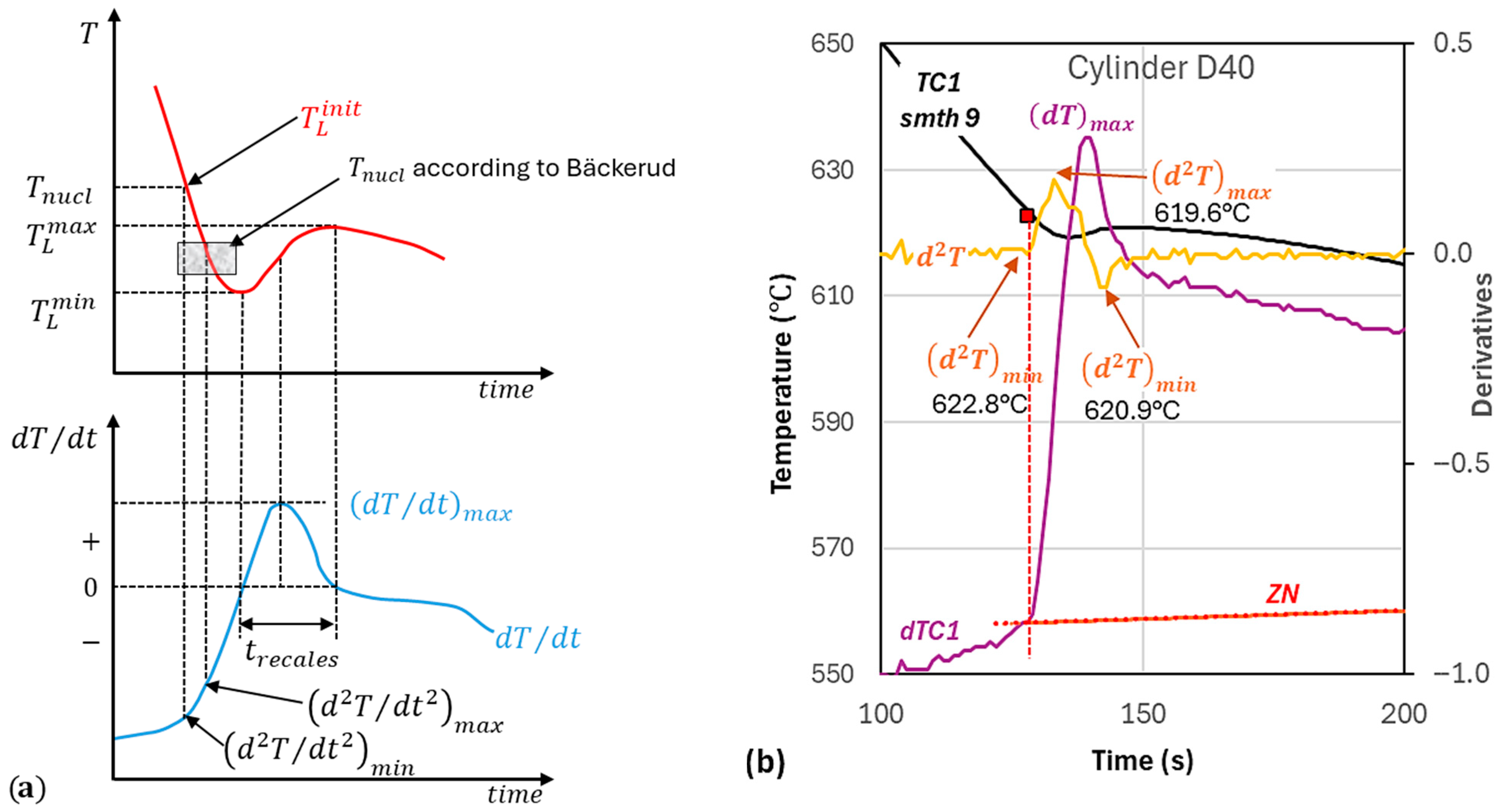
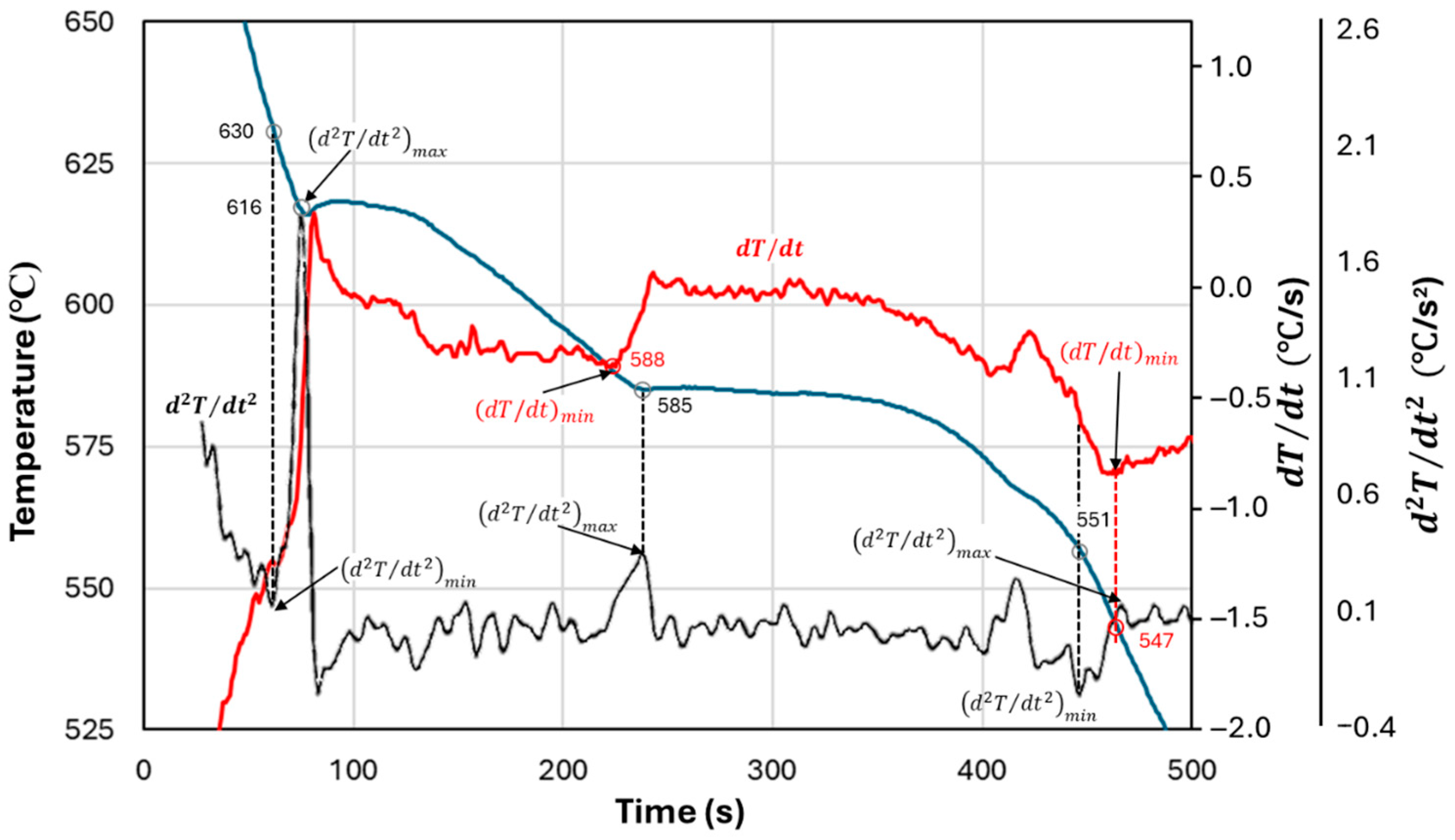
Figure 1. However, this selection is reconsidered in
Figure 2 and in the discussion that follows.
Solidification is assumed to start when the fraction solid in the melt becomes . At that time, the solidification heat released produces an inflexion on the cooling curve at a temperature defined as . However, the precise result for this temperature depends on the accuracy of the experimental measurements.
As discussed in earlier work, considerable noise may affect pinpointing
and the moment when the
. Using the maximum of the second time derivative of temperature,
, to find the inflexion on the
curve may bring the temperature significantly lower than
, as the heat released initially may be very small. In this work,
was taken as the temperature corresponding to the
preceding
(
Figure 2b). This temperature of 622.8 °C is higher than 619.6 °C corresponding to
.
According to Bäckerud et al. [
3], the nucleation temperature,
, which is the initial temperature in the calculations for
, is positioned in time before
and is lower than
. However, the
inflexion in this work was found to generate a
higher than
. In the example in
Figure 2b for cup D40,
is at a temperature of 619.6 °C, slightly above the 619.3
, while
is at 622.8. For the other two cups, selection of
based on the criterion
before
produces
, as shown in
Figure 2a.
The beginning of the eutectic temperature,
, was selected as
. The final temperature, which is the solidification temperature,
, can be taken either as
or as
[
1]. In this work,
was selected based on
, as in most papers on the subject, e.g., [
4,
7,
10,
11].
Data required for the calculations extracted from ref. [
1] are presented in
Table 3. It can be seen that the latent heat for the alloy of interest varies from 389 to 424 kJ/kg. Also, two values are suggested for
i.e., 1.139 and 1.35
°C.
5. Conclusions
Fraction solid evolution during the solidification of an Al-7.5%Si alloy was calculated based on the recorded cooling curves obtained from cylindrical steel cups with three different diameters. The cups were submerged in an induction furnace with molten Al-7.5%Si alloy. Once full, the cups were allowed to cool in air while the cooling curve was recorded with thermocouples. The recorded cooling curves were used to deliver information on the latent heat evolution during solidification and on the time evolution of fraction solid during solidification. Calculation of the latent heat and of the fraction solid was based on the calculation of the area between the recorded cooling curve and its corresponding zero-curve, ZC, which is a cooling curve of the liquid metal assuming no transformation (no latent heat produced). To calculate the ZC, either the Newtonian or the Fourier analysis method may be applied. Both these methods were used in this report. The Fourier analysis was conducted only on data averaged over nine points (smooth-9).
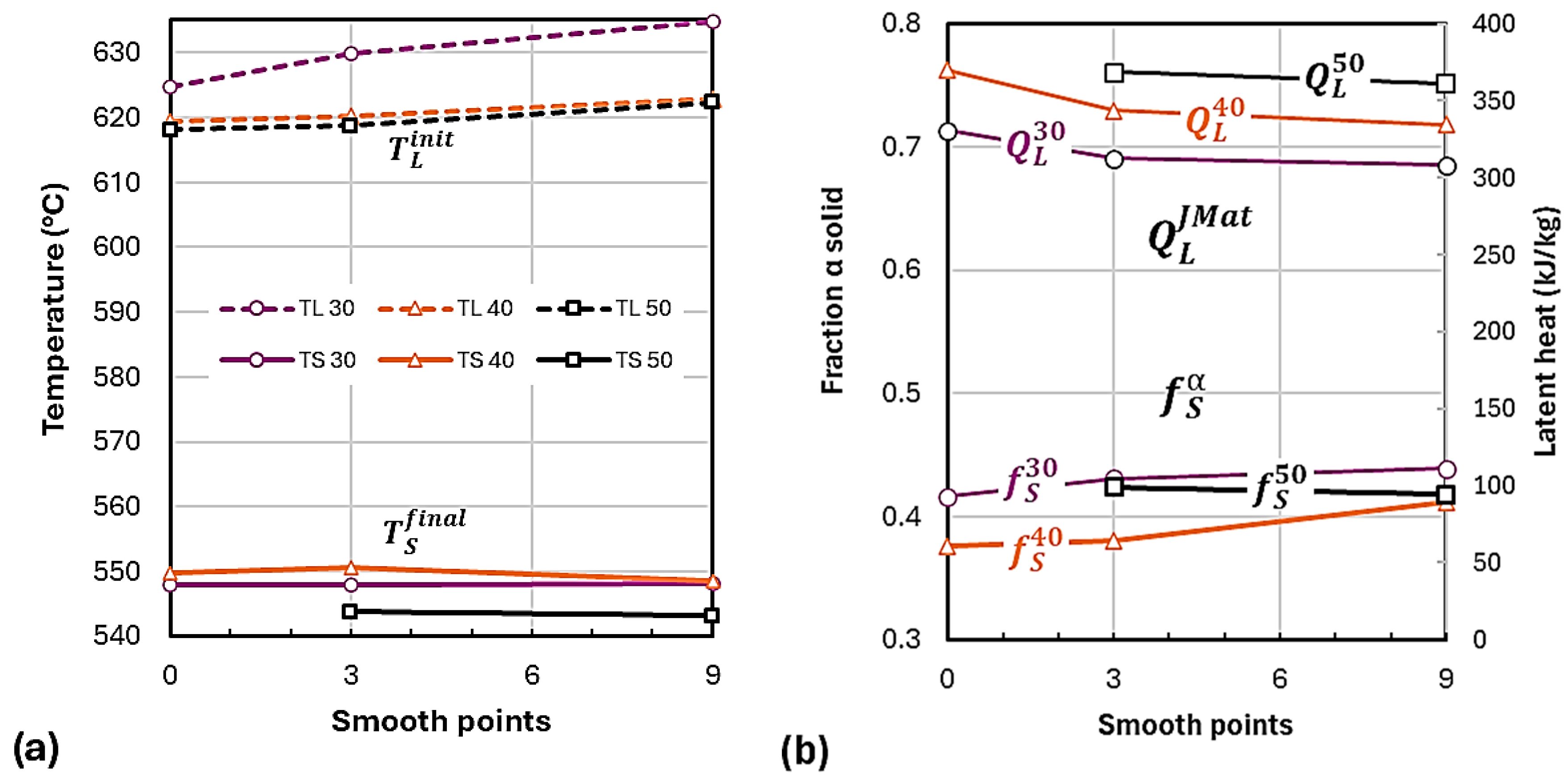
The paper demonstrates that the raw temperature data recorded by the thermocouples cannot be used in this analysis because of the data-acquisition noise, and consequently, smoothing subroutines must be employed. The time averaging over time step smoothing technique was used in this paper. It was found that the level of smoothing (number of data points over which the temperature was averaged) significantly affected the selection for the initial temperature, , which is the temperature at which the solidification starts. For example, for cup D40, the Newtonian analysis produced the following results: (a) for no smoothing, = −0.1 and = 619.3 °C; (b) for smoothing over three data points, ( = −0.03 with = 620.2; (c) for five-point smoothing, = 0 and = 622.8. This is an increase of 3.5 °C that affects the fraction solid values.
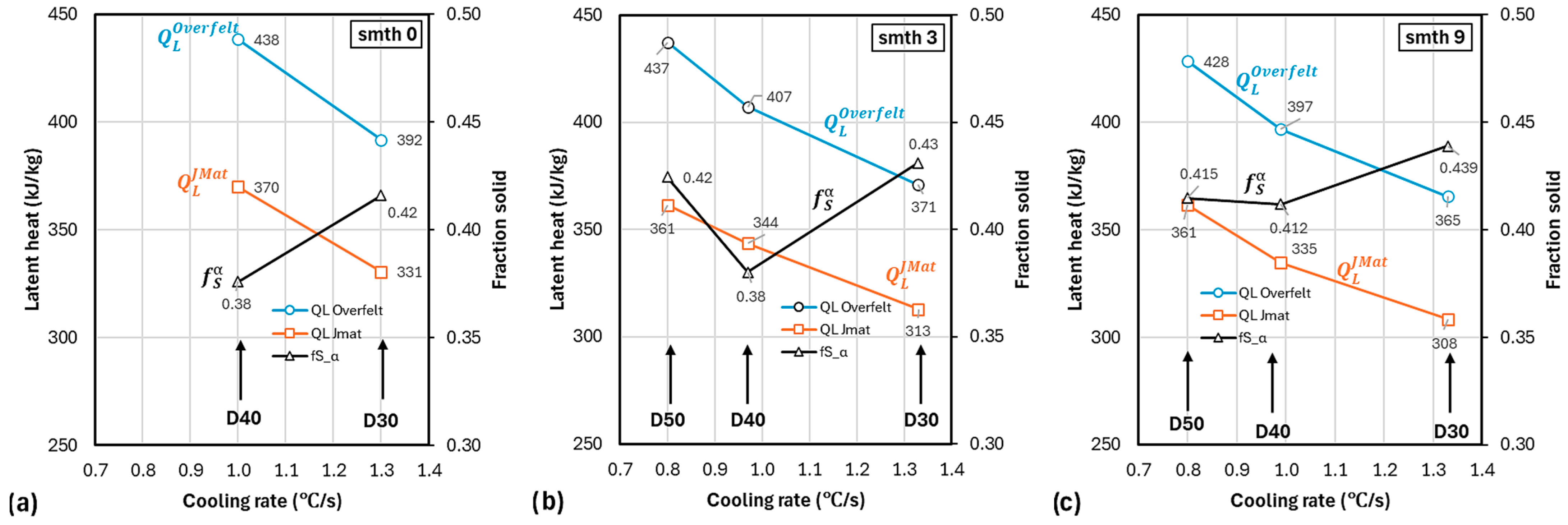
It was also found that, for the same , as expected, the latent heat, , decreased with a higher cooling rate. However, the calculated is highly dependent on the selection, as is directly proportional to . For smooth-9, changed from 365 for the JMat to 428 for the Overfelt . These values are both at the outside range of the literature data, which is 389 to 424 kJ/kg.
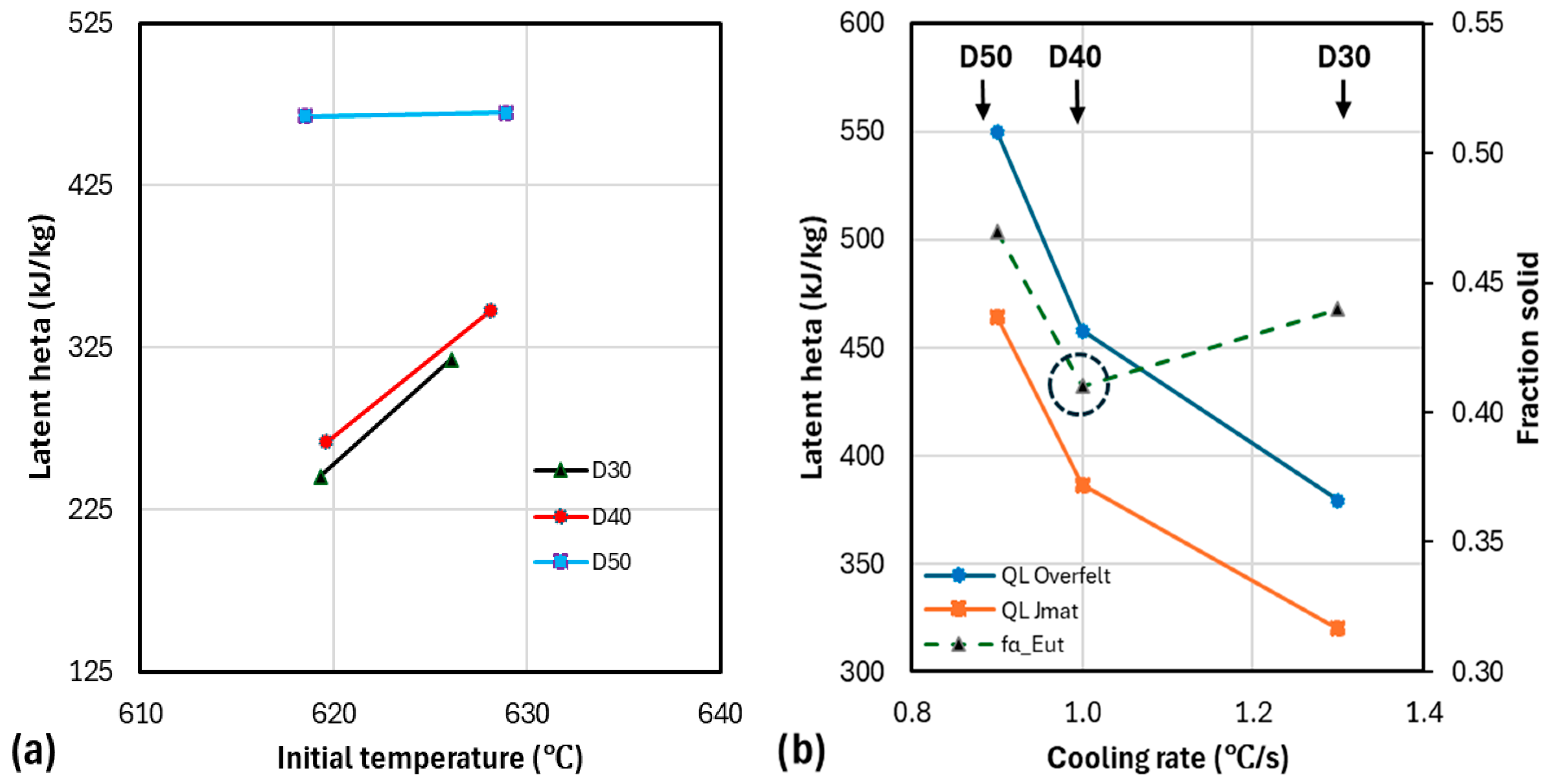
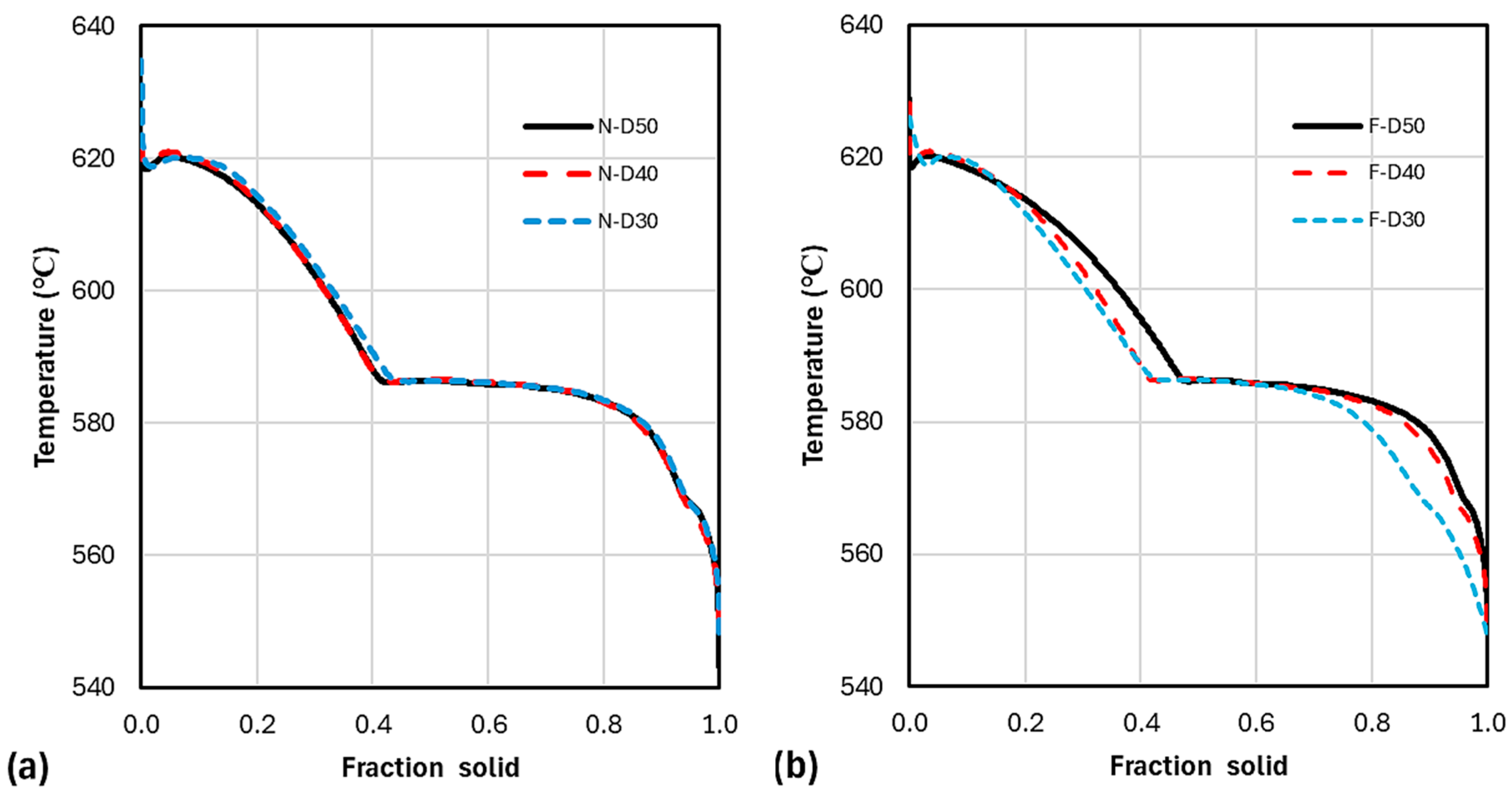
The thermal diffusivity (α) calculated in the Fourier analysis was affected by both the selection criterion for and the cooling rate, i.e., the size of the cup. However, for D50, α remained constant even when increased. The result was that the fraction solid remained constant at 0.47 for all variants of .
The calculated data were significantly affected by the maximum temperature registered by the thermocouple, supporting the requirement that all cups should have the same initial temperature. This approach is used in several industrial TA methods, such as Sintercast [
21]. Furthermore, the results presented in this paper are particularly important for applications where the evolution of fraction solid during solidification is needed to calculate outcomes such as porosity location in the casting.
Author Contributions
Conceptualization, D.M.S., D.R. and E.K.; methodology, D.M.S. and D.R.; software, E.K. and D.K.; formal analysis, D.M.S.; investigation, E.K., D.K. and H.K.; writing—original draft preparation, D.M.S.; writing—review and editing D.R., E.K., D.K. and H.K.; supervision, D.R.; project administration and funding acquisition, D.R. All authors have read and agreed to the published version of the manuscript.
Funding
This work was supported by a Korea Planning and Evaluation of Industrial Technology (KEIT) grant for development of 3.0 GPa% grade aluminum alloy and casting analysis technology for high vacuum die casting (20020283).
Data Availability Statement
The original contributions presented in this study are included in the article. Further inquiries can be directed to the corresponding author.
Conflicts of Interest
EungSu Kweon, DongHoon Roh, DongYoon Kang and HuiChan Kim were employed by the company AnyCasting Software Co., Ltd. The remaining authors declare that the research was conducted in the absence of any commercial or financial relationships that could be construed as a potential conflict of interest.
References
- Kweon, E.S.; Roh, D.H.; Kang, D.Y.; Stefanescu, D.M. The Use of Thermal Analysis for Generation of Fraction Solid Evolution in Al-Si alloys. Inter. Metalcat. 2025, 19, 3194–3211. [Google Scholar] [CrossRef]
- Rabus, D.; Polten, S. Interpretation of Solidification Structures in Castings by Means of Differential Thermal Analysis. Giess. Rundsch. 1972, 9, 114. [Google Scholar]
- Bäckerud, L.; Nilsson, K.; Steen, H. The Metallurgy of Cast Iron; Lux, B., Minkoff, I., Mollard, F., Eds.; Georgi Publishing: St. Saphorin, Switzerland, 1975; p. 625. [Google Scholar]
- Ekpoom, L.; Heine, R.W. Thermal analysis by differential heat analysis (DHA) of cast iron. Trans. Am. Foundry Soc. 1981, 89, 27–38. [Google Scholar]
- Chen, I.G.; Stefanescu, D.M. Computer-Aided Differential Thermal Analysis of Spheroidal and Compacted Graphite Cast Irons. Trans. Am. Foundry Soc. 1984, 92, 947–964. [Google Scholar]
- Djurdjevic, M.B.; Manasijevic, S.; Patarić, A.; Mihailović, M. Challenges by latent heat calculation—Competition among analytical and computational methods. Int. Commun. Heat Mass Transf. 2024, 157, 107704. [Google Scholar] [CrossRef]
- Fras, E.; Kapturkiewicz, W.; Burbielko, A.; Lopez, H.F. A New Concept in Thermal Analysis of Castings. AFS Trans. 1993, 101, 505–511. [Google Scholar]
- Barlow, J.O.; Stefanescu, D.M. Computer-Aided Cooling Curve Analysis Revisited. AFS Trans. 1997, 105, 349–354. [Google Scholar]
- Emadi, D.; Whiting, L.V.; Djurdjevic, M.; Kierkus, W.T.; Sokolowski, J. Comparison of Newtonian and Fourier thermal analysis techniques for calculation of latent heat and solid fraction of aluminum alloys. Metal. J. Metall. 2004, 10, 92–106. [Google Scholar] [CrossRef] [PubMed]
- Diószegi, A.; Hattel, J. Inverse thermal analysis method to study solidification in cast iron. Int. J. Cast Met. Res. 2004, 17, 311–318. [Google Scholar] [CrossRef]
- Kierkus, W.T.; Sokolowski, J.H. Recent advances in CCA: A new method of determining ‘baseline’ equation. AFS Trans. 1999, 66, 161–167. [Google Scholar]
- Overfelt, R.A.; Bakhtiyarov, S.I.; Taylor, R.E. Thermophysical properties of A201, A319, and A356 aluminium casting alloys. High Temp. High Press. 2002, 34, 401–409. [Google Scholar] [CrossRef]
- Li, M.; Li, Y.D.; Zhou, H.W. Effects of Pouring Temperature on Microstructure and Mechanical Properties of the A356 Aluminum Alloy Die castings. Mater. Res. 2020, 23, e20190676. [Google Scholar] [CrossRef]
- Itamura, M.; Yamamoto, N. Effect of silicon content on latent heat of Al-Si alloys. J. Jpn. Foundry Eng. 1996, 68, 493–498. [Google Scholar]
- Stefanescu, D.M.; Upadhya, G.; Bandyopadhyay, D. Heat Transfer-Solidification Kinetics Modeling of Solidification of Castings. Metall. Trans. A 1990, 21, 997–1005. [Google Scholar] [CrossRef]
- Stefanescu, D.M. Solidification of Flake, Compacted/Vermicular and Spheroidal Graphite Cast Iron as Revealed by Thermal Analysis and Directional Solidification Experiments. MRS Symp. 1985, 34, 151–162. [Google Scholar] [CrossRef]
- Loizaga, A.; Niklas, A.; Fernandez-Calvo, A.I.; Lacaze, J. Thermal analysis applied to estimation of solidification kinetics of Al–Si aluminum alloys. Int. J. Met. 2009, 22, 345–352. [Google Scholar]
- Djurdjevic, M.B. Application of thermal analysis in ferrous and nonferrous foundries. Met. Mater. Eng. 2021, 27, 457–471. [Google Scholar] [CrossRef] [PubMed]
- Labrecque, C.; Gagné, M. Interpretation of Cooling Curves of Cast Irons: A Literature Review. AFS Trans. 1998, 72, 83–90. [Google Scholar]
- Alonso, G.; Larranaga, P.; Sertucha, J.; Suarez, R.; Stefanescu, D.M. Gray cast iron with high austenite-to-eutectic ratio, part 1—calculation and experimental evaluation of the fraction of primary austenite in cast iron. Trans. Am. Foundry Soc. 2012, 120, 329–335. [Google Scholar]
- Dawson, S.; Popelar, P. Thermal Analysis and Process Control for Compacted Graphite Iron and Ductile Iron. In Proceedings of the 2013 Keith Millis Symposium on Ductile Iron, Nashville, TN, USA, 15–17 October 2013; p. 59. [Google Scholar]
Figure 1.
Effect of the method for establishing the critical temperature on the obtained temperature for an Al7.5Si alloy poured in a D55 cup (adapted from Ref. [
1]).
Figure 2.
Assumptions in the establishing of the initial temperatures: (a) characteristic temperatures and cooling rates; (b) example of selection of .
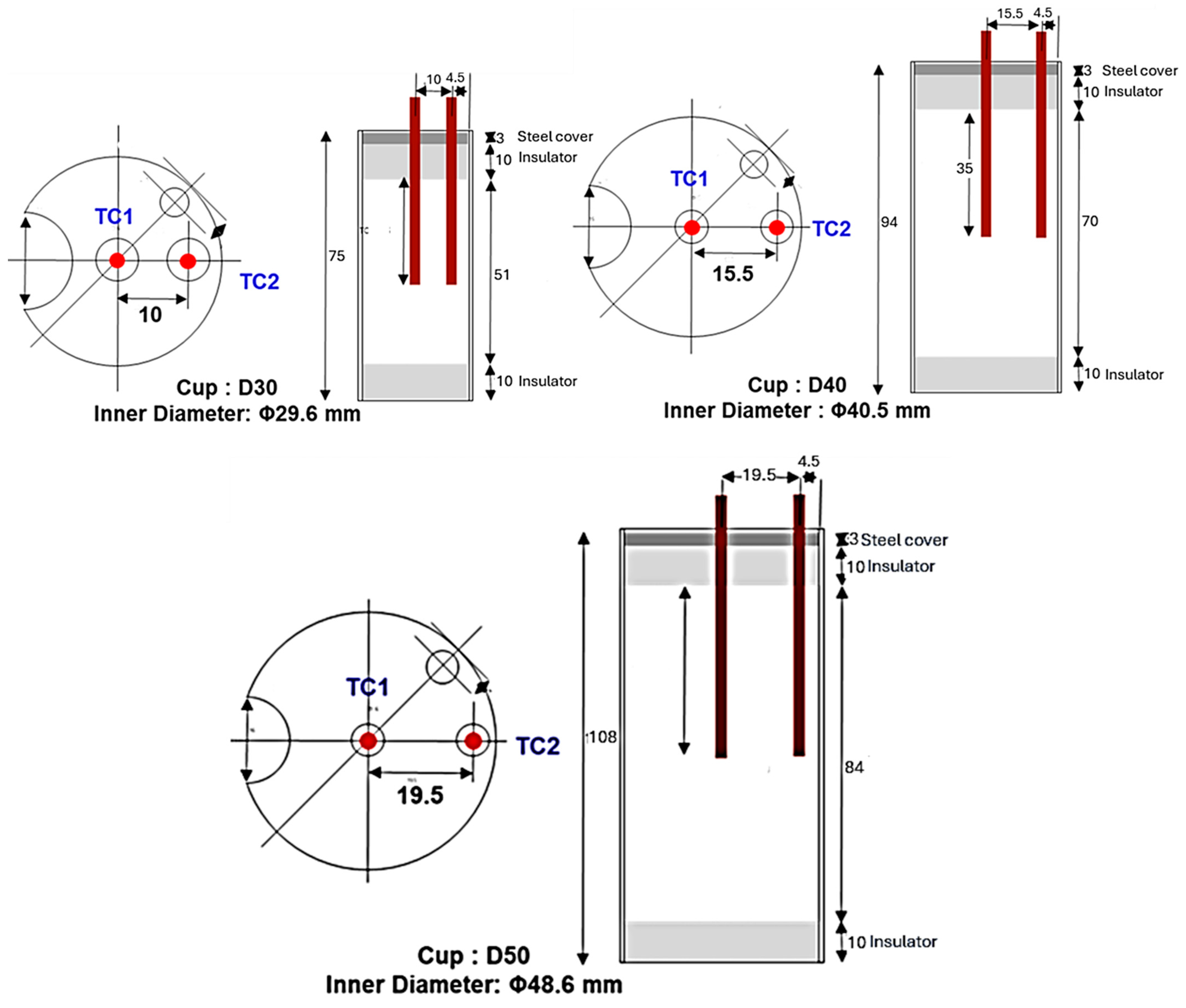
Figure 3.
Dimensions of the experimental cylindrical cups and positions of the thermocouples.
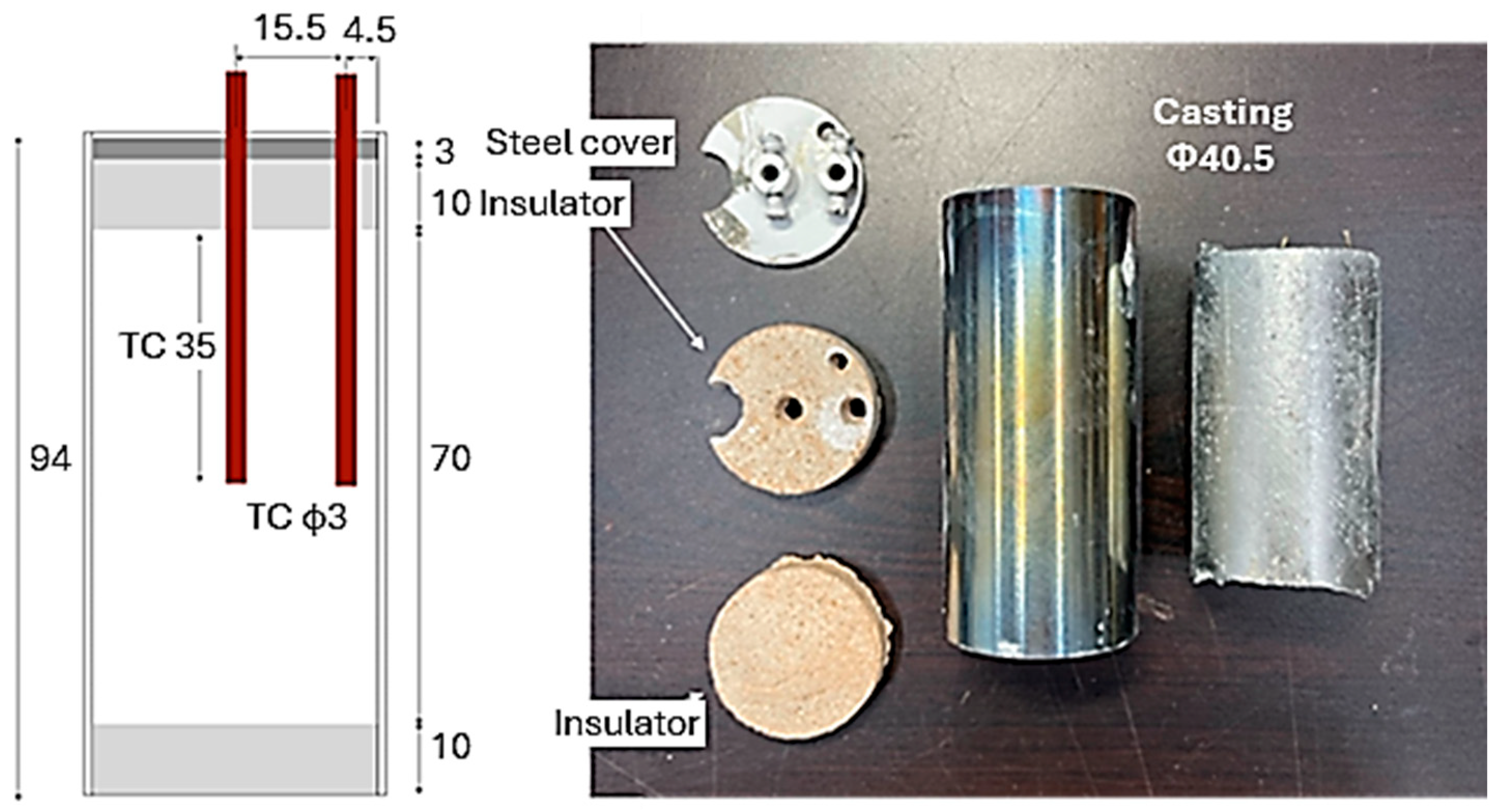
Figure 4.
Details of the construction of Cup D40.
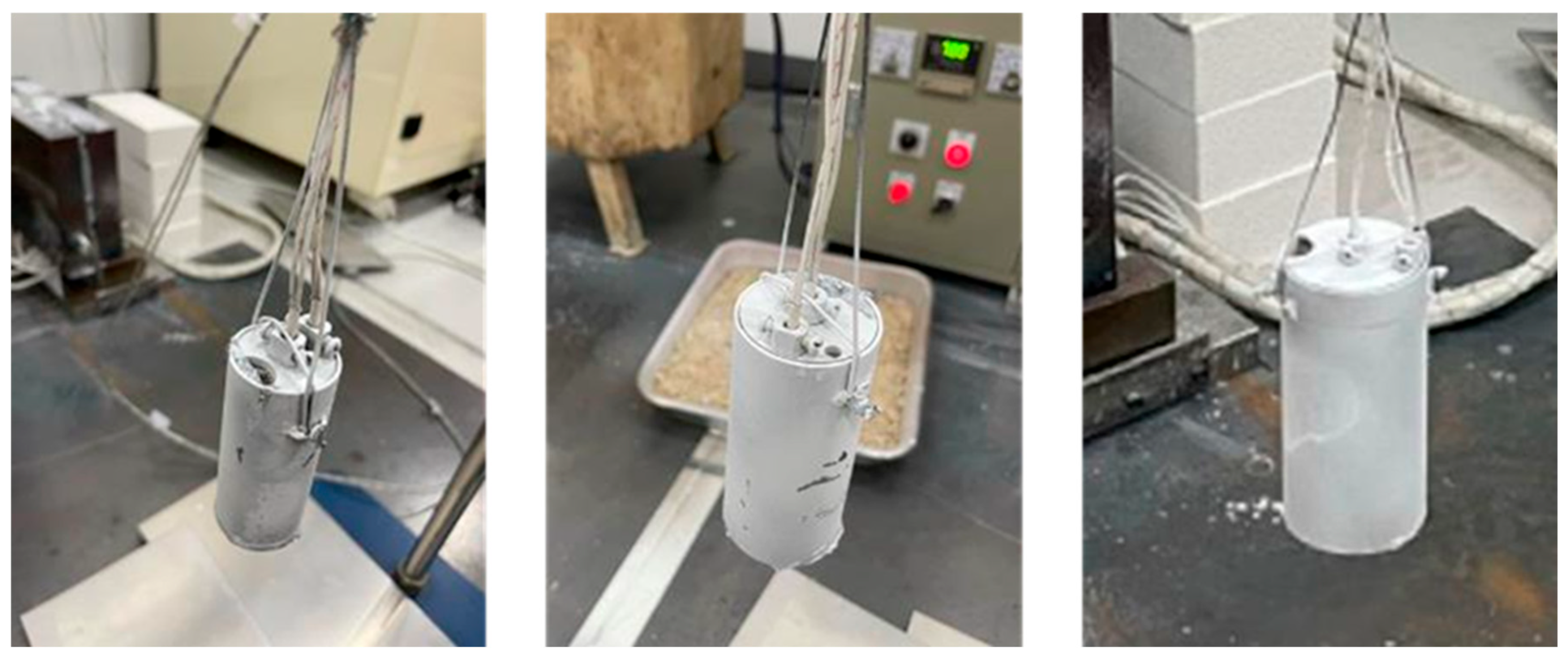
Figure 5.
Cooling of cylindrical cup to allow solidification of the molten alloy.
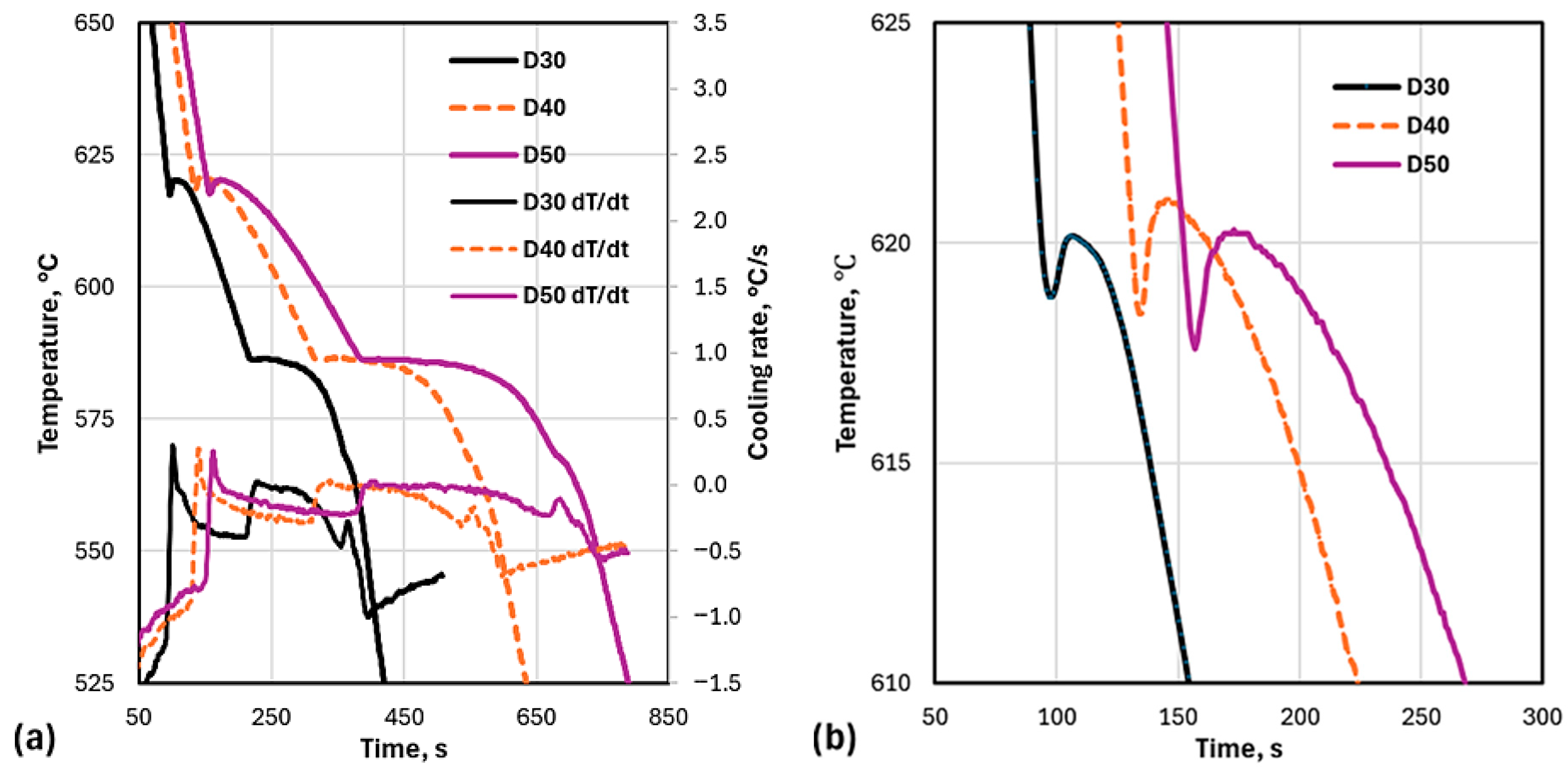
Figure 6.
Cooling curves of the three experimental cups: (a) cooling curves (raw data) and first derivatives (calculated with 9-point smoothing); (b) detail of liquidus arrest.
Figure 7.
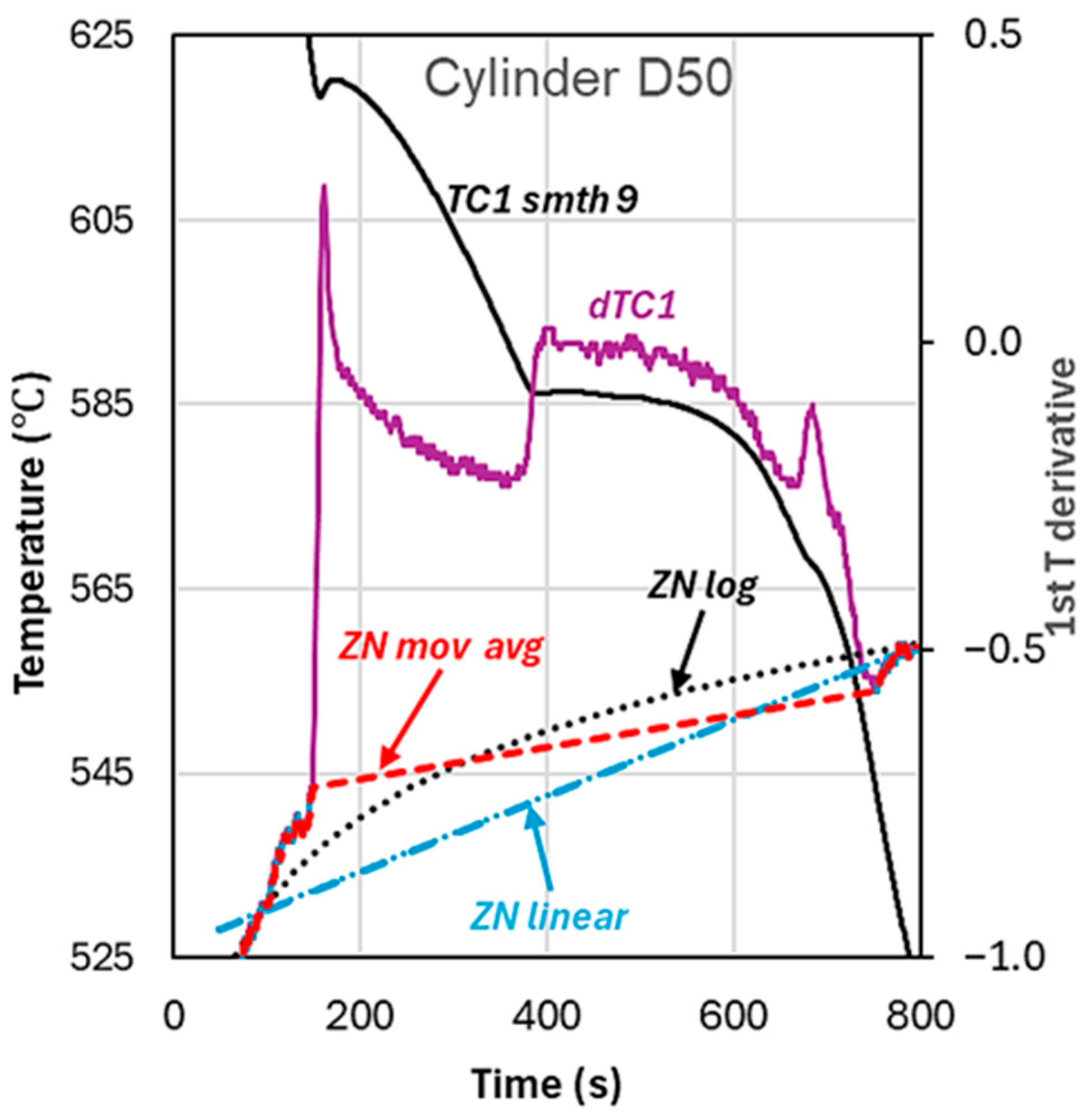
Various methods of calculation for the Newtonian Zero Curve, ZN, using values on the first derivative, dTC1, before the beginning and after the end of solidification.
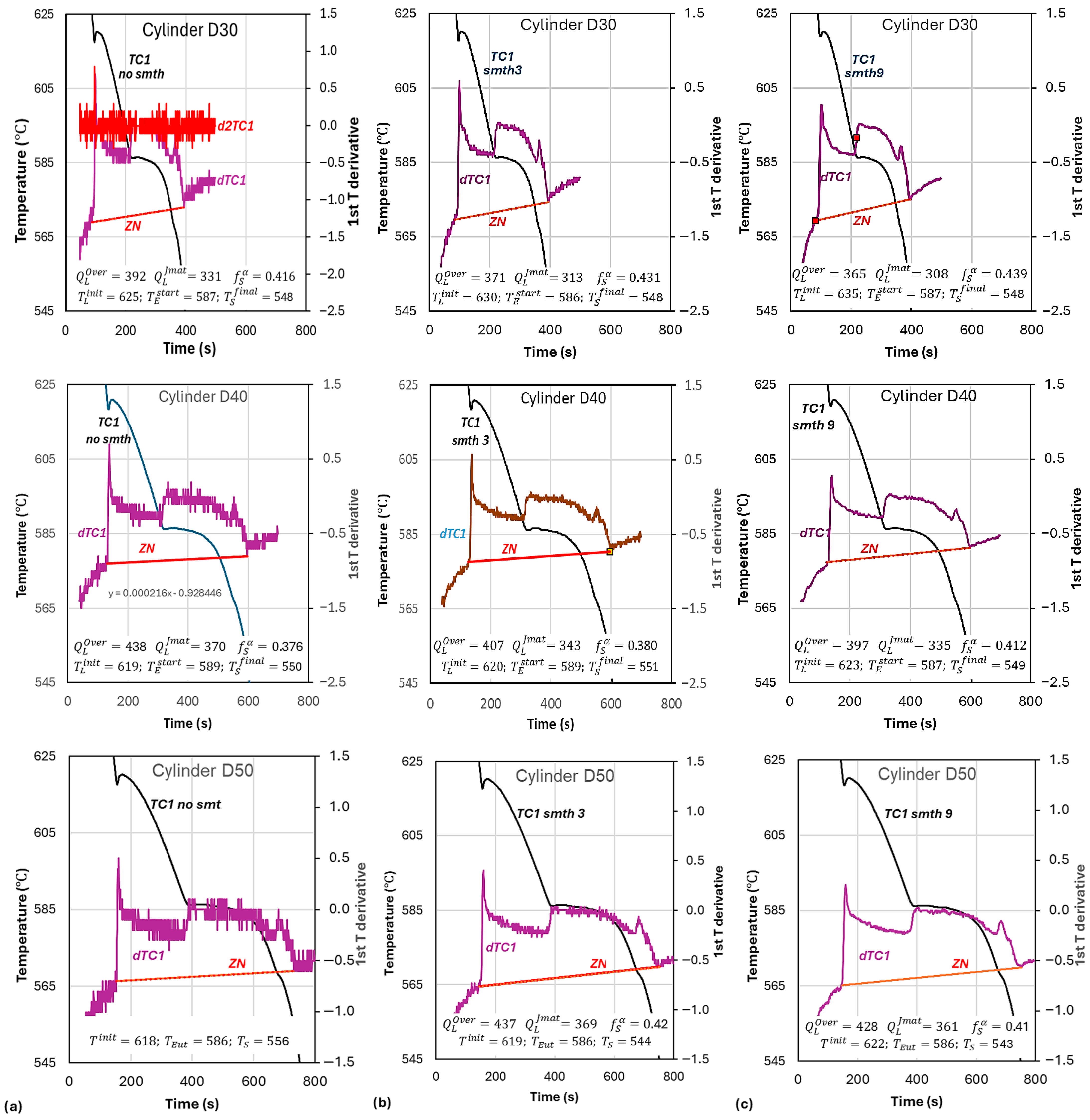
Figure 8.
Effect of smoothing of the 1st derivative data (cooling rate) and of the cup size on calculated latent heat: first row D30; second row D40; third row D50. (a) No smooth; (b) smooth 3; (c) smooth 9.
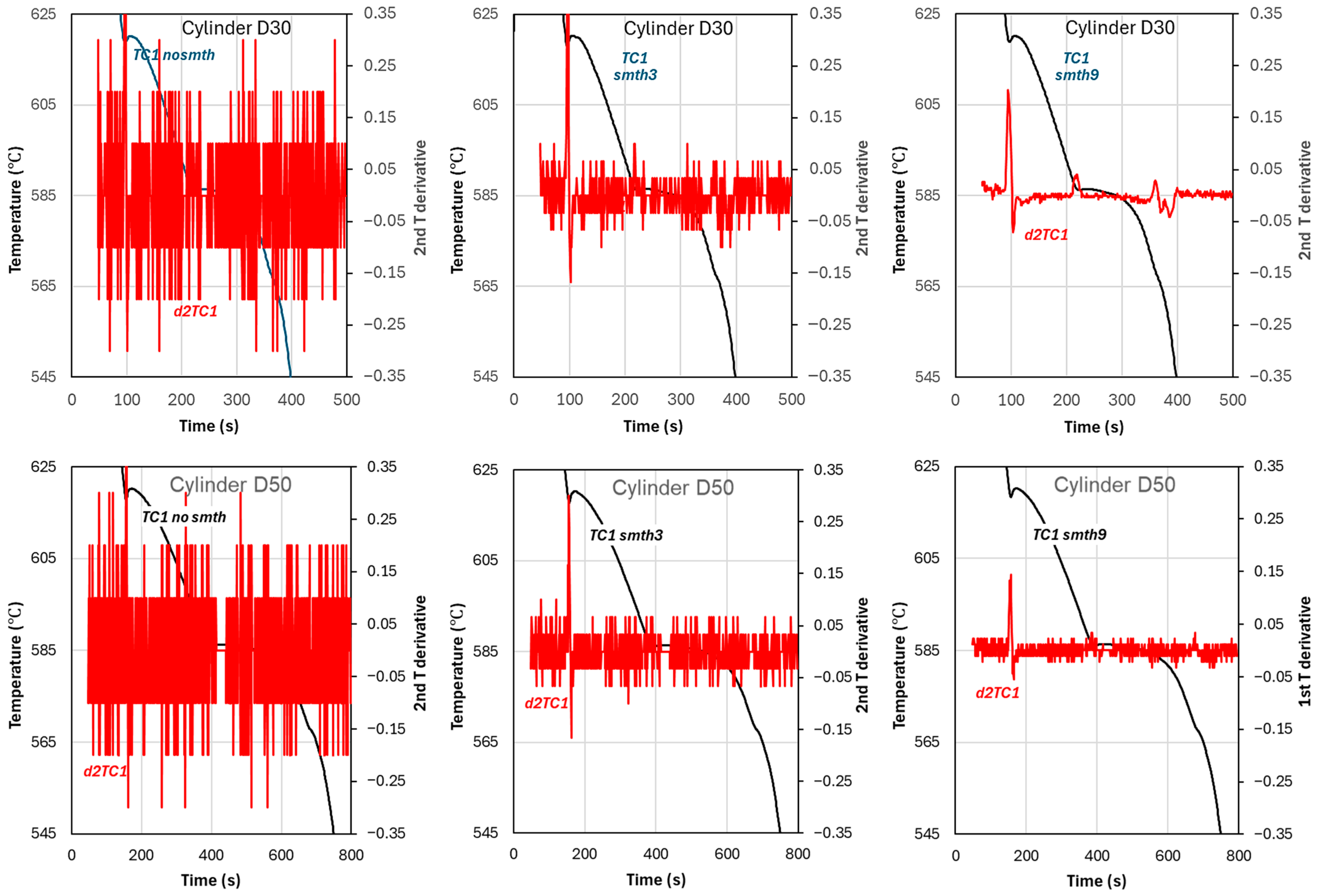
Figure 9.
Effect of temperature smoothing on the second time derivatives of temperature (d2T): first row for cups D30; second row for cups D50.
Figure 10.
Effects of smoothing on various parameters for cups 30, 40, and 50 (a) on the initial and final temperatures; (b) on the latent heat and fraction solid for the JMat .
Figure 11.
Effect of cooling rate of the test cups on the fraction solid of α-phase at the eutectic temperature () and on latent heat, for Newtonian analysis: (a) No smooth; (b) smooth 3; (c) smooth 9.
Figure 12.
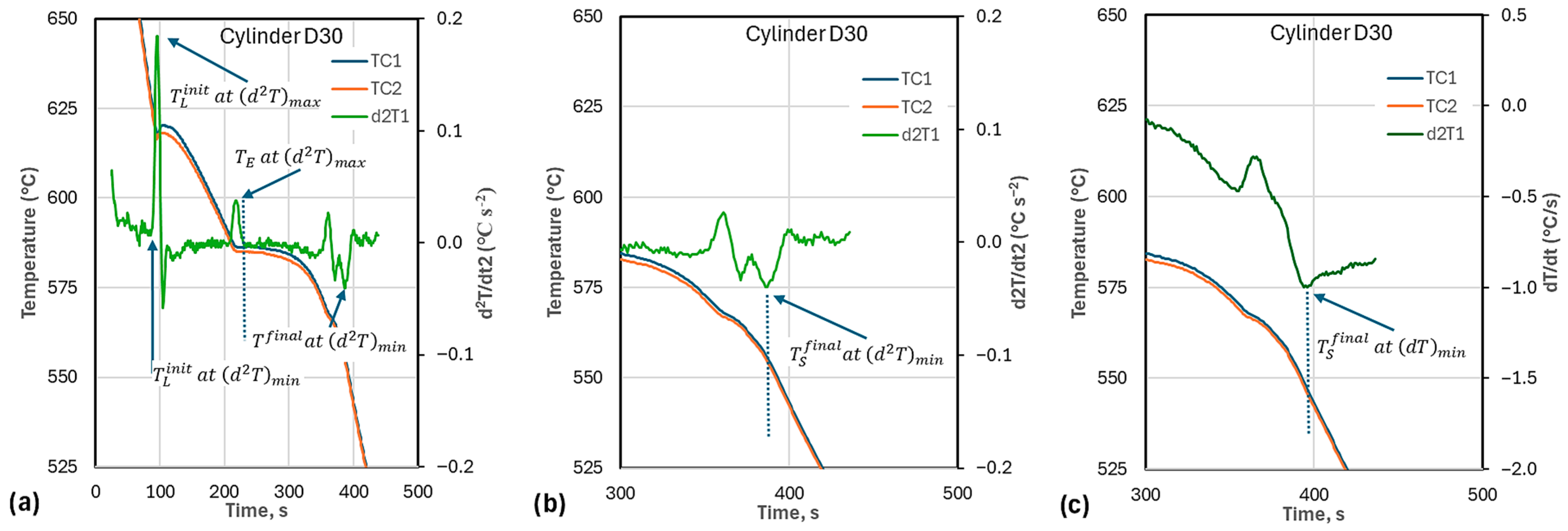
Evaluation of significant temperatures , , and using the 1st and 2nd time derivatives of temperature. (a) use of to determine beginning and end of solidification; (b) detail for end of solidification; (c) use of to find the end of solidification.
Figure 13.
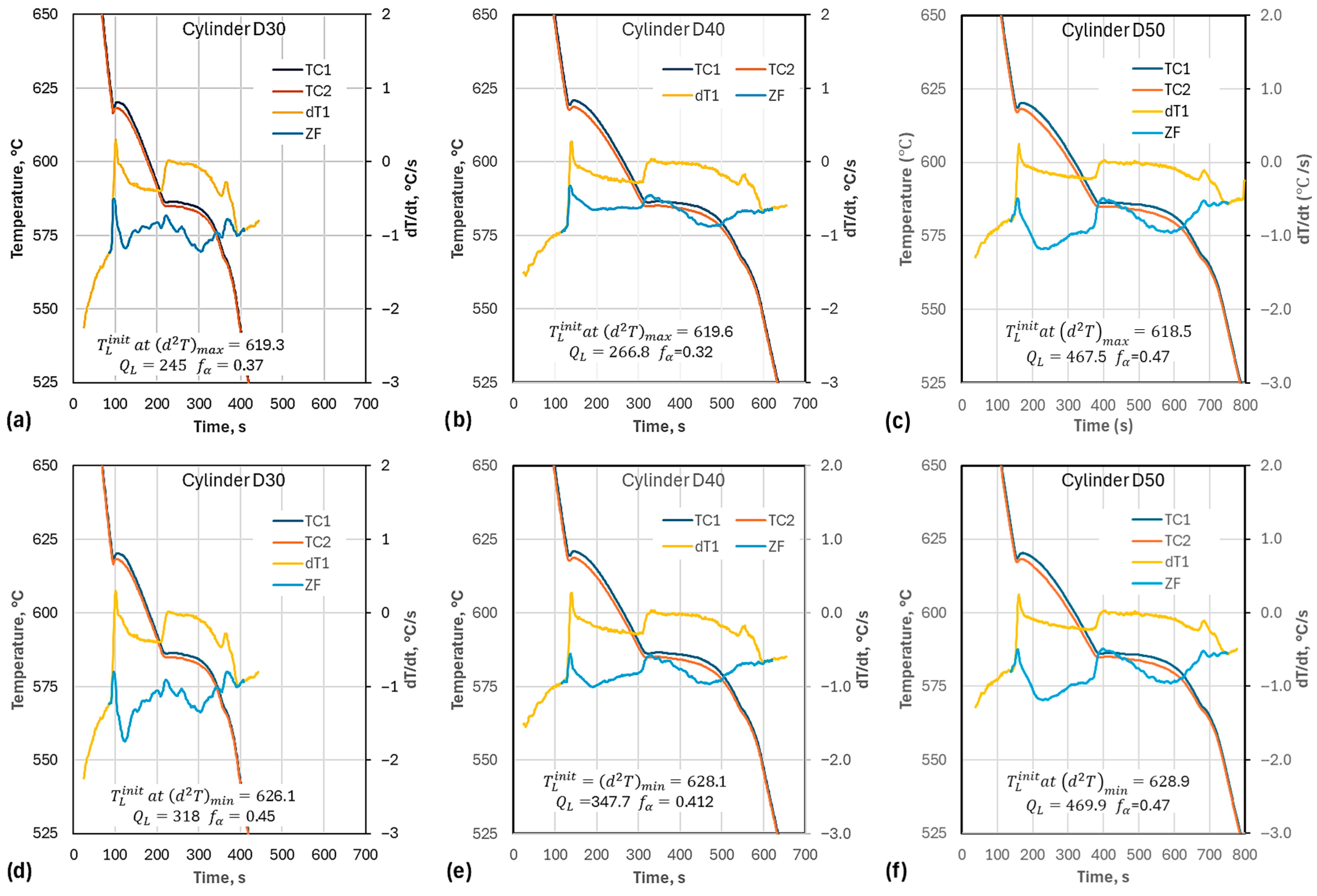
Effect of the selection of the initial temperature on latent heat and fraction solid calculations for smooth-9 , based on JMat . (a) cylinder D30; at ; (b) cylinder D40; at ; (c) cylinder D50; at ; (d) cylinder D30; at ; (e) cylinder D40; at ; (f) cylinder D50; at .
Figure 14.
The effect of experimental variables on calculation of latent heat for Fourier analysis on smooth-9 data: (a) effect of initial temperature; (b) effect of cooling rate on latent heat and fraction of solid (α-phase).
Figure 15.
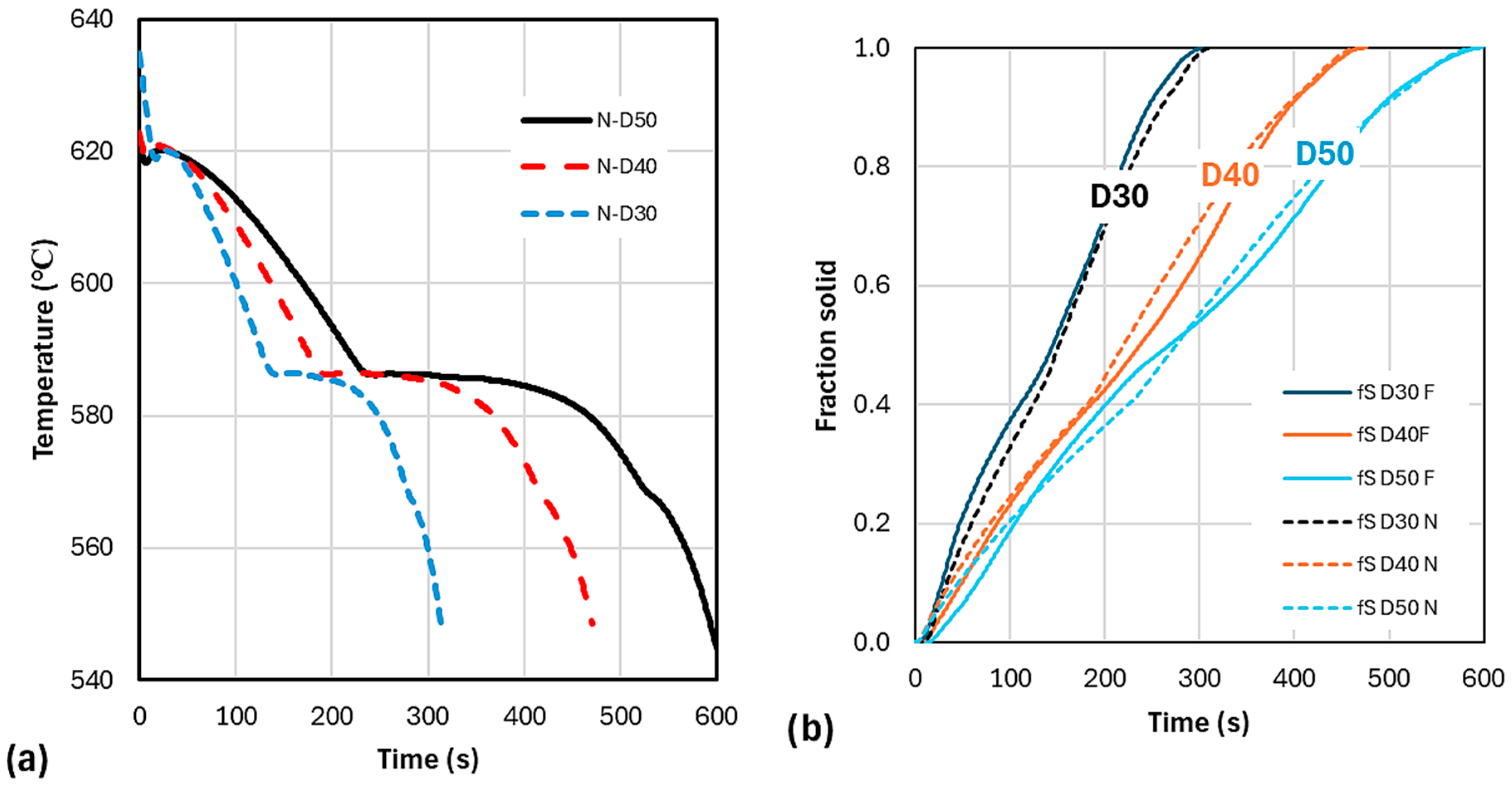
Evolution of smooth-9 cooling curve (a) and of fraction solid (b) for Newtonian and Fourier calculations.
Figure 16.
Temperature–fraction solid evolution (smooth-9) for Newtonian (a) and Fourier (b) analysis.
Table 1.
Equations used in the Newtonian analysis.
| Equation No. | Name | Equation | Parameters |
|---|
| Equation (1) | Newtonian zero curve | | , ,
, ρ—density |
| Equation (2) | Latent heat | | , ,
,
|
| Equation (3) | Fraction
solid |
|
Table 2.
Equations used in the Fourier analysis.
| Equation No. | Name | Equation | Parameters |
|---|
| Equation (4) | Fourier zero curve | |
|
| Equation (5) | Thermal diffusivity |
| |
| Equation (6) | Specific heat | |
|
| Equation (7) | Fraction
solid |
followed by iterations with Equation (3) | t—time; —time at the liquidus temperature
—time at the solidus temperature |
Table 3.
Experimental and tabulated data.
| %Si | Alloy | | | | * | | | | | Ref. |
|---|
| | | | °C | | | °C | |
| 7.5 | A356 | 389 | | 0.963 | | | 613 | | 557 | MatWeb |
| | 412 | | 1.139 | | | 610 | | 557 | JMatPro |
| | | 1.35 | 1.35 | | | | | | Overfelt [12] |
| | | | | | | 615 | 574 | 568 | Li [13] ** |
| Al-7.5Si | 424 | | | 0.46 | 0.54 | 615 *** | 577 *** | 424 | Itamura [14] |
Table 4.
Maximum recorded temperatures and cooling rates.
| Cup | D30 | D40 | D50 |
|---|
| Highest CC temp. (, °C | 788.6 | 771.0 | 779.1 |
| Cooling rate at 50 s, °C/s | 1.64 | 1.36 | 1.17 |
| , °C | 620.2 | 621.0 | 620.3 |
Table 5.
Effect of the smoothing level on calculated critical temperatures, fraction solid, and latent heat.
| Cup | Smooth
Level | Cooling
Rate | | | | | | | * | ** |
|---|
| | Select.
criterion | at
640 °C |
before
| | | | | at
| Equation (2) | Equation (2) |
| | no smth | 1.30 | 624.8 | 620.2 | 587.0 | 586.4 | 548.0 | 0.416 | 391.86 | 330.62 |
| 30 | smth-3 | 1.33 | 629.8 | 620.2 | 586.4 | 586.4 | 548.0 | 0.431 | 370.75 | 312.80 |
| | smth-9 | 1.33 | 634.8 | 620.2 | 586.6 | 586.4 | 548.1 | 0.439 | 365.48 | 308.36 |
| | no smth | 1.00 | 619.3 | 621.0 | 589.1 | 586.6 | 549.8 | 0.376 | 438.44 | 369.91 |
| 40 | smth-3 | 0.97 | 620.2 | 621.0 | 589.3 | 586.6 | 550.6 | 0.380 | 407.15 | 343.51 |
| | smth-9 | 0.99 | 622.8 | 620.9 | 586.6 | 586.6 | 548.5 | 0.412 | 396.67 | 334.67 |
| | no smth | 0.90 | 618.1 | 620.3 | 586.2 | 586.4 | 555.8 | nd | nd | nd |
| 50 | smth-3 | 0.83 | 624.6 | 620.2 | 586.2 | 586.4 | 543.8 | 0.424 | 437.26 | 368.92 |
| | smth-9 | 0.80 | 622.3 | 620.2 | 586.5 | 586.3 | 543.2 | 0.418 | 428.42 | 361.46 |
Table 6.
Fourier analysis of smooth-9 experimental data.
| Temp. | Assumption | T (°C) | α | | |
|---|
| D30 | | | | | |
| | 619.3 | 1.05 × 10⁻⁵ | 245.2 | 0.37 |
| 626.1 | 1.65 × 10⁻⁵ | 320.0 | 0.45 |
| | 586.4 | | | |
| | 548.0 | 2.14 × 10⁻⁵ | | |
| D40 | | | | | |
| | 619.6 | 1.20 × 10⁻⁵ | 266.8 | 0.32 |
| 628.1 | 2.06 × 10⁻⁵ | 347.7 | 0.41 |
| | 586.6 | | | |
| | 548.5 | 3.16 × 10⁻⁵ | | |
| D50 | | | | | |
| | 618.5 | 3.46 × 10⁻⁵ | 467.5 | 0.47 |
| 628.9 | 3.46 × 10⁻⁵ | 469.9 | 0.47 |
| | 586.5 | | | |
| | 543.5 | 3.46 × 10⁻⁵ | | |
| Disclaimer/Publisher’s Note: The statements, opinions and data contained in all publications are solely those of the individual author(s) and contributor(s) and not of MDPI and/or the editor(s). MDPI and/or the editor(s) disclaim responsibility for any injury to people or property resulting from any ideas, methods, instructions or products referred to in the content. |