


Abstract
The thermodynamic instability and relatively low mechanical strength of γ/γ′ phase boundaries in Ni-based single-crystal superalloys compromise the service safety of these materials. The interfacial segregation behavior of alloying elements is expected to enhance the thermodynamic stability and mechanical strength of γ/γ′ phase boundaries. In the present research, first-principles computations grounded in density functional theory were performed to examine the unclarified cosegregation characteristics of W-Re/Cr solutes at the γ-Ni/γ′-Ni3Al phase boundary, as well as the impacts of such cosegregation on interfacial formation heat and Griffith fracture work. The results indicated that Re and Cr atoms tend to segregate preferentially at the γ-L1-3.52-cp site within the W-alloyed phase boundary. This phenomenon can be attributed to the attractive interactions between W and Re/Cr, along with the fact that this site exhibits the most negative segregation energy. The thermodynamic stability of W-Re and W-Cr cosegregated phase boundaries is significantly enhanced, being much higher than that of clean or W-segregated phase boundaries, which is ascribed to deeper pseudogaps at the Fermi level. Notably, the preferred fracture path remains in region-1 after cosegregation, as directly evidenced by its lower Griffith fracture work compared to region-2. This disparity is rationalized by charge density analysis, which reveals a pronounced charge accumulation and consequently stronger bonding in region-2. Our results may provide atomistic insights into the solute cosegregation behaviors and their interfacial strengthening and stabilizing effects, and also the interfacial composition manipulation of Ni-based single-crystal superalloys.
1. Introduction
In the modern aerospace industry, the service environment of advanced turbine blades used in aircraft engines has become increasingly harsh. The inlet temperature of aircraft engines has exceeded 1200 °C, and the blades are required to maintain stable performance for over 10,000 h under high-temperature and high-pressure conditions [1]. Under such circumstances, nickel-based single-crystal superalloys have emerged as the core material for the fabrication of turbine blades, owing to their superior oxidation resistance, corrosion resistance, ductility, creep resistance, and high-temperature fracture strength [2,3]. The performance advantages of these alloys originate from the high fraction of γ′ precipitates (Ni3Al-based ordered L12 structure) and the γ matrix (a nickel-based face-centered cubic (FCC) disordered solid solution structure), which together form a coherent γ/γ′ phase boundary [4]. The core significance of this coherent phase boundary is manifested in two aspects. First, it enhances the high-temperature mechanical properties of the material through physical impedance of dislocation motion [5]. Second, the structural stability and performance parameters of this phase boundary directly govern the morphology, size distribution, and high-temperature coarsening rate of γ′ precipitates. Specifically, when the alloy is exposed to 1100 °C, abnormal coarsening of the γ′ phase results in an uneven distribution of γ channel width, which in turn significantly reduces the creep resistance of the alloy [6]. Therefore, the characteristics of the γ/γ′ phase boundary exert a decisive effect on the high-temperature service performance of nickel-based single-crystal superalloys. Precise control of these phase boundary characteristics has become a key technical strategy for achieving the design target of a 1300 °C turbine inlet temperature in next-generation aircraft engines [2,7].
Alloying stands as one of the core strategies for regulating the γ/γ′ phase boundary and optimizing the high-temperature performance of nickel-based single-crystal superalloys. However, the addition of a single element is no longer sufficient to meet the stringent service requirements of turbine blades used in modern aircraft engines. To address this limitation, numerous studies have utilized first-principles (FP) calculations to predict fundamental properties, which include atomic arrangement at grain boundaries under elemental segregation, segregation sites, binding energies, Griffith fracture work, theoretical tensile strength, electronic structure, charge density distribution, and interfacial bonding characteristics [8,9,10]. Notably, atomic-scale simulations have confirmed that solute elements or nano-precipitates can modulate dislocation behaviors (e.g., nucleation, gliding, and interfacial interaction) to optimize the mechanical properties of alloys, and this provides a reliable theoretical foundation for the regulation of phase boundaries in nickel-based superalloys [11,12]. Several studies based on density functional theory (DFT) have demonstrated that typical alloying elements, including Re, Ta, W, Mo, Ru, and Co, can selectively segregate to the γ/γ′ phase boundary, thereby substantially enhancing the overall performance of phase boundaries [9,13,14,15,16]. For example, the interfacial segregation of elements (e.g., Re, Ti, Mo, W, Cr, Nb, Ta, Hf, and Zr) enhances the stability of the γ/γ′ phase boundary compared with the non-segregated phase boundary. Among these elements, Re, Mo, W, etc. can enhance both the thermodynamic stability and fracture strength of the phase boundary [17]. Notably, through FP calculations, Gong et al. determined that W and Re significantly enhance the cohesion of the γ/γ′ phase boundary [18]. As a key strengthening element, Re has a low diffusion coefficient, which effectively inhibits dislocation climb and the high-temperature coarsening of the γ′ phase, and thereby substantially enhances the long-term thermal stability of the alloy [19]. However, when the Re content exceeds 6 wt%, it notably increases the tendency for precipitation of topologically close-packed (TCP) brittle phases (e.g., μ and σ phases). These brittle phases not only consume strengthening elements at the phase boundary but also serve as potential crack initiation sites, and this ultimately leads to a drastic decrease in the fracture toughness of the alloy [20]. To resolve this “strength vs. brittleness” dilemma, the fifth-generation nickel-based single-crystal superalloy adopts a “Re + Ru” cosegregation design strategy. The introduction of Ru allows its “reverse distribution” effect to suppress the oversaturation and aggregation of Re and Cr in the γ matrix, which thereby notably reduces the precipitation density of TCP phases. Atomic probe tomography (APT) studies have confirmed that the addition of Ru effectively enhances the solubility of Re and Cr in the γ′ phase while reducing the number of electronic vacancies in the γ matrix, thus decreasing the driving force for TCP phase formation by approximately 30% and ultimately extending the high-temperature service life of the alloy [21].
Multi-element cosegregation not only overcomes the limitations associated with the addition of a single element but also enables performance breakthroughs through the regulation of key parameters at the γ/γ′ phase boundary. Several studies have explored the cosegregation behavior of alloying elements and the effects of these elements on grain boundaries through FP calculations [22,23]. In Ni-based single-crystal superalloys, atom-probe tomography has revealed a pronounced cosegregation layer of Re, Co and Cr in the γ matrix adjacent to the γ/γ′ phase boundary, which induces a more negative local lattice misfit and may facilitate the nucleation of topologically close-packed phases [24]. By combining FP calculations, molecular dynamics simulations and three-dimensional atom-probe tomography, recent studies have demonstrated that the cosegregation of Re-W in the γ matrix promotes dislocation tangles and impedes dislocation motion, leading to synergistic strengthening at the γ/γ′ phase boundary [25]. Meanwhile, Zhang et al. systematically quantified the interaction energies between alloying atoms (Cr, Co, Mo, Re, W, etc.) and interfacial dislocations, demonstrating that Re and W are strongly attracted to dislocation cores in the γ matrix, which facilitates atomic flux and influences the rafting behavior of γ′ precipitates [26]. The synergistic strengthening effect of Re and Ru on the γ/γ′ phase boundary is considerably superior to the effect of single-element doping [15,27]. Shu et al. reported that the addition of Ru promotes the segregation of Re at the γ/γ′ phase boundary by facilitating the dissolution of Re into the γ′ phase, as evidenced by the decrease in the Re partitioning ratio from 1/7.64 in Ru-free alloy to 1/5.02 in the 3 wt% Ru-containing alloy [28]. Fawaz et al. investigated the effect of Zr-Re/W cosegregation on the stability and fracture strength of the γ-Ni/γ′-Ni3Al phase boundary through FP calculations [29]; their results indicated that cosegregation of Zr with Re or W at the phase boundary not only enhances the phase boundary stability compared to clean or single Zr-segregated phase boundaries but also improves the fracture strength of the phase boundary. Furthermore, the composite addition of Re and Mo can modulate the γ/γ′ lattice misfit, induce a regular dislocation network, and inhibit dislocation shear of the γ′ phase [9]. Xia et al. systematically reviewed recent research on the atomic-scale characterization of high-temperature alloys and clearly noted that cosegregation of Re with elements (e.g., Cr and Co) at the γ/γ′ phase boundary notably suppresses the interdiffusion of interfacial elements; this thereby delays the coarsening and degradation of the γ′ phase and extends the creep life of the alloy under high-temperature and low-stress conditions [30]. Wang et al. [31] demonstrated through phase-field simulation and thermodynamic calculations that Mo, Cr, and Al exhibit cosegregation behavior at the γ/γ′ phase boundary. Mo occupies the Al sites in γ′-Ni3Al, which drives Cr to further segregate toward the γ matrix. This cosegregation pathway not only notably reduces the diffusion coefficient of Al and suppresses γ′ coarsening but also enhances the high-temperature microstructural stability and creep resistance of the alloy by regulating the γ′ volume fraction and lattice misfit [31]. However, current research on multi-element cosegregation focuses mostly on classic combinations such as Re + Ru, and there remains a lack of systematic investigation into the cosegregation behavior, synergistic mechanisms, and the effects of these factors on phase boundary stability and fracture strength for element combinations (e.g., W-Re/Cr) at γ/γ′ phase boundaries with different orientations. This research gap acts as a key entry point for the present study.
The alloying elements cosegregated at phase boundary modulate the interfacial structure and chemical bonding, and thus in turn govern the properties of the phase boundary. Therefore, systematic cosegregation modification could act as an effective strategy for designing the microstructure and properties of high-performance materials. Compared to Re and Cr, W contributes to enhancing the thermodynamic stability of the γ/γ′ phase boundary. [17]. Thus, investigating the cosegregation behavior of Re and Cr at the W-segregated γ-Ni/γ′-Ni3Al phase boundary (i.e., W-Re/Cr cosegregation) holds considerable scientific significance. This research not only facilitates an understanding of the intrinsic stability and strengthening mechanisms underlying atomic cosegregation of W-M (M = Re or Cr) but also provides valuable insights for the design of Ni-Al-W-Re and Ni-Al-W-Cr alloys. Building on this, the present study utilizes FP calculations based on DFT to explore the cosegregation behavior of W-M (i.e., Ni-Al-W-Re/Cr phase boundary systems) and the influence of this behavior on the thermodynamic stability and fracture strength of the γ-Ni/γ′-Ni3Al phase boundary. The objective of this study is to achieve a deeper understanding of the changes in interfacial structure and properties induced by solute cosegregation, as well as the mechanisms underlying these changes.
2. Computational Methods
2.1. Supercell Model of (001) γ/γ′ Phase Boundary
In Ni-based single-crystal superalloys, grain boundaries are eliminated by design and γ′ precipitates are embedded within the γ matrix; consequently, intragranular γ/γ′ phase boundaries constitute the dominant internal boundary features governing strengthening and microstructural stability. The equilibrium morphology of γ′ precipitates is closely related to the orientation dependence of the γ/γ′ interfacial energy. Interfacial-energy calculations have shown that the {100} orientation exhibits relatively lower γ/γ′ interfacial energy than other low-index orientations (e.g., {110} and {111}), promoting γ′ precipitates bounded predominantly by {100} facets and thus favoring a cuboidal morphology, consistent with experimental observations [8]. Accordingly, in this study we focus on the (001)-oriented γ/γ′ phase boundary as a representative low-index boundary for atomic-scale segregation and cohesion analyses.
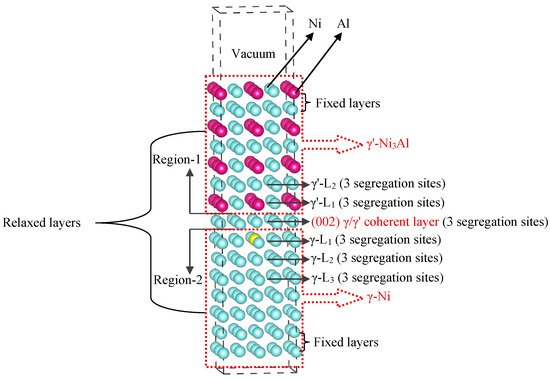
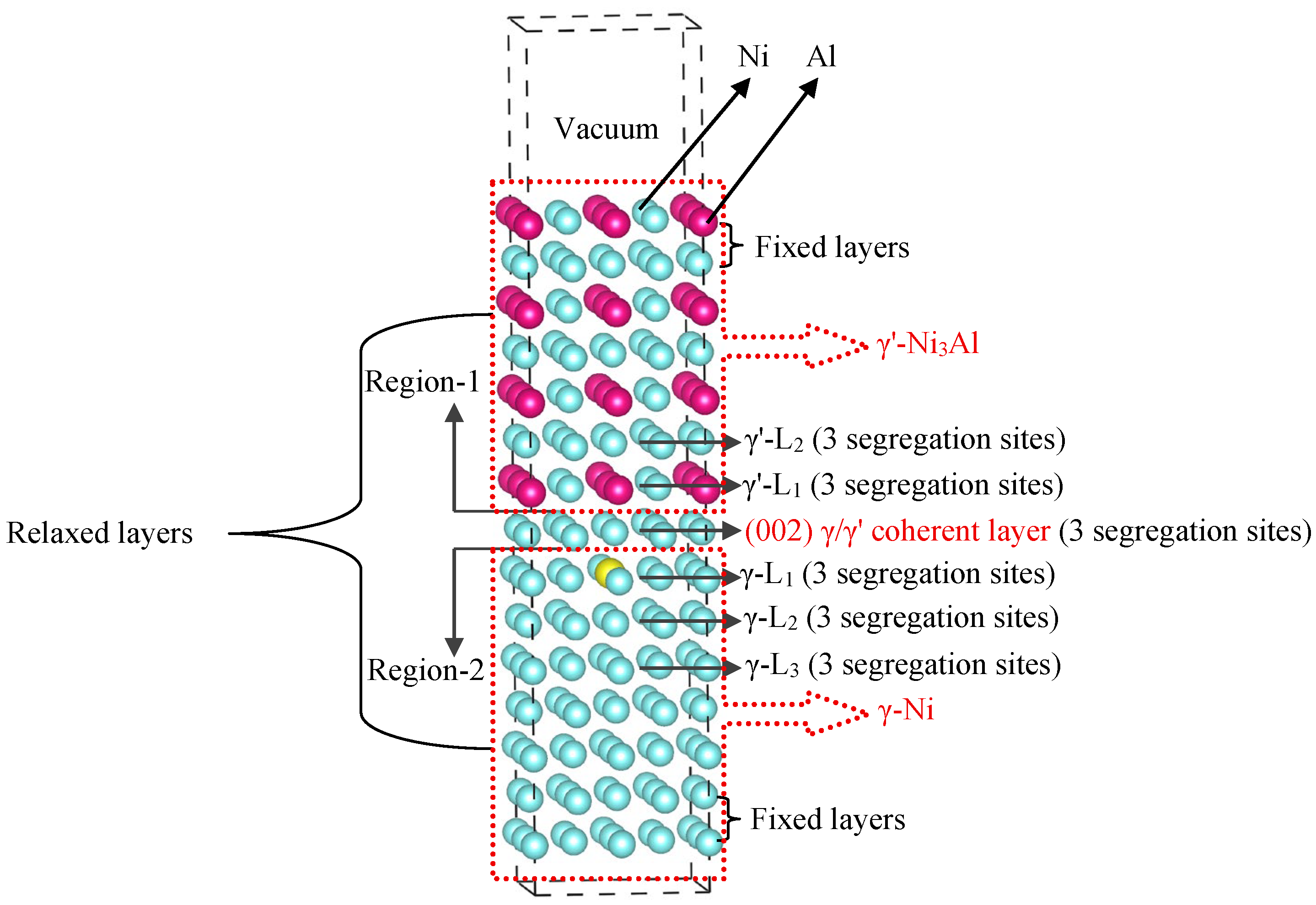
As shown in Figure 1, the lattice model of the (001) γ-Ni/γ′-Ni3Al phase boundary was constructed based on two surfaces, in which the (001) surface model of γ-Ni phase contains 8 Ni-atom layers (64 atoms, 8 atoms per layer) and the (002) surface model of γ′-Ni3Al phase contains 7 atomic layers (40 Ni and 16 Al, 8 atoms per layer). The lattice constants of the γ-Ni/γ′-Ni3Al supercell are equal to 7.047 Å along a and b, and 34.808 Å along c. The (002) plane with 8 Ni atoms in the middle of the interfacial supercell, is regarded as the coherent atomic layer between the γ and γ′ phases. A vacuum layer with a thickness of 10 Å was added to the γ′ phase side, in order to avoid the effect of the adjacent phase boundary images, due to periodic boundary conditions.
Figure 1.
A schematic representation of the supercell model of the (001) W-segregated γ-Ni/γ′-Ni3Al phase boundary (15 atomic layers) with 18 possible sites for Re/Cr segregation.
Since W enhances the thermodynamic stability of the γ-Ni/γ′-Ni3Al phase boundary more effectively than Re and Cr, the interfacial segregation of W should be prioritized over that of Re and Cr [17]. Thus, in the present work, Re/Cr atoms were doped into the phase boundary that had been pre-segregated with W atoms, so as to characterize the interfacial cosegregation behavior of W-M atomic pairs. As illustrated in Figure 1, the W atom shown as a yellow sphere tends to replace the corner-point (cp) Ni atom in the γ-L1 atomic layer, which has been verified in previous studies. Eighteen potential atomic sites in the interfacial supercell pre-segregated with W atom were considered for the Re or Cr segregation [29]. During the structural relaxation of the interfacial supercell, the middle part with eleven atomic layers were allowed to fully relax, while the two terminal atomic layers on each side of the interfacial supercell were fixed.
2.2. First-Principles Total Energy Calculations
Total energy calculations within the DFT framework were carried out using the VASP (Vienna Ab initio Simulation Package, version 5.4.4) software [32,33], incorporating spin polarization. The Perdew–Burke–Ernzerhof (PBE) functional was employed to describe to the electronic exchange-correlation interactions [34]. For the structural optimization of phase boundaries, the projector-augmented-wave (PAW) method [35] was used, with a plane-wave cutoff energy of 400 eV and a 3 × 3 × 1 Γ-centered Monkhorst-Pack k-point grid [36,37]. The static calculation of the γ-Ni/γ′-Ni3Al supercells with different interfacial distances was performed, where the interfacial distance of 1.979 Å corresponding to the minimum total energy was chosen to build the stable interfacial supercell.
2.3. Formation Heat of γ/γ′ Phase Boundaries
The formation heats (H) of the γ/γ′ phase boundaries segregated with or without alloying elements were calculated to identify the preferred positions for Re and W, and to evaluate their impact on the thermodynamic stability of the phase boundaries [17,28,38].
where are the total energies of the γ/γ′ phase boundaries segregated with or without alloying-elements M (M = Re and Cr). The variables , , , and represent the number of the corresponding constitute atoms in the interfacial supercells. The single atom energy of // or in their stable bulk phases was calculated and represented by the terms of // or , respectively.
2.4. Segregation Energy
The interfacial segregation tendency of M was quantitively evaluated by the segregation energy , as defined in Equation (2) [39,40]:
where and represent the total energies of the γ-Ni/γ′-Ni3Al supercells with M positioned in the interfacial core and the bulk-like layer, respectively. In Figure 1, the γ-L4 layer is positioned at a considerable distance from the (002) γ/γ′ coherent interface, and this layer was designated as the bulk-like layer [29].
2.5. Griffith Fracture Work
The γ/γ′ phase boundary is commonly considered to be the weakest mechanical region in Ni-based single-crystal superalloys. To some extent, the cohesive strength of the γ-Ni/γ′-Ni3Al phase boundary can be considered a reliable indicator of the interfacial fracture strength among these superalloys [41]. In this work, the Griffith fracture work was employed to determine the cohesive strength of the γ-Ni/γ′-Ni3Al phase boundaries segregated with or without M, by using the following equation [42,43,44], which is derived from the energy difference between the phase boundary and the corresponding surface:
where is the interfacial area, and is the total energy of the γ-Ni and γ′-Ni3Al surfaces fractured from the corresponding phase boundaries, respectively. Due to the composition conservation before and after the interfacial cleavage, herein + = and + = .
2.6. Binding Energy
To gain more insights into the W-M interactions at the γ-Ni/γ′-Ni3Al phase boundary, the binding energy () of W-M atomic pairs for varying atomic distances was calculated by Equation (4) [45,46].
Here , , , and correspond to the total energies of four types of supercells: the phase boundary supercell containing both W and , the unsegregated phase boundary supercell, the phase boundary supercell with single W atom segregation, and the phase boundary supercell with single atom segregation, in that order. A positive value signifies a repulsive interaction between W and atoms, whereas a negative value denotes an attractive interaction between these atoms.
3. Results and Discussion
3.1. Preferred Segregation Site of Re/Cr Atom at the γ/γ′ Phase Boundary
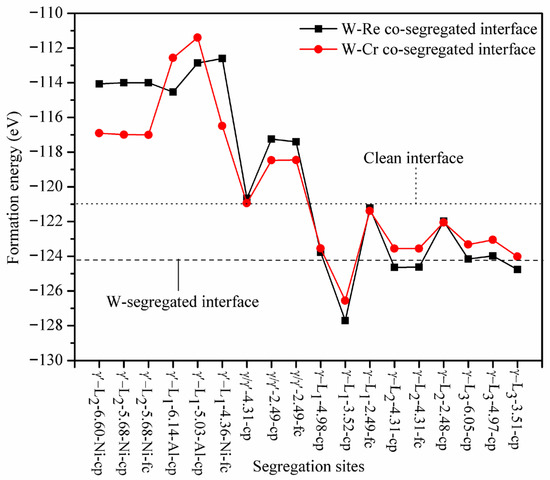
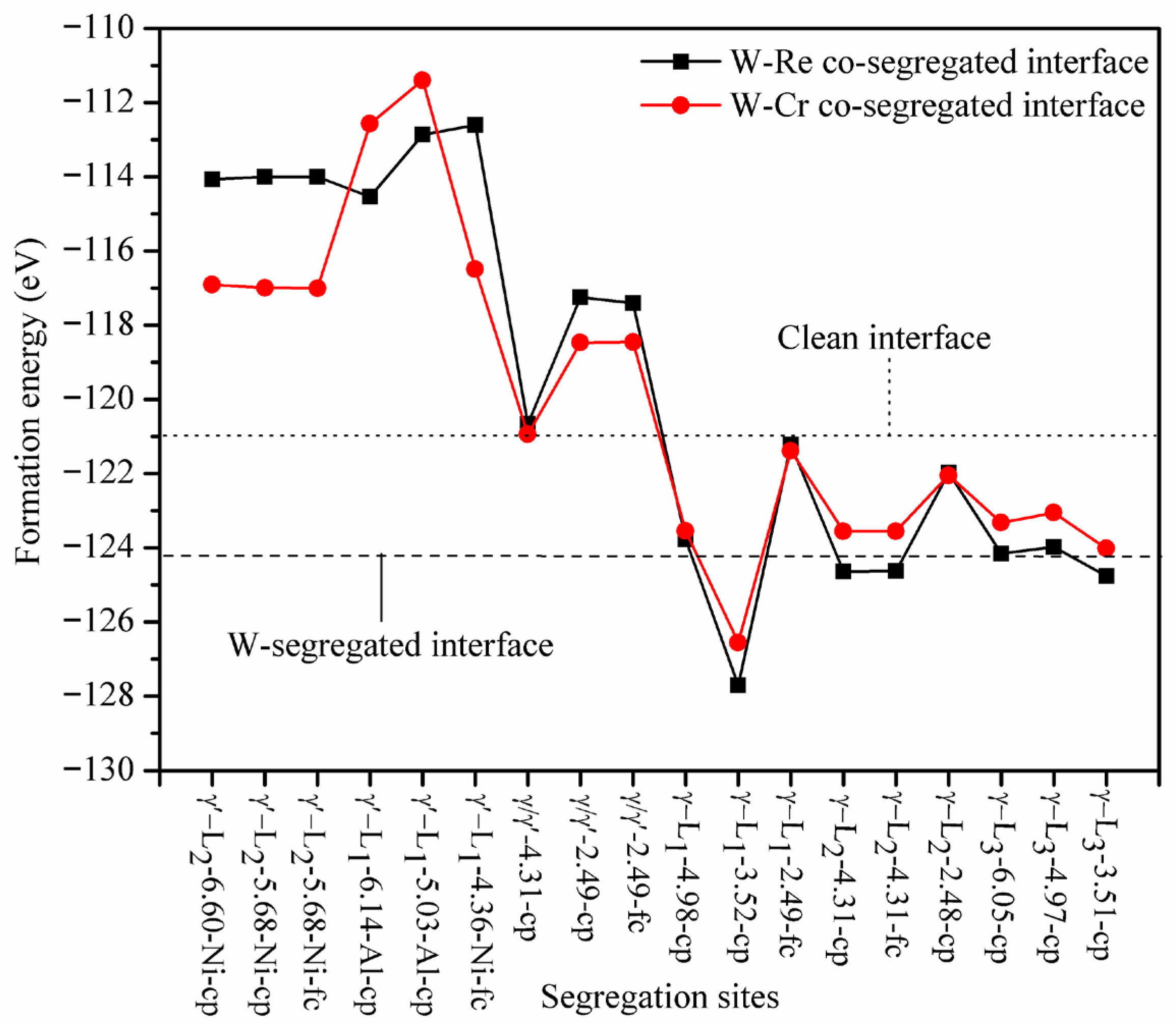
As shown in Figure 2, there were 18 potential substitution sites evaluated to analyze M atoms segregated at the γ/γ′ phase boundary pre-segregated by W atoms. Owing to their lower formation heats, M atoms exhibit a clear preference for partitioning to the γ matrix over the γ′ precipitate. This phase preference is consistent with the findings of Zhao et al., who reported that typical γ-phase solid solution elements such as Re and Cr exhibit a strong tendency to segregate to the corner-point (cp) sites of the γ-Ni (001) layer, while showing low solubility in the γ′-Ni3Al phase [18]. The interfacial formation heats are increased as M atoms accumulate at the γ′ bulk side or interfacial core area, compared to the W-segregated or clean γ/γ′ phase boundaries, indicating the detrimental effects on the stability of the phase boundaries. Among all sites, the γ-L1-3.52-cp (Pref-L1-cp) site is the most favorable for the segregation of Re/Cr, as it shows the most negative interfacial formation energies. Such an observation aligns with our earlier research [29]. Additionally, W-M cosegregation to the γ/γ′ phase boundaries delivers greater stability than clean and W-segregated phase boundaries, specifically when M atoms accumulate at the Pref-L1-cp substitutional site. In comparison to W-Cr cosegregation, W-Re cosegregation exhibits a greater ability to reduce interfacial energies when alloying atoms segregate to the γ bulk side. This observation confirms that W-Re segregation provides greater benefits for enhancing the thermodynamic stability of the γ/γ′ phase boundary. This is in agreement with the findings of Li et al., which demonstrated an attractive interaction between Re and W at the γ-cp sites, promoting the formation of a stable cosegregated configuration. On the other hand, the interaction between Cr and W is weaker, leading to higher interfacial energy and poorer stability in the W-Cr cosegregated phase boundary [9]. When W-M cosegregated to γ/γ′ phase boundaries, the interfacial stability is influenced by the segregation positions of M atoms, with the following stability sequence: the Pref-L1-cp site is identified as the most stable segregation position for both W-Re and W-Cr cosegregated γ/γ′ phase boundaries. W-Re cosegregated phase boundaries show a multi-level stability sequence, with several sites (γ-L3-3.51-cp, γ-L2-4.31-cp, γ-L2-4.31-fc) outperforming the W-segregated γ/γ′ phase boundary before stability declines at other sites. In contrast, W-Cr cosegregated phase boundaries only have the Pref-L1-cp site with stability exceeding that of the W-segregated γ/γ′ phase boundary.
Figure 2.
Formation enthalpy of the γ/γ′ interfacial supercell under three conditions: without alloying atoms, with only W, and with W-M cosegregation, where M segregates at different substitutional sites. 18 potential substitution sites are denoted as γ(γ′)-Lk-n-fc(cp), k refers to the atomic layer number, n represents the distance from the site to the W atom, and fc/cp correspond to the face-centered and corner-point sites of the FCC structure, respectively.
3.2. Segregation Tendency of Re/Cr at the W-Segregated γ/γ′ Phase Boundary
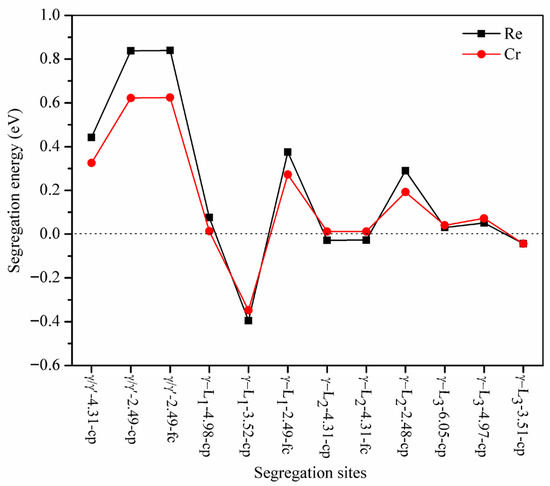
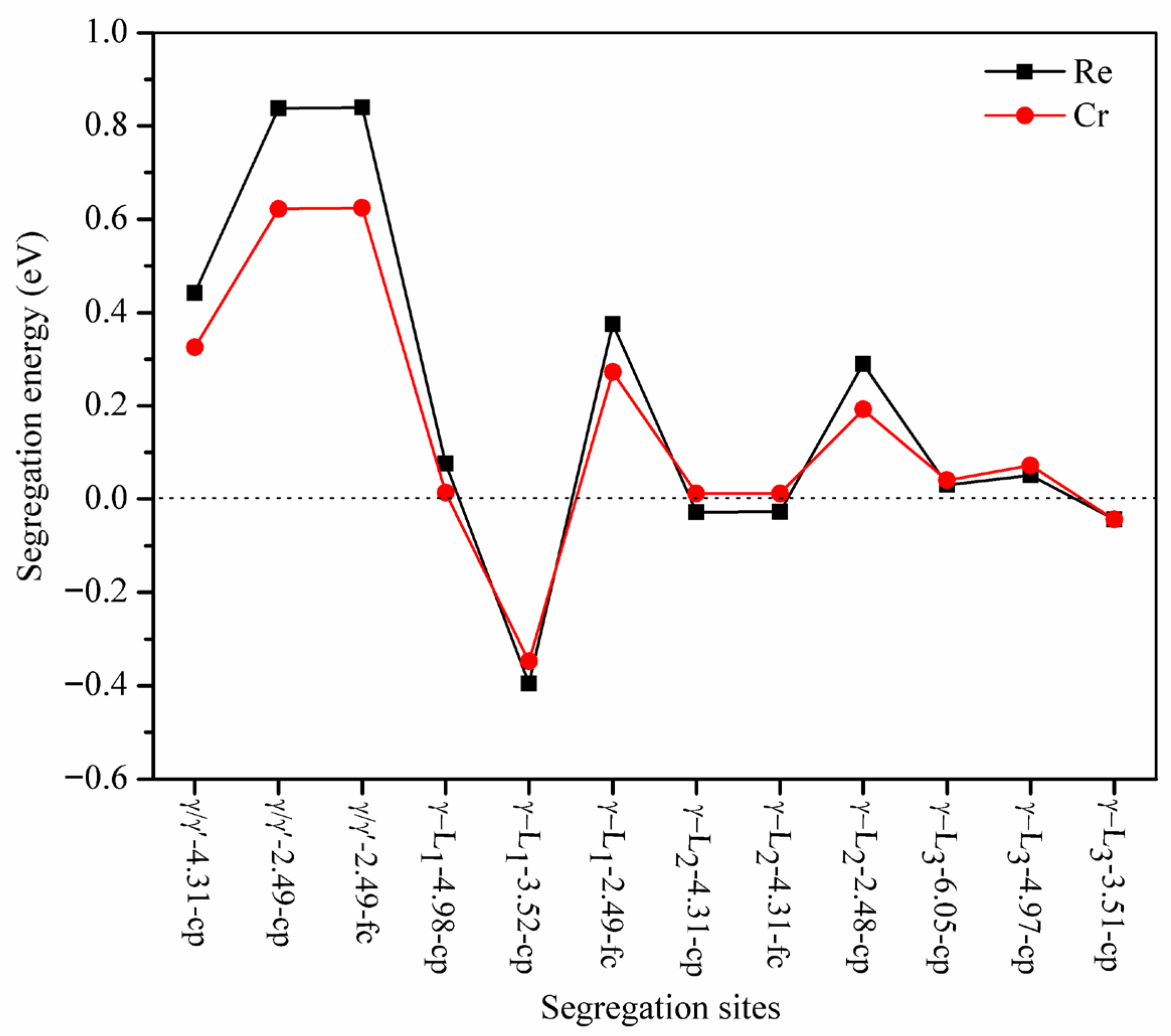
To determine the segregation tendency or ability of M (M = Re and Cr) at the phase boundary within only W segregation, the segregation energies of M at various sites were computed using Equation (2). As shown in Figure 3, the site Pref-L1-cp has the negative segregation energies of M, indicating that they tend to segregate into the phase boundary region rather than remain in the bulk environment. This observation is consistent with the findings of Zhu et al., who employed FP calculations combined with Monte Carlo simulations and demonstrated that Re atoms exhibit a significant segregation tendency at the γ side of the γ/γ′ phase boundary at low temperatures, with a strong preference for Ni substitution sites near the boundary, which attributed to the lower segregation energies of these sites compared to the bulk region [47]. Moreover, when M segregates to this type of site, the interfacial supercell exhibits the lowest formation heat, which is even lower than that of the two other types of phase boundaries as shown in Figure 1. In other words, when W-M cosegregates at this site on the phase boundary, it could stabilize the γ/γ′ phase boundary. This stabilizing effect is supported by the study of He et al., whose FP calculations confirmed that the cosegregation of Re and W can reduce interfacial energy and induce local lattice distortion, thereby synergistically enhancing the thermodynamic stability of the γ/γ′ phase boundary, which is consistent with the lower formation heat observed at the Pref-L1-cp site in this work [48]. Except for the Pref-L1-cp site, where the segregation energy is relatively low, the segregation energies of M at other sites fluctuate near zero, such as at the γ-L3-3.51-cp, γ-L2-4.31-cp, and γ-L2-4.31-fc sites. Even though some of these values are negative, it suggests that the driving force for M to segregate to these sites is weak. Lin et al. also reported a similar trend in their systematic study on the segregation behavior of transition metal elements in Ni-based ternary model superalloys, noting that if the substitution formation heat (closely related to segregation energy) is close to zero, the corresponding element exhibits a weak segregation driving force, which is consistent with the insignificant segregation tendency of Re/Cr at the aforementioned sites in this work [13]. In addition, there is no possibility for Re/W atom to segregate to the other sites, because their segregation energies are all positive. This aligns with the site preference law observed by Ma et al., who found that in Ni-based superalloys, alloying elements only exhibit effective segregation behavior when their partitioning energy (similar in nature to the segregation energy in this work) is negative; positive values indicate an unfavorable segregation process due to the lack of energetic advantage [49].
Figure 3.
Segregation energies of M at substitution positions of W presegregated γ/γ′ interfacial supercell.
3.3. Effects of W-M Cosegregation on the Griffith Fracture Work of the γ/γ′ Phase Boundary
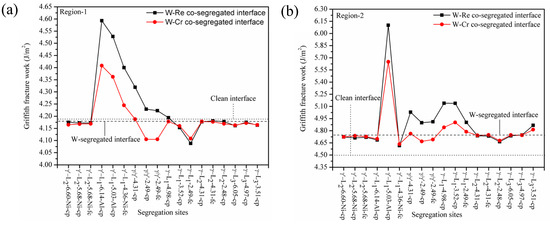
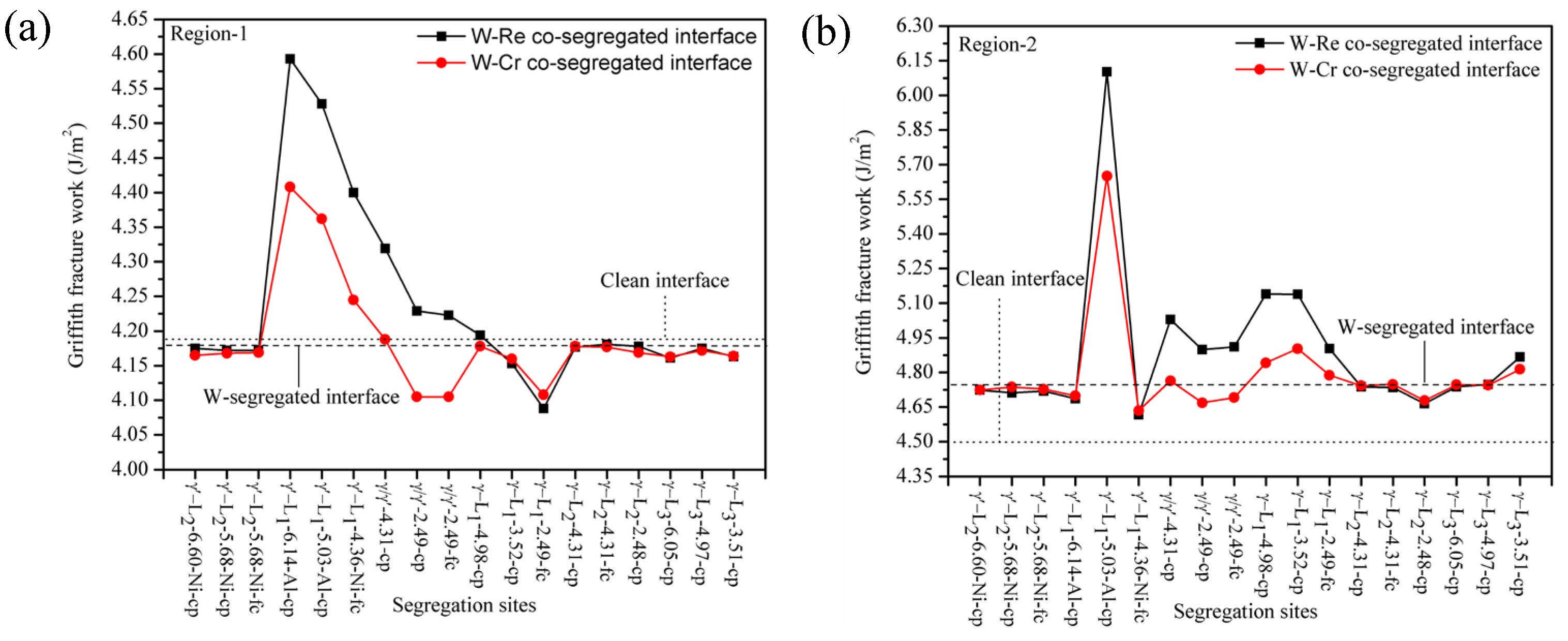
The Griffith fracture work is calculated at two potential fracture locations, region-1 and region-2, as shown in Figure 1. For region-1, the phase boundary is separated by cleaving the γ′-Ni3Al (001) atomic layer, while for region-2, the fracture occurs at the γ-Ni (001) atomic layer adjacent to the coherent (002) atomic layer. The detailed definition and calculation method are provided in Section 2.5. All the Griffith fracture work data shown in Figure 4 correspond to values for 4.186 J/m2 in region-1 as well as 4.522 J/m2 in region-2. For the W-segregated phase boundary, the Griffith fracture work was determined to be 4.177 J/m2 for region-1 as well as 4.751 J/m2 for region-2. In general, interfacial fracture takes place in regions where cohesion is relatively weak. For this reason, the fracture work in region-1 is regarded as representative of the fracture strength for both the clean phase boundary and the W-segregated phase boundary. Compared to the base elements, Re and Cr positively influence the interfacial fracture strength [17,28,50]. Therefore, the effects of W-M cosegregation on the fracture strength of the γ-Ni/γ′-Ni3Al phase boundary were investigated.
Figure 4.
Griffith fracture work of clean, W-segregated, W-M cosegregated γ-Ni/γ′-Ni3Al phase boundaries at different substitution sites in two potential fracture regions: (a) region-1 and (b) region-2.
The Griffith fracture work was calculated for clean and segregated phase boundaries at several substitution sites in both regions, as shown in Figure 4. Findings reveal that when Re/Cr segregates to the L2-γ′-Ni3Al sites, the Griffith fracture work of W-M cosegregated γ/γ′ phase boundaries was reduced for both regions. As depicted in Figure 4a, when M atoms segregate to the L1-γ′-Ni3Al sites of the W-segregated phase boundary, the interfacial fracture strength is even higher than that of the clean and W-segregated phase boundaries, due to the increase in Griffith fracture work. This observation is consistent with the FP study by Chen et al., which demonstrated that the strengthening effects of refractory elements at phase boundaries are highly site-dependent. Their work confirmed that segregation at specific sublattice sites enhances interfacial bonding and fracture resistance by reinforcing the chemical bonds between solute and host atoms [51]. In contrast, the segregation at these sites weakens the interfacial fracture strength except at the L2-γ′-5.03-Al-cp sites, when the interphase fracture occurs at region-2, as shown in Figure 4b. As for the segregation at the (002) γ/γ′ coherent layer, the W-Re cosegregation is quite beneficial for improving the fracture strength of clean γ-Ni/γ′-Ni3Al phase boundary, whereas the W-Cr cosegregation harms the fracture strength of W-segregated phase boundary. This trend is in agreement with the results reported by Zhang et al., who via APT and DFT found that Re tends to segregate at γ/γ′ coherent layers to stabilize the phase boundary, while the coexistence of Cr and W often leads to a decrease in interfacial bonding force due to the weaker chemical affinity between Cr and W compared to that between Re and W [52].
As addressed in Section 3.2, the Pref-L1-cp site serves as the preferred segregation location for M atoms within the W-segregated interfacial supercell. As shown in Figure 4a, the accumulation of Re and Cr at this position lowers the fracture strength of the W-enriched phase boundary. In contrast, Figure 4b demonstrates that the fracture strength of phase boundaries with W-M cosegregation is higher than that of both the clean phase boundary and the W-segregated phase boundary. Consequently, in the W-M cosegregated system, interfacial fracture tends to occur in region-1 when Re and Cr occupy the Pref-L1-cp site. This finding suggests that while W-M cosegregation leaves the preferred fracture path of the γ/γ′ phase boundary unaffected, it induces a slight decrease in fracture strength relative to the W-singly segregated phase boundary. This phenomenon aligns with the study by Huang et al., who, through APT and FP calculations, confirmed that the strengthening effect of Re is highly sensitive to the segregation site. They noted that certain corner-point (cp) sites in the γ phase may cause marginal weakening due to local lattice strain mismatch, while the fracture preference of the phase boundary remains unchanged [53]. In addition, Figure 4a shows that Re/Cr atom segregation at other sites within the Ni phase exerts a negative effect on fracture strength, with the exception of the L1-4.98-cp site, where the W-segregated fracture strength of the phase boundary remains unchanged or even enhanced. Figure 4b indicates that Re/Cr segregation at other Ni phase sites boosts fracture strength, excluding the L2-2.48-cp site, where the fracture strength of the W-segregated phase boundary decreases, but the cosegregated phase boundaries are still superior to the clean phase boundary.
3.4. Atomic Interactions and Electronic Mechanism of W-M Cosegregation Regulating γ-Ni/γ′-Ni3Al Phase Boundary Performance
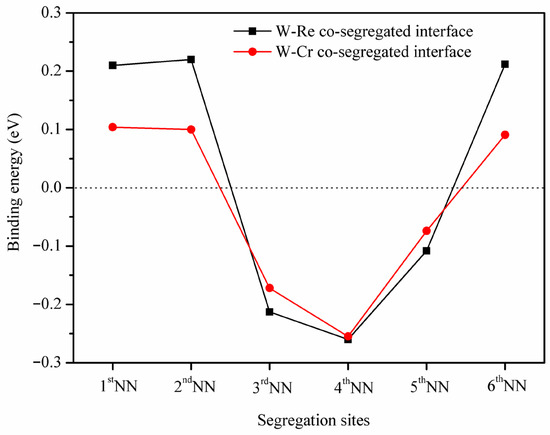
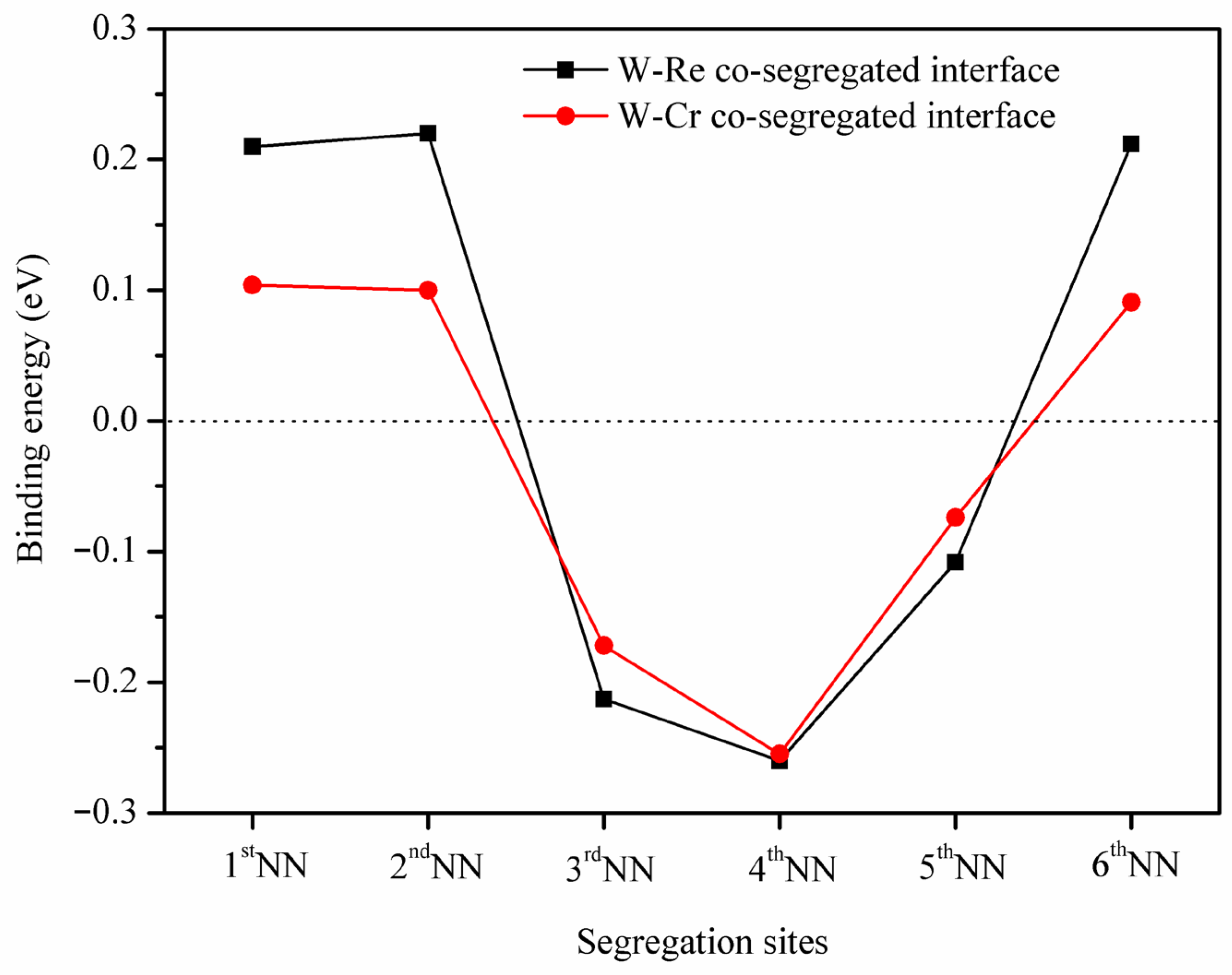
To clarify the atomic interactions and electronic origin underlying the effects of W-M cosegregation on interfacial performance, the EBinding of W-M (M = Re, Cr) atomic pairs, charge density distribution, and total density of states (DOS) of the γ-Ni/γ′-Ni3Al phase boundary were systematically analyzed. Figure 5 demonstrates that, the binding energies of W-M atoms were calculated by Equation (4), when M atoms were doped at the six nearest neighbor sites (γ-L2-2.48-cp (1st NN), γ-L1-2.49-fc (2nd NN), γ-L3-3.51-cp (3rd NN), γ-L1-3.52-cp (4th NN), γ-L2-4.31-cp (5th NN), and γ-L1-4.98-cp (6th NN)) of the W atom in the γ-Ni/γ′-Ni3Al phase boundary to demonstrate the interactions between W-Re and W-Cr atoms. Figure 5 illustrates that, the W-M atomic binding energies were calculated via Equation (4) by doping M atoms at the six nearest-neighbor sites of W in the γ/γ′ phase boundary, including γ-L2-2.48-cp (1st NN), γ-L1-2.49-fc (2nd NN), γ-L3-3.51-cp (3rd NN), γ-L1-3.52-cp (4th NN), γ-L2-4.31-cp (5th NN) and γ-L1-4.98-cp (6th NN), to characterize W-Re and W-Cr atomic interactions. As demonstrated by Figure 5, because of the positive binding energies between W and M atoms, it can be concluded that the W atom at the phase boundary exhibits strong repulsive forces against its neighboring M atom when the M atom segregates to the 1st NN, 2nd NN, and 6th NN sites of the W atoms. Conversely, when M atom substitutes for the 3rd NN, 4th NN, and 5th NN sites, the W and M atoms exhibit attractive interactions due to their negative binding energies. Moreover, the strongest attractive interaction between W and M atoms appears when M atom segregates to the 4th NN site. Notably, γ-L1-3.52-cp (4th NN) ranks as the most preferred segregation position for Re and Cr atoms among all the sites evaluated in this study.
Figure 5.
W-M binding energies calculated at segregation sites in W-segregated γ/γ′ phase boundary.
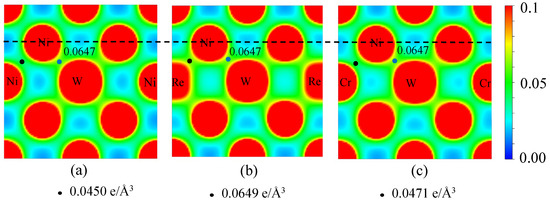
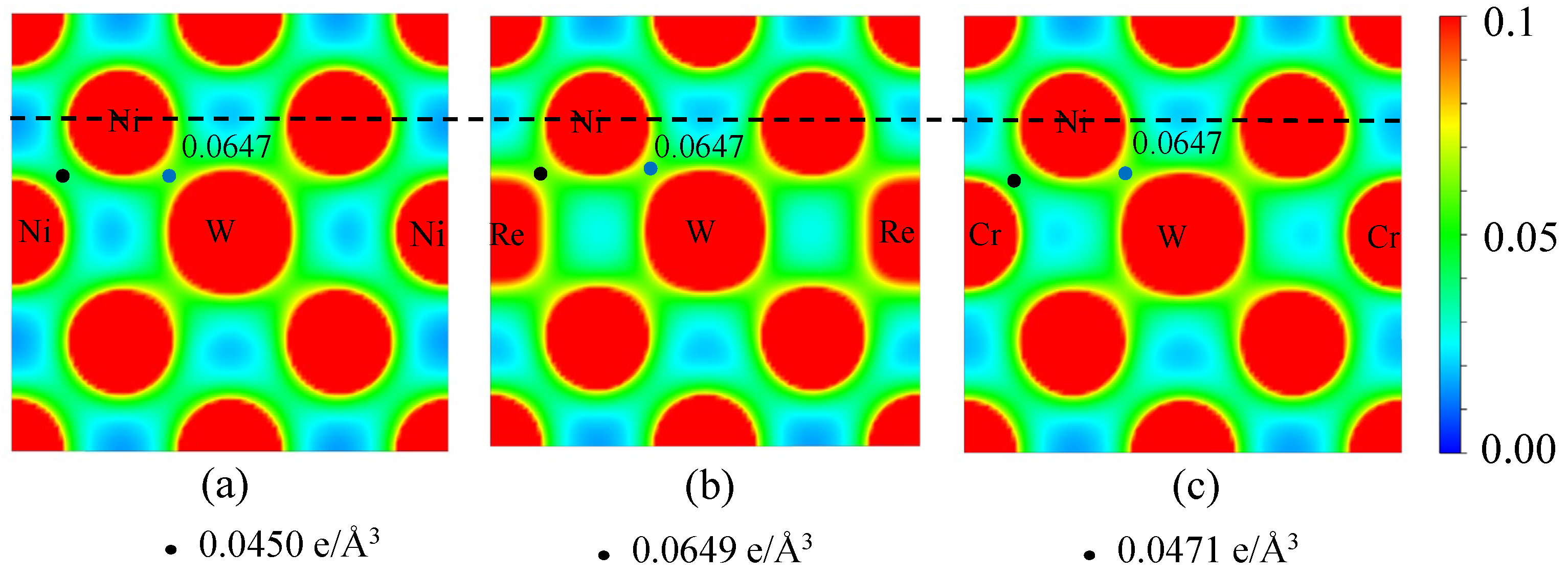
To clarify the intrinsic electronic mechanism that governs how cosegregation affects interfacial fracture strength, variations in bond strength between alloying atoms and their nearest neighbors were analyzed. This analysis focused on three types of phase boundaries: W-segregated, W-Re cosegregated, and W-Cr cosegregated, where W or Re atoms were located at the Pref-L1-cp site. For this purpose, charge density near the (002) γ/γ′ coherent layer was utilized, as presented in Figure 6 Variations in interfacial fracture strength are thought to be associated with changes in the bond strength of Ni-Ni and Ni-M bonds near the (002) γ/γ′ coherent layer. It is generally assumed that the atomic bond site with the lowest electronic charge density corresponds to the weakest point prone to cleavage. Thus, the minimum electronic charge density in Ni-Ni or Ni-M bonds can serve to evaluate the strength of such bonds [17,29]. As shown in Figure 6a, the minimum electron density (marked by a black dot) between the Ni atom at the Pref-L1-cp site and its closest Ni neighbor (i.e., the Ni-Ni bond) reaches 0.045 e/Å3. In contrast, the minimum electron density (indicated by a blue dot) in the Ni-W bond is 0.0647 e/Å3, a value that remains unchanged regardless of the segregant solute type in the phase boundary. In Figure 6b,c, the minimum charge density value at the black dot varies as alloying atoms segregate to the Pref-L1-cp site within the W-segregated γ/γ′ phase boundary. In region-2 (4th-6thNN), the bonding strength of Ni-Ni and M-Ni bonds decreases in the order of Re-Ni, Cr-Ni, and Ni-Ni, respectively. This finding effectively explains the relative magnitude of fracture strengths in region-2 for Re-W cosegregated, Cr-W cosegregated, and W-singly segregated phase boundaries, as illustrated in Figure 4b.
Figure 6.
Electronic charge density distributions of segregated γ/γ′ phase boundaries, plotted along a specific direction. The cross-section containing alloying atoms is positioned 3.523 Å from the coordinate origin of the phase boundary model. Subfigures correspond to: (a) W-segregated phase boundary, (b) W-Re cosegregated phase boundary, (c) W-Cr cosegregated phase boundary. Blue and black dots mark the minimum charge density values in Ni-W, Ni-Ni, or M-Ni bonds, with corresponding values listed in and below each subfigure. Dashed lines denote the (002) γ/γ′ coherent layer of the phase boundary.
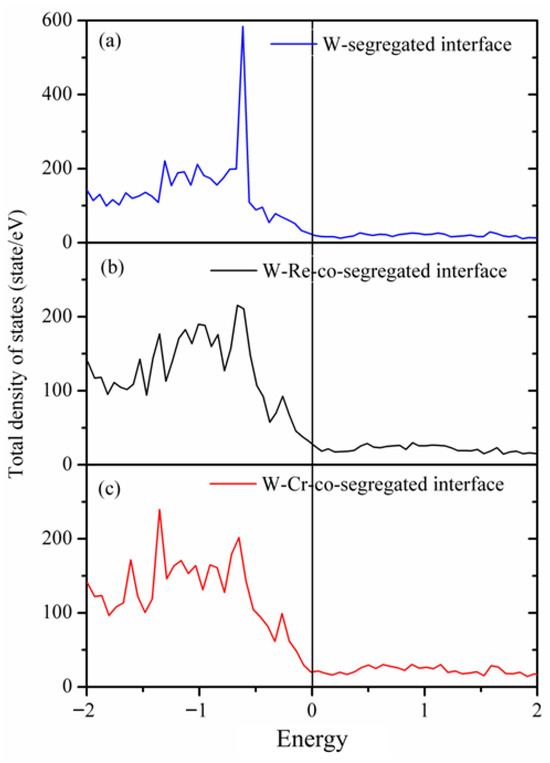
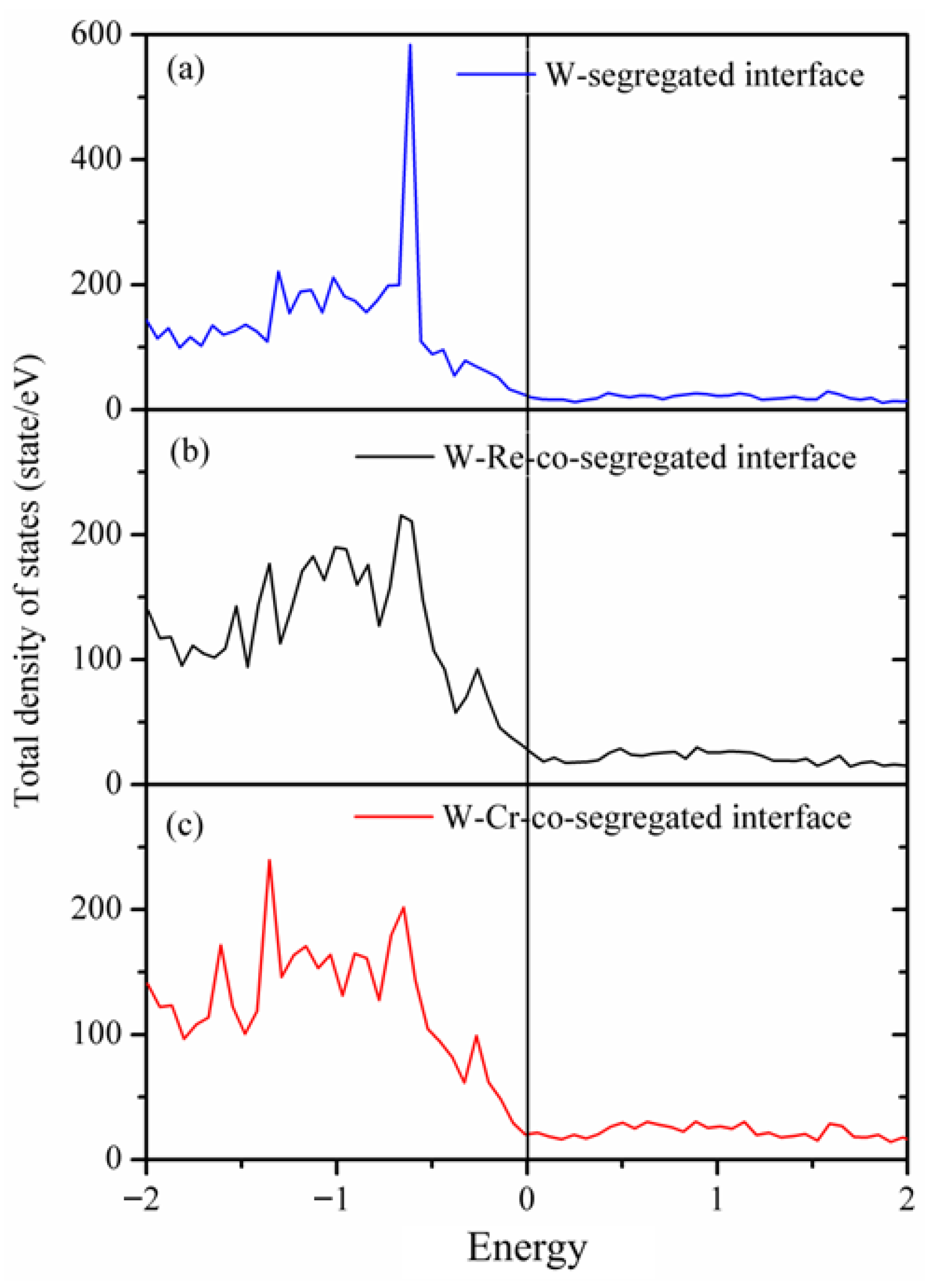
Additionally, the total density of states (DOS) was analyzed to assess the structural stability of γ/γ′ phase boundaries with segregation. The position of the Fermi level is a critical factor that governs the stability of binary intermetallic compounds. It is widely accepted that the pseudogap principle is critical to stabilizing such compounds: a deeper pseudogap or reduced DOS at the Fermi level results in notably enhanced structural stability [54,55,56]. The existence of a pseudogap in the electronic DOS (manifested as a distinct minimum at the Fermi level) correlates with the thermodynamic stabilization of the structure. Accordingly, Figure 7 presents the total density of states (DOS) calculations for W-segregated and W-M cosegregated phase boundaries, revealing that pseudogaps at these Fermi level of phase boundaries confirm their stability. Furthermore, the Fermi level DOS of the W-M cosegregated phase boundaries is lower than that of the W-segregated one, with such pseudogaps being deeper in the cosegregated systems relative to the W-segregated phase boundary. These findings indicate that W-Re and W-Cr cosegregated phase boundaries exhibit greater stability than the W-segregated counterpart, consistent with our earlier interfacial formation heat results (Figure 2).
Figure 7.
Total electronic density of states of (a) W-segregated phase boundary, (b) W-Re cosegregated phase boundary, (c) W-Cr cosegregated phase boundary. The solid line denotes the Fermi level.
To place the present results in context and clarify their practical relevance, we briefly compare with closely related first-principles studies of γ/γ′ phase boundaries in Ni-based single-crystal superalloys. Zhao et al. investigated vacancy-mediated segregation and its strengthening implications at γ/γ′ interfaces, showing that typical refractory and transition-metal solutes such as Ta, Re, Mo, and Cr preferentially occupy the γ-side cp Ni site adjacent to the coherent layer, and further indicating that point defects can influence the segregation–property relationship [18]. Ahmed et al. extended this perspective by screening a broader set of alloying elements and reporting that, with the exception of Y, most solutes favor the cp site in the γ-Ni (001) layer; they also related improved thermodynamic stability to a reduced density of states at the Fermi level and associated enhanced cohesion with strengthened X–Ni bonding across the interface [17]. Moving beyond the single-solute framework, Li et al. examined Re–X co-alloying near the coherent layer using a representative γ/γ′ supercell containing the (002) coherent plane and a vacuum separation, in which Re was fixed at its preferred γ-cp site while X was placed at distinct nearest-neighbor positions. Their results suggested that Re–X co-alloying generally stabilizes and strengthens the γ/γ′ phase boundary, and that partially substituting Re with W can be beneficial for interfacial strength [9]. Against this backdrop, the present work focuses on Re/Cr cosegregation on a W-presegregated γ/γ′ phase boundary using a sequential scheme in which W is introduced first, followed by Re or Cr. This strategy enables a quantitative evaluation of how W presegregation reshapes the site preference of Re/Cr, modifies local chemical interactions and electronic bonding characteristics, and consequently affects phase-boundary stability and cohesion within a unified framework. Such a sequential and site-resolved description helps translate atomistic trends into phase-boundary chemistry design considerations for single-crystal superalloys, particularly under practical constraints associated with heavy refractory additions, including cost and phase-stability concerns.
4. Conclusions
DFT-based FP calculations were used to study the cosegregation characteristics of W, Re, and Cr at the γ/γ′ phase boundary of nickel-based single-crystal superalloys, as well as their effects on interfacial thermodynamic stability and fracture strength. The main findings are as follows:
- (i)
- For phase boundaries containing W segregation, Cr and Re tend to preferentially partition into the γ-Ni phase. Their preferred segregation site is Pref-L1-cp, attributed to the lowest negative segregation energy at this location. In W-segregated boundaries, when Re or Cr atoms segregate to the Pref-L1-cp site first, attractive interactions arise between W-Re and W-Cr atomic pairs, which provides a rationale for this site being the optimal choice for Re and Cr segregation.
- (ii)
- The cosegregation behavior of W with Re and Cr enhances the thermodynamic stability of the phase boundaries, making it more stable than the W-segregated and clean phase boundaries. The stabilization effect of cosegregation is attributed to the formation of a deeper pseudogap in the DOS at the Fermi level in the W-M cosegregated phase boundary.
- (iii)
- W-M cosegregation does not modify the preferred fracture path of the γ/γ′ phase boundary, which remains region-1. This conclusion is drawn from the lower Griffith fracture work in region-1, designating it as the structurally weaker region. Charge density analysis rationalizes this mechanical disparity by showing a more pronounced charge accumulation and consequently stronger bonding in region-2.
Author Contributions
Conceptualization, H.-T.X.; Methodology, F.A.M.A. and J.-Q.R.; Software, J.-Q.R. and J.-C.L.; Validation, L.P. and F.A.M.A.; Formal analysis, F.A.M.A.; Investigation, L.P. and J.-C.L.; Resources, J.-Q.R., X.-F.L. and J.-C.L.; Data curation, F.-L.T.; Writing—original draft, L.P.; Writing—review & editing, H.-T.X.; Visualization, L.P.; Supervision, X.-F.L.; Project administration, H.-T.X., J.-Q.R. and F.-L.T.; Funding acquisition, H.-T.X. All authors have read and agreed to the published version of the manuscript.
Funding
This work was financially supported by the National Natural Science Foundation of China (Grant No. 12204210), the Joint Research Fund Project of Gansu Province (Grant No. 24JRRA1104), the Basic Research Innovation Group Project of Gansu Province (Grant No. 25JRRA803), the Major Project of Science and Technology of Gansu Province (Grant No. 24ZD13GA018), and the Central Government Guided Local Science and Technology Development Funding Project (grant No. 23ZYQB300). This work was performed in the Gansu Supercomputer Center.
Data Availability Statement
The original contributions presented in this study are included in the article. Further inquiries can be directed to the corresponding author.
Conflicts of Interest
The authors declare no conflict of interest.
References
- Long, H.; Mao, S.; Liu, Y.; Zhang, Z.; Han, X. Microstructural and compositional design of Ni-based single crystalline superalloys—A review. J. Alloys Compd. 2018, 743, 203–220. [Google Scholar] [CrossRef] [Scilit]
- Xu, X.; Zhao, X.; Yue, Q.; Xia, W.; Duan, H.; Gu, Y.; Zhang, Z. A morphological control strategy of γ′ precipitates in nickel-based single-crystal superalloys: An aging design, fundamental principle, and evolutionary simulation. Mater. Today Nano 2023, 22, 100335. [Google Scholar] [CrossRef] [Scilit]
- Zhang, X.; Hong, Z.; Zhou, Y.; Zhao, X.; Yang, H.; Yu, Q.; Wang, J.; Zhang, Z. Interfacial chemical fluctuation induced planar defects and topologically close-packed phase formation in nickel-based superalloys. J. Mater. Sci. Technol. 2026, 253, 87–97. [Google Scholar] [CrossRef] [Scilit]
- Zhang, Z.; Liu, Y.; Wang, Z.; Huang, J.; Chen, S.; Ye, Z.; Chen, X.; Yang, J. Influence behavior and mechanism of γ′- or γ″-precipitated phase types on damage resistance of heterogeneous interface in nickel-based superalloys. J. Alloys Compd. 2022, 924, 166559. [Google Scholar] [CrossRef] [Scilit]
- Xia, W.; Zhao, X.; Wang, J.; Yue, Q.; Cheng, Y.; Kong, L.; Zhang, Y.; Gu, Y.; Bei, H.; Zhang, Z. New strategy to improve the overall performance of single-crystal superalloys by designing a bimodal γ′ precipitation microstructure. Acta Mater. 2023, 257, 119200. [Google Scholar] [CrossRef] [Scilit]
- Xu, J.; Zhao, X.; Xia, W.; Qiao, L.; Cheng, Y.; Liu, H.; Yue, Q.; Gu, Y.; Zhang, Z. Coarsening transitional kinetics of γ′ precipitates in a nickel-based single crystal superalloy during thermal exposure. J. Alloys Compd. 2024, 1002, 175380. [Google Scholar] [CrossRef] [Scilit]
- Godha, A.; Das, D.; Ghosal, P.; Makineni, S.K. New Insights on the Interaction of Solutes with the Defects during Creep Deformation of CMSX4 Ni-Based Single Crystal Superalloy. Acta Mater. 2024, 281, 120360. [Google Scholar] [CrossRef] [Scilit]
- Mao, Z.; Booth-Morrison, C.; Sudbrack, C.K.; Noebe, R.D.; Seidman, D.N. Interfacial Free Energies, Nucleation, and Precipitate Morphologies in Ni-Al-Cr Alloys: Calculations and Atom-Probe Tomographic Experiments. Acta Mater. 2019, 166, 702–714. [Google Scholar] [CrossRef] [Scilit]
- Li, C.; Hu, P.; Ru, Y.; Zhao, W.; Pei, Y.; Li, S.; Gong, S. The Strengthening Effects of Re-X (X=Mo, W, Cr Ta, Re) Mediated by Their Local Partitioning Behaviors at γ/Γ′ Interface in Ni-Based Single Crystal Superalloys. J. Alloys Compd. 2022, 923, 166367. [Google Scholar] [CrossRef] [Scilit]
- Zhao, X.; Wang, Y.; Song, X.; Wang, Y.; Chen, Z. Segregation Behavior of Alloying Elements and Its Effects on Stacking Fault of Γ′ Phase in Ni-Based Superalloys: First-Principles Study. Comput. Mater. Sci. 2022, 202, 110990. [Google Scholar] [CrossRef] [Scilit]
- Bao, H.; Xu, H.; Li, Y.; Bai, H.; Ma, F. The interaction mechanisms between dislocations and nano-precipitates in CuFe alloys: A molecular dynamic simulation. Int. J. Plast. 2022, 155, 103317. [Google Scholar] [CrossRef] [Scilit]
- Xue, H.-T.; Zhang, Z.-J.; Hu, Z.-L.; Ren, J.-Q.; Tang, F.-L.; Zhang, Y.; Lu, X.-F.; Li, J.-C. Twinning-induced energy-lowering structural transformation of Σ5 001 grain boundary: A pathway to grain-boundary relaxation. Acta Mater. 2025, 288, 120829. [Google Scholar] [CrossRef] [Scilit]
- Lin, Y.-C.; Wang, C.-Y. Transition metal solutes in Ni-based ternary model superalloys: Partitioning and effects on elastic properties from first-principles calculations. Comput. Mater. Sci. 2021, 195, 110447. [Google Scholar] [CrossRef] [Scilit]
- Hu, P.; Zhao, W.; Ru, Y.; Pei, Y.; Li, S.; Xu, H. Effects of Intrinsic Point Defects on Antiphase Boundary Energy of γ’-Ni3Al from First-Principles Calculations. J. Mater. Sci. 2022, 57, 12916–12928. [Google Scholar] [CrossRef] [Scilit]
- Huang, M.; Zhu, J. An overview of rhenium effect in single-crystal superalloys. Rare Met. 2016, 35, 127–139. [Google Scholar] [CrossRef] [Scilit]
- Liu, S.H.; Liu, C.P.; Liu, W.Q.; Zhang, X.N.; Yan, P.; Wang, C.Y. Investigation of the elemental partitioning behaviour and site preference in ternary model nickel-based superalloys by atom probe tomography and first-principles calculations. Philos. Mag. 2016, 96, 2204–2218. [Google Scholar] [CrossRef] [Scilit]
- Ahmed, F.A.; Xue, H.; Tang, F.; An, J.; Luo, Y.; Lu, X.; Ren, J. Segregation of alloying elements and their effects on the thermodynamic stability and fracture strength of γ-Ni/γ′-Ni3Al interface. J. Mater. Sci. 2020, 55, 12513–12524. [Google Scholar] [CrossRef] [Scilit]
- Zhao, W.; Sun, Z.; Gong, S. Vacancy mediated alloying strengthening effects on γ/γ′ interface of Ni-based single crystal superalloys: A first-principles study. Acta Mater. 2017, 135, 25–34. [Google Scholar] [CrossRef] [Scilit]
- Zhang, J.; Huang, T.; Lu, F.; Cao, K.; Wang, D.; Zhang, J.; Zhang, J.; Su, H.; Liu, L. Unveiling the Re segregation at γ/γ′ interface in Ni-based superalloy. Scr. Mater. 2021, 204, 114131. [Google Scholar] [CrossRef] [Scilit]
- Li, J.; Sun, J.; Liu, J.; Sun, X. The precipitation and effect of topologically close-packed phases in Ni-based single crystal superalloys. J. Mater. Sci. Technol. 2024, 173, 149–169. [Google Scholar] [CrossRef] [Scilit]
- Liu, C.; Yang, W.; Cao, K.; Qu, P.; Qin, J.; Zhang, J.; Liu, L. New insights into the microstructural stability based on the element segregation behavior at γ/γ′ interface in Ni-based single crystal superalloys with Ru addition. J. Mater. Sci. Technol. 2023, 154, 232–240. [Google Scholar] [CrossRef] [Scilit]
- Uruchida, H.; Tsukada, Y.; Matsuoka, Y.; Koyama, T. Computational Approach to Grain Boundary Segregation Engineering of Nickel-Base Superalloys. Sci. Rep. 2024, 14, 12996. [Google Scholar] [CrossRef] [Scilit] [PubMed]
- Theska, F.; Tse, W.F.; Schulz, B.; Buerstmayr, R.; Street, S.R.; Lison-Pick, M.; Primig, S. Review of Microstructure–Mechanical Property Relationships in Cast and Wrought Ni-Based Superalloys with Boron, Carbon, and Zirconium Microalloying Additions. Adv. Eng. Mater. 2023, 25, 2201514. [Google Scholar] [CrossRef] [Scilit]
- Yang, W.; Qu, P.; Zhang, R.; Qin, J.; Liu, C.; Zhang, J.; Liu, L. The element segregation between γ/γ′ phases in a Ni-based single crystal superalloy studied by 3D-APT and its potential impact on local interfacial misfit strain. Met. Mater. Int. 2021, 27, 1892–1896. [Google Scholar] [CrossRef] [Scilit]
- Tan, W.; He, T.; Zhang, X.; Lin, B.; Xie, H.; Yu, T.; Shi, C.; Wen, Y.; Wang, C.; Zhang, Z. Synergistic effect of rhenium and tungsten in nickel-based model single crystal superalloys. J. Mater. Res. Technol. 2025, 35, 6965–6975. [Google Scholar] [CrossRef] [Scilit]
- Zhang, L.-M.; Cao, S.; Zhang, X.-C.; Zhang, S.-Z.; Hu, Q.-M. First-principles investigations of the interaction between alloying atom and dislocation and its implication to the rafting of Ni-based superalloys. J. Mater. Res. Technol. 2024, 29, 3813–3823. [Google Scholar] [CrossRef] [Scilit]
- Yao, X.; Ding, Q.; Wei, X.; Wang, J.; Zhang, Z.; Bei, H. The effects of key elements Re and Ru on the phase morphologies and microstructure in Ni-based single crystal superalloys. J. Alloys Compd. 2022, 926, 166835. [Google Scholar] [CrossRef] [Scilit]
- Shu, D.; Tian, S.; Tian, N.; Liu, L.; Liang, S.; Zhang, B. Influence of Re/Ru on concentration distribution in the γ/γ′ phases of nickel-based single crystal superalloys. Mater. Des. 2017, 132, 198–207. [Google Scholar] [CrossRef] [Scilit]
- Ahmed, F.A.; Xue, H.T.; Tang, F.L.; Ren, J.Q.; Lu, X.F.; Li, J.C. Effects of Zr-Re/W co-segregation behavior on the thermodynamic stability and fracture strength of γ-Ni/γ′-Ni3Al interface. Phys. Lett. A 2021, 408, 127466. [Google Scholar] [CrossRef] [Scilit]
- Xia, W.; Zhao, X.; Yue, L.; Zhang, Z. A review of composition evolution in Ni-based single crystal superalloys. J. Mater. Sci. Technol. 2020, 44, 76–95. [Google Scholar] [CrossRef] [Scilit]
- Wang, Z.; Liang, C.; Wang, D.; Ding, X. Composition and temperature dependence of kinetic behavior of γ′ precipitation in Ni–Al–Cr–Mo quaternary model superalloys: A phase field study. J. Alloys Compd. 2024, 976, 172982. [Google Scholar] [CrossRef] [Scilit]
- Kresse, G.; Hafner, J. Ab initio molecular dynamics for liquid metals. Phys. Rev. B 1993, 47, 558–561. [Google Scholar] [CrossRef] [Scilit] [PubMed]
- Cheng, Y.W.; Tang, F.L.; Xue, H.T.; Liu, H.X.; Gao, B.; Feng, Y.D. Bonding and electronic properties of the Cu2ZnSnS4/WZ–ZnO interface from first-principles calculations. J. Phys. D 2016, 49, 285107–285115. [Google Scholar] [CrossRef] [Scilit]
- Kresse, G.; Furthmüller, J. Efficient iterative schemes for ab initio total-energy calculations using a plane-wave basis set. Phys. Rev. B 1996, 54, 11169–11186. [Google Scholar] [CrossRef] [Scilit]
- Kresse, G.; Furthmüller, J. Efficiency of ab-initio total energy calculations for metals and semiconductors using a plane-wave basis set. Comput. Mater. Sci. 1996, 6, 15–50. [Google Scholar] [CrossRef] [Scilit]
- Perdew, J.P.; Burke, K.; Ernzerhof, M. Generalized gradient approximation made simple. Phys. Rev. Lett. 1996, 77, 3865–3868. [Google Scholar] [CrossRef] [Scilit]
- Kresse, G.; Joubert, D. From ultrasoft pseudopotentials to the projector augmented-wave method. Phys. Rev. B 1999, 59, 1758–1775. [Google Scholar] [CrossRef] [Scilit]
- Tian, D.; Chen, Y.; Jiang, Y.; Yi, Z.; Peng, P. Effect of P-doping on the rupture strength of γ-Ni/γ′-Ni3Al interfaces. IOP Conf. Ser. Mater. Sci. Eng. 2018, 381, 012161–012169. [Google Scholar] [CrossRef] [Scilit]
- Wu, X.; You, Y.W.; Kong, X.S.; Chen, J.L.; Luo, G.N.; Lu, G.H.; Liu, C.S.; Wang, Z. First-principles determination of grain boundary strengthening in tungsten: Dependence on grain boundary structure and metallic radius of solute. Acta Mater. 2016, 120, 315–326. [Google Scholar] [CrossRef] [Scilit]
- Zhevnenko, S.N.; Petrov, I.S.; Scheiber, D.; Razumovskiy, V.I. Surface and segregation energies of Ag based alloys with Ni, Co and Fe: Direct experimental measurement and DFT study. Acta Mater. 2021, 205, 116565. [Google Scholar] [CrossRef] [Scilit]
- Tan, Q.; He, S.; Chen, X.; Liu, Y.; Gorbatov, O.I.; Peng, P. Hydrogen-enhanced decohesion mechanism of the Ni-Ni3X interfaces in precipitation-hardened Ni-based alloys. J. Alloys Compd. 2023, 963, 171186. [Google Scholar] [CrossRef] [Scilit]
- Rice, J.R.; Wang, J.-S. Embrittlement of interfaces by solute segregation. Mater. Sci. Eng. A 1989, 107, 23–40. [Google Scholar] [CrossRef] [Scilit]
- Li, G.F.; Zheng, H.Z.; Shu, X.Y.; Peng, P. Structural stability of characteristic interface for NiTi/Nb nanowire: First-principle study. Met. Mater. Int. 2016, 22, 69–74. [Google Scholar] [CrossRef] [Scilit]
- Liu, R.; Yin, X.; Feng, K.; Xu, R. First-principles calculations on Mg/TiB2 interfaces. Comput. Mater. Sci. 2018, 149, 373–378. [Google Scholar] [CrossRef] [Scilit]
- Schuwalow, S.; Rogal, J.; Drautz, R. Vacancy mobility and interaction with transition metal solutes in Ni. J. Phys. Condens. Matter 2014, 26, 485014. [Google Scholar] [CrossRef] [Scilit]
- Mottura, A.; Wu, R.T.; Finnis, M.W.; Reed, R.C. A critique of rhenium clustering in Ni–Re alloys using extended X-ray absorption spectroscopy. Acta Mater. 2008, 56, 2669–2675. [Google Scholar] [CrossRef] [Scilit]
- Zhu, H.; Wang, J.; Wang, L.; Shi, Y.; Liu, M.; Li, J.; Chen, Y.; Ma, Y.; Liu, P.; Chen, X.-Q. Segregation of Re at the γ/γ′ boundary of Ni-based single crystal superalloys revealed by first-principles calculations based Monte-Carlo simulations. J. Mater. Sci. Technol. 2023, 143, 54–61. [Google Scholar] [CrossRef] [Scilit]
- He, S.; Tan, Q.; Chen, X.; Liu, Y.; Gorbatov, O.I.; Peng, P. First-principles study of Re-W interactions and their effects on the mechanical properties of γ/γ′ interface in Ni-based single-crystal alloys. Mater. Today Commun. 2023, 36, 106662. [Google Scholar] [CrossRef] [Scilit]
- Ma, Z.; Pei, Y.-L.; Luo, L.; Qin, L.; Li, S.-S.; Gong, S.-K. Partitioning behavior and lattice misfit of γ/γ′ phases in Ni-based superalloys with different Mo additions. Rare Met. 2021, 40, 920–927. [Google Scholar] [CrossRef] [Scilit]
- Gong, X.F.; Yang, G.X.; Fu, Y.H.; Xie, Y.Q.; Zhuang, J.; Ning, X.J. First-principles study of Ni/Ni3Al interface strengthening by alloying elements. Comput. Mater. Sci. 2009, 47, 320–325. [Google Scholar] [CrossRef] [Scilit]
- Chen, Y.; Yu, H.; Chen, Y.; Di, H.; Xu, W. The strengthening effects and mechanisms of alloying elements on interfaces for multiphase Ni-based superalloys: A first-principles study. J. Mater. Res. Technol. 2023, 23, 4802–4813. [Google Scholar] [CrossRef] [Scilit]
- Zhang, J.; Lu, F.; Huang, T.; Li, R.; Zhang, G.; Liu, L. An advanced approach to improve the high-temperature property for Ni-based superalloys: Interface segregation manipulation. Mater. Sci. Eng. A 2023, 881, 145382. [Google Scholar] [CrossRef] [Scilit]
- Huang, Y.; Mao, Z.; Noebe, R.D.; Seidman, D.N. The effects of refractory elements on Ni-excesses and Ni-depletions at γ(f.c.c.)/γ′(L12) interfaces in model Ni-based superalloys: Atom-probe tomographic experiments and first-principles calculations. Acta Mater. 2016, 121, 288–298. [Google Scholar] [CrossRef] [Scilit]
- Boulbazine, M.; Boudjahem, A.-G.; Bettahar, M. Stabilities, electronic and magnetic properties of Cu-doped nickel clusters: A DFT investigation. Mol. Phys. 2017, 115, 2495–2507. [Google Scholar] [CrossRef] [Scilit]
- Shewale, V.; Deshpande, M. Structural, electronic, and magnetic properties of NinM clusters (M = Hf, Ta, W) with n = 1–12. Comput. Theor. Chem. 2012, 984, 128–136. [Google Scholar] [CrossRef] [Scilit]
- Thorpe, M.F.; Weaire, D.; Alben, R. Electronic properties of an amorphous solid. III. The cohesive energy and the density of states. Phys. Rev. B 1973, 7, 3777–3788. [Google Scholar] [CrossRef] [Scilit]
Disclaimer/Publisher’s Note: The statements, opinions and data contained in all publications are solely those of the individual author(s) and contributor(s) and not of MDPI and/or the editor(s). MDPI and/or the editor(s) disclaim responsibility for any injury to people or property resulting from any ideas, methods, instructions or products referred to in the content. |
© 2025 by the authors. Licensee MDPI, Basel, Switzerland. This article is an open access article distributed under the terms and conditions of the Creative Commons Attribution (CC BY) license.