1. Introduction
Rolling is a metal working process in which metal billets are passed through the gap of a pair of rotating rolls, and the section of the material is reduced and the length is increased due to the compression of the rolls. Rolling represents one of the predominant processes in metalworking. Coinciding with technological advances and the evolution of rolling equipment, the varying thickness rolling process, characterized by the continuous modification of roll gap size, has come to fruition. This innovation furnishes technological assurance for objectives such as minimizing production loss, augmenting efficiency, and diversifying rolling products [
1,
2].
For instance, in the fabrication of medium and thick plates, plane shape control technology is employed in order to reduce the loss of the steel plate rolling process and improve the economic benefit. Since the 1980s, relevant companies began to develop planar shape control rolling technology. This technology is based on the metal rolling deformation law through the control of the section shape of the plate; the final plane shape of the product tends to be rectangular to achieve the purpose of reducing the cutting rate [
3]. The core process of plane shape control technology necessitates the use of the varying thickness rolling technique in the intermediate rolling pass to create a longitudinal thickness difference structure. In turning over steel, the transverse thickness discrepancy in the sheet can offset the non-uniform edge shape during rolling, thereby directing its planar form toward a rectangular shape and accomplishing a reduction in the amount of cutting [
4,
5].
Another illustration pertains to longitudinally profiled steel plates (LP steel plates) and tailor rolling blanks (TRBs) [
6]. There are two traditional processes for the production of variable thickness plates, using steel plates of different thicknesses for welding, or using mechanical milling processes to process thick plates. These two kinds of processes have the disadvantages of poor mechanical properties at the welding and large processing losses. LP steel plates and TRBs can perfectly result in these drawbacks, wherein material savings and weight reduction are attainable without compromising mechanical performance. The principal process in their production likewise revolves around varying thickness rolling [
7,
8].
In contrast to conventional rolling, the variable thickness rolling process can continuously adjust the size of the roll gap during rolling, resulting in the production of a rolling tilt angle. The variable thickness rolling introduces alterations in parameters such as rolling force, bite conditions, contact arc length between the rolled piece and the roller, and rolling exit position, attributable to the rolling tilt angle. These variations signify that extant conventional rolling theoretical models are inadequate for precisely depicting the varying thickness rolling process [
9,
10]. To construct a meticulous and encompassing theoretical model of varying thickness rolling, the relative motion between the rolled piece and the roller must initially be modeled, constituting the foundational analysis for the rolling process [
11,
12].
Currently, the relative motion models during the varying thickness rolling process predominantly bifurcate into two categories: the full sliding model and the full sticking model [
13].
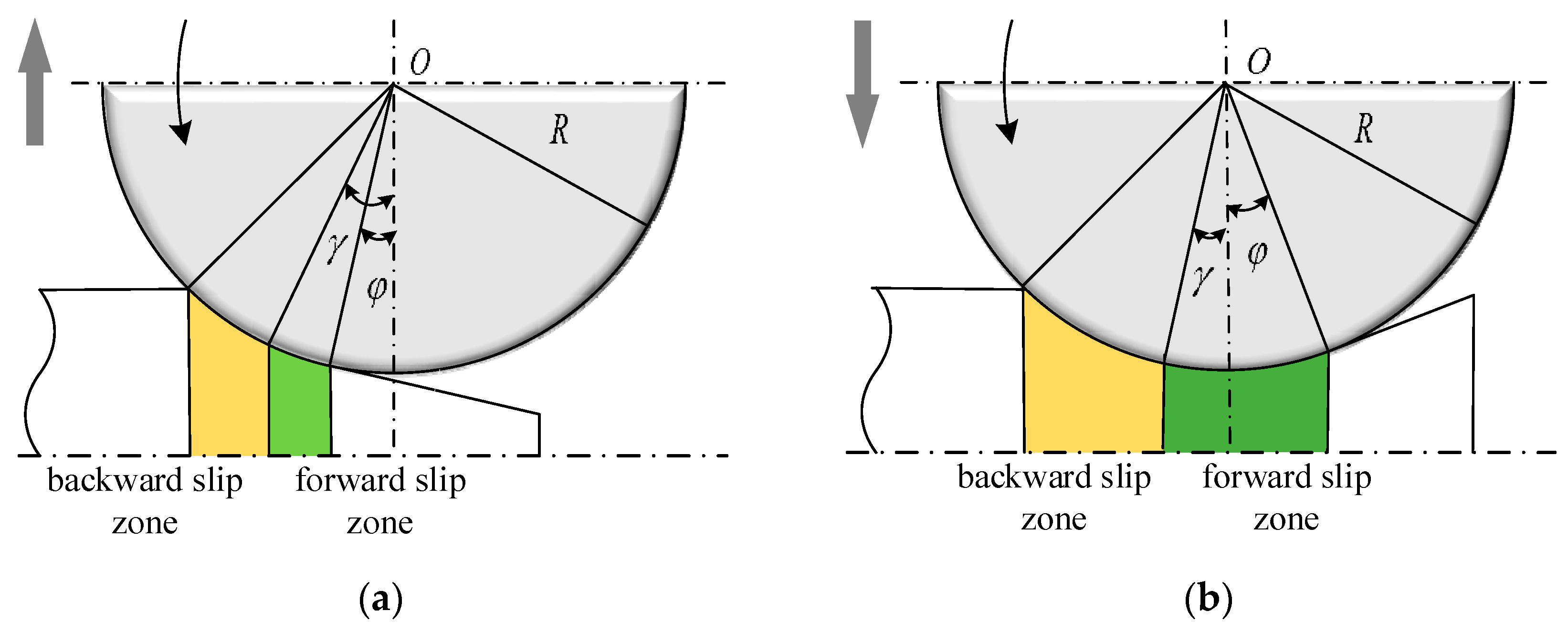
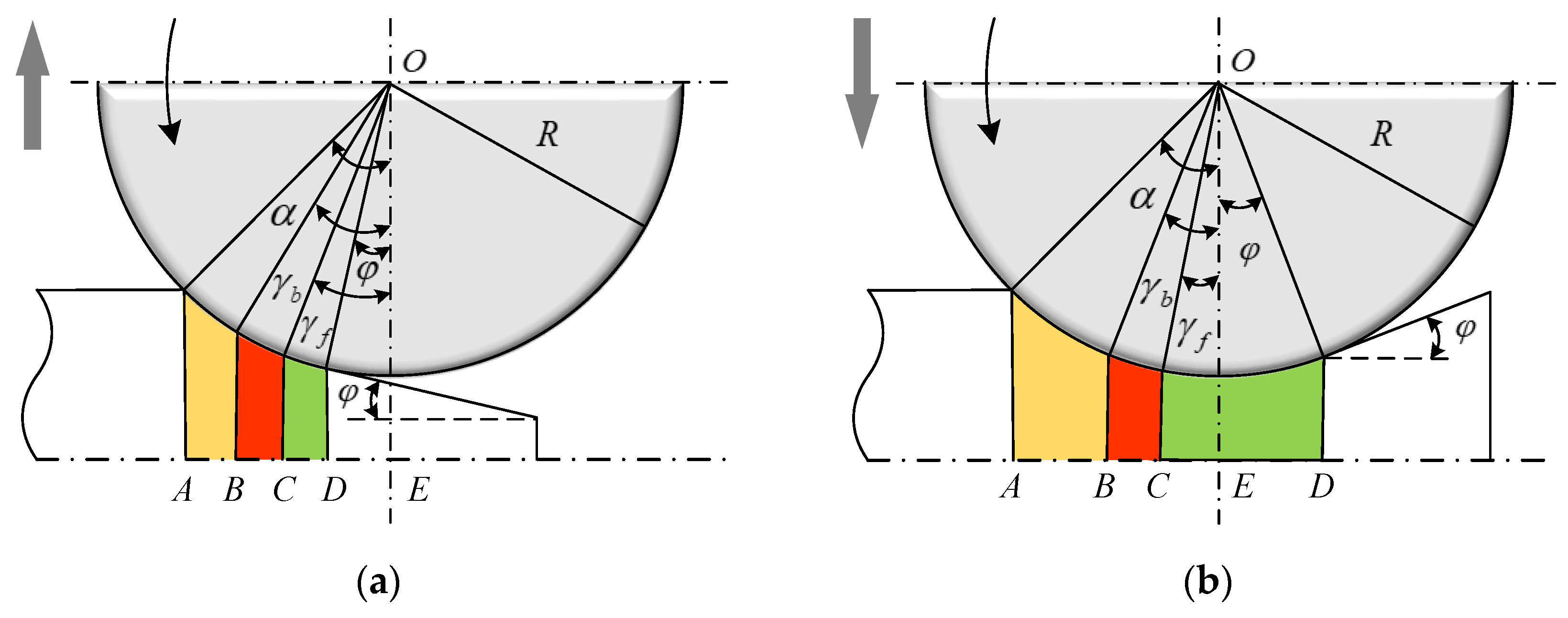
In the rolling process, the phenomenon that the outlet speed of the rolled metal is greater than the circumference speed of the roll is called the forward slip phenomenon, and the described parameter is called the front slip value. The area where the forward slip phenomenon occurs is the forward slip zone. The phenomenon that the inlet speed of the rolled metal is less than the circular speed of the roll is called the backward slip phenomenon, and the area where the backward slip phenomenon occurs is the backward slip zone. The critical plane of the forward slip zone and the backward slip zone is the neutral plane, and the corresponding angle is the neutral angle. The foundational assumption of the full sliding model is that a perpetual relative sliding state exists between the rolled piece and the roller, segmenting the rolling deformation zone into two regions: the forward slip zone and the backward slip zone, as delineated in
Figure 1. In
Figure 1,
is the rolling neutral angle and
is the rolling tilt angle.
Conversely, the full sticking model posits that the rolled piece and the roller remain relatively immobile; there is no forward slip and no backward slip. Given the continuous fluctuation in exit thickness in varying thickness rolling, the full sticking model necessitates that the rolled piece be discretized when analyzing the process, longitudinally dividing it into multiple fully sticking zones, with computations for rolling process parameters executed independently for each segment [
14].
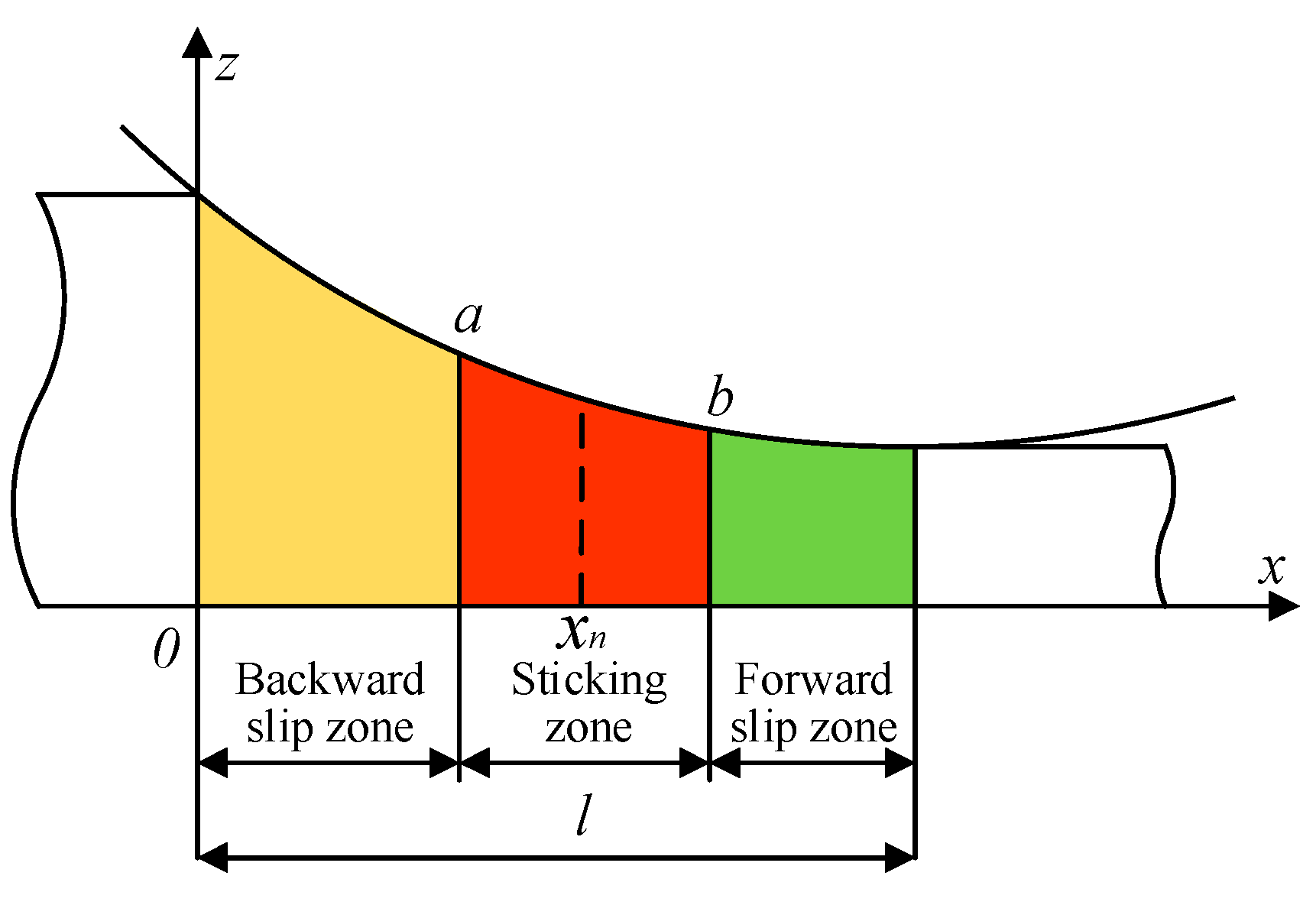
A plethora of experimental evidence demonstrates that the actual relative motion within the rolling deformation zone is neither entirely sliding nor fully adhered. A sticking zone materializes between the forward slip zone and the backward slip zone where the rolled piece and the roller are relatively stationary.
It is well known that the motion model of rolled piece and roll is the basic premise for the analysis and on-line control of processes with variable thickness rolling. The purpose of this paper is to develop a new mathematical model, called the “sticking-sliding” model, which can represent the relative motion of rolled piece and roller by combining the existing full-sliding hypothesis with the full-sticking hypothesis. The sticking-sliding model can represent the relative motion between rolled piece and roller more accurately than the existing model, and it can effectively improve the calculation accuracy of the relative motion parameters between rolled piece and roller. This research can provide theoretical support for process analysis and on-line control of variable thickness rolling [
15].
5. Rationality Verification
Based on the similar characteristics between lead and carbon steel in the hot rolling state, lead was chosen as the test material. Using an experimental rolling mill at room temperature, the preset variable thickness rolling process was employed without applying tension in the front and back, and multi-stage rolling experiments, including variable thickness rolling, were conducted on lead specimens. By comparing the calculated results with the measured results, this section verifies the rationality and correctness of the sticking-sliding model established based on the pre-displacement principle and analyzes the sliding situation between the rolled piece and the roller during the variable thickness rolling process.
The parameters of the experimental rolling mill are shown in
Table 4.
During the experiment, the speed sensor will continuously collect the exit speed signal of the rolled piece, and the pressure sensor will continuously collect the signal of rolling force; the rolling time can be obtained indirectly through the change in rolling force.
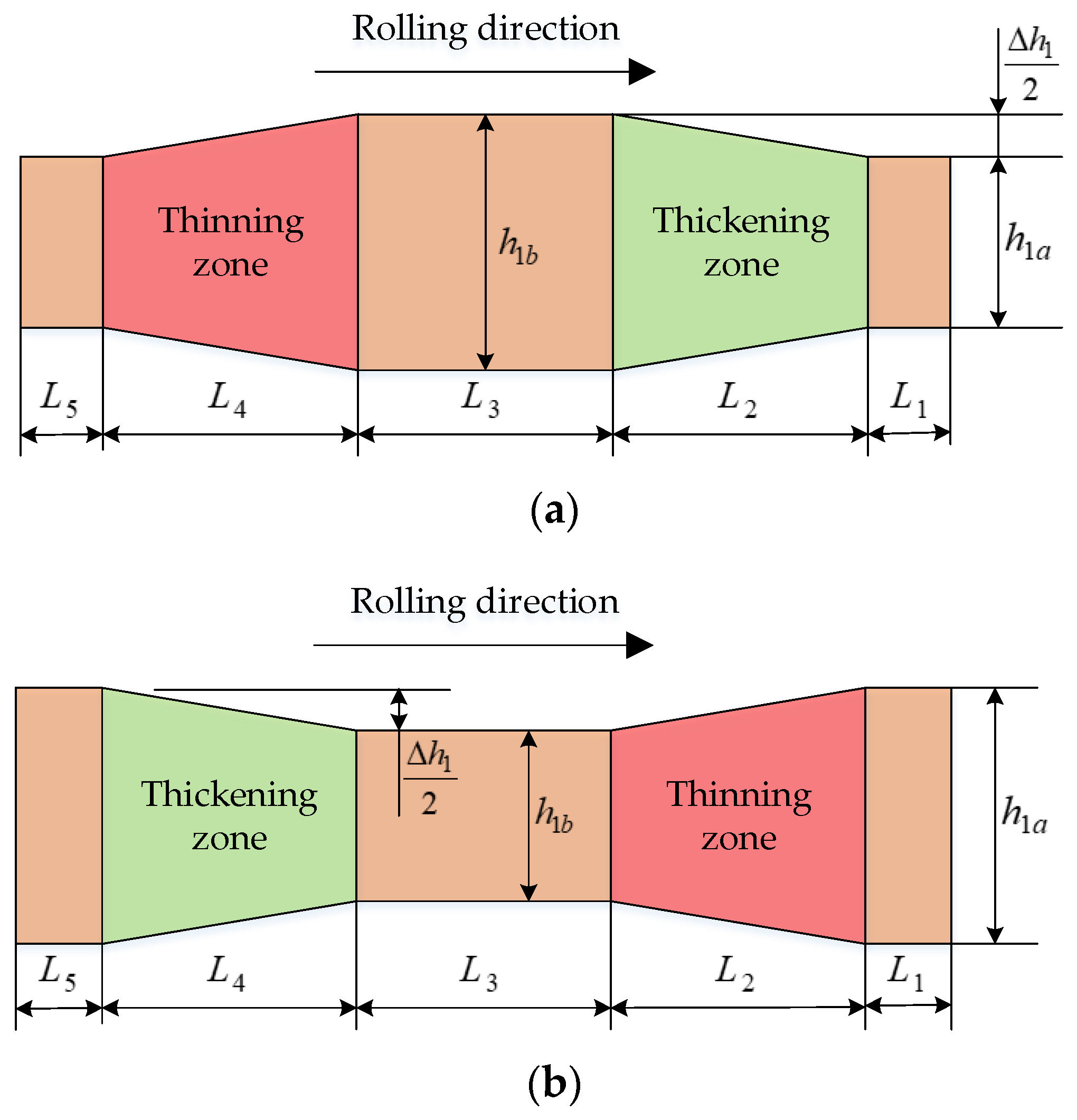
The number of experimental specimens is eight; the initial size is: 76 mm × 50 mm × 10 mm. The schematic diagram of the target structure of the specimens is shown in
Figure 6.
According to specimens 1~4, the experiment was divided into five rolling stages. After the specimen was engaged in the roll gap, stage began with conventional rolling, targeting a thickness of . Stage was thickening rolling, and when the specimen’s thickness was increased to the target thickness , stage of conventional rolling began. Stage was thinning rolling, and when the specimen’s thickness was reduced to , stage of conventional rolling began, continuing until the experiment ended.
According to specimens 1~4, after the specimen was engaged in the roll gap, stage began with conventional rolling, targeting a thickness of . Stage was thinning rolling, and when the specimen’s thickness was reduced to the target thickness , stage of conventional rolling began. Stage was thickening rolling, and when the specimen’s thickness was increased to , stage of conventional rolling began, continuing until the experiment ended.
The target longitudinal length values of the specimens are shown in
Table 5.
The target thickness values of the specimens are shown in
Table 6.
Specimens 1 and 2 were used to repeat experiment A, specimens 3 and 4 were used to repeat experiment B, specimens 5 and 6 were used to repeat experiment C, and specimens 7 and 8 were used to repeat experiment D. The average value of the parameters obtained from each experiment was applied to the calculation.
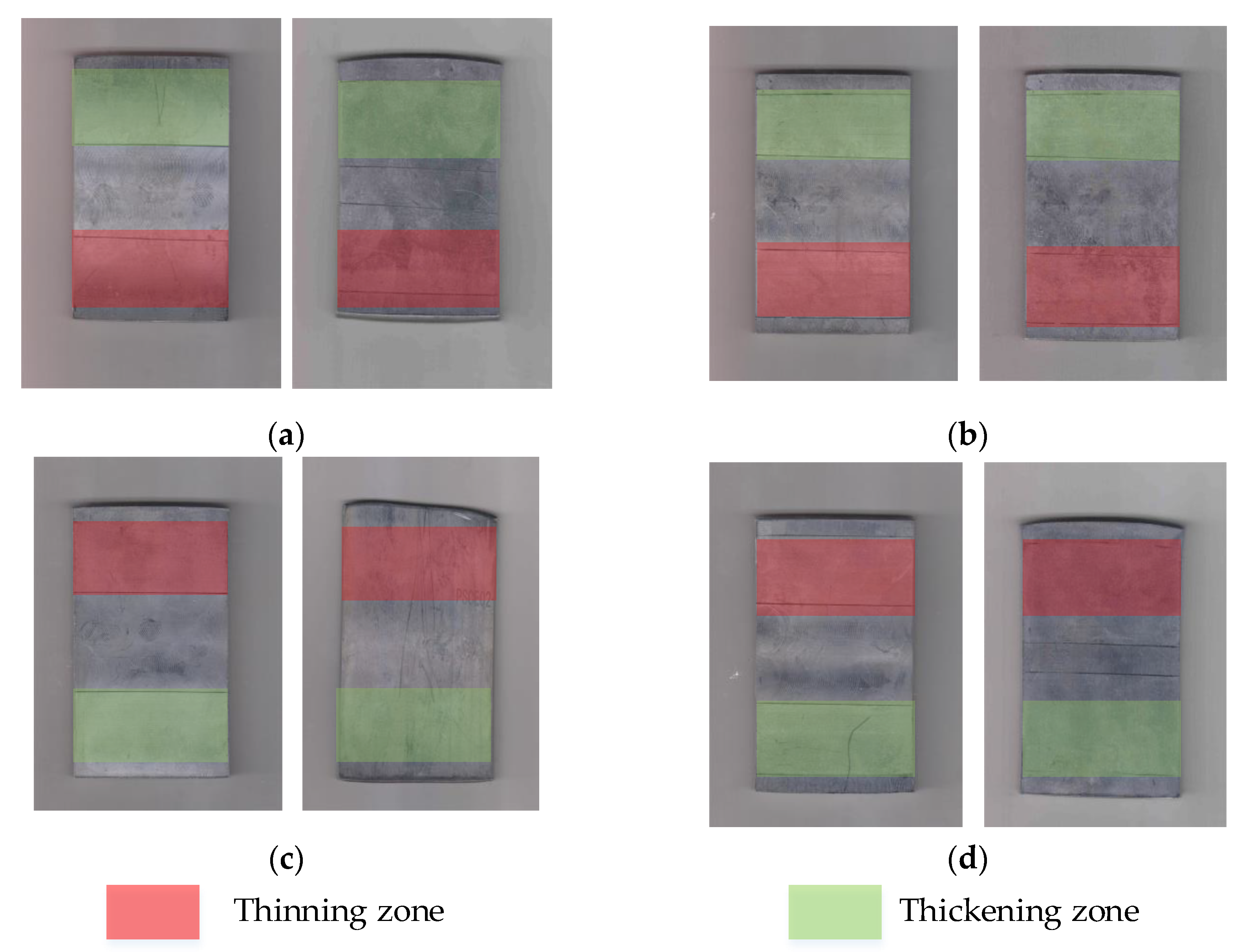
According to the target size of the specimens, the preset variable thickness rolling process was applied to carry out the experiment, and the experimental results are shown in
Figure 7.
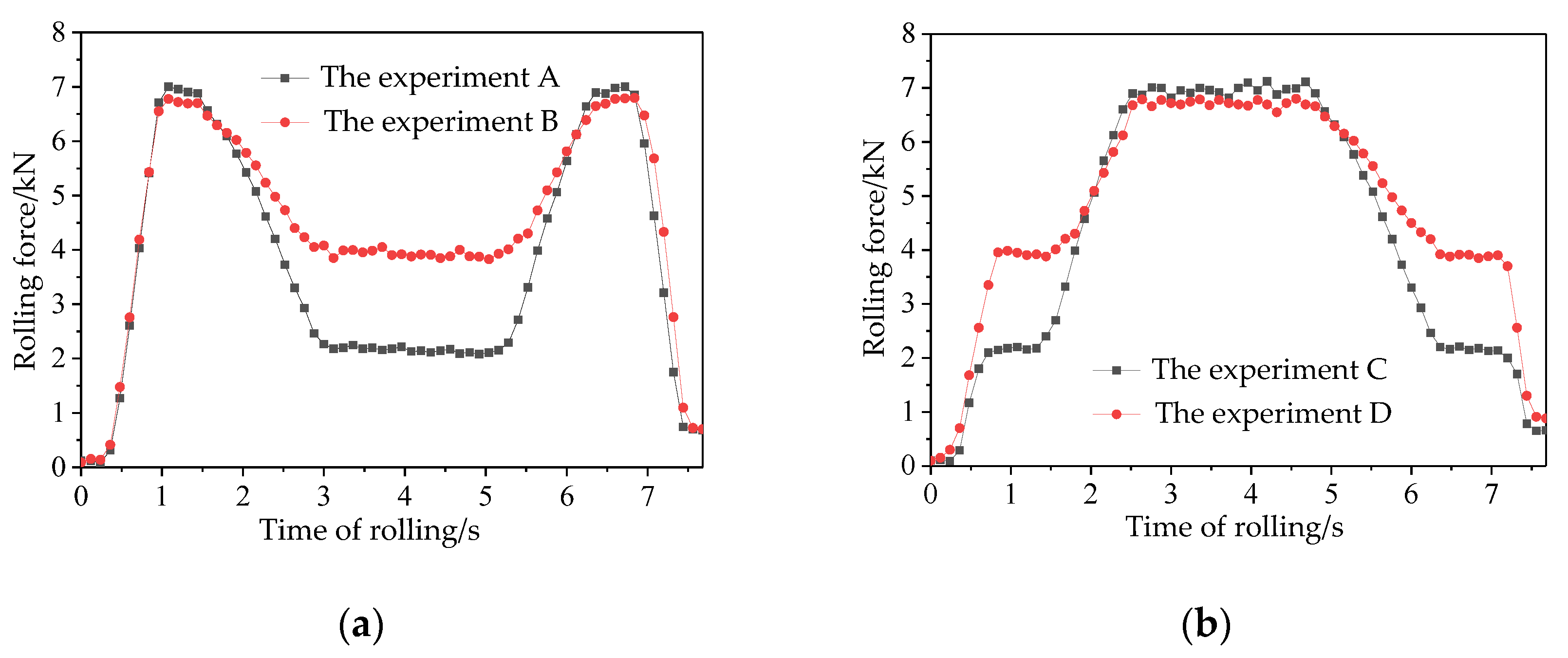
During the experiment, the roll gap of thickening rolling section and thinning rolling section changes continuously, which inevitably leads to the change in rolling force. The rolling forces in stages
L1–
L5 were continuously collected, and the results are shown in
Figure 8.
The contents shown in
Figure 8 were analyzed. The pressing amounts at both ends of experiment A and experiment B were larger, while the middle pressing amount was smaller, leading to a rolling force curve presenting a trend of higher at both ends and lower in the middle. Conversely, experiment C and experiment D had smaller pressing amounts at both ends and a larger pressing amount in the middle, so the rolling force curve exhibited a trend of lower at both ends and higher in the middle. Since the rolling force gradually decreased and the thickness gradually increased in thickening rolling, the forward sliding value gradually decreased. In contrast, the thinning rolling forward sliding value showed an increasing trend; thus, under the same conditions, the time required for the same longitudinal length of thickening rolling was longer than that for thinning rolling.
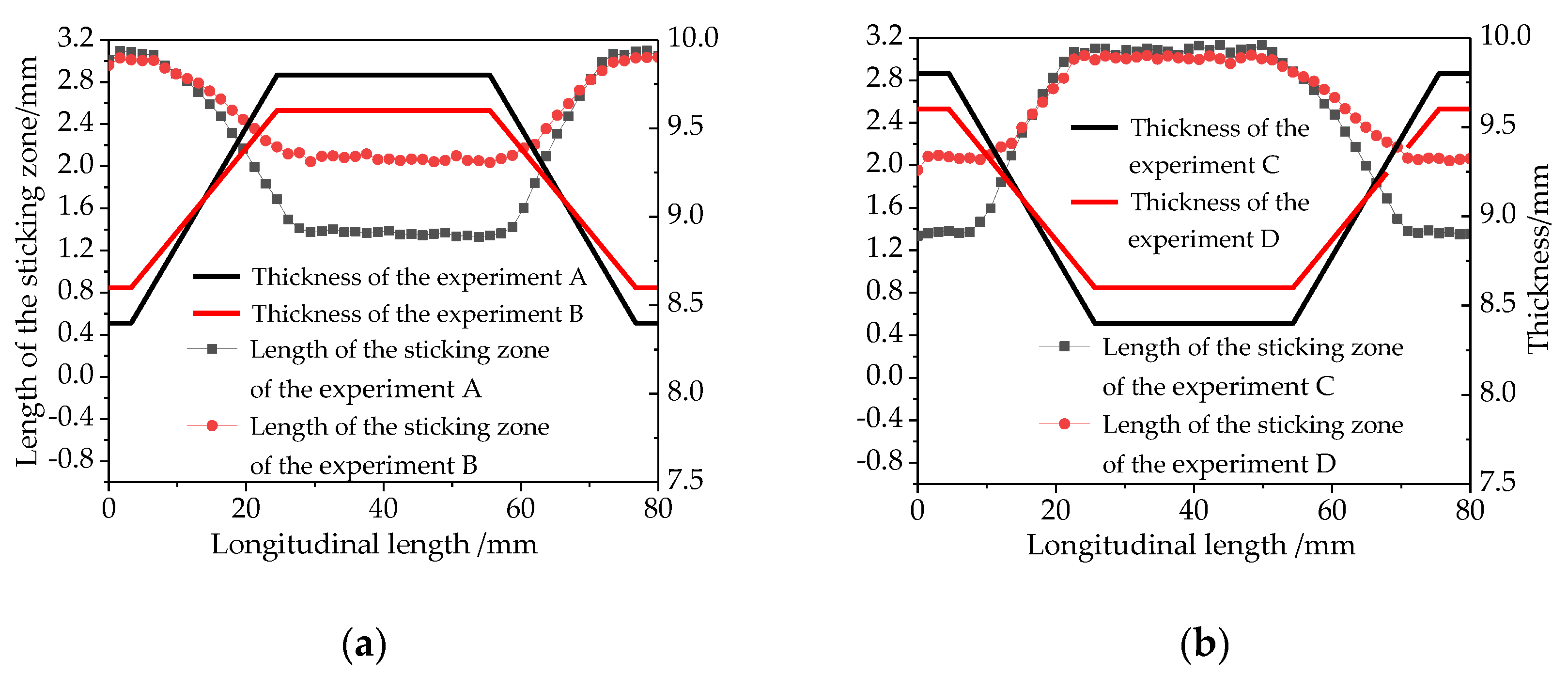
The longitudinal length of the sticking zone is an important parameter of the sticking-sliding model. According to the measured rolling force values, the curve of the length value of the sticking zone along the longitudinal direction can be calculated by applying the Equations (1)–(5) in this paper, as shown in
Figure 9.
As shown in
Figure 9, the longitudinal length of the sticking zone is inversely proportional to the thickness of the rolled piece.
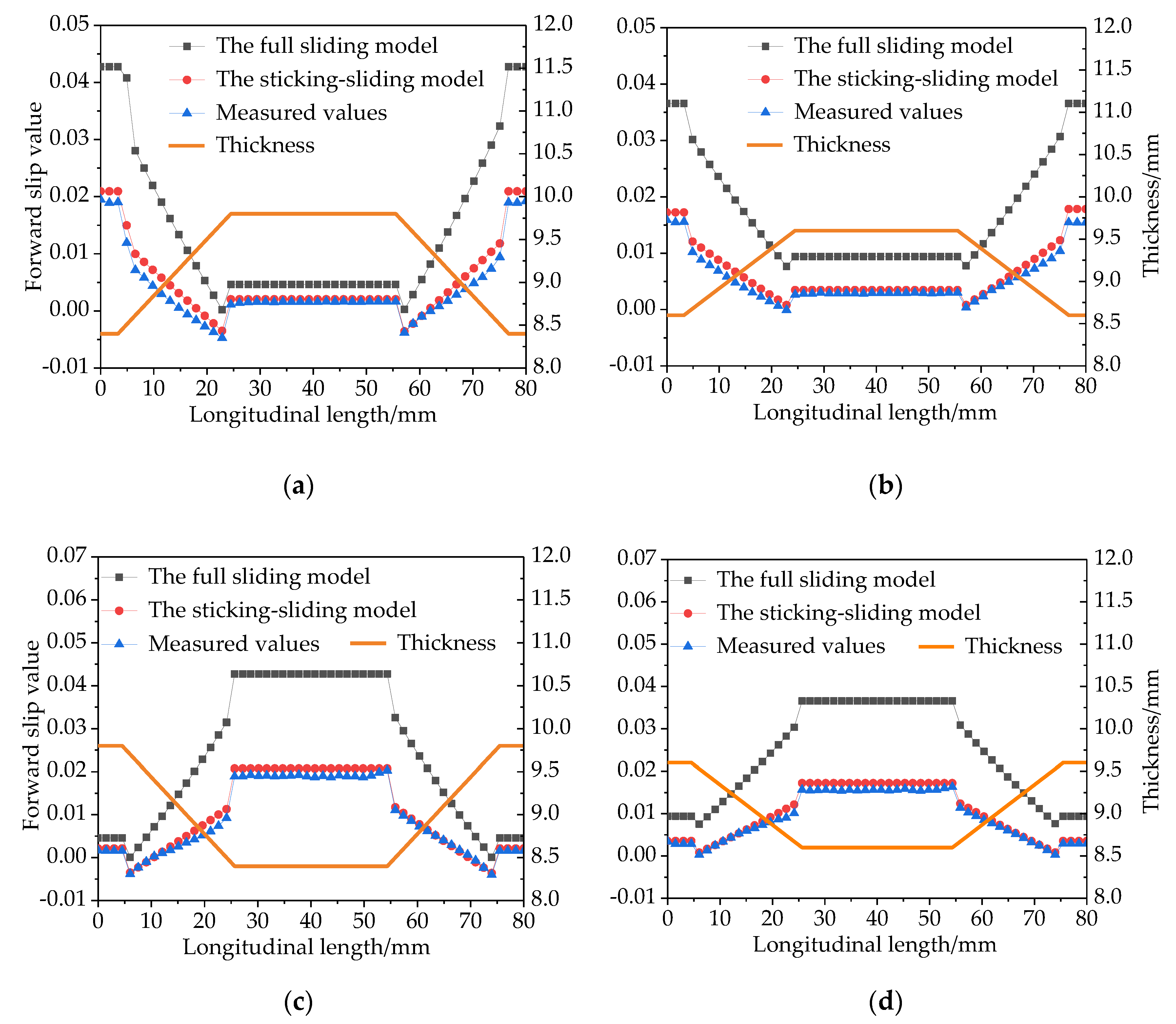
According to the measured exit speed of the mill and the circumference speed of the roll, the forward slip value can be calculated by applying Equation (19). This forward slip value can be considered as the measured forward slip value.
The sticking-sliding model described in this paper was applied to calculate the forward slip values at each rolling stage in the experiment. This forward slip value can be considered as the forward slip value of sticking-sliding model. At the same time, the full sliding model was applied to calculate the forward slip values at each rolling stage in the experiment.
The results of the sticking-sliding model, the results of the full sliding model, and the measured results are compared, as shown in
Figure 10.
As shown in
Figure 10, in the multi-stage rolling process, including variable thickness rolling, the sticking-sliding model described in this paper, based on the pre-displacement principle, exhibited a high degree of agreement between the calculated front sliding values and experimental results, with a calculation accuracy significantly higher than that of the full sliding model results.
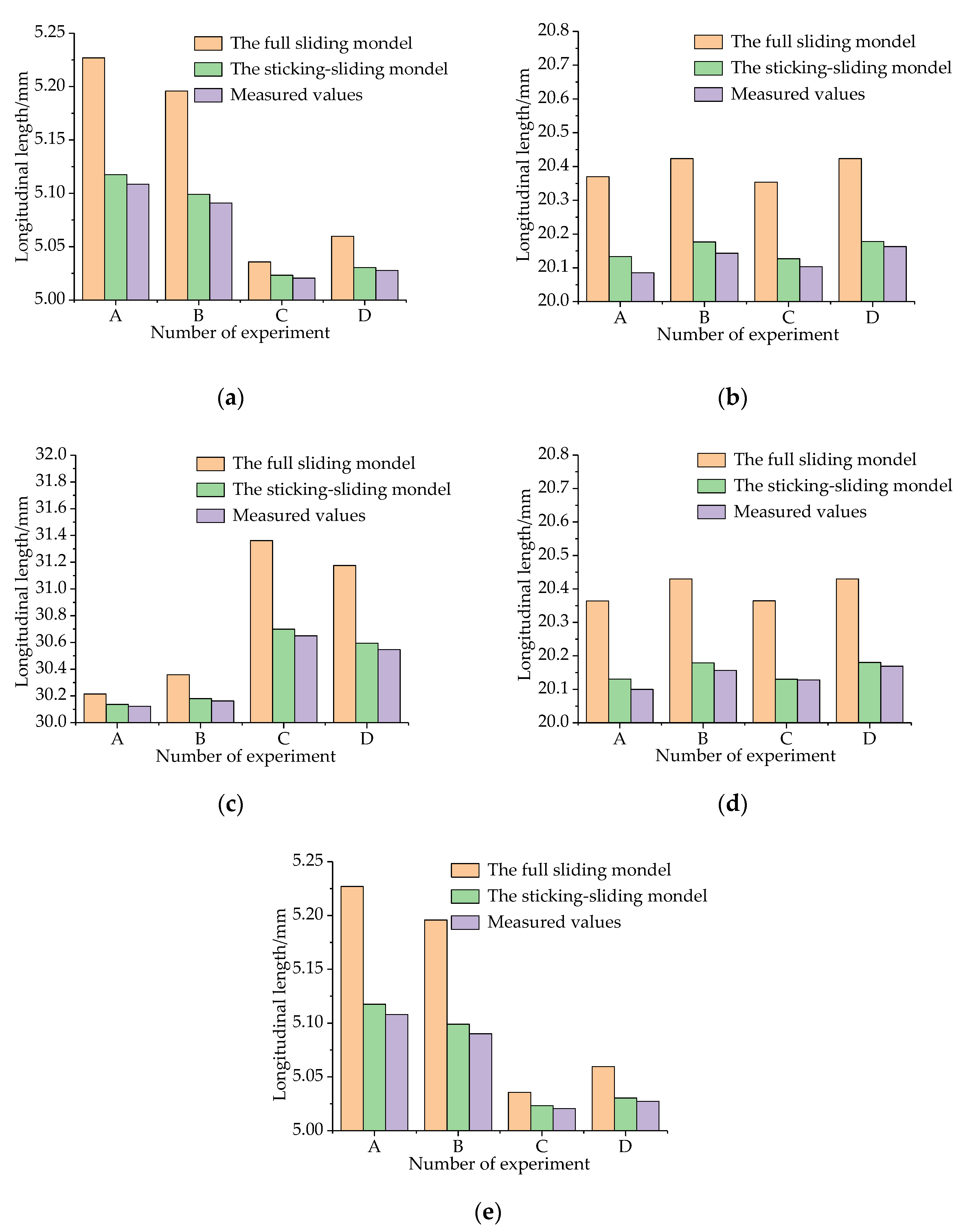
The longitudinal length of the specimens in each rolling stage is predicted by the sticking-sliding model. The results of the sticking-sliding model, the results of the full sliding model, and the measured results are compared, as shown in
Figure 11.
As shown in
Figure 11, the sticking-sliding model was used to calculate the longitudinal length of
L1~
L5 rolling stage specimens, exhibiting a high degree of agreement with the measured results; its accuracy is significantly higher than that of the full sliding model calculation results. On analyzing the experimental results, the main difference between the sticking-sliding model established based on the pre-displacement principle and the full sliding model is the addition of the sticking zone, which is closer to the actual situation. Since the rolled piece and the roller are relatively stationary within the sticking zone, the longitudinal flow of metal is macroscopically restricted, resulting in the forward sliding values and longitudinal length values calculated using the sticking-sliding model being smaller than the full sliding model’s calculated results. The experimental results also confirmed the rationality and correctness of the sticking-sliding model based on the pre-displacement principle.
Author Contributions
Literature search, S.Y.; Conceptualization, S.Y. and H.L.; Research idea, S.Y., H.L. and D.W.; Mode design, S.Y., H.L. and D.W.; Software and computing, G.W. and X.C.; Experiment, S.Y., G.W. and X.C.; Data analysis, S.Y., G.W. and X.C.; Figure, S.Y. and X.C.; Writing—original draft preparation, S.Y.; Writing—review and editing, S.Y., H.L. and D.W.; Finalization, S.Y., H.L., D.W., G.W. and X.C.; Project management, S.Y., G.W. and X.C. All authors have read and agreed to the published version of the manuscript.
Funding
This work was supported by the National Natural Science Foundation of China (Grant No. U21A20118).
Data Availability Statement
Not applicable.
Conflicts of Interest
The authors declare no conflict of interest.
References
- Du, P.; Hu, X.Q.; Wang, J.; Liu, X.H. Development and Application of Longitudinal Profiled Plate. Steel Roll. 2008, 25, 47–51. [Google Scholar]
- Yang, S.Y.; Liu, H.M.; Wang, D.C. Differential Analysis and Prediction of Planar Shape at the Head and Tail Ends of Medium-Thickness Plate Rolling. Metals 2023, 13, 1123. [Google Scholar] [CrossRef] [Scilit]
- Ji, Y.F.; Duan, J.R.; Li, H.Y.; Liu, Y.M.; Peng, W.; Ma, L.F. Improvement of Edge Crack Damage of Magnesium Alloy by Optimizing the Edge Curve During Cross Variable Thickness Rolling. Int. J. Adv. Manuf. Technol. 2021, 112, 1993. [Google Scholar] [CrossRef] [Scilit]
- Tan, L.J.; Zhang, S.; Ma, Y.H. Optimization and Application of Plan View Pattern Control Model for Plate Mill. Steel Roll. 2019, 36, 14–19. [Google Scholar]
- Wang, J.; He, C.Y.; Jiao, Z.J. Research and Industrial Practice on Plane Shape Control Model of Medium and Thick Plate; Metallurgical Industry Press: Beijing, China, 2015; pp. 46–60. [Google Scholar]
- Wang, S.; Wang, S.G.; Liu, X.H.; Li, C.S. Experiment and Simulation of Variable Thickness Rolling for 3D-Profiled Blank. J. Mater. Process. Technol. 2021, 290, 116971. [Google Scholar] [CrossRef] [Scilit]
- Lu, S.P.; Wang, Y.F.; Li, Q.; Wang, Z.Y.; Tian, P. Rolling Process Research and Production Practice of LP Plate. Wide Thick. Plate 2020, 26, 23–26. [Google Scholar]
- Wang, Y.Q.; Liu, X.L.; Liu, M.; Ban, H.Y.; Li, J.N. Rolling Technology of Longitudinally Profiled Steel Plate (LP Steel Plate) and Bearing Capacity of LP Flexural Members. Eng. Mech. 2019, 36, 1–12. [Google Scholar]
- Shafiei, E.; Dehghani, K.; Ostovan, F.; Toozandehjani, M. Effect of Microstructure and Texture Evolution During Variable Gauge Rolling on Mechanical Properties of Tailor Rolled Blanks. Met. Mater. Int. 2019, 25, 1378–1387. [Google Scholar] [CrossRef] [Scilit]
- Badparva, H.; Naeini, H.M.; Kasaei, M.M.; Asl, Y.D.; Abbaszadeh, B.; da Silva, L.F.M. Deformation length in flexible roll forming. Int. J. Adv. Manuf. Technol. 2023, 125, 1229. [Google Scholar] [CrossRef] [Scilit]
- Du, P.; Hu, X.Q.; Wang, J.; Liu, X.H.; Wang, G.D. Rolling Parameters for Longitudinal Plate Rolling Process. Iron Steel Res. 2008, 20, 26–31. [Google Scholar]
- Ding, X.K.; Yu, J.M.; Zhang, T.H. Establishment of Digital Model of Plane Shape of Medium and Thick Plate. Iron Steel 1998, 33, 33–37. [Google Scholar]
- Du, P. Research on Rolling Theory and Control Strategy for Longitudinally Profiled Flat Steel. Ph.D. Thesis, Northeastern University, Shenyang, China, 2008. [Google Scholar]
- Rezaei, R.; Naeini, H.M.; Tafti, R.A.; Kasaei, M.M.; Mohammadi, M.; Abbaszadeh, B. Effect of Bend Curve on Web Warping in Flexible roll Formed Profiles. Int. J. Adv. Manuf. Technol. 2017, 93, 3625. [Google Scholar] [CrossRef] [Scilit]
- Liu, H.M. Theory and Application of Three Dimensional Rolling; Science Press: Beijing, China, 1999; pp. 55–83. [Google Scholar]
- Samodurova, M.N.; Karandaeva, O.I.; Khramshin, V.R.; Liubimov, L.V. Calculating Power Parameters of Rolling Mill Based on Model of Deformation Zone with Four-Roll Passes. Machines 2020, 8, 73. [Google Scholar] [CrossRef] [Scilit]
- Zhi, Y.; Liu, X.H.; Sun, T.; Wu, Z.Q.; Zhang, G.J. Investigation of Mathematical Model for the Transition Zone of Tailor Rolled Blank for Variable Gauge Rolling. J. Harbin Eng. Univ. 2017, 38, 602–609. [Google Scholar]
- Liu, Y.M.; Wang, Z.H.; Wang, T. Prediction and Analysis of the Force and Shape Parameters in Variable Gauge Rolling. Chin. J. Mech. Eng. 2022, 35, 88. [Google Scholar] [CrossRef] [Scilit]
- Wang, S.; Hu, X.L.; Wang, X.G.; Chen, J.Q.; Liu, X.H.; Li, C.S. Design and Experiment of V-Shaped Variable Thickness Rolling for Rolled Profiled Strips. J. Mater. Res. Technol.-JMR&T 2021, 15, 4381. [Google Scholar]
- Chen, G.; Wang, X.B. A Soft Measurement and Preise Control Method for Steel Plate Position. Metall. Autom. 2018, 42, 29–33. [Google Scholar]
- Shi, H.J. Research on Metal Flow Law of Ultra-Heavy Plate During Variable Gauge Rolling Process. Ph.D. Thesis, Northeastern University, Shenyang, China, 2018. [Google Scholar]
- Wang, X.G.; Wang, S.; Liu, X.H. Variable Thickness Rolling of Plates Thick in the Middle and Thin on the Sides. J. Mater. Process. Technol. 2020, 277, 116432. [Google Scholar] [CrossRef] [Scilit]
- Bogatov, A.A.; Nukhov, D.S.; P’yankov, K.P. Finite-element Modeling of Plate-rolling. Metallurgist 2015, 59, 113. [Google Scholar] [CrossRef] [Scilit]
- Jiao, Z.J.; He, C.Y.; Gao, S.W.; Wang, X.; Zhang, Y.X.; Hao, L. Application of Variable Gauge Rolling Technology for Plate to Reduce the Head Impact. ISIJ Int. 2023, 63, 660. [Google Scholar] [CrossRef] [Scilit]
- Liu, X.H.; Zhang, G.J. Force Equilibrium Differential Equations for Variable Gauge Rolling. Iron Steel Res. 2012, 24, 10–14. [Google Scholar]
- Sun, J.N.; Zhang, C.Y.; Chen, C.; Huang, H.G. Numerical Simulation of Rolling Process of Three-layer Symmetrical Bimetallic Composite Plate with Variable Thickness. J. Univ. Sci. Technol. Liaoning 2017, 40, 91–97. [Google Scholar]
- Sun, J.N.; Chem, C.; Huang, H.G.; Zhang, C.Y.; Wang, S. Rolling Force Model of Longitude Profile LP Plate Based on E Orowan Differential Equation. Iron Steel 2017, 52, 37–42. [Google Scholar]
- Kragelsky, I.V. Friction and Wear Calculation Methods; Pergamon Press: Oxford, UK, 1982; pp. 94–137. [Google Scholar]
- Zhao, Q.L.; Liu, X.H.; Sun, X.K. Analysis of Mechanical Parameters of Asymmetrical Rolling Dealing with Three Region Percentages in Deformation Zones. Materials 2022, 15, 1219. [Google Scholar] [CrossRef] [Scilit]
- Sun, X.K.; Liu, X.H.; Wang, J.; Qi, J.L. Analysis of Asymmetrical Rolling of Strip Considering Percentages of Three Regions in Deformation Zone. Int. J. Adv. Manuf. Technol. 2020, 110, 763–775. [Google Scholar] [CrossRef] [Scilit]
- Wang, Y.L.; Zhu, A.R.; Fan, M.D. Calculation Principle of Friction and Wear; China Machine Press: Beijing, China, 1988; pp. 158–175. [Google Scholar]
- Barbu, C.D.; Sandru, N. Mathematical Approach of the Flat Rolling Problem and New Aspects Concerning the Geometry of the Deformation Zone. Proc. Rom. Acad. Ser. Math. Phys. Tech. Sci. Inf. Sci. 2019, 20, 77. [Google Scholar]
- Bian, Y.H.; Liu, H.M. Solving the Contact Friction In Cold Sheet and Strip Rolling by Using Preparatory Displacement Principle. Iron Steel Res. 1994, 6, 29–35. [Google Scholar]
- Zhang, X.P.; Qin, J.P. Rolling Theory; Metallurgical Industry Press: Beijing, China, 2006; pp. 127–141. [Google Scholar]
Figure 1.
Schematic diagram of varying thickness rolling with full sliding model: (a) schematic diagram of thickening rolling; (b) schematic diagram of thinning rolling.
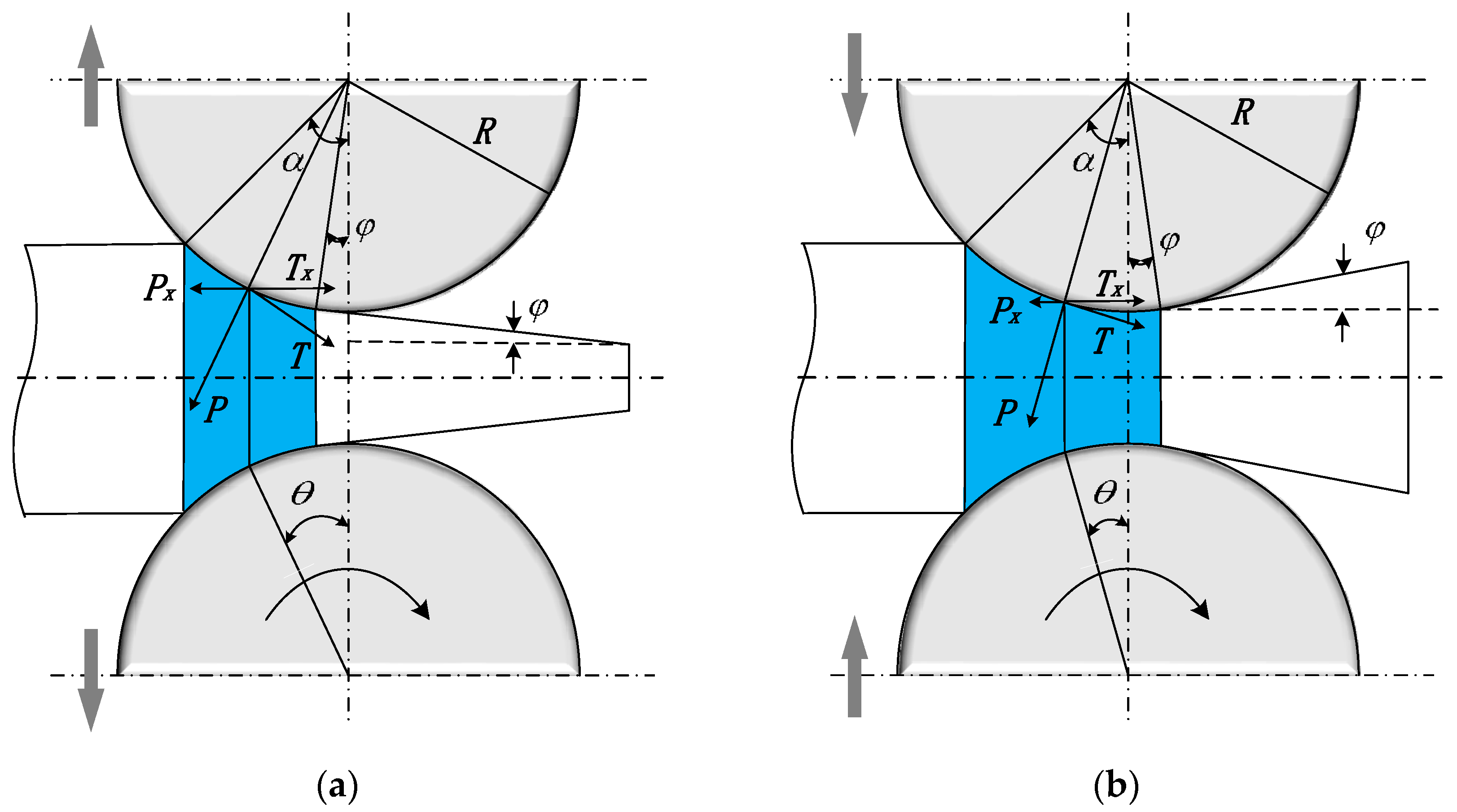
Figure 2.
Schematic diagram of varying thickness rolling: (a) schematic diagram of thickening rolling; (b) schematic diagram of thinning rolling.
Figure 3.
Schematic diagram of three sections of rolling deformation zone.
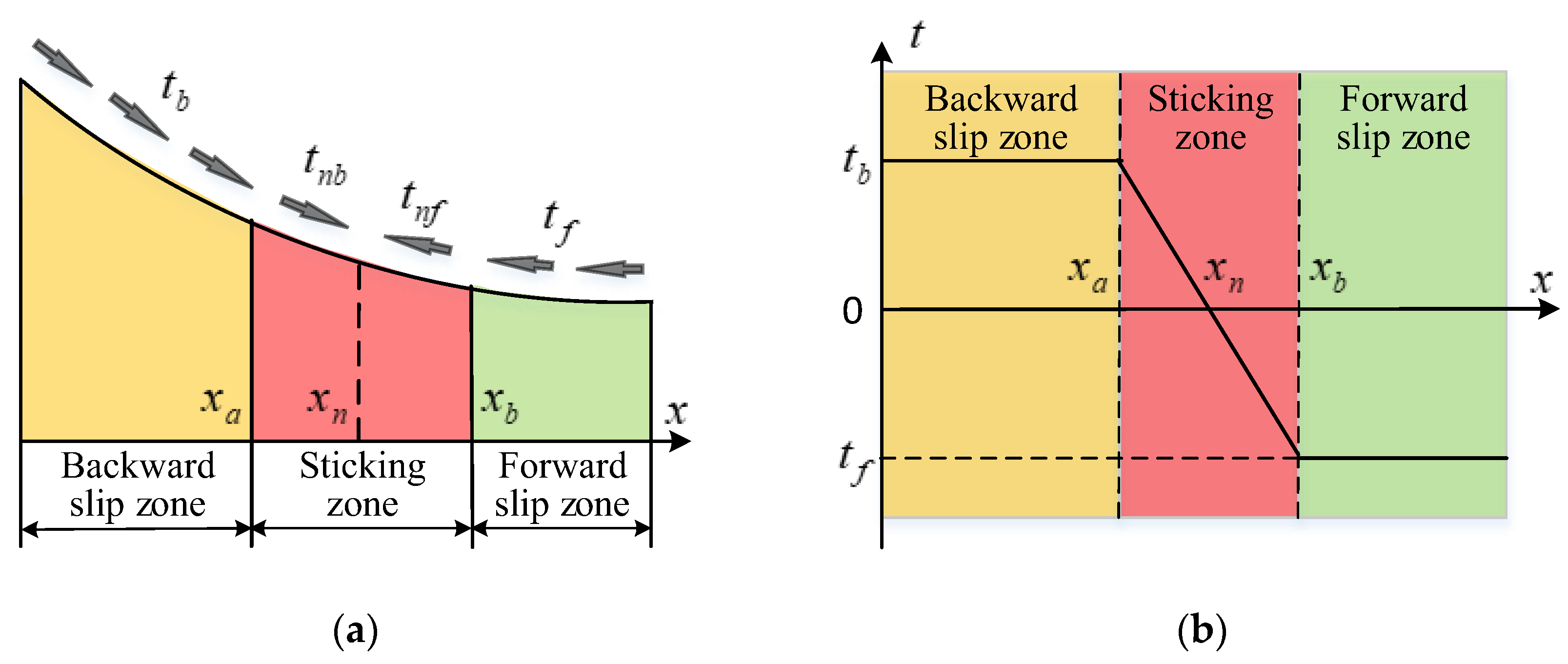
Figure 4.
The friction force of the contact surface and the trend of friction change. (a) Schematic diagram of the friction force of the contact surface; (b) trend diagram of the friction force.
Figure 5.
The schematic diagram of three zones of rolling deformation: (a) schematic diagram of thickening rolling; (b) schematic diagram of thinning rolling.
Figure 6.
The schematic diagram of the target structure of the specimens: (a) schematic diagram of the target structure of specimens 1~4; (b) schematic diagram of the target structure of specimens 5~8.
Figure 7.
Photographs of the results of the experiments: (a) photograph of experiment A; (b) photograph of experiment B; (c) photograph of experiment C; (d) photograph of experiment D.
Figure 8.
Graph of measured rolling force: (a) average rolling force measured in experiment A and experiment B; (b) average rolling force measured in experiment C and experiment D.
Figure 9.
Graph of length of the sticking zone and thickness: (a) length of the sticking zone and thickness of experiment A and experiment B; (b) length of the sticking zone and thickness of experiment C and experiment D.
Figure 10.
Comparison graph of forward slip values: (a) comparison graph of forward slip values of experiment A; (b) comparison graph of forward slip values of experiment B; (c) comparison graph of forward slip values of experiment C; (d) comparison graph of forward slip values of experiment D.
Figure 11.
Comparison plot of the longitudinal length of the rolled pieces at each rolling stage: (a) comparison plot of the longitudinal length of the rolling stage L1, (b) comparison plot of the longitudinal length of the rolling stage L2, (c) comparison plot of the longitudinal length of the rolling stage L3, (d) comparison plot of the longitudinal length of the rolling stage L4, and (e) comparison plot of the longitudinal length of the rolling stage L5.
Table 1.
Comparative table of process characteristics of varying thickness rolling.
| Type of Rolling | Roll Gap | Rolling Tilt Angle | Contact Arc Length |
|---|
| Thickening rolling | Increase | Negative value | Decrease |
| Thinning rolling | Decrease | Positive value | Increase |
Table 2.
Comparative table of varying thickness rolling conditions and parameters.
| Type of Rolling | Rolling Tilt Angle | Horizontal Component of Rolling Force (Px) | The Horizontal Component of Friction (Tx) | Resultant Action Coefficient (Ks) | Stable Rolling Conditions |
|---|
| Thickening rolling | Negative value | | | | |
|
| Thinning rolling | Positive value | | | | |
|
Table 3.
Comparative table of common roughness grades and related parameters.
| Roughness Grade | | | |
|---|
| Ra1.6 | 8 | 2.00 | 1.2900~0.6450 |
| Ra0.8 | 12 | 1.95 | 0.3500~0.1750 |
| Ra0.4 | 20 | 1.90 | 0.0880~0.0440 |
| Ra0.2 | 30 | 1.50 | 0.0180~0.0090 |
| Ra0.1 | 40 | 1.40 | 0.0064~0.0032 |
| Ra0.05 | 55 | 1.30 | 0.0021~0.0010 |
Table 4.
Comparative table of the parameters of the experimental rolling mill.
| Type of Parameters | Values |
|---|
| Width of the roller (mm) | 260 |
| Diameter of the roller (mm) | 110 |
| Rotational speed of the roller (r/min) | 2.15 |
| Maximum roll gap (mm) | 20 |
| Rolling force measurement range (kN) | 0~100 |
| Frequency of signal acquisition (Hz) | 20 |
| Roughness grades of the roller surface (Ra) | 0.1 |
Table 5.
Parameter table of target longitudinal length of the specimens.
| (mm) | (mm) | (mm) | (mm) | (mm) |
|---|
| 5 | 20 | 30 | 20 | 5 |
Table 6.
Parameter table of target thickness of the specimens.
| Specimen Number | #1, #2 | #3, #4 | #5, #6 | #7, #8 |
|---|
| (mm) | 1.4 | 1 | 1.4 | 1 |
| (mm) | 8.4 | 8.6 | 9.8 | 9.6 |
| (mm) | 9.8 | 9.6 | 8.4 | 8.6 |
| Disclaimer/Publisher’s Note: The statements, opinions and data contained in all publications are solely those of the individual author(s) and contributor(s) and not of MDPI and/or the editor(s). MDPI and/or the editor(s) disclaim responsibility for any injury to people or property resulting from any ideas, methods, instructions or products referred to in the content. |
© 2023 by the authors. Licensee MDPI, Basel, Switzerland. This article is an open access article distributed under the terms and conditions of the Creative Commons Attribution (CC BY) license (https://creativecommons.org/licenses/by/4.0/).