


Abstract
Recent advances in genomic medicine have led to the availability of genomic tests that have the potential to improve population health, yet the process for obtaining these tests and getting them reimbursed by insurers has not been described. The objective of this study was to describe the process of ordering pharmacogenomic tests by interviewing providers, patients, and laboratories about cancer-related pharmacogenomic tests. We interviewed patients who were prescribed, providers who prescribed medications that should be guided by pharmacogenomic testing, and individuals from diagnostic laboratories. A total of 10 providers, 16 patients, and eight diagnostic laboratories described logistical and insurance issues relating to ordering and receiving pharmacogenomic tests and medications. We found that the process of ordering pharmacogenomic tests is time-consuming, expensive, and complex. Ordering pharmacogenomic tests is quite different across institutions. Even in the same institution, multiple providers can order the test. Once the provider places the order for the pharmacogenomic test, the laboratory receives the request and usually begins testing without knowing how the test will be paid for. Next, the laboratory completes the pharmacogenomic testing and the results of the tests are reported to providers, patients, or placed directly in the medical record. In conclusion, processes related to ordering and obtaining insurance coverage for pharmacogenomic tests varies greatly across institutions and is time-consuming.
1. Introduction
Genomic medicine is exploding with discoveries that could improve cancer care, and many pharmacogenomic tests are becoming available for use in clinical practice [1,2]. Nevertheless, translation of new genomic technologies into clinical practice has been slower than hoped [3,4]. As of January 2018, 54,334 tests for 10,999 conditions and 16,419 genes were available [5]. The U.S. Food and Drug Administration (FDA) has included pharmacogenomic information in the drug labels of more than 100 drugs, with 31% being oncology therapy [6]. For example, clinical guidelines recommend that patients with early stage breast cancer with overexpression of human epidermal growth factor-like receptor No 2 (HER-2) receive trastuzumab [7], and erlotinib is recommended for epidermal growth factor receptor (EGFR) mutation positive nonsquamous non-small cell lung cancer [8]. Even with FDA recommendations for use of pharmacogenomic testing for these and other drugs, insurance companies can choose whether or not to cover them [1] and for whom. While pharmacogenomic tests for cancer are available, they are underutilized in clinical care [9,10].
It is critical to determine factors that could be related to this underutilization. Previous studies have examined the adoption of pharmacogenomic testing by providers [11] and attitudes of providers towards testing and subsequent decision-making for patients [12,13]. Our previous study of patients’ and providers’ views on access to cancer-related pharmacogenomic tests found that the process could be time-consuming and complex [14]. Nevertheless, no studies have examined the processes for ordering and paying for pharmacogenomic tests in the context of cancer care. The objective of this study was to explore the process of ordering and paying for pharmacogenomic tests through interviews with providers, patients, and laboratories in order to identify challenges or strategies that could facilitate access.
2. Materials and Methods
2.1. Overall Design
This qualitative study was approved by the Institutional Review Board at Harvard Pilgrim Health Care (HPHC). Provider, patient, and laboratory participants were given a $25 gift card for their time and appreciation of their participation.
2.2. Sampling
We used insurance claims data from HPHC, a regional health plan covering about 1 million members from New England. Based on HPHC claims data from 1 May 2013 to 30 April 2014, we identified 126 providers who had prescribed any of a selected list of cancer targeted therapies that could be informed by pharmacogenomic tests in accordance with clinical guidelines (Table 1). Details of our sampling process are described in a previous study [14]. Briefly, we mailed invitation letters to 126 providers and 261 patients, asking them to call a toll-free line or email if they were interested in participating in a telephone interview. Through our provider interviews, we learned that diagnostic laboratories play a major role in the process of access and reimbursement. Representatives from key laboratories that manufacture and run pharmacogenomic testing were recruited using snowball sampling. We identified and contacted 12 diagnostic lab employees who had experience with pharmacogenomic testing, either in a commercial or academic lab setting.

Table 1.
Interview participants and demographic information.
2.3. Instrument and Data Collection
Once selected, provider and patient interviews were conducted via telephone by two of the study’s investigators, Wu and Ceccarelli. We asked questions in four main areas: (1) the process for deciding to order this particular medicine and whether any pharmacogenomic tests were ordered before starting the medication; (2) factors influencing the decision to order or not order the test and to review the clinical implementation process for the test; (3) whether the provider discussed ordering the pharmacogenomic test with the patients and to what extent the patient was involved in the decision to order the test; and (4) challenges and difficulties in obtaining the pharmacogenomic test, whether prior authorizations were requested, whether genetic testing was ever denied, and how health insurance coverage affects use of pharmacogenomic tests.
Interviews with representatives of diagnostic labs were conducted via telephone by two of the study’s investigators, Lu and Loomer. Questions focused on similar content to provider and patient interviews: (1) the process of conducting and billing for pharmacogenomic tests in the context of cancer; (2) factors that influenced communication with patients, providers, and insurers; (3) how providers or insurers were involved in the testing or billing process, at any stage; and (4) challenges in conducting and billing tests including prior authorizations and denials of coverage. The interview questions served as a guide, and the interviewer had discretion in phrasing, using probes, and posing additional questions during the interview. Interviews lasted approximately 30 to 45 min each.
2.4. Analysis
The initial coding scheme was developed by the study team using the interview questions as a starting point. While provider transcripts were analyzed by Wu and Ceccarelli, patient and lab transcripts were analyzed by Wu and Loomer. Themes were identified while building the codebook. Findings were circulated to the study team, discrepancies discussed until agreed upon, omissions identified, and the codebook and coding scheme revised and finalized. Transcripts were again coded using the finalized codebook and coding scheme.
3. Results
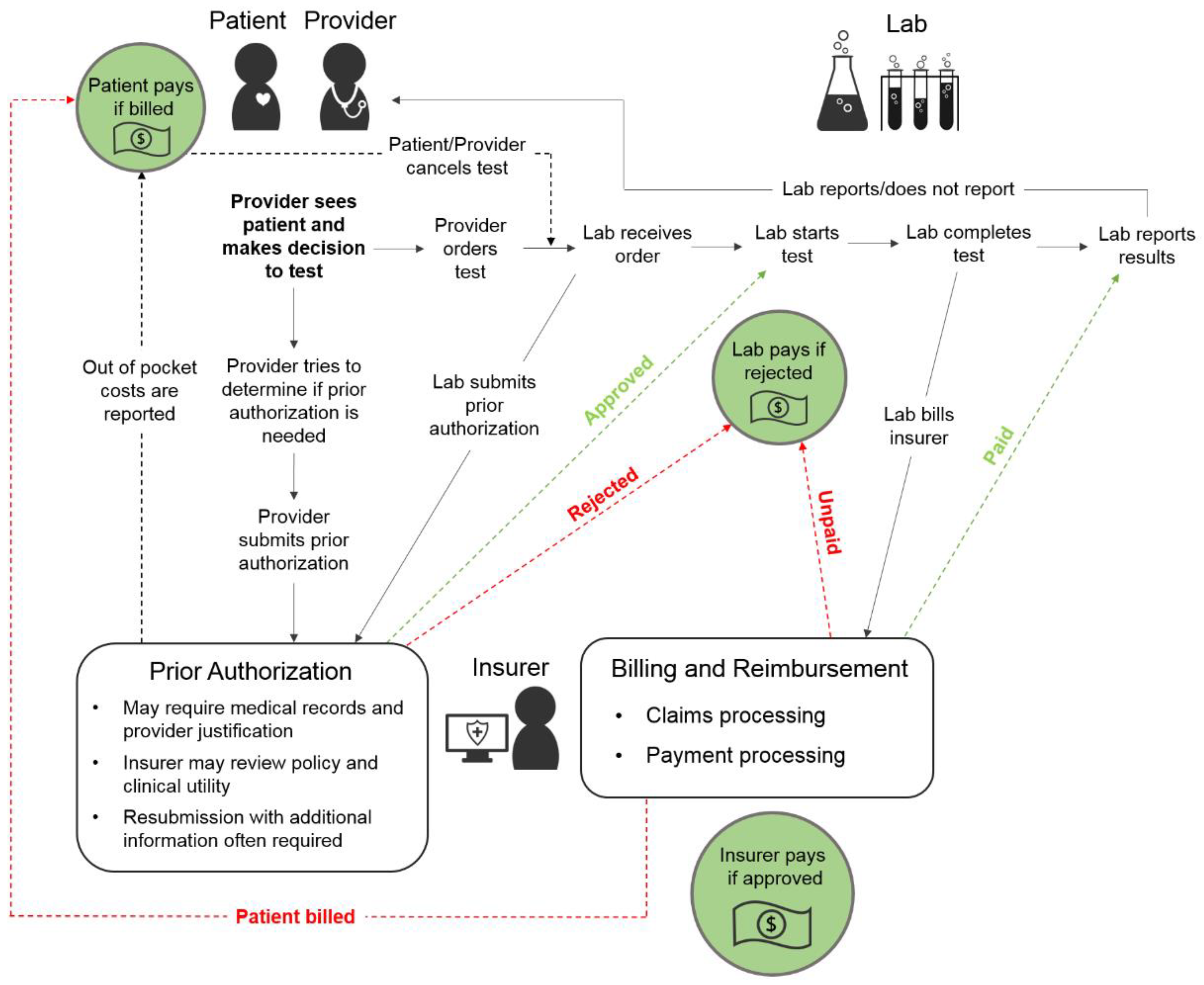
Table 1 provides an overview of interview participants. Based on results of the interviews of the providers, patients, and representatives of laboratories, we developed a diagram of the processes involved in ordering and paying for pharmacogenomic tests (Figure 1). After a patient receives a diagnosis, a provider orders a pharmacogenomic test. Prior to ordering the test, providers may determine if prior authorization is needed. Prior authorization may require the provider to provide justification; the insurer may review clinical utility policies to decide on approval. Once the provider orders the test, the lab receives the order. Sometimes the lab submits the prior authorization to the insurer. The lab usually starts the testing process immediately after receiving the order. The lab then completes the test and reports results to the provider. Once the lab test is completed, the lab bills the insurer. Sometimes the patient pays for the test partially or fully, sometimes the insurer covers the costs of the test fully, and sometimes the laboratory absorbs the costs of the test if the insurer does not pay and the laboratory has conducted the testing.
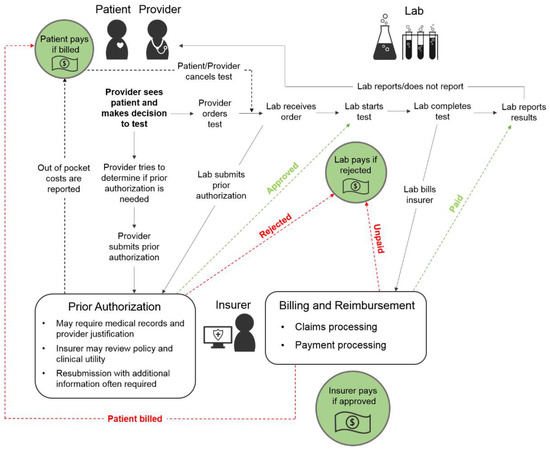
Figure 1.
Schematic of the clinical implementation process for pharmacogenomic tests.
3.1. Challenges, Adaptations, Impact, and Recommendations
Interviewees reported on challenges, adaptations, impact, and recommendations for each stage in the ordering process of pharmacogenomic testing (Table 2). The stages in the process include ordering the tests, the analysis of the samples by the laboratory, the reporting of results by the laboratory, and payment for the tests.
Table 2.
Challenges, adaptations, impact, and recommendations on the pharmacogenomic testing process.
3.1.1. Ordering Tests
Providers reported that the clinical implementation process for pharmacogenomic testing is time-consuming and variable for each insurer and patient. One provider stated, “It’s this waiting game for [the patient]”. Another challenge mentioned that it was the providers not having the expertise to order the tests, particularly panel tests. Providers noted that molecular pathology is confusing. Moreover, with so many new sequencing tests becoming available, “it is confusing to clinicians”. Some laboratories felt that larger, panel tests are sometimes ordered when they are unnecessary. A laboratory representative also stated that it is difficult to assess whether results of tests are used appropriately.
Laboratory representatives also believed that patients sometimes did not know whether the tests would be covered by insurers. Furthermore, providers stated that insurance requirements for coverage should be transparent and easy to find. Another provider expressed, “you see so many different patients with so many different insurance plans and you know different prescription plans and you don’t know what’s covered, what’s not and a large part of our day is spent you know figuring out what’s covered what’s not, what needs a prior authorization, what doesn’t, what the insurance will cover”.
One provider stated that their clinical group has adapted to the confusion around ordering and payment of pharmacogenomic tests by making resources about the process and costs available for all parties to help understand this complex field. However, laboratory representatives felt that sometimes providers order pharmacogenomic tests that are not needed.
Interviewees offered multiple suggestions for improving the clinical implementation process for pharmacogenomic tests. First, laboratory representatives felt that policies for pharmacogenomic testing could govern their use instead of insurers’ prior authorization requirements: “The benefit of developing a good medical policy that’s very clear and takes a long time is that it precludes the need for the complex and expensive preauthorization process”. Secondly, laboratory representatives stated that clinical utility needs to be established. One representative stated, “So we’re in a position now where we need to come to some form of consensus, certainly publish more to support doing panels in cancer patients and then that should be a covered service. It goes hand in hand with getting paid and having insurance pay for it, is developing clinical utility”. Third, providers felt that streamlining the process for ordering pharmacogenomic tests would be beneficial and would help prevent stress for patients as “They’re dealing with a very difficult diagnosis and it’s so stressful as it is and then to you know have patients be told well you know your insurance might not cover this or we have to find an alternative is really tough to tell people as a provider”.
3.1.2. Laboratory Analysis of Samples
Laboratory representatives stated that most laboratories start testing as soon as they receive samples in order to avoid delaying patient care. One laboratory representative stated, “within a day or so, ya’ know FedEx drops off the sample, whether that is blood and/or saliva, and the test is—we start to run the test immediately as long as it is a good sample.” Another laboratory representative stated, “We never want to put the patient in a bad place. We generally proceed with the test and end up not getting paid”. In addition, laboratory representatives noted that the process of testing is different than the process of ordering medications, although similar processes are adopted for both. For example, once laboratories start the process of pharmacogenomic testing, it is difficult to stop; thus, tests are sometimes run without knowledge of where the payment will come from, with the result that costs may end up being absorbed by the laboratory or paid for by the patient. In order to adapt, laboratories are starting to request that patients sign an agreement to cover the costs if the insurers will not. Laboratories also work hard to obtain prior authorizations and try to avoid negotiating competitive flat rates.
3.1.3. Reporting of Results
Once laboratories report the results of a test, providers and patients sometimes do not know what to do with the results. Providers noted that sometimes the clinical utility of tests is not known to them, making it difficult to know how to interpret test results even if there is promise that a test result will result in improved response to treatment. One provider stated, “In today’s day and age we actually have drugs that target, that are actually useful in that situation [of a positive pharmacogenomic test] so finding that information today would actually affect how we treat a patient…. We can say that there are treatments that may improve your outcomes but are not proven to”. Laboratories have adapted by working with doctors to interpret results with one representative stating, “We are trying to sort of pull the patient and doctor through to the other side to make the results of our testing even more useful”. Laboratory representatives emphasized that providers need to understand how to interpret results with one representative stating, “They’re the ones talking to patients and if they’re telling the patients ‘this is why I’m sending the test’ and that’s not why they’re sending the test, there’s a lot of confusion on the patient’s behalf”.
Laboratories have also worked to try to inform insurers of the utility of tests. One representative stated, “We can share with payers if they’re asking about a specific gene, why we’re running that test, we have a lot of references already pulled together to share”. The reason for sharing information is “a lot of the health plans don’t have the internal expertise to know how to create an internal policy on molecular pathology”. Another laboratory representative stated they have worked to make the results of testing more useful: “And so we’ve really spent a lot of our recent efforts over the last two years or so in trying to create that bridge from the results the doctor gets to the actual treatment of the patient”.
3.1.4. Payment for Tests
Multiple providers and laboratory representatives expressed that insurance policies and requirements for prior authorization vary across insurers, and costs are mostly unknown. One laboratory representative stated, “And it’s the complexities of the insurance system that you know, we have to know every possible insurers policies or rules, for every patient in real time”. Pharmacogenomic tests can be paid for by the insurer or the patient or absorbed by the laboratories performing the testing as insurance policies vary. One laboratory representative stated, “I’ve definitely had problems with of insurance either not covering it or requiring prior authorization”. A provider stated, “I think more of an issue has been few patients who have had large bills sent to them because they were told by the insurance they can only go to certain labs to get those tests done. That’s what I’ve come across more than anything”. Another provider said, “the testing, it should be more transparent and easier for the patient and the doctors to know whether a certain test is covered by a certain insurer”. Laboratory representatives also reported that billing codes are unclear and open to different interpretations, with one representative stating, “the molecular pathology billing landscape is very bizarre…. Some people are interpreting it as, if my test has 5–50 genes, I bill the small panel code, if my test has 51 or more, I bill the big panel code. Whereas other places are interpreting it as, if I’m running a test of 300 genes, it doesn’t matter how many genes are on the test, if only four of them are clinically relevant, or if only six of them are clinically relevant. So that’s the approach that our institute has taken, only bill for the clinically relevant genes. So we run the same panel every time, it’s a panel of—I don’t even know—300, 400, 500 genes, but it’s a lot of genes”.
Providers can adapt by using vendors who charge insurers so that the hospital or providers do not receive a bill. Some laboratories have an appeals group who may reach out to the clinical team for more clinical information in order to appeal to the insurer. Another laboratory is developing a real-time adjudication process to let patients know how much their out of pocket costs would be as “the computer can generate what the patient responsibility is”.
Interviewees offered several suggestions for improving the process of payment for pharmacogenomic tests. Providers suggested making the forms easier to complete, and making it obvious which form is needed. For example, one provider stated, “You know to be honest with you in terms of prior authorization, that’s the biggest hindrance to be honest with you is that there’s no standardization of the form. So most of the time when you’re trying to obtain a prior authorization, it’s trying to figure out what form you need to submit”. Another laboratory representative stated that although universal coverage documentation would be a potential solution, “it’s just a little complicated figuring out what the right national policy would be”.
4. Discussion
Many pharmacogenomic tests are currently available and thousands are in the pipeline for potential future use, yet little is known about their clinical implementation process. Our study found that the clinical implementation process for pharmacogenomic tests is currently complex and variable. Providers and laboratory representatives report many challenges to the process: the lack of standardized processes makes ordering confusing, ordering is time consuming, testing is expensive, providers do not have expertise in using pharmacogenomics tests, and billing codes are nonspecific. Recommendations proposed include making the process straightforward, making insurer policies transparent, and developing clinical guidelines [15].
Some of the challenges in obtaining pharmacogenomic testing reported in our study have been seen in previous studies. For instance, Miller et al. also reported that a major challenge to ordering pharmacogenomic tests is that there is no set process for ordering the tests [16]. They also noted that many providers reported that a lack of knowledge about how to order pharmacogenomic testing for cancer was an important barrier [16]. Moreover, providers and laboratories in our study reported that guidelines are needed on appropriate and relevant testing. Furthermore, laboratories in our study felt an additional challenge is providers may not have the appropriate expertise to decide when to order tests. While other studies support some of our results that providers lack confidence in this area, our qualitative interviews allowed a broad exploration of additional challenges rather than being limited to survey questions that were asked [16,17]. Providers and laboratory representatives in our study identified additional challenges such as ordering pharmacogenomic tests is time-consuming, there is great variability in insurance coverage, testing is expensive, clinical utility of tests is difficult to assess, and ordering of panel tests is more complicated than single gene assays. Furthermore, our study also highlights the complexity that the prior authorization process adds to the process.
Our findings that some providers lack the expertise to order the tests, and that health care providers lack adequate training in genomics, especially given that staying on top of the latest available genomic medicine tools, is a challenge are also consistent with prior research [1,18,19] A study by Weldon et al. used qualitative interviews conducted from 2008 to 2009 that focused on breast cancer pharmacogenomic tests concluded that major barriers to ordering the tests were poor timing of testing relative to treatment decisions guided by the tests and obstacles related to reimbursement [20]. Even though our study was several years later when more tests were available, these same challenges remain.
Strengths of our study include that it focuses on examining the processes of ordering pharmacogenomic tests from multiple viewpoints, i.e., providers, patients, and representatives of diagnostic laboratories. Understanding such processes while there are already many cancer-related pharmacogenomic tests being used—but prior to the tremendous influx of available tests—could help guide use and payment of pharmacogenomic tests for a wide range of diseases. Despite the strengths of our study, a few limitations deserve mention. First, our study is limited to patients who are insured by Harvard Pilgrim Health Care and their providers and laboratories but we also included commercial labs that serve other insurers and providers. Secondly, all the pharmacogenomic tests were cancer-related and may not be generalizable to other pharmacogenomic tests. We focused on cancer-related tests because they are being used in current clinical care. In addition, interviewing insurers was beyond the scope of this study.
In summary, processes related to ordering and obtaining insurance coverage for pharmacogenomic tests varies greatly across institutions and is time-consuming. Potential solutions include streamlining the process for ordering tests, making reimbursement requirements by insurers transparent, developing guidelines, and improving communication between providers, patients, and laboratories.
Author Contributions
A.C.W. and C.Y.L. designed the study. A.C.W., R.C., and S.L. conducted the qualitative interviews. A.C.W., S.L, K.M.M. and C.Y.L. conducted the qualitative analyses. A.C.W., K.M.M., R.C., S.L., and C.Y.L. drafted the manuscript.
Funding
This research was supported by the National Human Genome Research Institute of the National Institutes of Health under Award Number R21HG008510. The authors do not have financial relationships to disclose.
Acknowledgments
We thank our advisory panel, Geoffrey Ginsburg, Ellen Clayton, and James Sabin for their expert guidance. We thank Mikaela Batista for her assistance in drawing Figure 1.
Conflicts of Interest
The authors declare no conflicts of interest. The content is solely the responsibility of the authors and does not necessarily represent the official views of the National Institutes of Health.
References
- McCarthy, J.J.; McLeod, H.L.; Ginsburg, G.S. Genomic medicine: A decade of successes, challenges, and opportunities. Sci. Transl. Med. 2013, 5, 189sr184. [Google Scholar] [CrossRef] [PubMed]
- Aronson, S.J.; Rehm, H.L. Building the foundation for genomics in precision medicine. Nature 2015, 526, 336–342. [Google Scholar] [CrossRef] [PubMed]
- Khoury, M.J.; Gwinn, M.; Yoon, P.W.; Dowling, N.; Moore, C.A.; Bradley, L. The continuum of translation research in genomic medicine: How can we accelerate the appropriate integration of human genome discoveries into health care and disease prevention? Genet. Med. 2007, 9, 665–674. [Google Scholar] [CrossRef] [PubMed]
- Phillips, K.A. Closing the evidence gap in the use of emerging testing technologies in clinical practice. JAMA 2008, 300, 2542–2544. [Google Scholar] [CrossRef] [PubMed]
- National Institute of Health. Genetic Testing Registry. Available online: https://www.ncbi.nlm.nih.gov/gtr/ (accessed on 1 October 2018).
- Wang, B.; Canestaro, W.J.; Choudhry, N.K. Clinical evidence supporting pharmacogenomic biomarker testing provided in US Food and Drug Administration drug labels. JAMA Intern. Med. 2014, 174, 1938–1944. [Google Scholar] [CrossRef] [PubMed]
- Duffy, M.J.; Harbeck, N.; Nap, M.; Molina, R.; Nicolini, A.; Senkus, E.; Cardoso, F. Clinical use of biomarkers in breast cancer: Updated guidelines from the European Group on Tumor Markers (EGTM). Eur. J. Cancer 2017, 75, 284–298. [Google Scholar] [CrossRef] [PubMed]
- Greenhalgh, J.; Dwan, K.; Boland, A.; Bates, V.; Vecchio, F.; Dundar, Y.; Jain, P.; Green, J.A. First-line treatment of advanced epidermal growth factor receptor (EGFR) mutation positive non-squamous non-small cell lung cancer. Cochrane Database Syst. Rev. 2016, CD010383. [Google Scholar] [CrossRef] [PubMed]
- Levy, D.E.; Byfield, S.D.; Comstock, C.B.; Garber, J.E.; Syngal, S.; Crown, W.H.; Shields, A.E. Underutilization of BRCA1/2 testing to guide breast cancer treatment: Black and Hispanic women particularly at risk. Genet. Med. 2011, 13, 349–355. [Google Scholar] [CrossRef] [PubMed]
- Haas, J.S.; Phillips, K.A.; Liang, S.Y.; Hassett, M.J.; Keohane, C.; Elkin, E.B.; Armstrong, J.; Toscano, M. Genomic testing and therapies for breast cancer in clinical practice. J. Oncol. Pract. 2011, 7, e1s–e7s. [Google Scholar] [CrossRef] [PubMed]
- Stanek, E.J.; Sanders, C.L.; Taber, K.A.; Khalid, M.; Patel, A.; Verbrugge, R.R.; Agatep, B.C.; Aubert, R.E.; Epstein, R.S.; Frueh, F.W. Adoption of pharmacogenomic testing by US physicians: Results of a nationwide survey. Clin. Pharmacol. Ther. 2012, 91, 450–458. [Google Scholar] [CrossRef] [PubMed]
- Peppercorn, J.; Hamilton, E.; Marcom, P.K.; Beskow, L.; Lyman, G.H. Pharmacogenetic testing in the face of unclear clinical efficacy: Lessons from cytochrome P450 2D6 for tamoxifen. Cancer 2013, 119, 3703–3709. [Google Scholar] [CrossRef] [PubMed]
- Hoop, J.G.; Roberts, L.W.; Green Hammond, K.A.; Cox, N.J. Psychiatrists’ attitudes regarding genetic testing and patient safeguards: A preliminary study. Genet. Test. 2008, 12, 245–252. [Google Scholar] [CrossRef] [PubMed]
- Wu, A.C.; Mazor, K.M.; Ceccarelli, R.; Loomer, S.; Lu, C.Y. Access to Guideline-Recommended Pharmacogenomic Tests for Cancer Treatments: Experience of Providers and Patients. J. Pers. Med. 2017, 7, 17. [Google Scholar] [CrossRef] [PubMed]
- Henrikson, N.B.; Tuzzio, L.; Loggers, E.T.; Miyoshi, J.; Buist, D.S. Patient and oncologist discussions about cancer care costs. Support Care Cancer 2014, 22, 961–967. [Google Scholar] [CrossRef] [PubMed]
- Miller, F.A.; Krueger, P.; Christensen, R.J.; Ahern, C.; Carter, R.F.; Kamel-Reid, S. Postal survey of physicians and laboratories: Practices and perceptions of molecular oncology testing. BMC Health Serv. Res. 2009, 9, 131. [Google Scholar] [CrossRef] [PubMed]
- Johnson, L.M.; Valdez, J.M.; Quinn, E.A.; Sykes, A.D.; McGee, R.B.; Nuccio, R.; Hines-Dowell, S.J.; Baker, J.N.; Kesserwan, C.; Nichols, K.E.; et al. Integrating next-generation sequencing into pediatric oncology practice: An assessment of physician confidence and understanding of clinical genomics. Cancer 2017, 123, 2352–2359. [Google Scholar] [CrossRef] [PubMed]
- Van Karnebeek, C.D.M.; Wortmann, S.B.; Tarailo-Graovac, M.; Langeveld, M.; Ferreira, C.R.; van de Kamp, J.M.; Hollak, C.E.; Wasserman, W.W.; Waterham, H.R.; Wevers, R.A.; et al. The role of the clinician in the multi-omics era: Are you ready? J. Inherit. Metab. Dis. 2018, 41, 571–582. [Google Scholar] [CrossRef] [PubMed]
- Gaff, C.L.; Winship, I.M.; Forrest, S.M.; Hansen, D.P.; Clark, J.; Waring, P.M.; South, M.; Sinclair, A.H. Preparing for genomic medicine: A real world demonstration of health system change. NPJ Genom. Med. 2017, 2, 16. [Google Scholar] [CrossRef] [PubMed]
- Weldon, C.B.; Trosman, J.R.; Gradishar, W.J.; Benson, A.B., 3rd; Schink, J.C. Barriers to the use of personalized medicine in breast cancer. J. Oncol. Pract. 2012, 8, e24–e31. [Google Scholar] [CrossRef] [PubMed]
© 2018 by the authors. Licensee MDPI, Basel, Switzerland. This article is an open access article distributed under the terms and conditions of the Creative Commons Attribution (CC BY) license (http://creativecommons.org/licenses/by/4.0/).