


The Surgical Timing and Complications of Rib Fixation for Rib Fractures in Geriatric Patients



Abstract
1. Introduction
2. Materials and Methods
2.1. Study Design and Case Definition
2.2. Statistical Analysis
3. Results
3.1. Demographic Data
3.2. The Clinical Effect of Rib Fracture Fixation
3.3. Risk Factors Associated with Postoperative Complications
4. Discussion
5. Conclusions
Author Contributions
Funding
Institutional Review Board Statement
Informed Consent Statement
Data Availability Statement
Acknowledgments
Conflicts of Interest
References
- Cameron, P.; Dziukas, L.; Hadj, A.; Clark, P.; Hooper, S. Rib Fractures in Major Trauma. ANZ J. Surg. 1996, 66, 530–534. [Google Scholar] [CrossRef]
- Bulger, E.M.; Arneson, M.A.; Mock, C.N.; Jurkovich, G.J. Rib fractures in the elderly. J. Trauma 2000, 48, 1040–1046. [Google Scholar] [CrossRef]
- Ziegler, D.W.; Agarwal, N.N. The morbidity and mortality of rib fractures. J. Trauma Inj. Infect. Crit. Care 1994, 37, 975–979. [Google Scholar] [CrossRef]
- Fitzgerald, M.T.; Ashley, D.W.; Abukhdeir, H.; Christie, D.B., 3rd. Rib fracture fixation in the 65 years and older population: A paradigm shift in management strategy at a Level I trauma center. J. Trauma Acute Care Surg. 2017, 82, 524–527. [Google Scholar] [CrossRef]
- Slobogean, G.P.; MacPherson, C.A.; Sun, T.; Pelletier, M.E.; Hameed, S.M. Surgical fixation vs nonoperative management of flail chest: A meta-analysis. J. Am. Coll Surg. 2013, 216, 302–311.e1. [Google Scholar] [CrossRef]
- Granetzny, A.; Abd El-Aal, M.; Emam, E.; Shalaby, A.; Boseila, A. Surgical versus conservative treatment of flail chest. Evaluation of the pulmonary status. Interact Cardiovasc. Thorac Surg. 2005, 4, 583–587. [Google Scholar] [CrossRef]
- Fitzpatrick, D.C.; Denard, P.J.; Phelan, D.; Long, W.B.; Madey, S.M.; Bottlang, M. Operative stabilization of flail chest injuries: Review of literature and fixation options. Eur. J. Trauma Emerg. Surg. 2010, 36, 427–433. [Google Scholar] [CrossRef]
- Marasco, S.F.; Davies, A.R.; Cooper, J.; Varma, D.; Bennett, V.; Nevill, R.; Lee, G.; Bailey, M.; Fitzgerald, M. Prospective Randomized Controlled Trial of Operative Rib Fixation in Traumatic Flail Chest. J. Am. Coll. Surg. 2013, 216, 924–932. [Google Scholar] [CrossRef]
- Marini, C.P.; Petrone, P.; Soto-Sánchez, A.; García-Santos, E.; Stoller, C.; Verde, J. Predictors of mortality in patients with rib fractures. Eur. J. Trauma Emerg. Surg. 2021, 47, 1527–1534. [Google Scholar] [CrossRef]
- Shi, H.H.; Esquivel, M.; Staudenmayer, K.L.; Spain, A.D. Effects of mechanism of injury and patient age on outcomes in geriatric rib fracture patients. Trauma Surg. Acute Care Open 2017, 2, e000074. [Google Scholar] [CrossRef]
- Choi, J.; Mulaney, B.; Laohavinij, W.; Trimble, R.; Tennakoon, L.; Spain, D.A.; Salomon, J.A.; Goldhaber-Fiebert, J.D.; Forrester, J.D. Nationwide cost-effectiveness analysis of surgical stabilization of rib fractures by flail chest status and age groups. J. Trauma Acute Care Surg. 2021, 90, 451–458. [Google Scholar] [CrossRef]
- Liman, S.T.; Kuzucu, A.; Tastepe, A.I.; Ulasan, G.N.; Topcu, S. Chest injury due to blunt trauma. Eur. J. Cardio-Thorac. Surg. 2003, 23, 374–378. [Google Scholar] [CrossRef]
- Pieracci, F.M.; Coleman, J.; Ali-Osman, F.; Mangram, A.; Majercik, S.; White, T.W.; Jeremitsky, E.; Doben, A.R. A multicenter evaluation of the optimal timing of surgical stabilization of rib fractures. J. Trauma Acute Care Surg. 2018, 84, 1–10. [Google Scholar] [CrossRef]
- Radomski, M.; Pieracci, F. Timing of Surgical Stabilization of Rib Fractures. Curr. Surg. Rep. 2019, 7, 18. [Google Scholar] [CrossRef]
- de Moya, M.; Nirula, R.; Biffl, W. Rib fixation: Who, What, When? Trauma Surg. Acute Care Open 2017, 2, e000059. [Google Scholar] [CrossRef]
- Peek, J.; Beks, R.B.; Kremo, V.; van Veelen, N.; Leiser, A.; Houwert, R.M.; Link, B.C.; Knobe, M.; Babst, R.H.; Beeres, F.J.P. The evaluation of pulmonary function after rib fixation for multiple rib fractures and flail chest: A retrospective study and systematic review of the current evidence. Eur. J. Trauma Emerg. Surg. 2021, 47, 1105–1114. [Google Scholar] [CrossRef]
- Tanaka, H.; Yukioka, T.; Yamaguti, Y.; Shimizu, S.; Goto, H.; Matsuda, H.; Shimazaki, S. Surgical Stabilization of Internal Pneumatic Stabilization? A Prospective Randomized Study of Management of Severe Flail Chest Patients. J. Trauma Inj. Infect. Crit. Care 2002, 52, 727–732. [Google Scholar] [CrossRef]
- Pieracci, F.M.; Leasia, K.; Bauman, Z.; Eriksson, E.A.; Lottenberg, L.; Majercik, S.; Powell, L.; Sarani, B.; Semon, G.; Thomas, B.; et al. A multicenter, prospective, controlled clinical trial of surgical stabilization of rib fractures in patients with severe, nonflail fracture patterns (Chest Wall Injury Society NONFLAIL). J. Trauma Acute Care Surg. 2019, 88, 249–257. [Google Scholar] [CrossRef]
- Van Vledder, M.G.; Kwakernaak, V.; Hagenaars, T.; Van Lieshout, E.M.M.; Verhofstad, M.H.J.; South West Netherlands Trauma Region Study Group. Patterns of injury and outcomes in the elderly patient with rib fractures: A multicenter observational study. Eur. J. Trauma Emerg. Surg. 2019, 45, 575–583. [Google Scholar] [CrossRef]
- Nirula, R.; Diaz, J.J., Jr.; Trunkey, D.D.; Mayberry, J.C. Rib fracture repair: Indications, technical issues, and future directions. World J. Surg. 2009, 33, 14–22. [Google Scholar] [CrossRef]
- Moore, B.P.; Grillo, H.C. Operative stabilization of nonpenetrating chest injuries. J. Thorac. Cardiovasc. Surg. 1975, 70, 619–630. [Google Scholar] [CrossRef]
- Leinicke, J.A.; Elmore, L.; Freeman, B.D.; Colditz, G.A. Operative management of rib fractures in the setting of flail chest: A systematic review and meta-analysis. Ann. Surg. 2013, 258, 914–921. [Google Scholar] [CrossRef]
- Dehghan, N.; de Mestral, C.; McKee, M.D.; Schemitsch, E.H.; Nathens, A. Flail chest injuries: A review of outcomes and treatment practices from the National Trauma Data Bank. J. Trauma Acute Care Surg. 2014, 76, 462–468. [Google Scholar] [CrossRef]
- Coary, R.; Skerritt, C.; Carey, A.; Rudd, S.; Shipway, D. New horizons in rib fracture management in the older adult. Age Ageing 2019, 49, 161–167. [Google Scholar] [CrossRef]
- Lardinois, D.; Krueger, T.; Dusmet, M.; Ghisletta, N.; Gugger, M.; Ris, H.-B. Pulmonary function testing after operative stabilisation of the chest wall for flail chest. Eur. J. Cardio-Thorac. Surg. 2001, 20, 496–501. [Google Scholar] [CrossRef]
- Chen Zhu, R.; de Roulet, A.; Ogami, T.; Khariton, K. Rib fixation in geriatric trauma: Mortality benefits for the most vulnerable patients. J. Trauma Acute Care Surg. 2020, 89, 103. [Google Scholar] [CrossRef]
- Mayberry, J.C.; Kroeker, A.D.; Ham, L.B.; Mullins, R.J.; Trunkey, D.D. Long-term morbidity, pain, and disability after repair of severe chest wall injuries. Am. Surg. 2009, 75, 389–394. [Google Scholar] [CrossRef] [PubMed]
- Shelat, V.G.; Eileen, S.; John, L.; Teo, L.T.; Vijayan, A.; Chiu, M.T. Chronic pain and its impact on quality of life following a traumatic rib fracture. Eur. J. Trauma Emerg. Surg. 2012, 38, 451–455. [Google Scholar] [CrossRef]
- Gordy, S.; Fabricant, L.; Ham, B.; Mullins, R.; Mayberry, J. The contribution of rib fractures to chronic pain and disability. Am. J. Surg. 2014, 207, 659–663. [Google Scholar] [CrossRef]
- Schots, J.P.M.; Vissers, Y.L.J.; Hulsewé, K.W.E.; Meesters, B.; Hustinx, P.A.; Pijnenburg, A.; Siebenga, J.; de Loos, E.R. Addition of Video-Assisted Thoracoscopic Surgery to the Treatment of Flail Chest. Ann. Thorac. Surg. 2017, 103, 940–944. [Google Scholar] [CrossRef]
- Todd, S.R.; McNally, M.M.; Holcomb, J.B.; Kozar, R.A.; Kao, L.S.; Gonzalez, E.A.; Cocanour, C.S.; Vercruysse, G.A.; Lygas, M.H.; Brasseaux, B.K.; et al. A multidisciplinary clinical pathway decreases rib fracture–associated infectious morbidity and mortality in high-risk trauma patients. Am. J. Surg. 2006, 192, 806–811. [Google Scholar] [CrossRef] [PubMed]
- Witt, E.C.; Bulger, E.M. Comprehensive approach to the management of the patient with multiple rib fractures: A review and introduction of a bundled rib fracture management protocol. Trauma Surg. Acute Care Open 2017, 2, e000064. [Google Scholar] [CrossRef] [PubMed]
- Serbest, S.; Tiftikçi, U.; Tosun, H.B.; Kısa, Ü. The Irisin Hormone Profile and Expression in Human Bone Tissue in the Bone Healing Process in Patients. Med. Sci. Monit. 2017, 23, 4278–4283. [Google Scholar] [CrossRef] [PubMed]
- Serbest, S.; Tiftikci, U.; Tosun, H.B.; Gumustas, S.A.; Uludag, A. Is there a relationship between fracture healing and mean platelet volume? Ther. Clin. Risk Manag. 2016, 12, 1095–1099. [Google Scholar] [CrossRef]
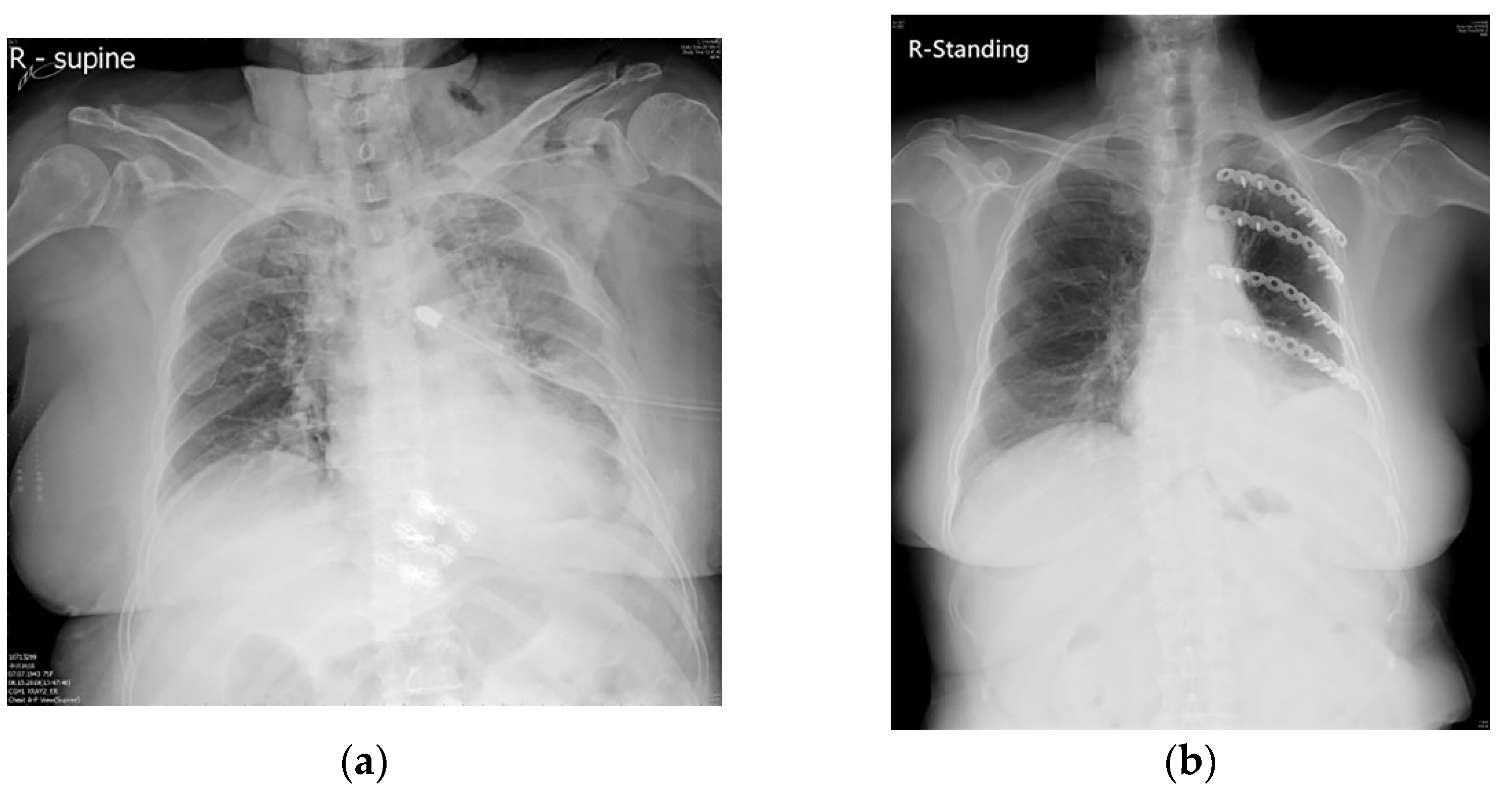
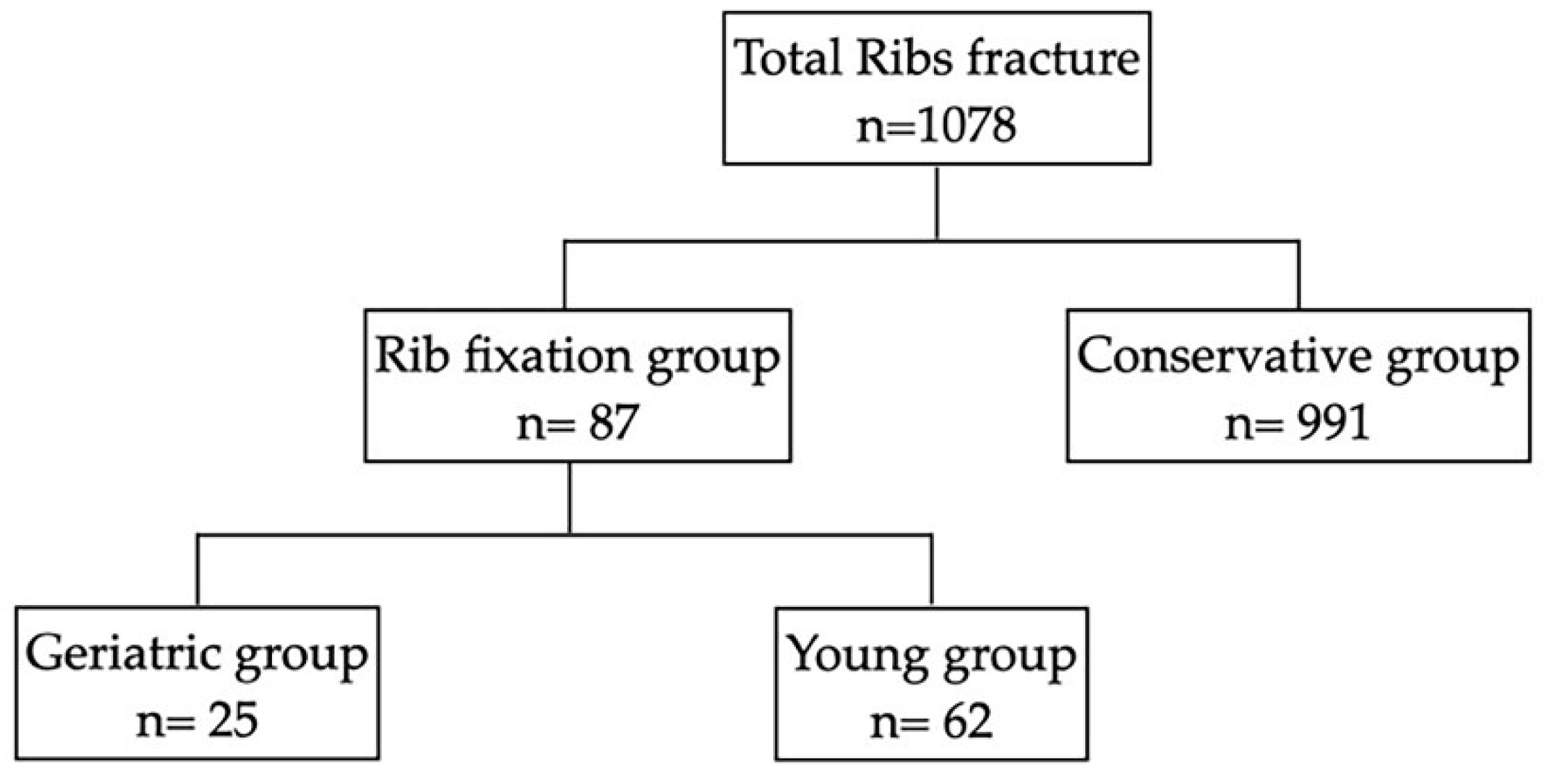

| Total | Non-Geriatric | Geriatric | p-Value † | |
|---|---|---|---|---|
| (n = 87) | (n = 62, 71.3%) | (n = 25, 28.7%) | ||
| Demographic data | ||||
| Gender | 0.794 | |||
| Male (n, %) | 62, 71.3% | 45, 72.6% | 17, 68.0% | |
| Female (n, %) | 25, 28.7% | 17, 27.4% | 8, 32.0% | |
| Age (median, IQR) | 56.00 [51.00, 66.00] | 54.00 [47.00, 57.75] | 70.00 [67.00, 73.00] | <0.001 * |
| Body weight (median, IQR) | 68.00 [60.00, 74.85] | 70.00 [60.12, 77.93] | 65.00 [58.00, 70.50] | 0.117 |
| BMI (median, IQR) | 25.30 [22.75, 27.65] | 25.40 [22.40, 28.32] | 25.10 [23.20, 26.20] | 0.318 |
| Obesity (n, %) | 28, 32.2% | 23, 37.1% | 5, 20.0% | 0.138 |
| Mechanism | 0.898 | |||
| Traffic accident (n, %) | 58, 66.7% | 40, 64.5% | 18, 72.0% | |
| Fall (n, %) | 27, 31.0% | 20, 32.3% | 7, 28.0% | |
| Blunt injury(n, %) | 2, 2.3% | 2, 3.2% | 0, 0.0% | |
| ISS (median, IQR) | 20.00 [16.00, 29.00] | 20.00 [16.00, 28.50] | 20.00 [16.00, 29.00] | 0.292 |
| NISS (median, IQR) | 24.00 [16.50, 34.00] | 24.00 [17.00, 33.50] | 24.00 [16.00, 34.00] | 0.880 |
| TRISS (median, IQR) | 0.94 [0.89, 0.97] | 0.96 [0.90, 0.99] | 0.92 [0.85, 0.94] | 0.010 * |
| Head AIS ≥ 3 (n, %) | 14, 16.1% | 9, 14.5% | 5, 20.0% | 0.532 |
| Chest AIS (median, IQR) | 4.00 [4.00, 4.00] | 4.00 [3.00, 4.00] | 4.00 [4.00, 4.00] | 0.037 * |
| Non-chest highest AIS (median, IQR) | 2.00 [1.00, 3.00] | 2.00 [1.00, 3.00] | 2.00 [1.00, 3.00] | 0.798 |
| Trauma pattern | ||||
| Rib fracture with flail segments | 0.031 * | |||
| Yes (n, %) | 49, 56.3% | 30, 48.4% | 19, 76.0% | |
| No (n, %) | 38, 43.7% | 32, 51.6% | 6, 24.0% | |
| Lung contusion (n, %) | 40, 46.0% | 27, 43.5% | 15, 60.0% | 0.488 |
| Pneumothorax (n, %) | 36, 41.4% | 26, 41.9% | 10, 40.0% | 1.000 |
| Hemothorax (n, %) | 79, 90.8% | 54, 87.1% | 25, 100.0% | 0.099 |
| Bilateral rib fractures (n, %) | 11, 12.6% | 8, 12.9% | 3, 12.0% | 1.000 |
| No. of fracture ribs (median, IQR) | 6.00 [5.00, 8.00] | 6.00 [5.00, 8.00] | 7.00 [5.00, 8.00] | 0.278 |
| No. of fracture sites (median, IQR) | 8.00 [5.00, 11.00] | 7.00 [5.00, 10.00] | 10.00 [6.00, 13.00] | 0.049 * |
| Pre-op ventilator usage (n, %) | 14, 16.1% | 10, 16.1% | 4, 16.0% | 1.000 |
| Post-op ventilator usage (n, %) | 33, 37.9% | 22, 35.5% | 11, 44.0% | 0.474 |
| Injury to operation (days, median, IQR) | 5.00 [3.00, 6.00] | 5.00 [3.00,6.00] | 5.00 [3.00,6.00] | 0.581 |
| Total | Non-Geriatric | Geriatric | p Value † | |
|---|---|---|---|---|
| (n = 87) | (n = 62, 71.3%) | (n = 25, 28.7%) | ||
| Surgical timing | 1 | |||
| Early surgery (n, %) | 56, 64.4% | 40, 64.5% | 16, 64.0% | |
| Late surgery (n, %) | 31, 35.6% | 22, 35.5% | 9, 36.0% | |
| Mortality (n, %) | 1, 1.1% | 1, 1.6% | 0, 0.0% | 1 |
| Length of stay (days, median, IQR) | 12.00 [10.00, 15.00] | 11.00 [9.25, 14.00] | 12.00 [10.00, 17.00] | 0.454 |
| ICU admission | 0.630 | |||
| Yes (n, %) | 34, 39.1% | 23, 37.1% | 11, 44.0% | |
| No (n, %) | 53, 60.9% | 39, 62.9% | 14, 56.0% | |
| ICU length of stay (days, median, IQR) | 5.00 [3.00,10.00] | 7.00 [3.00, 10.00] | 3.00 [2.00, 10.00] | 0.745 |
| Ventilatory days (days, median, IQR) | 4.00 [2.00,7.00] | 4.00 [1.00, 13.00] | 3.00 [1.00, 8.00] | 0.628 |
| Chest tube days (days, median, IQR) | 7.00 [4.00,11.75] | 7.00 [4.00, 11.75] | 9.00 [4.00, 12.00] | 0.895 |
| Complications (n, %) | 14, 16.1% | 10, 16.1% | 4, 16.0% | 1 |
| No Complication (n = 73) | With Complication (n = 14) | Univariate OR (95% CI, p-Value) | Multivariate † OR (95% CI, p-Value) | |
|---|---|---|---|---|
| Age group | ||||
| Geriatric (n, %) | 21, 28.8% | 4, 28.6% | 0.99 (0.25–3.33, p = 0.988) | |
| Non-geriatric (n, %) | 52, 71.2% | 10, 71.4% | 1 | |
| Gender | ||||
| Male (n, %) | 20, 27.4% | 5, 35.7% | 1.47 (0.41–4.82, p = 0.530) | |
| Female (n, %) | 53, 72.6% | 9, 64.3% | 1 | |
| Obesity | 25, 89.3% | 3, 10.7% | 0.52 (0.11–1.86, p = 0.353) | |
| ISS (median, IQR) | 20.00 [16.00, 24.00] | 29.00 [21.25, 34.00] | 1.12 (1.04–1.21, p = 0.003 *) | |
| NISS (median, IQR) | 24.00 [16.00, 29.00] | 33.50 [24.25, 41.00] | 1.09 (1.03–1.16, p = 0.003 *) | 1.06 (1.00–1.13, p = 0.071) |
| TRISS (median, IQR) | 0.96 [0.92, 0.98] | 0.85 [0.65, 0.91] | 0.01 (0.00–0.23, p = 0.010 *) | |
| No. of fracture ribs (median, IQR) | 6.00 [5.00, 8.00] | 8.00 [6.25, 11.75] | 1.26 (1.05–1.52, p = 0.014 *) | |
| No. of fracture sites (median, IQR) | 7.00 [5.00, 11.00] | 10.50 [7.50, 14.75] | 1.14 (1.02–1.29, p = 0.024 *) | |
| Bilateral rib fractures | 5, 45.5% | 6, 54.5% | 10.20 (2.55–43.63, p = 0.001 *) | 6.60 (1.38–35.54, p = 0.020 *) |
| Head AIS ≥ 3 | 10, 71.4% | 4, 28.6% | 2.52 (0.60–9.29, p = 0.176) | |
| Late surgery | 23, 74.2% | 8, 25.8% | 2.90 (0.91–9.74, p = 0.074) | 2.94 (0.77–12.68, p = 0.122) |
Publisher’s Note: MDPI stays neutral with regard to jurisdictional claims in published maps and institutional affiliations. |
© 2022 by the authors. Licensee MDPI, Basel, Switzerland. This article is an open access article distributed under the terms and conditions of the Creative Commons Attribution (CC BY) license (https://creativecommons.org/licenses/by/4.0/).
Share and Cite
Chen, S.-A.; Liao, C.-A.; Kuo, L.-W.; Hsu, C.-P.; Ouyang, C.-H.; Cheng, C.-T. The Surgical Timing and Complications of Rib Fixation for Rib Fractures in Geriatric Patients. J. Pers. Med. 2022, 12, 1567. https://doi.org/10.3390/jpm12101567
Chen S-A, Liao C-A, Kuo L-W, Hsu C-P, Ouyang C-H, Cheng C-T. The Surgical Timing and Complications of Rib Fixation for Rib Fractures in Geriatric Patients. Journal of Personalized Medicine. 2022; 12(10):1567. https://doi.org/10.3390/jpm12101567
Chicago/Turabian StyleChen, Szu-An, Chien-An Liao, Ling-Wei Kuo, Chih-Po Hsu, Chun-Hsiang Ouyang, and Chi-Tung Cheng. 2022. "The Surgical Timing and Complications of Rib Fixation for Rib Fractures in Geriatric Patients" Journal of Personalized Medicine 12, no. 10: 1567. https://doi.org/10.3390/jpm12101567
APA StyleChen, S.-A., Liao, C.-A., Kuo, L.-W., Hsu, C.-P., Ouyang, C.-H., & Cheng, C.-T. (2022). The Surgical Timing and Complications of Rib Fixation for Rib Fractures in Geriatric Patients. Journal of Personalized Medicine, 12(10), 1567. https://doi.org/10.3390/jpm12101567

