
Invasive Candidiasis in Hospitalized Patients with Major Burns
 , ,
, ,
Abstract
:1. Introduction
2. Materials and Methods
2.1. Database
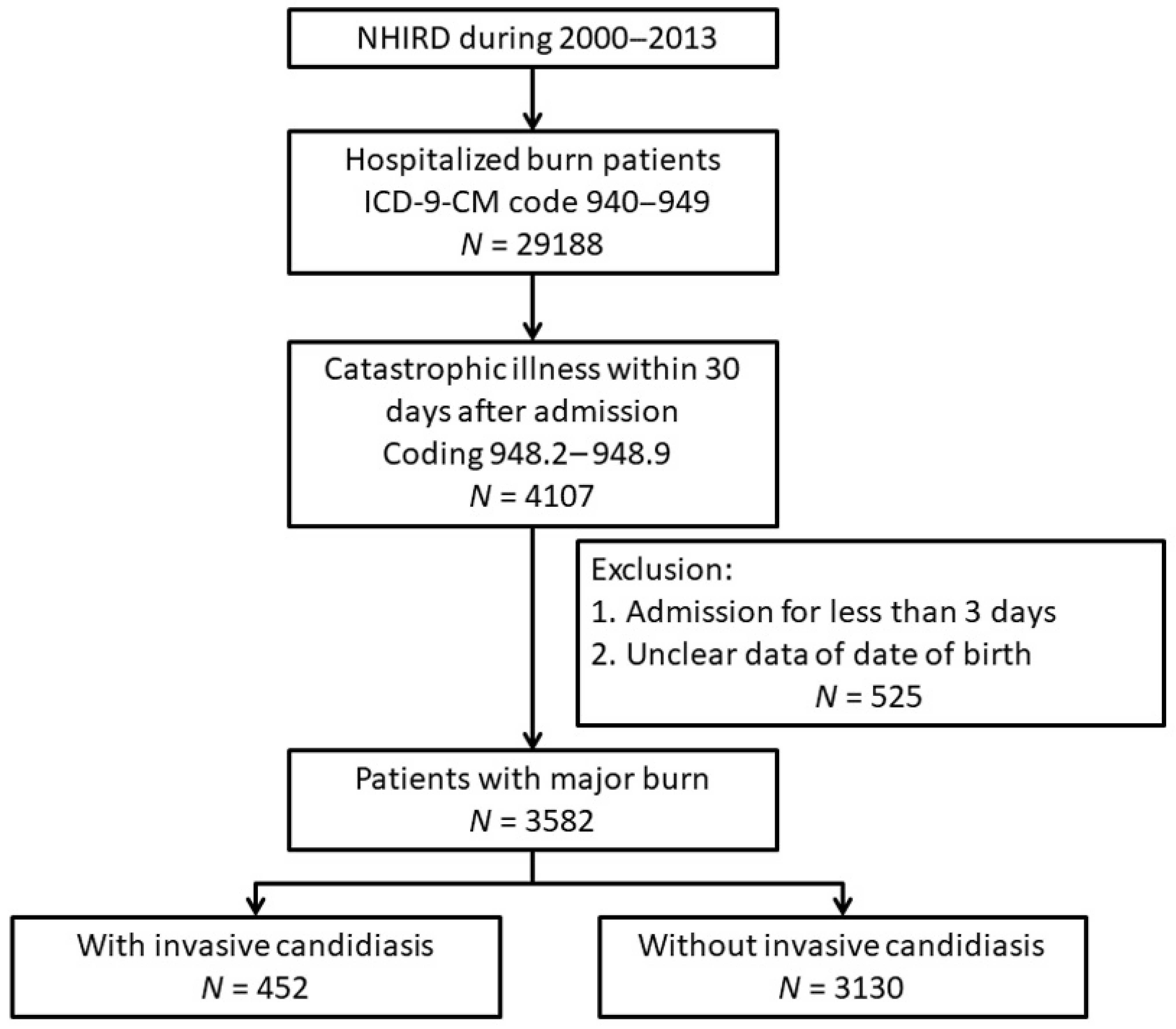
2.2. Study Design
2.3. Statistical Analysis
3. Results
4. Discussion
5. Conclusions
Author Contributions
Funding
Institutional Review Board Statement
Informed Consent Statement
Data Availability Statement
Acknowledgments
Conflicts of Interest
References
- World Health Organization. Burns. Available online: https://www.who.int/news-room/fact-sheets/detail/burns (accessed on 7 July 2021).
- Ha, J.F.; Italiano, C.M.; Heath, C.H.; Shih, S.; Rea, S.; Wood, F.M. Candidemia and invasive candidiasis: A review of the literature for the burns surgeon. Burns J. Int. Soc. Burn Inj. 2011, 37, 181–195. [Google Scholar] [CrossRef]
- Fochtmann, A.; Forstner, C.; Hagmann, M.; Keck, M.; Muschitz, G.; Presterl, E.; Ihra, G.; Rath, T. Predisposing factors for candidemia in patients with major burns. Burns J. Int. Soc. Burn Inj. 2015, 41, 326–332. [Google Scholar] [CrossRef]
- Desai, M.H.; Rutan, R.L.; Heggers, J.P.; Herndon, D.N. Candida infection with and without nystatin prophylaxis. A 11-year experience with patients with burn injury. Arch. Surg. 1992, 127, 159–162. [Google Scholar] [CrossRef]
- Still, J.M., Jr.; Belcher, K.; Law, E.J. Management of candida septicaemia in a regional burn unit. Burns J. Int. Soc. Burn Inj. 1995, 21, 594–596. [Google Scholar] [CrossRef]
- Ballard, J.; Edelman, L.; Saffle, J.; Sheridan, R.; Kagan, R.; Bracco, D.; Cancio, L.; Cairns, B.; Baker, R.; Fillari, P.; et al. Positive fungal cultures in burn patients: A multicenter review. J. Burn Care Res. Off. Publ. Am. Burn Assoc. 2008, 29, 213–221. [Google Scholar] [CrossRef]
- Sarabahi, S.; Tiwari, V.K.; Arora, S.; Capoor, M.R.; Pandey, A. Changing pattern of fungal infection in burn patients. Burns J. Int. Soc. Burn Inj. 2012, 38, 520–528. [Google Scholar] [CrossRef]
- Gonzalez-Lara, M.F.; Ostrosky-Zeichner, L. Invasive Candidiasis. Semin. Respir. Crit. Care Med. 2020, 41, 3–12. [Google Scholar] [CrossRef]
- Cheng, C.L.; Kao, Y.H.; Lin, S.J.; Lee, C.H.; Lai, M.L. Validation of the National Health Insurance Research Database with ischemic stroke cases in Taiwan. Pharmacoepidemiol. Drug Saf. 2011, 20, 236–242. [Google Scholar] [CrossRef]
- Yen, C.I.; Chiou, M.J.; Kuo, C.F.; Liao, H.T. Determination of risk factors for burn mortality based on a regional population study in Taiwan. Burns J. Int. Soc. Burn Inj. 2018, 44, 1591–1601. [Google Scholar] [CrossRef]
- Strollo, S.; Lionakis, M.S.; Adjemian, J.; Steiner, C.A.; Prevots, D.R. Epidemiology of Hospitalizations Associated with Invasive Candidiasis, United States, 2002–2012(1). Emerg. Infect. Dis. 2016, 23, 7–13. [Google Scholar] [CrossRef] [Green Version]
- Pedrosa, A.F.; Rodrigues, A.G. Candidemia in burn patients: Figures and facts. J. Trauma 2011, 70, 498–506. [Google Scholar] [CrossRef]
- Horvath, E.E.; Murray, C.K.; Vaughan, G.M.; Chung, K.K.; Hospenthal, D.R.; Wade, C.E.; Holcomb, J.B.; Wolf, S.E.; Mason, A.D., Jr.; Cancio, L.C. Fungal wound infection (not colonization) is independently associated with mortality in burn patients. Ann. Surg. 2007, 245, 978–985. [Google Scholar] [CrossRef]
- Renau Escrig, A.I.; Salavert, M.; Vivó, C.; Cantón, E.; Pérez Del Caz, M.D.; Pemán, J. Candidemia in major burns patients. Mycoses 2016, 59, 391–398. [Google Scholar] [CrossRef]
- Koulenti, D.; Blot, S. Patterns in the epidemiology of candidemia as a consequence of antibiotic and antifungal exposure. Burns J. Int. Soc. Burn Inj. 2020, 46, 500–501. [Google Scholar] [CrossRef]
- Zhou, J.; Tan, J.; Gong, Y.; Li, N.; Luo, G. Candidemia in major burn patients and its possible risk factors: A 6-year period retrospective study at a burn ICU. Burns J. Int. Soc. Burn Inj. 2019, 45, 1164–1171. [Google Scholar] [CrossRef]
- Devrim, İ.; Kara, A.; Düzgöl, M.; Karkıner, A.; Bayram, N.; Temir, G.; Şencan, A.; Sorguç, Y.; Gülfidan, G.; Hoşgör, M. Burn-associated bloodstream infections in pediatric burn patients: Time distribution of etiologic agents. Burns J. Int. Soc. Burn Inj. 2017, 43, 144–148. [Google Scholar] [CrossRef]
- Palackic, A.; Popp, D.; Tapking, C.; Houschyar, K.S.; Branski, L.K. Fungal Infections in Burn Patients. Surg. Infect. 2021, 22, 83–87. [Google Scholar] [CrossRef]
- Kullberg, B.J.; Arendrup, M.C. Invasive Candidiasis. N. Engl. J. Med. 2015, 373, 1445–1456. [Google Scholar] [CrossRef] [Green Version]
- Heard, J.; Pape, K.; Romanowski, K.; Liu, Y.; Herrera, S.; Granchi, T.; Wibbenmeyer, L. 287 Invasive Fungal Infections in Burns: Case Series and Review of the Literature. J. Burn Care Res. 2018, 39, S112. [Google Scholar] [CrossRef]
- Sharma, S.; Bajaj, D.; Sharma, P. Fungal Infection in Thermal Burns: A Prospective Study in a Tertiary Care Centre. J. Clin. Diagn. Res. JCDR 2016, 10, pc05–pc07. [Google Scholar] [CrossRef]
- Murray, C.K.; Loo, F.L.; Hospenthal, D.R.; Cancio, L.C.; Jones, J.A.; Kim, S.H.; Holcomb, J.B.; Wade, C.E.; Wolf, S.E. Incidence of systemic fungal infection and related mortality following severe burns. Burns J. Int. Soc. Burn Inj. 2008, 34, 1108–1112. [Google Scholar] [CrossRef]
- Gonçalves, B.; Ferreira, C.; Alves, C.T.; Henriques, M.; Azeredo, J.; Silva, S. Vulvovaginal candidiasis: Epidemiology, microbiology and risk factors. Crit. Rev. Microbiol. 2016, 42, 905–927. [Google Scholar] [CrossRef] [Green Version]
- Kalo-Klein, A.; Witkin, S.S. Candida albicans: Cellular immune system interactions during different stages of the menstrual cycle. Am. J. Obstet. Gynecol. 1989, 161, 1132–1136. [Google Scholar] [CrossRef]
- Skowronski, R.; Feldman, D. Characterization of an estrogen-binding protein in the yeast Candida albicans. Endocrinology 1989, 124, 1965–1972. [Google Scholar] [CrossRef]
- Struck, M.F.; Gille, J. Fungal infections in burns: A comprehensive review. Ann. Burn. Fire Disasters 2013, 26, 147–153. [Google Scholar]


| Year | Incidence | Total Population at Risk | Annual Incidence | ||||||
|---|---|---|---|---|---|---|---|---|---|
| per 105/Year | |||||||||
| Female | Male | Total | Female | Male | Total | Female | Male | Total | |
| 2000 | 46 | 150 | 196 | 14,109,224 | 14,085,347 | 28,194,571 | 0.33 | 1.06 | 0.70 |
| 2001 | 39 | 127 | 166 | 13,981,319 | 13,896,934 | 27,878,253 | 0.28 | 0.91 | 0.60 |
| 2002 | 64 | 191 | 255 | 13,823,504 | 13,711,521 | 27,535,025 | 0.46 | 1.39 | 0.93 |
| 2003 | 94 | 231 | 325 | 13,651,279 | 13,523,811 | 27,175,090 | 0.69 | 1.71 | 1.20 |
| 2004 | 86 | 236 | 322 | 13,526,372 | 13,378,291 | 26,904,663 | 0.64 | 1.76 | 1.20 |
| 2005 | 98 | 241 | 339 | 13,406,980 | 13,244,026 | 26,651,006 | 0.73 | 1.82 | 1.27 |
| 2006 | 72 | 228 | 300 | 13,276,737 | 13,103,229 | 26,379,966 | 0.54 | 1.74 | 1.14 |
| 2007 | 82 | 196 | 278 | 13,154,033 | 12,959,788 | 26,113,821 | 0.62 | 1.51 | 1.06 |
| 2008 | 72 | 225 | 297 | 13,034,087 | 12,820,600 | 25,854,687 | 0.55 | 1.75 | 1.15 |
| 2009 | 71 | 187 | 258 | 12,903,363 | 12,664,408 | 25,567,771 | 0.55 | 1.48 | 1.01 |
| 2010 | 64 | 165 | 229 | 12,769,325 | 12,510,816 | 25,280,141 | 0.50 | 1.32 | 0.91 |
| 2011 | 52 | 174 | 226 | 12,666,864 | 12,388,276 | 25,055,140 | 0.41 | 1.40 | 0.90 |
| 2012 | 56 | 176 | 232 | 12,558,021 | 12,258,413 | 24,816,434 | 0.45 | 1.44 | 0.93 |
| 2013 | 49 | 110 | 159 | 12,444,261 | 12,125,619 | 24,569,880 | 0.39 | 0.91 | 0.65 |
| Year | Invasive Candidiasis | Total Number of Patients | Annual Incidence | ||||||
|---|---|---|---|---|---|---|---|---|---|
| per 100/Year | |||||||||
| Female | Male | Total | Female | Male | Total | Female | Male | Total | |
| 2000 | 3 | 10 | 13 | 46 | 150 | 196 | 6.52 | 6.67 | 6.63 |
| 2001 | 8 | 10 | 18 | 39 | 127 | 166 | 20.51 | 7.87 | 10.84 |
| 2002 | 9 | 15 | 24 | 64 | 191 | 255 | 14.06 | 7.85 | 9.41 |
| 2003 | 16 | 27 | 43 | 94 | 231 | 325 | 17.02 | 11.69 | 13.23 |
| 2004 | 12 | 26 | 38 | 86 | 236 | 322 | 13.95 | 11.02 | 11.80 |
| 2005 | 4 | 27 | 31 | 98 | 241 | 339 | 4.08 | 11.20 | 9.14 |
| 2006 | 11 | 26 | 37 | 72 | 228 | 300 | 15.28 | 11.40 | 12.33 |
| 2007 | 12 | 38 | 50 | 82 | 196 | 278 | 14.63 | 19.39 | 17.99 |
| 2008 | 10 | 20 | 30 | 72 | 225 | 297 | 13.89 | 8.89 | 10.10 |
| 2009 | 12 | 28 | 40 | 71 | 187 | 258 | 16.90 | 14.97 | 15.50 |
| 2010 | 8 | 22 | 30 | 64 | 165 | 229 | 12.50 | 13.33 | 13.10 |
| 2011 | 9 | 26 | 35 | 52 | 174 | 226 | 17.31 | 14.94 | 15.49 |
| 2012 | 6 | 33 | 39 | 56 | 176 | 232 | 10.71 | 18.75 | 16.81 |
| 2013 | 7 | 17 | 24 | 49 | 110 | 159 | 14.29 | 15.45 | 15.09 |
| Characteristics | Without Invasive Candidiasis (n = 3130) | With Invasive Candidiasis (n = 452) | Total (n = 3582) | p-Value |
|---|---|---|---|---|
| n (%) | n (%) | n (%) | ||
| Age, mean ± SD | <0.001 | |||
| <30 | 1146 (36.6) | 99 (21.9) | 1245 | |
| 30–49 | 1202 (38.4) | 195 (43.1) | 1397 | |
| ≥50 | 782 (25.0) | 158 (35) | 940 | |
| Sex | 0.376 | |||
| Female | 818 (26.1) | 127 (28.1) | 945 | |
| Male | 2312 (73.9) | 325 (71.9) | 2637 | |
| Urbanization | 0.301 | |||
| Urban | 1569 (53.7) | 226 (56.5) | 1795 | |
| Suburban | 432 (14.8) | 48 (12.0) | 480 | |
| Rural | 919 (31.5) | 126 (31.5) | 1045 | |
| Family income (NTD) | 0.002 | |||
| ≤15,840 | 1839 (58.8) | 223 (49.3) | 2062 | |
| 15,841–28,800 | 977 (31.2) | 173 (38.3) | 1150 | |
| 28,801–45,800 | 211 (6.7) | 36 (8.0) | 247 | |
| >45,800 | 103 (3.3) | 20 (4.4) | 123 | |
| Diabetes | <0.001 | |||
| No | 2973 (95.0) | 410 (90.7) | 3383 | |
| Yes | 157 (5.0) | 42 (9.3) | 199 | |
| Hypertension | 0.001 | |||
| No | 2812 (89.8) | 382 (84.5) | 3194 | |
| Yes | 318 (10.2) | 70 (15.5) | 388 | |
| Hyperlipidemia | 0.536 | |||
| No | 2991 (95.6) | 429 (94.9) | 3420 | |
| Yes | 139 (4.4) | 23 (5.1) | 162 | |
| Burn sites | ||||
| Head | 1664 (53.2) | 292 (64.6) | 1956 | <0.001 |
| Trunk | 2196 (70.2) | 326 (72.1) | 2522 | 0.393 |
| Upper limbs | 1951 (62.3) | 268 (59.3) | 2219 | 0.213 |
| Hands | 621 (19.8) | 68 (15.0) | 689 | 0.016 |
| Lower limbs | 1726 (55.1) | 233 (51.5) | 1959 | 0.151 |
| Internal organs | 269 (8.6) | 49 (10.8) | 318 | 0.117 |
| TBSA of burn | <0.001 | |||
| 20–29% | 1423 (45.5) | 64 (14.2) | 1487 | |
| 30–39% | 676 (21.6) | 66 (14.6) | 742 | |
| 40–49% | 398 (12.7) | 82 (18.1) | 480 | |
| 50–59% | 187 (6.0) | 62 (13.7) | 249 | |
| 60–69% | 125 (4.0) | 57 (12.6) | 182 | |
| 70–79% | 106 (3.4) | 50 (11.1) | 156 | |
| 80–89% | 94 (3.0) | 37 (8.2) | 131 | |
| 90% or more | 121 (3.9) | 34 (7.5) | 155 | |
| Inhalation injury | 0.048 | |||
| No | 2925 (93.5) | 411 (90.9) | 3336 | |
| Yes | 205 (6.5) | 41 (9.1) | 246 | |
| Season | 0.675 | |||
| Winter | 1449 (46.3) | 214 (47.3) | 1663 | |
| Summer | 1681 (53.7) | 238 (52.7) | 1919 | |
| Mortality | ||||
| In 30 days | 318 (10.2) | 47 (10.4) | 365 | 0.876 |
| In 180 days | 404 (12.6) | 134 (29.7) | 538 | <0.001 |
| Variables | Multivariate | p-Value |
|---|---|---|
| Adjusted OR (95%CI) | ||
| Age, mean ± SD | ||
| <30 | 1.00 (ref) | |
| 30–49 | 1.34 (0.97–1.84) | 0.074 |
| ≥50 | 1.96 (1.36–2.82) | <0.001 |
| Gender | ||
| Female | 1.00 (ref) | |
| Male | 0.75 (0.58–0.97) | 0.029 |
| Urbanization | ||
| Urban | 1.00 (ref) | |
| Suburban | 0.89 (0.63–1.27) | 0.517 |
| Rural | 1.03 (0.80–1.32) | 0.838 |
| Family income (NTD) | ||
| ≤15,840 TWD | 1.00 (ref) | |
| 15,841–28,800 TWD | 0.98 (0.74–1.29) | 0.865 |
| 28,801–45,800 TWD | 1.19 (0.76–1.85) | 0.446 |
| >45,800 TWD | 1.13 (0.64–2.01) | 0.674 |
| Diabetes | 1.59 (0.99–2.54) | 0.053 |
| Hypertension | 1.17 (0.80–1.71) | 0.421 |
| Hyperlipidemia | 0.81 (0.47–1.41) | 0.456 |
| Burn sites | ||
| Head | 1.33 (1.02–1.73) | 0.036 |
| Trunk | 0.79 (0.60–1.05) | 0.103 |
| Upper limbs | 0.83 (0.64–1.07) | 0.149 |
| Hands | 0.80 (0.59–1.09) | 0.154 |
| Lower limbs | 0.88 (0.69–1.12) | 0.301 |
| Internal organs | 0.89 (0.40–1.98) | 0.776 |
| TBSA of burn | ||
| TBSA 20–29% | 1.00 (ref) | |
| TBSA 30–39% | 2.41 (1.63–3.57) | <0.001 |
| TBSA 40–49% | 4.81 (3.28–7.05) | <0.001 |
| TBSA 50–59% | 8.51 (5.63–12.84) | <0.001 |
| TBSA 60–69% | 11.59 (7.45–18.05) | <0.001 |
| TBSA 70–79% | 14.02 (8.83–22.25) | <0.001 |
| TBSA 80–89% | 12.06 (7.28–19.97) | <0.001 |
| TBSA 90% or more | 6.91 (4.04–11.82) | <0.001 |
| Inhalation injury | ||
| No | 1.00 (ref) | |
| Yes | 1.16 (0.48–2.76) | 0.744 |
| Season | ||
| Winter | 1.00 (ref) | |
| Summer | 0.83 (0.66–1.04) | 0.111 |
Publisher’s Note: MDPI stays neutral with regard to jurisdictional claims in published maps and institutional affiliations. |
© 2022 by the authors. Licensee MDPI, Basel, Switzerland. This article is an open access article distributed under the terms and conditions of the Creative Commons Attribution (CC BY) license (https://creativecommons.org/licenses/by/4.0/).
Share and Cite
Lin, Y.-L.; Chen, I.-C.; Yen, J.-H.; Lai, C.-S.; Tsai, Y.-C.; Lu, C.-T.; Wu, C.-Y.; Lin, W.-S.; Lin, C.-H.; Huang, Y.-C. Invasive Candidiasis in Hospitalized Patients with Major Burns. J. Pers. Med. 2022, 12, 47. https://doi.org/10.3390/jpm12010047
Lin Y-L, Chen I-C, Yen J-H, Lai C-S, Tsai Y-C, Lu C-T, Wu C-Y, Lin W-S, Lin C-H, Huang Y-C. Invasive Candidiasis in Hospitalized Patients with Major Burns. Journal of Personalized Medicine. 2022; 12(1):47. https://doi.org/10.3390/jpm12010047
Chicago/Turabian StyleLin, Yi-Ling, I-Chen Chen, Jung-Hsing Yen, Chih-Sheng Lai, Yueh-Chi Tsai, Chun-Te Lu, Cheng-Yeu Wu, Wei-Szu Lin, Ching-Heng Lin, and Yung-Chieh Huang. 2022. "Invasive Candidiasis in Hospitalized Patients with Major Burns" Journal of Personalized Medicine 12, no. 1: 47. https://doi.org/10.3390/jpm12010047
APA StyleLin, Y.-L., Chen, I.-C., Yen, J.-H., Lai, C.-S., Tsai, Y.-C., Lu, C.-T., Wu, C.-Y., Lin, W.-S., Lin, C.-H., & Huang, Y.-C. (2022). Invasive Candidiasis in Hospitalized Patients with Major Burns. Journal of Personalized Medicine, 12(1), 47. https://doi.org/10.3390/jpm12010047