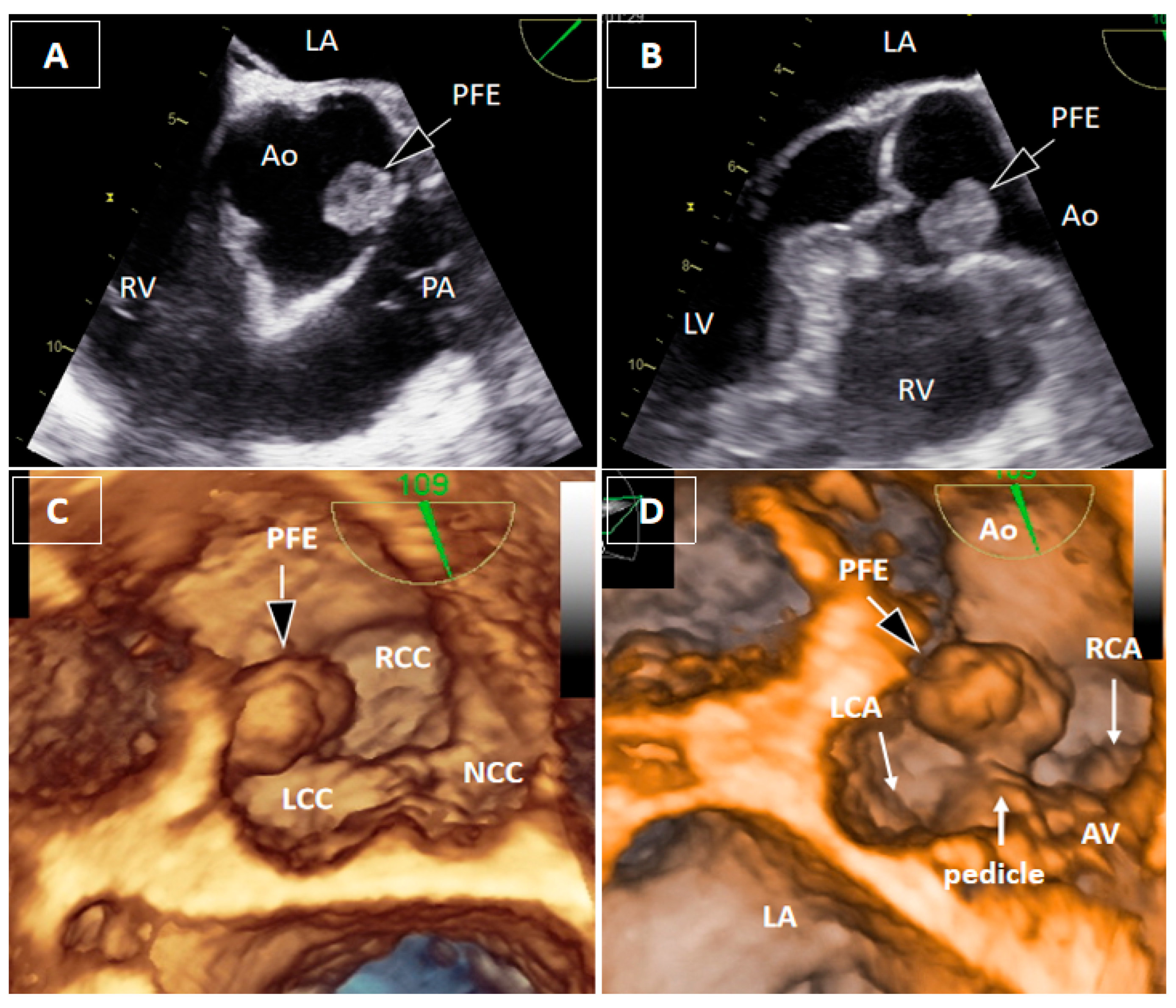
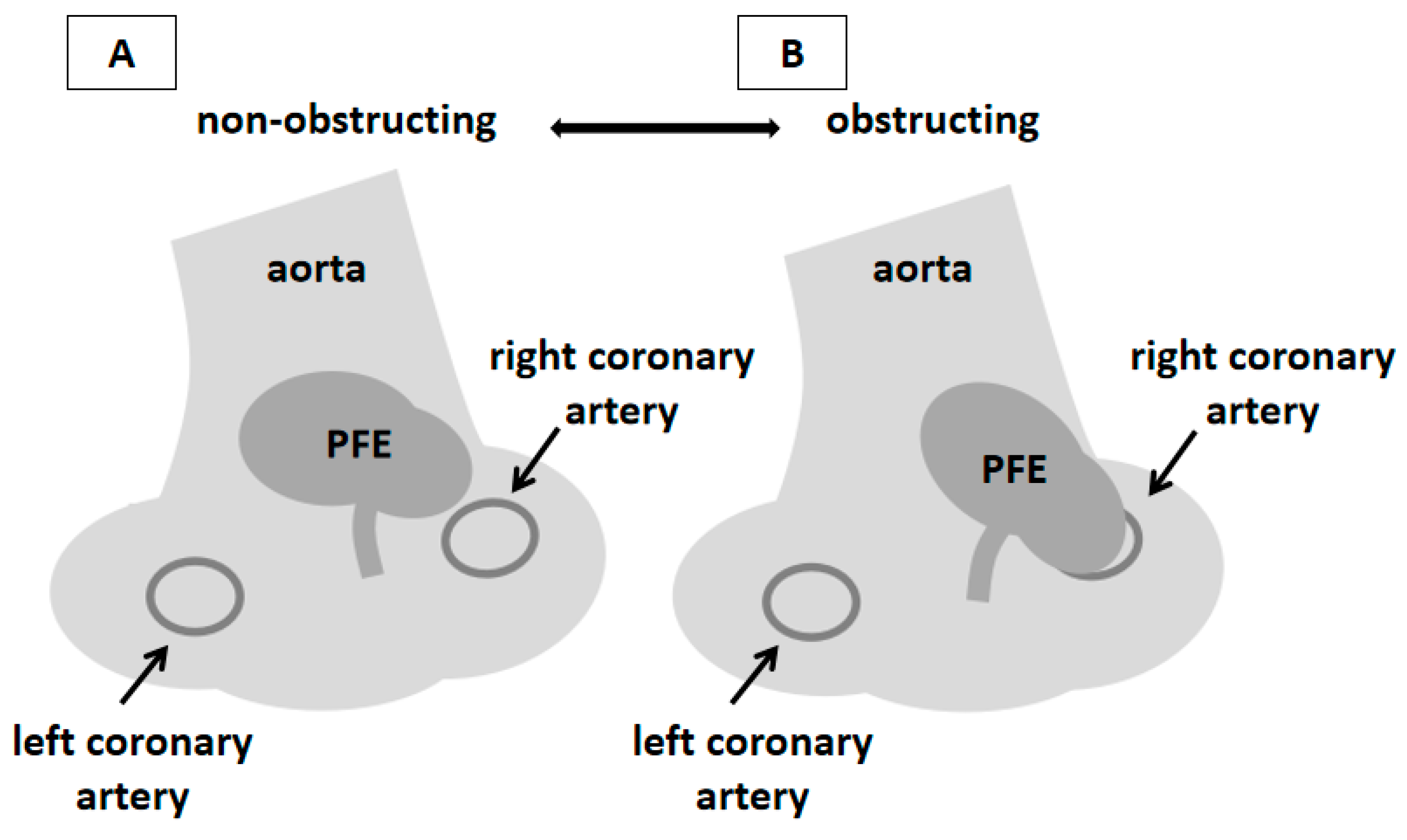
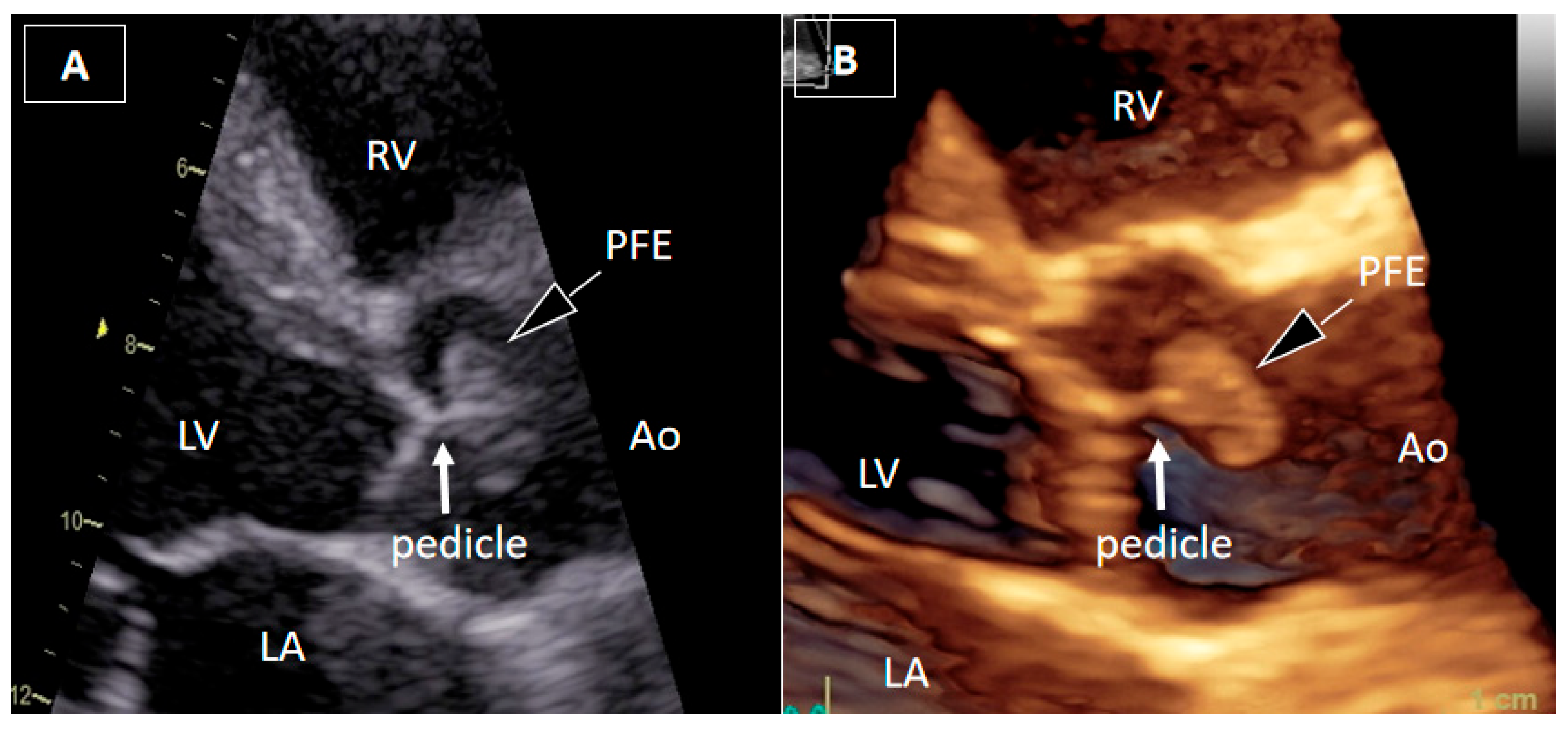
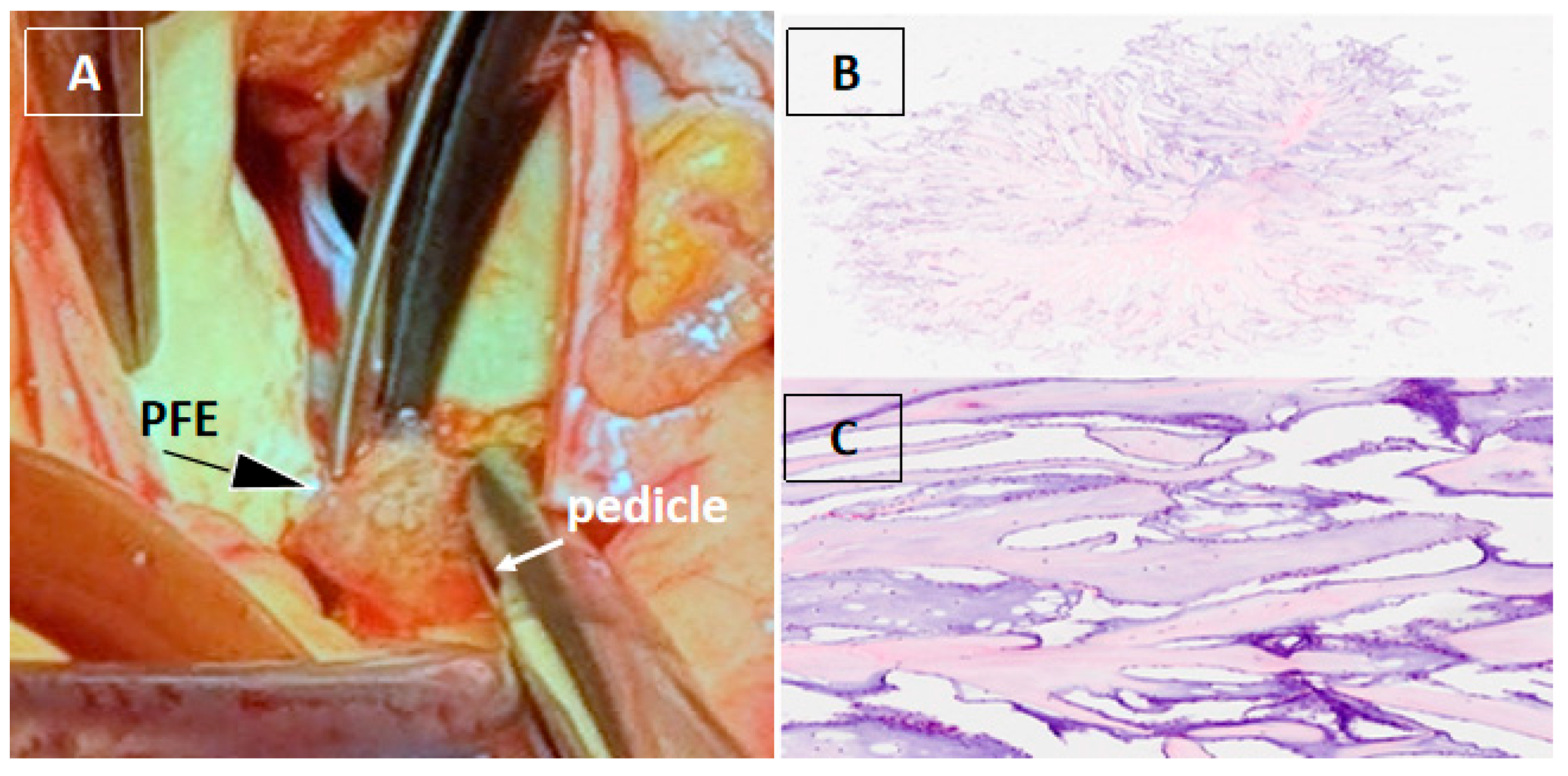
Papillary Fibroelastoma of the Aortic Root Causing Intermittent Coronary Ostial Obstruction: The Diagnostic Power of 3D Transesophageal Echocardiography

Abstract


Author Contributions
Funding
Institutional Review Board Statement
Informed Consent Statement
Data Availability Statement
Conflicts of Interest
Abbreviations
| Ao | Aorta |
| AV | Aortic valve |
| LA | Left atrium |
| LCA | Left coronary artery |
| LCC | Left coronary cusp |
| LV | Left ventricle |
| NCC | Non coronary cusp |
| PFE | Papillary fibroelastoma |
| PA | Pulmonary artery |
| RCA | Right coronary artery |
| RCC | Right coronary cusp |
| RV | Right ventricle |
| 2DTTE | Two-dimensional transthoracic echocardiography |
| 3DTTE | Three-dimensional transthoracic echocardiography |
| 2DTEE | Two-dimensional transesophageal echocardiography |
| 3DTEE | Three-dimensional transesophageal echocardiography |
References
- Gowda, R.M.; Khan, I.A.; Nair, C.K.; Mehta, N.J.; Vasavada, B.C.; Sacchi, T. Cardiac papillary fibroelastoma: A comprehensive analysis of 725 cases. J. Am. Heart J. 2003, 146, 404–410. [Google Scholar] [CrossRef] [PubMed]
- Ikegami, H.; Andrei, A.C.; Li, Z.; McCarthy, P.M.; Malaisrie, S.C. Papillary fibroelastoma of the aortic valve: Analysis of 21 cases, including a presentation with cardiac arrest. Tex. Heart Inst. J. 2015, 42, 131–135. [Google Scholar] [CrossRef] [PubMed]
- Alozie, A.; Zimpfer, A.; Erbersdobler, A.; Neßelmann, C.; Öner, A.; Dohmen, P.M. Surgery for Valvular and Nonvalvular Papillary Fibroelastomas. Semin. Thorac. Cardiovasc. Surg. 2022, 34, 560–568. [Google Scholar] [CrossRef] [PubMed]
- Aggeli, C.; Dimitroglou, Y.; Raftopoulos, L.; Sarri, G.; Mavrogeni, S.; Wong, J.; Tsiamis, E.; Tsioufis, C. Cardiac Masses: The Role of Cardiovascular Imaging in the Differential Diagnosis. Diagnostics 2020, 10, 1088. [Google Scholar] [CrossRef] [PubMed]
- Sozzi, F.B.; Gnan, E.; Pandolfi, A.; Iacuzio, L.; Kim, J.K.; Canetta, C.; Rizzuto, A.S.; Ruscica, M.; Carugo, S. Diagnostic Algorithm Using Multimodal Imaging for the Differential Diagnosis of Intra-Cardiac Masses. J. Clin. Med. 2025, 14, 508. [Google Scholar] [CrossRef] [PubMed]
- Tyebally, S.; Chen, D.; Bhattacharyya, S.; Mughrabi, A.; Hussainm, Z.; Manisty, C.; Westwood, M.; Ghosh, A.K.; Guha, A. Cardiac Tumors. J. Am. Coll. Cardiol. Cardio Oncol. 2020, 2, 293–311. [Google Scholar] [CrossRef] [PubMed]
- Kurmann, R.; El-Am, E.; Ahmad, A.; Abbasi, M.A.; Mazur, P.; Akiki, E.; Anand, V.; Herrmann, J.; Casanegra, A.I.; Young, P.; et al. Cardiac Masses Discovered by Echocardiogram; What to Do Next? Struct. Heart. 2023, 7, 100154. [Google Scholar] [CrossRef] [PubMed]
- Al-Azizi, K.M.; Hamandi, M.; Baxter, R.; Krueger, A.; Crawford, A.W.; William, M.; Good, C.; Mead, N.J. Papillary Fibroelastoma of the Ascending Aorta. Investig. Med. High Impact. Case Rep. 2019, 7, 2324709619840377. [Google Scholar] [CrossRef] [PubMed]
- Tadic, S.; Ilic, A.; Stefanovic, M.; Stojsic-Milosavljevic, A.; Popov, T.; Bjelobrk, M.; Milovancev, A.; Maksimovic, N.; Drid, P. Case Report: Multimodality Imaging as a lifeline for fatal localization of Valsalva sinus fibroelastoma. Front. Cardiovasc. Med. 2021, 8, 683534. [Google Scholar] [CrossRef] [PubMed]
- Erdoes, G.; Stalder, M.; Basciani, R.; Gugger, M.; Carrel, T.; Eberle, B. An uncommon cause of coronary artery ostial obstruction: Papillary fibroelastoma. Echocardiography 2010, 27, 337–340. [Google Scholar] [CrossRef] [PubMed]
- Masiello, P.; Catalano, A.; Mastrogiovanni, G.; Eusebio, G.; De Roberto, A.M.; Chivasso, P.; Ciancia, G.; Iesu, I.; Triggiani, D.; Iesu, S. Surgical removal of an exceedingly rare papillary fibroelastoma of the aortic wall causing unstable angina. Clin. Case Rep. 2021, 9, e04688. [Google Scholar] [CrossRef] [PubMed]
- Huenges, K.; Hartmann, F.; Panholzer, B.; Puehler, T. Successful interdisciplinary treatment of a rare cause of acute myocardial ischaemia from intermittent tumour-associated obstruction of the left main coronary artery: A case report. Eur. Heart J. Case Rep. 2021, 5, ytab292. [Google Scholar] [CrossRef] [PubMed]
- Ramirez, A.Y.; Kashuba-Shanahan, K.M.; Cavallaro, J.A.; Fentanes, E. Mobile Papillary Fibroelastoma Leading to Severe Chest Pain via Left Main Occlusion. JACC Case Rep. 2025, 30, 103535. [Google Scholar] [CrossRef] [PubMed]
- Hendrickx, I.; Bertrand, P.B.; Vrolix, M.; Ferdinande, B.; Cruysberghs, Y. Papillary fibro-elastoma as a rare cause of rate-dependent angina: Importance of diastolic coronary perfusion. Eur. Heart J. Cardiovasc. Imaging 2016, 17, 632. [Google Scholar] [CrossRef] [PubMed][Green Version]
Disclaimer/Publisher’s Note: The statements, opinions and data contained in all publications are solely those of the individual author(s) and contributor(s) and not of MDPI and/or the editor(s). MDPI and/or the editor(s) disclaim responsibility for any injury to people or property resulting from any ideas, methods, instructions or products referred to in the content. |
© 2026 by the authors. Licensee MDPI, Basel, Switzerland. This article is an open access article distributed under the terms and conditions of the Creative Commons Attribution (CC BY) license.
Share and Cite
Bečić, T.; Perković-Avelini, R.; Fabijanić, D. Papillary Fibroelastoma of the Aortic Root Causing Intermittent Coronary Ostial Obstruction: The Diagnostic Power of 3D Transesophageal Echocardiography. Diagnostics 2026, 16, 168. https://doi.org/10.3390/diagnostics16010168
Bečić T, Perković-Avelini R, Fabijanić D. Papillary Fibroelastoma of the Aortic Root Causing Intermittent Coronary Ostial Obstruction: The Diagnostic Power of 3D Transesophageal Echocardiography. Diagnostics. 2026; 16(1):168. https://doi.org/10.3390/diagnostics16010168
Chicago/Turabian StyleBečić, Tina, Ružica Perković-Avelini, and Damir Fabijanić. 2026. "Papillary Fibroelastoma of the Aortic Root Causing Intermittent Coronary Ostial Obstruction: The Diagnostic Power of 3D Transesophageal Echocardiography" Diagnostics 16, no. 1: 168. https://doi.org/10.3390/diagnostics16010168
APA StyleBečić, T., Perković-Avelini, R., & Fabijanić, D. (2026). Papillary Fibroelastoma of the Aortic Root Causing Intermittent Coronary Ostial Obstruction: The Diagnostic Power of 3D Transesophageal Echocardiography. Diagnostics, 16(1), 168. https://doi.org/10.3390/diagnostics16010168