Association of Endothelial Activation and Stress Index with Prognosis in Posterior Circulation Infarcts Treated with Recanalization Therapy

 , , ,
, , ,
Abstract
1. Introduction
2. Materials and Methods
Statistical Analysis
3. Results
4. Discussion
5. Conclusions
Author Contributions
Funding
Institutional Review Board Statement
Informed Consent Statement
Data Availability Statement
Conflicts of Interest
References
- Linfante, I.; Walker, G.R.; Castonguay, A.C.; Dabus, G.; Starosciak, A.K.; Yoo, A.J.; Abou-Chebl, A.; Britz, G.W.; Marden, F.A.; Alvarez, A.; et al. Predictors of mortality in acute ischemic stroke intervention: Analysis of the North American Solitaire Acute Stroke Registry. Stroke 2015, 46, 2305–2308. [Google Scholar] [CrossRef]
- Salerno, A.; Strambo, D.; Nannoni, S.; Dunet, V.; Michel, P. Patterns of ischemic posterior circulation strokes: A clinical, anatomical, and radiological review. Int. J. Stroke 2022, 17, 714–722. [Google Scholar] [CrossRef] [PubMed]
- Gramegna, L.L.; Requena, M.; Dinia, L.; Melendez, F.; Hernández, D.; Coscojuela, P.; Quintana, M.; Vert, C.; Rubiera, M.; Ribò, M.; et al. Predictors of response to endovascular treatment of posterior circulation stroke. Eur. J. Radiol. 2019, 116, 219–224. [Google Scholar] [CrossRef]
- Yoshimura, S.; Sakai, N.; Okada, Y.; Kitagawa, K.; Kimura, K.; Tanahashi, N.; Hyogo, T.; Yamagami, H.; Egashira, Y. Efficacy of endovascular treatment for acute cerebral large-vessel occlusion: Analysis of nationwide prospective registry. J. Stroke Cerebrovasc. Dis. 2014, 23, 1183–1190. [Google Scholar] [CrossRef]
- Liu, X.; Dai, Q.; Ye, R.; Zi, W.; Liu, Y.; Wang, H.; Zhu, W.; Ma, M.; Yin, Q.; Li, M.; et al. Endovascular treatment versus standard medical treatment for vertebrobasilar artery occlusion (BEST): An open-label, randomised controlled trial. Lancet Neurol. 2020, 19, 115–122. [Google Scholar] [CrossRef]
- Tuttolomondo, A.; Daidone, M.; Pinto, A. Endothelial dysfunction and inflammation in ischemic stroke pathogenesis. Curr. Pharm. Des. 2020, 26, 4209–4219. [Google Scholar] [CrossRef] [PubMed]
- Živančević, M.K.; Lović, D.; Radenovic, P.L. Neuroinflammation in post-ischemic brain. In Cerebral Ischemia [Internet]; Exon Publications: Brisbane, Australia, 2021; pp. 87–109. [Google Scholar]
- Shah, W.; Zhao, Q.; Wang, S.; Zhang, M.; Ma, H.; Guan, Y.; Zhang, Y.; Liu, Y.; Zhu, C.; Wang, S.; et al. Polydatin improves vascular endothelial function by maintaining mitochondrial homeostasis under high glucose conditions. Sci. Rep. 2023, 13, 16550. [Google Scholar] [CrossRef]
- Chen, B.; Zhang, Y.; Chen, S.; Li, X.; Dong, J.; Chen, W.; Tao, S.; Yang, W.; Zhang, Y. The role of vascular endothelial growth factor in ischemic stroke. Pharmazie 2021, 76, 127–131. [Google Scholar] [PubMed]
- Wang, X.; He, B. Endothelial dysfunction: Molecular mechanisms and clinical implications. MedComm 2024, 5, e651. [Google Scholar] [CrossRef]
- Piccardi, B.; Giralt, D.; Bustamante, A.; Llombart, V.; García-Berrocoso, T.; Inzitari, D.; Montaner, J. Blood markers of inflammation and endothelial dysfunction in cardioembolic stroke: Systematic review and meta-analysis. Biomarkers 2017, 22, 200–209. [Google Scholar] [CrossRef]
- Poggesi, A.; Pasi, M.; Pescini, F.; Pantoni, L.; Inzitari, D. Circulating biologic markers of endothelial dysfunction in cerebral small vessel disease: A review. J. Cereb. Blood Flow. Metab. 2016, 36, 72–94. [Google Scholar] [CrossRef] [PubMed]
- Wiseman, S.; Marlborough, F.; Doubal, F.; Webb, D.J.; Wardlaw, J. Blood markers of coagulation, fibrinolysis, endothelial dysfunction and inflammation in lacunar stroke versus non-lacunar stroke and non-stroke: Systematic review and meta-analysis. Cerebrovasc. Dis. 2014, 37, 64–75. [Google Scholar] [CrossRef]
- Esse, R.; Barroso, M.; Almeida, I.T.; Castro, R. The contribution of homocysteine metabolism disruption to endothelial dysfunction: State-of-the-art. Int. J. Mol. Sci. 2019, 20, 867. [Google Scholar] [CrossRef]
- Shen, X.; Liao, J.; Jiang, Y.; Xu, Y.; Liu, M.; Zhang, X.; Dong, N.; Yu, L.; Chen, Q.; Fang, Q. Elevated NT-proBNP levels are associated with CTP ischemic volume and 90-day functional outcomes in acute ischemic stroke: A retrospective cohort study. BMC Cardiovasc. Disord. 2022, 22, 431. [Google Scholar] [CrossRef]
- Alemseged, F.; Rocco, A.; Arba, F.; Schwabova, J.P.; Wu, T.; Cavicchia, L.; Ng, F.; Ng, J.L.; Zhao, H.; Williams, C.; et al. Posterior National Institutes of Health Stroke Scale Improves Prognostic Accuracy in Posterior Circulation Stroke. Stroke 2022, 53, 1247–1255. [Google Scholar] [CrossRef] [PubMed]
- Bakhshi, P.; Fakhri, S.; Heidarizadeh, K.; Kordestani-Moghadam, P.; Mokhayeri, Y. The relationship between APACHE II score and mortality among patients with stroke. Interdiscip. J. Acute Care 2022, 3, 64–68. [Google Scholar]
- Luft, T.; Benner, A.; Jodele, S.; Dandoy, C.E.; Storb, R.; Gooley, T.; Sandmaier, B.M.; Becker, N.; Radujkovic, A.; Dreger, P.; et al. EASIX in patients with acute graft-versus-host disease: A retrospective cohort analysis. Lancet Haematol. 2017, 4, e414–e423. [Google Scholar] [CrossRef]
- Kleeberg, A.; Luft, T.; Golkowski, D.; Purrucker, J.C. Endothelial dysfunction in acute ischemic stroke: A review. J. Neurol. 2025, 272, 143–150. [Google Scholar] [CrossRef]
- Huang, Y.; Li, Z.; Wang, J.; Wang, D.; Yin, X. Endothelial activation and stress index is a reliable predictor for the prevalence and mortality outcomes of stroke. Sci. Rep. 2025, 15, 23285. [Google Scholar] [CrossRef] [PubMed]
- Song, G.Y.; Jung, S.H.; Kim, K.; Kim, S.J.; Yoon, S.E.; Lee, H.S.; Kim, M.; Ahn, S.-Y.; Ahn, J.-S.; Yang, D.-H.; et al. Endothelial activation and stress index (EASIX) is a reliable predictor for overall survival in patients with multiple myeloma. BMC Cancer 2020, 20, 803. [Google Scholar] [CrossRef] [PubMed]
- Park, S.; Go, S.I.; Lee, G.W. The Endothelial Activation and Stress Index (EASIX) score is an independent prognostic factor in patients with diffuse large B-cell lymphoma. BMC Cancer 2022, 22, 816. [Google Scholar] [CrossRef] [PubMed]
- Penack, O.; Luft, T.; Peczynski, C.; Benner, A.; Sica, S.; Arat, M.; Itäla-Remes, M.; Corral, L.L.; Schaap, N.P.M.; Karas, M.; et al. Endothelial Activation and Stress Index (EASIX) to predict mortality after allogeneic stem cell transplantation: A prospective study. J. Immunother. Cancer 2024, 12, e007635. [Google Scholar] [CrossRef]
- Xu, H.B.; Ye, Y.; Xue, F.; Wu, J.; Suo, Z.; Zhang, H. Association Between Endothelial Activation and Stress Index and 28-Day Mortality in Septic ICU patients: A Retrospective Cohort Study. Int. J. Med. Sci. 2023, 20, 1165–1173. [Google Scholar] [CrossRef]
- Finke, D.; Hund, H.; Frey, N.; Luft, T.; Lehmann, L.H. Endothelial activation and stress index (EASIX) in coronary artery disease: A simplified measure as a promising biomarker. Clin. Res. Cardiol. 2024, 113, 1775–1777. [Google Scholar] [CrossRef]
- Sang, M.; Ma, X.; Zhu, F.; Zhu, C.; Ying, Z. Association between endothelial activation and stress index and 30-day mortality risk in acute myocardial infarction patients: A study based on the medical information mart for intensive care-IV database. BMC Cardiovasc. Disord. 2024, 24, 699. [Google Scholar] [CrossRef]
- Oksala, N.K.J.; Salonen, T.; Strandberg, T.; Oksala, A.; Pohjasvaara, T.; Kaste, M.; Karhunen, P.J.; Erkinjuntti, T. Cerebral small vessel disease and kidney function predict long-term survival in patients with acute stroke. Stroke 2010, 41, 1914–1920. [Google Scholar] [CrossRef] [PubMed]
- O’Rourke, M.F.; Safar, M.E. Relationship between aortic stiffening and microvascular disease in brain and kidney: Cause and logic of therapy. Hypertension 2005, 46, 200–204. [Google Scholar] [CrossRef]
- McCullough, P.A.; Jurkovitz, C.T.; Pergola, P.E.; McGill, J.B.; Brown, W.W.; Collins, A.J.; Chen, S.-C.; Li, S.; Singh, A.; Norris, K.C.; et al. Independent components of chronic kidney disease as a cardiovascular risk state: Results from the Kidney Early Evaluation Program (KEEP). Arch. Intern. Med. 2007, 167, 1122–1129. [Google Scholar] [CrossRef]
- Wannamethee, S.G.; Shaper, A.G.; Perry, I.J. Serum creatinine concentration and risk of cardiovascular disease: A possible marker for increased risk of stroke. Stroke 1997, 28, 557–563. [Google Scholar] [CrossRef] [PubMed]
- Rowat, A.; Graham, C.; Dennis, M. Dehydration in hospital-admitted stroke patients: Detection, frequency, and association. Stroke 2012, 43, 857–859. [Google Scholar] [CrossRef]
- Li, S.; Yin, M.; Zhou, Z.; Chen, H.-S. Dehydration is a strong predictor of long-term prognosis of thrombolysed patients with acute ischemic stroke. Brain Behav. 2017, 7, e00849. [Google Scholar] [CrossRef]
- Dong, K.; Huang, X.; Zhang, Q.; Yu, Z.; Ding, J.; Song, H. A lower baseline glomerular filtration rate predicts high mortality and newly cerebrovascular accidents in acute ischemic stroke patients. Medicine 2017, 96, e5868. [Google Scholar] [CrossRef]
- Yang, M.; Pan, Y.; Li, Z.; Yan, H.; Zhao, X.; Liu, L.; Jing, J.; Meng, X.; Wang, Y.; Wang, Y. Platelet Count Predicts Adverse Clinical Outcomes After Ischemic Stroke or TIA: Subgroup Analysis of CNSR II. Front. Neurol. 2019, 10, 370. [Google Scholar] [CrossRef]
- Gauer, R.L.; Whitaker, D.J. Thrombocytopenia: Evaluation and management. Am. Fam. Physician 2022, 106, 288–298. [Google Scholar] [PubMed]
- Han, Y.; Zhang, H.; Mu, S.; Wei, W.; Jin, C.; Tong, C.; Song, Z.; Zha, Y.; Xue, Y.; Gu, G. Lactate dehydrogenase, an independent risk factor of severe COVID-19 patients: A retrospective and observational study. Aging 2020, 12, 11245–11254. [Google Scholar] [CrossRef]
- Coppo, P.; Schwarzinger, M.; Buffet, M.; Wynckel, A.; Clabault, K.; Presne, C.; Poullin, P.; Malot, S.; Vanhille, P.; Azoulay, E.; et al. Predictive Features of Severe Acquired ADAMTS13 Deficiency in Idiopathic Thrombotic Microangiopathies: The French TMA Reference Center Experience. PLoS ONE 2010, 5, e10208. [Google Scholar] [CrossRef] [PubMed]
- Shekhar, S.; Cunningham, M.W.; Pabbidi, M.R.; Wang, S.; Booz, G.W.; Fan, F. Targeting vascular inflammation in ischemic stroke: Recent developments on novel immunomodulatory approaches. Eur. J. Pharmacol. 2018, 833, 531–544. [Google Scholar] [CrossRef]
- Anan, M.; Nagai, Y.; Fudaba, H.; Fujiki, M. Lactate and Lactate Dehydrogenase in Cistern as Biomarkers of Early Brain Injury and Delayed Cerebral Ischemia of Subarachnoid Hemorrhage. J. Stroke Cerebrovasc. Dis. 2020, 29, 104765. [Google Scholar] [CrossRef]
- Jin, X.X.; Fang, M.D.; Hu, L.L.; Yuan, Y.; Xu, J.-F.; Lu, G.-G.; Li, T. Elevated lactate dehydrogenase predicts poor prognosis of acute ischemic stroke. PLoS ONE 2022, 17, e0275651. [Google Scholar] [CrossRef]
- Aird, W.C. Phenotypic heterogeneity of the endothelium: I. Structure, function, and mechanisms. Circ. Res. 2007, 100, 158–173. [Google Scholar] [CrossRef] [PubMed]
- Cao, X.L.; Du, J.; Zhang, Y.; Yan, J.-T.; Hu, X.-M. Hyperlipidemia exacerbates cerebral injury through oxidative stress, inflammation and neuronal apoptosis in MCAO/reperfusion rats. Exp. Brain Res. 2015, 233, 2753–2765. [Google Scholar] [CrossRef] [PubMed]
- Restrepo, L.; Bang, O.Y.; Ovbiagele, B.; Ali, L.; Kim, D.; Liebeskind, D.S.; Starkman, S.; Vinuela, F.; Duckwiler, G.R.; Jahan, R.; et al. Impact of Hyperlipidemia and Statins on Ischemic Stroke Outcomes after Intra-Arterial Fibrinolysis and Percutaneous Mechanical Embolectomy. Cerebrovasc. Dis. 2009, 28, 384–390. [Google Scholar] [CrossRef]
- Yildiz, O. Vascular smooth muscle and endothelial functions in aging. Ann. N. Y. Acad. Sci. 2007, 1100, 353–360. [Google Scholar] [CrossRef]
- Soriano-Tárraga, C.; Lazcano, U.; Jiménez-Conde, J.; Ois, A.; Cuadrado-Godia, E.; Giralt-Steinhauer, E.; Rodríguez-Campello, A.; Gomez-Gonzalez, A.; Avellaneda-Gómez, C.; Vivanco-Hidalgo, R.M.; et al. Biological age is a novel biomarker to predict stroke recurrence. J. Neurol. 2021, 268, 285–292. [Google Scholar] [CrossRef]
- Zhang, X.; Gong, P.; Chen, S.; Wan, T.; Wang, X.; Wang, M.; Zhou, J.; Xie, Y.; Jiang, T. Endothelial Dysfunction and Parenchymal Hematoma in Ischemic Stroke Patients after Endovascular Thrombectomy. Cerebrovasc. Dis. 2023, 52, 663–670. [Google Scholar] [CrossRef] [PubMed]
- Chen, L.; Wang, M.; Yang, C.; Wang, Y.; Hou, B. The role of high-sensitivity C-reactive protein serum levels in the prognosis for patients with stroke: A meta-analysis. Front. Neurol. 2023, 14, 1199814. [Google Scholar] [CrossRef] [PubMed]
- Yu, B.; Yang, P.; Xu, X.; Shao, L. C-reactive protein for predicting all-cause mortality in patients with acute ischemic stroke: A meta-analysis. Biosci. Rep. 2019, 39, BSR20181135. [Google Scholar] [CrossRef]


| n (%)/M (Q1–Q3) | |
|---|---|
| Sex (n) | |
| Male | 43 (74.1) |
| Female | 15 (25.9) |
| Age (years) | 70 (57–76) |
| EASIX | 0.81 (0.58–1.27) |
| Length of hospital stay (days) | 10 (6–24) |
| NIHSS at admission | 12 (8–18) |
| NIHSS at 24 h | 15 (5–23) |
| Door-to-groin time (min) | 102 (70–148) |
| Symptom-to-groin time (min) | 260 (162.5–332.5) |
| Symptom-to-door time | 134.5 (60–240) |
| Door-to-recanalization time (min) | 127 (100.5–175.25) |
| mRS at discharge | 5 (3–6) |
| mRS at 90 days | 5 (2–6) |
| Intubation | 33 (56.9) |
| Duration of intubation | 3 (0–11) |
| ASPECT | 10 (0–10) |
| APACHE II | 13 (8–18) |
| Heart disease | 31 (53.4) |
| DM | 21 (36.2) |
| Previous stroke | 11 (19) |
| Past TIA | 3 (5.2) |
| Smoking | 14 (25) |
| Alcohol | 3 (5.3) |
| HT | 41 (70.7) |
| Hyperlipidemia | 13 (22.4) |
| AF | 24 (42.1) |
| In-hospital mortality | 24 (41.4) |
| Procedure | |
| Thrombectomy + tPA | 47 (81) |
| Thrombectomy | 11 (19) |
| TICI | |
| TICI 0 | 6 (10.3) |
| TICI 1 | 4 (6.9) |
| TICI 2a | 0 (0) |
| TICI 2b | 6 (10.3) |
| TICI 2c | 3 (5.2) |
| TICI 3 | 39 (67.2) |
| TOAST | |
| Large-artery thrombosis | 29 (50) |
| Cardioembolism | 18 (31) |
| Lacunar | 0 (0.0) |
| Other causes | 2 (3.4) |
| Unknown causes | 9 (15.5) |
| Hemorrhage | 13 (22.4) |
| Presence of hemorrhage symptoms | |
| Symptomatic | 9 (69.2) |
| Asymptomatic | 2 (15.4) |
| mRS at 90 days (MRS:0–2) | 21 (36.8) |
| Decompression | 2 (3.4) |
| Localization of occlusion | |
| Vertebral artery | 7 (12.1) |
| Posterior cerebral artery | 6 (10.3) |
| Basilar artery | 45 (77.6) |
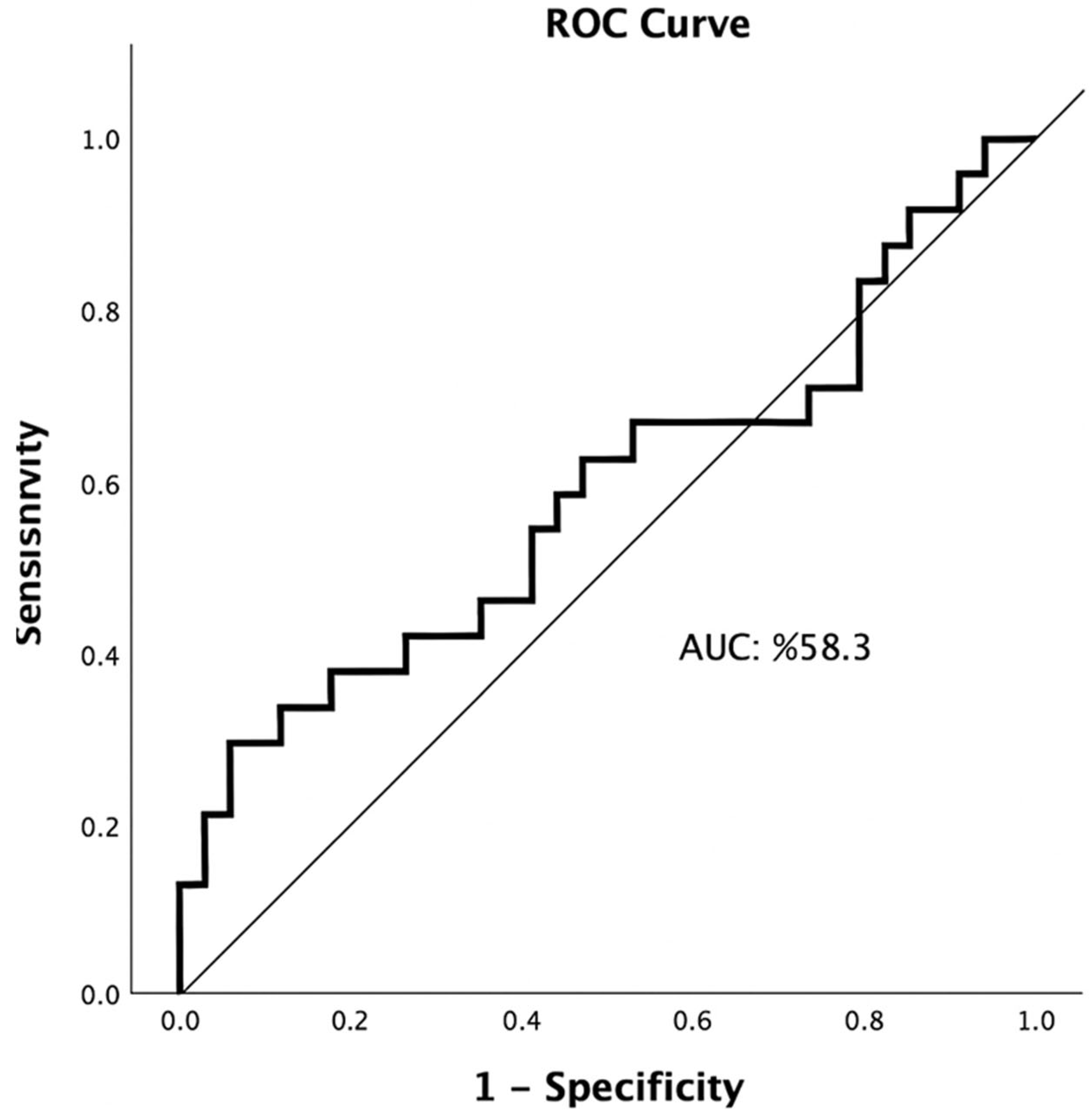
| Test Result Variables | Cut-Off | AUC (95 CI) | Std. Error | p | Sensitivity | Specificity | PPV | NPV |
|---|---|---|---|---|---|---|---|---|
| EASIX | >1.63 | 0.583 (0.428–0.739) | 0.08 | 0.295 | 0.292 | 0.942 | 0.778 | 0.653 |
| EASIX Group | |||
|---|---|---|---|
| Low EASIX < 1.63 (n = 49) | High EASIX > 1.63 (n = 9) | ||
| M[Q1–Q3]/n (%) | M[Q1–Q3]/n (%) | p-Value | |
| Male | 38 (77.6%) | 5 (55.6%) | 0.166 |
| Female | 11 (22.4%) | 4 (44.4%) | |
| Age < 70 | 33 (67.3%) | 2 (22.2%) | 0.011 |
| Age > 70 | 16 (32.7%) | 7 (77.8%) | |
| Smoking | 13 (27.7%) | 1 (11.1%) | 0.294 |
| Alcohol | 3 (6.3%) | 0 (0.0%) | 0.441 |
| DM | 17 (34.7%) | 4 (44.4%) | 0.576 |
| HT | 33 (67.3%) | 8 (88.9%) | 0.192 |
| Heart disease | 24 (49.0%) | 7 (77.8%) | 0.111 |
| Previous stroke | 10 (20.4%) | 1 (11.1%) | 0.513 |
| Past TIA | 3 (6.1%) | 0 (0.0%) | 0.446 |
| Hyperlipidemia | 8 (16.3%) | 5 (55.6%) | 0.009 |
| Wake-up stroke | 6 (12.2%) | 2 (22.2%) | 0.425 |
| Intubation | 25 (51.0%) | 8 (88.9%) | 0.035 |
| Procedure | |||
| Thrombectomy | 9 (18.4%) | 2 (22.2%) | 0.786 |
| Thrombectomy + tPA | 40 (81.6%) | 7 (77.8%) | |
| TICI | |||
| TICI 0 | 5 (10.2%) | 1 (11.1%) | 0.933 |
| TICI 1 | 3 (6.1%) | 1 (11.1%) | |
| TICI 2b | 5 (10.2%) | 1 (11.1%) | |
| TICI 2c | 3 (6.1%) | 0 (0.0%) | |
| TICI 3 | 33 (67.3%) | 6 (66.7%) | |
| TOAST | |||
| Large artery | 24 (49.0%) | 5 (55.6%) | 0.893 |
| Cardioembolic | 15 (30.6%) | 2 (22.2%) | |
| Lacunar | 0 (0.0%) | 0 (0.0%) | |
| Other causes | 2 (6.1%) | 0 (0.0%) | |
| Unknown causes | 7 (14.3%) | 2 (22.2%) | |
| Hemorrhage | 11 (22.4%) | 2 (22.2%) | 0.988 |
| MRS at 90 days (MRS:0–2) | 17 (35.4%) | 4 (44.4%) | 0.606 |
| AF | 21 (42.9%) | 3 (37.5%) | 0.776 |
| Decompression | 1 (2.0%) | 1 (11.1%) | 0.170 |
| Localization | |||
| Basilar artery | 37 (75.5%) | 8 (88.9%) | 0.526 |
| Posterior cerebral artery | 6 (12.2%) | 0 (0.0%) | |
| Vertebral artery | 6 (12.2%) | 1 (11.1%) | |
| In-hospital mortality | 17 (34.7%) | 7 (77.8%) | 0.016 |
| NIHSS at admission | 12.00 [7.50–18.00] | 19.00 [12.00–23.00] | 0.105 |
| NIHSS at 24 h | 13.50 [4.00–20.00] | 24.00 [16.00–26.00] | 0.049 |
| Door-to-groin time (min) | 102.00 [75.00–145.00] | 102.00 [70.00–152.00] | 0.981 |
| Symptom-to-door time(min) | 145.50 [60.00–240.00] | 71.00 [25.00–162.00] | 0.118 |
| Symptom-to-groin time (min) | 260 [163–333] | 268 [168–333] | 0.925 |
| mRS at discharge | 5 [2–6] | 6 [5–6] | 0.048 |
| mRS at 90 days | 4.00 [2.00–6.00] | 6.00 [6.00–6.00] | 0.048 |
| Duration of intubation | 0.50 [0.00–11.00] | 9.00 [3.00–9.00] | 0.106 |
| ASPECT | 10.00 [0.00–10.00] | 10.00 [9.00–10.00] | 0.500 |
| APACHE II | 12.50 [7.50–18.00] | 15.00 [15.00–22.00] | 0.181 |
| Glucose at admission (mg/dL) | 150.00 [126.00–197.00] | 107.00 [101.00–152.00] | 0.075 |
| WBC (/L) | 11.05 [9.04–13.29] | 9.49 [8.23–10.79] | 0.144 |
| NEU (/L) | 8.69 [6.58–10.62] | 7.82 [4.70–8.69] | 0.198 |
| LYMP (/L) | 1.44 [0.85–2.19] | 1.46 [0.62–2.06] | 0.577 |
| HGB (mg/dL) | 12.80 [11.90–14.70] | 13.30 [11.80–13.80] | 0.644 |
| PCT (/L) | 0.23 [0.21–0.29] | 0.26 [0.21–0.31] | 0.712 |
| MPV (/L) | 10.20 [9.50–11.00] | 10.80 [10.15–11.80] | 0.138 |
| Glucose (mg/dL) | 140.00 [109.00–194.00] | 130.00 [110.00–152.00] | 0.872 |
| Urea (mg/dL) | 25.90 [15.60–34.70] | 25.80 [23.10–32.60] | 0.548 |
| Creatinine (mg/dL) | 0.90 [0.75–1.00] | 1.40 [1.10–1.75] | <0.001 |
| PLT (/L) | 235.00 [211.00–273.00] | 234.00 [180.00–265.00] | 0.384 |
| T-Chol (mg/dL) | 189.00 [169.00–211.00] | 174.00 [153.00–185.00] | 0.207 |
| LDL-c (mg/dL) | 120.00 [96.00–141.00] | 104.50 [80.50–121.50] | 0.201 |
| HDL-c (mg/dL) | 41.50 [36.50–51.00] | 39.00 [29.00–46.00] | 0.469 |
| TG (mg/dL) | 108.00 [77.50–197.50] | 154.00 [118.00–167.00] | 0.237 |
| LDH (mg/dL) | 198.50 [163.50–257.00] | 396.00 [310.00–447.00] | 0.001 |
| Univariate | Multivariate | |||
|---|---|---|---|---|
| OR (95 CI) | p-Value | OR (95 CI) | p-Value | |
| Sex (male) | 0.926 (0.280–3.067) | 0.900 | ||
| Age > 70 | 1.551 (0.533–4.511) | 0.420 | ||
| EASIX (High > 1.63) | 6.588 (1.230–35.277) | 0.028 | 1.108 (0.203–42.99) | 0.998 |
| Smoking | 1.471 (0.436–4.958) | 0.534 | ||
| Alcohol | 2.909 (0.248–34.087) | 0.395 | ||
| DM | 2.031 (0.683–6.042) | 0.203 | ||
| HT | 1.012 (0.321–3.191) | 0.984 | ||
| Heart disease | 1.051 (0.368–2.996) | 0.927 | ||
| Previous stroke | 0.771 (0.198–2.999) | 0.708 | ||
| Past TIA | 0.696 (0.059–8/139) | 0.772 | ||
| Hyperlipidemia | 0.556 (0.149–2.072) | 0.381 | ||
| AF | 0.600 (0.202–1.786) | 0.356 | ||
| Wake-up stroke | 0.424 (0.078–2.311) | 0.321 | ||
| Intubation | 12.833 (3.167–52.007) | <0.001 | 2.809 (0.001–8.469) | 0.997 |
| Procedure (Thrombectomy + tPA) | 0.517 (0.138–1.945) | 0.329 | ||
| TICI (reference: TICI 0) | 1 | 0.223 | ||
| TICI 1 | 3 (0.188–47.963) | 0.437 | ||
| TICI 2b | 2 (0.112–35.807) | 0.560 | ||
| TICI 2c | 2 (0.112–35.807) | 0.638 | ||
| TICI 3 | 0.444 (0.078–2.529) | 0.361 | ||
| TOAST (reference: large-artery thrombosis) | 1 | 0.326 | ||
| Cardioembolic | 0.330 (0.087–1.255) | 0.104 | ||
| Lacunar | 0.001 (0.001–3.028) | 0.999 | ||
| Other causes | 0.001 (0.001–2.109) | 0.999 | ||
| Unknown causes | 2.143 (0.448–10.255) | 0.340 | ||
| Hemorrhage | 7.381 (1.755–31.038) | 0.006 | 7.101 (0.012–14.098) | 0.996 |
| mRS at 90 days (mRS: 0–2) | 0.067 (0.013–0.333) | <0.001 | ||
| Decompression | 1.435 (0.085–24.131) | 0.802 | ||
| Localization (reference: BA) | 1 | 0.642 | ||
| PCA | 0.750 (0.124–4.533) | 0.754 | ||
| VA | 2 (0.399–10.019) | 0.399 | ||
| NIHSS at admission > 12 | 3.5 (1.158–10.578) | 0.026 | ||
| NIHSS (24.) > 15 | 6.571 (1.983–21.782) | 0.002 | 1 (0.038–25.980) | 0.999 |
| Door-to-groin time (min) > 102 | 1.143 (0.390–3.347) | 0.808 | ||
| Symptom-to-door time (min) > 134.5 | 0.615 (0.201–1.887) | 0.396 | ||
| Door-to-recanalization time (min) > 127 | 1.57 (0.53–4.59) | 0.414 | ||
| mRS score at discharge > 5 | 125.4 (13.620–1154.584) | <0.001 | ||
| mRS at 90 days > 5 | 82.5 (13.853–491.325) | <0.001 | 2.346 (0.001–13.989) | 0.998 |
| Duration of intubation (days) > 3 | 6.133 (1.853–20.291) | 0.003 | 0.001 (0.001–8.989) | 0.997 |
| ASPECT: 10 | 0.706 (0.498–1.234) | 0.191 | ||
| APACHE II > 13 | 11.875 (3.346–42.142) | <0.001 | 0.948 (0.024–37.627) | 0.977 |
| Glucose at admission (mg/dL) > 147.5 | 1 (0.352–2.844) | 0.999 | ||
| Symptom-to-groin time (min) > 260 | 0.393 (0.131–1.182) | 0.096 | ||
| WBC > 10.84 | 1 (0.332–2.844) | 0.990 | ||
| NEU > 8.64 | 0.752 (0.264–2.145) | 0.594 | ||
| LYMP > 1.45 | 0.420 (0.144–1.227) | 0.113 | ||
| HGB > 12.9 | 0.564 (0.196–1.622) | 0.288 | ||
| PCT > 0.23 | 1.227 (0.425–3.541) | 0.705 | ||
| MPV > 10.3 | 0.571 (0.195–1.674) | 0.307 | ||
| Glucose > 139.5 | 1.773 (0.616–5.102) | 0.288 | ||
| Urea > 25.85 | 1 (0.351–2.278) | 0.998 | ||
| Creatinine > 0.92 | 2 (0.692–5.777) | 0.200 | ||
| PLT > 234.5 | 1.330 (0.466–3.792) | 0.594 | ||
| T-chol L > 185 | 0.536 (0.182–1.581) | 0.258 | ||
| LDL-c > 119 | 0.649 (0.215–1.957) | 0.443 | ||
| HDL-c > 41.5 | 1 (0.333–3.005) | 0.999 | ||
| TG > 113 | 0.796 (0.278–2.285) | 0.672 | ||
| LDH > 209 | 1.418 (0.494–4.075) | 0.517 | ||
Disclaimer/Publisher’s Note: The statements, opinions and data contained in all publications are solely those of the individual author(s) and contributor(s) and not of MDPI and/or the editor(s). MDPI and/or the editor(s) disclaim responsibility for any injury to people or property resulting from any ideas, methods, instructions or products referred to in the content. |
© 2025 by the authors. Licensee MDPI, Basel, Switzerland. This article is an open access article distributed under the terms and conditions of the Creative Commons Attribution (CC BY) license (https://creativecommons.org/licenses/by/4.0/).
Share and Cite
Kamaci Sener, D.; Haki, C.; Koc Yamanyar, G.; Kandemir, F.N.; Kamisli, S.; Sarac, K. Association of Endothelial Activation and Stress Index with Prognosis in Posterior Circulation Infarcts Treated with Recanalization Therapy. Diagnostics 2025, 15, 3234. https://doi.org/10.3390/diagnostics15243234
Kamaci Sener D, Haki C, Koc Yamanyar G, Kandemir FN, Kamisli S, Sarac K. Association of Endothelial Activation and Stress Index with Prognosis in Posterior Circulation Infarcts Treated with Recanalization Therapy. Diagnostics. 2025; 15(24):3234. https://doi.org/10.3390/diagnostics15243234
Chicago/Turabian StyleKamaci Sener, Deniz, Cemile Haki, Gulcin Koc Yamanyar, Fatma Nur Kandemir, Suat Kamisli, and Kaya Sarac. 2025. "Association of Endothelial Activation and Stress Index with Prognosis in Posterior Circulation Infarcts Treated with Recanalization Therapy" Diagnostics 15, no. 24: 3234. https://doi.org/10.3390/diagnostics15243234
APA StyleKamaci Sener, D., Haki, C., Koc Yamanyar, G., Kandemir, F. N., Kamisli, S., & Sarac, K. (2025). Association of Endothelial Activation and Stress Index with Prognosis in Posterior Circulation Infarcts Treated with Recanalization Therapy. Diagnostics, 15(24), 3234. https://doi.org/10.3390/diagnostics15243234