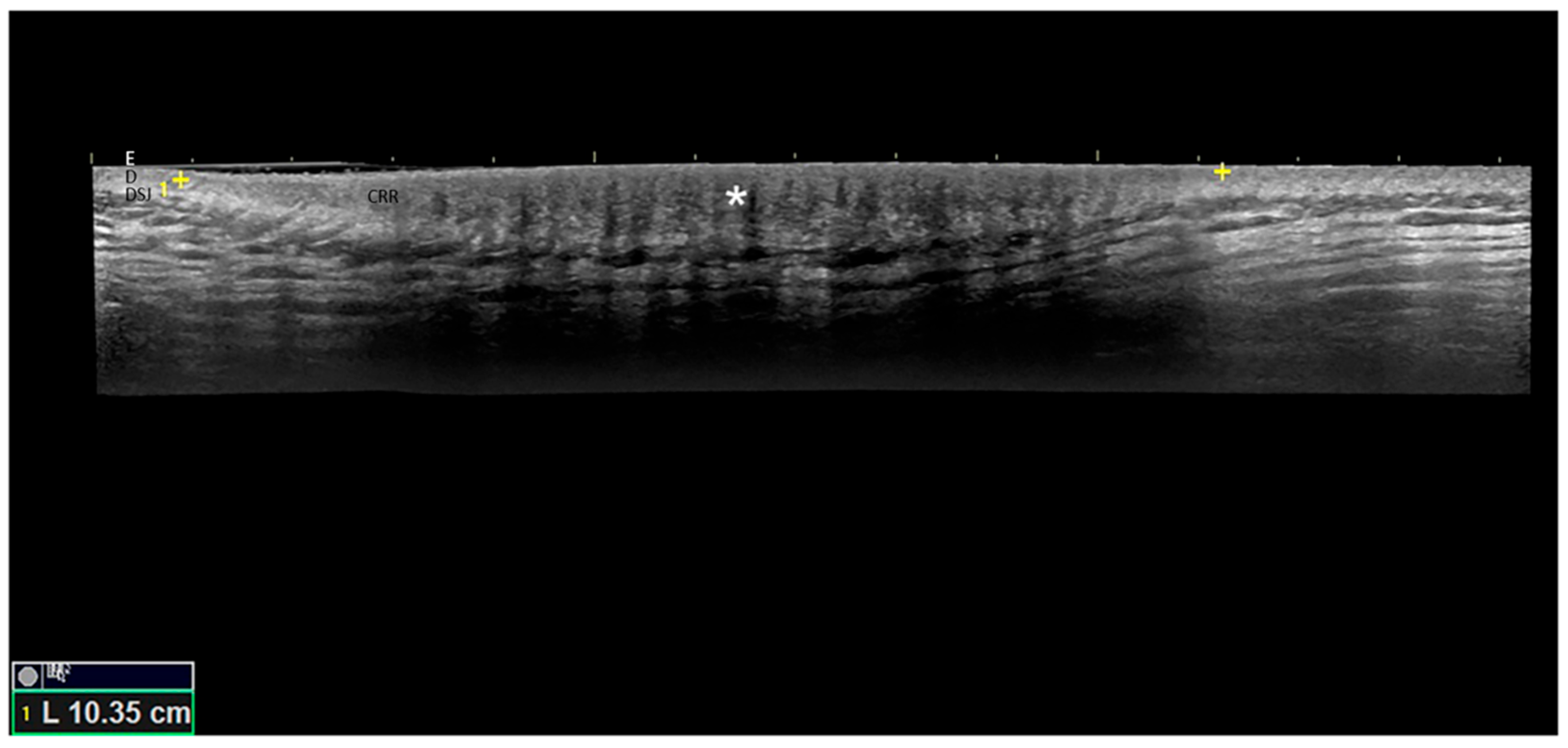
Shagreen Patch in Tuberous Sclerosis Complex at High-Frequency Ultrasound



Abstract

Author Contributions
Funding
Institutional Review Board Statement
Informed Consent Statement
Data Availability Statement
Conflicts of Interest
References
- Northrup, H.; Aronow, M.E.; Bebin, E.M.; Bissler, J.; Darling, T.N.; de Vries, P.J.; Frost, M.D.; Fuchs, Z.; Gosnell, E.S.; Gupta, N.; et al. Updated International Tuberous Sclerosis Complex Diagnostic Criteria and Surveillance and Management Recommendations. Pediatr. Neurol. 2021, 123, 50–66. [Google Scholar] [CrossRef] [PubMed]
- Jurca, A.A.; Hodisan, R.; Jurca, A.D.; Severin, E.; Jurca, S.; Trandafir, A.; Ilias, T.; Vesa, C.; Jurca, C.M. Tuberous Sclerosis Complex: A Case Series from a Romanian Genetics Center and a Review of the Literature. J. Clin. Med. 2025, 14, 2974. [Google Scholar] [CrossRef] [PubMed]
- Steiner, C.E.; Puzzi, M.B.; Marques-de-Faria, A.P.; de Oliveira Sobrinho, R.P.; Gil-da-Silva-Lopes, V.L.; Moreno, C.A. A Series of Patients with Genodermatoses in a Reference Service for Rare Diseases: Results from the Brazilian Rare Genomes Project. Genes 2025, 16, 522. [Google Scholar] [CrossRef] [PubMed]
- Rodríguez-Torres, D.A.; Arenas-Estala, J.; Sánchez-Cortés, R.G.; Dávila-Escamilla, I.V.; Nieto-Sanjuanero, A.; López-Uriarte, G.A. Prenatal Diagnosis and Management of Tuberous Sclerosis Complex with Cardiac Rhabdomyoma: A Case Report Highlighting the Role of Sirolimus and Postnatal Complications. Diagnostics 2025, 15, 1811. [Google Scholar] [CrossRef] [PubMed]
- Bongiorno, M.A.; Nathan, N.; Oyerinde, O.; Wang, J.A.; Lee, C.R.; Brown, G.T.; Moss, J.; Darling, T.N. Clinical Characteristics of Connective Tissue Nevi in Tuberous Sclerosis Complex With Special Emphasis on Shagreen Patches. JAMA Dermatol. 2017, 153, 660–665. [Google Scholar] [CrossRef] [PubMed]
- Ebrahimi-Fakhari, D.; Meyer, S.; Vogt, T.; Pföhler, C.; Müller, C.S.L. Dermatological manifestations of tuberous sclerosis complex (TSC). J. Dtsch. Dermatol. Ges. 2017, 15, 695–700. [Google Scholar] [CrossRef] [PubMed]
- Pounders, A.J.; Rushing, G.V.; Mahida, S.; Nonyane, B.A.S.; Thomas, E.A.; Tameez, R.S.; Gipson, T.T. Racial differences in the dermatological manifestations of tuberous sclerosis complex and the potential effects on diagnosis and care. Ther. Adv. Rare Dis. 2022, 3, 26330040221140125. [Google Scholar] [CrossRef] [PubMed]
- Cascarino, M.; Leclerc-Mercier, S. Histological Patterns of Skin Lesions in Tuberous Sclerosis Complex: A Panorama. Dermatopathology 2021, 8, 236–252. [Google Scholar] [CrossRef]
- Kuntoji, V.; Bhagwat, P.V.; Kudligi, C. Giant Shagreen Patch in Tuberous Sclerosis Complex. Indian Dermatol. Online J. 2018, 9, 353–355. [Google Scholar] [CrossRef]
- Gundalli, S.; Ankad, B.S.; Ashwin, P.K.; Kolekar, R. Dermoscopy of shagreen patch: A first report. Our Dermatol. Online 2015, 6, 331–333. [Google Scholar] [CrossRef]
- Plázár, D.; Meznerics, F.A.; Pálla, S.; Anker, P.; Farkas, K.; Bánvölgyi, A.; Kiss, N.; Medvecz, M. Dermoscopic Patterns of Genodermatoses: A Comprehensive Analysis. Biomedicines 2023, 11, 2717. [Google Scholar] [CrossRef] [PubMed]
Disclaimer/Publisher’s Note: The statements, opinions and data contained in all publications are solely those of the individual author(s) and contributor(s) and not of MDPI and/or the editor(s). MDPI and/or the editor(s) disclaim responsibility for any injury to people or property resulting from any ideas, methods, instructions or products referred to in the content. |
© 2025 by the authors. Licensee MDPI, Basel, Switzerland. This article is an open access article distributed under the terms and conditions of the Creative Commons Attribution (CC BY) license (https://creativecommons.org/licenses/by/4.0/).
Share and Cite
Tagliati, C.; Wortsman, X. Shagreen Patch in Tuberous Sclerosis Complex at High-Frequency Ultrasound. Diagnostics 2025, 15, 3168. https://doi.org/10.3390/diagnostics15243168
Tagliati C, Wortsman X. Shagreen Patch in Tuberous Sclerosis Complex at High-Frequency Ultrasound. Diagnostics. 2025; 15(24):3168. https://doi.org/10.3390/diagnostics15243168
Chicago/Turabian StyleTagliati, Corrado, and Ximena Wortsman. 2025. "Shagreen Patch in Tuberous Sclerosis Complex at High-Frequency Ultrasound" Diagnostics 15, no. 24: 3168. https://doi.org/10.3390/diagnostics15243168
APA StyleTagliati, C., & Wortsman, X. (2025). Shagreen Patch in Tuberous Sclerosis Complex at High-Frequency Ultrasound. Diagnostics, 15(24), 3168. https://doi.org/10.3390/diagnostics15243168