

Association of Tumor PD-L1 Expression with the T790M Mutation and Progression-Free Survival in Patients with EGFR-Mutant Non-Small Cell Lung Cancer Receiving EGFR-TKI Therapy

 ,
,  ,
,
Abstract
1. Introduction
2. Materials and Methods
2.1. Study Design and Patient Selection
2.2. Immunohistochemistry
2.3. Polymerase Chain Reaction
2.4. Statistical Analysis
3. Results
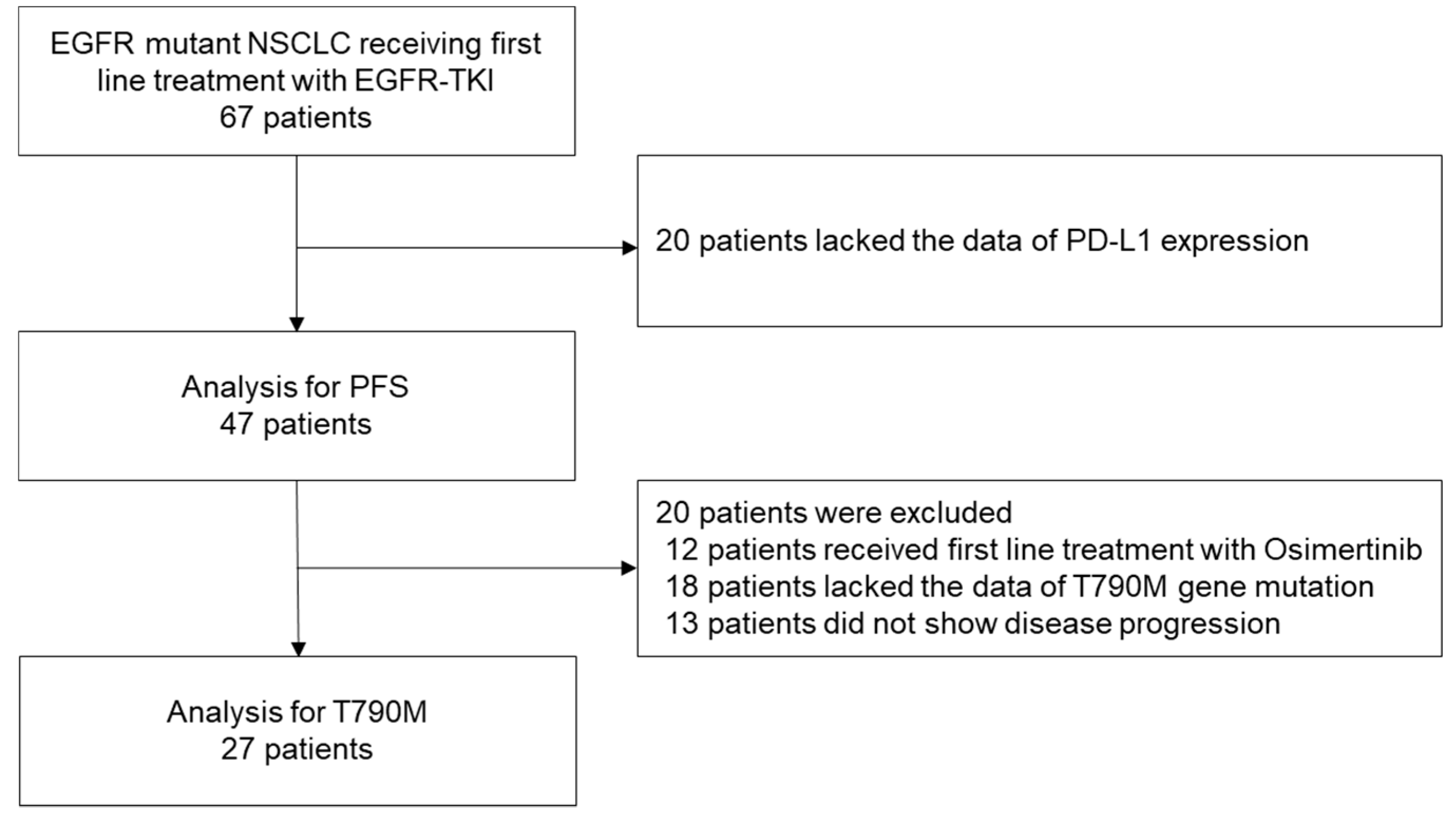
3.1. Patient Selection
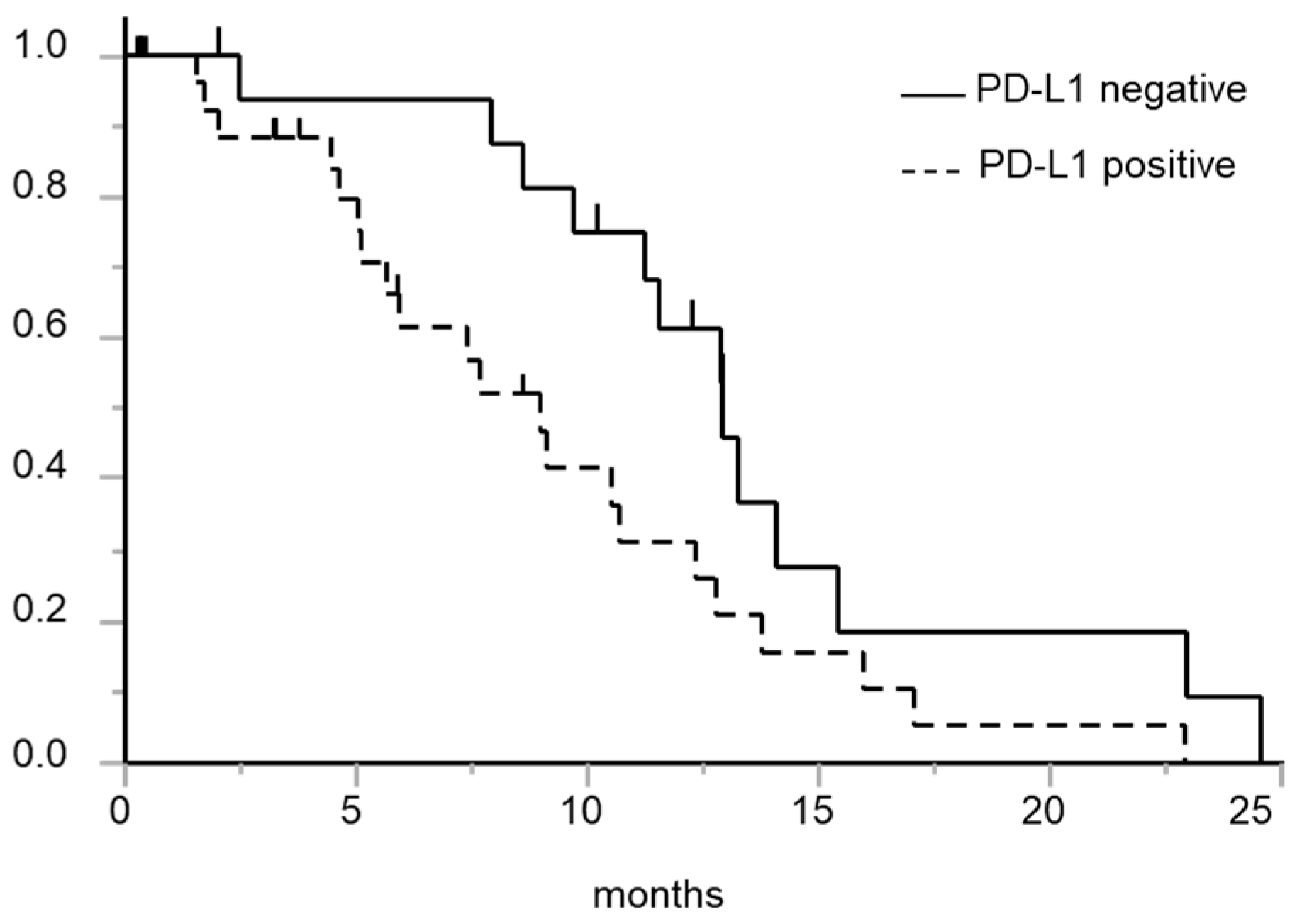
3.2. PFS
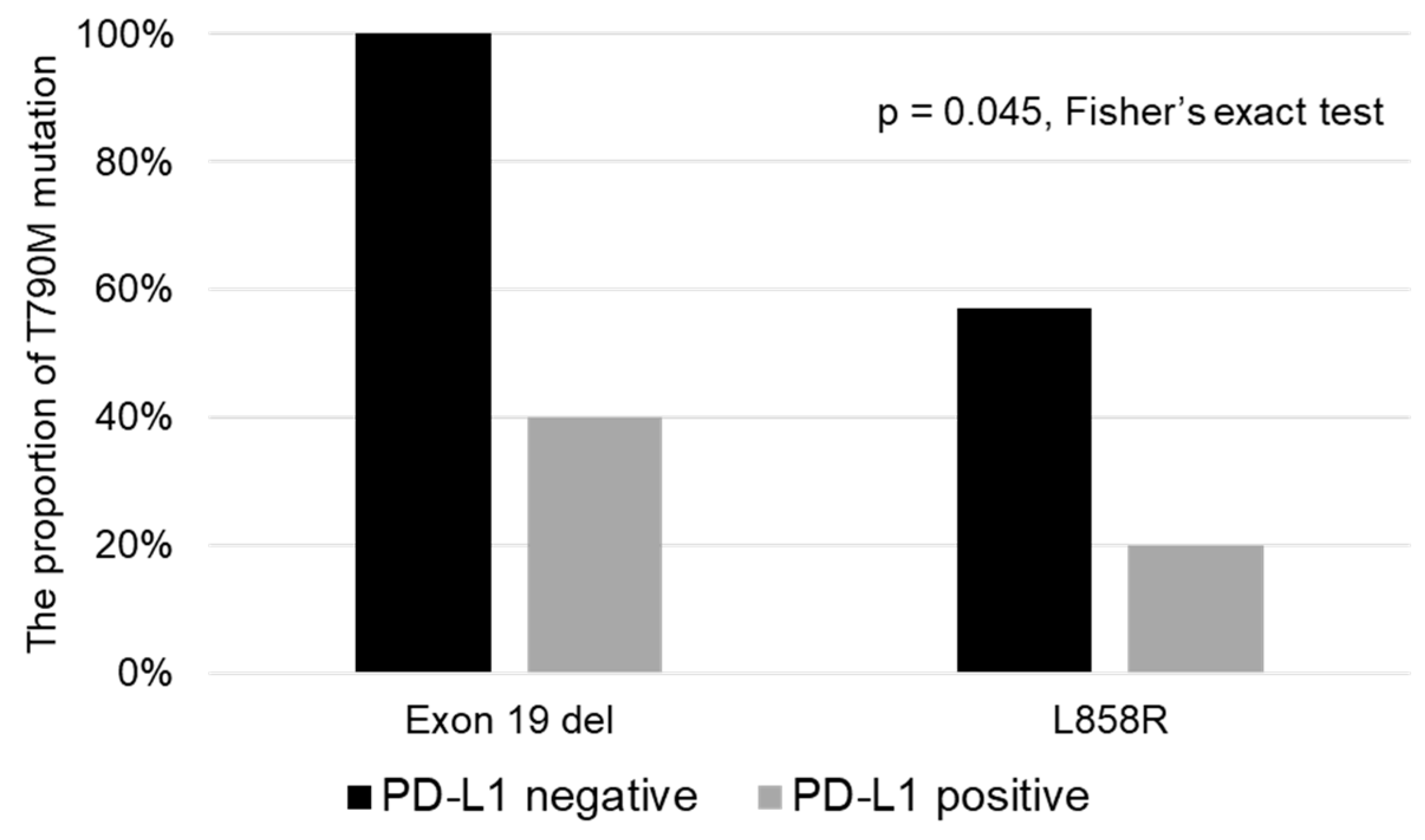
3.3. Acquisition of T790M
4. Discussion
Author Contributions
Funding
Conflicts of Interest
References
- Maemondo, M.; Inoue, A.; Kobayashi, K.; Sugawara, S.; Oizumi, S.; Isobe, H.; Gemma, A.; Harada, M.; Yoshizawa, H.; Kinoshita, I.; et al. North-East Japan Study Group. Gefitinib or chemotherapy for non-small-cell lung cancer with mutated EGFR. N. Engl. J. Med. 2010, 362, 2380–2388. [Google Scholar] [CrossRef] [PubMed]
- Mitsudomi, T.; Morita, S.; Yatabe, Y.; Negoro, S.; Okamoto, I.; Tsurutani, J.; Seto, T.; Satouchi, M.; Tada, H.; Hirashima, T.; et al. Gefitinib versus cisplatin plus docetaxel in patients with non-small-cell lung cancer harbouring mutations of the epidermal growth factor receptor (WJTOG3405): An open label, randomised phase 3 trial. Lancet Oncol. 2010, 11, 121–128. [Google Scholar] [CrossRef]
- Mok, T.S.; Wu, Y.-L.; Ahn, M.-J.; Garassino, M.C.; Kim, H.R.; Ramalingam, S.S.; Shepherd, F.A.; He, Y.; Akamatsu, H.; Theelen, W.S.; et al. Osimertinib or platinum-pemetrexed in EGFR T790M-positive lung cancer. N. Engl. J. Med. 2017, 376, 629–640. [Google Scholar] [CrossRef] [PubMed]
- Oya, Y.; Yoshida, T.; Kuroda, H.; Shimizu, J.; Horio, Y.; Sakao, Y.; Inaba, Y.; Hida, T.; Yatabe, Y. Association between EGFR T790M status and progression patterns during initial EGFR-TKI treatment in patients harboring EGFR mutation. Clin. Lung Cancer 2017, 18, 698–705.e2. [Google Scholar] [CrossRef] [PubMed]
- Joo, J.W.; Hong, M.H.; Shim, H.S. Clinical characteristics of T790M-positive lung adenocarcinoma after resistance to epidermal growth factor receptor-tyrosine kinase inhibitors with an emphasis on brain metastasis and survival. Lung Cancer 2018, 121, 12–17. [Google Scholar] [CrossRef] [PubMed]
- Kawamura, T.; Kenmotsu, H.; Omori, S.; Nakashima, K.; Wakuda, K.; Ono, A.; Naito, T.; Murakami, H.; Omae, K.; Mori, K.; et al. Clinical factors predicting detection of T790M mutation in rebiopsy for EGFR-mutant non-small-cell lung cancer. Clin. Lung Cancer 2018, 19, e247–e252. [Google Scholar] [CrossRef] [PubMed]
- Huang, Y.H.; Hsu, K.H.; Tseng, J.S.; Chen, K.C.; Hsu, C.H.; Su, K.Y.; Chen, J.J.W.; Chen, H.W.; Yu, S.L.; Yang, T.Y.; et al. The Association of acquired T790M mutation with clinical characteristics after resistance to first-line epidermal growth factor receptor tyrosine kinase inhibitor in lung adenocarcinoma. Cancer Res. Treat. 2018, 50, 1294–1303. [Google Scholar] [CrossRef] [PubMed]
- Borghaei, H.; Paz-Ares, L.; Horn, L.; Spigel, D.R.; Steins, M.; Ready, N.E.; Chow, L.Q.; Vokes, E.E.; Felip, E.; Holgado, E.; et al. Nivolumab versus docetaxel in advanced non squamous non-small-cell lung cancer. N. Engl. J. Med. 2015, 373, 1627–1639. [Google Scholar] [CrossRef] [PubMed]
- Gainor, J.F.; Shaw, A.T.; Sequist, L.V.; Fu, X.; Azzoli, C.G.; Piotrowska, Z.; Huynh, T.G.; Zhao, L.; Fulton, L.; Schultz, K.R.; et al. EGFR mutations and ALK rearrangements are associated with low response rates to PD-1 pathway blockade in non-small cell lung cancer: A retrospective analysis. Clin. Cancer Res. 2016, 22, 4585–4593. [Google Scholar] [CrossRef] [PubMed]
- Lisberg, A.; Cummings, A.; Goldman, J.W.; Bornazyan, K.; Reese, N.; Wang, T.; Coluzzi, P.; Ledezma, B.; Mendenhall, M.; Hunt, J.; et al. A phase II study of pembrolizumab in EGFR-mutant, PD-L1+, tyrosine kinase inhibitor naïve patients with advanced NSCLC. J. Thorac. Oncol. 2018, 13, 1138–1145. [Google Scholar] [CrossRef] [PubMed]
- Tang, Y.; Fang, W.; Zhang, Y.; Hong, S.; Kang, S.; Yan, Y.; Chen, N.; Zhan, J.; He, X.; Qin, T.; et al. The association between PD-L1 and EGFR status and the prognostic value of PD-L1 in advanced non-small cell lung cancer patients treated with EGFR-TKIs. Oncotarget 2015, 6, 14209–14219. [Google Scholar] [CrossRef] [PubMed]
- Lin, C.; Chen, X.; Li, M.; Liu, J.; Qi, X.; Yang, W.; Zhang, H.; Cai, Z.; Dai, Y.; Ouyang, X. Programmed death-ligand 1 expression predicts tyrosine kinase inhibitor response and better prognosis in a cohort of patients with epidermal growth factor receptor mutation-positive lung adenocarcinoma. Clin. Lung Cancer 2015, 16, e25–e35. [Google Scholar] [CrossRef] [PubMed]
- D’Incecco, A.; Andreozzi, M.; Ludovini, V.; Rossi, E.; Capodanno, A.; Landi, L.; Tibaldi, C.; Minuti, G.; Salvini, J.; Coppi, E.; et al. PD-1 and PD-L1 expression in molecularly selected non-small-cell lung cancer patients. Br. J. Cancer 2015, 112, 95–102. [Google Scholar] [CrossRef] [PubMed]
- Soo, R.A.; Kim, H.R.; Asuncion, B.R.; Fazreen, Z.; Omar, M.F.M.; Herrera, M.C.; Yun Lim, J.S.; Sia, G.; Soong, R.; Cho, B.C. Significance of immune checkpoint proteins in EGFR-mutant non-small cell lung cancer. Lung Cancer 2017, 105, 17–22. [Google Scholar] [CrossRef] [PubMed]
- Su, S.; Dong, Z.Y.; Xie, Z.; Yan, L.X.; Li, Y.F.; Su, J.; Liu, S.Y.; Yin, K.; Chen, R.L.; Huang, S.M.; et al. Strong programmed death ligand 1 expression predicts poor response and de novo resistance to EGFR tyrosine kinase inhibitors among NSCLC patients with EGFR mutation. J. Thorac. Oncol. 2018, 13, 1668–1675. [Google Scholar] [CrossRef] [PubMed]
- Haratani, K.; Hayashi, H.; Tanaka, T.; Kaneda, H.; Togashi, Y.; Sakai, K.; Hayashi, K.; Tomida, S.; Chiba, Y.; Yonesaka, K.; et al. Tumor immune microenvironment and nivolumab efficacy in EGFR mutation-positive non-small-cell lung cancer based on T790M status after disease progression during EGFR-TKI treatment. Ann. Oncol. 2017, 28, 1532–1539. [Google Scholar] [CrossRef] [PubMed]
- Hata, A.; Katakami, N.; Nanjo, S.; Okuda, C.; Kaji, R.; Masago, K.; Fujita, S.; Yoshida, H.; Zama, K.; Imai, Y.; et al. Programmed death-ligand 1 expression and T790M status in EGFR-mutant non-small cell lung cancer. Lung Cancer 2017, 111, 182–189. [Google Scholar] [CrossRef] [PubMed]
- Kim, T.J.; Hong, S.A.; Kim, O.; Kim, S.J.; Yang, J.H.; Joung, E.K.; Kang, J.H.; Hong, S.H. Changes in PD-L1 expression according to tumor infiltrating lymphocytes of acquired EGFR-TKI resistant EGFR-mutant non-small-cell lung cancer. Oncotarget 2017, 8, 107630–107639. [Google Scholar] [CrossRef] [PubMed]

| 47 (100%) | ||
| Age (yr) | <70 | 23 (48.9%) |
| ≥70 | 24 (51.1%) | |
| Sex | Male | 20 (42.6%) |
| Female | 27 (57.4%) | |
| Smoking history | Yes | 17 (36.2%) |
| No | 30 (63.8%) | |
| PS | 0–1 | 38 (80.9%) |
| ≥2 | 9 (19.1%) | |
| Histology | Adenocarcinoma | 44 (93.6%) |
| Others | 3 (6.4%) | |
| EGFR mutation | Exon 19 Deletion | 16 (34.0%) |
| Exon 21 L858R | 28 (59.6%) | |
| Others | 3 (6.4%) | |
| LDH | <200 IU/L | 21 (44.7%) |
| ≥200 IU/L | 26 (55.3%) | |
| Brain metastasis | Yes | 18 (38.3%) |
| No | 29 (61.7%) | |
| TNM classification (T) | T1-2 | 22 (46.8%) |
| T3-4 | 25 (53.2%) | |
| TNM classification (N) | N0-1 | 22 (46.8%) |
| N2-3 | 25 (53.2%) | |
| TNM classification (M) | M0-1a | 14 (29.8%) |
| M1b-1c | 33 (70.2%) | |
| Disease stage | IIIA-C/IVA | 20 (42.6%) |
| IVB | 27 (57.4%) | |
| EGFR-TKI | Gefitinib | 13 (27.7%) |
| Erlotinib | 8 (17.0%) | |
| Afatinib | 15 (31.9%) | |
| Osimertinib | 11 (23.4%) | |
| PD-L1 | Positive | 29 (61.7%) |
| Negative | 18 (38.3%) |
| PFS | p | ||
|---|---|---|---|
| Age (yr) | <70 | 9.7 (5.9–13.8) | 0.564 |
| ≥70 | 12.8 (7.4–13.2) | ||
| Sex | Male | 9.7 (5.9–15.4) | 0.713 |
| Female | 11.2 (5.6–12.9) | ||
| Smoking history | Yes | 12.3 (7.4–15.9) | 0.681 |
| No | 10.7 (5.9–12.9) | ||
| PS | 0–1 | 11.2 (7.7–12.9) | 0.561 |
| ≥2 | 10.7 (1.5–13.8) | ||
| Histology | Adenocarcinoma | 11.2 (7.9–12.9) | 0.436 |
| Others | 9.1 (2.0–13.8) | ||
| EGFR mutation | Exon 19 Deletion | 11.5 (9.1–15.9) | 0.308 |
| Exon 21 L858R | 10.7 (5.9–13.2) | ||
| Others | 7.7 (2.5–13.8) | ||
| LDH | <200 IU/L | 11.5 (7.9–13.8) | 0.320 |
| ≥200 IU/L | 9.1 (5.1–12.9) | ||
| Brain metastasis | Yes | 8.8 (5.9–12.9) | 0.329 |
| No | 12.3 (9.0–14.1) | ||
| TNM classification (T) | T1-2 | 12.8 (7.7–15.4) | 0.621 |
| T3-4 | 10.5 (5.6–12.9) | ||
| TNM classification (N) | N0-1 | 11.5 (8.6–15.9) | 0.132 |
| N2-3 | 10.7 (5.1–12.9) | ||
| TNM classification (M) | M0-1a | 12.3 (2.5–14.1) | 0.304 |
| M1b-1c | 9.7 (7.4–12.9) | ||
| Disease stage | IIIA-C/IVA | 12.8 (9.0–14.1) | 0.245 |
| IVB | 9.1 (5.9–12.9) | ||
| EGFR-TKI | Gefitinib | 12.8 (4.5–15.9) | |
| Erlotinib | 8.8 (2.5–14.1) | 0.608 | |
| Afatinib | 11.5 (4.6–13.8) | ||
| Osimertinib | Not reached | ||
| PD-L1 | Positive | 9.0 (5.1–12.3) | 0.029 |
| Negative | 12.9 (9.7–15.4) |
| HR (95% CI) | p | ||
|---|---|---|---|
| EGFR mutation | Exon 19 deletion | 0.49 (0.21–1.16) | 0.106 |
| Exon 21 L858R | 1 | ||
| Others | 1.27 (0.30–5.41) | 0.749 | |
| PS | 0–1 | 1.15 (0.44–3.03) | 0.775 |
| ≥2 | 1 | ||
| LDH | <200 IU/L | 0.85 (0.37–1.97) | 0.710 |
| ≥200 IU/L | 1 | ||
| Disease stage | IIIA-C/IVA | 0.50 (0.21–1.16) | 0.105 |
| IVB | 1 | ||
| PD-L1 | Positive | 2.84 (1.20–6.72) | 0.018 |
| Negative | 1 |
| Whole | T790M-Positive | T790M-Negative | p | ||
|---|---|---|---|---|---|
| 27 | 12 (44.4%) | 15 (55.6%) | |||
| Age (yr) | <70 | 18 | 7 (38.9%) | 11 (61.1%) | 0.448 |
| ≥70 | 9 | 5 (55.6%) | 4 (44.4%) | ||
| Sex | Male | 16 | 6 (37.5%) | 10 (62.5%) | 0.452 |
| Female | 11 | 6 (54.6%) | 5 (45.5%) | ||
| Smoking history | Yes | 13 | 6 (46.2%) | 7 (53.9%) | 1.000 |
| No | 14 | 6 (42.9%) | 8 (57.1%) | ||
| Histology | Adenocarcinoma | 24 | 11 (45.8%) | 13 (54.2%) | 1.000 |
| Others | 3 | 1 (33.3%) | 2 (66.7%) | ||
| PS | 0–1 | 18 | 7 (38.9%) | 11 (61.1%) | 0.412 |
| ≥2 | 9 | 5 (55.6%) | 4 (44.4%) | ||
| EGFR mutation | Exon 19 Deletion | 9 | 6 (66.7%) | 3 (33.3%) | 0.217 |
| Exon 21 L858R | 17 | 6 (35.3%) | 11 (64.7%) | ||
| Others | 1 | 0 (0%) | 1 (100%) | ||
| LDH | <200 IU/L | 14 | 8 (57.1%) | 6 (42.9%) | 0.252 |
| ≥200 IU/L | 13 | 4 (30.8%) | 9 (69.2%) | ||
| Brain metastasis | Yes | 13 | 6 (46.2%) | 7 (53.9%) | 1.000 |
| No | 14 | 6 (42.9%) | 8 (57.1%) | ||
| EGFR-TKI | Gefitinib | 9 | 6 (66.7%) | 3 (33.3%) | 0.243 |
| Erlotinib | 7 | 3 (42.9%) | 4 (57.1%) | ||
| Afatinib | 11 | 3 (27.3%) | 8 (72.3%) | ||
| PD-L1 | Positive | 16 | 4 (25.0%) | 12 (75.0%) | 0.022 |
| Negative | 11 | 8 (72.7%) | 3 (27.3%) |
Publisher’s Note: MDPI stays neutral with regard to jurisdictional claims in published maps and institutional affiliations. |
© 2020 by the authors. Licensee MDPI, Basel, Switzerland. This article is an open access article distributed under the terms and conditions of the Creative Commons Attribution (CC BY) license (http://creativecommons.org/licenses/by/4.0/).
Share and Cite
Inomata, M.; Azechi, K.; Takata, N.; Hayashi, K.; Tokui, K.; Taka, C.; Okazawa, S.; Kambara, K.; Imanishi, S.; Miwa, T.; et al. Association of Tumor PD-L1 Expression with the T790M Mutation and Progression-Free Survival in Patients with EGFR-Mutant Non-Small Cell Lung Cancer Receiving EGFR-TKI Therapy. Diagnostics 2020, 10, 1006. https://doi.org/10.3390/diagnostics10121006
Inomata M, Azechi K, Takata N, Hayashi K, Tokui K, Taka C, Okazawa S, Kambara K, Imanishi S, Miwa T, et al. Association of Tumor PD-L1 Expression with the T790M Mutation and Progression-Free Survival in Patients with EGFR-Mutant Non-Small Cell Lung Cancer Receiving EGFR-TKI Therapy. Diagnostics. 2020; 10(12):1006. https://doi.org/10.3390/diagnostics10121006
Chicago/Turabian StyleInomata, Minehiko, Kenji Azechi, Naoki Takata, Kana Hayashi, Kotaro Tokui, Chihiro Taka, Seisuke Okazawa, Kenta Kambara, Shingo Imanishi, Toshiro Miwa, and et al. 2020. "Association of Tumor PD-L1 Expression with the T790M Mutation and Progression-Free Survival in Patients with EGFR-Mutant Non-Small Cell Lung Cancer Receiving EGFR-TKI Therapy" Diagnostics 10, no. 12: 1006. https://doi.org/10.3390/diagnostics10121006
APA StyleInomata, M., Azechi, K., Takata, N., Hayashi, K., Tokui, K., Taka, C., Okazawa, S., Kambara, K., Imanishi, S., Miwa, T., Hayashi, R., Matsui, S., & Tobe, K. (2020). Association of Tumor PD-L1 Expression with the T790M Mutation and Progression-Free Survival in Patients with EGFR-Mutant Non-Small Cell Lung Cancer Receiving EGFR-TKI Therapy. Diagnostics, 10(12), 1006. https://doi.org/10.3390/diagnostics10121006

