Electromyographic Patterns of Scapular Muscles During Four Variations of Protraction–Retraction Exercises


Abstract
1. Introduction
2. Methods
2.1. Study Design
2.2. Participants
2.3. Experimental Procedures
2.4. Exercise Protocol
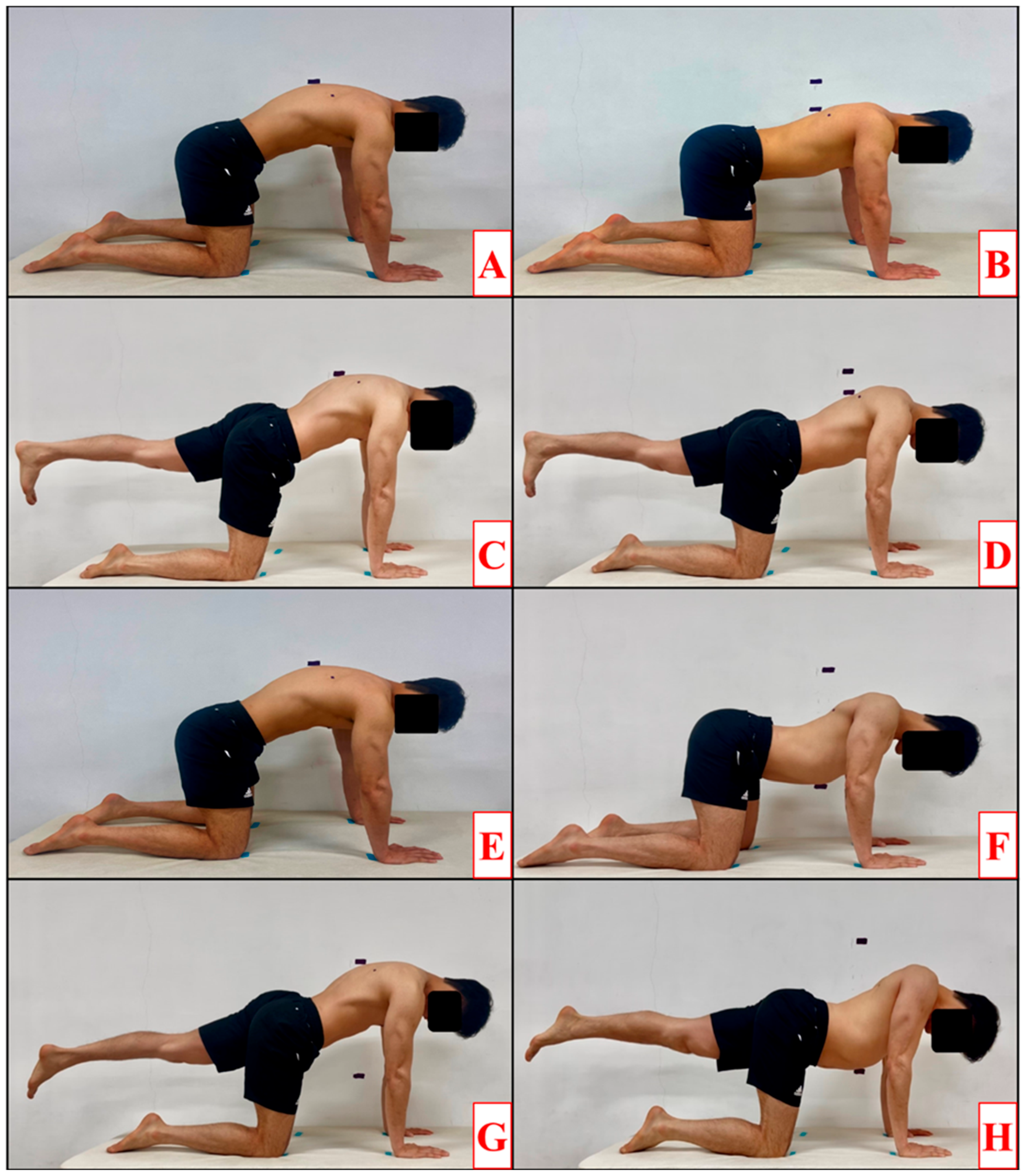
2.4.1. Push-Up Plus with Quadruped (PUP_Q)
2.4.2. Sternum Drop with Quadruped (STD_Q)
2.4.3. Single-Leg Condition
2.5. Outcome Measures
2.6. Statistical Analysis
3. Results
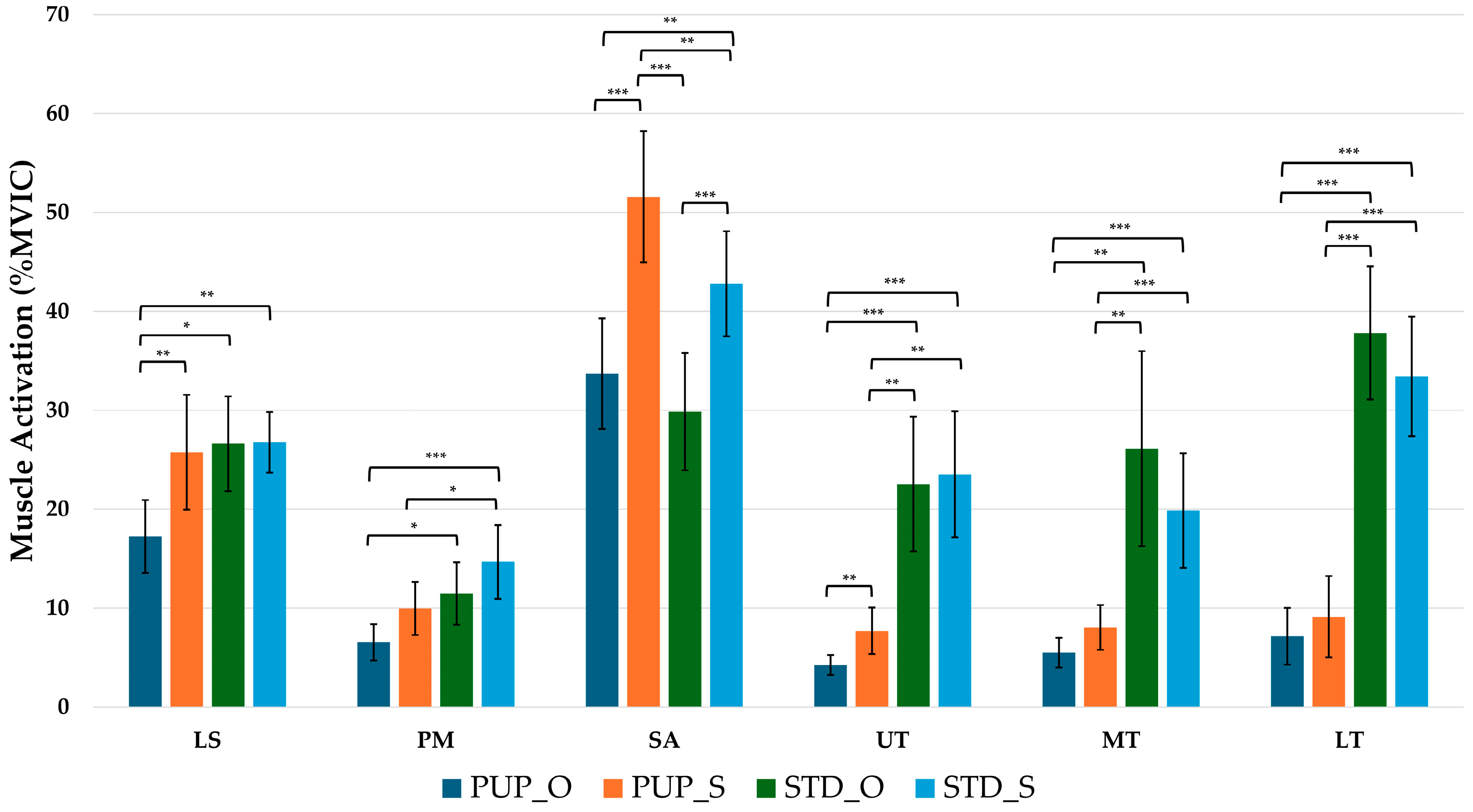
3.1. Muscle Activation During the Scapular Protraction Phase
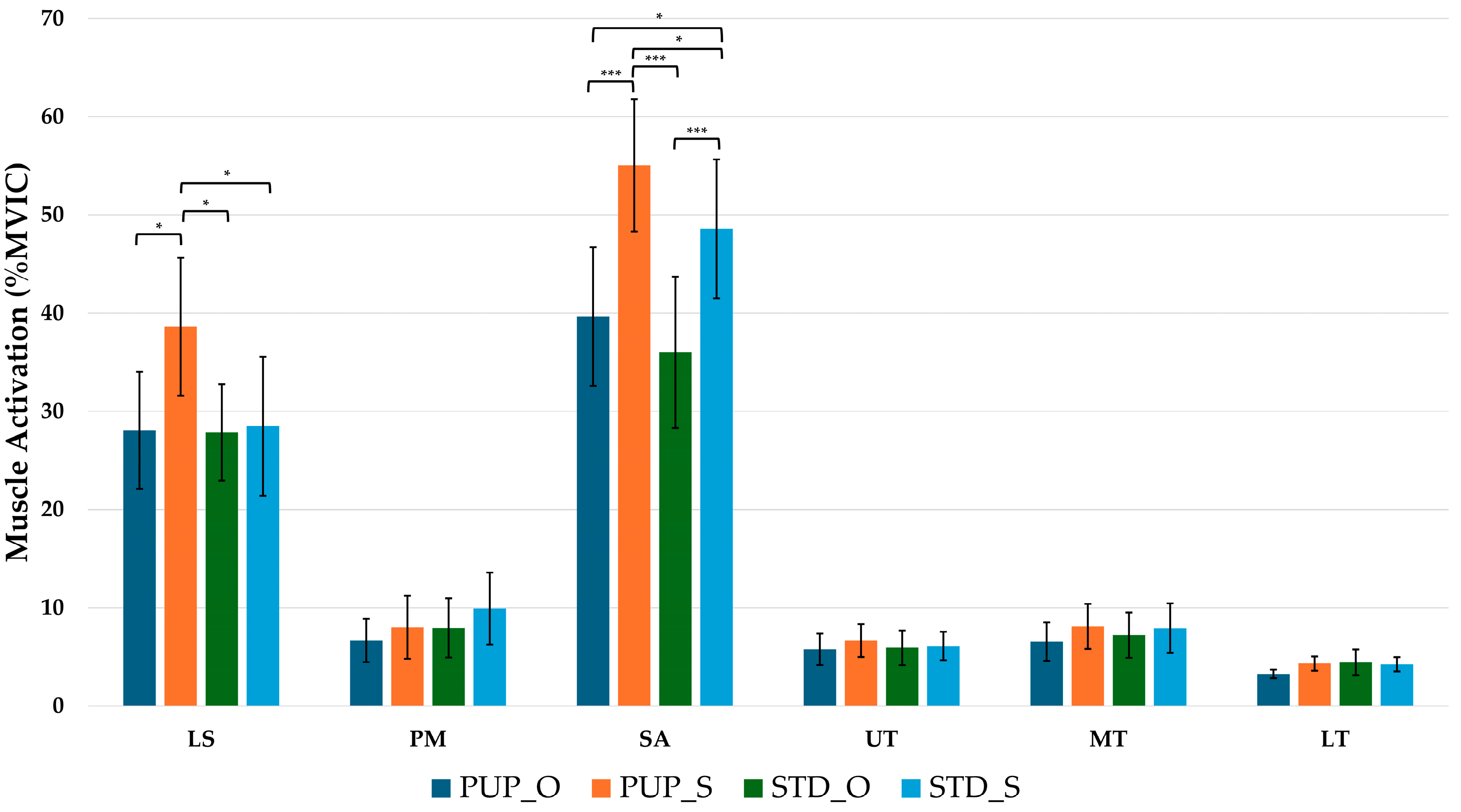
3.2. Muscle Activation During the Scapular Isometric Phase
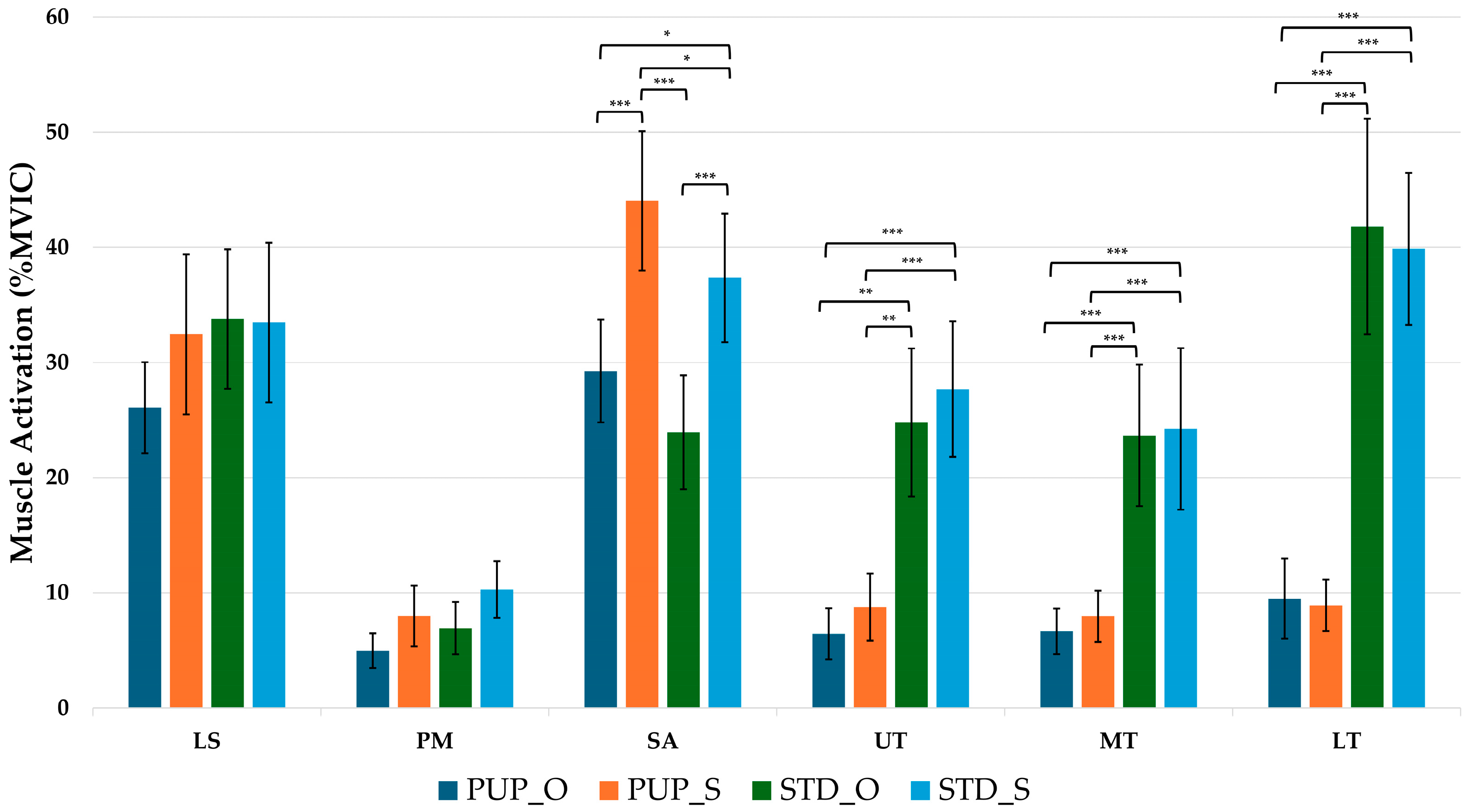
3.3. Muscle Activation During the Scapular Retraction Phase
3.4. Scapular Muscle Activation Ratio
4. Discussion
4.1. Scapular Protraction Phase
4.2. Isometric Phase
4.3. Scapular Retraction Phase
4.4. Stability Muscle Activation Ratio
4.5. Limitation of Study
5. Conclusions
Author Contributions
Funding
Institutional Review Board Statement
Informed Consent Statement
Data Availability Statement
Acknowledgments
Conflicts of Interest
References
- McClure, P.W.; Michener, L.A.; Sennett, B.J.; Karduna, A.R. Direct 3-dimensional measurement of scapular kinematics during dynamic movements in vivo. J. Shoulder Elb. Surg. 2001, 10, 269–277. [Google Scholar] [CrossRef]
- Ben Kibler, W. The role of the scapula in athletic shoulder function. Am. J. Sports Med. 1998, 26, 325–337. [Google Scholar] [CrossRef]
- Paine, R.; Voight, M.L. The role of the scapula. Int. J. Sports Phys. Ther. 2013, 8, 617–629. [Google Scholar] [CrossRef]
- Hickey, D.; Solvig, V.; Cavalheri, V.; Harrold, M.; Mckenna, L. Scapular dyskinesis increases the risk of future shoulder pain by 43% in asymptomatic athletes: A systematic review and meta-analysis. Br. J. Sports Med. 2018, 52, 102–110. [Google Scholar] [CrossRef]
- Jildeh, T.R.; Ference, D.A.; Abbas, M.J.; Jiang, E.X.; Okoroha, K.R. Scapulothoracic dyskinesis: A concept review. Curr. Rev. Musculoskelet. Med. 2021, 14, 246–254. [Google Scholar] [CrossRef]
- Teixeira, D.C.; Alves, L.; Gutierres, M. The role of scapular dyskinesis on rotator cuff tears: A narrative review of the current knowledge. EFORT Open Rev. 2021, 6, 932–940. [Google Scholar] [CrossRef]
- Berthold, J.B.; Burg, T.M.; Nussbaum, R.P. Long thoracic nerve injury caused by overhead weight lifting leading to scapular dyskinesis and medial scapular winging. J. Osteopath. Med. 2017, 117, 133–137. [Google Scholar] [CrossRef] [PubMed]
- Zarei, M.; Eshghi, S.; Hosseinzadeh, M. The effect of a shoulder injury prevention programme on proprioception and dynamic stability of young volleyball players; a randomized controlled trial. BMC Sports Sci. Med. Rehabil. 2021, 13, 71. [Google Scholar] [CrossRef] [PubMed]
- Yuksel, E.; Yesilyaprak, S.S. Scapular stabilization exercise training improves treatment effectiveness on shoulder pain, scapular dyskinesis, muscle strength, and function in patients with subacromial pain syndrome: A randomized controlled trial. J. Bodyw. Mov. Ther. 2024, 37, 101–108. [Google Scholar] [CrossRef] [PubMed]
- Liu, L.; Liu, Y.; Yuk, Y.-S.; Lim, H.-W. Effects of Using a Special Weighted Vest on Muscle Activity around the Scapula during Knee Push-Up Plus in Healthy Subjects. Healthcare 2024, 12, 1778. [Google Scholar] [CrossRef]
- Kang, F.-J.; Ou, H.-L.; Lin, K.-Y.; Lin, J.-J. Serratus anterior and upper trapezius electromyographic analysis of the push-up plus exercise: A systematic review and meta-analysis. J. Athl. Train. 2019, 54, 1156–1164. [Google Scholar] [CrossRef] [PubMed]
- Ludewig, P.M.; Hoff, M.S.; Osowski, E.E.; Meschke, S.A.; Rundquist, P.J. Relative balance of serratus anterior and upper trapezius muscle activity during push-up exercises. Am. J. Sports Med. 2004, 32, 484–493. [Google Scholar] [CrossRef]
- Phadke, V.; Camargo, P.; Ludewig, P. Scapular and rotator cuff muscle activity during arm elevation: A review of normal function and alterations with shoulder impingement. Rev. Bras. De Fisioter. 2009, 13, 1–9. [Google Scholar] [CrossRef]
- Neumann, D.A.; Camargo, P.R. Kinesiologic considerations for targeting activation of scapulothoracic muscles—Part 1: Serratus anterior. Braz. J. Phys. Ther. 2019, 23, 459–466. [Google Scholar] [CrossRef]
- Camargo, P.R.; Neumann, D.A. Kinesiologic considerations for targeting activation of scapulothoracic muscles—Part 2: Trapezius. Braz. J. Phys. Ther. 2019, 23, 467–475. [Google Scholar] [CrossRef]
- Martin, R.M.; Fish, D.E. Scapular winging: Anatomical review, diagnosis, and treatments. Curr. Rev. Musculoskelet. Med. 2008, 1, 1–11. [Google Scholar] [CrossRef]
- Arghadeh, R.; Alizadeh, M.H.; Minoonejad, H.; Sheikhhoseini, R.; Asgari, M.; Jaitner, T. Electromyography of scapular stabilizers in people without scapular dyskinesis during push-ups: A systematic review and meta-analysis. Front. Physiol. 2023, 14, 1296279. [Google Scholar] [CrossRef] [PubMed]
- Ahn, S.-H.; Kwon, O.-Y.; Choung, S.-D.; Kim, S.-H.; Jeon, I.-C. Comparison of muscle activity ratio of upper trapezius to serratus anterior during shoulder elevation between subjects with and without pain experienced in upper trapezius. Phys. Ther. Korea 2014, 21, 67–73. [Google Scholar] [CrossRef][Green Version]
- Briel, S.; Olivier, B.; Mudzi, W. Scapular force: Couple ratios in healthy shoulders—An observational study reflecting typical values. S. Afr. J. Physiother. 2022, 78, 1619. [Google Scholar] [CrossRef] [PubMed]
- Mendez-Rebolledo, G.; Orozco-Chavez, I.; Morales-Verdugo, J.; Ramirez-Campillo, R.; Cools, A.M.J. Electromyographic analysis of the serratus anterior and upper trapezius in closed kinetic chain exercises performed on different unstable support surfaces: A systematic review and meta-analysis. PeerJ 2022, 10, e13589. [Google Scholar] [CrossRef]
- Yoon, J.-O.; Kang, M.-H.; Kim, J.-S.; Oh, J.-S. Effect of modified bridge exercise on trunk muscle activity in healthy adults: A cross sectional study. Braz. J. Phys. Ther. 2018, 22, 161–167. [Google Scholar] [CrossRef]
- Arghadeh, R.; Alizadeh, M.H.; Minoonejad, H.; Sheikhhoseini, R.; Asgari, M.; Jaitner, T. Electromyography of shoulder muscles in individuals without scapular dyskinesis during closed kinetic chain exercises on stable and unstable surfaces: A systematic review and meta-analysis. Front. Sports Act. Living 2024, 6, 1385693. [Google Scholar] [CrossRef]
- Stevens, V.K.; Vleeming, A.; Bouche, K.G.; Mahieu, N.N.; Vanderstraeten, G.G.; Danneels, L.A. Electromyographic activity of trunk and hip muscles during stabilization exercises in four-point kneeling in healthy volunteers. Eur. Spine J. 2007, 16, 711–718. [Google Scholar] [CrossRef]
- Hwang, U.-J.; Kwon, O.-Y.; Jeon, I.-C.; Kim, S.-H.; Weon, J.-H. Effect of humeral-elevation angle on electromyographic activity in the serratus anterior during the push-up-plus exercise. J. Sport Rehabil. 2017, 26, 57–64. [Google Scholar] [CrossRef]
- Torres, R.J.; Pirauá, A.L.; Nascimento, V.Y.; Dos Santos, P.S.; Beltrão, N.B.; de Oliveira, V.M.; Pitangui, A.C.R.; de Araújo, R.C. Shoulder muscle activation levels during the push-up-plus exercise on stable and unstable surfaces. J. Sport Rehabil. 2017, 26, 281–286. [Google Scholar] [CrossRef]
- Hardwick, D.H.; Beebe, J.A.; McDonnell, M.K.; Lang, C.E. A comparison of serratus anterior muscle activation during a wall slide exercise and other traditional exercises. J. Orthop. Sports Phys. Ther. 2006, 36, 903–910. [Google Scholar] [CrossRef]
- Kowalski, K.L.; Connelly, D.M.; Jakobi, J.M.; Sadi, J. Shoulder electromyography activity during push-up variations: A scoping review. Shoulder Elb. 2022, 14, 326–340. [Google Scholar] [CrossRef]
- Park, S.-Y.; Yoo, W.-G. Differential activation of parts of the serratus anterior muscle during push-up variations on stable and unstable bases of support. J. Electromyogr. Kinesiol. 2011, 21, 861–867. [Google Scholar] [CrossRef] [PubMed]
- Lehman, G.J.; Gilas, D.; Patel, U. An unstable support surface does not increase scapulothoracic stabilizing muscle activity during push up and push up plus exercises. Man. Ther. 2008, 13, 500–506. [Google Scholar] [CrossRef] [PubMed]
- Gioftsos, G.; Arvanitidis, M.; Tsimouris, D.; Kanellopoulos, A.; Paras, G.; Trigkas, P.; Sakellari, V. EMG activity of the serratus anterior and trapezius muscles during the different phases of the push-up plus exercise on different support surfaces and different hand positions. J. Phys. Ther. Sci. 2016, 28, 2114–2118. [Google Scholar] [CrossRef] [PubMed][Green Version]
- Kim, S.-H.; Kwon, O.-Y.; Kim, S.-J.; Park, K.-N.; Choung, S.-D.; Weon, J.-H. Serratus anterior muscle activation during knee push-up plus exercise performed on static stable, static unstable, and oscillating unstable surfaces in healthy subjects. Phys. Ther. Sport 2014, 15, 20–25. [Google Scholar] [CrossRef]
- Pedrosa, G.F.; Simões, M.G.; Figueiredo, M.O.; Lacerda, L.T.; Schoenfeld, B.J.; Lima, F.V.; Chagas, M.H.; Diniz, R.C. Training in the initial range of motion promotes greater muscle adaptations than at final in the arm curl. Sports 2023, 11, 39. [Google Scholar] [CrossRef] [PubMed]
- Schoenfeld, B.J.; Grgic, J. Effects of range of motion on muscle development during resistance training interventions: A systematic review. SAGE Open Med. 2020, 8, 2050312120901559. [Google Scholar] [CrossRef] [PubMed]
- Richardson, J.T. Eta squared and partial eta squared as measures of effect size in educational research. Educ. Res. Rev. 2011, 6, 135–147. [Google Scholar] [CrossRef]
- Maenhout, A.; Van Praet, K.; Pizzi, L.; Van Herzeele, M.; Cools, A. Electromyographic analysis of knee push up plus variations: What is the influence of the kinetic chain on scapular muscle activity? Br. J. Sports Med. 2010, 44, 1010–1015. [Google Scholar] [CrossRef]
- Behm, D.G.; Leonard, A.M.; Young, W.B.; Bonsey, W.A.; MacKinnon, S.N. Trunk muscle electromyographic activity with unstable and unilateral exercises. J. Strength Cond. Res. 2005, 19, 193–201. [Google Scholar] [PubMed]
- Hermens, H.J.; Freriks, B.; Disselhorst-Klug, C.; Rau, G. Development of recommendations for SEMG sensors and sensor placement procedures. J. Electromyogr. Kinesiol. 2000, 10, 361–374. [Google Scholar] [CrossRef]
- Maeo, S.; Chou, T.; Yamamoto, M.; Kanehisa, H. Muscular activities during sling-and ground-based push-up exercise. BMC Res. Notes 2014, 7, 192. [Google Scholar] [CrossRef]
- Lim, H.-W. Comparison of Activity in Scapular Stabilizing muscles during knee push-up plus and modified Vojta’s 3-point support exercises. Healthcare 2021, 9, 1636. [Google Scholar] [CrossRef]
- Baek, Y.-J.; Jung, Y.-J.; Son, J.-I.; Lim, O.-B.; Yi, C.-H. Comparison of muscle activity and trunk compensation during modified push-up plus exercises in individuals with scapular winging. Isokinet. Exerc. Sci. 2017, 25, 201–207. [Google Scholar] [CrossRef]
- McLean, L. The effect of postural correction on muscle activation amplitudes recorded from the cervicobrachial region. J. Electromyogr. Kinesiol. 2005, 15, 527–535. [Google Scholar] [CrossRef] [PubMed]
- Muyor, J.M.; Rodríguez-Ridao, D.; Oliva-Lozano, J.M. Comparison of muscle activity between the horizontal bench press and the seated chest press exercises using several grips. J. Hum. Kinet. 2023, 87, 23. [Google Scholar] [CrossRef]
- Ekstrom, R.A.; Soderberg, G.L.; Donatelli, R.A. Normalization procedures using maximum voluntary isometric contractions for the serratus anterior and trapezius muscles during surface EMG analysis. J. Electromyogr. Kinesiol. 2005, 15, 418–428. [Google Scholar] [CrossRef] [PubMed]
- Zanca, G.G.; Oliveira, A.B.; Ansanello, W.; Barros, F.C.; Mattiello, S.M. EMG of upper trapezius− Electrode sites and association with clavicular kinematics. J. Electromyogr. Kinesiol. 2014, 24, 868–874. [Google Scholar] [CrossRef]
- Kara, D.; Harput, G.; Duzgun, I. Trapezius muscle activation levels and ratios during scapular retraction exercises: A comparative study between patients with subacromial impingement syndrome and healthy controls. Clin. Biomech. 2019, 67, 119–126. [Google Scholar] [CrossRef]
- Shapiro, S.S.; Wilk, M.B. An Analysis of Variance Test for Normality (Complete Samples). Biometrika 1965, 52, 591–611. [Google Scholar] [CrossRef]
- Park, E.; Cho, M.; Ki, C.-s. Correct use of repeated measures analysis of variance. Korean J. Lab. Med. 2009, 29, 1–9. [Google Scholar] [CrossRef]
- Greenhouse, S.W.; Geisser, S. On methods in the analysis ofprofile data. Psychometrika 1959, 24, 95–112. [Google Scholar] [CrossRef]
- Huynh, H.; Feldt, L.S. Estimation of the Box correction for degrees of freedom from sample data in randomised block and split-plot designs. J. Educ. Stat. 1976, 1, 69–82. [Google Scholar] [CrossRef]
- Mauchly, J.W. Significance test for sphericity of a normal n-variate distribution. Ann. Math. Stat. 1940, 11, 204–209. [Google Scholar] [CrossRef]
- Neumann, D.A.; Kelly, E.R. Kinesiology of the Musculoskeletal System: Foundations for Rehabilitation; Mosby: Maryland Heights, MO, USA, 2010. [Google Scholar]
- Contemori, S.; Panichi, R.; Biscarini, A. Effects of scapular retraction/protraction position and scapular elevation on shoulder girdle muscle activity during glenohumeral abduction. Hum. Mov. Sci. 2019, 64, 55–66. [Google Scholar] [CrossRef] [PubMed]
- Vaseghi, B.; Jaberzadeh, S.; Kalantari, K.K.; Naimi, S.S. The impact of load and base of support on electromyographic onset in the shoulder muscle during push-up exercises. J. Bodyw. Mov. Ther. 2013, 17, 192–199. [Google Scholar] [CrossRef] [PubMed]
- San Juan, J.G.; Suprak, D.N.; Roach, S.M.; Lyda, M. The effects of exercise type and elbow angle on vertical ground reaction force and muscle activity during a push-up plus exercise. BMC Musculoskelet. Disord. 2015, 16, 23. [Google Scholar] [CrossRef]
- Moon, S.-J.; Kim, T.-H.; Roh, J.-S. A Comparison of the Serratus Anterior Muscle Activity according to the Shoulder Flexion Angles in a Closed Kinetic Chain Exercise and an Open Kinetic Chain Exercise. J. Korean Soc. Phys. Med. 2013, 8, 369–378. [Google Scholar] [CrossRef]
- Johnson, G.; Bogduk, N.; Nowitzke, A.; House, D. Anatomy and actions of the trapezius muscle. Clin. Biomech. 1994, 9, 44–50. [Google Scholar] [CrossRef]
- Johnson, G.R.; Pandyan, A.D. The activity in the three regions of the trapezius under controlled loading conditions—An experimental and modelling study. Clin. Biomech. 2005, 20, 155–161. [Google Scholar] [CrossRef]
- Cools, A.M.; Witvrouw, E.E.; De Clercq, G.A.; Danneels, L.A.; Willems, T.M.; Cambier, D.C.; Voight, M.L. Scapular muscle recruitment pattern: Electromyographic response of the trapezius muscle to sudden shoulder movement before and after a fatiguing exercise. J. Orthop. Sports Phys. Ther. 2002, 32, 221–229. [Google Scholar] [CrossRef]
- Cho, S.-H.; Baek, I.-H.; Cheon, J.Y.; Cho, M.J.; Choi, M.Y.; Jung, D.H. Effect of the Push-up Plus (PUP) Exercise at Different Shoulder Rotation Angles on Shoulder Muscle Activities. J. Phys. Ther. Sci. 2014, 26, 1737–1740. [Google Scholar] [CrossRef][Green Version]
- Escamilla, R.F.; Yamashiro, K.; Paulos, L.; Andrews, J.R. Shoulder muscle activity and function in common shoulder rehabilitation exercises. Sports Med. 2009, 39, 663–685. [Google Scholar] [CrossRef]
- Behrsin, J.F.; Maguire, K. Levator scapulae action during shoulder movement: A possible mechanism for shoulder pain of cervical origin. Aust. J. Physiother. 1986, 32, 101–106. [Google Scholar] [CrossRef]
- Andersen, L.L.; Hansen, K.; Mortensen, O.S.; Zebis, M.K. Prevalence and anatomical location of muscle tenderness in adults with nonspecific neck/shoulder pain. BMC Musculoskelet. Disord. 2011, 12, 169. [Google Scholar] [CrossRef] [PubMed]
- Kim, J.-S.; Kim, M.-H.; Ahn, D.-H.; Oh, J.-S. Comparison of shoulder protraction strength and electromyography activity of serratus anterior and pectoralis major in subjects with or without a winged scapula. J. Sport Rehabil. 2019, 28, 272–277. [Google Scholar] [CrossRef] [PubMed]
- De Mey, K.; Danneels, L.; Cagnie, B.; Borms, D.; T’Jonck, Z.; Van Damme, E.; Cools, A.M. Shoulder muscle activation levels during four closed kinetic chain exercises with and without Redcord slings. J. Strength Cond. Res. 2014, 28, 1626–1635. [Google Scholar] [CrossRef] [PubMed]
- Ludewig, P.M.; Phadke, V.; Braman, J.P.; Hassett, D.R.; Cieminski, C.J.; LaPrade, R.F. Motion of the shoulder complex during multiplanar humeral elevation. JBJS 2009, 91, 378–389. [Google Scholar] [CrossRef]
- Heuberer, P.; Kranzl, A.; Laky, B.; Anderl, W.; Wurnig, C. Electromyographic analysis: Shoulder muscle activity revisited. Arch. Orthop. Trauma Surg. 2015, 135, 549–563. [Google Scholar] [CrossRef]
- Turgut, E.; Duzgun, I.; Baltaci, G. Effect of trapezius muscle strength on three-dimensional scapular kinematics. J. Phys. Ther. Sci. 2016, 28, 1864–1867. [Google Scholar] [CrossRef]
- Guney-Deniz, H.; Harput, G.; Toprak, U.; Duzgun, I. Relationship between middle trapezius muscle activation and acromiohumeral distance change during shoulder elevation with scapular retraction. J. Sport Rehabil. 2019, 28, 266–271. [Google Scholar] [CrossRef]
- Malmström, E.-M.; Olsson, J.; Baldetorp, J.; Fransson, P.-A. A slouched body posture decreases arm mobility and changes muscle recruitment in the neck and shoulder region. Eur. J. Appl. Physiol. 2015, 115, 2491–2503. [Google Scholar] [CrossRef]
- Lim, J.; Lee, D.; Kim, S.; Lee, S.; Ryu, J.S. Analysis of abnormal muscle activities in patients with loss of cervical lordosis: A cross-sectional study. BMC Musculoskelet. Disord. 2023, 24, 666. [Google Scholar] [CrossRef]
- Contemori, S.; Biscarini, A. Isolated infraspinatus atrophy secondary to suprascapular nerve neuropathy results in altered shoulder muscles activity. J. Sport Rehabil. 2019, 28, 219–228. [Google Scholar] [CrossRef]
- Cools, A.; Declercq, G.; Cambier, D.; Mahieu, N.; Witvrouw, E. Trapezius activity and intramuscular balance during isokinetic exercise in overhead athletes with impingement symptoms. Scand. J. Med. Sci. Sports 2007, 17, 25–33. [Google Scholar] [CrossRef] [PubMed]



| Muscle | Location |
|---|---|
| Levator scapulae | Lateral to the C3–C4 spinous process |
| Pectoralis major | Midclavicular line over the second intercostal space |
| Serratus anterior | 6th to 8th rib space in the mid-axillary line |
| Upper trapezius | Midpoint between the acromion and the C7 spinous process |
| Middle trapezius | Midpoint between the T2 spinous process and scapular spine |
| Lower trapezius | Midpoint between the T7 spinous process and scapular spine |
| Muscle | Initial Position | Isometric Contraction |
|---|---|---|
| Levator scapulae | sitting, head ipsilateral rotation, and shoulder elevation | shoulder elevation |
| Pectoralis major | supine, shoulder and elbow 90° flexion | shoulder horizontal adduction |
| Serratus anterior | sitting, shoulder 135° flexion | shoulder flexion |
| Upper trapezius | sitting, head contralateral rotation, lateral flexion, and shoulder elevation | head lateral flexion, shoulder elevation |
| Middle trapezius | prone, shoulder 90° abduction with thumb upward | scapular retraction |
| Lower trapezius | prone, shoulder 135° abduction with thumb upward | scapular retraction |
| Variable | PUP_Q (a) | PUP_S (b) | STD_Q (c) | STD_S (d) | p-Value | F | η2p |
|---|---|---|---|---|---|---|---|
| LS (%) | 17.25 ± 7.84 b,c,d | 25.76 ± 12.41 a | 26.62 ± 10.24 a | 26.75 ± 6.54 a | 0.011 * | 5.728 | 0.232 |
| PM (%) | 6.55 ± 4.22 c,d | 9.95 ± 6.21 d | 11.46 ± 7.30 a | 14.66 ± 8.64 a,b | <0.001 ** | 10.279 | 0.318 |
| SA (%) | 33.70 ± 13.27 b,d | 51.57 ± 15.72 a,c,d | 29.85 ± 14.04 b,d | 24.79 ± 12.59 a,b,c | <0.001 ** | 41.679 | 0.644 |
| UT (%) | 4.25 ± 2.18 b,c,d | 7.68 ± 5.16 a,c,d | 22.56 ± 14.96 a,b | 23.51 ± 13.98 a,b | <0.001 ** | 22.648 | 0.531 |
| MT (%) | 5.49 ± 3.30 c,d | 8.04 ± 4.97 c,d | 26.11 ± 21.68 a,b | 19.87 ± 12.76 a,b | <0.001 ** | 19.193 | 0.490 |
| LT (%) | 7.14 ± 6.47 c,d | 9.12 ± 9.28 c,d | 37.81 ± 15.18 a,b | 33.42 ± 13.61 a,b | <0.001 ** | 47.433 | 0.693 |
| Variable | PUP_Q (a) | PUP_S (b) | STD_Q (c) | STD_S (d) | p-Value | F | η2p |
|---|---|---|---|---|---|---|---|
| LS (%) | 28.07 ± 12.75 b | 38.63 ± 14.99 a,c,d | 27.86 ± 10.47 b | 28.49 ± 15.11 b | 0.001 * | 5.892 | 0.237 |
| PM (%) | 6.66 ± 4.82 | 8.02 ± 7.04 | 7.96 ± 6.63 | 9.92 ± 8.04 | 0.102 | 2.157 | 0.097 |
| SA (%) | 39.66 ± 16.36 b,d | 55.06 ± 15.59 a,c,d | 36.00 ± 17.83 b,d | 48.58 ± 16.37 a,b,c | <0.001 ** | 24.775 | 0.530 |
| UT (%) | 5.76 ± 3.41 | 6.66 ± 3.57 | 5.92 ± 3.78 | 6.11 ± 3.10 | 0.458 | 0.877 | 0.044 |
| MT (%) | 6.56 ± 4.30 | 8.10 ± 5.04 | 7.22 ± 5.05 | 7.92 ± 5.55 | 0.492 | 0.812 | 0.039 |
| LT (%) | 3.26 ± 0.97 | 4.33 ± 1.59 | 4.44 ± 2.85 | 4.24 ± 1.59 | 0.095 | 2.671 | 0.118 |
| Variable | PUP_Q (a) | PUP_S (b) | STD_Q (c) | STD_S (d) | p-Value | F | η2p |
|---|---|---|---|---|---|---|---|
| LS (%) | 26.07 ± 8.71 | 32.45 ± 15.27 | 33.77 ± 13.29 | 33.47 ± 15.24 | 0.113 | 2.134 | 0.096 |
| PM (%) | 4.98 ± 3.30 d | 7.97 ± 5.80 | 6.94 ± 4.97 | 10.28 ± 5.43 a | 0.001 * | 6.558 | 0.247 |
| SA (%) | 29.25 ± 10.05 b,d | 44.03 ± 13.64 a,c,d | 23.95 ± 11.16 b,d | 37.36 ± 12.60 a,b,c | <0.001 ** | 25.942 | 0.553 |
| UT (%) | 6.43 ± 4.91 c,d | 8.76 ± 6.37 c,d | 24.79 ± 14.14 a,b | 27.68 ± 12.92 a,b | <0.001 ** | 27.797 | 0.582 |
| MT (%) | 6.66 ± 4.35 c,d | 7.97 ± 4.87 c,d | 23.67 ± 13.48 a,b | 24.24 ± 15.40 a,b | <0.001 ** | 24.841 | 0.554 |
| LT (%) | 9.50 ± 8.03 c,d | 8.91 ± 5.20 c,d | 41.81 ± 21.67 a,b | 39.86 ± 15.25 a,b | <0.001 ** | 48.987 | 0.690 |
| Variable | PUP_Q (a) | PUP_S (b) | STD_Q (c) | STD_S (d) | p-Value | F | η2p |
|---|---|---|---|---|---|---|---|
| UT/SA | 0.18 ± 0.13 c,d | 0.18 ± 0.17 c,d | 0.70 ± 0.44 a,b | 0.47 ± 0.21 a,b | <0.001 ** | 23.901 | 0.544 |
| UT/LT | 1.45 ± 1.18 | 1.57 ± 1.56 | 1.25 ± 1.05 | 1.22 ± 0.90 | 0.287 | 1.292 | 0.064 |
Disclaimer/Publisher’s Note: The statements, opinions and data contained in all publications are solely those of the individual author(s) and contributor(s) and not of MDPI and/or the editor(s). MDPI and/or the editor(s) disclaim responsibility for any injury to people or property resulting from any ideas, methods, instructions or products referred to in the content. |
© 2025 by the authors. Licensee MDPI, Basel, Switzerland. This article is an open access article distributed under the terms and conditions of the Creative Commons Attribution (CC BY) license (https://creativecommons.org/licenses/by/4.0/).
Share and Cite
Jung, E.-Y.; Roh, S.-Y.; Mun, W.-L. Electromyographic Patterns of Scapular Muscles During Four Variations of Protraction–Retraction Exercises. Life 2025, 15, 1840. https://doi.org/10.3390/life15121840
Jung E-Y, Roh S-Y, Mun W-L. Electromyographic Patterns of Scapular Muscles During Four Variations of Protraction–Retraction Exercises. Life. 2025; 15(12):1840. https://doi.org/10.3390/life15121840
Chicago/Turabian StyleJung, Eui-Young, Su-Yeon Roh, and Woo-Lim Mun. 2025. "Electromyographic Patterns of Scapular Muscles During Four Variations of Protraction–Retraction Exercises" Life 15, no. 12: 1840. https://doi.org/10.3390/life15121840
APA StyleJung, E.-Y., Roh, S.-Y., & Mun, W.-L. (2025). Electromyographic Patterns of Scapular Muscles During Four Variations of Protraction–Retraction Exercises. Life, 15(12), 1840. https://doi.org/10.3390/life15121840