
Deep Fusion of Kinematic Features and Task-Aware Partition Planning for Mold Surface Robotic Polishing


Abstract
1. Introduction
- Efficiency Bottlenecks: Large-scale point clouds impose significant computational and storage burdens, often creating efficiency bottlenecks in processing.
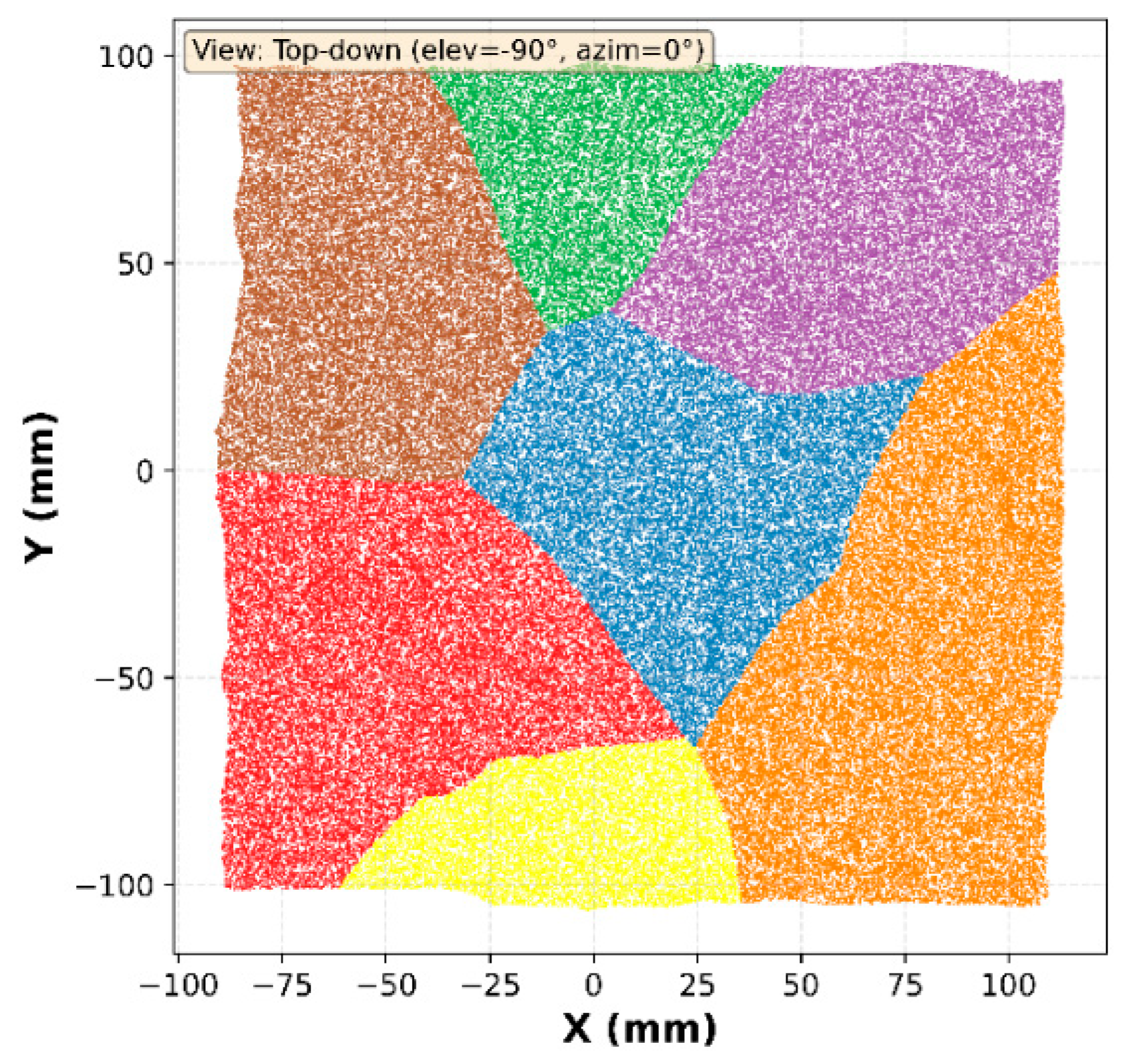
- Lack of Task-Oriented Organization: Existing segmentation methods prioritize geometric consistency but lack task-oriented region organization, making it difficult to explicitly consider coverage efficiency, tool direction-change costs, and reachability risks.
- Insufficient Verification: Planning evaluation typically remains at the geometric level, lacking a unified closed-loop verification framework that integrates kinematic reachability and safety margins.
2. Point-Cloud Preprocessing and Workpiece Foreground Extraction via the D-C-M Strategy
3. Task-Aware Region Partitioning for Manipulator Polishing
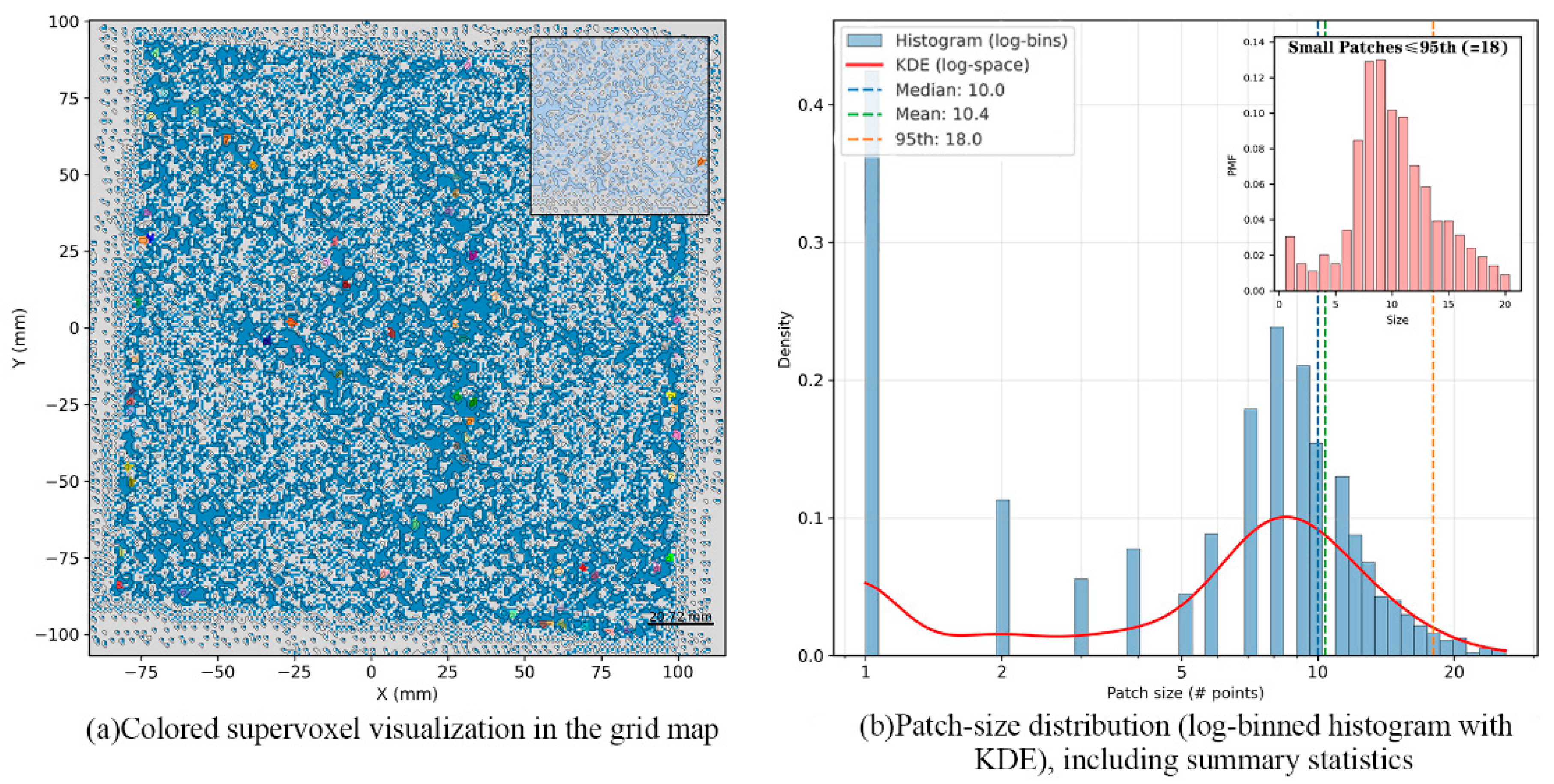
3.1. Supervoxel Construction for the Sampled Point Cloud
3.2. Attributed Adjacency Graph Construction and Edge Weight Modeling
3.3. Energy-Minimization Task Partitioning for Executable Manipulator Polishing
4. Coverage Toolpath Generation for Manipulator-Executable Polishing
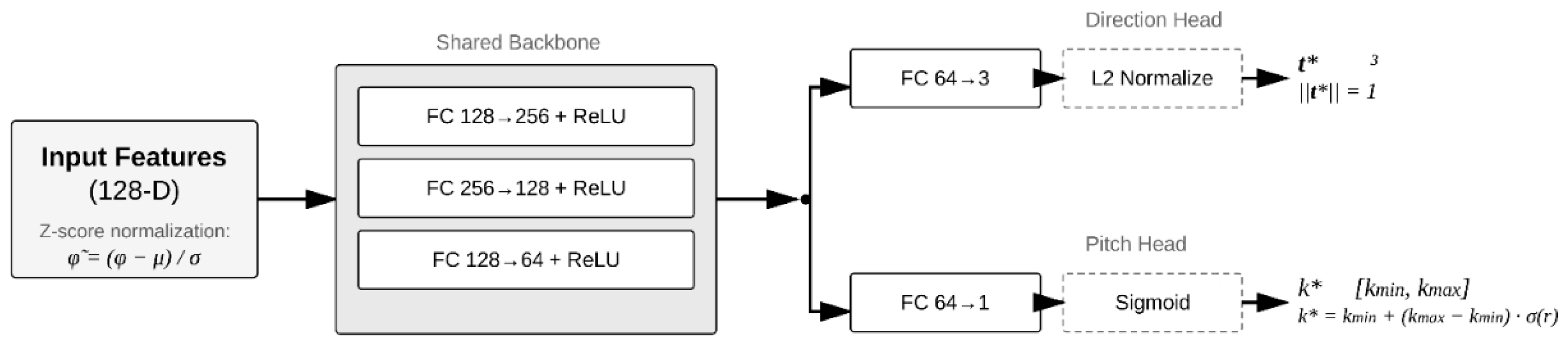
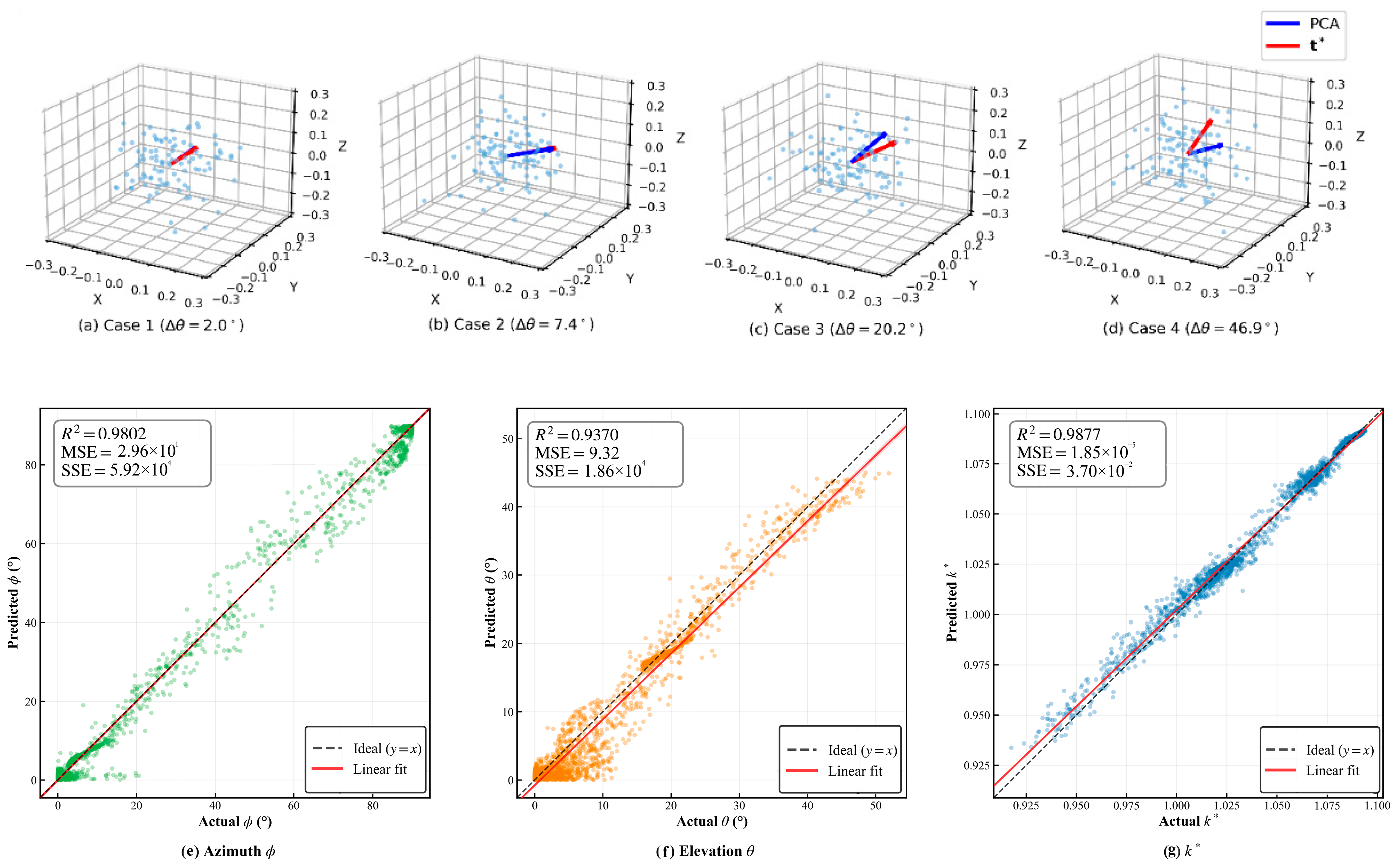
4.1. Learning-Based Process Parameter Prediction via Deep Geometric Feature Fusion
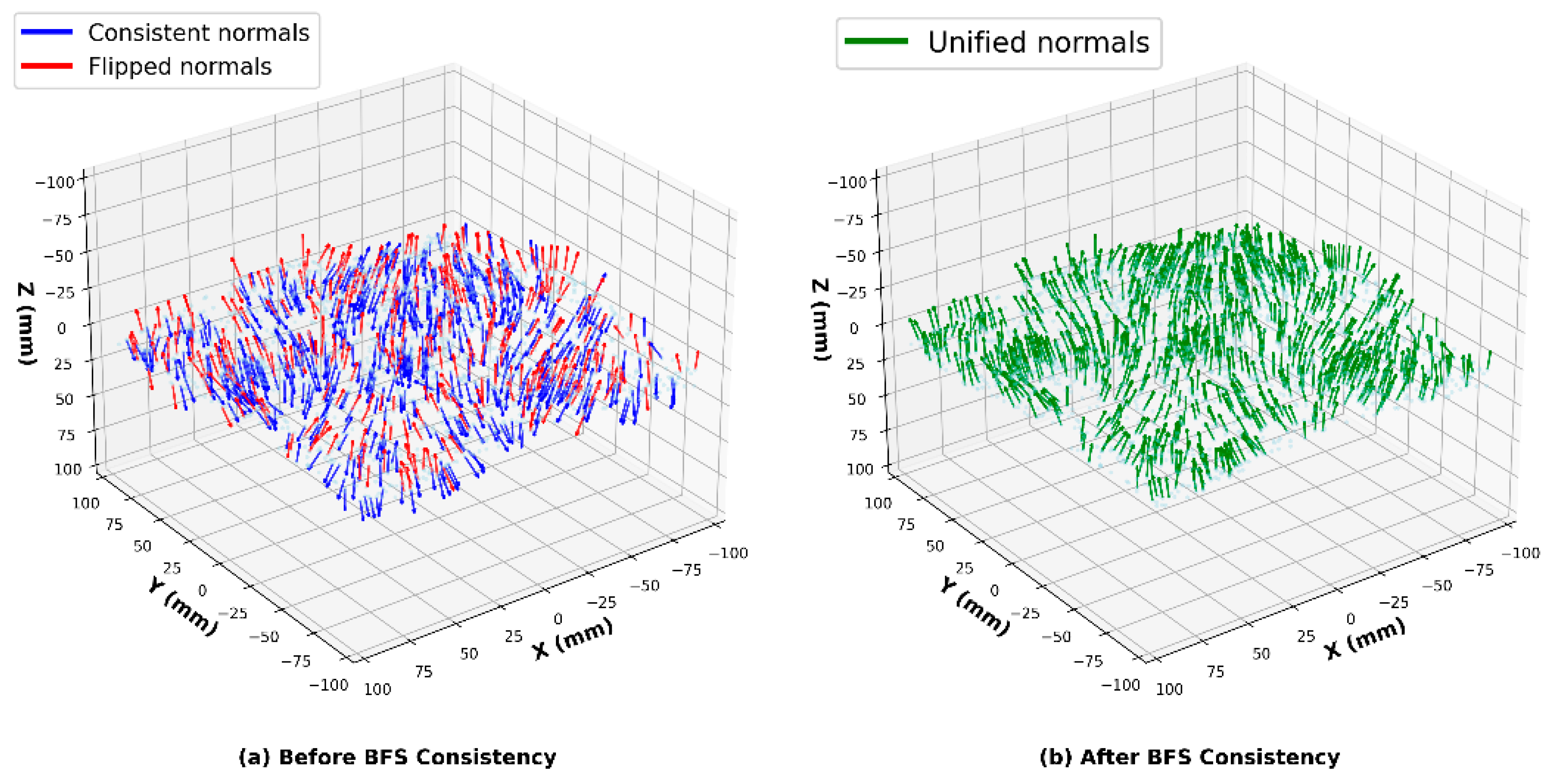
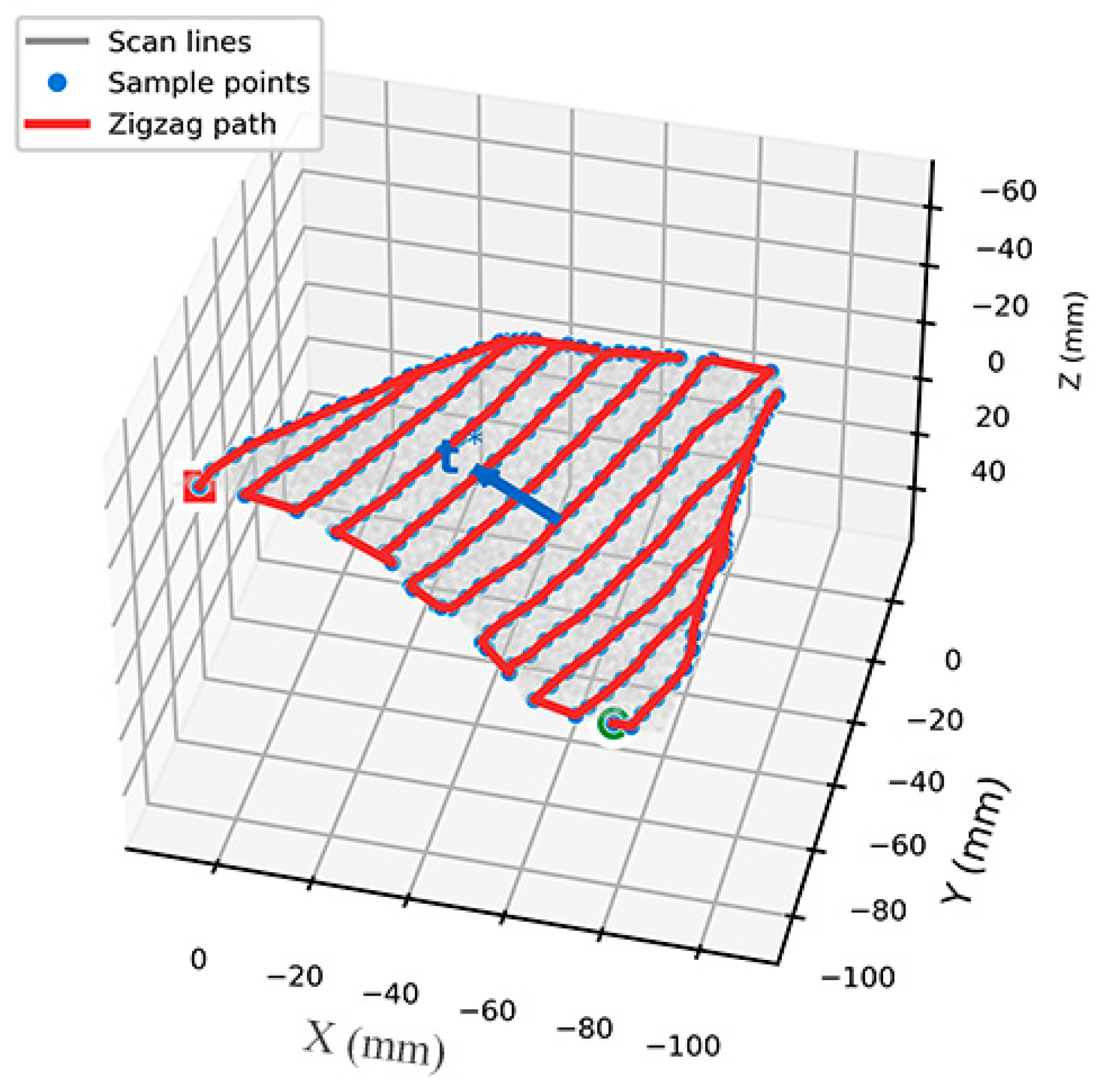
4.2. Topology-Aware Thick-Slice Serpentine Path Planning
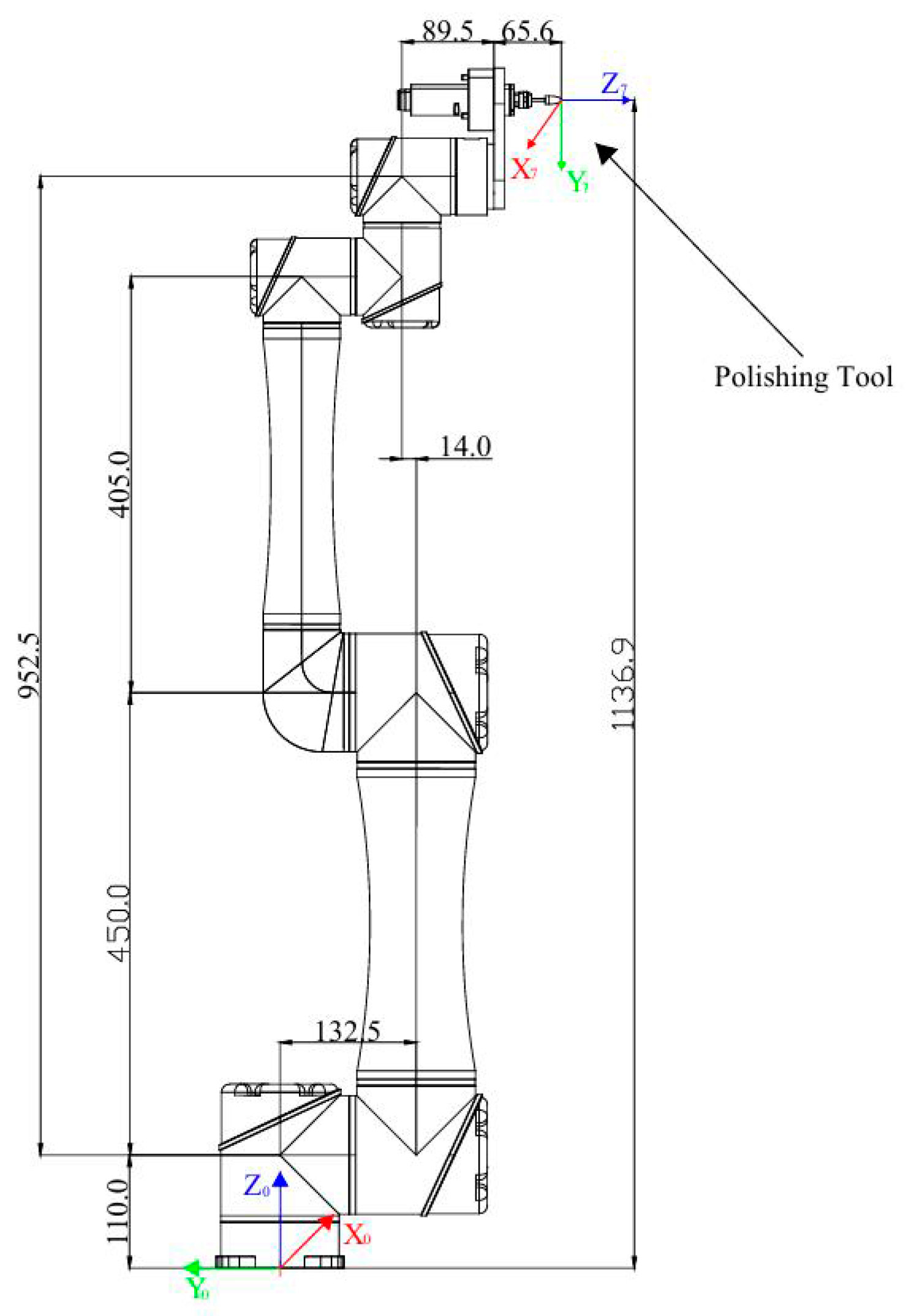
4.3. Kinematically Feasible Pose Mapping and Temporal Trajectory Parameterization via Inverse Kinematics
5. Robotic Polishing Simulation and Experiments
5.1. Simulation-Based Trajectory Executability and Process-Level Quality Evaluation
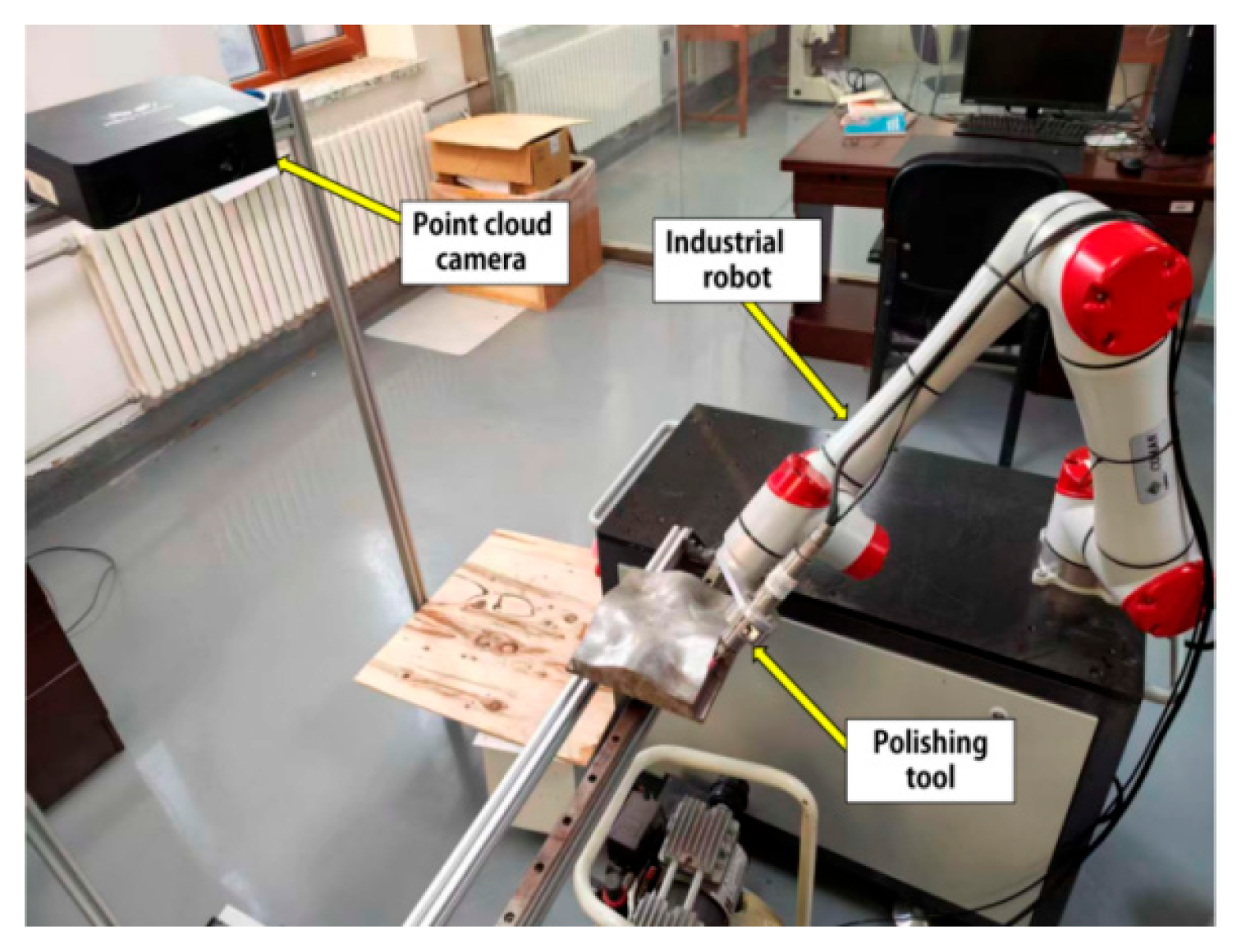
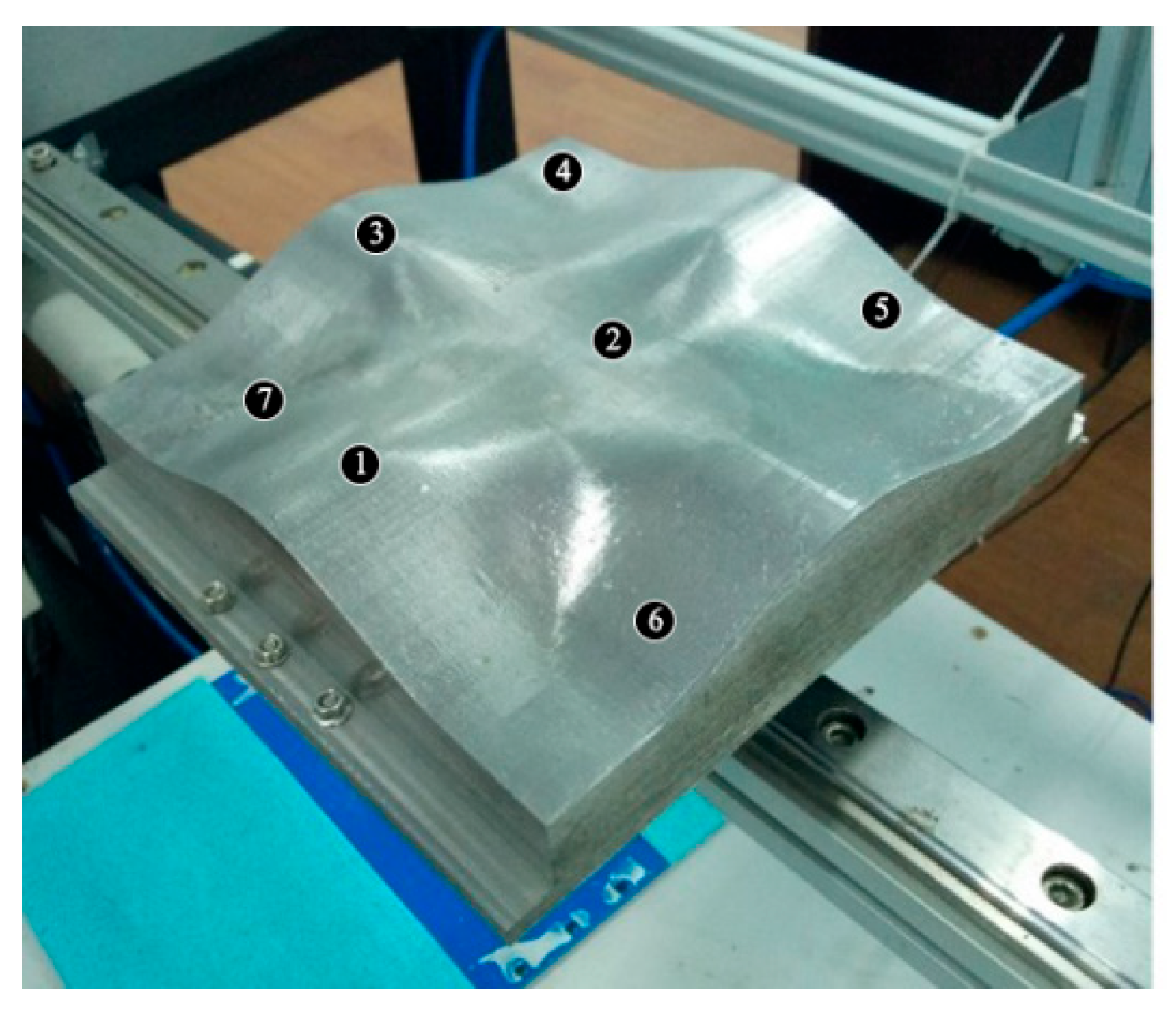
5.2. Mold Surface Polishing Experimental Verification
6. Conclusions and Future Work
Author Contributions
Funding
Data Availability Statement
Conflicts of Interest
Appendix A

| Algorithm Stage | Parameter (Symbol) | Value | Selection Rationale |
|---|---|---|---|
| Preprocessing | Outlier Sensitivity (α) | 2.0 | Standard statistical threshold (≈2σ) assuming approximately Gaussian measurement noise; removes sparse outliers while retaining the majority of inliers. |
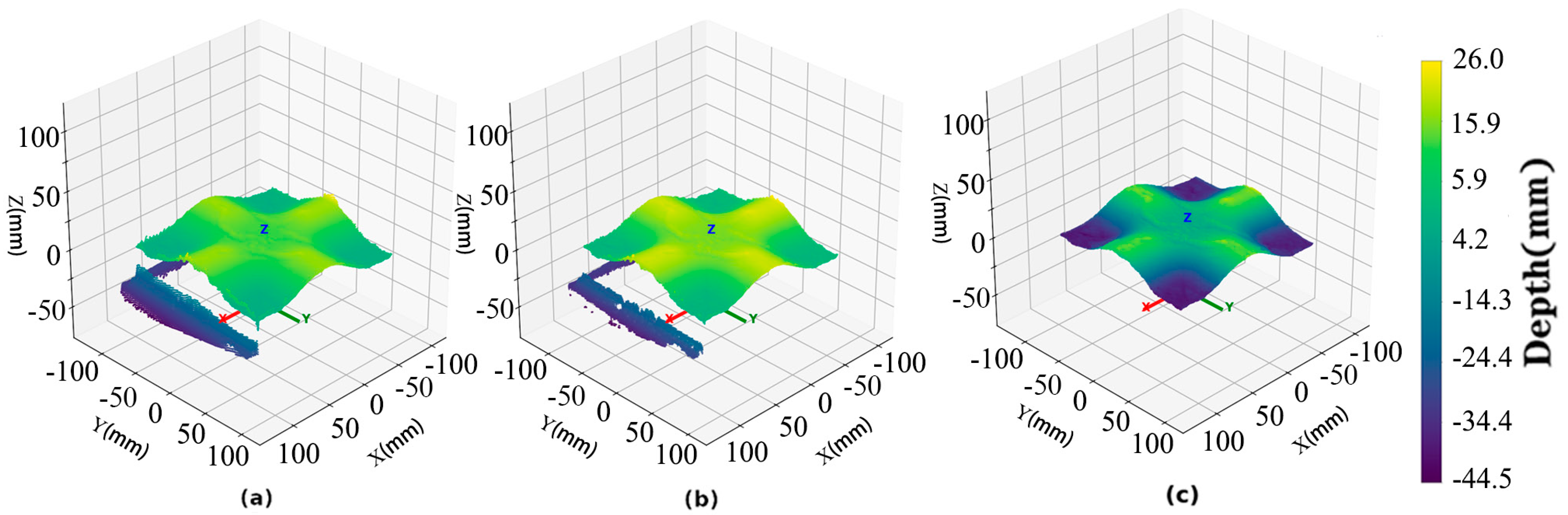
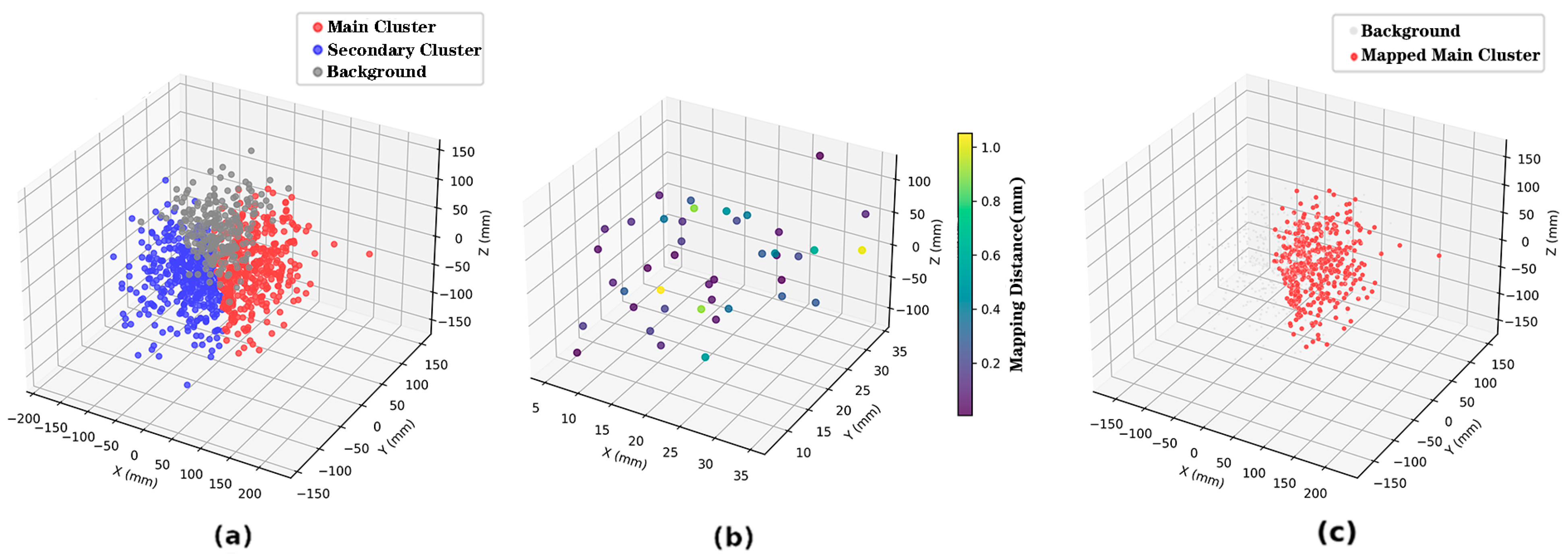
| Mapping Threshold (δmap) | Adaptive | Computed as to balance label diffusion with boundary precision during mapping-back. | |
| Partitioning | Seed Constraint (cg, cs) | 1.5/2.0 | Fixed empirically to control seed density relative to the local feature scale and maintain stable supervoxel growth across datasets. |
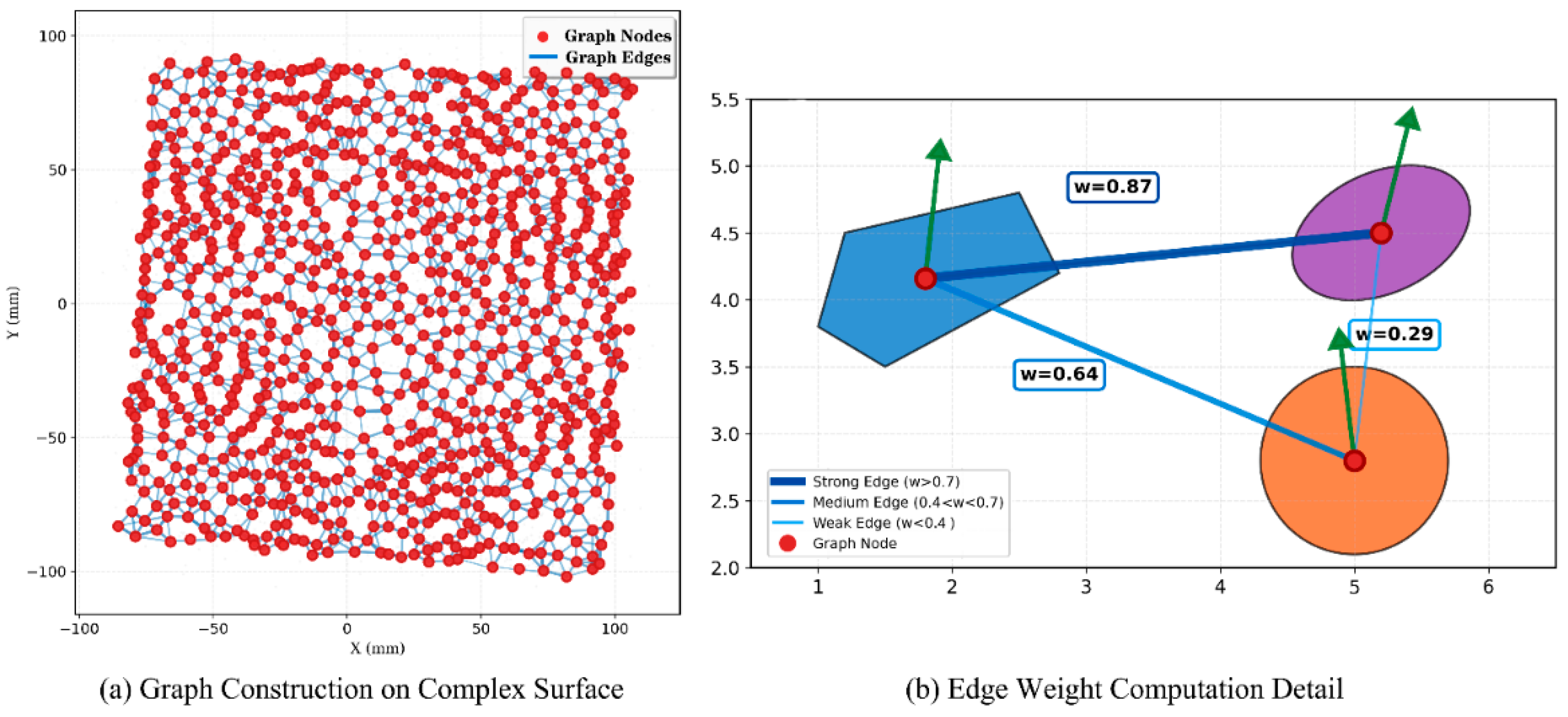
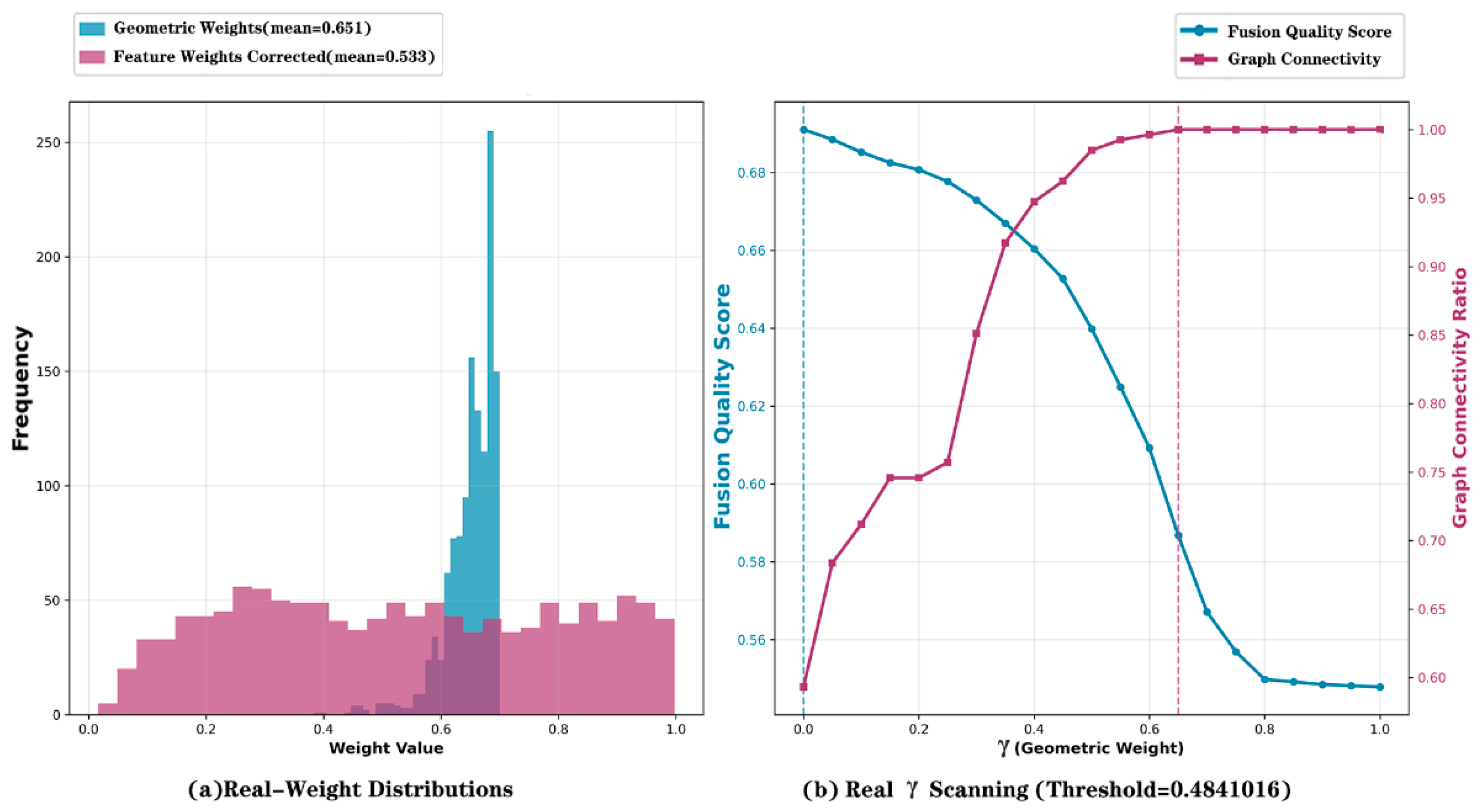
| Graph Weight Balance (γ) | 0.5 | Selected via sensitivity analysis (Pareto frontier in Figure 5) to balance kinematic connectivity and geometric adherence. | |
| Similarity Decay (λ) | 10.0 | Controls the steepness of feature-similarity decay; set empirically to obtain clear separation between intra-region and inter-region affinities. | |
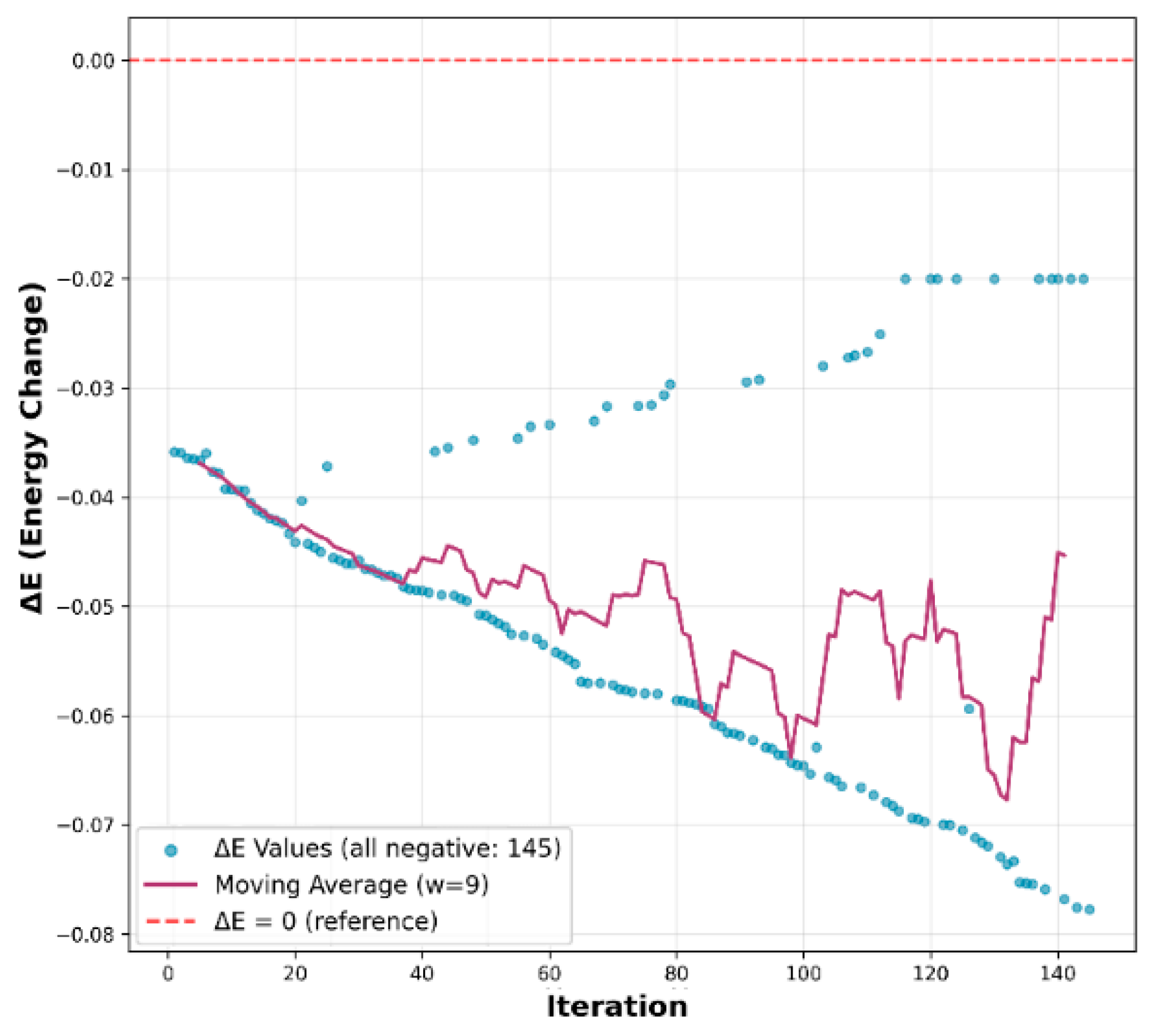
| Merge Threshold (τenergy) | −1.0 × 10⁻⁴ | Small negative threshold to enforce strictly monotonic energy reduction and suppress numerical noise-induced marginal merges. | |
| Path Planning | Loss Weights (λdir, λk) | Tuned | Tuned to balance convergence rates of the direction branch (cosine loss) and the step-distance branch (MSE). |
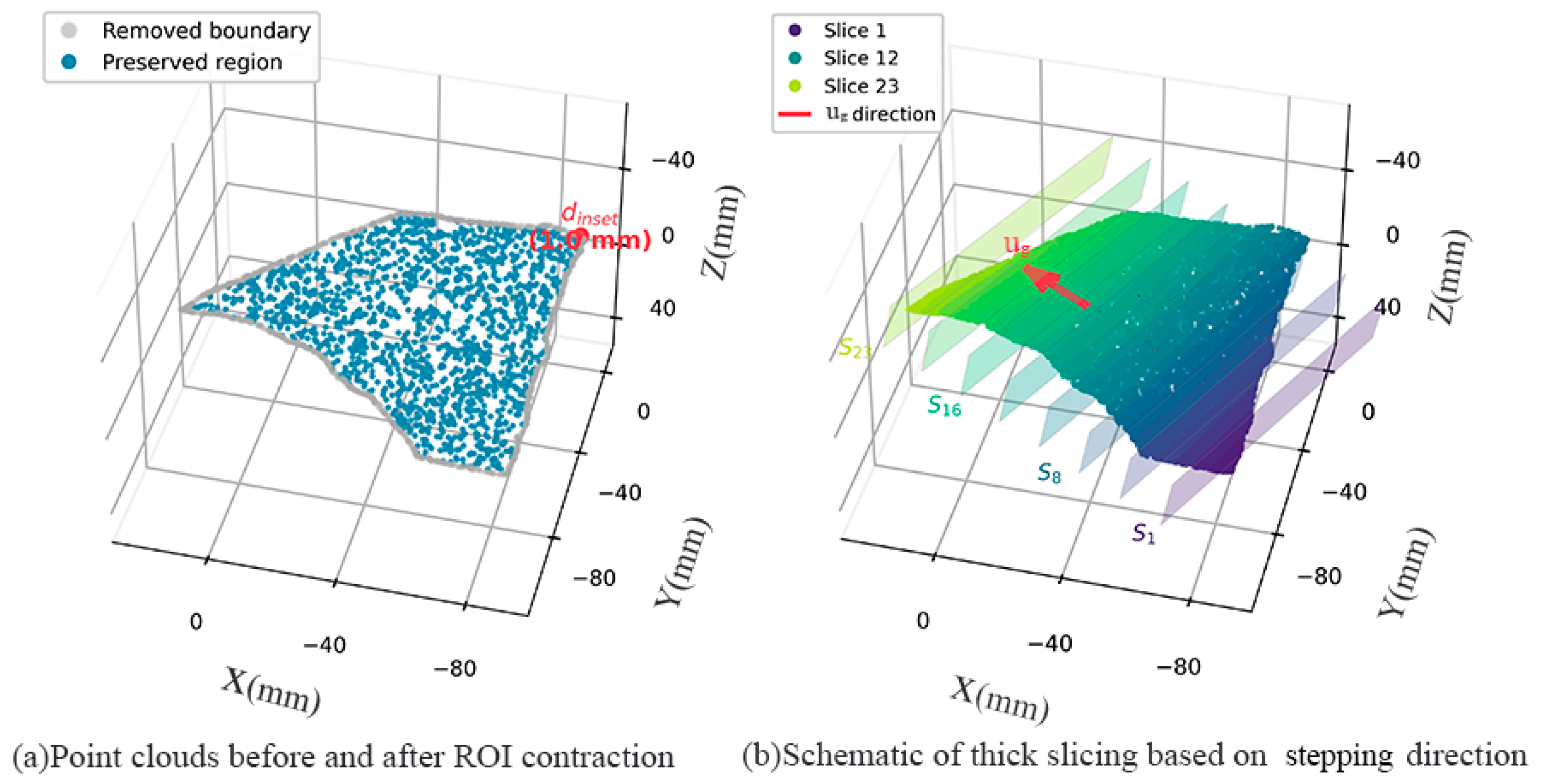
| ROI Inset Ratio (αinset) | 0.5 | Set to to ensure the tool center remains strictly inside the boundary during path generation. | |
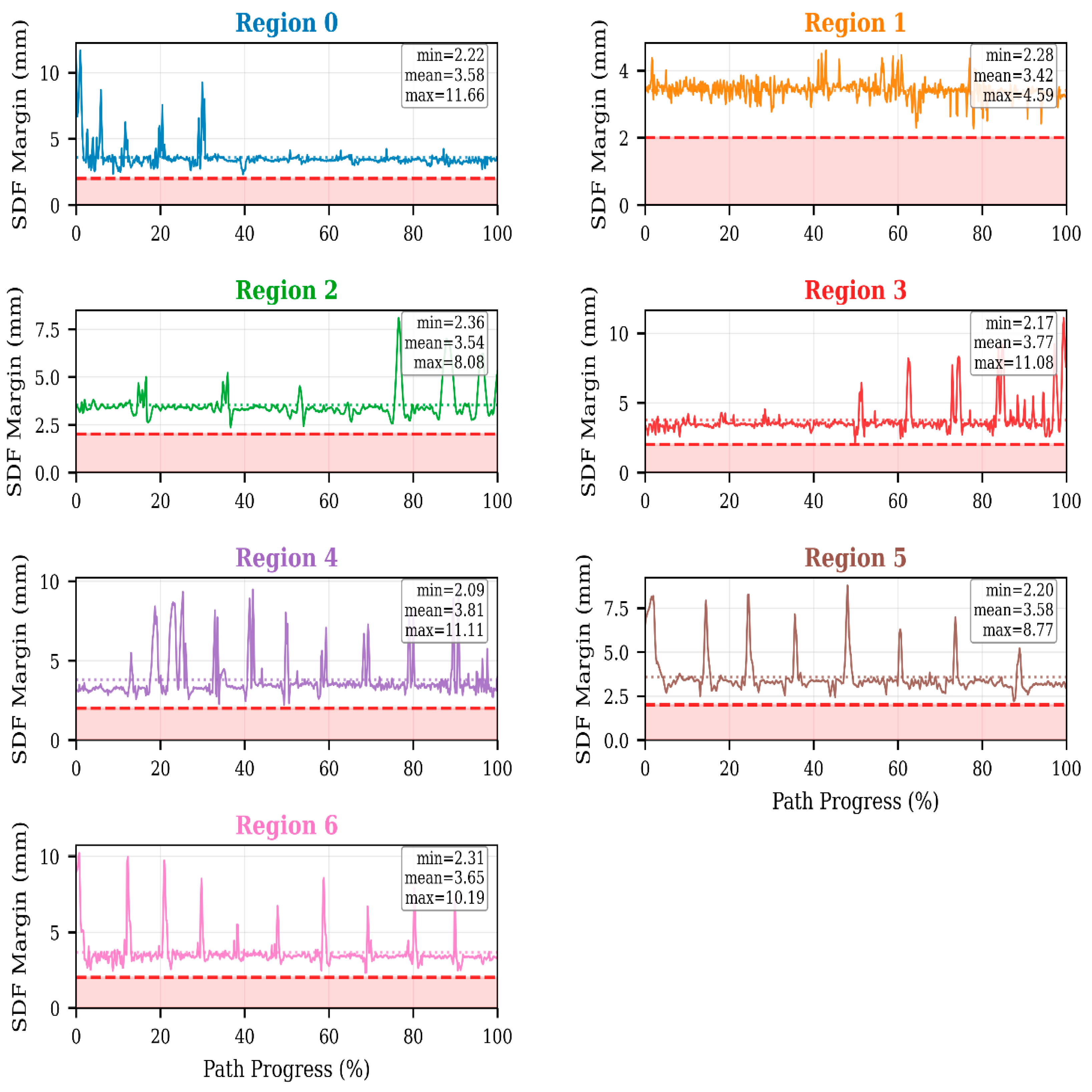
| Validation | Safety Margin (dsafe) | 2.0 mm | Conservative threshold set significantly higher than the robot repeatability (±0.03 mm) to ensure safe operation under perception uncertainty. |
References
- Zhu, D.; Feng, X.; Xu, X.; Yang, Z.; Li, W.; Yan, S.; Ding, H. Robotic Grinding of Complex Components: A Step towards Efficient and Intelligent Machining—Challenges, Solutions, and Applications. Robot. Comput.-Integr. Manuf. 2020, 65, 101908. [Google Scholar] [CrossRef]
- Márquez, J.J.; Pérez, J.M.; Ríos, J.; Vizán, A. Process Modeling for Robotic Polishing. J. Mater. Process. Technol. 2005, 159, 69–82. [Google Scholar] [CrossRef]
- Ke, X.; Yu, Y.; Li, K.; Wang, T.; Zhong, B.; Wang, Z.; Kong, L.; Guo, J.; Huang, L.; Idir, M.; et al. Review on Robot-Assisted Polishing: Status and Future Trends. Robot. Comput.-Integr. Manuf. 2023, 80, 102482. [Google Scholar] [CrossRef]
- Peta, K.; Wiśniewski, M.; Kotarski, M.; Ciszak, O. Comparison of Single-Arm and Dual-Arm Collaborative Robots in Precision Assembly. Appl. Sci. 2025, 15, 2976. [Google Scholar] [CrossRef]
- Gong, L.; Li, L.; Zhang, L.; Fan, C.; Li, N. Uniform Coverage Trajectory Planning for Polishing of Equation-Free Surfaces. Machines 2025, 13, 568. [Google Scholar] [CrossRef]
- Wang, K.; Ding, L.; Dailami, F.; Matthews, J. A Methodology to Support Robotic Polishing of Molds Integrated with CAD/CAM. J. Adv. Manuf. Syst. 2024, 23, 349–390. [Google Scholar] [CrossRef]
- Jamshidi, H.; Budak, E. An Analytical Grinding Force Model Based on Individual Grit Interaction. J. Mater. Process. Technol. 2020, 283, 116700. [Google Scholar] [CrossRef]
- Shan, Z.; Cai, Z.; Chen, T.; Chen, Z.; Hu, Y. A Trajectory Planning Technique for Grinding and Polishing Aerospace Turbine Blades’ Thermal Barrier Coatings Based on PCL Point Cloud Processing. Proc. Inst. Mech. Eng. Part B J. Eng. Manuf. 2025, 239, 1565–1579. [Google Scholar] [CrossRef]
- Wang, Z.; Zou, L.; Li, J.; Zhang, J.; Wang, W. Point-Driven Toolpath Curve and Orientation Smoothing in Robotic Belt Grinding for Turbine Blade. Robot. Comput.-Integr. Manuf. 2025, 96, 103046. [Google Scholar] [CrossRef]
- Xiao, M.; Ding, Y.; Yang, G. A Model-Based Trajectory Planning Method for Robotic Polishing of Complex Surfaces. IEEE Trans. Automat. Sci. Eng. 2022, 19, 2890–2903. [Google Scholar] [CrossRef]
- Ren, X.; Chen, G.; Wang, Z.; Wang, Z.; Sun, L. Polishing Path Planning Based on Point Cloud. In Proceedings of the 2020 the 4th International Conference on Innovation in Artificial Intelligence, Xiamen, China, 8–11 May 2020; pp. 222–228. [Google Scholar]
- Zeng, Z.; Jiang, C.; Ding, S.; Li, Q.; Zhai, Z.; Chen, D. Trajectory Planning of Shape-Following Laser Cleaning Robot for the Aircraft Radar Radome Coating. Appl. Sci. 2024, 14, 1163. [Google Scholar] [CrossRef]
- Rusu, R.B.; Cousins, S. 3D Is Here: Point Cloud Library (PCL). In Proceedings of the 2011 IEEE International Conference on Robotics and Automation, Shanghai, China, 9–13 May 2011; IEEE: New York, NY, USA, 2011; pp. 1–4. [Google Scholar]
- Zhou, N.; Jiang, P.; Jiang, S.; Shu, L.; Ni, X.; Zhong, L. An Identification and Localization Method for 3D Workpiece Welds Based on the DBSCAN Point Cloud Clustering Algorithm. J. Manuf. Mater. Process. 2024, 8, 287. [Google Scholar] [CrossRef]
- Bentley, J.L. Multidimensional Binary Search Trees Used for Associative Searching. Commun. ACM 1975, 18, 509–517. [Google Scholar] [CrossRef]
- Zeng, X.; Zhu, G.; Gao, Z.; Ji, R.; Ansari, J.; Lu, C. Surface Polishing by Industrial Robots: A Review. Int. J. Adv. Manuf. Technol. 2023, 125, 3981–4012. [Google Scholar] [CrossRef]
- Papon, J.; Abramov, A.; Schoeler, M.; Worgotter, F. Voxel Cloud Connectivity Segmentation—Supervoxels for Point Clouds. In Proceedings of the 2013 IEEE Conference on Computer Vision and Pattern Recognition, Portland, OR, USA, 23–28 June 2013; pp. 2027–2034. [Google Scholar]
- Lai, B.; Yuan, Y.; Zhang, Y.; Hu, B.; Yu, Q. An Accurate and Efficient Supervoxel Re-Segmentation Approach for Large-Scale Point Clouds Using Plane Constraints. Remote Sens. 2023, 15, 3973. [Google Scholar] [CrossRef]
- Felzenszwalb, P.F.; Huttenlocher, D.P. Efficient Graph-Based Image Segmentation. Int. J. Comput. Vis. 2004, 59, 167–181. [Google Scholar] [CrossRef]
- Yuan, Y.; Wang, J.; Li, W.; Wang, K.; Rao, H.; Xu, J. Fast Supervoxel Segmentation of Connectivity Median Simulation Based on Manhattan Distance. Int. J. Appl. Earth Obs. Geoinf. 2024, 133, 104108. [Google Scholar] [CrossRef]
- Guo, W.; Huang, X.; Qi, B.; Ren, X.; Chen, H.; Chen, X. Vision-Guided Path Planning and Joint Configuration Optimization for Robot Grinding of Spatial Surface Weld Beads via Point Cloud. Adv. Eng. Inform. 2024, 61, 102465. [Google Scholar] [CrossRef]
- Han, Y.; Zhang, L.; Guo, M.; Fan, C.; Liang, F. Tool Paths Generation Strategy for Polishing of Freeform Surface with Physically Uniform Coverage. Int. J. Adv. Manuf. Technol. 2018, 95, 2125–2144. [Google Scholar] [CrossRef]
- Li, Q.; Feng, H.; Shi, K.; Gao, Y.; Fang, Y.; Liu, Y.-S.; Han, Z. SHS-Net: Learning Signed Hyper Surfaces for Oriented Normal Estimation of Point Clouds. In Proceedings of the 2023 IEEE/CVF Conference on Computer Vision and Pattern Recognition (CVPR), Vancouver, BC, Canada, 17–24 June 2023; pp. 13591–13600. [Google Scholar]
- Song, X.; An, J.; Ma, X. Study on Trajectory Planning for Polishing Free-Form Surfaces of XY-3-RPS Hybrid Robot. Actuators 2025, 14, 269. [Google Scholar] [CrossRef]
- Guerrero, P.; Kleiman, Y.; Ovsjanikov, M.; Mitra, N.J. PCPN et Learning Local Shape Properties from Raw Point Clouds. Comput. Graph. Forum 2018, 37, 75–85. [Google Scholar] [CrossRef]
- Rososhansky, M.; Xi, F.J. Coverage Based Tool-Path Planning for Automated Polishing Using Contact Mechanics Theory. J. Manuf. Syst. 2011, 30, 144–153. [Google Scholar] [CrossRef]
- Wang, Z.; Zou, L.; Zhang, J.; Li, H.; Wang, W.; Huang, Y. Tool Axis Vector Optimization for Robotic Grinding Based on Measured Point Cloud of Complex Curved Blade. Adv. Eng. Inform. 2024, 62, 102716. [Google Scholar] [CrossRef]
- Sun, Y.; Jia, J.; Xu, J.; Chen, M.; Niu, J. Path, Feedrate and Trajectory Planning for Free-Form Surface Machining: A State-of-the-Art Review. Chin. J. Aeronaut. 2022, 35, 12–29. [Google Scholar] [CrossRef]
- Tafuro, A.; Ghalloub, C.; Zanchettin, A.M.; Rocco, P. Autonomous Robotic Polishing of Free-Form Poly-Surfaces: Planning from Scanning in Realistic Industrial Setting. Procedia Comput. Sci. 2024, 232, 2488–2497. [Google Scholar] [CrossRef]
- Wen, Y.; Jaeger, D.J.; Pagilla, P.R. Uniform Coverage Tool Path Generation for Robotic Surface Finishing of Curved Surfaces. IEEE Robot. Autom. Lett. 2022, 7, 4931–4938. [Google Scholar] [CrossRef]
- Lu, L.; Zhang, L.; Fan, C.; Wang, H. High-Order Joint-Smooth Trajectory Planning Method Considering Tool-Orientation Constraints and Singularity Avoidance for Robot Surface Machining. J. Manuf. Process. 2022, 80, 789–804. [Google Scholar] [CrossRef]
- Nieto Bastida, S.; Lin, C.-Y. Autonomous Trajectory Planning for Spray Painting on Complex Surfaces Based on a Point Cloud Model. Sensors 2023, 23, 9634. [Google Scholar] [CrossRef]
- Yang, F.; Cai, Z.; Chen, Y.; Dong, S.; Deng, C.; Niu, S.; Zeng, W.; Wen, S. A Robotic Polishing Trajectory Planning Method Combining Reverse Engineering and Finite Element Mesh Technology for Aero-Engine Turbine Blade TBCs. J. Therm. Spray Technol. 2022, 31, 2050–2067. [Google Scholar] [CrossRef]
- Chitta, S.; Sucan, I.; Cousins, S. MoveIt! [ROS Topics]. IEEE Robot. Automat. Mag. 2012, 19, 18–19. [Google Scholar] [CrossRef]
- Hornung, A.; Wurm, K.M.; Bennewitz, M.; Stachniss, C.; Burgard, W. OctoMap: An Efficient Probabilistic 3D Mapping Framework Based on Octrees. Auton. Robot. 2013, 34, 189–206. [Google Scholar] [CrossRef]
- Li, J.; Zou, L.; Luo, G.; Wang, W.; Lv, C. Enhancement and Evaluation in Path Accuracy of Industrial Robot for Complex Surface Grinding. Robot. Comput.-Integr. Manuf. 2023, 81, 102521. [Google Scholar] [CrossRef]






| N (Original) | M (Downsampled) | Mapping-Back Success Rate (%) | Mapping Distance 95th (mm) | Processing Time (s) | Speedup | |
|---|---|---|---|---|---|---|
| D-C-M | 237,640 | 11,882 | 98.5 | 1.78 | 1.14 | 7.5 |
| DS-Only | 237,640 | 11,882 | N/A | N/A | 0.78 | 11.0 |
| FR-DBSCAN | 237,640 | N/A | 100.0 | N/A | 8.59 | 1.0 |
| Feature Group | Dim. | Representative Statistics (Examples) |
|---|---|---|
| Geometric statistics | 20 | Coordinate moments, AABB size, aspect ratios |
| PCA-based shape cues | 15 | Principal-component magnitudes and ratios |
| Curvature descriptors | 20 | Variance, extrema, curvature ratios |
| Normal distribution | 30 | Mean, normal consistency, dispersion |
| Boundary cues | 15 | Boundary-point ratio, edge length, |
| Density statistics | 10 | Local point density and multi-scale spacing |
| Higher-order interactions | 18 | Mixed statistics across multiple cues |
| Attributes | Values |
|---|---|
| DOF | 6 |
| Rated payload (kg) | 5 |
| Arm extension (mm) | 952.5 |
| Repeatability (mm) | ±0.03 |
| Max TCP speed (m/s) | 3 |
| Robot weight (kg) | 16.5 |
| Metric | Value |
|---|---|
| Path Point Evaluation Baseline | 9283 |
| IK Success Rate | 100% (9283/9283) |
| Global Minimum Safety Margin | 2.09 MM |
| Idle-Motion Path Ratio | 1.98% |
| Global Coverage Rate | 99.42% |
| Global Over-Polishing Rate | 0.50% |
| Average Coverage Magnitude | 9.996 |
| Sub-Region Coverage Range | 98.77–100.00% |
| Maximum Regional Over-Polishing | 3.45% |
| Metric | Baseline Method | Proposed Method |
|---|---|---|
| IK Success Rate | 92% | 100% |
| Min. Safety Margin | 1.33 mm | 2.09 mm |
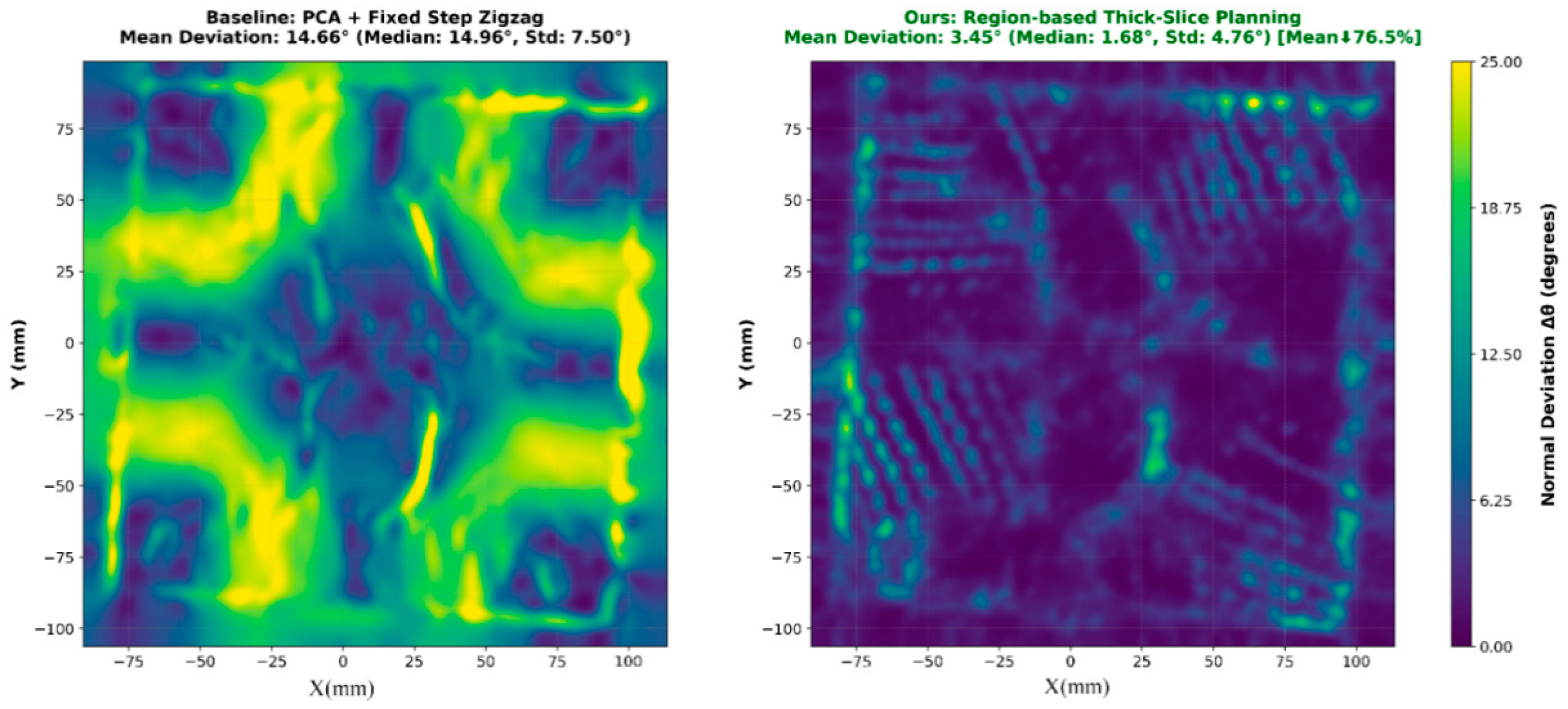
| Mean Deviation | 14.66 | 3.45 |
| Median Deviation | 14.96 | 1.68 |
| 95th Percentile | 25.04 | 13.01 |
| Std. Deviation | 7.50 | 4.76 |
| Coverage Rate | 100.00% | 99.42% |
| Avg. Coverage | 7.75 | 9.996 |
| Point | Before (Mean ± Std) (µm) | After (Mean ± Std) (µm) | ΔRa (µm) |
|---|---|---|---|
| P1 | 8.091 ± 0.529 | 0.669 ± 0.061 | 7.422 |
| P2 | 8.078 ± 0.365 | 0.611 ± 0.086 | 7.467 |
| P3 | 7.414 ± 0.528 | 0.626 ± 0.116 | 6.788 |
| P4 | 7.575 ± 0.689 | 0.595 ± 0.125 | 6.980 |
| P5 | 7.647 ± 0.653 | 0.529 ± 0.103 | 7.118 |
| P6 | 7.783 ± 0.361 | 0.647 ± 0.135 | 7.137 |
| P7 | 7.674 ± 0.481 | 0.561 ± 0.115 | 7.113 |
Disclaimer/Publisher’s Note: The statements, opinions and data contained in all publications are solely those of the individual author(s) and contributor(s) and not of MDPI and/or the editor(s). MDPI and/or the editor(s) disclaim responsibility for any injury to people or property resulting from any ideas, methods, instructions or products referred to in the content. |
© 2026 by the authors. Licensee MDPI, Basel, Switzerland. This article is an open access article distributed under the terms and conditions of the Creative Commons Attribution (CC BY) license.
Share and Cite
Yu, M.; Liu, X.; He, B.; Pan, Z. Deep Fusion of Kinematic Features and Task-Aware Partition Planning for Mold Surface Robotic Polishing. Machines 2026, 14, 243. https://doi.org/10.3390/machines14020243
Yu M, Liu X, He B, Pan Z. Deep Fusion of Kinematic Features and Task-Aware Partition Planning for Mold Surface Robotic Polishing. Machines. 2026; 14(2):243. https://doi.org/10.3390/machines14020243
Chicago/Turabian StyleYu, Miao, Xu Liu, Baowen He, and Zhen Pan. 2026. "Deep Fusion of Kinematic Features and Task-Aware Partition Planning for Mold Surface Robotic Polishing" Machines 14, no. 2: 243. https://doi.org/10.3390/machines14020243
APA StyleYu, M., Liu, X., He, B., & Pan, Z. (2026). Deep Fusion of Kinematic Features and Task-Aware Partition Planning for Mold Surface Robotic Polishing. Machines, 14(2), 243. https://doi.org/10.3390/machines14020243