Article

Synchronous Optimization of Structural Parameters and Roller Profiling Parameters for High-Speed and Heavy-Duty Oil-Lubricated Cylindrical Roller Bearings


College of Mechanical and Electronic Engineering, Nanjing Forestry University, Nanjing 210037, China
*
Author to whom correspondence should be addressed.
Machines 2026, 14(2), 140; https://doi.org/10.3390/machines14020140

Submission received: 21 December 2025 / Revised: 14 January 2026 / Accepted: 23 January 2026 / Published: 25 January 2026
(This article belongs to the Section Machine Design and Theory)

Abstract

Addressing the challenge of optimizing the fatigue life of cylindrical roller bearings under high-speed and heavy-duty conditions, a collaborative multi-parameter optimization design method is proposed. First, a novel five-parameter profiling equation is introduced to overcome the limitations of traditional profiling methods based on the elastohydrodynamic lubrication property of the roller–raceway contact pair. Second, a nonlinear constrained optimization model that comprehensively considers key bearing structural parameters and the new profiling characteristics is constructed. In this model, the fatigue life is taken as the direct optimization objective, and geometric constraints, strength conditions, and lubrication performance are contained. Finally, using a NU2218E cylindrical roller bearing as the study case, the synchronous optimization achieved about a 196% enhancement in fatigue life over that of optimizing structural or profiling parameters alone. The proposed multi-parameter collaborative optimization framework and the innovative profiling approach provide new technical approaches and theoretical foundations for the design of high-performance rolling bearings.

1. Introduction

Bearings are core components of rotating machinery, with fatigue life being a critical design consideration. Cylindrical roller bearings (CRBs) are widely employed in high-speed, heavy-duty applications such as main spindles, aircraft gearboxes, multi-wire saws, and gas turbines due to their load-carrying capacity [1]. As critical supporting elements, the fatigue life of CRBs becomes the bottleneck limiting the overall service life of equipment. With escalating demands for machining precision and reliability in modern industry, optimizing CRB design to extend fatigue life and reduce maintenance costs has become imperative.
Fatigue life models for rolling bearings can be categorized into three main types: theoretical models, condition monitoring-based models, and engineering models [2]. Currently, the optimization of fatigue life utilizing engineering models remains a prominent topic. To enhance roller bearing service life, the existing research primarily focuses on two optimization approaches: one is to optimize the overall structural parameters of bearings, the other is to improve roller profile (modification) design to relieve edge stress concentration. Regarding structural parameter optimization, numerous scholars have endeavored to enhance performance through geometric modifications. For instance, Dandagwhal and Kalyankar [3] employed a TLBO algorithm for the optimization of deep groove ball bearings and cylindrical roller bearings, which significantly improved the fatigue life. Abbasi et al. [4] utilized an enhanced Harris Hawk optimization algorithm to address multi-constrained design challenges in tapered roller bearings and enlarged the load capacity and longevity. Changsen [5] described gradient-based numerical optimization techniques for rolling bearings, specifically optimizing CRBs for basic dynamic capacity. Kumar et al. [6] improved the basic dynamic load rating of CRBs through structural optimization. Fang et al. [7] optimized geometric parameters of multi-row cam roller bearings using genetic algorithms, combining quasi-static analysis to enhance fatigue life with experimental validation demonstrating an improved hydraulic motor reliability. However, these structural optimization studies in this domain have typically not yet fully incorporated roller profile modification within the holistic design framework and pay insufficient attention to the critical influence of lubrication characteristics on fatigue life under high-speed, heavy-duty conditions. Under such operating regimes, the significant change in the lubrication state (such as oil film thickness) will directly impact stress distribution and fatigue life [8], and neglecting this factor may lead to the failure of optimization results in practical applications.
In roller profiling design, researchers have worked to improve the roller profile to relieve edge stress through calculations or experiments. Lundberg [9] pioneered logarithmic profile curves to reduce edge stresses under high loads. Reusner [10] advanced logarithmic profiling methods to eliminate edge stress concentrations, extending the bearing life during roller skewing. Kamamoto et al. [11] proposed empirical profiling formulas to maximize load capacity. Takada. [12] combined Lundberg’s logarithmic curve with circular arcs to characterize profile variations during roller misalignment. Crucially, these profiling analysis methods based on limited contact lines assume dry contact conditions, neglecting lubrication effects. In actual high-speed, heavy-duty operating environments, lubrication is paramount. Experiments by Tallian [13] and Liu et al. [14] demonstrate that oil film thickness significantly influences rolling bearing fatigue life. Studies by Kushwaha et al. [15] and Liu et al. [16,17] reveal drastic reductions in oil film thickness at roller ends, potentially causing premature failure. Duan et al. [18] integrated a CRB quasi-static model with lubrication theory to explore roller profile optimization for maximum fatigue life under lubricated conditions. The study revealed that the formation and thickness of the oil film exert a significant influence on the fatigue life.
Although the existing work has made progress in structural parameter optimization and roller modification design, there are obvious limitations: structural optimizations typically disregard the role of roller profile modification, while roller profile modification studies predominantly rely on dry contact assumptions, failing to adequately account for the pronounced effects of lubrication under high-speed, heavy-duty conditions. Moreover, the practical design space for model parameters inherently encompasses variations and uncertainties, which are seldom accounted for in deterministic optimization frameworks despite their potential influence on dynamic performance and reliability [19,20]. More importantly, there are few studies on synchronous optimization designs of bearing structural parameters and roller profiling parameters considering lubrication effects. Roller profile modification not only affects mechanical performance but also significantly alters oil film thickness and pressure distribution, which together affect the final fatigue life. Therefore, under these typical and demanding high-speed, heavy-duty operating conditions, a collaborative optimization method which can comprehensively consider lubrication effects, roller profile modification, and bearing structure parameters is urgently needed.
To address this, the present paper proposes a comprehensive CRB optimization design method integrating lubrication, roller profile modification, and structural parameters. Firstly, a finite line-contact elastohydrodynamic lubrication (EHL) model is established to evaluate the shortcomings of the existing roller modification profiles and provide a new one. Secondly, a modified L-P fatigue life model incorporating the quantifiable effects of roller profiling is introduced. Finally, a nonlinear constrained optimization mathematical model concurrently containing both structural and profiling parameters is constructed and solved. The advantages of the proposed optimization method are demonstrated by comparing with the methods which optimize either structural parameters or profiling parameters in isolation.

2. Fatigue Life Calculation Model of Cylindrical Roller Bearings Considering Lubrication and Roller Profile Modification

2.1. Cylindrical Roller Bearings and Roller Profiling Methods

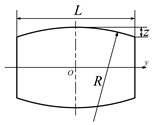
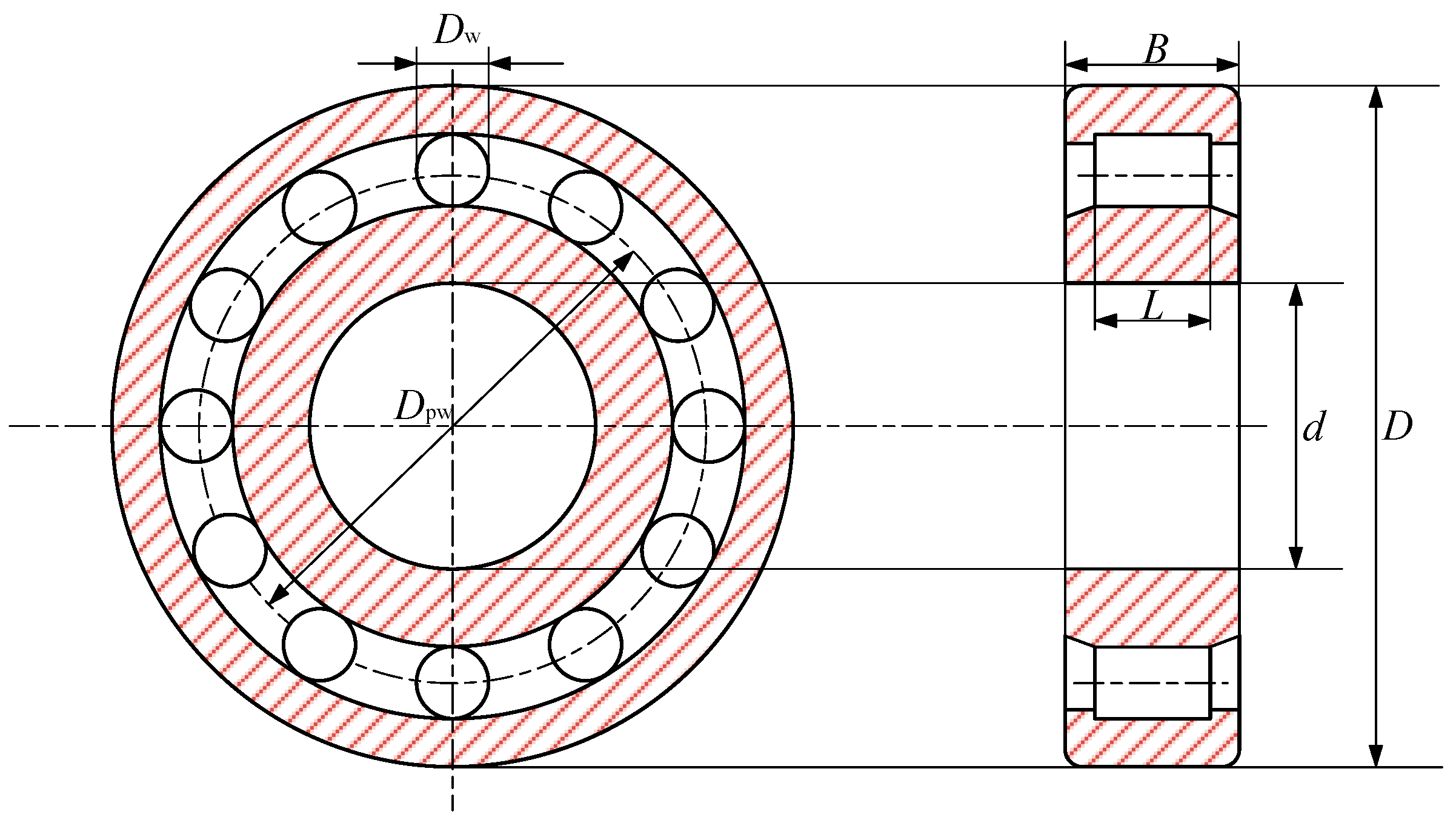
Cylindrical roller bearings (CRBs) exhibit relatively a simple external geometry, primarily defined by fundamental parameters such as the inner diameter d, outer diameter D, and width B. Key internal geometric parameters include the bearing pitch diameter Dpw, roller diameter Dw, and roller length L; the common nomenclature of a cylindrical roller bearing is shown in Figure 1. To mitigate stress concentration effects at roller ends, roller profiles are modified through profiling [21]. Representative profiling methods include full crowning, dub-off profile, and logarithmic profile [22]. The roller profile geometries and corresponding profiling equations for these methods are illustrated in Table 1. An appropriate roller profile design will effectively reduce or eliminate edge stress concentration while optimizing contact stress distribution [23].

2.2. Fatigue Life Calculation Model

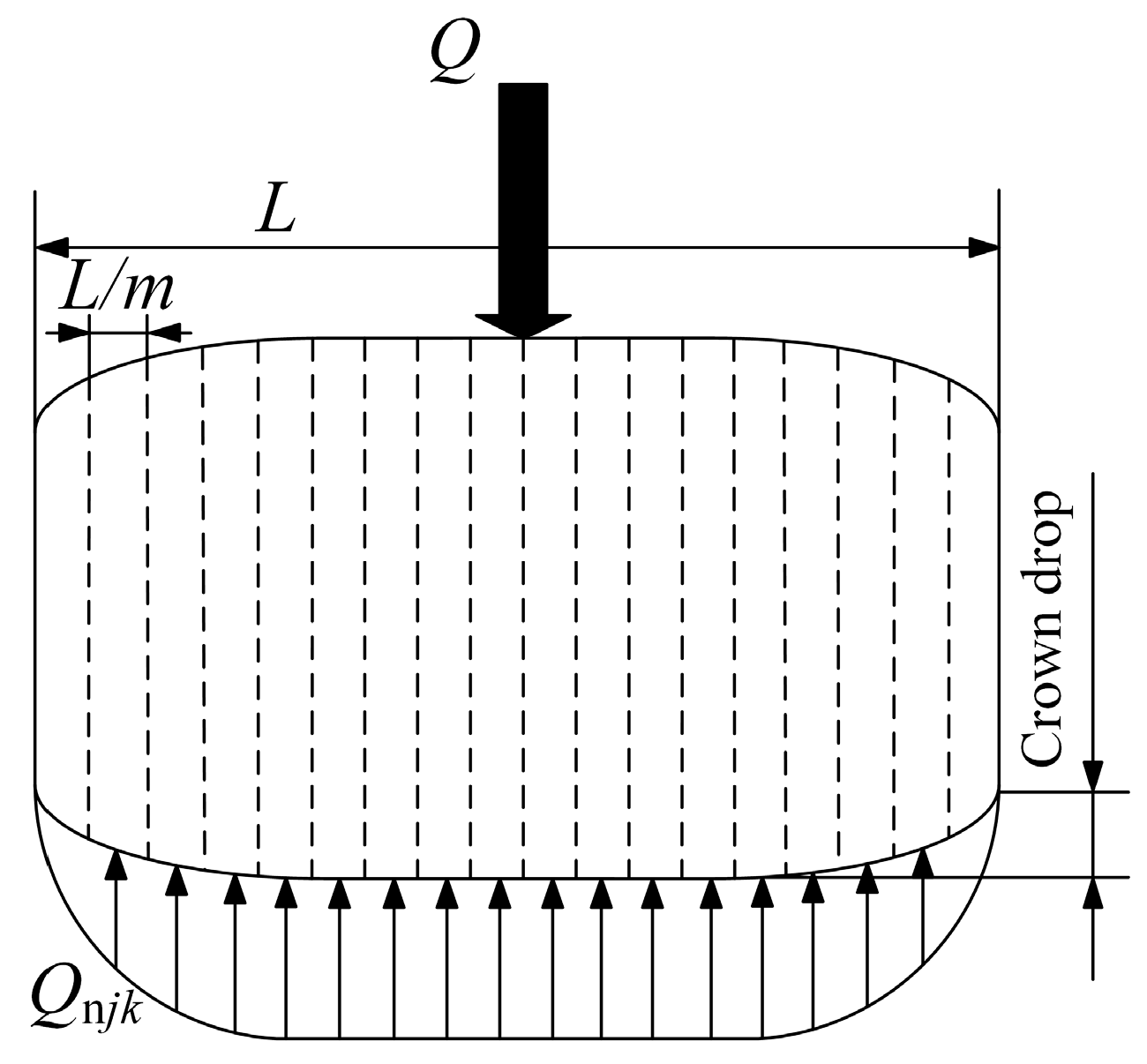
When a bearing is loaded, the load distribution along the roller length is typically non-uniform. The traditional Lundberg–Palmgren (L-P) life formula uses the average roller contact load for calculation, which neither reflects the influence of the load gradient along the roller direction on fatigue life nor considers the optimizing effect of profiled rollers on load distribution. To account for these factors and evaluate fatigue life more accurately, this study divides the roller of length L into m segments along its length direction and treats each segment as a raceway element of width L/m, as shown in Figure 2.
The fatigue life of an individual inner or outer raceway contact slice between the roller and inner or outer raceway subjected to a normal load Q can be estimated by
L n j k = Q c n Q n j k 4
where n takes i/o to represent the inner/outer raceway.
The life of the whole bearing is obtained by superposing the life of each contact slice, and thus the basic reference rating life L10 is as follows [24]:
L 10 = j = 1 Z k = 1 m Q ci Q i j k 4.5 + j = 1 Z k = 1 m Q co Q o j k 4.5 8 9
where Qijk is the contact load between the j-th roller and inner raceway at contact slice k, and Qojk is the contact load between the j-th roller and outer raceway at contact slice k. These discrete slice loads are obtained by integrating the three-dimensional oil film pressure distribution p(x, y) solved by the EHL model as follows:
Q n j k = Ω k p ( x , y ) d x d y
where Ωk represents the computational domain of the k -th slice along the roller length. Qci and Qco are the basic dynamic load ratings for each roller segment with inner and outer raceway slices, respectively.
Q c n = 552 ( 1 γ ) 29 / 27 ( 1 ± γ ) 1 / 4 γ 2 / 9 D w 29 / 27 ( L / m ) 7 / 9 Z 1 / 4
where γ = Dw/Dpw, and n takes i/o to represent the inner/outer raceway, respectively. The upper operator applies to the inner raceway and the lower operator applies to the outer raceway.
The above method for calculating bearing fatigue life does not consider the lubrication state between rollers and inner/outer raceways. Existing research [18] has shown that, under high-speed and heavy-load conditions, lubrication is one of the key factors affecting bearing life. Therefore, this paper incorporates the influences of material properties, lubrication characteristics, lubricant contamination, and fatigue limits [25], with the corrected life expressed as
L n m = a 1 a ISO L 10
a ISO = 0.1 1 1.5859 1.3993 κ 0.054381 e C C u P 0.4 9.185 , 0.1 κ < 0.4 0.1 1 1.5859 1.2348 κ 0.19087 e C C u P 0.4 9.185 , 0.4 κ < 1 0.1 1 1.5859 1.2348 κ 0.071739 e C C u P 0.4 9.185 , 1 κ 4
For κ values > 4, the value κ = 4 shall be used.
κ is the viscosity ratio; eC is the contamination factor (0.6 for general cleanliness); Cu is the fatigue load limit (35.8 kN for the studied NU2218E bearing); and P is the equivalent dynamic load of the bearing. a1 is the reliability life modification factor, which is equal to 1 when the bearing life reliability is set at 90%.
The viscosity ratio κ can be approximately estimated with the following equation:
κ = λ 1.3
where λ denotes the lubricant film parameter, which can be expressed as
λ = h min / S 1 2 + S 2 2
S 1 = S 2 = 1.25 R a
where hmin is the minimum film thickness, which is calculated through the EHL model presented in Section 2.2.1; S1, S2 is the root mean square roughness of the roller and raceway contact surfaces; and Ra represents the surface roughness.

2.2.1. Profiling Roller–Raceway Finite Line-Contact EHL Model

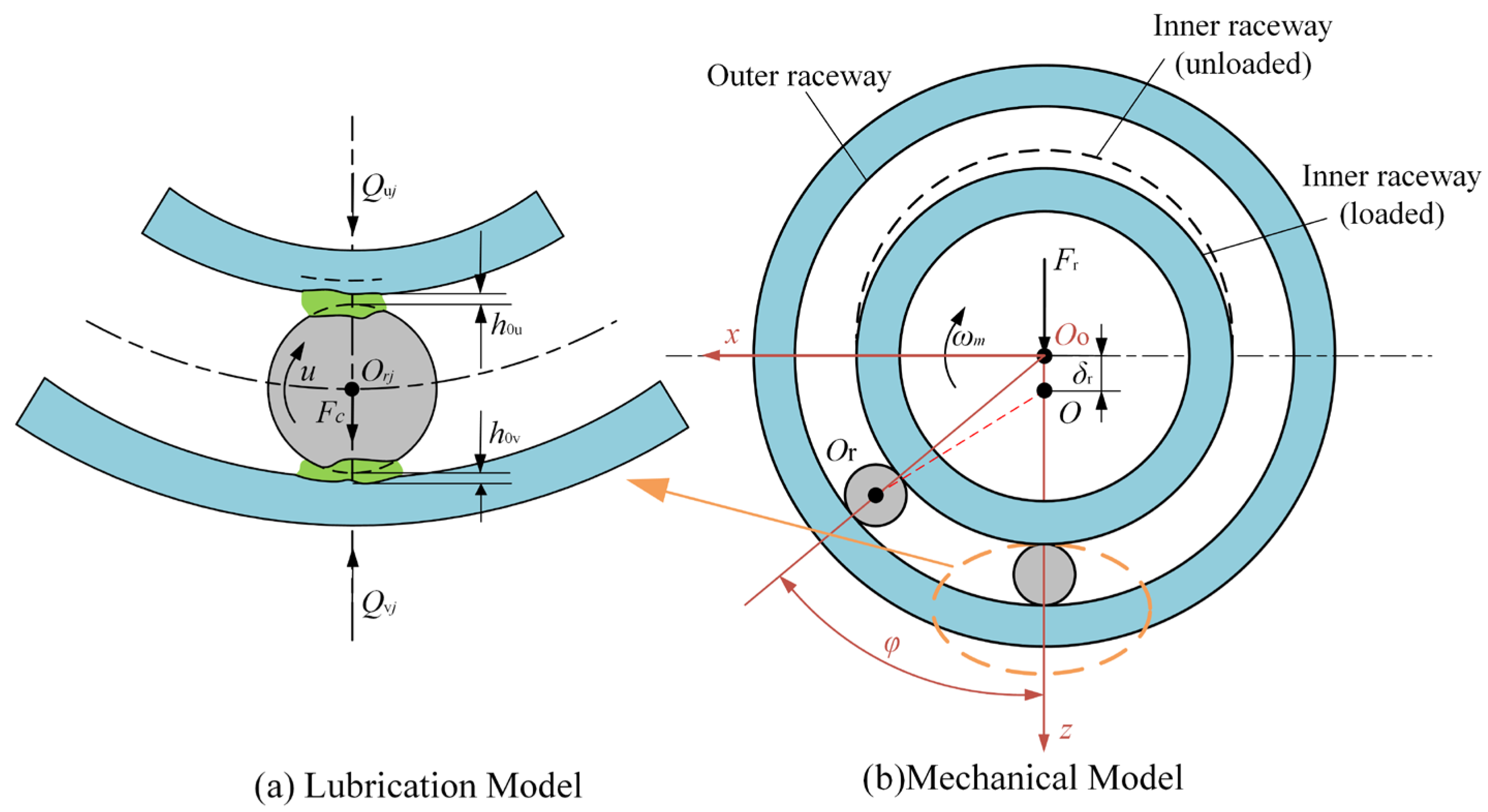
To obtain the contact load between the j-th roller and inner/outer raceway at contact slice k and the minimum film thickness hmin, it is necessary to establish a cylindrical roller bearing lubrication model to calculate the pressure distribution integral over m divided regions along the roller length direction. Due to the finite length of the roller, the roller–raceway lubrication constitutes a finite line-contact EHL problem. Figure 3a shows the details between the roller and raceway.
The Reynolds equation satisfied by the pressure in the fluid lubrication region can be expressed as
x ρ h 3 12 η p x + y ρ h 3 12 η p y = u x ρ h
where p is the pressure, h is the film thickness, u is the entrainment velocity between the rolling element and raceway, u = πnr/(120 Dpw(1 − γ2)), nr is the rotational speed of the inner raceway (r/min), γ = Dw/Dpw, and η and ρ are the viscosity and density of the lubricant, respectively.
The pressure–viscosity relationship of the lubricant and the Dowson–Higginson pressure–density relation are adopted from Ref. [26].
The interface film thickness equation can be written as
h ( x , y ) = h 0 + x 2 2 R x + z y + 2 π E Ω p x , y x x 2 + y y 2 d x d y
where E′ is the equivalent elastic modulus, 2/E′ = (1 − v12)/E1 + (1 − v22)/E2, h0 represents the rigid central separation distance in the contact zone, Ω is the entire computing domain, Rx = 0.5 Dw(1 ± γ), the upper operator applies to the outer raceway and the lower operator applies to the inner raceway, z(y) represents the profiling equation, and x′ and y′ are integration variables representing the coordinates of any point within the calculation domain Ω.
The load balance is expressed as
Ω p x , y d x d y = Q
In the equation, Q represents the contact load for the roller–raceway contact pair.
The present isothermal EHL model neglects thermal effects and wear.

2.2.2. Quasi-Static Model of Cylindrical Roller Bearings

For convenience, the rollers are numbered with the bottom roller as 1, increasing counterclockwise to Z. The radial load Fr acting on the inner raceway displaces the inner raceway center downward by δr along the z-axis, as shown in Figure 3b.
With the radial loads, the force equilibrium equations for roller j are
Q o j Q i j F c = 0
where Fc is the centrifugal force and is expressed as
F c = 1 2 m r D pw ω m 2
where mr is the mass of roller, and ωm is the roller orbit speed, ωm = πnr(1 − γ)/60.
The equation for the inner raceway is
F r j = 1 Z Q i j cos φ j = 0
where φj represents the azimuth angle of the j-th roller.

2.3. Numerical Method and Model Verification

2.3.1. Numerical Solution Method

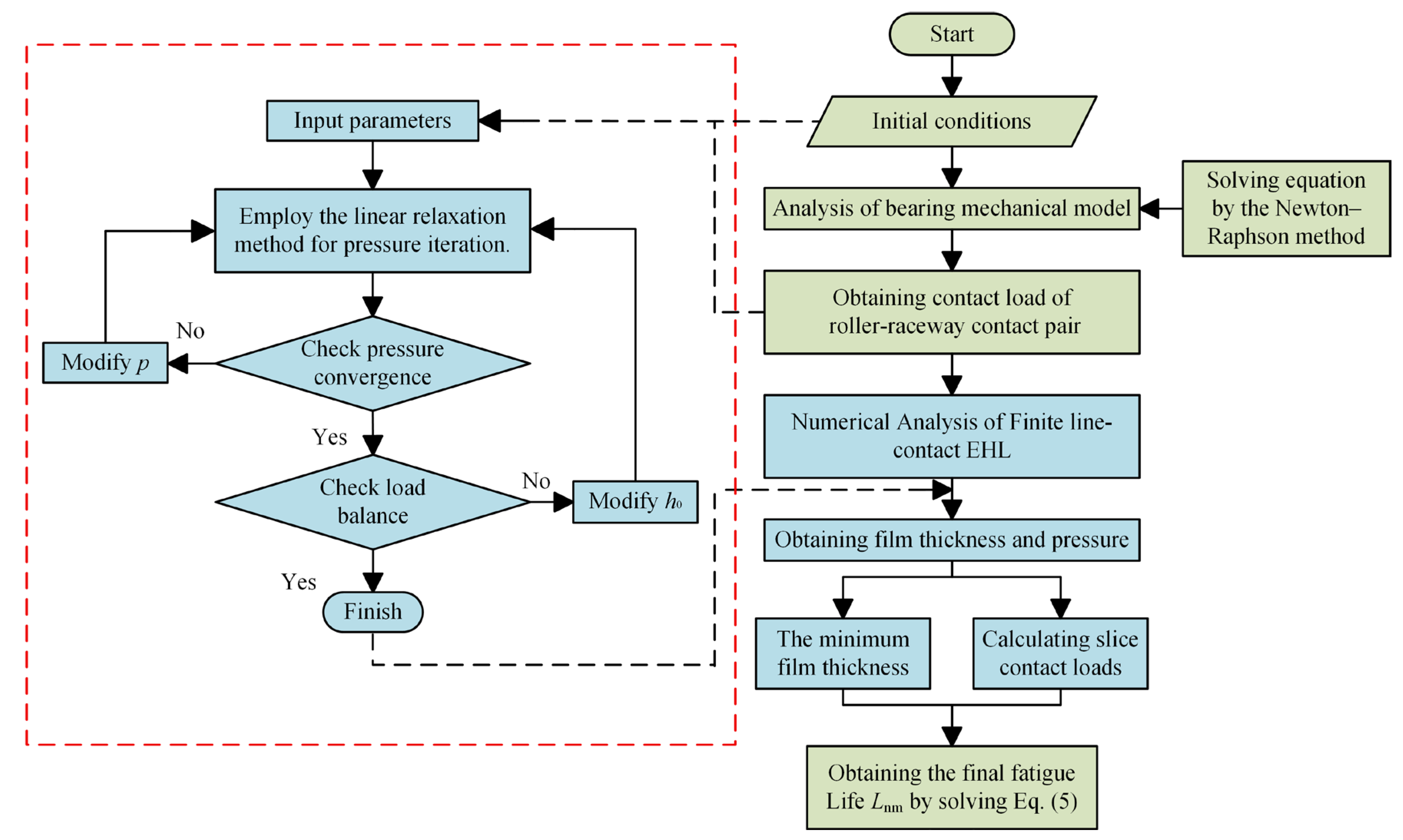
For the bearing mechanical model, the Newton–Raphson method is employed to solve the equation system in a grouped manner. For the EHL model of the roller–raceway contact pair, the first step of the numerical solution is rewriting the equations in dimensionless form, using the dimensionless variables of Table 2 based on the geometric parameters of contacting bodies and Hertz contact theory. The finite difference method (FDM) is adopted to discretize the Reynolds equation, and the linear relaxation iteration method is applied for the solution. To reduce the errors in fatigue life calculation, the number of grid points along the roller generatrix (axial direction) in the lubrication calculation should match the number of slices used in the fatigue life calculation. The complete solution procedure is illustrated in Figure 4.

2.3.2. Model Verification

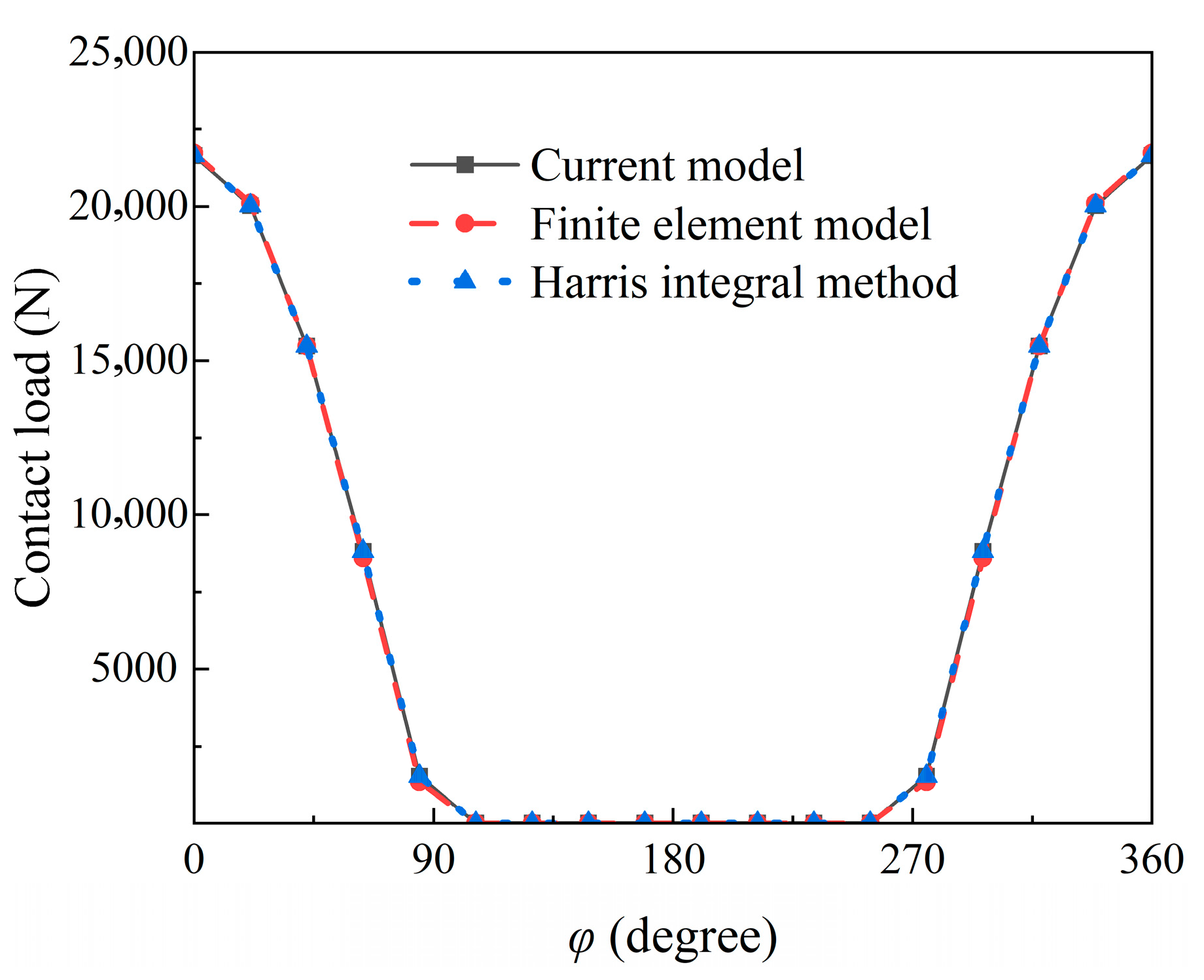
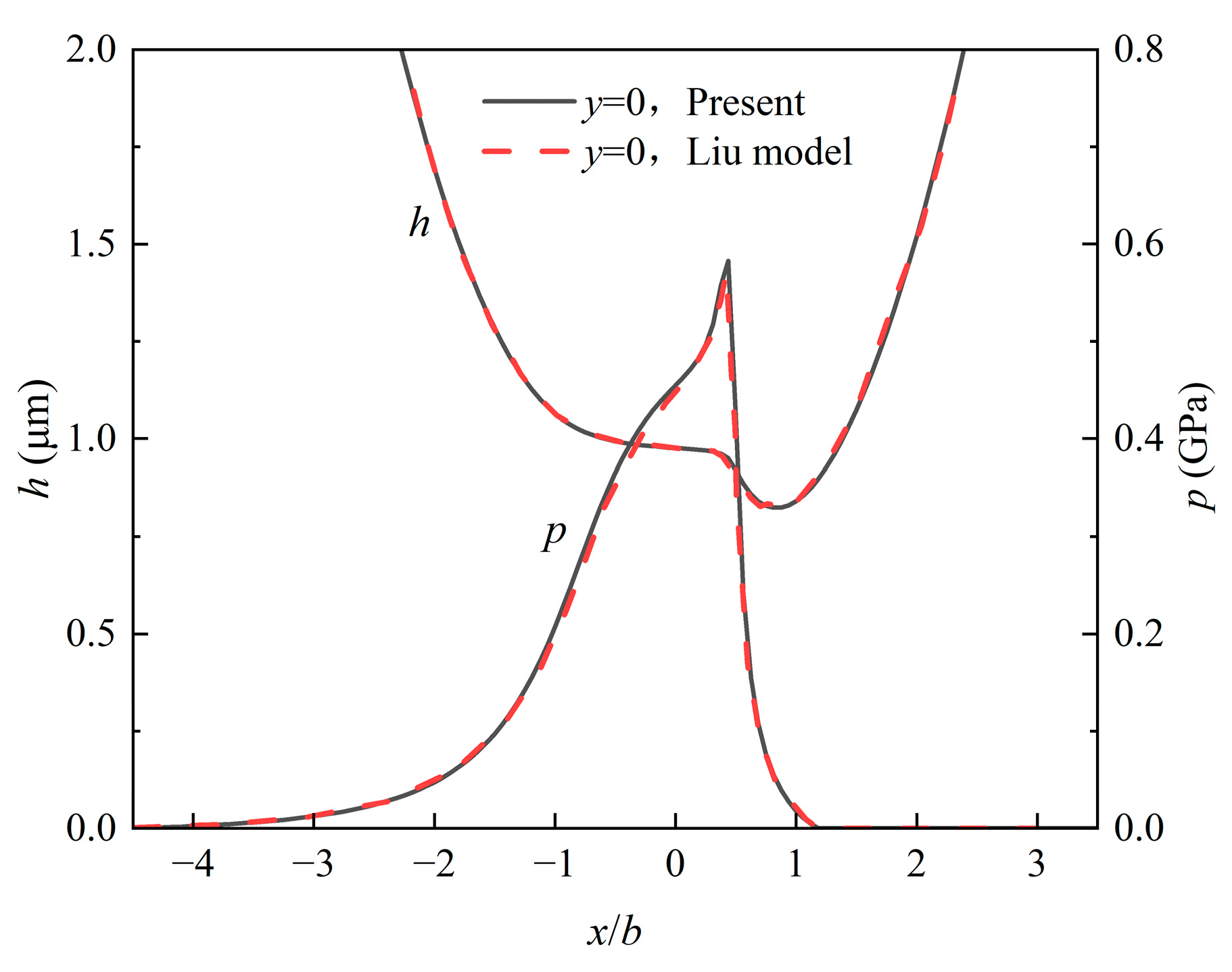
To validate the proposed model, the contact load results from this study are compared with the finite element method (FEM) and Harris model results from Ref. [27] (as shown in Figure 5), while the EHL results are compared with Ref. [28]. Moreover, the validation is performed under identical bearing and operating conditions to those specified in the respective references. Specifically, the lubrication model is validated under the partial-arc crowning of rollers, where the dimensionless speed is 6.0910 × 10⁻¹¹, the radius of the end profile of the roller is 4 mm, and the dimensionless load is 1.9689 × 10⁻⁵. The corresponding results are shown in Figure 6. As can be observed, the results from this study show a good agreement with the reference data, particularly in reproducing the characteristic features of finite line-contact EHL, such as the film thickness necking and the corresponding secondary pressure peak at the contact outlet. Considering that the prediction of rolling bearing fatigue life is highly dependent on the computational precision of both the mechanical and lubrication models, the validation of these fundamental models provides theoretical assurance for the reliability of subsequent life calculation models.

3. Results and Discussion

This study analyzes a cylindrical roller bearing (model NU2218E, CSC Bearing Co., Ltd., Changshu, China) used in the main roller of a multi-wire saw. The bearing raceways (inner and outer) are manufactured from GCr15 bearing steel, while the rollers are made of silicon nitride. The operating conditions include an inner raceway rotational speed of nr = 6000 r/min with a stationary outer raceway. Detailed parameters are provided in Table 3. This section primarily examines the effects of operating conditions and profiling methods on lubrication characteristics and fatigue life.

3.1. Effects of Profiling Methods and Proposal of a Novel Profiling Method

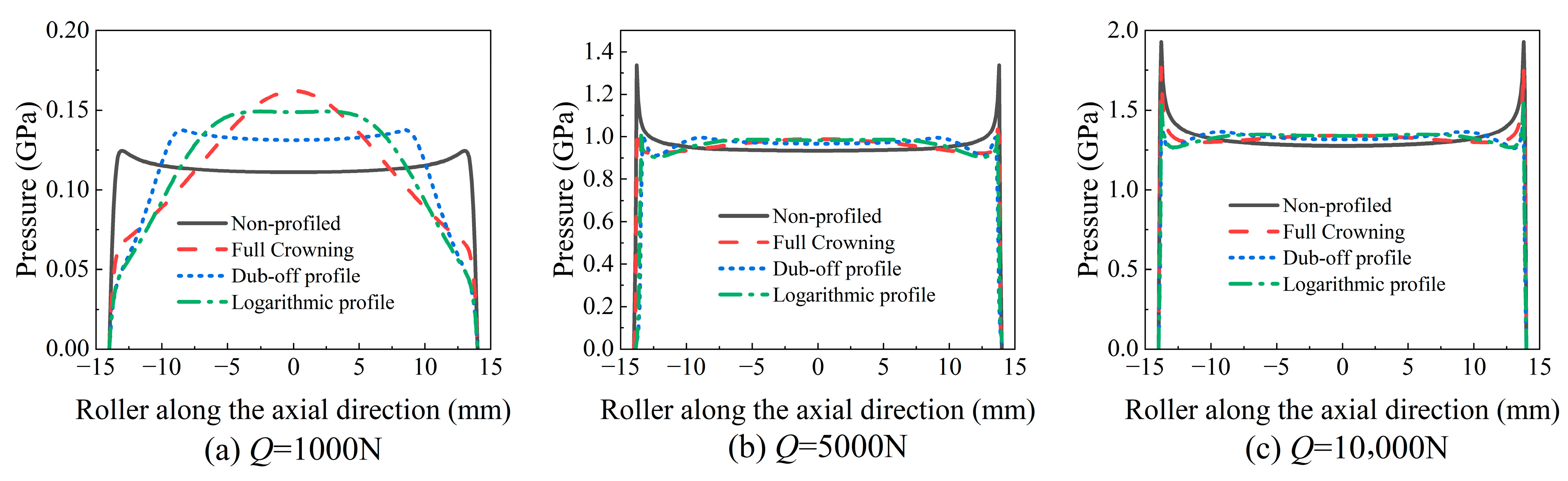
Figure 7 shows the oil film pressure distributions along the roller generatrix under three roller–inner raceway contact loads (1000 N, 5000 N, and 10,000 N) for non-profiled rollers and the three common profiling methods shown in Table 1. The specific parameters used in the analysis are R = 50 m for full crowning, Ry = 5 m with a profiling ratio of 0.4 for the dub-off profile, and A = 0.004 for the logarithmic profile. It can be seen that, when the load is 1000 N, the non-profiled roller shows an optimal axial pressure uniformity. In contrast, the three profiling methods exhibit over-profiling, especially full crowning, which reduces the contact zone causing the central pressure concentration and abrupt drops at both ends. When the load increases to 5000 N, the non-profiled roller displays typical edge effects, with its contact pressure curve showing a double-peak characteristic, and the pressure distribution uniformity of all three profiled rollers shows significant improvement. Under relatively large conditions (10,000 N), both unprofiled and full profiled rollers exhibit severe edge effects, and dub-off profiled rollers and logarithmic profiled rollers show mitigated yet still present edge effects.
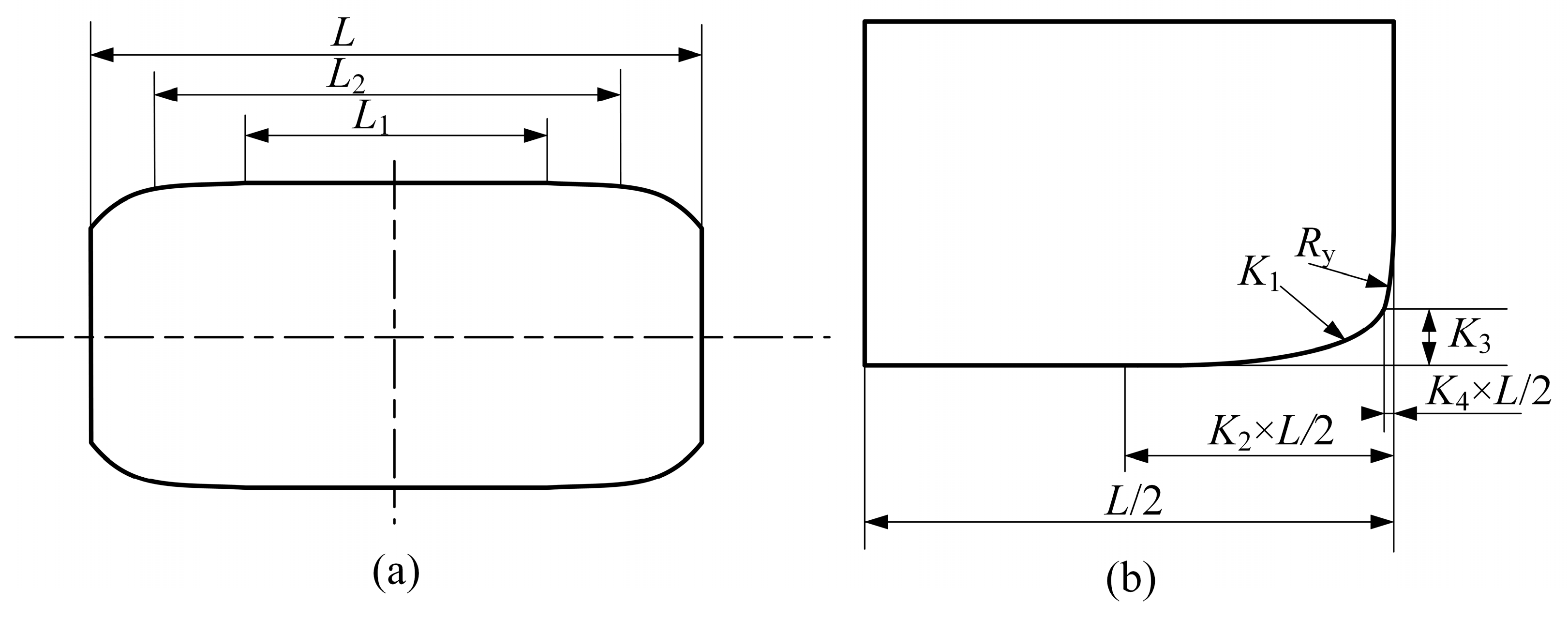
The comparative analysis demonstrates that dub-off and logarithmic profiling methods exhibit a relatively better load adaptability compared to non-profiled and full crowning. However, both methods are based on fixed mathematical equations determined by limited parameters. This scarcity of parameters severely restricts the range of achievable roller profiles, making it difficult to obtain optimized contours that generate a smoother, more uniform pressure distribution across varying load conditions. To address this limitation, this study proposes a novel five-parameter profiling curve, as shown in Figure 8. The curve enables a coordinated adjustment of the roller profile through five independent design variables. This parametric design framework possesses the potential to adapt to different loads through parameter adjustment. The profiling equation is given in Equation (16). Although the proposed profile curve is relatively complex, its manufacturing is entirely within the capabilities of modern precision grinding technology. By employing the lapping process, a sub-micron roundness and profile accuracy along with excellent symmetry can be achieved, meeting the design requirements for the roller profile [29,30].
The five-parameter profiling equation is derived as
z y = A ln 1 1 1 exp ( K 3 A ) y L / 2 K 2 L / 2 + 1 2 , ( 1 K 2 ) L 2 y ( 1 K 4 ) L 2 A ln 1 1 1 exp ( K 3 A ) y L / 2 K 2 L / 2 + 1 2 + R y 2 L 2 2 2 R y 2 y 2 , ( 1 K 4 ) L 2 y L 2 0 , y ( 1 K 2 ) L 2
where A = 0.001K1, L1 = (1 − K2) L, L2 = (1 − K4) L, K1 is the load coefficient, K2 is the logarithmic profile length coefficient, K3 is the crown drop of the logarithmic profile, K4 is the arc crown length coefficient, and Ry is the radius of the end arc.
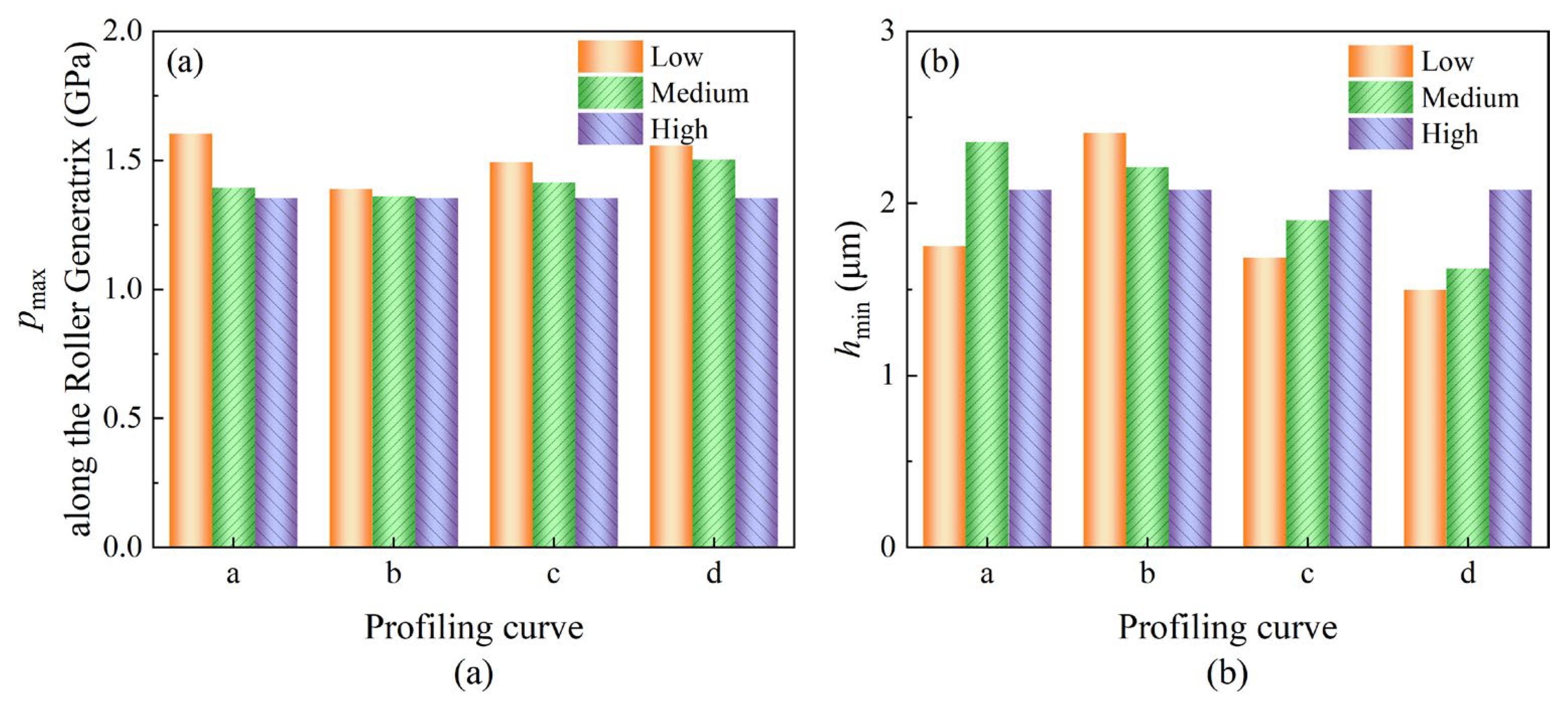
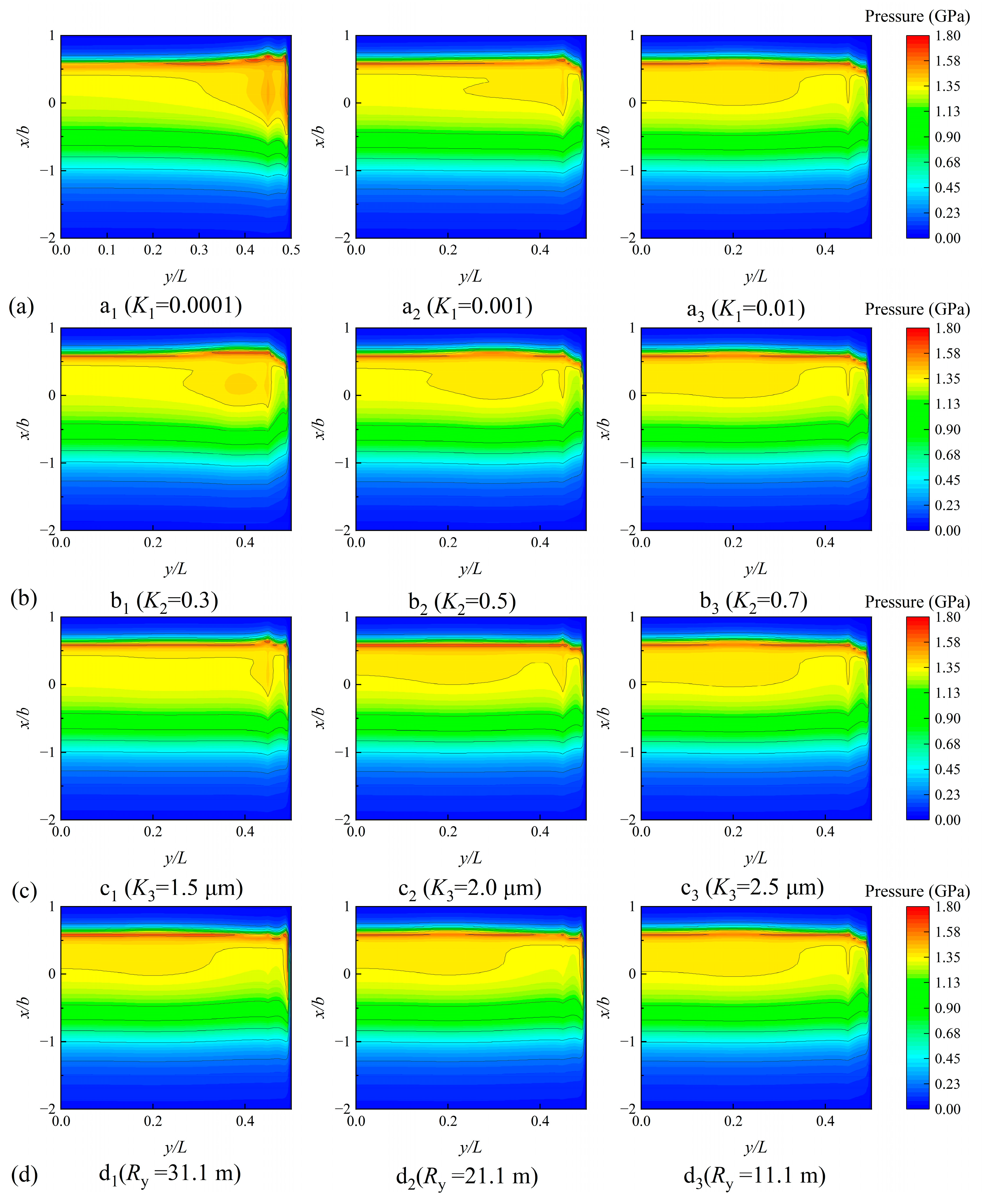
To investigate the influence of the five-parameter profiling equation on rollers under a 10,000 N load condition, this section systematically varies selected parameters of the equation (as specified in Table 4). Since the K4 value clusters around 0.1, and the sensitivity analysis confirms its significantly weaker impact on pressure and oil film distribution compared to other parameters, it is fixed at 0.1 in this study. The resulting maximum pressure and minimum film thickness along the roller generatrix are presented in Figure 9, while the oil film pressure contour plot is shown in Figure 10.
Figure 9 demonstrates the influence of systematically varying each profiling parameter in the given five-parameter profiling equation on pressure distribution. It can be observed that, as the values of K1, K2, and K3 increase, the maximum pressure (p) along the roller generatrix shows a decreasing trend. This occurs because the profiling amount in the given equation is relatively small, and increasing the profiling zone and magnitude helps distribute pressure more uniformly and smoothly along the roller’s axial direction. In contrast, Ry exhibits an opposite trend compared to the first three parameters. Under loading conditions, especially heavy loads, the stress concentration at the roller edges becomes more pronounced. With a fixed arc crown length coefficient, the smaller the arc radius, the greater the modification degree of the roller end, and the better the mitigation effect on edge stress concentration to a certain extent. Additionally, different profiling parameters influence the minimum oil film thickness between the roller and the raceway to varying degrees, which directly or indirectly affects the lubrication performance and subsequent fatigue life calculations.
Figure 10 shows that, when the pressure (p) along the roller generatrix decreases, the pressure distribution across the entire roller contact zone becomes more uniform. As the values of K1, K2, and K3 increase while Ry decreases, the pressure distribution becomes more homogeneous, which corresponds to the observed reduction in p along the roller generatrix mentioned earlier.

3.2. Effects of Bearing Structural Parameters and Roller Profiling Parameters on Bearing Fatigue Life

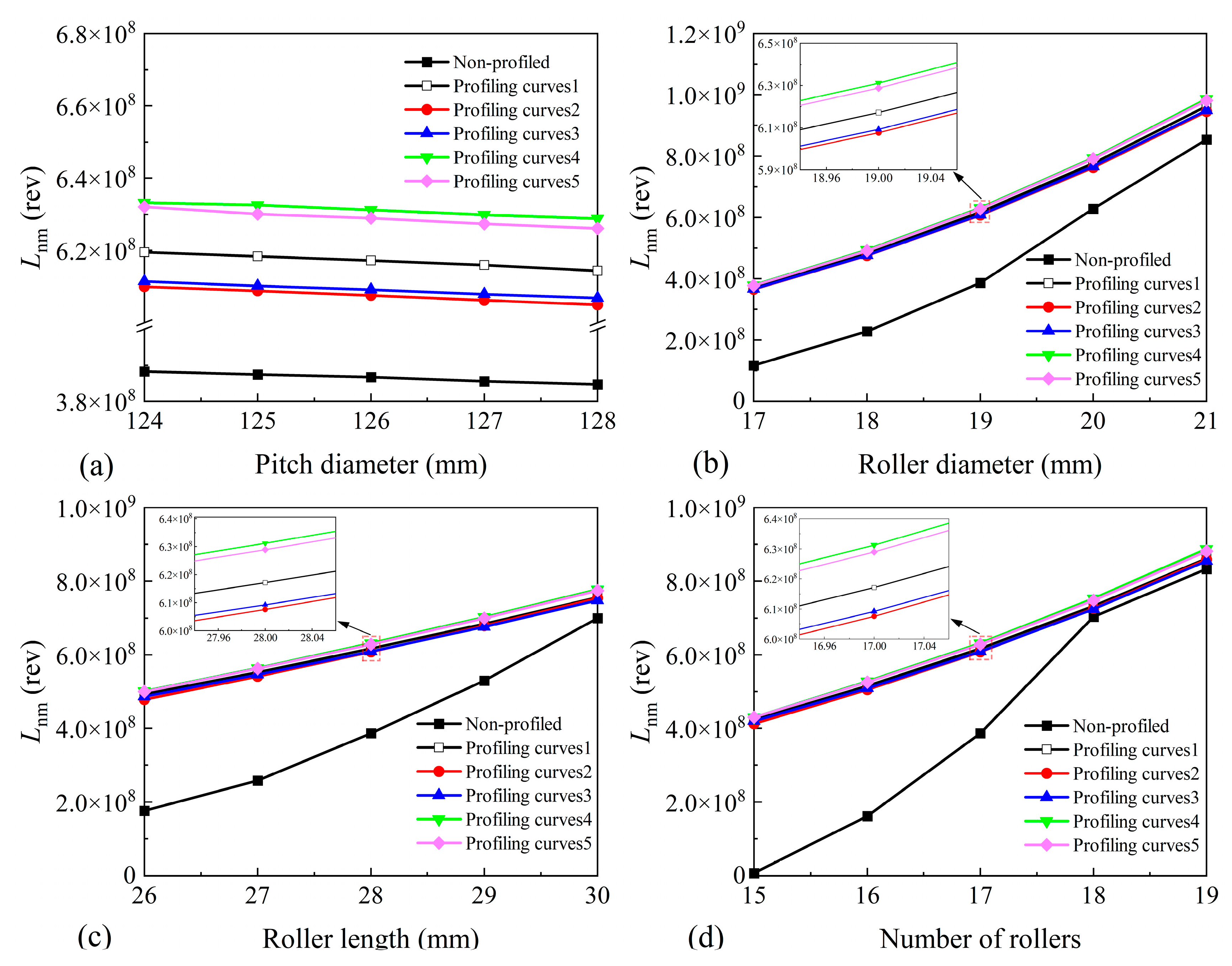
The influence of bearing structural parameters on the fatigue life is investigated under six different roller profiling conditions specified in Table 5, with the results presented in Figure 11.
The results in Figure 11 demonstrate that the bearing pitch diameter has no obvious effect on the fatigue life, while the roller diameter, roller length, and number of rollers exhibit significant effects, with their impact trends being approximately linear. Under different structural parameters, the profiling versus non-profiling of bearing rollers also affects fatigue life to some extent, though the influence degree and pattern of identical profiling parameters remain similar. This phenomenon primarily occurs because the variations in the listed profiling parameters are not particularly large, and the rollers are modified to a large extent. Consequently, while the fatigue life shows considerable differences compared to non-profiled cases, the variations among different profiled cases are not pronounced.
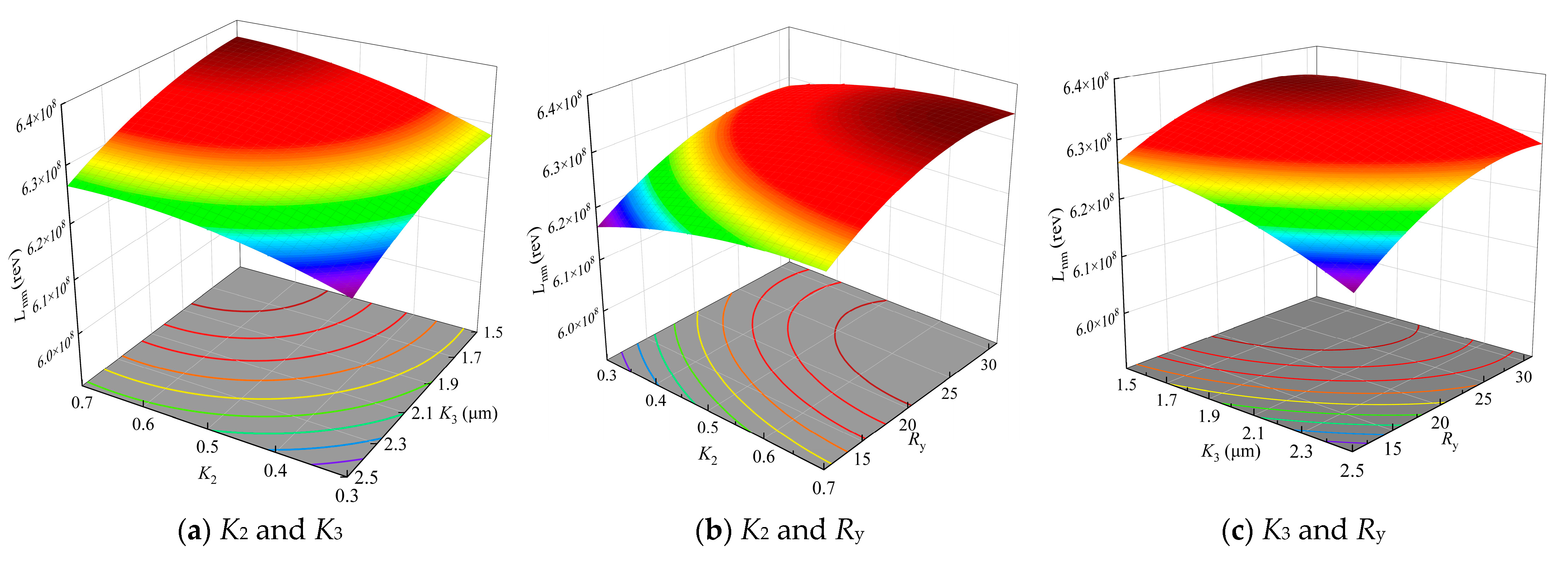
To further investigate the synergistic effects of profiling parameters on fatigue life, an interaction analysis was conducted focusing on three key geometric parameters of the proposed five-parameter profiling curve: the logarithmic profile length coefficient K2, the crown drop of the logarithmic profile K3, and the radius of the end arc Ry.
The response surfaces in Figure 12 elucidate the pairwise interaction effects of these parameters on the fatigue life Lnm. The analysis reveals that Ry has the most pronounced main effect on the fatigue life, followed by K3, with K2 exerting a relatively weaker influence. More importantly, significant interactions are evident. The strongly curved and steep response surface for K3 and Ry, accompanied by dense contour lines, indicates a highly significant interaction, necessitating their coordinated adjustment to manage the nonlinear effects on life. While less dramatic, the interactions between K2 and K3 and between K2 and Ry are also non-negligible, as confirmed by the distinct curvature and contour density of their respective response surfaces. In summary, the parameters of the five-parameter profiling curve do not act in isolation. Substantial interactions exist among K2, K3, and Ry, with the coupling between K3 and Ry being particularly dominant. Consequently, the optimization of roller profiling must account for these synergistic effects collectively, providing essential guidance for achieving maximum fatigue life through the coordinated adjustment of multiple design variables.

4. Optimal Design of Structural Parameters and Roller Profiling Parameters for Cylindrical Roller Bearings

4.1. Mathematical Model of Optimization

This study focuses on the optimization design of cylindrical roller bearings with nine mutually independent design variables. The internal geometric dimensions are defined by Dpw, Dw, Z, and L; the roller profile is characterized by K1, K2, K3, K4, and Ry.
t = [ D pw , D w , Z , L , K 1 , K 2 , K 3 , K 4 , R y ]
Objective Function: Fatigue life of cylindrical roller bearings.
max [ F ( t ) ] = max [ L nm ]
where t denotes the vector of design variable, and F(t) is the objective function. The calculation method of Lnm is derived from Section 2.
Based on the bearing’s internal geometry, contact strength, and lubrication requirements, the following constraints are established. For conciseness, these constraints are compiled in Table 6 and described below:
Constraints 1–4: The bearing pitch diameter must be selected between the inner and outer diameters. To ensure operational mobility, the difference between the pitch diameter and mean diameter shall not exceed a specified threshold.
Constraints 5–6: Studies indicate that the cylindrical roller diameter Dw must satisfy the tabulated conditions [31,32].
Constraints 7–9: In cylindrical roller bearings, the rollers rotate on inner/outer raceways. To prevent roller collision, an adequate roller spacing must be maintained by restricting the minimum angular separation between rollers, thereby constraining the roller count [33].
Constraints 10–11: Per cylindrical roller bearing design principles, the roller length must exceed the mean roller diameter, with the total length constrained within limits to prevent protrusion beyond the raceways.
Constraints 12–14: Engineering practice requires a thicker inner raceway than outer raceway since the inner races experience higher stresses due to the smaller curvature. The outer raceway effective wall thickness, critical for stiffness, strength, roller diameter, and length, must maintain minimum proportions. And the effective wall thickness of the outer raceway is an important parameter that affects the stiffness and strength of the outer raceway as well as the diameter and length of the rollers. The minimum wall thickness should not be less than a specific ratio. And the thickness of the outer raceway should be sufficient enough such that, in the worst case, the maximum dynamic shear stress occurs at the center of the raceway. The maximum dynamic shear stress should occur at three times Zstatic [34,35].
Constraint 15: Adequate lubrication prevents severe roller–raceway friction by eliminating metal-to-metal contact. The minimum film parameter λ at all contact points must be constrained to guarantee sufficient lubrication [33,36].
Constraints 16–20: To prevent overlooking optimal profiling curves, broad ranges are set for five profiling parameters. The numerical analysis and the literature confirm that the cylindrical roller profiling parameters must conform to tabulated constraints [3,37].

4.2. Optimization Results and Analysis

The proposed optimization method was applied to the NU2218E roller bearing (CSC Bearing Co., Ltd., Changshu, China) with an operating speed of 6000 r/min and a radial load of 43,560 N on the inner raceway; both macro-geometry and the roller profile were optimized using a genetic algorithm (GA). This algorithm was selected for this optimization due to its proven effectiveness in handling mixed-variable (discrete and continuous) design spaces and its robust global search capability. The crossover probability was 0.4, the mutation probability was 0.2, the population size was 100, and the maximum number of generations was 150. The optimization procedure comprised, first, inputting bearing dimensional parameters, material parameters, operating conditions, design variables, and constraints; and, next, executing the iterative optimization of structural and profiling parameters, during which the objective function Lnm was calculated for each population. The algorithm continuously evaluated objective values across generations until convergence criteria were satisfied, finally outputting the optimized parameter set and the corresponding objective function value.
The convergence yielded design-constraint-compliant optimization results, increasing the fatigue life Lnm to 1.16 × 10⁹ revolutions; Table 7 shows the comparison of parameters before and after optimization. Before optimization, the roller bus bar is a straight bus bar; therefore, the values of K1, K2, K3, K4, and Ry are set to 0. Optimized values required rounding to practical tolerances, with the rounded parameters and recalculated life shown; substituting optimized variables into constraints yielded a pre-optimization fatigue life of 3.88 × 10⁸ revolutions versus the post-optimization 1.15 × 10⁹ revolutions, representing a 196% improvement.
The complete optimization required approximately 56 h on a standard desktop computer. In practical engineering applications, the computational time could be further reduced through high-performance computing resources such as parallel processing and dedicated computational hardware.
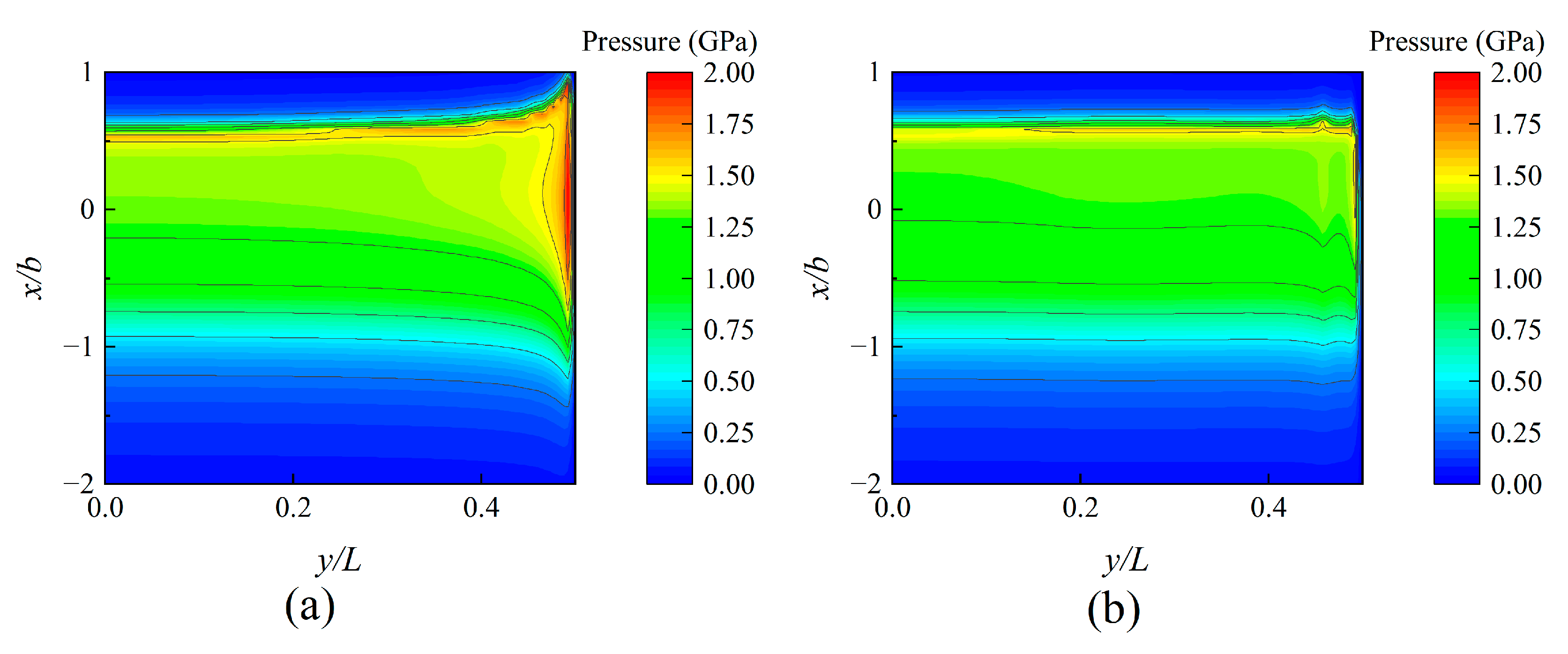
Figure 13 shows the oil film pressure distribution on the most heavily loaded roller. Before optimization, the oil film pressure in the middle of the optimized roller generatrix is about 1.3 Gpa, and the edge effect of 1.98 GPa appears at the end. After optimization, the roller shape suitable for working conditions is obtained, and the edge effect of the roller is alleviated to a large extent. The maximum oil film pressure of the roller bus bar is 1.45 GPa, and the middle pressure is reduced to 1.27 Gpa.
A comparative analysis against existing similar optimization methods, summarized in Table 8, was conducted to quantitatively benchmark the proposed synchronous framework. The table compares the fatigue life achieved by two conventional single-aspect strategies—optimizing only the structural parameters and optimizing only the profiling parameters—against the proposed synchronous method. The results demonstrate its clear synergistic advantage. The conventional structural optimization improved the fatigue life to 9.86 × 10⁸ revolutions, while the conventional profiling optimization yielded 6.39 × 10⁸ revolutions. In contrast, the synchronous optimization of both parameter sets achieved a superior life of 1.15 × 10⁹ revolutions. This marked enhancement—representing a significant additional gain of 1.64 × 10⁸ revolutions over the best-performing conventional single-aspect strategy—validates the necessity of the holistic design approach proposed in this work, as it effectively captures the critical interactions ignored by existing similar methods that optimize parameters in isolation.

5. Conclusions

This study proposes an optimization design method for cylindrical roller bearings aimed at maximizing fatigue life by concurrently optimizing structural parameters and roller profiling parameters. The principal conclusions are as follows:
  • The effect of roller profile modification is highly dependent on the load. Within the load range studied, non-profiled rollers demonstrate an optimal performance under the lower load condition (1000 N), whereas they exhibit a pronounced edge stress concentration under the higher load condition (10,000 N). Traditional profiling methods show a poor load adaptability. The proposed five-parameter profiling model overcomes these limitations by adjusting the parameters to accommodate varying loads.
  • The novel profiling equation’s influence on the oil film pressure and thickness is systematically revealed. Increasing K1, K2, and K3 reduces the peak pressure and improves the uniformity under specific conditions, while decreasing Ry effectively mitigates the edge stress concentration. Parameter variations also significantly influence the minimum oil film thickness, thereby impacting the fatigue life.
  • Parametric sensitivity analysis demonstrates that structural parameters such as the roller diameter, length, and number have a dominant influence on bearing fatigue life (exhibiting near-linear relationships), whereas the pitch diameter has a minimal impact. Optimized profiling substantially enhances the fatigue life compared to unprofiled bearings. Notably, at comparable profiling optimization levels, different parameter combinations yield similar life improvements due to constrained adjustment ranges and achieved profiling sufficiency.
  • The implementation on an NU2218E cylindrical roller bearing yields optimized variables satisfying all constraints. The optimized design achieves about a 196% enhancement in fatigue life over that of optimizing structural or profiling parameters alone, validating the effectiveness and engineering practicality of both the proposed optimization method and the five-parameter profiling method.
Future work will focus on extending the current model to non-isothermal conditions and incorporating wear effects, while further exploring the framework’s application under parameter uncertainties and to other bearing types.

Author Contributions

Conceptualization, S.C. and Y.Z.; methodology, S.C. and Y.Z.; software, S.C.; validation, S.C., Y.Z., and C.M.; formal analysis, Y.Z. and C.M.; investigation, S.C.; resources, C.M. and Q.H.; data curation, S.C.; writing—original draft preparation, S.C.; writing—review and editing, S.C. and Y.Z.; visualization, S.C.; supervision, Y.Z., C.M., and Q.H.; project administration, Y.Z. and C.M. All authors have read and agreed to the published version of the manuscript.

Funding

This work was supported by the National Natural Science Foundation of China (Grant No. 52505064), the Special Fund for Transformation of Scientific and Technological Achievements in Jiangsu Province in 2023 (Grant No. BA2023050), and the Research and Practice Innovation Program for Graduate Students in Jiangsu Province (Grant No. KYCX25_1399).

Data Availability Statement

Data are contained within the article.

Conflicts of Interest

The authors declare no conflicts of interest.

Abbreviations

Nomenclature
AProfiling coefficient
a1The modification factor for reliability
aISOThe modification factor for systems approach
BBearing width
b0Width of the contact line between the inner raceway and the roller
CoThe basic static load rating of the cylindrical roller bearing
CuThe fatigue load limit
DOuter diameter
DoInner diameter of the outer ring
DwRoller diameter
DpwBearing pitch diameter
dInner diameter
eCThe contamination factor
EEquivalent elastic modulus
FcCentrifugal force of a roller
FrRadial load
hminMinimum film thickness
hFilm thickness
h0Rigid central separation distance in the contact zone
K1Load coefficient
K2Logarithmic profile length coefficient
K3Crown drop of logarithmic profile
K4Arc crown length coefficient
KDmax/DminConstraint constants
LRoller of length
L1Length of the straight part of roller
LnmFatigue life considering lubrication correction
L10Fatigue life without considering lubrication correction
mNumber of roller segments
mrMass of roller
nrRotational speed of the inner raceway
PThe equivalent dynamic load of the bearing
pFilm pressure
QContact force
Qijk/ojkContact load between the j-th roller and inner/outer raceway at contact slice k
Qci/coBasic dynamic load ratings for each roller slice with inner/outer raceway slices
RRadius of the full crowning
RaRoughness of rollers and raceways
RyRadius of the end profile of the roller
S1/2The root mean square roughness of the roller and raceway contact surfaces
uEntrainment velocity between the rolling element and raceway
x, yCoordinates
ZNumber of rollers
ZstaticDepth at which the maximum static shear stress occurs
z(y)Profiling equation
γRatio of roller diameter to bearing pitch diameter
λOil film parameter
δrDisplacement of the inner ring
κThe viscosity ratio
ΩkComputational domain of the k-th slice along the roller length
ωmRoller orbit speed
φAzimuth angle
α0Pressure–viscosity coefficient
η0Viscosity at atmospheric pressure
ρDensity of lubricant
ρ0Density at atmospheric pressure
Subscripts
jRoller’s label
kNumber of slices
nTakes i/o to represent inner/outer raceway, respectively
iInner raceway/ring
oOuter raceway/ring

References

  1. Gupta, P.K. Failure stress modification in fatigue life models for rolling bearings. Proc. Inst. Mech. Eng. Part J J. Eng. Tribol. 2019, 233, 1327–1344. [Google Scholar] [CrossRef]
  2. Yu, A.; Huang, H.-Z.; Li, Y.-F.; Li, H.; Zeng, Y. Fatigue Life Prediction of Rolling Bearings Based on Modified SWT Mean Stress Correction. Chin. J. Mech. Eng. 2021, 34, 110. [Google Scholar] [CrossRef]
  3. Dandagwhal, R.D.; Kalyankar, V.D. Design optimization of rolling element bearings using advanced optimization technique. Arab. J. Sci. Eng. 2019, 44, 7407–7422. [Google Scholar] [CrossRef]
  4. Abbasi, A.; Firouzi, B.; Sendur, P.; Heidari, A.A.; Chen, H.; Tiwari, R. Multi-strategy Gaussian Harris hawks optimization for fatigue life of tapered roller bearings. Eng. Comput. 2022, 38, 4387–4413. [Google Scholar] [CrossRef] [PubMed]
  5. Changsen, W. Analysis of Rolling Element Bearings. In Mechanical Engineering; Wiley: London, UK, 1991. [Google Scholar]
  6. Kumar, K.S.; Tiwari, R.; Reddy, R.S. Development of an optimum design methodology of cylindrical roller bearings using genetic algorithms. Int. J. Comput. Methods Eng. 2008, 9, 321–341. [Google Scholar] [CrossRef]
  7. Fang, Y.; Su, Q.; Dong, P.; Yang, Y.; Xu, B.; Zhang, C.; Zhang, J. Optimizing Multi-Row Cam Roller Bearing for Long Fatigue Life of Hydraulic Motors. Chin. J. Mech. Eng. 2024, 37, 90. [Google Scholar] [CrossRef]
  8. Tsuha, N.A.H.; Cavalca, K.L. Finite line contact stiffness under elastohydrodynamic lubrication considering linear and nonlinear force models. Tribol. Int. 2020, 146, 106219. [Google Scholar] [CrossRef]
  9. Lundberg, G. Elastic contact between two semi-infinite bodies. Forsch. Ingenieurwes 1939, 5, 201–211. [Google Scholar] [CrossRef]
  10. Reusner, H. The logarithmic roller profile-the key to superior performance of cylindrical and taper roller bearings. Ball Bear. J. 1987, 230, 2–10. [Google Scholar]
  11. Kamamoto, S.; Fujimoto, K.; Yamamoto, T. Research on crowning profile to obtain the maximum load carrying capacity for roller bearings. Koyo Eng. J. 2001, 159, 44–51. [Google Scholar]
  12. Takata, H. Experimental study of fatigue life of profiled roller bearings. NSK Tech. J. 1992, 653, 1–7. [Google Scholar]
  13. Tallian, T.E. Rolling bearing life modifying factors for film thickness, surface roughness, and friction. J. Lubr. Technol. 1981, 103, 509–516. [Google Scholar] [CrossRef]
  14. Liu, J.Y.; Tallian, T.E.; McCool, J.I. Dependence of bearing fatigue life on film thickness to surface roughness ratio. A S L E Trans. 1975, 18, 144–152. [Google Scholar] [CrossRef]
  15. Kushwaha, M.; Rahnejat, H.; Gohar, R. Aligned and misaligned contacts of rollers to races in elastohydrodynamic finite line conjunctions. Proc. Inst. Mech. Eng. Part C J. Mech. 2002, 216, 1051–1070. [Google Scholar] [CrossRef]
  16. Liu, X.L.; Yang, P.; Yang, P.R. Analysis of the lubricating mechanism for tilting rollers in rolling bearings. Proc. Inst. Mech. Eng. Part J J. Eng. Tribol. 2011, 225, 1059–1070. [Google Scholar] [CrossRef]
  17. Liu, X.; Yang, P. On the thermal elastohydrodynamic lubrication of tilting roller pairs. Tribol. Int. 2013, 65, 346–353. [Google Scholar] [CrossRef]
  18. Duan, H.; Song, J.; Wang, Z. Lubrication and fatigue life evaluation of high-speed cylindrical roller bearing under misalignment. Math. Probl. Eng. 2020, 2020, 1–11. [Google Scholar] [CrossRef]
  19. Liu, Y.; Li, T.; Hu, P.; Jiang, Y. Nonlinear dynamics analysis of ball bearings subject to varying clearance considering the interference fit. Nonlinear Dyn. 2025, 113, 30931–30947. [Google Scholar] [CrossRef]
  20. Chen, H.; Fu, C.; Zhao, H.; Lu, K.; Zhang, Y. Stochastic nonlinear dynamics analysis of ball bearings with defects. Nonlinear Dyn. 2026, 114, 61. [Google Scholar] [CrossRef]
  21. Tong, V.C.; Kwon, S.W.; Hong, S.W. Fatigue life of cylindrical roller bearings. Proc. Inst. Mech. Eng. Part J J. Eng. Tribol. 2017, 231, 623–636. [Google Scholar] [CrossRef]
  22. Göncz, P.; Drobne, M.; Glodež, S. Computational model for determination of dynamic load capacity of large three-row roller slewing bearings. Eng. Fail. Anal. 2013, 32, 44–53. [Google Scholar] [CrossRef]
  23. Tiwari, R.; Waghole, V. Optimization of spherical roller bearing design using artificial bee colony algorithm and grid search method. Int. J. Comput. Methods Eng. 2015, 16, 221–233. [Google Scholar] [CrossRef]
  24. Gbashi, S.M.; Olatunji, O.O.; Adedeji, P.A.; Madushele, N. From academic to industrial research: A comparative review of advances in rolling element bearings for wind turbine main shaft. Eng. Fail. Anal. 2024, 163, 108510. [Google Scholar] [CrossRef]
  25. Zhang, K.; Huang, Z.; Li, Q.; Zhang, R. Fatigue Life Analysis of Cylindrical Roller Bearings Considering Elastohydrodynamic Lubrications. Appl. Sci. 2025, 15, 7867. [Google Scholar] [CrossRef]
  26. Qiu, L.; Liu, S.; Chen, X.; Wang, Z. Lubrication and loading characteristics of cylindrical roller bearings with misalignment and roller modifications. Tribol. Int. 2022, 165, 107291. [Google Scholar] [CrossRef]
  27. Hou, Y.; Wang, X. Measurement of load distribution in a cylindrical roller bearing with an instrumented housing: Finite element validation and experimental study. Tribol. Int. 2021, 155, 106785. [Google Scholar] [CrossRef]
  28. Liu, X.; Yang, P. Numerical analysis of the oil-supply condition in isothermal elastohydrodynamic lubrication of finite line contacts. Tribol. Lett. 2010, 38, 115–124. [Google Scholar] [CrossRef]
  29. Ren, C.; Liu, W.; Chen, G.; He, C.; Zhang, J.; Hao, Y. A novel lapping method for ultraprecision cylindrical rollers based on precision evolution. J. Mater. Process. Technol. 2024, 324, 118260. [Google Scholar] [CrossRef]
  30. Liu, W.; Ren, C.; Chen, G.; Zhang, J.; Hao, Y.; He, C. Rounding mechanism of a novel double-disc arc-contact lapping for high-precision rollers. Int. J. Adv. Manuf. Technol. 2023, 125, 5571–5589. [Google Scholar] [CrossRef]
  31. Waghole, V.; Tiwari, R. Optimization of needle roller bearing design using novel hybrid methods. Mech. Mach. Theory 2014, 72, 71–85. [Google Scholar] [CrossRef]
  32. Gao, S.; Zhang, Y.; Ji, S.; Wang, X.; Li, Y. Optimized design for crankshaft bearing of RV reducer based on genetic algorithm. J. Mech. Sci. Technol. 2025, 39, 1915–1928. [Google Scholar] [CrossRef]
  33. Kumar, K.S.; Tiwari, R.; Prasad, P.V.V.N. An Optimum Design of Crowned Cylindrical Roller Bearings Using Genetic Algorithms. J. Mech. Des. 2009, 131, 051011. [Google Scholar] [CrossRef]
  34. Lostado, R.; Martinez, R.F.; Mac Donald, B.J. Determination of the contact stresses in double-row tapered roller bearings using the finite element method, experimental analysis and analytical models. J. Mech. Sci. Technol. 2015, 29, 4645–4656. [Google Scholar] [CrossRef]
  35. Chakraborty, I.; Kumar, V.; Nair, S.B.; Tiwari, R. Rolling element bearing design through genetic algorithms. Eng. Optim. 2003, 35, 649–659. [Google Scholar] [CrossRef]
  36. MacLaren, A.; Kadiric, A. Elastohydrodynamic traction and film thickness at high speeds. Tribol. Lett. 2024, 72, 92. [Google Scholar] [CrossRef]
  37. Cui, L.; He, Y. A new logarithmic profile model and optimization design of cylindrical roller bearing. Ind. Lubr. Tribol. 2015, 67, 498–508. [Google Scholar] [CrossRef]
Figure 1. Schematic diagram of cylindrical roller bearing structure.
Machines 14 00140 g001
Figure 2. Discretization of a roller of length L into m segments along the axial direction.
Machines 14 00140 g002
Figure 3. Schematic diagram of the roller bearing mechanical model and lubrication model.
Machines 14 00140 g003
Figure 4. Flowchart of numerical solution.
Machines 14 00140 g004
Figure 5. Comparison of internal load distribution among current, FEM, and Harris models [27].
Machines 14 00140 g005
Figure 6. Comparison of pressure distribution and film thickness distribution between the current model and Liu model [28].
Machines 14 00140 g006
Figure 7. Influence of various profiling methods on roller pressure distribution (y = 0 cross-section) under different loading conditions.
Machines 14 00140 g007
Figure 8. Five-parameter profiling roller profile: (a) Length segmentation; (b) Profile parameters.
Machines 14 00140 g008
Figure 9. Maximum oil film pressure and minimum film thickness corresponding to the five-parameter profiling equation for a single roller: (a) maximum oil film pressure; (b) minimum film thickness.
Machines 14 00140 g009
Figure 10. Influence of different profiling parameters on pressure distribution: (a) effect of K1; (b) effect of K2; (c) effect of K3; (d) effect of Ry.
Machines 14 00140 g010
Figure 11. Effects of structural parameters and profiling parameters on bearing fatigue life: (a) pitch diameter and profiling parameters; (b) roller diameter and profiling parameters; (c) roller length and profiling parameters; (d) number of rollers and profiling parameters.
Machines 14 00140 g011
Figure 12. Influence of roller profiling parameter interaction on fatigue life.
Machines 14 00140 g012
Figure 13. Pressure distribution: (a) before optimization; (b) after optimization.
Machines 14 00140 g013
Table 1. Profiling methods and corresponding equations.
Roller Profiling MethodProfiling Equations
Machines 14 00140 i001
(a) Dub-off profile
z y = R R 2 y 2    L 2 y L 2
Machines 14 00140 i002
(b) Dub-off profile
z y = 0 y < L 1 2 R y R y 2 y 0.5 L 2 L 1 2 y L 2
Profiling Ratio: (LL1)/L
Machines 14 00140 i003
(c) Logarithmic profile
z y = A ln 1 1 ( 2 y / L ) 2 L 2 y L 2
where A is the profiling coefficient
Table 2. Dimensionless variables of finite line-contact EHL problem.
b = 8 Q R x π E L p H = 2 Q / π b L X = x / b Y = y / b Q ¯ = Q / E R x L
p ¯ = p / p H h ¯ = h R x / b 2 η ¯ = η / η 0 ρ ¯ = ρ / ρ 0 U = η 0 v / E R x
Table 3. Parameters of bearing.
ParameterValueParameterValue
Inner diameter, d90 mmElastic modulus of rollers and raceways, E1/E2310/207 GPa
Outer diameter, D160 mmPoisson’s ratio of rollers and raceways, v1/v20.27/0.3
Pitch diameter, Dpw126 mmRoughness of rollers and raceways, Ra0.08/0.08 μm
Roller diameter, Dw19 mmViscosity–pressure
coefficient, α0
1.88 × 10⁻⁸ Pa−1
Roller length, L28 mmInitial density, ρ0870 kg/m3
Roller number, Z17Initial viscosity, η00.156 Pa·s
Table 4. Four analysis cases corresponding to the five-parameter profiling equation for a single roller.
Modification
Degree
K1K2K3 (μm)K4Ry (m) Modification
Degree
K1K2K3 (μm)K4Ry (m)
aLow0.00010.72.50.111.1cLow0.010.71.50.111.1
Medium0.0010.72.50.111.1Medium0.010.72.00.111.1
High0.010.72.50.111.1High0.010.72.50.111.1
bLow0.010.32.50.111.1dLow0.010.72.50.131.1
Medium0.010.52.50.111.1Medium0.010.72.50.121.1
High0.010.72.50.111.1High0.010.72.50.111.1
Table 5. Profiling curves and their corresponding parameter values.
K1K2K3 (μm)K4Ry (m)
Non-profiled00000
Profiling curves10.010.72.50.111.1
Profiling curves20.00010.72.50.111.1
Profiling curves30.010.32.50.111.1
Profiling curves40.010.71.50.111.1
Profiling curves50.010.72.50.131.1
Table 6. Constraint conditions.
Design VariableConstraint Ranges
Pitch diameter,
Dpw
G 1 ( X ) = d D pw 0
G 3 ( X ) = ( 0.5 e ) ( D + d ) D pw 0
G 2 ( X ) = D pw D 0
G 4 ( X ) = D pw ( 0.5 + e ) ( D + d ) 0
0.03 e 0.08
Roller diameter,
Dw
G 5 ( X ) = K D min D d 2 D w 0 G 6 ( X ) = D w K D max D d 2 0
0.3 K D min 0.4 , 0.5 K D max 0.64
Number of rollers,
Z
G 7 ( X ) = 2 Z arcsin ( D w D pw ) + Z π 180 2 π 0
G 9 ( X ) = Z π D pw 1.1 D w 0
G 8 ( X ) = π ( D + d ) 2.6 D w Z 0
Roller length, L G 10 ( X ) = L D w 0 G 11 ( X ) = L 0.73 B 0
Other constraints G 12 ( X ) = 0.5 ( D D pw D w ) 0.5 ( D pw D w d ) 0
G 13 ( X ) = ε D w 0.5 ( D D pw D w ) 0
G 14 ( X ) = 0.5 ( D D o ) 3 Z static 0 Z static = 0.626 b o
G 15 ( X ) = h min ( S 1 2 + S 2 2 ) 3 0
K1 G 16 ( X ) = 0 K 1 5
K2 G 17 ( X ) = 0 K 2 1
K3 G 18 ( X ) = 1 K 3 10
K4 G 19 ( X ) = 0 K 4 0.2
Ry G 20 ( X ) = 5 R y 50
Table 7. Design variables and fatigue life from synchronous optimization methods.
ParametersBefore
Optimization
After
Optimization
Rounded
Values
Dpw (mm)126125.7325125.73
Dw (mm)1921.124121.12
L (mm)2829.2029.20
Z171717
K100.89550.90
K200.650.65
K3 (μm)01.55341.55
K400.08300.08
Ry (m)013.390713.39
Lnm (Rev)3.88 × 1081.16 × 1091.15 × 109
Table 8. Design variables and fatigue life from conventional optimization methods.
ParametersBefore
Optimization
Optimization of
Structural Parameters
Optimization of
Roller Profiling Parameters
Dpw (mm)126125.84126
Dw (mm)1921.1519
Lm (m)2829.2028
Z171717
K1000.742
K2000.78
K3 (μm)001.68
K4000.089
Ry (m)0028.52
Lnm (Rev)3.88 × 1089.86 × 1086.39 × 108
Disclaimer/Publisher’s Note: The statements, opinions and data contained in all publications are solely those of the individual author(s) and contributor(s) and not of MDPI and/or the editor(s). MDPI and/or the editor(s) disclaim responsibility for any injury to people or property resulting from any ideas, methods, instructions or products referred to in the content.