
Implementation of a Digital Twin in Additive Manufacturing of Copper—Methodology, Implications, and Future Prospects

 ,
,  ,
,
Abstract
1. Introduction
1.1. Implementation of Digital Twins
1.2. Digital Twins in PBF-LB/M Systems
1.3. PBF-LB/M of Copper
2. Materials and Methods
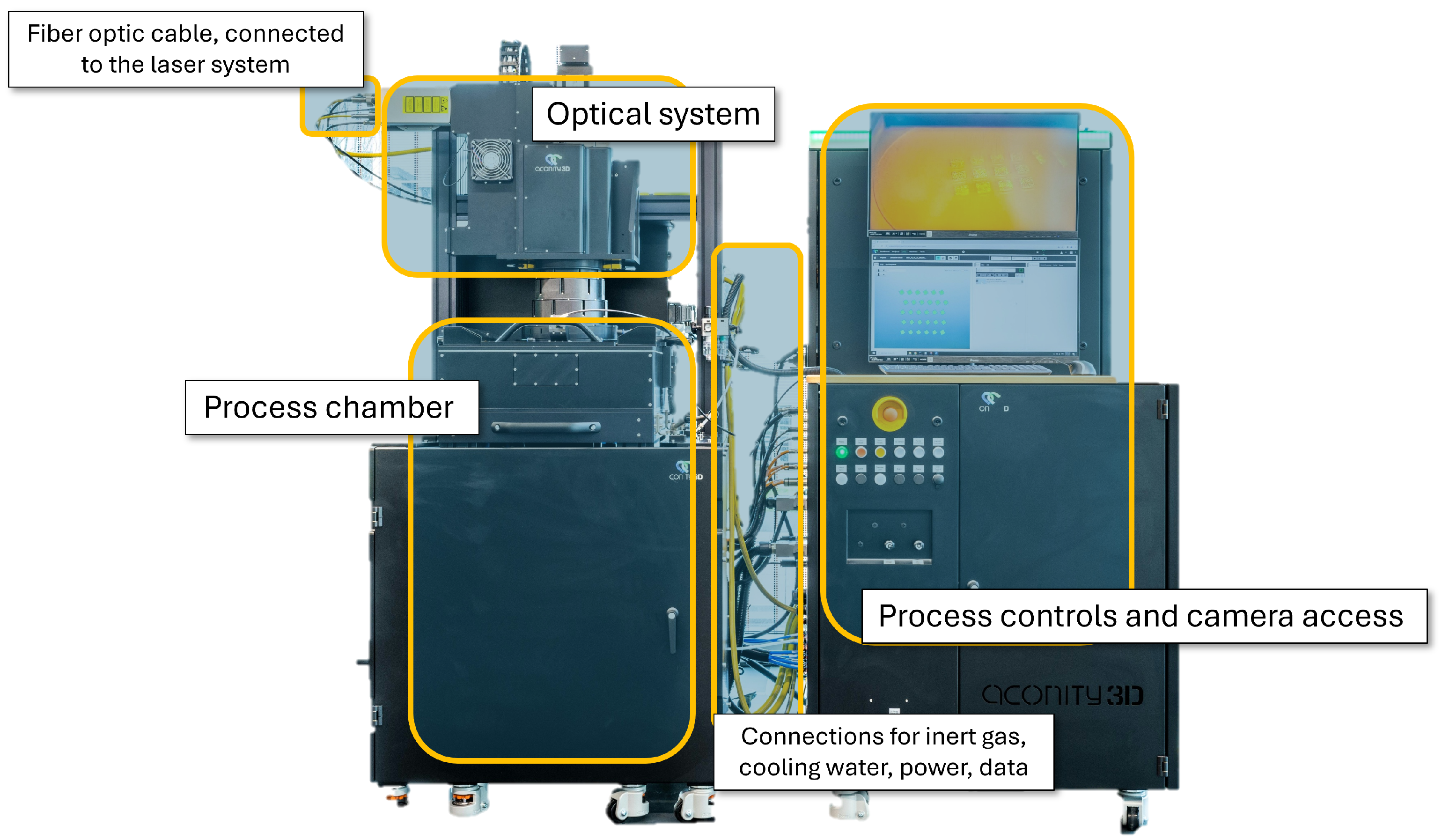
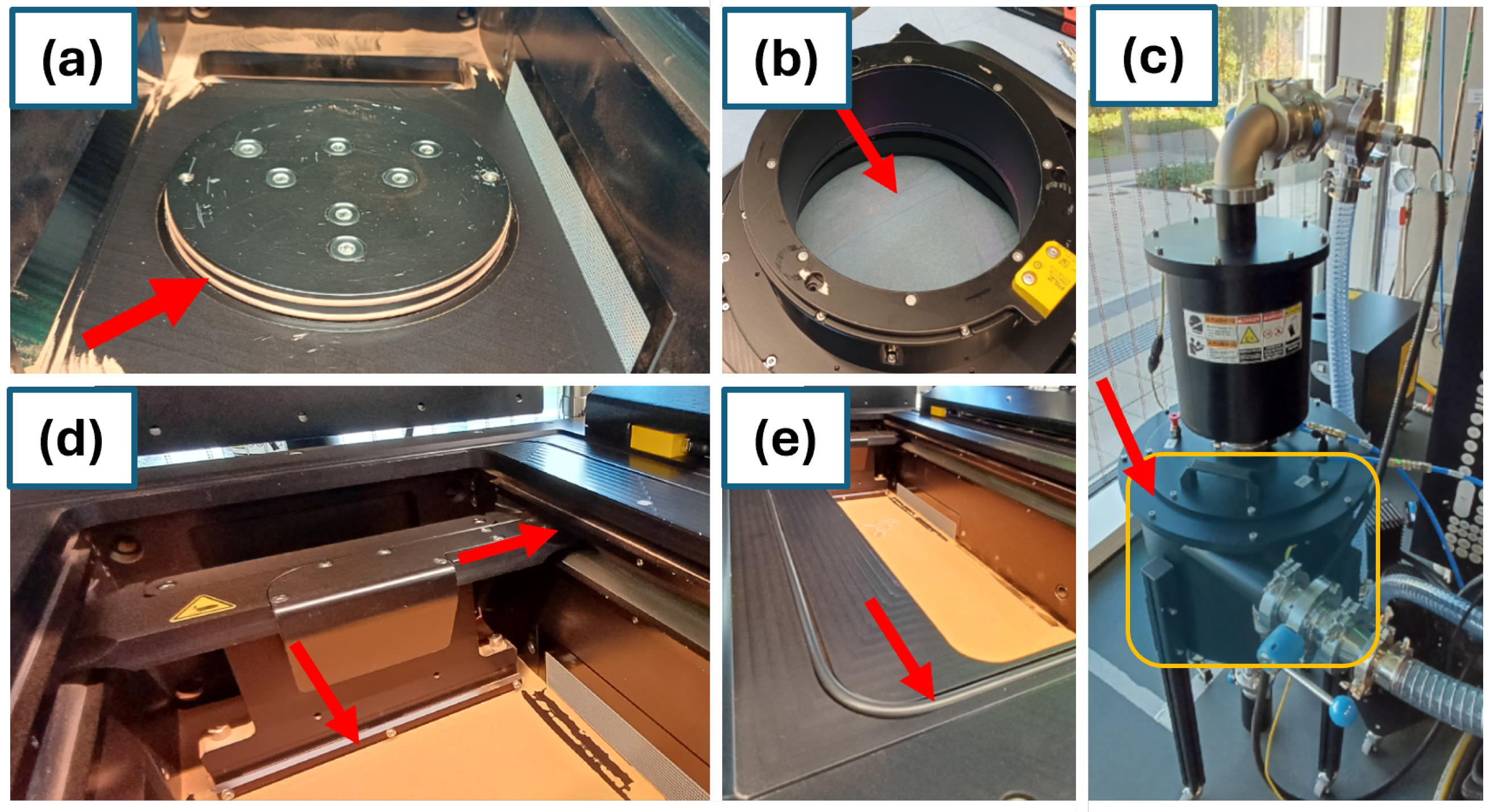
2.1. PBF-LB/M System
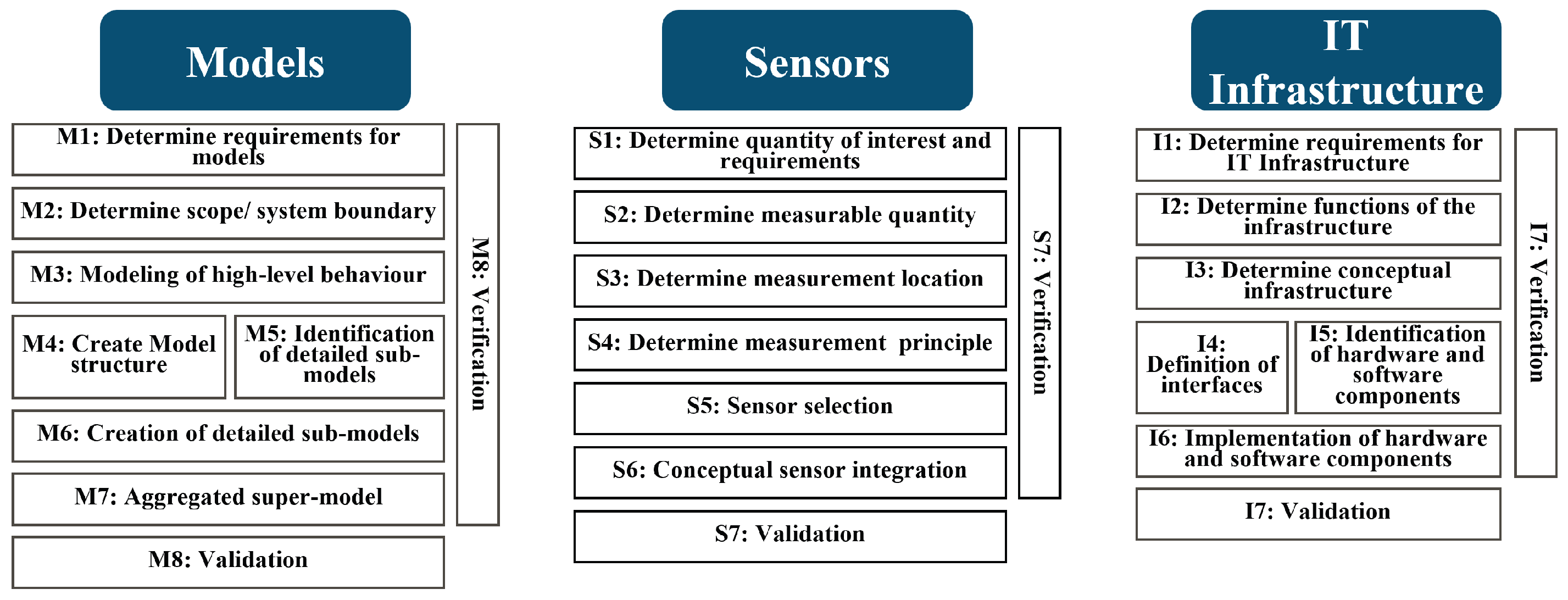
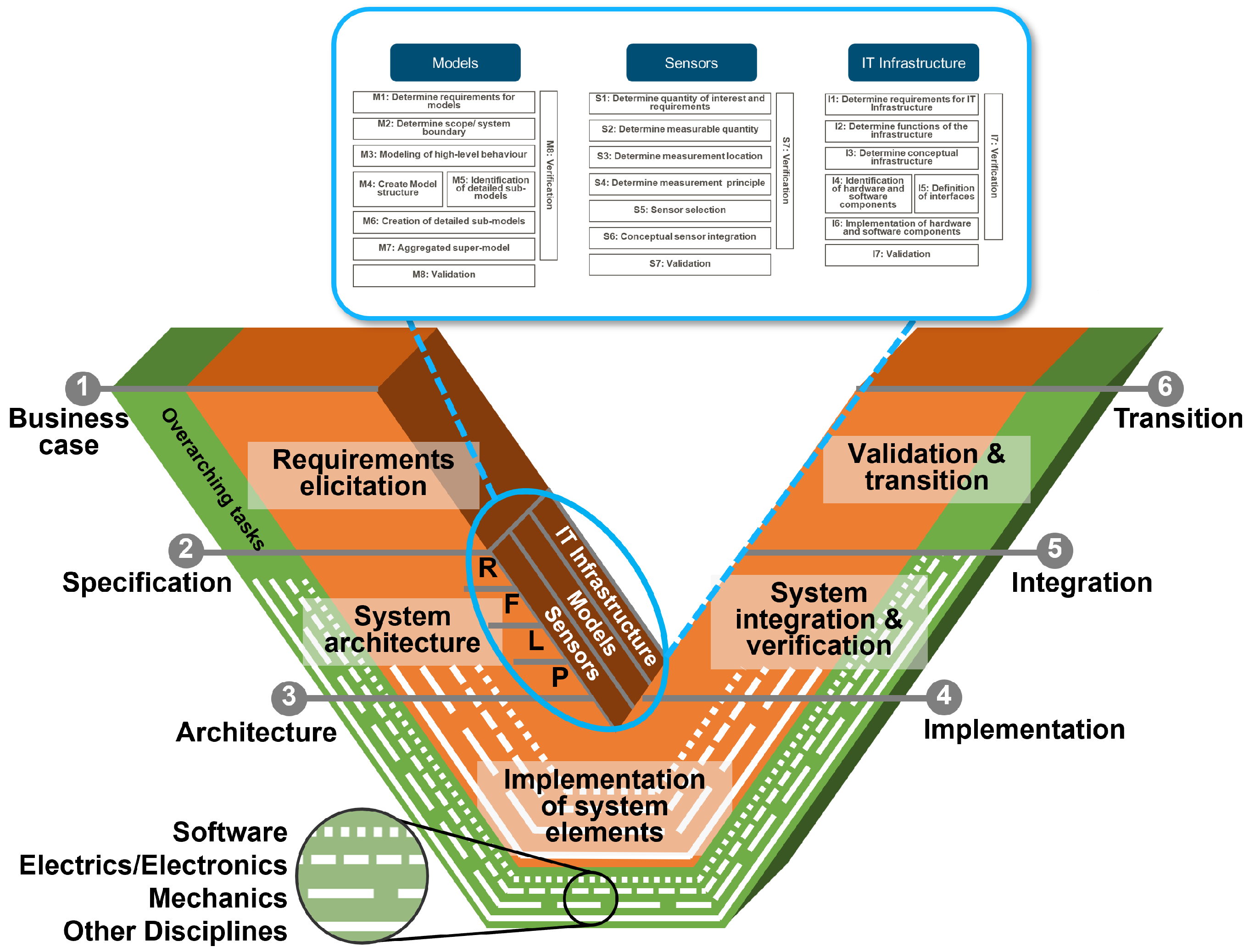
2.2. Utilized Methodology for DT Implementation
3. Results
3.1. Methodology Based Implementation
3.1.1. Models
- A predictive model for pre-designing the process with regard to the expected relative density depending on the process parameters
- A decision model that checks the possibility of starting the process based on the current system status
- A descriptive model for describing the current production run for monitoring and error detection
- Only metrics for which the necessary sensors are already available are used.
- A high degree of abstraction in the models is acceptable due to the many factors influencing the PBF-LB/M process
- Models can also be used with approximate values
- Analytical and descriptive models are combined
- The condition and damage to parts of the PBF system are considered separately
- Models verified by accompanying research are used
- Data is sampled at a frequency of 1 Hz or less
- The total computing time required to update all models is less than 30 ms
3.1.2. Sensors
- Laser power
- Layer height
- Laser scanning speed
- Oxygen level
- Process chamber pressure
- Inert gas flow
- Status cooling system
- Cyclone filter differential pressure
- Electrical power consumption
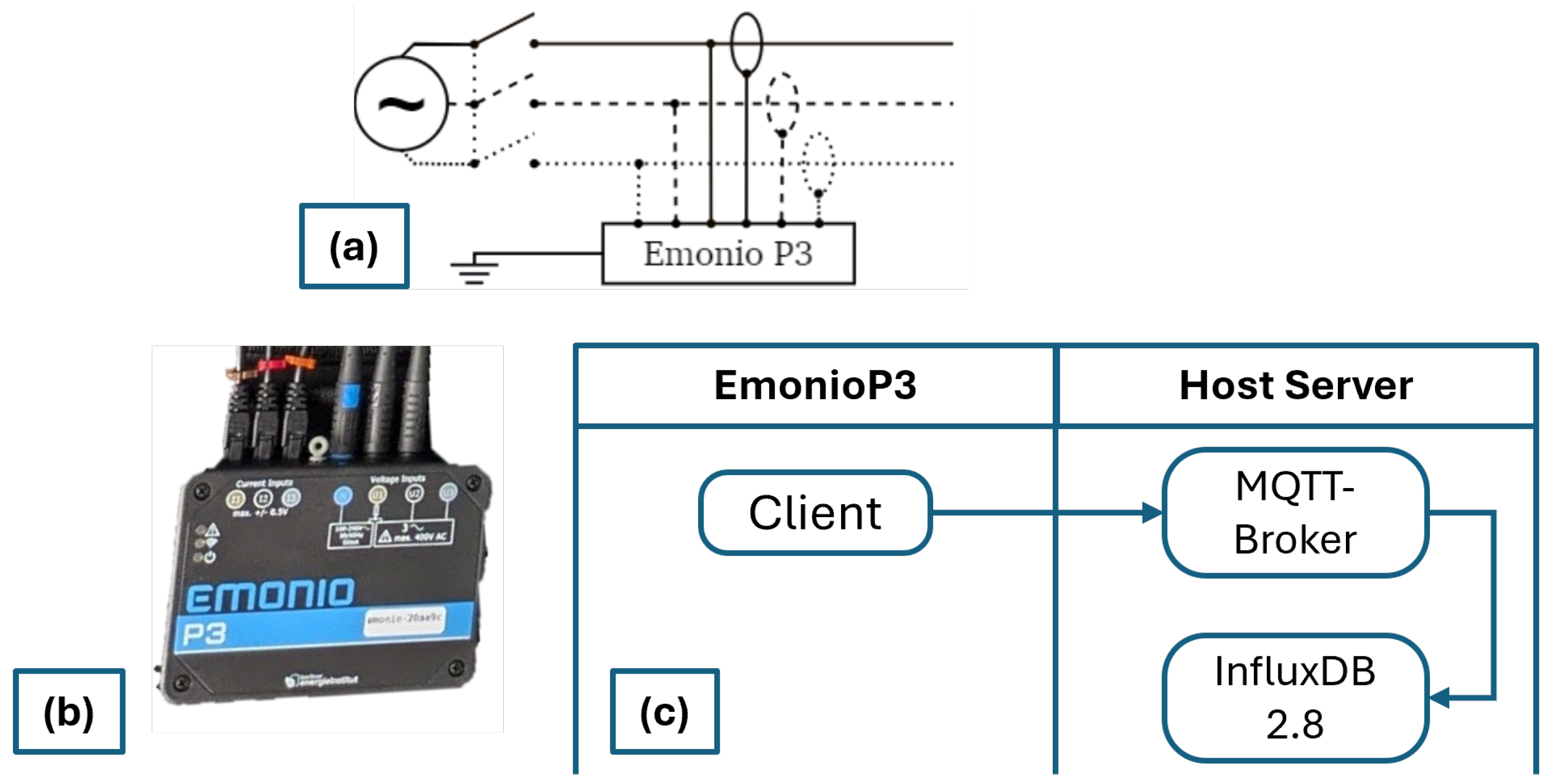
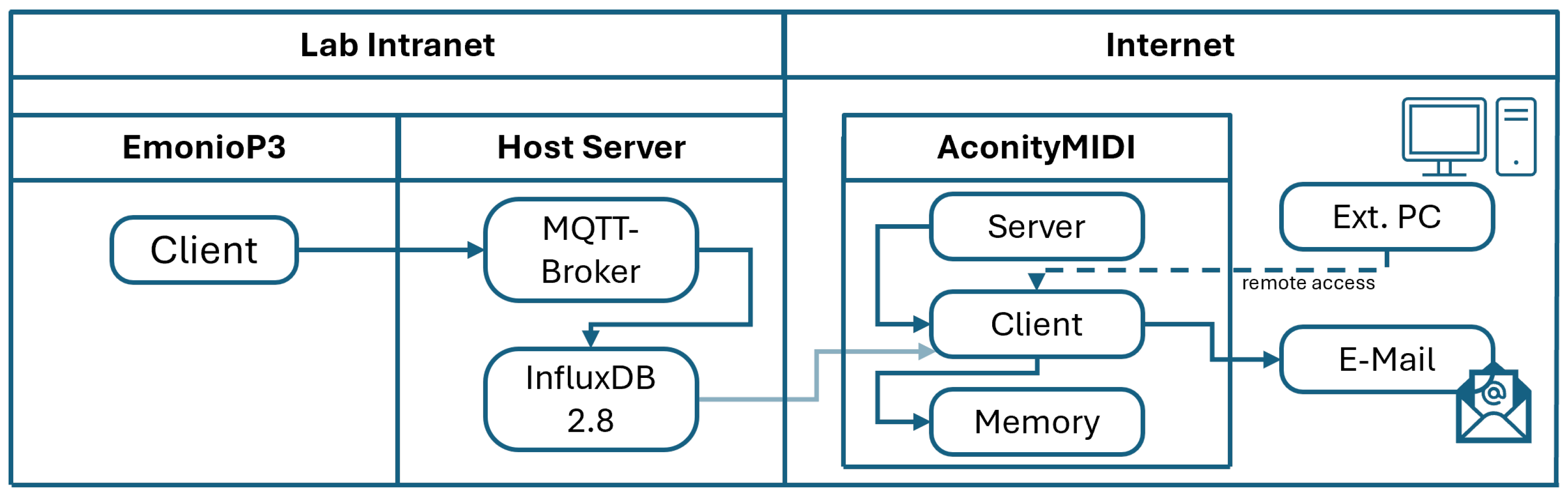
3.1.3. IT-Infrastructure
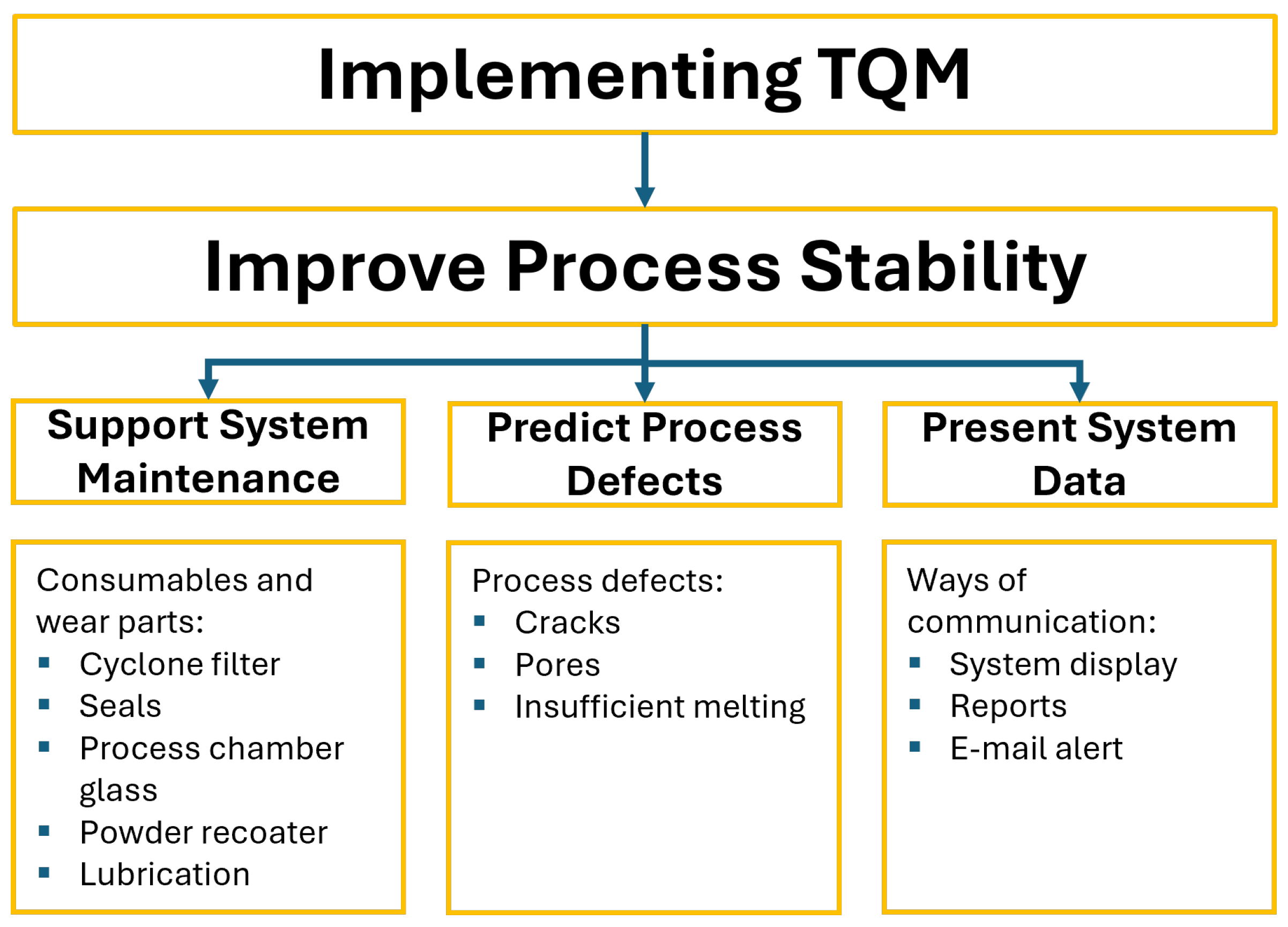
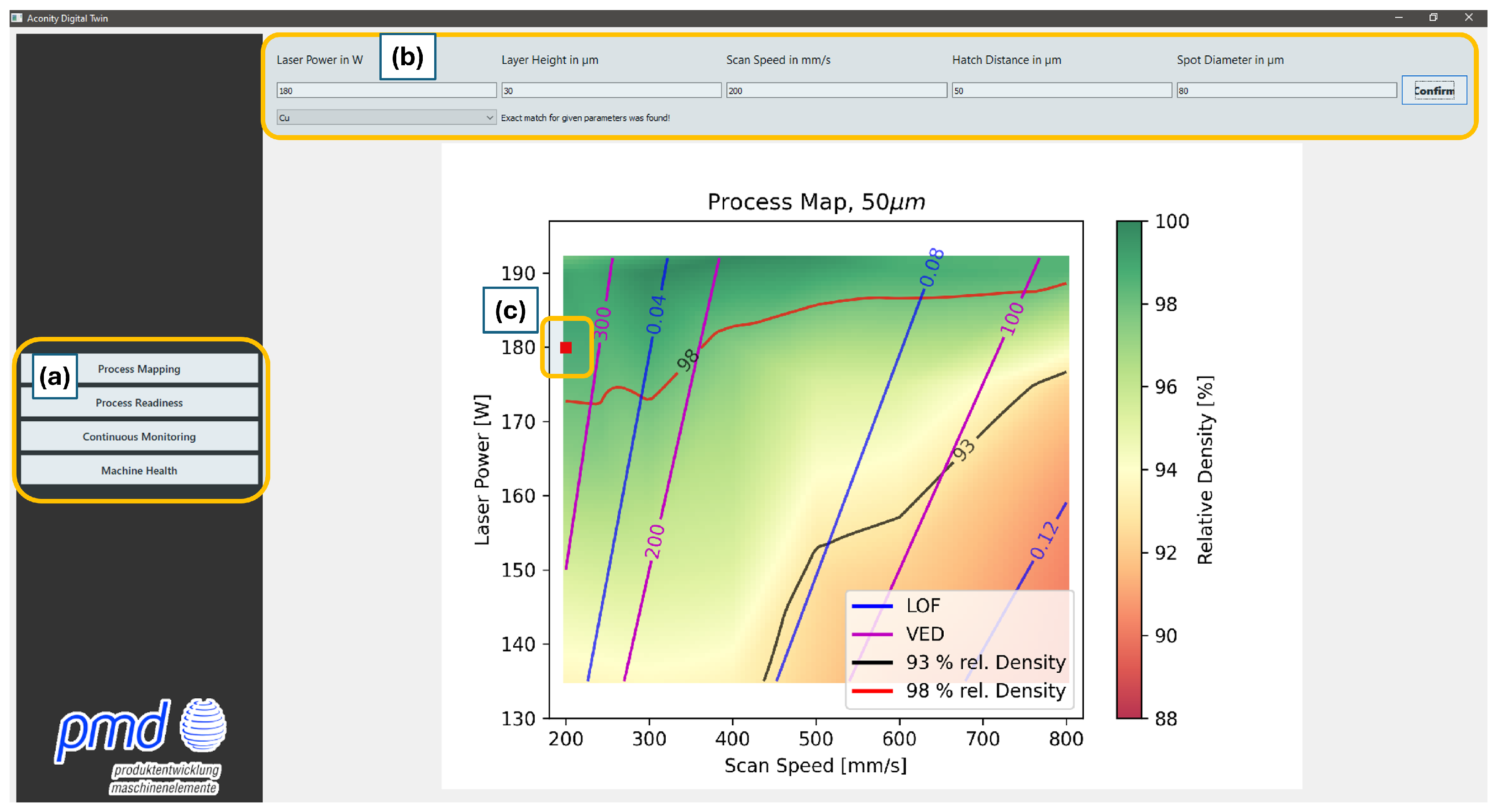
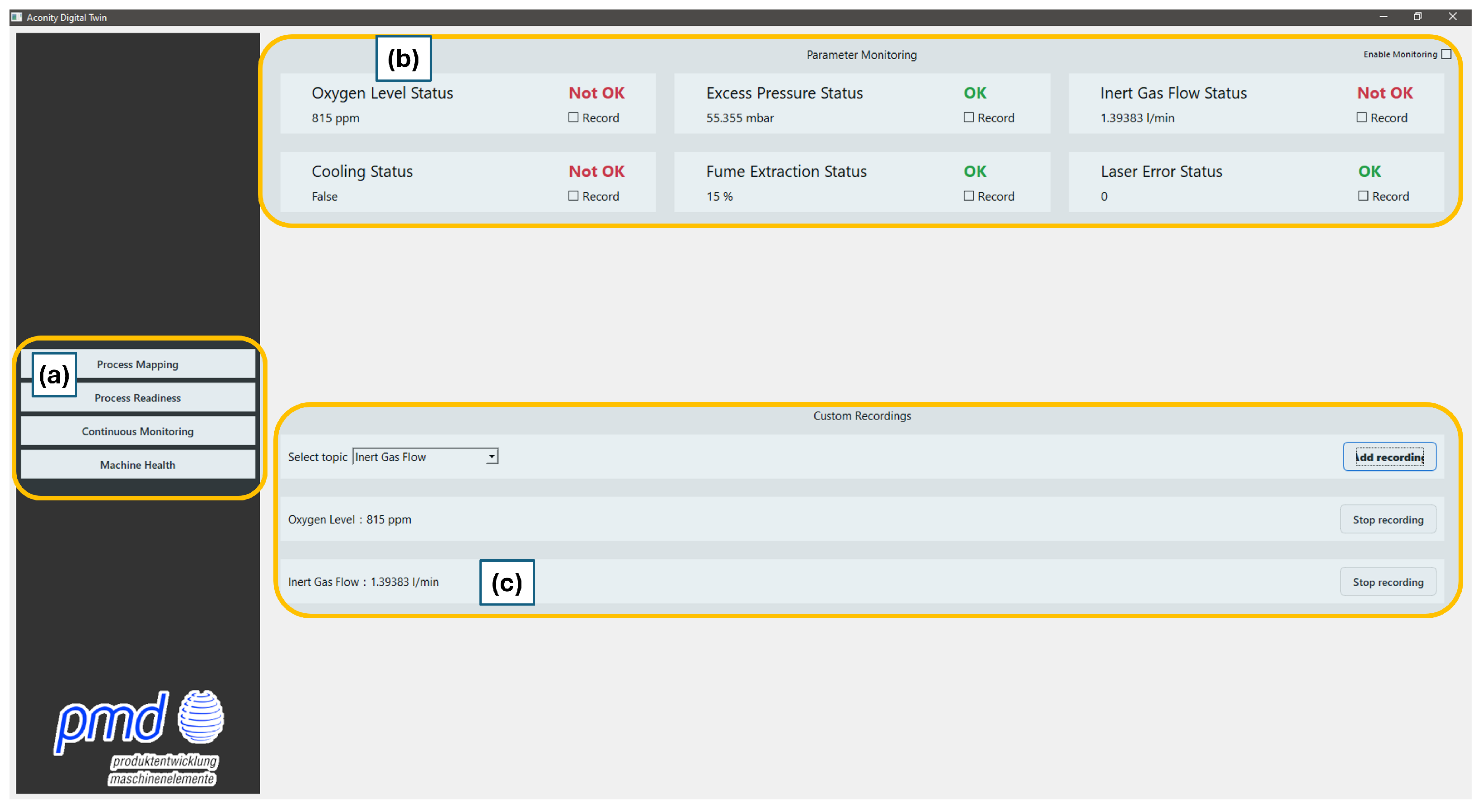
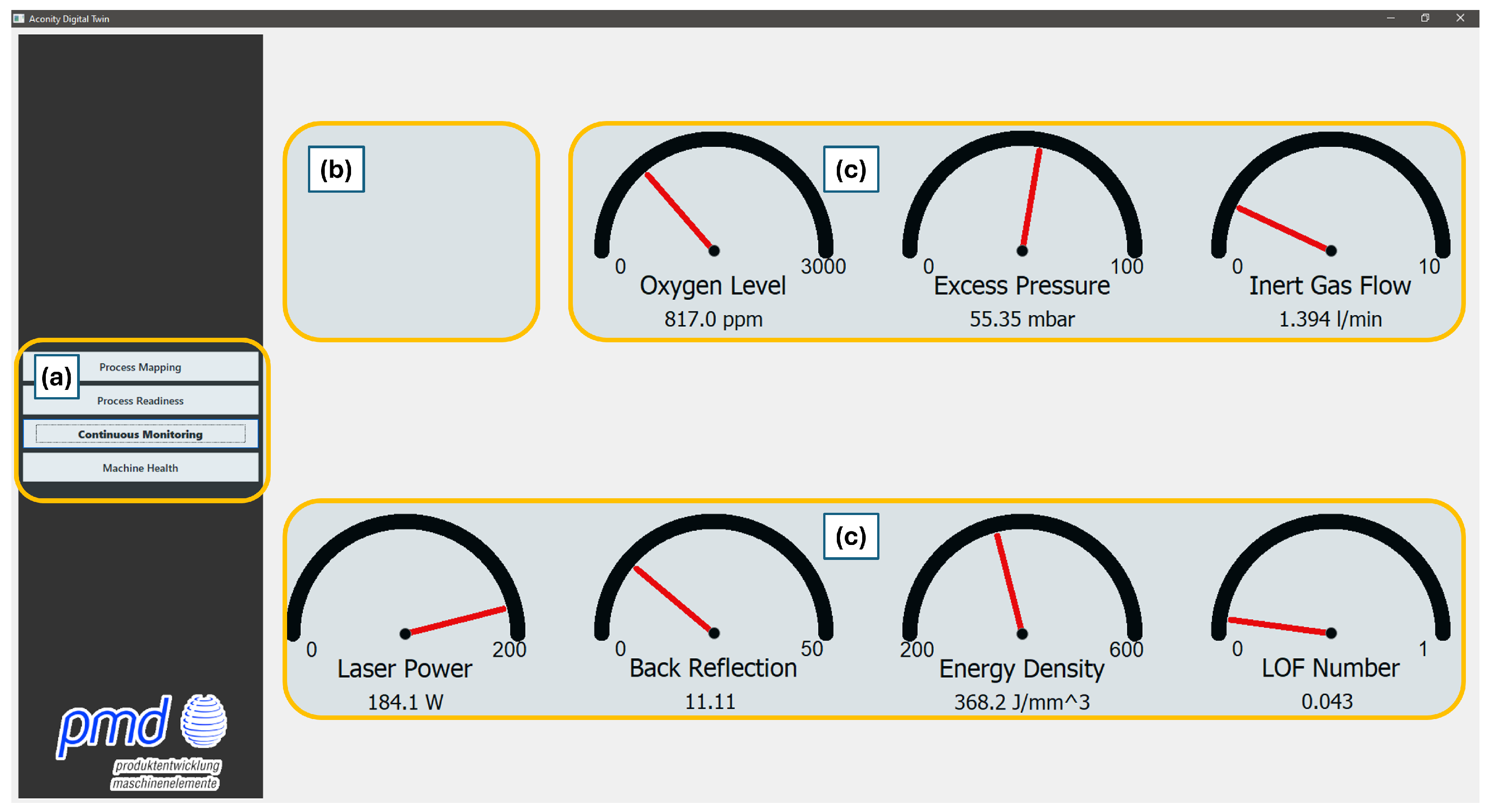
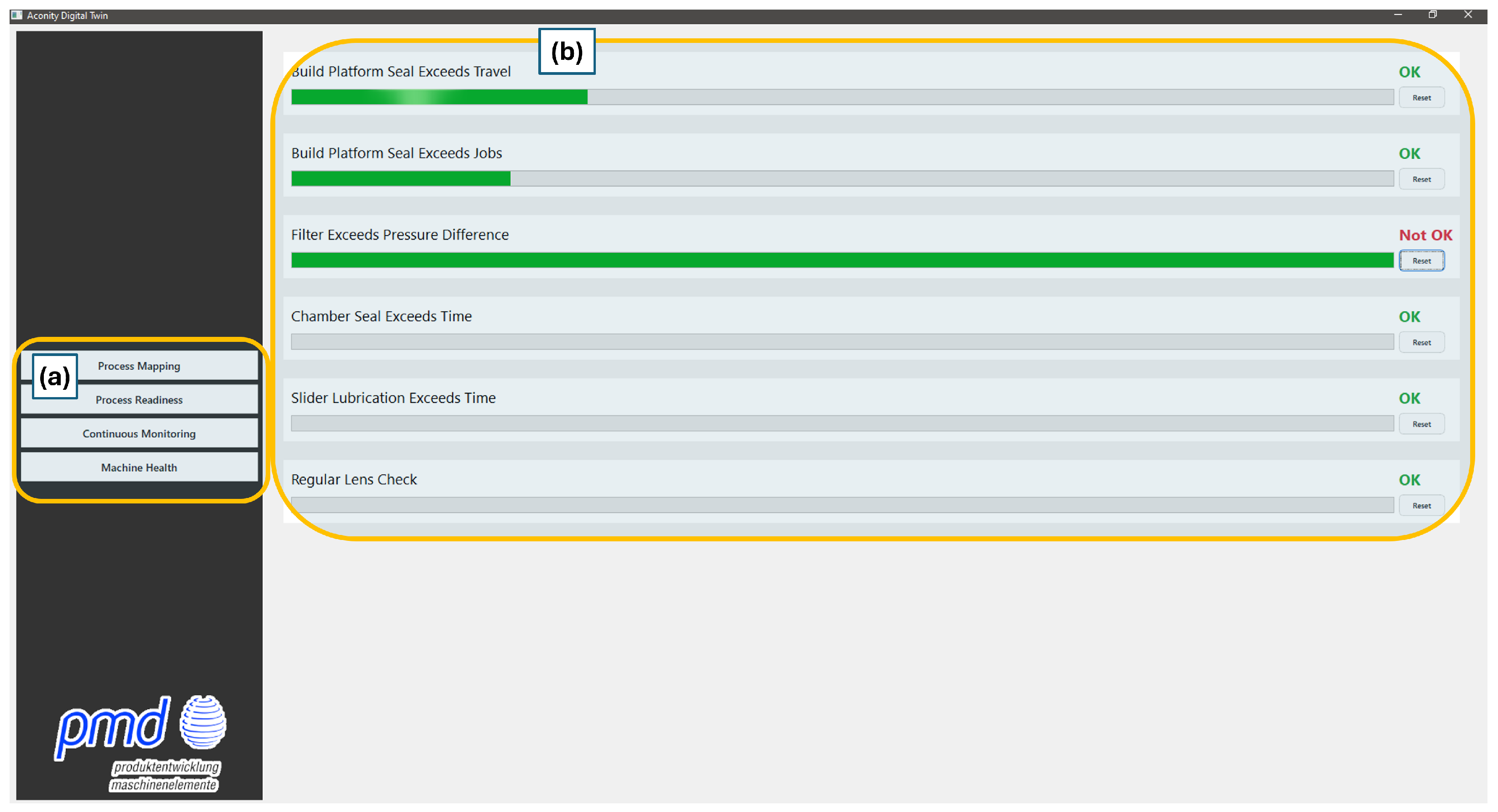
3.2. Functions and Usability of the DT
4. Discussion
4.1. Implications of DT Functionality on System Performance
4.2. Discussion of the DT Implementation Methodology
4.3. Directions for Further Research and Development
5. Conclusions
- The implemented DT has a comprehensive impact on plant operation. It simplifies the training of new operators, facilitates process planning and the use of process knowledge, and increases process stability through reliable tracking of the service life of critical components. Above all, it improves the ergonomics of use by simplifying information processing and storage for system operators.
- The methodology used has proven itself and its applicability has once again been evaluated with positive results. The order in which the work steps are carried out could be adjusted with regard to requirements gathering. A more cross-domain consideration between the definitions of models and existing hardware and software is considered useful, as the logical structure of models and the parallelizability of calculations depend directly on the structure of the system under consideration.
- The implemented DT is, according to the authors, only a basic version that is capable of running, but its range of functions has a noticeable impact on operations and meets the specified requirements to the planned extent. The planned use of EmonioP3 will open up further areas of application for the DT in the future, particularly for sustainability assessments and cost calculations, which will require the integration of additional models. AconityMIDI can be integrated even more deeply into the DT by using all sensors or camera images together with artificial intelligence-supported image evaluation for fault detection and general process monitoring.
Author Contributions
Funding
Data Availability Statement
Conflicts of Interest
Abbreviations
| DT | Digital Twin |
| PBF-LB/M | Powder Bed Fusion, using a Laser Beam for Metals |
| AM | Additive Manufacturing |
| TQM | Total Quality Management |
| TDABC | time-driven activity-based costing |
| UML | Unified Modeling Language |
| SysML | Systems Modeling Language |
| OSI | Open Systems Interconnection |
References
- Stark, R.; Anderl, R.; Thoben, K.D.; Wartzack, S. WiGeP-Positionspapier: „Digitaler Zwilling“. Z. Für Wirtsch. Fabr. 2020, 115, 47–50. [Google Scholar] [CrossRef] [Scilit]
- D’Amico, R.D.; Addepalli, S.; Erkoyuncu, J.A. Industrial Insights on Digital Twins in Manufacturing: Application Landscape, Current Practices, and Future Needs. Big Data Cogn. Comput. 2023, 7, 126. [Google Scholar] [CrossRef] [Scilit]
- Gulewicz, M. Digital twin technology—Awareness, implementation problems and benefits. Eng. Manag. Prod. Serv. 2022, 14, 63–77. [Google Scholar] [CrossRef] [Scilit]
- Fett, M.; Wilking, F.; Goetz, S.; Wartzack, S.; Kirchner, E. Utilization of RFLP in V-Model methodology for the interdisciplinary development of Digital Twins. Forsch. Ingenieurwesen 2025, 89, 28. [Google Scholar] [CrossRef] [Scilit]
- Shafto, M.; Conroy, M.; Doyle, R.; Glaessgen, E.; Kemp, C.; LeMoigne, J.; Wang, L. Modeling, Simulation, Information Technology and Processing Roadmap; NASA: Houston, TX, USA, 2010. [Google Scholar]
- van der Valk, H.; Haße, H.; Möller, F.; Arbter, M.; Henning, J.L.; Otto, B. A Taxonomy of Digital Twins. In Proceedings of the 26th Americas Conference on Information Systems (AMCIS), Salt Lake City, USA, 15–17 August 2020. [Google Scholar]
- Schweiger, L.; Barth, L. Properties and Characteristics of Digital Twins: Review of Industrial Definitions. SN Comput. Sci. 2023, 4, 436. [Google Scholar] [CrossRef] [Scilit]
- ISO/IEC 30173:2023; Digital Twin—Concepts and Terminology. Standards Australia Limited: Sydney, Australia, 2023.
- ISO/IEC 20924:2024; Internet of Things (IoT) and Digital Twin—Vocabulary. ISO: Geneva, Switzerland, 2024.
- Digital Twin Consortium. The Definition of a Digital Twin; Digital Twin Consortium: Boston, MA, USA, 2020. [Google Scholar]
- Ozkaya, M.; Akdur, D.; Turunc, A. Understanding Practitioners’ Perspectives on Digital Twin: A Survey. Res. Sq. 2025. [Google Scholar] [CrossRef] [Scilit]
- Fett, M.; Wilking, F.; Goetz, S.; Kirchner, E.; Wartzack, S. A Literature Review on the Development and Creation of Digital Twins, Cyber-Physical Systems, and Product-Service Systems. Sensors 2023, 23, 9786. [Google Scholar] [CrossRef] [Scilit] [PubMed]
- Fett, M.; Wilking, F.; Goetz, S.; Kirchner, E.; Wartzack, S. Sensor selection and integration for Cyber-Physical Systems in context of Digital Twins—A systematic review of requirements. In Proceedings of the 2023 18th Annual System of Systems Engineering Conference (SoSe), Lille, France, 14–16 June 2023; pp. 1–7. [Google Scholar] [CrossRef] [Scilit]
- Fett, M.; Kraft, M.; Wilking, F.; Goetz, S.; Wartzack, S.; Kirchner, E. Medium-Level Architectures for Digital Twins: Bridging Conceptual Reference Architectures to Practical Implementation in Cloud, Edge and Cloud–Edge Deployments. Electronics 2024, 13, 1373. [Google Scholar] [CrossRef] [Scilit]
- Shen, T.; Li, B. Digital twins in additive manufacturing: A state-of-the-art review. Int. J. Adv. Manuf. Technol. 2024, 131, 63–92. [Google Scholar] [CrossRef] [Scilit]
- Yadroitsev, I.; Yadroitsava, I.; Du Plessis, A. Basics of laser powder bed fusion. In Fundamentals of Laser Powder Bed Fusion of Metals; Elsevier: Amsterdam, The Netherlands, 2021; pp. 15–38. [Google Scholar] [CrossRef] [Scilit]
- Robens, G.; Kirchner, A.; Maier, M.; Rohde, G.; Schmid, D. Produktionsorganisation: Qualitätsmanagement und Produktpolitik, 9. aufl. ed.; Bibliothek des technischen Wissens, Verl. Europa-Lehrmittel: Haan-Gruiten, Germany, 2015. [Google Scholar]
- DIN EN ISO 9001; Qualitätsmanagementsysteme-Anforderungen. Deutsches Institut für Normung: Berlin, Germany, 2015.
- Krückemeier, S. Virtuelle Bauteilprüfung im Digitalen Zwilling in der Additiven Fertigung. Ph.D. Thesis, Technische Universität Darmstadt, Darmstadt, Germany, 2025. [Google Scholar] [CrossRef]
- Wittmeir, T.; Oettl, F.; Schilp, J. Digitaler Zwilling für die additive Fertigung/Digital twin for additive manufacturing. Wt Werkstattstech. Online 2023, 113, 119–123. [Google Scholar] [CrossRef] [Scilit]
- Fang, Q.; Xiong, G.; Zhou, M.; Tamir, T.S.; Yan, C.B.; Wu, H.; Shen, Z.; Wang, F.Y. Process Monitoring, Diagnosis and Control of Additive Manufacturing. IEEE Trans. Autom. Sci. Eng. 2024, 21, 1041–1067. [Google Scholar] [CrossRef] [Scilit]
- Nath, P.; Mahadevan, S. Probabilistic Digital Twin for Additive Manufacturing Process Design and Control. J. Mech. Des. 2022, 144, 091704. [Google Scholar] [CrossRef] [Scilit]
- Körner, C.; Markl, M.; Koepf, J.A. Modeling and Simulation of Microstructure Evolution for Additive Manufacturing of Metals: A Critical Review. Metall. Mater. Trans. A 2020, 51, 4970–4983. [Google Scholar] [CrossRef] [Scilit]
- Anderson, A.M.; van der Merwe, A. TIME-DRIVEN ACTIVITY-BASED COSTING RELATED TO DIGITAL TWINNING IN ADDITIVE MANUFACTURING. S. Afr. J. Ind. Eng. 2021, 32, 37–43. [Google Scholar] [CrossRef] [Scilit]
- Dejene, N.D.; Lemu, H.G. Current Status and Challenges of Powder Bed Fusion-Based Metal Additive Manufacturing: Literature Review. Metals 2023, 13, 424. [Google Scholar] [CrossRef] [Scilit]
- Vahedi Nemani, A.; Ghaffari, M.; Sabet Bokati, K.; Valizade, N.; Afshari, E.; Nasiri, A. Advancements in Additive Manufacturing for Copper-Based Alloys and Composites: A Comprehensive Review. J. Manuf. Mater. Process. 2024, 8, 54. [Google Scholar] [CrossRef] [Scilit]
- Morshed-Behbahani, K.; Aliyu, A.; Bishop, D.P.; Nasiri, A. Additive manufacturing of copper-based alloys for high-temperature aerospace applications: A review. Mater. Today Commun. 2024, 38, 108395. [Google Scholar] [CrossRef] [Scilit]
- Malec, W.; Kulasa, J.; Brudny, A.; Hury, A.; Adamczyk, B.; Rzepecki, R.; Sekula, R.; Kmita, G.; Rybak, A. Comparative Studies of the Properties of Copper Components: Conventional vs. Additive Manufacturing Technologies. Metals 2024, 14, 975. [Google Scholar] [CrossRef] [Scilit]
- Qu, S.; Ding, J.; Fu, J.; Fu, M.; Zhang, B.; Song, X. High-precision laser powder bed fusion processing of pure copper. Addit. Manuf. 2021, 48, 102417. [Google Scholar] [CrossRef] [Scilit]
- Aghayar, Y.; Moazzen, P.; Behboodi, B.; Shahriari, A.; Shakerin, S.; Lloyd, A.; Mohammadi, M. Laser powder bed fusion of pure copper electrodes. Mater. Des. 2024, 239, 112742. [Google Scholar] [CrossRef] [Scilit]
- Constantin, L.; Wu, Z.; Li, N.; Fan, L.; Silvain, J.F.; Lu, Y.F. Laser 3D printing of complex copper structures. Addit. Manuf. 2020, 35, 101268. [Google Scholar] [CrossRef] [Scilit]
- Weilkiens, T. Systems Engineering mit SysML/UML: Anforderungen, Analyse, Architektur, 3., überarb. und aktualisierte aufl. ed.; dpunkt.verl.: Heidelberg, Germany, 2014. [Google Scholar]
- Wirth, F.; Frauchiger, A.; Gutknecht, K.; Cloots, M. Influence of the Inert Gas Flow on the Laser Powder Bed Fusion (LPBF) Process. In Industrializing Additive Manufacturing; Meboldt, M., Klahn, C., Eds.; Springer International Publishing: Cham, Switerland, 2021; pp. 192–204. [Google Scholar] [CrossRef] [Scilit]
- Luo, X.; Yang, P.; Li, Q.; Guo, S.; Qiu, J.; Liu, G. Online monitoring of a high-power CW laser optical mirror based on infrared and visible image features visualization. Appl. Opt. 2025, 64, 1001–1011. [Google Scholar] [CrossRef] [Scilit]
- Tietze, W. (Ed.) Handbuch Dichtungspraxis, 3. aufl. ed.; Vulkan-Verl.: Essen, Germany, 2003. [Google Scholar]
- Bartz, W.J. Einführung in die Tribologie und Schmierungstechnik: Tribologie - Schmierstoffe - Anwendungen; mit 142 Tabellen; Expert-Verlag: Renningen, Germany, 2010. [Google Scholar]
- Schäfle, M.B.; Gärtner, J.; Nahr, F.; Bruder, E.; Schmidt, M.; Kirchner, E. Process development for green laser LPBF of pure Cu using dimensionless numbers. Prog. Addit. Manuf. 2025, 10, 8179–8196. [Google Scholar] [CrossRef] [Scilit]
- Tang, M.; Pistorius, P.C.; Beuth, J.L. Prediction of lack-of-fusion porosity for powder bed fusion. Addit. Manuf. 2017, 14, 39–48. [Google Scholar] [CrossRef] [Scilit]
- Kyogoku, H.; Ikeshoji, T.T. A review of metal additive manufacturing technologies: Mechanism of defects formation and simulation of melting and solidification phenomena in laser powder bed fusion process. Mech. Eng. Rev. 2020, 7, 19-00182. [Google Scholar] [CrossRef] [Scilit]
- Gusarov, A.V. Physics and modeling. In Fundamentals of Laser Powder Bed Fusion of Metals; Elsevier: Amsterdam, The Netherlands, 2021; pp. 79–117. [Google Scholar] [CrossRef] [Scilit]
- ISO 23247; Automation Systems and Integration — Digital Twin Framework for Manufacturing Part 2: Reference Architecture. International Organization for Standardization: Geneva, Switzerland, 2021.
- China, C.R.; Goodwin, M. Was ist das OSI-Modell? Available online: https://www.ibm.com/de-de/think/topics/osi-model (accessed on 7 January 2026).
- Fantozzi, I.C.; Santolamazza, A.; Loy, G.; Schiraldi, M.M. Digital Twins: Strategic Guide to Utilize Digital Twins to Improve Operational Efficiency in Industry 4.0. Future Internet 2025, 17, 41. [Google Scholar] [CrossRef] [Scilit]
- Feng, K.; Xiao, H.; Zhang, J.; Ni, Q. A digital twin methodology for vibration-based monitoring and prediction of gear wear. Wear 2025, 571, 205806. [Google Scholar] [CrossRef] [Scilit]
- Shi, L.; Ding, Y.; Cheng, B. Development and Application of Digital Twin Technique in Steel Structures. Appl. Sci. 2024, 14, 11685. [Google Scholar] [CrossRef] [Scilit]
- Koesters, A.; Koetz, F.; Bock, M.; Fett, M.; Breimann, R.; Kirchner, E. Methodical Development of a Digital Twin for an Industry Valve. Machines 2024, 12, 674. [Google Scholar] [CrossRef] [Scilit]
- Ng, W.L.; Goh, G.L.; Goh, G.D.; Ten, J.S.J.; Yeong, W.Y. Progress and Opportunities for Machine Learning in Materials and Processes of Additive Manufacturing. Adv. Mater. 2024, 36, e2310006. [Google Scholar] [CrossRef] [Scilit]
- Boschetto, A.; Bottini, L.; Vatanparast, S. Powder bed monitoring via digital image analysis in additive manufacturing. J. Intell. Manuf. 2024, 35, 991–1011. [Google Scholar] [CrossRef] [Scilit]
- Anandan Kumar, H.; Kumaraguru, S. Distortion in Metal Additive Manufactured Parts. In 3D Printing and Additive Manufacturing Technologies; Kumar, L.J., Pandey, P.M., Wimpenny, D.I., Eds.; Springer: Singapore, 2019; pp. 281–295. [Google Scholar] [CrossRef] [Scilit]
- Mahmoud, D.; Magolon, M.; Boer, J.; Elbestawi, M.A.; Mohammadi, M.G. Applications of Machine Learning in Process Monitoring and Controls of L-PBF Additive Manufacturing: A Review. Appl. Sci. 2021, 11, 11910. [Google Scholar] [CrossRef] [Scilit]
- Pusateri, V.; Hauschild, M.Z.; Kara, S.; Goulas, C.; Olsen, S.I. Quantitative sustainability assessment of metal additive manufacturing: A systematic review. CIRP J. Manuf. Sci. Technol. 2024, 49, 95–110. [Google Scholar] [CrossRef] [Scilit]
- Figueiredo, K.; Hammad, A.W.; Pierott, R.; Tam, V.W.; Haddad, A. Integrating Digital Twin and Blockchain for dynamic building Life Cycle Sustainability Assessment. J. Build. Eng. 2024, 97, 111018. [Google Scholar] [CrossRef] [Scilit]



| Requirements | |||
|---|---|---|---|
| Structure | Type | Designation | Values, Data, Description |
| Output data | FR | Record process parameters | Record user-controlled process data and make it available for export for further processing.Minimum required data: Wear, energy input |
| TR | Limit output to relevant data | Provide data sets that are as compact as possible by identifying and isolating relevant characteristics.Limit data sets by using customizable permissible ranges () | |
| W | Present in a visually appealing way | Use colors and analogous symbols to improve communication | |
| Interfaces | FR | Allow user interactions | Provision of a graphical user interface with buttons and text fields |
| FR | Allow data export | Provide data for further processing | |
| FR | Reading an external (electrical power) sensor | Provide interface for external sensor for monitoring electrical power consumption | |
| W | Data access from outside the lab location | Notification of responsible persons upon detection of an error | |
| Compatibility | W | Transferability to other PBF systems | Machine-specific information in configuration files can be modified by users: material used, sensor configuration and sensor access data, machine access data, customizable maintenance information |
| W | Switching between process and machine models | Decision rules used to identify characteristics should be customizable by users | |
| FR | Compatibility with the system PC | Compatibility with Windows 11, 1920 × 1080 screen, mid-range CPU, use of local storage | |
| FR | Allow for remote maintenance access | Maintaining the currently usable internet connection | |
| Model Criteria | |||
|---|---|---|---|
| Component Type | Part | Criterion for Wear Assessment | Values for Operating Limits |
| Seal | Build platform seals | Summed up movement of the build platform in millimeters (mm) OR number of built jobs | OR |
| Process chamber seal | Service time in hours (h) | ||
| Wear parts | Powder recoater brush | Service time in hours (h) | |
| Lubrication linear bearing | Service time in hours (h) | ||
| Miscellaneouscomponents | Process chamber glass | Service time in hours (h) | |
| Cyclone filter | Differential pressure in millibar (mbar) | ||
| Model Criteria | |||
|---|---|---|---|
| Parameter Category | Process Parameter | Criterion for Process Readiness | Limits for Process Readiness |
| Atmosphere | Oxygen level | Oxygen fraction in parts per million (ppm) | |
| Excess pressure | Excess pressure in the process chamber in millibar (mbar) | ||
| Fume extraction | Status of fume extraction on/off AND fume extraction power setting in % | Status = on AND | |
| Inert gas flow | Argon gas flow in liters per minute (L/min) | ||
| Laser | Laser cooling | Status of cooling system on/off | Status = on |
| Laser error | Number of errors present | Errors = 0 | |
Disclaimer/Publisher’s Note: The statements, opinions and data contained in all publications are solely those of the individual author(s) and contributor(s) and not of MDPI and/or the editor(s). MDPI and/or the editor(s) disclaim responsibility for any injury to people or property resulting from any ideas, methods, instructions or products referred to in the content. |
© 2026 by the authors. Licensee MDPI, Basel, Switzerland. This article is an open access article distributed under the terms and conditions of the Creative Commons Attribution (CC BY) license.
Share and Cite
Schäfle, M.B.; Fett, M.; Bojunga, P.; Sondermann, F.; Kirchner, E. Implementation of a Digital Twin in Additive Manufacturing of Copper—Methodology, Implications, and Future Prospects. Machines 2026, 14, 97. https://doi.org/10.3390/machines14010097
Schäfle MB, Fett M, Bojunga P, Sondermann F, Kirchner E. Implementation of a Digital Twin in Additive Manufacturing of Copper—Methodology, Implications, and Future Prospects. Machines. 2026; 14(1):97. https://doi.org/10.3390/machines14010097
Chicago/Turabian StyleSchäfle, Moritz Benedikt, Michel Fett, Philipp Bojunga, Florian Sondermann, and Eckhard Kirchner. 2026. "Implementation of a Digital Twin in Additive Manufacturing of Copper—Methodology, Implications, and Future Prospects" Machines 14, no. 1: 97. https://doi.org/10.3390/machines14010097
APA StyleSchäfle, M. B., Fett, M., Bojunga, P., Sondermann, F., & Kirchner, E. (2026). Implementation of a Digital Twin in Additive Manufacturing of Copper—Methodology, Implications, and Future Prospects. Machines, 14(1), 97. https://doi.org/10.3390/machines14010097