Safety Assessment of Fuze Based on T-S Fuzzy Fault Tree and Interval Triangular Fuzzy Multi-State Bayesian Network
Abstract
1. Introduction
- (1)
- Uncertainty Input: Interval triangular fuzzy subsets are introduced to characterize the failure probabilities of basic events in fuze systems. This approach not only captures the intrinsic fuzziness of failure events but also accommodates and quantifies epistemic discrepancies among expert judgments through interval-valued membership functions, thereby providing more robust and engineering-practical uncertainty inputs for the model.
- (2)
- System Behavior Modeling: Constructing a T-SFFT for the fuze system and employing ‘if-then’ rules to meticulously describe the intricate fault propagation mechanisms within the fuze system, the limitations of traditional fault tree analysis for fuze systems are overcome.
- (3)
- Reasoning and Assessment: The T-SFFT of the fuze system is mapped to a fuzzy BN, with CPTs and probabilistic reasoning models constructed. This model not only enables forward safety prediction from fuze components to the fuze system but also facilitates reverse diagnosis from fuze system failures to underlying component causes.
2. Construction of Fuzzy BNs for Fuze Systems
2.1. Methods of Constructing BNs
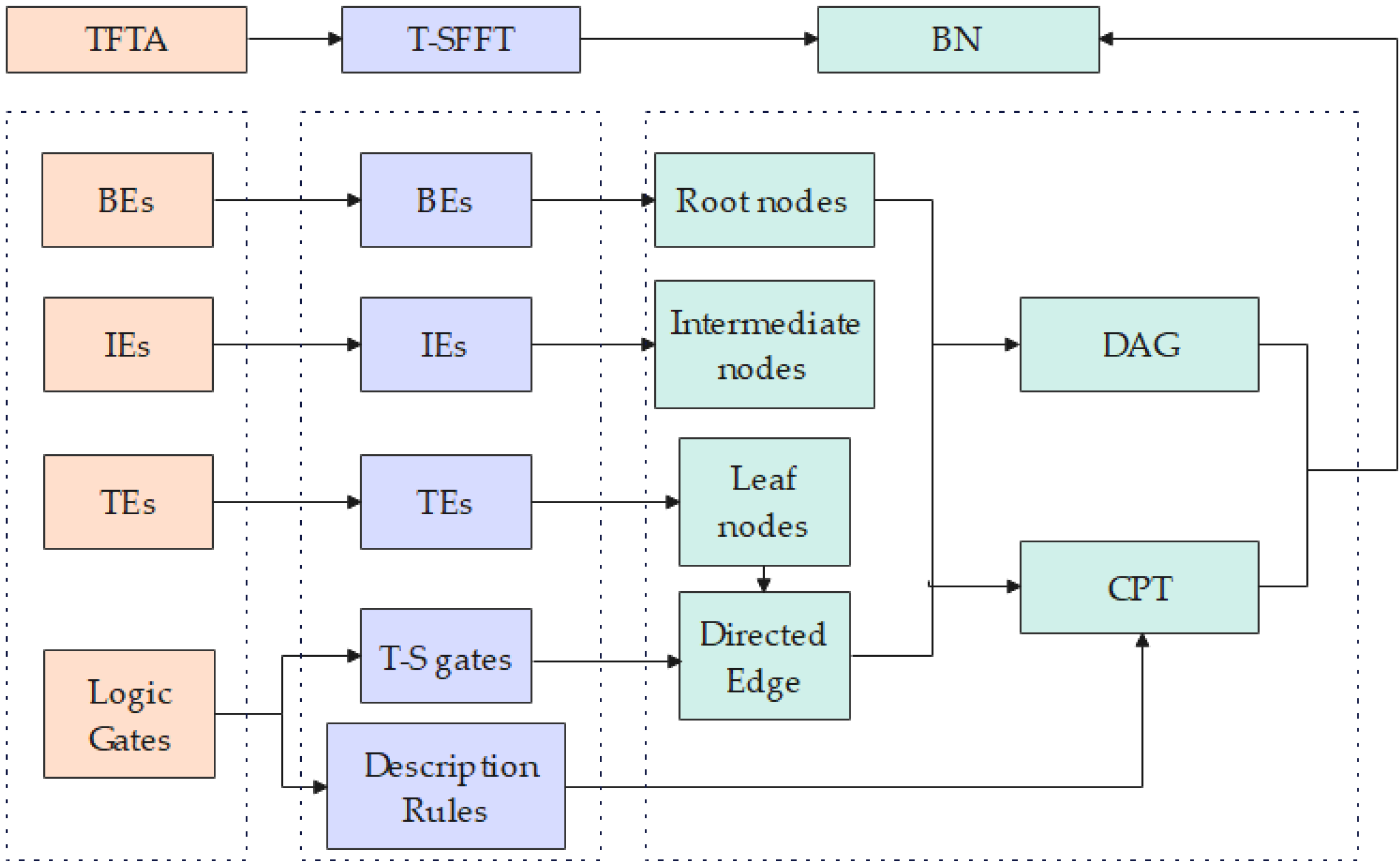
2.1.1. BN Flowchart Construction
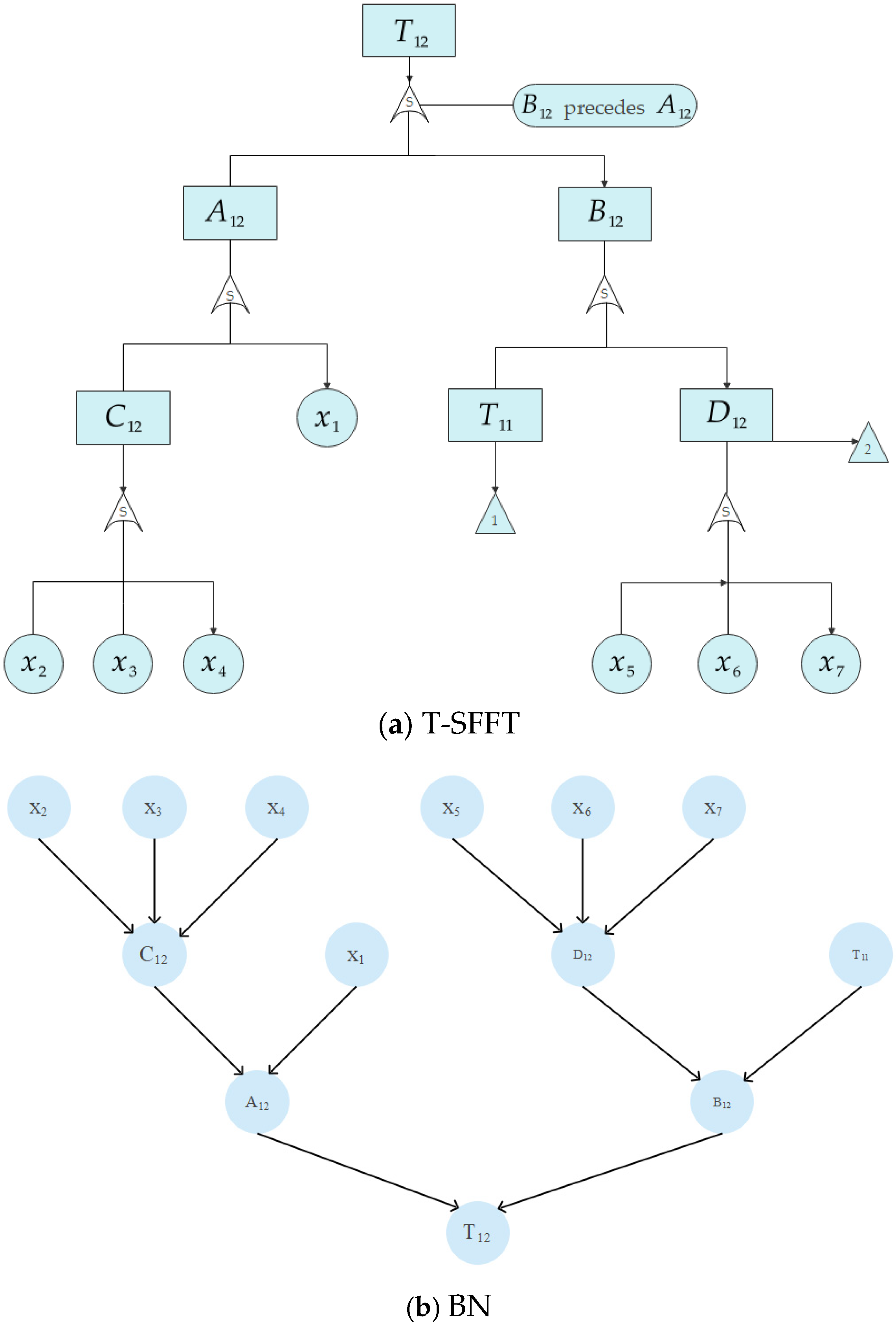
2.1.2. Algorithmic Transformation Method for Constructing BNs
2.2. Node Description Method for BN
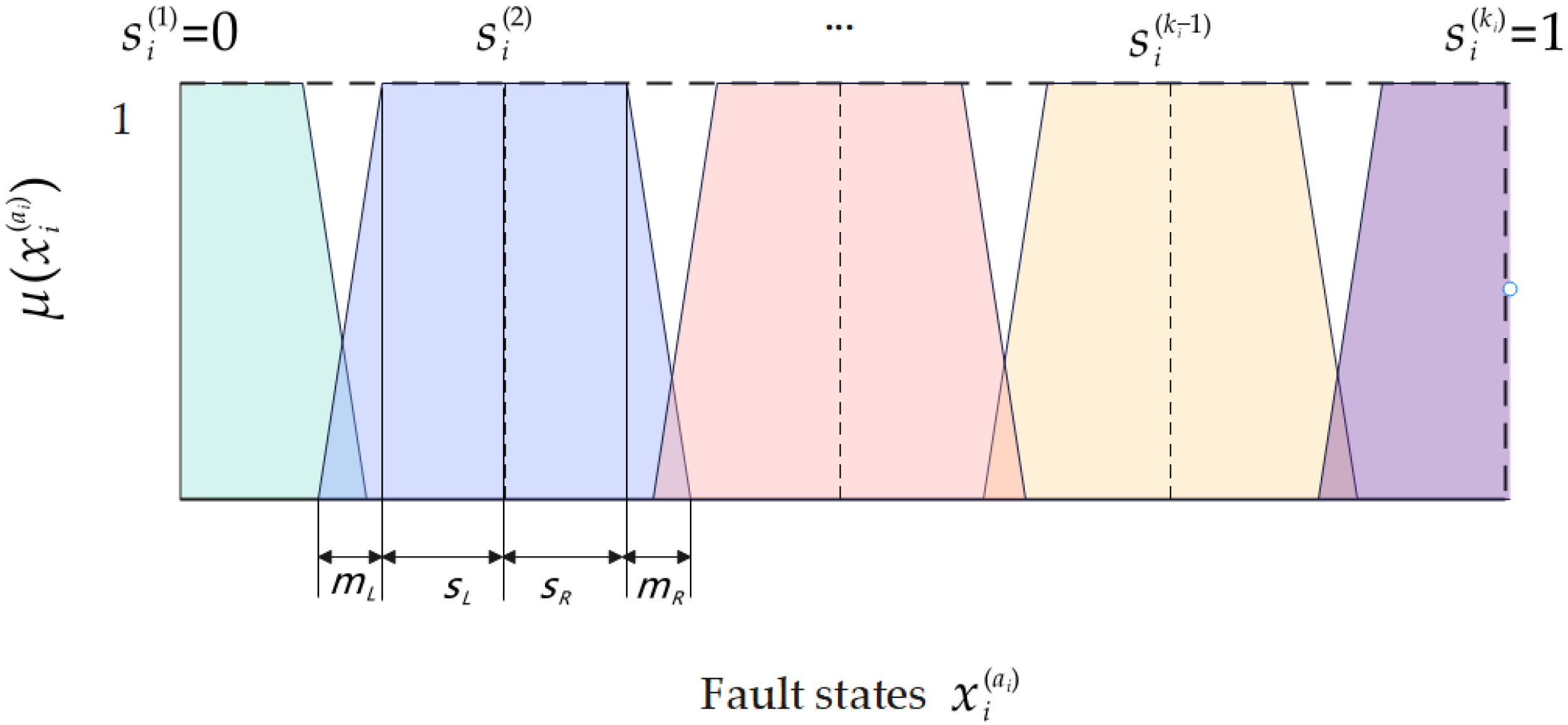
2.2.1. The Fault State Description of Nodes
2.2.2. The Fault Rate Description of Nodes
2.2.3. CPT Construction
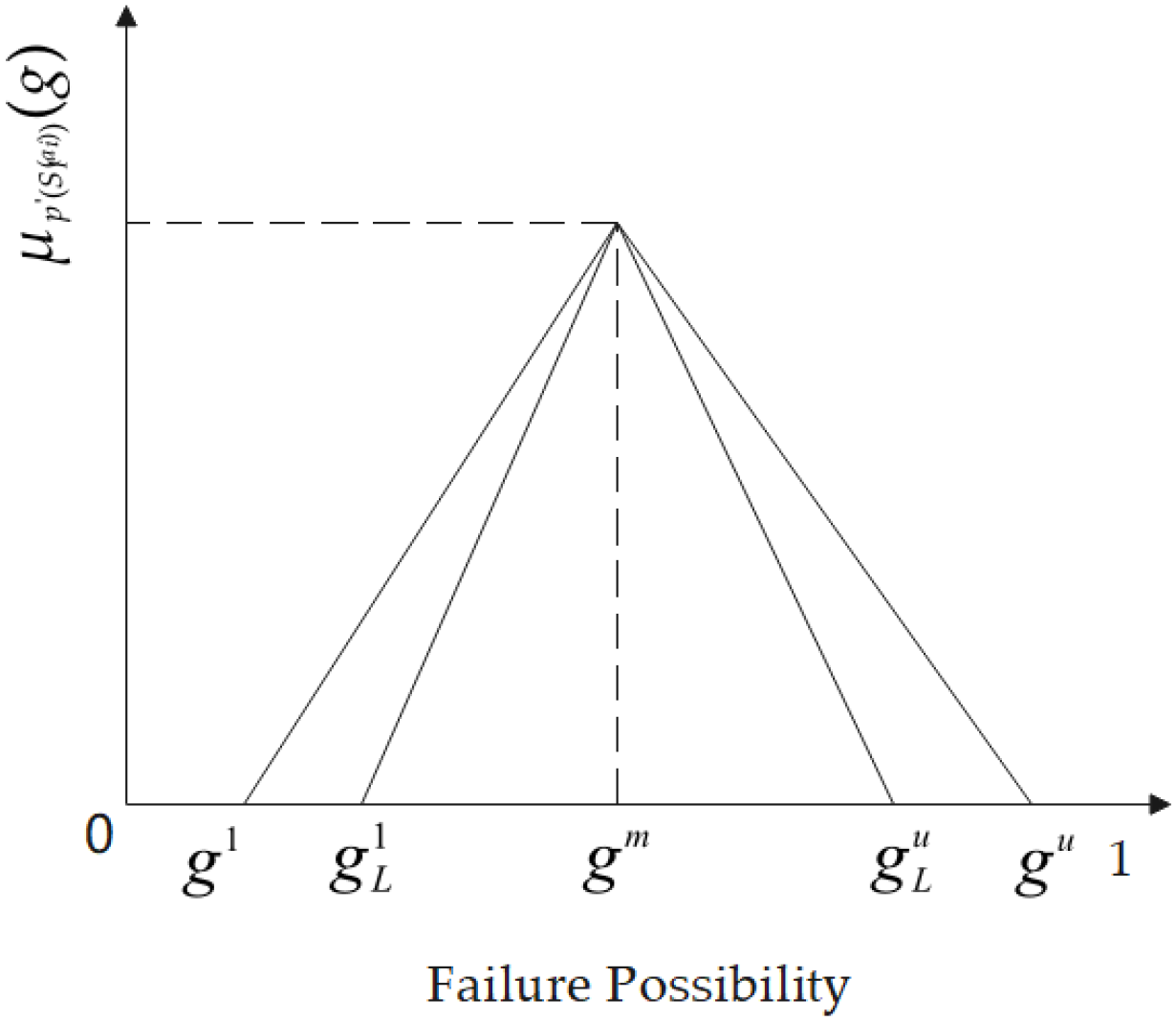
2.2.4. Leaf Node Interval Fuzzy Subset
2.2.5. Posteriori Probability
3. Case Study Analysis
3.1. Constructing the DAG of a BN
3.2. CPTs with Fuze Function Initiation Prior to Scheduled Arming and Enabling Sequence
3.2.1. Fuzzy Fault State Description of Fuze Nodes
3.2.2. Fuzzy Fault Probability Description of the Fuze Nodes
3.2.3. Fuzzy CPT Construction of the Fuze Nodes
4. Numerical Analysis
4.1. Interval-Valued Fuzzy Subsets of Nodes Under Various Fault States
4.2. Probability of Top Event Occurring Under the Current Failure States
4.3. Posteriori Probability
4.4. Result Analysis
- (1)
- The fault probability at leaf node is in the order of 10−5 for a fault state of 0.5 and in the order of 10−9 for a fault state of 1. This indicates that both half-failure and complete failure states occurring in this fuze system prior to initiation of the ordained arming and safety-interruption sequence are low-probability events, with the complete fault state being smaller by four orders of magnitude compared to the half-failure fault state;
- (2)
- Based on calculations, the sum of the fault probabilities for leaf node across its three fault states (state:0, 0.5, 1) equals 1, validating the feasibility of the computational methodology. Furthermore, the fault probability magnitude for the complete fault state (state 1) complies with the requirements stipulated in China National Military Standard;
- (3)
- When the fault state of leaf node is 0, the probability value reaches 0.9999…, demonstrating that the system exhibits an extremely high likelihood of normal operation during this phase. This observation aligns with TFTA, thereby validating the feasibility and accuracy of employing the interval-triangular fuzzy multi-state Bayesian method for fuze safety assessment;
- (4)
- According to the posteriori probabilities of each node, under the condition of fuze complete failure before initiation of the ordained arming and safety-interruption sequence, the descending order of priority for detecting half-failure nodes is as follows: , , , , , (notably, and exhibit no half-failure states). Conversely, the descending priority order for detecting complete-fault nodes is as follows: , , , , , , , .
5. Conclusions and Outlook
- (1)
- This study proposes a safety assessment framework for fuze systems, effectively addressing multi-source uncertainties within the systems by integrating interval-based triangular fuzzy subsets, T-SFFT, and BNs. This framework captures both the inherent information ambiguity in system failures (uncertainty in fault boundaries) and the intrinsic vagueness in expert judgements (interval-based fuzzy quantification). Consequently, it overcomes the limitations of traditional Boolean logic when modelling multi-state failure systems;
- (2)
- This study defines conversion rules and algorithms for transforming T-S fault trees into Bayesian networks within fuze systems. It ensures that the complex and uncertain information contained within the T-S gate rule library is fully and faithfully mapped onto BNs, thereby establishing Bayesian structures and parameters. This methodology lays the foundation for bidirectional reasoning in fuze system fault diagnosis, encompassing both forward prediction and backward diagnosis.
- (3)
- Case studies indicate that the probability of the fuze functioning before the initiation of the ordained arming and safety-interruption sequence is 5.435977 × 10⁻⁹. Comparison with GJB standards and the relevant literature revealed that the calculated results were of the same order of magnitude and closely aligned in value.
- (4)
- This framework enables the scientific quantification of safety risks within fuze systems and facilitates fault root cause analysis. Compared to conventional methods, the analytical outcomes provided by this framework offer greater engineering guidance. It not only determines the failure probability of fuze systems but also identifies, through reverse analysis, the sources of underlying uncertainty and their propagation pathways.
- (1)
- Optimization of Fault State Modelling: The current model employs simplified processing, classifying certain faults and complete failure states into identical fuzzy subsets. Future work will focus on exploring more uncertainty modelling approaches, establishing logically related yet mutually exclusive fuzzy subsets for different fault states to further enhance the precision and accuracy of the evaluation model.
- (2)
- Data Source Optimization: Within the existing framework, fault data for fuze systems primarily originates from expert assessments. Future work will incorporate physical models as prior information, thereby reducing reliance on expert assessments and enhancing the persuasiveness of evaluation outcomes.
- (3)
- Dynamic Analysis Extension: This research currently focuses on static safety analysis of fuze systems. Given the dynamic nature of fuze operational environments, extending this framework to dynamic BNs represents a key research direction.
- (4)
- Computational Efficiency Enhancement: To address the combinatorial explosion of conditional probability tables caused by multiple state nodes and parent nodes within the framework, alongside complex operations arising from fuzzy number propagation, subsequent work may incorporate technical strategies such as parallel computing or cloud computing to meet large-scale computational demands.
Author Contributions
Funding
Data Availability Statement
Acknowledgments
Conflicts of Interest
Appendix A
Step-by-Step Manual Calculation Demonstration for Node C12 Under Various Fault Conditions
- Probability decomposition of basic events based on interval triangular fuzzy decomposition method
- 2.
- Calculate the fuzzy degree K of the joint probability for key combinations
- (1)
- Calculation of KL
- (2)
- Calculation of KU
- 3.
- Calculate the failure probability of node C12
- (1)
- (2)
- (3)
References
- MIL-STD-1316F; Design Criteria Standard: Fuze Design, Safety Criteria for. United States Department of Defense: Arlington, VA, USA, 2017.
- Zhang, D.B.; Huang, W.Q.; Li, Z.W.; Zhang, L. The Application of Image Enhancement Technology in Ammunition Fuze Safety Detector. Adv. Mater. Res. 2014, 940, 513–516. [Google Scholar] [CrossRef]
- Fares, J.; Fares, Y. Cluster Munitions: Military Use and Civilian Health Hazards. Bull. World Health Organ. 2018, 96, 584–585. [Google Scholar] [CrossRef] [PubMed]
- ARMY MIL-STD 1911 A; Military Standard: Hand-Emplaced Ordnance (HEO) Design, Safety Criteria for. United States Department of Defense: Arlington, VA, USA, 1998.
- STANAG 4187; Fuzing Systems: Guidelines for STANAG 4187, Ed3. Nato Standardization Office: Brussels, Belgium, 1999.
- STANAG 4497; Safety Principles for Man-Portable Munitions (HEM), Ed 2. North Atlantic Treaty Organization: Brussels, Belgium, 2016.
- Liu, J.; Yang, J.-B.; Wang, J.; Sii, H.-S. Engineering System Safety Analysis and Synthesis Using the Fuzzy Rule-Based Evidential Reasoning Approach. Qual. Reliab. Eng. Int. 2005, 21, 387–411. [Google Scholar] [CrossRef]
- Sharp, A.; Andrade, J.; Ruffini, N. Design for Reliability for the High Reliability Fuze. Reliab. Eng. Syst. Saf. 2019, 181, 54–61. [Google Scholar] [CrossRef]
- Li, W.-Z.; Zhao, X.; Zhang, J.; Xue, J. Study on the Reliability Evaluating Method of Exterior Ballistic Discrimination Fuze. In Proceedings of the 2013 International Conference on Quality, Reliability, Risk, Maintenance, and Safety Engineering (QR2MSE), Chengdu, China, 15–18 July 2013; IEEE: New York, NY, USA, 2013; pp. 1504–1506. [Google Scholar]
- Watson, H.A. Launch Control Safety Study (Minuteman I ICBM Launch Control System); Bell Telephone Laboratories: Murray Hill, NJ, USA, 1961. [Google Scholar]
- Mohd Tohir, M.Z.; Martín-Gómez, C. Electric Vehicle Fire Risk Assessment Framework Using Fault Tree Analysis. Open Res. Eur. 2023, 3, 178. [Google Scholar] [CrossRef] [PubMed]
- Ruijters, E.; Stoelinga, M. Fault Tree Analysis: A Survey of the State-of-the-Art in Modeling, Analysis and Tools. Comput. Sci. Rev. 2015, 15–16, 29–62. [Google Scholar] [CrossRef]
- Dixon, J. Fault Tree Analysis for System Safety. In Design for Safety; Gullo, L.J., Dixon, J., Eds.; Wiley: Hoboken, NJ, USA, 2018; pp. 185–208. ISBN 978-1-118-97429-2. [Google Scholar]
- Mahmood, Y.A.; Ahmadi, A.; Verma, A.K.; Srividya, A.; Kumar, U. Fuzzy Fault Tree Analysis: A Review of Concept and Application. Int. J. Syst. Assur. Eng. Manag. 2013, 4, 19–32. [Google Scholar] [CrossRef]
- Coolen, F.P.A. On the Use of Imprecise Probabilities in Reliability. Qual. Reliab. Eng. Int. 2004, 20, 193–202. [Google Scholar] [CrossRef]
- Liu, Z.; Li, Y.-F.; He, L.-P.; Yang, Y.-J.; Huang, H.-Z. A New Fault Tree Analysis Approach Based on Imprecise Reliability Model. Proc. Inst. Mech. Eng. Part O J. Risk Reliab. 2014, 228, 371–381. [Google Scholar] [CrossRef]
- Lavasani, S.M.; Ramzali, N.; Sabzalipour, F.; Akyuz, E. Utilisation of Fuzzy Fault Tree Analysis (FFTA) for Quantified Risk Analysis of Leakage in Abandoned Oil and Natural-Gas Wells. Ocean Eng. 2015, 108, 729–737. [Google Scholar] [CrossRef]
- Zhang, X.; Deng, Z.; Jian, Y.; Huang, Q.; Peng, H.; Ma, Q. Reliability Analysis of Nuclear Safety-Class DCS Based on T-S Fuzzy Fault Tree and Bayesian Network. Nucl. Eng. Technol. 2023, 55, 1901–1910. [Google Scholar] [CrossRef]
- Bai, B.; Zhang, J.-Y.; Zhou, C.; Zhang, C.-H. Reliability Analysis of Industrial Robot Using T-S Fuzzy Fault Tree. J. Mech. Strength 2021, 43, 1348–1358. [Google Scholar] [CrossRef]
- Tan, L.; Xue, F.; Jin, G.; Shen, K. Fault Diagnosis of Multi-Rotor Unmanned Aerial Vehicle Propulsion Systems Based on T-S Fault Tree. Aerosp. Syst. 2025, 8, 923–931. [Google Scholar] [CrossRef]
- Lei, C. Reliability analysis of automatic transmission based on TS fuzzy fault tree. Open Access Libr. J. 2018, 5, 1. [Google Scholar] [CrossRef]
- Song, H.; Zhang, H.-Y.; Chan, C.W. Fuzzy Fault Tree Analysis Based on T–S Model with Application to INS/GPS Navigation System. Soft Comput. 2009, 13, 31–40. [Google Scholar] [CrossRef]
- Bi, Z.; Li, C.; Li, X.; Gao, H. Research on Fault Diagnosis for Pumping Station Based on T-S Fuzzy Fault Tree and Bayesian Network. J. Electr. Comput. Eng. 2017, 2017, 1–7. [Google Scholar] [CrossRef]
- Wang, L.; Huang, Y.; Wang, Y.; Gu, B.; Li, B.; Fang, D. Comprehensive Lifecycle Safety Risk Assessment for Construction Robotics Using T-S Fault Tree Analysis and Bayesian Network. Autom. Constr. 2025, 172, 106041. [Google Scholar] [CrossRef]
- GJB/Z 29A-2021; Central Military Commission of China. Handbook for Fuze Typical Fault Tree. National Military Standards—General Armament Department: Beijing, China, 2019.
- GJB 373B-2019; Central Military Commission of China. Fuze Design, Safety Criteria for. National Military Standards—General Armament Department: Beijing, China, 2019.



| Rules | x1 | x2 | xn | |||
|---|---|---|---|---|---|---|
| L |
| Root Nodes | Event Name | Interval Triangular Fuzzy Subsets |
|---|---|---|
| the fuze achieved interruption clearance prior to initiation of the ordained arming and safety-interruption sequence | [(6.2,6.3); 6.4; (6.5,6.6)] × 10−9 | |
| electric detonator self-detonation | [(2,2.5); 3; (3.5,4)] × 10−5 | |
| removal of the short-circuit pin | [(1,1.5); 2; (2.5,3)] × 10−5 | |
| premature power activation | [(2,3);4;(5,6)] × 10−5 | |
| abnormal switch tube conduction | [(4,4.5); 5; (5.5,6)] × 10−5 | |
| manufacturing defect in blast-isolation material | [(2,2.5); 3; (3.5,4)] × 10−5 | |
| inadequate strength of blast-isolation material | [(0.5,0.7); 1; (1.5,1.7)] × 10−5 | |
| insufficient blast-isolation distance | [(6.5,7.5); 8; (8.5,9.5)] × 10−5 |
| Rules | ||||||
|---|---|---|---|---|---|---|
| 1 | 0 | 0 | 0 | 1 | 0 | 0 |
| 2 | 0 | 0 | 0.5 | 1 | 0 | 0 |
| 3 | 0 | 0 | 1 | 1 | 0 | 0 |
| 4 | 0 | 0.5 | 0 | 1 | 0 | 0 |
| 5 | 0 | 0.5 | 0.5 | 1 | 0 | 0 |
| 6 | 0 | 0.5 | 1 | 1 | 0 | 0 |
| 7 | 0 | 1 | 0 | 1 | 0 | 0 |
| 8 | 0 | 1 | 0.5 | 1 | 0 | 0 |
| 9 | 0 | 1 | 1 | 1 | 0 | 0 |
| 10 | 1 | 0 | 0 | 1 | 0 | 0 |
| 11 | 1 | 0 | 0.5 | 1 | 0 | 0 |
| 12 | 1 | 0 | 1 | 1 | 0 | 0 |
| 13 | 1 | 0.5 | 0 | 1 | 0 | 0 |
| 14 | 1 | 0.5 | 0.5 | 0 | 0.7 | 0.3 |
| 15 | 1 | 0.5 | 1 | 0 | 0.3 | 0.7 |
| 16 | 1 | 1 | 0 | 1 | 0 | 0 |
| 17 | 1 | 1 | 0.5 | 0 | 0.3 | 0.7 |
| 18 | 1 | 1 | 1 | 0 | 0 | 1 |
| Rules | ||||||
|---|---|---|---|---|---|---|
| 1 | 0 | 0 | 0 | 1 | 0 | 0 |
| 2 | 0 | 0 | 0.5 | 0 | 0.7 | 0.3 |
| 3 | 0 | 0 | 1 | 0 | 0 | 1 |
| 4 | 0 | 0.5 | 0 | 0 | 0.7 | 0.3 |
| 5 | 0 | 0.5 | 0.5 | 0 | 0.8 | 0.2 |
| 6 | 0 | 0.5 | 1 | 0 | 0 | 1 |
| 7 | 0 | 1 | 0 | 0 | 0 | 1 |
| 8 | 0 | 1 | 0.5 | 0 | 0 | 1 |
| 9 | 0 | 1 | 1 | 0 | 0 | 1 |
| 10 | 0.5 | 0 | 0 | 0 | 0.7 | 0.3 |
| 11 | 0.5 | 0 | 0.5 | 0 | 0.8 | 0.2 |
| 12 | 0.5 | 0 | 1 | 0 | 0 | 1 |
| 13 | 0.5 | 0.5 | 0 | 0 | 0.8 | 0.2 |
| 14 | 0.5 | 0.5 | 0.5 | 0 | 0.9 | 0.1 |
| 15 | 0.5 | 0.5 | 1 | 0 | 0 | 1 |
| 16 | 0.5 | 1 | 0 | 0 | 0 | 1 |
| 17 | 0.5 | 1 | 0.5 | 0 | 0 | 1 |
| 18 | 0.5 | 1 | 1 | 0 | 0 | 1 |
| 19 | 1 | 0 | 0 | 0 | 0 | 1 |
| 20 | 1 | 0 | 0.5 | 0 | 0 | 1 |
| 21 | 1 | 0 | 1 | 0 | 0 | 1 |
| 22 | 1 | 0.5 | 0 | 0 | 0 | 1 |
| 23 | 1 | 0.5 | 0.5 | 0 | 0 | 1 |
| 24 | 1 | 0.5 | 1 | 0 | 0 | 1 |
| 25 | 1 | 1 | 0 | 0 | 0 | 1 |
| 26 | 1 | 1 | 0.5 | 0 | 0 | 1 |
| 27 | 1 | 1 | 1 | 0 | 0 | 1 |
| Rules | |||||
|---|---|---|---|---|---|
| 1 | 0 | 0 | 1 | 0 | 0 |
| 2 | 0 | 0.5 | 0 | 0.7 | 0.3 |
| 3 | 0 | 1 | 0 | 0 | 1 |
| 4 | 1 | 0 | 0 | 0 | 1 |
| 5 | 1 | 0.5 | 0 | 0 | 1 |
| 6 | 1 | 1 | 0 | 0 | 1 |
| Rules | |||||
|---|---|---|---|---|---|
| 1 | 0 | 0 | 1 | 0 | 0 |
| 2 | 0 | 0.5 | 0 | 0.7 | 0.3 |
| 3 | 0 | 1 | 0 | 0 | 1 |
| 4 | 0.5 | 0 | 0 | 0.7 | 0.3 |
| 5 | 0.5 | 0.5 | 0 | 0.5 | 0.5 |
| 6 | 0.5 | 1 | 0 | 0 | 1 |
| 7 | 1 | 0 | 0 | 0 | 1 |
| 8 | 1 | 0.5 | 0 | 0 | 1 |
| 9 | 1 | 1 | 0 | 0 | 1 |
| Rules | |||||
|---|---|---|---|---|---|
| 1 | 0 | 0 | 1 | 0 | 0 |
| 2 | 0 | 0.5 | 0.8 | 0.2 | 0 |
| 3 | 0 | 1 | 1 | 0 | 0 |
| 4 | 0.5 | 0 | 1 | 0 | 0 |
| 5 | 0.5 | 0.5 | 0.5 | 0.5 | 0 |
| 6 | 0.5 | 1 | 0.2 | 0.8 | 0 |
| 7 | 1 | 0 | 1 | 0 | 0 |
| 8 | 1 | 0.5 | 1 | 0 | 0 |
| 9 | 1 | 1 | 0 | 0 | 1 |
| Nodes | Fault State is 0, Interval Triangular Fuzzy Subsets × 10−1 |
|---|---|
| T12 | [(9.999851, 9.999868); 9.999882; (9.999895, 9.999912)] |
| A12 | [(9.999600, 9.999650); 9.999700; (9.999750, 9.999800)] |
| B12 | [(9.996960, 9.997300); 9.997600; (9.997860, 9.998200)] |
| C12 | [(9.999999, 9.999999); 9.999999; (9.999999, 9.999999)] |
| D12 | [(9.998200, 9.997860);9.997600; (9.9973002, 9.996960)] |
| Nodes | Fault State is 0.5, Interval Triangular Fuzzy Subsets |
|---|---|
| T12 | [(0.882021, 1.048590); 1.175956; (1.322911, 1.489462)] × 10−5 |
| A12 | [(0.727985, 1.842703); 3.639890; (6.256031, 9.827607)] × 10−14 |
| B12 | [(4.410192, 5.243080); 5.879958; (6.614786, 7.447609)] × 10−5 |
| C12 | [(1.04, 2.6325); 5.2; (8.9375, 14.04)] × 10−14 |
| D12 | [(6.299655, 7.489485); 8.3993000; (9.449045, 10.6387810)] × 10−5 |
| Nodes | Fault State is 1, Interval Triangular Fuzzy Subsets |
|---|---|
| T12 | [(2.718071, 4.039287); 5.435977; (7.134611, 9.180509)] × 10−9 |
| A12 | [(2.000000, 2.500000); 3.000000; (3.500000, 4.0000000)] × 10−5 |
| B12 | [(1.359036, 1.615715); 1.811992; (2.038460, 2.2951273)] × 10−4 |
| C12 | [(2.16, 5.4675); 10.8; (18.5625, 29.16)] × 10−14 |
| D12 | [(1.1699665, 1.39095); 1.559930; (1.754905,1.97587810)] × 10−4 |
| Root Nodes | Failure States | Membership Degree | ||
|---|---|---|---|---|
| 0 | 0.5 | 1 | ||
| 0 | 1 | 0 | 0 | |
| 1 | 0 | 0 | 1 | |
| 0.1 | 1 | 0 | 0 | |
| 0.8 | 0 | 0.33333 | 0.66667 | |
| 0.2 | 0.66667 | 0.33333 | 0 | |
| 0.3 | 0.33333 | 0.66667 | 0 | |
| 0.7 | 0 | 0.66667 | 0.33333 | |
| 0.3 | 0.33333 | 0.66667 | 0 | |
| Failure States | 0 | 0.5 | 1 |
|---|---|---|---|
| 0.939556 | 0.060444 | 0 |
| Root Nodes | Posteriori Probability | |
|---|---|---|
| -- | 2.999999988 × 10⁻⁵ | |
| -- | 4.000823959 × 10⁻¹⁰ | |
| 1.600069 × 10⁻⁹ | 1.600095457 × 10⁻⁹ | |
| 2.500086 × 10⁻⁹ | 2.50011931 × 10⁻⁹ | |
| 2.533311 × 10⁻⁶ | 4.966908836 × 10⁻⁶ | |
| 2.814439 × 10⁻⁷ | 1.103774237 × 10⁻⁶ | |
| 1.801391 × 10⁻⁵ | 3.532024061 × 10⁻⁵ | |
| 6.784334 × 10⁻¹⁴ | 2.260495399 × 10⁻¹³ | |
Disclaimer/Publisher’s Note: The statements, opinions and data contained in all publications are solely those of the individual author(s) and contributor(s) and not of MDPI and/or the editor(s). MDPI and/or the editor(s) disclaim responsibility for any injury to people or property resulting from any ideas, methods, instructions or products referred to in the content. |
© 2025 by the authors. Licensee MDPI, Basel, Switzerland. This article is an open access article distributed under the terms and conditions of the Creative Commons Attribution (CC BY) license.
Share and Cite
Wang, X.; Zhang, Y.; Li, S.; Li, B. Safety Assessment of Fuze Based on T-S Fuzzy Fault Tree and Interval Triangular Fuzzy Multi-State Bayesian Network. Machines 2026, 14, 14. https://doi.org/10.3390/machines14010014
Wang X, Zhang Y, Li S, Li B. Safety Assessment of Fuze Based on T-S Fuzzy Fault Tree and Interval Triangular Fuzzy Multi-State Bayesian Network. Machines. 2026; 14(1):14. https://doi.org/10.3390/machines14010014
Chicago/Turabian StyleWang, Xue, Ya Zhang, Shizhong Li, and Bo Li. 2026. "Safety Assessment of Fuze Based on T-S Fuzzy Fault Tree and Interval Triangular Fuzzy Multi-State Bayesian Network" Machines 14, no. 1: 14. https://doi.org/10.3390/machines14010014
APA StyleWang, X., Zhang, Y., Li, S., & Li, B. (2026). Safety Assessment of Fuze Based on T-S Fuzzy Fault Tree and Interval Triangular Fuzzy Multi-State Bayesian Network. Machines, 14(1), 14. https://doi.org/10.3390/machines14010014