


Abstract
We propose two efficient numerical approaches for solving variable-order fractional optimal control-affine problems. The variable-order fractional derivative is considered in the Caputo sense, which together with the Riemann–Liouville integral operator is used in our new techniques. An accurate operational matrix of variable-order fractional integration for Bernoulli polynomials is introduced. Our methods proceed as follows. First, a specific approximation of the differentiation order of the state function is considered, in terms of Bernoulli polynomials. Such approximation, together with the initial conditions, help us to obtain some approximations for the other existing functions in the dynamical control-affine system. Using these approximations, and the Gauss—Legendre integration formula, the problem is reduced to a system of nonlinear algebraic equations. Some error bounds are then given for the approximate optimal state and control functions, which allow us to obtain an error bound for the approximate value of the performance index. We end by solving some test problems, which demonstrate the high accuracy of our results.
Keywords:
variable-order fractional calculus; Bernoulli polynomials; optimal control-affine problems; operational matrix of fractional integration MSC:
34A08; 65M70 (Primary); 11B68 (Secondary)
1. Introduction
The Bernoulli polynomials, named after Jacob Bernoulli (1654–1705), occur in the study of many special functions and, in particular, in relation with fractional calculus, which is a classical area of mathematical analysis whose foundations were laid by Liouville in a paper from 1832 and that is nowadays a very active research area [1]. One can say that Bernoulli polynomials are a powerful mathematical tool in dealing with various problems of dynamical nature [2,3,4,5,6]. Recently, an approximate method, based on orthonormal Bernoulli’s polynomials, has been developed for solving fractional order differential equations of Lane–Emden type [7], while in [8] Bernoulli polynomials are used to numerical solve Fredholm fractional integro-differential equations with right-sided Caputo derivatives. Here we are interested in the use of Bernoulli polynomials with respect to fractional optimal control problems.
An optimal control problem refers to the minimization of a functional on a set of control and state variables (the performance index) subject to dynamic constraints on the states and controls. When such dynamic constraints are described by fractional differential equations, then one speaks of fractional optimal control problems (FOCPs) [9]. The mathematical theory of fractional optimal control has born in 1996/97 from practical problems of mechanics and began to be developed in the context of the fractional calculus of variations [10,11,12]. Soon after, fractional optimal control theory became a mature research area, supported with many applications in engineering and physics. For the state-of-the-art, see [13,14,15] and references therein. Regarding the use of Bernoulli polynomials to numerically solve FOCPs, we refer to [2], where the operational matrices of fractional Riemann–Liouville integration for Bernoulli polynomials are derived and the properties of Bernoulli polynomials are utilized, together with Newton’s iterative method, to find approximate solutions to FOCPs. The usefulness of Bernoulli polynomials for mixed integer-fractional optimal control problems is shown in [16], while the practical relevance of the methods in engineering is illustrated in [17]. Recently, such results have been generalized for two-dimensional fractional optimal control problems, where the control system is not a fractional ordinary differential equation but a fractional partial differential equation [18]. Here we are the first to develop a numerical method, based on Bernoulli polynomials, for FOCPs of variable-order.
The variable-order fractional calculus was introduced in 1993 by Samko and Ross and deals with operators of order , where is not necessarily a constant but a function of time [19]. With this extension, numerous applications have been found in physics, mechanics, control, and signal processing [20,21,22,23,24]. For the state-of-the-art on variable-order fractional optimal control we refer the interested reader to the book [25] and the articles [26,27]. To the best of our knowledge, numerical methods based on Bernoulli polynomials for such kind of FOCPs are not available in the literature. For this reason, in this work we focus on the following variable-order fractional optimal control-affine problem (FOC-AP):
subject to the control-affine dynamical system
and the initial conditions
where and are smooth functions of their arguments, , n is a positive integer number such that for all , , and is the (left) fractional derivative of variable-order defined in the Caputo sense. We employ two spectral methods based on Bernoulli polynomials in order to obtain numerical solutions to problem (1)–(3). Our main idea consists of reducing the problem to a system of nonlinear algebraic equations. To do this, we introduce an accurate operational matrix of variable-order fractional integration, having Bernoulli polynomials as basis vectors.
The paper is organized as follows. In Section 2, the variable-order fractional calculus is briefly reviewed and some properties of the Bernoulli polynomials are recalled. A new operational matrix of variable-order is introduced for the Bernoulli basis functions in Section 3. Section 4 is devoted to two new numerical approaches based on Bernoulli polynomials for solving problem (1)–(3). In Section 5, some error bounds are proved. Then, in Section 6, some FOC-APs are solved using the proposed methods. Finally, concluding remarks are given in Section 7.
2. Preliminaries
In this section, a brief review on necessary definitions and properties of the variable-order fractional calculus is presented. Furthermore, Bernoulli polynomials and some of their properties are recalled.
2.1. The Variable-Order Fractional Calculus
The two most commonly used definitions in fractional calculus are the Riemann–Liouville integral and the Caputo derivative. Here, we deal with generalizations of these two definitions, which allow the order of the fractional operators to be of variable-order.
Definition 1
(See, e.g., [25]). The left Riemann—Liouville fractional integral of order is defined by
where Γ is the Euler gamma function, that is,
Definition 2
(See, e.g., [25]). The left Caputo fractional derivative of order is defined by
For , , , and , some useful properties of the Caputo derivative and Riemann–Liouville fractional integral are as follows [25]:
where is the ceiling function.
2.2. Bernoulli Polynomials
The set of Bernoulli polynomials, , consists of a family of independent functions that builds a complete basis for the space of all square integrable functions on the interval . These polynomials are defined as
where , , are the Bernoulli numbers [28]. These numbers are seen in the series expansion of trigonometric functions and can be given by the following identity [29]:
Thus, the first few Bernoulli numbers are given by
Furthermore, the first five Bernoulli polynomials are
For an arbitrary function , we can write
Therefore, an approximation of the function x can be given by
where
and
The vector A in (9) is called the coefficient vector and can be calculated by the formula (see [2])
where is the inner product, defined for two arbitrary functions as
and is calculated using the following property of Bernoulli polynomials [29]:
It should be noted that
is a finite dimensional subspace of and , given by (9), is the best approximation of function x in X.
3. Operational Matrix of Variable-Order Fractional Integration
In this section, we introduce an accurate operational matrix of variable-order fractional integration for Bernoulli functions. To this aim, we rewrite the Bernoulli basis vector B given by (10) in terms of the Taylor basis functions as follows:
where is the Taylor basis vector given by
and Q is the change-of-basis matrix, which is obtained using (8) as
Since Q is nonsingular, we can write
By considering (11) and applying the left Riemann–Liouville fractional integral operator of order to the vector , we get that
where is a diagonal matrix, which is obtained using (4) as follows:
Finally, by using (12) in (13), we have
where is a matrix of dimension , which we call the operational matrix of variable-order fractional integration for Bernoulli functions. Since Q and are lower triangular matrices and is a diagonal matrix, is also a lower triangular matrix. In the particular case of , one has
4. Methods of Solution
In this section, we propose two approaches for solving problem (1)–(3). To do this, first we introduce
Then, we may use the following two approaches to find approximations for the state and control functions, which optimize the performance index.
4.1. Approach I
In our first approach, we consider an approximation of the nth order derivative of the unknown state function x using Bernoulli polynomials. Set
where A is a vector with unknown elements and B is the Bernoulli basis vector given by (10). Then, using the initial conditions given in (3), and Equations (5), (14), and (15), we get
By substituting (16)–(18) into the control-affine dynamical system given by (2), we obtain an approximation of the control function as follows:
For the sake of simplicity, we introduce
In many applications, it is difficult to compute the integral of function . Therefore, it is recommended to use a suitable numerical integration formula. Here, we use the Gauss–Legendre quadrature formula to obtain
where , , are the zeros of the Legendre polynomial of degree N, , and are the corresponding weights [30], which are given by
Finally, the first order necessary condition for the optimality of the performance index implies
which gives a system of nonlinear algebraic equations in terms of the unknown elements of the vector A. By solving this system, approximations of the optimal state and control functions are, respectively, given by (16) and (19).
4.2. Approach II
In our second approach, we set
Then, using (7) with , we obtain that
Furthermore, we get
By introducing
then this approach continues in the same way of finding the unknown parameters of the vector A as in Approach I.
5. Error Bounds
The aim of this section is to give some error bounds for the numerical solution obtained by the proposed methods of Section 4. We present the error discussion for Approach II, which can then be easily extended to Approach I.
Suppose that is the optimal state function of problem (1)–(3). Let with ( is a Sobolev space [31]). According to our numerical method, is the best approximation of function f in terms of the Bernoulli polynomials, that is,
We recall the following lemma from [31].
Lemma 1
(See [31]). Assume that with . Let be the truncated shifted Legendre series of f. Then,
where
and C is a positive constant independent of function f and integer M.
Since the best approximation of function f in the subspace X is unique and and are both the best approximations of f in X, we have . Therefore, we get that
Hereafter, C denotes a positive constant independent of M and n.
Theorem 1.
Proof.
Let and be the variable-order Riemann–Liouville integral operator. By definition of the norm for operators, we have
In order to prove the theorem, first we show that the operator is bounded. Since , using Schwarz’s inequality, we get
where we have used the assumption , which gives for , and a particular property of the Gamma function, which is . Therefore, is bounded. Now, using (26), and taking into account (7) and (23), we obtain that
The proof is complete. □
Remark 1.
Since we have , , with a similar argument it can be shown that
With the help of Theorem 1, we obtain the following result for the error of the optimal control function. For simplicity, suppose that in the control-affine dynamical system given by (2) the function appears as (cf. Remark 2).
Theorem 2.
Suppose that the assumptions of Theorem 1 are fulfilled. Let and be the exact and approximate optimal control functions, respectively. If satisfies a Lipschitz condition with respect to the second argument, then
Proof.
Using Equation (2), the exact optimal control function is given by
and the approximate control function obtained by our Approach II is given by
Since the function satisfies a Lipschitz condition with respect to the second variable, there exists a positive constant K such that
Remark 2.
For the general case , the same result of Theorem 2 can be easily obtained by assuming that φ satisfies Lipschitz conditions with respect to the variables x, , …, .
As a result of Theorems 1 and 2, we obtain an error bound for the approximate value of the optimal performance index J given by (20). First, we recall the following lemma in order to obtain the error of the Gauss–Legendre quadrature rule.
Lemma 2
Now, by considering the assumptions of Theorems 1 and 2, we prove the following result.
Theorem 3.
Let be the exact value of the optimal performance index J in problem (1)–(3) and be its approximation given by (20). Suppose that the function is a sufficiently smooth function with respect to all its variables and satisfies Lipschitz conditions with respect to its second and third arguments, that is,
and
where and are real positive constants. Then, there exist positive constants and such that
Proof.
Using (20) and (32), we have
where
for . Therefore, taking into consideration (33)–(36), we get
where we have used the property of equivalence of and -norms and
The proof is complete. □
Remark 3.
A similar error discussion can be considered for Approach I by setting with and taking into account the fact that the operators , and , for , are bounded.
Remark 4.
In practice, since the exact control and state functions that minimize the performance index are unknown, in order to reach a given specific accuracy ϵ for these functions, we increase the number of basis functions (by increasing M) in our implementation, such that
and
where
6. Test Problems
In this section, some FOC-APs are included and solved by the proposed methods, in order to illustrate the accuracy and efficiency of the new techniques. In our implementation, the method was carried out using Mathematica 12. Furthermore, we have used in employing the Gauss–Legendre quadrature formula.
Example 1.

As first example, we consider the following variable-order FOC-AP:
subject to
The exact optimal state and control functions are given by
which minimize the performance index J with the minimum value . In [26], a numerical method based on the Legendre wavelet has been used to solve this problem with . For solving this problem with , according to our methods, we have . In this case, both approaches introduced in Section 4 give the same result. By setting , we suppose that
where
The operational matrix of variable-order fractional integration is given by
Therefore, we have
Moreover, using the control-affine dynamical system, we get
By substituting (38) and (39) into (37), using the Gauss–Legendre quadrature for computing J, and, finally, setting
we obtain a system of two nonlinear algebraic equations in terms of and . By solving this system, we find
which gives the exact solution
As it is seen, in the case of , our approaches give the exact solution with (only two basis functions) compared to the method introduced in [26] based on the use of Legendre wavelets with (six basis functions).
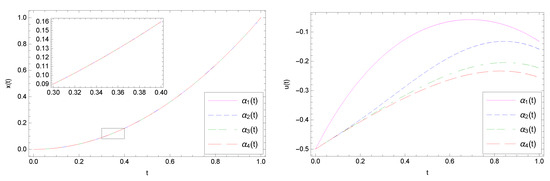
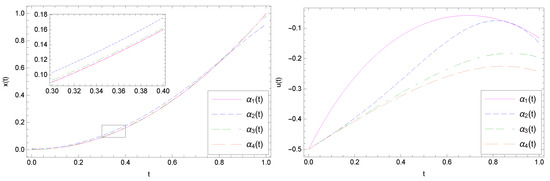
Since the optimal state function is a polynomial of degree 2, Approach I gives the exact solution with for every admissible . On the other hand, if , then . Therefore, according to the theoretical discussion and the error bound given by (35), the numerical solution given by Approach II converges to the exact solution, very slowly, that can be confirmed by the results reported in Table 1 obtained with and different values of M. Furthermore, by considering a different , and by applying the two proposed approaches with , the numerical results for the functions x and u are displayed in Figure 1 and Figure 2. Figure 1 displays the numerical results obtained by Approach I, while Figure 2 shows the numerical results given by Approach II. For these results, we have used
Table 1.
(Example 1.) Numerical results obtained by Approach II for the performance index with different M and .
Figure 1.
(Example 1.) Comparison between the approximate state (left) and control (right) functions obtained by Approach I with and different (40).
Figure 2.
(Example 1.) Comparison between the approximate state (left) and control (right) functions obtained by Approach II with and different (40).
Moreover, the numerical results for the performance index, obtained by our two approaches, are shown in Table 2. It can be easily seen that, in this case, Approach I gives higher accuracy results than Approach II. This is caused by the smoothness of the exact optimal state function x.
Table 2.
(Example 1.) Numerical results for the performance index with and different (40).
Example 2.
Consider now the following FOC-AP borrowed from [32]:
subject to
and the initial conditions . For this problem, the state and control functions
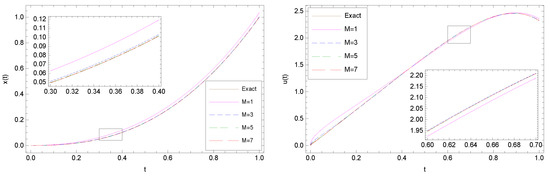
minimize the performance index with the optimal value . We have solved this problem by both approaches. The numerical results of applying Approach I to this problem, with different values of M, are presented in Figure 3 and Table 3. Figure 3 displays the approximate state (left) and control (right) functions obtained by , together with the exact ones, while Table 3 reports the approximate values of the performance index. Here, we show that Approach II gives the exact solution by considering . To do this, we suppose that
Figure 3.
(Example 2.) Comparison between the exact and approximate state (left) and control (right) functions obtained by Approach I with different values of M.
Table 3.
(Example 2.) Numerical results for the performance index obtained by Approach I with different M.
with
Therefore, we have
where
Using the dynamical control-affine system given by (42), we get
By substituting (43) and (44) into (41), the value of the integral can be easily computed. Then, by taking into account the optimality condition, a system of nonlinear algebraic equations is obtained. Finally, by solving this system, we obtain
By taking into account these values in (43) and (44), the exact optimal state and control functions are obtained. Lotfi et al. have solved this problem using an operational matrix technique based on the Legendre orthonormal functions combined with the Gauss quadrature rule. In their method, the approximate value of the minimum performance index with five basis functions has been reported as while our suggested Approach II gives the exact value only with two basis functions.
As we see, in this example, Approach II yields the exact solution with a small computational cost, while the precision of the results of Approach I increases by enlarging M. Note that here the optimal state function is not an infinitely smooth function.
Example 3.
As our last example, we consider the following FOC-AP [32]:
subject to
For this example, the following state and control functions minimize the performance index J with minimum value :
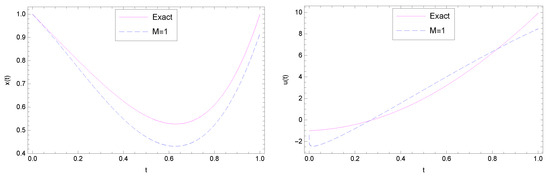
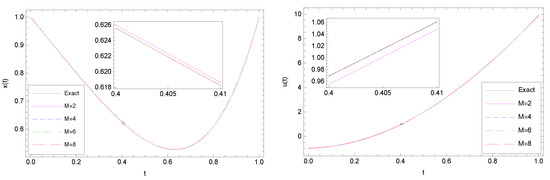
This problem has been solved using the proposed methods with different values of M. By considering , the numerical results of Approach I are shown in Figure 4. In this case, an approximation of the performance index is obtained as . By choosing , according to our numerical method, we have . Therefore, we set
Figure 4.
(Example 3.) Comparison between the exact and approximate state (left) and control (right) functions obtained by Approach I with .
where
Hence, using the initial conditions, the state function can be approximated by
where
In the continuation of the method, we find an approximation of the control function u using the control-affine dynamical system. Then, the method proceeds until solving the resulting system, which yields
These values give us the exact solution of the problem. This problem has been solved in [32] with five basis functions and the minimum value was obtained as while our suggested Approach I gives the exact value with only three basis functions.
In the implementation of Approach II, we consider different values of M and report the results in Table 4 and Figure 5. These results confirm that the numerical solutions converge to the exact one by increasing the value of M. Nevertheless, we see that since the exact state function x is a smooth function, it takes much less computational effort to solve this problem by using Approach I.
Table 4.
(Example 3.) Numerical results for the performance index obtained by Approach II with different M.
Figure 5.
(Example 3.) Comparison between the exact and approximate state (left) and control (right) functions obtained by Approach II with different values of M.
7. Conclusions
Two numerical approaches have been proposed for solving variable-order fractional optimal control-affine problems. They use an accurate operational matrix of variable-order fractional integration for Bernoulli polynomials, to give approximations of the optimal state and control functions. These approximations, along with the Gauss–Legendre quadrature formula, are used to reduce the original problem to a system of algebraic equations. An approximation of the optimal performance index and an error bound were given. Some examples have been solved to illustrate the accuracy and applicability of the new techniques. From the numerical results of Examples 1 and 3, it can be seen that our Approach I leads to very high accuracy results with a small number of basis functions for optimal control problems in which the state function that minimizes the performance index is an infinitely smooth function. Moreover, from the results of Example 2, we conclude that Approach II may give much more accurate results than Approach I in the cases that the smoothness of is more than .
Author Contributions
Conceptualization, S.N. and D.F.M.T.; investigation, S.N. and D.F.M.T.; software, S.N.; validation, D.F.M.T.; writing—original draft, S.N. and D.F.M.T.; writing—review and editing, S.N. and D.F.M.T. All authors have read and agreed to the published version of the manuscript.
Funding
Torres was funded by Fundação para a Ciência e a Tecnologia (FCT, the Portuguese Foundation for Science and Technology) through grant UIDB/04106/2020 (CIDMA).
Acknowledgments
This research was initiated during a visit of Nemati to the Department of Mathematics of the University of Aveiro (DMat-UA) and to the R&D unit CIDMA, Portugal. The hospitality of the host institution is here gratefully acknowledged. The authors are also grateful to three anonymous reviewers for several questions and comments, which helped them to improve the manuscript.
Conflicts of Interest
The authors declare no conflict of interest.
References
- Machado, J.T.; Kiryakova, V.; Mainardi, F. Recent history of fractional calculus. Commun. Nonlinear Sci. Numer. Simul. 2011, 16, 1140–1153. [Google Scholar] [CrossRef]
- Keshavarz, E.; Ordokhani, Y.; Razzaghi, M. A numerical solution for fractional optimal control problems via Bernoulli polynomials. J. Vib. Control 2016, 22, 3889–3903. [Google Scholar] [CrossRef]
- Bhrawy, A.H.; Tohidi, E.; Soleymani, F. A new Bernoulli matrix method for solving high-order linear and nonlinear Fredholm integro-differential equations with piecewise intervals. Appl. Math. Comput. 2012, 219, 482–497. [Google Scholar] [CrossRef]
- Tohidi, E.; Bhrawy, A.H.; Erfani, K. A collocation method based on Bernoulli operational matrix for numerical solution of generalized pantograph equation. Appl. Math. Model. 2013, 37, 4283–4294. [Google Scholar] [CrossRef]
- Toutounian, F.; Tohidi, E. A new Bernoulli matrix method for solving second order linear partial differential equations with the convergence analysis. Appl. Math. Comput. 2013, 223, 298–310. [Google Scholar] [CrossRef]
- Bazm, S. Bernoulli polynomials for the numerical solution of some classes of linear and nonlinear integral equations. J. Comput. Appl. Math. 2015, 275, 44–60. [Google Scholar] [CrossRef]
- Sahu, P.K.; Mallick, B. Approximate solution of fractional order Lane-Emden type differential equation by orthonormal Bernoulli’s polynomials. Int. J. Appl. Comput. Math. 2019, 5, 89. [Google Scholar] [CrossRef]
- Loh, J.R.; Phang, C. Numerical solution of Fredholm fractional integro-differential equation with right-sided Caputo’s derivative using Bernoulli polynomials operational matrix of fractional derivative. Mediterr. J. Math. 2019, 16, 28. [Google Scholar] [CrossRef]
- Rosa, S.; Torres, D.F.M. Optimal control of a fractional order epidemic model with application to human respiratory syncytial virus infection. Chaos Solitons Fractals 2018, 117, 142–149. [Google Scholar] [CrossRef]
- Malinowska, A.B.; Torres, D.F.M. Introduction to the Fractional Calculus of Variations; Imperial College Press: London, UK, 2012. [Google Scholar] [CrossRef]
- Malinowska, A.B.; Odzijewicz, T.; Torres, D.F.M. Advanced methods in the fractional calculus of variations. In Springer Briefs in Applied Sciences and Technology; Springer: Cham, Switzerland, 2015. [Google Scholar]
- Almeida, R.; Pooseh, S.; Torres, D.F.M. Computational Methods in the Fractional Calculus of Variations; Imperial College Press: London, UK, 2015. [Google Scholar] [CrossRef]
- Ali, M.S.; Shamsi, M.; Khosravian-Arab, H.; Torres, D.F.M.; Bozorgnia, F. A space-time pseudospectral discretization method for solving diffusion optimal control problems with two-sided fractional derivatives. J. Vib. Control 2019, 25, 1080–1095. [Google Scholar] [CrossRef]
- Nemati, S.; Lima, P.M.; Torres, D.F.M. A numerical approach for solving fractional optimal control problems using modified hat functions. Commun. Nonlinear Sci. Numer. Simul. 2019, 78, 104849. [Google Scholar] [CrossRef]
- Salati, A.B.; Shamsi, M.; Torres, D.F.M. Direct transcription methods based on fractional integral approximation formulas for solving nonlinear fractional optimal control problems. Commun. Nonlinear Sci. Numer. Simul. 2019, 67, 334–350. [Google Scholar] [CrossRef]
- Rabiei, K.; Ordokhani, Y.; Babolian, E. Numerical solution of 1D and 2D fractional optimal control of system via Bernoulli polynomials. Int. J. Appl. Comput. Math. 2018, 4, 7. [Google Scholar] [CrossRef]
- Behroozifar, M.; Habibi, N. A numerical approach for solving a class of fractional optimal control problems via operational matrix Bernoulli polynomials. J. Vib. Control 2018, 24, 2494–2511. [Google Scholar] [CrossRef]
- Rahimkhani, P.; Ordokhani, Y. Generalized fractional-order Bernoulli-Legendre functions: An effective tool for solving two-dimensional fractional optimal control problems. IMA J. Math. Control Inf. 2019, 36, 185–212. [Google Scholar] [CrossRef]
- Samko, S.G.; Ross, B. Integration and differentiation to a variable fractional order. Integral Transform. Spec. Funct. 1993, 1, 277–300. [Google Scholar] [CrossRef]
- Lorenzo, C.F.; Hartley, T.T. Variable order and distributed order fractional operators. Nonlinear Dyn. 2002, 29, 57–98. [Google Scholar] [CrossRef]
- Abdeljawad, T.; Mert, R.; Torres, D.F.M. Variable order Mittag-Leffler fractional operators on isolated time scales and application to the calculus of variations. In Fractional Derivatives with Mittag-Leffler Kernel; Springer: Cham, Switzerland, 2019; Volume 194, pp. 35–47. [Google Scholar]
- Hassani, H.; Naraghirad, E. A new computational method based on optimization scheme for solving variable-order time fractional Burgers’ equation. Math. Comput. Simul. 2019, 162, 1–17. [Google Scholar] [CrossRef]
- Odzijewicz, T.; Malinowska, A.B.; Torres, D.F.M. Fractional variational calculus of variable order. In Advances in Harmonic Analysis and Operator Theory; Birkhäuser/Springer Basel AG: Basel, Switzerland, 2013; Volume 229, pp. 291–301. [Google Scholar] [CrossRef]
- Yan, R.; Han, M.; Ma, Q.; Ding, X. A spectral collocation method for nonlinear fractional initial value problems with a variable-order fractional derivative. Comput. Appl. Math. 2019, 38, 66. [Google Scholar] [CrossRef]
- Almeida, R.; Tavares, D.; Torres, D.F.M. The variable-order fractional calculus of variations. In Springer Briefs in Applied Sciences and Technology; Springer: Cham, Switzerland, 2019. [Google Scholar] [CrossRef]
- Heydari, M.H.; Avazzadeh, Z. A new wavelet method for variable-order fractional optimal control problems. Asian J. Control 2018, 20, 1804–1817. [Google Scholar] [CrossRef]
- Mohammadi, F.; Hassani, H. Numerical solution of two-dimensional variable-order fractional optimal control problem by generalized polynomial basis. J. Optim. Theory Appl. 2019, 180, 536–555. [Google Scholar] [CrossRef]
- Costabile, F.; Dell’Accio, F.; Gualtieri, M.I. A new approach to Bernoulli polynomials. Rend. Mat. Appl. 2006, 26, 1–12. [Google Scholar]
- Arfken, G. Mathematical Methods for Physicists; Academic Press: New York, NY, USA; London, UK, 1966. [Google Scholar]
- Shen, J.; Tang, T.; Wang, L.L. Spectral Methods; Springer Series in Computational Mathematics; Springer: Heidelberg, Germany, 2011; Volume 41. [Google Scholar] [CrossRef]
- Canuto, C.; Hussaini, M.Y.; Quarteroni, A.; Zang, T.A. Spectral Methods. In Scientific Computation; Springer: Berlin, Germany, 2006. [Google Scholar]
- Lotfi, A.; Yousefi, S.A.; Dehghan, M. Numerical solution of a class of fractional optimal control problems via the Legendre orthonormal basis combined with the operational matrix and the Gauss quadrature rule. J. Comput. Appl. Math. 2013, 250, 143–160. [Google Scholar] [CrossRef]
© 2020 by the authors. Licensee MDPI, Basel, Switzerland. This article is an open access article distributed under the terms and conditions of the Creative Commons Attribution (CC BY) license (http://creativecommons.org/licenses/by/4.0/).