


Abstract
This paper mainly deals with introducing and studying the properties of generalized nabla differentiability for fuzzy functions on time scales via Hukuhara difference. Further, we obtain embedding results on for generalized nabla differentiable fuzzy functions. Finally, we prove a fundamental theorem of a nabla integral calculus for fuzzy functions on time scales under generalized nabla differentiability. The obtained results are illustrated with suitable examples.
1. Introduction
The theory of dynamic equations on time scales is a genuinely new subject and the research related to this area is developing rapidly. Time scale theory has been developed to unify continuous and discrete structures, and it allows solutions for both differential and difference equations at a time and extends those results to dynamic equations. Basic results in time scales and dynamic equations on time scales are found in [1,2,3,4,5,6]. In [7], the author illustrated an example where delta derivative needs more assumptions than nabla derivative. Some recent studies in economics [8], production, inventory models [9], adaptive control [10], neural networks [11], and neural cellular networks [12] suggest nabla derivative is also preferable and it has fewer restrictions than delta derivative on time scales.
On the other hand, when we expect to investigate a real world phenomenon absolutely, it is important to think about a number of unsure factors too. To specify these vague or imprecise notions, Zadeh [13] established fuzzy set theory. The theory of fuzzy differential equations (FDEs) and its applications was developed and studied by Kaleva [14], Lakshmikantham and Mohapatra [15]. The concept based on Hukuhara differentiability has a shortcoming that the solution to a FDEs exists only for increasing length of support. To overcome this shortcoming, Bede and Gal [16] studied generalized Hukuhara differentiability for fuzzy functions. In light of this preferred advantage, many authors [17,18,19] tend their enthusiasm to the generalized Hukuhara differentiability for fuzzy set valued functions.
The calculus of fuzzy functions on time scales was studied by Fard and Bidgoli [20]. Vasavi et al. [21,22,23,24] introduced Hukuhara delta derivative, second-type Hukuhara delta derivative, and generalized Hukuhara delta derivatives by using Hukuhara difference, and they studied fuzzy dynamic equations on time scales. Wang et al. [25] introduced and studied almost periodic fuzzy vector-valued functions on time scales. Deng et al. [26] studied fractional nabla-Hukuhara derivative on time scales. Recently, Leelavathi et al. [27] introduced and studied properties of nabla Hukuhara derivative for fuzzy functions on time scales. However, this derivative has the disadvantage that it exists only for the fuzzy functions on time scales which have a diameter with an increasing length. For the fuzzy functions with decreasing length of diameter on time scales, Leelavathi et al. [28] introduced the second-type nabla Hukuhara derivative and studied its properties. Later, they continued to study fuzzy nabla dynamic equations under the first and second-type nabla Hukuhara derivatives in [29] under generalized differentiability by using generalized Hukuhara difference in [30]. Consider a simple fuzzy function , , where is a triangular fuzzy number. Clearly, has decreasing length of diameter in and increasing length of diameter in . Therefore, the fuzzy function is neither a nabla Hukuhara differentiable (as defined in [27]) nor a second-type nabla Hukuhara differentiable (as defined in [28]) on . In this context, it is required to define a nabla Hukuhara derivative for a fuzzy function which may have both increasing and decreasing length of diameter on a time scale. To address this issue, in the present work, we define a new derivative called generalized nabla derivative for fuzzy functions on time scales via Hukuhara difference and study their properties. In [31], the authors introduced a nabla integral for fuzzy functions on time scales and obtained fundamental properties. In the present work, we continue to study nabla integral for fuzzy functions on time scales and prove a fundamental theorem of nabla integral calculus for generalized nabla differentiable functions.
The rest of this paper is arranged as follows. In Section 2, we present some basic definitions, properties, and results relating to the calculus of fuzzy functions on time scales. In Section 3, we establish the nabla Hukuhara generalized derivative for fuzzy functions on time scales and obtain its fundamental properties. The results are highlighted with suitable examples. In Section 4, we prove an embedding theorem on and obtain the results connecting to generalized nabla differentiability on time scales. Using these results, we finally prove the fundamental theorem of nabla integral calculus for fuzzy functions on time scales under generalized nabla differentiability and a numerical example is provided to verify the validity of the theorem.
2. Preliminaries
Let be the family of all nonempty convex compact subsets of . Define the set addition and scalar multiplication in as usual. Then, by [14], is a commutative semi-group under addition with cancellation laws. Further, if and , then
Let P and Q be two bounded nonempty subsets of . By using the Pampeiu–Hausdorff metric, we define the distance between P and Q as follows:
where is the Euclidean norm in . Then, becomes a separable and complete metric space [14].
Define:
- (a)
- If there exists a such that , then u is said to be normal.
- (b)
- u is fuzzy convex.
- (c)
- u is upper semi-continuous.
- (d)
- The closure of = is compact.
For , denote ; then, from the above conditions, we have that the -level set . By Zadeh’s extension principle, a mapping can br extended to by
We have , for all and h is continuous. The scalar multiplication ⊙ and addition ⊕ of is defined as , where
Define by the equation
where is the Pampeiu–Hausdorff metric defined in . Then, is a complete metric space [14]. The following theorem extends the properties of addition and scalar multiplication of fuzzy number valued functions () to [14].
The properties of addition and scalar multiplication of fuzzy number valued functions () are easily extended to .
Theorem 1
([32]).
- (a)
- If we denote , then is the zero element with respect to ⊕, i.e., .
- (b)
- For any has no inverse with respect to .
- (c)
- For any with or and , .
- (d)
- For any and , we have .
- (e)
- For any and , we have .
Definition 1
([14]). Let . If there exists such that , then we say that M is the Hukuhara difference of K and L and is denoted by .
For any and , the following hold:
- (a)
- ;
- (b)
- ;
- (c)
- ;
- (d)
- ;
- (e)
- ; and
- (f)
- .
provided the Hukuhara differences exists.
A triangular fuzzy number is denoted by three points as . This representation is denoted as membership function
In addition, -level sets of triangular fuzzy number t is an interval defined by -cut operation, , for all . Clearly, the triangular fuzzy number is in .
Let , be two triangular fuzzy numbers in . The addition and scalar multiplication are defined as:
Remark 1.
From Theorem 1(c), we can deduce that, for any and .
- (a)
- If , then exists and .
- (b)
- If , then exists and .
Proof.
- (a)
- Since and , from Theorem 1(c), we get Therefore, . Hence, .
- (b)
- Since and , from Theorem 1(c), it is easily proven that
□
Now, we discuss the differentiability and integrability of fuzzy functions on (where I is a compact interval).
Definition 2
([14]). A mapping is said to be strongly measurable if, for each , the fuzzy function defined by is measurable.
Remark 2
([14]). A mapping is said to be integrably bounded if there exists an integrable function h such that , for all .
Definition 3
([14]). Let . The integral of Φ over I is denoted by or ,
where g is a level wise selection of measurable functions of for .
A mapping is said to be integrable over I if is integrably bounded and strongly measurable function and also .
Theorem 2
([14]). Let be integrable. Then,
- (a)
- ;
- (b)
- , where ;
- (c)
- , where ;
- (d)
- is integrable; and
- (e)
- .
Definition 4
([18]). A fuzzy function is said to be differentiable from left at if for , there exists , such that the following holds:
- (a)
- for , exist and
- (b)
- for , exist and .
Here, P is the derivative of Φ from left at and is denoted as .
Definition 5
([18]). A fuzzy function is said to be differentiable from right at if, for , there exists , such that the following holds:
- (a)
- for , exist and
- (b)
- for , exist and
Here, P is the derivative ofΦ from right at and is denoted as . The limits are taken over .
Definition 6
([18]). If Φ is both left-differentiable and right-differentiable at , then Φ is said to be differentiable at and . Here, P is called the derivative of Φ at and we consider one-sided derivative at the end points of I.
Remark 3
([18]). If Φ is differentiable at , then there exists a , such that:
- (a)
- For , or exists.
- (b)
- For , or exists.
3. Generalized Nabla Hukuhara Differentiability on Time Scales
This section is concerned with defining and studying the properties of derivative for fuzzy functions on time scales. In addition, we illustrate the results with suitable examples.
Definition 7
([21]). For any given , there exists a , such that the fuzzy function has a unique -limit at if , for all and it is denoted by .
Here, -limit denotes the limit on time scale in the metric space .
Remark 4.
From the above definition, we have
where the zero element in is given by .
Definition 8.
A fuzzy mapping is continuous at , if exists and , i.e.,
Remark 5.
If is continuous at , then, for every , there exists a , such that
Remark 6.
Let and .
- (a)
- If , then Φ is said to be right continuous at .
- (b)
- If , then Φ is said to be left continuous at .
- (c)
- If , then Φ is continuous at .
Definition 9.
A fuzzy function is said to be left-differentiable at s , if there exists an element with the property that, for any given , there exists a of s for some and ,
or
for all , where , is the generalized nabla left-derivative of Φ at s.
Definition 10.
A fuzzy function is said to be right-differentiable at , if there exists an element with the property that, for every given , there exists a neighborhood of s for some and ,
or
for all , where , is the generalized nabla right-derivative of Φ at s.
Definition 11.
A fuzzy function is said to be differentiable at , if Φ is both right- and left-differentiable at and
Here, or is called -derivative of Φ at and it is denoted by . Moreover, if derivative exists at each , then Φ is differentiable on .
Theorem 3.
Let be a fuzzy function and , then:
- (a)
- If is differentiable at s, then Φ is continuous at .
- (b)
- If s is left dense and is differentiable at s iff the limitsexist as a finite number and holds any one of the following:
- (i)
- (ii)
- (iii)
- (iv)
Proof.
(a) Suppose that is differentiable at s. Let . Choose , where . Clearly, . Since is left-differentiable, there exists a neighborhood of s such that, for all with
or
For and for all , to each , we have,
Similarly, we can prove is continuous at s, if is right-differentiable at s.
(b) Suppose that is differentiable at s and s is left dense. To each , there exists a neighborhood of s such that
or
and
or
for all . Since s is left dense, we have
or
or
for . Since is arbitrary, we get any one of (i)–(iv). □
The converse proposition of Theorem 3(a) may not be true. That is a fuzzy function which is continuous may not be differentiable.
Example 1.
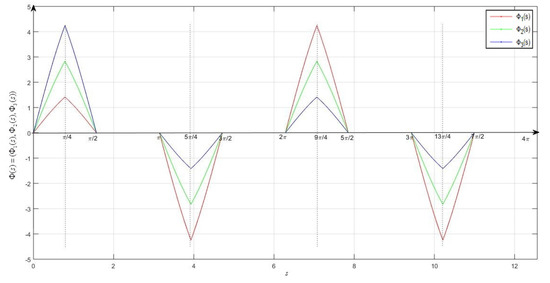
Let be a fuzzy function defined as follows:
where , and is a triangular fuzzy number. Since
and
In addition, . Then, from Remark 6(c), Φ is continuous at (See Figure 1). Since is dense, , for h sufficiently small, and, from Remark 1(a), we have
Figure 1.
Graphical Representation of in Example 1.
In a similarly way,
Therefore, . Hence, Φ is not differentiable at .
Definition 11 can equivalently be written as follows:
Remark 7.
If is differentiable at if and only if there exists an element , such that any one of the following holds:
- (GH1)
- for , provided the Hukuhara difference , and the limits existor
- (GH2)
- for , provided the Hukuhara difference , and the limits existor
- (GH3)
- for , provided the Hukuhara difference , and the limits existor
- (GH4)
- for , provided the Hukuhara difference , and the limits exist
Thus, is called the derivative of Φ on .
Remark 8.
Let be differentiable.
- (a)
- If Φ is -nabla differentiable at , then there exists a , such that, for , we haveThus, if Φ is -nabla differentiable on , then is non-decreasing on .
- (b)
- If Φ is -nabla differentiable at , then there exists a , such that, for , we haveThus, if Φ is -nabla differentiable on , then is non-increasing on .
- (c)
- If Φ is -nabla differentiable at , then there exists a , such that, for , we haveTherefore, is non-decreasing in the left neighborhood and non-increasing in the right neighborhood of s. Thus, monotonicity of fails at s.
- (d)
- If Φ is -nabla differentiable at , then there exists a such that, for ,Therefore, is non-increasing in the left neighborhood and non-decreasing in the right neighborhood of s. Thus, monotonicity of fails at s.
Example 2.
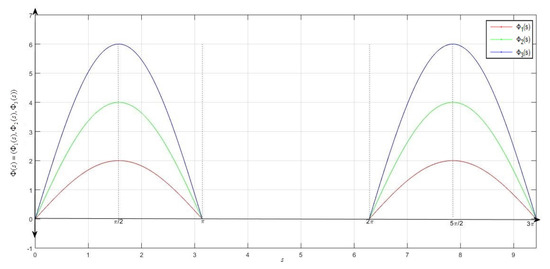
Let be a fuzzy function defined as , where is a triangular fuzzy number. Let .
In Figure 2, it is easily seen that is -nabla differentiable on , is -nabla differentiable on . Now, we check the differentiability at . Since is dense, . In addition, , and, from Remark 1(a), we have . Consider
Figure 2.
Graphical Representation of in Example 2.
In a similar way, we get . Hence, Φ is -nabla differentiable at . Similarly, we can show that Φ is also -nabla differentiable at .
Theorem 4.
If is continuous at s and s is left scattered, then:
- (a)
- Φis differentiable at s as in or withand (or)
- (b)
- Φis differentiable at s as in with
- (c)
- Φis differentiable at s as in with
Proof.
Suppose and is continuous at left scattered point s. Then, from or , we have
Since the Hukuhara differences exists, then
where are in . By adding the above equations, we get . Then, or are in and hence the result is obvious.
Suppose and is continuous at left scattered point s. Then, from (GH3), we have
Hence, .
Suppose and is continuous at left scattered point s. Then, from (GH4), we have
Hence, □
Remark 9.
A fuzzy function is defined as , where , are nabla differentiable such that , for all .
- (a)
- If Φ is differentiable as in at ld-point s or differentiable as at left scattered point s, then , for .
- (b)
- If Φ is differentiable as at ld-point s or differentiable as at left scattered point s, then , for .
Theorem 5.
Let be differentiable at .
- (1)
- If Φ and Ψ are both differentiable of same kind, then:
- (a)
- is also differentiable of same kind at s with
- (b)
- also differentiable of same kind at s, provided exists and
- (2)
- If Φ and Ψ are different kinds of differentiable at s, and exists for , then is differentiable at s with .
Proof.
If s is ld-point, then . The proof of this theorem is similar to the proof of Lemma 4 and Theorem 4 in [17].
Suppose that and are both -nabla differentiable at left scattered point . Then, exists with and exists with . Now,
Multiplying the above equation with , we get
and it follows that
Hence, is differentiable as in with
The case when and are differentiable as in is similar to the previous one.
Suppose and are both -nabla differentiable at left scattered points , similar to 1(a), we have and . Consider
It implies that
Multiplying the above equation with , we get the desired result. In a similar way, we can easily prove the other case.
Suppose that is differentiable as in and is differentiable as in at left scattered points , then the Hukuhara difference exists with and exists with . Now, by adding these equations, we get
Since the Hukuhara difference of and exist, we have
Now, by multiplying (5) with , we get is -nabla differentiable.
In a similar way, if is differentiable as in and is differentiable as in at left scattered points , then we can easily prove that
Now, by multiplying (6) with , we get is -nabla differentiable. Therefore,
□
The following example illustrates the feasibility of Theorem 5.
Example 3.
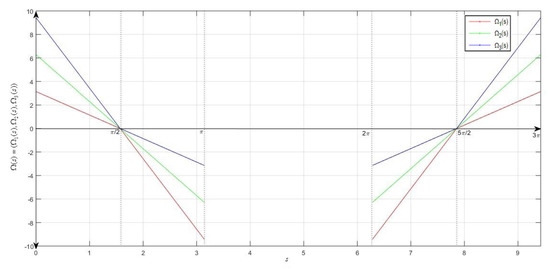
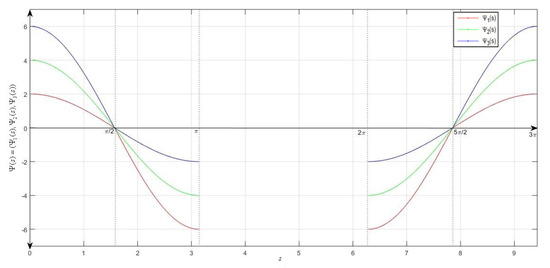
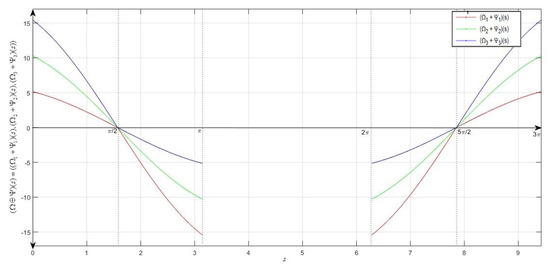
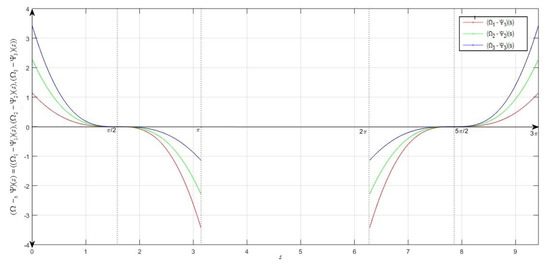
Let be fuzzy functions defined as follows:
and
where , is a triangular fuzzy number.
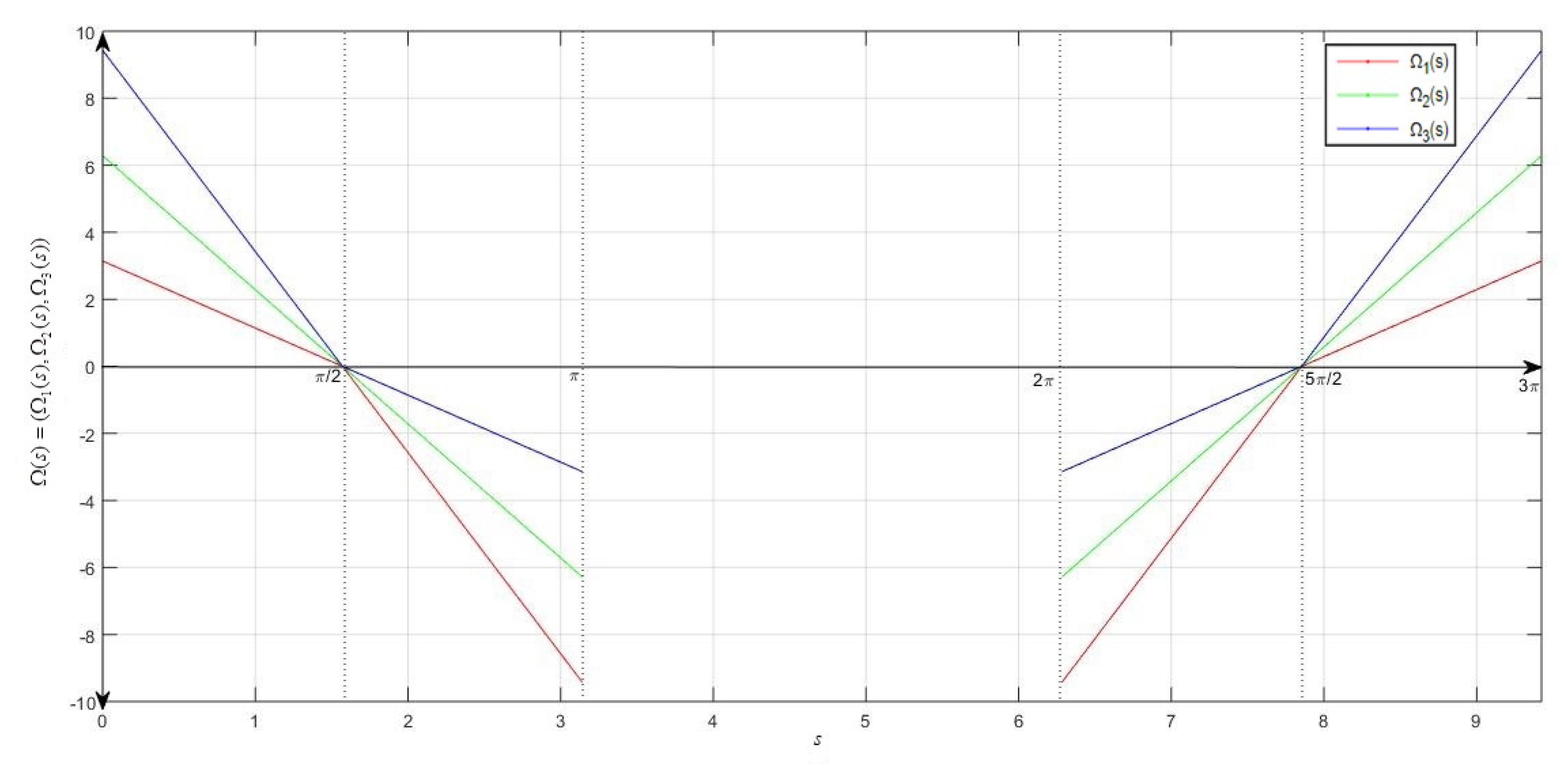
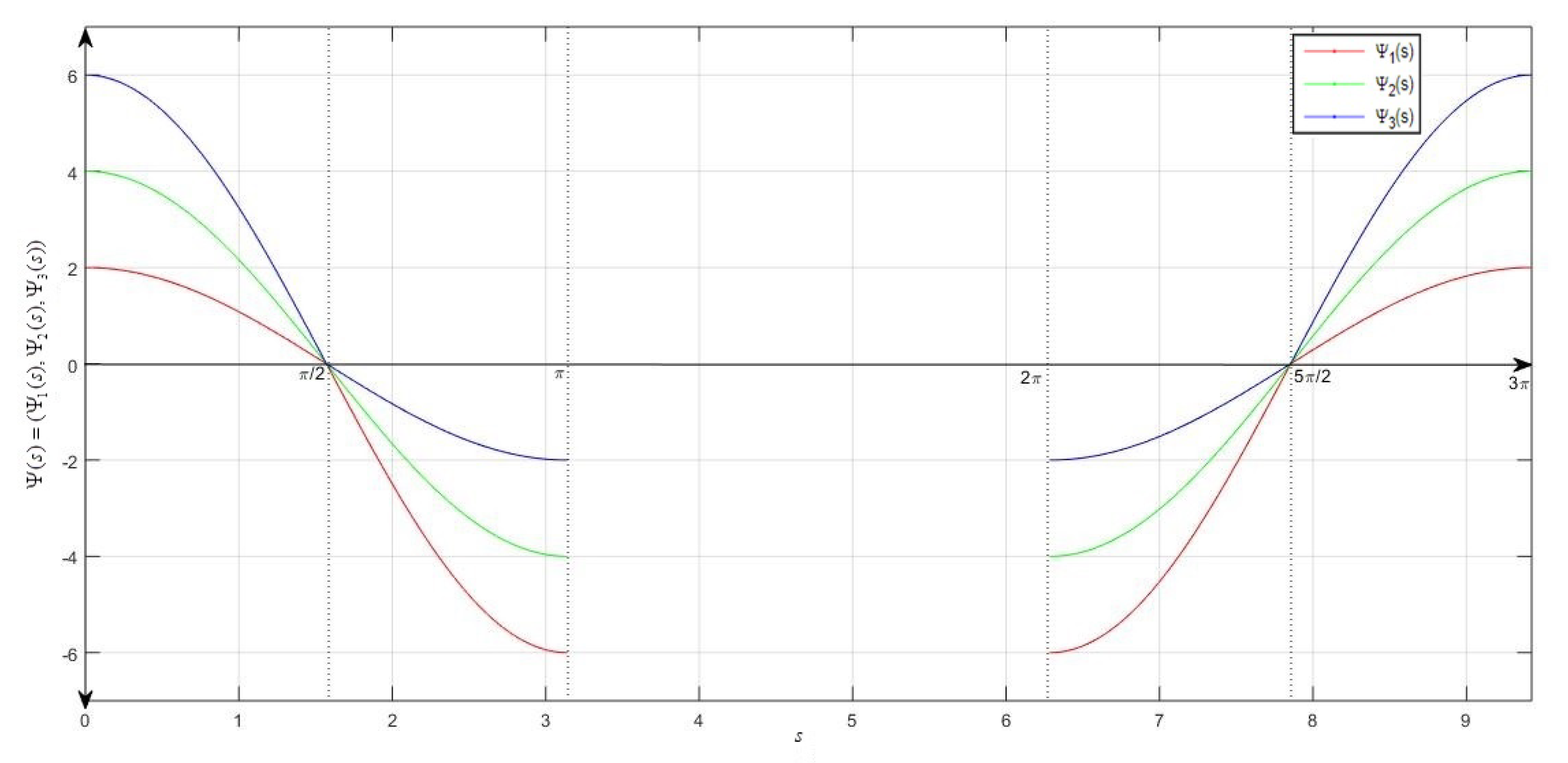
IN Figure 3 and Figure 4, it is easily seen that Ω and Ψ are -nabla differentiable on , -nabla differentiable on , and -nabla differentiable at . Thus, , are differentiable at left scattered point . Now, from Remark 1, we have
and
Figure 3.
Graphical Representation of in Example 3.
Figure 4.
Graphical Representation of in Example 3.
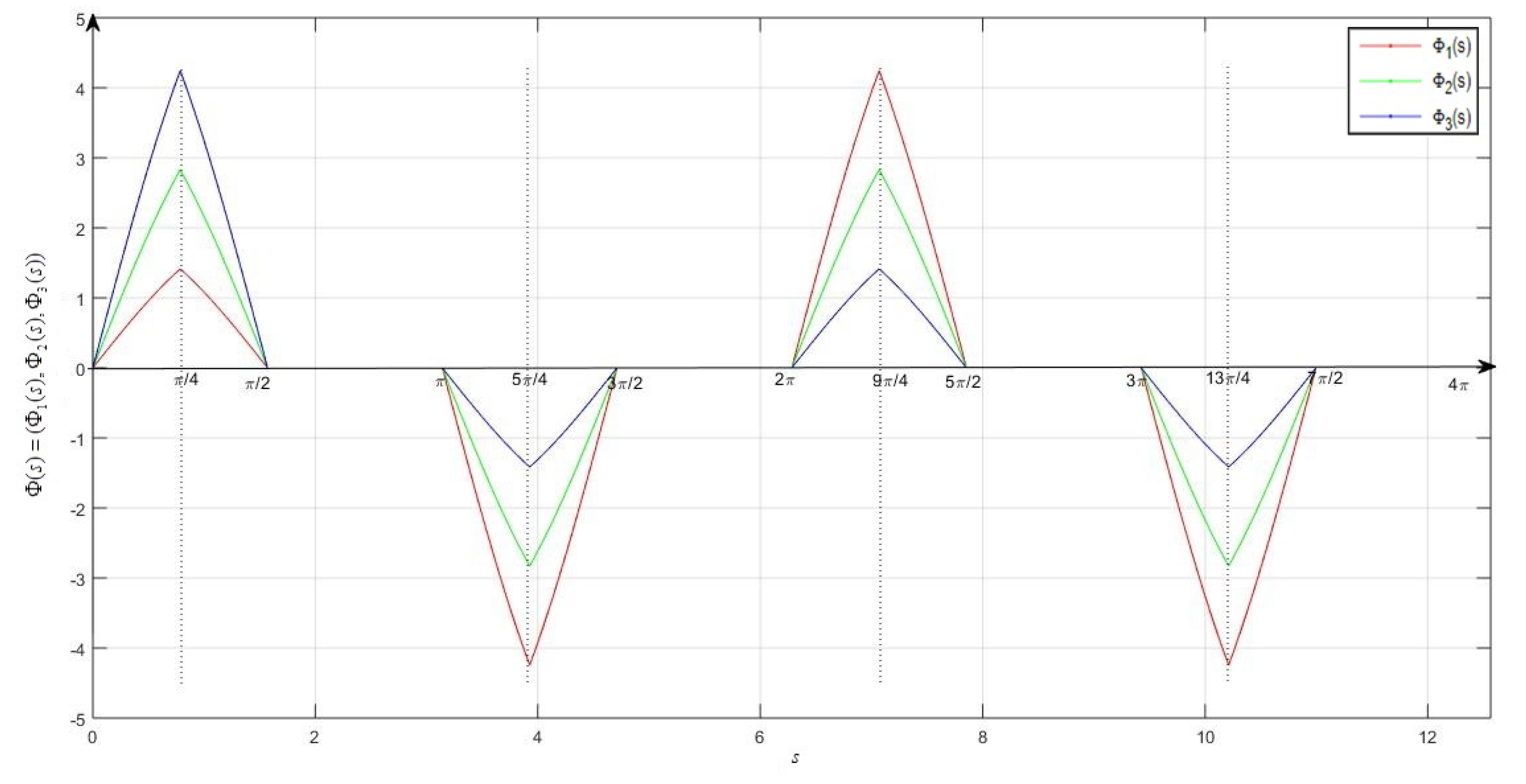
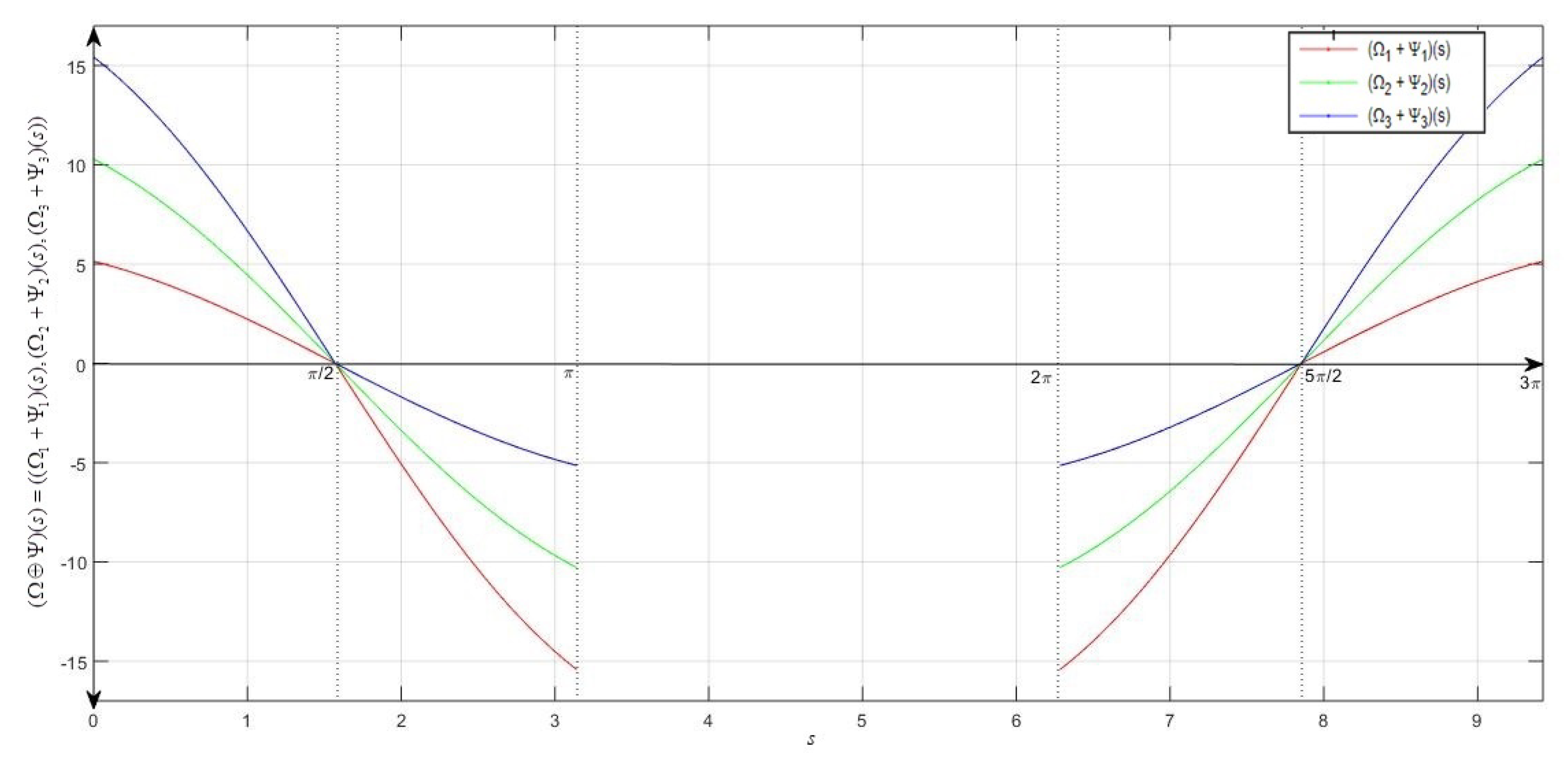
In Figure 5, is -nabla differentiable on , -nabla differentiable on . At , Ω and Ψ are -nabla differentiable with , and . Now,
Figure 5.
Graphical Representation of in Example 3.
Similarly, we can show that . Thus, is -nabla differentiable at and Theorem 5 1(a) is verified.
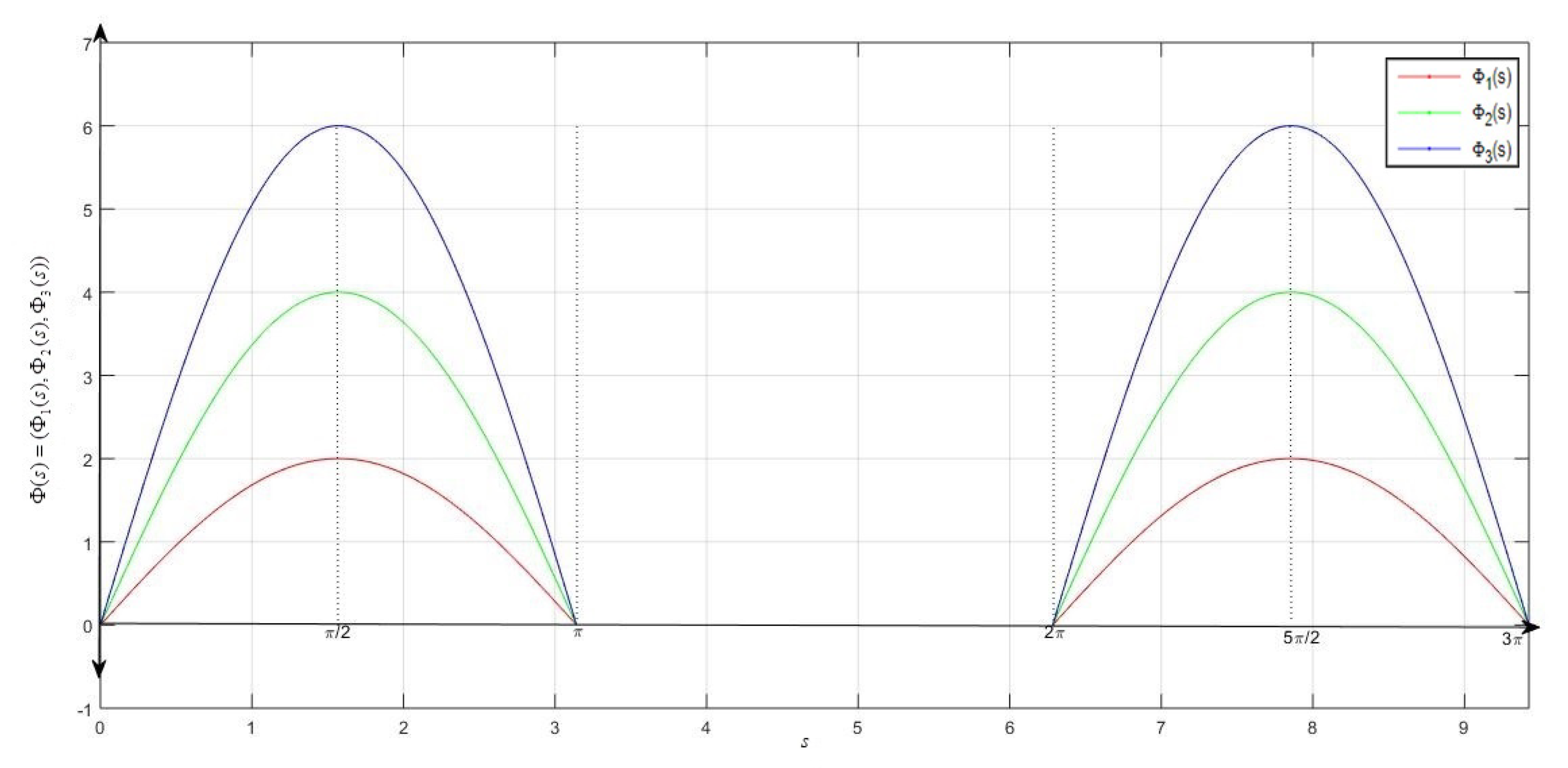
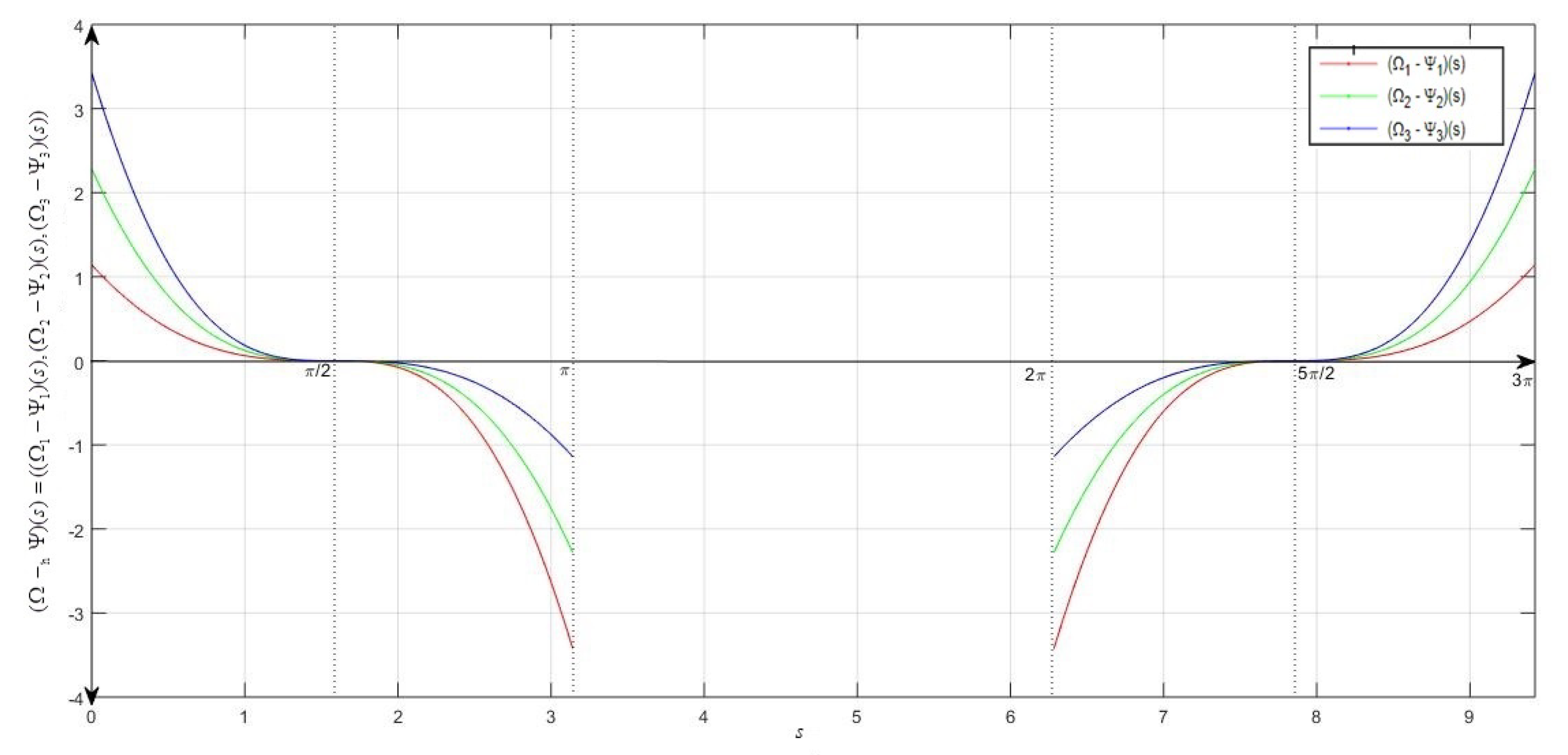
In Figure 6, it is easily seen that is -nabla differentiable on and -nabla differentiable on . Again, from Remark 1, we have
Figure 6.
Graphical Representation of in Example 3.
Similarly, we can show that . Thus, is -nabla differentiable at and Theorem 5 1(b) is verified.
Consider as in Example 2, Φ is -nabla differentiability at and Ψ is -nabla differentiability at . Hence, Φ and Ψ are different kinds of differentiable at , and exists at . Now, from Theorem 5(2), we have
Similarly, we can show that . Hence, Theorem 5(2) is verified.
Now, we check the -differentiable at . It is left scattered and , . Clearly, Ω, Φ, and Ψ are - and -nabla differentiable at . We get , and . In addition, the results of Theorem 5 hold at left scattered point .
4. Integration of Fuzzy Functions on Time Scales
In this section, we prove fundamental theorem of nabla integral calculus for fuzzy functions on time scales under generalized fuzzy nabla differentiable functions on time scales.
First, we prove an embedding theorem on and obtain some results which are useful to prove the main theorem. To prove the these results, we make use of Definitions 1–3 and Theorem 4 in [31].
Let be the set of all functions , is bounded on , left-continuous for each , right-continuous on 0, and has right limit for each . Endowed with the norm , is a Banach space. It is known that the following result which embeds into isometrically and isomorphically.
Theorem 6.
If we define by , where , , then is a closed convex cone with vertex 0 in X (here X is a Banach space with the norm ).
Proof.
First, we show that is a Banach space. Consider a cauchy sequence and for , there exists , such that implies , that is
which yields the result that and as where , is a Banach space. Hence, is a Banach space. To obtain i embeds into isometrically and isomorphically, we need to prove the following:
- (a)
- , for any and ; and
- (b)
- .
Let . The -level set of can be written as
Now,
Therefore,
Thus, (a) is proved.
Now, consider
□
We make use the Proposition 3.1 and Remark 3.4 in [18] to prove the following results.
Theorem 7.
Suppose is left-differentiable at ; then, is nabla-differentiable at . Moreover,
- (a)
- If there exists a exists for , then
- (b)
- If there exists a exists for , then .
Proof.
Let be left-differentiable at .
(a) If there exists a such that exists for , then
From Remark 3.4.1 in [18], we have
Consider
we have
Thus, .
Similarly, we can prove (b). □
Theorem 8.
Suppose is right-differentiable ; then, is nabla-differentiable at . Moreover,
- (a)
- If there exists a exists for , then
- (b)
- If there exists a exists for , then
Proof.
The proof of this theorem is similar to that of Theorem 7. □
Theorem 9.
If is differentiable at s, then is nabla-differentiable and . In this case, either or
Proof.
Let be differentiable at and s is left dense; then, the proof is similar to the proof of Theorem 8 [16]. Now, for s being left scattered, we have
Consider
Then, .
Again, in the same way,
However,
Since , we have
Thus, Therefore, . Finally, .
From Remark 8, it is clear that, the fuzzy function is - or -nabla differentiable at discrete points. For example, if is -differentiable on , and is only -nabla differentiable at , -nabla differentiable at , then is -nabla differentiable on and -nabla differentiable on . Therefore, if is -differentiable on , then it is possible to partition the into sub-intervals such that in each sub-interval is either - or -nabla differentiable.
Now, we prove the main theorem of this section fundamental theorem of nabla integral calculus of fuzzy functions on time scales. □
Theorem 10.
Let and be a division of the interval such that Φ is or -nabla differentiable on each of the interval with same kind of differentiability on each sub-interval. Then,
where such that Φ is -nabla differentiable on and such that Φ is -nabla differentiable on
Proof.
Let is differentiable on . Suppose is -nabla differentiable on . Then, for , we have
Let ; using Cauchy formula for functions with values in Banach space, we have
By Theorem 9, there exists and we get .
Since the embedding i commutes with the integral, we obtain
Then, it follows that
By the definition of , we obtain
By the additive property of the embedding i, we have
Example 4.
Consider as in Example 2. We partition as such that is -nabla differentiable on , and -nabla differentiable on , . Thus, from Theorem 10, we have
5. Conclusions
This paper is concerned with investigating a new derivative called generalized nabla derivative for fuzzy functions on time scales and studies some basic properties of derivative. In addition, we prove a fundamental theorem of nabla integral calculus for fuzzy functions on time scales under generalized differentiability on time scales. The advantage of derivative is that it is exists even for a fuzzy function having increasing and decreasing length of diameter on a time scale. The results obtained in this paper include results of Leelavathi et al. [27], when the function having only increasing length of diameter, and the results of Leelavathi et al. [28], when the function having only decreasing length of diameter. The obtained results are illustrated with numerical examples. In the future, we propose to study fuzzy nabla dynamic equations on time scales under generalized nabla derivative and their applications.
Author Contributions
All authors contributed equally and significantly to writing this article. All authors have read and agreed to the published version of the manuscript.
Funding
This research received no external funding.
Conflicts of Interest
The authors declare no conflict of interest.
References
- Agarwal, R.P.; Bohner, M. Basic calculus on time scales and some of its applications. Results Math. 1999, 35, 3–22. [Google Scholar] [CrossRef]
- Bohner, M.; Peterson, A. Dynamic Equations on Time Scales: An Introduction with Applications; Birkhauser: Boston, MA, USA, 2001. [Google Scholar]
- Bohner, M.; Peterson, A. Advances in Dynamic Equations on Time Scales; Birkhauser: Boston, MA, USA, 2003. [Google Scholar]
- Guseinov, G.S. Integration on time scales. J. Math. Anal. Appl. 2003, 285, 107–127. [Google Scholar] [CrossRef]
- Hilger, S. Ein Makettenkalkuls mit Anwendung auf Zentrumsmannigfaltigkeiten. Ph.D. Thesis, Universitat Wurzburg, Würzburg, Germany, 1988. [Google Scholar]
- Hilger, S. Analysis on measure chains—A unified approach to continuous and discrete calculus. Results Math. 1990, 18, 18–56. [Google Scholar] [CrossRef]
- Atici, F.M.; Biles, D.C. First order dynamic inclusions on time scales. J. Math. Anal. Appl. 2004, 292, 222–237. [Google Scholar] [CrossRef]
- Atici, F.M.; Daniel, C.B.; Alex, L. An application of time scales to economics. Math. Comput. Model. 2006, 43, 718–726. [Google Scholar] [CrossRef]
- Atici, F.M.; Usynal, F. A production-inventory model of HMMS model on time scales. Appl. Math. Lett. 2008, 21, 236–243. [Google Scholar] [CrossRef]
- Jackson, B.J. Adaptive control in the nabla setting. Neural Parallel Sci. Comput. 2008, 16, 253–272. [Google Scholar]
- Liu, B.; Do, Y.; Batarfi, H.A.; Alsaadi, F.E. Almost periodic solution for a neutral-type neural networks with distributed leakage delays on time scales. Neuro Comput. 2016, 173, 921–929. [Google Scholar]
- Gao, J.; Wang, Q.R.; Zhang, L.W. Existence and stability of almost-periodic solutions for cellular neural networks with time-varying delays in leakage terms on time scales. Appl. Math. Comput. 2015, 237, 639–649. [Google Scholar] [CrossRef]
- Zadeh, L.A. Fuzzy sets. Inf. Control. 1965, 8, 338–353. [Google Scholar] [CrossRef]
- Kaleva, O. Fuzzy differential equations. Fuzzy Sets Syst. 1987, 24, 301–317. [Google Scholar] [CrossRef]
- Lakshmikantham, V.; Mohapatra, R.N. Theory of Fuzzy Differential Equations and Inclusions; Taylor and Francis: Abingdon, UK, 2003. [Google Scholar]
- Bede, B.; Gal, S.G. Generalizations of the differentiability of fuzzy-number-valued functions with application to fuzzy differential equations. Fuzzy Sets Syst. 2005, 151, 581–599. [Google Scholar] [CrossRef]
- Bede, B.; Rudas, I.J.; Bencsik, A.L. First order linear fuzzy differential equations under generalized differentiability. Inf. Sci. 2007, 177, 1648–1662. [Google Scholar] [CrossRef]
- Li, J.; Zhao, A.; Yan, J. Cauchy problem of fuzzy differential equations under generalized differentiability. Fuzzy Sets Syst. 2012, 200, 1–24. [Google Scholar] [CrossRef]
- Stefanini, L.; Bede, B. Generalized Hukuhara differentiability of interval-valued functions and interval differential equations. Nonlinear Anal. 2009, 71, 1311–1328. [Google Scholar] [CrossRef]
- Fard, O.S.; Bidgoli, T.A. Calculus of fuzzy functions on time scales(I). Soft Comput. 2015, 19, 293–305. [Google Scholar] [CrossRef]
- Vasavi, C.; Suresh Kumar, G.; Murty, M.S.N. Fuzzy Hukahara delta differential and applications to fuzzy dynamic equations on time scales. J. Uncertain Syst. 2016, 10, 163–180. [Google Scholar]
- Vasavi, C.; Suresh Kumar, G.; Murty, M.S.N. Fuzzy dynamic equations on time scales under second type Hukuhara delta derivative. Int. J. Chem. Sci. 2016, 14, 49–66. [Google Scholar]
- Vasavi, C.; Suresh Kumar, G.; Murty, M.S.N. Generalized differentiability and integrability for fuzzy set-valued functions on time scales. Soft Comput. 2016, 20, 1093–1104. [Google Scholar] [CrossRef]
- Vasavi, C.; Suresh Kumar, G.; Murty, M.S.N. Fuzzy dynamic equations on time scales under generalized delta derivative via contractive-like mapping principles. Indian J. Sci. Technol. 2016, 9, 1–6. [Google Scholar] [CrossRef][Green Version]
- Wang, C.; Agarwal, R.P.; O’Regan, D. Calculus of fuzzy vector-valued functions and almost periodic fuzzy vector-valued functions on time scales. Fuzzy Sets Syst. 2019, 375, 1–52. [Google Scholar] [CrossRef]
- Deng, J.; Xu, C.; Sun, L.; Cao, N.; You, X. On conformable fractional nabla-Hukuhara derivative on time scales. In Proceedings of the International Conference on Fuzzy Theory and Its Applications (iFUZZY), Yilan, Taiwan, 13–16 November 2017. [Google Scholar] [CrossRef]
- Leelavathi, R.; Suresh Kumar, G.; Murty, M.S.N. Nabla Hukuhara differentiability for fuzzy functions on time scales. IAENG Int. J. Appl. Math. 2018, 49, 114–121. [Google Scholar]
- Leelavathi, R.; Suresh Kumar, G.; Murty, M.S.N. Second type nabla Hukuhara differentiability for fuzzy functions on time scales. Ital. J. Pure Appl. Math. 2020, 43, 779–801. [Google Scholar]
- Leelavathi, R.; Suresh Kumar, G.; Murty, M.S.N.; Srinivasa Rao, R.V.N. Existence-uniqueness of solutions for fuzzy nabla initial value problems on time scales. Adv. Differ. Equ. 2019, 2019, 269. [Google Scholar] [CrossRef]
- Leelavathi, R.; Suresh Kumar, G.; Murty, M.S.N. Charaterization theorem for for fuzzy functions on time scales under generalized nabla Hukuhara difference. Int. J. Innov. Technol. Explor. Eng. 2019, 8, 1704–1706. [Google Scholar]
- Leelavathi, R.; Suresh Kumar, G.; Murty, M.S.N. Nabla Integral for Fuzzy Functions on Time Scales. Int. J. Appl. Math. 2018, 31, 669–678. [Google Scholar] [CrossRef][Green Version]
- Anastassiou, G.A.; Gal, S.G. On a fuzzy trigonometric approximation theorem of Weierstrass-type. J. Fuzzy Math. 2001, 9, 701–708. [Google Scholar]
© 2020 by the authors. Licensee MDPI, Basel, Switzerland. This article is an open access article distributed under the terms and conditions of the Creative Commons Attribution (CC BY) license (http://creativecommons.org/licenses/by/4.0/).