


Abstract
Various types of topological and closure operators are significantly used in fuzzy theory and applications. Although they are different operators, in some cases it is possible to transform an operator of one type into another. This in turn makes it possible to transform results relating to an operator of one type into results relating to another operator. In the paper relationships among 15 categories of modifications of topological L-valued operators, including Čech closure or interior L-valued operators, L-fuzzy pretopological and L-fuzzy co-pretopological operators, L-valued fuzzy relations, upper and lower F-transforms and spaces with fuzzy partitions are investigated. The common feature of these categories is that their morphisms are various L-fuzzy relations and not only maps. We prove the existence of 23 functors among these categories, which represent transformation processes of one operator into another operator, and we show how these transformation processes can be mutually combined.
1. Introduction
In fuzzy set theory many structures are used, which are based on various modifications of topological operators. These structures include variants of fuzzy topological spaces, fuzzy rough sets, fuzzy approximation spaces, fuzzy closure operators, fuzzy pretopological operators and their dual terms, such as fuzzy interior operators. For examples of these structures see, e.g., [1,2,3,4,5,6,7,8]. Although these structures are generally based on the common basis of different topological spaces and their modifications, the tools and language they use are often very different and it is difficult to identify deeper relationships between the different types of these structures.
One way to effectively identify and describe the relationships among these objects is to use category theory methods. Description of transformation processes between objects of one type using the category theory language ensure morphisms and functors. The significance of morphisms and functors in categories is that morphisms between objects and functors between categories actually represent the processes of transforming objects of one type into objects of another type, whereby these transformations define not only how to create an object of one type from another type, but also how to transform relationships between objects of one type into relationships between objects of the other type.
In the paper [9], the relationships among some categories of fuzzy structures related to topological operators were discussed. The common feature of these categories was that the morphisms in these categories were based on mappings between the underlying sets of corresponding objects.
Recently, however, a number of results have emerged in the theory of fuzzy sets, which are based on the application of fuzzy relations as morphisms in suitable categories. A typical example of that use of fuzzy relations is the category of sets as objects and L-valued fuzzy relations between sets as morphisms. This category is frequently used in approximation functors, which represent various approximations of fuzzy sets. The approximation defined by a fuzzy relation, which can be described as a functor between appropriate categories, was defined for the first time by Goguen [10], when he introduced the notion of the image of a fuzzy set under a fuzzy relation. Many examples using explicitly or implicitly approximation functors defined by various types of fuzzy relations can be found in rough fuzzy sets theory and many others (see, e.g., [5,11,12,13]).
In this paper we want to significantly expand the information on the relationships between categories of topological L-operators expressing the concept of "proximity" in different ways, while in accordance with the current trend of using L-fuzzy relations, the morphisms in these categories are L-fuzzy relations with various properties.
In detail, we consider 15 categories and some of their subcategories of Čech closure or interior -valued operators, categories of -fuzzy pretopological and -fuzzy co-pretopological operators, the category of -valued fuzzy relations, categories of upper and lower F-transforms and the category of spaces with fuzzy partitions, where L is a complete residuated lattice or -algebra, and where morphisms in all of these categories are L-valued fuzzy relations.
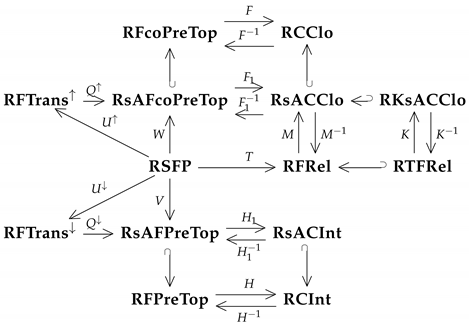
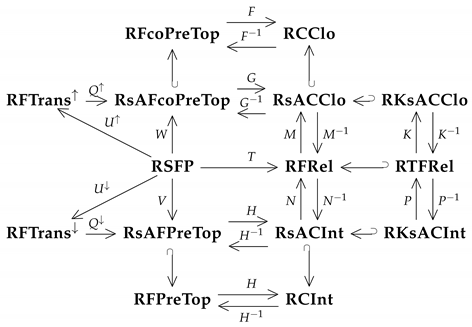
The main results of this paper are Theorems 1 and 2, which prove the existence of 23 functors among these categories, including how these functors combine with each other. It follows from these theorems that the key category between the above categories is the category of spaces with fuzzy partitions with special fuzzy relations as morphisms. As follows from the commutative diagrams in both Theorems, any space with a fuzzy partition can be transformed into an L-fuzzy relation, Čech closure or interior operator, L-fuzzy pretopological or co-pretopological operators or strong-Alexandroff variants of these operators.
The structure of the paper is as follows. In Section 1 we repeat basic properties of residuated lattices and we recall definitions of principal structures representing various concepts of proximity.
In Section 2, which represents the principal content of the paper, we introduce 15 new categories, whose objects are various types of proximity structures and whose morphisms are various types of relations between these structures. The main result are then two theorems identifying functors among these categories, which in fact represent the transformation processes among the individual structures.
2. Preliminaries
In this section we repeat basic properties of residuated lattices and recall definitions of principal structures representing various concepts of proximity, which are frequently used in L-valued fuzzy set theory, including interior and closure operators, pretopologies and co-pretopologies, and fuzzy partitions, sometimes with additional special properties.
We refer to [14,15] for additional details regarding residuated lattices.
Definition 1.
A residuated lattice is an algebra such that:
- 1.
- is a bounded lattice with the least element 0 and the greatest element 1;
- 2.
- is a commutative monoid, and
- 3.
- , .
A residuated lattice is complete if it is complete as a lattice.
The following is the derived unary operation of negation ¬:
A residuated lattice is called an -algebra if it satisfies . In a -algebra the following identities hold:
Unless otherwise stated, throughout this paper, a complete residuated lattice will be fixed and for simplicity, instead of we use only L.
Let X be a nonempty set and a set of all L-fuzzy sets (=L-valued functions) of X. For all , is a constant L-fuzzy set on X. For all , the is a set of all elements , such that . An L-fuzzy set is called normal, if . An L-fuzzy set is a singleton of , if it has the following form:
In the next definitions we repeat basic definitions of the L-valued operators that were mentioned above. These operators are very useful tools in several areas of mathematical structures with direct applications, both mathematical (e.g., topology, logic) and outside of mathematics (e.g., data mining, knowledge representation). In fuzzy set theory, several particular cases as well as general theory of interior and closure operators, which operate with fuzzy sets (so-called fuzzy interior or closure operators), are studied. The original notions of a Kuratowski closure and interior operators were introduced in several papers, see [1,2,3,16,17]. In this paper we use a more general form of these operators, called Čech operators or preclosure operators, where the idempotence of operators is not required.
Definition 2.
The map is called a Čech (L-fuzzy) interior operator, if for every , it fulfils:
- 1.
- ,
- 2.
- ,
- 3.
- .
A Čech interior operator is said to be a strong Čech–Alexandroff interior operator, if:
and is said to be a Kuratowski interior operator if .
Definition 3.
The map is called a Čech (L-fuzzy) closure operator, if for every , it fulfils:
- 1.
- ,
- 2.
- ,
- 3.
- .
A Čech closure operator is said to be a strong Čech–Alexandroff closure operator, if
and is said to be a Kuratowski closure operator if .
We recall the notion of an L-fuzzy pretopological space and L-fuzzy co-pretopological space as it has been introduced in [8].
Definition 4.
An L-fuzzy pretopology on X is a set of functions , such that for all and ,
- 1.
- ,
- 2.
- ,
- 3.
- .
An L-fuzzy pretopological space is said to be a strong Čech–Alexandroff L-fuzzy pretopological space, if:
Definition 5.
An L-fuzzy co-pretopology on X is a set of functions , such that for all and ,
- 1.
- ,
- 2.
- ,
- 3.
- .
An L-fuzzy co-pretopological space is said to be a strong Čech–Alexandroff L-fuzzy co-pretopological space, if:
Finally, we recall the notion of an L-fuzzy partition (see [18,19]).
Definition 6.
A set of normal fuzzy sets in X is an L-fuzzy partition of X, if:
- 1.
- The corresponding set of ordinary subsets is a partition of X, and
- 2.
- implies .
Instead of the index set from we use .
We use the notion of powerset maps defined by a fuzzy relation, which was first defined in [10]. If is an L-fuzzy relation, then the powerset maps and are defined by:
3. Relational Categories of -Valued Topological Objects and Functors among Them
As we mentioned in the Introduction, in the paper [9], several functors among categories based on fuzzy topological structures were discussed, whose common feature was that morphisms in these categories were mappings between corresponding underlying sets. In this section we want to significantly expand the information on the relationships between categories of topological L-operators expressing the concept of “proximity”, while in accordance with the current trend of using L-fuzzy relations, the morphisms in these categories are L-fuzzy relations with various properties.
The categories we will deal with have the objects defined in Section 2. Instead of classical maps between sets we use special fuzzy relations as morphisms.
Definition 7.
In what follows, we denote sets by , and by the composition of morphisms from the standard category .
- 1.
- The category is defined by:
- (a)
- Objects are pairs , where is a Čech L-fuzzy interior operator (Definition 2),
- (b)
- is a morphism, if is an L-fuzzy relation and
- 2.
- The category is defined by:
- (a)
- Objects are pairs , where is a Čech L-fuzzy closure operator (Definition 3),
- (b)
- is a morphism, if is an L-fuzzy relation, and
- 3.
- The category is defined by:
- (a)
- Objects are L-fuzzy pretopological spaces (Definition 4),
- (b)
- is a morphism, where , , if is an L-fuzzy relation, and for all ,
- 4.
- The category is defined by:
- (a)
- Objects are L-fuzzy co-pretopological spaces (Definition 5),
- (b)
- is a morphism, where , , if is an L-fuzzy relation, and for all ,
- 5.
- The category is defined by:
- (a)
- Objects are pairs , where r is a reflexive L-fuzzy relation on X,
- (b)
- is a morphism, if is an L-fuzzy relation, andwhere ∘ is the composition of L-fuzzy relations.
- 6.
- The category is defined by:
- (a)
- Objects are sets with an L-fuzzy partition , (Definition 6),
- (b)
- is a morphism if and are L-fuzzy relations such that
- i.
- For each ,
- ii.
- For each ,
- 7.
- The category is defined by:
- (a)
- Objects are upper F-transforms , where are sets with L-fuzzy partitions and , where ,
- (b)
- is a morphism if and are L-fuzzy relations and for each ,hold.
- 8.
- The category is defined by:
- (a)
- Objects are lower F-transforms , where are sets with L-fuzzy partitions, where , for , ,
- (b)
- is a morphism if and are L-fuzzy relations and and for each ,hold.
In the next theorems we will use the following subcategories of categories from Definition 7.
Definition 8.
The following full subcategories of categories from Definiton 7 will be used:
- 1.
- The full subcategory of with transitive L-fuzzy relations as objects,
- 2.
- The full subcategory of with strong Čech–Alexandroff L-fuzzy closure operators as objects,
- 3.
- The full subcategory of with Kuratowski strong Čech–Alexandroff L-fuzzy closure operators,
- 4.
- The full subcategory of with strong Čech–Alexandroff L-fuzzy interior operators as objects,
- 5.
- The full subcategory of with Kuratowski strong Čech–Alexandroff L-fuzzy interior operators,
- 6.
- The full subcategory of with strong Čech–Alexandroff L-fuzzy pretopological spaces as objects,
- 7.
- The full subcategory of with strong Čech–Alexandroff L-fuzzy co-pretopological spaces.
The main results of the paper are the following two theorems, in which we will define 23 functors to describe relationships between pairs of categories and some of their subcategories from Definitions 7 and 8.
Theorem 1.
Let be a complete residuated lattice. There exist functors such that the following diagram of these functors commutes,
where , , and are pairs of inverse functors.
 |
Proof.
(1) Let be a morphisms in , where , . The functor is defined by:
According to [5], is an object of . For arbitrary , we have:
Therefore, F is defined correctly and R is a morphism in .
(2) Let be a morphisms in . According to the same reference [5], the object function such that:
for , is defined correctly. We set . Then we obtain:
Hence, R is a morphism in and is a functor. It is clear that F and are inverse functors.
(3) Let be a morphism in the category and let the object function be defined by:
According to results from [6] and many others, and the object function is defined correctly. For we obtain:
Hence, R is a morphism in and M is a functor.
(4) In the proof we use the following identity, which was proven in [20], and which allows to express a general L-fuzzy set in the following form:
where is the constant function with the value .
Let be a morphism in and let the object function be defined by:
It is clear that r and s are reflective fuzzy relations.
We set . Then, for we obtain:
which follows from the fact that d is a strong Čech–Alexandroff closure. Hence, is a morphism in the category and is a functor. We prove that M and are inverse functors. Let . Then , where
On the other hand, , where , , and we obtain:
Therefore, M and are inverse functors.
(5) Let be a morphism in the category . The functor is defined by:
We prove that this definition is correct, i.e., and c is a Kuratowski closure operator. In fact, for we have:
and the definition of K is correct.
(6) Let be a morphism in and let the functor be defined by:
We prove that this definition is correct. In fact, for arbitrary , according to (3), we obtain:
Hence, for arbitrary and , we obtain:
Because , it follows that . Therefore, r is a transitive relation.
(7) Let be a morphism in and let the object function be defined by:
where is the unique index such that . It is easy to see that the object function W is defined correctly. We set . For arbitrary and , from the inequalitiy (2) we obtain:
as follows from the identity
Hence, R is a morphisms in and W is a functor.
(8) Let be defined by , . By a simple computation it can be proven that the definition of is correct and is a functor.
(9) Let be a morphism in the category . We define by:
We prove that R is a morphism in the category . In fact, let . Then, according to Inequality (2),
Hence, T is a functor.
(10) The functor can be simply defined by:
(11) The functors and are restrictions of the functors F and . It can be proven simply that these functors are mutually inverse.
(12) Let be a morphism in . We define by:
It can be proven by a simple computation that the object function of V is defined correctly. We show that R is a morphism. In fact, for arbitrary , using Inequality (2), we obtain for and arbitrary :
Therefore, R is a morphisms and V is a functor.
(13) Let be a morphism in . We define by:
It is clear that the object function is defined correctly. We show that R is a morphism, i.e., holds. In fact, for , we have:
Therefore, is a functor.
(14) The functor can be defined simply by:
(15) Let be a morphism in , where , . We define by:
By a simple verification we can see that is an object of . We prove that R is a morphism in . Using the properties of morphisms from , for arbitrary , we obtain:
Hence, R is a morphism and H is a functor. The inverse functor is defined symmetrically, i.e., , , . It is clear that is a functor and are mutually inverse.
(16) The functors and are restrictions of functors H and .
It can be verified easily that the diagram of functors commutes. □
For the proof of the next theorem we use the following lemma, which was proven in [21].
Lemma 1.
Let be a complete -algebra and . For , let be a constant function with the constant value α. Then for each we have:
Theorem 2.
Let be a complete -algebra. Then the following diagram of functors from Theorem 1 and new functors commutes, where , and are inverse pairs of functors.
 |
Proof.
(1) Let be a morphism in . We define N by:
The definition of objects is correct, because r is a reflexive relation. In fact, if , then and it follows that . Let , then we have:
On the other hand, using Lemma 1, for we obtain:
Because i and j are strong Čech–Alexandroff operators, we obtain:
Therefore, we obtain:
and it follows . Therefore, R is a morphism in .
(2) Let be a morphism in . We define by:
It is clear that object function is defined correctly. We show that R is a morphism in , i.e., we need to prove that for arbitrary , holds. Because both operators and have properties of strong Čech–Alexandroff operators, according to Lemma 1, for arbitrary we obtain:
Therefore, we obtain the following equivalence:
for arbitrary . Let . We have:
On the other hand, we have:
Therefore, we obtain:
and R is a morphism in .
(3) We prove that are inverse functors. In fact, let . Then we have:
as follows from Lemma 1. Hence, . Conversely, for , we obtain:
Hence and are inverse functors.
(4) Let be a morphism in . We define P by:
Hence, if , then . We need to prove only that r is a transitive L-fuzzy relation. For arbitrary we have:
as follows from Lemma 1. Hence, for we obtain:
Analogously we obtain:
Therefore, from we obtain and r is a transitive relation.
(5) Let be a morphism in . We define by:
Hence, if , then . We need to prove only that i is a Kuratowski interior operator. For arbitrary we have:
Analogously, as in previous part (5), we prove that:
Using Lemma 1, for arbitrary we obtain:
□
For the illustration of previous functors we show how from one topological type structure another structure can be defined.
Example 1.
Let be a complete residuated lattice. Using Theorem 1 we show how a strong Čech–Alexandroff L-fuzzy closure operator c in a set X can be constructed from an equivalence relation σ in X. In fact, using σ we can define a fuzzy partition , where is the set of equivalence classes defined by σ and iff ; otherwise the value is 0. Using functors from the Theorem 1, the L-fuzzy closure operator c in X can be defined by , i.e., for arbitrary ,
Example 2.
Let be a complete -algebra. Using the Theorem 2 we show how from a strong Čech–Alexandroff L-fuzzy pretopological space , a strong Čech–Alexandroff L-fuzzy co-pretopological space can be defined. In fact, we can put . If then is defined by:
as can be verified by a simple calculation.
4. Conclusions
The article follows the paper [9], in which the issue of relationships between categories motivated by topological structures was investigated. These structures include variants of fuzzy topological spaces, fuzzy rough sets, fuzzy approximation spaces, fuzzy closure operators and fuzzy pretopological operators, and their dual terms, such as fuzzy interior operators, are frequently used in fuzzy set theory and applications. The common feature of these categories was that the morphisms in these categories with topological objects were mappings among the supports of these structures. Recently, however, a number of results have emerged in the theory of fuzzy sets, which are based on the application of fuzzy relations as morphisms in suitable categories.
In this sequel, we looked at a more general situation where morphisms in these categories of topological structures are not mappings, but L-fuzzy relations. In detail, we considered categories and some of their subcategories of Čech closure or interior L-valued operators, categories of L-fuzzy pretopological and L-fuzzy co-pretopological operators, the category of L-valued fuzzy relation, categories of upper and lower F-transforms and the category of spaces with fuzzy partitions, where morphisms between objects are based on L-valued relations. We investigated functors between these categories with relational morphisms, which can thus represent transformation processes between different types of topological structures.
As an interesting consequence of these relationships among relational categories, it follows that the category of spaces with fuzzy partitions and relational morphisms plays the key role. From the corresponding functor diagrams it follows that a space with a fuzzy partition can be used to create an object of any of the above categories of topological structures. Moreover, from a relational variant of a morphism between two spaces with fuzzy partitions we can derive a relational morphism between corresponding transformed objects from these categories of topological structures.
This paper presents the first systematic contribution to the study of relationships between categories of different variants of fuzzy topological structures, where the morphisms between structures are L-valued fuzzy relations. Although there are isomorphic functors between some pairs of these categories, it is not yet known which of the functors between the remaining pairs of categories are also isomorphisms. It is also not known in all cases whether the special subcategories presented in this paper constitute reflective subcategories, which would make it possible to extend the general forms of a given topological structure to these special structures from these subcategories. These issues will be the subject of further research.
Funding
This research was partially supported by the Grand Agency of the Czech Republic, grand number 18-06915S.
Conflicts of Interest
The author declares no conflict of interest.
References
- Bělohlávek, R. Fuzzy closure operators. J. Math. Anal. Appl. 2001, 262, 473–489. [Google Scholar] [CrossRef]
- Bělohlávek, R. Fuzzy closure operators II. Soft Comput. 2002, 7, 53–64. [Google Scholar] [CrossRef]
- Biacino, V.; Gerla, G. Closure systems and L-subalgebras. Inf. Sci. 1984, 33, 181–195. [Google Scholar] [CrossRef]
- Elkins, A.; Šostak, A.; Uljane, I. On a category of extensional fuzzy rough approximation operators. In Communication in Computer and Information Science; Springer: Berlin, Germany, 2016. [Google Scholar]
- Perfilieva, I.; Singh, A.P.; Tiwari, S.P. On the relationship among F-transform, fuzzy rough set and fuzzy topology. Soft Comput. 2017, 21, 3513–3523. [Google Scholar] [CrossRef]
- Ramadan, A.A.; Li, L. Categories of lattice-valued closure (interior) operators and Alexandroff L-fuzzy topologies. Iran. J. Fuzzy Syst. 2018. [Google Scholar] [CrossRef]
- Perfilieva, I.; Singh, A.P.; Tiwari, S.P. On F-transform, L-fuzzy partitions and l-fuzzy pretopological spaces. In Proceedings of the 2017 IEEE Symposium Series on Computational Intelligence (SSCI), Honolulu, HI, USA, 27 November–1 December 2017; pp. 1–8. [Google Scholar]
- Zhang, D. Fuzzy pretopological spaces, an extensional topological extension of FTS. Chin. Ann. Math. 1999, 3, 309–316. [Google Scholar] [CrossRef]
- Močkoř, J.; Perfiljeva, I. Functors among categories of L-fuzzy partitions, L-fuzzy pretopological spaces and L-fuzzy closure spaces. In IFSA World Congress and NAFIPS Annual Conference: Fuzzy Techniques: Theory and Applications. IFSA/NAFIPS Louisiana, USA; Springer: Cham, Switzerland, 2019; pp. 382–393. [Google Scholar]
- Goguen, J.A. L-fuzzy sets. J. Math. Anal. Appl. 1967, 18, 145–174. [Google Scholar] [CrossRef]
- Dikranjan, D.; Šostak, A. On two categories of many-valued fuzzy relations. In IFSA-EUSFLAT Proceedings; Atlantis Press: Paris, France, 2015; pp. 933–938. [Google Scholar]
- Wang, C.Y. Fuzzy rough sets based on generalized residuated lattices. Inf. Sci. 2013, 248, 31–49. [Google Scholar] [CrossRef]
- Wu, W.Z.; Leung, Y.; Mi, J.S. On characterization of (, )-fuzzy rough approximation operators. Fuzzy Sets Syst. 2005, 154, 76–102. [Google Scholar] [CrossRef]
- Höhle, U. Fuzzy sets and sheaves. Part I, Basic concepts. Fuzzy Sets Syst. 2007, 158, 1143–1174. [Google Scholar] [CrossRef]
- Novák, V.; Perfilijeva, I.; Močkoř, J. Mathematical Principles of Fuzzy Logic; Kluwer Academic Publishers: Boston, MA, USA, 1999. [Google Scholar]
- Bandler, W.; Kohout, L. Special properties, closures and interiors of crisp and fuzzy relations. Fuzzy Sets Syst. 1988, 26, 317–331. [Google Scholar] [CrossRef]
- Bodenhofer, U.; De Cock, M.; Kerre, E.E. Openings and closures of fuzzy preorderings: Theoretical basics and applications to fuzzy rule-based systems. Int. J. Gen. Syst. 2003, 32, 343–360. [Google Scholar] [CrossRef]
- Močkoř, J. Spaces with fuzzy partitions and fuzzy transform. Soft Comput. 2017, 13, 3479–3492. [Google Scholar] [CrossRef]
- Perfilieva, I. Fuzzy transforms: Theory and applications. Fuzzy Sets Syst. 2006, 157, 993–1023. [Google Scholar] [CrossRef]
- Rodabaugh, S.E. Powerset operator foundation for poslat fuzzy sst theories and topologies. In Mathematics of Fuzzy Sets: Logic, Topology and Measure Theory, The Handbook of Fuzzy Sets Series; Höhle, U., Rodabaugh, S.E., Eds.; Kluwer Academic Publishers: Boston, MA, USA, 1999; Volume 3, pp. 91–116. [Google Scholar]
- Močkoř, J. Axiomatic of lattice-valued F-transform. Fuzzy Sets Syst. 2018, 342, 53–66. [Google Scholar] [CrossRef]
© 2020 by the author. Licensee MDPI, Basel, Switzerland. This article is an open access article distributed under the terms and conditions of the Creative Commons Attribution (CC BY) license (http://creativecommons.org/licenses/by/4.0/).