


Abstract
In this article, we show that there are homeomorphisms of plane continua whose conjugacy class is residual and have the shadowing property.
MSC:
37E05; 37C50; 37C20
1. Introduction
Let be a compact metric space and denote by the space of homeomorphisms with the distance
A property is said to be generic if it holds on a residual subset of . Recall that a set is if it is a countable intersection of open sets and it is residual if it contains a dense subset. For instance, it is known that the shadowing property is generic for X a compact manifold ([1], Theorem 1) or a Cantor set ([2], Theorem 4.3). Recall that has the shadowing property if for all , there is such that if is a -pseudo orbit, then there is such that for all . We say that is a -pseudo orbit if for all .
A remarkable result, proved in [3,4], states that if X is a Cantor set, then there is a homeomorphism of X whose conjugacy class is a dense subset of . That is, a generic homeomorphism of a Cantor set is conjugate to this special homeomorphism. We say that are conjugate if there is such that and the conjugacy class of f is the set of all the homeomorphisms conjugate to f. This result gives rise to a natural question: besides the Cantor set,
which compact metric spaces have a Gδ dense conjugacy class?
On a space with a dense conjugacy class, the study of generic properties (invariant under conjugacy, as the shadowing property) is reduced to determine whether a representative of this class has the property or not.
In Theorem 2, we show that there are one-dimensional plane continua with a dense conjugacy class whose members have the shadowing property. The proof of this result is based on Theorem 1, where we show that for a compact interval I there is a conjugacy class in which is dense in the subset of orientation preserving homeomorphisms of I. In addition, the proof of Theorem 2 depends on Propositions 2 and 3, where we give sufficient conditions for the existence of a residual conjugacy class and for a homeomorphism to have the shadowing property, respectively. The following open question has an affirmative answer in the examples known by the authors:
if a homeomorphism has a Gδ dense conjugacy class, does it have the shadowing property?
2. Generic Dynamics on a Closed Segment
Let and define . In this section, we show the following result.
Theorem 1.
There is whose conjugacy class is a dense subset of .
Remark 1.
The generic dynamics of circle homeomorphisms is studied in detail in [5], Theorem 9.1. The proof of Theorem 1 follows the same ideas. As we could not find this result in the literature, we include the details.
To prove Theorem 1, we start by defining the homeomorphism . For this purpose, we introduce some definitions. For let . A connected component of will be called a wandering interval. Following [6], we say that a wandering interval is an r-interval if for all . Analogously, it is an l-interval if for all . For each interval , fix a homeomorphism such that is an r-interval. Analogously, we consider with an l-interval.
For and , define the closed interval
For x in the ternary Cantor set, define . In another case, there is a minimum integer such that for some and define
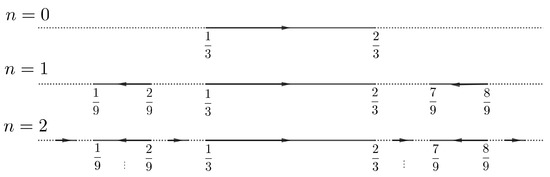
Figure 1.
A sketch of the phase diagram of .
Remark 2.
From [7], Theorem 8, we know that , and every homeomorphism conjugate to , has the shadowing property.
The next result gives a useful characterization of the conjugacy class of . Given , we say that satisfies the property if there are intervals , , such that:
- ;
- is an r-interval for i odd and an l-interval for i even;
- and .
Proposition 1.
A homeomorphism is conjugate to if and only if it satisfies for all .
Proof.
The direct part of the proof is clear from the construction of .
To prove the converse, suppose that g satisfies for all . From Condition (3), we see that is totally disconnected. Suppose that is an isolated fixed point. If , then there is a wandering interval . Taking , we have a contradiction with (3), because . Analogously we show that p cannot be 1. If , then p is in the boundary of two wandering intervals. Taking smaller than the length of these intervals, we contradict (1) and (3). Thus, has no isolated point and is a Cantor set. Condition (2) (applied for a suitable small) implies that between two wandering intervals there is an r-interval and an l-interval.
Let and be the families of r-intervals and l-intervals of g, respectively. We define an order in in the following way: if for all , . We will make the conjugacy by induction. For the first step, name which satisfies for every . In the case that there exists more than one interval which verifies this condition, we choose any of them. Let be a wandering interval of such that c is the midpoint of . By construction, is an r-interval of , thus we can consider a conjugacy of g and restricted to these intervals. Notice that and are the midpoints of and , respectively. Take satisfying and for every such that . In addition, take satisfying and for every such that . Then, consider to be a conjugacy from g to restricted to the corresponding intervals. Similarly, define . Then, we go on defining homeomorphisms on each step. If is even, we choose r-intervals, otherwise we choose l-intervals. Notice that since in each step we choose the largest interval of the r or l-intervals of g, every wandering interval of g is eventually chosen. In this way, the conjugacies give rise to a conjugacy h of g and in the whole interval and the proof ends. □
Proof of Theorem 1.
Given , let be the set of increasing homeomorphisms of I satisfying . Notice that implies for all . Thus, from Proposition 1 we have that the conjugacy class of is the countable intersection . To finish the proof, applying Baire’s Theorem, we show that each is open and dense in .
To prove that is open, consider . It is clear that there is such that . Consider the intervals from the definition of property , for . For each odd , take and for i even take . Consider large such that and for all i. Take a neighborhood of f such that for all and , for all i. This implies that is contained in an r-interval for g and is contained in an l-interval for g. For all and i odd, we have
Arguing analogously for i even, we conclude that and is open.
To prove that is dense in , the following remark is sufficient. Given , and small, we can define close to f such that:
- and are conjugate;
- and are conjugate; and
- g has an r or l-interval at .
That is, a fixed point can be exploded into a small wandering interval with an arbitrarily small perturbation. By finitely performing many such explosions, the density of is obtained. □
3. Genericity on a Plane One-Dimensional Continuum
In this section, we show that there are some particular one-dimensional plane continua with a dense conjugacy class whose members have the shadowing property. We start with a sufficient condition for the existence of a dense conjugacy class. An open subset is a free arc if it is homeomorphic to .
Proposition 2.
If X is a compact metric space such that
- , where each is a compact arc with extreme points for all ;
- is a free arc for all ; and
- for all , it holds that and for all
then has a dense conjugacy class.
Proof.
For each , let and define
and the map as . In , we consider the product topology. It is clear that is a homeomorphism for each . Let be the dense conjugacy class of given by Theorem 1 and define . Thus, is a dense conjugacy class in . □
Remark 3.
Notice that a representative of the dense conjugacy of Proposition 2 is obtained by considering a conjugate of on each arc of X.
Now, we prove a sufficient condition for a homeomorphism to have the shadowing property. For this purpose, we need some definitions and a lemma. Suppose that is a compact metric space and take . A compact f-invariant subset is a quasi-attractor if for every open neighborhood U of A there is an open subset such that and . If, in addition, has the shadowing property, we say that A is a quasi-attractor with shadowing.
Lemma 1.
If is a quasi-attractor with shadowing, then for all there is such that if is a δ-pseudo-orbit with , then there is that ε-shadows .
Proof.
Given , take such that every -pseudo-orbit in A is -shadowed by a point in A. Consider such that implies . Since A is a quasi-attractor, for there exists an open set V such that and . Take such that .
Suppose that is a -pseudo-orbit with . Since , we have that and . In this way, we prove that for all . For each , take such that . We have that
This proves that is a -pseudo-orbit contained in A. There exists that -shadows . Thus,
Therefore, the proof ends. □
Proposition 3.
If every point of X belongs to a quasi-attractor with shadowing, then f has shadowing.
Proof.
Suppose that is given. For each , let be a quasi-attractor with shadowing containing x. Let be given by Lemma 1 such that for every -pseudo-orbit with there is a point in that -shadows . As X is compact, there is a finite sequence such that , where and . If we take , we have that for every -pseudo-orbit in X, there is j such that . Then, there is a point in that -shadows and the proof ends. □
Let be the union of
- the circle arc , ;
- the horizontal segment ; and
- the vertical segments , for .
See Figure 2.
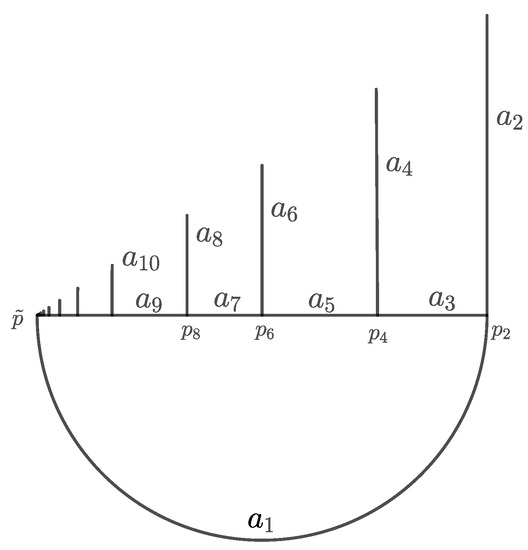
Figure 2.
The continuum Y can be decomposed as a union of arcs as in Proposition 2.
Theorem 2.
For the continuum Y, there is a conjugacy class which is dense in and whose members have the shadowing property. In particular, the shadowing property is generic in .
Proof.
The continuum Y satisfies the hypothesis of Proposition 2. Indeed, the conditions (1) and (2) are directly from the construction of Y. Consider the points indicated in Figure 2. It is clear that for all . This implies that is invariant and . In turn, this implies that is invariant under each . In this way, it is shown that condition (3) of Proposition 2 holds. Therefore, contains a dense conjugacy class.
As explained in Remark 3, a representative of this conjugacy class is obtained by taking a conjugate of on each arc . It only remains to prove that has the shadowing property. By Remark 2, we know that has the shadowing property. By construction, each is a quasi-attractor for . Since the arcs cover Y, we can apply Proposition 3 to conclude that has the shadowing property. □
Author Contributions
Both authors contributed equally to this work.
Funding
This research received no external funding.
Conflicts of Interest
The authors declare no conflict of interest.
References
- Pilyugin, S.Y.; Plamenevskaya, O.B. Shadowing is generic. Topol. Appl. 1999, 97, 253–266. [Google Scholar] [CrossRef]
- Bernardes, N.C., Jr.; Darji, U.B. Graph theoretic structure of maps of the Cantor space. Adv. Math. 2012, 231, 1655–1680. [Google Scholar] [CrossRef]
- Akin, E.; Glasner, E.; Weiss, B. Generically there is but one self homeomorphism of the Cantor set. Trans. Am. Math. Soc. 2008, 360, 3613–3630. [Google Scholar] [CrossRef]
- Kechris, A.S.; Rosendal, C. Turbulence, amalgamation, and generic automorphisms of homogeneous structures. Proc. Lond. Math. Soc. 2007, 94, 302–350. [Google Scholar] [CrossRef]
- Akin, E.; Hurley, M.; Kennedy, J.A. Dynamics of Topologically Generic Homeomorphisms; American Mathematical Society: Providence, RI, USA, 2003. [Google Scholar]
- Pilyugin, S.Y. Shadowing in Dynamical Systems; Lecture Notes in Mathematics; Springer: Berlin, Germany, 1999; Volume 1706. [Google Scholar]
- Pennings, T.; Eeuwen, J.V. Pseudo-orbit shadowing on the unit interval. Real Anal. Exchang. 1990, 16, 238–244. [Google Scholar]
© 2019 by the authors. Licensee MDPI, Basel, Switzerland. This article is an open access article distributed under the terms and conditions of the Creative Commons Attribution (CC BY) license (http://creativecommons.org/licenses/by/4.0/).