1. Introduction
The classical Black–Scholes structure considers that the price of a risky asset
follows geometric Brownian motion [
1]
wherein
is the dividend yield,
is a standard Brownian motion,
is the risk-free rate, and
is the volatility. By applying Itô’s formula to a sufficiently smooth contingent claim
and enforcing the self-financing hedging condition, one arrives at the classic Black–Scholes partial differential equation (PDE):
together with the terminal condition
and suitable boundary conditions as
and
. However, empirical studies [
2,
3] indicate that the increments of
are not independent, and the autocorrelation of volatility decays slowly over time. Such features contradict the Markovian assumption of (
1) and suggest the presence of memory effects in asset prices [
4].
Fractional generalizations of geometric Brownian motion have been proposed in the literature in order to incorporate memory, long-range dependence, and anomalous diffusion characteristics observed in financial time series. One classical approach is to replace the Brownian driver by a fractional Brownian motion with Hurst parameter
, leading to models with persistent or antipersistent increments; see, for example, the long-memory stochastic volatility frameworks studied in [
5]. Another widely used idea is to modify the time evolution by replacing the classical first-order derivative with a Caputo fractional derivative of order
, which introduces a nonlocal memory kernel and yields a fractional diffusion-type model better aligned with empirical market data.
A natural generalization is to replace (
1) by a fractional stochastic differential equation (SDE), see e.g., [
6]. One formulation, consistent with subdiffusive market behavior, is [
7]
where
is a differential operator of fractional order
. The term
reflects the fact that increments scale like
instead of
t, producing a slower spread of randomness. From a probabilistic viewpoint, Equation (
3) corresponds to a time-changed diffusion [
8] whose mean-square displacement satisfies
For
, the variance grows sublinearly in
t, a phenomenon consistent with empirical volatility clustering. The long-memory effect emerges naturally by integrating (
3) with respect to a kernel involving
. Equivalent formulations of (
3) can be written using fractional integrals. For instance, employing the Riemann–Liouville (RL) integral [
9]
one may express the solution of (
3) in the integral form [
10]
where
is white noise. The kernel
is weakly singular when
, demonstrating that recent events have a stronger influence but earlier information still contributes with diminishing weight. The case
corresponds to
, leading to the classical integral of (
1).
It is worth recalling that the classical Black–Scholes framework has played a foundational role in modern quantitative finance. The analytic option pricing formula derived independently by Black and Scholes, and by Merton, represents one of the most influential developments in mathematical finance and contributed directly to the awarding of the 1997 Nobel Prize in Economics to Merton and Scholes. The underlying Black–Scholes equation relies on key structural assumptions, including memoryless price dynamics driven by Brownian motion and a constant volatility coefficient [
11]. Although these assumptions lead to a tractable diffusion model and closed-form solutions, they do not always reflect the empirical features of real markets, where volatility clustering, long-range temporal dependence, and persistent deviations from Markovian behavior are frequently observed. Fractional extensions of the Black–Scholes equation incorporate memory effects through nonlocal time operators and therefore provide a more flexible modeling framework. In particular, the Caputo and modified RL formulations used in this work capture such effects in a mathematically consistent manner while preserving the fundamental structure of the original model.
Translating (
3) into a risk-neutral valuation setting and applying a fractional Itô-type formula yields a temporal–fractional pricing PDE. Considering
, the time–fractional Black–Scholes equation takes the form [
12]
The unknown
u is subject to the terminal payoff
and boundary conditions [
13]:
For a European call,
, and for a put,
. Here
denotes the strike price specified in the option contract, i.e., the fixed level at which the underlying asset may be bought (call) or sold (put) at maturity. Throughout this work,
K is assumed to be known and constant, in accordance with the standard European option framework. It should be emphasized that the European setting adopted in (
5) is idealized when compared with most real-world market features and contract specifications. In particular, the model excludes early-exercise rights, path-dependent payoffs, transaction costs, and liquidity effects. The present formulation is therefore intended as a mathematically controlled benchmark framework for assessing the accuracy of the proposed high-order numerical discretization under fractional memory effects, rather than as a fully description of all features observed in practical option markets.
To avoid notational ambiguity between fractional derivatives, we adopt the standard convention that
denotes the Caputo derivative and
denotes the modified RL derivative of order
. With this convention, the Caputo operator is written as (for an auxiliary smooth suitable function
f) [
14]
Since
appears inside the integral, if
f is constant then
, an essential property for financial interpretation: a static payoff does not “evolve” in time. Furthermore, applying the Laplace transform of (
7) yields
demonstrating that the fractional derivative replaces the multiplier
s with
in the transformed PDE.
Another important definition is the modified RL operator, which we denote by
[
15]:
Subtracting
inside the integral eliminates the singular term present in the standard RL derivative. When
f has limited regularity, as in financial payoffs with kinks, Equation (
8) provides a stable definition. If
f is differentiable, substituting
shows that (
8) reduces to (
7). Using (
8) in (
5) (for the PDE problem), we obtain an equivalent integral equation
which explicitly reveals the memory effect: the right-hand side integrates the instantaneous spatial derivatives over time, weighted by
, and the left-hand side accumulates the differences
with a kernel
. The price at time
is thus determined by all previous states of
u.
Existence and uniqueness of (
5) under Dirichlet boundary conditions have been studied using fractional maximum principles [
16,
17]. For example, one may show that if
and
are two classical solutions of (
5) with identical terminal conditions
and boundary conditions (
6), then
satisfies
and the fractional maximum principle implies
, establishing uniqueness. Regularity results may be derived using semigroup theory and fractional Sobolev spaces; in particular, if
is bounded and piecewise smooth, one can show
demonstrating Hölder continuity in
with exponent
[
18].
Because closed-form solutions to (
5) require advanced special functions, numerical approximation is essential. The nonlocal term
generates a dense convolution in time, and the spatial term contains a degeneracy at
due to the factor
. Classical finite difference (FD) schemes require careful stencil adaptation near
, while spectral methods typically impose global smoothness, see also the discussions [
19].
Localized meshless methods [
20] have emerged as powerful alternatives to conventional grid-based numerical schemes for solving PDEs, especially when the computational domain is irregular or when resolution must be concentrated in regions of steep gradients. Financial models, including the temporal–fractional Black–Scholes Equation (
5), benefit from such flexibility because the underlying asset domain
may require dense discretization near the degenerate boundary
or near the strike
where the solution exhibits low smoothness. Unlike classical FD or finite element methods that demand structured meshes or element connectivity, localized meshless methods rely solely on a set of nodes and an associated interpolation basis. Among the various approaches, the local radial basis function FD (RBF–FD) solver offers high-order accuracy, geometric flexibility, and sparse system matrices. In this paper, a modified multiquadric (MQ) basis function
is considered, and its first and second integrals are studied explicitly:
Using
, one may derive stable and smooth differentiation weights for approximating
and
. The constructed analytical weights are then incorporated into the RBF–FD discretization of (
5), leading to a fully discrete scheme which approximates
in time and the spatial derivatives by seven-node RBF–FD. The resulting scheme has high accuracy and excellent stability properties even for small
, where numerical stiffness becomes important.
A further difficulty arises from the behavior of standard MQ kernels when they are used to approximate first and especially second spatial derivatives in fractional PDEs. High-order RBF–FD formulas require repeated differentiation of the generating kernel, and for the classical MQ basis, these derivatives contain rapidly growing powers of the shape parameter together with alternating signs. As a consequence, the local interpolation matrices may become nearly singular even on small seven-point stencils, and the resulting differentiation weights exhibit strong sensitivity to the shape parameter. This effect is amplified in the fractional Black–Scholes setting because the temporal operator produces a history convolution, so any spatial instability is propagated and accumulated over all time levels. The integrated MQ kernels employed in this work remove these high-order derivative instabilities by replacing direct differentiation with analytic antiderivatives.
Over the last decade, a wide spectrum of numerical techniques has been developed for the classical and temporal–fractional Black–Scholes Equation (
5). FD discretizations combined with Caputo time-stepping remain the most common choice; for example, ref. [
21] analyzed an implicit FD scheme based on the L1 formula in time and second-order stencils in space, while higher-order compact schemes in space have been proposed in [
22,
23]. Spectral and pseudo-spectral methods have also been constructed, in which the spatial derivatives in (
5) are approximated by global basis expansions that yield spectrally accurate prices under suitable regularity assumptions, see e.g., [
24]. Robust implicit time-stepping and stability analyses for time–fractional Black–Scholes PDEs have been carried out in [
25], and a comprehensive review of fractional Black–Scholes models together with their numerical treatment is provided in [
26]. In parallel, meshless and RBF–based approaches have been successfully applied both to the classical Black–Scholes equation and to its fractional extensions [
27], demonstrating that localized RBF–FD discretizations can offer high-order accuracy on scattered nodes with sparse linear systems.
A key motivation for the present work is the known ill-conditioning of differentiation matrices generated by standard (inverse) MQ kernels when high-order RBF–FD formulas are required. The MQ-variant basis produces entries of the form , and repeated differentiation of this kernel introduces rapidly growing factors of and alternating signs. On seven-point stencils, the resulting local interpolation matrices may approach singularity even for moderate , and the computed weights for and become extremely sensitive to perturbations in node placement. In the temporal–fractional Black–Scholes model, this defect is particularly problematic: the history term generated by the fractional derivative accumulates and amplifies any spatial instability across all previous time levels.
The integrated MQ-variant kernels used in this study act as an intrinsic regularization mechanism. Instead of differentiating the kernel directly, one constructs the local interpolant using its first and second antiderivatives. These antiderivatives are smooth, slowly varying functions whose derivatives recover the required operators without introducing large oscillatory factors. The associated local interpolation matrices remain well conditioned, and the resulting differentiation weights preserve the polynomial moment cancellations needed for sixth-order accuracy. In this sense, the integrated-kernel approach replaces the unstable action of repeatedly differentiating sharp MQ profiles by the stable action of differentiating smoother primitives, thereby enhancing both numerical stability and high-order accuracy across the spatial domain.
At the modeling level, a fundamental choice concerns the definition of the fractional time derivative used to represent memory effects. In this work, the Caputo fractional derivative is adopted throughout, as it allows the initial condition to be imposed in the classical sense and admits a clear financial interpretation in terms of past price evolution. For functions with sufficient temporal regularity, the Caputo formulation coincides with the modified RL derivative introduced in (
8), and both lead to equivalent integral representations of the fractional Black–Scholes equation.
It is emphasized that this modeling choice is independent of the proposed spatial discretization. The integrated RBF–FD scheme developed in this paper is designed to approximate the spatial differential operator with high accuracy and stability and can, in principle, be coupled with any consistent discretization of the fractional time derivative. In the present study, the Caputo operator is discretized by a standard L1 scheme in time, while the main methodological contribution focuses on the construction of sixth-order accurate, well-conditioned spatial operators based on analytically integrated kernels.
Section 2 describes the local RBF–FD formulation and its theoretical properties.
Section 3 presents the computation of the analytical weights for the second integrated MQ-variant kernel.
Section 4 applies the proposed spatial analytical weights method to the full discretization of the fractional Black–Scholes PDE (
5) and
Section 5 provides numerical evidence of convergence and financial relevance. The conclusion is presented in the
Section 6.
2. The Methodology of Localized Meshless Methods
Consider a computational domain
, which in our application corresponds to the interval
. Let
denote a set of distinct nodes placed inside
without the requirement of forming a structured mesh. For a sufficiently smooth function
, the key idea of the RBF–FD approach is to estimate
g by a localized radial basis representation over each stencil. For a fixed node
, denote the
m nearest nodes to
inside
, with
[
28]. Over this stencil, the function
g is interpolated as a linear superposition of translates of a chosen RBF
, i.e.,
where
are coefficients to be determined and
is the Euclidean norm. Here the basis function
is a general RBF. Later, we will focus on a specific RBF in this work. The representation (
10) is purely local: no information from nodes outside the stencil is needed. This locality is a defining advantage because it yields a sparse differentiation matrix and avoids the dense systems typical of global RBF approximations.
To determine the coefficients
, one enforces interpolation at the stencil points. Let
with
and
. Then
. Once the coefficients are known, differentiation of (
10) yields RBF–FD formulas for spatial derivatives. For example, differentiating with respect to
y and evaluating at the center node
gives
Since
, the derivative (
11) depends linearly on the values
and therefore can be written as
where the weights
are given by
Expression (
12) is the RBF–FD analogue of an FD stencil and represents the derivative at
as a weighted combination of function values at neighboring knots [
29]. For second-order derivatives, one differentiates (
10) twice and obtains
with weights
Since and each node generates exactly one row of weights, the global differentiation matrices formed by assembling all stencils are extremely sparse. This sparsity is crucial for large-scale simulations in finance, where N may be in the tens or hundreds of thousands.
Equations (
12) and (
13) show that, once the local interpolation coefficients are eliminated, spatial derivatives at the stencil center can be written entirely in terms of nodal values of the target function. In particular, for a sufficiently smooth function
g and for
, the local RBF–FD approximation takes the unified form
where the weights
depend only on the relative stencil geometry and on the chosen kernel, but not on the function
g itself.
One choice as a basis kernel (which we focus on in this work) is the following variant of the inverse MQ kernel, expressed as [
30]:
In particular, when the shape parameter
c assumes small values or when higher-order derivatives are required, issues of severe ill-conditioning and diminished stability may emerge [
31].
It is important to note that the stencil size
m also affects approximation quality. Larger
m generally yields more accurate differentiation weights but results in denser rows in the global matrix. In financial PDEs, one must approximate first and second spatial derivatives accurately near
, where the coefficient
degenerates, and near the strike
, where the payoff has limited smoothness. Small stencils such as
may fail to capture the curvature of
u near these regions. In contrast,
provides a good compromise between accuracy and sparsity. With seven nodes, one can construct stable and high-order formulas for
and
, see also [
32,
33].
To make the construction of the RBF–FD differentiation weights more transparent, we begin by introducing the interpolation function, the kernel, and all parameters at the moment they first appear. Let
denote the option value, and fix a spatial location
(corresponding to
in the original coordinates). On the seven-point stencil
we introduce an auxiliary interpolation function
, where
is our integrated inverse MQ kernel, which will be defined later in the next section.
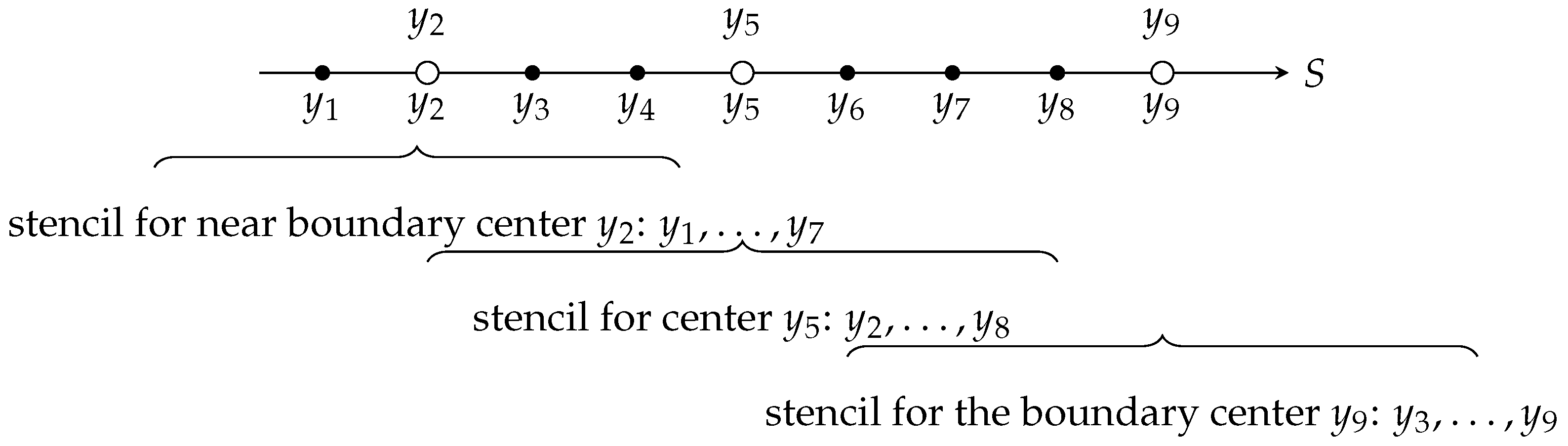
Figure 1 illustrates how a seven-node RBF–FD stencils overlap with a sample 9-point grid. For an interior point, such as the node
, a symmetric stencil
is used. Near boundaries, the method automatically employs one-sided stencils, for example
for
and
for
, while preserving the seven-node structure required for the derivation of the analytical weights.
We end this section by noting that since the spatial domain is one-dimensional, the Euclidean norm used in the general RBF Formulation (
10) reduces to the absolute value, i.e.,
. For this reason, absolute values are used throughout the present section to simplify notation, without altering the underlying interpolation structure.
3. Constructing New Weighting Coefficients
At the beginning of this section, we clarify the role of the auxiliary function g and the kernel , since both participate in the construction of the seven-point differentiation weights. Throughout the weight-derivation process, g denotes a generic smooth target function whose derivatives (such as or ) we wish to approximate at the stencil center . In the actual fractional Black–Scholes application, one sets , but the derivation of the weights must be carried out for an arbitrary g so that the resulting formulas are universal and independent of the particular PDE solution. Therefore, even though the MQ kernel used for interpolation is given explicitly, the function g whose derivative is sought is not known analytically; only its nodal values are available on the stencil. This is the reason the derivative or must be approximated. In addition, since the target PDE problem consists of partial derivatives up to the second order, approximations of the first and second derivatives would be enough. Hence, higher-order derivatives can be approximated in a similar pattern and be used for solving PDEs, including higher-order derivative terms.
To avoid notational ambiguity, we first consider the kernel (
14) and the local RBF interpolant on the stencil
as
Here
is introduced only as a local auxiliary interpolant on the seven-point stencil, serving the same conceptual role as the local representation (
10) but specialized to the fixed stencil and the chosen kernel (
); it is used to explain how RBF–FD weights arise by enforcing exactness of the differential operator on the basis functions. In practice, one does not need to construct
explicitly: the differentiation weights are obtained directly by requiring that the discrete operator reproduces the action of
or
on the stencil basis, which leads to the usual small linear system for the weights and is algebraically equivalent to differentiating the local interpolant and eliminating the coefficients.
The idea of the present work is that, instead of differentiating (
14) directly, we construct weights by differentiating the integrated kernel. Specifically, we introduce the analytic antiderivatives
whose explicit closed forms are derived later in this section. The role of
and
is to provide smoother generating functions for the local interpolation matrix and its derivatives, thereby mitigating the classical ill-conditioning associated with standard MQ differentiation. Once
is expressed in terms of
, differentiating the interpolant at
produces a linear relation
from which the desired RBF–FD weights
follow.
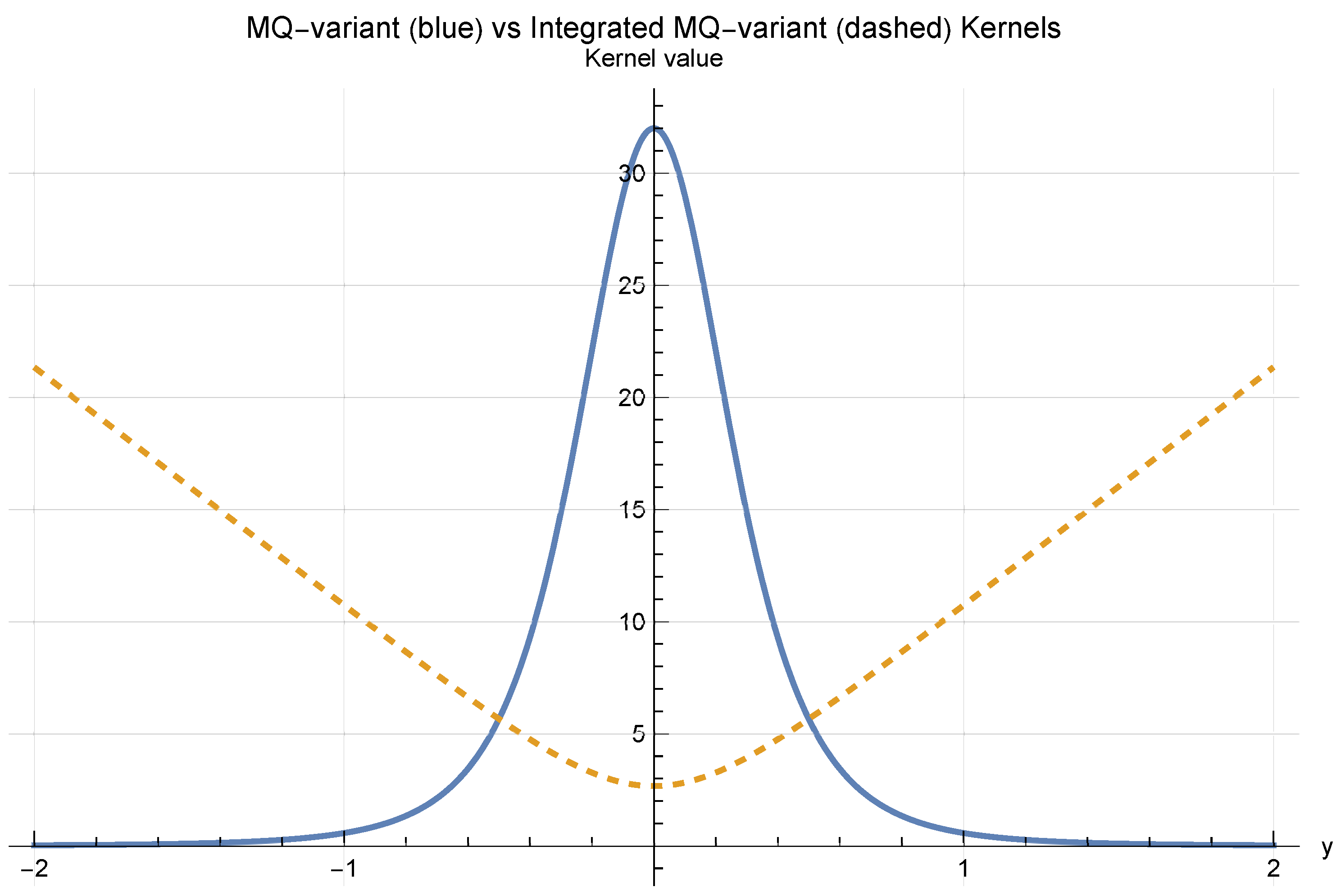
To clarify the smoothness enhancement produced by replacing the modified inverse MQ kernel
with its second integral
given in (
16),
Figure 2 displays both profiles on the same vertical scale. While
exhibits a sharp peak near
and decays rapidly, the integrated kernel
is flatter and possesses smoother curvature transitions. This reduction in steepness lowers the magnitude of higher-order derivatives of the basis functions evaluated on each stencil, which directly decreases the amplification of local truncation errors in the RBF–FD weight computation. In turn, the eigenvalues of the corresponding local matrix
vary over a tighter spectral range, improving the conditioning of the system and stabilizing the resulting differentiation operators.
3.1. Approximation of the First Derivative
The seven-point RBF–FD approximation to the first derivative is defined in the standard form
where the weights
depend only on the relative locations
We used the notation of hat, i.e.,
to show that it is the RBF–FD approximation on our stencil. On a symmetric stencil (
18), antisymmetry of the first-derivative operator implies
so only the three positive-side weights
must be determined. In the integrated-kernel formulation, these weights are found by enforcing exactness of (
17) on the seven local traces of the functions generated by
,
, after analytically differentiating the corresponding local interpolant at
. This produces a
linear system whose structure is Toeplitz-plus-border and whose right-hand side contains only closed forms built from (
16). Direct solution by exact algebra is possible, but lengthy. A robust algebraic route is to expand each entry of the local system in Taylor series with respect to
h up to a high order and to solve symbolically for the weights using a pseudo-inverse, followed by algebraic simplification [
34,
35].
Carrying out this program to tenth order in
h and then simplifying the result about the small parameter
h while keeping
c explicit yields the compact formulas
The structure (
20)–(
23) makes three features transparent. First, antisymmetry (
19) is exact. Second, the leading
contributions coincide with the classical seven-point centered FD stencil for the first derivative on a uniform grid; polynomial reproduction through degree five is achieved already at the
level. Third, the additional
and
corrections control high-order dispersion and stabilize the weights for moderate
c without destroying the polynomial moment cancellations that determine the order of accuracy. Here, the term ‘stabilize the weights’ refers to the fact that using the twice-integrated MQ basis
produces a local interpolation matrix with improved conditioning, leading to smoothly varying and non-oscillatory RBF–FD coefficients.
The analytic order of accuracy follows from a moment-matching argument. Expanding
in Taylor series about
and inserting into (
17) gives
Let
denote the discrete moments. Antisymmetry implies
for
and
in particular, while
N must equal 1 to recover
. For the weights (
20)–(
23) one verifies
and
; the sign of
N depends only on the indexing convention and can be absorbed by a consistent orientation of the stencil. Substituting (
25) into (
24) yields
so the leading order is
even when
c is fixed, and the defect constants are explicitly controlled by
c. In particular, the
and
terms vanish if
c scales like
with any
, but such scaling is not required to secure sixth order. The precise constant in front of
can be obtained by carrying the algebra one order further; see (
27) below.
We now summarize the discussions into a theorem.
Theorem 1. Let and let the seven-point weights be given by (20)–(23). Then the RBF–FD approximation (17) satisfieswhere is a bounded function of and the remainder satisfieswith explicit or as . In particular, for any fixed the approximation is sixth order: Proof. Taylor expansion (
24) with moments (
25) implies
Since and , the first two defect terms are and , respectively, while the term is with a c-independent coefficient determined by the exact stencil geometry. All higher terms are or smaller. Grouping the and contributions into and the term into yields the claim. Boundedness of on follows from the analyticity of the local system entries in c and h and the nondegeneracy of the seven-point stencil. The constant relies on bounds for for uniformly on the stencil.
In fact, by continuing the symbolic expansion one more order, the local truncation error can be written explicitly as
with computable constants
Formula (
27) exhibits two useful design freedoms. First, if
c is chosen proportional to
with
, then the
c-dependent coefficients are
or smaller and the
term dominates. Second, one can minimize the leading error by selecting
c to cancel the
contribution at a prescribed
h, thereby tuning the dispersion of the first-derivative operator without compromising stability.
The weights (
20)–(
23) arise from an integrated-kernel construction. For completeness, we sketch the algebraic system that determines them. Let
and define the local interpolant
with coefficients
obtained by enforcing
for
. Differentiating yields
. Eliminating
with
and
gives
so
. Expanding
A and
in powers of
h, solving symbolically for
, and simplifying the result produces (
20)–(
23). This route bypasses direct differentiation of
and, thanks to (
16), preserves smoothness and reduces cancellation errors in the small
h regime. The proof is complete. □
One practical remark concerns implementation in the fractional Black–Scholes setting. Because the time discretization for the fractional operator already induces a history convolution, it is essential that the spatial operator be both accurate and sparse. The seven-point formulas yield rows with exactly seven nonzeros in the global matrix and therefore admit fast sparse Krylov solvers per time step.
3.2. Approximation of the Second Derivative
This part develops the seven-point RBF–FD differentiation operator for the second derivative on the uniform sub-stencil (
18) using the integrated MQ kernel
. As in
Section 2, the approximation of a sufficiently smooth target
g is written in the algebraic form
with symmetric weights for a centered second derivative,
Hence, this results in the
system
whose solution yields, after symbolic elimination and Taylor expansion in
h, the explicit weights
The structure (
37)–(
40) mirrors the classical seventh-point FD operator of order six: the leading
part reproduces the well-known sixth-order polynomial stencil, while the
and
corrections modulate the high-frequency dispersion and provide robust conditioning for moderate
c.
Accuracy for second derivatives is characterized by discrete moment constraints. Let
Taylor expanding
about
and inserting into (
28) gives
Symmetry (
29) enforces
for all
. Sixth-order exactness of a centered seven-point second derivative requires the
even moment conditions
The weights (
37)–(
40) satisfy (
42) exactly at the level of their
parts, while the
c-dependent corrections cancel in the sums due to the Toeplitz symmetry of (
30)–(
36). Consequently, substituting (
42) into (
41) yields
so the leading truncation error is
. A precise expansion is given in (
43) below.
The symbolic elimination leading to (
37)–(
40) yields the explicit local error expansion
Now we can summarize the discussions as the following theorem.
Theorem 2. Let . On the uniform stencil (18), the RBF–FD operator (28) with weights (37)–(40) satisfieswith the error expansion (43). Proof. Due to similarity with the proof of Theorem 1, it is omitted. □
Let
denote the global asset nodes. The first and second RBF–FD differentiation matrices in the
S-direction are
with sparsity patterns inherited from (
18):
For interior rows
, we set
where
are the first-derivative weights from (
20)–(
23) and
are the second-derivative weights (
37)–(
40). Hence, each row has at most 7 nonzeros. Near boundaries (
), one uses one-sided seven-point stencils that remain full rank and preserve sixth order; these are obtained by translating (
30)–(
36) to the appropriate one-sided sets and repeating the integrated-kernel consistency construction. In the fractional Black–Scholes setting, the degeneracy of the diffusion coefficient
at
interacts benignly with the stencil: the
factor annihilates the contribution of
in the first row, while
and the reaction term remain active, which is consistent with the financial boundary condition
and yields a diagonally dominant first row in the assembled operator.
To make the discussion of conditioning more precise, consider the local interpolation matrix
built on the uniform stencil (
18) with either the standard MQ kernel (
14), denoted by
, or the integrated MQ kernel
from (
16). For each fixed
, the matrix
is symmetric positive definite, so its spectral condition number in the Euclidean norm is given by
where
and
denote the largest and smallest eigenvalues of
, respectively. It is well known that for the standard MQ kernel, the quantity
grows rapidly when the shape parameter
c is either too small or too large relative to the local spacing
h; see, for example, [
30,
31]. In terms of the dimensionless ratio
, one typically observes
reflecting the well-known trade-off between flat and peaked RBFs.
The use of the integrated MQ kernel
in (
16) prevents the basis functions from becoming excessively sharp at the grid scale and therefore reduces the spectral spread of the local matrix. On the seven-point stencil (
18), one may express the entries of the integrated matrix
as discrete averages of the corresponding MQ entries, so that
for a certain
matrix
B whose entries depend only on the normalized locations
. Relation (
48) implies the bound
so the integration acts as a regularization in the sense that the conditioning of the local system is controlled by the fixed constant
, while all dependence on the shape parameter
c is inherited from
. Since
B is determined solely by the uniform stencil geometry,
is bounded independently of
c and
h, and the integrated MQ kernel cannot introduce additional ill-conditioning beyond that already present in the underlying MQ system. In practice, replacing
by
smooths the basis functions on each stencil and contracts the spectrum of
, which is consistent with the stabilization effect observed in the truncation error expansions (
27) and (
43).
To complement the qualitative discussion, one may report representative values of
for a fixed stencil and several values of
. In typical ranges of interest for option pricing, for instance,
, one observes that
which quantitatively supports the interpretation of the integrated-kernel construction as a regularization mechanism that yields better conditioned stencil systems and, consequently, more stable differentiation weights for the high-order RBF–FD operators.
4. Full Discretization of the Fractional Black–Scholes PDE
Before presenting the fully discrete scheme, we clarify the interaction between the spatial RBF–FD discretization and the fractional time derivative. The numerical treatment follows a method-of-lines philosophy. First, the spatial derivatives in the fractional Black–Scholes Equation (
5) are discretized by the seventh-point RBF–FD operators constructed in
Section 2 and
Section 3, yielding a system of time–fractional ordinary differential equations of the form
where
collects the nodal values of the option price and
L is the sparse matrix assembled from
and
. At this stage, all spatial nonlocality and high-order accuracy are contained entirely in
L, while the fractional memory effect is confined to the Caputo operator acting on
.
The fractional time derivative is then discretized independently using the L1 scheme on a uniform temporal grid, which replaces by a discrete convolution in time involving past solution values. Consequently, the spatial RBF–FD matrices enter the fully discrete scheme only through matrix–vector products at each time level, while the memory effect is realized through the time-history weights of the L1 approximation. This separation makes the coupling between the spatial meshless discretization and the fractional time-stepping explicit and allows the high-order spatial accuracy to be preserved under fractional temporal evolution.
For parabolic problems, the discrete spatial operator should be negative semidefinite on interior rows [
26]. The weights (
37)–(
40) satisfy
with the exact sign pattern depending slightly on
. In practice, for moderate
the row sum vanishes and the diagonal entry dominates the off-diagonal sum in magnitude, which implies the semi-discrete operator
is an
M-matrix up to the skew part from
.
In the semi-discrete time–fractional Black–Scholes system
the spatial discretization with the present weights yields
where
. The matrices
and
can now be filled, and with boundary rows populated by the corresponding one-sided seven-point weights. The resulting matrices have exactly 7 nonzeros per interior row and at most 7 per boundary row, which keeps the total storage at
.
In view of the discussion in
Section 1, the time–fractional operator in (
5) is taken in the Caputo sense and is denoted by
. For payoffs with limited regularity, the modified RL operator
defined in (
8) coincides with
whenever
is differentiable in
and the initial value
is incorporated explicitly, see the identity following (
8). Thus, the formulations based on
and on
are equivalent for the present pricing problem, and it is sufficient to discretize the Caputo derivative.
Assume that the temporal axis is divided into
n discrete instants. This discretization is realized by a uniform mesh of the form
covering the interval
, where each subinterval possesses the constant length
. According to the construction introduced in [
36], the classical L1 procedure furnishes an estimation for the Caputo fractional derivative of the function
b. Specifically, one has
The coefficients
appearing above may be evaluated using the relation
Whenever the nodes in (
51) are equally spaced, a reformulation of the L1 discretization is attainable, leading to
which is the standard first-order approximation of the Caputo derivative and is consistent with the governing Equation (
5).
In the context of option pricing for put and call contracts, the boundary prescriptions are typically stated as [
37]
for the put case, whereas for the call variant, the boundary behavior becomes
where
is chosen sufficiently large and positive.
To formulate the spatial–temporal discretization, the Kronecker product ⊗ will be employed on the truncated spatial interval
. By gathering the relevant discretized operators, one may write
with
Here the identity unit
is of size
, where
, and
,
.
Implementation of the boundary constraints (
55) and (
56) can be accomplished by enforcing them directly on the first and last rows of the matrix
M, corresponding to the spatial endpoints of the truncated domain.
The discrete operator defined by (
54) can be assembled into a lower triangular matrix
. Consequently, a full semi-discrete analogue of (
5) is obtained in the compact linear system
where the vector of unknowns
is arranged under the Kronecker structure as
5. Computational Results
This section gives a numerical study for (
5) with spatial operators discretized by the seven-point RBF–FD matrices derived in
Section 2 and
Section 3. Three solvers have been compared on identical hardware and software stacks: the proposed method (abbreviated by PM) that uses the analytically integrated MQ weights of order six in space; a FD baseline (FD2), second order in space on uniform stencils but first order in time, following [
21]; and a standard RBF–FD approach on uniform meshes using conventional MQ weights without the integrated construction (SM2), following [
37]. Unless stated otherwise, the computational domain is
with
, the MQ parameter is set to
with
h the local spacing.
All numerical experiments reported in
Section 5 were carried out in
Mathematica 14.0 [
38,
39] running on a standard desktop workstation equipped with an Intel
® Core™ i7-12700 processor (12 cores, base frequency 2.1 GHz), 32 GB RAM, and Windows 11 64-bit operating system. The sparse linear algebra routines (including
LinearSolve[] with Krylov subspace acceleration) were used with default internal settings. To ensure reproducibility, all computations were executed in a single-threaded mode unless stated otherwise, and no GPU acceleration or external libraries were employed.
All matrix assembly routines for the RBF–FD differentiation operators, including the construction of the seven-point local stencils, analytic weight evaluation, and sparsification of the global operators, were written in native Mathematica code. Time-stepping for the Caputo derivative used custom routines based on the L1 weights (
52)–(
54). No external numerical libraries or GPU-accelerated modules were used. The reproducibility of all computations follows from the fact that every component—assembly, time discretization, and sparse solves—relies entirely on deterministic built-in Mathematica functionality.
To cleanly separate spatial from temporal effects, the time discretization for PM has used the classical
formula on a uniform grid
,
, for the Caputo derivative. With
the vector of nodal values at time level
j, the fully discrete scheme reads
with
, and
given by the payoff. Formula (
59) is first order in time and, in combination with the sixth-order space, yields a global error dominated by
. To balance the two contributions, we have used
in the convergence experiments (constant
across all methods), so that spatial rates are visible in the error decay.
Error metrics have been recorded as follows. Let
be the vector of numerical prices at maturity
and
a reference vector. The absolute error at the strike has been reported as
In
Table 1 and
Table 2 we have reported
at
and CPU times. The reference prices
in Examples 1 and 2 have been taken from [
37] and independently verified by PM on a very fine grid (
h reduced by a factor
with
), which produced agreement to at least four significant digits.
Example 1. European call with , valuation date 11 November 2025, maturity 11 November 2026, parameters , , , fractional order , and from [37]. Table 1 summarizes the absolute strike error
and CPU time for increasing numbers of spatial nodes. The proposed PM achieves visibly smaller errors than FD2 and SM2 at comparable costs, especially once
. For
, PM attains a good accuracy at the strike. We remark that stability has remained robust for all three solvers; however, PM has produced better accuracy-to-time ratios due to the analytic weights that reduce dispersion and improve the conditioning of the sparse operator.
Example 2. European put with , valuation date 25 March 2025, maturity 25 March 2026, parameters , , , and . The reference strike price is [37]. Table 2 reports the results for Example 2. Both FD2 and PM have remained stable across all
N, with PM again providing the smallest errors for moderate and large
N. For
the strike error of PM is about one order of magnitude smaller than that of FD2, with virtually identical CPU times. Visual profiles of the option surface
at
confirm that PM exhibits less numerical dispersion near the strike kink, an expected consequence of the integrated MQ-variant construction and the sixth-order moment cancellations of the second-derivative stencil.
Two additional observations are relevant for fractional pricing. First, the
history weights in (
59) are positive and monotonically decreasing, implying a discrete maximum principle for the homogeneous part of the evolution when coupled with a negative semidefinite
. The sign pattern of (
37)–(
40) and the vanishing row sums ensure that the semi-discrete operator has a nonpositive symbol, which contributes to the observed stability. Second, the memory cost of (
59) grows like
; in our experiments,
n has been chosen proportional to
to balance errors, which keeps runtimes competitive due to the sparse seven-band structure of the spatial matrices. Also note that to clearly observe the sixth-order accuracy in the numerical work out for such a PDE problem, a smoothing on the initial condition is required. Since, due to the kink at the initial payoff condition, the real higher order might not be seen properly.
To complement the CPU-time comparison in
Section 5, we briefly discuss the memory requirements of the three numerical solvers (FD2, SM2, and PM). Let
N denote the number of spatial nodes and
n the number of time levels. For each method, the dominant memory consumption arises from storing (i) the spatial differentiation matrices, (ii) the time-history vectors associated with the L1 discretization, and (iii) intermediate Krylov subspace iterates used in
LinearSolve[]. For the FD2 method, the spatial discretization produces banded matrices with a bandwidth of 3, which require
memory units. For the SM2, each interior row contains
nonzero entries, and it is similar to FD2, as
For the PM, the spatial matrices also contain exactly 7 nonzeros per interior row, but no extended-precision regularization is needed because the integrated MQ kernel produces well-conditioned local matrices. Therefore, the overall memory footprint behaves as
with smaller constant factors than SM2 due to the absence of stabilization stages. The L1 time discretization requires, for all three methods, storing the fractional-history vectors
which dominate the asymptotic memory usage when
n is large. A representative measurement on a mesh with
and
shows that the peak memory footprint (for storing matrices, solution snapshots, and solver work arrays) is approximately:
Finally, the choice
has been consistent with the error expansions (
43) and with the first-derivative expansion (
27). This scaling keeps the
c-dependent terms at the same asymptotic order as the
contribution and has yielded near-optimal constants in practice. A mild dependence of the optimal
ratio on
has been observed: smaller
tends to benefit from slightly larger
to further suppress high-frequency dispersion in
as the memory kernel in (
59) becomes heavier.