


Abstract
In this paper, we investigate optimization problems for a Hermitian quadratic matrix-valued function involving two variable matrices. We derive algebraic formulas for the maximal and minimal ranks and partial inertias of this function based on a linearization method and specific block matrix rank and inertia transformations. Further, we establish necessary and sufficient conditions for the existence of solutions satisfying the associated matrix equation and various Hermitian inequalities. As applications, we obtain extremal ranks and inertias for the Hermitian generalized Schur complement with respect to Hermitian reflexive generalized inverses, and provide conditions for Hermitian reflexive generalized inverses to satisfy specific Hermitian properties. In addition, we apply these results to analyze optimization, stability, and congestion in a traffic flow network modeled by this quadratic function.
Keywords:
quadratic matrix-valued function; minimal rank; maximal rank; Moore–Penrose inverse; generalized Schur complement; inertia MSC:
15A24; 15A09; 15A03; 15B57
1. Introduction
The rank and inertia of a matrix are fundamental and practical concepts in linear algebra. The rank describes the row or column vector space dimensions, which can be computed efficiently through established elementary block matrix operations. The inertia of a Hermitian matrix classifies its eigenvalues into three separate parts over the field of real numbers. Consequently, the inertia of a Hermitian matrix can be created and used to characterize its definiteness. In Lemma 1, Matsaglia and Styan [1] demonstrate the application of various formulas that simplify intricate matrix expressions or equalities, which enhances the appreciation of partitioned matrices with orthogonal projectors. Further, Lemma 4 provides sufficient and necessary conditions for a Hermitian matrix expression to satisfy Hermitian structures.
Because the rank of a matrix is a finite non-negative integer, there must be maximal and minimal ranks of matrix expressions for their variant matrices. The maximal and minimal ranks and inertias of matrix expressions with variable entries are intricately connected to many challenges in matrix theory and its applications. For instance, all solutions to the matrix expression preserve invariant rank if and only if . is solvable for X if and only if . The matrix equation holds for all of matrix X if and only if .
Several works examine extremal ranks and inertias of linear Hermitian matrix expressions and use them to characterize solvability and definiteness properties. Guerarra [2,3], studies positive and negative definite submatrices and the Hermitian parts of least-rank solutions to equations such as and , showing how extremal ranks and inertias describe the structure of constrained Hermitian solutions. Liu and Tian [4,5] investigate, respectively, extremal ranks of submatrices in Hermitian solutions and max-min problems for expressions of the form , providing general formulas that directly motivate Lemma 3 of this paper. Also in [6], Tian investigates the maximization and minimization of the rank and inertia of the Hermitian matrix expression and related forms. It derives explicit formulas for the maximal and minimal rank and partial inertias over all variable matrices X.
Matrix theory covers two key fields of study: linear and nonlinear matrix functions and their specific instances. Nonlinear matrix equation issues involve maximizing or minimizing a quadratic matrix-valued function according to certain variables commonly known as quadratic programming issues or optimization challenges; for instance, Tian [7] derives formulas for the extremal ranks and inertias of a four-term quadratic matrix-valued function, applying them to related optimization problems. Yao [8] and Tian [9] develop rank and inertia optimization techniques for quadratic Hermitian expressions and constrained matrix-valued functions, often under linear matrix equation restrictions. Lan et al. [10] extend this study to quadratic Hermitian matrix-valued functions subject to matrix equation constraints, emphasizing algebraic linearization method. In [11], Tian gives some closed-form formulas for the extremal ranks of the quadratic matrix function with respect to and ; then, equivalent conditions were established for the solutions of two linear matrix equations to be orthogonal and proportional. Moreover, in [12], he studies problems on ranks, inertias, maximization, and minimization in the Löwner partial ordering of the quadratic Hermitian matrix function , subject to a consistent linear matrix equation , by simple algebraic treatment. In [13], Tian studies the optimization problems on ranks and inertias of the quadratic matrix function with respect to the variable matrix X, and he investigates equivalent conditions for the solutions of the matrix equation to satisfy some quadratic Hermitian matrix equalities and inequalities. In [14], the authors develop various sufficient criteria for Hermitian positive definite solutions to the matrix equation to exist and be unique. In [15], Xiong and Qin study the extremal ranks of nonlinear matrix expressions with respect to two-variable matrices and provided conditions for the solvability of nonlinear matrix functions.
Before proceeding, we introduce the notation and basic concepts used in this paper. Throughout this work, all complex matrices and all complex Hermitian matrices are denoted by and , respectively. The symbols , , and stand for the rank of A, the conjugate transpose of A, and the identity matrix of order n, respectively. The Moore–Penrose inverse of a matrix is the unique matrix that satisfies the following four matrix equations:
and this is frequently denoted as . The Moore–Penrose generalized inverse is a useful tool for solving several kinds of matrix equations, and extensive research has focused on it (see [16,17]). and denote the two orthogonal projectors induced by . The inertia of is defined to be the triplet , where , , and are the number of positive, negative, and zero eigenvalues of A, counted with their multiplicities, respectively. The two numbers and are usually called the partial inertias of A. For a matrix , we have and .Throughout this work, all complex matrices and all complex Hermitian matrices are denoted by and , respectively. The symbols , , and stand for the rank of A, the conjugate transpose of A, and the identity matrix of order n, respectively. The Moore–Penrose inverse of a matrix is the unique matrix that satisfies the following four matrix equations:
and this is frequently denoted as . The Moore–Penrose generalized inverse is a useful tool for solving several kinds of matrix equations, and extensive research has focused on it (see [16,17]). and denote the two orthogonal projectors induced by . The inertia of is defined to be the triplet , where , , and are the number of positive, negative, and zero eigenvalues of A, counted with their multiplicities, respectively. The two numbers and are usually called the partial inertias of A. For a matrix , we have and .
Motivated by the works mentioned above and more generalized cases, let us consider the Hermitian quadratic matrix-valued function
where , , , , , , , , and are given, and and are unknown.
The following problems are discussed in this paper:
Problem 1.
Let be as given in (1). Investigate algebraic formulas for finding the extremal ranks and inertias
Problem 2.
hold.
Given in (1), and based on the findings of Problem 1,
- (i) investigate the necessary and sufficient conditions for the existence of and such that the following matrix equation and inequalities
As an application, we give the extremal ranks and inertias of the generalized Hermitian Schur complement with respect to Hermitian reflexive generalized inverses and of T and S, respectively. As a further contribution, we provide an application to a traffic flow network, in which we establish equivalent conditions for situations wherein the traffic flow network is optimal, stable, or crowded.
This paper is structured as follows: In Section 2, we introduce some known results on matrix ranks and inertias. In Section 3, we derive algebraic formulas for the rank and inertias of (1), as well as the sufficient and necessary conditions for the existence of solutions to Problems 1 and 2. Section 4 outlines the application derived from the results discussed in Section 3. Section 5 provides a summary of the previous findings.
2. Preliminaries
This section examines the crucial role of rank and inertia formulas in developing the theories discussed in this study. It highlights key results on the ranks and inertias of block matrices and on Hermitian matrix expressions.
Lemma 1
([1]). Let , , and . Then,
Lemma 2
([16]). Let . Then, the Hermitian reflexive generalized inverse of the matrix T can be expressed as
where U is arbitrary.
Lemma 3
([5]). Let , , and be given. Then,
where
Obviously, we have the following results concerning the rank and inertia of Hermitian matrices.
Lemma 4
([18]). Let S be a set consisting of matrices over , and let ℏ be a set consisting of Hermitian matrices over . Then, the following applies:
- (a)
- If , S has a nonsingular matrix if and only if ;
- (b)
- If , all are nonsingular if and only if ;
- (c)
- if and only if ;
- (d)
- if and only if ;
- (e)
- ℏ has a matrix , () if and only if
- (f)
- All satisfy , () if and only if
- (g)
- ℏ has a matrix , () if and only if
- (h)
- All satisfy , () if and only if
Lemma 5
([18]). Let , , and . Then,
3. Main Results
In this section, we address Problems 1 and 2 by deriving the optimization problems related to the rank and inertia of Equation (1) using the linearization method and Lemma 3. We then establish the solvability conditions for certain nonlinear matrix equations and examine the Hermitian properties of nonlinear matrix expressions.
Matrix multiplication and block matrices play an important role throughout this paper, where we use elementary block matrix operations and congruent block operations. Moreover, matrix operations can be performed efficiently using fast matrix multiplication algorithms, which in turn accelerate other matrix operations. For a comprehensive overview, we refer to the recent work in [19], where these algorithms rely fundamentally on block matrix structures.
Let be as given in (1). Following that, based on specific block matrix rank and inertia transformations, we have
and
Further, we have
where
and is arbitrary.
Now, we present the main result of this paper.
Theorem 1.
- (a)
- The maximum rank of is
- (b)
- The minimum rank of is
- (c)
- The maximum partial inertia of is
- (d)
- The minimum partial inertia of iswhere
Proof.
where
By applying Lemmas 1 and 4, elementary block matrix operations, and elementary congruence matrix operations to the block matrices above, we obtain
From Lemma 4 and Theorem 1, we achieve the following results:
Corollary 1.
Let be as given in (1), and let N, , and be matrices as given in Theorem 1. Then, the following applies:
- (a)
- There exists and such that is nonsingular iff
- (b)
- There exists and such that iff
- (c)
- There exists and such that iff
- (d)
- There exists and such that iff
- (e)
- There exists and such that iff
- (f)
- There exists and such that iff
In the next part, we put and into Theorem 1; then, we have the following result:
Corollary 2.
Let
where , , , , , , and are given, and and are unknown. Let be the matrix as given in Theorem 1. Let
Then, the following applies:
- (a)
- There exists and such that is nonsingular iff
- (b)
- There exists and such that iff
- (c)
- There exists and such that iff
- (d)
- There exists and such that iff
- (e)
- There exists , such that iff
- (f)
- There exists and such that iff
Next, by setting and , as well as and and , , and in Theorem 1, we can derive some solvability conditions of nonlinear matrix equations and Hermitian structures of specific nonlinear matrix expressions as follows.
Corollary 3.
Let
where , , and are given, and and are unknown. Then, the following applies:
- (a)
- The maximum rank of is
- (b)
- The minimum rank of is
- (c)
- The maximum partial inertia of is
- (d)
- The minimum partial inertia of isFurther, the following applies:
- (i)
- There exists and such that is nonsingular iff
- (ii)
- There exists and such that iff
- (iii)
- There exists and such that iff
- (iv)
- There exists and such that iff
- (v)
- There exists and such that iff
- (vi)
- There exists , such that iff
Proof.
By setting and , , , and in Theorem 1, yields
It is easy to verify that
By substituting the results from (25)–(27) into (6)–(9), respectively, the assertions (a)–(d) are obtained as follows:
- (a)
- The maximum rank of is
- (b)
- The minimum rank of is
- (c)
- The maximum partial inertia of is
- (d)
- The minimum partial inertia of iswhere
4. Some Applications
This section presents direct applications of the results obtained in Section 3 by first determining the maximum and minimum ranks and inertias of the Hermitian generalized Schur complement . Additionally, we provide the solvability conditions for the matrix equation .
4.1. Hermitian Generalized Schur Complement
Theorem 2.
Let , , , , and be given. Let
Then, the following applies:
- (a)
- The maximum rank of is
- (b)
- The minimum rank of is
- (c)
- The maximum partial inertia of is
- (d)
- The minimum partial inertia of iswhereFurther, the following applies:
- (i)
- There exists and such that is nonsingular iff
- (ii)
- There exists and such that iff
- (iii)
- Equation holds for all and iff
- (iv)
- There exists and such that iff
- (v)
- There exists and such that iff
- (vi)
- There exists and such that iff
- (vii)
- There exists and such that iff
4.2. Optimization and Stability of a Traffic Flow Network
A collection of traffic matrices can describe the flow of traffic in a city with a system of roadways. The traffic volume between any two points on the road, whether at an intersection or along an individual segment, is represented by each element of the matrix. The objective is to enhance traffic flow in order to reduce congestion while maintaining the capacity of the road network within certain boundaries. Related work on neural network-based optimization for network analysis complements these algebraic approaches; one can refer to [20,21,22,23,24].
Let be the traffic flow matrix, where each element represents the traffic flow from road segment i to road segment j, and let C be the capacity matrix, where each element represents the maximum allowed traffic flow between road segments i and j.
We model the traffic flow network using the quadratic matrix-valued function
where is a Hermitian matrix representing the initial traffic conditions or network constraints, and are Hermitian positive definite matrices capturing road capacities and intersection interaction coefficients, and represent control variables such as signal timings and traffic routing decisions. This quadratic form naturally arises as it quadratically penalizes deviations from optimal flow while respecting network capacity constraints, allowing the extremal rank and inertia results from Corollary 3 to characterize network optimality, stability, and congestion.
1. Non-Singular Traffic Flow Network
- (a)
- Full Connectivity:
Combining Corollary 3(a) and Lemma 4(a), the rank condition
which implies that the rank of the matrix must be equal to the number of intersections m,
- (b)
- No Traffic Bottlenecks:
Since the matrix L represents initial traffic conditions or network constraints, to ensure the connectivity across all intersections, the rank of the matrices and must satisfy the condition
2. Optimal Traffic Flow Distribution (Minimized Congestion)
The network achieves optimal traffic distribution (minimized congestion) if and only if the following conditions hold:
- (a)
- Maximizing Rank:
Combining Corollary 3(a) and Lemma 4(a), the rank of should be maximized and equal to the total number of network intersections that is,
This condition ensures that traffic can flow efficiently across all paths, with no isolated intersections.
- (b)
- Balanced Traffic Load:
Combining Lemma 4(e) and Corollary 3(c), the inertia of , representing the network’s load distribution, should be balanced. Specifically:
which is equivalent to condition (iii) in Corollary 3. This condition guarantees a stable and evenly distributed traffic flow.
3. Traffic Congestion
Conversely to the Point 1, the network demonstrates congestion (i.e., bottlenecks or isolated intersections), if and only if the following conditions hold:
- (a)
- Rank Deficiency
The rank of must be strictly less than the total number of intersections m, that is,
this condition holds if and only if
Since the matrix L represents initial traffic conditions or network constraints, the rank of the interaction matrices and must be insufficient to handle the traffic flow across the network, that is,
This means that the road capacities or network resources are inadequate to handle the traffic demand, leading to congestion.
- (b)
- Inertia of Congestion:
The inertia of must indicate the presence of negative or null eigenvalues, so combining Lemma 4(g) and Corollary 3(d), we indicate instability and congestion if and only if
this condition holds if and only if
which is equivalent to the condition (vi) in Corollary 3, that is,
This means that a positive count of negative eigenvalues signifies areas of the network where traffic is over-congested, and flow is unstable.
4.3. Examples
Example 1.
Our goal in this example is to optimize traffic distribution across the network to minimize congestion and keep the system stable. To do this, we define an objective function that minimizes the rank and inertia of the matrix given in (35), which can be interpreted as optimizing traffic flow across the network, and then define a road capacity matrix C. Additionally, the total flow between intersections must not exceed road capacity.
Consider a road capacity matrix C as follows:
where represents the maximum capacity of traffic between intersection i and intersection j for
Further, we consider the matrices L, , and as follows:
By adjusting the signal timings or road capacities represented by variables and , we optimize the rank and inertia of , thereby making the traffic flow matrix more efficient.
By performing MATLAB (R2016a) computations on the two matrices
we get the corresponding traffic flow matrix
The rank and the eigenvalues of the matrix are, respectively,
Hence,
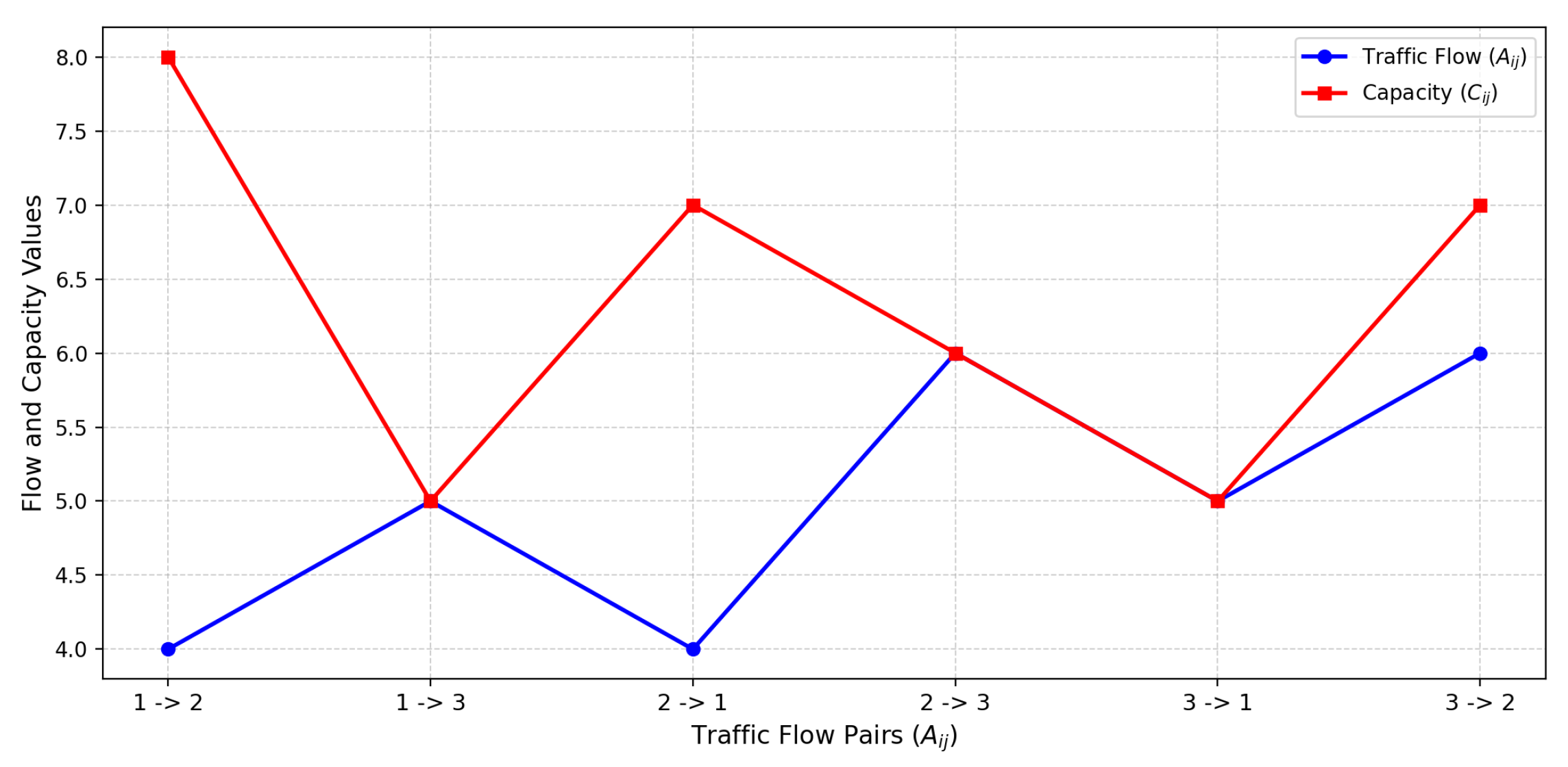
When the conditions for a nonsingular network and the optimal distribution of rank and inertia are satisfied, even if the conditions for congestion rank deficiency, capacity violation, and negative inertia are not, we can conclude that the network is stable and the traffic flow is optimized. Figure 1 shows how traffic flow compares with road capacity at each pair of intersections, providing insight into whether the network is operating efficiently or is potentially facing congestion.
Figure 1.
Traffic flow and capacity between intersections.
Example 2.
Consider a road capacity matrix C as follows:
where represents the maximum capacity of traffic between intersection i and intersection j for
Further, we consider the matrices L, , and as follows:
By adjusting the signal timings or road capacities represented by variables and , we optimize the rank and inertia of , thereby improving the efficiency of the traffic flow matrix.
By performing MATLAB computations on the two matrices
we get the corresponding traffic flow matrix
The rank and the eigenvalues of the matrix are, respectively,
Hence,
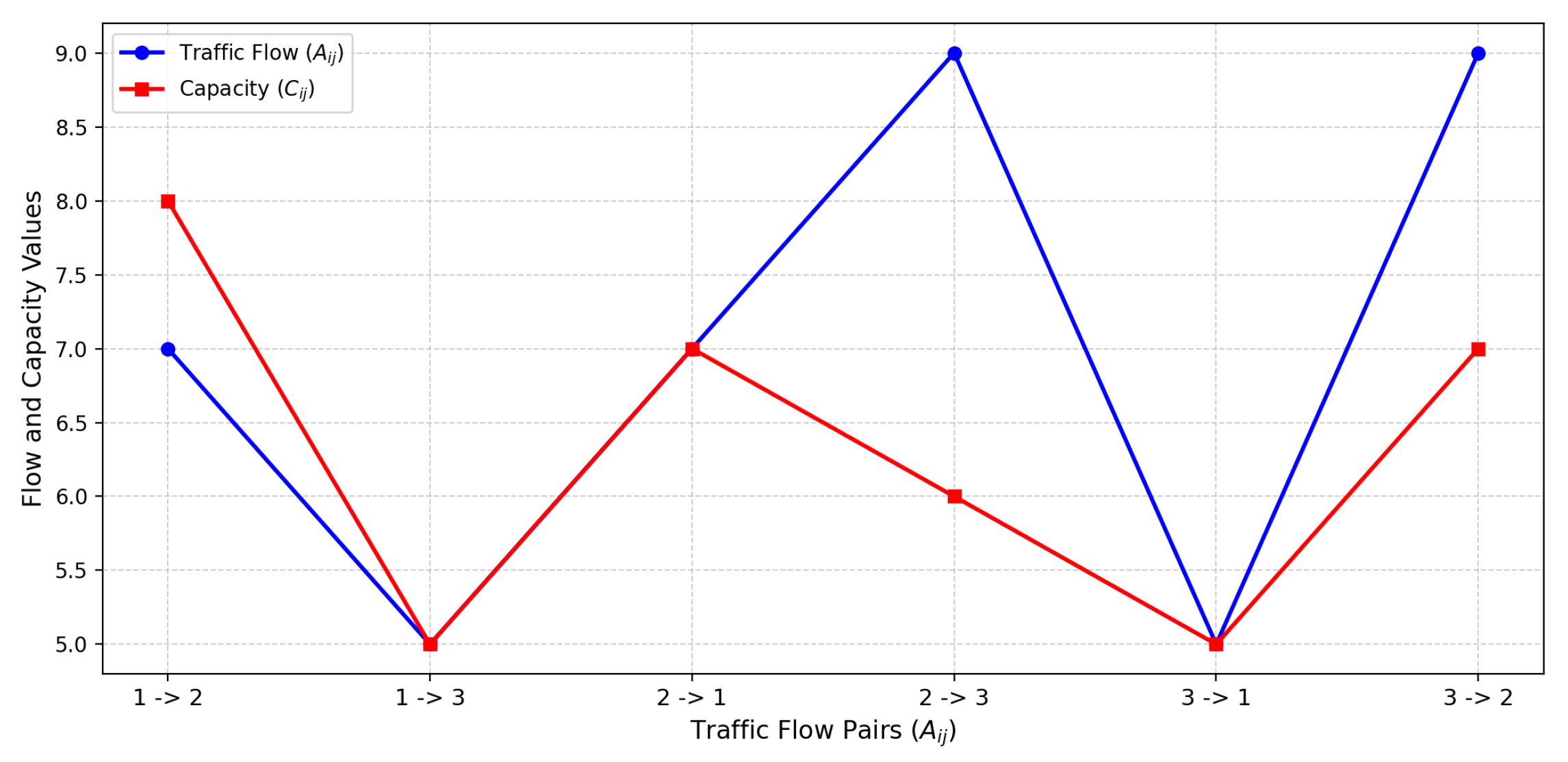
Instability: The system is unstable due to the singular traffic flow matrix and negative eigenvalues, indicating negative traffic flows at certain intersections.
Congestion: Congestion is indicated in the intersections where traffic flow exceeds road capacity, meaning the system cannot handle the current load.
The negative eigenvalue and the rank deficiency in the system prevent the network from achieving stable traffic flow, leading to bottlenecks and unrealistic traffic behavior.
Figure 2 shows a comparison between traffic flow and capacity, highlighting areas where traffic exceeds capacity, which may indicate congestion or instability in the system.
Figure 2.
Traffic flow and capacity between intersections.
5. Conclusions
Using the algebraic linearization method and elementary block matrix operations, in this paper, we derived closed-form formulas for the extremal ranks and partial inertias of a Hermitian quadratic matrix-valued function with two variable matrices. These results yielded necessary and sufficient conditions for solvability of the associated matrix equation and various Hermitian inequalities. As applications, we established extremal properties of the Hermitian generalized Schur complement with respect to reflexive generalized inverses, as well as criteria for optimization, stability, and congestion in traffic flow networks. The findings advanced matrix optimization theory and offered practical tools for network analysis.
Funding
This research received no external funding.
Data Availability Statement
Data are contained within the article.
Acknowledgments
The author wishes to express sincere gratitude to the editors and anonymous reviewers for their valuable comments and suggestions, which greatly improved this paper.
Conflicts of Interest
The author declares no conflicts of interest.
References
- Matsaglia, G.; PH Styan, G. Equalities and inequalities for ranks of matrices. Linear Multilinear Algebra 1974, 2, 269–292. [Google Scholar] [CrossRef] [Scilit]
- Guerarra, S. Positive and negative definite submatrices in an hermitian least rank solution of the matrix equation AXA* = B. Numer. Algebra Control Optim. 2019, 9, 15–22. [Google Scholar] [CrossRef] [Scilit]
- Guerarra, S. Maximum and minimum ranks and inertias of the hermitian parts of the least rank solution of the matrix equation AXB = C. J. Numer. Algebra Control Optim. 2020, 11, 75–86. [Google Scholar] [CrossRef] [Scilit]
- Liu, Y.; Tian, Y. Extremal ranks of submatrices in an hermitian solution to the matrix equation AXA* = B with applications. J. Appl. Math. Comput. 2010, 32, 289–301. [Google Scholar] [CrossRef] [Scilit]
- Liu, Y.; Tian, Y. Max-min problems on the ranks and inertias of the matrix expressions A − BXC ± (BXC)* with applications. J. Optim. Theory Appl. 2011, 148, 593–622. [Google Scholar] [CrossRef] [Scilit]
- Tian, Y. Maximization and minimization of the rank and inertia of the Hermitian matrix expression A − BX − (BX)* with applications. Linear Algebra Appl. 2011, 434, 2109–2139. [Google Scholar] [CrossRef] [Scilit]
- Tian, Y. Formulas for calculating the extremum ranks and inertias of a four-term quadratic matrix-valued function and their applications. Linear Algebra Appl. 2012, 437, 835–859. [Google Scholar] [CrossRef] [Scilit]
- Yao, Y. The optimization on ranks and inertias of a Quadratic Hermitian matrix function and its applications. J. Appl. Math. 2013, 1, 961568. [Google Scholar] [CrossRef] [Scilit]
- Tian, Y. Some optimization problems on ranks and inertias of matrix-valued functions subject to linear matrix equation restrictions. Banach J. Math. Anal. 2014, 8, 148–178. [Google Scholar] [CrossRef] [Scilit]
- Lan, Y.; Zou, H.; Yuan, Y. The optimization problems of a quadratic Hermitian matrix-valued function with the constraint of matrix equations. Filomat 2024, 38, 8813–8826. [Google Scholar] [CrossRef] [Scilit]
- Tian, Y. Extremal ranks of a quadratic matrix expression with applications. Linear Multilinear Algebra 2011, 59, 627–644. [Google Scholar] [CrossRef] [Scilit]
- Tian, Y. Solutions of a constrained hermitian matrix-valued function optimization problem with applications. Oper. Matrices 2016, 10, 967–983. [Google Scholar] [CrossRef] [Scilit]
- Tian, Y. Solving optimization problems on ranks and inertias of some constrained nonlinear matrix functions via an algebraic linearization method. Nonlinear Anal. Theory Methods Appl. 2012, 75, 717–734. [Google Scholar] [CrossRef] [Scilit]
- Zhixiang, J.; Chengbo, Z. On the nonlinear matrix equation . Linear Multilinear Algebra 2022, 70, 4467–4482. [Google Scholar]
- Xiong, Z.; Qin, Y. Extremal ranks of some nonlinear matrix expressions with applications. J. Optim. Theory Appl. 2014, 163, 595–613. [Google Scholar] [CrossRef] [Scilit]
- Ben-Israel, A.; Greville, T.N.E. Generalized Inverses: Theory and Applications; Springer Science and Business Media: Berlin/Heidelberg, Germany, 2000. [Google Scholar]
- Campbell, S.L.; Meyer, C.D. Generalized Inverses of Linear Transformations; SIAM: Philadelphia, PA, USA, 2009. [Google Scholar]
- Tian, Y. Equalities and inequalities for inertias of Hermitian matrices with applications. Linear Algebra Appl. 2010, 433, 263–296. [Google Scholar] [CrossRef] [Scilit]
- Respondek, J.S. Fast Matrix Multiplication with Applications; Springer: Cham, Switzerland, 2025. [Google Scholar]
- Gerontitis, D.; Tzekis, P. Recurrent Neural Networks for Solving Time-Varying Linear Optimization Problems. In Mathematical Analysis, Optimization, Approximation and Applications; World Scientific: Singapore, 2025; pp. 347–376. [Google Scholar]
- Jiang, C.; Wang, J.; Zhao, R.; Gerontitis, D.K.; Shi, Y. A zeroing neural dynamics algorithm for discrete-time nonlinear optimization with linear equality constraint and perturbation inhibition. Neurocomputing 2025, 647, 130492. [Google Scholar] [CrossRef] [Scilit]
- Jin, L.; Stanimirovic, P.S.; Xu, S.S.D. Dynamic Neural Networks for Robot Systems: Data-Driven and Model-Based Applications; Frontiers Media SA: Lausanne, Switzerland, 2024. [Google Scholar]
- Khan, A.H.; Cao, X.; Li, S. Recurrent Neural Network–Based Nonlinear Orientation Control of Redundant Stewart Platform. J. Field Robot. 2025, 42, 3952–3967. [Google Scholar] [CrossRef] [Scilit]
- Shi, Y.; Zhao, W.; Li, S.; Li, B.; Sun, X. Novel discrete-time recurrent neural network for robot manipulator: A direct discretization technical route. IEEE Trans. Neural Netw. Learn. Syst. 2021, 34, 2781–2790. [Google Scholar] [CrossRef] [Scilit] [PubMed]
Disclaimer/Publisher’s Note: The statements, opinions and data contained in all publications are solely those of the individual author(s) and contributor(s) and not of MDPI and/or the editor(s). MDPI and/or the editor(s) disclaim responsibility for any injury to people or property resulting from any ideas, methods, instructions or products referred to in the content. |
© 2025 by the author. Licensee MDPI, Basel, Switzerland. This article is an open access article distributed under the terms and conditions of the Creative Commons Attribution (CC BY) license.