
Abstract
The Shimizu–Morioka dynamical system is analytically investigated in this paper by means of the Optimal Auxiliary Functions Method (OAFM). This system has a chaotic dynamical behavior, specified for more physical applications as chaos synchronization, an attractive phenomenon involving various real-life processes. Semi-analytical solutions for the Shimizu–Morioka system are provided. A comparative analysis between the obtained results via the OAFM method and the corresponding numerical solution highlights the accuracy and efficiency of the involved method. The choice of the OAFM method is justified by the performance in comparison with the iterative method with 7–10 iterations. The physical parameters’ influence is investigated on damped oscillations and periodical behaviors of the obtained solutions.
MSC:
37B65; 37C79; 65H20; 37J06; 37J35; 65L99
1. Introduction
Real-life phenomena are often modeled by systems of differential equations. In the last three decades, there has been a great interest in nonlinear dynamical systems in general and in nonlinear chaotic systems in particular. Chaotic behavior phenomena are widely investigated [1,2]. Lorenz introduced the first chaotic system in 1963, the so-called Lorenz model [3]. In 1980, Shimizu and Morioka introduced a more manageable model [4]. The Shimizu–Morioka system exhibits similar dynamics to the Lorenz system.
Many researchers have focused on studying the analysis of the dynamic behaviors of the Shimizu–Morioka model [1]. They practice feedback control laws and the delayed feedback control method to study the local and global stabilization and bifurcation of the Shimizu–Morioka model. This system has gained interest due to many interesting potential physical applications [1]. Rucklidge [5] provided a unified approach for deriving lower-order models for two-dimensional convection in a horizontal Boussinesq fluid layer and presented a third-order ordinary differential equation that is generically equivalent to the Shimizu–Morioka model. The local Hopf bifurcation in the chaotic Shimizu–Morioka system with delayed feedback control was investigated in [6].
Chaos has important potential applications in many technological and engineering disciplines. In general, methods for controlling chaos are divided into two categories. The first, contains model-based control methods, which use the governing equations of the system to obtain the control actions. These methods cannot be used when the governing equations of the system are not known or available. The method is based on the structure of the invariant manifold of unstable orbits, making it difficult to apply to fast experimental systems. The second, proposed by Pyragas [7], uses time-delayed control forces, being a delayed feedback control acquisition. In the Pyragas method, the control gains are obtained using a trial-and-error process, but it has been successfully applied to several practical systems. Pyragas delayed feedback control has been applied to discrete-time chaotic systems as well as continuous-time chaotic systems.
Many other methods have been suggested for stabilizing chaotic systems, such as feedback linearization, variable structure control, sliding mode control, backstepping, and fuzzy control [8,9]. The basic idea of the delayed feedback control method is to achieve continuous control for a dynamic system by applying a feedback signal that is proportional to the difference between the dynamic variable and its delayed value.
Numerical simulations indicate that delayed feedback control plays an effective role in chaos control. The stability changes as the delays vary [8,9]. The dynamical aspects about bifurcation of the periodic orbits of the system have been analyzed analytically by [6].
Synchronization is a phenomenon present in nature, and it plays an important role in the different dynamical system with applications in the mechanical, electronic, and biomedical fields. Usually, synchronization requires some relationship between different processes. As a result of synchronization, the coupled systems (oscillators) fix their individual frequencies in a certain ratio. The chaotic systems have been synchronized, starting in the 1990s. A chaotic oscillator was designed and simulated, and the synchronization and masking communication circuits of the Rucklidge attractor were studied [10]. Various techniques were used to control the chaotic behavior of the dynamical systems, such as the Shimizu–Morioka system, and some mechanical processes were modeled: turbulent motion in fluid mechanics, double convection process, uniformly rotating fluid layer.
Some researchers use feedback control laws and the delayed feedback control method to study the local and global stabilization and bifurcation of the Shimizu–Morioka model [9].
Research on dynamic behaviors for delayed differential equations has received much attention in interdisciplinary disciplines, including natural sciences, engineering, biological sciences, and others. The delay can be considered a bifurcation parameter, and when it passes through critical values, the equilibrium loses its stability, and the Hopf bifurcation occurs [8,11,12].
In [13], a deformation of the Shimizu–Morioka system was constructed using the method of integrable deformations for three-dimensional systems of differential equations.
In nonlinear fields, the complexity of some engineering application areas is studied: laser and plasma technologies, physical systems, mechanical and chemical engineering, ecological systems, systems engineering, secure communications and telecommunications [14].
In this work we propose the Shimizu–Morioka dynamical system with two physical parameters written in the form [1]
subject to initial conditions
The Shimizu–Morioka dynamical system (1) is a model where are the state variables, and are the dimensionless physical parameters.
Dynamical properties of the Shimizu–Morioka system (1) and its equilibria are presented in [1], investigating the existence of Darboux and analytic first integrals of this system.
Namely, it was investigated that the system (1) has no analytic first integral, but the linear part of the system (1) has two independent first integrals in each of the cases: , ; , .
If , then the system (1) has only one equilibrium point, ; if , it has three equilibria, , , ; if , it has the line of equilibria .
In the case of the singular point , the characteristic equation of the Jacobian matrix of system (1) at is
and it has three eigenvalues: , , .
When , Equation (3) has two negative real roots and a positive real root. When , Equation (3) has two positive real roots and a negative real root. So is a saddle node.
In the case of the singular point , the characteristic equation of the Jacobian matrix of system (1) at is
and, by means of the Routh–Hurwitz criterion, is asymptotically stable if and only if
Taking into account these considerations, we will build semi-analytical solutions of system (1) using the OAFM technique.
Beyond the HPM or VIM or ADM methods, the choice of the OAFM method is justified by the reduced number of iterations (just two) for control convergence of the approximate solutions (in the sense that the semi-analytical solutions are approaching the exact solution). There are some strongly nonlinear differential equations, for which the HPM method requires more than two iterations. In the OAFM method, the deformed equations (for the first approximation, the second approximation, and so on) are easily constructed, and the initial guess is freely selected.
This article is organized as follows. At first, Section 1, Introduction, presents general properties of the Shimizu–Morioka dynamical system. In Section 2, we explain the conceptual basis of OAFM method. In Section 3, we validate the method, and we provide a comparison of the analytical and numerical results. The key results and conclusions of this article are summarized in Section 4.
2. The Main Approach of the OAFM Method
2.1. Main Steps of the OAFM
We start from the nonlinear differential equation as in [15,16,17]:
where is a linear operator, arbitrarily chosen, g is a known function, is a given nonlinear operator, t denotes the independent variable, and the approximate solution is written with just two components in the form
Remark 1.
The linear operator is chosen such that the initial approximation becomes an elementary function or combination of the elementary functions. These functions could be as follows:
- (i)
- The exponential function or the rational function in the case of the boundary value problems from fluid mechanics;
- (ii)
- Trigonometric functions , describe the nonlinear vibrations with periodic behaviors;
- (iii)
- , model the nonlinear vibrations with harmonic/anharmonic oscillations—damping effect.
The initial approximation and the first approximation are determined as follows.
The function is a solution of the following equation:
Now, Equation (5) becomes
The nonlinear operator can be expanded in the form
Using Equations (8) and (9), the first approximation is a solution of the problem
where and are two arbitrary auxiliary functions depending on the initial approximation and several unknown parameters and , , .
Finally, the semi-analytical solution is obtained from the Equation (6) in the form
with and as solutions of Equations (7) and (10), respectively.
Remark 2.
The nonlinear operator is given by
with a positive integer, and are known functions depending on .
For this reason, Equation (10) is written as
with , , , … being arbitrary auxiliary functions depending on the unknown parameters , , , … being optimally computed via the various methods, such as the collocation method, the least squares method, the Galerkin method, the weighted residual method, and so on.
Using the linearly independent functions , we introduce some types of approximate solutions of Equation (5).
Definition 1.
Definition 2.
The OAFM functions satisfying the conditions
are called ε-approximate OAFM solutions of Equation (5).
Definition 3.
The OAFM functions satisfying the conditions
are called weak ε-approximate OAFM solutions of Equation (5) on the real interval .
The following theorem assures the existence of weak -approximate OAFM solutions of Equation (5).
Theorem 1.
Equation (5) admits a sequence of weak ε-approximate OAFM solutions.
Proof.
This can be found in [18]. □
2.2. Semi-Analytical Solutions via OAFM Procedure
The system (1) can be reduced to a strongly nonlinear differential equation, namely,
If is a semi-analytical solution of Equation (18), then the semi-analytical solutions of the unknown functions and are given by
To avoid laborious calculations regarding the direct application of the OAFM method to Equation (18), it is more convenient to apply one directly to the initial system (1) as shown below.
Case 1: In accordance with [1], the physical parameters and are chosen such that , , .
By the integration of system (1), it will obtain
In this case, we propose to find a semi-analytical solution for the unknown function .
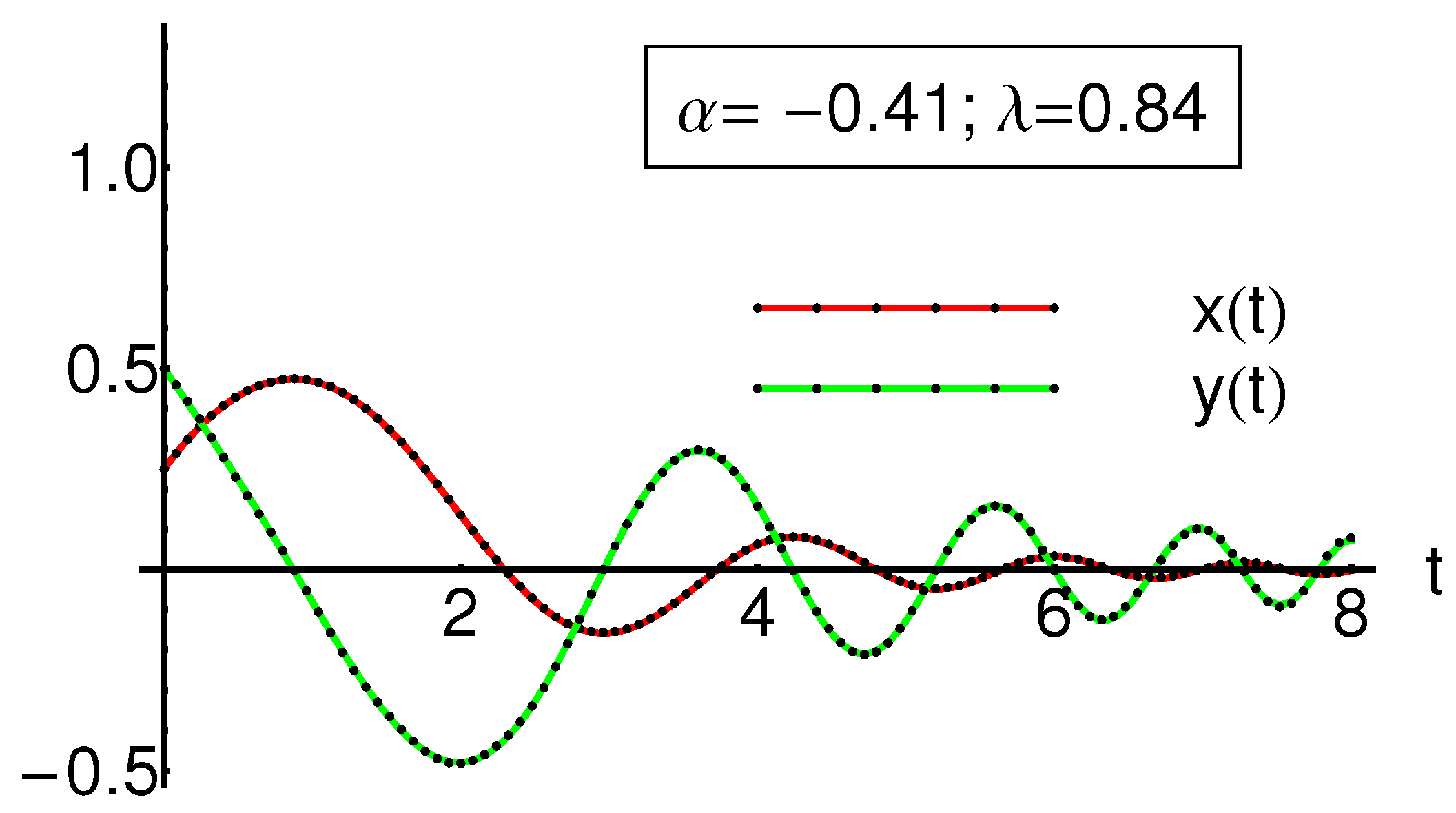
The solution of system (1) describes a damped oscillatory motion for the mentioned physical parameters.
The initial system (1) has the form
with , , where , , and are functions depending on some unknown parameters , , , and .
The operators , , respectively, from Equation (5) corresponding to unknown function are and , respectively.
Using the OAFM technique, a semi-analytical solution (based on Equation (12)) is written as
Similarly, and can be computed from Equation (7) using the linear operators and , being a linear combinations of the functions set:, .
For the first approximation the nonlinear operator becomes:
This expression contains a linear combination of functions set:
Here, the first approximation of the unknown function using the Equation (14), becomes
The auxiliary functions , can be defined as
or
The first approximation is built using the auxiliary functions defined by Equation (28) and by the integration of Equation (27):
with being an arbitrary fixed integer, and , , , , and being unknown convergence-control parameters depending on , , and will be optimally computed at the end.
Thus, the first-order approximate solution given by Equation (22) is well determined by Equations (24) and (29), via the OAFM technique, as
with , , as the convergence-control parameters.
Combining Equations (20) and (22), semi-analytical solutions for unknown functions and are obtained:
where is defined by Equation (30).
Case 2: Following [1], and such that is not an integer.
The initial system (1) is written as
where , , , , , , , are unknown parameters at this moment.
In the same manner, from Equation (5) corresponding to unknown function , the linear operator and nonlinear operator .
Using OAFM procedure, a semi-analytical solution has the same form as Equation (22).
Analogously, the initial approximations and can be obtained from Equation (7) using the linear operators and , having the form , .
The operator becomes
as a linear combination of the functions set
Now, the first approximation of the unknown function can be obtained using Equation (14) as
The auxiliary functions , are defined by
or
or
and so on, where , , are unknown parameters.
The function could be obtained using the auxiliary functions given by Equation (38) and by the integration of Equation (37):
where , , , , , are unknown convergence-control parameters, depending on physical parameters , , initial conditions and , , , , , , and will be optimally identified at the end.
Therefore, the function defined by Equation (22) is well determined by Equations (34) and (39), via the OAFM procedure, as
with , , and are the convergence-control parameters.
In the same manner, using Equations (20) and (40), the semi-analytical solutions for unknown functions and could be obtained.
Case 3: In accordance with [1], the physical parameters and are chosen such that , for saddle node.
3. Numerical Results and Validation
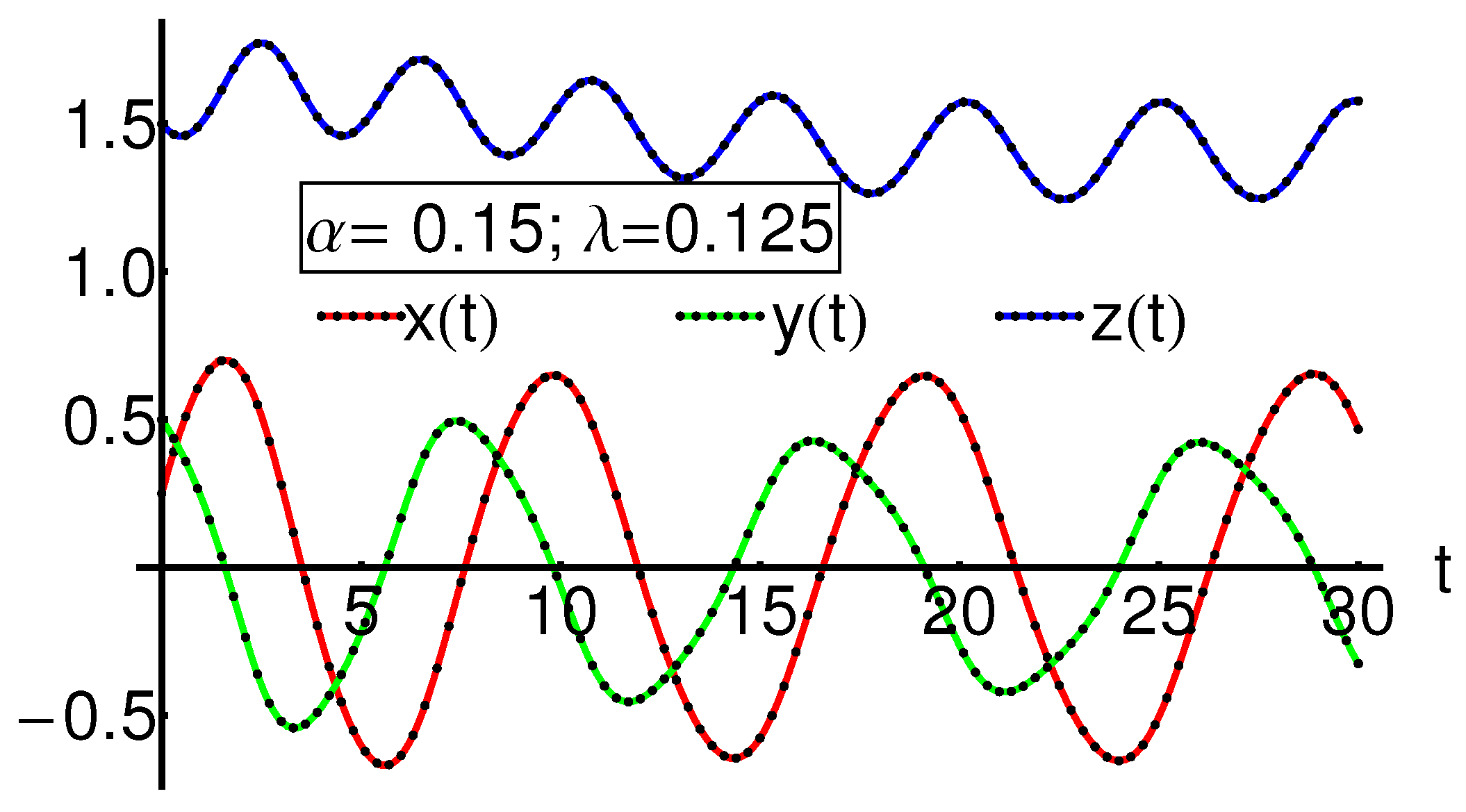
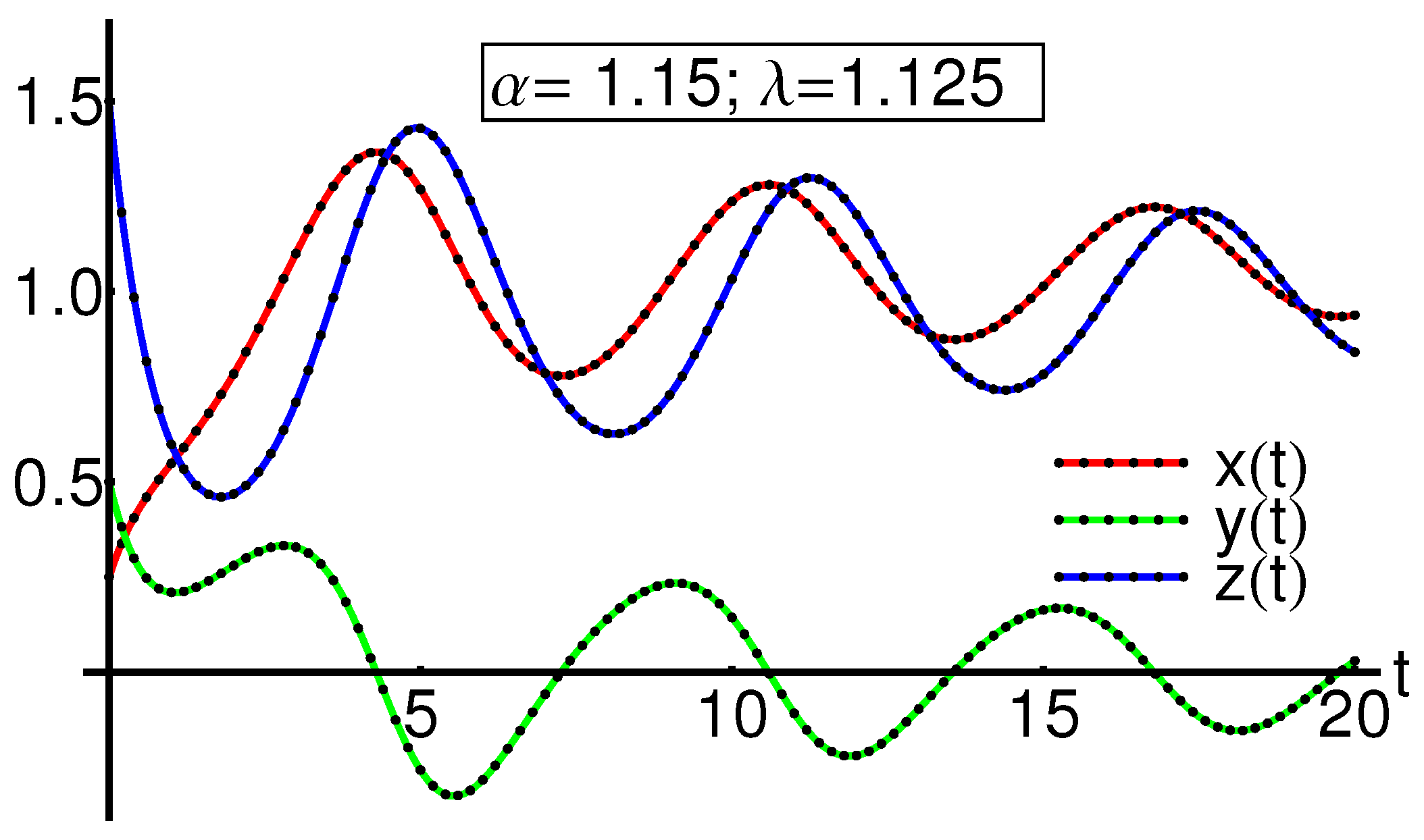
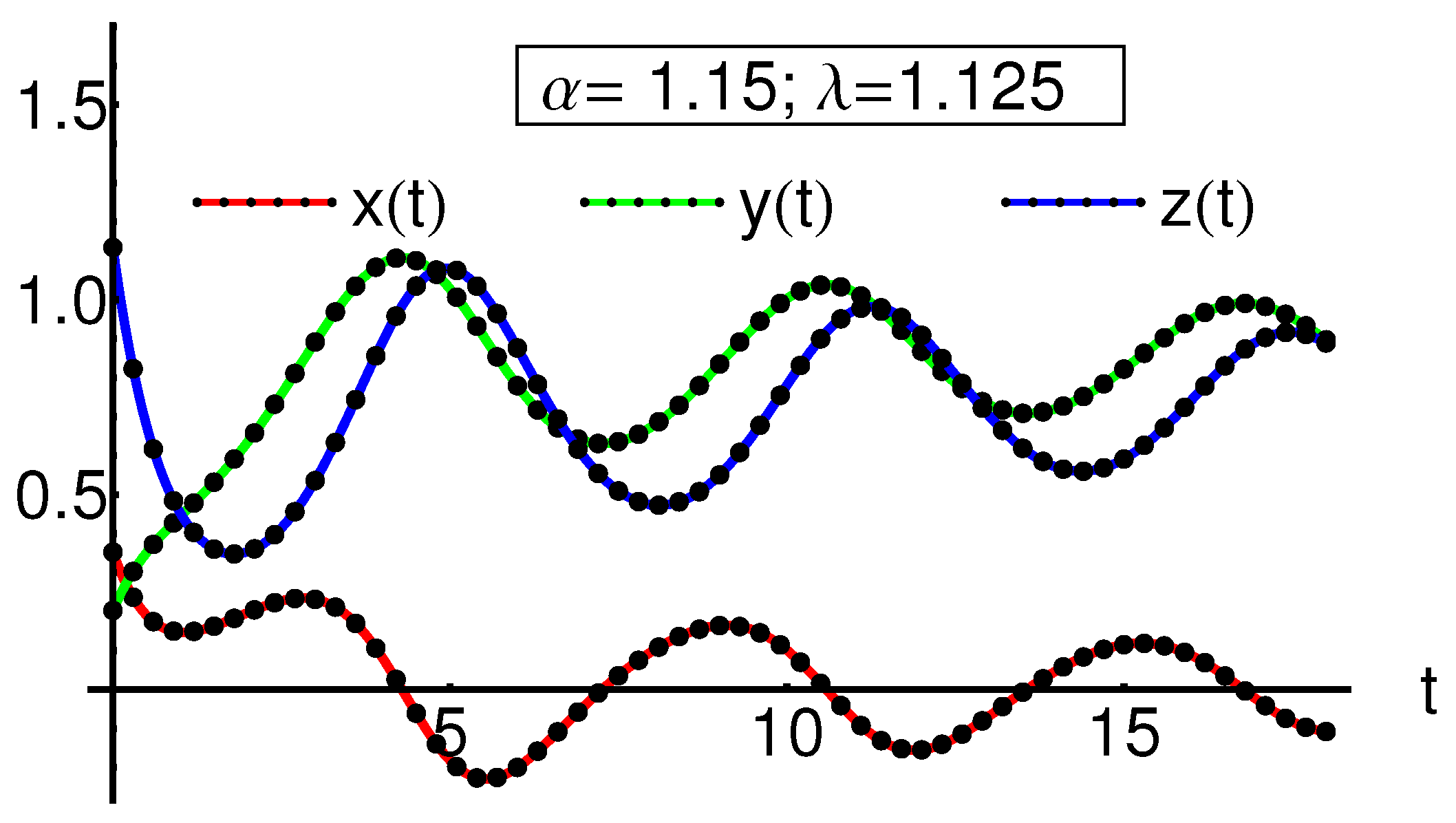
This section is dedicated to presenting the OAFM solutions for two mentioned cases. The comparison between OAFM solutions and the corresponding numerical ones for the given initial conditions and physical constants , is quantitatively detailed in Table 1 for , , in Table 2 for , , and Table 3 for , . The qualitative results are shown in Figure 1 for , , in Figure 2 for , , and in Figure 3 for , . The numerical results are computed via the fourth-order Runge–Kutta method. The absolute values denoted by highlight the accuracy of the obtained results in these tables.
These representations highlight a good agreement between the OAFM solutions and the states of the analyzed system, with the corresponding numerical solutions.
The last column of Table 1 and Table 2 shows the accuracy of the obtained results by the order of magnitude (–) for the absolute difference for: , , and specified physical parameters.
The physical parameters and are chosen to be positive such that the conditions for equilibrium point , mentioned in the Introduction are satisfied. If has negative values then the direction of time is changed, and the system (1) has only one equilibrium point in comparison with the three equilibria points for .
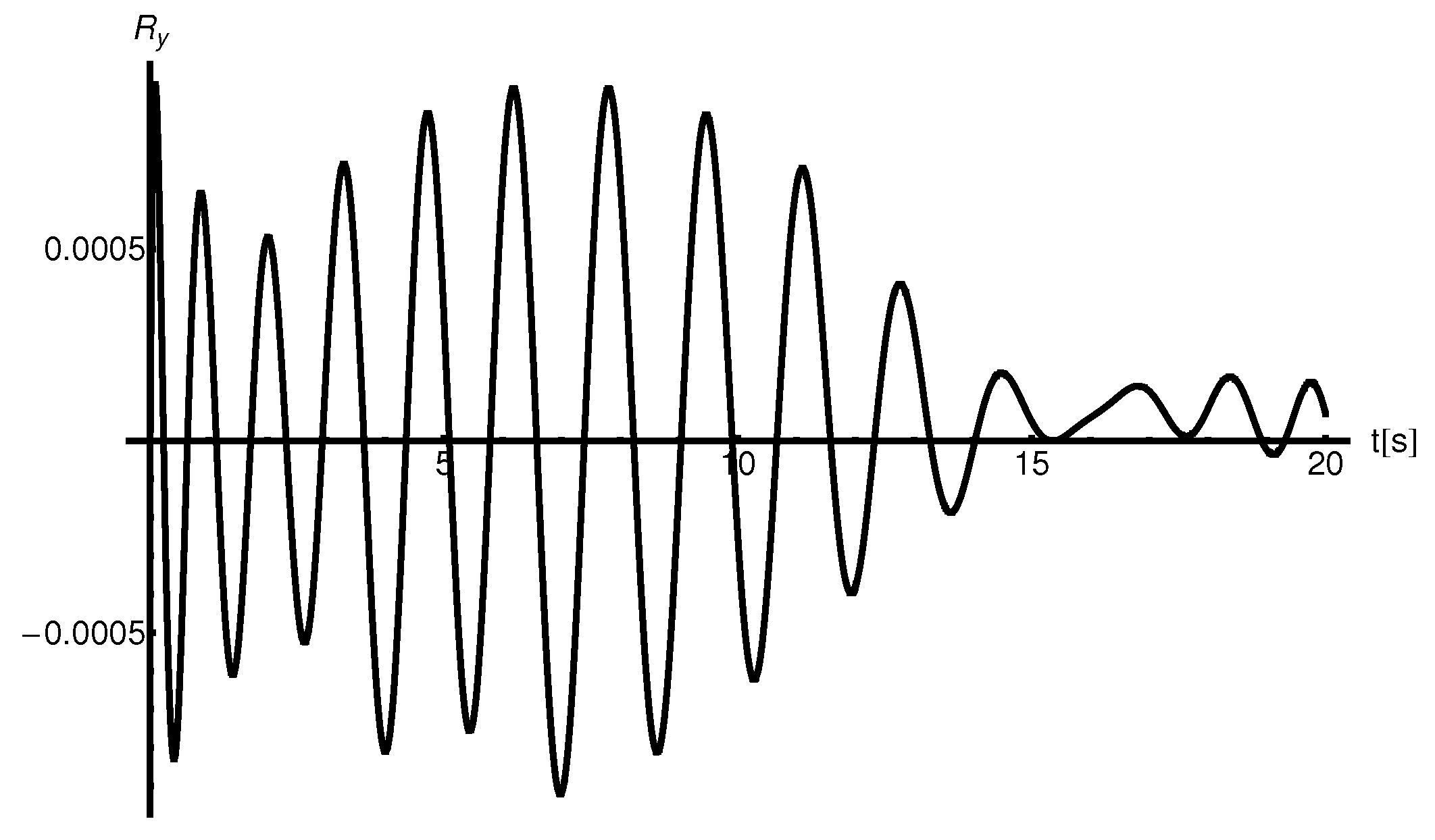
A representative variation of the residual function defined by
with , , and given by Equations (30) and (31) for and is presented in Figure 4.
Figure 4.
The variation of the residual function given by (41) for for , , , physical constants , .
The obtained numerical value for .
The amplitude of residual function decreases in time as it is shown in Figure 4.
A comparison between the Rucklidge system investigated in [19] and the Shimizu–Morioka system analyzed in the present work is highlighted below.
While in [19], they considered the parameters , , in this comparative analysis, we treat the particular case of the Rucklidge system with , , . Using the transformation given in [1] just for , , both systems are equivalent. As it is shown in Figure 5, the OAFM semi-analytical solutions are close.
Figure 5.
Rucklidge (solid curves) versus Shimizu–Morioka (dotted curves) OAFM solutions for: , , , physical parameters: , (solid curves: red for , green curve for , blue for ).
For the Rucklidge-type dynamical system, the physical parameters a, b, c, and d are strictly positive (see [1]), but for the Shimizu–Morioka system the parameter can be negative (Case 3 presented in Section 2). This negative value for yields a negative value for parameter a of the Rucklidge system, and it is the studied subject in this section.
OAFM Technique Versus the Iterative Method
The choice of the OAFM method is justified by the comparison between the obtained results via the OAFM technique and the analytical solution obtained with the iterative method.
The iterative method developed by Daftardar-Gejji et al. [20] is proposed for solving nonlinear functional equations. This method is validated just for a special class of nonlinear functional equations with known exact solutions.
A simple integration of the system (1), yields
The iterative scheme leads to
The iterative solution generates the solution of Equations (1) as
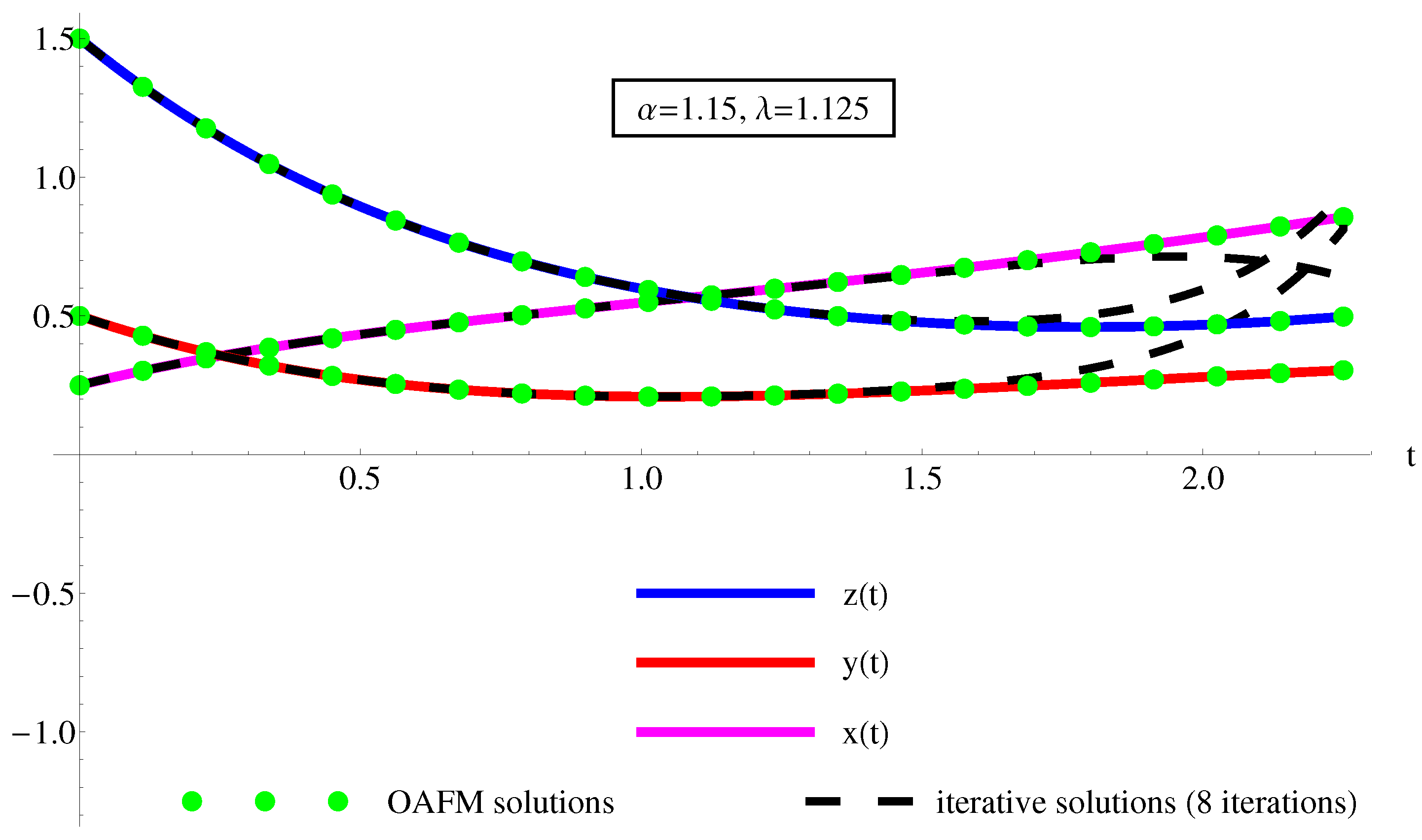
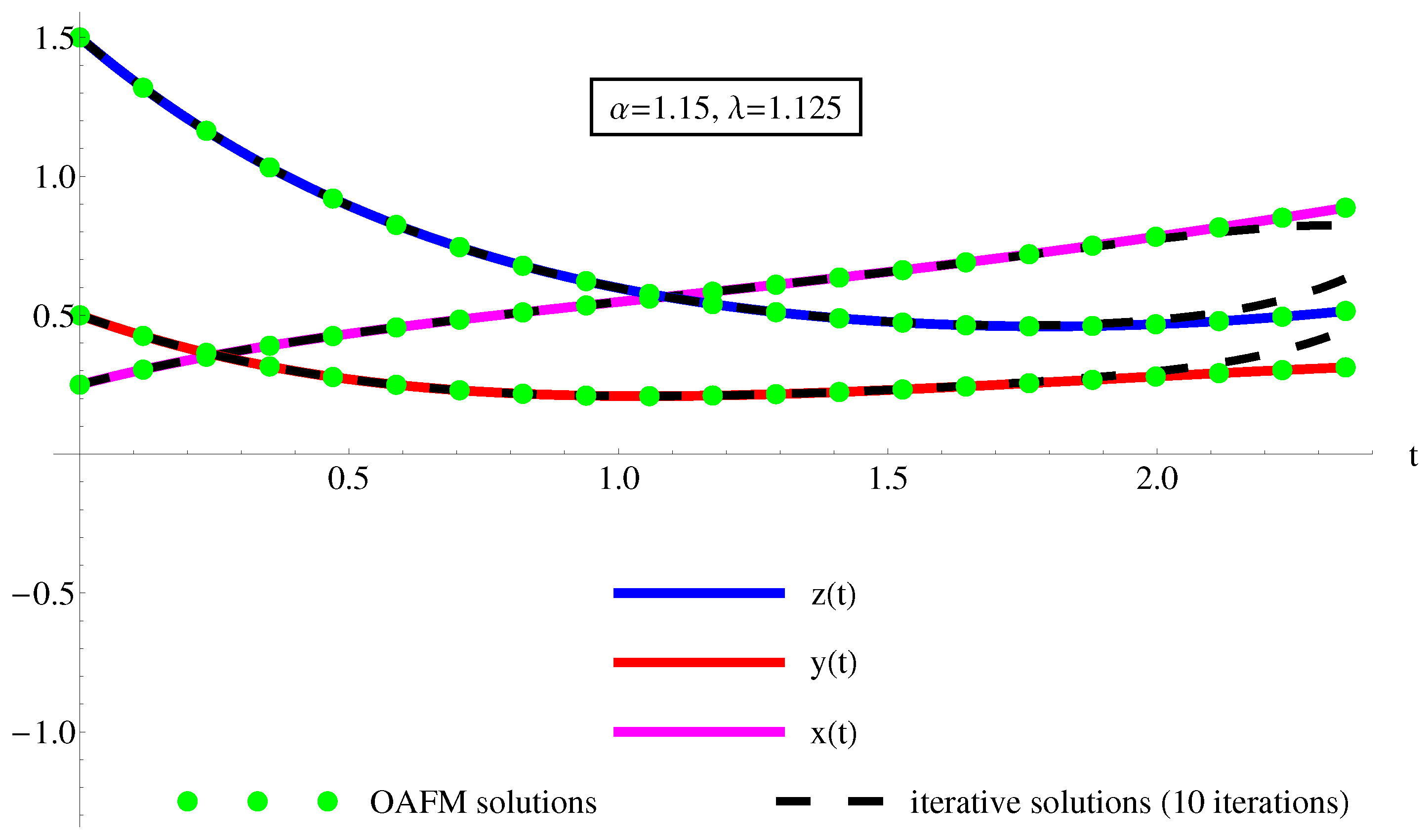
The iterative solutions , after eight iterations using algorithm (43), for the initial data , , and physical parameters , (presented in Table 4 and Table 5), are built:
Table 4.
The comparative values of the numerical solution, OAFM solution using (A1) and the iterative solution .
Table 5.
The comparative values of the numerical solution, OAFM solution using (A1) and the iterative solution .
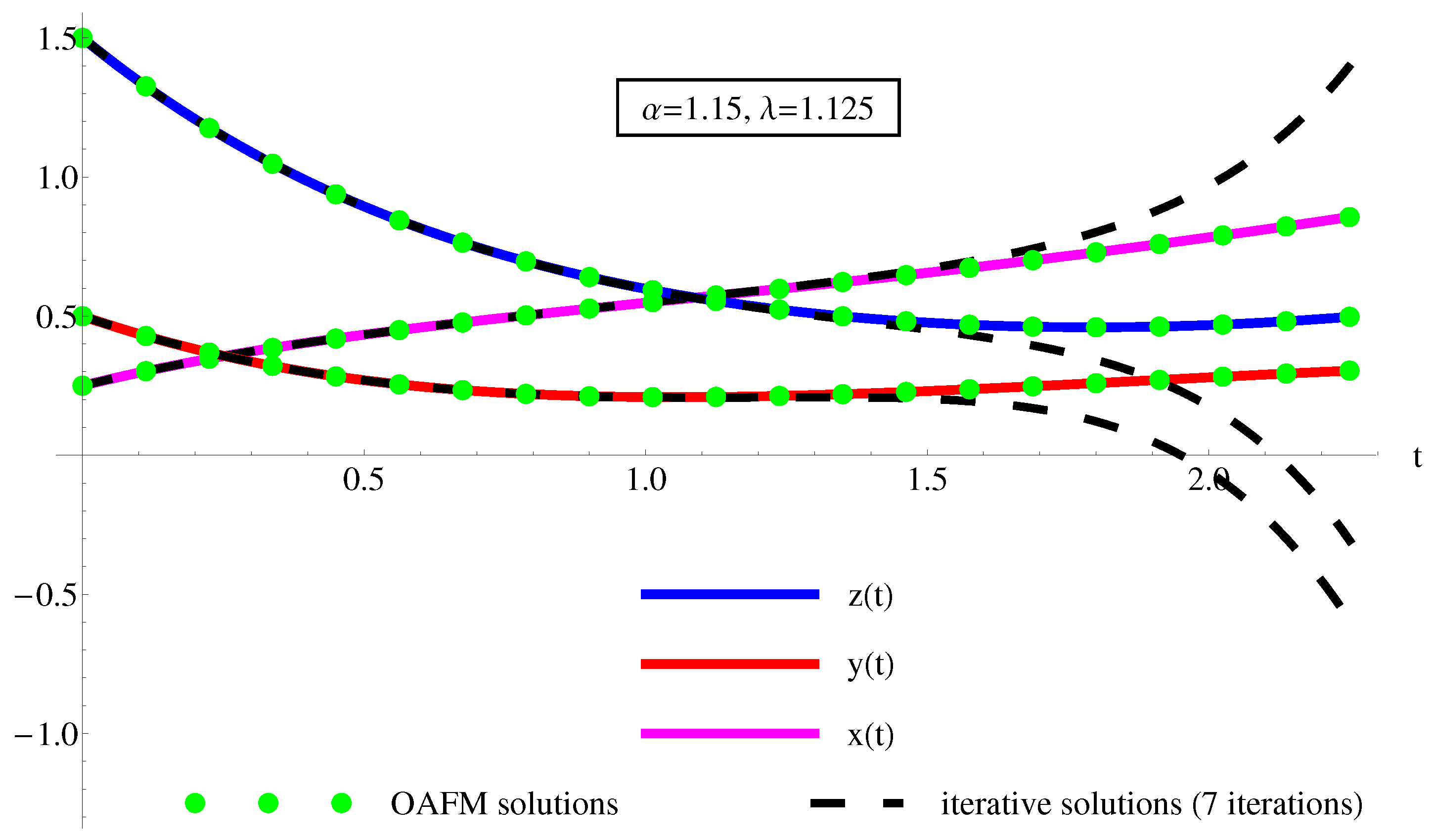
The performance of the OAFM method is comparative to the iterative method (using 7–10 iterations) results from Table 4 and Table 5 and Figure 6, Figure 7 and Figure 8. By analyzing these results, it is clear that by increasing the number of iterations, the performance of the iterative method becomes competitive to the OAFM method.
Figure 6.
The accuracy of the semi-analytical solutions , , of Equation (1) using Equation (A1) (dotted green curves), by comparison with the iterative solutions (7 iterations) , , using Equation (44) (dashing black curves) and the corresponding numerical ones (solid color curves: magenta for , red for , and blue for ), respectively.
Figure 7.
The accuracy of the semi-analytical solutions , , of Equation (1) using Equation (A1) (dotted green curves), by comparison with the iterative solutions (8 iterations) , , using Equation (44) (dashing black curves) and the corresponding numerical ones (solid color curves: magenta for , red for , and blue for ), respectively.
Figure 8.
The accuracy of the semi-analytical solutions , , of Equation (1) using Equation (A1) (dotted green curves), by comparison with the iterative solutions (10 iterations) , , using Equation (44) (dashing black curves) and the corresponding numerical ones (solid color curves: magenta for , red for , and blue for ), respectively.
4. Conclusions
This article demonstrated damped oscillations behaviors for solutions of the Shimizu–Morioka dynamical system using the OAFM approach. The dynamics of the system is influenced by values of the physical parameters and .
A good agreement between the OAFM results and the corresponding numerical ones are highlighted in this work. The comparative analysis reflects the accuracy of the method; the obtained solutions are approaching the exact solution.
OAFM solutions are built for the chosen values for the physical parameters , such that the asymptotic stability of equilibrium point is satisfied, e.g., , , . In this work are presented in detail two cases corresponding to (i) , arbitrarily chosen, and (ii) , where is not an integer number.
The advantages of the OAFM method comparative to other analytical methods are synthesized by the following:
- The arbitrary choice of the linear operator L and auxiliary functions allows writing the OAFM solution in effective form;
- The convergence control is ensured by the residual functions being smaller than 1);
- The comparison between the OAFM solutions with the iterative corresponding using 7, 8, 10 iterations highlights the efficiency of the OAFM method by arbitrarily choosing the auxiliary functions and optimally finding the unknown parameters.
Author Contributions
Conceptualization, N.P.; formal analysis, N.P.; investigation, R.-D.E. and R.B.; methodology, R.-D.E., R.B. and N.P.; software, R.-D.E. and R.B.; supervision, N.P.; validation, R.-D.E., R.B. and N.P.; visualization, R.-D.E., R.B. and N.P.; writing—original draft, R.-D.E., R.B. and N.P. All authors have read and agreed to the published version of the manuscript.
Funding
This research received no external funding.
Data Availability Statement
The original contributions presented in this study are included in the article. Further inquiries can be directed to the corresponding author.
Acknowledgments
The authors would like to acknowledge the contribution of the COST Action Dynalife CA21169, supported by COST (European Cooperation in Science and Technology.
Conflicts of Interest
The authors declare no conflicts of interest.
Appendix A
Example A1.
Example A2.
Example A3.
References
- Huang, K.; Shi, S.; Li, W. Integrability analysis of the Shimizu-Morioka system. Commun. Nonlinear Sci. Numer. Simulat. 2020, 84, 105101. [Google Scholar] [CrossRef]
- Chen, Z.; Wen, G.; Zhou, H.; Chen, J. A new M × N-grid double-scroll chaotic attractors from Rucklidge chaotic system. Optik 2017, 136, 27–35. [Google Scholar] [CrossRef]
- Lorenz, E.N. Deterministic nonperiodic flow. J. Atmos. Sci. 1963, 20, 130–141. [Google Scholar] [CrossRef]
- Shimizu, T.; Morioka, N. On the bifurcation of a symmetric limit cycle to an asymmetric one in a simple model. Phys. Lett. A 1980, 76, 201–204. [Google Scholar] [CrossRef]
- Rucklidge, A.M. Chaos in models of double convection. J. Fluid Mech. 1992, 237, 209–229. [Google Scholar] [CrossRef]
- Wei, Z.; Zhang, X. Chaos in the Shimizu-Morioka Model with Fractional Order. Front. Phys. 2021, 9, 636173. [Google Scholar] [CrossRef]
- Pyragas, V.; Pyragas, K. Modification of delayed feedback control using ergodicity of chaotic systems. Lith. J. Physics 2010, 50, 305–316. [Google Scholar] [CrossRef]
- El-Dessoky, M.M.; Yassen, M.T.; Aly, E.S. Bifurcation analysis and chaos control in Shimizu-Morioka chaotic system with delayed feedback. Appl. Math. Comput. 2014, 243, 283–297. [Google Scholar] [CrossRef]
- Hajiloo, R.; Salarieh, H.; Alasty, A. Chaos control in delayed phase space constructed by the Takens embedding theory. Commun. Nonlinear Sci. Numer. Simulat. 2018, 54, 453–465. [Google Scholar] [CrossRef]
- Dong, C.; Lian, J.; Qi, J.; Hantao, L. Symbolic Encoding of Periodic Orbits and Chaos in the Rucklidge System. Complexity 2021, 2021, 4465151. [Google Scholar] [CrossRef]
- Zhang, X. Stability and bifurcation analysis for a delayed Shimizu-Morioka model. Miskolc Math. Notes 2019, 20, 585–598. [Google Scholar] [CrossRef]
- Llibre, J.; Pessoa, C. The Hopf bifurcation in the Shimizu-Morioka system. Nonlinear Dyn. 2015, 79, 2197–2205. [Google Scholar] [CrossRef]
- Lazureanu, C.; Cho, J. On the dynamics of a deformed version of the Shimizu-Morioka system. Sci. Bull. Politeh. Timis. Trans. Math. Phys. 2021, 66, 3–28. [Google Scholar]
- Tarammim, A.; Akter, M.T. Shimizu-Morioka’s chaos synchronization: An efficacy analysis of active control and backstepping methods. Front. Appl. Math. Stat. 2023, 9, 1100147. [Google Scholar] [CrossRef]
- Marinca, V.; Herisanu, N. Approximate analytical solutions to Jerk equation. In Springer Proceedings in Mathematics & Statistics: Proceedings of the Dynamical Systems: Theoretical and Experimental Analysis, Lodz, Poland, 7–10 December 2015; Springer: Cham, Switzerland, 2016; Volume 182, pp. 169–176. [Google Scholar]
- Marinca, V.; Ene, R.-D.; Marinca, V.B. Optimal Auxiliary Functions Method for viscous flow due to a stretching surface with partial slip. Open Eng. 2018, 8, 261–274. [Google Scholar] [CrossRef]
- Ene, R.-D.; Pop, N.; Lapadat, M. Approximate Closed-Form Solutions for the Rabinovich System via the Optimal Auxiliary Functions Method. Symmetry 2022, 14, 2185. [Google Scholar] [CrossRef]
- Ene, R.-D.; Pop, N.; Lapadat, M.; Dungan, L. Approximate closed-form solutions for the Maxwell-Bloch equations via the Optimal Homotopy Asymptotic Method. Mathematics 2022, 10, 4118. [Google Scholar] [CrossRef]
- Ene, R.-D.; Pop, N.; Badarau, R. Exact Parametric and Semi-Analytical Solutions for the Rucklidge-Type Dynamical System. Mathematics 2025, 13, 2052. [Google Scholar] [CrossRef]
- Daftardar-Gejji, V.; Jafari, H. An iterative method for solving nonlinear functional equations. J. Math. Anal. Appl. 2006, 316, 753–763. [Google Scholar] [CrossRef]
Disclaimer/Publisher’s Note: The statements, opinions and data contained in all publications are solely those of the individual author(s) and contributor(s) and not of MDPI and/or the editor(s). MDPI and/or the editor(s) disclaim responsibility for any injury to people or property resulting from any ideas, methods, instructions or products referred to in the content. |
© 2025 by the authors. Licensee MDPI, Basel, Switzerland. This article is an open access article distributed under the terms and conditions of the Creative Commons Attribution (CC BY) license (https://creativecommons.org/licenses/by/4.0/).