1. Introduction
The study of the nonexistence of classical solutions of the Dirichlet problem
when
Q is a second-order elliptic partial differential operator and
has a rich history (e.g., [
1] (§ 14.4), [
2] (§ 406–416), [
3,
4,
5]). When
is discontinuous at
a classical solution
of (
1) cannot exist; one example is the helicoid
which satisfies the two-dimensional Laplace and minimal surface equations in
(
) and is a generalized (e.g., Perron) solution of the corresponding Dirichlet problems (e.g., [
2]). Classical Phragmen–Lindeloff theorems imply that solutions of linear, uniformly elliptic equations which have jump discontinuities at points of the boundary and are bounded or satisfy growth conditions near these points of discontinuity have radial limits at these points (e.g., [
6,
7]). Solutions of prescribed mean curvature equations with jump discontinuities at points on
when
is a domain in
have radial limits at these points without imposing any growth or boundedness conditions (e.g., [
8,
9]).
If we eliminate the restriction that
has jump discontinuities at points on
what can be said about the “contour limits” at
of a generalized solution of (
1)? Here, by “contour limits”, we mean limits along curves (or types of curves) which have
P as an endpoint, such as radial limits, tangential limits or nontangential limits. When, for example,
is a unit ball in
and
f is a generalized solution of (
1) which has an asymptotic value
a at
we see that
a is a contour limit of
f at
thus, asymptotic values can be considered as a special case of contour limits (e.g., [
10,
11,
12]). There are, for example, numerous examples of the existence or nonexistence of different types of contour limits for harmonic functions (e.g., [
13,
14,
15]). For the minimal surface equation on
there are generalized solutions of (
1) for which none of the radial limits exist at a specified point
([
16]). The construction of such examples can often be characterized as using a “gliding hump technique” (e.g., [
17]). Gliding hump techniques work by constructing a sequence (in this case, a sequence of solutions of (
1)) with certain properties and by showing that the assumption that the limit of this sequence has a specific property leads to a contradiction. Of course, in these gliding hump examples, the boundary data
is highly oscillatory at
P (e.g., like
). Some recent articles on the Dirichlet problem allowing highly oscillatory boundary data
or highly oscillatory coefficients
(in (
4)) are ([
18,
19]); other recent articles on elliptic boundary value problems involve inverse problems ([
20]), capillary hypersurfaces in a wedge ([
21]) and the Dirichlet problem of translating mean curvature equations ([
22]).
In this study, we first investigate a slight modification of the gliding hump technique used in [
16] and consider its application to generalized solutions of (
1) when
Q is a quasilinear elliptic operator on
which may not be uniformly elliptic. When
is convex, we construct examples of generalized solutions
of (
1) such that for any curve
in
ending at
the limit of
f at
P along
does not exist (see Theorem 1). In the cases under consideration, the structure of the operator and the geometry of the domain play critical roles; in particular, barriers for (
1) at a point
may only exist if
is locally convex at
P (e.g., [
1] (Chapter 14)) or mean convex ([
23]). Second, we consider domains
which have a nonconvex corner at a point
and operators
Q which have a well-defined
genre g (see Definition 3). In 1912, Sergei Bernstein ([
24]) expressed the degree of nonlinearity of a quasilinear elliptic partial differential equation through the concept of “genre”, and Jim Serrin extended this concept in their monumental 1969 paper [
5]. Using comparison functions from [
5,
25,
26] and assuming that
we shall prove that for any generalized solution
of (
1) whose graph has finite area, there exist infinitely many paths
of finite length in
ending at
P such that the limit of
f at
P along
exists (see Theorem 3). Third, if we assume
has a jump discontinuity at
P and
Q is an operator with
then we obtain this same conclusion without assuming
has a nonconvex corner at
P (see Theorem 4).
The significance of this work is its examination of the question “How might a bounded generalized solution of (
1) behave at (or near) a point
when
is discontinuous at
P?” as well as its illustration of the importance of the geometry of
(i.e., do local barriers for (
1) exist at and near
P), the genre of
Q and the type of discontinuity of
at
One question of interest is “Does there exist a connection between the existence of radial limits of
f at
P and the existence of any contour limit of
f at
P?” Is there any way of constructing a bounded generalized solution
f of (
1) which does not have radial limits at
P and is fundamentally different than that in
Section 2?
3. Nonconvex Corners
The existence of the radial limits at
of
when
is a locally Lipschitz open set in
and
f is a solution of a prescribed mean curvature equation (with mean curvature
H) for various choices of
H (and Dirichlet or contact angle boundary conditions) was first established by the second author for
(e.g., [
2] (§ 416)) and extended to general
H in [
8] (see also [
33,
34]). These results assume the boundary data satisfies certain conditions; for example, in Dirichlet problems, the prescribed boundary data
have, at worst, a jump discontinuity at
The proofs of these results follow the pattern in [
8] of proving that a conformal parameterization of the graph of
f is continuous on the closure of the parameter domain and using [
35] to establish the Hölder continuity on
of the first derivative of the parameterization (for an appropriate
) and then prove that the radial limits exist.
An initial part of the proofs above consists of the following argument. Suppose that and has finite area For our purposes, we may assume is a simply connected set. Let be an isothermal (i.e., conformal) parameterization of so that where For let and be the length of the image curve The Courant–Lebesgue Lemma asserts that for each there exists a number so that where
The “Fundamental Lemma” ([
36] (Lemma 3.1)) used above plays a critical role:
Lemma 1 (Courant–Lebesgue Lemma)
. In a domain B of the —plane, consider the class of piecewise smooth vectors X for which the Dirichlet integral is uniformly bounded by a constant About an arbitrary fixed point O, we draw circles of radius Denote by an arc or set of arcs of such a circle contained in by s arclength on Then for every positive there exists a value depending on with such thattending to zero for Furthermore, the square of the length of the image of in —space has the bound i.e., the oscillation of on is at most Recall that
where
is the surface area of the image
of
and
if the surface
is represented in conformal (i.e., isothermal or isometric) coordinates ([
36] (§ 3.1)).
In [
9], the proofs above (of, for example, [
8]) are modified to prove that if
has a “reentrant” (i.e., nonconvex) corner at
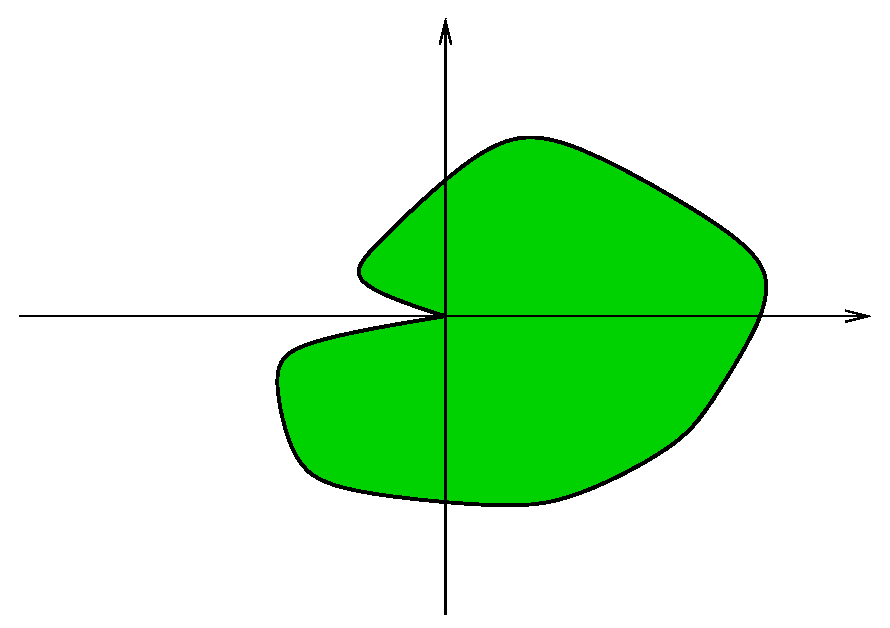
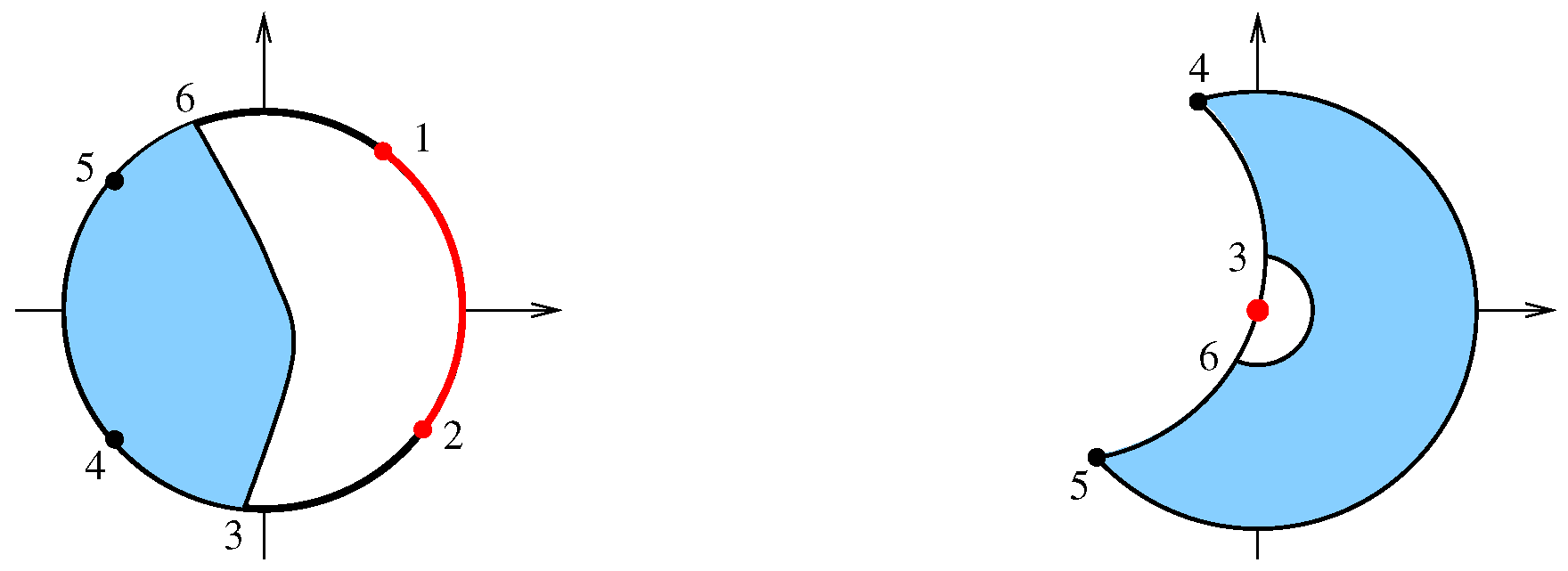
(e.g.,
Figure 1), then the nontangential radial limits at
P of
f exist without regard to the restrictions on the boundary data noted above. To see that the conformal parameterization of the graph of
f is continuous on the closure of the parameter domain, one uses the Courant–Lebesgue Lemma as noted and particular comparison functions, specifically catenoids for
and unduloids for
to control the oscillation of the third component of
Y and prove that
Y is uniformly continuous on
This topic was investigated further, illustrated in [
37] (Example 1.4) (see also [
38]) (p. 430) when
Q is the minimal surface operator on
and
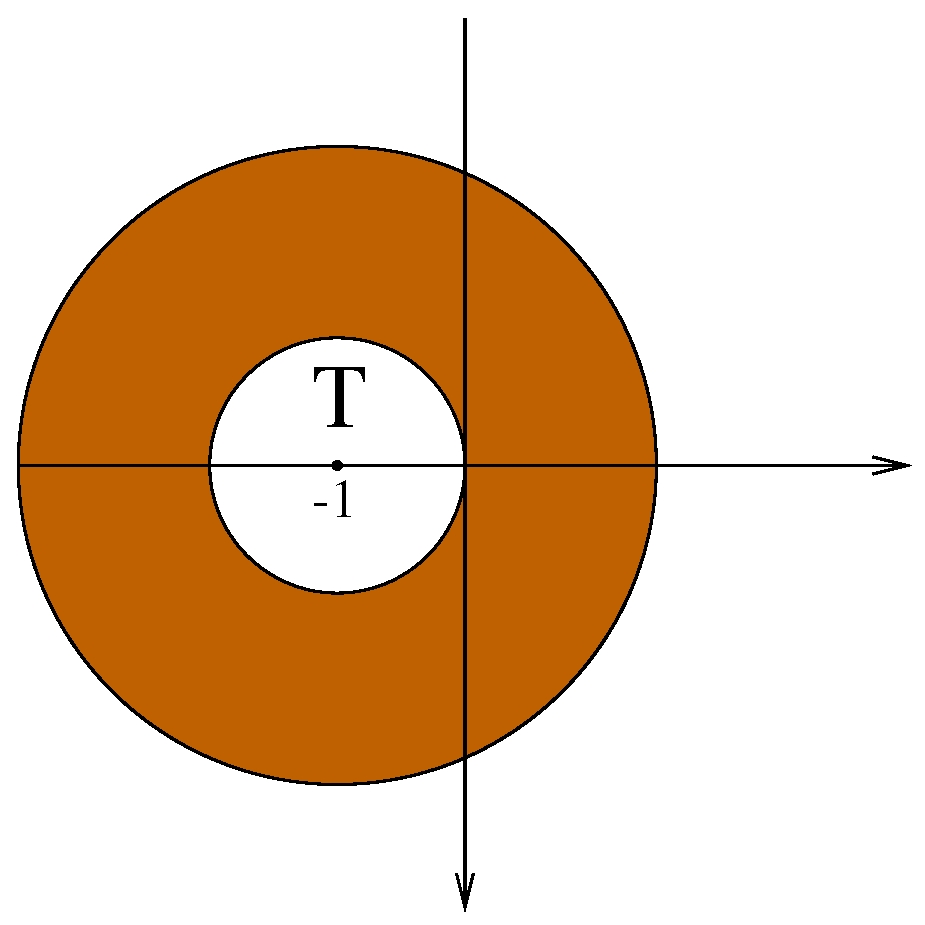
(see
Figure 2). In this case,
is not locally convex at any point of the inner boundary
of
and
f need not equal
on
Standard results (e.g., [
38] (Theorem 3)) show that
To see that
Y is continuous on the closure of the parameter domain, one works in a neighborhood
U of
P and uses “Bernstein functions” ([
37] (Lemma 2.3)) to control the oscillation of the third component of the conformal parameterization of the graph of
f restricted to
(a catenoid would have worked just as well for this particular example). The continuity of
f at
P then follows from the symmetry of the problem.
A brief discussion of the use of catenoids and unduloids as comparison functions in [
9] may help illustrate the use of comparison functions in Theorems 2 and 3. In [
9], nothing (except boundedness) is known about the behavior of
f (or
) on
, and it is necessary to avoid
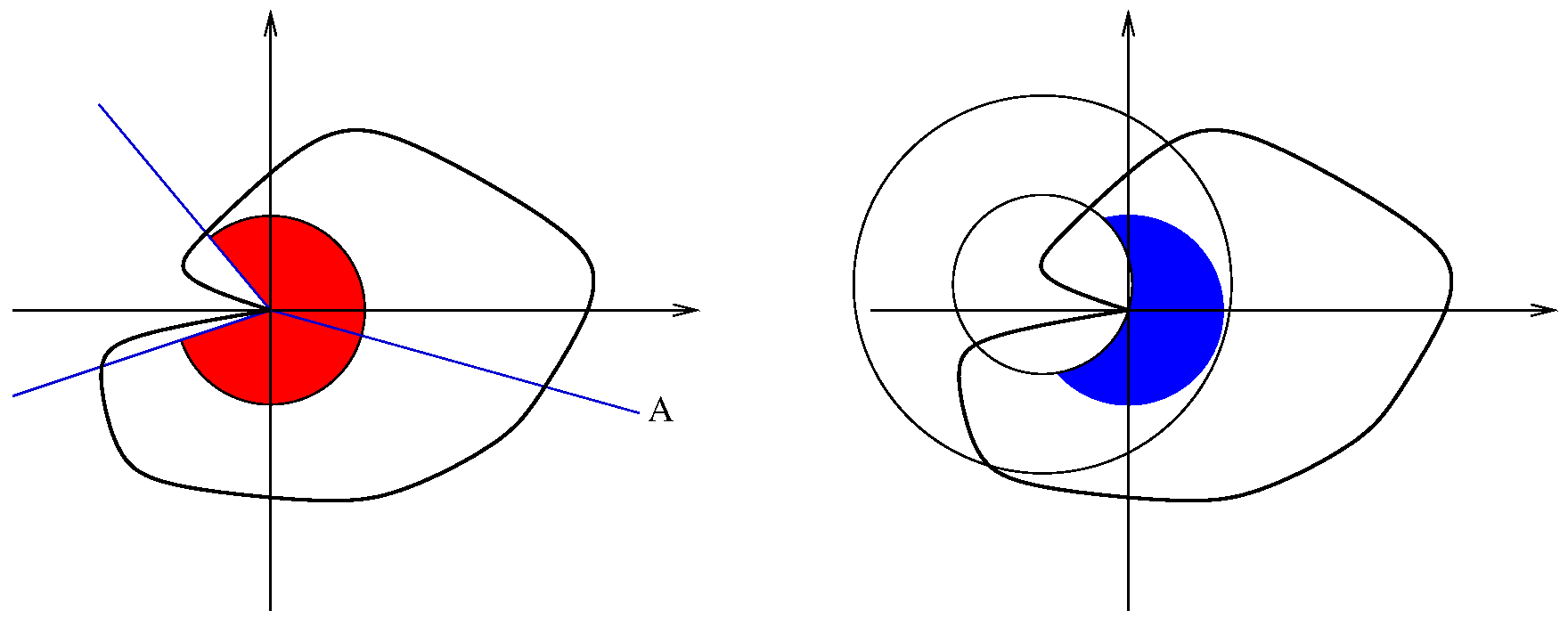
Thus, we restrict our attention to a subdomain
of
such as those illustrated in
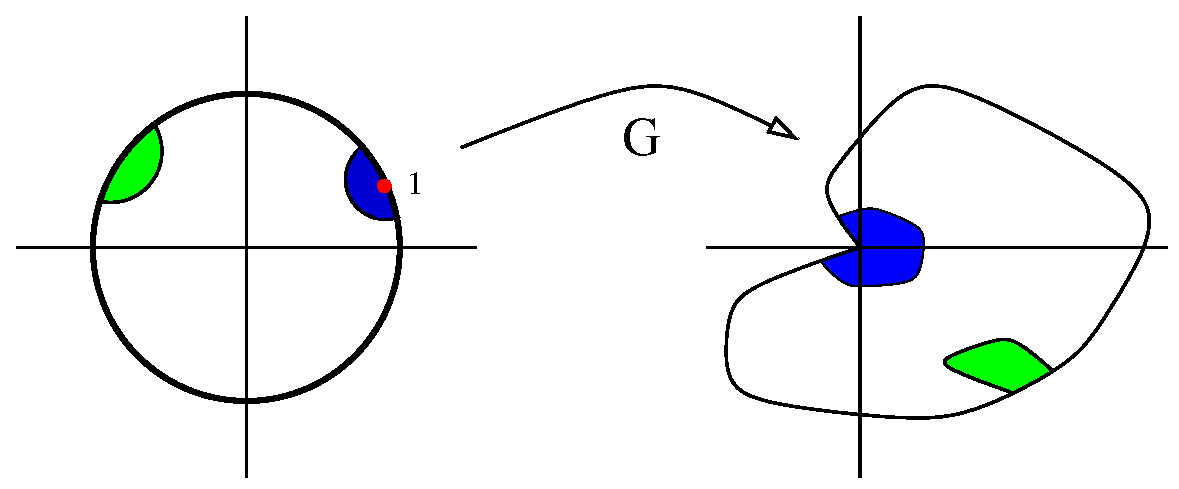
Figure 3 (right) and
Figure 4 (right). If
is the isothermal parameterization of the graph of
f over
with
and
then the oscillation of
z on the curves
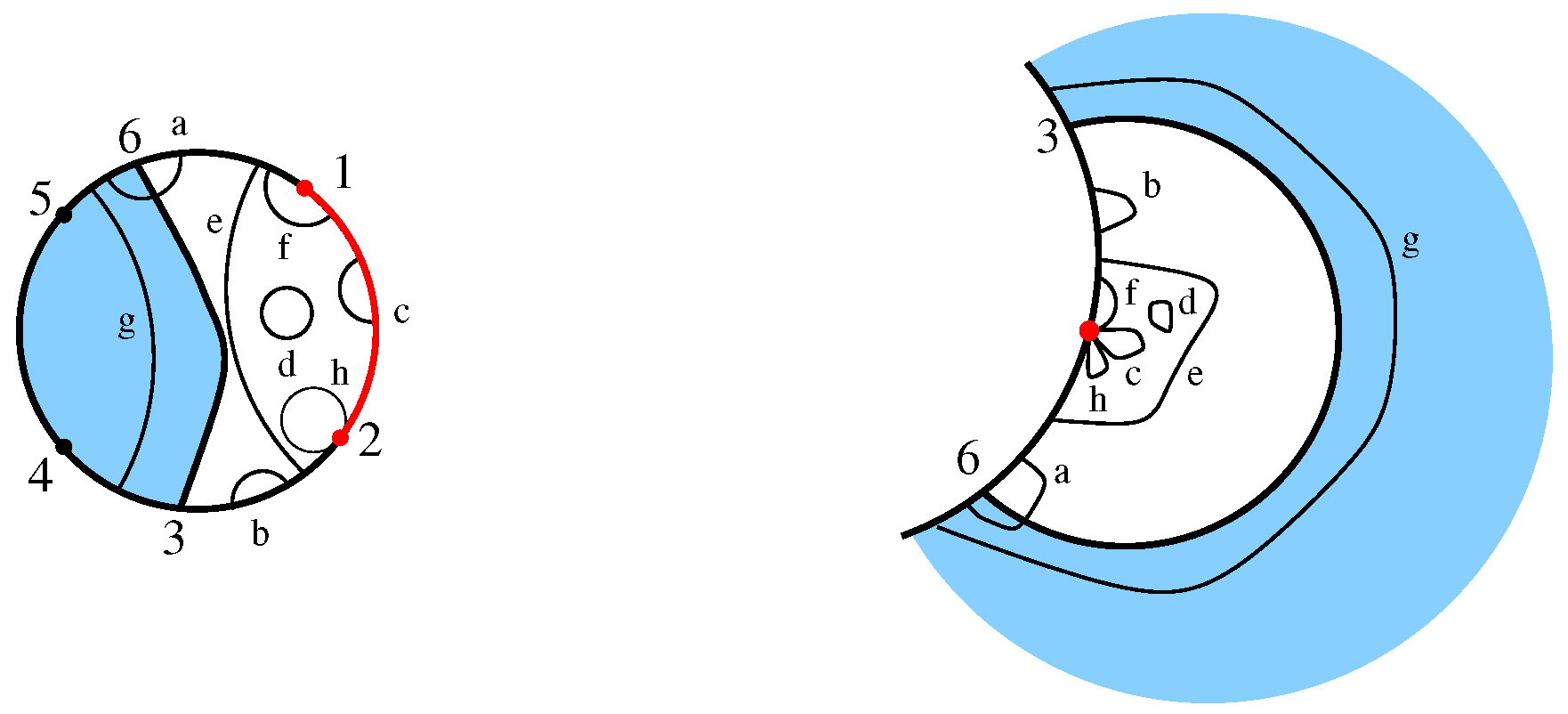
labeled a through g in
Figure 4 (left), is controlled by the Courant–Lebesgue Lemma. If
m and
M are the infimum and supremum of
z on
then [
1] (Theorem 14.10) implies
in the region
between
and
where the graphs of
are appropriate catenoids in [
9]. Since we have uniform control of
in
we see that
z and
Y are uniformly continuous on
Assuming that the use of catenoids or unduloids as comparison functions could be replaced by different comparison functions for (
2) (e.g., [
37]), this argument depends solely on the assumption that the area of the graph of the solution of (
2) is finite. So suppose that there exist numbers
and functions
such that the graph of
makes a contact angle of zero with the cylinder
and the graph of
makes a contact angle of
with the cylinder
where
and
Suppose further that
for
and
for
where
and
for
These functions
are “Bernstein (comparison) functions” and they are necessary to prove the existence of contour limits (see Remark 4); they will play a critical role in the remainder of this article (see [
1] (p. 357) for a brief discussion of such comparison functions).
In contrast to Theorem 1, we claim the following:
Theorem 2. Suppose is an open set, and there exist and such that where (see Figure 3 (left)). Suppose there exist comparison functions for (2) as described above. Let satisfy (2) such that the area of the graph of f is finite. Then there exist (infinitely many) paths γ of finite length in Ω ending at P along which f has a limit at Proof. We may assume
and
Set
and let
be the area of
Choose
such that
and set
for some
(see
Figure 3 (right)). Let
then the area
of
satisfies
Now
consists of three pieces, which are
and the two components of
notice that
and so
There exists an isothermal (conformal) parameterization
of
that is,
Y is a diffeomorphism of
E and
on
on
and
where
is the Dirichlet integral of
Let us write
and set
for
so
on
E and
Then
G extends to a function in
G is a diffeomorphism of
E and
the preimage under
G of
is an open, connected arc
of
and
G is a homeomorphism of
and
(see the proof of [
8] (Lemma 2.1)).
We claim that Y is uniformly continuous on E and so extends to a function This only requires that we prove that the third component of Y is uniformly continuous on We shall let denote the set of continuous, strictly increasing functions from the nonnegative reals to the nonnegative reals which are zero at zero; moduli of continuity will be chosen in this class.
Set
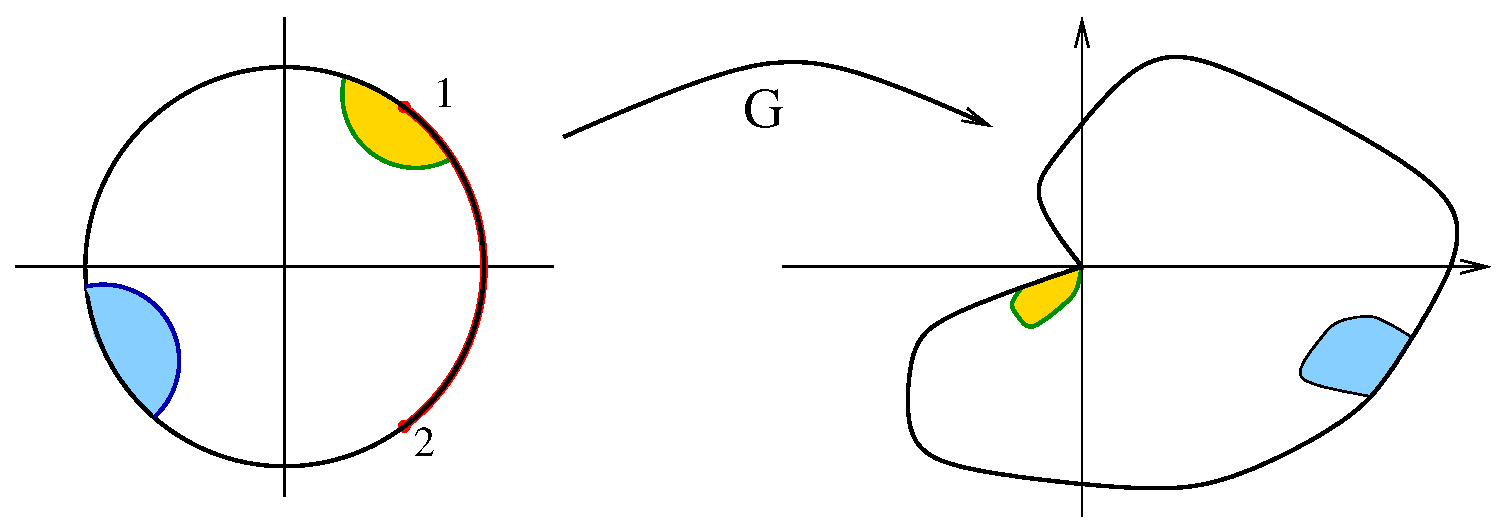
(see
Figure 5, where
is the (shorter) arc joining points labeled 1 and 2). Now
hence
, and so there exists
such that
when
Since
for each
there exists
such that
whenever
For let and be the length of the image curve as before. Let and Let and then on and on Further and for
Let
Choose
such that
and
Let
From the Courant–Lebesgue Lemma, there exists
such that
There are two possibilities: (i)
and (ii)
Consider case (i) first. Then
and so, for
Now we consider case (ii). Let ( may not be in ) and set Then there exists a point Setting we have and so and Thus,
Then the types of possible curves
and their images
are illustrated in
Figure 4 and are as follows: (1)
is a closed curve with
(labeled c, h in
Figure 4), (2)
is a curve joining
P to a point on
(labeled f in
Figure 4), (3)
is a curve joining a point on
to another point on
(labeled a, b, e, g in
Figure 4) and (4)
is a closed curve and
(labeled d in
Figure 4).
Notice that
for
Using the “Bernstein comparison argument” (e.g., [
1] (Theorem 14.10), [
5] (Theorem 15.1)), we then see that
for
Now
and
Thus, lies in a strip of width less than and so Thus, is uniformly continuous on E and so extends to a function
Now if is a single point on then and so f has a limit at P along every path in ending at Suppose is an arc of of positive length. Then exists for every path which ends at a point Since we see that the paths are finite length paths in with P as an endpoint and along which f has a limit at P of . □
Remark 3. From case (ii) in the proof of Theorem 2, we let be an open subset of E such that then can be shown to be uniformly continuous on (i.e., [26] (Theorem 4) allows one to prove that (6) holds). Remark 4. When Q is a uniformly elliptic operator, Bernstein (comparison) functions do not exist. If they did exist, they could be used to prove, for example, that the harmonic function f defined in the unit disc byand vanishing at every point of the unit circle except is bounded, even though as ([26] (p. 166)). (When Q is uniformly elliptic on one can argue as in [6] (p. 1180) (after freezing coefficients if Q is not linear) and see that a similar contradiction would occur in this case (see also the references in [6] and [1] (Chapters 6 & 14)).) Further, the conclusion of Theorem 2 might be false for uniformly elliptic equations. Take, for example, a bounded harmonic function g on the unit disc in which has no asymptotic value at (e.g., Theorem 1) and conformally map g to a domain Ω with a reentrant corner at such that maps to the resulting bounded harmonic function will not have any contour limit at Whether or not the graph of this harmonic function has finite surface area over Ω (or a suitable ) is uncertain. 4. Singularly Elliptic Equations
Consider the elliptic operator
Q given in (
4). Let
and define
In the further study of the solvability of the Dirichlet problem, Serrin ([
5] (§ 17)) introduced the term
singularly elliptic operators to demonstrate that the structure of the coefficient matrix
can lead to the nonexistence of classical solutions
of (
2) and (
3). This term was later modified as follows.
Definition 1 ([
25]).
The elliptic operator Q given in (4) is called strongly singularly elliptic if and there is a positive function such that and for any positive constant if we have Definition 2 ([
26]).
The elliptic operator Q given in (4) is called weakly singularly elliptic if and there is a positive function such that and for any positive constant if we have Definition 3 ([
5,
24]).
The elliptic operator Q given in (4) is said to have genre g if and there are positive constants and such that for we have Notice that if
Q has genre
then
Q is strongly singularly elliptic if
and is weakly singularly elliptic if
. (Serrin ([
5] (p. 426)) illustrates by example that “It is easy to construct equations having any given nonnegative genre
g”.) Uniformly elliptic operators have genre
, while the minimal surface operator and operators of mean curvature type have genre
Genre most easily characterizes the extent to which elliptic operators differ from being uniformly elliptic. We shall prove the following two theorems.
Theorem 3. Suppose is an open set, Q has genre and there exist and (and ) such that (see Figure 3). Let and satisfy (2) such that the area of the graph of f is finite. Then there exist (infinitely many) paths γ of finite length in Ω ending at P along which f has a limit at The proof of Theorem 3 will follow from Corollary 1 of Theorem 2.
Theorem 4. Suppose is an open set, and Q has genre Let and satisfy (2). Suppose further that ϕ has a jump discontinuity at on and the area of the graph of f is finite. Then there exist (infinitely many) paths γ of finite length in Ω ending at P along which f has a limit at The proof of Theorem 4 will follow from Corollary 2.
Corollary 1. Suppose is an open set, Q is strongly singularly elliptic, there are positive constants μ and H such thatand there exist and (and ) such that Let and satisfy (2) such that the area of the graph of f is finite. Then there exist (infinitely many) paths γ of finite length in Ω ending at P along which f has a limit at Proof. First we note that
(e.g., [
25] (Theorem 1), [
26] (Theorem 3)). We need to prove that there exist comparison functions
for (
2) as described in
Section 3. These comparison functions are given in [
25], and a description here is useful. Set
if
and
if
then
Clearly,
is a monotonically decreasing function with range
and so has an inverse function
Now
is a positive, monotonically decreasing function of
with range
and
Let
and
(
) be given in the proof of [
25] (Lemma 2) (with
). Set
and choose
such that
Set
(Of course,
here.) Define
where
Then
is the desired (upper) comparison function (and
is the desired (lower) comparison function). (In particular, ref. [
25] (24) shows that
in
for any constant
Since
the graph of
makes a contact angle of zero with the cylinder
) The conclusion of the corollary follows from Theorem 2. □
Proof of Theorem 3. Since
Q has genre
there exist positive constants
and
such that
for
Thus,
If we define
and let
we have
and
In the first case, we have
, and in the second case, we have
In either situation, we see that
and so
Q is strongly singularly elliptic. Further,
if
Theorem 3 then follows from Corollary 1. □
Suppose the hypotheses of Corollary 1 are satisfied except that
Q is weakly singularly elliptic rather than strongly singularly elliptic. In this case, it is uncertain if the conclusion of Corollary 1 holds. The function
defined in the proof of Corollary 1 still satisfies
in
for any constant
c ([
26] (31)) and
however, from [
26] (24), we see that
In this case, we significantly strengthen the requirements on
and eliminate the nonconvexity requirement in order to obtain the conclusion of Corollary 1.
Corollary 2. Suppose is an open set, Q is weakly singularly elliptic, there are positive constants μ and H such that Let and satisfy (2). Suppose further that ϕ has a jump discontinuity at on and the area of the graph of f is finite. Then there exist (infinitely many) paths γ of finite length in Ω ending at P along which f has a limit at Proof. We may assume
and let
be the modulus of continuity of
that is,
when
do not lie on different components of
Let the limits of
at
P from the two sides of
be denoted
and
First we note that
(e.g., [
26] (Theorem 3)); in fact, the only use of the fact that
Q is weakly singularly elliptic is through the general maximum principle (i.e., [
26,
39]). We use the notation in the proofs of Theorem 2 and Corollary 1.
Set
and let
be the area of
There exists an isothermal (conformal) parameterization
of
we have
Then G is a diffeomorphism of E and the preimage under G of is an open, connected arc of G is a homeomorphism of and
Suppose for some From the Courant–Lebesgue lemma, we know that there are curves in joining points and on each side on of P such that has length at most and so Letting go to zero, we see that and
Let If is not a single point, then it is a closed arc of of diameter for some we may assume If for some set Select such that
Let with Let be the midpoint of and Since and lie in Set
If
then the maximum principle implies
and so
If
for some
then [
26] (Theorem 3) implies
and so
Now suppose is an arc in with positive diameter and so that (If then a case already considered.) Let and be the endpoints of
Consider first the case in which
for some
and so
(see
Figure 6). Then
and
since
Thus,
Then [
26] (Theorem 3) implies
and so
Consider next the case in which
where
has positive length. Notice that
cannot contain a neighborhood in
of
P since
as illustrated in
Figure 7. Thus, the jump discontinuity of
at
P does not affect the reasoning in the case above and that argument continues to show that
Hence,
is uniformly continuous on
E and extends to a function in
Now if is a single point on then and so f has a limit at P along every path in ending at If is an arc of of positive length, then exists for every path which ends at a point Since we see that the paths are finite-length paths in with P as an endpoint and along which f has a limit at P of . □
Proof of Theorem 4. This follows from Corollary 2 using similar arguments to those in the proof of Theorem 3. □