


Abstract
The presented work enhances the study of topological characteristics in non-classical circumstances by examining -compact and -connected spaces in the context of generalized topological spaces. The notions of -compactness and -connectedness are explored better to understand their characteristics and behavior in these generalized topologies. Further, the study implements the same extended contexts to investigate the separation axioms, particularly , , and . The structural consequences of these axioms, which are essential for categorizing topological spaces according to the distinctness of points and sets, are examined. Since the premises of -compactness and -connectedness are not directly related to the separation axioms, exploring them independently enhances the analysis of generalized topology. This study serves as theoretical insights and establishes the foundation for future research in generalized topological spaces, contributing to their continued evolution.
MSC:
54A05; 54A10
1. Introduction
Topology, as a cornerstone of modern mathematics, offers a framework for analyzing continuity, convergence, and separation across various spaces. Among its core concepts, compactness and connectedness stand out for their theoretical significance and practical applications. The study of generalized topological spaces has seen significant advancements through the works of various researchers. Levine’s [1] concept of generalized closed sets is important in general topology and has been thoroughly studied by many topologists in recent years. The analysis of generalized closed sets has produced intriguing new ideas, such as new covering properties and separation axioms. Császár [2] introduced the concept of generalized open sets, a foundational element that has greatly influenced subsequent studies in this area. Khayyeri and Mohamadian [3] exploration provides a critical framework for understanding the structural aspects of these spaces. Building on this, Sarsak [4] examined key properties of generalized open sets, shedding light on their behavior and further enriching the theoretical landscape of generalized topologies. These contributions are essential to the ongoing efforts to extend classical topological concepts into more generalized and versatile frameworks. The work of Maki, Balachandran and Devi [5], Maki, Rao, and Gani [6], and Navalagi and Page [7] has been instrumental in advancing the understanding of semi-generalized closed sets, generalized semi-closed sets, and their generalizations, such as semi-open and pre-open sets, which lay the foundation for further explorations into topological structures respectively. Advancements in generalized topological spaces have significantly enriched the field of topology. The concept of -open sets was recently introduced by Missier and Jesti [8], including several additional functions in -open sets. The idea of -compactness in , introduced by Thomas and John [9], provided a refined understanding of compactness in a generalized framework. Extending these notions to generalized topological spaces has enabled mathematicians to address more complex structures and solve broader classes of problems.
To classify topological spaces according to the distinguishability of points and sets, this study also focuses on the separation axioms, namely , , and . Urysohn [10] began the systematic exploration of separation axioms in topology. This work was later expanded by Freudenthal and Est [11] and offered a more comprehensive discussion of these concepts. In the intermediate space between and , significant contributions were made by Youngs [12]. These studies laid the groundwork for further innovations, including Stone’s [13] result, which showed that any topological space can be transformed into a space by identifying indistinguishable points. These foundational works continue to inform and inspire contemporary research in the field.
In this context, the -compact and -connected spaces offer a new dimension to the study of generalized topological spaces. By examining the relationship between separation axioms such as , , and , this work explores how these axioms influence the structural properties of these spaces. The study delves into the categorization of -, -, and - axioms, which contribute to the overall behavior of these extended topological frameworks. This work aims to further clarify the connections between separation axioms and the unique properties of -sets, advancing our understanding of these spaces.
2. Preliminaries
This section explains the main section by discussing various definitions and outcomes from the literature.
Definition 1
([3]). Assume a set ϕ. A collection ⊆ ( is the power set of ) is referred to as a generalized topology () on if ϕ and all unions of non-empty sub-classes of are part of . The pair (, ) is known as generalized topological space ().
Remark 1
([2]). The members of are indicated as open. Perceive to be any subset of (, ). is considered as closed if (∖) is open. Closure of is indicated by () is the intersection of all closed set that contains . The interior is represented as (), which is the union of all open sets that are contained in .
Definition 2
([2]). Assume that an operator ψ:→ in satisfies x for ψ(x). Therefore, ψ(x) is referred to a generalized neighbourhood of a point x in . The collection of all generalized neighbourhood of is termed as Ψ().
Definition 3
([4,5,6,7]).
- 1.
- Consider (, ) as a . Assume that as a subset of (, ) is generalized -semi-open if there is an open set in such that or appropriately, if ⊆ Cl(Int()).
- 2.
- The complement of a generalized -semi-open set is a generalized -semi-closed set. SO(, ) is the family of all generalized -semi-open sets in (, ).
- 3.
- The union of all generalized -semi-open sets of contained in is generalized semi-interior of (shortly, ).
- 4.
- The intersection of all generalized semi−closed sets of containing is the generalized semi-closure of (briefly ).
Definition 4
([9]). A generalized topological space (, ) is called -compact if every open cover of (, ) has a finite sub-cover.
Definition 5
([14]). Let (, ) and (, ) be a . A mapping :(, ) → (, ) is called --irresolute if the inverse image of every --open set in (, ) is a --open in (, ).
3. Main Results
The main section of this article systematically explores the compactness, connectedness, and separation axioms within generalized topological frameworks. This part focuses on generalized topology, where the concepts of -compactness, -connectedness, and separation axioms , , and are introduced, analyzed, and supported with theoretical insights and examples.
3.1. --Compact Space in
Definition 6.
- 1.
- Consider (, ) to be . A subset of is generalized semi-generalized closed (briefly -Sg-closed) if Cl() ⊆ whenever ⊆ and is generalized -semi-open in .
- 2.
- The complement of a generalized semi-generalized closed set is a generalized semi-generalized open. It is indicated as -Sg-open.
- 3.
- The generalized semi-generalized interior (briefly ()) of is specified as the union of all -Sg-open sets of contained in .
- 4.
- Assume a subset of a space . The generalized semi-generalized closure (briefly ()) of is termed as the intersection of all -Sg-closed sets in containing .
Definition 7.
A subset of a generalized topological space (, ) is called generalized -open (--open shortly) if there is an open set such that ⊆⊆(). The collection of all --open sets in (, ) is represented by O(, ).
Definition 8.
A generalized topological space (, ) is called -semi-compact if every semi-open cover of (, ) has a finite subcover.
Definition 9.
Assume a generalized topological space (, ) and a subset of (, ). A collection of --open set in (, ) is referred to as --open cover of if .
Definition 10.
If every --open cover of (, ) has a finite subcover, then the generalized topological space (, ) is called --compact.
Definition 11.
A subset of a generalized topological space (, ) is called --compact relative to if, for every collection of --open subsets of such that , there is a finite subset such that .
Definition 12.
Assume to be a subset of generalized topological space (, ). If is --compact as a subspace of , then is called --compact.
Theorem 1.
- 1.
- Every -semi-compact space is --compact.
- 2.
- Every --compact space is -compact.
Proof.
1 and 2 originates from Definition 4, Definition 8, and Definition 10. □
Example 1.
Let = (the set of natural numbers), and let be the generalized topology on defined as follows:
- n + 2, n + 3, n + 4, ….
- Now, consider the subset . To check if is -semi-compact, let be a collection of --open sets such that . For any such cover, we can always find a finite subcover since is finite and hence --semi-compact.
- Now, let be a collection of --open sets such that . Since is finite and every point in must be covered by some , a finite subset will suffice to cover . Therefore, is --compact.
- For , any open cover in the generalized topology will also have a finite subcover since is finite. Thus, is -compact.
Theorem 2.
Every --closed subset of a --compact space is --compact relative to (, ).
Proof.
Assume that as a --closed subset of --compact space (, ) ⇒ is --open in (, ). Consider {:i ∈ ∧} be a cover of by --open subset of such that ⊂ ∪{:i ∈ ∧} ⇒ ⊂ ∪{:i ∈ ∧} = . Consequently, (, ) is --compact, so there is a finite subset of such that ⊂ ∪ {:i ∈ ∧} = . Then ⊂ ∪ {:i ∈ ∧} and therefore is --compact relative to . □
Theorem 3.
Assume a surjective --continuous map : (, ) → (, ). If (, ) is --compact, then (, ) is -compact.
Proof.
Consider an open cover {:i ∈ ∧} of . is --continuous ⇒ {():i ∈ ∧} is a --open cover of . Furthermore, there is a finite -subcover {(), (), (), …, ()}, as is --compact. The surjectiveness of ⇒ {, , , …, } is a finite -subcover of ⇒ is -compact. □
Theorem 4.
Assume a surjective --irresolute map : (, ) → (, ). If (, ) is --compact, then (, ) is --compact.
Proof.
Consider a --open cover {:i ∈ ∧} of . is --irresolute ⇒ { ():i ∈ ∧} is a --open cover of . Furthermore, there is a finite -subcover {(), (), (), …, ()}, as is --compact. Now implies that {, , , …, } is a finite -subcover of ⇒ is --compact. □
Theorem 5.
If a --irresolute map : (, ) → (, ) and a subset of (, ) is --compact relative to , then the image () is --compact relative to .
Proof.
Let {:i ∈ ∧} be any collection of --open subsets of such that () ⊂ ∪ {:i ∈ ∧}. Then ⊂ ∪ {():i ∈ ∧} holds. is --compact relative to by hypothesis, so there is a , a finite subset of ∧, such that ⊂ ∪ {():i } ⇒ () ⊂ ∪ {:i }. Therefore, () is --compact relative to . □
Theorem 6.
If a surjective map : (, ) → (, ) is strongly --continuous, and (, ) is -compact, then (, ) is --compact.
Proof.
Consider a --open cover {:i ∈ ∧} of . is strongly --continuous ⇒{ ():i ∈ ∧} is an open cover of . Furthermore, there is a finite -subcover {(), (), (), …, ()}, as is -compact. The surjectiveness of ⇒{, , , …, } is a finite subcover of ⇒ is --compact. □
Theorem 7.
If a surjective map : (, ) → (, ) is perfectly --continuous and (, ) is -compact, then (, ) is --compact.
Proof.
Every perfectly --continuous is strongly --continuous. Consequently, the result is derived from Theorem 6. □
3.2. --Connected Space
Definition 13.
Assume a generalized topological space (, ) and two disjoint non-empty open sets and in . Then (, ) is known as -disconnection if ∪ = .
Definition 14.
Consider a generalized topological space (, ) and two disjoint non-empty open sets and in . Then (, ) is known as a -connected space if (, ) has no -disconnection {, }.
Definition 15.
Assume a generalized topological space (, ) and two disjoint non-empty --open sets , and in (, ) does not exist as ∪ = . Then space (, ) is known as --connected space, otherwise called --disconnected space if ∪ = .
Example 2.
Consider = and = , , . In this space (, ) , , . Thus, there does not exist any non-empty --open sets and such that ⇒ (, ) is --connected space.
Theorem 8.
Every --connected space is -connected space.
Proof.
Let (, ) be a --connected space. Assume (, ) is not a -connected space. Then for any two disjoint non-empty open subsets and in , ∪ = . Every open set is --open set. Thus, and are also --open sets, and ∪ = . Then (, ) is not --connected space, which implies a contradiction. Therefore, (, ) is a -connected space. □
Remark 2.
The converse of the above theorem is invalid as demonstrated by the following illustration.
Example 3.
Consider that = and = , , , . In (, )O = , , , and (, ) O = , , , , , there does not exist any non-empty open sets and such that = ⇒ (, ) is a -connected space. However, there are two non-empty disjoint --open sets and such that = ⇒ (, ) is not a --connected space.
Theorem 9.
Assume a generalized topological space (, ). Then the subsequent is equivalent.
- i.
- is --connected.
- ii.
- and are only a --open set and a --closed set in .
- iii.
- Any --continuous mapping : (, ) → (, ) is a constant map where (, ) is at least a two-point discrete space.
Proof.
(i) then (ii): A --open set and --closed set in (, ) ⇒ is also a --open set and a --closed set in (, ). Then ∪ = , as and are both disjoint --open sets, which implies a contradiction. (, ) is a --connected space, so is or .
(ii) then (i): Consider two disjoint --open sets and in (, ) and ∪ = . Since = , is a --open set and a --closed set. By hypothesis, is or , which is a contradiction. Hence, (, ) is a --connected space.
(ii) then (iii): Assume a --continuous mapping : (, ) → (, ) is a constant map where (, ) is at least a two-point discrete space. Then ({x}) is a --open and a --closed set for all elements of . = ∪ ({x}), where x and ({x}) is --open and --closed in . By hypothesis, ({x}) is or , ∀ x ∈ , then fails to map. There is, then, at least one point for x elements of where ({x}) is not empty ⇒ ({x}) = ⇒ is a constant function.
(iii) then (ii): Let be --open and --closed in a generalized topological space (, ) where is a non-empty set. Consider a --continuous mapping : (, ) → (, ) defined as () = {x} and () = {y}, where x, y ∈ and x ≠ y. By hypothesis, is a constant map and = . □
Theorem 10.
Assume : (, ) → (, ) is a surjective, --continuous mapping and (, ) is a --connected space. Then (, ) is a -connected space.
Proof.
Assume (, ) is not a -connected space. Consider two non-empty disjoint open sets and in . For example, ∪ = . Because is --continuous, () ∪ () = and (). () is a --open disjoint set in , which implies a contradiction. Thus, is --connected. Hence, is a -connected space. □
Theorem 11.
Consider : (, ) → (, ) is a surjective, --irresolute function, and (, ) is a --connected space, so (, ) is a -connected space.
Proof.
Assume (, ) is a --connected space. Consider two non-empty --open sets and in , such as ∪ = . is surjective, --continuous, so () ∪ () = and (). () is a --open disjoint subset in , which implies a contradiction. Thus, is --connected. Hence, is also a --connected space. □
Theorem 12.
Consider : (, ) → (, ) is a strongly --continuous function, and (, ) is a -connected space. Then its image is a --connected space.
Proof.
Consider : (, ) → (, ) is a strongly --continuous map, and (, ) is a -connected space. Assume (, ) is not a --connected space for two non-empty disjoint --open sets and in , such as ∪ = . is strongly --continuous, so () ∪ () = and (), () are open disjoint sets in , which implies a contradiction. Thus, is -connected; hence, is a --connected space. □
3.3. --Separation Axioms
Definition 16.
A generalized topological space (, ) is called a -Tc space if every --closed set is closed.
Definition 17.
Consider that , to be a subset of , is said to be a - space if for every explicit point and of , , or , , where is an open set of .
Definition 18.
Let . is said to be a - space if for every explicit point and of , , and , , where and are open sets of .
Definition 19.
Assume . is said to be a - space if for every explicit point and of , , and , , where and are open sets of and .
Definition 20.
The function : → is indicated as --continuous if there is an inverse image that is --open in (, ) for every open set in (, ).
3.3.1. --, --, -- Spaces
Definition 21.
Consider that , to be a subset of , is said to be a -- space if for every explicit point and of , , or , , where is a --open set of .
Definition 22.
Let . is said to be a -- space if for every explicit point and of , , and , , where and are --open sets of .
Definition 23.
Assume . is said to be a --(--Housdorff) space if for every explicit point and of , , and , , where and are --open sets of and .
Theorem 13.
- i.
- If is -, then is --.
- ii.
- If is -, then is -- and --.
- iii.
- If is -, then is --.
- iv.
- If is --, then is --.
- v.
- If is --, then is --.
Proof.
(i) Assume is a - space. There is an open set for distinct points of every pair of where ∉ , , or ∉ , . Then -O() with ∉ , , or ∉ , . Therefore, is a -- space. In the same way, we can demonstrate (ii), (iii), (iv), and (v). □
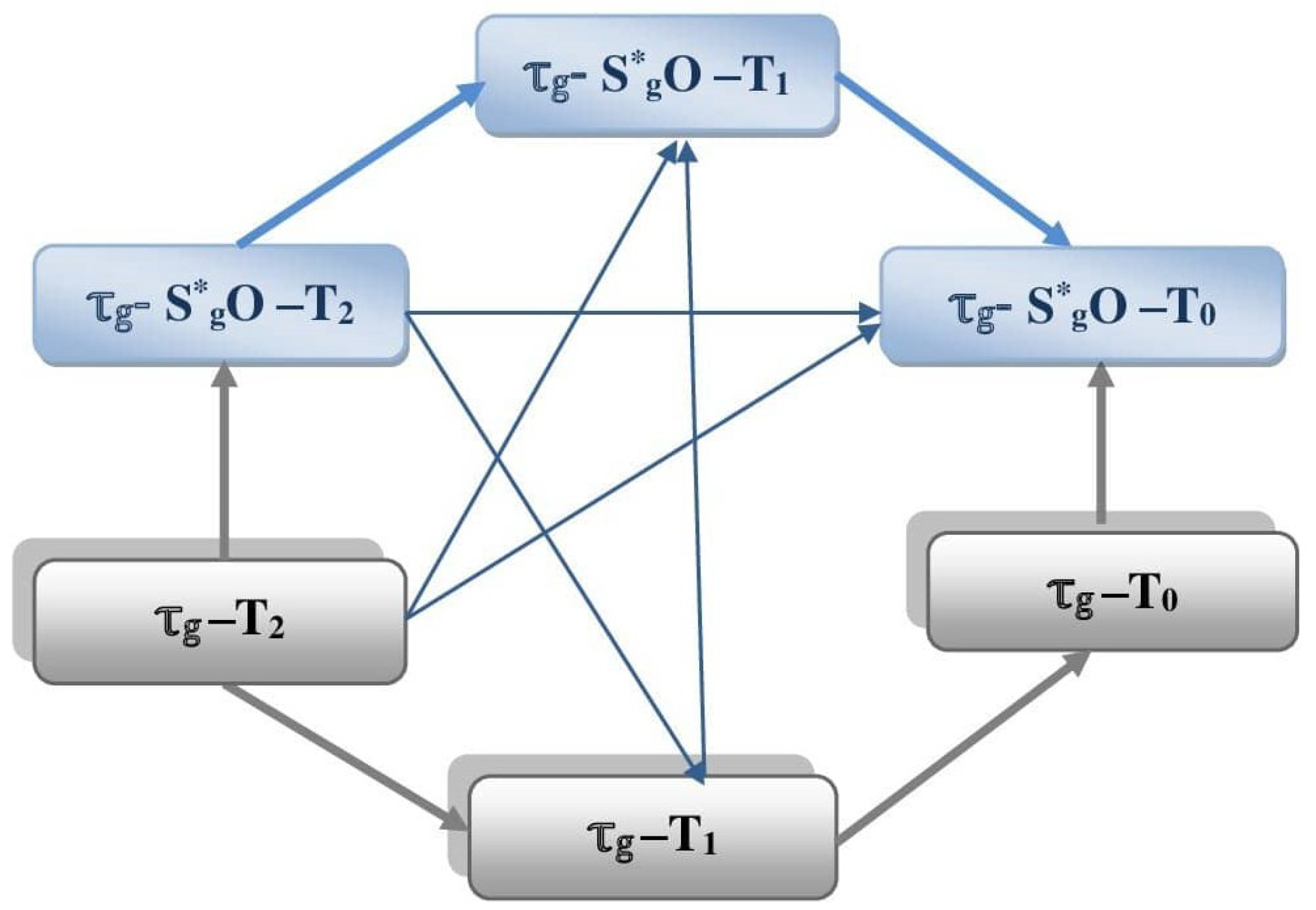
See the below Figure 1 for the relation between the above theorems.
Figure 1.
An illustration of the above theorems and considerations.
Remark 3.
The illustration below demonstrates that the converse of the above theorem is invalid.
Example 4.
Let = and = , , . In (, )O = , , and -O = P(). Hence, (, ) is as follows:
- ○
- -- but not -. For explicit points and of , no open set exists with , or , , where is an open set of .
- ○
- -- space but not - space. For explicit points and of , no two open sets and exists with , and , .
- ○
- -- space but not - space. For explicit points and of , no two distinct open sets and exists with , and , .
Theorem 14.
If is bijective and strongly --open, and is --, then is a -- space.
Proof.
Take and of with . By hypothesis, = () and = () where and are the explicit points of . By hypothesis, -O() with and . Therefore, () ∈ () and () ∉ (). () ∈ -O() as is strongly --open. Thus, () is a --open set in with () and ∉ (). Therefore, is a -- space. □
Theorem 15.
If is injective and --irresolute, and is --, then is a -- space.
Proof.
Take and explicit points of . is injective ⇒ () ≠ (). As is --, there is a -O() such that () ∈ , () ∉ , or there is a -O() such that () ∈ , () ∉ with () ≠ (). As is --irresolute, then () ∈ -O(), and there is a () ∈ , () ∉ or () ∈ -O() ⇒ () ∈ , () ∉ . Hence, is a -- space. □
Theorem 16.
Assume is -- iff singleton ∈ -C().
Proof.
Assume is --, . Then - {} ⇒ . However, is a -- space ⇒ there is a , -O() ⇒ ∉ , ⊆ ( - {}). Furthermore, ⊆ ( - {}) ⇒ ( - {}) ∈ -O(). Thus, {} is --closed. Conversely, consider that . Then {} and {} are --closed sets, and { is --open. Certainly, {} ∉ { and {} ∈ {. Similarly { is --open, {} ∉ { and {} ∈ {. Thus is -- space. □
Theorem 17.
Let : → . Then the subsequent findings are valid:
- (i)
- If is --continuous and injective, is - ⇒ is --.
- (ii)
- If is --continuous and injective, is - ⇒ is --.
- (iii)
- If is --irresolute and injective, is -- ⇒ is --.
Proof.
(i) Assume , where , . Then () = and () = . Additionally, () ≠ (). (, ) - ⇒ , ∉ and , ∉ . Then (), ∉ () and (), ∉ (). According to the definition of --continuity, () and () ∈ -O(). For , , ⇒ (), ∉ () and (), ∉ (). Thus, (, ) is a -- space. In the same way, (ii) and (iii) can be proven. □
Theorem 18.
The subsequent statements are equivalent.
- 1.
- is --.
- 2.
- If , then , there is a containing and -Cl().
Proof.
(1) ⇒ (2) Take and with . There is a disjoint set and -O() such that and . Then and -C() and ⇒ -Cl(). (2) ⇒ (1) Consider and with ⇒ there is a --open containing such that -Cl() ⇒ ( - (-Cl())). ( - (-Cl())) ∈ -O() and ∉ ( - (-Cl())). Additionally, ∩ ( - (-Cl())) = . Therefore, is --. □
3.3.2. --Regular Space
Definition 24.
If ∀-C() and , there are disjoint open sets and such that , .
The relationship between --regularity and -regularity is as follows.
Theorem 19.
Every --regular space is -regular.
Proof.
Considering to be a --regular space. Take -C() and ∉ . As is --regular, there is a pair of disjoint open sets and such that ⊆ , . Hence, is -regular. □
Remark 4.
Every -regular space is not a --regular space.
Example 5.
Let = and = , , . Hence, (, ) is -regular but not a --regular space. For -C() and , there are no disjoint open sets and such that , .
Theorem 20.
Every -regular space with a -Tc space is --regular.
Proof.
Considering to be -regular, -Tc. Assume -C() and such that ∉ . As is a -Tc space, is closed, and ∉ . Since is -regular, there is a pair of disjoint open sets and such that ⊆ , . Hence, is --regular. □
Theorem 21.
If is --regular, then it is a -regular space.
Proof.
According to this fact, every closed set belongs to -C(). □
Theorem 22.
The subsequent statements are equivalent.
- 1.
- is --regular.
- 2.
- and each --open nbhd , there is an open nbhd of such that Cl() .
Proof.
(1) ⇒ (2) Assume is a --neighbourhood of . There is a -O() such that ⊆ . Now -C() and ∉ . From (1), there is a , such that ⊆ , , ∩ = . Thus, ⊆ . Now Cl() ⊆ Cl() = and ⊆ ⇒ ⊆ ⊆ . Thus, Cl() ⊆ . (2) ⇒ (1) Consider a --closed in and ∉ or ∈ ()c and is --open ⇒ ()c is --nbhd of . By hypothesis, there is an open nbhd such that , Cl() ⊆ ()c ⇒ ⊆ { - Cl()} and ∩ { - Cl()} = . Thus, is --regular. □
Theorem 23.
Assume is --regular iff for every -C() and point ( - ), , and Cl() ∩ Cl() = ϕ, where and are open sets.
Proof.
Given that is --regular. Assume -C() and . Then and and = where and are open sets ⇒ ∩ Cl() = . As is --regular, and Cl() ⊆ , ∩ = , where and are open. Furthermore, Cl() ∩ = . = ∩ ⇒ , ⊆ and Cl() ∩ Cl() = , where and are open in . On the other hand, consider and are open sets. , ⊆ and Cl() ∩ Cl() = ∀ -C() and ∈ ( - ) ⇒ , ⊆ and ∩ = . Thus, is --regular. □
Theorem 24.
A subspace of --regular (, ) is --regular.
Proof.
Obvious. □
Theorem 25.
Consider that is bijective and --irresolute and an open map from --regular into . Then is --regular.
Proof.
Let and -C() and ∉ . Additionally, is --irresolute. Then () ∈ -C(). Now assume = (). Then () = and ∉ (). If is --regular, then there is a and such that and () ⊆ , ∩ = . is open and bijective ⇒ (), ⊆ () and ( ∩ ) = () = ⇒ is --regular. □
3.3.3. --Normal Space
Definition 25.
Assume is --normal if for each pair , -C(), there are open sets and in such that and .
Theorem 26.
Every --normal is -normal.
Proof.
As is a --normal. Assume disjoint sets and in . Therefore, , -C(). is --normal ⇒ there is a pair , such that ⊆ , ⊆ . Thus, is -normal. □
Remark 5.
The subsequent illustration demonstrates that the converse of the above theorem is invalid.
Example 6.
Consider = and = , , , , . Here (, ) is -normal but not a --normal space. For disjoint sets , -C(), there are no open sets and in .
Theorem 27.
If is -normal and a -Tc space, then is --normal.
Proof.
Assume is -normal. Consider disjoint set , -C(). As -Tc space, and are closed. Since is -normal, there are disjoint open sets and in such that ⊆ and ⊆ . Thus, is --normal. □
Theorem 28.
Every --normal is -g-normal.
Proof.
Since is --normal. Disjoint set , -C() ⇒ there is a disjoint , such that ⊆ and ⊆ . Thus, is -g-normal. □
Remark 6.
Every -g-normal space is not --normal.
Example 7.
Let = and = , , , , . Here (, ) is -g-normal but not a --normal space. For disjoint --closed sets , , there are no open sets and in .
Theorem 29.
Every --normal space is -w-normal.
Proof.
Similar to Theorem 28. □
Remark 7.
The converse of the above theorem is invalid, as demonstrated by subsequent illustration.
Example 8.
Let = and = , , , , . Here (, ) is -w-normal but not a --normal space. For disjoint --closed sets , , there are no open sets and in .
Theorem 30.
If is a --closed subspace of --normal , then is --normal.
Proof.
Assume is --normal and is a --closed subspace. A pair of disjoint sets and -C() ⇒ there is a , such that ⊆ and ⊆ ⇒ ∩ and ∩ are open in . Furthermore, ⊆ and ⊆ ⇒ ∩ ⊆ ∩ and ∩ ⊆ ∩ and ( ∩ ) ∩ ( ∩ ) = ∩ ( ∩ ) = . Thus, is --normal. □
Theorem 31.
The subsequent statements in (, ) are equivalent.
- (1)
- is --normal.
- (2)
- Cl() for each -C() and each -O() with , where is an open set.
- (3)
- For any disjoint set , -C(), there is an open set such that and Cl() = ϕ.
- (4)
- For each disjoint set , -C(), there are open sets , such that , and Cl() ∩ Cl() = ϕ.
Proof.
(1) ⇒ (2) Take -C(). -C() such that ⇒ and ( - ) are two disjoint sets of -C(). According to the --normal definition, and ( - ) ⊆ , where and are open disjoint sets. Therefore, ⊆ ( - ) and ∩ = ⇒ ⊆ ( - ) and Cl() ⊆ ( - ) ⊆ ⇒ Cl() ⊆ . Thus, ⊆ ⊆ Cl() ⊆ . (2) ⇒ (3) Consider disjoint sets , -C(), ⊆ ( - ) where and ( - ) are --closed and --open sets in . From (2), there is an open set and ⊆ ⊆ Cl() ⊆ ( - ). Cl() ⊆ ( - ) ⇒ ) ∩ Cl() = . Thus, ⊆ and Cl() ⊆ = . (3) ⇒ (4) Consider disjoint sets , -C(). By (3), there is an open set such that ⊆ and Cl() ∩ = . However, Cl() is closed ⇒ a --closed set in . As Cl(), -C(). Then, by (3), ⊆ and Cl() ∩ Cl() = , where is an open set in . (4) ⇒ (1) Assume disjoint sets , -C(). Then by hypothesis there are open sets and such that ⊆ and ⊆ , Cl() ∩ Cl() = ⇒ ⊆ and ⊆ . Thus, is --normal. □
Theorem 32.
Assume a mapping : → . If is bijective, open, and --irresolute from a --normal onto , then is --normal.
Proof.
Assume disjoint sets , -C(). Since is --irresolute, () and () are in -C(). is --normal ⇒ () ⊆ and () ⊆ , where and are open in . Also, as is bijective and open, () and () are open and ⊆ (), ⊆ (). Thus, is --normal. □
Theorem 33.
The subsequent statements in (, ) are equivalent.
- (1)
- is -g-normal.
- (2)
- There are disjoint open sets , -O() such that , for each disjoint set and .
Proof.
(1) ⇒ (2) Let is -g-normal. Assume disjoint sets , of . Since (, ) is -g-normal, there are disjoint -g-open sets and such that ⊆ , ⊆ ⇒ , -O() with ⊆ , ⊆ and ∩ = . (2) ⇒ (1) Assume two disjoint --closed sets , -C(). By hypothesis, ⊆ , ⊆ and ∩ = , where and are disjoint sets in -O(). Since ⊆ -gInt(), ⊆ -gInt() and -gInt() ∩ -gInt() = . Thus, (, ) is -g-normal. □
4. Methodology
A theoretical method is used in this study to examine the separation axioms, connectedness, and compactness in generalized topological spaces. The following is the structure of the methodology:
- ○
- Literature Review: Existing research on the separation axioms, connectedness, and compactness in generalized topological spaces is thoroughly reviewed. The fundamental framework for applying these ideas to the -compact and -connected spaces in more comprehensive frameworks is laid forth in this review.
- ○
- Definition and Evolution: In the generalized topological contexts, new definitions and characteristics of connectedness and compactness are put forward. To make sure that these definitions align with the fundamental structure of generalized topologies, they are thoroughly examined.
- ○
- Analysis of the Separation Axioms: Within the same generalized frames, the separation axioms , , and are examined.
- ○
- Theoretical Proofs: The specified properties and definitions are supported by formal proofs, demonstrating their applicability and validity. The associations between compactness, connectedness, and separation properties are analyzed.
- ○
- Comparative Analysis: To demonstrate the differences, analogies, and advantages of the generalized approach, a comparison between these expanded notions and their classical equivalents is analyzed.
- ○
- Conclusions and Consequences: The outcome findings are synthesized to provide a comprehensive understanding of the behavior of -compact space, -connected space, and separation axioms within generalized topological contexts. The implications of these results for future research in generalized topology are discussed.
5. Conclusions
This study provides a comprehensive exploration of compactness, connectedness, and separation axioms within the frameworks of generalized topological spaces. By extending classical notions of compactness and connectedness to -compact and -connected spaces, the research highlights the versatility and depth of these properties in generalized settings. The definitions and properties introduced are validated through rigorous theoretical analysis, offering new insights into the structural characteristics of these spaces. In addition, the investigation of separation axioms -, -, and - within generalized topology underscores their critical role in classifying spaces based on point–set distinguishability. Although no direct relationships between -compactness, -connectedness, and separation axioms were established, their independent study provides a clearer understanding of the topological landscape in generalized frameworks. This work contributes to the growing body of research in generalized topology, laying the groundwork for future studies that may further refine these concepts or explore their applications in advanced mathematical theories and related disciplines. It emphasizes the importance of extending classical topological ideas to accommodate more complex and generalized structures.
Author Contributions
Conceptualization, M.S., T.K., U.I., M.I., I.-L.P. and F.M.M.; methodology, M.S., T.K., U.I., M.I., I.-L.P. and F.M.M.; software, M.S., T.K., U.I., M.I., I.-L.P. and F.M.M.; validation, M.S., T.K., U.I., M.I., I.-L.P. and F.M.M.; formal analysis, M.S., T.K., U.I., M.I., I.-L.P. and F.M.M.; investigation, M.S., T.K., U.I., M.I., I.-L.P. and F.M.M.; resources, M.S., T.K., U.I., M.I., I.-L.P. and F.M.M.; data curation, M.S., T.K., U.I., M.I., I.-L.P. and F.M.M.; writing—original draft preparation, M.S., T.K., U.I., M.I., I.-L.P. and F.M.M.; writing—review and editing, M.S., T.K., U.I., M.I., I.-L.P. and F.M.M.; visualization, M.S., T.K., U.I., M.I., I.-L.P. and F.M.M.; supervision, M.S., T.K., U.I., M.I., I.-L.P. and F.M.M.; project administration, M.S., T.K., U.I., M.I., I.-L.P. and F.M.M.; funding acquisition, M.S., T.K., U.I., M.I., I.-L.P. and F.M.M. All authors have read and agreed to the published version of the manuscript.
Funding
This research received no external funding.
Data Availability Statement
Data will be available on demand from the corresponding author.
Acknowledgments
The authors extend their appreciation to the Deanship of Research and Graduate Studies at King Khalid University for funding this work through Large Research Project under grant number RGP2/48/46.
Conflicts of Interest
The authors declare no conflicts of interest.
References
- Levine, N. Generalized closed sets in topology. Rend. Del Circ. Mat. Di Palermo 1970, 19, 89–96. [Google Scholar] [CrossRef]
- Császár, A. Generalized open sets in generalized topologies. Acta Math. Hung. 2005, 106, 53. [Google Scholar] [CrossRef]
- Khayyeri, R.; Mohamadian, R. On base for generalized topological spaces. Int. J. Contemp. Math. Sci. 2011, 6, 2377–2383. [Google Scholar]
- Sarsak, M.S. On some properties of generalized open sets in generalized topological spaces. Demonstr. Math. 2013, 46, 415–427. [Google Scholar] [CrossRef]
- Maki, H.; Balachandran, K.; Devi, R. Remarks on semi-generalized closed sets and generalized semi-closed sets. Kyungpook Math. J. 1996, 36, 155. [Google Scholar]
- Maki, H.; Rao, K.C.; Gani, A.N. On generalizing semi-open sets and preopen sets. Pure Appl. Math. Sci. 1999, 49, 17–30. [Google Scholar]
- Navalagi, G.; Page, H. ϑ-Generalized semi-open and ϑ-Generalized semi-Closed Functions. Proyecciones-J. Math. 2009, 28. [Google Scholar] [CrossRef]
- Missier, S.; Son, J. A New Notion of Generalized Closed Sets in Topological Spaces. IOSR J. Math. 2014, 10, 122–128. [Google Scholar] [CrossRef]
- Thomas, J.; John, S.J. μ-compactness in generalized topological spaces. J. Adv. Stud. Topol 2012, 3, 18–22. [Google Scholar] [CrossRef]
- Urysohn, P. Über die Mächtigkeit der zusammenhängenden Mengen. Math. Ann. 1925, 94, 262–295. [Google Scholar] [CrossRef]
- Van Est, W.; Freudenthal, H. Trennung durch stetige Funktionen in topologischen Räumen. In Proceedings of the Indagationes Mathematicae (Proceedings); Elsevier: Amsterdam, The Netherlands, 1951; Volume 54, pp. 359–368. [Google Scholar]
- Youngs, J. A Note on Separation Axioms and Their Application in the Theory of a Locally Connected Topological Space 1943. Available online: https://www.semanticscholar.org/paper/A-note-on-separation-axioms-and-their-application-a-Youngs/dd89fd556ea98eab6b29462c361b4c82d5c502bd (accessed on 12 February 2025).
- Stone, M.H. Applications of Boolean algebras to topology. Sb. Math. 1936, 1, 765–772. [Google Scholar] [CrossRef] [PubMed]
- Shahbaz, M.; Kamran, T.; Ishtiaq, U.; Imtiaz, M.; Popa, I.L.; Maiz, F.M. Some New Notions of Continuity in Generalized Primal Topological Space. Mathematics 2024, 12, 3995. [Google Scholar] [CrossRef]
Disclaimer/Publisher’s Note: The statements, opinions and data contained in all publications are solely those of the individual author(s) and contributor(s) and not of MDPI and/or the editor(s). MDPI and/or the editor(s) disclaim responsibility for any injury to people or property resulting from any ideas, methods, instructions or products referred to in the content. |
© 2025 by the authors. Licensee MDPI, Basel, Switzerland. This article is an open access article distributed under the terms and conditions of the Creative Commons Attribution (CC BY) license (https://creativecommons.org/licenses/by/4.0/).

