


Abstract
The normalized analytic function , which connects the open unit disk onto a bounded domain within the right half of a nephroid-shaped region, is associated with the bounded turning of functions denoted by . It calculates the sharp coefficient inequalities, which include the upper bound of the third Hankel determinant and Logarithmic coefficients related to the functions of the class. This research mainly focuses on identifying solutions to specific coefficient-related problems for analytic functions within the domain of nephroid functions.
Keywords:
analytic function; Hankel determinant; univalent function; logarithmic coefficient; nephroid function MSC:
30C45; 30C80
1. Introduction and Definitions
Let A represent the class of function f defined by
where these functions are analytic in the unit disk . Let S represent a subclass of A that contains the univalent functions in E. For two functions, f and g, belonging to the set A, the function f is said to be subordinate to the function g, denoted as , if an analytic function w satisfying and for all exists, such that:
The class of functions with bounded turning, introduced by the Zaprawa subclass [1], can be defined in the following way
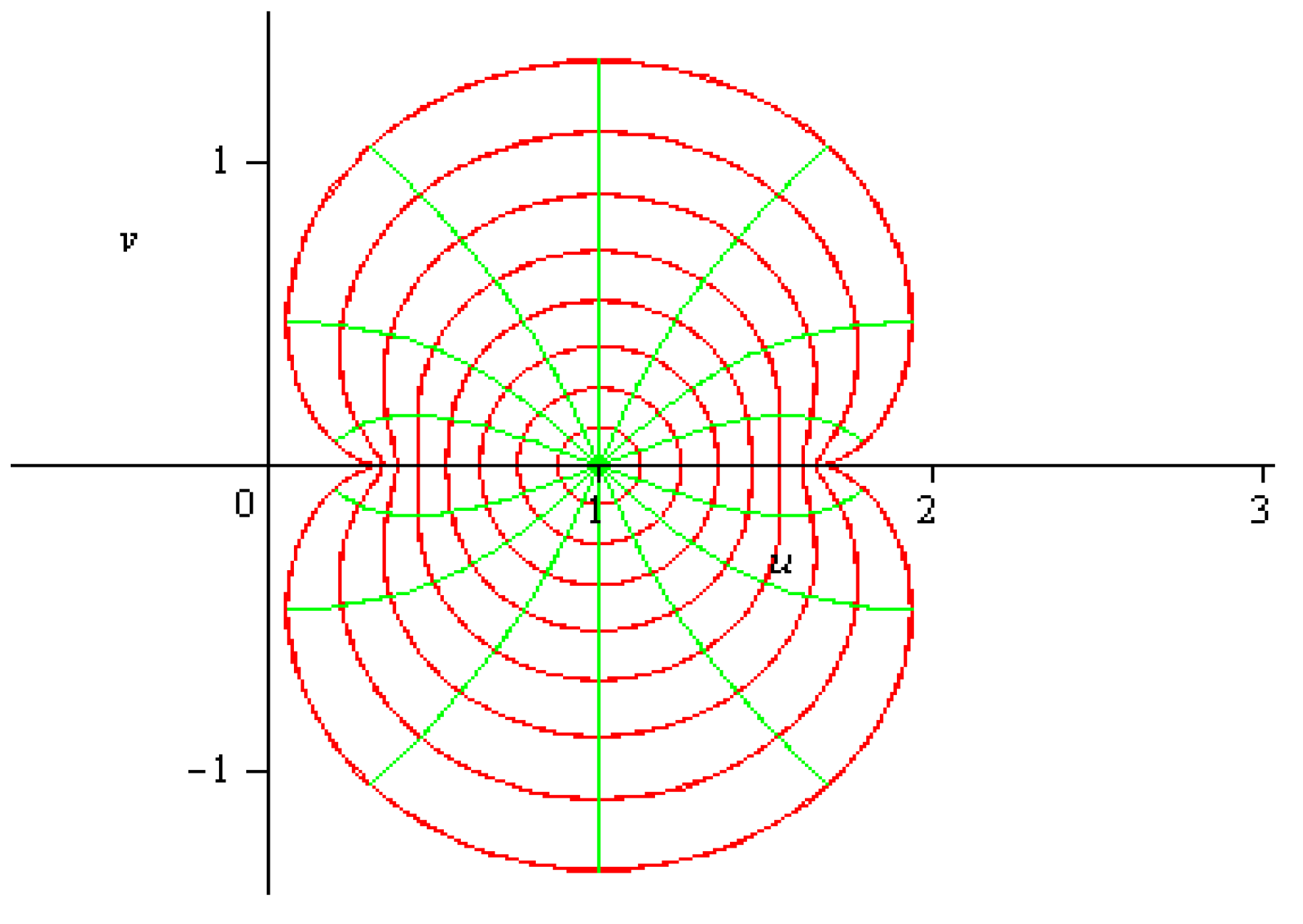
where is the analytic function that satisfies for all . We study the analytic function = , which maps the domain E into the nephroid-shaped region. The nephroid curve is an important test case for studying the behavior of functions under geometric transformations in the complex plane. It helps researchers analyze how analytic functions map the unit disk to nephroid-shaped regions, allowing for the exploration of concepts such as starlikeness, convexity, and other geometric properties. This region is a nephroid shape symmetric to the real axis, as shown in Figure 1 below.
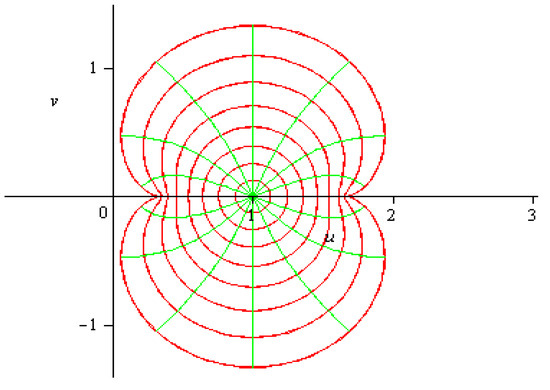
Figure 1.
The image domain of the nephroid function .
Using the above-mentioned function , we introduce the following class
for all .
The aim is to find the sharp bound for and for the class .
The estimation of has been the main focus of research on the Hankel determinant. Selvaraj and Kumar’s [3] proved for the class C of convex functions. More results may be obtained from [4,5,6,7].
Many authors have explored these Hankel determinants for various subclasses of analytic and univalent functions. Sharp bounds for were recently obtained utilizing a result from [8]; for more in depth studies on Hankel determinants, see [9,10,11,12,13,14].
and
The determinant of Hankel .
In the current research, we study the Hankel determinant, represented by , for the cases and .
When for , we obtain
For the whole class of univalent functions, as well as for its subclasses, determining the growth of the Hankel determinant depending on q and n is a fascinating problem to study. For class S, Pommerenke obtained some significant results [15]. The growth problem can be resolved to an estimate of the Hankel determinant for the suggested subclasses of A for fixed values of q and n. Srivastava et al. [16] discovered the same bound of Hankel and Toeplitz determinants for q-starlike functions connected to the generalized conic domain, while Arif et al. [17] determined the bound of the third Hankel determinant for functions associated with the sine function. Murugusundaramoorthy and Bulboacă [18] found the upper bound of Hankel determinants for certain analytic functions connected with the shell-shaped region. Khan et al. [19] determined the bound of third-order Hankel determinants for logarithmic coefficients of starlike functions connected with the sine function; Riaz et al. [20,21,22] studied the Hankel determinants for starlike and convex functions associated with the sigmoid function, lune, and cardioid domain; and Raza et al. [23] recently studied Hankel determinants for starlike functions connected with the symmetric Booth Lemniscate in 2022.
The logarithmic coefficients of , represented by , are defined by the series expansion as follows:
The third logarithmic coefficient in certain subclasses of close-to-convex functions was studied by Cho et al. [24], while Ali et al. [25] studied the logarithmic coefficients of specific close-to-convex functions. For a function f given by (1), the logarithmic coefficients are as follows:
Based on all of the above ideas, we propose studying the Hankel determinant, where its entries are derived from the logarithmic coefficients of .
From the above, it is easy to conclude that
The main aim of this article is to determine upper bounds for for the class of nephroid functions.
Definition 1.
Let P denote the set of all functions p that are analytic in E and satisfy the condition . These functions have the following series representation.
2. A Set of Lemmas
Lemma 1.
Lemma 2
Lemma 3.
If the series representation of the function is as defined in (10), then x,, we obtain
where , we can use the formula for within [26]. Libera and Zlotkiewicz [28] are recognized with the formula for , while [29] for the formula of .
Lemma 4
([30]). If the series representation of the function is as defined in (10) and if and β satisfies the inequality conditions , , and
then,
3. Third Hankel Determinant for the Class
In this section, we explore the sharp bound of the third-order Hankel determinant for .
Theorem 1.
If the series representation of the function as given in (1), then
The bound is sharp, and its sharpness can be attained from
Proof.
Let . Then,
If , then
Using (18), we obtain
Considering that the series is defined in (1), it implies that
Comparing (20) and (19), we have
Substituting the expressions (21)–(24) into (2) and setting , we have
where . Now, letting and , we obtain
Then, from (25), we have
Since , it follows that
where , x, ∈, and
and
Taking and replacing by y and by x, one obtains
where
with
Then, the partial derivative of the function (27) by ‘y’, is given by
Taking we have
For to belong to , it is possible only if
and
Suppose,
This gives
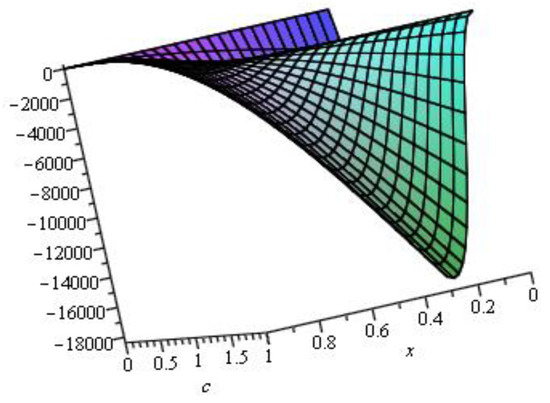
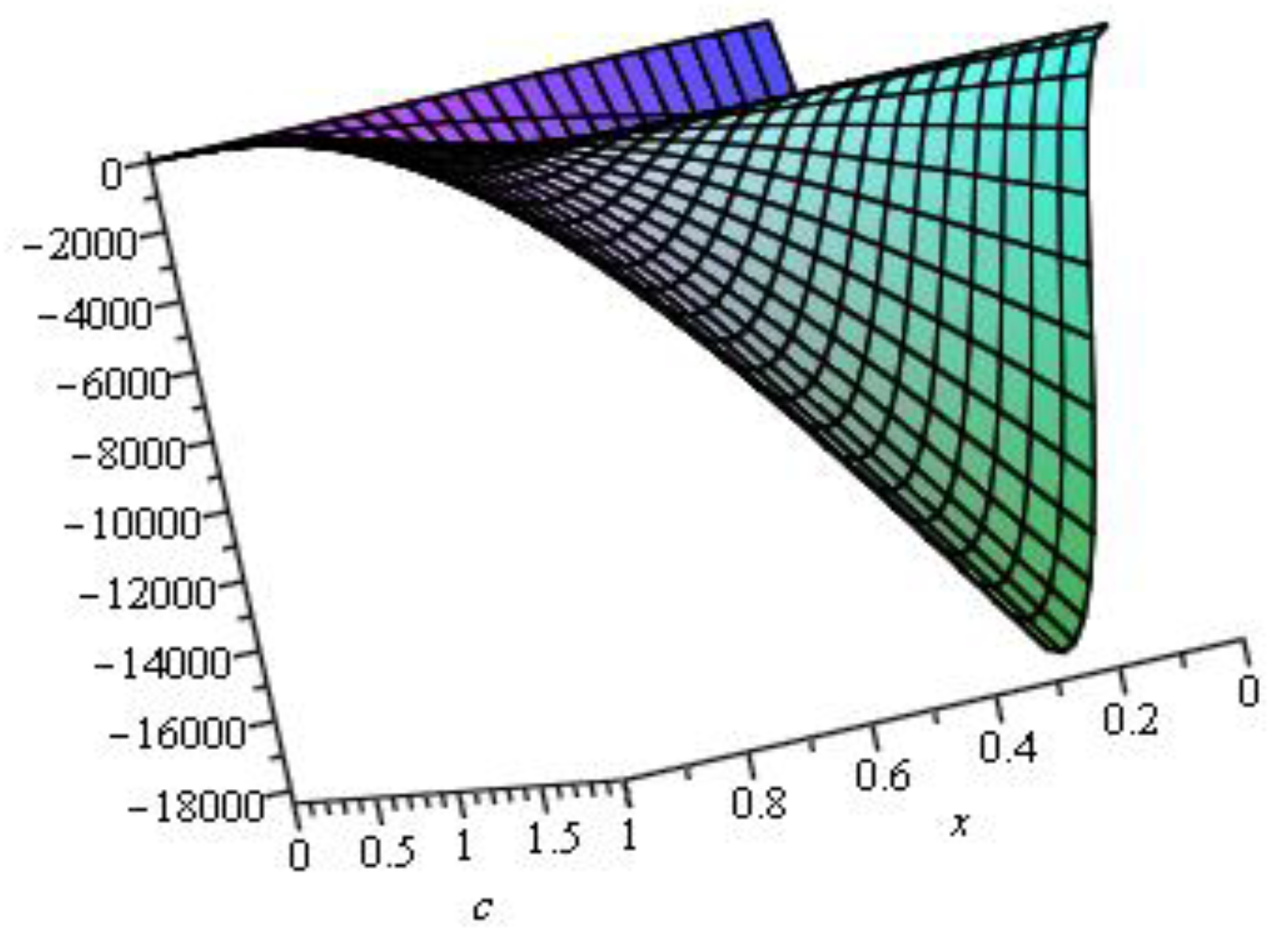
Since for as can be seen from the graph of in Figure 2.
Figure 2.
The graph of .
It follows that decreases in . Therefore, , and calculation shows that f has no critical points in . As a result, (28) does not hold for all . To determine the value of c, we consider the function to be greater than zero. In the original function, we need to substitute the minimum value of the original function. Proper calculation of time is possible. If you have the interval or if you restrict the interval to a certain number, substitute that number into . The value of obtained from both the original interval and the restricted interval will be the same. In that case, the inequality will still hold, and a critical point will exist. There is no such number that, when restricting the interval, would cause the inequality to be unsatisfied.
Next, we will explore the maxima of within the interiors of all six faces of Using in (27), we obtain
Consequently, belongs to , we have not found any maxima for . If we take in (27), we obtain
Putting in (27), we obtain
By solving and the critical point if we have
Further, , gives
By inserting (31) into the above equation, we have
Now, solving for , we obtain . Therefore, no optimal solution exists for in . When in (27), we obtain
If has no critical point, then . Considering in (27), we have
If we take
The solution does not exist in .
Taking in (27), we obtain
If we take
The solution does not exist in . Finally, we evaluate the maximum close to at the 12 edges.
When we substitute and in (27), we have
It can be observed that for , indicating that is an increasing function on the interval . Therefore, it reaches its maximum value at .
Put , in (27), we obtain
It can be observed that for , indicating that is an increasing function on the interval . Therefore, it reaches its maximum value at .
Put , in (27), we obtain
Clearly, is obvious, while increases for , finding its maximum value at , we obtain
Put , and in (27), we obtain
It can be observed that for , indicating that is an decreasing function on the interval . Therefore, it reaches its maximum value at .
Put , in (27), we obtain
Put , , and , in (27), we obtain
Put , in (27), we obtain
The maximum value of the function is . That is,
Put , in (27), we obtain
We observe , so reaches its maximum value at , so we have
By using (26), we obtain
Hence, achieving the required result. □
Theorem 2.
If the series representation of the function as given in (1), then
The following function preserves equality and gives the best possible result.
Proof.
Substituting (22)–(24) with , we have
By applying the resulting form of Equations (14)–(16), with , we have
By inserting the above expressions in (34), we have
As it follows that
where , and
If we apply and then by substituting for y and by x, it can be concluded that
where
with
Differentiating (36) w.r.t ‘y’, using we obtain
Taking we have
and
Suppose,
As for it follows that is decreases on . Therefore, , and the calculation shows that f has no critical points in . As a result, (37) does not hold for all .
Furthermore, we will look at the interior of each of six faces for the maxima of .
Substituting in (36), we obtain
The above show that in has no point of extrema.
Placing in (36), we have
Place in (36), we obtain
The system of equations
has no solution between . By using in (36), we obtain
The critical value does not exist.
Place in (36), we obtain
The equation , has no optimal solution in
Finally, we expect the maximum of close to six faces of .
Place , in (36), we obtain
Place , in (36), we obtain
We observe , so has a maximum at . We obtain
Place , in (36), we obtain
So, has maximum value at , we obtain
Place , in (36), we obtain
Place , in (36), we obtain
Place , and , we obtain
Place , in (36), we obtain
When reaches its maximum value, we obtain
Place , in (36), we obtain
When reaches its maximum value, we obtain
Consequently, based on the previous situation, we determine that
Hence, the required result. □
4. Logarithmic Coefficient Inequalities for the Class
We begin by determining the bound for the logarithmic coefficient of the function .
Theorem 3.
Proof.
Applying (12) in (41), we can write
Now, from (42), we can write
Applying (11), we have
For (43), we have
then
and
It is obvious that and
Using Lemma (13), we obtain
From (44), we have
By using (14) to (16), we have
Differentiate above function w.r.t , we obtain
If we obtain
Put in (45), we obtain
Therefore, we were able to find any maximum of in .
When we use in (45), we obtain
Put in (45), we have
The critical points can be obtained by solving . We have
If the above function has no critical points.
Place in (45), we obtain
For the critical point gives , at which reaches its maxima.
Place in (45), we obtain
Place in (45), we obtain
The solution for the system of equations , in does not exist.
Place , in (45), we obtain
Taking , we obtained , which is the critical point, where is the maximum value. That is,
Place , in (45), we obtain
Equation , and we obtain , the critical point, where is the maximum value. That is,
Place , in (45), we obtain
Clearly, is decreasing over with , representing the minimum value. Consequently, we obtain
Place , in (45), we obtain
Taking differentiate , which obtained , the critical point, where is the maximum value. That is,
Place , in (45), we obtain
Theorem 4.
Proof.
Theorem 5.
Theorem 6.
Proof.
By using (42) and (44), we have
By using (14) to (16), we obtain
Differentiate (49), partially w.r.t parameter we have
Taking , we have
For to belong to , its only possible through
and
Suppose,
Since, for it follows that is decreasing on . Therefore, , and the calculation shows that f has critical points in . As a result, (50) is satisfied for all
Next, we explore the maxima of within the interior of all six faces of .
Place in (49), we obtain
Therefore, in , we did not find any maxima for .
Using , we obtain
Place in (49), we obtain
The critical point can be obtained by finding and , when we set , we have
For , we have
By inserting (53), we have
We now obtain by finding for . Therefore, in , no optimal solution for is obtained.
Place in (49), we obtain
For the critical point gives , at which, attains the maxima, which is
Place in (49), we obtain
The solution does not exist for the above equations
in .
Place , in (49), we obtain
Equation , provides , where is the maximum value. Thus, we have
Place , in (49), we obtain
At , obtains its maximum value as it decreases. Consequently,
Place , in (49), we obtain
The maximum value of attained at , and it increases in the interval , we obtain
Place , and , in (49), we obtain
Equation , provides , where is the maximum value. Thus, we have
Place , in (49), we obtain
Place c = 2, we observe that the Equation (52) is free from . Therefore, it follows that
Place , in (49), we obtain
Equation , results in , where is the maximum value. We obtain
Place , in (49), we obtain
obtain a maximum value at , we obtain
□
5. Hankel Determinant with Logarithmic Coefficients for the Class
The following sections discuss the bound of the second-order Hankel determinant for functions in the class
Theorem 7.
Proof.
Theorem 8.
Proof.
The determinant is defined this way.
By using (42) and (44), we obtain
where and by substituting Now, applying by (14) to (16), we have
By using (55), the above expression
As it follows that
where and
and
If we apply and then by substituting for y and by x, it is concluded that
where
with
and
Differentiating (57) partially with respect to parameter y, we have
The equation gives
and
Suppose,
As for it follows that is decreasing on . Therefore, , and the calculation shows that f has no critical points in . As a result (58) does not hold for all
Next, we calculate the interior of each of the six edges of for the maximum of .
Place , in (57) we obtain
Thus, we have not identified any maxima for within the interval . Place , in (57) we obtain
Place , in (57) we obtain
If , we obtain
Further,
Inserting (61) into the above expression and , we have
Consequently, belongs to , no ideal solution for exists.
Place , in (57) we obtain
The above function has no critical points.
Taking , in (57) we have
The system of equations has no solution , in does not exist.
Place , in (57) we have
The given system of equations has no solution , within the interval .
Place , , in (57) we obtain
The maximum value is , occurs at the critical point , which obtains . That is
Place , in (57), we obtain
We see that obtain the maximum value of , we obtain
Place , in (57), we obtain
It follows that for , which shows that is the maximum value at , then
Put , in (57), we obtain
The has no critical points.
Put , in (57), we obtain
The maximum value for occurs when , which is the critical point . Therefore, we obtain
Place , , in (57) we obtain
It is obvious from the simple equation that reaches its maximum value at , we have
Equation (56), may be utilized to obtain that
Hence, the required proof is achieved. □
6. Conclusions
A new subclass of nephroid functions associated with bounded turning has been introduced. The function used to define the class has not been explored completely; this can be used further to define more classes such as the class of starlike function, the class of convex function, the class of closed-to-convex function, and many more. All these proposed classes would be defined through a subordinate to the function . Similar and many other coefficient-related problems, such as coefficient bounds Hankel determinants, Toeplitz determinants, and toeplitz hermitian determinants, can be investigated for the proposed classes. The upper bounds for the second and third Hankel determinants and the logarithmic coefficients have been derived for this class. This article presents and proves the main results as Theorems 1–8. The third Hankel determinant problem for different subclasses of analytic functions has been studied and explored by numerous researchers in Geometric Function Theory (GFT), as mentioned in the introduction. This work will help to determine the fourth-order Hankel determinants for the same classes of analytic functions explored for further studies.
Author Contributions
Conceptualization, W.U. and R.F.; Methodology, W.U. and R.F.; Validation, L.-I.C.; Formal analysis, R.F.; investigation, W.U; Resources, D.B.; Data curation, D.B.; Visualization, R.F.; Supervision, R.F.; Project administration, L.-I.C.; Funding acquisition, D.B. and L.-I.C. All authors have read and agreed to the published version of the manuscript.
Funding
This research received no external funding.
Data Availability Statement
No data were used to support this study.
Acknowledgments
This work was carried out for the requirement of a degree program under the synopsis notification no. CUI-Reg/Notif-2297/24/2383, dated 2 October 2024.
Conflicts of Interest
The authors declare no conflicts of interest.
References
- Zaprawa, P. Third Hankel determinants for subclasses of univalent functions. Mediterr. J. Math. 2017, 14, 19. [Google Scholar] [CrossRef]
- Noonan, J.W.; Thomas, D.K. On the second Hankel determinant of mean p-valent functions. Trans. Am. Math. 1976, 223, 337–346. [Google Scholar] [CrossRef]
- Selvaraj, C.; Kumar, T.R.K. Second Hankel determinant for certain classes of analytic functions. Int. J. Appl. Math. 2015, 28, 37–50. [Google Scholar]
- Hayami, T.; Owa, S. Generalized Hankel determinant for certain classes. Int. J. Math. Anal. 2010, 4, 2573–2585. [Google Scholar]
- Liu, M.S.; Xu, J.F.; Yang, M. Upper bound of second Hankel determinant for certain subclasses of analytic functions. Abstr. Appl Anal. 2014, 2014, 603180. [Google Scholar] [CrossRef]
- Noonan, J.W.; Thomas, D.K. On the Hankel determinants of mean p-valent functions. Proc. Lond. Math. Soc. 1972, 3, 503–524. [Google Scholar] [CrossRef]
- Vamshee Krishna, D.; Ram Reddy, T. Hankel determinant for starlike and convex functions of order alpha. Tbil. Math. J. 2012, 5, 65–76. [Google Scholar]
- Libera, R.J.; Zlotkiewicz, E.J. Coefficient bounds for the inverse of a function with derivative in P. Proc. Am. Math. Soc. 1983, 87, 251–257. [Google Scholar] [CrossRef]
- Banga, S.; Kumar, S.S. The sharp bounds of the second and third Hankel determinants for the class SL*. Math. Slovaca 2020, 70, 849–862. [Google Scholar] [CrossRef]
- Kowalczyk, B.; Lecko, A.; Sim, Y.J. The sharp bound of the Hankel determinant of the third kind for convex functions. Bull. Aust. Math. Soc. 2018, 97, 435–445. [Google Scholar] [CrossRef]
- Kowalczyk, B.; Lecko, A.; Lecko, M.; Sim, Y.J. The sharp bound of the third Hankel determinant for some classes of analytic functions. Bull. Korean Math. Soc. 2018, 55, 1859–1868. [Google Scholar]
- Kwon, O.S.; Lecko, A.; Sim, Y.J. The bound of the Hankel determinant of the third kind for starlike functions. Bull. Malays. Math. Sci. Soc. 2019, 42, 767–780. [Google Scholar] [CrossRef]
- Riaz, A.; Raza, M.; Thomas, D.K. Hankel determinants for starlike and convex functions associated with sigmoid functions. Forum Math. 2021, 34, 137–156. [Google Scholar] [CrossRef]
- Zhang, H.-Y.; Tang, H.; Niu, X.-M. Third-order Hankel determinant for a certain class of analytic functions related with an exponential function. Symmetry 2018, 10, 501. [Google Scholar] [CrossRef]
- Pommerenke, C. On the coefficients and Hankel determinant of univalent functions. J. Lond. Math. Soc. 1966, 41, 111–122. [Google Scholar] [CrossRef]
- Srivastava, H.M.; Ahmad, Q.Z.; Khan, N.; Khan, N.; Khan, B. Hankel and Toeplitz Determinants for a Subclass of q-Starlike Functions Associated with a General Conic Domain. Mathematics 2019, 7, 181. [Google Scholar] [CrossRef]
- Arif, M.; Raza, M.; Tang, H.; Hussain, S.; Khan, H. Hankel determinant of order three for familiar subsets of analytic functions related with sine function. Open Math. 2019, 17, 1615–1630. [Google Scholar] [CrossRef]
- Murugusundaramoorthy, G.; Bulboacă, T. Hankel Determinants for New Subclasses of Analytic Functions Related to a Shell Shaped Region. Mathematics 2020, 8, 1041. [Google Scholar] [CrossRef]
- Khan, B.; Aldawish, I.; Araci, S.; Khan, M.G. Third Hankel Determinant for the Logarithmic Coefficients of Starlike Functions Associated with Sine Function. Fractal Fract. 2022, 6, 261. [Google Scholar] [CrossRef]
- Raza, M.; Riaz, A.; Xin, Q.; Malik, S.N. Hankel Determinants and Coefficient Estimates for Starlike Functions Related to Symmetric Booth Lemniscate. Symmetry 2022, 14, 1366. [Google Scholar] [CrossRef]
- Riaz, A.; Raza, M.; Thomas, D.K. The Third Hankel determinant for starlike functions associated with sigmoid functions. Forum Math. 2022, 34, 137–156. [Google Scholar]
- Riaz, A.; Raza, M. Hankel determinants for starlike and convex functions associated with lune. Bull. Sci. MathéMatiques 2023, 187, 103289. [Google Scholar] [CrossRef]
- Riaz, A.; Raza, M.; Thomas, D.K. Hankel determinants for starlike and convex functions associated with a cardioid domain. Preprint 2022. [Google Scholar] [CrossRef]
- Cho, N.E.; Kowalczyk, B.; Kwon, O.S.; Lecko, A.; Sim, Y.J. On the third logarithmic coefficient in some subclasses of close-to-convex functions. Rev. R. Acad. Cienc. Exactas Fís. Nat. (Esp.) 2020, 114, 52. [Google Scholar] [CrossRef]
- Ali, M.F.; Vasudevarao, A. On logarithmic coefficients of some close-to-convex functions. Proc. Am. Math. Soc. 2018, 146, 1131–1142. [Google Scholar] [CrossRef]
- Pommerenke, C. Univalent Function; Vanderhoeck & Ruprecht: Göttingen, Germany, 1975. [Google Scholar]
- Carathéodory, C. Über den Variabilitätsbereich der Fourier’schen Konstanten von position harmonischen Funktionen. Rend. Circ. Mat. Palermo 1911, 32, 193–217. [Google Scholar] [CrossRef]
- Libera, R.J.; Złotkiewicz, E.J. Early coefficients of the inverse of a regular convex function. Proc. Am. Math. Soc. 1982, 85, 225–230. [Google Scholar] [CrossRef]
- Kwon, O.S.; Lecko, A.; Sim, Y.J. On the fourth coefficient of functions in the Carathéodory class. Comput. Methods Funct. Theory 2018, 18, 307–314. [Google Scholar] [CrossRef]
- Ravichandran, V.; Verma, S. Bound for the fifth coefficient of certain starlike functions. C. R. Math. Acad. Sci. Paris 2015, 353, 505–510. [Google Scholar] [CrossRef]
Disclaimer/Publisher’s Note: The statements, opinions and data contained in all publications are solely those of the individual author(s) and contributor(s) and not of MDPI and/or the editor(s). MDPI and/or the editor(s) disclaim responsibility for any injury to people or property resulting from any ideas, methods, instructions or products referred to in the content. |
© 2025 by the authors. Licensee MDPI, Basel, Switzerland. This article is an open access article distributed under the terms and conditions of the Creative Commons Attribution (CC BY) license (https://creativecommons.org/licenses/by/4.0/).