


Abstract
This article introduces certain algebraic properties of generalized -pre-invex functions on . A new fractal weighted integral identity is established and further employed to obtain several Ostrowski-type results in the fractal setting for functions whose first derivatives in the modulus belong to the generalized -pre-invex functions’s class. An illustrative example is presented to validate the theoretical findings. Moreover, applications of the main results are derived in connection with generalized random variables and various special means, highlighting the effectiveness and potential scope of the proposed approach.
Keywords:
local fractional integrals; generalized (MSC:
26D10; 26A33; 26A51
1. Introduction
Convex functions have some valid properties in different areas of mathematics. However, it is very difficult to apply strict convex functions in practical situations. To overcome this difficulty, researchers studied different generalizations and extensions of convex functions. Convex functions are linked to several outcomes in the domain of mathematical inequalities. The following intriguing integral inequality for the class of functions whose derivatives exists and continuous with bounded derivatives was developed by Ostrowski in 1938 in his article [1].
Theorem 1.
Let be a function differentiable over . If is integrable on with upper bound M. Then, the given inequality is valid:
for all .
This inequality calculates the deviation of a mapping from its integral mean and estimates the approximate area of a mapping’s curve represented by a rectangle.
Milovanovic and Pečarić in [2] established the generalization of Ostrowski for n-times differentiable mappings. In [3], a novel version of the Ostrowski inequality was presented by Roumeliotis et al. which addresses the product of two functions. Dragomir et al. [4] established weighted Ostrowski-type inequalities by employing the Hölder condition on continuous functions. The inequalities of the type of Ostrowski for differentiable convex functions were presented by Latif et al. in [5]. Kirmaci and Özdemir [6] developed some important results related to midpoint inequality via differentiable convex functions.
Wang et al. [7] provided inequalities of the midpoint kind for pre-invex first derivatives. The weighted Ostrowski-type inequality for first-order differentiable pre-invex functions was presented by Meftah and his team in [8] and incorporated in original wording as follows.
Theorem 2.
Let be a function differentiable over with , and let be a continuous and symmetric function about . If is pre-invex with respect to , one has
holds for all .
Researchers studied generalized Ostrowski inequalities on fractal sets via extended convex functions. Recent findings, including generalizations, enhancements, and variations of integral inequality on fractal domains are associated with various generalizations of convex functions. For further information, refer to [9,10] and the related sources.
The pre-invex function is one of the most well-known extended convex functions. Let us revisit the definition of a pre-invex function. Consider a non-empty set , a continuous mapping , and a bifunction .
Definition 1
([11]). Suppose , then the set is defined as an invex set with respect to a given bifunction if
If the bifunction , then an invex set becomes a convex set.
Definition 2
([12]). The supposition that is an invex set with respect to implies that the function is pre-invex on if
where and . When is pre-invex then Ψ becomes pre-concave.
Definition 3
([13]). Supposing that are two non-negative functions, a function Ψ on invex set is -pre-invex, if
where and .
We also require condition C proposed by Mohan and Neogy, described in ([14]) and reproduced below.
Condition C.
Suppose be invex set. If , for every , bifunction satisfies,
The following equality follows from Condition C:
where and , .
Yang introduced the concept of local fractional calculus theory in [15,16]. This theory is widely used to model non-differentiable phenomena that arise in different fields of engineering, sciences and allied fields of these through differential equations. Applications in the framework of local fractional calculus theory include the exploration of the interconnections between random walk processes, control theory, physics, and communication engineering, see [17,18,19,20]. The concepts of convexity and their generalization of refinements on fractal sets have been expanded by several academics for investigating the classical Hermite–Hadamard inequality studied in [21] by J. Hadamard in [13,22,23,24,25,26,27,28,29,30,31,32,33] and the references herein.
Recent contributions [34,35] by Ayman-Mursaleen and collaborators also relate to the generalized analytical frameworks relevant to this work. The study by Ayman-Mursaleen, Nasiruzzaman, and Rao (2025) on Szaśz–Jakimovski–Leviatan Beta-type integral operators enhanced via Appell polynomials provides refined approximation structures that align with modern extensions of operator theory in generalized settings. Likewise, Ayman-Mursaleen (2025) investigated the controllability of tempered Caputo fractional dynamical systems, illustrating current advances in fractional and nonlocal analysis. These works further support the motivation for developing generalized convexity-based inequalities on fractal sets.
Let us go over the various generalized definitions of convex functions in the domain of fractal set theory presented by Wenbing Sun.
Definition 4
([33]). Suppose be invex set with respect to . A function is called a generalized s-pre-invex function, if for , and then
for each .
Definition 5
([36]). Suppose is the non-negative function, where along with is the fractal dimensional function of dimension ℵ. Then on fractal sets where Ψ is the generalized h-convex function, if Ψ is non-negative and for every and , one has
Definition 6
([37]). Suppose is the non-negative function, where , and is the interval in , and suppose is the invex set with respect to . Let be the function of fractal dimensional ℵ. Then on fractal sets, Ψ is a generalized h-pre-invex function, if Ψ is non-negative and for every and , one has
If we reverse the inequality (7), then is generalized h-pre-concave with respect to .
Definition 7
([38]). Two functions Ψ and ϑ are similarly ordered on if and only if,
This study is motivated to study the fractal-weighted version of Ostrowski-type inequalities for functions whose first derivative in modulus is generalized -pre-invex function. Additionally, we discuss an example and establish some applications to a few latest inequalities concerning the generalized random variables and generalized special means in favor of our results.
To address this gap, the present article introduces and investigates a new class of generalized weighted pre-invex functions defined in the fractal domain. We establish a weighted fractal integral identity and employ it to derive several Ostrowski-type inequalities for functions whose local fractional derivatives satisfy the proposed generalized pre-invex conditions. These results extend and unify many existing inequalities, providing a broader analytical framework for handling nondifferentiable or fractal-type behaviors. An illustrative example is provided to verify the sharpness of the derived inequalities, and applications are presented for generalized random variables and special means, demonstrating the practical relevance of the proposed framework.
The contributions of this work can be summarized as follows:
- We introduce a new generalized class of weighted pre-invex functions on fractal sets, extending classical convexity-based structures to the local fractional environment.
- We establish a novel weighted fractal integral identity that serves as the backbone for deriving new Ostrowski-type inequalities.
- We obtain several generalized Ostrowski-type inequalities on fractal domains under the framework of the proposed pre-invexity conditions.
- We verify the obtained results through a concrete example and provide applications to generalized random variables and special means.
These developments enrich the theory of inequalities on fractal domains and may serve as a foundation for further advancements in local fractional optimization, fractional stochastic processes, and nondifferentiable analysis.
These extensions help obtain more accurate estimates and broaden the applicability of such inequalities in various theoretical and applied fields.
2. Preliminaries
The concept introduced by Yang can be understood by referring to the sources [15,16]. Let Yang’s fractional set be represented by and the base set be represented by , and the dimension of the cantor set is .
The ℵ-type (set of integers) can be defined as
The ℵ-type (set of rational numbers) can be defined as
The ℵ-type (set of irrational numbers) can be defined as
The ℵ-type (set of the real numbers) can be defined as
The properties listed below are satisfied by fractal numbers:
If , then
- and
- If , then
- If , then
For completeness, we recall the definitions of the local fractional derivative and integral on .
Definition 8
([15,16]). A non-differentiable function is local fractional continuous at if for any there exists such that
holds whenever . If is local continuous on , we donate .
Definition 9
([15,16]). The local fractional derivative of the function of order ℵ at can be defined as
where is known to be a ℵ-local derivative set. If there exists for any , we denote , where .
Definition 10
([15,16]). Let . The local fractional integral of can be defined by
where is partition of , .
Note that and if . We denote if there exists for any .
Lemma 1
([15,16]). (1) Let , then
(2) Let and , then
Lemma 2
([15,16]).
Lemma 3
([15,16]).
Lemma 4
([15,16] Generalized Hölder’s inequality). Let with , let , then
Recall the generalized beta function
Theorem 3.
is the interior of ) such that for a, b with . In addition, suppose that . Then,
for all .
To begin, we recall the definition of the generalized -pre-invex function in the fractal domain.
Definition 11
([39]). Suppose are two non-negative functions with . Let be an invex set with respect to ð. A function is called a generalized -pre-invex function with respect to ð, if for every and , one has
3. Main Results
First, we present a number of algebraic properties of generalized -pre-invex functions on fractal sets.
Proposition 1.
If be generalized -pre-invex functions for with respect to ð, then is generalized -pre-invex function.
Proof.
Let be an invex set with respect to the mapping . Assume that are generalized -pre-invex on . Then, for every and , we have
Adding the above two inequalities yields
Since
we obtain
This is precisely the definition of generalized -pre-invexity for . Hence, the sum is generalized -pre-invex on . □
Proposition 2.
If be generalized -pre-invex functions for with respect to ð and , then is generalized -pre-invex function.
Proof.
Since is generalized -pre-invex functions on and and .
Hence is generalized -pre-invex functions on . □
Proposition 3.
For , Let be a sequence of generalized -pre-invex functions converging pointwise to a function then ,
Proof.
Let , and let
Hence is a generalized -pre-invex function on . □
Theorem 4.
Let Ψ and ϑ be two similarly ordered generalized -pre-invex functions on , then their product is also a generalized -pre-invex function provided that
Proof.
Let and be two similarly ordered generalized -pre-invex functions and
Then,
So and are two similarly ordered generalized -pre-invex functions. □
4. Weighted Fractal Ostrowski-Type Inequalities for Differentiable Generalized -Pre-Invex Functions
Definition 12
([40]). A function is referred to as a generalized super-multiplicative function if
for all .
The function h is known as a generalized sub-multiplicative function if we reverse the inequality in (11). If the equality holds in (11), then is known to be generalized multiplicative function.
Due to the symmetric property of the function to , we have
and
where .
Lemma 5.
Let be a function that is absolutely continuous on where and let be a continuous function that is symmetric around . If , then it follows that
holds for all .
Proof.
Let
where,
and
By applying the local fractional integration by parts of
Similarly, we get
Theorem 5.
Let be two non-negative functions satisfying the condition of generalized super-multiplicativity, with and . Let be a differentiable function on with where , and let be a continuous function that is symmetric around . If is generalized -pre-invex function with respect to ð and , then the following inequality holds:
Proof.
By using Lemma 5, modulus properties, and generalized -pre-invexity of , we get
Hence, the proof is completed. □
Corollary 1.
If we take in Theorem 5
Proof.
By
After solving the integral, we obtained the result. □
Corollary 2.
If we take in Corollary 1, we get
Corollary 3.
If we take in Corollary 1, we get
Corollary 4.
If we take and in Corollary 1, we get
Corollary 5.
If we take in Corollary 1, we get
Corollary 6.
If we take and in Corollary 1, we get
Corollary 7.
If we take and in Corollary 1, we get
Corollary 8.
If we take and and in Corollary 1, we get
Theorem 6.
Let be a function possessing the properties of non-negativity and generalized super-multiplicativity. Let be a function differentiable over with where and let be a continuous function and symmetric to and . If is pre-invex and , , then we have the following inequality:
Proof.
By using Lemma 5, modulus properties, Hölder’s inequality, and the generalized -pre-invexity of , we get
Hence, the proof is completed. □
Corollary 9.
If we take in Theorem 6
Corollary 10.
If we take in Corollary 9, we get
Corollary 11.
If we take and in Corollary 9, we get
Corollary 12.
If we take in Corollary 9, we get
Corollary 13.
If we take and in Corollary 9, we get
Corollary 14.
If we take and and in Corollary 9, we get
Example 1.
Let , and letting , we obtain , then from [39], we know that Ψ is a generalized -pre-invex function for . Taking , and , then all the suppositions in Corollary 4 are satisfied. For , the expression on the left side of the inequality gives,
For , , so . Hence the expression on the right of the inequality gives
Hence, the given mapping satisfies the Condition of Corollary 4 for , .
5. Applications Concerning Generalized Random Variables and Generalized Special Means
This part of the paper addresses applications of our results concerning generalized random variables and generalized special means. Consider the ℵ-type special means for ,
The generalized arithmetic mean
Suppose X is a continuous random variable taking its values in the finite interval , where for which the probability density function is , which exhibits symmetry around . The generalized moment for X is defined as
Theorem 7.
Suppose is a random variable, with values taken from the finite interval where with a probability density function , which is symmetric to , then for , we get
Proof.
Consider a generalized convex function in Corollary 8, Where and . □
5.1. Interpretation to Generalized Random Variables
Assuming X be a generalized continuous random variable defined on the fractal interval with probability density function satisfying
The fractal moment (or expected value of r order) of X is then defined by
Using Theorem 5, and choosing , we obtain an upper bound for the deviation between the expected value and the generalized arithmetic mean:
where denotes the generalized fractal arithmetic mean, and is the bound on the local fractional derivative of .
Equation (23) provides a quantitative estimate of the deviation between the expected (mean) value of a fractal random variable and its corresponding arithmetic mean. It measures how the irregularity or self-similarity (captured by the dimension ℵ) influences statistical averages. For , the result reduces to the classical Ostrowski inequality, whereas for , it describes distributions defined on fractal supports such as Cantor-like or self-affine sets.
We observe from Figure 1 that the bound increases from small ℵ, reaches a maximum near , and then slowly decreases as . This matches the intuition that the fractal correction is most significant for some intermediate fractional dimension and tends toward the classical regime as ℵ approaches 1.
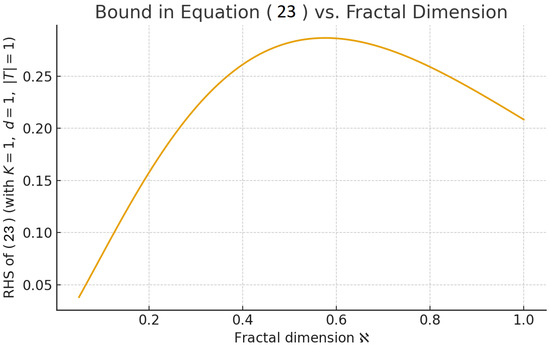
Figure 1.
Illustration of the deviation bound between and for different values of ℵ.
Figure 2 demonstrates that the bound grows approximately quadratically with the fractal interval, while its dependence on ℵ is nonlinear—attaining a peak near and decreasing as . This behavior highlights the transition from highly irregular fractal structures to the classical (smooth) domain where the Ostrowski-type bound becomes minimal.
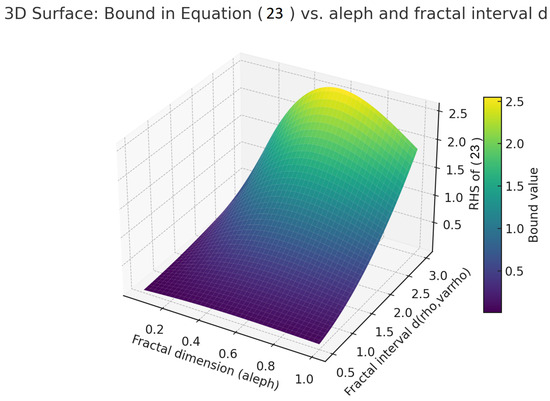
Figure 2.
Three-dimensional surface representation of the upper bound in Equation (23) as a function of the fractal dimension ℵ and the fractal interval .
Figure 3 explores the two-dimensional representation of the bound in Equation (23) and provides a comprehensive insight into how the inequality behaves under simultaneous variations of the fractal dimension ℵ and the fractal interval . In the contour projection (left panel), each contour line represents a set of parameter pairs yielding the same magnitude of the bound, thereby illustrating the sensitivity of the inequality to these parameters. The heatmap (right panel) complements this visualization by showing continuous intensity gradients, where darker regions correspond to larger bound values.
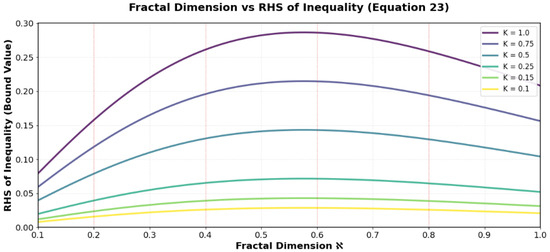
Figure 3.
Two-dimensional visualization of the bound in Equation (23) for varying fractal dimension ℵ and fractal interval . The left panel presents the contour projection, indicating regions of equal bound magnitude, while the right panel depicts the corresponding heatmap.
Both visualizations collectively demonstrate that the bound grows approximately quadratically with the fractal interval , which is consistent with its theoretical dependence in Equation (23). Conversely, the bound decreases nonlinearly as ℵ approaches unity, indicating that systems with higher fractal dimensions—representing smoother or more regular domains—experience smaller deviations between the expected value and the generalized arithmetic mean. This observation validates that the local fractional framework extends the classical Ostrowski inequality to fractal settings, effectively quantifying deviations within both smooth and non-smooth (fractal) structures.
5.2. Quantitative Interpretation and Discussion
To illustrate the influence of the fractal dimension on the established inequality (23), we consider the simplified case with , , and . The resulting bound
is evaluated for three different values of ℵ.
The numerical results presented in Table 1 and illustrated in Figure 4 provide a quantitative interpretation of the bound established in Equation (23) for selected values of the fractal dimension ℵ. For simplicity, the constants were chosen as , , and , allowing a direct examination of the influence of ℵ on the magnitude of the bound . The calculated values indicate that , , and , which clearly show a decreasing trend as the fractal dimension increases.

Table 1.
Numerical evaluation of the bound for different fractal dimensions.
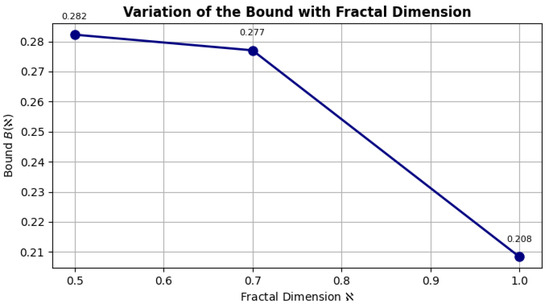
Figure 4.
Comparison of the bound for and .
This behavior aligns with the theoretical expectation that as ℵ approaches unity, the underlying function space transitions from a highly irregular fractal structure to a smoother Euclidean form. Consequently, the deviation between the expected value and the generalized mean becomes smaller, reflecting reduced uncertainty in systems of higher smoothness. Conversely, smaller values of ℵ correspond to domains with greater irregularity, for which the deviation is more pronounced. This confirms that the proposed inequality successfully captures the influence of fractal geometry on the behavior of random variables, generalizing the classical Ostrowski inequality to non-integer dimensional spaces.
6. Conclusions and Future Perspectives
By employing the concept of a generalized -pre-invex function, this study has established refined weighted versions of Ostrowski-type integral inequalities within fractal domains. The proposed framework extends classical inequalities to non-integer dimensional settings, thereby enriching the analytical foundation of integral inequalities for pre-invex functions on fractal sets. Building upon an identity proved by Meftah [8], several new results were derived for generalized -pre-invex functions, accompanied by notable special cases and numerical illustrations. Additionally, applications concerning generalized random variables and generalized special means were discussed to demonstrate the theoretical and computational significance of the established inequalities.
From a practical perspective, the developed inequalities serve as valuable analytical tools for modeling physical, probabilistic, and engineering systems characterized by fractal or irregular structures. Such formulations can be effectively utilized in signal and image analysis, uncertainty quantification, and stochastic processes where data exhibit self-similar or non-smooth behavior. Hence, the present work not only advances the theoretical understanding of fractal inequalities but also provides a bridge to their real-world applications.
Looking forward, the proposed results may be extended to fractional differential and integral equations defined on fractal sets, enabling deeper insights into the stability and convergence of such systems. Future studies could also explore stochastic and optimization models within self-similar domains, where the role of fractal randomness becomes prominent. Moreover, numerical investigations of these inequalities in multidimensional fractal geometries could further enhance their applicability to real-world problems in physics, engineering, and data science. These extensions would reinforce the versatility of local fractional calculus as a unifying tool for both theoretical development and practical modeling on complex domains.
Author Contributions
Conceptualization, M.M.; Methodology, M.M. and A.J.; Validation, K.N.; Formal analysis, M.B.; Investigation, M.B.; Writing—original draft, M.B.; Writing—review & editing, M.M., K.N. and A.J.; Visualization, K.N. and A.J.; Project administration, A.J.; Funding acquisition, A.J. All authors have read and agreed to the published version of the manuscript.
Funding
This article has been produced with the financial support of the European Union under the REFRESH—Research Excellence For Region Sustainability and High-tech Industries project number CZ.10.03.01/00/22_003/0000048 via the Operational Programme Just Transition.
Data Availability Statement
Data sharing is not applicable to this article, as no datasets were generated or analyzed during the current study.
Conflicts of Interest
The authors declare that they have no competing interests.
References
- Ostrowski, A. Über die absolutabweichung einer differentiebaren funktion von ihrem integralmitelwert. Comment. Math. Helv. 1937, 10, 226–227. [Google Scholar] [CrossRef]
- Milovanovic, G.; Pečarić, J. On generalization of the inequality of A. Ostrowski and some related applications. Univ. Beograd. Publ. Elektrotehn. Fak. Ser. Mat. Fiz. 1976, 576, 155–158. [Google Scholar]
- Cerone, P.; Dragomir, S.; Roumeliotis, J. An inequality of Ostrowski type for mappings whose second derivatives are bounded and applications. RGMIA Res. Rep. Collect. 1998, 1, 35–42. [Google Scholar]
- Dragomir, S.S.; Cerone, P.; Roumeliotis, J.; Wang, S.A. A Weighted Version of Ostrowski Inequality for Mappings of Holder Type and Applications in Numerical Analysis. Bull. Math. Soc. Sci. Math. Roum. 1999, 42, 301–314. [Google Scholar]
- Latif, M.A.; Alomari, M.W.; Hussain, S. On Ostrowski-type inequalities for functions whose derivatives are m-convex and (α,m)-convex functions with applications. Tamkang J. Math. 2012, 43, 521–532. [Google Scholar] [CrossRef]
- Kirmaci, U.; Özdemir, M.E. Some inequalities for mappings whose derivatives are bounded and applications to special means of real numbers. Appl. Math. Lett. 2004, 17, 641–645. [Google Scholar] [CrossRef]
- Wang, Y.; Xi, B.Y.; Qi, F. Hermite-Hadamard type integral inequalities when the power of the absolute value of the first derivative of the integrand is preinvex. Le Mat. 2014, 69, 89–96. [Google Scholar] [CrossRef]
- Meftah, B.; Souahi, A. Some weighted Ostrowski-type inequalities for differentiable preinvex functions. Math. Methods Appl. Sci. 2021, 44, 14892–14914. [Google Scholar] [CrossRef]
- Sun, W. Local fractional Ostrowski type inequalities involving generalized h-convex functions and some applications for generalized moments. Fractals 2020, 29, 2150006. [Google Scholar] [CrossRef]
- Yu, Y.; Liu, J.; Du, T. Certain error bounds on the parameterized integral inequalities in the sense of fractal sets. Chaos Solitons Fractals 2022, 161, 112328. [Google Scholar] [CrossRef]
- Ben-Israel, A.; Mond, B. What is invexity? J. Aust. Math. Soc. Ser. B Appl. Math. 1986, 28, 1–9. [Google Scholar] [CrossRef]
- Weir, T.; Mond, B. Pre-invex functions in multiple objective optimization. J. Math. Anal. Appl. 1988, 136, 29–38. [Google Scholar] [CrossRef]
- Noor, M.A.; Noor, K.I.; Rashid, S. Some New Classes of Preinvex Functions and Inequalities. Mathematics 2018, 7, 29. [Google Scholar] [CrossRef]
- Mohan, S.R.; Neogy, S.K. On invex sets and preinvex functions. J. Math. Anal. Appl. 1985, 189, 901–908. [Google Scholar] [CrossRef]
- Yang, X.J. Advanced Local Fractional Calculus and its Applications, 1st ed.; World Science Publisher: Singapore, 2012. [Google Scholar]
- Yang, X.-J.; Baleanu, D.; Srivastava, H.M. Local Fractional Integral Transforms and Their Applications, 1st ed.; Academic Press: Cambridge, MA, USA, 2015. [Google Scholar]
- Atangana, A. Modelling the spread of COVID-19 with new fractal-fractional operators: Can the lockdown save mankind before vaccination? Chaos Solitons Fractals 2020, 136, 109860. [Google Scholar] [CrossRef]
- Kumar, S.; Atangana, A. A numerical study of the non-linear fractional mathematical model of tumor cells in presence of chemotherapeutic treatment. Int. J. Biomath. 2020, 13, 2050021. [Google Scholar] [CrossRef]
- Wang, K.J. Variational principle and approximate solution for the generalized Burgers-Huxley equation with fractal derivative. Fractals 2020, 29, 1–6. [Google Scholar] [CrossRef]
- Gao, F.; Srivastava, H. Exact travelling wave solutions for the local fractional two-dimensional Burgers-type equations. Comput. Math. Appl. 2016, 73, 203–210. [Google Scholar] [CrossRef]
- Hadamard, J. Étude sur les propriétés des fonctions entières et en particulier d’une fonction considérée par Riemann. J. Math. Pures Appl. 1893, 58, 171–216. [Google Scholar]
- Ali, M.A.; Budak, H.; Abbas, M.; Chu, Y.M. Quantum Hermite–Hadamard-type inequalities for functions with convex absolute values of second qb-derivatives. Adv. Differ. Equ. 2021, 2021, 7. [Google Scholar] [CrossRef]
- Butt, S.I.; Kashuri, A.; Tariq, M.; Nasir, J.; Aslam, A.; Gao, W. Hermite–Hadamard-type inequalities via n-polynomial exponential-type convexity and their applications. Adv. Differ. Equ. 2020, 2020, 508. [Google Scholar] [CrossRef]
- Du, T.; Awan, M.U.; Kashuri, A.; Zhao, S. Some k-fractional extensions of the trapezium inequalities through generalized relative semi-(m,h)-preinvexity. Appl. Anal. 2021, 100, 642–662. [Google Scholar] [CrossRef]
- Mo, H.; Sui, X.; Yu, D. Generalized Convex Functions on Fractal Sets and Two Related Inequalities. Abstr. Appl. Anal. 2014, 2014, 636751. [Google Scholar] [CrossRef]
- Rashid, S.; Noor, M.A.; Noor, K.I.; Safdar, F. Integral inequalities for generalized preinvex functions. Punjab Univ. J. Math. 2019, 51, 77–91. [Google Scholar]
- Muddassar, M.; Dragomir, S.; Hussain, Z. Rayna’s fractional integral operations on Hermite–Hadamard inequalities with η-G-Preinvex functions. Adv. Oper. Theory 2020, 5, 1390–1405. [Google Scholar] [CrossRef]
- Almutairi, O.; Kilicman, A. Generalized Fejér–Hermite–Hadamard type via generalized (h-m)-convexity on fractal sets and applications. Chaos Solitons Fractals 2021, 147, 110938. [Google Scholar] [CrossRef]
- Du, T.; Wang, H.; Khan, M.; Zhang, Y. Certain integral inequalities considering generalized m-convexity on fractal sets and their applications. Fractals 2019, 27, 1–17. [Google Scholar] [CrossRef]
- Mo, H.; Sui, X. Hermite–Hadamard-type inequalities for generalized s-convex functions on real linear fractal set (0 < α < 1). Math. Sci. 2017, 11, 241–246. [Google Scholar]
- Iftikhar, S.; Erden, S.; Kumam, P.; Awan, U.M. Local fractional Newton’s inequalities involving generalized harmonic convex functions. Adv. Differ. Equ. 2020, 2020, 185. [Google Scholar] [CrossRef]
- Sarikaya, M.; Budak, H. Generalized Ostrowski type inequalities for local fractional integrals. Proc. Am. Math. Soc. 2016, 145, 1527–1538. [Google Scholar] [CrossRef]
- Sun, W. Hermite-Hadamard type local fractional integral inequalities for generalized s-preinvex functions and their generalization. Fractals 2020, 29, 2150098. [Google Scholar] [CrossRef]
- Ayman-Mursaleen, M. Controllability Of Tempered Caputo Fractional Dynamical Systems. J. Nonlinear Convex Anal. 2025, 26, 2501–2511. [Google Scholar]
- Ayman-Mursaleen, M.; Nasiruzzaman, M.; Rao, N. On the Approximation of Szász-Jakimovski-Leviatan Beta Type Integral Operators Enhanced by Appell Polynomials. Iran. J. Sci. 2025, 49, 1013–1022. [Google Scholar] [CrossRef]
- Sun, W. Generalized h-convexity on fractal sets and some generalized Hadamard type inequalities. Fractals 2019, 28, 2050021. [Google Scholar] [CrossRef]
- Sun, W. Some Hermite–Hadamard type inequalities for generalized h-preinvex function via local fractional integrals and their applications. Adv. Differ. Equ. 2020, 2020, 426. [Google Scholar] [CrossRef]
- Pečarić, J.E.; Proschan, F.; Tong, Y.L. Convex functions, Partial Orderings, and Statistical Applications, 1st ed.; Academic Press: Cambridge, MA, USA, 1992. [Google Scholar]
- Vivas-Cortez, M.; Bibi, M.; Muddassar, M.; Al-Sa’di, S. On local fractional integral inequalities via generalized ()-preinvexity involving local fractional integral operators with Mittag-Leffler kernel. Demonstr. Math. 2023, 56, 20220216. [Google Scholar] [CrossRef]
- Luo, C.; Wang, H.; Du, T. Fejér–Hermite–Hadamard type inequalities involving generalized h-convexity on fractal sets and their applications. Chaos Solitons Fractals 2020, 131, 109547. [Google Scholar] [CrossRef]
Disclaimer/Publisher’s Note: The statements, opinions and data contained in all publications are solely those of the individual author(s) and contributor(s) and not of MDPI and/or the editor(s). MDPI and/or the editor(s) disclaim responsibility for any injury to people or property resulting from any ideas, methods, instructions or products referred to in the content. |
© 2025 by the authors. Licensee MDPI, Basel, Switzerland. This article is an open access article distributed under the terms and conditions of the Creative Commons Attribution (CC BY) license (https://creativecommons.org/licenses/by/4.0/).