
Article

Parameter Estimation for Stochastic Korteweg–de Vries Equations

1
School of Mathematics and Big Data, Dezhou University, Dezhou 253023, China
2
School of Mathematics and Statistics, Shandong University of Technology, Zibo 255049, China
*
Author to whom correspondence should be addressed.
Axioms 2025, 14(12), 884; https://doi.org/10.3390/axioms14120884

Submission received: 30 October 2025 / Revised: 26 November 2025 / Accepted: 28 November 2025 / Published: 29 November 2025

Abstract

In this paper, we propose two methods for parameter estimation in stochastic Korteweg–de Vries (KdV) equations with unknown parameters. Both methods are based on the numerical discretization of the stochastic KdV equation. Moreover, we further propose an extrapolation-based approach to improve the accuracy of parameter estimation. In addition, for the deterministic case, the convergence and conservation of the fully discrete schemes are analyzed. Both our theoretical analysis and numerical tests indicate the efficiency of the proposed methods for the KdV equations considered.

1. Introduction

Korteweg–de Vries (KdV) equations describe long, unidirectional, and weakly nonlinear water waves on a channel [1], making them highly significant in physical research, for its numerical methods, such as the linearized energy–mass preserving scheme [2], Hermite finite difference methods [3,4], scattering-solution algorithms [5], Machine Learning [6], and soliton/breather solutions under non-zero boundary conditions [7] have also been extensively studied. When considering the propagation of ion-acoustic solitons in a noisy plasma, it seems necessary to add a noise term to the KdV equation. For the KdV equation with a noise term, its numerical solutions and exact solutions were, respectively, studied in [8,9]. Its extended form was also studied in [10], by adding additional and random terms to enable the equation to describe various real situations in many areas, including fluid dynamics, plasma physics, large-amplitude internal waves and Bose–Einstein condensates [11,12,13,14,15], therefore, numerical methods for stochastic KdV equations have attracted attention: finite difference and midpoint methods [16], Fourier and wavelet collocation [17], local discontinuous Galerkin [18], and nonlinearization of spectral problems [19]. For constructing symplectic methods, whether deterministic or stochastic, the midpoint rule in time is frequently applied [20,21,22,23,24,25], they have good long term behavior, and operator splitting [26], and stochastic multi-symplectic Runge–Kutta [27], as well as broader applications of stochastic symplectic methods [28] that have also been explored. For stochastic differential equations, minor noise can have big long-term impacts [29], so we focus on their long-term behavior. Additionally, while the forward problem is stable, the inverse problem is often unstable. From the perspective of stochastic modeling, its parameters are usually unknown. For example, in many financial model problems, the stochastic differential equation form of the model is often assumed first. By solving the parameters of the equation, it is important to study the essential problems in the financial field. It is important to use the existing data to analyze or infer the parameters of the data model, namely parameter estimation. Hence, for the KdV equations under consideration, the main motivation of our research is to study the multi-parameter inversion in the stochastic sense based on different numerical schemes, and to design efficient and stable parameter inversion methods and rapid correction techniques.
Motivated by these advancements, this work investigates a stochastic KdV equation with additive noise and two unknown parameters:
u t + a u u y + u y y y = γ ξ ˙ , π L y π L ,
where ξ ˙ denotes space–time white noise, understood as the generalized time derivative of a cylindrical Wiener process W t , y and γ is its amplitude; here, γ and a are unknown. Parameter a characterizes the strength of nonlinear waves in this system, while γ quantifies the extent of noise influence on the system. We apply Fourier spectral methods in space, combined with the midpoint and Euler–Maruyama methods in time, then develop parameter estimation strategies based on these discrete equations. By integrating numerical discretization of governing equations with noise distribution analysis, our approaches establish a parameter representation framework that generates computationally efficient mean-convergent solutions. This method was also studied in [30], which we refer to as the expected variance method (EV), but it only discusses general stochastic ordinary differential equations. In [31], the maximum likelihood estimation(MLE) of general types of linear stochastic PDEs was considered. In this paper, we choose (1) as an example and extend it to more complex cases in our research. This choice deliberately targets the numerical challenges arising from third-order dispersion terms and quadratic nonlinearity, which remain unexplored in prior parameter estimation literature [32,33,34,35]. We compare the EV framework constructed in (1) with the Maximum Likelihood Estimation (MLE) framework in [31], which generates higher computational overhead to achieve equivalent statistical significance. The proposed EV method demonstrates three characteristics: (1) superior accuracy to MLE in short-term parameter estimation; (2) runtime efficiency improvements over MLE in long-term estimation while maintaining comparable precision; and (3) experimental evidence revealing that parametric accuracy in Fourier spectral implementations does not necessarily improve with spatial grid refinement but instead exhibits temporal degradation—an effect exacerbated by large drift parameters and low-order temporal schemes. This artifact originates from spurious high-wavenumber components progressively accumulated in temporal evolution when implementing Fourier spectral discretization. To address these limitations, we propose a corrective strategy: an extrapolation-based precision enhancement technique, previously unexplored in stochastic systems. Experimental results confirm that this method effectively mitigates temporal accuracy degradation under moderate perturbations, demonstrating stable corrective effects on parameter estimation outcomes.
As γ 0 , Equation (1) reduces to the deterministic KdV equation:
u t + u u y + u y y y = 0 , π L y π L ,
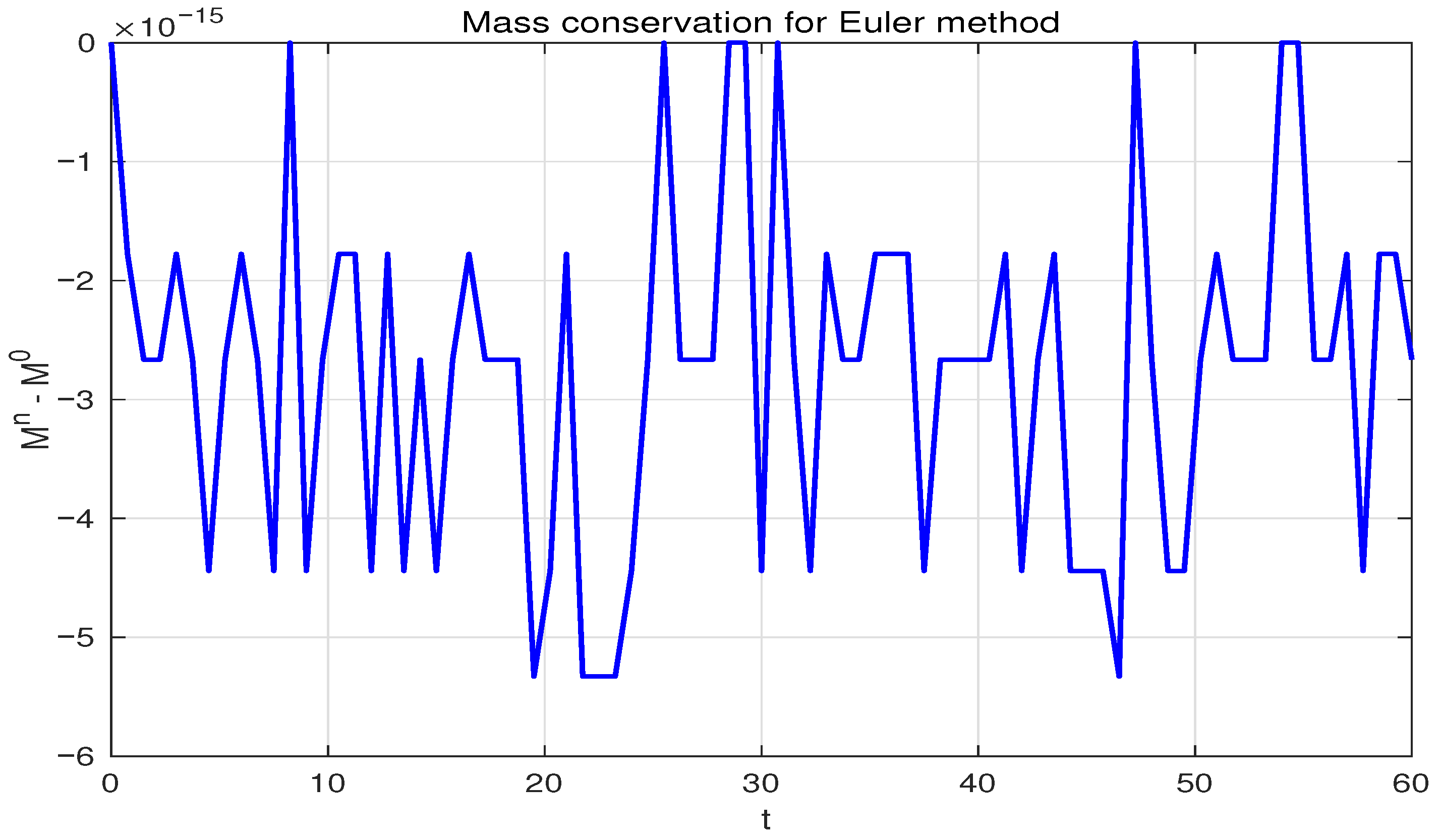
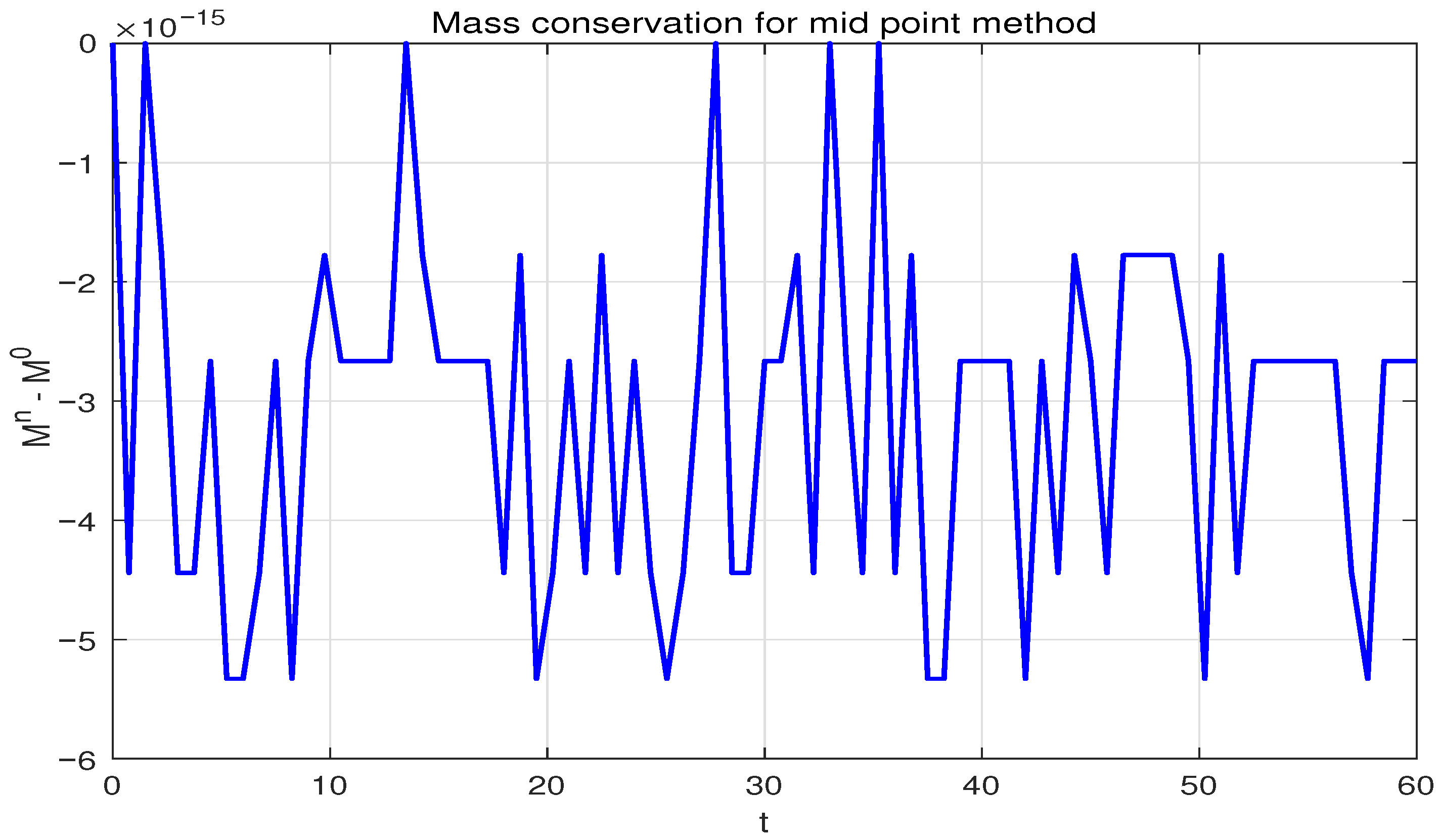
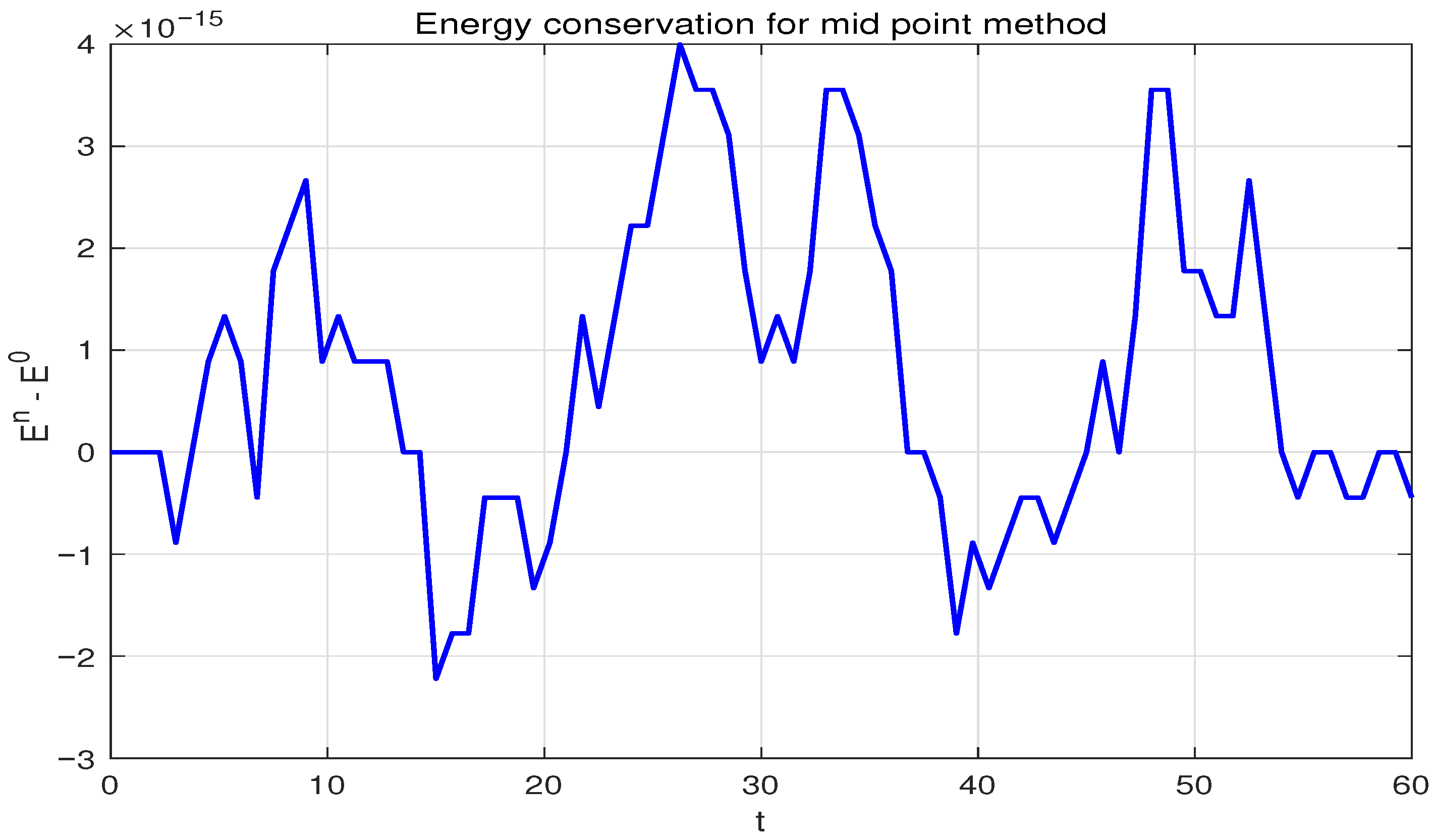
which we also examine for its structure-preserving properties within the Fourier spectral framework. Notably, for the non-symplectic Euler method, mass conservation is maintained, while the symplectic midpoint method preserves both mass and energy effectively.
The remainder of this paper is organized as follows. Section 2 reviews the Fourier pseudo-spectral formulation, and Section 3 presents fully discrete schemes (using midpoint and Euler–Maruyama) for the KdV equations in Fourier space. Section 4 introduces two parameter estimation methods for the stochastic KdV equation, incorporating an extrapolation procedure, and briefly addresses structure-preserving properties in the deterministic case. Numerical results appear in Section 5, followed by concluding remarks in Section 6.

2. Fourier Pseudo-Spectral Approximations

In this paper, since u y , t decays exponentially to zero as y for (2), so we can truncate the infinite interval to a finite one π L , π L with L > 0 , and approximate the boundary conditions by the periodic boundary conditions on π L , π L . For (1), in fact, for a large enough L, even if the wave function is affected by noise, it can achieve the above properties, and can be approximated as a random periodic solution under the appropriate perturbation.
For any u x L 2 0 , 2 π , its Fourier series are formulated as
u x = k = u ^ k e i k x , where u ^ k = u , e i k x = 1 2 π 0 2 π u x e i k x d x .
In turn, the projection of u x onto B N , the space of trigonometric polynomials in x of degree up to N, becomes
P N u x = k = N / 2 N / 2 u ^ k e i k x .
In general, the Fourier coefficients u ^ k in (4) can not be evaluated exactly, so we have to resort to some quadrature formula. A simple and accurate quadrature formula for 2 π -periodic functions is the rectangular rule, given a positive integer N, let x j = j h = j 2 π N , 0 j N 1 :
1 2 π 0 2 π v x d x 1 N j = 0 N 1 v x j , v C 0 , 2 π ,
which is exact for all v s p a n e i k x : 0 k N 1 .
Applying (5) to (3) leads to the approximation
u ^ k u ˜ k = 1 N j = 0 N 1 u x j e i k x j , k = 0 , ± 1 , .
and the u ˜ k are N p e r i o d i c , which implies that for even N, we have u ˜ N / 2 = u ˜ N / 2 ; hence, there are only N independent coefficients. We set
T N = u = k = N / 2 N / 2 u ˜ k e i k x , u ˜ N / 2 = u ˜ N / 2 ,
and define the mapping I N : C 0 , 2 π t o T N
I N u x = k = N / 2 N / 2 u ˜ k e i k x ,
where u ˜ k is given by (6). I N is the interpolation operator from C 0 , 2 π t o T N such that
I N u x j = u x j , x j = 2 π j N , 0 j N 1 .
Applying the Fourier spectral method in the spatial domain essentially means approximating the solution function using a truncated Fourier series. The Fourier spectral method fundamentally relies on obtaining Fourier coefficients through discrete transforms. This process essentially maps the solution function from physical space to the Fourier spectral domain, where differential operators become diagonalized. Historically constrained by the O N 2 complexity of coefficient calculations, such methods were computationally prohibitive. With the advent of Fast Fourier Transform (FFT) algorithms that reduce the complexity to O N log N , these techniques have become a cornerstone of modern numerical simulations. It is well known that an efficient algorithm using the fast Fourier transform (FFT) is available to compute the Fourier coefficients given by (6), and its inverse fast Fourier transform (IFFT) is also available in many software packages. For solving another type of wave equation, the good Boussinesq (GB) equation, the combination of the Fourier spectral method for spatial discretization and the operator splitting method for time was investigated in [36]. Its good performance under periodic boundary conditions has made this method quite popular for the numerical solution of the PDEs. In addition, some theoretical and other details about the Fourier spectral method can also be found in [37,38,39,40]. Here, we restrict our attentions to their implementations in MATLAB. In this paper, we will use u ^ to denote the fast Fourier transform of u throughout. Therefore, for (1), we have
u t + a u u y + u y y y = γ ξ u t + a 1 2 u 2 y + u y y y = γ ξ .
Hereafter, we take the Fourier transform on both sides of (10), yielding the following:
u ^ t + a i k 2 L u 2 ^ i k 3 L 3 u ^ = γ ξ ^ ,
for (10), y π L , π L . We multiply both sides of (11) by the integrating factor e i k 3 t / L 3 , yielding the following:
e i k 3 t / L 3 u ^ t + a i k 2 L e i k 3 t / L 3 u 2 ^ i k 3 L 3 e i k 3 t / L 3 u ^ = γ e i k 3 t / L 3 ξ ^ ,
and we let U ^ = e i k 3 t / L 3 u ^ , so we have U ^ t = i k 3 L 3 U ^ + e i k 3 t / L 3 u ^ t . Therefore, for (12), we have
U ^ t + i k 3 L 3 U ^ + a i k 2 L e i k 3 t / L 3 u 2 ^ i k 3 L 3 U ^ = e i k 3 t / L 3 γ ξ ^ .
By multiplying both sides with the integrating factor, we can eliminate the linear terms in the equation and, to some extent, reduce the stiffness of the equation. By simplifying (13), we obtain
U ^ t = a i k 2 L e i k 3 t / L 3 u 2 ^ + e i k 3 t / L 3 γ ξ ^ .
In Fourier frequency space, we use F u to represent u ^ , denoting performing the Fast Fourier Transform (FFT) on u, and use F 1 u to denote the inverse Fourier transform of u. Thus, (14) can be further expressed in the following form:
U ^ t = a i k 2 L e i k 3 t / L 3 F F 1 e i k 3 t / L 3 U ^ 2 + e i k 3 t / L 3 γ ξ ^ ,
For (15), this essentially represents a form of a stochastic ordinary differential equation
U ^ t = f t , U ^ , f t , U ^ = a i k 2 L e i k 3 t / L 3 F F 1 e i k 3 t / L 3 U ^ 2 + e i k 3 t / L 3 γ ξ ^ .
Up to this point, we have applied the Fourier spectral method in space to the stochastic KdV equation and transformed it into an ordinary differential equation form using the integrating factor method. This transformation not only facilitates the discretization of the time derivative but also makes it more convenient for implementation in MATLAB.

3. Discretization of the Derivatives in Time

Let τ be the temporal step size, t n = n τ , n = 0 , 1 , 2 , , M , t n + 1 / 2 = t n + t n + 1 2 , where M = [ T / τ ] , u n = u ( y , t n ) . For the discretization of the time derivative, we use the Euler–Maruyama method and the implicit midpoint method, respectively. By applying the Euler–Maruyama method to discretize (16), we have
U ^ n + 1 U ^ n τ = a i k 2 L e i k 3 t n / L 3 F F 1 e i k 3 t n / L 3 U ^ n 2 + γ e i k 3 t n / L 3 B ^ n + 1 B ^ n τ ,
where ξ ^ = d B ^ τ . Let ξ ^ denote the white noise in the Fourier frequency domain and B ^ denote the Brownian motion in the Fourier frequency domain. Here, they can be regarded as a form of complex Gaussian random noise, as the Fourier frequency domain is a complex-valued space. When handling this in MATLAB, the complex noise can be normalized so that d B ^ C N 0 , τ , where C N 0 , τ denotes a complex Gaussian distribution. Equation (17) is essentially the fully discretized form of (1), which can also be written as follows:
U ^ n + 1 = U ^ n a τ i k 2 L e i k 3 t n / L 3 F F 1 e i k 3 t n / L 3 U ^ n 2 + γ e i k 3 t n / L 3 B ^ n + 1 B ^ n .
For (16), that is U ^ n + 1 = U ^ n + f ( t n , U ^ n ) , where f t n , U ^ = a τ i k 2 L e i k 3 t n / L 3 F F 1 e i k 3 t n / L 3 U ^ n 2 + γ e i k 3 t n / L 3 B ^ n + 1 B ^ n .
Thus, by applying the implicit midpoint method to discretize the time derivative of (16), it can be expressed in the following form:
U ^ n + 1 = U ^ n a τ i k 2 L e i k 3 t n + 1 / 2 / L 3 F F 1 e i k 3 t n + 1 / 2 / L 3 U ^ n + 1 + U ^ n 2 2 + γ e i k 3 t n + 1 / 2 / L 3 d B ^ ,
that is U ^ n + 1 = U ^ n + f t n + 1 / 2 , U ^ n + 1 + U ^ n 2 .

4. Parameter Estimation Methods and Some Structure-Preserving Properties

This section introduces two parameter estimation methods for the stochastic KdV equation based on its numerical discretization, along with an extrapolation technique to improve estimation accuracy. These approaches fall under the EV method framework discussed earlier. We also provide a comparative analysis between the EV method and MLE under identical numerical schemes. Other relevant theoretical studies can also be found in [41]. The next section validates these methods through numerical experiments and examines structure-preserving properties in the deterministic case, supported by corresponding numerical results.

4.1. EV Estimation Methods

The first parameter estimation method applies the Fourier spectral method for spatial discretization and the Euler–Maruyama method for time discretization, resulting in the fully discrete form (18). From (13) in Section 2, we define U ^ = e i k 3 t / L 3 u ^ , giving u ^ = e i k 3 t / L 3 U ^ . For the discrete case, this becomes u ^ n = e i k 3 t n / L 3 U ^ n , leading to the following form:
u ^ n + 1 = e i k 3 t n + 1 / L 3 U ^ n + 1 = e i k 3 t n / L 3 e i k 3 τ / L 3 U ^ n + 1 ,
Subsequently, substituting the expression for U ^ n + 1 from (18) into (20), we obtain
u ^ n + 1 = e i k 3 τ / L 3 u ^ n a τ i k 2 L e i k 3 τ / L 3 u 2 ^ t n + e i k 3 τ / L 3 γ B ^ n + 1 B ^ n .
To clarify, Equation (21) is still framed in the Fourier frequency domain. In the physical domain, the Brownian increment follows a distribution with zero mean and variance τ . However, in the Fourier frequency domain, when the sample size is sufficiently large and the time step τ is small, it can also be approximately regarded as following a complex distribution with zero mean and variance τ , that is, d B ^ C N 0 , τ . This will be further verified through numerical experiments in the next section. Therefore, for (21), if we let d u * = u ^ n + 1 e i k 3 τ / L 3 u ^ n , n o n l i n e a r = i k 2 L e i k 3 τ / L 3 u ^ 2 t n . According to Equation (21), the expectation of the Brownian increment in the Fourier frequency domain framework can be expressed as
n o n l i n e a r , E d u * n o n l i n e a r , n o n l i n e a r τ = a ,
where E d u * denotes taking the expectation of d u * , and · represents the inner product. Taking the inner product of both the numerator and denominator with n o n l i n e a r eliminates the influence of the complex space, resulting in a real-valued parameter estimation. According to [30], at a given time point, we obtain m estimates. At the next time point, the numerical solution from the previous time point is fixed as the initial value for the next step. Finally, the average of the obtained estimates theoretically represents the final estimated parameter value a.
This process is essentially a specific application of Equation (22). Moreover, according to the parameter estimation theory for stochastic ordinary differential equations described in [30], the distribution of the following stochastic ODE is given by
X i + 1 X i = h f X i , θ + B t i + 1 B t i σ X i , γ ,
thus, we have X i + 1 X i N h f X i , θ , h σ 2 X i , γ , where, X i represents the numerical solution at time t i , h denotes the time step size, and h f X i , θ corresponds to the deterministic part of the stochastic ODE. θ and γ are unknown parameters. Using the relationship of the variance at t 1 , we have 1 m 1 j = 1 m X ω j 0 , t 1 h f X 0 2 = h σ 2 X 0 , γ . Therefore, for (21), essentially, it also takes the form of a stochastic ODE. Using the relationship of its variance, we obtain the expression for the parameter γ as
1 m 1 j = 1 m d u * n o n l i n e a r 2 τ = γ ,
Here, m represents the number of sample paths.
Secondly, the second parameter estimation method is based on applying the Fourier spectral method in space and the implicit midpoint method in time to the stochastic KdV equation. The corresponding fully discretized form is provided in (19). When the time discretization method is replaced by the implicit midpoint method instead of the Euler–Maruyama method, the same steps as in (20) and (21) are followed. The difference lies in substituting (19) into (20). For convenience, we denote the nonlinear part using the implicit midpoint method as N m i d , which represents the new form of the nonlinear term obtained by substituting the expression of U ^ n + 1 in (19) into (20). We can get the following form:
u ^ n + 1 = e i k 3 τ / L 3 u ^ n a τ i k 2 L e i k 3 τ / 2 L 3 N m i d + e i k 3 τ / 2 L 3 γ d B ^ ,
Similarly, for (25), we let d u * * = u ^ n + 1 e i k 3 τ / L 3 u ^ n , n o n l i n e a r * = i k 2 L e i k 3 τ / 2 L 3 N m i d . According to Equation (25), the expectation of the Brownian increment in the Fourier frequency domain framework can be expressed as
n o n l i n e a r * , E d u * * n o n l i n e a r * , n o n l i n e a r * τ = a ,
where E d u * * denotes taking the expectation of d u * * , and · represents the inner product.
Similar to the time discretization using the Euler–Maruyama method, when the implicit midpoint method is used for time discretization, we can obtain the following expression for the estimation of parameter γ :
1 m 1 j = 1 m d u * * n o n l i n e a r * 2 τ = γ ,
where m represents the number of sample paths.

4.2. Extrapolation Method

In fully discrete parameter estimation for the stochastic KdV equation, the choice of time discretization may affect the accuracy of parameter estimation. However, high-accuracy schemes for SPDEs are relatively rare. To address this gap, we propose using extrapolation. Although widely employed to refine solutions of deterministic PDEs, extrapolation has seen limited use in SPDEs, and it has not been explored for SPDE parameter estimation.
Extrapolation leverages numerical solutions at two different time steps to cancel leading-order truncation errors, thereby enhancing accuracy—particularly for low-order methods—without altering the underlying scheme. Its performance depends on the stability of the base method, yet it only requires additional computations with different step sizes, making it straightforward to implement. Consequently, extrapolation holds considerable promise for diverse numerical applications.
In deterministic equations, accuracy improvements via extrapolation often employ the following formula:
X e x t r a p = 2 p 2 p 1 X τ 2 1 2 p 1 X τ ,
where X e x t r a p represents the extrapolated numerical solution, X τ represents the numerical solution with a time step size of τ , and X τ 2 represents the numerical solution with a time step size of τ 2 . p denotes the order of the truncation error for the discretization method.
Extrapolation is traditionally used to improve the accuracy of numerical solutions for deterministic PDEs, especially in low-order schemes. Here, however, our aim is parameter estimation for the stochastic KdV equation rather than direct numerical solution. Hence, we apply extrapolation directly to the expectations of d u * and d u * * from (22), (24), (26) and (27), instead of extrapolating the solution itself, so that it acts more directly on the estimation process. In particular, d u * and d u * * can be regarded as the numerical solutions in (28). However, here, p should be interpreted as the order of weak convergence rather than strong convergence, as indicated by the following formula:
E X T Y N C τ p ,
For (29), a numerical method is said to be strongly convergent with a strong convergence order of p if there exist constants C > 0 and p > 0 , independent of the time step size τ , such that (29) holds. Here, X T represents the exact solution at time T, and Y N denotes the numerical approximation of X T . If the above expression (29) is replaced with
E φ X T E φ Y N C τ p ,
and holds for any polynomial φ , then the numerical method is said to be weakly convergent with a weak convergence order of p.
In this paper, for the stochastic KdV equation with Itô-type additive noise, we apply extrapolation by considering E d u * and E d u * * as solutions. In fact, for E d u * and E d u * * , they represent a deterministic part. For deterministic methods, the Euler method is of first-order, and the implicit mid-point method is of second-order. Therefore, for the two parameter estimation methods mentioned earlier, extrapolation can be applied to the expectations and variances of the increments using the following formula:
E d u * e x t r a p = 2 E d u * τ / 2 E d u * τ , V a r d u * e x t r a p = 2 V a r d u * τ / 2 V a r d u * τ ,
E d u * * e x t r a p = 4 3 E d u * * τ / 2 1 3 E d u * * τ , V a r d u * * e x t r a p = 4 3 V a r d u * * τ / 2 1 3 V a r d u * * τ ,
For (31), this is the extrapolation formula applied to the first parameter estimation method, and for (32), this is the extrapolation formula applied to the second parameter estimation method. The extrapolated results can then be substituted into the respective parameter estimation expressions to obtain the extrapolated parameter estimates.

4.3. MLE Estimation Method

While [31] addresses MLE in depth, our discussion here is confined to a concise treatment of MLE within the proposed framework.
To facilitate reader comprehension of MLE as a statistical parameter estimation strategy, this section provides a detailed exposition of parameter estimation for general stochastic ordinary differential equations (ODEs). This is followed by a plain-language characterization of the stochastic KdV equation central to our study.
First, we examine the general class of linear stochastic ordinary differential equations (ODEs) addressed in [30], corresponding to the previously established formulation (23). We have X i + 1 X i N h f X i , θ , h σ 2 X i , γ , where, X i represents the numerical solution at time t i , h denotes the time step size, and h f X i , θ corresponds to the deterministic part of the stochastic ODE. θ and γ are unknown parameters. Let θ = θ , γ , and building upon the theoretical framework of MLE, we derive the maximum likelihood function for the parameter vector θ as follows:
L θ = i = 0 N 1 1 2 π h σ 2 t i , X i , γ e X i + 1 X i f t i , X i , θ h 2 2 σ 2 t i , X i , γ h ,
where we apply the logarithmic transformation to (33), thereby obtaining the log-likelihood function ln L θ . The likelihood function, being typically multiplicative across probability terms, presents computational complexity when directly differentiated with respect to parameters. This inherent difficulty motivates the standard practice of logarithmic transformation to enhance analytical tractability. Setting the partial derivatives of the log-likelihood function to zero generates the score equations, which we subsequently solve numerically as follows:
ln L ( θ ) θ = 0 .
For the stochastic KdV Equation (1), we implement spatial discretization via the Fourier spectral method coupled with temporal discretization using the Euler–Maruyama scheme, yielding the fully discrete formulation (18). This discretization framework naturally leads to the structure in (21). Similarly, letting θ = a , γ , we obtain
L θ = i = 0 N 1 1 2 π τ γ 2 e u ^ n + 1 ^ e i k 3 τ / L 3 u ^ n + a τ i k 2 L e i k 3 τ / L 3 u 2 ^ t n 2 2 γ 2 τ .
Subsequent maximum likelihood estimation under this discrete paradigm follows the computational rules specified in (33) and (34), with the optimization process (34) executed numerically using MATLAB’s fminsearch routine.

4.4. Some Structure-Preserving Properties

Gardner et al. once pointed out that the KdV equation has infinite conservation properties [42]. For the deterministic case, specifically (2) with a = 1 , we examine certain conserved quantities, focusing primarily on mass and energy conservation. In (2), u depends on the spatial variable y π L , π L and time t. When L is sufficiently large, (2) satisfies periodic boundary conditions. The spatial variable y is mapped to the Fourier frequency domain as x 0 , 2 π , with x = y L + π .
Theorem 1.
Let M ( t ) = π L π L u y , t d y = L 0 2 π u x , t d x . When the solution u is represented by its Fourier series, we still have
M ( t ) = M ( 0 ) .
Proof. 
For a periodic function u ( x ) defined on 0 , 2 π , its Fourier series expansion can be expressed as
u x = k = u ^ k e i k x ,
where k represents different frequency components, and u ^ k denotes the Fourier coefficient corresponding to the frequency k, with u ^ k = 1 2 π 0 2 π u x e i k x d x .
The integral here represents the inner product of u x with the orthogonal basis functions e i k x , which provides the projection of the function onto the frequency k. Specifically, when k = 0 , the Fourier basis function becomes e 0 = 1 , leading to
u ^ 0 ( x , t ) = 1 2 π 0 2 π u x , t d x .
Moreover, since the mean value of u x , t on 0 , 2 π is defined as 1 2 π 0 2 π u x , t d x , it therefore follows that
M ( t ) = 2 π L u ^ 0 ( t ) ,
Thus, under periodic boundary conditions, according to [42], since the KdV equation conserves mass, we have u ^ 0 ( t ) = u ^ 0 ( 0 ) . Thus, when the solution is represented by its Fourier series in the continuous sense, we still have
M ( t ) = M ( 0 ) .
Theorem 2.
Let M ˜ n = h j = 0 J u n ( x j ) , denotes the mass corresponding to the midpoint scheme in the discrete sense, where h = u x j + 1 u x j , j = 0 , 1 , 2 J , and we have
M ˜ n = M ˜ n + 1 ,
Similarly, let M ^ , denote the mass corresponding to the Euler scheme in the discrete sense, and we also have
M ^ n + 1 = M ^ n .
Proof. 
For (19), we extract the deterministic component, that is, the time discretization method employs the implicit midpoint scheme. First, when k = 0 , f t n + 1 / 2 , U 0 n + 1 + U 0 n 2 = 0 . Given U ^ 0 n + 1 = U ^ 0 n + τ · 0 = U ^ 0 n , it follows that u ^ 0 n = e 0 U ^ 0 n = U ^ 0 n , and consequently,
M ˜ n + 1 = M ˜ n .
Similarly, for (18), the time discretization method employs the explicit Euler scheme, and the same reasoning applies to the Euler method, resulting in U ^ 0 n + 1 = U ^ 0 n + τ · 0 = U ^ 0 n , u ^ 0 n + 1 = u ^ 0 n , and consequently,
M ^ n + 1 = M ^ n .
Theorem 3.
E ( t ) = 1 2 π L π L u y , t 2 d y = L 2 0 2 π u x , t 2 d x , let E n = h 2 j = 0 J 1 u n y j 2 , denotes the energy corresponding to the midpoint scheme in the discrete sense, where y j = π L + j h , h = 2 π L / J , j = 0 , 1 , 2 J , and we have
E n = E 0 .
Proof. 
By the Parseval theorem, we have E n = π L k = J / 2 J / 2 1 U ^ k n 2 , since U ^ k n = u ^ k n . For E n + 1 E n , we have
E n + 1 E n = π L k U ^ k n + 1 2 U ^ k n 2 .
U ^ k n + 1 2 U ^ k n 2 = 2 Re U ^ k n + 1 U ^ k n U ^ k n + 1 / 2 ¯ is considered, where Re takes the real part. U ^ k n + 1 / 2 ¯ takes its conjugate. Therefore, for (46), we have
E n + 1 E n = 2 π L k Re τ i k 2 L N k n + 1 / 2 U ^ k n + 1 / 2 ¯ .
where N k n + 1 / 2 = e i k 3 t n + 1 / 2 / L 3 F u n + 1 / 2 2 k , since Re i z = Im z , we have
E n + 1 E n = π τ k k · Im N k n + 1 / 2 U ^ k n + 1 / 2 ¯ ,
where N k n + 1 / 2 U ^ k n + 1 / 2 ¯ = F u n + 1 / 2 2 k u ^ k n + 1 / 2 ¯ ; thus, we have
k k · N k n + 1 / 2 U ^ k n + 1 / 2 ¯ = k k · F u n + 1 / 2 2 k u ^ k n + 1 / 2 ¯ ,
In Fourier space, multiply by k the corresponding spatial differential operator k u ^ k = i L F u y k . Thus, for (49), in combination with the Parseval theorem and the properties of Fourier transform, we have
k k F v k u ^ k ¯ = 1 2 π π L π L v i L u y d y ,
where v = u n + 1 / 2 2 . Therefore, for (49), we have
k k · F u n + 1 / 2 2 k u ^ k n + 1 / 2 ¯ = i L 2 π π L π L u n + 1 / 2 2 u n + 1 / 2 y d y ,
For the right end of (51), this integral is 0 at the periodic boundary condition, and this means that scalar (49) is 0, and we can obtain
k k · N k n + 1 / 2 U ^ k n + 1 / 2 ¯ = k k · F u n + 1 / 2 2 k u ^ k n + 1 / 2 ¯ = i L 2 π π L π L u n + 1 / 2 2 u n + 1 / 2 y } d y = 0 .
Substituting (52) into (48), we obtain
E n + 1 E n = 0 ,
that is
E n = E 0 .
For the deterministic KdV Equation (2), applying the Fourier spectral method in space and using either the implicit midpoint or explicit Euler method in time satisfies (41) and (42), respectively. Notably, the explicit Euler method also conserves mass, which is surprising since the midpoint method is typically favored for structure-preserving properties and is widely recognized as symplectic [20,21,22,23,24,25]. Additionally, the implicit midpoint method preserves (45). In the next section, numerical experiments will demonstrate errors in conserved quantities and analyze the convergence orders of the Fourier spectral method (in space) and the implicit midpoint method (in time).

5. Numerical Experiments

This section presents numerical results for parameter estimation of the stochastic KdV Equation (1) using the two methods mentioned in Section 4, along with results improved by the extrapolation method. Under identical numerical discretization scheme, we conduct a comparative analysis between the EV strategy and MLE framework, with particular focus on their mean behavior characterization. For the deterministic case (2), numerical experiments on mass conservation (41), (42) and energy conservation (45) are provided. Additionally, the convergence orders of the spatial and temporal discretization methods for (2) are demonstrated through tables and figures.

5.1. Parameter Estimation

In Table 1 and Table 2, we present the parameter estimation results at time T = 10 obtained using the two EV methods mentioned in (4). Additionally, we provide the parameter estimation results after combining the two methods with extrapolation.
For (1), the initial conditions are chosen as
u 0 = 12 κ 2 sech 2 κ y y 0 ,
which are also the initial conditions for the corresponding deterministic case (2). For (55), κ = 0.3 , y 0 = 20 . For (1), the parameter L = 15 , that is, y 15 π , 15 π , the number of spatial grid points N is 256, the time step size dt is 0.01 , and the number of sample paths M is 500.
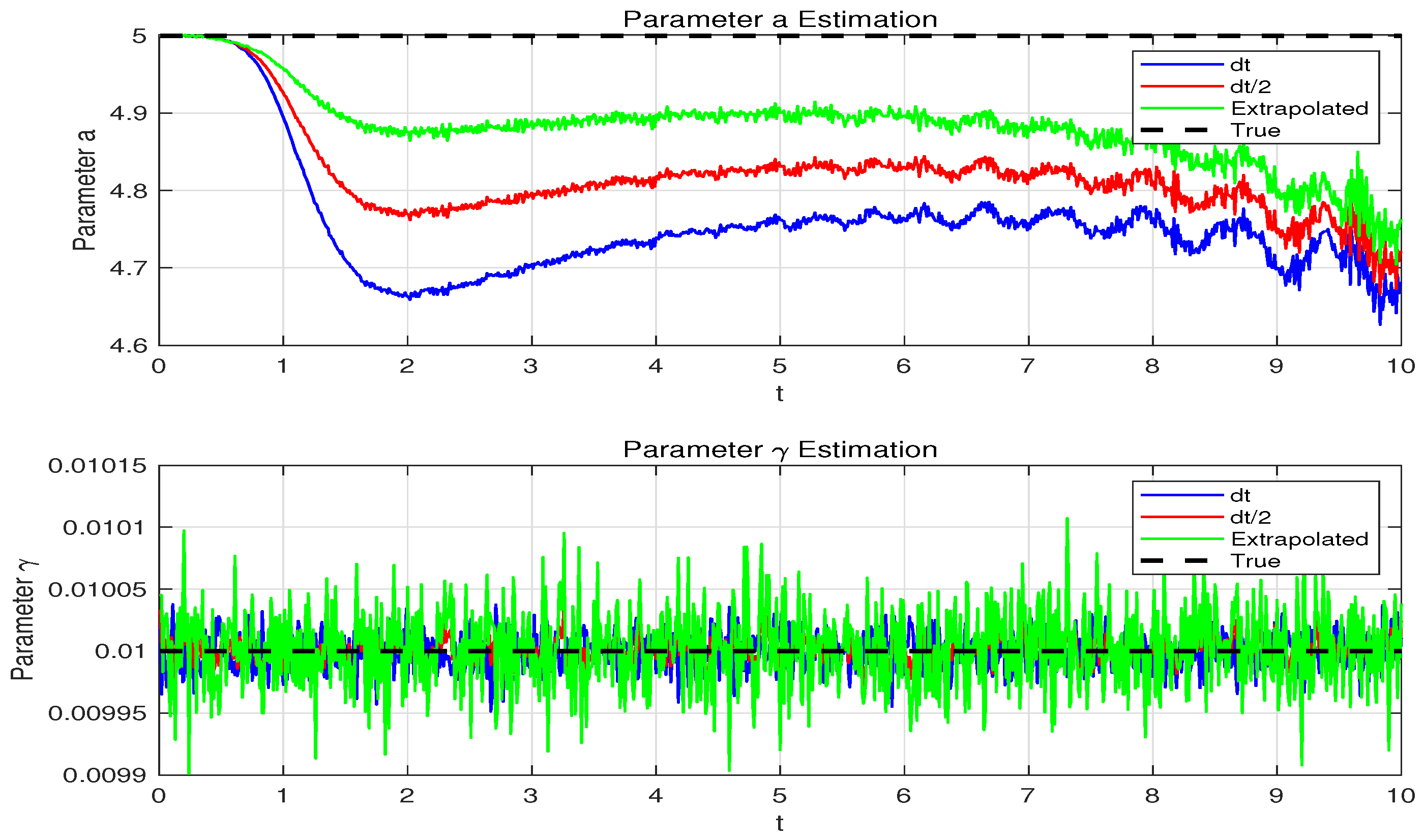
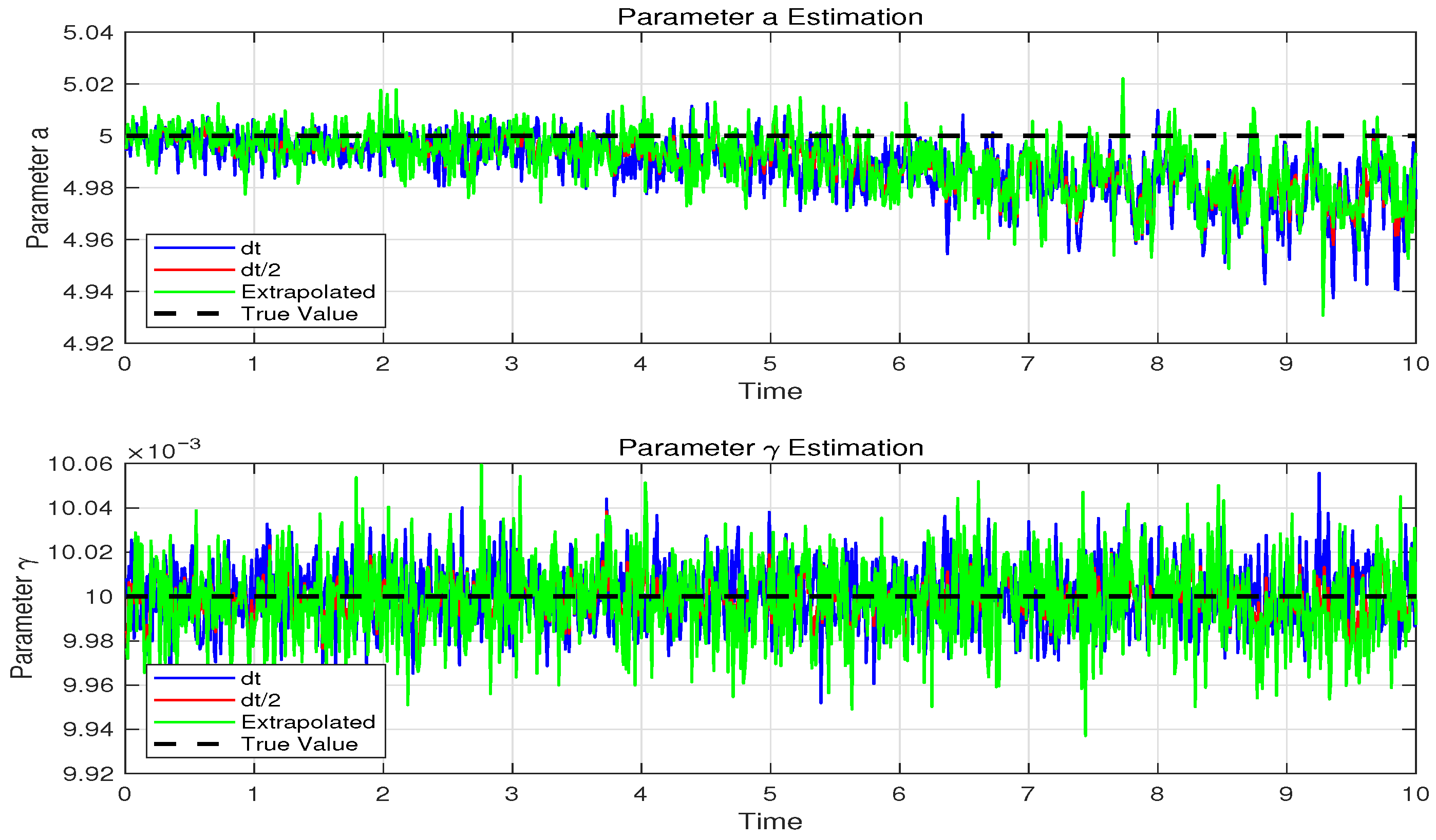
The E s c h e m e applies the Euler–Maruyama method in time, while the M s c h e m e uses the implicit midpoint method. Their extrapolation-enhanced counterparts are denoted E s c h e m e e x t r a p and M s c h e m e e x t r a p , respectively. Table 1 and Table 2 show that the midpoint method generally outperforms the Euler–Maruyama method, and that combining either with extrapolation further increases parameter estimation accuracy. However, as noise intensity grows, estimation quality diminishes. This is mainly due to the influence of noise disturbance on an unstable system. Compared to short time evolution, for long time evolution, the effect of noise is amplified, and for the spatially truncated value of N, we chose a big value. This means that the sampling frequency of the Fourier transform is high, because the roughness of the function increases due to the enhancement of noise. Under the sampling conditions of high frequency, some invalid samples accumulate over time, affecting the accuracy of the estimate. Finally, Figure 1 and Figure 2 depict parameter estimation simulations for a = 5 and γ = 0.01 over T = 10 , using both methods. In the long time, because very small noise disturbance will have a big impact on the stochastic differential equation, we first carried out some numerical experiments in the long time, with small disturbance. For Table 1, we fixed a smaller perturbation parameter and tested the effect of different drift term coefficients, and for Table 2, we fixed a drift term coefficient, and the effects of different small perturbation parameters were tested. This concludes the explanation for our choice of conducting such an experiment. For the Table 3, we also tested the effect of larger drift term parameters. Similar experiments in the same numerical schemes for the EV method and the MLE method under normal perturbations are also shown in Table 4 and Table 5.
In Figure 1 and Figure 2, the blue curves represent discretization based on the aforementioned step size, i.e., dt takes 0.01, since extrapolation is based on the combination of the selected step size and half step size; therefore, we use the red curve to represent the simulation results based on the half-step, and we use the green curve to represent the extrapolated simulation results. A comparison of Figure 1 and Figure 2 reveals that, for parameter estimation using the Euler–Maruyama method with time discretization, the improvement achieved through extrapolation is more pronounced compared to the parameter estimation obtained using the implicit midpoint method. However, its estimation performance still lags behind the implicit midpoint method used for time discretization, which to some extent indicates that the midpoint discretization scheme is more stable. In some cases, its performance will be more obvious compared to lower order time discretization schemes, and the application of extrapolation method shows a relatively stable correction effect under low disturbances. This is a precision correction method worth considering for the instability of the scheme and the accuracy degradation caused by the increase in time. When the scheme is stable enough and the performance is good enough, the correction effect brought by extrapolation method will also weaken.
In addition, we found that for the value of N, it is not necessarily better to have a larger value. When N is set to a relatively big value, (4)–(6) it can lead to the intake of high-frequency waves. Excessive intake of these high-frequency waves can cause errors to accumulate over time in stochastic differential equations. Therefore, for complex nonlinear stochastic partial differential equations, more stable solutions and fast performance correction solutions are of research value. We found that when N is set to 64, both EV schemes exhibit relatively stable performance.
The E s c h e m e f i n a l and M s c h e m e f i n a l denote the optimal estimates before and after extrapolation, respectively. As demonstrated in Table 3, when N = 64 , both schemes maintain stable estimation accuracy with satisfactory precision. Notably, the optimal estimates from the M s c h e m e exhibit superior performance compared to those from the E s c h e m e , while neither scheme shows observable accuracy degradation throughout the evaluation period. We further present a comparative analysis of the EV strategy and MLE strategy under identical numerical discretization schemes at N = 64 , examining both short-duration and long-duration conditions. Here, the selection of experimental parameters, such as the size of the time step and the number of samples, are consistent with those used in the previous experiments.
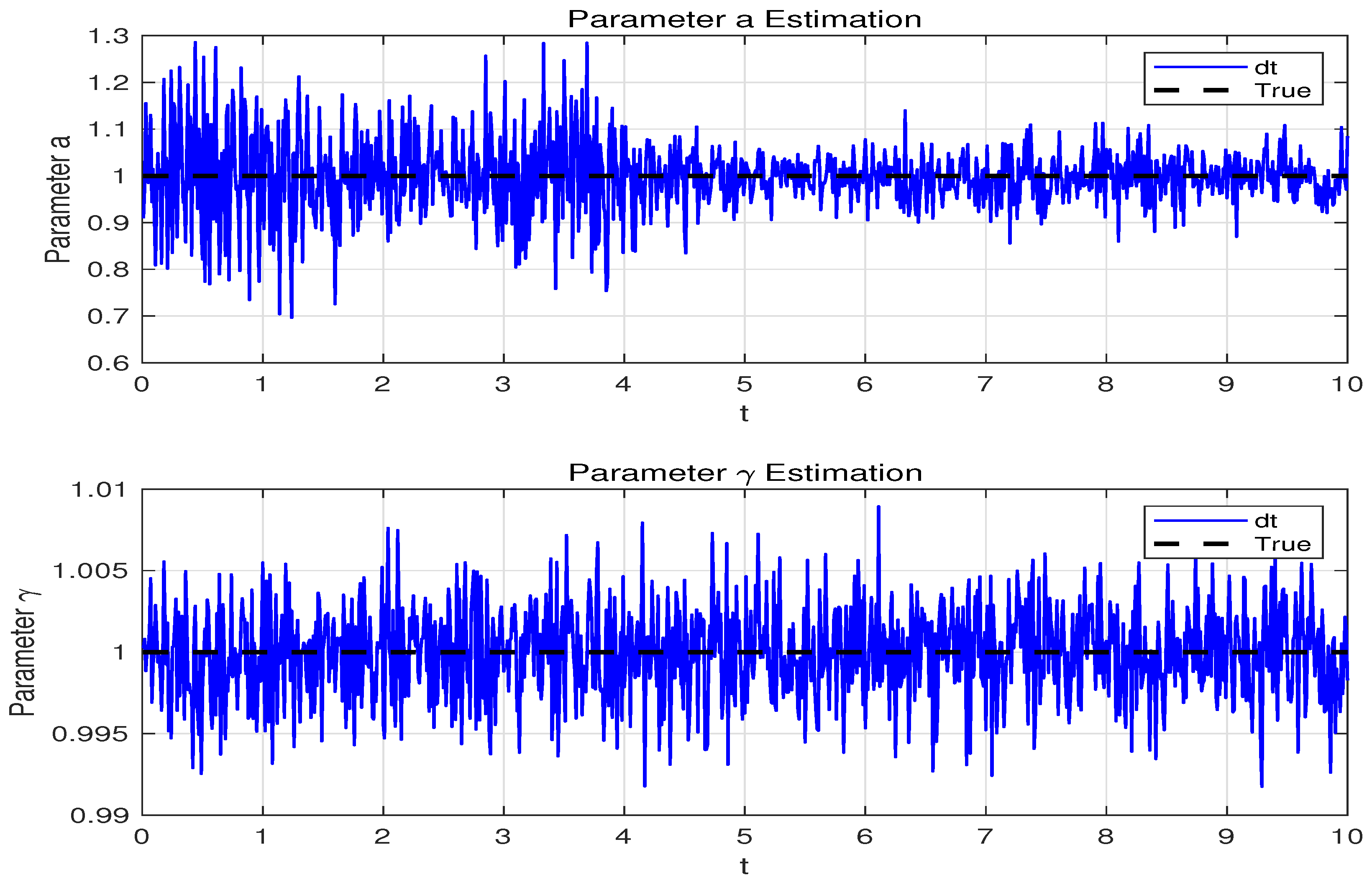
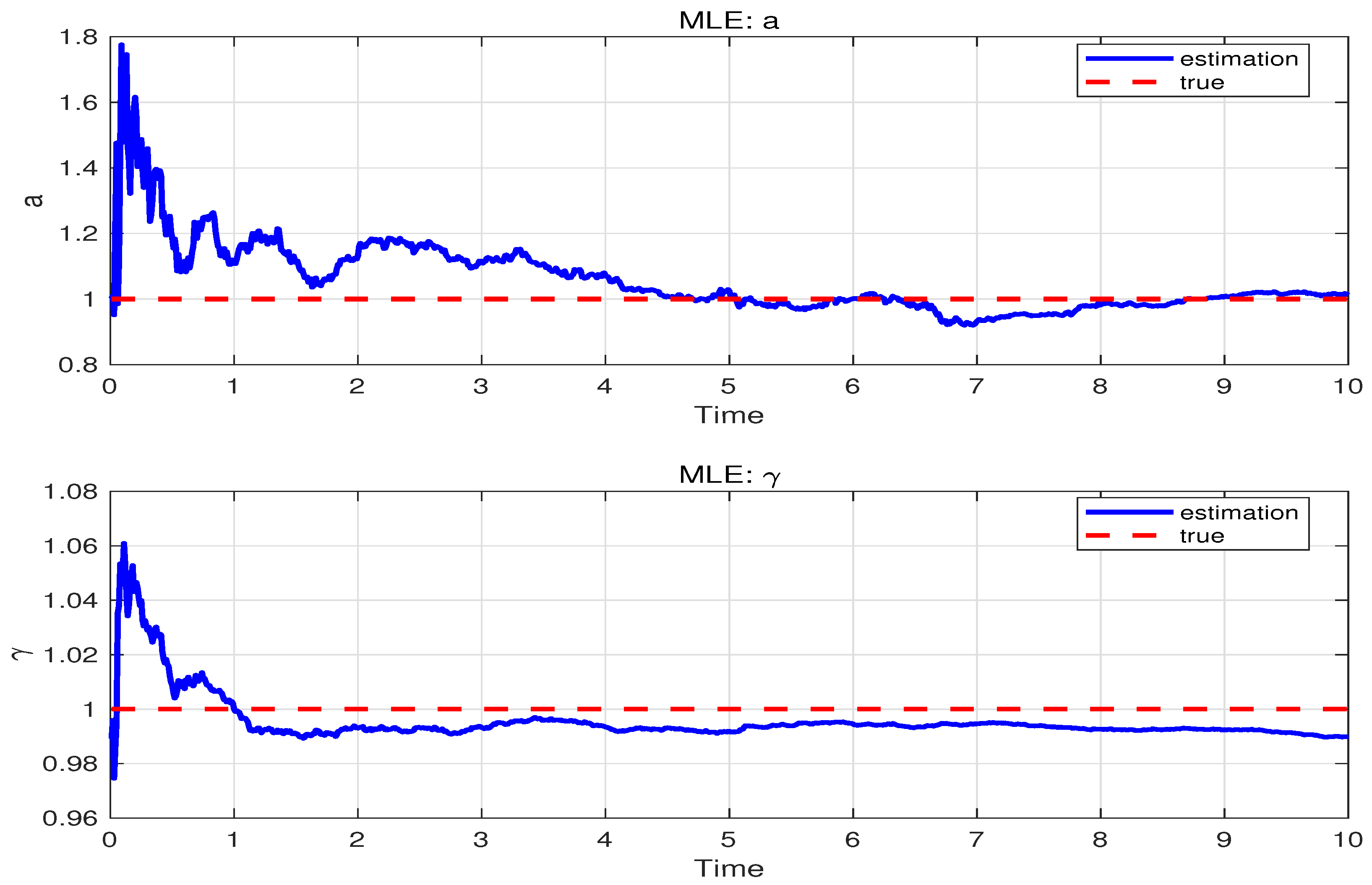
The M L E E s c h e m e represents the MLE strategy employing the Euler–Maruyama method for temporal discretization. Being a point estimation approach, MLE yields parameter values that maximize the likelihood function at discrete time points. In contrast, the EV estimation strategy produces temporal-averaged parameter estimates over the entire observation window. To facilitate equitable comparison of these averaging effects, we implement a modified MLE procedure where parameter estimation is performed at each timestep, subsequently computing the ensemble mean across all temporal realizations. This averaged MLE estimator is denoted as M L E E s c h e m e M . From Figure 3 and Figure 4, we can observe that under the same numerical strategy, the EV estimation strategy is generally more stable and exhibits stable and better estimation performance over a long period of time. For MLE, its disadvantage is mainly reflected in the instability of estimation in a short period of time, which requires a long period of data to achieve stable and good estimation performance. Moreover, if considering parameter estimation in the mean sense, it requires significant computational overhead over a long period of time. Since the EV method directly relies on numerical discretization methods for parameter estimation, while the MLE method needs to go through the processes described in (33) and (34) on the basis of numerical discretization, the EV method runs faster than the MLE method in the sense of the mean. When the MLE method is used without considering the mean, it only conducts one-time parameter estimation, and its speed will also increase. In contrast, the EV method conducts parameter estimation at each time step and then takes the mean over the entire time period. This is the explanation for the running times presented in Table 4 and Table 5.
For the MLE method, the estimation result is the optimal value obtained using the discretized data from the entire time period, and it requires a relatively big amount of data to achieve a good optimal estimate. The EV method directly depends on numerical discretization methods. When an appropriate numerical method is applied, the advantage of the EV method for multi-parameter estimation in a short time period becomes more obvious. Over a long time period, the estimation performance of the EV method is comparable to the optimal estimate of the MLE method. This also indicates to some extent that for multi-parameter estimation in the sense of the mean over a long time period, the EV method is often faster and more accurate than the MLE method.

5.2. Conservation Laws and Convergence Order in the Deterministic Case

For the stochastic KdV Equation (1), as the noise tends to zero and the parameter a = 1 , Equation (1) converges to its deterministic counterpart (2). In this section, we will conduct numerical experiments on the three conservation laws given in (41), (42), (45) and present the convergence order of (2) when using the Fourier spectral method for spatial discretization and the implicit midpoint method for time discretization.
For (2), the initial conditions are chosen as (55), where κ = 0.3 , y 0 = 20 , the parameter L = 15 , that is y 15 π , 15 π , the number of spatial grid points N is 256, time T = 60 . The time step size dt is 0.01 .
From Figure 5, Figure 6 and Figure 7, we observe that for Equation (2), the Fourier spectral method for spatial discretization, combined with either the explicit Euler method or the implicit midpoint method for time discretization, preserves mass conservation. Regarding energy conservation, the Fourier spectral method for spatial discretization, along with the implicit midpoint method for time discretization, also ensures energy conservation.
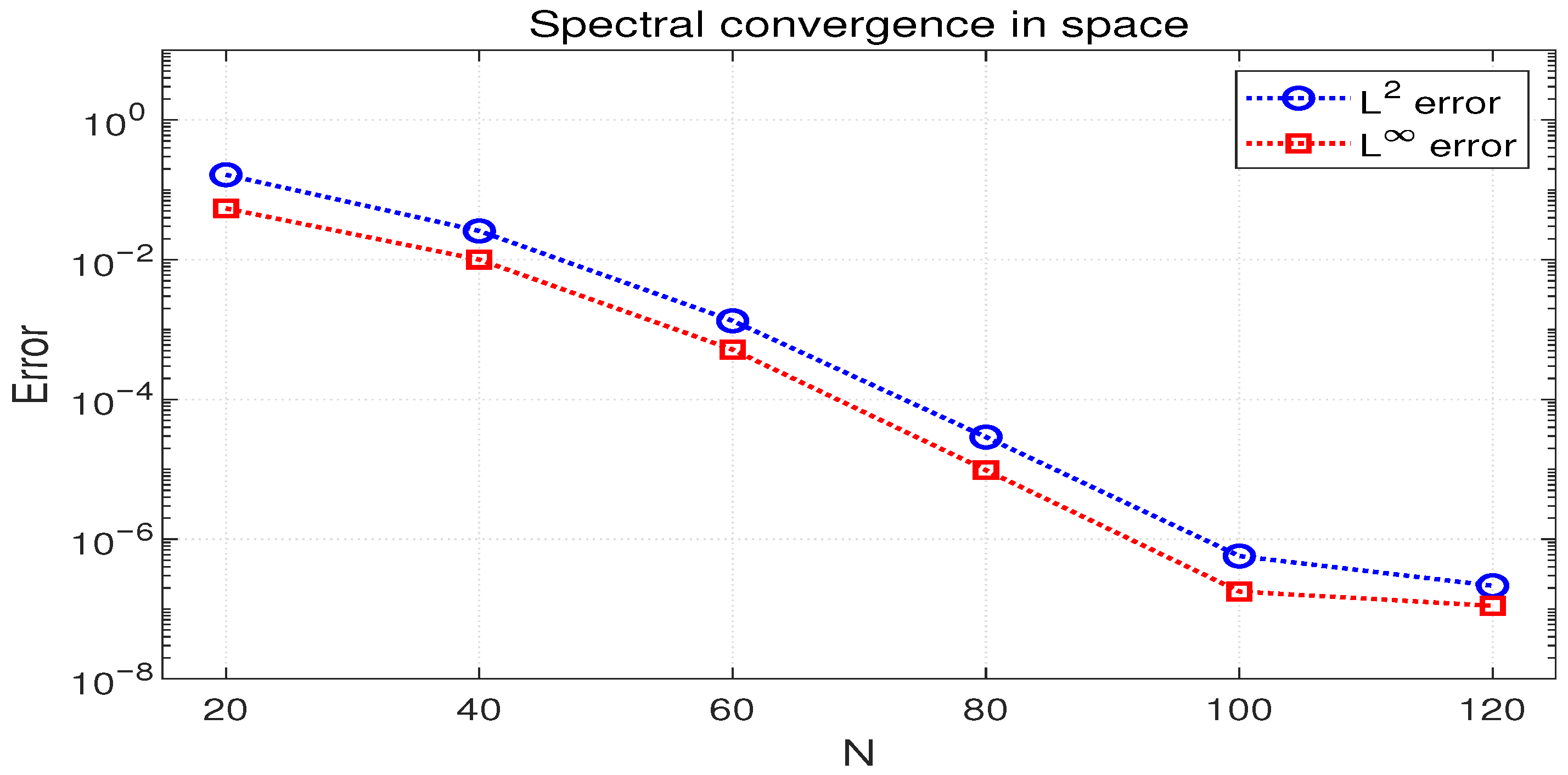
Next, we will present convergence tests for Equation (2) using the Fourier spectral method for spatial discretization and the implicit midpoint method for time discretization. Spatially, Equation (2) exhibits spectral accuracy, while temporally, it achieves second-order accuracy. For the test of spectral accuracy in space, we set the time step τ = 10 5 , use the same initial conditions and parameters as before, and vary the number of grid points N for testing. For the temporal convergence test, we fix the number of spatial grid points to N = 256 and vary the time step size, evaluating the convergence order using the following formula:
e n h , τ 2 = h j U j n u j n 2 , e n h , τ = max j | U j n u j n |
Here, e n h , τ 2 represents the numerical error in the l 2 norm, and e n h , τ = max j | U j n u j n | represents the numerical error in the l norm. Here, h denotes the physical spatial step size, τ denotes the time step size, U j n represents the exact solution, u j n represents the numerical solution, n denotes the time level, and j denotes the spatial grid point.
From Figure 8 and Table 6, we conclude that for Equation (2), using the Fourier spectral method for spatial discretization and the implicit midpoint method for time discretization, the scheme achieves spectral accuracy in space and second-order convergence in time.

6. Conclusions and Prospects

Under the Itô setting, we addressed parameter estimation for the stochastic KdV Equation (1). Two EV schemes were proposed, both centred on the expectation–variance (EV) estimator and equipped with an extrapolation correction. Numerical experiments show that EV is faster and more accurate than MLE in estimation of parameter mean over a long period of time. The weaknesses of EV was uncovered as follows: for Fourier-spectral grids, spatial refinement can degrade accuracy in time—an effect intensified by big drift coefficients and low-order time scheme. The decay is suppressed either by higher-order, structure-preserving integrators (e.g., the implicit midpoint rule) or by the proposed extrapolation, which offers a reliable fallback when such integrators are unavailable. EV approach enables more efficient mean parameter inversion. However, for certain complex SPDEs, the choice of numerical discretization methods may present limitations compared to statistical estimation strategies like MLE. Deterministic convergence and structure-preserving experiments confirm the superior efficiency and stability of the implicit midpoint scheme. Both analysis and numerics experiments validate the effectiveness of the overall approach. Looking ahead, we aim to extend these estimation strategies to other sophisticated stochastic PDEs, design a more efficient and accurate parameter inversion method, and deepen our exploration of their structure-preserving characteristics.

Author Contributions

Conceptualization, Z.L. and X.Y.; methodology, Z.L. and X.Y.; software, Z.L. and X.Y.; validation, Z.L., X.Y., Y.L. and Y.W.; formal analysis, Z.L. and X.Y.; investigation, Z.L., X.Y., Y.L. and Y.W.; resources, X.Y.; data curation, Z.L. and X.Y.; writing—original draft preparation, Z.L.; writing—review and editing, Z.L. and X.Y.; visualization, Z.L. and X.Y.; supervision, X.Y.; project administration, X.Y.; funding acquisition, X.Y. All authors have read and agreed to the published version of the manuscript.

Funding

This work is supported by the Natural Science Foundations of Shandong (No. ZR2024MA017, ZR2023MA062, ZR202204010001), the Science and Technology Plan Project of Dezhou (No. 2021dzkj1638) and the Research Platform Project of Dezhou University (No. 2023XKZX024).

Institutional Review Board Statement

Not applicable.

Informed Consent Statement

Not applicable.

Data Availability Statement

Matlab codes can be provided if required.

Conflicts of Interest

The authors declare no conflicts of interest.

References

  1. Korteweg, D.; de Vries, G. On the change of form of long waves advancing in a rectangular channel, and a new type of long stationary wave. Philos. Mag. 1895, 39, 422–443. [Google Scholar] [CrossRef]
  2. Liu, K.; Fu, T. Linearly-fitted energy-mass-preserving schemes for Korteweg–de Vries equations. J. Comput. Appl. Math. 2024, 448, 115914. [Google Scholar] [CrossRef]
  3. Abrahamsen, D.; Fornberg, B. Solving the Korteweg-de Vries equation with Hermite-based finite differences. Appl. Math. Comput. 2021, 401, 126101. [Google Scholar] [CrossRef]
  4. Soleymani, F.; Zhu, S. On a high order Gaussian radial basis function generated Hermite fnite diference method and its application. Calcolo 2021, 58, 50. [Google Scholar] [CrossRef]
  5. Fermo, L.; Mee, C.V.D.; Seatzu, S. A numerical method to compute the scattering solution for the KdV equation. Appl. Numer. Math. 2020, 149, 3–16. [Google Scholar] [CrossRef]
  6. Williams, K.; Akers, B. Numerical Simulation of the Korteweg–de Vries Equation with Machine Learning. Mathematics 2023, 11, 2791. [Google Scholar] [CrossRef]
  7. Liu, N. Soliton and breather solutions for a fifth-order modified KdV equation with a nonzero background. Appl. Math. Lett. 2020, 104, 106256. [Google Scholar] [CrossRef]
  8. Debussche, A.; Printems, J. Numerical simulation of the stochastic Korteweg–de Vries equation. Phys. D 1999, 134, 200–226. [Google Scholar] [CrossRef]
  9. Xie, Y. Exact solutions for Wick-type stochastic coupled KdV equations. Phys. Lett. A 2004, 327, 174–179. [Google Scholar] [CrossRef]
  10. Zhao, H.; Ma, L. The stochastic Korteweg–de Vries equation with loss and non-uniformity terms. Phys. A Stat. Mech. Appl. 2023, 625, 129004. [Google Scholar] [CrossRef]
  11. Garnier, J. Long-time dynamics of Korteweg–de Vries solitons driven by random perturbations. J. Stat. Phys. 2001, 105, 789–833. [Google Scholar]
  12. Apel, J.; Ostrovsky, L.; Stepanyants, Y.; Lynch, J.F. Internal solitons in the ocean and their effect on underwater sound. J. Acoust. Soc. Am. 2007, 121, 695–722. [Google Scholar] [CrossRef]
  13. Herman, R. The stochastic, damped KdV equation. J. Phys. A Gen. Math. 1990, 23, 1063–1084. [Google Scholar] [CrossRef]
  14. Gao, P. Averaging principle for Korteweg–de Vries equation with a random fast oscillation. Z. Angew. Math. Phys. 2019, 70, 1–28. [Google Scholar] [CrossRef]
  15. Seadawy, A.; Iqbal, M.; Lu, D. Propagation of kink and anti-kink wave solitons for the nonlinear damped modified Korteweg–de Vries equation arising in ion-acoustic wave in an unmagnetized collisional dusty plasma. Phys. A 2020, 544, 123560. [Google Scholar] [CrossRef]
  16. Jiang, S.; Wang, L.; Hong, J. Stochastic multisymplectic integrator for stochastic KdV equation. AIP Conf. Proc. 2012, 1479, 1757–1760. [Google Scholar] [CrossRef]
  17. Chen, Y.; Song, S.; Zhu, H. Multi-symplectic methods for the Ito-type coupled KdV equation. Appl. Math. Comput. 2012, 218, 5552–5561. [Google Scholar]
  18. Liu, X.; Yang, Z.; Ma, Q.; Ding, X. A structure-preserving local discontinuous Galerkin method for the stochastic KdV equation. Appl. Numer. Math. 2024, 204, 1–25. [Google Scholar] [CrossRef]
  19. Ma, W.; Zhou, R. Nonlinearization of spectral problems for the perturbation KdV systems. Phys. Lett. A 2001, 296, 60–74. [Google Scholar]
  20. Lang, Z.; Yin, X.; Liu, Y.; Chen, Z.; Kong, S. Combined compact symplectic schemes for solving good Boussinesq equations. Axioms 2024, 13, 574. [Google Scholar] [CrossRef]
  21. Wang, L.; Kong, L.; Chen, M.; Zhu, P.; Guo, H. Structure-Preserving Combined High-Order Compact Schemes for Multiple Order Spatial Derivatives Differential Equations. J. Sci. Comput. 2023, 96, 8. [Google Scholar]
  22. Kong, L.; Chen, M.; Yin, X. A novel kind of efficient symplectic scheme for Klein-Gordon-Schrödinger equation. Appl. Numer. Math. 2019, 135, 481–496. [Google Scholar] [CrossRef]
  23. Jing, B.; Meng, Z. Multi-symplectic Fourier Pseudospectral Method for the Nonlinear schro¨ dinger equation. Elect. Transa. Numer. Anal. 2001, 12, 193–204. [Google Scholar]
  24. Wang, J. Multi-symplectic Fourier Pseudospectral Method for the Nonlinear schro¨ dinger equations with wave operator. J. Comput. Math. 2007, 25, 31–48. [Google Scholar]
  25. Wang, L.; Ma, Y.; Kong, L.; Duan, Y. Symplectic Fourier Pseudo-spectral Schemes for Klein-Gordon- Schrodinger equation. China J. Comput. Phys. 2011, 28, 275–282. [Google Scholar]
  26. Li, X.; Wang, B. Energy-preserving splitting methods for charged-particle dynamics in a normal or strong magnetic field. Appl. Math. Lett. 2022, 124, 107682. [Google Scholar]
  27. Zhang, L.; Ji, L. Stochastic multi-symplectic Runge-Kutta methods for stochastic Hamiltonian PDEs. Appl. Numer. Math. 2019, 135, 396–406. [Google Scholar]
  28. Chen, C.; Hong, J.; Jin, D.; Sun, L. Asymptotically-Preserving Large Deviations Principles by Stochastic Symplectic Methods for a Linear Stochastic Oscillator. Siam. J. Numer. Anal. 2021, 59, 32–59. [Google Scholar]
  29. Evans, L. An Introduction to Stochastic Differential Equations; American Mathematical Society: Berkeley, CA, USA, 2013. [Google Scholar]
  30. Cai, X.; Wang, L. Some methods of parameter estimation for stochastic differential equations. J. Univ. Chin. Acad. Sci. 2017, 34, 529–537. [Google Scholar]
  31. Zhang, C.; Dai, X. Parameter estimation for some type of stochastic partial differential equation in the infinite dimensional space. J. Zhejiang Univ. 2015, 42, 136–141. [Google Scholar]
  32. Rao, B.P. Bayes estimation for some stochastic partial differential equations. J. Stat. Plan. Infer. 2000, 91, 511–524. [Google Scholar] [CrossRef]
  33. Rao, B.P. Estimation for Some Stochastic Partial Differential Equations Based on Discrete Observations II. Calcutta Stat. Assoc. Bull. 2003, 54, 129–141. [Google Scholar] [CrossRef]
  34. Zhang, C.; Lin, Z. On asymptotic properties of the parameter estimator for a type of SPDE. J. Stat. Plan. Infer. 2008, 138, 4033–4040. [Google Scholar] [CrossRef]
  35. Cialenco, I. Parameter estimation for SPDEs with multiplicative fractional noise. Stoch. Dyn. 2010, 10, 561–577. [Google Scholar] [CrossRef]
  36. Zhang, C.; Wang, H.; Huang, J.; Wang, C.; Yue, X. A second order operator splitting numerical scheme for the “good” Boussinesq equation. Appl. Numer. Math. 2017, 119, 179–193. [Google Scholar] [CrossRef]
  37. Boyd, J. Chebyshev and Fourier Spectral Methods, 2nd ed.; Dover: New York, NY, USA, 2001. [Google Scholar]
  38. Canuto, C.; Hussani, M.Y.; Quarteroni, A.; Zang, T.A. Spectral Methods: Evolution to Complex Geometries and Applications to Fluid Dynamics; Springer: Berlin, Germany, 2007. [Google Scholar]
  39. Hesthaven, J.; Gottlieb, S.; Gottlieb, D. Spectral Methods for Time-Dependent Problems; Cambridge University Press: Cambridge, UK, 2007. [Google Scholar]
  40. Tadmor, E. The exponential accuracy of Fourier and Chebyshev differencing methods. SIAM J. Numer. Anal. 1986, 23, 1–10. [Google Scholar] [CrossRef]
  41. Bishwal, J. Parameter Estimation in Stochastic Differential Equations; Lecture Notes in Mathematics; Springer: Berlin/Heidelberg, Germany, 1923. [Google Scholar]
  42. Gardner, C.; Greene, J.; Kruskal, M.; Miura, R.M. Method for Solving Korteweg-Devries Equation. Phys. Rev. Lett. 1967, 19, 1095–1097. [Google Scholar] [CrossRef]
Figure 1. Euler–Maruyama scheme.
Axioms 14 00884 g001
Figure 2. Midpoint scheme.
Axioms 14 00884 g002
Figure 3. E-scheme.
Figure 3. E-scheme.
Axioms 14 00884 g003
Figure 4. MLE-E-scheme-M.
Axioms 14 00884 g004
Figure 5. Mass conservation for Euler scheme.
Axioms 14 00884 g005
Figure 6. Mass conservation for midpoint scheme.
Axioms 14 00884 g006
Figure 7. Energy conservation for midpoint scheme.
Axioms 14 00884 g007
Figure 8. Spectral convergence for midpoint scheme.
Axioms 14 00884 g008
Table 1. Parameter estimation results at T = 10 with and without extrapolation.
Initial Parameter a = 1 a = 2 a = 3 a = 4 a = 5 a = 6 γ = 0.01
E s c h e m e 0.99751.99062.96563.90044.76285.54990.0100
E s c h e m e e x t r a p 0.99751.99422.98413.95534.88745.72400.0100
M s c h e m e 0.99811.99582.99353.98664.98555.97720.0100
M s c h e m e e x t r a p 0.99841.99592.99463.98914.98765.98300.0100
Table 2. Parameter estimation results at T = 10 with and without extrapolation.
Initial Parameter γ = 0.005 a = 5 γ = 0.01 a = 5 γ = 0.05 a = 5
E s c h e m e 0.00504.78380.01004.76280.05004.3982
E s c h e m e e x t r a p 0.00504.91280.01004.88740.05004.4197
M s c h e m e 0.00504.99510.01004.98550.05004.6432
M s c h e m e e x t r a p 0.00504.99560.01004.98760.05004.7482
Table 3. Parameter estimation results at T = 10 .
Initial Parameter a = 6 a = 7 a = 8 a = 9 γ = 0.01 Mean Cpu Time
E s c h e m e f i n a l 5.99216.99087.98838.98580.010065 s
M s c h e m e f i n a l 5.99926.99948.00069.00080.0100130 s
Table 4. Parameter estimation results at T = 1 .
Initial Parameter a = 1 γ = 1 a = 6 γ = 1 a = 10 γ = 1 Mean Cpu Time
E s c h e m e 1.00700.99976.01010.99979.98970.99976 s
M L E E s c h e m e 1.11731.00016.08521.000110.07511.00002 s
M L E E s c h e m e M 1.26431.01826.16151.018610.17781.018510 s
Table 5. Parameter estimation results at T = 10 .
Initial Parameter a = 1 γ = 1 a = 2 γ = 1 a = 3 γ = 1 Mean Cpu Time
E s c h e m e f i n a l 1.00040.99971.99630.99993.00030.999865 s
M L E E s c h e m e 1.01700.98972.00000.99883.00070.99012 s
M L E E s c h e m e M 1.05820.99572.04680.99563.03490.9957935 s
Table 6. The convergence order in the time direction when N = 256 .
τ l 2 ErrorOrder l ErrorOrder
0.05 4.0840 × 10 5 - 2.2050 × 10 5 -
0.025 1.0220 × 10 5 1.9986 5.5180 × 10 6 1.9986
0.0125 2.5660 × 10 6 1.9938 1.3830 × 10 6 1.9963
0.0063 6.8350 × 10 7 1.9085 3.4920 × 10 7 1.9857
Disclaimer/Publisher’s Note: The statements, opinions and data contained in all publications are solely those of the individual author(s) and contributor(s) and not of MDPI and/or the editor(s). MDPI and/or the editor(s) disclaim responsibility for any injury to people or property resulting from any ideas, methods, instructions or products referred to in the content.