


Abstract
This study focuses on a class of perturbed Dirichlet–Neumann tridiagonal (PDNT) Toeplitz matrices, mainly exploring their eigenvalue sensitivity and inverse problems. By the explicit expressions for eigenvalues and eigenvectors of PDNT Toeplitz matrices, an analytical formula for the eigenvalue condition number is proposed, and numerical experiments are presented based on the theoretical results. Meanwhile, the stability of eigenvalues is analyzed with respect to structured perturbations and pseudospectral properties, and finally, two inverse eigenvalue problems are discussed.
MSC:
15B05; 15A12; 15A18
1. Introduction
The structured distance of PDNT Toeplitz matrices has been discussed [1]. This paper mainly studies the eigenvalue sensitivity of such matrices and explores their inverse eigenvalue problems.
Tridiagonal Toeplitz matrices find significant applications in resistance network modeling [2], quantum anomalous Hall effect analysis [3], and molecular orbital theory [4]. They are also widely used in partial differential equations [5,6,7,8], time series decomposition [9], and Tikhonov regularization of discrete ill-posed problems [10,11]. Thus, studying their fundamental computational properties is essential.
Previous studies have achieved fruitful results in the numerical algebra of banded and quasi-banded matrices. Refs [12,13,14] systematically investigate efficient solvers for linear systems arising from such matrices and propose fast algorithms for determinant evaluation. Ref [15] focuses on tridiagonal Toeplitz matrices, analyzes their pivoting patterns under various diagonal-dominance conditions, and constructs an efficient block LU factorization accordingly. In addition, [16] independently addresses the eigenvalue problem of a class of symmetric tridiagonal matrices.
Norm equalities and inequalities for perturbed tridiagonal Toeplitz matrices are concentrated on in [17], while closed-form expressions and fast algorithms for the determinants, inverses, and eigenpairs of periodical or border-perturbed tridiagonal Toeplitz matrices are focused on in [18,19,20,21]. Meanwhile, systematic analysis approaches for two regular matrix pairs are presented in [22,23,24]. With respect to -pseudospectral separations in banded Toeplitz matrices, works [25,26,27] reveal characteristic spectral behaviors through investigation. Tridiagonal Toeplitz matrix operators have become a research focus due to their dual strengths: efficient computation of key metrics and multidisciplinary applicability. In foundational works such as [28,29,30,31], Biswa Datta was the first to investigate multiple themes, among which are the inverse eigenvalue problems discussed here.
2. Main Concepts and Definitions
This paper employs the Euclidean norm and the Frobenius norm to quantify vectors and matrices, respectively.
Definition 1
([1]).
As a z-order square matrix satisfying Equation (1), the PDNT Toeplitz matrix has the standardized form = (z;,,,,,). The phase parameters are further defined as follows:
In particular, when , .
Lemma 1
([1]). Let be a PDNT Toeplitz matrix. Then, the right eigenvector corresponding to the eigenvalue of matrix is given by
Similarly, the left eigenvector is expressed as
where
And and represent the complex conjugates of and , respectively.
denotes the normal PDNT matrix minimizing the Frobenius norm distance to , with parameters , , and , where and are given by , and
Furthermore, the eigenvalues of are explicitly expressed as follows:
3. Eigenvalue Sensitivity
Regarding eigenvalue analysis of general matrices, extensive research has been conducted on various aspects, such as condition numbers and sensitivity, see references [32,33,34,35]. Ref. [36] derives bounds for structured eigenvalue condition numbers and analyzes the effect of different algebraic structures on eigenvalue sensitivity. In references [37,38], the zero-structured, patterned, and traditional condition numbers of simple eigenvalues are compared, and the eigenvalue sensitivities of Toeplitz and Hankel matrices under patterned perturbations are analyzed through numerical experiments.
We examine the eigenvalue sensitivity of matrices and from various perspectives.
To quantify the sensitivity of eigenvalue set
to perturbations in and , we introduce a mapping
The sensitivity of to and perturbations is directly related to the Jacobian matrix of o, with the detailed analysis proceeding as follows:
From (5), the Jacobian matrix of o takes the following form.
After substituting Equations and into the Frobenius norm operation, the derivation results in
When considering relative errors in , and , the analogue to becomes a matrix.
The matrix is found to possess the following properties
where is the Hermitian adjoint of .
With both its spectral norm and Frobenius norm yielding
We introduce the ratio g as
Remark 1.
The norm of remains immune to changes in and , while the norm of is governed by g. Notably, as g decreases, the Frobenius norm of approaches positive infinity. Moreover, if and only if ,
3.1. Individual Eigenvalue Condition Numbers
This section focuses on the analysis of individual eigenvalue condition numbers.
We first prove an essential trigonometric identity
Proof.
For , we have
For , using the identity , we obtain
Thus,
By the formula for the sum of cosines of equally spaced angles, it follows that
Substituting this result, we get
□
When , a series of subsequent results are derived from Equations (3), (4), and (11).
For
and
If , the PDNT Toeplitz matrix is normal, and its eigenvectors satisfy
The eigenvalue condition number then reduces to
To prove the subsequent theorem, we first derive the following identities from Euler’s formula
Furthermore, the following trigonometric relations hold immediately, let
Theorem 1.
For a PDNT Toeplitz matrix , assuming without loss of generality, the eigenvalue condition number exhibits two cases.
For : , .
For : if ,
if ,
where M and N are defined as
And
Here, (), and g is defined in Equation (10).
Proof.
When and , then . For an eigenvalue with , define . By trigonometric half-angle identities, the summation simplifies to
From Equations (16) and (17), we derive the following:
Let denote and denote Consequently, the following conclusion can be drawn based on Equations (20) and (21):
and analogously,
Using Equations (12) and (13), the following can be obtained:
By (3) and (4), we can get
Based on the preceding results and substituting Equations (24) and (25) into Equation (14), we obtain the expression for the condition number of the j-th eigenvalue as
where
Substituting Equations (22) and (23) yields the desired result.
When , obviously holds. □
Remark 2.
For , Equation (19) can be rewritten via algebraic manipulation as follows:
When ,
where , .
Though the explicit forms of polynomial combinations M and N are omitted, theoretical analysis and numerical experiments confirm
3.2. The Global Eigenvalue Condition Number
This section systematically investigates the global condition number:
This property provides an explicit analytical method for computation.
By substituting Equations (18) and (19) into Equation (27), we obtain expression for the global condition number ():
For PDNT Toeplitz matrices satisfying , their parameter bounds can be determined through Equations (3) and (4).
For PDNT Toeplitz matrices with , we are able to the bounds:
3.3. The -Pseudospectrum
Given , follow [27], the -pseudospectrum of is defined as the set
An alternative, equivalent definition that will be utilized in Section 5 is as follow:
the vectors l in this definition are referred to as -pseudoeigenvectors.
First, define the function
and then further construct the ellipse
This ellipse is precisely the spectral boundary of Regarding the ellipse , its major axis can be characterized by
Similarly, the interval between its foci is defined according to
When and is finite, the spectral containment of the matrix is contained in , and is the smallest interval with this property. With the help of Equation (6), it can be determined that the interval where the spectrum of the normal PDNT Toeplitz matrix closest to lies is (30).
3.4. Structured Perturbations
Under the condition , we investigate of the original matrix = (z;,,,,,). For the parameter with , we obtain a family of diagonalizable matrices possessing simple eigenvalues. As the parameter , the family of matrices converges to a defective matrix . This matrix possesses only one eigenvalue with a geometric multiplicity of one. The structured perturbation
shifts all eigenvalues of matrix , such that they all become .
Under , the rate of change of the j-th eigenvalue of with respect to the perturbation is given by
Let , with , and define . It follows that
where I denotes the identity matrix, implying that is normal. The limit matrix is achieved via the perturbation
For , the relative eigenvalue variation rate is characterized by
The derived results reveal an inverse relationship between the rate and the Frobenius norm of the Jacobian matrix (9). The rate reaches its maximum when is normal, as shown in Remark 1.
4. Examples of Eigenvalue Sensitivity
This section numerically verifies the properties of PDNT Toeplitz matrices and their eigenvalues as analyzed previously. For the matrix defined in
with , where g is the ratio in (10). It is observed that is defective, while is normal. The eigenvalues of and are visualized in Figure 1, Figure 2, Figure 3 and Figure 4, where horizontal and vertical axes represent the real and imaginary parts of eigenvalues, respectively. The eigenvalues are determined by resorting to Equations (5) and (6). The figures depict the image of the unit circle under the matrices , and the detailed information can be referred to in Equation (29). Figure 5 demonstrates the spectra of the matrices and obtained by executing the QR algorithm. In the first five figures, each green elliptical curve is the spectral boundary of
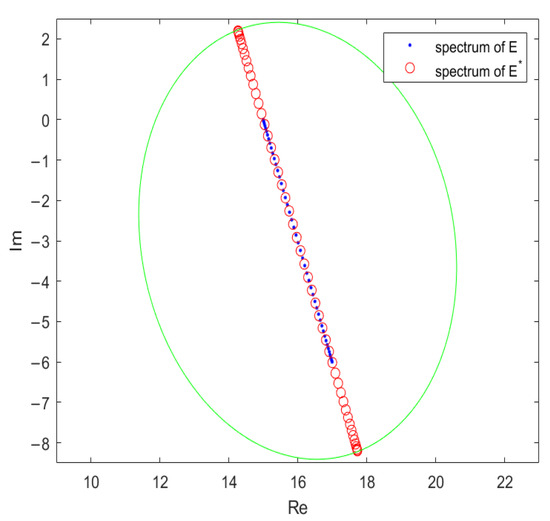
Figure 1.
The spectra of matrix and the closest normal PDNT Toeplitz matrix at .
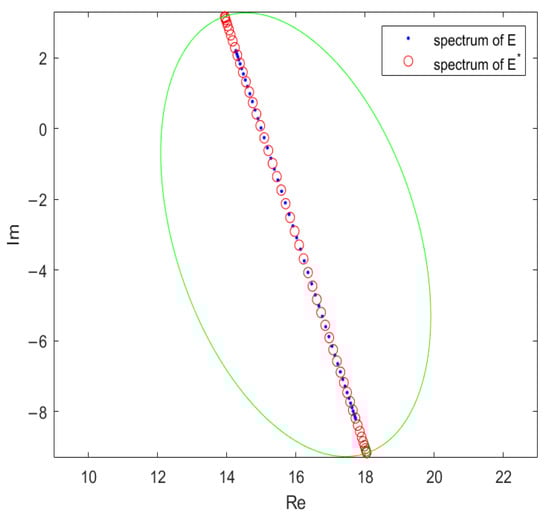
Figure 2.
The spectra of matrix and the closest normal PDNT Toeplitz matrix at .
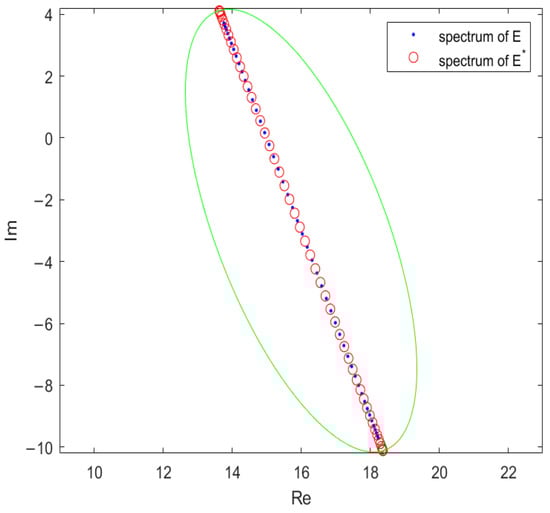
Figure 3.
The spectra of matrix and the closest normal PDNT Toeplitz matrix at .
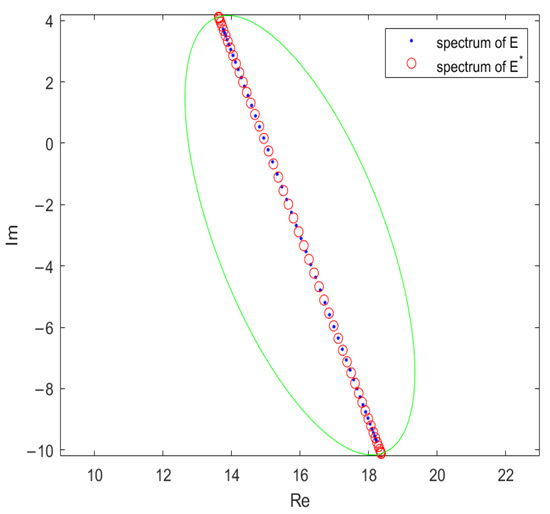
Figure 4.
The spectra of matrix and the closest normal PDNT Toeplitz matrix at .
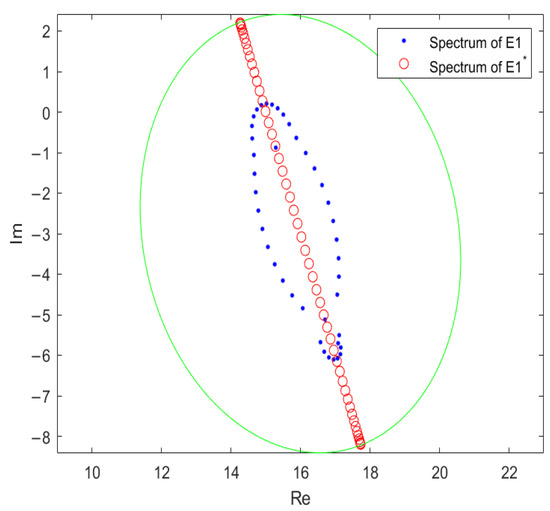
Figure 5.
The spectra of and at , denoted and in the legend.
In the process of solving eigenvalues, due to the differences in calculation methods, the visualization effects will also differ. By comparing Figure 1 and Figure 5, it is difficult to discern that the matrices and have identical eigenvalues. As can be seen from Figure 5, when is set to the machine epsilon , the spectrum of the matrix is nearly adjacent to the boundary of the -pseudospectrum. Figure 6 displays the -pseudospectra of under progressively increasing -values. Figure 7 depicts the variation of the average forward and backward errors of with matrix dimension z after adding tiny random perturbations. Figure 8 and Figure 9 plot the condition number versus the parameter g at , corresponding to the two distinct cases and , respectively.
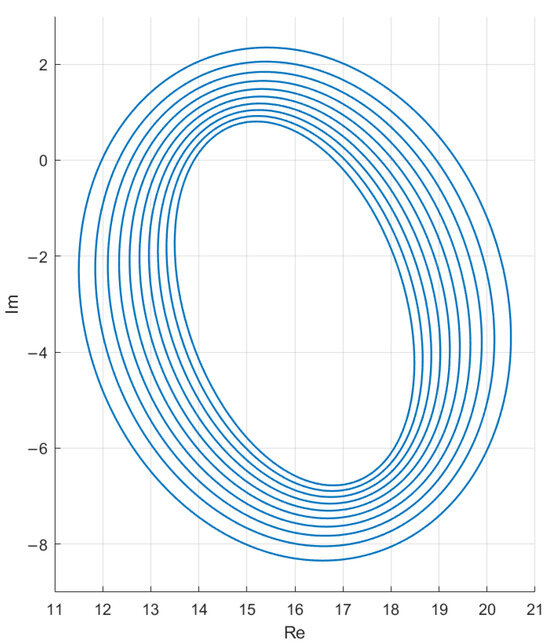
Figure 6.
The figure shows the -pseudospectrum of at , consisting of ten contours whose -values increase by one order of magnitude from (innermost) to (outermost).
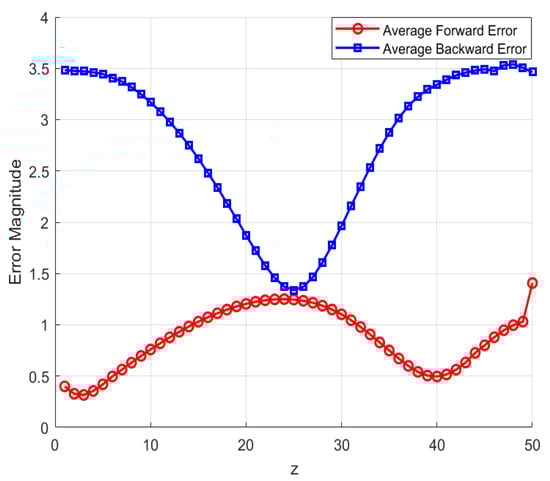
Figure 7.
The variation of the average forward and backward errors of at g = 0.1 with matrix dimension z. Red circles represent the average forward error, and blue squares represent the average backward error.
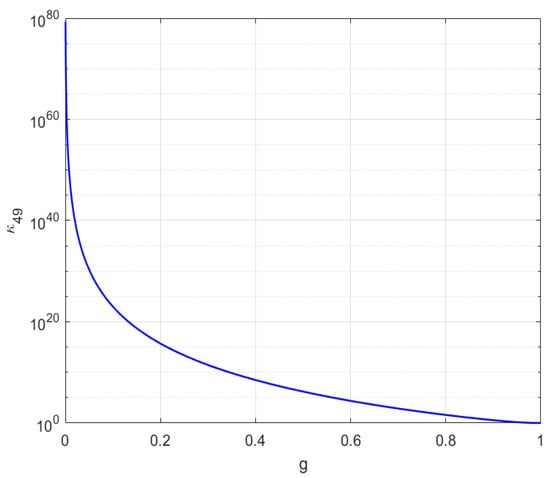
Figure 8.
Logarithmic plot of the condition number () versus the parameter g for and .
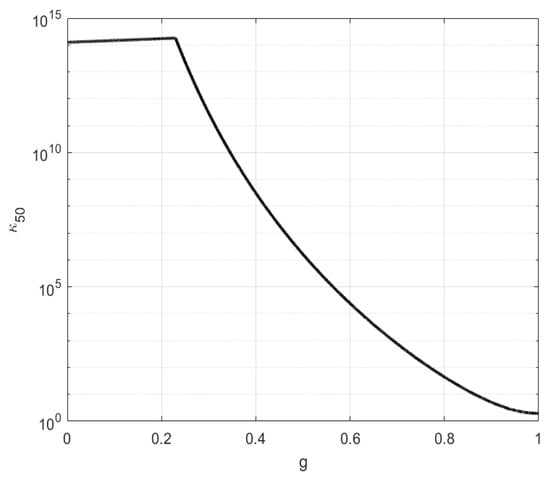
Figure 9.
Logarithmic plot of the condition number () versus the parameter g for and .
5. Inverse Problems for
This section first addresses the inverse eigenvalue problems for PDNT Toeplitz matrices, followed by an investigation of their inverse vector counterparts. In the latter problem, a trapezoidal PDNT Toeplitz matrix is determined by minimizing the matrix-vector product norm with a specified vector.
Problem 1.
Given two distinct complex numbers , and a natural number z, construct a PDNT Toeplitz matrix = (z;,,,,,) with the requirement that its extremal eigenvalues are and .
While no unique solution exists for this problem, it is crucial to emphasize that the eigenvalues of are fully determined by the given data. Given the eigenvalues
the and the product are uniquely determined by
The given data determines both the magnitude and the phase angle . Both the choice of subdiagonal or superdiagonal element arguments and the ratio g () defined in Equation (10) can be freely assigned. The ill-conditioning of the eigenvalues increases as the parameter g approaches 0. When the parameter is chosen, the resulting matrix becomes normal. By selecting different phase angles for subdiagonal or superdiagonal elements, distinct normal matrices can be constructed.
Problem 2.
For a given vector , construct a trapezoidal PDNT Toeplitz matrix
such that attains
By defining the vector , the problem transforms to
When the columns of matrix (34) are linearly independent, this least-squares problem admits a unique solution.
Proof.
Assume, for contradiction, that the least squares solution is not unique. Then, there exist two distinct solutions , such that
where , and .
Consider the convex combination . We have
Since both and are minimizers, denote . By convexity,
Equality holds only if
However, since A has full column rank, , which implies , contradicting . Therefore, the solution must be unique. □
The columns are linearly dependent if, and only if, there exists a complex number such that the components of satisfy
In the process of solving for the solution of , a key question is how to characterize the unit vectors , for which remains small. Given that is the PDNT Toeplitz matrix constructed by prepending and appending appropriately chosen rows to , the definition in Equation (28) implies that the -pseudoeigenvectors of corresponding to is contained within
Author Contributions
Conceptualization: Z.J. (Zhaolin Jiang); writing—original draft: H.C.; methodology: Z.J. (Zhaolin Jiang); writing—review and editing: Q.M.; supervision: Z.J. (Ziwu Jiang). All authors have read and agreed to the published version of the manuscript.
Funding
The research was partially supported by the Natural Science Foundation of Shandong Province (Grant No. ZR2022MA092).
Data Availability Statement
The original contributions presented in this study are included in the article. Further inquiries can be directed to the corresponding author.
Conflicts of Interest
The authors declare no conflicts of interest.
References
- Jiang, Z.L.; Chu, H.X.; Miao, Q.Y.; Jiang, Z.W. Structured distance to normality of Dirichlet–Neumann tridiagonal Toeplitz matrices. Axioms 2025, 14, 609. [Google Scholar] [CrossRef]
- Jiang, X.Y.; Zhang, G.J.; Zheng, Y.P.; Jiang, Z.L. Explicit potential function and fast algorithm for computing potentials in α × β conic surface resistor network. Expert Syst. Appl. 2024, 238, 122157. [Google Scholar] [CrossRef]
- Yue, C.M.; Xu, Y.F.; Song, Z.D.; Weng, H.M.; Lu, Y.M.; Fang, C.; Dai, X. Symmetry-enforced chiral hinge states and surface quantum anomalous Hall effect in the magnetic axion insulator Bi2−xSmxSe3. Nat. Phys. 2019, 15, 577–581. [Google Scholar] [CrossRef]
- Schneider, B.I.; Gharibnejad, H. Numerical methods every atomic and molecular theorist should know. Nat. Rev. Phys. 2020, 2, 89–102. [Google Scholar] [CrossRef]
- Diele, F.; Lopez, L. The use of the factorization of five-diagonal matrices by tridiagonal Toeplitz matrices. Appl. Math. Lett. 1998, 11, 61–69. [Google Scholar] [CrossRef]
- Fischer, D.; Golub, G.; Hald, O.; Leiva, C.; Widlund, O. On Fourier-Toeplitz methods for separable elliptic problems. Math. Comput. 1974, 28, 349–368. [Google Scholar] [CrossRef]
- Willms, A.R. Analytic results for the eigenvalues of certain tridiagonal matrices. SIAM J. Matrix Anal. Appl. 2008, 30, 639–656. [Google Scholar] [CrossRef]
- Yueh, W.C.; Cheng, S.S. Explicit eigenvalues and inverses of tridiagonal Toeplitz matrices with four perturbed corners. ANZIAM J. 2008, 49, 361–387. [Google Scholar] [CrossRef]
- Luati, A.; Proietti, T. On the spectral properties of matrices associated with trend filters. Econom. Theory 2010, 26, 1247–1261. [Google Scholar] [CrossRef]
- Hansen, P.C. Rank-Deficient and Discrete Ill-Posed Problems: Numerical Aspects of Linear Inversion; SIAM: Philadelphia, PA, USA, 1998. [Google Scholar]
- Reichel, L.; Ye, Q. Simple square smoothing regularization operators. Electron. Trans. Numer. Anal. 2009, 33, 63–83. [Google Scholar]
- Jia, J.; Li, S. On the inverse and determinant of general bordered tridiagonal matrices. Comput. Math. Appl. 2015, 69, 503–509. [Google Scholar] [CrossRef]
- Sogabe, T. New algorithms for solving periodic tridiagonal and periodic pentadiagonal linear systems. Appl. Math. Comput. 2008, 202, 850–856. [Google Scholar] [CrossRef]
- Du, L.; Sogabe, T.; Zhang, S.L. A fast algorithm for solving tridiagonal quasi-Toeplitz linear systems. Appl. Math. Lett. 2018, 75, 74–81. [Google Scholar] [CrossRef]
- Liu, Z.; Li, S.; Yin, Y.; Zhang, Y. Fast solvers for tridiagonal Toeplitz linear systems. Comput. Appl. Math. 2020, 39, 315. [Google Scholar] [CrossRef]
- Fonseca, C.M.D. On the eigenvalues of some tridiagonal matrices. J. Comput. Appl. Math. 2007, 200, 283–286. [Google Scholar] [CrossRef]
- Wang, J.; Zheng, Y.P.; Jiang, Z.L. Norm equalities and inequalities for tridiagonal perturbed Toeplitz operator matrices. J. Appl. Anal. Comput. 2023, 13, 671–683. [Google Scholar] [CrossRef]
- Fu, Y.; Jiang, X.Y.; Jiang, Z.L.; Jhang, S. Properties of a class of perturbed Toeplitz periodic tridiagonal matrices. Comput. Appl. Math. 2020, 39, 146. [Google Scholar] [CrossRef]
- Fu, Y.; Jiang, X.Y.; Jiang, Z.L.; Jhang, S. Inverses and eigenpairs of tridiagonal Toeplitz matrix with opposite-bordered rows. J. Appl. Anal. Comput. 2020, 10, 1599–1613. [Google Scholar] [CrossRef]
- Wei, Y.; Zheng, Y.P.; Jiang, Z.L.; Shon, S. The inverses and eigenpairs of tridiagonal Toeplitz matrices with perturbed rows. J. Appl. Math. Comput. 2022, 68, 623–636. [Google Scholar] [CrossRef]
- Wei, Y.L.; Jiang, X.Y.; Jiang, Z.L.; Shon, S. On inverses and eigenpairs of periodic tridiagonal Toeplitz matrices with perturbed corners. J. Appl. Anal. Comput. 2020, 10, 178–191. [Google Scholar] [CrossRef]
- Noschese, S.; Pasquini, L.; Reichel, L. Tridiagonal Toeplitz matrices: Properties and novel applications. Numer. Linear Algebra Appl. 2013, 20, 302–326. [Google Scholar] [CrossRef]
- Bebiano, N.; Furtado, S. Structured distance to normality of tridiagonal matrices. Linear Algebra Appl. 2018, 552, 239–255. [Google Scholar] [CrossRef]
- Demmel, J. Nearest Defective Matrices and the Geometry of Ill-Conditioning; Oxford University Press: New York, NY, USA, 1990. [Google Scholar]
- Böttcher, A.; Grudsky, S.M. Spectral Properties of Banded Toeplitz Matrices; SIAM: Philadelphia, PA, USA, 2005. [Google Scholar]
- Reichel, L.; Trefethen, L.N. Eigenvalues and pseudo-eigenvalues of Toeplitz matrices. Linear Algebra Appl. 1992, 162, 153–185. [Google Scholar] [CrossRef]
- Trefethen, L.N.; Embree, M. Spectra and Pseudospectra: The Behavior of Nonnormal Matrices and Operators; Princeton University Press: Princeton, NJ, USA, 2005. [Google Scholar]
- Arnold, M.; Datta, B.N. Single-input eigenvalue assignment algorithms: A close look. SIAM J. Matrix Anal. Appl. 1998, 19, 444–467. [Google Scholar] [CrossRef]
- Datta, B. An algorithm to assign eigenvalues in a Hessenberg matrix: Single input case. IEEE Trans. Autom. Control 1987, 32, 414–417. [Google Scholar] [CrossRef]
- Datta, B.N.; Lin, W.-W.; Wang, J.-N. Robust partial pole assignment for vibrating systems with aerodynamic effects. IEEE Trans. Autom. Control 2006, 51, 1979–1984. [Google Scholar] [CrossRef]
- Datta, B.N.; Sokolov, V. A solution of the affine quadratic inverse eigenvalue problem. Linear Algebra Appl. 2011, 434, 1745–1760. [Google Scholar] [CrossRef]
- Golub, G.H.; Wilkinson, J.H. Ill-conditioned eigensystems and the computation of the Jordan canonical form. SIAM Rev. 1976, 18, 578–619. [Google Scholar] [CrossRef]
- Wilkinson, J.H. The Algebraic Eigenvalue Problem; Oxford University Press: Oxford, UK, 1965. [Google Scholar]
- Wilkinson, J.H. Sensitivity of eigenvalues II. Utilitas Math. 1986, 30, 243–286. [Google Scholar]
- Stewart, G.W. Matrix Perturbation Theory; Academic Press: New York, NY, USA, 1990. [Google Scholar]
- Karow, M.; Kressner, D.; Tisseur, F. Structured eigenvalue condition numbers. SIAM J. Matrix Anal. Appl. 2006, 28, 1052–1068. [Google Scholar] [CrossRef][Green Version]
- Noschese, S.; Pasquini, L. Eigenvalue condition numbers: Zero-structured versus traditional. J. Comput. Appl. Math. 2006, 185, 174–189. [Google Scholar] [CrossRef]
- Noschese, S.; Pasquini, L. Eigenvalue patterned condition numbers: Toeplitz and Hankel cases. J. Comput. Appl. Math. 2007, 206, 615–624. [Google Scholar] [CrossRef][Green Version]
Disclaimer/Publisher’s Note: The statements, opinions and data contained in all publications are solely those of the individual author(s) and contributor(s) and not of MDPI and/or the editor(s). MDPI and/or the editor(s) disclaim responsibility for any injury to people or property resulting from any ideas, methods, instructions or products referred to in the content. |
© 2025 by the authors. Licensee MDPI, Basel, Switzerland. This article is an open access article distributed under the terms and conditions of the Creative Commons Attribution (CC BY) license (https://creativecommons.org/licenses/by/4.0/).