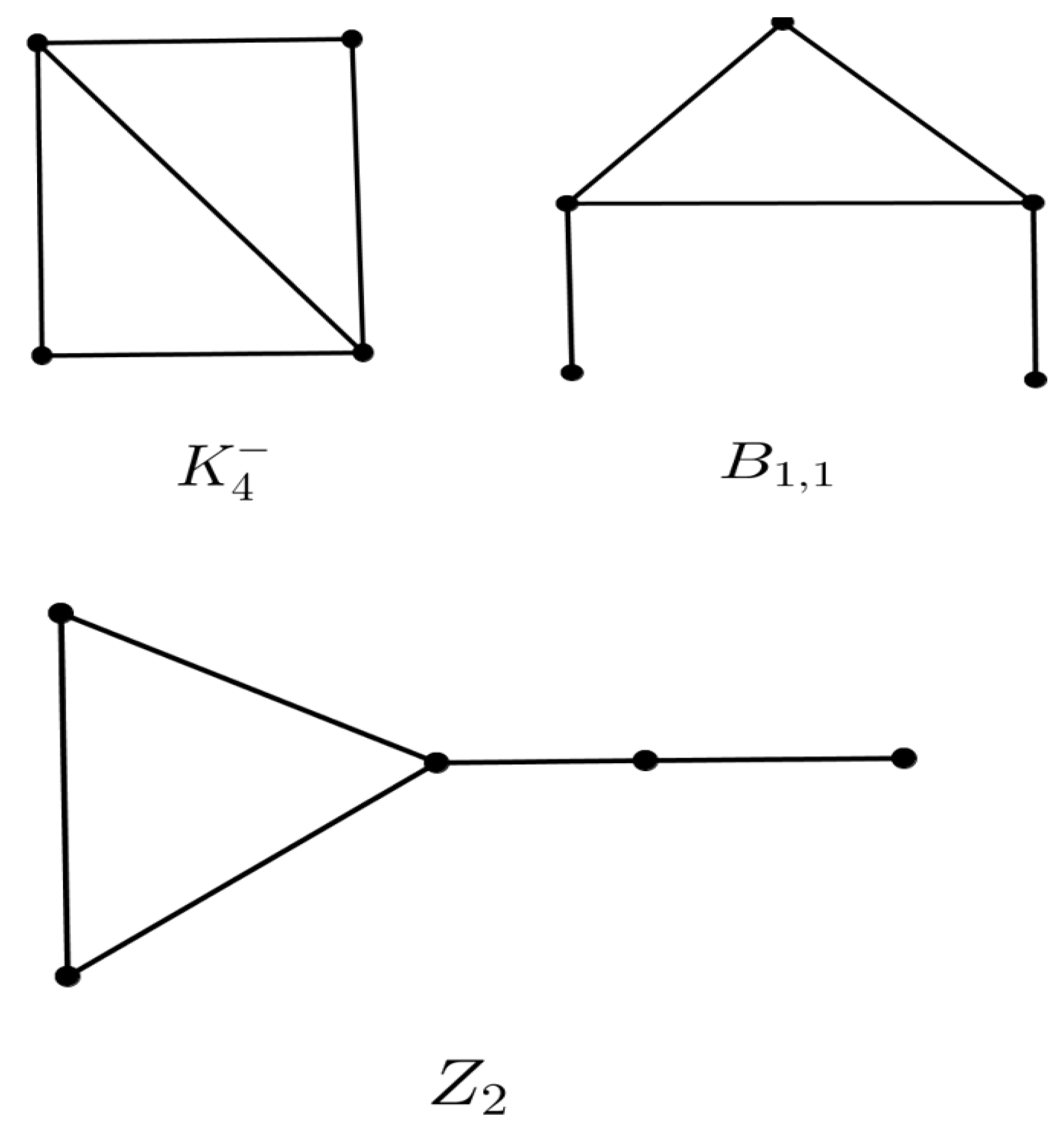
According to Problem 1, we obtain Theorems 3 and 4, which gives an infinite family of graphs with if
Proof. Let G be a non-trivial -free graph. Suppose that G consists of k components with Clearly, Thus, without loss of generality, we assume that G is connected, i.e., We begin with the following result.
Claim 1. For a vertex x in a CSDS S of G, if then is a clique.
Proof. Suppose that S is a CSDS of G and with If then we are done. Let Suppose on the contrary that and By the definition of a CSDS, we have and Assume that Then, and which implies a contradiction. Thus, is a clique. □
For a CSDS S of G, since if and only if for a vertex and a vertex we can obtain the following claim by Claim 1.
Claim 2. For a vertex x in a CSDS S of G,
By the definition of a CSDS and Claims 1 and 2, we can obtain the following result.
Claim 3. Let S be a dominating set such that for each vertex If S is not a CSDS of G, then S contains a vertex x such that and contains two non-adjacent vertices.
Claim 4. If S is a minimum CSDS of G with then there is a vertex with such that .
Proof. Suppose on the contrary that for each vertex with Let such that Then, by the hypothesis, we have Let Since S is a CSDS of we have and for each vertex Moreover, since and we have for each vertex Thus, is a dominating set of Since S is a minimum CSDS of G and is not a CSDS of Thus, by Claim 3, there exists a vertex y in with and Moreover, let with By we have Suppose that Then, for each If then is a 4-cycle by a contradiction. Thus, which implies a contradiction. Thus, contains at least one vertex in . Moreover, by Claim 1 and we have
Without loss of generality, assume that and Then, by Since we have by for each vertex with Thus, and By and we have We have by and It follows that a contradiction. Thus, for some vertex with □
Claim 5. G contains a minimum CSDS S such that S is an independent set.
Proof. Suppose to the contrary that each minimum CSDS of G is not an independent set. We choose a minimum CSDS S of G such that is minimum. Since S is not an independent set, we have which implies By Claim 4, without loss of generality, assume that and Let By Claim 1, Moreover, for each vertex Thus, is a dominating set of G with for each vertex We have by which implies Thus, by the choice of is not a CSDS of By Claim 3, there is a vertex and such that and By we have By Claim 1 and , at least one vertex in is not in In the following, we claim that there is a contradiction if or
Suppose that Then, for each If then a contradiction. If then is a 4-cycle, a contradiction. Thus, Without loss of generality, assume that and Then, By and we have Suppose that We have by a contradiction to Suppose that Then, we have by a contradiction to Thus, the claim is true. □
Let us resume the proof of Theorem 3. If G contains a minimum CSDS which is a maximum independent set of then we are done. Thus, we assume that each minimum CSDS of G is not a maximum independent set. Then, by Theorem 1, which implies We have Otherwise, suppose is a minimum CSDS of Then, each vertex in is adjacent to i.e., Then, by Claim 1, G is a complete graph, a contradiction to
Let be a maximum independent of G. By Claim 5, we take a minimum CSDS S of G such that S is an independent set and is maximum. Then, by and hence and Since S is a dominating set of G, each vertex in is adjacent to a vertex of The rest proof boils down to two cases as follows.
Case 1. for each vertex
Since and S is a dominating set of there is a vertex such that Assume that By the hypothesis of the case, for each Suppose that and assume Since are in the independent set We have since S is an independent set. Thus, is a 4-cycle, a contradiction. Thus, Suppose By we have and Moreover, since S is an independent set, a contradiction.
Case 2. There is a vertex and a vertex such that
Let By for each vertex which implies that is an independent set with Since for each vertex and is a dominating set of G with for each vertex by Claim 1. If is a CSDS of then a contradiction to the choice of Thus, is not a CSDS of By Claim 3, there exists a vertex and such that and Since we have Moreover, it is easy to verify that and hence by By Claim 1 and we have
Suppose that Then, for each Since S is an independent set and we have which implies that is a 4-cycle, a contradiction. Thus, Without loss of generality, assume that and Then, By and we have Since and we have which implies a contradiction to
It follows that Theorem 3 is true. □
By Theorems 1 and 3, we can obtain the following corollary, which characterizes a graph G with
Proof. We assume that G is connected and -free graph with As the proof of Theorem 3, it suffices to prove that there is a minimum CSDS of which is a maximum independent set of G. If G is a complete graph, i.e., then and we are done. Suppose on the contrary that Then,
Claim 1.
Proof. Suppose on the contrary that Let be a CSDS of Then, each vertex in is adjacent to v and each vertex in is adjacent to Since Then, by let such that is an independent set. Then, a contradiction. Thus, a contradiction. □
Let S be a minimum CSDS of G such that is minimum. By Claim 1,
Claim 2. There exists a vertex with such that if
Proof. Suppose to the contrary that for each vertex with We assume that with Then, Let Since S is a CSDS of for each vertex Moreover, by and we have is a dominating set of G such that for each vertex By the minimality of and is not a CSDS of Then, by Claim 3 of Theorem 3, let such that and with We have since Clearly, if where
Suppose Then, for each We have ; otherwise, by and so a contradiction. Thus, by and We have by Thus, a contradiction to It follows that by .
Without loss of generality, assume and Then, and by the hypothesis that for each vertex with Note that By and assume We claim that and for each vertex Let We have or by and Assume Suppose Then, we have by and and hence a contradiction. Thus, If then by a contradiction. Thus, which implies a contradiction. It follows that and then By and we have
We have Otherwise, without loss of generality, let Then, and by the above result. Thus, a contradiction. Moreover, we claim that Otherwise, let Then, by We have by and Thus, by and Then, we have a contradiction. We have Otherwise, assume Then, by and by Thus, a contradiction. Let by Then, by the previous proof, and hence by It follows that a contradiction. □
Claim 3. S is an independent set.
Proof. Suppose on the contrary that S is not an independent set. By Claim 2, assume with and Clearly, Let For each vertex we have or by and Thus, is a dominating set with and which implies is not a CSDS by the choice of Clearly, By Claim 3 of Theorem 3, let such that and let be two distinct non-adjacent vertices such that By we have By without loss of generality, assume that Then, We have by and which implies . We claim Otherwise, Then, by and a contradiction. Thus, and then By and we have a contradiction to □
Let be a maximum independent set of G. By Claim 3, we choose a minimum CSDS S of G such that S is an independent set and is maximum. Then, by Since S is a dominating set and there are two vertices in having a common neighbor in Assume and such that
Claim 4. If , then where
Proof. Without loss of generality, let and suppose on the contrary that Let Since is an independent set. We have by Thus, is a dominating set with By and the choice of is not a CSDS of Clearly, Thus, by Claim 3 of Theorem 3, let such that and such that and Since and we have By without loss of generality, assume Then,
We claim that Suppose Then, and hence a contradiction. Thus,
We claim that each vertex in is nonadjacent to u and adjacent to Let since and S is an independent set. Then, or by and Suppose Assume Then, which implies by and Thus, by and It follows that a contradiction. Thus, and moreover, we have since G is claw-free and S is an independent set. Let Suppose Then, which implies by . Since and we have and hence a contradiction. Thus, i.e., By and we have or If then by and which implies a contradiction. Thus, and which implies a contradiction. It follows that and In the following we use the result to obtain a contradiction.
Since and let By the above result, we have ; otherwise, there is a vertex in adjacent to u, a contradiction. Thus, by Moreover, we have for some by Without loss of generality, assume Then, by and We have by and Thus, a contradiction. □
Claim 5.
Proof. Without loss of generality, suppose on the contrary that Then, by Claim 4, and hence let such that Since S is a CSDS of
Let We have by and Moreover, by and We claim Suppose Then, Let We have by and hence a contradiction. Thus,
We claim that by reduction to absurdity. Suppose and assume Then, and by Let Then, or by and Assume Then, by and we have and hence a contradiction. Thus, and similarly, which implies a contradiction.
Since and G is connected, assume that such that and Moreover, by we have Let Then, Suppose Then, without loss of generality, assume By and we have Thus, by which implies by It follows that a contradiction. Thus, and then Without loss of generality, let Then, by a contradiction. □
Claim 6. for each vertex x in
Proof. Without loss of generality, suppose on the contrary that Since let Then, or by and Without loss of generality, assume that Since Moreover, since G is claw-free and S is an independent set, Assume and
We claim that Suppose By and we have or Suppose that Then, otherwise, a contradiction. Thus, a contradiction. It follows that , and then Since we assume that By we have Moreover, we have by a contradiction. Thus,
Let Since is an independent set with Moreover, each vertex in is adjacent to u or since G is claw-free. Clearly, and then Thus, is not a CSDS of G by the choice of Then, let such that and let be two non-adjacent vertices in such that Without loss of generality, assume that Then, which implies or In the following, we claim that and then obtain a forbidden subgraph to give a contradiction.
Suppose Then, by , a contradiction to Without loss of generality, assume that Then, by and for each Suppose that and has a common neighbor in Without loss of generality, assume that Then, or by and a contradiction. Thus, Without loss of generality, assume that Then, It follows that a contradiction. Thus, the claim is true. □
Claim 7. If a vertex in is in , then where
Proof. Without loss of generality, let We have by Claim 6. Then, each vertex in is adjacent to By Claim 5, since G is claw-free. Assume and It suffices to prove Suppose We claim that Otherwise, let such that By we have Moreover, by Thus, a contradiction, and then
Let Then, by We claim that . Otherwise, let such that Clearly, by and Thus, we have by Then, since Since we have which implies a contradiction. Similarly, Moreover, each vertex in is adjacent to u or v since G is claw-free. Let By the previous result, is a dominating set of G. Moreover, is an independent set.
We claim that or for each vertex in and each Otherwise, without loss of generality, suppose that and Then, we have by and hence a contradiction. It follows that if for each where
By is not a CSDS of Then, let such that and let be two non-adjacent vertices in such that Suppose that By without loss of generality, assume that Then, by the above result. Since we obtain a contradiction to Thus, Without loss of generality, assume that Then, by We have or by Without loss of generality, assume that Then, we have by which implies by Thus, a contradiction. It follows that □
Now we come to complete the theorem. We claim that By Claim 7, it suffices to prove if no vertex of is in for each vertex Assume Then, by Claim 6, let such that We have by and We have since G is claw-free and by Claim 5. Assume that Clearly, by Then, by Thus,
Let Since G is claw-free and each vertex in is adjacent to u or Thus, is a dominating set, and moreover, is an independent set by Clearly, and then Thus, is not a CSDS of G by the choice of Then, let such that and let such that and
Without loss of generality, assume that Then, and Thus, It follows that if a contradiction to Thus, Without loss of generality, assume that Then, by We have or by Without loss of generality, assume that Then, Otherwise, a contradiction. It follows that a contradiction. Thus, the theorem is true. □
According to Problem 2, we give the following result.