


Abstract
Let be two N-functions, f be a -measurable function, and be four weight functions. This study presents necessary and sufficient conditions for weight functions such that the inequality holds, which extends several established results.
MSC:
42B25; 46E30
1. Introduction
In the field of weighted theory, the significance of weight inequalities cannot be overstated, as they represent the core of ongoing research. Gogatishvili and Kokilashvili [1] have elucidated both necessary and sufficient conditions for weighted inequalities within Orlicz classes applicable to maximal functions on spaces of homogeneous type. Similarly, criteria that are both necessary and sufficient for weighted integral inequalities linked with Doob’s maximal operator in the martingale Orlicz frameworks have been delineated by Chen and Liu [2]. Berkovits [3] has ventured into the parabolic analog realm by proposing a variant of Muckenhoupt’s class and has successfully formulated a John–Nirenberg inequality applicable to a BMO class. Furthermore, Ren [4] explored a four-weight weak-type maximal inequality in martingale contexts. An essential and sufficient criterion for a three-weight weak-type one-sided Hardy–Littlewood maximal inequality on has been identified by Zhang and Ren [5], which also integrates previous two-weight weak and extra-weak inequalities into a unified three-weight weak-type framework. Additional studies that extend these discussions are documented in references [6,7,8,9,10,11,12].
In particular, in a seminal work from 1972, Muckenhoupt [13] put forth a landmark study delineating the behavior of weak-type inequalities associated with the Hardy–Littlewood maximal function. This function is characterized as follows:
where the supremum encompasses all Q cubes that contain the point x within . Within this framework, Muckenhoupt established that when considering the Hardy–Littlewood maximal function, a noteworthy finding arises with respect to weighted weak-type inequalities. Specifically, he demonstrated that under the influence of two distinct weight functions, u and v, the inequality maintains its form, i.e., the inequality
holds if and only if . There is a positive constant c such that we have the following:
where .
The condition proposed by Muckenhoupt has significantly influenced the weighted theory, prompting a series of scholarly efforts to expand these concepts into various function spaces. Within the realm of Orlicz spaces, the application and adaptation of inequality (1) were examined by researchers, including Gallardo [14], Bagby [15], Bloom and Kerman [16], and Gogatishvili and Kokilashvili [17]. During this period, the primary challenge in the study of weighted weak-type inequalities for maximal functions in Orlicz spaces involved overcoming the condition. Notably, Pick [18] advanced this field significantly by introducing a -extension of (1) along with its weighted formulation and obtained its weighted equivalent representation, i.e., the weighted inequality, as follows:
holds, if and only if , namely
where is a complement function of . Recently, in 2022, extensive research by Ren and Ding [19] elaborated on the essential and sufficient criteria for the inequality (2), further extending the insights previously established in [18]. Building upon these foundational studies on [18,19], the current paper delves into the four-weight generalization of inequality (2), as follows:
and establishes necessary and sufficient criteria for the four-weight weak-type maximal inequality (3), which provides a relatively complete four-weight characterization.
The subsequent sections of this manuscript are organized in the following manner: Section 2 offers a preliminary discussion, delivering a succinct summary of the essential concepts and lemmas that underpin our study. Section 3 presents the central findings of this research, accompanied by a detailed and rigorous substantiation. Finally, Section 4 articulates the conclusions drawn from this work and delineates various prospects for future inquiry.
2. Preliminaries
This section presents a summary of the crucial elements related to the complete measure space, its Besicovitch property, and N-functions relevant to our analysis. For detailed discussions, the reader is referred to references [9,18,20].
Consider as a complete measure space, where d serves as a quasimetric. It is postulated that is a doubling measure relative to d and the space exhibits the Besicovitch property, as noted in [20].
We examine a function f, which is both locally integrable and measurable in relation to . We define the following:
We present the definition of the maximum function of f as follows:
where the supremum is taken over all balls B with .
An almost everywhere positive -measurable locally integrable function is referred to as a weight function. If represents a weight, we denote the following:
A mapping is considered an N-function if it is even and convex, satisfies only when , and has and . If is an N-function, then the complementary function of given by can also be regarded as an N-function. This pair of complementary N-functions satisfies Young’s inequality, as follows:
see [20].
Lemma 1
([18]). Let be two complementary N-functions, then and increase on . Additionally, they meet the following inequalities:
and
for all .
Throughout this paper, and are constants that can vary across different instances.
3. Main Result
In 2022, Ren and Ding [19] presented some necessary and sufficient conditions for the two-weight weak-type maximal inequality (i.e., Theorem 1).
Theorem 1.
Let be two pairs of complementary N-functions, f be a μ-measurable function, and ϱ and σ be weight functions. Then the subsequent statements are equivalent:
- (i)
- The following inequality holds for any f and , with a constant :
- (ii)
- The following inequality holds for any f and , with a constant :
- (iii)
- The following inequality holds for any f and ball B, with a constant :
- (iv)
- The following inequality holds for any and ball B, with constants and :
Subsequently, this paper expands the initial two-weight weak-type maximal inequality into a more complex four-weight weak-type maximal inequality. To present the core Theorem 2, it is essential to incorporate and discuss Lemmas 2 and 3, as follows:
Lemma 2.
Let denote two pairs of complementary N-functions, f denote an μ-measurable function, and denote weight functions. Then the following assertions are equivalent:
- (i)
- The following inequality holds for any f and , with a constant :
- (ii)
- The following inequality holds for any f and ball B, with a constant :
- (iii)
- The following inequality holds for any and ball B, with constants and :
Proof.
We establish the proof by demonstrating the implications .
. Let B denote a given ball and k denote a natural number; we set the following:
and we set the following:
with to be specified later.
Then, we have the following:
If for the aforementioned ball B and , it holds that , then we have the following:
If for the aforementioned ball B and , it holds that , in (11), we set , then . By noting that is increasing on , we have the following:
from (11), we have the following:
Combining (13) and (14), we obtain the following:
Now, we select to be sufficiently small such that and , and substitute into the aforementioned inequality, yielding the following:
from which we obtain the following:
letting yields (12).
. , we have the following:
where the supremum is taken over all balls B satisfying and . , we have the following:
using Young’s inequality and (12), we have the following:
where . We then obtain the following:
For arbitrary , there exists a ball , such that and , satisfying the following:
Lemma 3.
Let be two pairs of complementary N-functions, f be a μ-measurable function, and be weight functions. Then, the following assertions are equivalent:
- (i)
- The following inequality holds for any f and , with a constant :
- (ii)
- The following inequality holds for any f and ball B, with a constant :
- (iii)
- The following inequality holds for any f and ball B, with a constant :
- (iv)
- The following inequality holds for any and ball B, with constants and :
Proof.
We establish the proof by demonstrating the implications .
. Without loss of generality, setting . By applying Young’s inequality and using (18), we have the following:
we set , then , by (18) and (4), we have the following:
So, we have the following:
where .
. Let us set = , then = , by (19), we have the following:
Now, we put into the above inequality and choose , such that , and by (5), we have the following:
So, we have the following:
where .
. , we set the following:
where the supremum is evaluated across all balls B, within which x is included and whose radii do not exceed n. For each ball B belonging to set X, the following is established:
by applying Young’s inequality and using (20), we have the following:
where . Subsequently, we obtain the following:
For arbitrary , there exists a ball such that , satisfying the following:
By utilizing the Besicovitch property, we select an—at most—countable number of balls from the ball family to satisfy the following:
Then, by combining (21) and (22), we deduce the following:
letting , we obtain the following:
where . □
Remark 1.
Recently, a new equivalent characterization for the two-weight weak-type maximal inequality, labeled inequality (9), was established in [12]. Efforts were made to extend this inequality to a four-weight form and incorporate it into Lemmas 2 and 3. Despite these attempts, the results did not meet expectations. Nonetheless, the pursuit of uncovering and exploring new extensible two-weight inequalities continues.
Our main conclusion is as follows:
Theorem 2.
Let denote two pairs of complementary N-functions, f denote a μ-measurable function, and denote weight functions. Then the subsequent statements are equivalent:
- (i)
- The following inequality holds for any f and , with a constant :
- (ii)
- The following inequality holds for any f and , with a constant :
- (iii)
- The following inequality holds for any f and ball B, with a constant :
- (iv)
- The following inequality holds for any f and ball B, with a constant :
- (v)
- The following inequality holds for any , and ball B, with constants and :
- (vi)
- The following inequality holds for any and ball B, with constants and :
Proof.
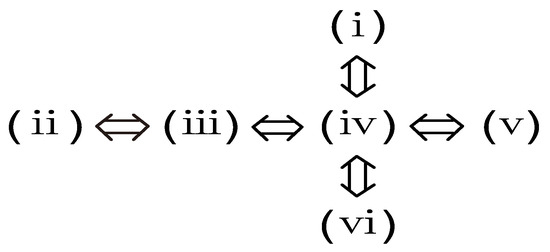
It follows from Lemma 2 that and Lemma 3 that . That is, we have the following equivalence relation graph (see Figure 1):
Figure 1.
Equivalence relation graph.
So, we have that – are equivalent. □
4. Conclusions
Upon analyzing Theorems 1 and 2, it is evident that inequalities (23) to (25) each represent the four-weight extension forms of inequalities (6) to (8), respectively. Moreover, inequality (28) extends inequality (9) in a similar manner. Additionally, inequalities (26) and (27) introduce novel four-weight extension forms that are not covered under Theorem 1. Consequently, Theorem 2 effectively encompasses a broader spectrum, offering a comprehensive and cohesive four-weight extension of Theorem 1, which elucidates a more complete characterization in four-weight terms. Future investigations will concentrate on developing new four-weight extension forms corresponding to inequality (23) and on formulating four-weight equivalent characterizations for inequalities on high dimensions.
Funding
The author was supported by the National Natural Science Foundation of China (grant no. 12101193).
Data Availability Statement
The original contributions presented in the study are included in the article, further inquiries can be directed to the corresponding author.
Conflicts of Interest
The author declares no conflict of interest.
References
- Gogatishvili, A.; Kokilashvili, V. Criteria of weighted inequalities in Orlicz classes for maximal functions defined on homogeneous type spaces. Georgian Math. J. 1994, 1, 641–673. [Google Scholar] [CrossRef][Green Version]
- Chen, W.; Liu, P.D. Weighted integral inequalities in Orlicz martingale classes. Sci. China Math. 2011, 54, 1215–1224. [Google Scholar] [CrossRef]
- Berkovits, L. Parabolic Muckenhoupt weights in the Euclidean space. J. Math. Anal. Appl. 2011, 379, 524–537. [Google Scholar] [CrossRef]
- Ren, Y.B. A four-weight weak type maximal inequality for martingales. Acta Math. Sci. 2019, 39, 413–419. [Google Scholar] [CrossRef]
- Zhang, E.X.; Ren, Y.B. A unified version of weighted weak type inequalities for one-sided maximal function on R2. Bull. Malays. Math. Sci. Soc. 2023, 46, 122. [Google Scholar] [CrossRef]
- Chen, W.; Zhu, C.X. Weighted estimates for the multilinear maximal function on the upper half–spaces. Math. Nach. 2019, 292, 777–792. [Google Scholar] [CrossRef]
- Ding, S.; Ren, Y.B. Criteria of a multi–weight weak type inequality in Orlicz classes for maximal functions defined on homogeneous type spaces. Acta Math. Hung. 2020, 162, 677–689. [Google Scholar] [CrossRef]
- Ghosh, A.; Mohanty, P. Weighted inequalities for higher dimensional one-sided Hardy–Littlewood maximal function in Orlicz spaces. Expo. Math. 2022, 40, 23–44. [Google Scholar] [CrossRef]
- Kokilashvili, V.; Krbec, M. Weighted Inequalities in Lorentz and Orlicz Spaces; World Scientific Publishing: Singapore, 1991. [Google Scholar]
- Lerner, A.K.; Ombrosi, S. A boundedness criterion for general maximal operators. Publ. Mat. 2010, 54, 53–71. [Google Scholar] [CrossRef]
- Wang, J.; Ren, Y.B.; Zhang, E.X. A weighted weak type inequality for the one–sided maximal operator. Ukr. Math. J. 2023, 75, 712–720. [Google Scholar] [CrossRef]
- Zhang, E.X. Criteria of a Two-Weight, Weak-Type Inequality in Orlicz Classes for Maximal Functions Defined on Homogeneous Spaces. Mathematics 2024, 12, 2271. [Google Scholar] [CrossRef]
- Muckenhoupt, B. Weighted norm inequalities for the Hardy maximal function. Trans. Am. Math. Soc. 1972, 165, 207–226. [Google Scholar] [CrossRef]
- Gallardo, D. Weighted weak type integral inequalities for the Hardy–Littlewood maximal operator. Isr. J. Math. 1989, 67, 95–108. [Google Scholar] [CrossRef]
- Bagby, R.J. Weak bounds for the maximal function in weighted Orlicz spaces. Stud. Math. 1990, 95, 195–204. [Google Scholar] [CrossRef][Green Version]
- Bloom, S.; Kerman, R. Weighted Orlicz space integral inequalities for the Hardy–Littlewood maximal operator. Stud. Math. 1994, 2, 149–167. [Google Scholar] [CrossRef]
- Gogatishvili, A.; Kokilashvili, V. Necessary and sufficient conditions for weighted Orlicz class inequalities for maximal functions and singular integrals. I. Georgian Math. J. 1995, 2, 361–384. [Google Scholar] [CrossRef]
- Pick, L. Two weight weak type maximal inequalities in Orlicz classes. Stud. Math. 1991, 100, 207–218. [Google Scholar] [CrossRef][Green Version]
- Ren, Y.B.; Ding, S. Necessary and sufficient conditions for the two-weight weak type maximal inequality in Orlicz class. Czechoslov. Math. J. 2022, 72, 79–85. [Google Scholar] [CrossRef]
- Ren, Z.D.; Rao, M.M. Applications of Orlicz Spaces; Marcel Dekker: New York, NY, USA, 2002. [Google Scholar]
Disclaimer/Publisher’s Note: The statements, opinions and data contained in all publications are solely those of the individual author(s) and contributor(s) and not of MDPI and/or the editor(s). MDPI and/or the editor(s) disclaim responsibility for any injury to people or property resulting from any ideas, methods, instructions or products referred to in the content. |
© 2024 by the author. Licensee MDPI, Basel, Switzerland. This article is an open access article distributed under the terms and conditions of the Creative Commons Attribution (CC BY) license (https://creativecommons.org/licenses/by/4.0/).