



Theoretical Investigation of Fractional Estimations in Liouville–Caputo Operators of Mixed Order with Applications

 ,
,  ,
,  ,
,  ,
,  and
and
Abstract
1. Introduction
2. Preliminaries
- (i)
- ;
- (ii)
- and ;
- (iii)
- ;
- (iv)
- .
- (v)
- For , and , we haveand
- (vi)
- It can be noted, for , thatfor .
3. Solution of Difference Systems
4. Numerical Tests
5. Concluding Remarks and Future Works
Author Contributions
Funding
Data Availability Statement
Acknowledgments
Conflicts of Interest
References
- Kilbas, A.A.; Srivastava, H.M.; Trujillo, J.J. Theory and Applications of Fractional Differential Equations; Elsevier B.V.: Amsterdam, The Netherlands, 2006. [Google Scholar]
- Cinar, M.; Secer, A.; Ozisik, M.; Bayram, M. Derivation of optical solitons of dimensionless Fokas-Lenells equation with perturbation term using Sardar sub-equation method. Opt. Quant. Electron 2022, 54, 402. [Google Scholar]
- Ehsan, H.; Abbas, M.; Nazir, T.; Mohammed, P.O.; Chorfi, N.; Baleanu, D. Efficient analytical algorithms to study Fokas dynamical models involving M-truncated derivative. Qual. Theory Dyn. Syst. 2024, 23, 49. [Google Scholar]
- Dos Santos, J.P.C.; Arjunan, M.M.; Cuevas, C. Existence results for fractional neutral integro-differential equations with state-dependent delay. Comput. Math. Appl. 2011, 62, 1275–1283. [Google Scholar]
- Goodrich, C.S.; Peterson, A.C. Discrete Fractional Calculus; Springer: Berlin/Heidelberg, Germany, 2015. [Google Scholar]
- Korpinar, Z.; Inc, M.; Baleanu, D.; Bayram, M. Theory and application for the time fractional Gardner equation with Mittag-Leffler kernel. J. Taibah Univ. Sci. 2019, 13, 813–819. [Google Scholar]
- Hashemi, M.S.; Inc, M.; Bayram, M. Symmetry properties and exact solutions of the time fractional Kolmogorov-Petrovskii-Piskunov equation. Rev. Mex. Física 2019, 65, 529–535. [Google Scholar]
- Chadha, A.; Pandey, D.N. Existence of mild solutions for a fractional equation with state-dependent delay via resolvent operators. Nonlinear Stud. 2015, 22, 71–85. [Google Scholar]
- Phuong, N.D.; Sakar, F.M.; Etemad, S.; Rezapour, S. A novel fractional structure of a multi-order quantum multi-integro-differential problem. Adv. Differ. Equ. 2020, 2020, 633. [Google Scholar]
- Rezapour, S.; Imran, A.; Hussain, A.; Martínez, F.; Etemad, S.; Kaabar, M.K.A. Condensing Functions and Approximate Endpoint Criterion for the Existence Analysis of Quantum Integro-Difference FBVPs. Symmetry 2021, 13, 469. [Google Scholar] [CrossRef]
- Etemad, S.; Matar, M.M.; Ragusa, M.A.; Rezapour, S. Tripled Fixed Points and Existence Study to a Tripled Impulsive Fractional Differential System via Measures of Noncompactness. Mathematics 2022, 10, 25. [Google Scholar]
- Atici, F.; Uyanik, M. Analysis of discrete fractional operators. Appl. Anal. Discret. Math. 2015, 9, 139–149. [Google Scholar]
- Atici, F.M.; Atici, M.; Belcher, M.; Marshall, D. A new approach for modeling with discrete fractional equations. Fund. Inform. 2017, 151, 313–324. [Google Scholar]
- Atici, F.; Sengul, S. Modeling with discrete fractional equations. J. Math. Anal. Appl. 2010, 369, 1–9. [Google Scholar]
- Goodrich, C.S. On discrete sequential fractional boundary value problems. J. Math. Anal. Appl. 2012, 385, 111–124. [Google Scholar]
- Noureen, R.; Naeem, M.N.; Baleanu, D.; Mohammed, P.O.; Almusawa, M.Y. Application of trigonometric B-spline functions for solving Caputo time fractional gas dynamics equation. AIMS Math. 2023, 8, 25343–25370. [Google Scholar]
- Silem, A.; Wu, H.; Zhang, D.-J. Discrete rogue waves and blow-up from solitons of a nonisospectral semi-discrete nonlinear Schrödinger equation. Appl. Math. Lett. 2021, 116, 107049. [Google Scholar]
- Liu, Y.; Liu, H.; Zhu, Y. An approach for numerical solutions of Caputo-Hadamard uncertain fractional differential equations. Fractal Fract. 2022, 6, 693. [Google Scholar] [CrossRef]
- Lu, Q.; Zhu, Y. Comparison theorems and distributions of solutions to uncertain fractional difference equations. J. Comput. Appl. Math. 2020, 376, 112884. [Google Scholar]
- Chen, C.R.; Bohner, M.; Jia, B.G. Ulam-Hyers stability of Caputo fractional difference equations. Math. Meth. Appl. Sci. 2019, 42, 7461–7470. [Google Scholar]
- Lizama, C. The Poisson distribution, abstract fractional difference equations, and stability. Proc. Am. Math. Soc. 2017, 145, 3809–3827. [Google Scholar]
- Mohammed, P.O.; Abdeljawad, T.; Hamasalh, F.K. On discrete delta Caputo-Fabrizio fractional operators and monotonicity analysis. Fractal Fract. 2021, 5, 116. [Google Scholar] [CrossRef]
- Liu, X.; Du, F.; Anderson, D.; Jia, B. Monotonicity results for nabla fractional h-difference operators. Math. Meth. Appl. Sci. 2021, 44, 1207–1218. [Google Scholar]
- Abdeljawad, T.; Baleanu, D. Monotonicity analysis of a nabla discrete fractional operator with discrete Mittag-Leffler kernel. Chaos Solit. Fractals 2017, 116, 1–5. [Google Scholar]
- Goodrich, C.S.; Lizama, C. Positivity, monotonicity, and convexity for convolution operators. Discret. Contin. Dyn. Syst. 2020, 40, 4961–4983. [Google Scholar]
- Wu, G.-C.; Baleanu, D.; Zeng, S.-D. Discrete chaos in fractional sine and standard maps. Phys. Lett. A 2014, 378, 484–487. [Google Scholar]
- He, J.W.; Zhang, L.; Zhou, Y.; Ahmad, B. Existence of solutions for fractional difference equations via topological degree methods. Adv. Differ. Equ. 2018, 2018, 153. [Google Scholar]
- Huang, L.-L.; Park, J.H.; Wu, G.-C.; Mo, Z.-W. Variable-order fractional discrete-time recurrent neural networks. J. Comput. Appl. Math. 2020, 370, 112633. [Google Scholar]
- Mohammed, P.O.; Baleanu, D.; Al-Sarairah, E.; Abdeljawad, T.; Chorfi, N. Theoretical and numerical computations of convexity analysis for fractional differences using lower boundedness. Fractals 2023, 31, 2340183. [Google Scholar]
- Mohammed, P.O.; Almusawa, M.Y. On analysing discrete sequential operators of fractional order and their monotonicity results. AIMS Math. 2023, 8, 12872–12888. [Google Scholar]
- Segi Rahmat, M.R.; Md Noorani, M.S. Caputo type fractional difference operator and its application on discrete time scales. Adv. Differ. Equ. 2015, 2015, 160. [Google Scholar]
- Almusawa, M.Y.; Mohammed, P.O. Approximation of sequential fractional systems of Liouville-Caputo type by discrete delta difference operators. Chaos Solit. Fractals 2023, 176, 114098. [Google Scholar]
- Fečkan, M.; Pospíšil, M.; Danca, M.-F.; Wang, J. Caputo delta weakly fractional difference equations. Fract. Calc. Appl. Anal. 2022, 25, 2222–2240. [Google Scholar]
- Srivastava, H.M.; Mohammed, P.O.; Ryoo, C.S.; Hamed, Y.S. Existence and uniqueness of a class of uncertain Liouville-Caputo fractional difference equations. J. King Saud Univ. Sci. 2021, 33, 101497. [Google Scholar]
- Mohammed, P.O.; Goodrich, C.S.; Srivastava, H.M.; Al-Sarairah, E.; Hamed, Y.S. A study of monotonicity analysis for the delta and nabla discrete fractional operators of the Liouville-Caputo family. Axioms 2023, 12, 114. [Google Scholar] [CrossRef]
- Mozyrska, D.; Girejko, E. Overview of Fractional h-difference Operators. In Advances in Harmonic Analysis and Operator Theory. Operator Theory: Advances and Applications; Almeida, A., Castro, L., Speck, F.O., Eds.; Birkhäuser: Basel, Switzerland, 2013; Volume 229. [Google Scholar]
- Mozyrska, D.; Girejko, E.; Wyrwas, M. Fractional nonlinear systems with sequential operators. Cent. Eur. J. Phys. 2013, 11, 1295–1303. [Google Scholar]
- Abdeljawad, T. Different type kernel h-fractional differences and their fractional h–sums. Chaos Solit. Fractals 2018, 116, 146–156. [Google Scholar]
- Podlubny, I. Fractional Differential Equations; AP: New York, NY, USA, 1999. [Google Scholar]
- Miller, K.S.; Ross, B. An Introduction to the Fractional Calculus and Fractional Differential Equation; John Wiley & Sons: New York, NY, USA, 1993. [Google Scholar]
- Girejko, E.; Mozyrska, D. Positivity of fractional discrete systems with sequential h-differences. In Proceedings of the 2012 IEEE 4th International Conference on Nonlinear Science and Complexity (NSC), Budapest, Hungary, 6–11 August 2012; pp. 137–140. [Google Scholar]
- Wang, M.; Jia, B.; Chen, C.; Zhu, X.; Du, F. Discrete fractional Bihari inequality and uniqueness theorem of solutions of nabla fractional difference equations with non-Lipschitz nonlinearities. Appl. Math. Comput. 2020, 367, 125118. [Google Scholar]
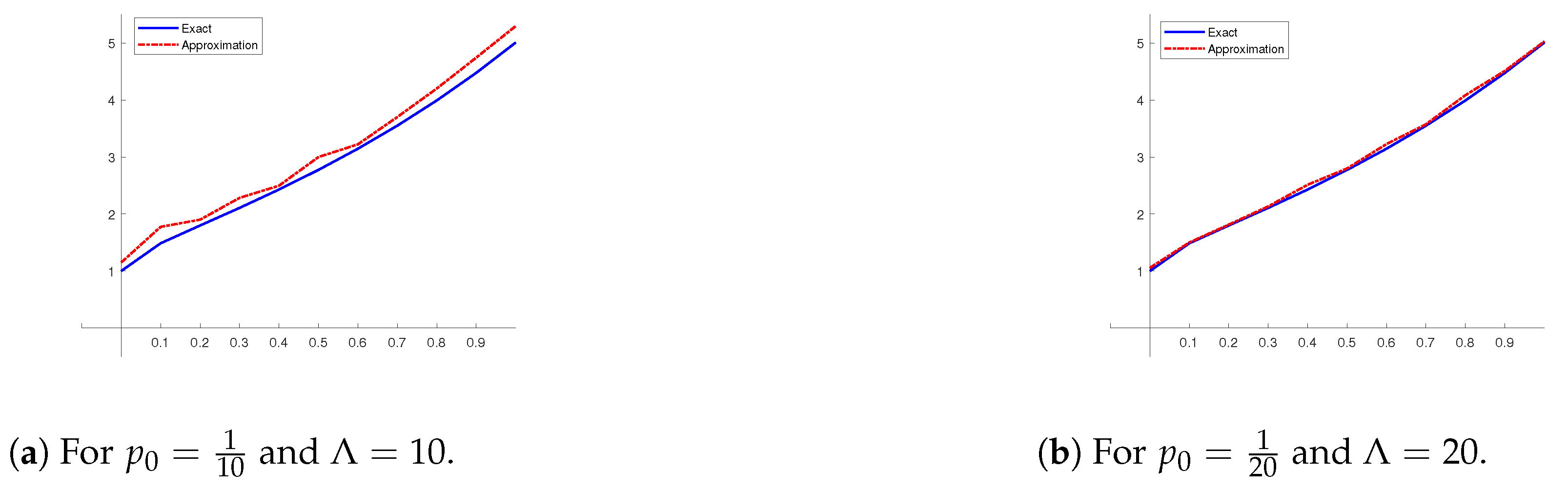
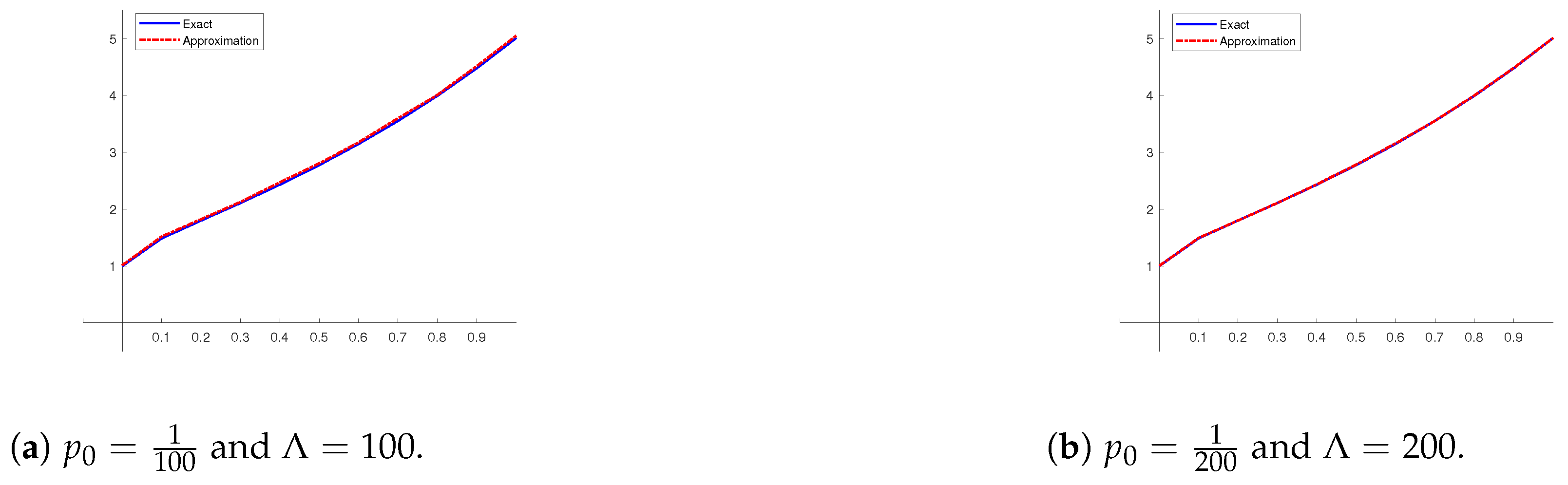

| Numerical Result | ||
|---|---|---|
| 1.000000000000000 | 1.003804458469754 | 0.003804458469754 |
| 1.486763397673679 | 1.492441614080931 | 0.005678216407252 |
| 1.799017244188177 | 1.799775787083807 | 0.000758542895631 |
| 2.107699203837270 | 2.108238705023936 | 0.000539501186666 |
| 2.430043141497662 | 2.435351117027752 | 0.005307975530090 |
| 2.774285957670009 | 2.782077629971030 | 0.007791672301020 |
| 3.146213032210335 | 3.155553139052627 | 0.009340106842292 |
| 3.550802683646889 | 3.552101745731627 | 0.001299062084737 |
| 3.992835834192708 | 3.998524070801430 | 0.005688236608722 |
| 4.477184810795735 | 4.481878717206317 | 0.004693906410582 |
| 5.008980080762283 | 5.009099101457296 | 0.000119020695013 |
| Numerical Result | ||
|---|---|---|
| 1.000000000000000 | 1.000711215780434 | 0.000711215780434 |
| 1.486763397673679 | 1.486985144407696 | 0.000221746734017 |
| 1.799017244188177 | 1.799134661839032 | 0.000117417650856 |
| 2.107699203837270 | 2.107995879710488 | 0.000296675873218 |
| 2.430043141497662 | 2.430361919799588 | 0.000318778301926 |
| 2.774285957670009 | 2.774710124429723 | 0.000424166759714 |
| 3.146213032210335 | 3.146720890494996 | 0.000507858284661 |
| 3.550802683646889 | 3.550888199443980 | 0.000085515797090 |
| 3.992835834192708 | 3.993098316427406 | 0.000262482234698 |
| 4.477184810795735 | 4.477985825418505 | 0.000801014622770 |
| 5.008980080762283 | 5.009009301039845 | 0.000029220277562 |
Disclaimer/Publisher’s Note: The statements, opinions and data contained in all publications are solely those of the individual author(s) and contributor(s) and not of MDPI and/or the editor(s). MDPI and/or the editor(s) disclaim responsibility for any injury to people or property resulting from any ideas, methods, instructions or products referred to in the content. |
© 2024 by the authors. Licensee MDPI, Basel, Switzerland. This article is an open access article distributed under the terms and conditions of the Creative Commons Attribution (CC BY) license (https://creativecommons.org/licenses/by/4.0/).
Share and Cite
Mohammed, P.O.; Lupas, A.A.; Agarwal, R.P.; Yousif, M.A.; Al-Sarairah, E.; Abdelwahed, M. Theoretical Investigation of Fractional Estimations in Liouville–Caputo Operators of Mixed Order with Applications. Axioms 2024, 13, 570. https://doi.org/10.3390/axioms13080570
Mohammed PO, Lupas AA, Agarwal RP, Yousif MA, Al-Sarairah E, Abdelwahed M. Theoretical Investigation of Fractional Estimations in Liouville–Caputo Operators of Mixed Order with Applications. Axioms. 2024; 13(8):570. https://doi.org/10.3390/axioms13080570
Chicago/Turabian StyleMohammed, Pshtiwan Othman, Alina Alb Lupas, Ravi P. Agarwal, Majeed A. Yousif, Eman Al-Sarairah, and Mohamed Abdelwahed. 2024. "Theoretical Investigation of Fractional Estimations in Liouville–Caputo Operators of Mixed Order with Applications" Axioms 13, no. 8: 570. https://doi.org/10.3390/axioms13080570
APA StyleMohammed, P. O., Lupas, A. A., Agarwal, R. P., Yousif, M. A., Al-Sarairah, E., & Abdelwahed, M. (2024). Theoretical Investigation of Fractional Estimations in Liouville–Caputo Operators of Mixed Order with Applications. Axioms, 13(8), 570. https://doi.org/10.3390/axioms13080570

