


Abstract
In this study, we introduced a generalization of distance Fibonacci sequences and investigate some of its basic properties. We then proposed a generalization of distance Fibonacci sequences for negative integers and investigated some basic properties. Additionally, we explored the construction of matrix generators for these sequences and offered a graphical representation to clarify their structure. Furthermore, we demonstrated how these generalizations can be applied to obtain the Padovan and Narayana sequences for specific parameter values.
Keywords:
distance Fibonacci numbers; generalized Fibonacci numbers; negative integers; matrix generators MSC:
11B39; 03D45
1. Introduction
The Fibonacci number sequence, renowned for its distinctive and fascinating properties, remains one of the most well-known and studied numerical sequences in mathematics. This sequence continues to capture the interest of researchers across a wide array of disciplines [1,2,3,4,5]. Within mathematics, the Fibonacci sequence finds applications in diverse areas, such as algebra [6,7,8], where it aids one in solving equations and understanding numerical patterns, and graph theory [9,10,11], where it helps one analyze the properties of graphs and networks.
Beyond its mathematical applications, the Fibonacci sequence’s influence extends to various branches of science. In computer science, it is utilized in algorithm design, particularly in recursive algorithms and data structure optimization. In biology, Fibonacci numbers describe phenomena such as the branching patterns of trees, the arrangement of leaves on a stem, and the reproductive patterns of certain animals. Additionally, in physics, the sequence appears in the study of dynamical systems and models of natural phenomena [12,13,14,15,16].
The versatility and ubiquity of the Fibonacci sequence underscore its importance as a powerful tool for theoretical exploration and practical problem solving. Its applications in fields ranging from cryptography to economics demonstrate the sequence’s capacity to provide insights into complex systems and processes. The continued study and utilization of Fibonacci numbers highlight their enduring significance and the rich interplay between mathematics and the natural world. Fibonacci numbers are given
with and .
Fibonacci numbers frequently appear as solutions to various counting problems across different fields of mathematics. One notable application is in the enumeration of independent sets in graphs. An independent set, also known as a stable set, is a set of vertices in a graph, none of which are adjacent. Counting these sets is a fundamental problem in combinatorial optimization and graph theory.
In 1971, Japanese chemist H. Hosoya introduced a significant concept in the study of molecular graphs. He proposed a structure descriptor known as the Hosoya index, which is defined as the total number of matchings in a molecular graph. A matching in a graph is a set of edges without common vertices, representing bonds in a molecular structure. Hosoya’s research demonstrated that the Hosoya index is strongly correlated with certain physicochemical properties of alkanes, a class of hydrocarbons. This finding illustrates the profound connection between a molecular structure and its physical and chemical properties, showcasing the interdisciplinary nature of modern scientific research. Next, two American chemists, R.M. Merrifield and H.E. Simmons, introduced the analogous structure descriptor as the number of all the independent sets of a graph, which is very often represented by Fibonacci numbers.
The real interest in counting independent sets in graphs was significantly advanced by the work of H. Prodinger and R.F. Tichy, who demonstrated that the number of independent sets in a path graph corresponds to Fibonacci numbers. This discovery highlighted the deep connection between combinatorial structures and Fibonacci sequences, leading to a broader exploration of generalized Fibonacci numbers in graph theory. These generalized Fibonacci numbers can be utilized to design efficient algorithms for counting independent sets in path graphs and other related graph structures [17].
This seemingly simple observation by Prodinger and Tichy provided a major impetus for extensive research into the enumeration of independent sets in various graph types. The significance of their work was further amplified by its chemical applications, particularly in the context of molecular graph theory. The enumeration of independent sets has proven valuable in understanding the structural properties of chemical compounds, thereby bridging the gap between mathematics and chemistry.
For an in-depth discussion on this topic, one can refer to the comprehensive survey paper by I. Gutman and S. Wagner [16], which meticulously reviews the literature and includes a bibliography of 128 references. This survey not only encapsulates the development of the field but also serves as a foundational resource for researchers interested in the intersection of graph theory and chemical graph theory.
Motivated by the graph interpretation of Fibonacci numbers related to the number of independent sets, the problem of counting distance independent sets in graphs was considered too. In [10], M. Kwaśnik and I. Włoch defined distance Fibonacci numbers in the natural way.
with for , which gives the total number of distance independent sets in paths.
The theory of distance Fibonacci numbers was developed over the next few decades, and, by reviewing the literature, we can find many types of distance Fibonacci numbers. We selected only some of them, such that all initial conditions would be equal to 1.
In 2020, I. Matoušová and P. Trojovský [18] investigated the application of (2,q)-distance number sequences in the development of algorithms and mathematical operations. Their research demonstrated that these sequences have practical applications in various fields, including data processing, random number generation, and error correction. By exploring these applications, Matoušová and Trojovský provided new insights into the utility of (2,q)-distance number sequences, highlighting their versatility beyond traditional mathematical contexts.
Furthermore, their work underscored the intrinsic connections between mathematics and computer science, offering a novel perspective which extends beyond the conventional use of Fibonacci sequences. This interdisciplinary approach not only broadens the potential applications of these sequences but also exemplifies the ongoing integration of mathematical theory into computational practices. The findings of Matoušová and Trojovský, thus, contribute significantly to both theoretical and applied mathematics, demonstrating the continued relevance and expansion of number sequence applications in modern computational and data-driven environments. Many researchers have studied various different properties of generalized versions of these sequences [19,20,21,22,23,24]. Nowadays, the concept of distance sense has attracted attention among generalizations of Fibonacci sequences [9,11]. Recently, the generalization of distance Fibonacci numbers have been shown by and defined as follows:
with , for. Numbers are also named -distance Fibonacci numbers.
Nowadays, new kinds of distance Fibonacci numbers have been introduced in the field [25,26,27]. Especially, in [25], is defined recursively as follows:
with , .
In [26,27], and are defined and given their properties. Let and be integers. Then, is defined recursively as follows:
with initial conditions and .
Similarly, is given as follows:
with initial conditions and .
It has been observed that Narayana and Padovan sequences and repeat Fibonacci sequences such as those repeated two times and three times are obtained for some k and n values in the and sequences [26,27]. In this paper, we present a generalization of our works conducted above. First, we define a generalization of the distance Fibonacci sequences . Then, we obtain some properties of distance Fibonacci sequences . We associate these sequences with Narayana and Padovan sequences. Moreover, we also define a generalization of the distance Fibonacci sequences for negative integers and study some properties of the sequences. We give a graph interpretation of these sequences. Finally, we present matrix generators of these sequences.
2. Materials and Methods
(t,k) Generalization of Distance Fibonacci Sequences
Now, we can give the definition of distance Fibonacci sequences . These sequences are also represented as -distance Fibonacci sequences.
Definition 1.
For integers and , -distance Fibonacci numbers are given by
such that , for
.
For , we have the following data
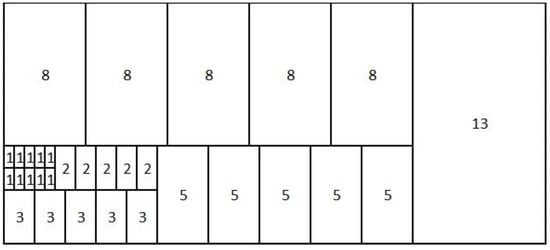
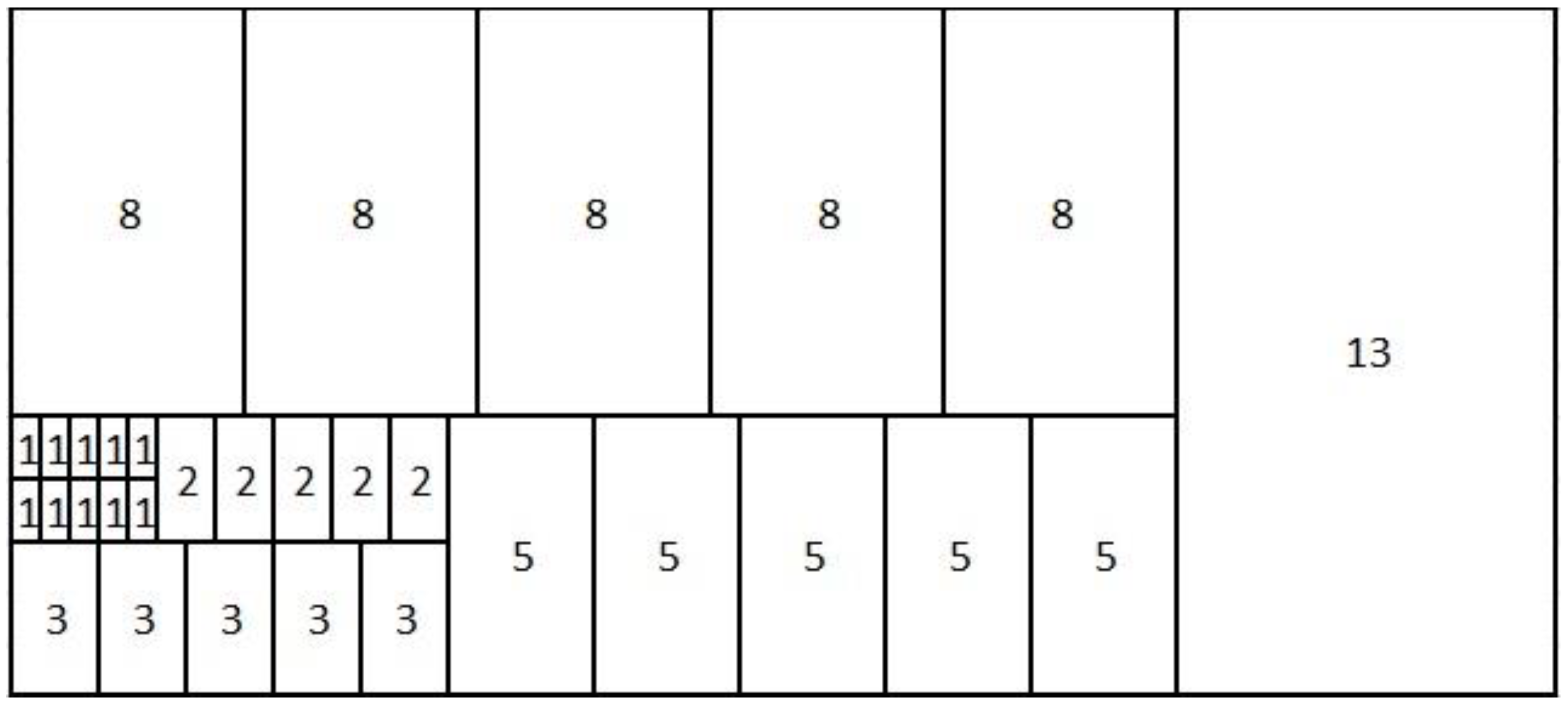
The tile defined by Fibonacci numbers represents a plane. In studies [25,26,27], it is stated that a plane is tiled with , , and . Now let us generally denote the tiling covering of a plane by . For example, can be seen in Figure 1.
Figure 1.
A tiling for .
Like classical Fibonacci numbers, can be extended to negative integers. In this definition, let us extend to negative integers. Starting from here, let us determine and examine the properties of these numbers.
Definition 2.
where, ,
and
for
.
3. Results
3.1. The Properties of
In this Section, we present fundamental theorems about the sequence of .
Theorem 1.
Let , , and be integers. Then,
Proof.
We prove this by induction for n. Let m and t be fixed integers as in the assumptions of the theorem. All the initial values of the sequence are equal to 1, so, for we have the following equivalence:
Assume that the following equivalences are true for .
We will now prove the equivalences for , i.e.,
We consider the successive numbers in the above equivalences,
Now, we observe that the leftmost parts of the equivalences above are equal part by part. Specifically, the first addends of the sums are equal, and the second addends of the sums are also equal. This conclusion is reached through induction for n. By confirming the base case and assuming that the statement holds for n, we demonstrate that it holds for n + 1 as well. Thus, the inductive step is completed, thereby finalizing the induction process. This methodical approach ensures the validity of our equivalence, establishing a robust foundation for further mathematical analysis and verification. □
Theorem 2.
Let be integers. Then,
Proof.
(by induction) If , then
On the other hand,
Hence, we have the equivalence. Assume that is true for . We will now show that it is true for .
From the equivalence
we have that .
We will use it in the next step.
This is the end of the proof. □
3.2. Graph Interpretation of
First, we provide a graph interpretation of for . Let us use the well-known terminology for graph theory [28]. For , we denote a path without loops and multiple edges with the vertex set by . The vertices of the path are numbered in the natural fashion. Additionally, we denote the empty graph by . Let be a family of vertex disjoint subgraphs of such that where , , and .
The family is a covering of with the rest. If then we have covering of . For , we assume that the empty set is the unique covering of .
Give a graph interpretation of numbers using covering with the rest of and denote the total number of coverings with the rest of by .
Theorem 3.
Let be the integer. Then, .
Proof.
(by induction for n) Denote by the number of all coverings with the rest of such that , and by the number of all coverings with the rest of such that .
If , then the empty set is the unique covering with the rest of so .
If , then , so .
If , then there is the unique covering with the rest of realized by either so .
If assume that for an arbitrary n. We will now show that
Clearly, .
Moreover, and .
Then,
So, this is the end of the proof. □
From above interpretation, we give a direct formula for with the following theorem.
Theorem 4.
Let and be integers. Then,
Proof.
If , then and
Suppose that . From Theorem 3, the number is equal to the number of coverings of . Each covering consists of w paths and j paths , where and . Also, for a fixed w, we obtain , and the number of coverings is equal to . Hence, we obtain the desired result. □
3.3. Pascal-like Triangle
Now, we introduce a Pascal-like triangle related to sequence . Let and be fixed integers. The number is equal to the total number of coverings of graph with the rest. The set of coverings can be divided into subsets according to the number of included paths . For , let be the number of coverings with the rest of the graph such that each covering has exactly paths Moreover, we put .
Let be the entry in the nth row and mth column of the Pascal-like triangle.
Theorem 5.
Let
be integers. Then,
Proof.
The right-hand side of is equal to , so the proof is completed. The next theorem gives a formula for calculating the entries of the first column of the Pascal-like triangle. □
Theorem 6.
Let
be integers. Then,
Proof.
By the definition, is the number of all coverings of with the rest, using only paths . The rest can be one of the following: . So, there is exactly one such covering for and , and there is no covering for . □
From the above theorem, it follows that the first column of the Pascal-like triangle forms a repeating sequence of ones and zeros.
Corollary 1.
Let
be integers. Then,
Theorem 7.
Let
be integers. Then,
Proof.
Note that the first nonzero entry in the mth column of the Pascal-like triangle is for . Next, entries in this column are ones and zeros. If where , then . Then, there is exactly one covering of by paths . If where , then . Then, there exist no coverings of . So, we have ones and zeros. □
From the proof of the above theorem, we deduce that the first entries in each column of the Pascal-like triangle form a repeating sequence of ones and zeros, the same as in the first column.
Corollary 2.
Let
be integers. Then,
Theorem 8.
Let
be integers. Then,
Proof.
To determine , we use the definition that it is the number of coverings of path by path , and then we have ways to cover the remaining part of using paths . If we cover the first vertices of with path , then the remaining part of can be cover in ways. Using a basic rule of counting, we have
completing the proof. □
Let and . Consider, for example, the number of the triangle that corresponds to the sequence . It is equal to the number of coverings such that each covering has four paths to cover eight vertices of , with the remaining vertices covered by path . Because it can be achieved in five ways, . Analogously, we calculate the number . In this case, we have vertex of path not covered. Several rows of the Pascal-like triangles are presented below. For convenience, we write these triangles as matrices.
The matrix correspond to the sequence and correspond to the sequence . Note that, for the sequence , we obtain a classical Pascal triangle, .
3.4. Generating Functions
We state the following theorem, which gives the generating functions of .
The generating function is defined as . The generating function of Fibonacci numbers can be expressed in a specific form.
Theorem 9.
Let be the integer. The generating function of Fibonacci numbers can be expressed in a specific form.
The generating function of
Fibonacci numbers has the following form:
Proof.
Let
Using Recurrence (3), we have , where
Hence, which ends the proof. □
3.5. Matrix Generators
Matrices are widely utilized for solving complex problems due to their efficiency in computing large Fibonacci numbers and executing specific mathematical operations. Their power lies in the ability to handle substantial computations swiftly and effectively. By parallelizing and optimizing matrix operations, performance is significantly enhanced, particularly when dealing with extensive data sets. This approach accelerates the calculation process and ensures greater accuracy and scalability.
Matrix methods are invaluable in both theoretical and applied mathematics. They facilitate the efficient computation and manipulation of large sets of equations, making them essential in various fields. For example, in computer science, matrices are fundamental in algorithms for graphic processing and machine learning. In physics and engineering, they assist in modeling systems of linear equations and signal processing.
The advantages of matrix methods include their ability to represent complex problems compactly, implement numerical algorithms efficiently, and develop scalable solutions for growing data sizes. Consequently, matrices play a crucial role in advancing computational techniques and solving intricate problems across diverse scientific and engineering disciplines. Their application underscores the importance of matrix methods in achieving precision, speed, and scalability in mathematical computations. In [18,25,26,27], using matrices provided an alternative way to find distance Fibonacci numbers.
Presented below are k × k matrices that provide a suitable structure for consecutive number sequences, such as the distance Fibonacci sequence, and the related operations. These matrices facilitate the efficient computation and analysis of such sequences, offering a robust framework for both theoretical exploration and practical applications in various mathematical and computational contexts.
Let be integers and be a square matrix. The element is equal to the coefficient at in (3). For , if then and if then , otherwise .
For and , we obtain if and we have otherwise. So, we obtain the following matrices.
For
Now, we define a square matrix as follows.
We give the following theorems with the help of basic determinant properties and Laplace theorem.
Theorem 10.
Let , and be integers. Then,
Proof.
We prove the equivalence via induction for n. If , then the result is seen from (3). Suppose that Formula (5) holds for n. We will now prove it for n + 1. Since , we have, using (3),
which ends the proof. □
Corollary 3.
Let and be integers. Then, the determinant of and are as follows, respectively
and
3.6. Connection with Pascal’s Triangle
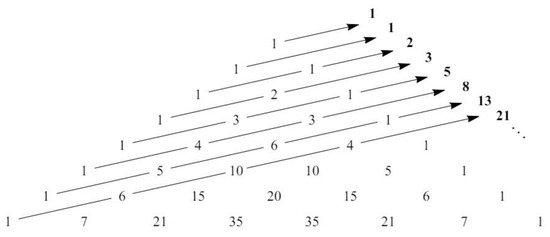
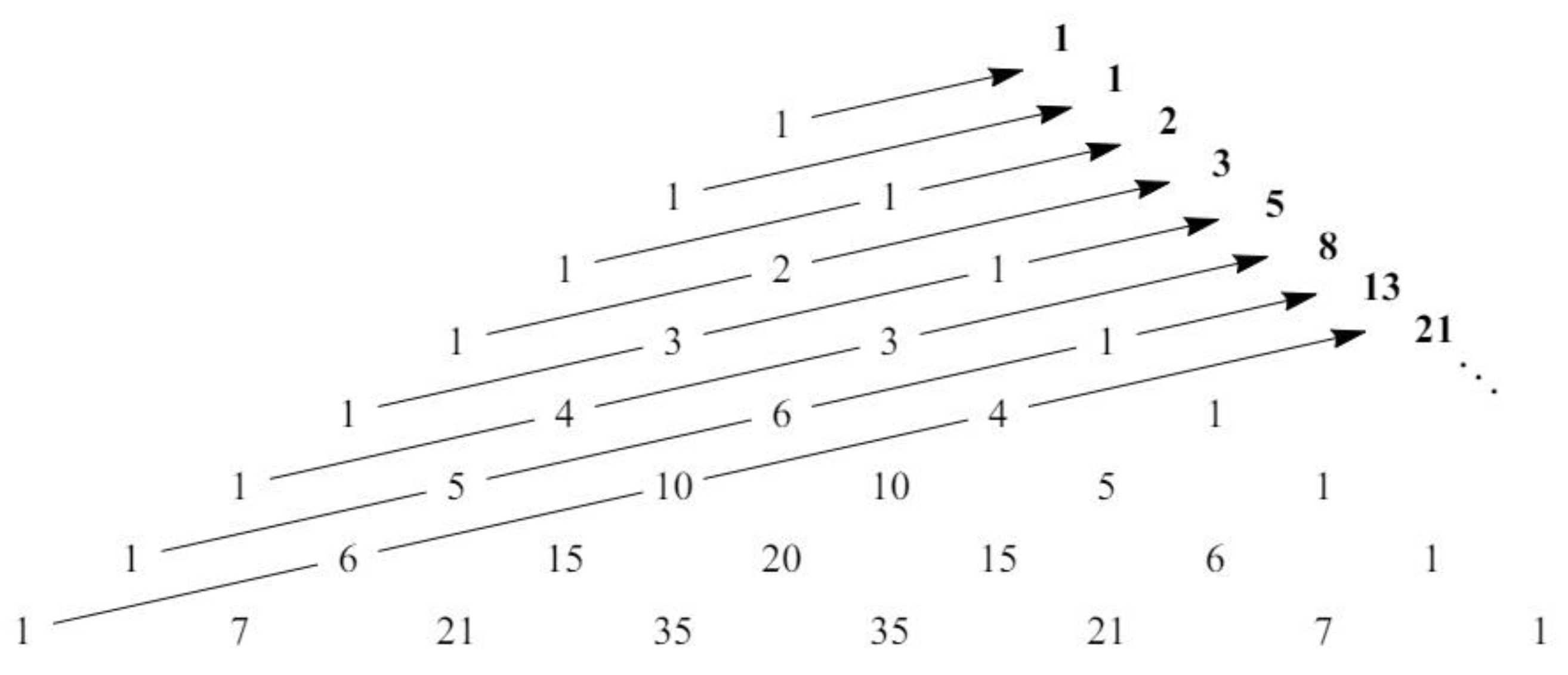
In 1876, the French mathematician Édouard Lucas made a notable discovery regarding Fibonacci numbers. He observed that these numbers can be derived from the sums of the elements along the north–east diagonals of Pascal’s triangle. This revelation established a profound connection between two fundamental sequences in mathematics: the Fibonacci sequence and the binomial coefficients represented in Pascal’s triangle. Lucas’s insight not only highlighted an elegant combinatorial property but also enriched the mathematical understanding of Fibonacci numbers, demonstrating their pervasive presence in various mathematical structures and sequences (see Figure 2) [18]. In [25,26,27] and in this study, the connection between Pascal’s triangle and distance Fibonacci numbers is examined.
Figure 2.
Pascal’s triangle with added north–east diagonals.
To discover the connections between -distance Fibonacci numbers and Pascal’s triangle, we must investigate a family of sequences described by the same recurrence as with distinct initial conditions.
For integers and , let us consider a family of sequences defined recursively as follows:
where if and otherwise , . Note that all sequences share the same matrix generator .
For clarity, let us determine some initial words of sequences for ,and . See Table 1 below.
Table 1.
and -distance Fibonacci numbers.
Now, we can give the following theorem, as in [29].
Theorem 11.
Let , , and be integers. Then,
In [5], Er explored a family of sequences similar to . From [5], we know that is as below.
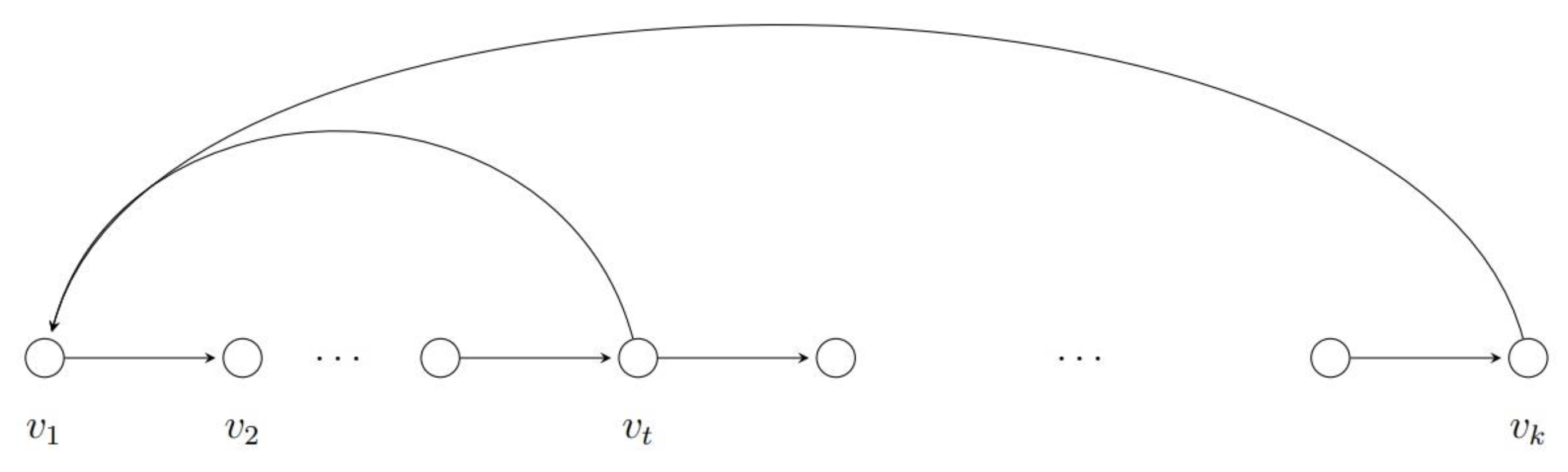
The matrix can be construced as the adjacency matrix of a directed graph D, as depicted in Figure 3.
Figure 3.
Digraph D for .
We know that the entries of give the number of all distinct paths of length between corresponding vertices in digraph D. Strictly speaking, the entry shows the number of all paths of length from to in D.
The above matrix methods have been used for study sequences such as, for example, in [20]. We also use these methods for the family of sequences .
Theorem 12.
Let and be integers. Then,
and
for and
for .
Theorem 13.
Let and be integers. Then,
4. Conclusions
In this paper, we presented a generalization of Fibonacci-type sequences, denoted as , derived through the concept of Fibonacci sequence distance. We systematically examined the fundamental properties of providing a comprehensive analysis. This analysis included the sequence’s graph interpretation, matrix requirements, and its intricate relationship with Pascal’s triangle. Additionally, we extended the definition to include for negative integers, thereby broadening the scope and applicability of the sequence.
The sequence encompasses several well-known sequences as special cases. Notably, specific values within correspond to the Padovan and Narayana sequences, showcasing the versatility and depth of this generalization. This unification under a single framework allows for a deeper exploration of the inter-relationships among various integer sequences.
One of the significant implications of our work is the potential application of the sequence in various scientific and computational fields. For instance, the classical Fibonacci sequence is already employed in diverse methods, such as algorithm development, network optimization, bioinformatics, cryptography, molecular structure analysis, and physicochemical property determination. The extended range of numbers provided by the distance Fibonacci sequence promises to enhance these applications by offering a richer set of numerical tools.
In algorithm development, the sequence can be utilized to design more efficient and effective algorithms, particularly those which rely on recursive structures or dynamic programming. Network optimization can benefit from the extended sequence by allowing for more flexible and robust models of network growth and resource allocation. In bioinformatics, the sequence can aid in modeling biological processes that exhibit Fibonacci-like patterns but require a broader numerical range for accurate representation.
Cryptography, a field heavily reliant on number theory, can leverage the sequence to develop novel encryption schemes and security protocols. The sequence’s mathematical properties might offer new avenues for creating cryptographic algorithms that are both secure and computationally efficient.
Furthermore, in molecular structure analysis and physicochemical property determination, the sequence can help in the modeling of molecular interactions and the prediction of compound properties. The broader set of numbers allows for more detailed simulations and analyses, potentially leading to new discoveries and insights in chemical and physical sciences.
Overall, the distance Fibonacci sequence represents a significant advancement over the classical Fibonacci sequence. By offering a more extensive set of numbers and encompassing various known sequences, it provides a powerful tool for both theoretical exploration and practical application across multiple disciplines. The insights and applications derived from this generalization have the potential to drive innovation and discovery in numerous scientific and computational fields.
The sequence included in this study can be expanded, over time, with further research.
Author Contributions
Methodology, N.Ş.Y. and A.W.; Investigation, N.Ş.Y.; Writing—original draft, N.Ş.Y.; Writing—review & editing, A.W. and E.Ö.; Supervision, E.Ö. All authors have read and agreed to the published version of the manuscript.
Funding
This research received no external funding.
Data Availability Statement
Data is contained within the article.
Conflicts of Interest
The authors declare no conflicts of interest.
References
- Kiliç, E. The generalized order k-Fibonacci Pell sequence by matrix methods. J. Comput. Appl. Math. 2007, 209, 133–145. [Google Scholar] [CrossRef] [Scilit]
- Kiliç, E.; Taşçi, D. On the generalized Fibonacci and Pell Sequences by Hessenberg matrices. Ars. Comb. 2010, 94, 161–174. [Google Scholar]
- Koshy, T. Fibonacci and Lucas Numbers with Applications, 3rd ed.; A Wiley Interscience Publication: Waterloo, ON, Canada, 2001. [Google Scholar]
- Şen, E. Fibonacci Numbers, Golden Section and Applications. arXiv 2013, arXiv:1301.6606. [Google Scholar]
- Włoch, I.; Włoch, A. On some multinomial sums related to Fibonacci Type numbers. Tatra Mt. Math. Publ. 2020, 77, 99–108. [Google Scholar] [CrossRef] [Scilit]
- Feingold, A.J. A hyperbolic GCM Lie algebra and the Fibonacci numbers. Proc. Am. Math. Soc. 1980, 80, 379–385. [Google Scholar] [CrossRef]
- Souza, J.; Curado, E.M.F.; Rego-Monteiro, M.A. Generalized Heisenberg algebras and Fibonacci series. J. Phys. A Math. Gen. 2007, 39, 10415–10425. [Google Scholar] [CrossRef] [Scilit]
- Schork, M. Generalized Heisenberg algebras and k-generalized Fibonacci Numbers. J. Phys. A Math. Theory 2007, 40, 4207–4214. [Google Scholar] [CrossRef] [Scilit]
- Bednarz, U.; Włoch, A.; Wołowiec-Musiał, M. Distance Fibonacci Numbers, their interpretations and matrix generators. Comment. Math. 2013, 53, 34–46. [Google Scholar] [CrossRef] [Scilit]
- Kwaśnik, M.; Włoch, I. The total number of generalized stable sets and kernels in graphs. Ars Comb. 2000, 55, 139–146. [Google Scholar]
- Bród, D.; Włoch, I.; Piejko, K. Distance Fibonacci Numbers, distance Lucas numbers and their applications. Ars Comb. 2013, 161, 2695–2701. [Google Scholar]
- Stojmenovic, I. Recursive algorithms in computer science courses: Fibonacci numbers and binomial coefficients. IEEE Trans. Educ. 2000, 43, 273–276. [Google Scholar] [CrossRef] [Scilit]
- Atkins, J.; Geist, R. Fibonacci Numbers and computer algorithms. Coll. Math. J. 1987, 18, 328–336. [Google Scholar] [CrossRef]
- Sinha, S. The Fibonacci numbers and Its Amazing Applications. Int. J. Eng. Sci. Invent. 2017, 6, 7–14. [Google Scholar]
- Omotehinwa, T.O.; Ramon, S.O. Fibonacci Numbers and Golden Ratio in Mathematics and Science. Int. J. Comput. Inf. Technol. 2013, 2, 630–638. [Google Scholar]
- Gutman, I.; Wagner, S. Maxima and minima of the Hosoya index and the Merrifield-Simmons index. A survey of results and techniques. Acta Appl. Math. 2010, 112, 323–346. [Google Scholar]
- Prodinger, H.; Tichy, R. Fibonacci numbers of graphs. Fibonacci Q. 1982, 20, 16–21. [Google Scholar]
- Matoušová, I.; Trojovský, P. On coding by (2,q)- distance Fibonacci numbers. Mathematics 2020, 8, 2058. [Google Scholar] [CrossRef] [Scilit]
- Tatlow, R. The Use and Abuse of Fibonacci numbers and The Golden Section in Musicology today. Underst. Bach 2006, 1, 69–85. [Google Scholar]
- Horadam, A.F. A generalized Fibonacci sequence. Amer. Math. Mon. 1961, 68, 455–459. [Google Scholar] [CrossRef] [Scilit]
- Jaiswal, D.V. On a generalized Fibonacci sequence. Labdev. J. Sci. Tech. Part. A 1969, 7, 67–71. [Google Scholar]
- Falcon, S. Binomial Transform of The Generalized k-Fibonacci numbers. Commun. Math. Appl. 2019, 10, 643–651. [Google Scholar] [CrossRef] [Scilit]
- Falcon, S.; Plaza, A. The k-Fibonacci sequence and the Pascal 2-Triange. Chaos Solitions Fractals 2007, 33, 38–49. [Google Scholar] [CrossRef] [Scilit]
- Sburlati, G. Generalized Fibonacci sequences and linear congruences. Fibonacci Quart 2002, 40, 446–452. [Google Scholar]
- Bednarz, U.; Bród, D.; Włoch, A.; Włoch, I.; Wołowiec-Musiał, M. On a new type of distance Fibonacci Numbers. Discret. Appl. Math. 2013, 161, 2695–2701. [Google Scholar]
- Özkan, E.; Yılmaz, N.Ş.; Włoch, A. On F3(k,n)-numbers of the Fibonacci Type. Bol. Soc. Matemática Mex. 2021, 27, 77. [Google Scholar]
- Yilmaz, N.Ş.; Włoch, A.; Özkan, E.; Strzałka, D. On doubled and quadrupled Fibonacci type sequences. Ann. Math. Silesianae 2023, 38, 1–15. [Google Scholar]
- Diestel, R. Graph Theory; Springer: Heidelberg, Germany; New York, NY, USA, 2005. [Google Scholar]
- Soykan, Y. On Generalized Narayana Numbers. Int. J. Adv. Appl. Math. Mech. 2020, 7, 43–56. [Google Scholar]

Disclaimer/Publisher’s Note: The statements, opinions and data contained in all publications are solely those of the individual author(s) and contributor(s) and not of MDPI and/or the editor(s). MDPI and/or the editor(s) disclaim responsibility for any injury to people or property resulting from any ideas, methods, instructions or products referred to in the content. |
© 2024 by the authors. Licensee MDPI, Basel, Switzerland. This article is an open access article distributed under the terms and conditions of the Creative Commons Attribution (CC BY) license (https://creativecommons.org/licenses/by/4.0/).