


Abstract
The super line graph of index r, denoted by , is defined for any graph G with at least r edges. Its vertices are the sets of r edges of G, and two such sets are adjacent if an edge of one is adjacent to an edge of the other. In this paper, we give an explicit characterization for all graphs G with being a complete graph. We present lower bounds for the clique number and chromatic number of for several classes of graphs. In addition, bounds for the domination number of are established in terms of the domination number of the line graph of a graph. A number of related problems on are proposed for a further study.
MSC:
05C76
1. Introduction
The line graph of a graph G is the graph with the edges of G as its vertices where two vertices of are adjacent if and only if they share a common end vertex in G. There is a huge amount of literature devoted to the line graph and its various generalizations [1,2,3,4,5,6,7,8,9,10,11,12]. The super line graph of index r, denoted by , is defined for any graph G with at least r edges. Its vertices are the sets of r edges of G, and two such sets are adjacent if an edge of one is adjacent to an edge of the other. As for , the super line graph is a kind of generalization of the notion of line graph. Index-r line graphs were first introduced by Bagga, Beineke, and Varma [13] in 1995. Some properties of were presented by Bagga, Beineke, and Varma [14] in 1999. In particular, they showed that is pancyclic for any connected graph G of size at least 2. A graph G of order n is path-comprehensive if every pair of vertices are joined by paths of all lengths in . In 2008, Li, Li, and Zhang [15] showed that if G has no isolated edges, then is path-comprehensive, and that if G has at most one isolated edge, then is vertex-pancyclic, answering a question posed by Bagga, Beineke, and Varma [14]. We refer to [16,17,18,19,20,21,22,23,24,25,26] for more results on super line graphs.
The symbols , , and represent the complete graph, cycle, and path of order n, respectively. The symbol denotes the complete bipartite graph with parts of size m and n. In addition, is called a star if . We use to denote the unicyclic graph graph of order n obtained from by adding an edge as shown in Figure 1, whereas denotes the tree obtained from by deleting an edge from its triangle, but distinct from .
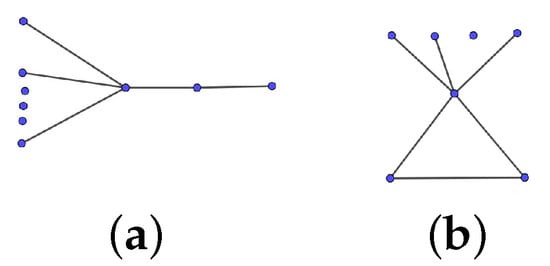
Figure 1.
Graphs and : (a) ; (b) .
Let G be a graph. For a positive integer k, denotes the graph consisting of k copies of G. The square of of G is the graph with , in which two vertices u and v are adjacent if and only if , where denotes the distance of u and v in G. The degree of a vertex v is denoted by . The maximum and the minimum degree of G are denoted by and , respectively. A vertex subset S of a graph G is a clique if is a complete graph. The clique number of G, denoted by , is the maximum cardinality of a clique in G. A vertex subset S of a graph G is an independent set if is an empty graph. The independence number of G, denoted by , is the maximum cardinality of an independent set of G. An edge set M of G is called a matching if no two elements of M are adjacent in G. The matching number of G, denoted by , is the maximum cardinality of a matching of G. Bagga, Beineke, and Varma [19] determined the independence number of .
Theorem 1.
(Bagga, Beineke, and Varma [19]). If G is a graph of size at least r, then . Furthermore, if S is a maximum independent set of vertices in , then either
(1) for some maximum matching of G, where with , or
(2) S consists of disjoint stars , or
(3) and the vertices in S are or .
The line completion number of a graph G is the least index r for which is complete. This notion was investigated in [22,23,24,25,26]. For a graph G without an isolated vertex, means that is complete. It is clear that if and G contains a triangle, and otherwise. In addition, is complete if and only if G is a star or a triangle. Bagga, Beineke, and Varma [14] characterized all graphs with , as we see in the next section.
In this paper, we give an explicit characterization for all graphs G with being a complete graph. We present lower bounds for the clique number and chromatic number of for several classes of graphs. In addition, bounds for the domination number of are established in terms of the domination number of the line graph of a graph G. A number of related problems on are proposed for further study.
2. Clique
For convenience, means that H is a subgraph of G. More specifically, present the meaning that H is a proper subgraph of G. We start with an easy observation.
Lemma 1.
If , then is an induced subgraph of .
Theorem 2.
(Bagga, Beineke, and Varma [14]). For a graph G, is complete if and only if G does not contain or as a subgraph.
Next we give an explicit characterization for graphs whose super line graphs of index 2 are complete.
Theorem 3.
For a graph G of order n and size , is complete if and only if or G is a subgraph of for some n.
Proof.
As both and have six vertices, does not contain or as a subgraph, and so neither does a subgraph of . The same conclusion holds for for any n. By Lemma 1 and Theorem 2, is complete.
To prove the ’only if’ part, let G be a graph of order and size with no isolated vertex such that is complete. In view of Lemma 1, we may further assume that m is as large as possible, subject to the aforementioned property. It remains to show that .
Claim 1.
G is connected.
Proof.
Suppose G is disconnected. Since is a complete graph, by Theorem 2, , . It follows that G has exactly two components, one of which is isomorphic to and the other one is . Thus . However, this contradicts the assumption that m is as large as possible. □
Next we show that . First of all, . Otherwise, . Since , , a contradiction. Let v be a vertex of the maximum degree in G.
Claim 2.
.
Proof.
Suppose that there exist two vertices u and w that are not adjacent to v. If , then one can find a subgraph isomorphic to , contradicting our assumption. If , then there exists a subgraph isomorphic to with the edge set of form . □
Claim 3.
.
Proof.
By Claim 2, suppose that , and let u be the unique vertex of G, which is not adjacent to v. Since , ; otherwise, one can find a subgraph of G isomorphic to . In addition, if any two neighbors of v are adjacent in G, either or occurs. Thus, , a contradiction. □
Claim 4.
.
Proof.
By Claim 3, . Since is complete and by the maximality of m, . If , then by , either or occurs. This proves .
The proof is completed. □
Theorem 4.
For any integer , .
Proof.
Label the vertices of as . Let . Clearly, .
Claim 5.
is a clique in.
Proof.
Consider any two elements and , where , and . It is enough to show that they are adjacent in . If , then the edges and are adjacent in G, implying that and are adjacent in . If , then , implying that the edges and are adjacent in G, implying that and are adjacent in . □
Let . One can see that .
Claim 6.
is a clique in.
Proof.
Observe that both and are cliques of . Moreover, and are adjacent in for any and . It follows that is a clique in . □
Let . It is easy to see that is a clique in with . Note that , and are pairwise disjoint and . Thus, the assertion of the theorem follows from the following claim.
Claim 7.
is a clique in.
Proof.
Take three vertices , , and arbitrarily, where for , for or for some , and for some .
First of all, w must be adjacent to u and v, because at least one of and is adjacent to , 12 and in .
It remains to show u and v are adjacent. Assume that for . If , then u and v are adjacent because and 12 are adjacent in G. If , then u and v are still adjacent because and are adjacent in G. Now we assume that for some . One can show that u and v are adjacent by considering the cases when and .
The proof is completed. □
At present, we did not know the exact value of for general n.
3. Chromatic Number
A mapping is a k-coloring of G if for any edge , where k is a positive integer. The chromatic number of G, denoted by , is the minimum integer k for which G has a k-coloring. Obviously, for any graph G. The well-known theorem of Vizing says that for a simple graph G. However, it is hard to determine and for a general graph G.
Theorem 5.
For a graph G of order n and size m without an isolated vertex,
with equality if and only if either or .
Proof.
Assume that G is a graph of order n and size m without an isolated vertex. Since the order of a graph is the trivial upper bound for its chromatic number and the order of is , the result follows trivially.
If or , then by Theorem 3, is complete. Thus . For the converse, assume that . It follows that is complete. Again, by Theorem 3, or , completing the proof. □
Corollary 1.
For a tree T of order n, with equality if and only if or .
Proof.
It is immediate from Theorem 5. □
Corollary 2.
For a unicyclic graph G of order n, , with equality if and only if either or .
Proof.
Since G is a unicyclic graph G of order n, , where m is the size of G. By Theorem 5, the result follows. □
All unicyclic graphs of order 5 are given in Figure 2.
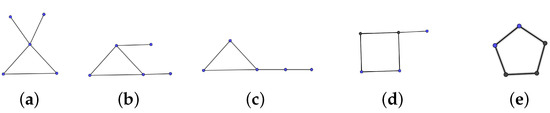
Figure 2.
All unicyclic graphs of order 5, in which (a), (b) and (c) have the cycle length three, and (d) and (e) have the cycle length four and five, respectively.
Theorem 6.
For an odd integer ,
Proof.

First, label the edges of as successively, as shown in Figure 3a. Since is even, the edges of can be divided into two maximum edge independent sets and . Let , let for an integer . Furthermore, let both i and j are odd number between 1 and }, both i and j are even between 2 and }, and . A simple computation shows that . Observe that all for each i, B and C are independent sets in , and the vertices in D can be properly colored in three additional colors. Thus
□
Figure 3.
The labeling of edges of and : (a) ; (b) the subgraph induced by D.
By Theorem 5, , and thus . However, the bound in the above theorem can be attained by the following example.
Proposition 1.
Proof.
By the above theorem, . To show , label the edges of as successively, as illustrated in Figure 3. Let . . Let . Since v is adjacent to all vertices of A in , . Suppose and let c be a 7-coloring of . We consider the two adjacent vertices and of . One can check that is adjacent to all elements of except . In addition, is adjacent to all elements of A except as well. It implies that , contradicting that . Thus . This proves . □
Theorem 7.
For an even integer ,
Proof.
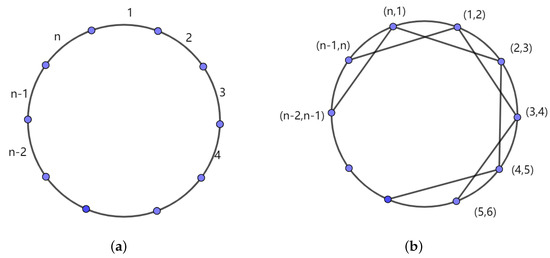
First, label the edges of as successively in the clockwise order, as shown in Figure 4a. Since n is even, the edges of can be divided into two maximum matchings and . By a similar way as in the proof of the previous theorem, let , let for an integer . Furthermore, let both i and j are odd number between 1 and }, both i and j are even between 2 and n}, and . A simple computation shows that . Observe that all for each i, B and C are independent sets in . In addition, , where is as shown in Figure 4b. One can see that
Figure 4.
The labeling of edges of and : (a) ; (b) subgraph of induced by D.
Thus, combining above facts, we conclude that
□
4. Domination
For a graph G, a subset is called a dominating set if each vertex of is adjacent to some element of S in G. The domination number of G, denoted by , is the minimum cardinality of a dominating set of G. A subset is called a total dominating set of G if each vertex of G is adjacent to some element of S in G. The total domination number of G, denoted by , is the minimum cardinality of a total dominating set of G. Obviously, for for any graph G without an isolated vertex. Note that for any connected graph G.
Theorem 8.
For a connected graph G of order ,
Proof.
First we show that . Let be a minimum dominating set of . For each , we take an edge of G, say , adjacent to . It suffices to show that is a total dominating set of . Consider a pair of edges. If for each i, then by e must be adjacent to some . It follows that is adjacent to in . If for some j, then by e is adjacent to . Thus and are adjacent in . This proves .
Let be a minimum dominating set of . If is a dominating set of , then , and hence
Now assume that is not a dominating set of . We choose a vertex, say e, which is not dominated by in . We claim that e is the unique vertex of with the aforementioned property. Let be a vertex not dominated by in . Since is dominated by , one of e and f must be adjacent to some element of in . This contradiction proves the claim. Thus is a dominating set of . It follows that , and thus
completing the proof. □
5. Discussion
Previously, the Hamiltonian property, line completion number of super line graphs was investigated. In this paper, we study several kind of parameters of , such as clique number, chromatic number, and domination number. We do not know the exact value of yet. However, it is hard to decide these parameters of a general graph G, even though G is a complete graph, a cycle, or a path. Therefore, we provide some bounds for these parameters.
Since for any graph G of order n, . The following problem is worth being investigated.
Problem 1.
In view of Theorems 3.4 and 3.6, it is natural to seek the exact values for and .
Problem 2.
Problem 3.
The following conjectures seem to be true.
Conjecture 1.
For any tree T of order n,.
Conjecture 2.
For a unicyclic graph G of order n,.
A more basic problem on is stated as follows.
Problem 4.
For a connected graph G of order n and size m, what are the exact bounds for the size of ?
Author Contributions
Conceptualization, B.W.; Methodology, H.M.; Validation, J.M., B.W. and H.M.; Investigation, J.M., B.W. and H.M.; Writing—original draft, J.M.; Writing—review & editing, B.W.; Project administration, B.W. All authors have read and agreed to the published version of the manuscript.
Funding
The work was supported by NSFC (No. 12061073).
Institutional Review Board Statement
Not applicable.
Informed Consent Statement
Data is contained within the article.
Data Availability Statement
This manuscript has no associated data.
Conflicts of Interest
The authors declare no conflict of interest.
References
- Hemminger, R.L.; Beineke, L.W. Line graphs and Line digraphs. In Selected Topices in Graph Theory; Beineke, L.W., Wilson, R.J., Eds.; Academic Press: London, UK; New York, NY, USA, 1978; pp. 271–306. [Google Scholar]
- Broersma, H.J.; Hoede, C. Path graphs. J. Graph Theory 1989, 13, 427–444. [Google Scholar] [CrossRef]
- Prisner, E. A common generalization of line graphs and clique graphs. J. Graph Theory 1994, 18, 301–313. [Google Scholar] [CrossRef]
- Prisner, E. Graph Dynamics; Pitman Research Notes in Mathematics Series, 338; Longman Harlow: Harlow, UK, 1995. [Google Scholar]
- Prisner, E. Line graphs and generalizations–A survey, Surveys in graph theory (San Francisco, CA, 1995). Congr. Numer. 1996, 116, 193–229. [Google Scholar]
- Chen, X. General sum-connectivity index of a graph and its line graph. Appl. Math. Comput. 2023, 443, 127229. [Google Scholar] [CrossRef]
- Wang, T.; Wu, B.; Wang, T. Harmonic index of a line graph. Discrete Appl. Math. 2023, 325, 284–296. [Google Scholar] [CrossRef]
- Cohen, N.; Dimitrov, D.; Krakovski, R.; Škrekovski, R.; Vukašinović, V. On Wiener index of graphs and their line graphs. MATCH Commun. Math. Comput. Chem. 2010, 64, 683–698. [Google Scholar]
- Wu, B. Wiener index of line grpahs. MATCH Commun. Math. Comput. Chem. 2010, 64, 699–706. [Google Scholar]
- Bagga, J. Old and new generalizations of line graphs. Int. J. Math. Math. Sci. 2004, 29, 1509–1521. [Google Scholar] [CrossRef]
- Bagga, J.; Beineke, L. New results and open problems in line graphs. AKCE Int. J. Graphs Comb. 2022, 19, 182–190. [Google Scholar] [CrossRef]
- Beineke, L.W.; Bagga, J.S. Fundamentals of line graphs. In Line Graphs and Line Digraphs; Springer: Berlin/Heidelberg, Germany, 2021; pp. 3–15. [Google Scholar]
- Bagga, K.S.; Beineke, L.W.; Varma, B.N. Super line graphs. Graph Theory Comb. Appl. 1995, 1, 35–46. [Google Scholar] [CrossRef]
- Bagga, J.; Beineke, L.W.; Varma, B.N. The super line graph . Discret. Math. 1999, 206, 51–61. [Google Scholar] [CrossRef]
- Li, X.; Li, H.; Zhang, H. Path-comprehensive and vertex-pancyclic properties of super line graph . Discret. Math. 2008, 308, 6308–6315. [Google Scholar] [CrossRef]
- Bagga, J.; Ellis, R.B.; Ferrero, D. The spectra of super line multigraphs. Adv. Discret. Math. Appl. 2008, 13, 81–89. [Google Scholar]
- Bagga, J.; Ferrero, D.; Ellis, R. The structure of super line graphs. In Proceedings of the 8th International Symposium on Parallel Architectures, Algorithms and Networks (ISPAN’05), Las Vegas, NV, USA, 7–9 December 2005; p. 4. [Google Scholar]
- Bagga, J.; Vasquez, M.R. The super line graph for hypercubes. Cong. Numer. 1993, 93, 111–113. [Google Scholar]
- Bagga, J.S.; Beineke, L.W.; Varma, B.N. Independence and cycles in super line graphs. Australas. J. Comb. 1999, 19, 171–178. [Google Scholar]
- Bagga, K.S.; Beineke, L.W.; Varma, B.N. Super line graphs and their properties. In Combinatorics, Graph Theory, Algorithms and Applications (Beijing, 1993); World Sci. Publishing: River Edge, NJ, USA, 1994; pp. 1–6. [Google Scholar]
- Beineke, L.W.; Bagga, J.S. Super line graphs and super line digraphs. In Line Graphs and Line Digraphs; Springer: Berlin/Heidelberg, Germany, 2021; pp. 233–256. [Google Scholar]
- Bagga, K.S.; Beineke, L.; Varma, B. The line completion number of a graph. Graph Theory Comb. Appl. 1995, 2, 1197–1201. [Google Scholar]
- Bagga, J.; Beineke, L.; Varma, B. A number theoretic problem on super line graphs. AKCE Int. J. Graphs Comb. 2016, 13, 177–190. [Google Scholar] [CrossRef][Green Version]
- Gutierrez, A.; Llado, A.S. On the edge-residual number and the line completion number of a graph. Ars Comb. 2002, 63, 65–74. [Google Scholar]
- Kureethara, J.V.; Sebastian, M. Line completion number of grid graph Pn × Pm. Commun. Comb. Optim. 2021, 6, 299–313. [Google Scholar]
- Tapadia, S.; Waphare, B. The line completion number of hypercubes. AKCE Int. J. Graphs Comb. 2019, 16, 78–82. [Google Scholar] [CrossRef]
Disclaimer/Publisher’s Note: The statements, opinions and data contained in all publications are solely those of the individual author(s) and contributor(s) and not of MDPI and/or the editor(s). MDPI and/or the editor(s) disclaim responsibility for any injury to people or property resulting from any ideas, methods, instructions or products referred to in the content. |
© 2023 by the authors. Licensee MDPI, Basel, Switzerland. This article is an open access article distributed under the terms and conditions of the Creative Commons Attribution (CC BY) license (https://creativecommons.org/licenses/by/4.0/).