1. Introduction
In recent years, a plethora of fuzzy implication functions have been proposed in the literature [
1,
2,
3,
4]. These functions have been investigated from a more theoretical point of view [
2,
5,
6] to the one involving practical applications [
7,
8,
9]. They can be used in various fields such as approximate reasoning [
10,
11,
12,
13], decision making [
14], image processing [
15], and fuzzy mathematical morphology [
16].
The first impact of fuzzy implications functions was the formalization of the “if… then…” rules in the fuzzy inference process used, for example, in fuzzy rule-based systems. Roughly speaking, it allows one to deduce a possible imprecise conclusion from a collection of imprecise premises. Therefore the implication operator is taken as a fuzzy relation, known as the generalized modus ponens/tollens [
17,
18,
19]. For instance, in classification problems, the following schema may be applied in the fuzzy inference process, taking
as being fuzzy concepts:
Premise: A belongs to class P;
Relation 1: A and B are close;
Relation 2: B is slightly smaller than A;
Conclusion: B belongs to class P.
There are many strategies to define fuzzy implication functions that either combine logical connectives (for instance, (S,N), R or QL-implications), or use univariate functions, such as Yager’s
f and
g-generated implications [
13].
The class of implication functions constructed from a t-norm
T and a fuzzy negation
N was revisited by Pinheiro et al. [
20] where the focus was on their properties and also the definition of fuzzy subsethood measures using the fuzzy implication functions called (T,N)-implications.
Most studies on fuzzy implication functions use t-norms and t-conorms [
21,
22]. However, different operators have been applied to construct implication-like functions, notably, uninorms or semi-uninorms [
23,
24,
25], pseudo-t-norms [
26,
27], (dual) copulas, quasi- (semi-) copulas [
28,
29,
30,
31]. We also highlight the ones given from weaker operators such as overlap and grouping functions which are non-necessarily associative aggregation operators [
32,
33,
34,
35] and their interval-valued extensions. Notice that, in contrast with the work by Pinheiro et al. [
20] mentioned above, Dimuro et al. [
33] developed the more flexible concept of
-operations and fuzzy implications functions derived from overlap and grouping functions, with the applications to the construction of fuzzy subsethood and entropy measures.
Note that, in classical logic, one can define the implication connective in distinct ways, meaning that if the truth tables are equal, then the operators are equivalent [
36]. However, when one generalizes those equivalences to the unit interval
, different classes of fuzzy implication functions are obtained. For example, when we generalize the ∨ operator and replace it by the grouping function
G, the ∧ operator by the overlap function
O and ¬ by a fuzzy negation
N, we can mention
-implication functions [
34], which generalize the material implication used in Kleene algebra that can be defined according to the tautology:
.
In [
32],
-implication functions were proposed using overlap functions inspired on the generalization of Boolean implications resulted as the residuum of the conjunction of Heyting algebra considered in the intuitionistic logic and defined according to the identity:
, where
X is a universe set and
. Moreover, the implication functions defined in the quantum logic framework, were also generalized [
33], using the following tautology:
, called QL-implication functions. Finally, we have
D-implication functions [
35] (also known as Dishkant implication), derived from the following generalization:
.
Therefore, following the natural sequence of the investigation on fuzzy implication functions constructed from overlap and grouping functions, the tautology still can be used to defined a new class. Despite being generalized by t-norms, and called -implication functions, it seems that applying a more general and flexible context may be feasible when using general overlap functions instead of the standard overlap functions.
The aim of this paper is to provide a theoretical study on a new family of fuzzy implications entitled -implications, where is the set of general overlap functions and N is a fuzzy negation. The objectives are threefold: (i) the study of the main properties satisfied by this new class, (ii) -implication characterization, and (iii) analysis of the intersections between -implications and other families of implications defined via overlap and grouping functions.
The remaining sections of the paper is structured as follows.
Section 2 recalls some definitions and important concepts used in our work. The major contributions related to the new class of
-implication functions and the intersections between other classes are seen in
Section 3 and
Section 4. At last, we discuss the final remarks and future works in
Section 5.
3. -Implications
A class of fuzzy implication functions entitled
-implications was investigated in [
20]. They were derived from the composition of a fuzzy negation and a t-norm, and many relevant properties were discussed. In the current study, a similar class of implication functions is investigated. However, we substitute the t-norm by a bivariate GOF. Thus, we provide a new class of implication function called
-implications, defined as follows.
Definition 13. A function is said to be a -implication if there exists a bivariate general overlap function and a fuzzy negation such that, for all If N is strict, then I is called strict -implication. Analogously, if N is strong, I is called strong -implication. Remark 6. The above definition agrees with the result given by Theorem 4.3 [50], which states that a function is an implication function if and only if A is a conjunctor. This result is dual to Theorem 33 [11]. From now on, whenever I is a -implication function generated from and N, it will be denoted by .
Example 1. We can construct some examples of .
- (i)
Consider the GOF: and the standard fuzzy negation , then we have that: - (ii)
Take the GOF: , for and , so: - (iii)
Consider the general overlap function and the crisp fuzzy negation , then we have that: - (iv)
Take the GOF , for and the crisp fuzzy negation , so:
Proposition 7. If I is a -implication function then .
Proof. Indeed, let I be a -implication function generated by a general overlap function and a fuzzy negation N, then
(I1) Given such that , by (4), for all , it holds that . So, , that is, .
(I2) Analogous to (I1).
(I3) For all , .
(I4) For all , .
(I5) .
Therefore, is a fuzzy implication function. □
The next result presents the conditions under which the class of (T,N)-implication functions is different from he class of -implication functions.
Proposition 8. Let N be a strict fuzzy negation and be a GOF. If has no neutral element, then for any t-norm T.
Proof. By hypothesis,
has no neutral element, so there is
such that
. Since
N is strict, given
, there is
such that
. So,
On the other hand, for any t-norm
T, we have
. Therefore,
. □
Corollary 1. Let N be a strict fuzzy negation and and be general overlap functions. If has no neutral element, then .
Example 2. Consider the GOF and the strict fuzzy negation respectively defined by and . So, one has that:Observe that and for any t-norm T, we have that . Therefore, for all , . Observe that it is possible to recover the bivariate general overlap function from any -implication function which was constructed from such GOF and a strict fuzzy negation, as shown in the following proposition.
Proposition 9. Let be a bivariate GOF and N be a fuzzy negation. If N is strict, then, for all , Proof. Straightforward. □
Corollary 2. Let be a bivariate GOF and N be a fuzzy negation. If N is strong, then , for all .
Proposition 10. Let and N be a GOF and a fuzzy negation, respectively. Then,
- (i)
If 1 is the neutral element of , then ;
- (ii)
If N is strict and , then 1 is the neutral element of .
Proof. Indeed
- (i)
For all , one has that .
- (ii)
Since N is strict and , for all , we have: . □
Note that the converse of Proposition 10(i) is not always valid. There are non-strict negations N that satisfy , but has no neutral element. See the following example:
Example 3. Take the fuzzy negation given byand consider a bivariate general overlap function that satisfies (3a). Then, for all , one has that: However, does not necessarily have a neutral element.
Proposition 11. Let be a bivariate GOF and N be a fuzzy negation such that , for all . Then:
- (i)
If , then ;
- (ii)
If N is strict and , then .
- (i)
By hypothesis, take
. Then, applying
N on both sides,
. On the other hand,
for all
. So, it follows that
, and, therefore,
.
- (ii)
Since
, for all
, so, in particular,
, for all
. Moreover,
. Hence, by hypothesis,
for all
. So,
, since
N is strict. Therefore, for all
,
.
□
Proposition 12. Let be a -implication function. Then:
- (i)
satisfies L-CP(N);
- (ii)
If N is a strict negation, then satisfies R-CP(N−1);
- (iii)
If satisfies R-CP(N) with a strict negation N and 1 is the neutral element of , then N is a strong negation;
- (iv)
If N is a strong negation, then satisfies CP(N);
- (v)
If satisfies CP(N) with a strict negation N and 1 is the neutral element of , then N is a strong negation.
Proof. (i) For all , it holds that: .
(ii) For all , one has that .
(iii) Since satisfies , then . Hence, since N is a strict negation, for all , i.e., for all . So, since 1 is the neutral element of , , for all .
(iv) For all , since N is strong: .
(v) Since satisfies CP(N) and N is a strict negation, then , i.e., . So, since 1 is the neutral element of , , for all . □
Example 4. Consider a bivariate general overlap function with 1 being its neutral element, and the fuzzy negation given by Equation (9). Then, for and for all , one has that: Now, for and for all : However, N does not need to necessarily be a strong fuzzy negation to satisfies the CP(N) property.
Proposition 13. Let be a -implication. If N is a strong negation, then
- (i)
satisfies (NP) if and only if 1 is the neutral element of .
- (ii)
satisfies (EP) if and only if is associative.
Proof. Indeed,
(i) Consider , for all . Then, since N is strong, for all , .
So, one has that , for all . Conversely, since 1 is neutral element of , then for all , we have that .
(ii) Consider that
satisfies (EP). Then, for all
, since
N is a strong negation,
and so,
, for all
. Therefore,
is associative.
Conversely,
, since
N is strong and
is associative, then
Therefore, satisfies (EP). □
Proposition 14. Let be a -implication. If N is a strict negation, so if and only if is associative.
Proof. Indeed, consider that
. Then, for all
,
So,
, for all
, since
N is a strict negation. Therefore,
is associative. Conversely,
, since
is associative, then
So, for all , since N is continuous, there is such that . Thus , for all . □
Proposition 15. Let be a bivariate GOF satisfying (2a), and be a -implication. If N is a frontier fuzzy negation, then satisfies (EP1).
Proof. Suppose that , for all . This means that . In this case, since N is a frontier negation, then: .
By (2a), either or . Then, one has the following cases:
(1) For , it follows: .
(2) For , since N is a frontier negation, so . So, by (2a), or . If , then . On the other hand, if , then .
Thus, in any case, it holds that . □
Proposition 16. Let be a -implication with a strict fuzzy negation N.
- (i)
If satisfies (IB) and has 1 as neutral element, then N is strong and is idempotent.
- (ii)
If N is strong and is idempotent and associative, then satisfies (IB) and has 1 as neutral element.
Proof. Indeed,
(i) Since satisfies (IB), we have for , , . So, . Therefore, , for all , since 1 is neutral element of . However, N being a strict negation, then , for all and, then, N is strong. Moreover, since , we have that , since N is strong. So, . In particular, for , , for all , since 1 is the neutral element of . Therefore, the general overlap function is idempotent.
(ii) For all
,
So, satisfies (IB). In case , since N is strong, . So, for all , . Since is continuous and increasing, for all , there is such that . Thus, for all , . Therefore, 1 is a neutral element of □
Corollary 3. Let be a -implication with a strict fuzzy negation N. If satisfies (IB) and 1 is the neutral element of the bivariate general overlap function , then is the minimum t-norm.
Proof. Straightforward from Propositions 16 and 5. □
Remark 7. Observe that, trivially, is crisp if and only if N is crisp. In fact, for each , if 1 is a neutral element of then and .
Proposition 17. Let be a crisp -implication, and let 1 be a neutral element of , then:
- (i)
satisfies (EP) but it does not satisfy (NP);
- (ii)
satisfies (LOP) but it does not satisfy (ROP);
- (iii)
satisfies (IP);
- (iv)
satisfies (IB);
- (v)
satisfies (CP) with respect to N;
- (vi)
satisfies (R-CP) with respect to N.
- (i)
Straightforward from Proposition 6 [
49], considering Remark 7.
- (ii)
Since N is crisp and 1 is a neutral element of , it follows that:
- (LOP)
For all such that , two situations are possible:
- (1)
If there exists
such that
, so, by Remark 7 and
(C4), we have that
. Therefore,
For , as , it holds that . Hence one concludes that . For , it is immediate that .
- (2)
If there exists
such that
, so, by Remark 7 and
(C3), we have
. Thus,
For , as , it holds that . So one concludes that .
For , it is immediate that .
Therefore, it holds that satisfies .
- (ROP)
We also consider two situations:
- (1)
If
, for some
, then take
such that
. Consequently, by Equation (
10),
.
- (2)
If
, for some
, then take
such that
. Thus, by Equation (
11),
.
In both situations, there exists , but . So does not satisfy .
- (iii)
Given , since N is crisp, either or . If , then . On the other hand, if , then , since 1 is the neutral element of .
- (iv)
Given , as N is crisp, either or .
- (1)
Take
, and for all
,
and
.
- (2)
Now,
, and
, since 1 is the neutral element of
,
and
. So, if
, then
and
. Now, if
, then, by
,
and
. Therefore, in any case,
.
- (v)
Given , as N is crisp, either or .
- (1)
For , then , and therefore , for all .
- (2)
For
, since 1 is the neutral element of
,
and, we also have that
for all
. Since
N is crisp,
for all
. Therefore,
.
- (vi)
Given , as N is crisp, either or .
- (1)
For
, since 1 is the neutral element of
, for all
,
and
. If
, consequently,
. Moreover, if
then,
.
- (2)
For , since 1 is the neutral element of , . Moreover, , for all . So, if , then . However, if , then, by , we have that . So, in any case, .□
Aggregating -Implications
In [
12], the authors performed a study on
fuzzy implications obtained by the composition of an aggregation function
A and a family
of fuzzy implication functions. Here we verify under which conditions an
-operator is a
-implication, whenever
is a family of
-implication functions.
Definition 14 (Definition 5.1 [
12])
. Let be an aggregation function and take as a family of k-ary functions. An -operator on , denoted by , is given by: In [
12], it has been shown that
preserves some properties of
for
. For example, if
are fuzzy implication functions then
is also a fuzzy implication function.
Proposition 18. Let be a continuous aggregation function and let be a family of -implication functions. Then, is a -implication whenever for and N is a strong negation.
Proof. Consider the family of
-implication functions represented by
. Then, since
and
N is a strong negation, for all
,
By Proposition 1, is an aggregation function. Furthermore, by the continuity of A and N, we have that is continuous. So, by Lemma 1, is a general overlap function. Therefore, since , then is a -implication function. □
Corollary 4. Let be a continuous aggregation function and let , for , be a family of -implication functions. If N is a strong negation, then for with for , it holds that:
- (i)
satisfies L-CP(N);
- (ii)
If N is also strict, then satisfies R-CP(N−1);
- (iii)
satisfies CP(N).
Proof. Straightforward from Propositions 12 and 18. □
4. Intersections between Families of Fuzzy Implications
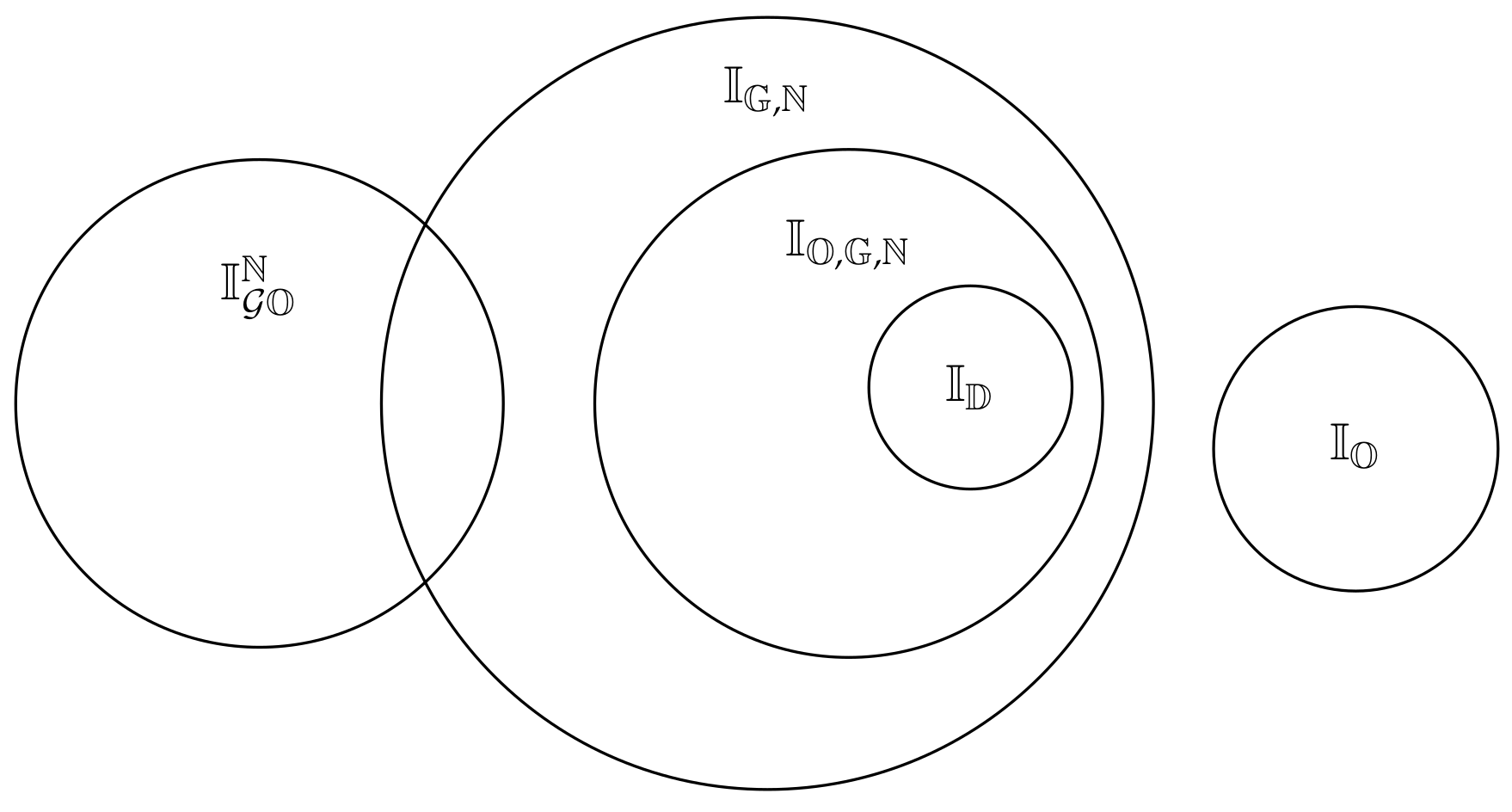
In this section we present results regarding the intersections that exist among the families of fuzzy implications , , , and D-implications derived from (general) overlap and grouping functions O and G, respectively, and fuzzy negations N. We will represent these families by , and , respectively.
4.1. Intersections between and -Implications
Proposition 19. Let N and be fuzzy negations, be a bivariate general overlap function and G be a grouping function such that .
- (i)
If N is strict and is frontier, then is an overlap function.
- (ii)
If 1 is the neutral element of , then:
- (a)
If N is a strong negation, then ;
- (b)
If N is continuous and , then N is strong;
- (c)
N is strong if and only if 0 is the neutral element of G.
- (iii)
If 0 is the neutral element of G, then:
- (a)
is strong if and only if ;
- (b)
is strong if and only if 1 is the neutral element of .
Proof. - (i)
Indeed, if
, then
Moreover, if
, then
Consequently, satisfies (O2) and (O3) and we conclude that is an overlap function.
- (ii)
Indeed,
- (a)
by Prop. 3.4(xxi) [
34] we have that
satisfies R-CP(N′), so
for all
. Therefore,
.
- (b)
Since
satisfies R-CP(N′) and
,
. So, for
,
, i.e.,
Since 1 is the neutral element of and , for all , . Now, since N is continuous, for every , there is such that . So, , for all .
- (c)
For all , . So the result holds.
- (iii)
Indeed,
- (a)
by Prop. 3.4(ii) [
34] we have that
satisfies (NP), so
for all
. Therefore, the result follows.
- (b)
Consider as a strong negation, then by the previous item, . So, , for all . Therefore, 1 is the neutral element of . Conversely, , and therefore, by sub-item (a) of item (ii), is a strong negation. □
The next propositions show that strict -implication functions generated by general overlap functions satisfying (2a) and (3a) are strict -implication functions and vice-versa.
Proposition 20. Let N be a strict fuzzy negation, be a GOF satisfying (2a) and (3a), and let G be the grouping function defined according to Equation (4). Then, one has that . Proof. For all
, since
N is strict, it follows:
□
Proposition 21. Let N be a strict negation, G be a grouping function and be the general overlap function defined in Equation (3). Then, . Proof. For all
, since
N is strict, it follows that:
□
Corollary 5. Let I be a fuzzy implication function. Then, I is a strict -implication with satisfying conditions (2a) and (3a) if and only if I is a strict -implication.
Proof. Straightforward from Propositions 20 and 21. □
By Corollary 5 we have that the intersection of and -implications is non-empty: . In addition, we also conclude that , where is the family of all strict -implication functions and, analogously, is the family of all strict -implication functions.
Next, we provide an example presenting an implication function belonging to both classes and -implications.
Example 5. Take the strict fuzzy negation N, defined by and consider the grouping function G given by . Then, for all , . Now, consider the general overlap fuction (Equation (3)). Note that and satisfies (2a) and (3a). So since , we have that: Therefore, is a -implication and a -implication.
Proposition 22. Let such that . If I is a -implication function then I is not a -implication function.
Proof. Suppose that I is a -implication function. Then, there is a grouping G and a fuzzy negation N such that for each . However, since G is continuous and , , then for any there exists such that . Therefore, . □
Corollary 6. Each crisp -implication function is not a -implication function.
Let . Proposition 22 proves that . Thus, there are -implication functions that are not -implication functions and therefore, the class of -implication functions is not contained in the class of -implication functions.
Note that the converse also holds as shown in the next proposition.
Proposition 23. There are -implication functions that are not -implication functions.
Proof. Take the
-implication function
, where
and
. Thus,
Suppose there exists a GOF
and a fuzzy negation
N such that
Thus, for
,
, for all
,
Furthermore, for
,
, for all
. So, in particular, for
, since
is commutative,
for all
. Now, given
, we have either
or
. If
then, by Equation
and
, it follows
, which is a contradiction, since
. Furthermore, if
, then
which is a contradiction, since
. In both cases we have a contradiction, so
is not a
- implication function. □
The last two results ensure that and .
4.2. Intersections between and -Implication Functions
A tuple
, with
O being an overlap function,
G being a grouping function and
N being a fuzzy negation, known as a
-operator [
33] is in fact an implication function if and only if
. Then, we conclude that:
Proposition 24. There are no fuzzy implication functions that are simultaneously implication functions and -implication functions.
Proof. Indeed, by Proposition 12(i), any
-implication function
satisfies L-CP(N). Moreover by Theorem 3.1(v) [
33], any
-implication
does not satisfy (L-CP) for any negation
N. □
Corollary 7. There is no fuzzy implication function which is simultaneously a -implication function and a strict -implication function.
Proof. Straightforward from Corollary 5 and Proposition 24. □
Therefore, one can conclude that the intersection of
-implication functions and
-implication functions is empty, i.e.,
. As a consequence, the intersection of
-implication functions and
-implication functions with
N being a strict negation, is also empty:
. In Theorem 5.1 [
33], it is seen that
-implication functions are included in the class of
-implications. Example 6 illustrates that.
Example 6. Consider the overlap function , the grouping function and the fuzzy negation given by Equation (9). Then, for all , one has that: Therefore, .
4.3. Intersections between and -implication Functions
Proposition 25. There are no fuzzy implication functions that are simultaneously -implication functions and -implication functions.
Proof. Indeed, by Proposition 12(i), any
-implication
satisfies L-CP(N), however by Theorem 4.2 [
32], it is guaranteed that every
-implication,
, does not satisfy (L-CP) for any negation
N. □
Therefore, one can conclude that -implication functions and the family of -implication functions do not intercept, i.e., .
4.4. Intersections between and D-Implication Functions
From the results given in Theorem 4.1 [
35] we know that every
D-implication function is a
-operation considering the greatest fuzzy negation. Still, from Theorem 4.2 [
35] we know that every
D-implication is a
-implication considering the greatest fuzzy negation. Therefore, it is straightforward that there are no intersections between
implication functions and
D-implication or
-implication functions. Moreover, by Theorem 4.3 [
35] one can say that there is no intersection between
-implication functions and
D-implication functions.
In
Figure 1, we illustrate the main results presented in this section. Note that the intersections between the families of
,
,
and
D-implication functions had already been presented in other works [
32,
33,
34,
35].
5. Final Remarks
In propositional logics, one may consider the negation (¬) and other logical connectives such as the implication (→), the disjunction (∨) or the conjunction (∧) as being primitive. Other connectives can be defined in a standard form using only two primitive connectives [
36]. In particular, when the primitive connectives are the negation and the disjunction, the standard definition of the implication is given by (i)
and when the primitive connectives are the negation and the conjunction, the standard definition of the implication is given by (ii)
. The first one, in fuzzy logics, had motived the introduction of several classes of fuzzy implication functions, such as the
,
and
implications, where the disjunction is given, respectively, by a t-conorm
S, a grouping function
G or a disjunctive aggregation function
A (e.g., see [
11,
34,
51]). The second one, using conjunctive operators, allowed the definition of implication functions based on t-norms [
20]. In this work we introduced a class of implication function based on (ii), where the conjunction is given by generalized overlap functions.
The main contributions of this work are the investigation of properties satisfied by such implication functions, their characterization, and a study of the intersections between them and other classes of implication functions derived from (general) overlap/grouping functions. The summary of these intersections is illustrated in
Figure 1. Actually, we complete this study by also considering the class of
-implication functions, denoted by
, which is also based on the standard definition of the implication given by (ii), but using a t-norm instead of a general overlap function. Since each continuous t-norm is a general overlap function but the converse does not hold, then trivially we have that:
,
and
. In addition,
Table 2 shows some of the properties satisfied by the
-implication functions and
-implication functions whenever we take into account: any fuzzy negation
N, strong fuzzy negations (represented by
), non-strong fuzzy negations (represented by
) or crisp negations (represented by
). For each property, yes/no means that the property is/is not held for each implication of that class. Additional restrictions may appear as follows: no
st means the property is not valid if
N is strict, yes(no)
means the property is(not) valid when 1 is the neutral element of
, and yes
means the property holds when
is associative. Empty table cells mean that some implication functions of the class satisfy the property whereas others do not. We can notice that indeed
-implication functions are more general since more properties are verified.
Our future works include studying the use of
operators on other classes of implication functions and the construction of other classes of fuzzy subsethood measures like it was made in [
20,
33], which can be used to generate fuzzy entropies, similarity measures and penalty functions, and applied in many ways.





 ,
,